




 English (pdf)
 Article in xml format
 Article references

 Automatic translation
 Send this article by e-mail
 Cited by SciELO
 Similars in
SciELO
 uBio

 Permalink

Globally, participation in tourism and recreational activities within protected areas has seen a significant increase (Revollo-Fernández et al., 2024). This growth aligns with a broader global trend where tourism plays a crucial role in both conservation and economic development, particularly in countries with high biodiversity and extensive protected areas, which attract a significant number of visitors and generate substantial economic benefit (Balmford et al., 2015). While these activities provide substantial socioeconomic benefits, they also introduce negative externalities, such as the disruption of biophysical conditions, which can undermine in-situ conservation efforts (Vargas, 2009).
Within this context, recreational ecology-defined as the scientific study of the effects of outdoor recreation and tourism on natural and semi-natural environments-serves as a crucial framework for understanding and managing these impacts (Hammitt & Cole, 1998). This field assesses ecological changes associated with visitor activities, accounting for various factors that can either exacerbate or alleviate such impacts (Leung et al., 2008). In recent decades, research in recreational ecology has expanded significantly, with studies focusing on key challenges such as visitor carrying capacity, habitat degradation, and species behavioral changes in high-traffic areas (Marion et al., 2016). By offering insights into the ecological consequences of increased tourism, recreational ecology supports the development of management strategies aimed at minimizing potential ecological damage and enhancing the sustainability of conservation efforts (Monz et al., 2013).
In Costa Rica, ecotourism is a cornerstone of the national economy (Krüger, 2005; Weaver, 1999). The country’s protected areas have become increasingly popular among diverse tourist groups, leading to a notable rise in visitation (ICT, 2024). However, despite this growth, the field of recreational ecology has received limited attention, resulting in critical gaps in our understanding of the ecological impacts of tourism in Costa Rica’s protected areas and the necessary management responses.
This study aims to address these gaps by examining the specific themes and categories within recreational ecology that have been explored in Costa Rica’s context. It provides a systematic review of scientific literature that identifies the negative implications of tourism while also highlighting research gaps and emerging trends structured perspective aligns with the principles of recreational ecology and offers guidance for future research and the development of sustainable management practices in this field.
Materials and methods
This study employs a quantitative approach through a systematic literature review to uncover the negative ecological impacts of tourism in protected areas (Pickering & Byrne, 2014). Between January and May 2024, we reviewed studies in both Spanish and English, focused on experimental ecological impacts within Costa Rica. The inclusion criteria included peer-reviewed articles, experimental methodologies, and publications addressing the effects of tourism.
We searched databases such as Web of Science, Scopus, ScienceDirect, and Google Scholar using keywords in both languages. From an initial set of 39 documents, 14 met the inclusion criteria. We categorized the studies by publication year, site, ecological components, objectives, methodologies, impact findings, and management implications. To ensure quality, we evaluated the articles based on their experimental methods. This approach provides a detailed perspective on the effects of tourism and supports the development of sustainable management strategies.
Results
The reviewed publications span from 1990 to 2024. Most of the fieldwork was conducted in 1987 and 1998, and each year produced two papers. The peak year for publications was 2014 (n=3), while the decade from 2010 to 2020 recorded the highest output, with a total of five works. On average, there was a 4,47-year lag (SD = 4,10) between fieldwork and publication. Research primarily addressed topics in primatology, tropical biology, conservation, ecotourism, and management. Among the 45 researchers involved in work conducted in Costa Rica, 71,11% were foreign, and 14 articles appeared in English. Gender representation among authors was nearly balanced, with 46,67% male and 53,33% female. Research locations varied, with Manuel Antonio National Park leading in research activity (n=5), followed by Tortuguero National Park (n=3).
The studies focused on three primary ecological components: soil and vegetation, wildlife, and air. Investigations into soil and vegetation explored issues such as erosion, trail conditions, and the effects of trampling. Wildlife, representing the majority (73,33%) of the work, predominantly analyzed the behavior of species such as the White-faced Monkey (Cebus imitator), and the Howler Monkey (Alouatta palliata (n=7), alongside raccoons (Procyon lotor and Procyon cancrivorus), water anoles (Anolis aquaticus), and tropical spotted dolphins (Stenella attenuate). Additionally, one study examined CO2 emissions resulting from tourist boat activities. Research was conducted in areas with different types of governance, all engaged in tourism (Table 1). In state-managed PA, all studies were carried out in sites classified under IUCN management categories I and II.
Table 1 Study locations and frequency of tourism research in Costa Rica categorized by governance
| Governance | Locations |
| Private | La Selva Biological Station (1), Monteverde Cloud Forest Biological Reserve (1), Las Cruces Biological Station (1), Lapa Ríos Rainforest Ecolodge (1), Loma Linda State (1). |
| State | Tortuguero National Park (3), Braulio Carrillo National Park (1), Manuel Antonio National Park (5), Poás Volcano National Park (1), Cabo Blanco Abolute Natural Reserve (1). |
| Mixed* | Curú National Wildlife Refuge (2). |
| Uncertain | Between Drake Bay and Isla del Caño Biological Reserve (Marine area). |
*Refers to areas managed through a combination of private and state governance.
Thirteen studies were conducted in terrestrial ecosystems, whereas only two focused on marine or aquatic ecosystems, such as canals (Fig. 1). This imbalance highlights a notable research gap in understanding the impacts of tourism on aquatic environments.
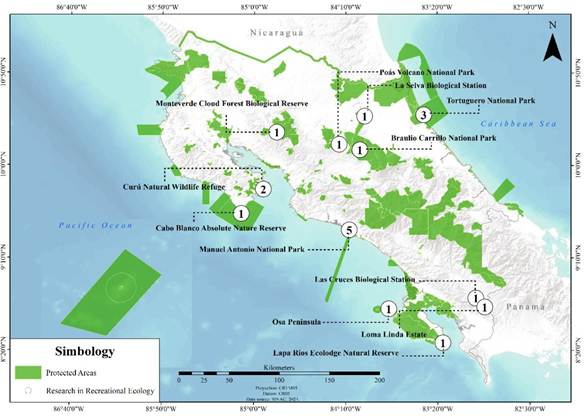
Fig. 1 Locations of research sites for studies on tourism impacts in Costa Rica. GIS based on data from SINAC (2024).
Methodologies of studies on tourism impacts: Approaches varied from non-intrusive observations to more invasive procedures, such as species capture and trail simulation (Table 2). Despite the diversity of methods (n=15), only one study reported minimal negative impacts of tourism on wildlife, while the others highlighted significant behavioral and habitat disturbances.
Table 2 Objectives and methods applied on tourism studies impacts
| Ecological component | Methods applied* | Objective |
|---|---|---|
| Simulation of rainfall on the trail and adjacent surfaces | Quantify infiltration and soil particle detachment | |
| Soil and vegetation | Interviews with protected areas administrators | Identify and qualitatively assess trail conditions |
| Trail monitoring | Compare vegetation change and recovery | |
| Instantaneous sampling focal/cluster census | Direct observation, troop tracking, and data collection | |
| Ethnoprimatology | Quantitative assessment of primate behavior | |
| Night census | Quantify successful turtle nests, false nests, and failed nesting activity | |
| Captures by traps and placement of radio transmitters | Follow-up of individual mobility | |
| Captures (samples) of individuals with different clothing colors | Determine the probability of capture | |
| Visitor interviews | Assess visitor attitudes towards monkeys | |
| Wildlife | Use of camera traps | Monitor mammals and birds in various locations |
| Instantaneous sampling every two minutes along a strip transect | Study dolphin sighting density and behavior in the presence of tourist boats | |
| Recording of interactions between wildlife and tourists | Record site, time, date, interaction type, and species involved | |
| Air | Vessel registration and various parameters for CO2 calculations | Obtain vessel information (type, owner, engine size), tour frequency, and calculate emissions |
* The methods described in this table were based on the following sources, listed in chronological order: Lippold (1990); Boucher et al., (1991); Carrillo & Vaughan (1993); Jacobson & López (1994); Wallin & Harden (1996); Farrell & Marion (2001); Montero & Lobo (2010); Alvarado-Van der Laat (2014); Webb & McCoy (2014); McKinney (2014); Kauffman (2014); López et al., (2019); Fondren et al., (2020); Schulte et al., (2020); Porras et al., (2022).
Key impacts identified: The main impacts identified include significant soil erosion and vegetation degradation. Trails showed increased runoff and detachment of soil particles (Farrell & Marion, 2001). Additionally, uncontrolled foot traffic has contributed to the formation of unauthorized trails, leading to habitat fragmentation and a decline in plant regeneration rates. Compacted soil further reduces water infiltration, increasing surface runoff and sedimentation in nearby aquatic ecosystems (Wallin & Harden, 1996).
Research on wildlife studies highlighted diverse responses to tourism (Webb & McCoy, 2014; McKinney, 2014; Schulte et al., 2020; Kauffman, 2014; Porras et al., 2022). Species such as White-faced Monkey and Howler Monkey showed greater interaction with visitors (McKinney, 2014), while other species exhibited avoidance behaviors that led to habitat shifts (Lippold, 1990). In some cases, species displacement has resulted in increased competition for resources in adjacent habitats, affecting biodiversity and ecosystem stability. Nocturnal species such as Procyon lotor and Procyon cancrivorus, have also altered their daily activity patterns due to human presence, becoming increasingly dependent on anthropogenic food sources (Carrillo & Vaughan, 1993; Porras et al., 2022).
In Manuel Antonio, tourism influenced White-faced Monkeys and two raccoon species (North American racoon and Crab-eating raccoon) altering their feeding habits and activity patterns (Carrillo & Vaughan, 1993; Porras et al., 2022). Frequent interactions between tourists and wildlife have led to behavioral conditioning, where animals actively seek human food, increasing the risk of malnutrition, disease transmission, and aggressive encounters.
Furthermore, air pollution from tourist boats raised environmental concerns in Tortuguero, impacting both air and water quality. The accumulation of boat emissions and fuel residues in aquatic ecosystems can affect water pH, harm aquatic life, and contribute to long-term habitat degradation (Alvarado, 2014).
Discussion
As of May 2024, only 15 publications on recreational ecology in Costa Rica have been produced, underscoring the limited scientific interest and the early stage of research dissemination in this field. This aligns with Sumanalapa & Wolf (2019) observation regarding low scientific output in developing countries. Notably, none of these publications explicitly refer to the term 'recreational ecology,' even though 71% of the authors were foreign.
The Manuel Antonio National Park stands out with the highest number of publications, likely due to its status as the most visited protected area in the region, rendering it more vulnerable to negative impacts and thus a key site for study (Marion et al., 2016). Visitor numbers emerged as the primary variable negatively affecting wildlife behavior (Carrillo & Vaughan, 1993; Porras et al., 2022), with peak visitation times correlating with increased human-wildlife interactions. This pattern aligns with global trends, where popular protected areas often experience greater ecological pressure, emphasizing the urgent need for adaptive management strategies (Newsome et al., 2012).
Most research has focused on ecology and general biology, with particular emphasis on species such as monkeys and raccoons, primarily using observational methods. This narrow focus underscores the need for interdisciplinary approaches that incorporate innovative methodologies and technologies (Marion et al., 2016), as well as greater attention to non-charismatic species- those that typically receive less public interest due to their appearance, behavior, or lack of media presence. Unlike charismatic species, such as large mammals or colorful birds, non-charismatic species (e.g., insects, plants, and small vertebrates) often play critical ecological roles yet remain underrepresented in conservation and ecological studies (Monz et al., 2013). Additionally, significant research gaps persist in marine ecosystems, with only one study addressing this area, while topics such as birdwatching and trekking remain largely unexplored.The lack of research in aquatic environments mirrors a broader gap in recreational ecology, where terrestrial impacts are more frequently documented, despite growing concerns over the effects of tourism on marine biodiversity (Davenport & Davenport, 2006).
From a theoretical perspective, this research enhances the field of recreational ecology by providing a systematic review of specific environmental impacts of tourism in Costa Rica's PA. This study consolidates experimental evidence and fills critical gaps in the literature, acting as a foundational reference for future research and management efforts in recreational ecology. These findings emphasize essential areas for targeted intervention and ongoing monitoring, which support the development of sustainable tourism strategies grounded in ecological science. Future research should also explore the socio-ecological dimension of tourism, integrating community perspectives and participatory conservation approaches.
To address emerging trends in recreation and tourism, it is essential to develop robust strategies for research, evaluation, and monitoring that inform effective management decisions. The protection of the health and integrity of natural resources is crucial for the delivery of high- quality visitor experiences and the promotion of sustainable tourism development in protected areas (Marion et al., 2016). This requires stronger collaboration between policymakers, researchers, and local stakeholders to ensure that conservation goals align with economic and social sustainability (Eagles, 2014).
Ethics, conflict of interest, and funding statement
The authors declare full compliance with ethical and legal requirements during the study and manuscript production, with no conflicts of interest. All financial sources are stated in the acknowledgments. All authors agree with the final manuscript. Author contributions: M.M.C: literature review, research methodology, design, data analysis, manuscript writing. E.C.J: study design, manuscript writing, revision. A.R.L: data collection, analysis, discussion contribution. G.U.A: data collection, analysis, discussion contribution. C.B.L: study design, manuscript writing, revision. All co-authors: preparation, final approval of the manuscript. A signed document is filed in the journal archives.

