




 English (pdf)
 Article in xml format

 Automatic translation
 Send this article by e-mail
 Cited by SciELO
 Similars in
SciELO
 uBio

 Permalink

Velvet worms are ancient predators with a fossil record that extends 515 million years to the Cambrian (Monge Nájera & Ho, 1999; 2000). It is unknown how −and if− they hunted under water in tidal mudflats, but the adhesive net they currently use for defense and to hunt does not function in seawater (Monge-Nájera, Barrientos & Aguilar, 1993; Concha et al., 2015). They are eaten by birds and snakes and even fish during Amazon floods (MongeNájera, Barrientos & Aguilar, 1993), and in turn they prey on spiders (Read & Hughes, 1987; Dias & Lo-ManHung, 2009). Here we report two cases of the opposite interaction: Ctenid spiders feeding on onychophorans in Colombia and Costa Rica.
The observations were done in two reserves, Tamá and La Selva. Parque Nacional Natural Tamá, Colombia (7° 02’ - 7° 27’ N, 72° 02’ - 72° 28’ W) has an unknown biodiversity of onychophorans and is covered by tropical cloud forest, Andean forest and paramo (MAVDT, 2008). La Selva Biological Station, Costa Rica (10°25’19”N, 84°00’54” W) has onychophorans of the genus Epiperipatus and includes primary and secondary lowland rainforest (McGlynn & Kelley, 1999).
At 19:00 hours, January 27, 2011, the first author photographed a female wolf spider (Ctenus sp.) eating an immobilized velvet worm, Epiperipatus sp. (Peripatidae, Figure 1).
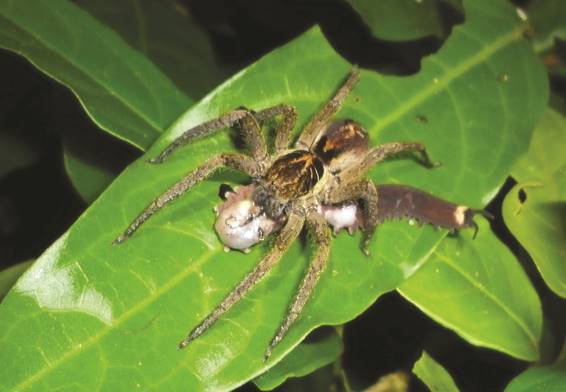
Figura 1 Female wolf spider (Ctenus sp.) externally digesting an Epiperipatus sp. in Colombia. Photograph by R. Franco.
The spider held the worm against a leaf and was eating the rear end. The skin of that part had already been digested and a dark band, possibly the intestine, was partly visible. The worm’s body was twisted, so the rear end’s ventral side was upwards. In the front part there were some markings (perhaps wounds), a drop of urine in the fourth right leg and no signs of defensive glue expelling. The antennae were bent downwards, suggesting that the animal was dead (Figure 1).
The other case was observed by Joseph Warfel in La Selva, near May 2003 or 2004. The spider (Ctenus sp.) was feeding on a dead Epiperipatus sp., about 1.5 m above ground (Figure 2). Some external digestion is seen in the middle of the body.
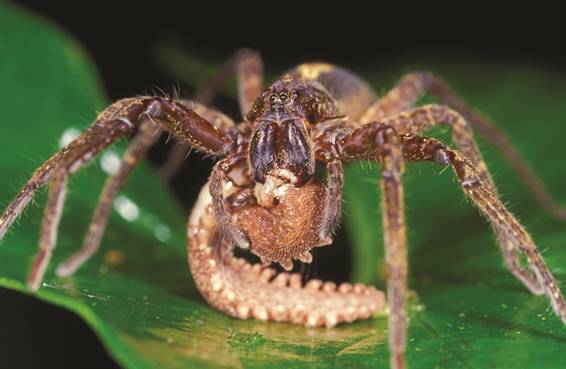
Like spiders, velvet worms have external digestion, which has the evolutionary value of reducing body weight and functioning under water (Hernández-García, Martín & Castro, 2000). We do not know why the spiders started digestion of these prey in the middle of the body instead of the rear or head.
Why do onychophorans hunt dangerous predators such as Theraphosid and Ctenid spiders (Read & Hughes, 1987; Dias & Lo-Man-Hung, 2009) and are feared by Opiliones (Cook, Smith, Proud, Víquez, & Townsend, 2013)? Perhaps the amount of nutrition justifies the risk and these particular onychophorans, which hunt at night guided by olfaction and touch, were unlucky and attacked too large prey (see an informal report by Read, 1985). But the absence of expelled defensive adhesive in both cases suggests that the worms were attacked by surprise.
The chemical composition and action of Ctenus venoms are poorly known (Okamoto et al., 2009) but the efficacy of the spider’s venom suggests that the worm’s nerves and muscles are biochemically equivalent to those of insects, which are only distantly related to velvet worms.
Curiously, velvet worms have inspired an unexpected number of cartoons (Monge-Nájera, & Morera-Brenes, 2015) and there is one imagining a different outcome of a worm/spider encounter (http://goo.gl/gXTsw8). We hope this note inspires others to record any cases of predation related to these poorly known worms.

