




 English (pdf)
 Article in xml format
 Article references
 Automatic translation
 Send this article by e-mail
 Cited by SciELO
  Similars in
SciELO
Similars in
SciELO  uBio
uBio 
 Permalink

Introduction
Orchids naturalize much less than other flowering plants or ferns, probably due to the absence of specialist pollinators and appropriate mycorrhizae required by most orchids (Daehler, 1998). For instance, most orchid species have a single pollinator (Ackerman et al., 2023), and for orchid seeds to germinate they require particular mycorrhizal fungi to penetrate their seed (Liu et al., 2010). Florida’s flora has 12 naturalized orchids (Wunderlin et al., 2025), but only three of these species have spread widely in the state, with most of the others, such as Phaius tankervilleae (Banks) Blume (Robinson et al., 2011), being limited to one or two counties. Ten of the 12 orchid species are terrestrials while the other two are epiphytes. The greater naturalization of terrestrial orchids may be due to the large array of mycorrhizae in the soil and mulch environments in which they grow. Of the widely occurring naturalized orchids in Florida, Zeuxine strateumatica (L.) Schltr. thought to have been introduced to the United States from China in grass seed, was first found in Florida in 1936 (Ames, 1938). Oeceoclades maculata (Lindl.) Lindl. is an African orchid which spread slowly northward after it appeared in Brazil, reaching Florida by 1974 (Wetterer & Wetterer, 2022). Eulophia graminea Lindl. first found in South Miami in 2007 (Pemberton et al., 2008), has spread widely in the state (Pemberton, 2013), and is currently documented to occur in Duval County in northern Florida almost to the Georgia border (Wunderlin et al., 2025).
In this communication, we report the naturalization of Cymbidium aloifolium (L.) Sw., an epiphyticlithophytic Asian orchid, in southern Florida. This marks the first known naturalization of this orchid species in the world and only second naturalization among the 89 species of Cymbidium Sw. (POWO, 2025). The first, Cymbidium dayanum Rchb.f. is naturalized in Hawaii (Ackerman, 2012). Like most naturalized orchids, these Cymbidium species are escapees from horticulture. Cymbidium aloifolium has a wide distribution in South and Southeast Asia, occurring in semideciduous seasonal forests and savanna-like woodlands (Pfahl, 2025). The distribution of the orchid, summarized from the literature (POWO, 2025) is in the eastern Himalayas in Nepal and Bhutan, South Asia in India, Bangladesh, Sri Lanka and the Andaman Islands, in Southeast Asian countries of Myanmar, Thailand, Laos, Cambodia, Vietnam, Malaysia, Sumatra and Java, and in the southern Chinese provinces of Guangdong, Guangxi, Guizhou and Yunnan. This orchid is medically important in its native South Asia where various parts of the plant are used to treat many different ailments (Kumar et al., 2022). The plant is cultivated in its native region and elsewhere due to its abundant, long-lived, attractive flowers, which are born on long, pendulous stalks (Kumar et al., 2022).
After discovering what appeared to be plants of a Cymbidium orchid growing in trees in a residential area of Pinecrest, a city just south of Miami, Florida, in Miami-Dade County, we sought to identify the orchid and to learn of its occurrence and possible origins.
Materials and methods
Identification of the plant
To confirm the identity of C. aloifolium, which was first identified by its characteristic vegetative and floral morphology, molecular techniques and DNA barcoding were employed at Fairchild Tropical Botanic Gardens. Total genomic DNA from six plants was extracted from silica-dried leaf tissue using DNeasy Mini Plant Kit (QIAGEN, Venlo Limburg, The Netherlands). Following DNA isolation, two sets of primers were used to amplify specific genetic regions through polymerase chain reaction (PCR): the nuclear ribosomal internal transcribed spacer (ITS) region using four ITS1 and ITS2 primers, and the plastid region using trnL-F using trnLR primers. These regions are commonly used for DNA barcoding due to their variability among species. The ITS region is particularly useful in identifying orchids, including members of the genus Cymbidium, and allows for resolution at the species level (Sharma et al., 2012). The plastid trnL-F region offers a complementary, maternally inherited marker that provides additional evidence for Cymbidium species identity (Zhang et al., 2021). Although more conserved than ITS, it helps corroborate findings and provides insight into hybridization events or maternal lineage. Using both nuclear and plastid markers enhances the reliability of identification and reduces the risk of error due to incomplete lineage sorting or hybrid ancestry. After PCR amplification, the products were visualized via gel electrophoresis to confirm successful amplification. Amplicons were then purified using ExoSAP-IT reagent (Affymetrix, Santa Clara, California, USA). Samples were sent for Sanger Sequencing at Eurofins Genomics. The resulting sequences were aligned using Geneious (Biomatters, Auckland, New Zealand) and compared against reference sequences from GenBank through nucleotide BLAST. Sequence similarity greater than 97% confirms the identity of the samples. Sequences obtained from this project will be deposited in GenBank.
Surveys for naturalized plants
Surveys were made in the suburban residential area of Pinecrest, Florida in Miami-Dade County, where naturalized orchids plants were first observed in 2017. Searches for naturalized plants of this orchid were also made in the gardens of Fairchild Tropical Botanic Garden and the Montgomery Foundation in Coral Gables, Florida, a city adjacent to Pinecrest, were made in January 2025. The surveys in the residential area of Pinecrest were primarily of trees along the right of way between the street and the sidewalk and in the front yards of residences with the permission of the owners. When plants were found on a phorophyte, the number of plants, their size-age class (seedling, juvenile, and mature -medium and large reproductives), the presence and number of fruit, and the plants’ position on the trees including their height above the ground were recorded. Seedlings were those that sprouted from seed during the current year and usually bore a single leaf fan of growth. Juvenile plants were small plants with multiple leaf fan growths. Mature plants were categorized as medium in size if they were no more than 30 cm across at their centers, between leaf base and leaf tips, and large if they were more than 30 cm across at their centers. The host tree species was recorded as was the size of the host tree, indicated by its diameter at breast height (DBH). Casual walking searches for plants of the orchid were made in the trees of the botanical gardens.
Horticultural presence
Horticultural literature and historical sales catalogues were searched to attempt to learn when the orchid entered horticulture. Current marketing information about the orchid was sought including its presence at regional orchid shows and online sales. Social media was searched for information related to its cultivation.
Results and Discussion
Identity of the orchid
Species identity was confirmed using a combination of morphological and molecular characteristics. Morphologically, the plants were identified as hot to warm-growing epiphytes with very small pseudobulbs enclosed by leaf bases. The leaves are coriaceous, suberect, linear-ligulate, and obscurely bilobed at the apex. Flowers are borne on long, basal, pendent, racemose inflorescences (Fig. 1A) that appear during the spring and early summer. Diagnostic floral features consistent with C. aloifolium include the distinctive strap-like petals and a prominently veined labellum (Fig. 1B).
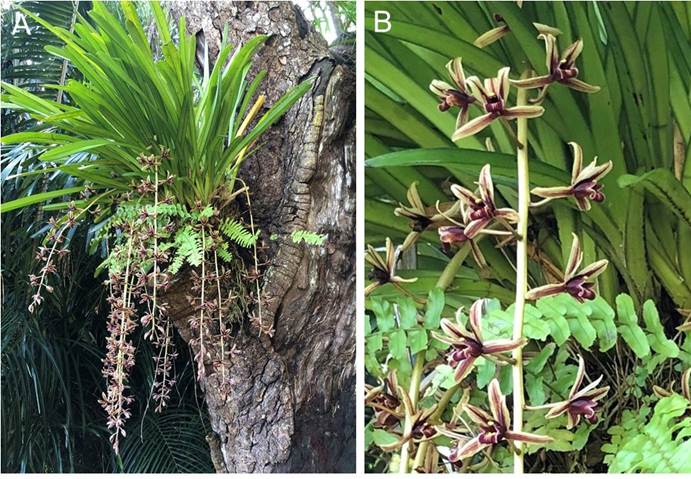
A. Flowering plant with multiple pendulous inflorescences.
B. Inflorescence detail.
Figure 1 Cymbidium aloifolium
While vegetative traits alone were insufficient for definitive identification -particularly in non-flowering or juvenile individuals- molecular analysis via DNA barcoding provided robust support. The internal transcribed spacer (ITS) region and the chloroplast trnL-F intergenic spacer that were amplified and sequenced, revealed high sequence similarity (>99%) with reference sequences of C. aloifolium (GenBank accession numbers: PQ809756.1, PQ815665.1). All six individual samples showed consistent matches, confirming their identity as C. aloifolium.
Survey findings
The results of the surveys in Pinecrest and the botanical gardens are shown in Table 1. A total of 101 C. aloifolium plants were found on 38 different individual phorophytes in an area of ca. 13 km2. An additional large plant was found on the tiled roof at a building at the Montgomery Foundation. Fiftythree of these plants were judged to be mature, with 24 being large and 29 as medium. Large plants were often 50 to 75 cm across, frequently wrapping around their host tree trunks and large branches. Thirty-seven plants were characterized as juveniles, and 11 were seedlings, thought to have germinated during the past rainy season during the summer of 2024. Nine of these mature plants bore a total of 86 fruit. Two of these plants, however, bore most of the fruit. A single large plant growing on a pygmy date palm (Phoenix roebelenii O’brien) bore 34 fruits, while four large plants growing on a mahogany (Swietenia macrophylla King) bore 43 fruits. The remaining 9 fruits included 4 produced by a single plant growing on a palm, probably Copernicia hospita Mart., and 5 fruits on another plant growing on a Southern live oak (Quercus virginiana Mill.).
Table 1 Cymbidium aloifolium naturalized plants in Pinecrest and Coral Gables, Florida. Family, scientific name and common name are provided for the phorophytes (hosts); native species in bold. DBH=diameter at breast height; x̄ =mean; sd=stand. deviation.
| No. Hosts | No. Plants | No. 1Mature plants | No. Fruiting plants | No. Fruit | No. 1Juvenile | No. 1Seedlings | Host DBH (m) | Plant height (m) | |
|---|---|---|---|---|---|---|---|---|---|
| Arecaceae | |||||||||
| 1. Copernicia cf. hospita None | 1 | 1 | 1 large | 3 | 4 | 0.93 | 0.75 | ||
| 2. Phoenix roebelenii Pygmy date palm | 8 | 24 | 4 large 6 medium | 1 | 34 | 13 | 1 | 0.26-0.41 x̄=0.32 sd=0.05 | 0.90-2.12 x̄=1.73 sd=0.47 |
| 3. Sabal palmetto Palmetto palm | 2 | 5 | 5 medium | 1.07 | 2.12-3.45 x̄=3.32 sd=1.19 | ||||
| 4. Serenoa repens Saw palmetto | 2 | 2 | 2 | 0.57 | 0.3-0.6 x̄=0.45 sd=0.21 | ||||
| 5. Thrinax radiata Florida thatch palm | 5 | 27 | 3 large 6 medium | 11 | 7 | 0.29-0.43 x̄=0.38 sd=0.05 | 1.6-3.6 x̄=2.83 sd=0.97 | ||
| Burseraceae | |||||||||
| 6. Bursera simaruba Gumbo limbo | 1 | 1 | 1 | 0.87 | 2.4 | ||||
| Combretaceae | |||||||||
| 7. Conocarpus erectus Buttonwood | 1 | 4 | 1 large 1 medium | 2 | 1.48 | 3.0-4.2 x̄=3.48 sd=0.56 | |||
| Fabaceae | |||||||||
| 8. Bauhinia cf. purpurea orchid tree | 1 | 10 | 3 large | 5 | 2 | 1.73 | 1.96-4.24 x̄=3.28 sd=0.76 | ||
| Fagaceae | |||||||||
| 9. Quercus virginiana Southern live oak | 6 | 8 | 2 large 4 medium | 1 | 5 | 2 | 1.78-3.03 x̄= 2.47 sd=0.57 | 1.2-3.6 x̄=2.2 sd=3.19 | |
| Lauraceae | |||||||||
| 10. Persea americana Avocado | 1 | 1 | 1 large | 1.03 | 1.36 | ||||
| Meliaceae | |||||||||
| 11. Swietenia macrophylla Mahogany | 8 | 16 | 7 large 7 medium | 4 | 43 | 2 | 1.06-2.92 x̄=2.26 sd=0.75 | 2.42-5.45 x̄= 4.36 sd=1.19 | |
| Moraceae | |||||||||
| 12. Ficus cf. benjamina Benjamin fig | 1 | 1 | 1 large | 1.5 | 2.7 | ||||
| Pinaceae | |||||||||
| 13. Pinus ellioti Slash pine | 1 | 2 | 1 | 1 | 1.19 | 2.4 | |||
| Unknown (N/A) | |||||||||
| 14. Building roof (Montogomery Foundation) | 1 | 1 large | 3 | ||||||
| Total | 38 | 103 | 53 (29 medium, 24 large) | 9 | 86 | 37 | 11 |
1Mature plants, those capable of fruiting, are divided in medium and large: medium plants are those with five growth shoots and a width estimated to be less than 30 cm at their centers, between the leaf bases and leaf tips; large plants are wider than 30 cm across, commonly reaching 50 cm or more. Juvenile plants are small plants with multiple leaf fan growths. Seedlings are those that sprouted and grew during the last 2024 growing season.
Thirteen different phorophyte species hosted the naturalized Cymbidium plants (Table 1). Seven of these are native and six non-native introduced species. Five of the 13 species are palms belonging to five different genera, but only two of these palms hosted half (51/103) of the orchid plants. These were the Florida thatch palm trees (Thrinax radiata Lodd. ex Schult. & Schult.f.) that bore 27 plants of the orchid, and eight non-native pygmy date palm trees that bore 24 plants. Other host trees with numerous orchid plants were mahogany with 8 trees hosting 16 plants and Southern live oak with six trees hosting 8 plants. Most of the host species have rough bark, with textures that may help catch and hold the airborne orchid seed and provide microhabitats for mutualistic mycorrhizae that foster seed germination. Three host species, Bursera simaruba (L.) Sarg., Ficus benjamina L. and Bauhinia L., have smooth bark but the orchid plants found on them grew at cut ends of branches and or on partially decayed areas, which may have been the habitats of mutualistic mycorrhizae. Some saprophytic and plant parasitic fungi can serve as orchid seed germination mutualists (Sathiyadash et al., 2020).
Data on the size of host trees, diameters at breast height, and heights above the ground where the C. aloifolium plants were found, did not reveal any patterns among host species, except that all the hosts were large and mature. Within host species, however, the sites where the orchids occurred were more consistent. Most of the plants growing on the oaks were lower on the trunks ca. 2.5 m above the ground and often at the junction of the trunk and a major branch (Fig. 2A). Most of the large plants in the mahogany trees were high (ca. 3-4 m) in the canopy (Fig. 2B). Both the pygmy date and the thatch palms are small and most of the numerous orchids they hosted grew beneath the fronds below 2 to 3 m above the ground. The moist fibrous of old frond bases of the pygmy date palms supported many seedlings and juvenile plants (Fig. 2C).
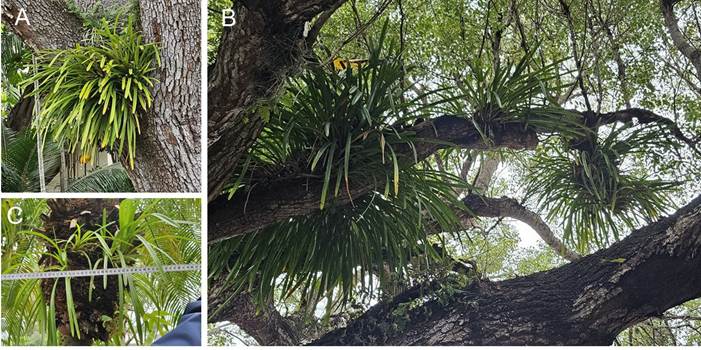
A. Large plant of Cymbidium aloifolium on a Southern live oak (Quercus virginiana) tree trunk.
B. Large plants in the canopy of a mahogany (Swietenia macrophylla) tree.
C. Juvenile plants growing on a pygmy date palm (Phoenix roebelenii).
Figure 2
We identified hosts as native or introduced but all these species were cultivated in the front yards or in the right of ways in this old residential neighborhood. An interesting exception was a remnant native Pine Rockland plant community occupying a 50 × 75 m or 0.375 ha lot within this neighborhood. In this lot, six C. aloifolium plants were found on four hosts of three native species; a slash pine (Pinus elliottii Engelm.), a palmetto palm (Sabal palmetto (Walter) Lodd. ex Schult. & Schult.f.) and two saw palmettos (Serenoa repens (W.Bartram) Small), the latter are more shrubs than trees. Among these naturalized orchids were two mature plants, a single juvenile and three seedlings. The presence of the orchid in this Pine Rockland remnant demonstrates the ability of this orchid to invade this plant community and the suitability of this community for the orchid. The Pine Rockland is a unique and highly endangered community in South Florida (U.S. Fish and Wildlife Service, 1999). It is notable that another invasive orchid, the yellow cowhorn orchid (Cyrtopodium flavum Link & Otto ex Rchb.) from Brazil, has a large population on another Pine Rockland remnant (Pemberton & Liu, 2011). The yellow cowhorn is lithophilic, while Cymbidium aloifolium is known to be both epiphytic and lithophilic. The naturalized C. aloifolium plants that we have encountered thus far, including those in the Pinecrest neighborhood Pine Rockland remnant, have been epiphytic except for one plant growing on a building at the Mongomery garden. The orchid’s ability to be lithophytic may increase its invasion potential of this important community type.
In addition to the plants found during our survey in Pinecrest, a single large reproductive plant was found in Fairchild Botanic Garden in Coral Cables. The naturalized C. aloifolium plant was growing on a planted palm, Copernicia species, probably C. hospita, adjacent to a mangrove creek next to Matheson Hammock State Park. The plant was at 0.75 m above ground and bore three infructescences with 1, 1, and 2 fruits. At the Montogomery garden a single large plant without apparent fruit was found growing on the edge of the tiled roof of the building that houses the herbarium of Fairchild Tropical Garden. It is interesting to note that this building is located about 100 m from mahogany trees bearing numerous large fruiting C. aloifolium growing along Old Cutler Road in Pinecrest. Voucher specimens of naturalized C. aloifolium have been placed in the herbaria of Fairchild Tropical Botanic Garden, the University of Florida and the University of South Florida.
Horticultural presence
There are three main groups of cultivated Cymbidium species. The longest cultivated are the terrestrial species, such as C. ensifolium (L.) Sw. and its hybrids, which have been highly favored fragrant orchids cultivated for thousands of years in China (Hew & Wong, 2023). Then there are the large flowered cooler growing Cymbidium species such as C. insigne Rolfe from the Himalayas, Indochina and South China and their hybrids (Pridgeon, 1992). Lastly are the so called small-flowered Cymbidium species that are tropical epiphytes with pendulous flowers, which is the group to which C. aloifolium belongs (Pridgeon, 1992; Staples & Herbst, 2005).
The first evidence of the cultivation of C. aloifolium in the United States that we located was its listing in the 1876 book, New and Choice Orchids (William Rollisson & Sons, 1876). Not long after that, in 1889, it appeared in the sales catalogue of The United States Nursery in Short Hills, New Jersey. In 1890, it was offered in John Saul nursery catalogue of orchids, Washington DC (Saul, 1890). The Reasoner Brother’s Royal Palm Nurseries near Ft. Meyers, Florida, which operated from 1887 to 1930, was one of the most important early horticultural nurseries in Florida (Pemberton & Liu, 2009). This nursery sold many orchids but no Cymbidium species or their hybrids. The orchid did not occur in any of the other examined 15 US orchid nursery sales catalogues published from 1911 to 1960, available on The Internet Archive (2025). Cymbidium aloifolium was not included in the book 100 Orchids for Florida (Kramer, 2006) or in Orchids to Know and Grow (Sheehan & Black, 2007).
We have not noticed C. aloifolium being sold in recent years at the large orchid shows in southern Florida (Ft Lauderdale Orchid Society Show, Tamiami International Orchid Festival in Miami, the Fairchild Orchid Festival or the Redland International Orchid Show. A search for online sales of C. aloifolium plants on Google, (accessed 24 April 2025), found 25 companies offering the orchid. A limited search of social media, YouTube, (accessed 19 January 2025) found 20 posts related to this orchid, mostly dealing with its cultivation. This information suggests that C. aloifolium has had and still has more limited popularity as a horticultural subject than many orchids. The many online companies selling plants and the social media posts related to its cultivation, however, indicate an interest in this orchid. The cultivation of C. aloifolium in tropical and subtropical regions may present more opportunities for it to escape and naturalize.
Reproductive biology
In India, C. aloifolium is pollinated by the most common Asian honeybee, Apis cerana Fabricius, 1793 (Adit et al., 2022; Buragohain et al., 2016). The flowers (Fig. 1) lack nectar and appear to be pollinated through deception. Due to the similarity in the morphology and size of the Indian honeybee and the ubiquitous common honeybee (A. mellifera L. 1758) in Florida, we suspect that the common honeybee is probably the pollinator of the orchid in Florida, but this remains to be verified.
Finding 101 naturalized plants on 38 different phorophytes belonging to 13 species in nine different families during the surveys indicates that suitable mycorrhizae were present at many different specific sites where the seed of this orchid germinated and grew. We suspect C. aloifolium is a mycorrhizal generalist, capable of germinating on broad spectrum of mycorrhizae as has been recently found with other naturalized orchids in Florida (Downing et al., 2020), but this also needs to be determined. Cymbidium aloifolium has thus overcome two significant barriers to orchid naturalization, the acquisition of suitable mycorrhizae for seed germination and capable pollinators of its flowers.
Description of the plant
The following description of C. aloifolium is based on the one given in the Native orchids of China in Color (Chen et al., 1999). Plants epiphytic or lithophytic. Pseudobulbs ovoid, slightly flattened, 3-6 cm long, 2.5-4.0 cm thick, usually enclosed in persistent leaf bases. Leaves 4-5, strap shaped, thickly coriaceous, ridged, 40-90 cm long, 1.5-4 cm wide, unequally round-bilobed at the apex. Inflorescence (Fig. 1A), lateral, pendulous, 20-60 cm long, raceme with 15-35 flowers, bracts small. Flowers (Fig. 1B) 3-4 cm across, slightly scented, sepals and petals pale yellow with a broad maroon-brown central stripe and some dark streaks; lip white or cream colored with maroon-veined side lobes and mid lobes. Sepals oblong to narrowly elliptic, 1.5-2.0 cm long, 4-6 cm wide. Petals narrowly elliptic, slightly shorter than the sepals. Lip subovate, 1.3-2.0 cm long, 3 lobed; callus 2-lamellate, lamellae often broken in the middle. Column 1.0-1.2 cm long.
Cymbidium aloifolium is distinguished from other epiphytic Cymbidium species cultivated in Florida by its small, hidden pseudobulbs, stiff, bilobed leaves, and especially its long, pendant inflorescence bearing many striped flowers with a veined labellum. In contrast, many other epiphytic species have more visible pseudobulbs, arched or erect inflorescences, and different floral shapes and markings. This species is often confused with C. dayanum but C. aloifolium is distinguished by its smaller pseudobulbs, strap-like petals, veined labellum, and pendant inflorescence, whereas C. dayanum has more prominent pseudobulbs, narrower, striped flowers, and a more arching inflorescence. Flower structure and markings are the most reliable way to tell them apart, especially when vegetative features are ambiguous. The flowers of C. dayanum differ from C. aloifolium in having a rounded lip edge and an hourglass shape in the center of the lip.
Potential to spread and persist
The native distribution of C. aloifolium reaches Sikkim in northern India (POWO, 2025). The southern border of Sikkim is 27 degrees north and the lowest elevation in the province is ca. 300 m above sea level (Government of Sikkim, 2021). The areas where this orchid grows in Sikkim should be much cooler than the area where the orchid has naturalized in Florida, which is at 26 degrees north and at near sea level. This suggests that C. aloifolium may be able to live well north of its present location in Miami-Dade County, particularly along both the eastern and western southern coasts which rarely get frost. The plant’s leathery leaves, which help it survive the dry season in monsoonal South and Southeast Asia, should preadapt the plant to survive the long dry season in Florida. Being a tropical species, the orchid has the potential to spread south and/or to escape from cultivation into the American tropics in tropical America. In 2024, a research-grade iNaturalist observation of Cymbidium aloifolium from French Guiana in South America was posted (Léotard, 2024).
Only two epiphytic orchids have naturalized in Florida prior to the naturalization of C. aloifolium described here, but the persistence of these species is questionable. Laelia rubescens Lindl. is listed in the Florida Plant Atlas (Wunderlin et al., 2025) as occurring in Miami Dade County. It was found growing on Southern live oak trees in Matheson Hammock in MiamiDade County by Roger Hammer (pers. com.), but recent searches by the present authors have failed to locate plants of this orchid. A research grade iNaturalist post in 2019 shows what appears to be an orchid in Big Cypress National Wildlife Preserve in Collier County.
Encyclia rufa (Lindl.) Britton & Millsp. is a Bahamian orchid reported from Brevard County on the east coast of Florida by the Florida Plant Atlas (Wunderland et al., 2025). We have been unable to find herbarium specimens of these orchids. Naturalized terrestrial orchids are probably better able to survive the variable weather of the subtropical Florida because their subterranean parts of these orchids may survive periodic freezes. Some of the massive, naturalized plants of C. aloifolium, that we have encountered, may be selfinsulating against the rare freezes that occur in South Florida. If so, C. aloifolium may be the exceptional naturalized epiphytic orchid to persist and perhaps spread in the southern part of Florida, but time will tell.

