




 English (pdf)
 Article in xml format
 Article references

 Automatic translation
 Send this article by e-mail
 Cited by SciELO
 Similars in
SciELO
 uBio

 Permalink


The estimated 250 species of orchid bees (Hymenoptera: Apidae: Euglossini) pollinate thousands of tropical American plants, perhaps about a third of the plants in this area (Dressler, 1982; Williams, 1982). Male orchid bees are the only pollinators of about 700 so-called perfume orchids in the American tropics (Dressler, 1982; Vogel, 1966). Instead of producing their own pheromones for reproduction, male orchid bees collect volatile chemicals from the surfaces of these orchids and from other sources and expose the chemicals during their courtship (Eltz et al., 2005). Females of each orchid bee species will mate only after their males display particular blends of collected chemicals, unique to each orchid bee species (Eltz et al., 2005; Henske et al., 2022; Zimmerman et al., 2009). The bees visiting the orchids are manipulated by their flowers, so their collection of these volatile oils often results in the pollination of their flowers.
One orchid bee, Euglossa dilemma Bembé & Eltz, has become naturalized in Florida (Pemberton & Wheeler, 2006; Skov & Wiley, 2005) and has spread south to the Keys and north to central Florida (Pemberton & Escalona, 2023). A perplexing discovery was made when a female E. dilemma was found dead inside the bucket-shaped flower of a Coryanthes panamensis G.Gerlach in Coral Gables, Florida. This female bore the pollinarium of this orchid on her thorax (Fig. 1A). The orchid species was identified to be C. panamensis from a photograph of the flowers by the perfume orchid expert Günter Gerlach. The pollinarium on the dead female was determined to be that of a Coryanthes species based on its morphology and position on the bee as indicated by a drawing in Roubik and Hanson (2004) and verified by Gerlach. A photograph of the pinned specimen of this bee clearly shows the tibia of its hind leg with its concave morphology (the corbiculae used to carry pollen), verifying that the bee is a female (Fig. 1B). The orchid flower was on a C. panamensis plant grown in a basket in the residential garden of a Coral Gables, Florida. The discovery was made when the plant was brought to a meeting of the Orchid Species Coalition, a club of orchid growers, at Fairchild Tropical Garden, also in Coral Gables, on January 8, 2008. A male E. dilemma was found dead in the bucket flower of this orchid on a plant also brought to the club’s meeting, on November 9, 2008. It did not bear a pollinarium.
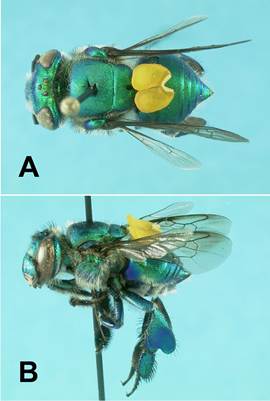
A. Dorsal view.
B. Lateral view.
This orchid bee is naturalized in Florida where this specimen was discovered dead in the flower of C. panamensis, an uncommon potted plant grown by orchid hobbyists.
Figure 1 Euglossa dilemma female (concave hind tibia) with the pollinarium of Coryanthes panamensis.
Coryanthes orchids have one of the most bizarre flowers and strangest pollination mechanisms of all orchids. The following description of a Coryanthes flower and the pollination mechanism is slightly modified from Gerlach and Schill (1989) and is provided to better understand the female’s behavior when she visits the orchid. See Gerlach (2016) for more extensive information about these fascinating orchids and their pollination. The fleshy lip of the Coryanthes flower (Fig. 2) is composed of three parts- the cup-shaped hypochil (H), the partially covered tubular mesochil (M) and the bucket-like enlarged epichil (E), which is filled with a fluid secreted by two broadly falcate protuberances the pleuridia (P1) at the base of the column (C). Male orchid bees land on the hypochil of the flower and try to get below the hood to collect fragrance compounds. In trying to get a footing on the waxy, smooth mesochil, they slip and fall in the bucket-like epichil, which is filled with a mucilaginous fluid, where their wings are wetted. The only way for a bee to escape is by crawling out through a tunnel formed by the epichil of the lip and the column, which bears the stigma and single anther. Before exiting the tunnel, the bee contacts the stigma, which removes a pollinarium it may bear from its thorax. Then the exiting bee contacts the anther, and its sticky viscidium glues the pollinarium (the viscidium, stipes, and two pollinia -the whole pollen mass) to its thorax.
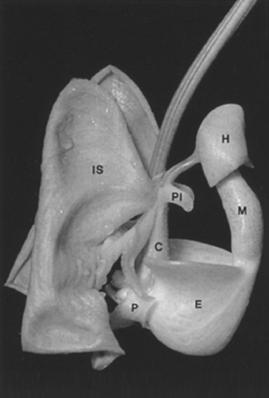
lS, lateral sepalum; P, petalum; lip consisting of a short claw: H, hypochile; M, mesochile; E, epichile; C, column; Pl, pleuridia, ca. life size (Gerlach & Schill, 1989).
The flower is shown to illustrate the complexity involved in a female orchid bee’s visits to a bucket orchid flower and removing the pollinaria, which Euglossa dilemma did twice.
Figure 2 Coryanthes speciosa flower, side view.
The female orchid bee paradox
Female orchid bees respond to male orchid bees displaying with particular bouquets of fragrance chemicals and mate. Perfume orchids produce these volatile compounds in higher concentrations and in complex blends to lure male orchid bee pollinators. Female orchid bees, however, don’t visit or pollinate the flowers of perfume orchids. Queries with orchid bee-perfume orchid experts James Ackerman, Günter Gerlach, and David Roubik (pers. comm.) confirmed that they have not observed female orchid bees visiting perfume orchids, despite spending many years in the field studying perfume orchids and orchid bees. Furthermore, female orchid bees don’t come to, or very rarely come to baits using perfume orchid fragrance chemicals to attract male orchid bees, even when male conspecifics are present at the baits. After checking his records of baiting in Panama, James Ackerman reports that he encountered only a single female orchid bee out of 36,000 orchid bees. This was Euglossa imperialis Cockerell that came to a Benzyl Benzoate bait. Günter Gerlach had never seen a female orchid bee at baits, except on occasion when a female flew towards his insect net in which he had captured male orchid bees at baits. That female orchid bees can smell the fragrance chemicals and are attracted to males displaying with them but don’t visit perfume orchids or perfume compound baits seems paradoxical. A displaying male orchid bee is, apparently, an essential element in this chemical attraction for females.
The puzzle of why the female E. dilemma visited the flowers of C. panamensis
Because this female orchid bee bore the orchid’s pollinarium, she either visited the flower she was found in twice, or another flower first and then this flower, where she probably drowned in the viscous liquid it contained. Why did this orchid bee visit this flower intensively enough to be trapped in the bucket, only to escape through liquid through the tunnel and exit with a pollinarium, and then re-enter a flower? Bees do fall into water traps and water-filled pan traps are used to trap and study bees. Other kinds of bees and insects probably fall into the bucket flowers of Coryanthes species, but they apparently don’t escape with the orchid’s pollinarium on them, or reenter that of another flower. The repeated visitation by the female E. dilemma suggests that, although she did have accidents by slipping and falling into the bucket of the flower, her visits were not accidental.
The presence of the pollinarium on the female E. dilemma is significant because flower visitors that remove pollen from orchids are considered to be their pollinators (Ackerman, 1983; Dressler, 1981), so by this criterion, this bee is a pollinator of C. panamensis (although not a successful one). Plants of this bucket orchid, however, are quite rare in Florida, being non-native pot ornamentals of interest only to specialty orchid hobbyists, suggesting that the trapped bee probably had no or little contact with plants of this species before she visited. With so few plants of this orchid in the environment, this potential pollination has no plant reproductive or plant population level meaning to it. Also, because Euglossa dilemma and C. panamensis are not sympatric in their native ranges in tropical America, there would have been no opportunity for a E. dilemma female or male to visit and potentially pollinate the flowers of this species. Male orchid bees of both Eulaema and Euglossa species associate with Coryanthes orchids in Panama (Roubik & Hanson 2004) and C. panamensis Friese is pollinated by Euglossa hemichlora Cockerell and Euglossa townsendii Cockerell (Roubik & Knutson, 2017; G. Gerlach pers. comm.).
What attracted this female E. dilemma to make repeated visits to flowers of C. panamensis? During 20 years of observing this bee in Florida, I have recorded it to use 259 taxa of plants including 237 different species (Pemberton, 2023). This bee is an extreme generalist concerning the types of flowers it visits to obtain nectar and pollen, although it prefers gullet flowers that it can crawl into, tubular flowers whose rewards it can access with its long tongue, and buzz pollinated flowers for pollen. None of these preferred flowers or the less visited flowers resemble those of C. panamensis in terms of morphology or fragrance, so it seems unlikely that a female E. dilemma would mistakenly visit C. panamensis while seeking food. Females also collect resin rewards from the flowers of the few Clusia L. (Clusiaceae) and Dalechampia Plum. ex L. (Euphorbiaceae) species (Pemberton, 2024), but these flowers too are extremely different from those of C. panamensis. A female E. dilemma visited and removed the pollen from the flower of Vanilla planifolia L. but this orchid is not perfume orchid (Pemberton et al., 2023).
Perhaps the fragrance of C. panamensis attracted this female orchid bee, as it very likely had attracted the male also found dead in a flower of this orchid. Among the fragrance components of the perfume of flowers of C. panamensis are methyl cinnamates (Kaiser, 2005). Euglossa dilemma males collect these same cinnamates (Pemberton & Wheeler, 2006), and in the process pollinate the perfume orchids offering them, including Lycaste aromatica Lindl. (Pemberton, 2023). Male E. dilemma have been observed to habitually collect the herbicide triclopyr because the fragrance of its principal breakdown product mimics methyl cinnamate (Pemberton & Kindt, 2024; Ramirez et al., 2010). Methyl cinnamate is used with eugenol as the principal baits to attract Euglossa viridissima Friese (Roubik & Hanson, 2004), E. dilemma’s sibling species from which it was separated (Eltz et al., 2011). These bees respond to essentially the same chemicals (Brand et al., 2015). Male orchid bees are genetically programed to collect particular odorant chemicals that are essential for their courtship and successful mating (Henske et al., 2022; Zimmermann et al., 2009). Because male E. dilemma bees collect and store these cinnamates, they also display with these cinnamates, which are part of their odorant chemical bouquets. This suggests that female E. dilemma bees can smell them, which in turn suggests that they can also smell C. panamensis flowers. Being able to smell the flower, but not normally visiting it is again the paradox. Female orchid bees, however, are not passive regarding their reproduction. Male orchid bees display with their fragrance bouquets on the tops of ridges or other places with air movement, which facilitates the dispersal of their fragrance, and virgin females fly up these fragrance trails to reach the displaying males (Pokorny et al., 2017). It is possible that the female E. dilemma that visited the flower of C. panamensis and removed the pollinarium and visited a flower again, was just an aberrant individual female. It could also suggest that female orchid bee behavior is, or potentially is, more plastic than previously thought, but the absence of female orchid bees at perfume orchids and their extreme rarity at baits belies this idea.
Might the female orchid bee’s visits to the bucket orchid flowers suggest something about orchid bee evolution? Orchid bees first began to collect volatiles 38 million years ago and subsequently perfume orchids evolved for orchid bee pollination three times (Ramírez et al., 2011). If female orchid bees deviate from their species-specific blend of odor compounds by responding to others or even single odors, such as seen with the female E. dilemma’s possible response to methyl cinnamates produced by C. panamensis, the reproductive barriers that protect the orchid’s and the orchid bee’s species integrity could be lost. However, mutations creating new fragrance perceptions and responses in both male and female bees would provide new opportunities for speciation, perhaps like the recent divergence of E. dilemma and E. viridissima (Brand et al., 2015). The difference in the fragrance blends collected and displayed by male E. dilemma and its sibling E. viridissima is only a single compound, HNDB (2-hydroxy 6-nona-1,3-dienyl-benzaldehyde), and the bees’ difference in degree of preference for HNDB has been traced to a single OR protein that occurs in E. dilemma but not E. viridissima (Brand et al., 2020). Fragrance perception and response in orchid bees may be more evolutionarily labile than previously thought. Female orchid bee response to specific fragrances is largely unstudied (Thomas Eltz, pers com.).
Although this bee bearing the Coryanthes pollinarium appears to be female due to the corbicula on its metatibias, the possibility exists that it could be a gynandromorph. This might explain why an apparent female visited the Coryanthes and picked up the orchid’s pollinarium. Gynandromorphy is a condition in which bees or other organisms have morphological features of both sexes due to genetic anomalies (Nesbitt & Gartler, 1971). Gynandromorphs have been described in at least four Euglossa species (Suzuki et al., 2014). The four species discussed by Suzuki et al., (2014) were the mixed or mosaic type of gynandromorphy with their sexual characteristics distributed patchily throughout their bodies. Two of these Euglossa species gynanders were collected at chemical baits which is an of male behavior. Euglossa iopoecila Dressler was collected at a eugenol bait in Brazil (Giangarelli & Sofia, 2011), and E. pleosticta Dressler at a cineole bait also in Brazil (Camargo & Gonçalves, 2013). Carmargo and Gonçalves (2013) considered it difficult to predict the behavior of gynanders based on scent attraction. Suzuki et al., (2014) did DNA genetic analysis on a gynander of E. melanotricha Moure which emerged from a nest collected in south-western Brazil. The results revealed that the gynandromorph shared several alleles with both normal females analyzed as well as with the two control males. Both the mixed morphology and mixed genetics of this bee led the authors to categorize it as an intersex bee.
To determine if this E. dilemma bearing the pollinarium might be a gynander, the external sexual morphology of the specimen was examined and the following characteristics were noted. Both antennae have 12 segments, the scutellum bears an ellipsoid tuft, and the metatibias are corbiculate, all of which are female features. In addition, the specimen lacks male features, including the fore tarsi having brushes, velvet pads on the mesotibias, as well as an inflated hind tibia with a slit on the top. Despite the bee being a morphological female, there may be neurological anomalies that caused the bee to exhibit male-like attraction to and repeat visits to the bucket orchid flowers of C. panamensis causing the pollinarium to be placed on its scutellum.
Future research could analyze this E. dilemma specimen to determine its genetic gender, which could provide insights into why this apparent female orchid bee behaved, in part, as a male. The specimen will be deposited in the Florida Arthropod Collection in Gainesville. Suzuki et al., (2014) extracted DNA from the hind legs of a gynander of E. melanotricha Moure to analyze the complementary sex determination gene (sl-CSD), which has been widely accepted as acting in sex determination (Zayed, 2009). DNA can now be routinely extracted from pinned insect specimens, even those of great age through a non-destructive enzymatic method (Santos et al., 2018). Because only one gynander of a Euglossa has been genotyped (Suzuki et al., 2014), it would be informative to determine the genders of the others.
It would also be informative to explore the neurological and behavioral responses of female E. dilemma and other female orchid bees to fragrance chemicals. There has been no published research on antennograms of female orchid bees, but an unpublished study involving small numbers of bees found that that the antennae of female E. dilemma responded to perfume orchid fragrance chemicals, but the response was smaller than that of males (Thomas Eltz, pers. comm.). Antennograms coupled with gas chromatographs record the electrical activity of an insect’s antenna in the presence of an odor and have been useful in identifying sex pheromones and pollinator responses to floral fragrances (Cardé & Hayes, 2004; Raguso 2004).
The complex biology and ecology of orchid bees make them fascinating creatures. The extraordinary visitation of a female orchid bee to a perfume orchid is an interesting anomaly of orchid bee behavior.

