




 English (pdf)
 Article in xml format
 Article references
 Automatic translation
 Send this article by e-mail
 Cited by SciELO
  Similars in
SciELO
Similars in
SciELO  uBio
uBio 
 Permalink

Introduction
Borneo serves as an invaluable natural laboratory for botanists, with Sabatini et al. (2022) highlighting the island’s extraordinary plant diversity. The geological and geographical conditions of Borneo have contributed to its status as one of the regions with the highest orchid diversity in the world (Hassler & Rheinheimer, 2020; Rafiqpoor et al., 2005; Wood & Cribb, 1994). This island spans three countries: Malaysia, Brunei Darussalam, and Indonesia. According to Juiling et al. (2020) the center of orchid diversity and endemicity in Borneo is primarily located in Sabah, Malaysia. Another significant area for orchid exploration is the Heart of Borneo (HOB), a forest management initiative involving the three countries. Besi et al. (2020) identified at least 59 genera of orchids in Sarawak, with the highland region serving as a hotspot for diversity. However, this suggests a gap in research on orchid diversity in other parts of Borneo, particularly Kalimantan, Indonesia.
Recent discoveries of new orchid species across various regions of Kalimantan indicate that many areas remain unexplored. Notable new species include Bulbophyllum pulanense Yudistira, F.H.Kurniawan & Mustaqim, B. sapathawungense Yudistira, R.P.P.Ahmad & Mustaqim, B. sungaiutikense F.H.Kurniawan, Yudistira & Mustaqim, Phalaenopsis kapuasensis Metusala & P.O’Byrne, and Trichoglottis najibii Yudistira & Mustaqim are new species to science found in West and East Kalimantan. Meanwhile, Bulbophyllum abangjoei Rusea, Besi & Pungga and B. lyriforme J.J.Verm. & P.O’Byrne, previously only known from Sarawak and Papua, have now been recorded in Kalimantan (Kurniawan et al., 2022; Metusala, 2017; Yudistira et al., 2022, 2023, 2024).
Between 2018 and 2024, during field research in the provinces of South, Central, and West Kalimantan, we collected terrestrial and epiphytic orchid specimens from lowland dipterocarp forests and karst areas. Three species previously reported only in Sumatra (Comber, 2001; POWO, 2023) have now been newly recorded from Kalimantan: Eria compressoclavata J.J.Sm. (endemic to Sumatra; Sungai Liat, Bangka Island, and Jambi), Oxystophyllum cuneatipetalum (J.J.Sm.) M.A.Clem. (native to Sumatra), and Plocoglottis quadrifolia J.J.Sm. (in Indonesia, it is only known from Sumatra).
Materials and methods
The specimens examined were collected during botanical explorations conducted between 2018 and 2024 in three Kalimantan provinces, Indonesia: South Kalimantan, Central Kalimantan, and West Kalimantan. The comparative morphological study was based on examinations of living plants, dried specimens, and spirit specimens preserved in 70% ethanol, stored at WAN (Herbarium Wanariset, Institute of Research and Development for Natural Resource Conservation Technology, Balikpapan, Kalimantan Timur, Indonesia) and CEB (Herbarium Celebense, Tadulako University). All photographs were taken using a Nikon D5600 body with either a Nikon DX AF-S 40 mm f/1.2, 8G Micro Nikkor lens or a Nikon D3300 AF-P NIKKOR 18-55 mm lens, and images were post-edited for optimization using Adobe® Photoshop CS6. The terminology used for the morphological descriptions follows Beentje (2016). Identification was accomplished by comparing morphometric characters of fresh specimens with those described in Orchids of Sumatra by Comber (2001). The original species descriptions and herbarium studies of digital specimens housed at L, P, and MW (following Thiers, 2021, continuously updated) were accessed via GBIF (2023). Distribution data for each specimen were cross-referenced with Comber (2001) and the species distribution map by POWO (2023). The taxonomic account and colour drawings were prepared from recently collected specimens deposited at WAN. Our identifications were confirmed through consultation with relevant literature, original species descriptions, and distribution maps provided by POWO (2023).
Taxonomic treatment
Eria compressoclavata J.J.Sm. Bull. Jard. Bot. Buit. Ser. 3, 12: 129 .1932.
TYPE: Indonesia. Sumatra: Sungai Liat, Bangka,: without locality, H.A.B.Bunnemeijer s.n., cult. Hort. Bogor. XII B, IX, 130 (holotype, BO! not seen). (Fig. 1).
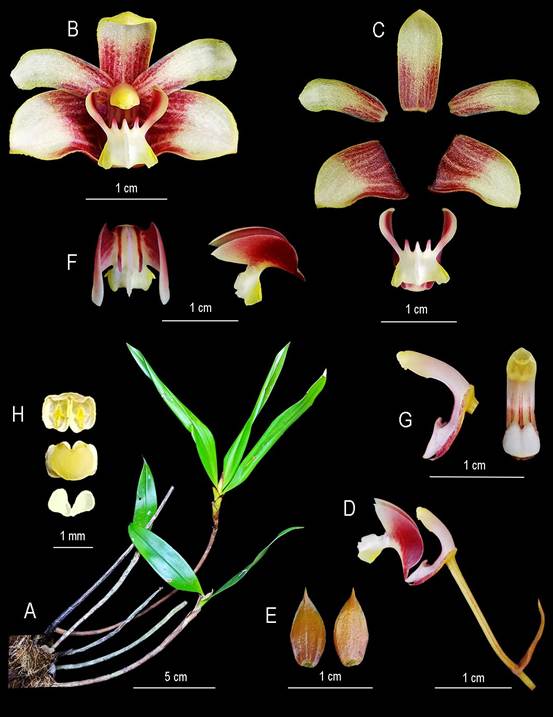
A. Habit.
B. Flower (front view).
C. Perianth dissected.
D. Column with lip, lateral view.
E. Floral bract.
F. Lip, upper-side and lateral view.
G. Column, lateral and front view.
H. Anther cap and Pollinarium.
Photos taken by Abdul R. Idris, correction and design by Zainudin base on ZBA137231222.
Figure 1 Eria compressoclavata (J.J.Sm.).
Epiphytic perennial herb, creeping rhizome, branched. Stems elliptic at the base, ca. 3 cm bearing stem apart, an acute angle, club shape, oblong to elliptic in cross-section, ca. 6-38 × 0.5-1.0 cm. Leaves exist only at the upper part of stems, carried 1-3 leaves, single formation, ca. 1 cm apart, lanceolate, somewhat oblique, acute apex, ca. 6-11 × 1.5-2.0 cm, sessilenarrow at the base, short petioles under 3 mm, green to lime green, entire margin, the veins scarcely conspicuous, glabrous. Inflorescence spread from the stem close to the apex, nodding, single flowers with very short peduncles, under 3 mm. Flower bract single, dark orange, ca. 8-9 × 5-6 mm, entire margin, attenuate apex, glabrous, flower widely opened, about ca. 2.5 cm, concave. Ovary straight, grooved, 13-15 mm long, orange to yellowish, darkening toward the base. Dorsal sepal oblong, narrow at the base, shortly and obtuse apiculate, concave around ca. 10 × 4 mm, reddish to dark red at the base, pale yellow from the middle to the apex. Lateral sepal trapezoid, obtuse, about ca. 10 × 8 mm, curve close to the base, reddish to dark red at the base, pale yellow from the middle to the apex. Petals oblique obovate-oblong, rounded, around ca. 10 × 5 mm broad, dark red at the base, yellowish from the middle to the apex. Lip trilobed, recurved 90 degrees in the center, with tree ridges between the side lobes, the middle one much taller, mainly white with some pale yellow suffused with red between the side lobes and some purple on the ridges, side lobes erect, narrowly falcate-triangular, acute, much longer, than the mid-lobe, reddish with yellowish close to the margin, 1 cm from the base to their apices, mid-lobe smaller, shallowly trilobed, the lobules rounded, pale yellow and white to the middle, ca. 10 × 5 mm. Column curved, ca. 12 × 3 mm, concave rounded shaped, yellowish to reddish streaks from apex to the base. Anther cap ca. 1 mm, bright yellow and pale-yellow inside. Pollinia in four pairs, pale yellow, less than 1 mm in size.
Examined materials: INDONESIA. Bangka: L!-image L. 0059847; L!-image L. 0059848. Central Kalimantan: Palangka Raya, Puruk Cahu, Kelasin, Sapat Hawung Nature Reserve, 800-1000 m, October 2023, YRY018SH (dried and spirit: CEB!). South Kalimantan: Tanah Bumbu, HRB-Mangkalapi, Eastern of Mts. Meratus. 77 m, 22 December 2022, ZBA137231222, ZBA138231222 (dried specimen: WAN!). Sumatra: Bangka Soengai Liat, S. Boei, 27 October 1917 (L!-image L. 1510506). West Kalimantan: Bukit Baka Bukit Raya National Park, Sintang, Serawai, Rantau Malam, Soa Tohutung, 1400-1600 m, 02 July 2024, YRY0450BR (dried and spirit specimen: WAN!).
Distribution: Previously known only from Sungai Liat, Bangka Island (500 m), and considered endemic to Sumatra. Range extension includes: Mts. Meratus-HRB Mangkalapi, Tanah Bumbu, South Kalimantan (<100 m), Sapat Hawung Nature Reserve, Central Kalimantan (800-1000 m), and Bukit Baka Bukit Raya National Park, West Kalimantan (1400-1600 m) (Fig. 4).
Habitat and ecology: In Sumatra, it grows at an elevation of 500 m. In Kalimantan, it is found in lowland hill forests, secondary forests, and disturbed dipterocarp forests below 100 m, as well as highland primary forests up to 1600 m. It grows as an epiphyte on Artocarpus sp. (Moraceae) and Garcinia sp. (Clusiaceae), with most individuals observed growing 5-15 m above the ground in the tree canopy.
Phenology: Flowering in the wild all year round. Seed pods not seen.
Notes: J.J. Smith (Comber, 2001) suggested that this species closely resembled Eria neglecta Ridl., a widespread species (Borneo, Malaya, Sumatra, and Thailand) (POWO, 2024), but differed in its thicker stems, number of leaves, larger flowers, and non-lanceolate sepals. He considered it more similar to Eria nutans Lindl., though distinguishable by the colour of the flowers and lip shape: E. nutans has predominantly pink flowers with obtuse lip side lobes, while Eria compressoclavata shows mostly yellowish flowers with acute lip side lobes. Ormerod (2014) proposed placing this species in section Nutantes Ridl. along with other seven species, due to its distinct characteristics, such as having one or a few leaves clustered near the stem apex, vs. spread along the stem, pseudoterminal vs. axillary inflorescence of 1-2 flowers.
Oxystophyllum cuneatipetalum (J.J.Sm.) M.A.Clem., Telopea 10: 277. 2003. Dendrobium cuneatipetalum J.J.Sm. Bull. Jard. Bot. Buit, ser. 3, 9: 157. 1927. Aporum cuneatipetalum (J.J.Sm.) Rauschert. Repert. Spec. Nov. Regni Veg. 95 (7-8): 439. 1983.
TYPE: Indonesia. Sumatra: West Sumatra, Ranau, G. Pakiwang. Alt. 1300 m. Steenis, 3823 (holotype, L!) (Fig. 2).
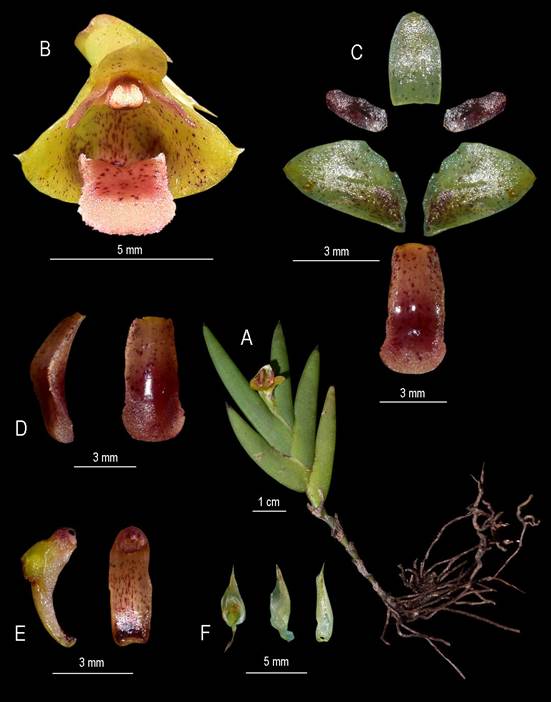
A. Habit and Inflorescence.
B. Flower (front view).
C. Perianth dissected.
D. Lip, lateral dan back view.
E. Column, lateral dan front view.
F. Floral bract, front, lateral, and back view.
Photos taken by Yuda R. Yudistira, correction and design by Zainudin base on ZBA207251222.
Figure 2 Oxystophyllum cuneatipetalum (J.J.Sm.).
Rhizomes stem-like, freely branching. Stems ca. 2-6 mm apart, flattened, thin basally, leafy to ca. 15 cm long, thickened towards the apex. Leaves close together, imbricate, the upper edge ca. 2.6-3.2 cm, the lower ca. 3.1-3.7 × 0.6-0.8 cm broad, their free apices ca. 1.5 cm long. Inflorescence axillary and terminal, nodding. Flowers fleshy, ca. 0.8-0.9 cm × 0.7-0.8 cm, pale yellow green. Floral bract triangular ovate 0.4-0.5 cm × 0.2-0.3 cm, acute in the apex, pale yellow green. Ovary terete, short ca. 0.2-0.3 cm long, green. Dorsal sepal recurved in the middle, oblong, obtuse, shortly apiculate, ca. 0.5 × 0.2-0.3 cm, suffused with dull purple apically. Lateral sepals forming a conspicuous conical, obtuse mentum at the base, which is 4 mm long and obliquely triangular, their apices recurved, ca. 0.5-0.6 × 0.5 cm broad at the base, pale yellow to yellowish. Petals small, wedge-shaped from the base, obliquely oblong and a slightly undulate, their apices broadly obtuse, erose and dull purple, 0.3-0.4 × 0.1-0.2 cm, dark red to purplish. Lip erect, recurved just below the middle, not lobed, oblong, fleshy, 0.5-0.6 × 0.2-0.3 cm, the apical part with thin margins which are strongly recurved, rugose, margins erose and hairy, its surface wrinkled, warty and a small conical tooth underneath, red to brownish. Column oblong, 0.5 × 0.15-0.20 cm. Anther cap cucullate, 0.1 × 0.1 cm, purple. Pollinia not seen.
Examined materials: INDONESIA. South Kalimantan: Tanah Bumbu, HRB-Mangkalapi, Eastern of Mts. Meratus. 77 m, 25 December 2022, ZBA207251222 (dried specimen: WAN!). Sumatra: Ranau-Mt. Pakiwong, Steenis 07 November 1929 (L!-image L.1498398). West Sumatra: Barisan Range-Road Tapa, Sinjai, Vogel 11 March 1974 (L!-image L.1498397).
Distribution: Previously only known native to Sumatra, specifically in Bengkulu and the Barisan Range at an elevation of 1350 m. Distribution extension: Mts. Meratus-HRB Mangkalapi, Tanah Bumbu (<100 m) (Fig. 4).
Habitat and ecology: In Sumatra, it grows in heavily disturbed montane forest, approximately 35 m high, with an open canopy, abundant rattans (Calamus spp.) and undergrowth palms (Iguanura spp., & Pinanga spp.). It is found on mountain ridges in deep, clayey soil with stones, on steep terrain. In Kalimantan, it occurs in disturbed hill and secondary forests in the eastern part of the Meratus Mountains, at around 100 m elevation, in riparian areas, and as an epiphyte on Artocarpus spp. (Moraceae), hanging 8-10 m above the ground in the trees.
Phenology: Flowering all year round. Seed pods not seen.
Notes: J.J. Smith (Comber, 2001) noted that this species is well characterized within the section Oxystophyllum Blume, by its flower color, wedge-shaped petals, and the distinctly rugose, erose apical portion with have a tubercle-like projection underneath the apex of the fleshy lip, differentiating it from D. cuneatipetallum J.J.Sm., D. leonis (Lindl.) Rchb.f., and D. prostratum Ridl.
Plocoglottis quadrifolia J.J.Sm. Bull. Jard. Bot. Buitenzorg ser. 3, 8: 36. 1926.
TYPE: Indonesia. Sumatra: Agam, Boekit Batoe Banting, Groeneveldt 873 (holotype, L!) (Fig. 3).
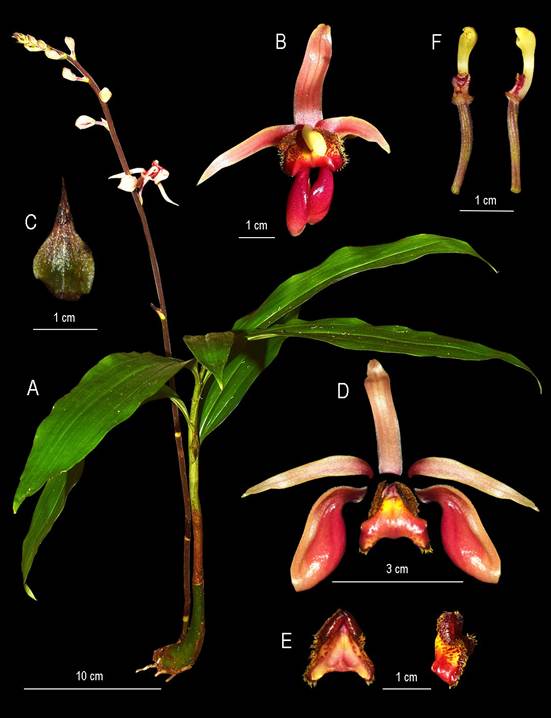
A. Habit.
B. Flower.
C. Floral bract.
D. Perianth dissected.
E. Labellum, adaxial and lateral view.
F. Column, front and lateral view.
Photos, correction and design by Zainudin base on ZBA256270222.
Figure 3 Plocoglottis quadrifolia (J.J.Sm.).
Terrestrial perennial herb, evergreen, cylindrical stems reed-like, 2-4 stem per clump, ca. 25-30 × 2-4 cm, ca. 1.3-3.0 cm in diameter. Leaves exist in the half to the apex of stem, sheathing leaves covered lower stems, 4-6 leaves per stem, lanceolate-elliptic, acute acuminate at the apex, entire margin, glabrous, parallelodromous, blades ca.16-23 × 2.5- 5.0 cm, short petioles ca. 1 cm long, pale green to dark green. Inflorescence monopodial, raceme, pubescence cylindrical peduncle ca. 50-60 cm × 4-5 mm, carried 10-11 bud flowers, rising from the base of stems, dark-brown with greenish close to the top, brown-black in lower side, taller than leavy shoots, 2-4 sterile bract, clustering, ca. 3-4 × 3 mm, concave and openly wide, pale green to reddish, lanceolate-oblong, attenuate at the apex, glabrous to hairy. Floral bract ovate to lanceolate, attenuate at the apex, ca. 8 × 2 mm, pale green sometimes purplish, rachis ca. 1-12 cm long, flowers opened from based to the top, 1-3 flowers opened in time, mostly pink-yellowish and bright reddish in some part of lateral sepals and labellum, pubescence. Ovary straight, twisted, and grooved, ca. 1.5 cm long, densely pubescent, reddish green with a slender shape. Dorsal sepal lanceolate, ca. 25-27 × 4-5 mm, outside densely pubescence, acute, entire, with 3 dominant veins, pale pink yellow in coloration. Lateral sepal ovate-lanceolate, ca. 16-19 × 6-8 mm, outside densely pubescence, acute, entire, with 5 dominant veins, pale pink in the abaxial side, pink-bright reddish in the adaxial, and curve at the middle to apex. Petals narrowly lanceolate, ca. 15 × 5 mm, glabrous, acute, entire, 3 dominant veins, pale pink-yellowish, dark red at the apex. Lip quadrangular, narrowed towards the base, 3 lobed in the apical half, midlobe reflexed to apical tooth, sidelobe triangular, ca. 12 × 10 mm, united with column, fimbriate margin, glabrous, obtuse, bright yellow-red coloration, in the adaxial side paler in coloration, sometimes with red mart at the base, margin darker with yellow fimbriate. Column straight, ca. 1 cm long, bright yellow rostellum a short blunt beak.
Examined materials: INDONESIA. South Kalimantan: Tanah Bumbu, Teluk Kepayang, Tibarau Panjang, Eastern part of Mts. Meratus. 18 m, 27 February 2022, ZBA256270222 (dried specimen: WAN!). Sumatra: W.K. Agam, Boekit Batoe Bintang, Groeneveldt (L!-image L.0062347). THAILAND. Thailand peninsula, Nokhon si Thammarat, Khao Long Foot Hills, Geesink & Santisuk, 16 May 1973 (L!-image L.1531634); Put N., 02 June 1927 (P!-image P00387167); VIETNAM. Nuraliev 30 May 2014 (MW!-image MW0735492).
Distribution: Previously recorded only from a few locations: Bukit Batu Banting, Agam and Kampung Susuk North Sumatra (850 m) Sumatra. Distribution extension: Mts. Meratus, Tibarau Panjang, Teluk Kepayang, Tanah Bumbu (18-59 m), Tabalong-Jaro around 400 m a.s.l. (Fig. 4).
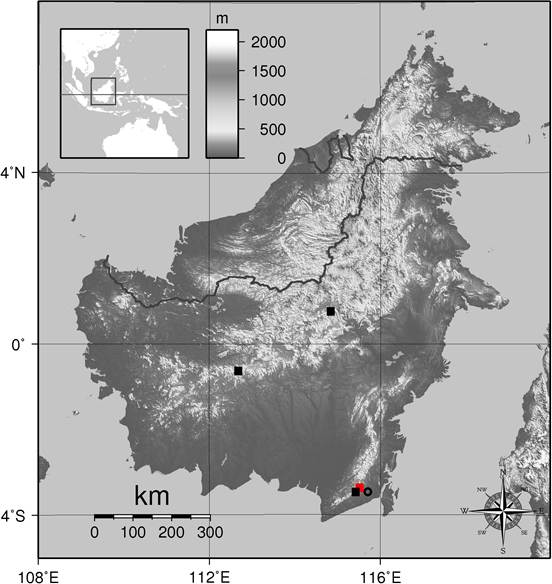
Map generated from https://commons.wikimedia.org
Figure 4 Distribution map of three Sumatran orchids in Kalimantan: Eria compressoclavata J.J.Sm. (black square), Oxystophyllum cuneatipetalum J.J.Sm. (red square), Plocoglottis quadrifolia J.J.Sm. (black circle).
Habitat and ecology: In Sumatra, it is found in rock crevices, disturbed evergreen forests, and along waterfalls, as well as in lower hills up to 500 m. In Kalimantan, it inhabits karst/limestone environments, characterized by warm, dry, evergreen forests. They grow in habitats covered by leaf litter, from 18 to 400 m of elevation.
Phenology: Previously recorded flowering in May, but we have observed flowering in January, February, and October. Seed pods have not been seen.
Notes: This species is easily distinguishable from others by its reed-like stems bearing several leaves, long straight dorsal sepal, and fimbriate labellum margins. It is morphologically similar to Plocoglottis lowii Rchb.f., but differs vegetatively: reed-like stems versus narrow-conical pseudobulbs, and green versus purple coloration of the plant.

