




 English (pdf)
 Article in xml format
 Article references
 Automatic translation
 Send this article by e-mail
 Cited by SciELO
  Similars in
SciELO
Similars in
SciELO  uBio
uBio 
 Permalink

Introduction
The Neotropical orchid genus Aa Rchb.f. occurs in Costa Rica and throughout the Andean region, from Venezuela to northern Argentina. The genus is characterized by its inflorescences with an elongated peduncle completely enclosed by many hyaline, imbricating sheaths, sub-dense to dense cylindrical spikes of tiny, non-resupinate, protandrous flowers that rarely exceed one centimeter in length (including the ovary). The floral bracts are hyaline to diaphanous, and the ovary may be glabrous to pubescent. The flowers have straight or spreading lateral sepals, a reflexed dorsal sepal and petals, and a calceolate or globose lip that conceals the short column with an erose, denticulate, or lacerate margin (Szlachetko & Nowak, 2014; Trujillo & Vargas, 2011).
According to the literature and field notes on herbarium labels, the flower color of Aa species has mainly been described as white, whitish, white and green, and brownish white. However, there are also some species with orange or dark green and brown flowers (Martín, Zanotti & Scrocchi, 2020; Trujillo & Vargas, 2011)
Despite several recent studies documenting new populations, describing new species, and transferring species wrongly placed in Aa to Myrosmodes Rchb.f. (Martín et al., 2020; Szlachetko & Kolanowska, 2014; Szlachetko & Novak, 2014; Trujillo & Delgado Rodriguez, 2011; Trujillo & Vargas, 2011), the genus Aa remains poorly understood. The taxonomic circumscriptions of most accepted species remain unclear, and several populations may represent undescribed species. So far, excluding the basionyms of species now placed in Myrosmodes, 29 names are referable to Aa.
Many Aa specimens remain unidentified or misidentified in herbaria; for example, in Peruvian herbaria, specimens with different floral features, which clearly represent different species, have been identified as Aa paleacea (Kunth) Rchb.f. or Aa mathewsii (Rchb.f.) Schltr.
Recent botanical surveys conducted in the departments of Lima and San Martín, Peru, led to the discovery of a new species of Aa with dark green flowers (Fig. 1). Additional specimens of the new species were located at USM, and photographic records are also available in iNaturalist (2024).
Based on the revision of type material and the protologues of other species of Aa with dark green flowers previously described from Argentina and Colombia, we determined during our studies of the new species of Aa from Peru that Aa tenebrosa C.M.Martín & Scrocchi is a synonym of Aa hieronymi (Cogn.) Schltr., that Aa nigrescens Schltr. is a distinct species from A. leucantha (Rchb.f.) Schltr. (proposed by Garay, 1978), and that A. lehmannii Rchb.f. ex Szlach. & Kolan. is an illegitimate, superfluous name for A. leucantha (Shenzhen Code Art. 52.1 in Turland et al., 2018).
Material and methods
Fieldwork was carried out in 2023 in Lima and San Martín departments, Peru. Notes on the habitat and phenology, as well as detailed photographs of the vegetative and floral details of the new species, were taken in situ. Specimens were deposited at herbaria HOXA, HSP, KUELAP, and MOLF. Additional specimens of Aa were examined at USM. Flowers preserved in 70% ethanol or rehydrated flowers from herbarium specimens were examined and drawn under a stereomicroscope. Measurements were made on the herbarium specimens -exsiccata- and the alcohol-preserved flowers.
The relevant literature on the genus Aa was revised, including the protologues of all previously described species of Aa, floristic and taxonomic treatments, and other works that include descriptions and illustrations of this group (e.g., Garay, 1978; Schweinfurth, 1958). Flower sketches were digitized and processed with Paint.NET v 5.0.13. A map was prepared with SimpleMappr and edited with Paint.NET v 5.0.13.
Additionally, specimens were physically reviewed at AMES, K, NY, and W. High-resolution digital images of the specimens housed at CORD, F, G, GOET, and SI were examined through the online platforms Catalogue des herbiers de Genève (CHG, 2023), Field Museum’s online Botanical Collections Database (F, 2023), JSTOR Global Plants (JSTOR, 2023), and Repositorio Digital UNC Herbarios (UNC, 2023).
The conservation status of the new species was assessed using the IUCN criteria (IUCN, 2012, 2024), based on estimates of the Extent of Occurrence (EOO) and Area of Occupancy (AOO), both calculated through the GeoCat Geospatial Conservation Assessment Tool (Bachman et al., 2011).
Taxonomic treatment
Aa olivacea D.Trujillo, Rob.Fern. et Edquén, sp. nov. (Fig. 1 - 3).
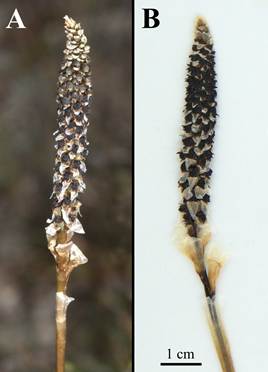
A. In habitat.
B. Pressed and dried.
Photographs by A. A. Wong Sato (A) and D. Trujillo (B).
Figure 1 Inflorescence of Aa olivacea (from Fernandez-Hilario et al. 2459, HOXA-083298).
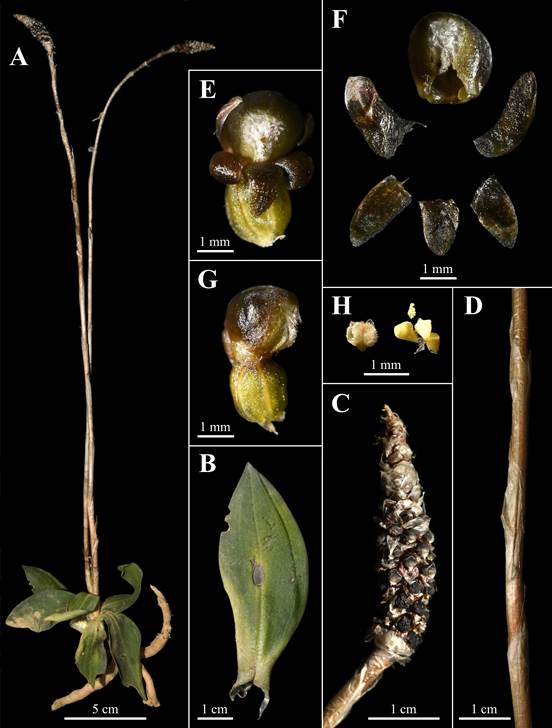
A. Habit.
B. Leaf.
C. Inflorescence.
D. Peduncle.
E. Flower, front view.
F. Dissected perianth.
G. Lip and ovary, side view.
H. Anther and pollinarium.
Photographs by J.D. Edquén.
Figure 2 Aa olivacea (from Edquén 6943).
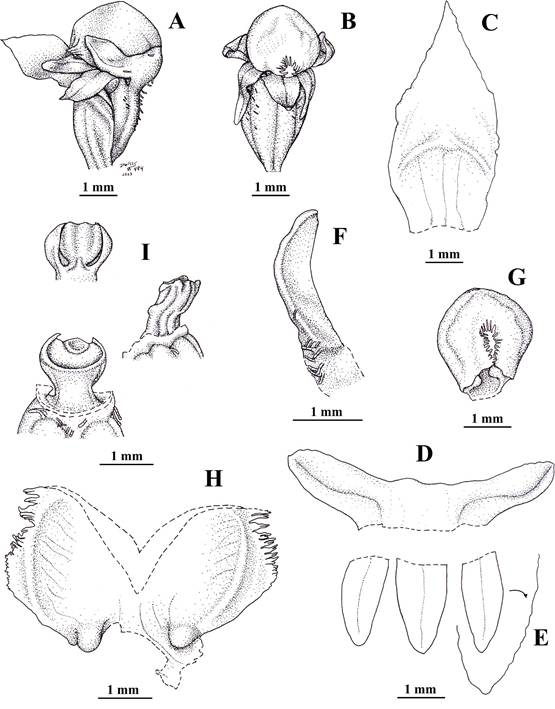
A. Flower, side view.
B. Flower, front view.
C. Floral bract.
D. Dissected perianth.
E. Detail of petal margin.
F. Lateral sepal, dorsal view.
G. Lip, adaxial view.
H. Lip spread out, adaxial view.
I. Column, dorsal, side and front view.
Drawing by D. Trujillo, based on Fernandez-Hilario et al. 2459, MOLF000170.
Figure 3 Aa olivacea.
TYPE: Peru. Department of Lima: province Oyón, district Oyón, laderas frente a Oyón, 3740 m, 16-22 May 2023, R. Fernandez-Hilario, A. A. Wong Sato, I. Revilla. K. Bernabé, & M. Zea 2459 (holotype: HOXA-083298!; isotypes: MOLF000170!, HSP!).
Diagnosis: Aa olivacea is similar to Aa hieronymi (Cogn.) Schltr., from which it can be distinguished by having elliptic to lanceolate leaves, 60-100-flowered spikes, glabrous rachis, olive green to chestnut brown flowers, lateral sepals with the margin entire to occasionally minutely erose near the apex, petals with slightly erose to sinuate apical margin, lip unlobed, and ovary with scarce hairs.
Plant terrestrial, small, 28-50 cm tall. Roots fleshy, fasciculate, to 7 cm long, 3.5-6.0 mm in diameter. Leaves withered or green at flowering time, forming a basal rosette; conduplicate, sheathing the stem, blade elliptic to lanceolate, acute, 6.0-6.2 × 1.1-2.5 cm. Inflorescence erect, 27.0-48.5 cm long; peduncle terete, 3-5 mm in diameter, enclosed by 10-19 translucent, whitish sheaths with brown veins, these tubular-infundibuliform with ovate to lanceolate, acute to acuminate free apical portion; spike dense, 3-6 cm long, 0.6-1.0 cm in diameter, with 60- 100 flowers opening in succession; rachis glabrous. Flowers non-resupinate, protandrous; sepals and petals chestnut brown to olive green with cream to light brown apex, lip dark chestnut brown with olive green with a light olive green and creamy white margin, 3-5 mm long (including the ovary). Floral bracts translucent brown with cream white apex, broadly elliptic, ovate to lanceolate, acute, distal margin somewhat irregularly erose, 4.2-7.5 × 2.4-3.7 mm, exceeding the length of the flowers. Ovary olive green to greenish brown, sessile, obovoid to cylindric, with scarce hairs mainly near its junction with the lateral sepals, 1.2-2.6 × 0.9-1.9 mm. Dorsal sepal reflexed, ovate to oblong, obtuse, 1-veined, 1.4-2.9 × 0.9-1.3 mm. Lateral sepals spreading almost horizontally in mature flowers, perpendicular to the floral axis, obliquely oblong to lanceolate, obtuse, margin entire to occasionally minutely erose near the apex, shortly connate by <1 mm at base, dorsally with scarce hairs at base, 1-veined, 2.0-3.0 × 0.9-1.0 mm. Petals reflexed, ovate to oblong or elliptic, obtuse, distal margin slightly erose to sinuate, 1-veined, 1.6-2.1 × 0.6-1.0 mm. Lip globose, oblate in side view, slightly inflexed, shortly unguiculate, unlobed, with a fleshy disc and a narrow opening, the margin lacerate to erose, base with two spherical calli, 1.4-2.4 mm long, 1.8-2.7 × 3.9-4.9 mm when spread out. Column short, olive green and brownish, thickened above, straight in young flowers and slightly bent backward in old flowers, 0.75-1.40 × 0.73-1.35 mm. Anther dorsally brown with cream-white margins, erect, subquadrate, 0.5-0.8 × 0.60-1.05 mm. Pollinarium made up of 4, cream yellow, clavate pollinia, united apically to a translucent white, drop-like viscidium. Stigma subrectagular to transversely elongate, 0.45-0.63 × 0.60-1.00 mm. Fruit an ellipsoid capsule, 3.0 × 2.5-2.7 mm.
Paratypes: Peru. Departamento de San Martín: provincia de Rioja, distrito Pardo Miguel Naranjos, Bosque de Protección Alto Mayo, sector Chisquilla en orientación al Cerro Campanario o Siete Lagunas, 3348 m, 1 Abr 2023, J. D. Edquén, K. Edquen, M. Enco & E. Yrigoín 6943 (KUELAP-004023!). Departamento de Lima, provincia de Cajatambo, distrito Copa, Anexo Huayllapa, 3690 m, 2 Ago 2017, H. Beltrán, S. Castillo & S. Rivera 8220 (USM-305454!). Departamento de Pasco: provincia de Pasco, distrito Huariaca, Fundo Chaprin, 3200 m, 19 May 2012, S. Baldeón, S. Baldeón & J. Baldeón 7536 (USM-289632!).
Other records: Peru. Department of Ancash: province of Bolognesi, -10.127985° lat., -77.177197° lon., 14 Jun 2015, R.Ripley s.n. (Ripley, 2015a); province of Bolognesi, -10.127963° lat.; -77.177267° lon.,14 Jun 2015, R. Ripley s.n. (Ripley, 2015b); province of Bolognesi, -10.17151° lat., -77.337193° lon., 16 Jun 2015, R. Ripley s.n. (Ripley 2015c); Department of Lima, province of Cajatambo, -10.359417° lat., -76.961656° lon., 21 Jun 2023, Chauncey s.n. (Chauncey, 2023).
Etymology: From the Latin olivaceus, referring to the olive-green color of the flowers.
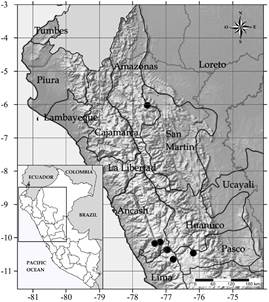
Distribution: Known only from the Peruvian Andes, in the Ancash, Lima, Pasco, and San Martin departments, at elevations of 3200 to 3740 m (Fig. 4).
Habitat and ecology: Terrestrial in wet grasslands (jalca) and shrublands, among rocks on stony hillsides (Fig. 5A-B). In the San Martin location, the grassland reaches 50 cm height, with abundant ferns and Puya sp. (Bromeliaceae), scattered shrubs of Brachyotum sp. (Melastomataceae), Senecio sp. (Asteraceae), and herbs such as Gentiana sp. (Gentianaceae), Rockhausenia nubigena (Kunth) D.J.N.Hind (Asteraceae), and orchids of the genera Elleanthus C.Presl, Pachyphyllum Kunth, and Stelis Sw. in rocky areas. At Oyón, Lima, the species was recorded in shrublands on slight to moderate slopes dominated by Alonsoa meridionalis (L.f.) Kuntze (Scrophulariaceae), Austrocylindropuntia subulata (Muehlenpf.) Backeb. (Cactaceae), Baccharis buxifolia (Lam.) Pers., B. tricuneata (L.f.) Pers. (Asteraceae), Monnina salicifolia Ruiz & Pav. (Polygalaceae), Proustia berberidifolia (Cuatrec.) Ferreyra (Asteraceae), and Satureja revoluta (Ruiz & Pav.) Briq. (Lamiaceae).
In the population of Lima, we observed a cellophane bee, Colletes sp. (Colletidae), visiting the flowers of A. olivacea. The bee apparently searched for nectar by inserting its proboscis into the lip of the flower (Fig. 5C-D). Celophane bees have also been recorded visiting flowers of Aa weddelliana (Rchb.f.) Schltr. in Lomas de Amara, department of Ica, Peru (D. Trujillo, pers. obs.). These floral visits, along with the evidence of protandry from anatomical studies of Aa erosa (Rchb.f.) Schltr. (Trujillo, Franke & Agerer. 2011), suggest that A. olivacea may be a cross-pollinating species.
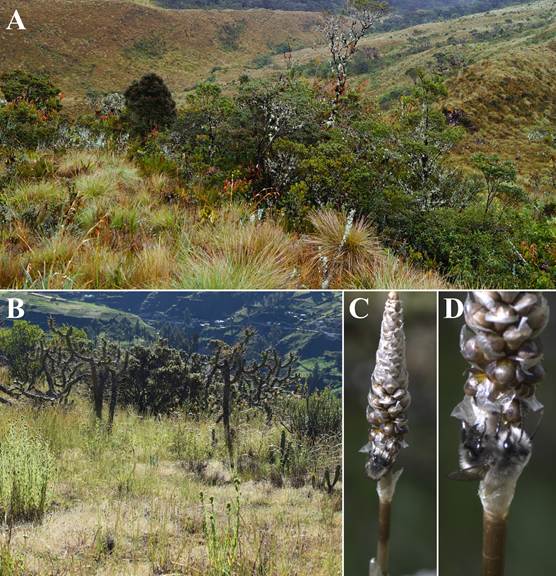
A. Habitat in San Martin.
B. Habitat in Lima.
C. Cellophane bee visiting flowers.
D. Cellophane bee inserting its proboscis into the lip.
Photographs by J.D. Edquén (A), R. Fernandez-Hilario (B) and A. A. Wong Sato (C, D).
Figure 5 Aa olivacea.
Phenology: Flowering occurs in the field from April to August. Developing capsules were observed at the bottom of the spikes in all the specimens examined.
Conservation status: Aa olivacea is endemic to the central-northern Peruvian Andes. It is known from six locations: five in the central departments of Ancash, Lima, and Pasco, and one in the northeastern department of San Martin. The main threats to the species are habitat loss and degradation due to land conversion for agriculture, overgrazing, and the traditional practice of burning of grasses on hillsides by farmers (Roman et al., 2024). Two of the populations were recorded within protected areas: Bosque de Protección Alto Mayo and Private Conservation Area Huallapa, which are expected to effectively protect the habitat of these respective populations. Based on the six known locations, the estimated Extent of Occurrence is 31,176.781 km2, but the Area of Occupancy is only 28 km2. However, considering the large areas of potential habitat between the central and northern populations, further research is expected to record new populations in the departments of Amazonas, La Libertad, and northern Ancash. Therefore, the species is assessed as Near Threatened (IUCN, 2012, 2024).
Taxonomic comments: The combination of morphological characteristics with the flower coloration makes specimens of A. olivacea readily distinguishable from those of all other species of the genus (Fig. 1-2). The olive green to chestnut brown color of its flowers turns dark brown to black when old and dried (Fig. 1B); whereas other Aa species, that have white, white and green or brownish white color flowers turns light brown to brown colors when old and dried; this feature distinguishes the species from others in herbarium collections. The new species is similar to A. hieronymi from northern Argentina (Fig. 6). Both species display dense spikes of dark green to brown flowers that turn black in old (and dried) flowers, with translucent, whitish floral bracts, lateral sepals spreading and perpendicular to the floral axis, and a globose, slightly inflexed lip. However, A. olivacea is recognized by its elliptic to lanceolate leaves (vs. linear-lanceolate), 60 to 100-flowered spikes, (vs. 7 to 25-flowered spikes), a glabrous rachis (vs. pubescent), olive green to chestnut brown flowers (vs. emerald green to brown), lateral sepals with the margin entire to occasionally minutely erose near the apex (vs. apical margin slightly serrate), petals with the apical margin slightly erose to sinuate (vs. apical margin slightly serrate), an unlobed lip with lacerate to erose margin (vs. obscurely trilobed lip with deeply laciniate margins), and ovary with scarce hairs especially in the distal half (vs. many hairs distributed over almost all the ovary).
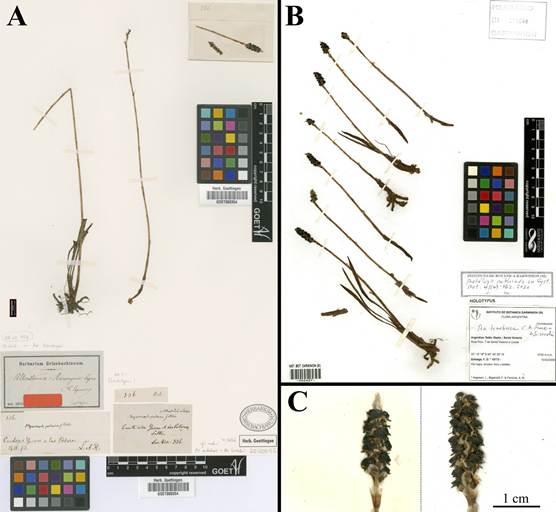
A. Lectotype of Aa hieronymi (GOET008354).
B. Holotype of Aa tenebrosa (SI092427).
C. Close-up of inflorescences of A. hieronymi (left) and A. tenebrosa (right).
Reproduced with the kind permissions of the herbaria of the University of Göttingen (A), and the Instituto de Botánica Darwinion (B).
Figure 6 Type specimens of Aa from Argentina.
Aa nigrescens also has a densely many-flowered spike whose flowers turn black upon drying; it was described by Schlechter (1920a) from Cauca, Colombia, based on Madero 26 (holotype: B destroyed, copy of an analysis based on the type drawing at AMES00000005!). However, this species has narrowly elliptic leaves, larger sepals (3.5-4.0 mm long), erect lateral sepals (i.e. not spreading), obliquely ligulate and larger petals (3.5 mm long), and erect, larger lip (ca. 4 mm long).
Comments on Other AA Species With Dark Green Flowers That Turn Black Upon Drying
Aa hieronymi (Cogn.) Schltr., Repert. Spec. Nov. Regni Veg. 11: 150. 1912.
Basionym: Altensteinia hieronymi Cogn., Fl. Bras. (Martius) 3(4): 245. 1895.
TYPE: Argentina. Province of Salta: cuesta entre Yacone y Potreros, Mar 1873, P. G. Lorentz & G. Hieronymus 336 (holotype: B, destroyed; lectotype (first step designated by Schlechter 1920c: 438, second step designated by Martín, Zanotti & Scrocchi 2020): GOET008354 (mixed) (photo seen); isolectotype: CORD 00002206 (photo seen)).
Aa tenebrosa C.M.Martín & Scrocchi, Syst. Bot. 45(4): 762. 2020. syn. nov.
TYPE: Argentina. Province of Salta: department of Santa Victoria, Ruta Provincial 7, de Santa Victoria a Lizoite, 22°16’18”S, 65°05’25”W, 3730 m, 15 Feb 2009, F. Zuloaga et al. 10773 (holotype: SI092427 (photo seen); isotypes: CORD (photo seen), CTES0043314).
Cogniaux (1895) described Altensteinia hieronymi citing seven specimens (syntypes): P. G. Lorentz & G. Hieronymus 336, P. G. Lorentz & G. Hieronymus 617, F. Schickendantz 264, G. Hieronymus s.n., G. Hieronymus s.n., G. Hieronymus 796, and O. Schnyder 598. Later, Schlechter (1912) transferred Altensteinia hieronymi to the genus Aa, and subsequently, Schlechter (1920b, c) proposed three new species based on various of Cogniaux’s (1895) syntypes: Aa achalensis Schltr. (G. Hieronymus 796), Aa lorentzii Schltr. (P. G. Lorentz & G. Hieronymus 617), and Aa schickendanzii Schltr. (F. Schickendantz 264). Schlechter explicitly designated the specimen P. G. Lorentz & G. Hieronymus 336 as the (lecto-)type of A. hieronymi and emended the species description, including some comments in German (Schlechter, 1920c). In the last lines, Schlechter pointed out: “… It is one of the few species in which the flowers take on a black color when dried”. Duplicates of the specimen P. G. Lorentz & G. Hieronymus 336 are housed at GOET and CORD, lectotype and isolectotype, respectively, as designated by Martín et al. (2020). The herbarium sheet GOET008354 has two attached specimens, with their spikes placed in the envelope in the upper right-hand corner of the sheet, each representing a different species (Fig. 6A). The specimen on the herbarium sheet that agrees with Schlechter’s description and annotation in German of A. hieronymi is the inflorescence on the left (the one bearing leaves), and its spike (within the envelope) is the one with a portion of the peduncle.
Martín et al. (2020) published a taxonomic revision of the genus Aa from the southern central Andes, including the description of A. tenebrosa, a new species from Argentina, based on F. Zuloaga et al. 10773 (Fig. 6B). They indicated that the dark or brownish green flowers of A. tenebrosa, in combination with other features, distinguish this species from other members of Aa. Nonetheless, it seems that Martin et al. (2020) overlooked Schlechter’s comment about the black flowers upon drying of A. hieronymi, similar to those of A. tenebrosa, as they did not mention it.
Aa tenebrosa shows all the features of A. hieronymi, except for having shorter peduncles. Both species have dense and short spikes with relatively few flowers (compared to other species of the genus), pubescent rachis, oblong and obtuse lateral sepals, and lobed, transversely elliptic lip when viewed from the side (in dried flowers; Fig. 6C). The lip of A. tenebrosa is 3-lobed (see color photograph of the type in IBODA, 2023), whereas Schlechter (1920c) described the lip of A. hieronymi as “sub 5-lobed” (probably and artifact during flower dissection). Due to the similarities noted above, we determined that A. tenebrosa is a synonym of A. hieronymi.
Aa leucantha (Rchb.f.) Schltr., Repert. Spec. Nov. Regni Veg. Beih. 7: 213. 1920.
Basionym: Altensteinia leucantha Rchb.f., Flora 69: 548. 1886.
TYPE: (north Ecuador, on moist, boggy ground on the Páramo del Mojanda, 3300 m, 28 Jan 1881. Lehmann 247) (holotype: W0302214/W-R 612!) (Fig. 7-8.)
Aa lehmannii Rchb.f. ex Szlach. & Kolan., Ann. Bot. Fenn. 51(5): 330. 2014. nom. illeg. superfl.
TYPE: Ecuador. Páramo del Mojanda: 3300 m. 28 Jan 1881, Lehmann 247 (“244” in error) (holotype: W0302214/W-R 612!).
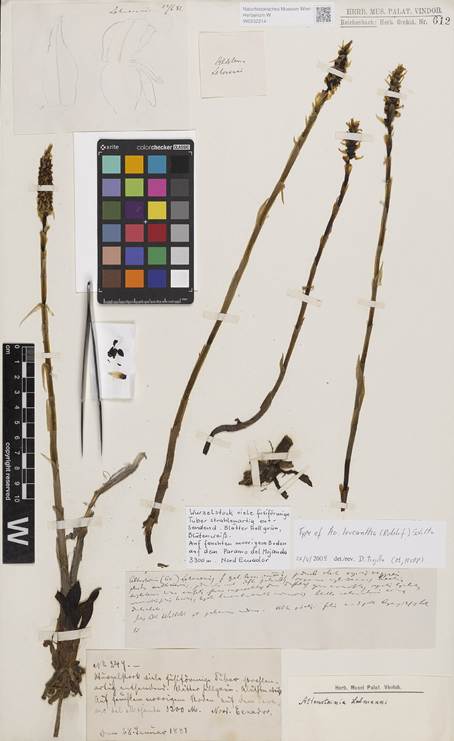
Reproduced with the kind permission of the Herbarium, Naturhistorisches Museum Wien.
Figure 7 Holotype of Aa leucantha (W0302214).
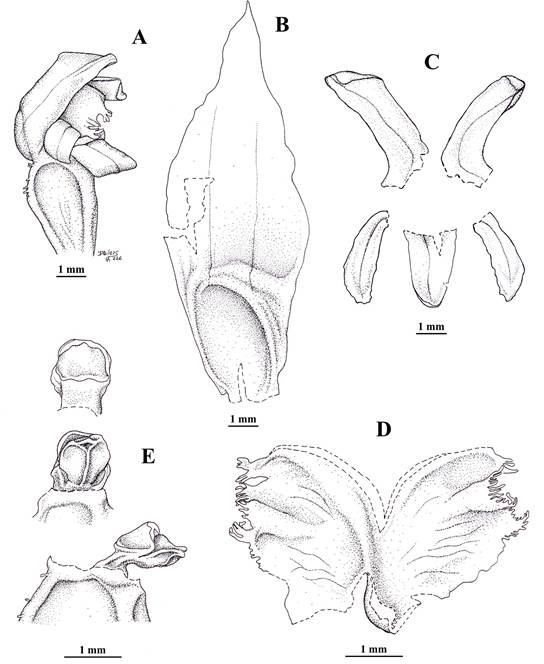
A. Flower, side view.
B. Floral bract.
C. Dissected perianth.
D. Lip, spread out.
E. Column, front, dorsal, side view.
Drawing by D. Trujillo, based on Lehman 247 (W0302214).
Figure 8 Aa leucantha.
In the protologue of Altensteinia leucantha Rchb.f. (the basionym of A. leucantha), Reichenbach did not indicate the specimen on which he based the description. However, in the Reichenbach herbarium at W, there is a sheet containing an Aa specimen (composed of four inflorescences), a flower illustration, and two (original) labels. One label, in F.C. Lehmann’s handwriting, bears the number “247” and collection data (Fig. 7). The second label, in Reichenbach’s handwriting, indicates: “Altensteinia (Aa) lehmanni (…)” followed by a description that agrees with the original description of Altensteinia (Aa) leucantha. Garay, in his work on Orchidaceae in Flora of Ecuador (1978), referred to the specimen Lehman 247 as the type of A. leucantha, and we agree.
Szlachetko and Kolanowska (2014) proposed Aa lehmannii, based on Lehmann 244, a specimen from Reichenbach’s collection at W. The illustration published in their Fig. 1, indicated as having been drawn by A. Kröl, was originally prepared by D. Szlachetko in February 2009. A copy of Szlachetko’s drawing, kept at W with collection number 2009-001251 (W-0302213)!, includes an annotation on the upper right-hand corner stating “WR-612”; which is, in fact, the Reichenbach Herbarium’s sheet number of specimen Lehmann 247, the type specimen of A. leucantha. Therefore, A. lehmannii is an illegitimate, superfluous name for A. leucantha because both names were based on the same specimen (Shenzhen Code Art. 52.1 in Turland et al., 2018).
Garay (1978) considered A. nigrescens a synonym of A. leucantha; however, we consider them to represent different species. Aa nigrescens can be distinguished by its flowers, which are drying black (vs. dark brown), an oblong to elliptic dorsal sepal 3.5 mm long (vs. ovate, 2.1-3.0 mm long), obliquely lanceolate lateral sepals (vs. obliquely obovate to oblong), obliquely ligulate petals with an entire margin (vs. obliquely elliptic to lanceolate or oblong with apical margin slightly erose to sinuate), and an obscurely pilose ovary from the middle to the apex (vs. sparsely pilose ovary only near its junction with the lateral sepals).

