




 English (pdf)
 Article in xml format
 Article references
 Automatic translation
 Send this article by e-mail
 Cited by SciELO
  Similars in
SciELO
Similars in
SciELO  uBio
uBio 
 Permalink
Introduction
Scaphosepalum Pfitz. is a genus in the subtribe Pleurothallidinae with up to 52 species generally accepted (Pridgeon 2005, Endara et al. 2011, Chase et al. 2015, Karremans 2016, Karremans et al. 2016). After Luer (1988), who recognized three sections and 30 species in his monograph, several new species have been described in the last twenty-five years (Luer 1991, 1992, 1997, 1998a, b, 2000, 2002, 2009, Valenzuela Gamarra 2015). The characteristic features of the genus are the osmophores at the base of the sepals and the non-resupinate flowers (Luer 1988, Pridgeon et al. 2005, Endara et al. 2011, Karremans et al. 2016). The peak of diversity of the genus is in the northern Andes, between Colombia and Ecuador. Preliminary phylogenetic studies show strong biogeographic components affecting the distribution and isolation of different taxa within Scaphosepalum (Endara, Williams & Whitten 2011). Some species seem to have wide ranges like Scaphosepalum breve (Rchb.f.) Rolfe or Scaphosepalum swertiifolium (Rchb.f.) Rolfe while others seem to be endemic to certain areas like Scaphosepalum dodsonii Luer, S. hirtzii Luer, or S. ursinum Luer (Luer 1988, Endara et al. 2011). The most recent phylogenetic study that includes Scaphosepalum suggests that the genus is related to Teagueia and close to Platystele (Karremans et al. 2016).
The north-west of Carchi province is one of the areas with high species diversity in Ecuador, where at least six species occur: Scaphosepalum decorum Luer & Escobar, S. cimex Luer & Hirtz, S. ophidion Luer, S. reptans Luer & Hirtz, S. swertiifolium and S. ursinum Luer (Luer 1988, 2009). A conspicuous new species of Scaphosepalum, found in the same area, close to Maldonado in Carchi, is described here.
Scaphosepalum zieglerae Baquero, sp. nov. (Fig. 1, 2 B, 3A-D ).
TYPE: Ecuador, Carchi, El Carmen - Chical road,
0°54’42.5”N 78°12’48.7”W, 1755 m, collected by Luis Baquero on 15 March 2016, LB 3026 (holotype, QCNE).
Diagnosis: Species with large plants and long, thin petiolate leaves, vegetatively similar to Scaphosepalum beluosum Luer from which it differs by the dark green, subplicate leaves instead of conduplicate, light green to green, a caudate apex of the leaf instead of subacute, the flexuous inflorescence with conspicuous acuminate bracts instead of non-flexuous with thin, tubular floral bracts, the ovary smooth instead of speculate, the tails of the sysnsepal fimbriate instead of ciliate-spiculate, and the dark blood-red, subpandurate lip instead of green dotted with purple, subpandurate-ligulate, with lateral lobes above the middle.
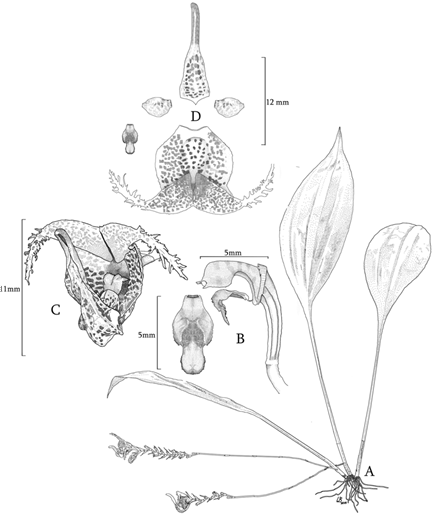
Figure 1 Scaphosepalum zieglerae Baquero. A, gabit. B, column and lip (the lip extended). C, flower. D, dissected flower. Drawn by L. Baquero from the holotype.
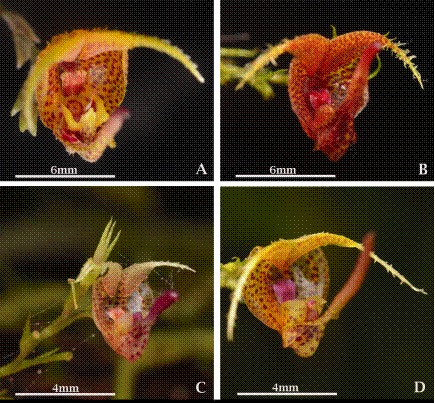
Figure 2 Different species of Scaphosepalum. A, S. beluosum. B, S. ziegleriae C, S. ophidion. D, S. reptans.
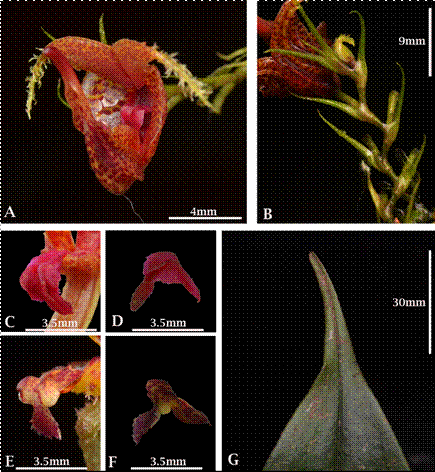
Figure 3 Scaphosepalum zieglerae flower and parts. A, flower. B, inflorescence and floral bracts. C, lip of Scaphosepalum zieglerae in ¾ position. D, lip of Scaphosepalum zieglerae, lateral view. E, lip of Scaphosepalum beluosum Luer in ¾ position. F, lip of Scaphosepalum beluosum Luer, lateral view. G, caudate apex and dark green color of the leaf of Scaphosepalum zieglerae.
Plant large, robust, epiphytic, densely caespitose, to 30 cm tall. Roots slender, 0.8 mm in diameter. Ramicauls erect, slender, 2-4 cm long, enclosed by 2-3 sheets. Leaf erect, thinly coriaceous, subplicate, longpetiolate, 20-35 cm long including the petiole 8-15 cm long, leaf apex caudate 2-3 cm long, the blade elliptical 4.0-6.5 cm wide, attenuate below into the slender, channeled petiole. Inflorescence a loose, flexuous, successively several to many-flowered raceme from low on the ramicaul, 12-20 cm long, each flower borne by a slender, faintly verrucose, horizontal peduncule 11-18 cm long; floral bracts thin, conspicuous, longer than the pedicel, conduplicate, acuminate, 9 mm long; pedicel 3-5 mm long, ovary ribbed, 5 mm long. Sepals waxy yellow, spotted with reddish brown to blood-red, ciliated margins, with dentate carinae, the middle sepal tricarinate, ovate and concave in the lower half, 14 × 4 mm in natural position, the apical half brownish red, narrowly tubular with revolute margins, the lateral sepals connate 10 mm into a bifid, oblong, concave lamina 6 mm unexpanded, the apical portion of each lateral sepal occupied by a thick, triangular, diverging, glabrous cushion 3.5 × 4 mm, continuous with the acute, oblique, diverging apex terminating in a decurved, fimbriate tail, the total length of each lateral sepal including the tail 16 mm long. Petals waxy yellow, spotted with red-brown, longitudinal callous medially, obliquely ovate, acute, slightly reflexed at apex, 4 × 3 mm, the labellar margin obtusely angled, the upper margin slightly dilated. Lip dark blood-red, oblong-subpandurate, reflexed near the middle, 5.0 × 2.5 mm, the epichile obtuse, ciliate to fringed at the edge, the disc with a pair of tall, erect, serrated lamellae above the middle, the hypochile rectangular, slightly concave, the base truncate, minutely bilobulate. Column red, semiterete, slender, 4.5 mm, broadly winged above the middle, with a thick foot 2.5 mm long. Pollinia 2, yellow. Fruits and seeds not observed.
Eponymy: Named after Susann Ziegler Annen, of Switzerland, important donor and promoter of Ecominga Foundation’s Dracula Reserve, Ecuador, who made it possible to purchase and protect large areas of primary forest hosting this new species and many other species.
Distribution: One population of Scaphotsepalum zieglerae has been found growing in primary cloud forest in north-western Ecuador. Plants found in two mountain ridges, close to each other, where they are fairly common between 1790m and 1850m of elevation, around km 7 of the Chical-El Carmen road in the province of Carchi, Ecuador.
Habitat and EcoLogy: Scaphosepalum zieglerae is found growing on the base of trunks of big trees in primary cloud forest at ~1800m of elevation. Large plants can be seen growing in very dark areas, where heavily filtered sunlight reaches the low understory of the forest. The dark, large leaves of S. zieglerae only compete in size with the big long-stem leaves of S. decorum. Other species of Scaphosepalum like S. cimex, S. decorum, S. ophidion, S. reptans and S. swertiifolum were found living in sympatry with this species.
Conservation status: The population of Scaphosepalum zieglerae is under protection of the Ecominga Foundation at the Dracula Reserve, close to the Cerro Colorado sector. Extensive exploration has been done around the area by the team of orchid specialists from Ecominga for almost a decade and no other populations have been found. The Blanco river and the almost vertical walls of the Pailon ridge could act as natural barriers perhaps limiting its distribution; it is possibly more restricted than other Scaphosepalum species (S. swertiifolium, S. decorum and S. ophidion) growing sympatrically, which are found in many other localities in Carchi and around Ecuador, and also in Colombia (Luer 1988, 2009). Perhaps more research in the field and in neighboring Colombia will lead to the discovery of new populations of S. zieglerae.
Scaphosepalum zieglerae is recognized among the species of Scaphosepalum by a unique combination of characters: the large, long petiolate, dark-green leaves, the caudate leaf apex and, specially, the flowers with spiky tails and dark blood-red colored lip (Fig. 1, 2 and 3). Scaphosepalum zieglerae looks superficially similar to S. beluosum, mainly because of the long petiolate plants and lateral inflorescences. In addition, it seems that S. zieglerae and S. ophidion could be related because they share long flexuous racemes with conspicuous acuminate bracts, fimbriate tails of the synsepal and the oblong-subpandurate lip (Fig. 1, 2). Scaphosepalum zieglerae shares with S. fimbriatum Luer & Hirtz the fimbriated sepaline tails, but it differs from the latter species by the size of the plants, the shape and length of the leaves, and the size and general morphology of the flowers.

