




 English (pdf)
 Article in xml format
 Article references
 Automatic translation
 Send this article by e-mail
 Cited by SciELO
  Similars in
SciELO
Similars in
SciELO  uBio
uBio 
 Permalink

Introduction
Orchids represent the largest family of flowering plants, with approximately 30,000 species (Chase et al., 2015). They grow in a wide range of habitats worldwide, mainly in tropical and subtropical regions and at elevations ranging from sea level up to 3000 m (Chase et al., 2003; Djordjević et al., 2022). This diversity and broad distribution have allowed orchids to play a significant role in various cultures throughout history, being used for medicinal, food, ornamental and ceremonial purposes (Cox-Tamay, 2013; Fonge et al., 2019; Góngora-Chin et al., 2016; Ibarra-Contreras et al., 2021; Lawler, 1984; Ossenbach, 2009; Rosete-Blandariz et al., 2019; Teoh, 2019). Despite the vast number of orchid species, a significant portion is lost each year due to the over-collection of specimens. This has led to a decline in wild populations, species extinction, and habitat degradation (Zhao et al., 2021).
Orchids are one of the most used groups of plants in Mexico (Cox-Tamay et al., 2016; Espinoza-Pérez et al., 2018; Jiménez-López et al., 2019), with around 1315 species and 170 genera, of which around 40% of which are endemic to the country (Castillo-Pérez et al., 2018; Gutiérrez-Rodríguez et al., 2022; Hágsater et al., 2005). Some orchids, such as Laelia autumnalis (Lex.) Lindl. and Oncidium sphacelatum Lindl., are frequently used as ornamental plants regularly incorporated into garlands, ornaments, and crafts for religious festivities in communities within the states of Veracruz and Guanajuato (Martínez-Morales et al., 2020). This has led to the excessive collection of these species, with reports indicating that more than 60,000 plants or parts of plants may be collected each year, depending on the species (Ticktin et al., 2023). Unfortunately, this collection often occurs without proper management or regulation (Espejo-Cruz et al., 2023). Another widely used orchid is Vanilla planifolia Andrews, from which vanillin is extracted for use as a flavoring and aromatic agent in the culinary industry. In addition, its flowers are in demand in the craft market, with V. planifolia being an important source of income for the rural communities of Mexico (Herrera-Cabrera et al., 2022; Luis-Rojas et al., 2020). The traditional uses and knowledge of orchids within these communities significantly shape their cultural identity. This knowledge is passed down through generations both within and between communities (Hernández-Mejía et al., 2024).
Understanding how different demographic groups value and utilize orchids is essential, as ethnobotanical knowledge can vary significantly among generations. Older individuals often possess a deeper, more traditional understanding of medicinal and edible plants, while younger individuals may be more influenced by globalization. Additionally, the appropriation of knowledge is affected by various multicultural factors (Kumar et al., 2021).
“El Cielo” Biosphere Reserve is a protected natural area located in the northeast of the country, renowned for its diverse ecosystems, including semideciduous forests, tropical montane cloud forests, pine-oak forests and submontane scrub (Sánchez-Ramos et al., 2005). The epiphytic orchids found in this reserve are particularly valuable for nature conservation because they are restricted to a limited number of habitats, showcasing a high degree of heterogeneity. They have the northernmost distribution in the Mexican transition zone, where the environments range from warm subhumid to dry climates (de la Rosa-Manzano et al., 2019).
Research conducted in this reserve has focused on describing the diversity patterns of epiphytic orchids within each type of vegetation. The studies indicate that the semideciduous forest and the tropical montane cloud forest host the highest diversity of epiphytic orchids (Lacaille-Múzquiz, 2005; de la Rosa-Manzano et al., 2019). Additionally, investigations into the traditional uses of orchids in family gardens by local communities have identified several species, including Isochilus linearis (Jacq.) R.Br., Lycaste aromatica (Graham) Lindl., Prosthechea cochleata (L.) W.E.Higgins and Stanhopea tigrina Bateman ex. Lindl., that are valued for their ornamental qualities. These studies also shed light on the processes of acquisition, transmission, and socialization of ethnobotanical knowledge within these communities (González-Romo & Gispert, 2005). Given the diversity of epiphytic orchids in the RBEC (de la Rosa-Manzano et al., 2017; de la Rosa-Manzano et al., 2019), we propose conducting a systematic analysis of the ethnobotanical significance of these orchids. Our goal is to obtain an updated overview of their use within local communities and to assess whether any species fall under a protection category. This information will serve as a baseline for implementing management and conservation strategies in collaboration with the communities (Menchaca-García et al., 2012).
We plan to (i) evaluate the traditional uses of epiphytic orchids in three RBEC communities, (ii) assess local perceptions regarding the importance of conserving these orchids, and (iii) identify any orchid species in the study area that are classified as protected.
We anticipate that if community members are aware of the richness of epiphytic orchids and have direct contact with the natural resources of the RBEC, they will attribute various uses to these orchids. These uses may differ based on gender and age. Additionally, if traditional knowledge is identified and shared among residents, we expect that interest in conserving the most valued species of epiphytic orchids in the study area will grow.
Materials and methods
Study area.- The “El Cielo” Biosphere Reserve (RBEC) is the most significant protected natural area in northeastern Mexico, celebrated for its diverse flora, wildlife, and ecosystems. It is located in the Sierra Madre Oriental, specifically in the regions known as Sierra de Cucharas and Sierra de Guatemala, covering an elevation range from 200 to 2200 m (Fig. 1). The study was conducted in three communities within the reserve: Alta Cima, Gómez Farías, and San José. Alta Cima has a population of 142 residents, comprising 47.9% women and 52.1% men, distributed across 38 families. Gómez Farías is the largest community, with a population of 854 residents (49.4% women and 50.6% men) living in 246 families. San José, the smallest community, has 66 residents, with 45.5% women and 54.5% men, residing in 21 families (INEGI, 2020). The levels of urbanization vary among the three communities. Gómez Farías is the most urbanized, with access to electricity, piped water, drainage, and the internet. Alta Cima is less urbanized, while San José is the least urbanized, relying on solar-powered electricity and having limited access to piped water (INEGI, 2020).
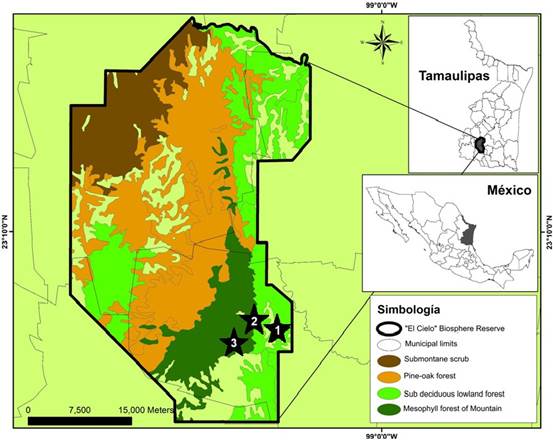
Figure 1 Location of the “El Cielo” Biosphere Reserve, Mexico. The three communities evaluated are indicated: 1. Gómez Farías, 2. Alta Cima and 3. San José. Map prepared by Vanoye Eligio V.
Ethnobotanical research.- In the Alta Cima community, a survey was conducted with 20 families (52.6% of the response rate), in San José with 21 families (100% response rate), and in Gómez Farías with 57 families (32% response rate) (INEGI, 2020, Fig. 1). The ethnobotanical survey focused on the community's knowledge, management and use of epiphytic orchids and involved one family member per household, with no age restrictions for participants. Informed consent was obtained and all responses were kept confidential.
The survey included four sections (seeAppendix 1): 1) Information about the interviewee, 2) General information about the plant, 3) Ethnobotanical information about orchids, and 4) Local perceptions regarding the conservation status of epiphytic orchids in the Reserve. The survey was validated using the expert panel validation method (INEE, 2019). Age categories were defined into five groups, ranging from 20 to 60+ years, with ten-year intervals. The data collected were compiled to create a database for further analysis.
Ethnobotanical data analysis.- The following ethnobotanical indices were determined according to Hussain et al. (2023):
Relative Frequency Citation (RFC): This is used to calculate the relative frequency of citations, using the local importance of each plant species (Birjees et al., 2022). It was calculated using the following formula:
Where FC is the proportion of informants who mentioned the use of a particular species. N represents the total number of informants. This index theoretically varies from 0, when no one refers to the plant as useful, to 1 in the unlikely case that all informants mention the use of the species.
Use value (UV): This index is used to find the relative importance of each species used locally. It combines the frequency of the species mentioned with the number of uses mentioned per species and is often used to highlight notable species of interest (Zenderland et al., 2019). It is calculated according to the following formula (Jan et al., 2021; Phillips et al., 1994):
Where ∑U is the number of uses each informant mentions for each species mentioned. It is higher when more uses of a species are reported and lower when fewer uses of a species are reported; n is the total number of informants interviewed for each particular species.
Informant Agreement Ratio (IAR): A metric used to evaluate how suitable specific plants are for each use category. It was determined using the following formula:
Where Nur is the number of mentions in each use category and Nt is the number of species mentioned in each category. The values range from 0 to 1.
Plant Part Value (PPV): The method proposed by Chaachuay et al. (2019) was used to find the relative value of the different sections of the specimens. The following formula was used:
Where RU represents the total number of plant uses (including all parts) specified by the informant, while Rupp represents the total number of uses for each given portion.
Analysis of data.- R software version 4.3.3 was used for statistical analyses. The Pearson Chi-square test (χ2) was applied to find possible differences between (i) gender of the informants in each community and among communities, and (ii) among age range of the informants of RBEC.
Because there is an imbalance in the number of interviews conducted in each community, a subsampling of the majority variable, “community” was performed. Specifically, 20 observations were randomly selected from the Gómez Farías community to match the number of observations in the minority group, creating a balanced model. Additionally, since the food and medicinal categories each recorded less than six observations, they were combined into the “other” category, resulting in two levels for the response variable: “other” and “ornamental”. A binomial logistic regression model with logit link function was used to evaluate the association between the response variable and the predictors “gender”, “community” and “age range” (20-30, 30-40, 40-50, 50-60 and 60+ ages).
The model was fitted using the glm function of the “Stats” package of the R software version 4.3.3. In the Alta Cima variable, women and 20-30 age range were not present as coefficients because they were taken as reference points, as well as ornamental use. The statistical significance of the predictors was evaluated by Likelihood Ratio Test, considering a significance level of α = 0.05. The ratio was obtained as the percentage of the predictor’s deviance with respect to null deviance.
Results
Of the total informants, 64% were women and 36% men (χ2= 8, d.f = 1, P < 0.05). Comparing the three communities, Gómez Farías had both the highest number of women interviewed (52%, 33 informants; χ2 = 10.6, d.f = 2, P < 0.05), and the highest number of men interviewed (68%, 24 informants; χ2 = 20.6, d.f = 2, P < 0.05). According to age range, RBEC informants between 50 and 60 years of age was highest with 33% (33 informants), followed by those who were between 30 and 40 years of age with 19% (18 informants), and both ranges of 20 to 30 and 40 to 50 with 16% (16 informants each); particularly, the smallest number of informants was the 60+ age range (15%, 15 informants) (χ2 = 11.7, d.f = 4, P < 0.05).
Uses of epiphytic orchids by communities.- We found that inhabitants of the RBEC used ten epiphyte orchid species (Fig. 2) for purposes such as ornamental, food, medicinal, and others (inspiration and tourism, which were considered as uses of orchids provided to society according to ecosystem service classification; Hernández-Mejía et al., 2024) (Table 1). The ornamental use of orchids stood out with 78% (80 informants), followed by other uses with 12% (10 informants), food with 6% (6 informants) and medicinal with 2% (2 informants) (Fig. 3A). In the analysis by community, Alta Cima stood out for ornamental use, which was 90%, and for other uses (inspiration/tourism) with 10% (Fig. 3B); in Gómez Farías the category of ornamental use was 85%, and other uses with 15% (Fig. 3C). Finally, in San José, four uses of epiphytic orchids stood out: ornamental with 60%, other uses with 28%, food with 7%, and medicinal with 5% (Fig. 3D).
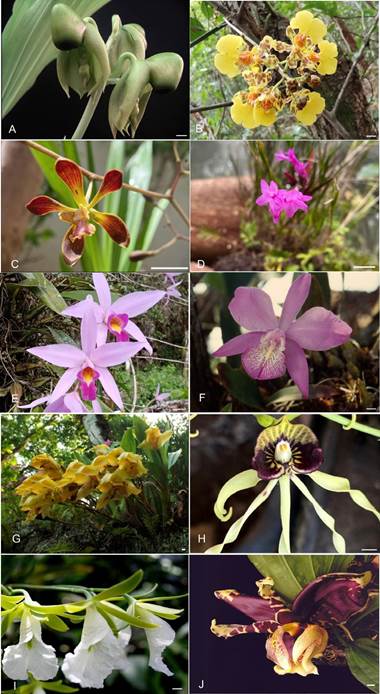
Photo credit: Diederick Antoni (A), Julieta Hernández (C & H), Edilia de la Rosa (B, D & G), Wilfrido Rodríguez Pérez (J), Antonio Guerra (E & F). Illustration assembled by Julieta Hernández.
Figure 2 Total species reported in the study.
Table 1 Ethnobotanical data of epiphytic orchids mentioned in the surveys carried out in the “El Cielo” Biosphere Reserve.
| Scientific name | Local name | Used part | Ethnobotanical use in RBEC | Other reported uses outside the study area |
|---|---|---|---|---|
| Catasetum integerrimumHook. | Monjito | Complete plant | Orn, Other | Pseudobulbs used to cure tumors; treatment of kidney, gastrointestinal diseases and diabetes mellitus (Castillo-Pérez, 2023; Herbario CICY, 2010; Hernández-Bautista & Martínez-Espinoza, 2019; López-Puc & Herrrera-Cool, 2022). |
| Cohniella ascendens (Lindl.) Christenson. | Lápiz | Complete plant | Orn | Inflammation caused by splinter; “Limpia” (a ritual to prevent, diagnose, or cure a disease set); headaches; toothaches; stomach aches; kidney diseases. (Cano-Asseleih et al., 2015; Rodríguez-Castro, 2009). |
| Encyclia parviflora (Regel) Withner. | Rocío | Complete plant | Orn | - |
| Isochilus unilateralis B.L.Rob. | Marcianita | Complete plant | Orn | - |
| Laelia anceps Lindl. | Calaverita | Racemose inflorescence | Orn, Other | Religious offerings; to treat pain and inflammation (Menchaca-García & Morales-Ruiz, 2016; Vergara-Galicia et al., 2013). |
| Laelia speciosa (Kunth) Schltr. | Lirio morado | Racemose inflorescence | Orn, Other | Cough and inflamed blows (Vergara-Galicia et al., 2013). |
| Lycaste aromatica (Graham) Lindl. | Lirio amarillo | Complete plant | Orn, Other | - |
| Prosthechea cochleata (L.) W.E.Higgins. | Pulpito | ingle flower | Orn, Other | An adhesive mucilage is obtained from the pseudobulbs (Royal Botanic Gardens, 2024). |
| Prosthechea mariae (Ames) W.E.Higgins. | Lirio blanco | Complete plant | Orn, Other | - |
| Stanhopea tigrina Bateman. | Torito, cabeza de perro, tigre | Single flower | Food, Med, Orn, Other | Against heatstroke and weakness; renal disorders, and mental disorders (del Carmen Díaz-Torres, 2019; Teoh, 2019). |
*Ethnobotanical use in RBEC: Food, (Med) Medicinal, (Orn) Ornamental, Other (including tourism, inspiration and appreciation).
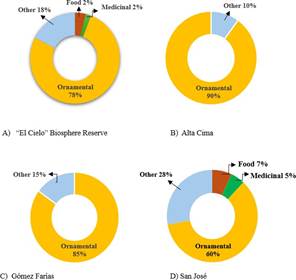
Figure 3 Percentages of uses of epiphytic orchids per inhabitant from the “El Cielo” Biosphere Reserve (A); and the three communities evaluated: Alta Cima (B), Gómez Farías (C) and San José (D).
Gender and community influenced the use of orchids in the RBEC (Table 2). Gender contributed the most to the model, explaining 21.4% of the variability, followed by community (18.9%) and age range (6.37%). The male gender showed a 23 times higher probability of using orchids in the “other” category (medicinal, food, inspiration/tourism) compared to the female gender (Odds ratio = 23.19, P = 0.0001; Table 3). For the community variable, a trend was observed in the probability of using orchids in the “other” category in the community of San José compared to Alta Cima. Conversely, Gómez Farías community showed a lower probability of using orchids in the “other” category compared to those from Alta Cima, who are most likely to use orchids as ornamentals. However, these differences were marginally statistically significant (P = 0.05; Table 3). Finally, individuals in the age ranges of 30-40, 50-60, and 60+ showed a lower probability of using orchids in the “other” category. In contrast, the probability of this type of use increased among individuals aged 40-50, although these values were not statistically significant (Table 3).
Table 2 Analysis of variance of the binomial logistic regression model. The table reports likelihood-ratio (LR), Chi-squared, degrees of freedom (Df), and associated p-values. These results evaluate the statistical significance of each predictor (age range, gender and community) in explaining variation in the binary response variable.
| LR Chisq | Df | Pr(>Chisq) | |
| Age range | 6.3201 | 4 | 0.1765 |
| Gender | 21.2273 | 1 | 4.08E-06 *** |
| Community | 18.8425 | 2 | 8.10E-05 *** |
Table 3 Coefficients, standard errors and odds ratios of the binomial logistic regression model, where the variable community (Gomez Farías and San José), male gender and age range (30-40, 40-50, 50-60, and 60+) were evaluated. Variable Alta Cima, women and 20-30 age range are not presented as coefficients because they were taken as reference points, as well as ornamental use. Significance level, * (0.01), ** (0.001), *** (0.05).
| Estimate | Std.error | z value | P.value | Odds_ratio | Lower | Upper | |
|---|---|---|---|---|---|---|---|
| Intercept | -2.376 | 1.166 | -2.037 | 0.042 | 0.093 | 0.009 | 0.914* |
| 30-40 | -0.452 | 1.308 | -0.345 | 0.730 | 0.636 | 0.049 | 8.267 |
| 40-50 | 1.784 | 1.178 | 1.514 | 0.130 | 5.951 | 0.591 | 59.884 |
| 50-60 | -0.799 | 1.022 | -0.782 | 0.434 | 0.450 | 0.061 | 3.336 |
| 60+ | -0.064 | 1.110 | -0.057 | 0.954 | 0.938 | 0.107 | 8.261 |
| Male | 3.144 | 0.813 | 3.866 | 0.000 | 23.187 | 4.710 | 114.141** |
| Gómez Farías | -2.051 | 1.049 | -1.955 | 0.050 | 0.129 | 0.016 | 1.006*** |
| San José | 1.607 | 0.998 | 1.611 | 0.107 | 4.987 | 0.706 | 35.230 |
Ethnobotanical indices.- Relative Frequency Citation (RFC): The RFC ranged from 0.01 to 0.19 in the RBEC. Laelia anceps Lindl., presented the highest value with 0.19. For its part, Isochilus unilateralis B.L.Rob., Lycaste aromatica and Cohniella ascendens (Lindl.) Christenson showed values below 0.05.
Use value index (UV): The values found for this index were from 0.01 to 0.04, where S. tigrina had the highest use value, which was 0.04; species like Encyclia parviflora (Regel) Withner, I. unilateralis, and C. ascendens, had the lowest use value (0.01) and were mentioned in just one category of use.
Informant agreement index (IAR): The IAR applied to orchid species yielded the maximum value of 0.80 for the ornamental use category. The other uses, include touristic purposes and inspiration/creativity, were in second place with a value of 0.40.
Plant Part Value (PPV): The highest proportion of the PPV was for using the racemose inflorescence with 57, while using the complete plant was 43.
Communities’ perception of orchid conservation.- Regarding the importance of conserving orchids in the RBEC, 52% of those surveyed considered that the conservation of orchids is very important, 30% mentioned that it is important, 15% that it is somewhat important and 3% considered it unimportant.
Orchids used by the RBEC communities include species under protection status according to the Mexican law NOM-059-SEMARNAT-2010 (SERMANAT, 2010); including Laelia speciosa (Kunth) Schltr. as under special protection, and both Prosthechea mariae (Ames) W.E.Higgins and S. tigrina as threatened (Table 1, Fig. 2). Under international listings such as the IUCN Red List of Threatened Species (IUCN 2024), the species reported in this study are still not evaluated according to the list criteria.
Discussion
Orchids play an essential role in the daily lives of the inhabitants of the RBEC, who take advantage of this resource using it for purposes such as ornamental, food, and medicinal, which coincides with our proposal. The use of 10 epiphytic orchid species in this study is low compared to other studies. For instance, 62 Mexican orchid species with anti-inflammatory, vasorelaxant, antinociceptive, antioxidant, and spasmolytic properties have been reported (Castillo-Pérez et al., 2024). Similarly, 53 orchid species in Costa Rica are utilized as a tourist resource (Kirby, 2003). These comparisons highlight the need for further research that allows the conservation and maintenance of the species in order to obtain ethnobotanical information on those that have potential medicinal use and have not been evaluated in the study area.
Ornamental use was the most prominent in the three communities, contributing with more than 60% of the uses in each. Generally, the inhabitants of the RBEC collect orchid plants and have one or more species of orchids as part of the family garden, where the main interest is for them to reach the flowering stage to appreciate and decorate their gardens. The ornamental use of orchids has been well documented (Beltrán-Rodríguez et al., 2012; Hinsley et al., 2018; Ibarra-Contreras et al., 2021; Martínez-Morales et al., 2020; Nurfadilah, 2020); they are a key element in various religious events and festivities in other places, as in the case of Laelia autumnalis, which is used on the Day of the Dead, when its inflorescences are collected for the arrangement of altars that are placed both in homes and cemeteries in the state of Guanajuato, Mexico (Beltrán-Rodríguez et al., 2012).
Other species such as Laelia albida Bateman ex Lindl., L. furfuracea Lindl., and Prosthechea karwinskii (Mart.) J.M.H.Shaw also have a high ornamental value, and their commercialization is increasing in Oaxaca, Mexico (Ibarra-Contreras et al., 2021; Solano-Gómez et al., 2010). It is important to consider that orchids and community traditions are a key part of cultural identity, so strategies must be developed to mitigate the damage from over-collecting plants and ensure that their use is sustainable (Ticktin et al., 2023).
As expected, responses from informants using orchids in the RBEC across age ranges were different; however, this variable was not significant in the model. The number of mentions from informants between 51 and 60 years old (34%) was the highest, and older people represented the guardians of traditional knowledge. During the interview, participants pointed out that young people from Gómez Farías (between 20 and 30 years old, 62.5% of the total) know and use orchid species such as P. cochleata “pulpito” or C. ascendens “lápiz” from the tropical dry forest that surrounds the community, but have no interest in cultural knowledge, nor have the tradition of continuing to transmit this knowledge to new generations. In fact, individuals of this community showed a lower probability of using orchids in the “other” category than those from Alta Cima. This could be related to the young people of Gómez Farías having more access to technology compared to the other two populations who are without even an internet signal, probably causing a lack of interest in traditional knowledge and representing a concern for the preservation of the ethnobotanical use of orchids. In addition, community residents mention in the survey that young people often migrate to large cities in search of life opportunities, which could affect interest in the vital role played by orchids and their conservation in the communities of the RBEC. Contrarily, Beltrán-Rodríguez et al. (2012), found that the knowledge and customs required to carry out the processes of collection, marketing and use practices of
L. autumnalis are instilled from parents to children, favoring the preservation and transmission of local traditions. It is important to recognize that residents, particularly those who are older and have more knowledge about epiphytic orchids, can become part of future proposals for the development of conservation strategies, since they have the experience, practices and potential to carry out successful conservation of both the species and the ecosystem (Hussain et al., 2023). Proposals such as environmental education workshops and scientific dissemination fairs on the uses and management of orchids in the study area will allow the knowledge of the residents of the RBEC to be transmitted and remain in future generations (Velázquez-Juárez, 2019).
The gender of people who use orchids in the RBEC was a significant factor, as expected. Recent studies on gender bias in ethnobotanical knowledge show that not everyone in a community has the same level of knowledge, and one gender is generally held to be the one with the most knowledge (Dan-Guimbo et al., 2011; Laleye et al., 2015; Müller et al., 2015). According to our model, ornamental use of epiphytic orchids in the RBEC was most probably by women, who are mostly housewives (Beltrán-Rodríguez et al., 2012) and have learned to take advantage of these plants as inspiration to make souvenirs to sell to tourists, providing an economic income for their families. The implementation of training programs for the propagation of plants destined for sustainable and legal commercialization could be successful, as in Costa Rica (Gutiérrez, 2008), where the Union of Associations of Rural Women Producers of the Western Central Sector and Rambla produce and export orchids, establishing sales stands at exhibitions, supermarkets or on private orders. They also export mainly to Panama and the USA. This program has reduced the over-collection of wild specimens (Gutiérrez, 2008).
The highest number of uses reported for epiphytic orchids was in the community of San José (Fig. 2D), despite having the smallest number of inhabitants compared to Alta Cima and Gómez Farías. San José is the least urbanized community and does not have essential services. However, it is surrounded by tropical mountain cloud forest (González-Medrano, 2005), which houses ~60% of the epiphytic orchid species in Mexico (Espejo-Serna et al., 2021), being highly recognized and appreciated for their high nutritional, medicinal, ornamental value, among others (Şen et al., 2018; Bozyel & Merdamert-Bozyel, 2020). In this community, S. tigrina has different uses, including the use of its flowers as food. Similarly, Teoh (2019) reported that S. tigrina has been used against heatstroke and loss of strength since the post-Hispanic period; in addition, Moreno-Martínez and Menchaca-García (2007) highlight the use of the flowers of this species in the preparation of tortillas so that they acquire a pleasant aroma since this orchid flower has molecules of phenylmethyl acetate, cinnamyl acetate, indole, benzyl acetate, and methyl salicylate, which give it its intense, sweet and aromatic aroma (Castillo-Pérez et al., 2021; Gerlach, 2010).
Alta Cima was the community where the inhabitants used the largest number of orchid species and where orchids are most likely used as ornamental, compared to the other two communities. Alta Cima is a community with a low urbanization level but does have basic services and an elementary school. Here, the male inhabitants use orchid species from the area for tourism and recognize the ornamental value of orchids, exploiting them along the guided routes and trails through the RBEC, where they obtain economic income. In this community, L. anceps is well recognized as an ornamental species for the size of its flowers (6.25 to 12.5 cm), and its striking pink color (Fig. 2E), as well as being easily propagated (Halbinger & Soto-Arenas, 1997). Although this species does not show declining populations in Mexico, it is prone to over-collection of specimens for illegal sale and decoration in festivities, in addition to the degradation of its habitat (Solano-Gómez et al., 2010; Cox-Tamay & Cervantes-Uribe, 2016). It is necessary to promote its protection to conserve and its habitats and prevent it from becoming threatened due to its ornamental value (Cox-Tamay & Cervantes-Uribe, 2016; Vera-Aguilar et al., 2022).
Some epiphytic orchids named in NOM-059-SEMARNAT-2010 include L. speciosa, P. mariae and S. tigrina. Particularly, L. speciosa is also used by residents of the RBEC who are dedicated to ecotourism mainly as a visual attraction within the tours they provide. It is reported as a species subject to special protection, so its populations are not strongly affected (Campos-Rojas & Muñoz-Pérez, 2018). The L. speciosa population is a conservation priority in our region because it has one of the most northerly distributions of the species (Halbinger & Soto-Arenas, 1997). Community participation, therefore, is essential to conservation and management programs since they have the closest relationship with this resource. The main threat it faces is massive looting to form decorations for the Corpus Christi festival in some towns in Michoacán, Mexico, so it is necessary to promote studies on the biology, ecology and reproduction of species for their effective conservation (Vera-Aguilar et al., 2022).
Both P. mariae and S. tigrina are endemic species to Mexico and are listed as threatened (SEMARNAT, 2010). P. mariae is appreciated for its unique appearance and white flowers (Fig. 2I) and for its ornamental and horticultural uses (Alanís-Méndez et al., 2024). However, its populations are threatened due to the fragmentation and loss of its natural habitat (Alanís-Méndez et al., 2024; Rocha-Gutiérrez & Duque-Sánchez, 2017). Meanwhile, S. tigrina, due to its floristic attractiveness and characteristic fragrance (Gerlach, 2010; Castillo-Pérez et al., 2021), is the object of looting for illegal trade, while problems with its germination and propagation have been reported, which makes it a vulnerable species in the face of so many threats (Zamora-Cortez, 2021).
In conclusion, this study emphasizes the importance of traditional knowledge and the conservation of epiphytic orchid species, highlighting their ornamental, medicinal, and cultural values. It notes that gender differences play a role in the utilization of orchids, with women primarily leading ornamental and economic activities. However, factors such as overharvesting and habitat degradation pose significant threats to numerous orchid species, particularly those that are endemic or protected, such as L. speciosa, P. mariae, and S. tigrina.
To address these threats, strategies such as establishing nurseries, creating germplasm banks, and promoting environmental education should be implemented to reduce the overexploitation of orchid species and encourage their conservation. By documenting and preserving cultural practices, this research contributes to biodiversity protection while ensuring the transmission of traditional knowledge amidst globalization and evolving rural lifestyles.

