




 English (pdf)
 Article in xml format
 Article references

 Automatic translation
 Send this article by e-mail
 Cited by SciELO
 Similars in
SciELO
 uBio

 Permalink


Introduction
The majority of the currently known more than 6 700 species of brachyuran crabs can be found in marine environments. However, almost 1 400 crab species are so-called true or primary freshwater crabs (Cumberlidge, 2016; Yeo et al., 2008), which share the following characteristics: (1) they have adopted freshwater, semi-terrestrial or terrestrial modes of life, (2) are completely independent of marine environments, and (3) reproduce by direct development, which means that they are lacking any free-living larval stage, hatching directly as juveniles (Cumberlidge & Ng, 2009; Yeo et al., 2008). In the present contribution, the term “freshwater crabs” refers to true or primary freshwater crabs.
Freshwater crabs occur in tropical and subtropical regions around the world and most of them live associated with a variety of freshwater bodies (Yeo et al., 2008), including flowing and standing waters covering a range of water quality, but also in caves (for Neotropics, e.g. Álvarez & Villalobos, 1998; Cumberlidge et al., 2014; Rodríguez & Herrera, 1994). Others, however, are terrestrial species, which can typically be found away from permanent freshwater sources, occupying for example water pools in tree holes (e.g., Bayliss, 2002; Cumberlidge & Vannini 2004; Grinang et al., 2015) and leaf axils (e.g., Wehrtmann et al., 2016a). Due to their large biomass, freshwater crabs are important players in ecosystem processes (e.g., Abdallah et al., 2004; Masese et al. 2014; Yang et al., 2020a, Yang et al., 2020b) and interact with their environment as predators and prey (Wehrtmann et al., 2019).
Freshwater habitats are among the most endangered ecosystems in the world (Abell et al., 2008; Dudgeon et al., 2006; Revenga & Kura, 2003) and its species diversity is threatened by a variety of factors, mainly associated with anthropogenic activities, which have resulted in an elevated extinction rate of freshwater species (Collen et al., 2014), including freshwater crabs (Cumberlidge et al., 2014). A recent assessment of freshwater crab species in Colombia, the country with the highest species number reported in the Neotropics, revealed an alarming increase of threatened species from 26 % in 2008, to 34 % in 2015, to 62 % in 2018 (Acevedo-Alonso & Cumberlidge, 2021). Moreover, an appropriate assessment of the conservation status of Neotropical crab species is still hampered by the high number of species classified as “Data Deficient”, since knowledge about their distributions, biology, and ecology is still quite incipient (Cumberlidge et al., 2014; Wehrtmann et al., 2016b). Proposing appropriate measures for the conservation and management of this group of crustaceans depends on detailed knowledge of aspects of their biology and ecology.
On a worldwide scale, east and southeastern Asia harbor the highest diversity of freshwater crabs, followed by the Neotropics with 311 species in two families: Trichodactylidae and Pseudothelphusidae (Cumberlidge et al., 2014). Diversity hotspots in the Neotropics are Colombia and Mexico (Cumberlidge et al., 2014), while Panama and Costa Rica stand out for its high diversity in Central America with 17 and 15 species, respectively (Magalhães et al., 2015).
Costa Rica is well known as a biodiversity hotspot with approximately 3.6 % of the total expected world’s diversity (Kohlmann et al., 2010; Mittermeier et al., 2014). The country has abundant and diverse freshwater ecosystems, which harbor a great biological diversity, particularly freshwater macroinvertebrates (Springer et al., 2014). The hydrological component comprises 34 water basins, 320 wetland areas and 510 lacustrine systems, including natural systems such as coastal lagoons, lakes, and lagoons as well as those of antropogenic origin (e.g., reservoirs and dams for hydroelectric power plants) (see Coto-Pacheco et al., 2005; Springer et al., 2014). All these aquatic environments, ranging from sea level up to 3500 m. a. s. l. (Umaña et al., 1999), represent potential habitats for freshwater crabs.
Freshwater crab research in Costa Rica
Fig. 1 provides an overview about the production of freshwater crab publications of Costa Rica. This time line might be divided into the following three periods: (1) Period I: pre-1900, the discovery phase as the start of freshwater crab research by the description of the first species from Costa Rica; (2) Period II: 1900-2000 when, after a long intermission, taxonomic studies on the freshwater crab fauna were resumed; and (3) Period III: post-2000 characterized by initiating studies including the ecology and molecular phylogeny of freshwater crabs while continuing the biodiversity assessment of these decapods.
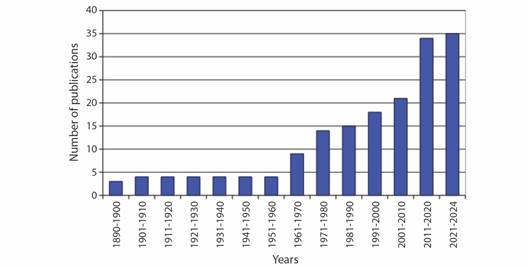
Fig. 1 Accumulative production of publications about freshwater crabs from Costa Rica. We considered only publications that included specimens collected in Costa Rica; on the contrary, publications that only mentioned freshwater crab species from Costa Rica were not considered.
Period I: The incipient status of natural history studies in Costa Rica in the 19th century meant that, as was customary in Latin America at the time, specimens collected in the country were usually sent to European and North American museums for study by experts in the respective taxonomic groups (Lobo et al., 2021). Scientists who pioneered biological studies in Costa Rica in the late 19th century, whether foreigners like Charles W. Richmond, Paul Biolley, and Henri Pittier, or locals like José Fidel Tristán Fernández and José Cástulo Zeledón Porras (Lobo et al., 2021; Quirós, 2013; Quirós, 2022), sent their collections of freshwater crabs to the National Museum of Natural History, Washington D.C. (USA), where they were properly studied by Mary Jane Rathbun, one of the great carcinologists at the turn of the 19th and 20th centuries. In three publications, Rathbun (Rathbun, 1893; Rathbun, 1896; Rathbun, 1898) authored eleven (10 still considered valid today) of the 20 nominal taxa (currently valid or not) of this group ever described and recorded from Costa Rica. With this, she is the most prolific author regarding the description of species of the Costa Rican freshwater crab fauna. Table 1 lists in chronological order in which all 20 nominal species were described from, or currently occurring in, Costa Rica, and provides additional information about their taxonomic authorities, the country of the type locality, the reference in which the first record of their occurrence in Costa Rica was made, as well as the institutional collection where the type material is deposited.
Table 1 Nominal species of pseudothelphusid freshwater crabs (valid and synonyms, listed in chronological order they appeared in the taxonomic literature) described from, or currently occurring in, Costa Rica, their taxonomic authorities, country of the type locality, reference of the first record in Costa Rica, and repository collection of the type material.
| Taxa | Taxonomic authority | Type Locality | First record in CR | Type material |
| Ptychophallus colombianus | (Rathbun, 1893) | Panama | Lara et al. (2013) | USNM |
| Potamocarcinus richmondi | (Rathbun, 1893) | Nicaragua | Rathbun (1905) | USNM |
| Potamocarcinus nicaraguensis | Rathbun, 1893 | Nicaragua | Rathbun (1893) | USNM |
| Potamocarcinus magnus | (Rathbun, 1896) | Costa Rica (Unknown) | USNM | |
| Ptychophallus tristani | (Rathbun, 1896) | Costa Rica (San José) | USNM | |
| Ptychophallus exilipes | (Rathbun, 1898) | Costa Rica (Unknown) | USNM | |
| Achlidon agrestis | (Rathbun, 1898) | Costa Rica (Cartago) | USNM | |
| Ptychophallus montanus | (Rathbun, 1898) | Costa Rica (San José) | USNM | |
| Ptychophallus tumimanus | (Rathbun, 1898) | Costa Rica (Cartago) | USNM | |
| Pseudothelphusa convexa (= Ptychophallus montanus) | Rathbun, 1898 | Costa Rica (Puntarenas) | USNM | |
| Allacanthos pittieri | (Rathbun, 1898) | Costa Rica (Puntarenas) | USNM | |
| Ptychophallus paraxantusi | (Bott, 1968) | Costa Rica (Puntarenas) | MNHN | |
| Ptychophallus campylus (= Ptychophallus tristani) | Pretzmann, 1968 | Costa Rica (Unknown) | NHMW | |
| Ptychophallus costaricensis | Villalobos, 1974 | Costa Rica (San José) | UCR-MZ | |
| Ptychophallus (Pt.) tumimanus ingae (= Ptychophallus tumimanus) | Pretzmann, 1978 | Costa Rica (Puntarenas) | NHMW | |
| Achlidon puntarenas | Hobbs III, 1991 | Costa Rica (Puntarenas) | USNM | |
| Ptychophallus uncinatus | Campos & Lemaitre, 1999 | Panama | Lara et al. (2013) | USNM |
| Ptychophallus barbillaensis (= Ptychophallus uncinatus) | Rodríguez & Hedström, 2000 | Costa Rica (Limón) | UCR-MZ | |
| Ptychophallus osaensis (= Ptychophallus paraxantusi) | Rodríguez, 2001 | Costa Rica (Puntarenas) | USNM | |
| Allacanthos yawi | Magalhães, Lara & Wehrtmann, 2010 | Costa Rica (Puntarenas) | UCR-MZ |
Abbreviations: CR: Costa Rica; MNHN: Muséum national d’Histoire naturelle, Paris; NHMW: Naturhistorishes Museum Wien, Vienna; UCR-MZ, Museo de Zoología de la Universidad de Costa Rica, San José; USNM, National Museum of Natural History, Smithsonian Institution, Washington, D.C.
In her first publication, Rathbun (1893) described Potamocarcinus nicaraguensis based on specimens from Costa Rica and Nicaragua collected in the Rio San Juan watershed but she chose Nicaragua as the type locality (Rathbun, 1905). In this paper, she also described Pseudothelphusa richmondi (= Potamocarcinus richmondi) and Pseudothelphusa colombianus (= Ptychophallus colombianus), from Nicaragua and Panama, respectively. Both species were later recorded also from Costa Rica: Po. richmondi by Rathbun (1905), Smalley (1964), Pretzmann (1972), and Magalhães et al. (2015), and Pt. colombianus by Lara et al. (2013) and Magalhães et al. (2015). In a subsequent work, dedicated exclusively to species from Costa Rica (Rathbun, 1896), she described two new species: Pseudothelphusa magna (= Potamocarcinus magnus) (Fig. 2A) and Pseudothelphusa tristani (= Ptychophallus tristani), the latter named in honor of its collector, the Costa Rican José Fidel Tristán. It was in her third work (Rathbun, 1898), however, that she added the largest number of species described by a single author to the Costa Rican freshwater crab fauna. Following the taxonomic concept of that time, all species were included in the genus Pseudothelphusa (but currently transferred to other genera): Ps. exilipes (= Ptychophallus exilipes) (Fig. 2B), Ps. montana (= Pt. montanus), Ps. tumimanus (= Pt. tumimanus), Ps. agrestis (= Achlidon agrestis), Ps. pittieri (= Allacanthus pittieri, named after Henri Pittier), and Ps. convexa (currently a synonym of Pt. montanus).
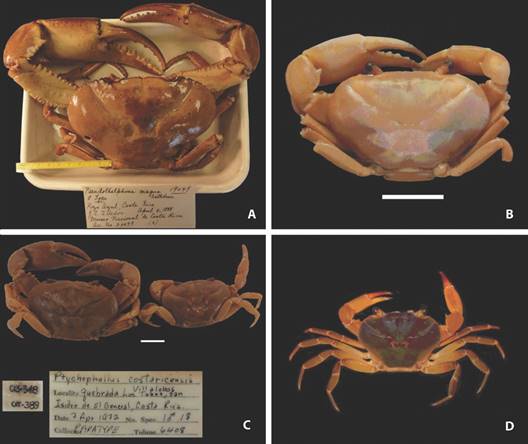
Fig. 2 A. Potamocarcinus magnus (Rathbun, 1896), male, syntype, USNM 19049, habitus, dorsal view; B. Ptychophallus exilipes (Rathbun, 1898), male, USNM 39089, habitus, dorsal view; C. Ptychophallus costaricensisVillalobos, 1974, male (carapace width 34.8 mm) and female (carapace width 26.5 mm), paratypes, TMNH 6408, habitus, dorsal view; D. Ptychophallus uncinatusCampos & Lemaitre, 1999, male, collected in Veragua, Atlantic slope of Costa Rica; habitus, dorsal view.
Period II: Studies of Costa Rican freshwater crabs went through a long intermission during the first half of the 20th century. The only notable exception was the publication of Rathbun’s seminal three-part monograph on the systematics of world freshwater crabs, all of which were then grouped under a single family, Potamonidae. The second part (Rathbun, 1905), which dealt with the then subfamily Pseudothelphusinae, did not add any new taxon to the Costa Rican fauna but expanded the geographic distribution of some of the species.
A new surge of interest in the study of the river crabs from Costa Rica began in the mid-1960s when Smalley (1964), one of the first authors to systematically use gonopodal features as an essential tool in the taxonomic studies of these crabs, proposed the erection of four subgenera within the genus Pseudothelphusa to classify the diversity of Costa Rican species: Ps. (Achlidon), Ps. (Allacanthos), Ps. (Megathelphusa), and Ps. (Ptychophallus), in addition to provide new records of occurrence for several species. Except for Megathelphusa, all other subgenera were later raised to generic level.
After the Rathbun’s (Rathbun, 1893; Rathbun, 1896; Rathbun, 1898) publications, new species from Costa Rica were only described again in 1968 by European carcinologists. In that year, Pretzmann, who had elevated Ptychophallus to full generic status somewhat earlier (Pretzmann, 1965), described Ptychophallus (Ptychophallus) campylus collected from an undetermined locality in Costa Rica (Pretzmann, 1968). Bott (1968), without recognizing the new generic arrangement proposed by Pretzmann (1965), described Pseudothelphusa (Ptychophallus) paraxantusi based on specimens from Costa Rica that were erroneously assigned by Rathbun (1898), Rathbun (1905) and Smalley (1964) to Pseudothelphusa xantusi, a species from Mexico currently considered as incertae sedis (Rodriguez, 1982). Schmitt (1969) presented a more detailed illustration of the male first gonopod of Achlidon agrestis to complement the description of the then subgenus provided by Smalley (1964).
The first description of a new species published by a Costa Rican carcinologist was made by Carlos R. Villalobos and appeared in the Revista de Biología Tropical in 1974. Based on material he collected in southwestern Costa Rica, Villalobos (1974) described Ptychophallus costaricensis (Fig. 2C). He also verified the extent of the distribution of Po. nicaraguensis in Costa Rica and compared the intraspecific variability between populations of this species from the San Carlos River basin and those from the Nicaragua lakes (Villalobos & Burgos, 1974).
Pseudothelphusa puntarenas (= Achlidon puntarenas) was described by Hobbs III (1991), who considered it the first cavernicolous crab from Costa Rica, as it was based on specimens collected in the Emus Cave, Puntarenas Province, in the southern portion of the country. This species was later found also in epigean environments (Magalhães et al., 2015). Ptychophallus montanus, although it does not exhibit characteristic morphological adaptations for underground life, was also found in caves from this same region (Hobbs III, 1993).
The other two taxa introduced as new are presently treated as junior synonyms of previously described species: Pretzmann (1978) described Ptychophallus (Pt.) tumimanus ingae (= Pt. tumimanus), and Rodríguez & Hedström (2000) introduced Ptychophallus barbillaensis, which was synonymized by Magalhães et al. (2015) under Ptychophallus uncinatus (Fig. 2D), a species originally described from Panama by Campos & Lemaitre (1999) but later found also in the Grande de Térraba River basin in southern Costa Rica (Lara et al., 2013).
During this period, it is worth mentioning that the revisional studies by Pretzmann (1972) and Rodriguez (1982) on the systematics of the pseudothelphusid crabs as well as the studies by Bott (1967) and Pretzmann (1980) on the material from Central America added relevant information on the taxonomy and distribution of the species from Costa Rica.
Period III: This phase is the most productive period with a total of (so far) 17 publications. Although the taxonomic work continued during this period with the description of a new species, Ptychophallus osaensis (= Pt. paraxantusi) by Rodríguez (2001) and Allacanthos yawi by Magalhães et al. (2010), as well as a study on the diversity and distribution of the river crabs inhabiting the Grande de Térraba River basin (Lara et al., 2013), and a revision of Costa Rican freshwater crabs that included all representatives of the genus Ptychophallus (see Magalhães et al., 2015), there has been a clear shift of the research focus: practically for the first time, studies included and centered around the ecology of the freshwater crabs. For example, Rigler (2012) and Garlick-Ott (2017) studied behavioral aspects of populations of Po. magnus and Ptychophallus spp., respectively, that inhabit the cloud forest in Monteverde (Puntarenas), whereas Corajod (2015) investigated sexual dimorphism and habitat preferences of freshwater crabs occurring in this same area. Other studies experimented in the field with frog clay models of different colors (Baringer, 2019; Willink et al., 2014) and concluded that crab predation did not depend on frog coloration. Field observations of Pt. uncinatus revealed not only cannibalism, but also showed that different specimens of this species were preying upon an insect larva, a frog, and a lizard, while a spider of the family Ctenidae was feeding on a specimen of Pt. uncinatus (see Wehrtmann et al., 2019). On the other hand, Ramírez-Fernández & Fernández-Vargas (2020) reported the first record of the crab-eating rat, Ichthyomys tweedii, from Costa Rica (presumably preying on pseudothelphusid crabs at the location where it was found in southern Costa Rica), and Yang et al. (2020a) and Yang et al. (2020b) quantified the effects of pseudothelphusid crabs on leaf breakdown concluding that these crabs are a significant element in detrital processing in headwater stream. Recently, Deleva et al. (2023) reviewed the status of the knowledge of the cave-dwelling fauna of Costa Rica, which included notes on freshwater crabs. All these studies provided novel information about the role of freshwater crabs in Neotropical freshwater ecosystems.
Phase III also represents the beginning of molecular studies including freshwater crab species occurring in Costa Rica. The first study, published by Poettinger et al. (2016), analyzed the phylogenetic relationships among Neotropical freshwater crabs of the Pseudothelphusidae, focusing on the taxonomic position of Ptychophallus and related genera. More recently, Álvarez et al. (2020) presented a revision of the higher taxonomy of Neotropical freshwater crabs of the family Pseudothelphusidae, using both multigene and morphological analyses.
Outlook
International collaboration has been a key factor for the progress of freshwater crab research during the last two decades. Several projects funded by the Universidad de Costa Rica and Consejo Nacional de Rectores (CONARE) allowed to establish networks among Latin American researchers of freshwater crabs, which resulted not only in numerous publications, but also in an exchange of students, especially with the Universidad de São Paulo, Brazil. These collaborations need to be continued as part of multidisciplinary studies, which always should include interested students to foster (1) the development of a future generation of scientists focusing on or at least including freshwater crabs and (2) the establishment of (international) research groups studying different aspects of freshwater crabs in the Neotropics.
The taxonomic diversity of freshwater crabs in Costa Rica has been well studied, especially during the last years. Fig. 3 shows the geographic distribution of sampling locations where freshwater crabs were found in Costa Rica. Although this map might not include absolutely all reports, it certainly reveals not only the sample distribution of freshwater crabs in Costa Rica, but also reflects the efforts made to obtain freshwater crab samples from different areas in Costa Rica. Despite this geographic coverage, it does not mean that the freshwater crab inventory in Costa Rica is completed and that no new records of (eventually new) species can be expected. Therefore, it is strongly recommended to continue freshwater crab surveys, especially in areas where sampling efforts have been limited or absent (see Fig. 3).
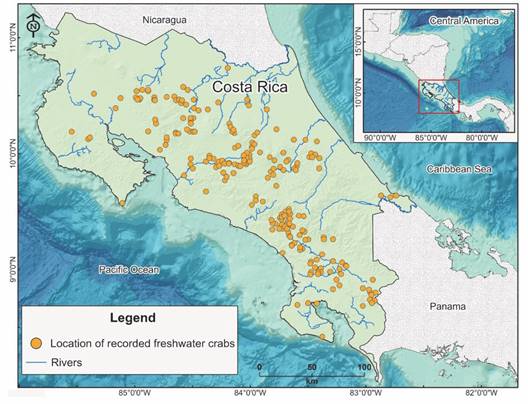
Fig. 3 Sampling locations in Costa Rica where freshwater crabs were encountered (based on Magalhães et al., 2015).
The collection of freshwater crabs in the Museo de Zoología of the Universidad de Costa Rica, MZUCR, has been and will be an extremely valuable source of information for everybody interested in these macroinvertebrates. Considering the concept of collections-based science in the 21st century (see Funk, 2018), it is of utmost importance to keep managing these collections adequately and to count on qualified human resources for the maintenance of both the deposited specimens and the corresponding database. The deposited specimens can be used for the extraction of DNA material, which in turn allows us to revise the identification of the samples. Additionally, the analyses of molecular material from preserved crabs will provide valuable data regarding the evolution of characters and modes of speciation. The collection of freshwater crabs in the Museo de Zoología of the Universidad de Costa Rica contains specimens that cover a time span of dozens of years and thus provides an important source of information that can be used to detect possible changes in species distributions through time and space, for example in relation to climate change impacts and habitat destruction. The value of these collections, however, are generally underappreciated by the public, policymakers, and funding agencies (see Suarez & Tsutsui, 2004), and therefore, it will be of special importance to explain and highlight the significance of maintaining and expanding these collections not only by publications in scientific journals, but especially by involving the public, for example by citizen science (Simoniello et al., 2019). Future strategies aimed to complete our knowledge about freshwater crabs should include people and communities living in different parts of Costa Rica. The results of a meaningful engagement of citizens will help to guide for example future efforts to collect freshwater crabs and thus, allow a more efficient use of the limited financial resources available for these field trips and inventories.
Although our knowledge about freshwater crabs in Costa Rica has increased considerably especially during the last decades, information about many aspects of the life history and ecology of these invertebrates remains fragmentary or simply absent. For example, freshwater crabs are secondary intermediate hosts for metacercariae of the trematode Paragonimus spp., and the consumption of undercooked or raw freshwater crabs infected with these metacercariae can lead to the contraction of paragonimiasis or lung fluke disease (see Blair, 2022). One early study in Costa Rica focused on this topic (Brenes et al., 1968). and more recently Hernández-Chea et al. (2017) confirmed the presence of two species of Paragonimus, Pa. caliensis and Pa. mexicanus, in freshwater crabs collected in Costa Rica. However, and considering the wide distribution of freshwater crabs in the country, their role as food item and, therefore, the importance of this topic for public health, additional studies are required to obtain a more complete picture of freshwater crabs as hosts of Paragonimus spp. and to increase awareness of this disease in the health system and prevention in the Costa Rican population.
The field of behavior has been mostly neglected in freshwater crab research and not only in Costa Rica, except for the field studies of freshwater crab predation on frog clay models (see above). No laboratory experiment has been conducted to gather information on freshwater crab behavior. For example, it would be interesting to study parental care in these macroinvertebrates, since females carry their offspring for an extended period of time (see Wehrtmann et al., 2010). An adequate laboratory setting could be an ideal place to observe and describe the interaction female-offspring while the juveniles are attached to their mother. Prolonged brood care is one of the evolutionary cues for the successful colonization of freshwater habitats (Vogt, 2013; Vogt & Tolley, 2004), and the results of such laboratory observations (maybe accompanied by field studies) might help to identify the ecological and evolutionary pressures involved in the evolution of (prolonged) maternal care (see also Palaoro & Thiel, 2020).
Climate change impacts on freshwater crabs have yet not been studied in Costa Rica. A recent worldwide review (Toh et al., 2022) found only 49 publications with empirical evidence of climate change effects on freshwater decapods, and the majority of these publications referred to crayfishes Astacidea. Climate change scenarios for Costa Rican montane forests, one of the principal habitats of freshwater crabs, predict an increase of temperature and a decrease in precipitation in these areas, which may have serious implications for mountain ecosystems (Karmalkar et al., 2008). Therefore, and considering the severe impacts already shown for some freshwater crab species (see Toh et al., 2022), future studies about this topic are encouraged to assess their vulnerability to climate change impacts and to foster adequate conservation interventions and measures for this threatened group of decapods.
Climate change is not the only threat for freshwater crabs. Their survival is also imperiled by pollution, deforestation, habitat loss, and invasive species (Cumberlidge et al., 2014; Toh et al., 2022). There is an urgent need to obtain more information about these topics, and Costa Rica with its relatively high species diversity would be an ideal place to study how these threats affect the ecology and survival of freshwater crabs. For example, Martín-Torrijos et al. (2021) detected the crayfish plague pathogen Aphanomyces astaci in an introduced population of the crayfish Procambarus clarkii in Costa Rica, and modeling results (Azofeifa-Solano et al., 2023) revealed that this crayfish showed a relatively high probability to invade mountain ranges, which can be also occupied by freshwater crabs. The consequences of such niche overlap as well as the possible infection of freshwater crabs with the crayfish plague pathogen Ap. astaci needs to be assessed.
Another example for an open research area is the contamination of freshwater crabs with microplastics (MPs), which is a hazardous pollutant of global concern, impacting mainly but not exclusively aquatic ecosystems and human health as people may consume decapod crustaceans, such as freshwater crabs, contaminated with MPs (D’Costa, 2022; de Miranda & de Carvalho-Souza, 2016). Although studies on the presence of MP in freshwater decapods are scarce (see D’Avignon et al., 2021), a recent study (Yu et al., 2023) revealed the presence of considerable amounts of MPs in freshwater crabs from aquaculture ponds in the Yangtze River Delta of China. An integrative study on the contamination of Costa Rican river systems should certainly include freshwater crabs, since they spend their entire life in these aquatic systems and may serve as a possible indicator for MP contamination.
When developing future research strategies including freshwater crabs, it is recommendable considering synergistic effects of different stressors, including for example climate change, deforestation, pollution, and non-native species (Toh et al., 2022). Such an approach will require multidisciplinary research projects, which might also generate species-specific information on freshwater crabs. Such data are essential for the development and implementation of management plans to protect the local biodiversity.
Ethical statement: the authors declare that they all agree with this publication and made significant contributions; that there is no conflict of interest of any kind; and that we followed all pertinent ethical and legal procedures and requirements. All financial sources are fully and clearly stated in the acknowledgments section. A signed document has been filed in the journal archives.

