




 English (pdf)
 Article in xml format
 Article references

 Automatic translation
 Send this article by e-mail
 Cited by SciELO
 Similars in
SciELO
 uBio

 Permalink


Introduction
Condition factor, gonadosomatic index and maturation patterns are functional features of importance in the study of the biology of tropical marine fishes with relevance in conservation and management. Condition factor alludes to the physical health of individuals and hence of the population (Gubiani et al., 2020; Le Cren, 1951). It focuses on the question whether an individual weights what it should according to its measured length. An overall measure of condition factor is indicative of favorable or unfavorable environmental conditions for the population. In turn, the gonadosomatic index focuses on the reproductive cycle a fish goes through typically over a year. The main purpose of such an index is to identify the population time of spawning (Fontoura et al., 2009; Lowerre-Barbieri et al., 2011). The incidence of mature fish in time may shed light onto the same question, but more importantly, the study of the proportion of mature fish in representative length samples provides an estimation of one main life-history event in a fish, the mean length at sexual maturity (Lm), relevant for fishery management (Cope & Punt, 2009; Froese et al., 2008).
The lane snapper Lutjanus synagris Linnaeus (1758) is a fish species of commercial interest in the Caribbean coast of Colombia (García & Duarte, 2024; Ministerio de Agricultura y Desarrollo Rural, 2024), although in decline globally (García, 2010; García & Duarte, 2024), in our study area, the Golf of Salamanca (Martínez-Viloria et al., 2022; Salazar-Perez et al., 2020), and in other areas of the Colombian Caribbean (Martínez-Viloria, 2022; Ramírez et al., 2017). It is a notorious member of soft bottom fish assemblages (García et al., 1998; Manjarres et al., 2001) occurring throughout the extension of the coast from South to North in soft bottoms (García & Armenteras, 2015). Although Allen (1985) states that L. synagris main habitat is around coral reefs and vegetated sandy areas it turns out to be the most common fish in historical soft bottom trawls in the Colombian Caribbean (García, 2018; García & Armenteras, 2015).
Few studies have been conducted in Colombian Caribbean waters on reproductive aspects of L. synagris. Based on the gonadosomatic index different peaks in spawning activity have been suggested for this species. Arteaga et al. (2004) found two peaks in spawning, one from April to August with a maximum in May and a second peak in October in the Northern Colombian Caribbean Sea (Guajira Peninsula and Tayrona National Natural Park). Posada-Peláez et al. (2012) reports a peak in spawning from August to November in an area including the Eastern corner of the Gulf of Salamanca, the Tayrona National Natural Park, and some localities to the East but not reaching the Guajira Peninsula. In both cases it is suggested that increased spawning is associated with the rainy season environmental and climatic conditions, that is, higher sea surface temperatures and lower sea surface salinity in contrast to the dry season (December to April) when an upwelling phenomenon takes place in the area conductive to lower sea surface temperature and higher salinity (Andrade & Barton, 2005).
Regarding condition factor no antecedent could be found in the primary literature focusing on Colombian populations of L. synagris. Estimations of Lm, on the other hand, are numerous and disparate (see García & Ramírez, 2016, their Table 1) for the Northern Colombian Caribbean coast including the Gulf of Salamanca with values ranging from 25.1 cm (Altamar et al., 2015) to 34.0 cm (Arteaga et al., 2004) total length for both sexes. Geographically the closest estimate of Lm is that of Posada-Peláez et al. (2012) whose study area partly overlap ours, with 28 cm total length for both sexes.
In this study, estimations of condition factor, gonadosomatic index and maturation patterns in time are given for L. synagris in the Gulf of Salamanca as well as an estimate of Lm. Via linear models the dependency of these indices on several climatic, environmental, and operative variables was explored.
Materials and methods
Fig. 1 shows the study area and the sampling stations. Sampling was conducted monthly from April 1997 to March 1998, excepting January and June. Stations were selected in three clusters according to oceanographic conditions in the Gulf of Salamanca which at the center shows an intrusion of oceanic water (García et al., 2013), plus some interspersed stations. Trawling operations at a station lasted an average 30 minutes at an average speed of 3.5 knots. On board L. synagris individuals were measured (standard length) and weighted. A representative sample of fishes were brought to the lab (in total 166 males and 123 females) and the stage of maturation was assessed by the appearance of gonads according to the scale of Holden & Raitt (1975). Afterwards the gonads of males and females were extirpated and weighted. Fishes classified in stage III, IV and V (Holden & Raitt, 1975) of gonadal development were labeled as mature. At each station measurements of bottom salinity and temperature were made with the aid of a CTD probe.
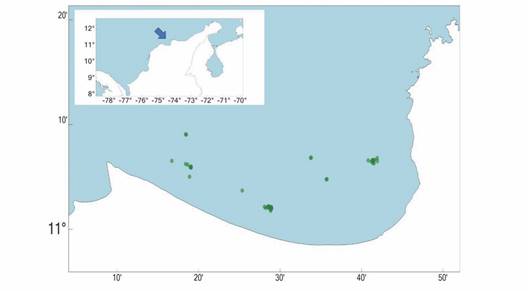
Fig. 1 Study area Gulf of Salamanca, Colombian Caribbean, and sampling stations. The arrow shows the position of the Gulf of Salamanca in the Colombian Caribbean coast.
Condition factor was found with the formula (Le Cren, 1951): CF = Wex / Wob, where Wex is the expected weight of an individual and Wob is the observed weight of the same individual. Expected weights were estimated from the length weight relationship derived by García et al. (1998) that originated from cruises in the study area in the period 1995 to 1998. The length weight relationship is based on 2015 individuals, size ranging from 8 cm to 33.5 cm (García et al., 1998). The formula for Wex is: Wex = 0.0898 × (SL / 10)2.63, where SL is standard length (cm). The gonadosomatic index was found with the formula: GDS = 100 × (Wgo / Wob), where Wgo is the weight of the gonad and Wob is the observed weight of the same individual.
Temporal trends of both indices and of the incidence in percentage of mature versus unmature fish were explored by means of boxplots and barplots. To estimate Lm for males, females and both sexes a logistic regression model was adjusted to the raw mature-immature data with individual lengths as the predictor variable. The Lm estimated and their bootstrap confidence intervals were transformed from standard length to total length (TL) with the formula TL = 0.0 + 1.203 × SL, found in FishBase for L. synagris (Froese & Pauly, 2023).
The dependency of condition factor (CF) and gonadosomatic index (GDS) on variables related to climate (bottom salinity and temperature), space (latitude and longitude decimal transformed and depth), and fish behavior (time of the day when captured decimal transformed and moon phase of the day of capture) were explored. Latitude, longitude, depth, and time of the day correspond to the middle position and time of the research ship during a given tow. Correlations among the quantitative variables were found to be less than 0.5 (Pearson correlation test) in all cases. The linear model is CF / GDS ~ Latitude + Longitude + Depth + Time + Temperature + Salinity + Moon Phase. Regarding the results of the model, the dependency of CF and GDS on the moon phases was further explored with the model: CF / GSD ~ Moon Phase.
Multiple comparisons of means were conducted with the Tukey HSD test. Numerical analysis and graphics were done with R base (R Core Team, 2021) and R packages parzer (Chamberlain & Sagouis, 2021), car (Fox & Weisberg, 2019), ggplot2 (Wickham, 2016), cowplot (Wilke, 2020), Rmisc (Hope, 2022) and multcomp (Hothorn et al., 2008).
Results
Fig. 2 and Fig. 3 show the monthly estimates of CF and GDS index, respectively. Except for March samples, no peak is noticeable in CF with ups and downs around one across the year and this is true for males, females and both sexes (Fig. 2A, Fig. 2B, Fig. 2C). The peak in March median is probably due to a small sample size (n = 8). CF medians grouped by season do not differ, but CF is more dispersed in the dry season (Fig. 2D). GDS index (Fig. 3) behaves in a richer fashion than CF. For males, females and both sexes there appear to be a building up of gonad material as the year progresses to May in the case of males and to September in the case of females, but with great dispersion (Fig. 3A, Fig. 3B). When plotted together the GDS index shows maximum values in March and April (Fig. 3C). Female gonads are noticeable heavier than male gonads as evidenced by the scale of the plots (Fig. 3). When grouped by season no difference in median GDS index is noticeable (Fig. 3D).
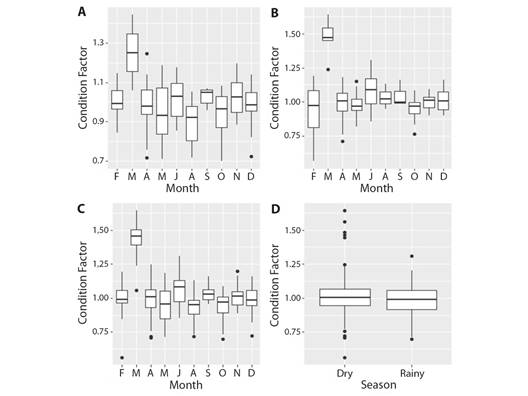
Fig. 2 Monthly series of condition factor of Lutjanus synagris in the Gulf of Salamanca, Colombian Caribbean from April 1997 to March 1998. A. Males. B. Females. C. Both. D. Seasonal comparison for both sexes.
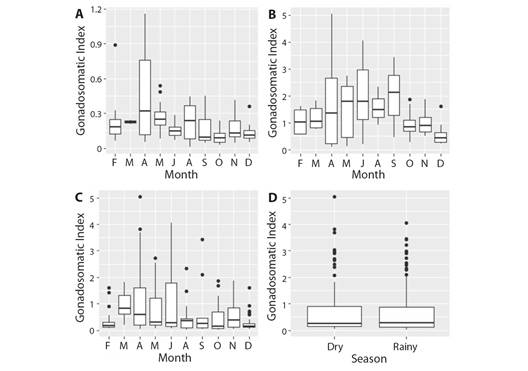
Fig. 3 Monthly series of gonadosomatic index of Lutjanus synagris in the Gulf of Salamanca, Colombian Caribbean from April 1997 to March 1998. A. Males. B. Females. C. Both. D. Seasonal comparison for both sexes.
The incidence in percentage of mature individuals in the year is shown in Fig. 4. Mature males and females were found in all monthly samples. Proportionally mature females showed higher incidence than males (Fig. 4A, Fig. 4B). In general, the incidence of mature individuals is higher in the first months of the year with a decreasing trend from February to August (Fig. 4C). However, when grouped by season no difference in percentage incidence of mature fish is noticeable (Fig. 4D).
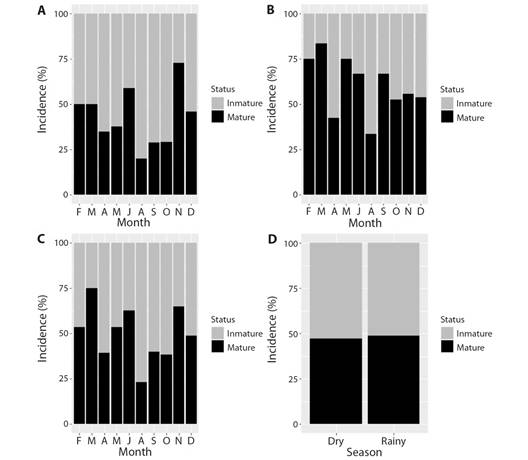
Fig. 4 Monthly percentage incidence series of mature individuals of Lutjanus synagris in the Gulf of Salamanca, Colombian Caribbean from April 1997 to March 1998. A. Males. B. Females. C. Both. D. Seasonal comparison for both sexes.
The logistic model provides an estimate of Lm of 27 cm 26-28 CI (confidence interval) for males, 25 cm 24-26 CI for females and 26 cm 25-27 CI for both sexes (Fig. 5) which are within the same order of magnitude of other Lm estimates (see García & Ramirez, 2016, their Table 1) in the Northern Colombian Caribbean.
Table 1 Association between predictor variables and condition factor for Lutjanus synagris in the Gulf of Salamanca, Colombian Caribbean.
| Variables/Sex | Males | Females | Both |
| Latitude | < 0.05 + | N.S. | < 0.05 + |
| Longitude | N.S. | < 0.05 + | N.S. |
| Depth | N.S. | N.S. | N.S. |
| Time | N.S. | < 0.05 - | N.S. |
| Temperature | < 0.05 - | N.S. | < 0.05 - |
| Salinity | N.S. | N.S. | < 0.05 + |
| Moon phase | < 0.05 | < 0.05 | < 0.05 |
The sign positive or negative indicates the direction of the association. Number in the table is the p-value of the test of hypothesis of no association. N.S., not significant.
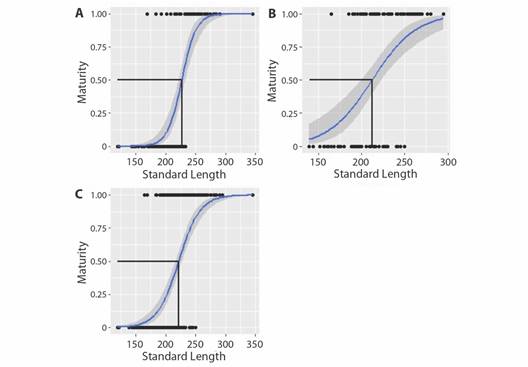
Fig. 5 Sigmoid curves representing the relation between standard length and the probability of being mature for Lutjanus synagris in the Gulf of Salamanca, Colombian Caribbean. Length at which there is 50 % probability of being mature is signaled. Model line plus standard deviation. A. Males. B. Females. C. Both sexes.
Results of the linear models adjusted to CF and GDS indices are shown in Table 1 and Table 2, respectively. An interesting finding is that moon phase has a significant effect in all instances (p < 0.05) affecting both indices and sexes (Table 1, Table 2). These results prompted the formulation of an additional linear model to closely explore the effect of moon phases, which is referred further below.
Table 2 Association between predictor variables and gonadosomatic index for Lutjanus synagris in the Gulf of Salamanca, Colombian Caribbean.
| Variable/Sex | Males | Females | Both |
| Latitude | N.S. | N.S. | N.S. |
| Longitude | < 0.05 + | N.S. | N.S. |
| Depth | N.S. | < 0.05 + | < 0.05 + |
| Time | N.S. | N.S. | N.S. |
| Temperature | N.S. | < 0.05 + | < 0.05 + |
| Salinity | < 0.05 - | < 0.05 - | < 0.05 - |
| Moom Phase | < 0.05 | < 0.05 | < 0.05 |
The sign positive or negative indicates the direction of the association. Number in the table is the p-value of the test of hypothesis of no association. N.S., not significant.
Predictors affected differentially CF and GDS indices of males and females. CF of males is affected positively by latitude while it is negatively affected by bottom temperature. CF of females is affected positively by longitude and negatively by time of the day when the individual was captured (Table 1). GDS index of males, in turn, is affected positively by longitude and negatively by bottom salinity while for females GDS index was positively affected by depth and bottom temperature and negatively by bottom salinity (Table 2). When pooling males and females the response of CF and GDS index was contrasting. CF responded negatively to the bottom temperature and positively to bottom salinity while GDS index responded positively to bottom temperature and negatively to bottom salinity. CF was affected by latitude while GDS was not. GDS index was affected by depth while CF was not (Table 1, Table 2).
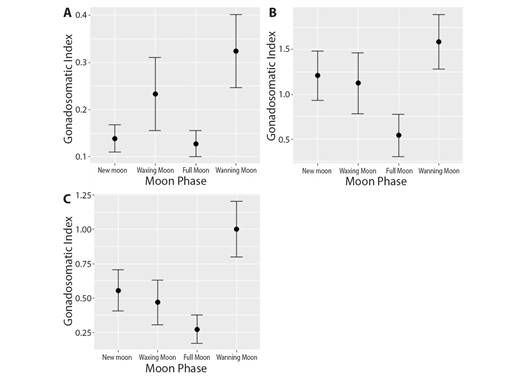
The linear model with moon phase as predictor confirmed the results of the full model. For males and females and when pooled CF and GDS indices were significantly affected by the moon phase (p < 0.05), except for CF in males. Table 3 shows the results of Tukey HSD multiple comparisons test. Noticeably, while for CF in females and both sexes the moon phase that is different from the others is waxing moon (Fig. 6), for GDS index the moon phase that is different from the others is waning moon (Table 3, Fig. 7).
Table 3 Multiple comparisons of mean values of condition factor and gonadosomatic index of Lutjanus synagris by moon phase in the Gulf of Salamanca, Colombian Caribbean.
| Group/Index | Condition Factor | Gonadosomatic Index |
| Males | p > 0.05 for all pairwise comparisons | Waning Moon ≠ New Moon, Full Moon |
| Females | Waxing Moon ≠ New Moon, Full Moon, Waning Moon | Waning Moon ≠ Full Moon |
| Both | Waxing Moon ≠ New Moon, Full Moon, Waning Moon | Waning Moon ≠ New Moon, Waxing Moon, Full Moon |
Statistical significance was set at < 0.05. Tukey HSD test.
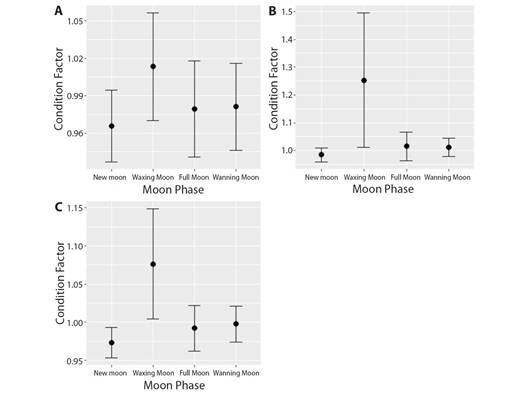
Fig. 6 Mean condition factor plus 95 % confidence intervals by moon phases for Lutjanus synagris, Colombian Caribbean. A. Males. B. Females. C. Both sexes.
Discussion
The first thing to notice is that the health condition of L. synagris was stable over the year and that no time period be it monthly or seasonal has bearing on health status at least in what the condition factor can tell us. Food offer in the year appears to be stable regardless of the seasonal upwelling. Upwelling phenomena have been traditionally associated with increased primary productivity and via the food web to better food offer in the water column. However, for the Gulf of Salamanca it has been found that the effect of the upwelling is more reflected on temperature and salinity changes rather than on increased primary production (Ramírez, 1990). For instance, García et al. (2013) found that concentrations of chlorophyll did not differ in the dry (upwelling) and rainy seasons. On the other hand, seasonal change is not without consequences. Duarte & García (1999) found that the importance of crustaceans in the diet of L. synagris diminishes in favor of teleost in the dry season.
Males and females of L. synagris associated differentially to the predictors explored here in terms of CF. Males respond to the latitudinal gradient while females respond to the longitudinal gradient. Thus, the distribution of individuals in the geographic space is not homogeneous. Further research should be conducted focused on characterizing the environmental gradients offered to L. synagris in the Gulf of Salamanca to find a mechanistic explanation of these patterns.
The effect of movement of individuals during the day was detected only for females. The later the capture, the lower the CF. A hypothesis to be explored is whether this pattern is related to a feeding cycle with more incidence of empty stomachs at night. In turn, CF of males had a negative association with bottom temperature while for both sexes a positive association with bottom salinity emerges. These conditions, low temperature and high salinity are reminiscent of the conditions in the dry season (upwelling) thus this pattern enters in contradiction with the finding that no monthly or seasonal trend was found in the year. García et al. (2013) found three water masses in the Gulf of Salamanca with characteristic temperature and salinity and moving limits as the season change. One to the East under the influence of brackish water of the Ciénaga Grande de Santa Marta, one to the center sector of the Gulf of Salamanca corresponding to a salty oceanic intrusion, and a third to the West under the influence of discharge of the Magdalena River. Thus, the Golf of Salamanca is not a homogeneous water body. The location of the stations may explain this pattern that is in line with the associations with latitude and longitude discussed earlier.
Unlike CF that showed no monthly tendency, the GDS index shows a tendency of increasing median values as the year progresses including and from the dry season (upwelling) and extending beyond. Median monthly values, however, showed substantial variability. On the other hand, the percentage incidence of mature individuals indicates predominance of mature fish approximately in the same months when high GDS index values were seen. Thus, with caveats, it appears that the main spawning activity of L. synagris occurred the first part of the year from February to a peak in September for females but continued the year round. These months partly overlap with the range given by Arteaga et al. (2004) and less so with the range given by Posada-Peláez et al. (2012). The main difference is that the range given here fully includes the dry season months. Given that bottom water temperatures and salinity are associated significantly with the GDS index, positively for temperature and negatively for salinity, and temperature increases, and salinity decreases as the year progresses thus it appears that spawning augmented activity is triggered by the gradients of these environmental variables until temperature and salinity reach a maximum and a minimum, respectively.
The same case as with CF, no seasonal difference in median GDS index was found. Considering these findings, the idea that the climate season per se correlates with the spawning cycle in L. synagris should be abandoned in favor of a scenario in which it is the gradient of increasing temperature and decreasing salinity that triggers augmented spawning activity.
The estimated length at first maturity, Lm, is well in the range of Lm values calculated for L. synagris in the Colombian Caribbean coast. However, these measures have been criticized because many of them come from sampling the fishery instead of sampling the population. García and Ramírez (2016) demonstrated that estimates of Lm significantly correlated to mean size of captured individuals that in turn depended on the selectivity patterns of the fishing gears. Thus, Lm estimates obtained from sampling the fishery do not necessarily reflect what is happening in the population and management measures based on Lm as indicator obtained that way may not be optimal. It would be interesting to conduct research on the current status of this trait in the Gulf of Salamanca for comparison.
The most interesting finding in this study is the significant association between moon phases and both CF and GDS indices values. Many marine species, including fishes, use moon phases as cue to synchronize relevant events in their life cycle (Andreatta & Tessmar-Raible, 2020; Tessmar-Raible et al., 2011) hence it might not be a surprise that L. synagris does so. However, to our knowledge in the Colombian Caribbean, apart from some mentions based on fishermen local knowledge (Altamar et al., 2010), the phenomenon of synchronization of biological activity with moon phases has not been documented, excepting Lopez and García (2001) in reference to postlarvae and juveniles of shrimps. In the context of fisheries Altamar et al. (2010) related CPUE with moon phases for the bigeye scad (Selar crumenophthalmus).
It is suggestive that while CF is significantly larger in the waxing moon, GDS index is significantly larger in the waning moon. Fishes appear to be preparing for the spawning events along the lunar cycle. This hypothesis should be tested with new research and field sampling designed to test it. At any rate it is clear that the lunar cycle superimposes on the yearly patterns for CF and GDS indices in L. synagris in the Gulf of Salamanca.
Shortcomings of the studies referenced here, including this, are the time period of observations that rarely extends more than one year and also that many are dependent on fishery landings instead of unbiased samples of the population. This renders the observations to criticisms as just anecdotical. However, as reproduction is an event so central in the life history of species it can be viewed as a conservative set of traits. The challenge is to learn how reproduction characteristics that emerged in evolution are modulated by biological, climatic, environmental factors and impacted by human activities like fishing through clear cut questions and well-planned sampling.
Condition factor of the lane snaper L. synagris is stable throughout the year when followed at monthly time steps. The gonadosomatic index builds up the first months of the year to a maximum in September. The gradient of increasing temperature and decreasing salinity appears to trigger augmented spawning activity rather than a strict conformance with the dry and rainy seasons. Of the predictive variable tested the moon phases were the most determinant with the waxing moon significantly associated to the highest values of condition factor and the waning moon significantly associated to the highest values of the gonadosomatic index.
Ethical statement: The authors declare that they all agree with this publication and made significant contributions; that there is no conflict of interest of any kind; and that we followed all pertinent ethical and legal procedures and requirements. All financial sources are fully and clearly stated in the acknowledgments section. A signed document has been filed in the journal archives.

