




 English (pdf)
 Article in xml format
 Article references

 Automatic translation
 Send this article by e-mail
 Cited by SciELO
 Similars in
SciELO
 uBio

 Permalink


Introduction
Hyalinobatrachium is a genus of the Centrolenidae family known as glassfrogs, this group is widely distributed within tropical forests from Mexico to some regions of South America (Mendoza et al., 2019; Frost, 2022). Currently, the genus contains 35 valid species (Frost, 2022). In the last years, the species of this genus have been studied, and their taxonomy and distribution have been debated (Mendoza et al., 2019; Mendoza-Henao et al., 2020). This group has recently undergone some taxonomic changes, and this change has affected mainly species that occur in the Central America region.
In El Salvador, the only representative species of this genus is Hyalinobatrachium fleischmanni (Boettger, 1893) and has been recorded in only three locations with few records and few individuals (see Köhler et al., 2006; Henríquez & Greenbaum, 2014; Segura et al., 2018). Due to this distribution being restricted to a few locations in the country (probably due to few studies), this species is classified as an endangered species in El Salvador (Greenbaum & Komar, 2005; MARN, 2015). However, new molecular and biogeographic evidence suggests that H. fleischmanni may not be as widely distributed from Mexico to Ecuador (Mendoza et al., 2019; Mendoza-Henao et al., 2020). A recent study of morphology, bioacoustics, and molecular about H. fleischmanni restricted this species to eastern Honduras and Nicaragua until Costa Rica and resuscitated H. viridissimum (Taylor, 1942) to the North-Central of America Central to Mexico (see Mendoza-Henao et al., 2020). However, no sample of El Salvador was analyzed. Consequently, the H. fleischmanni population that has been recorded in El Salvador, due to the geographic location adjacent between H. fleischmanni and H. viridissimum comb. nov. should be analyzed. On the other hand, the same study recognizes differences in the call patterns within the species of the genus Hyalinobatrachium in the region, even among populations of H. viridissimum comb. nov. Therefore, by analyzing the calls of the glassfrog from El Salvador it is possible to have notions about their taxonomy (Köehler et al., 2017; Rodriguez et al., 2017; Mendoza-Henao et al., 2020), and as well as knowing the characteristics of their calls, aspects that to date have not been studied.
Overall, amphibian studies in El Salvador are scarce and only a few studies have been recorded in the last 20 years. Köhler et al. (2006) established a baseline for the knowledge of the Salvadoran amphibians, after this contribution, few publications have been known about this group (Greenbaum, 2004; Felger et al., 2007; Herrera et al, 2007; Henríquez & Greenbaum, 2014; Segura et al., 2018). This information gap makes in many cases it difficult for taxonomic identity in some species that occur in the country (Mendoza-Henao et al., 2020). Even, this information gap difficult to generate conservation strategies for this vulnerable group under possible threats such as habitat degradation, amphibian alien introduction, diseases (chytrid fungal), or climate change (Young et al., 2001; Stuart et al., 2004). Therefore, it is necessary to increase research efforts at all levels to increase knowledge about this taxonomic group within the Salvadoran context.
Therefore, here we carry out the first acoustic analysis of the glassfrog that inhabits El Salvador, and with this to contribute to the taxonomic aspects of the populations that occur in the country. In addition, we carried out the first analysis on some aspects related to habitat use. Our study area is in the northern mountain region (central and northeast) of El Salvador near to Honduras border. This region stands out for being one of the sites with the highest forest coverage in the country with several ecosystems diversity (MARN, 2018). Therefore, one guiding question in our study was whether the glassfrog has habitat use restrictions in El Salvador. Accordingly, here we ask ourselves if there is a difference between the abundance of Salvadorean glassfrogs and the different ecosystem types that inhabit this species. Also, because our records are within an elevation gradient, and due the study area presents landscape recovery processes within abandoned agricultural areas, where is very likely to find dispersed forest cover connected between forests, mainly between the riparian forest. Herein we ask ourselves if the forest cover (without distinction of the type of ecosystem) together with the elevation has an important effect on the abundance and presence of Salvadorean glassfrog. Finally, due to our records coming from areas near rivers and stational streams, herein we ask if the river type influences the abundance and presence of Salvadorean glassfrog.
This study belongs to a series of works carried out for the study area whose purpose is to generate scientific knowledge under a community science or citizen science approach (see Morales- Rivas et al., 2020; Argueta et al., 2020), an approach that has been expanded greatly in recent years and has proven to be a reliable technique for co-producing scientific knowledge (Kosmala et al., 2016; Fritz et al., 2019; Rowley et al., 2019; Callaghan et al., 2020). It is probably that this study is the first count and bioacoustics analysis of glassfrog in El Salvador and perhaps is the only one with more records and information on this species in the country. Therefore, this study contributes to the knowledge of this species in El Salvador and contributes information for other studies at the regional level.
Study area
El Salvador is located within the Central American region on the Pacific slope. Its climate is typical of Neotropical regions, it has two well-defined seasons, the rainy season begins from May to October and the dry season begins from November to April. El Salvador has an approximate forest coverage of ~37%, mainly secondary forests (~22%) and agroforestry systems (~8%) (MARN, 2018). The study area is in the central and northeast region of El Salvador, in the mountains of the department of Morazán and Cabañas, close to the border with Honduras. The representative ecosystems in the study area are tropical deciduous broad-leaved forest, tropical evergreen seasonal needle-leaved forest, tropical semi-deciduous mixed submontane forest, and agroforestry systems.
Data collection
The samples during the rainy season from September to November were carried out. The sites were visited twice, once in 2019 and once in 2020. For the selection of sample sites, the experience of the volunteers in the field was used as a reference, also, safe sites for the volunteer team were selected since delinquency limits much fieldwork research in El Salvador. The sites correspond to the rivers and streams of the Río Lempa basin (see more detail in Appendix Table A.1). In the case of the rivers of the department of Morazán, tributaries of the Río Sapo, Quebrada de Perquín, Río Negro, Río Araute, Río Masala, Río Olomina, Río Cañaverales, Río Las Flores, Río San Antonio were visited. While in the department of Cabañas, only the Río Paso Hondo and La Quebradona in Cinquera were visited (Fig. 1). To carry out the sampling, a team of volunteers from the local communities was first trained to identify species through the detection of calls and direct observation of glassfrog on trees or shrubs near rivers and streams. Also, the volunteers were trained to use GPS, and record calls using cellphones. The sampling was carried out during the first hours of the night between 6-8 pm. The sampling was carried out walking within the forest or in sites close to the rivers and streams. The count of individuals was made through the detection of calls and direct observation in trees or shrubs near rivers and streams within a 15-meter radius (approximately) of each site were detected. To avoid overestimation within the count, only individuals that were considered an independent registry were recorded, also the sites are separated by at least ~300m between them. For this study, no scientific collections were made, and the manipulation of specimens was avoided to avoid diseases, no protected areas were visited either, and only used the participation of volunteers from local communities and forest owners.
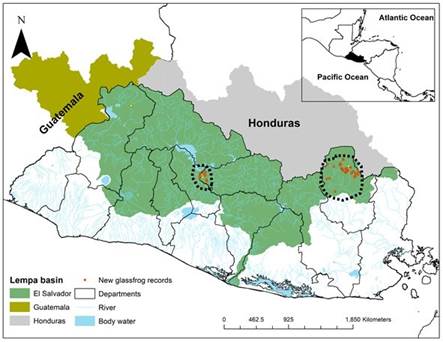
Fig. 1 Sampling sites and glassfrog records in the department of Morazán and Cabañas 2019-2020. Black lines show the two sampling regions and potential distribution areas. Yellow circles represent the three only previous records in El Salvador; 1 male in Metapán, Santa Ana; 1 male in Río Sapo, Morazán, and 2 males in Cinquera, Cabañas (Köhler et al., 2006; Henríquez & Greenbaum, 2014; Segura et al., 2018).
Bioacoustics data collection
We recorded individuals by call detection within the forest. The recordings were made with cell phones in WAV format and all records with a frequency of 44,1kHz and an amplitude resolution of 16 bits were analyzed. The species of the genus Hyalinobatrachium reported in the country may correspond to the species of H. viridissimum comb. nov. and H. fleischmanni. Therefore, we compared our calls with databases available of populations close to our region according to the biogeography of both species. In the case of H. viridissimum comb. nov. (Maya) the call samples come from Mexico (Chiapas), and the H. fleischmanni call samples come from Costa Rica (see Vargas-Masís, 2019; Zamudio-Torres et al., 2020). We used the calls (peak frequency, bandwidth, call duration) to compare populations and species identification since some authors suggest that bioacoustics analyses may be a reliable and effective tool in diagnosing and delimiting species (Köehler et al., 2017; Rodriguez et al., 2017). In addition, recent evidence suggests differences between call traits within genetic groups of H. viridissimum comb. nov. and H. fleischmanni described for the region (see Mendoza-Henao et al., 2020). Therefore, the comparing the calls of Salvadorean glassfrog with these populations, we can have notions about their taxonomy. The sound files were analyzed in Raven Pro 1.6 software (K. Lisa Yang Center for Conservation Bioacoustics, 2022) and some recording was deposited scientific collection of bioacoustics of Universidad Estatal a Distancia (see Vargas-Masís, 2019).
Ecosystem type
We used the land use map for El Salvador to describe the ecosystem types where glassfrogs were detected (see Crespin & Simonetti, 2015). To evaluate the relationship between glassfrog records between the ecosystem types, we characterized the ecosystem types where the glassfrog was detected (Fig. A.1. in appendix), including the elevation (masl). Due to the home range of glassfrog being relatively small (Mendoza et al., 2019), we estimated the forest cover (Ha) using the database available (see Hansen et al., 2013) within a buffer of 300m radius in each site. Also, we classify the river type according to river flow: if the flow is constant throughout the year, we classify it as a river or if is seasonal during the rainy season, we classify it as a stational stream (i.e., two types). Finally, since the data come from different sites throughout the landscape, these sites were classified according to their location by the municipality (i.e., seven municipalities, hereinafter referred to as "site"). All geographical information was managed using the Geographic Information System (ArcGIS).
Statistics analysis
To identify the glassfrog species that occur in El Salvador, we evaluated differences in call variables of peak frequency (Hz), bandwidth (Hz), and call duration (s) between populations of H. viridissimum comb. nov. (n=17; Mexico), H. fleischmanni (n=7; Costa Rica) with Salvadorean glassfrog (n=8). For this, we used Wilcoxon rank-sum test since our data did not show homogeneity of variance. For statistical analysis of glassfrog habitat use, we used Generalized Linear Mixed Models (GLMM) because of the nested nature of our sampling design (e.g., ecosystem types were nested within each of the seven sites). Thus, by using GLMM, we can control for random differences driven by sites. Specifically, we use the glassfrog abundance data (i.e., count data) for all models as our response variable. We used a Poisson error distribution with a log-link function because it is the most appropriate for the counting data. To compare the differences between glassfrog abundance by each ecosystem type a first GLMM was performed. For this, we used the ecosystem types (six types, see below) where glassfrog were recorded as fixed factor and the site (i.e., the seven municipalities) as a random factor. Then, to compare the means by ecosystem type, we used Fisher’s least significant difference test (LSD; p<0,05). Due to the study area having dispersed forest cover connected between forests under an elevation gradient, and due to the relationship between this species with vegetation for their arboreal habits, we evaluated the relationship between glassfrog abundance with these variables. For this, a second model (GLMM) was performed, using the forest cover (Ha) and elevation (masl) as fixed factors and the site as a random factor. Then, all models with the null model were compared and selected the best model (parsimonious) through the AIC and BIC values. Finally, due to the glassfrog records coming from different river types (river and stational streams) we evaluated the relationship between glassfrog abundance by river types. For this, a third model we performed, where we used the variable of river type as a fixed factor and the site as a random factor, and to compare the means by river types, we used Fisher’s least significant difference test (LSD; p<0,05). All statistical analyses including the analysis of glassfrog habitat use and comparison within calls were performed using InfoStat (Di Rienzo et al., 2011).
Results
We obtained a total of 32 samples for the call comparison analysis between species. The results of the Wilcoxon test showed significant differences in the peak frequency (Hz) between Salvadoran glassfrog populations with H. fleischmanni (W=78; p=0,009) and H. viridissimum comb. nov. (W=172; p<0,0001). In the case of the bandwidth (Hz) and call duration (s), both results of the Wilcoxon test were significant (Table 1). The bioacoustics results suggest that the calls of populations of the glassfrog in El Salvador differ from the calls of populations described in the region. Tentatively, according to the biogeography of the Hyalinobatrachium genus in Central America, the geology location of El Salvador (Chortis block), and according to the peak frequency range of H. viridissimum comb. nov. (more detail see Mendoza-Henao et al., 2020), this species from El Salvador may correspond to a new population of H. viridissimum in the Pacific (henceforth, Salvadoran glassfrog).
Table 1 Main bioacoustics parameters and Wilcoxon rank-sum test between H. fleischmanni, H. viridissimum comb. nov. (Maya), and Salvadorean glassfrog. Black values represent significance values (p<0,05)
| - | Wilcoxon rank-sum test | - | - |
| Species | Peak Frequency (Hz) | Bandwidth (Hz) | Call duration (s) |
| Salvadorean glassfrog- H. fleischmanni | W=78; p=0,0090 | W=84; p=0,0003 | W=83; p=0,0006 |
| Salvadorean glassfrog- H. viridissimum | W=172; p<0,0001 | W=40; p=0,0002 | W=41; p=0,0002 |
| H. fleischmanni - H. viridissimum | W=147; p=0,0001 | W=56; p=0,0454 | W=108; p=0,1927 |
| Main acoustic parameters (mean ± SD) | |||
| Species | Peak Frequency (Hz) | Bandwidth (Hz) | Call duration (s) |
| Salvadorean glassfrog | 4288,3±131,58 | 499,81±197,57 | 0,14±0,03 |
| H. fleischmanni | 4559,9±206,17 | 965,08±61,75 | 0,27±0,08 |
| H. viridissimum | 4116,73±86,49 | 1251,22±413,88 | 0,22±0,05 |
We counted 361 individuals of glassfrog and we registered 53 new record sites between Morazán and Cabañas departments (Table A.1). In the Morazán department, we counted 321 individuals in 44 sites, while in the Cabañas department, only were recorded 40 individuals in nine sites. The sites where glassfrog was recorded correspond to little disturbed ecosystems and postwar restored land. All localities where glassfrog was recorded corresponded to rivers and stational streams with clear, well-oxygenated waters, river widths between 2-5 meters approximately, and shallow waters, with moderate water velocity, sites with abundant trees and shrubs >2m high. The records of this species are distributed from ~260 to ~1 100masl. During the sampling, it was notorious to hear and observe Ptychohyla salvadorensis in the same localities. All records are located outside protected areas (Statal areas).
According to the ecosystem type for each samples sites, we identified six ecosystem types: tropical evergreen seasonal needle-leaved forests (TESNL); tropical deciduous broad-leaved lowland forest (TDBL); short graminoid savanna with lowland evergreen broadleaf trees (GSEBT); agricultural systems (AS; cattle, crops: sugar, corn, beans); tropical semi-deciduous mixed submontane forest (TSDMS); and coffee plantations (under shade) (Fig. 2). Concerning the difference in the abundance of Salvadorean glassfrog between the ecosystem types, the model was significant (χ2 30,07; p< 0,0001) (Table 2). Therefore, there are differences between glassfrog abundance by ecosystem type. According to the abundance of glassfrog, the TDBL and AS ecosystems have high abundance values and showed significant differences between TESNL and TSDMS ecosystems that showed the lowest abundance values. Concerning the relationship between the Salvadorean glassfrog abundance and the forest cover and elevation, all models including these variables were significant and lower AIC values than the null model. In addition, the model that includes both variables had a lower AIC (Table 3). Therefore, the presence and abundance of Salvadorean glassfrog are influenced by the forest cover and elevation. Concerning the difference in the abundance between the river type, the model was not significant (χ2 0,82; p> 0,3698). Therefore, the presence and abundance of Salvadorean glassfrog are not influenced by the river type, and it is possible to be found in both river systems.
Table 2 Comparison between the abundance of Salvadorean glassfrog within the ecosystem type. Average abundance of glassfrog and standard error.
| Land use and ecosystem type | Means | S.E. | Letter |
|---|---|---|---|
| Tropical deciduous broad-leaved lowland forest | 7,68 | 2,52 | A |
| Agricultural system | 6,32 | 1,77 | A |
| Short graminoid savanna with lowland evergreen broadleaf trees | 4,41 | 1,96 | AB |
| Coffee plantation | 2,74 | 2,37 | AB |
| Tropical evergreen seasonal needle-leaved forests | 2,56 | 0,93 | B |
| Tropical semi-deciduous mixed submontane fores | 2,35 | 1,06 | B |
Means with a letter in common are not significantly different (Fisher’s LSD, p < 0,05)
Table 3 Relationship between the abundance of Salvadorean glassfrog within the forest cover and elevation.
| Model | n | df | LogLik | Desviance | AIC | BIC | P-value |
| 1+Elevation+Forest cover | 53 | 50 | -171,77 | 129,18 | 351,54 | 359,42 | 0,000 |
| 1+Elevation | 53 | 51 | -174,83 | 135,36 | 355,67 | 361,58 | 0,001 |
| 1+Forest cover | 53 | 51 | -178,05 | 150,88 | 362,10 | 368,01 | 0,018 |
| Null | 53 | 52 | -212,62 | 244,20 | 427,25 | 429,22 | 1,000 |
Significant differences (p<0,05) are in bold
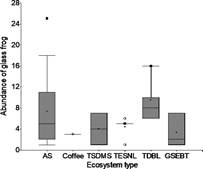
Fig. 2 Box plot of the abundance of Salvadorean glassfrog by ecosystem type of Morazán and Cabañas departments, El Salvador. Ecosystem types: Tropical evergreen seasonal needle-leaved forests (TESNL), tropical deciduous broad-leaved lowland forest (TDBL), short graminoid savanna with lowland evergreen broadleaf trees (GSEBT), agricultural systems (AS); tropical semi-deciduous mixed submontane forest (TSDMS), and coffee plantations (Coffee).
Discussion
Salvadoran amphibians have been little studied and are alarming how little we know about this taxonomic group in the country. The lack of information like museum vouchers, bioacoustics records, or scientific publications means that many local and regional studies overlook information about the species that occur in the country. This information gap has made it difficult to know the amphibian population status in the country. Before our study, only three sites were known with few recorded individuals (only 4 males) of the Salvadorean glassfrog (Köhler et al., 2006; Henríquez & Greenbaum, 2014; Segura et al., 2018). Now, we know 56 record sites between Santa Ana, Cabañas, and Morazán departments (Fig. 1). We observed during the sampling that the species is not distributed uniformly throughout the river or streams but in specific places. It is likely that these conditions, coupled with its arboreal habits and distribution in remote locations in northern El Salvador, contributed to the scarce knowledge about this species in the country. Probably this glassfrog is distributed along the mountains of northern El Salvador near Honduras and Guatemala (Santa Ana, Chalatenango, Cabañas, Morazán, and some regions in San Miguel, and La Unión). However, we suggest continuing the study on this species to know its distribution throughout the country.
On the other hand, the taxonomy of glassfrogs has proven to be complex (H. fleischmanni species complex). Recent work, without including the glassfrogs of El Salvador, has shown that there are at least four different subpopulations under the name of H. viridissimum comb. nov. in Central America and Mexico. Herein, according to the geological location of El Salvador (Chortis block), Hyalinobatrachium genus biogeography in Central America, and our bioacoustics result we consider that the species from El Salvador could correspond to a new population (tentatively) of H. viridissimum in the Pacific (Townsend, 2014; Mendoza et al., 2019; Mendoza-Henao et al., 2020). Our results determine bioacoustics differences between the calls of Salvadoran glassfrog populations and calls of adjacent populations. These results suggest that a new glassfrog population could be located within El Salvador. Although it is also possible that there are only variations in the calls within the populations for other factors own of this species or results of environmental factors (Köehler et al., 2017), therefore these results should be taken with caution. Therefore, it is imperative to study the population of El Salvador at the molecular and morphological levels to confirm the taxonomic status of Salvadorean glassfrogs. Although our work does not have a strict taxonomic focus and is rather an effort to expand knowledge of the Salvadorean glassfrog under a citizen science approach. Our findings are relevant for future research on this species in the region and it is necessary to pay attention and focus research and conservation efforts on this population. Some authors record alarming declines of amphibians in Central America, mainly in ecosystems above 500masl (Young et al., 2001) whose main possible causes are climate change and chytrid fungal disease. More than 75% of our sites are over this level, which could suggest a possible threat to the species under this context. Although these species declines may have multiple causes (Alford et al., 2001; Collins & Storfer, 2003), the degradation of ecosystems, poor water quality in rivers, and deforestation may likely be one of the main threats facing biodiversity in El Salvador (Dull, 2008; Crespin & Simonetti, 2015; MARN, 2022), even, exist risk by introduction of the amphibian alien species (see Antúnez-Fonseca et al., 2021). Currently, only ~8% of the Salvadorean territory corresponds to protected areas (UNEP-WCMC, 2019), and very few of these areas have connectivity in the country, a widespread apparently problem throughout the world (Ward et al., 2020). Consequently, most of Salvadoran biodiversity is exposed to human activity. Our records are placed outside protected areas (Statal areas), which supports the need to create conservation strategies that include private lands as the corridor biologicals, mainly for those species that require healthy ecosystems as the amphibian group.
Herein we asked a question about if there are limitations in the use of habitat for the Salvadorean glassfrog. In appearance, this species can use different ecosystem types, and even inhabits agricultural systems with forest cover or coffee plantations, although the deciduous broad- leaved forest was the ecosystem where a greater abundance of this species was recorded. Our records of Salvadorean glassfrog are in mountains between 200 and 1100masl, in forests and rivers with little or moderate disturbance. Herein, we identified the elevation and forest cover as important factors for this species, this relationship may be explained due to most of the forest cover and better environmental quality conditions (mainly water quality) being in mountain regions to the north of the country (MARN, 2020). However, it is necessary to emphasize that Salvadoran forests are subject to high fragmentation and the protection of these habitats will depend on different strategies of conservation. On the other hand, decades ago, many of the ecosystems where we carry out our study were abandoned cattle ranching or agriculture landscapes affected by fires and bombed during the civil war 80s, and currently are recovering through secondary succession (Hecht & Saatchi, 2007; Herrador et al., 2011; Clark et al., 2012; Redo et al., 2012). Therefore, the protection of these new forests -secondary forests- should be a biodiversity conservation priority.
This contribution is an effort to involve local community actors to generate scientific knowledge. The experience of the volunteers and knowledge of their forests facilitated the registration of this species. Also, we carry out the largest count of this species in the country and contribute important descriptions of taxonomy aspects and habitat use of this species. Future studies must include other variables in models to explain other ecological aspects of this species with more precision. Also, is imperative to evaluate this population at the morphological and molecular level (e.g. Mendoza et al., 2019; Mendoza-Henao et al., 2020). Our results are very useful for decision-makers and communities local. This species, due to its unique characteristics (translucent body), can use as a tourist attraction to generate economic income for local communities, and so conserve these important areas for the species on private land. Herein, we showed that communities locals can co-producer scientific material and can be actors key in efforts of species conservation. Therefore, decision-makers should consider the local communities for planning the territories and identify these areas as important areas for the conservation of Salvadorean amphibians.
Ethical, conflict of interest and financial statements
The authors declare that they have fully complied with all pertinent ethical and legal requirements, both during the study and in the production of the manuscript; that there are no conflicts of interest of any kind; that all financial sources are fully and clearly stated in the acknowledgments section; and that they fully agree with the final edited version of the article. A signed document has been filed in the journal archives.
The statement of each author’s contribution to the manuscript is as follows: F.S.A., V.H., and X.P.O.: Study design, data collection, analysis, writing, and reviewing the manuscript. J.G.A.R. and E.A.C.A.: Study design, data collection, and reviewing of the manuscript.

