




 Inglês (pdf)
 Artigo em XML
 Referências do artigo

 Tradução automática
 Enviar este artigo por email
 Citado por SciELO
 Similares em
SciELO
 uBio

 Permalink


Introduction
Dendrobium sect. Crinifera Pfitzer of 1889 (Pfitzer 1888-1889) was first described as Desmotrichum Blume in 1825 (Blume 1825-1826). However, noting that Blume’s name was illegitimate, Hawkes (1961) proposed the new generic name Flickingeria A.D.Hawkes for this group of species that are distributed from India to Samoa (Lavarack et al. 2000). For the next many years, the group was almost consistently recognised as genus Flickingeria, but following a series of DNA-based phylogenetic studies demonstrating Flickingeria to be nested in Dendrobium Sw. (e.g., Burke et al. 2008, Yukawa et al. 1993, 2000), Schuiteman (2011) advocated the resurrection of Dendrobium sect. Crinifera to accommodate all the species previously treated under Flickingeria. This solution was implemented in Genera Orchidacearum (Pridgeon et al. 2014).
Ridley (1896) published a description and proposed the name Dendrobium pallens Ridl. for a new species based on material in SING, probably originating from Thailand (for details, see O’Byrne 2019: 55). The species name was illegitimate due to the existence of D. ×pallens Lawr. ex B.S.Williams of 1894, but Kränzlin (1910) legitimised the epithet when formally recognising Ridley’s species as Desmotrichum pallens Kraenzl. Hawkes (1961:457) published the new combination Flickingeria pallens (Kraenzl.) A.D.Hawkes. This name became widely accepted for many years, but the true taxonomic identity of Ridley’s plant remained unresolved until O’Byrne (2019), based on a thorough morphological analysis of comprehensive material from Peninsular Malaysia, convincingly referred it to Dendrobium pardalinum Rchb.f. of 1885.
However, O’Byrne (2019) also realised that Seidenfaden’s (1980) interpretation of F. pallens was in conflict with the type material and the protologue. He concluded that the more recent collections from Thailand on which Seidenfaden (1980) had based his description and illustrations should be described as a new species. We discussed this issue with Peter O’Byrne shortly before his passing in 2018, and during our correspondence, O’Byrne proposed the name Dendrobium krabiense for the new species. Based on our discussion with O’Byrne and our own examination of relevant herbarium material, we agree in his taxonomic finding, considering the undescribed species most morphologically similar to D. pardalinum and D. phuketense Schuit. & Peter B.Adams. Consequently, we here describe the new species, appropriately crediting O’Byrne for his important preparatory work and for coining the name.
Materials and methods
We examined all material of Flickingeria pallens sensu Seidenf. in herbaria BK, BKF, C and K. For checking and characterising the delimitation of the newly described species, we also examined material of Dendrobium pardalinum in the same range of herbaria and D. phuketense in C and K. Using a ruler and an object micrometer under a lowpower binocular microscope for measuring vegetative and floral organs, respectively, we prepared a morphological description of the new species. As a supplement to the herbarium studies, we consulted Seidenfaden’s unpublished sketches of relevant taxa in the archive of the Natural History Museum of Denmark.
Taxonomic treatment
Dendrobium krabiense P.O’Byrne ex H.A.Pedersen & Suddee, sp. nov. (Fig. 1-2).
TYPE: THAILAND. Krabi province: Laem Nang, 16 February 1966, flowering in cultivation 25 June 1977, Seidenfaden & Smitinand GT 6465 (holotype: C).
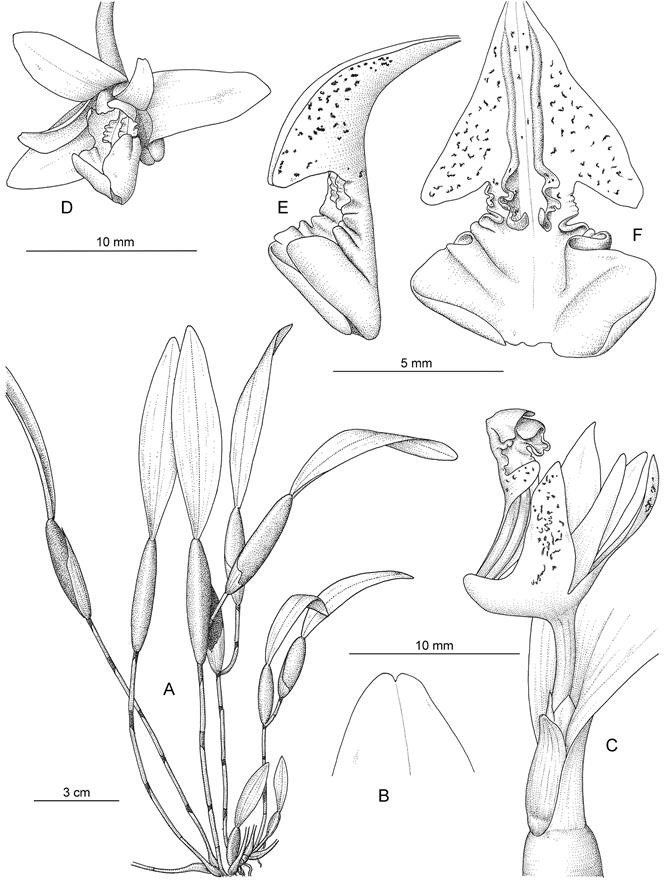
Drawn from the type Seidenfaden & Smitinand GT 6465 (C), Seidenfaden & Smitinand GT 6327 (A-B) and Seidenfaden & Smitinand GT 6276 (D-F).
Illustration by Poul Juul; previously published in Dansk Botanisk Arkiv 34(1): 38 (1980).
A. Habit. B. Leaf tip. C. Inflorescence. D. Flower.E. Lip in side view. F. Lip in ventral view, side lobes artificially spread out.
Figure 1 Dendrobium krabiense P.O’Byrne ex H.A.Pedersen & Suddee.
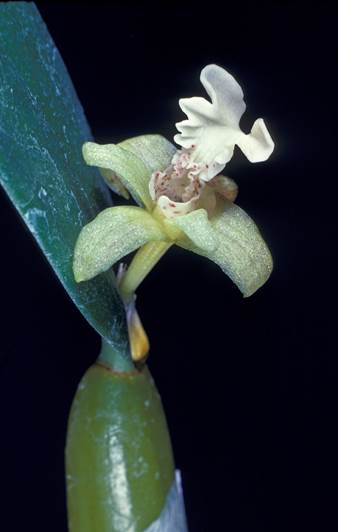
Flower of Seidenfaden & Smitinand GT 6461.
Photograph by Gösta Kjellsson; previously published in Dansk Botanisk Arkiv 34(1): 96 (1980).
Figure 2 Dendrobium krabiense P.O’Byrne ex H.A.Pedersen & Suddee.
Diagnosis: Dendrobium krabiense is similar to D. pardalinum but differs in the lip mid-lobe being distinctly clawed (vs. sessile) and in the lip having two lateral keels extending from near lip base to claw of mid-lobe (vs. one median and two lateral keels extending from near lip base to near mid-lobe apex). Dendrobium krabiense is also similar to D. phuketense, but differs in having larger, spotted flowers with a mentum that is proportionally longer in relation to the dorsal sepal.
Plant lithophytic or epiphytic; rhizome creeping, 1.5-3.2 mm in diameter, with 1-2 internodes, each 3-4 mm long; stems branched, glabrous. Pseudobulbs oblong to fusiform, slightly compressed, 2.5-5.5 cm long, 0.5-1.2 cm in maximum diameter, sometimes longitudinally furrowed. Foliage leaves subsessile, oblong-lanceolate to lanceolate, 6.5-9.0 × 1.5-2.5 cm, coriaceous, glabrous, apex obtuse and minutely retuse. Inflorescence arising adaxially, 1-flowered; peduncle 4-6 mm long, glabrous, enveloped by several scale-like sheaths. Flower lasting less than a day; sepals, petals and mentum pale greenish yellow, with purplish markings near base on the dorsal surface, lip white with small purple markings scattered on disk and side lobes, column pale yellow with red dots around the stigmatic cavity, ovary and pedicel yellow. Sepals spreading, recurved; dorsal sepal oblong, subacute to obtuse, 10.0-12.5 × 2.5-3.0 mm, glabrous; lateral sepals ovate-lanceolate, subacute to obtuse, 11-13 × 3-4 mm, glabrous, base oblique and broad; mentum at a right angle to ovary, 5-6 mm long, ca. 0.5 times as long as dorsal sepal, obtuse. Petals spreading, recurved, linear-lanceolate, (sub)acute, 8-10 × 1.5-2.0 mm, entire, glabrous. Lip porrect, trilobed, 10-12 mm long, glabrous; disk ornamented with a pair of lateral keels extending from near lip base to claw of mid-lobe where they become undulate lamellae; side lobes erect, incurved, obliquely triangular-ovate, obtuse, entire, apices 6.0-6.5 mm apart when folded down; mid-lobe distinctly clawed (claw broader than long), 7.5-8.0 mm in maximum width, bilobulate with obliquely obovate-oblong lobules measuring 2.9-3.2 × 2.6-3.0 mm, entire, basal margins strongly undulate. Column subterete, slightly incurved, ca. 3.0 mm long; column foot ca. 5.0 mm long. Ovary with pedicel semifusiform-terete, 3-5 mm long, glabrous.
Additional material examined: THAILAND. Krabi province: Koh Ngai. 11 February 1966, flowering in cultivation 26 February 1980, Seidenfaden & Smitinand GT 6430 (C). Koh Jum. 14 February 1966 (flowering in cultivation 2 October 1966, 26 October 1979), Seidenfaden & Smitinand GT 6461 (C). Laem Nang. 16 February 1966 (flowering in cultivation 23 June and 26 October 1979, 22 March 1980), Seidenfaden & Smitinand GT 6465 (C). Nakhon Si Thammarat province: Khao Luang. 750-1000 m, 25 January 1966, flowering in cultivation 16 May and 26 October 1979, Seidenfaden & Smitinand GT 6276 (C). 1000-1350 m, 26 January 1966, flowering in cultivation 30 January 1980, Seidenfaden & Smitinand GT 6327 (C). Thung Song. 13 February 1929, Put 2375 (BK, C, K). Phangnga province: Takua Pa. 400-500 m, 26 September 1963, Smitinand & Sleumer 1293 (K). Satun province: Satun. ca. 50 m. 27 December 1927, Kerr 464 (BK, K). Surat Thani province: Khao Rahu. 1 July 1966, Sakol 1175 (BK). Tha Kanon. ca. 300 m, 15 March 1927, Kerr 0394 (C, K).
Distribution: Apparently endemic to peninsular Thailand and small nearby islands (Fig. 3). However, as D. krabiense occurs close to Thailand’s southern border in Satun province, it should also be searched for in the northern part of Peninsular Malaysia.
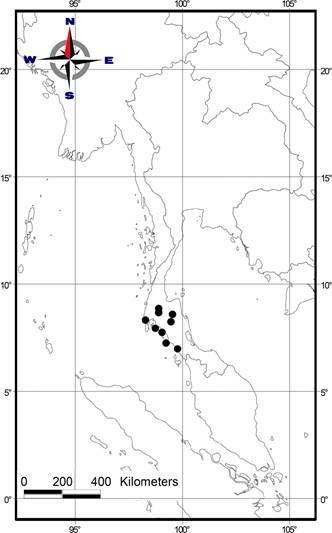
Filled circles indicate individual occurrences documented by herbarium collections.
Figure 3 The known distribution of Dendrobium krabiense P.O’Byrne ex H.A.Pedersen & Suddee.
Ecology: Dendrobium krabiense occurs in tropical evergreen rainforest from near sea level to ca. 1000 m in elevation. Here, it grows as an epiphyte on trees and as a lithophyte on limestone rocks.
Phenology: Probably flowering all the year round (flowering recorded in February, March, July, September and December in the wild - in cultivation also in January, May and October).
Etymology: Named for Krabi province, the type locality.

