




 English (pdf)
 Article in xml format
 Article references

 Automatic translation
 Send this article by e-mail
 Cited by SciELO
 Similars in
SciELO
 uBio

 Permalink

Introduction
Masdevallia Ruiz & Pav. is one of the most species-rich genera of subtribe Pleurothallidinae with an estimated of 600 species (Dasltröm & Ruiz Pérez 2015, WCSP 2017). The genus ranges from southern Mexico, Central America and northern Andes to Peru, Bolivia and southern Brazil. The highest concentration of species is found in Colombia (152 spp.), Ecuador (269 spp.) and Peru (197 spp.) (OrtizValdivieso et al. 2016, WCSP 2017). About 42 species are found in Central America, mostly in Costa Rica and Panama. Costa Rica harbors 34 species and 12 of them are endemic (Luer 2003a, Smith et al. 2015, Oses Salas & Karremans 2016).
Luer (2003a) revised the genus for Costa Rica and clarified most of the taxonomic problems. However, some specimens collected for a taxonomic reassessment of the genus in Costa Rica still cannot be assigned to any known species so far. Recently, Smith et al. (2015) and Oses Salas & Karremans (2016) added M. jorge-warneri (C.M.Sm., Bogarín & Pupulin) Bogarín and M. utriculata Luer respectively. However, other collections remained under study until a further understanding of the natural variation of populations allow us to distinguish among them. One of these unclassified collections correspond to a species of Masdevallia, which is restricted to the middle elevations of the southern Pacific region of Costa Rica, morphologically similar to Masdevallia floribunda Lindl., M. lata Rchb.f. and M. ostaurina Luer & V.N.M. Rao. Here, we describe and illustrate this new species of Masdevallia s.l. following the broad circumscription of the genus (Luer 1986, 2000a, 2000b, 2001, 2002, 2003a, 2003b, 2006, Dasltröm & Ruiz Pérez 2015, Vieira-Uribe & Bogarín 2016).
Taxonomic Treatment
Masdevallia luerorum Bogarín, Oses & C.M.Sm. , sp. nov.
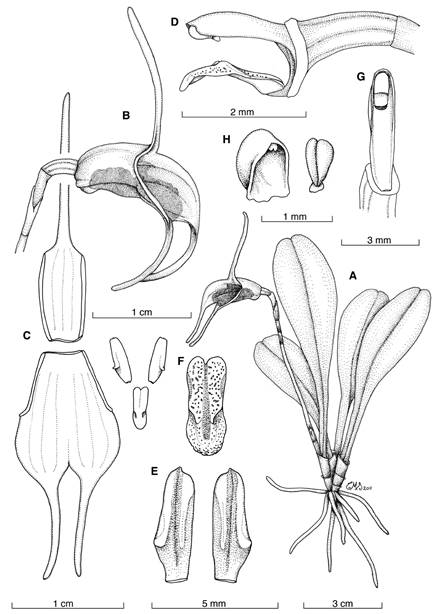
TYPE: Costa Rica. San José: Pérez Zeledón, Pejibaye, 9°10’00”N 83°35’00”W, 500 m, premontane wet forest, collected by J. Cambronero, flowered in cultivation in Palmares de San Isidro de Pérez Zeledón, 28 July 2009, D. Bogarín 7364 (holotype, CR; isotypes, JBL, USJ). Figs. 1, 2, 3, 6B.
Species Masdevalliae latae Rchb.f. similis, sed inflorescentia uniflora, sepalibus brevioribus, tubo sepalino latoque cylindrico, mento infra pedem columnae parviore, mento secondario minore, deflectione inter mentos non profunda, plicis marginalibus partem medianam labelli approximates, apice labelli rotundoque conspicue verrucoso differt.
Epiphytic, caespitose, erect herb, up to 9 cm tall. Roots white, glabrous, flexuous, to 1 mm in diameter. Ramicauls almost indistinguishable, erect, up to 11 mm long, 1.5 mm wide, enclosed by 2-3 ribbed, tubular sheaths to 10 mm long. Leaves bright green, erect to suberect, coriaceous, obelliptic, obtuse, emarginate, with a short apiculus, 6-8 cm long including the petiole, 1-2 cm wide, the base gradually narrowed into the petiole ca. 1.5 cm long. Inflorescence apparently single flowered. Peduncle few spotted with brown, suberect, 4.5-7.0 cm long, with three tubular bracts, one near the pedicel and the other two below the middle. Floral bract tubular, 6 mm long. Pedicel 10 mm long. Ovary light green, 3-5 mm long, with 6 straight ribs. Flowers with yellow sepals, suffused with reddish-purple in the lamina of the lateral sepals, petals white, lip white dotted with purple and dark yellow at the apex, column white; the flowers do not produce perceptible fragrances. Dorsal sepal oblong, 22-30 mm long including the tail, 4 mm wide, connate to the lateral sepals for about 8-10 mm forming a cylindrical sepaline tube, the free portion about 15- 20 mm long including the tail, basally subtriangular, abruptly contracted into a slender, erect, apical tail to 13-20 mm long. Lateral sepals obovate, oblique, 20-30 mm long including the tails, 9-15 mm wide expanded together, connate for about 6-10 mm to form a lamina, the free portion about 23-25 mm long, each basally subtriangular, gradually contracted into a slender, descending, apical tail to 8.5-13.5 mm long. Petals ovate, oblique, unguiculate, 4.5-5 mm long, 1.5 mm wide, the apex obtuse with a small apiculus, the labellar margin with a low, longitudinal callus ending in a short, pointed tooth between the iddle and lower third of the petal. Lip oblong, convex, 4 mm long, 1.5 mm wide, with marginal folds near the middle, the apex rounded, verrucose, the base subcordate, hinged beneath. Column semiterete, 4 mm long, 1 mm wide. Foot 2 mm long with a short, incurved extension. Pollinia two, ovoid. Anther cap cucullate.
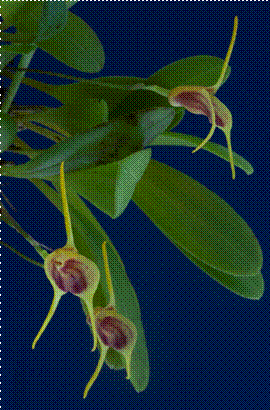
Figure 2 Masdevallia luerorum, from the plant that served as the type specimen, D. Bogarín 7364. Photograph by C.M. Smith.
Distribution: Known only from southern Pacific of Costa Rica along the Fila Costeña (Fig. 4).
Habitat: Epiphytic in premontane wet forest at 500 m of elevation.
Phenology: Plants bloom in July, September, and October. Eponymy: Dedicated to Jane and Carlyle A. Luer for their contributions to the taxonomy of Costa Rican Masdevallia.
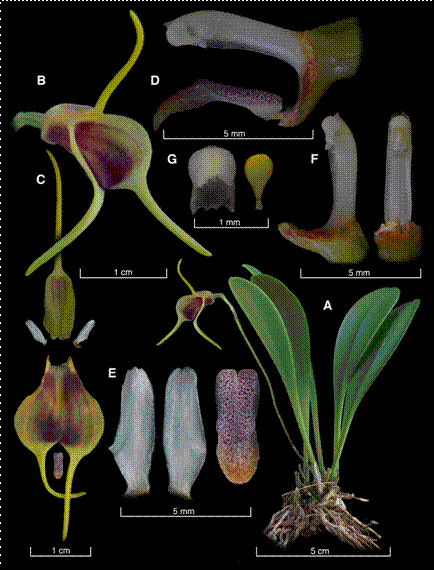
Figure 3 Lankester composite dissection plate (LCDP) of Masdevallia luerorum. A. Habit. B. Flower. C. Dissected perianth. D. Column and lip, lateral view. E. Petals and lip, adaxial view. F. Column, lateral and adaxial view. G. Anther cap and pollinarium. Plate by D. Bogarín and L.Oses. Voucher at JBL.
Masdevallia luerorum can be distinguished from other Costa Rican species by its broad yellow sepals suffused with reddish-purple (Fig. 5). Morphologically, it resembles Masdevallia lata (=Alaticaulia lata (Rchb.f.) Luer) (Fig. 5D, 6). However, the sepals are longer in M. lata than in M. luerorum (dorsal sepal 30 mm vs. 38-68 mm, lateral sepals 28 mm vs. 34-65 mm). The color of the sepals is also distinct; there is much more yellow in the lateral sepals of M. luerorum and they are suffused with reddish-purple, while in M. lata the sepals are a much darker brownish-red, with yellow restricted to the dorsal sepal and the tails (Luer 2000). The synsepal of M. lata is laterally compressed whereas in M. luerorum it forms a cylindrical tube that expands to a more open lamina. Masdevallia luerorum has a small mentum beneath the column foot, a small secondary mentum and between the two mentums a slight deflection, whereas M. lata has a much larger mentum beneath the column foot and a larger secondary mentum and a very conspicuous deflection between the two menta (Luer 2000) (Fig. 5B, 5D). The two species also present differences in the lip. The marginal folds in M. lata are above the middle, whereas in M. luerorum they are below to the middle. Furthermore, in M. lata the lip is divided into a well-defined hypochile and epichile, whereas in M. luerorum, this division is less evident. The apex of the lip in M. luerorum is rounded and conspicuously verrucose versus an obtuse and minutely verrucose apex in M. lata (Luer 2000).
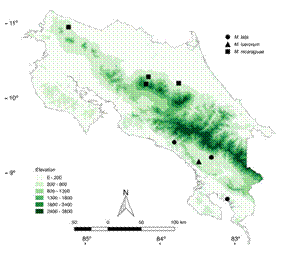
Figure 4 Distribution map of: Masdevallia lata (circles), M. luerorum (triangle) and M. nicaraguae (squares) in Costa Rica.
Both M. lata and M. luerorum are likely sympatric in the vicinity of the Fila Costeña in the southern Pacific of Costa Rica. Masdevallia lata extends from San Isidro de El General towards the south in the Península de Osa and Panama where M. luerorum is absent. However, both species potentially overlap in the Cordillera Costeña (Fig. 4). The hypothesis that M. luerorum might represent a geographical variation of M. lata has been initially tested by performing phylogenetic analysis of Bayesian inference (BI) and maximum likelihood (ML) of the nuclear ribosomal internal transcribed spacers (nrITS) and the plastid maturase K (matK) datasets (Oses et al., in prep.). Both analysis yielded the same topology and suggested that M. luerorum and M. nicaraguae Luer are closely related. The species were also grouped with M. lata and the Colombian M. pescadoensis Luer & R. Escobar into a clade with serially branching pattern. Masdevallia lata occupies a basal position (posterior probability for BI reconstruction =0.94), followed by M. pescadoensis (posterior probability=0.98 and bootstrap for ML=77) whereas M. luerorum and M. nicaraguae are grouped with strong support (posterior probability=1.0 and bootstrap for ML=93).
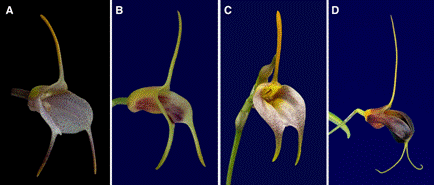
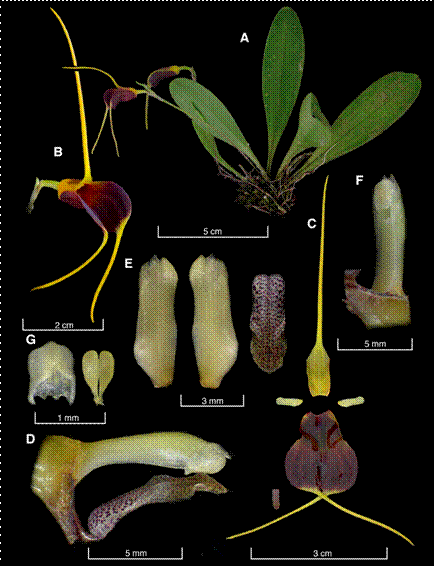
Figure 6 LCDP of Masdevallia lata Rchb.f. A. Habit. B. Flower. C. Dissected perianth. D. Column and lip, lateral view. E. Petals and lip, adaxial view. F. Column, lateral (or ¾) view. G. Pollinarium and anther cap. Plate by D. Bogarín & C.M. Smith based on Bogarín 11335 (JBL).
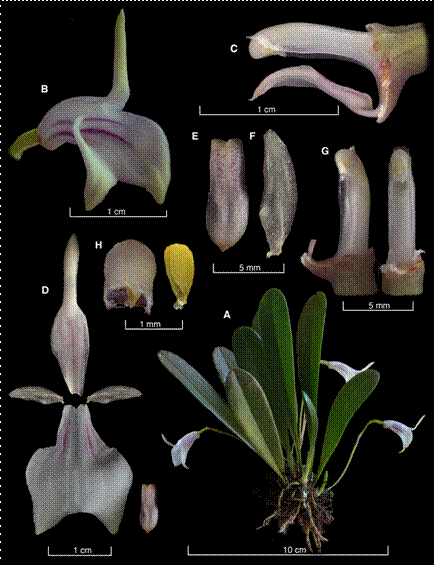
Figure 7 LCDP of Masdevallia nicaraguae Luer. A. Habit. B. Flower. C. Ovary, column and lip, lateral view. D. Dissected perianth. E. Petal. F. Lip, adaxial view. G. Column, adaxial and lateral view. H. Pollinarium and anther cap. Plate by L. Oses based on Karremans 6832 (JBL).
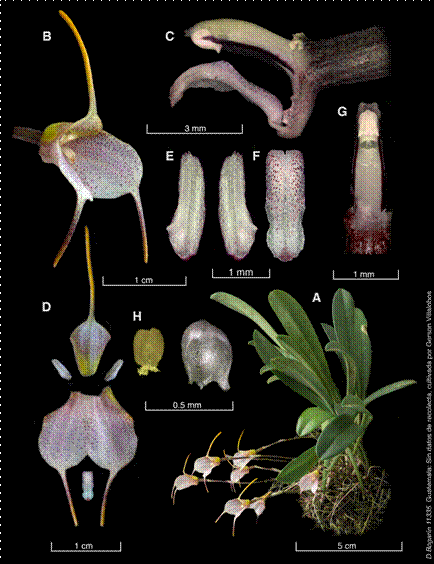
Figure 8 LCDP of Masdevallia floribunda Lindl. A. Habit. B. Flower. C. Ovary, column and lip, lateral view. D. Dissected perianth. E. Petals. F. Lip, adaxial view. G. Column, adaxial view. H. Pollinarium and anther cap. Plate by D. Bogarín based on Bogarín 11335 (JBL).
Masdevallia nicaraguae is distinguished from Masdevallia foribunda Lindl., M. luerorum and M. lata by the white flowers suffused with rose stripes toward the bases of sepals and the thick, triangular shorter sepaline tails of the lateral sepals (Luer 2003a, Karremans et al. 2012) (Fig. 7). In addition, Masdevallia luerorum and M. nicaraguae are geographically isolated. Masdevallia nicaraguae ranges in the Caribbean lowlands of northern Costa Rica and southern Nicaragua along the San Juan River and the lower slopes of Cordillera de Guanacaste and Tilarán whereas M. luerorum is restricted to the Pacific mid-elevation areas of Cordillera Costeña (Fig. 4).
Masdevallia luerorum has little resemblance with Masdevallia floribunda (Figs. 5A, 8) and Masdevallia ostaurina Luer & V.N.M. Rao (Fig. 5C), but differs in flower coloration; the sepals of M. floribunda and M. ostaurina are white to yellowish or pinkish and dotted with purple to varies degrees and purple-spotted peduncle. Moreover, M. ostaurina has a dark purple lip (vs. lip white dotted with purple) and M. floribunda has a column with a purple margin (vs. without purple margin) (Luer 2001, 2004). Also, Masdevallia floribunda lacks a secondary mentum and has a shorter sepaline tube with a more spreading lamina formed by the lateral sepals (Fig. 8). Furthermore, M. floribunda has a verrucose callus that protrudes both above and beneath lip close to the apex, which is absent in M. luerorum.

