




 English (pdf)
 Article in xml format
 Article references

 Automatic translation
 Send this article by e-mail
 Cited by SciELO
 Similars in
SciELO
 uBio

 Permalink

Introduction
Platystele Schltr. belongs to subtribe Pleurothallidinae and currently includes about 110 species (Karremans et al. 2016). The genus is closely related to Scaphosepalum Pfitzer and Teagueia (Luer) Luer, all belonging to the Specklinia Lindl. affinity (Pridgeon, Solano & Chase 2001, Karremans 2016). Species of Platystele can be recognized by the small plants, the tiny flowers, which are frequently flat, with free and spreading sepals and petals, a simple lip with a basal glenion, a short column with an apical anther and bilobed stigma (Luer, 1990).
In the latest monographic study of the genus from Costa Rica, Luer (2003) recorded 13 species. Subsequent authors added five species Platystele catiensis Karremans & Bogarín, P. speckmaieri Luer & Sijm, P. sylvestrei Karremans & Bogarín, P. tausensis Bogarín & Karremans, and P. tica Karremans & Bogarín to the country’s flora (Bogarín & Karremans 2010, Fernández, Bogarín, Karremans & Jiménez 2014, Rakosy, Speckmaier, Weber, Huber & Weissenhofer 2013).
While revising material of Platystele in preparation for a revision of the genus from Costa Rica, we encountered two unnamed entities. Unfortunately, we were unable to retrieve any additional material for study, and have to rely on what is currently available to name these two distinct taxa. They are described here forth bringing the total number of species of Costa Rican Platystele to twenty.
Taxonomic Treatment
Platystele carl-lueriana Karremans & Bogarín, sp. nov. ( Fig. 1-2).
TYPE: Costa Rica. Limón: Pococí, Guápiles, Jiménez, 10°10’09.35”N 83°46’54.94”W, 457 m. En árboles solitarios en potreros. Floreció en cultivo en la colección personal de Gerson Villalobos el 29 de agosto 2014, A.P. Karremans 6310 ( holotype, JBL-Spirit ).
Platystele carl-lueriana is florally similar to P. catiensis and P. oxyglossa Schltr., but can be easily distinguished the compact inflorescence that barely exceeds the leaf (versus an elongate, loosely flowered inflorescence).
Plant minuscule, epiphytic, caespitose, erect, up to 2.4 cm tall, including the inflorescence. Roots basal, flexuous, filiform. Ramicauls erect, slender, abbreviated, enclosed by tubular, imbricating, slightly compressed, membranous sheaths, becoming brownish and papery with age. Leaf narrowly-elliptic to ligulate, erect, conduplicate, subacute, emarginate, abaxially keeled and terminating in a short apiculus, 1.9-2.1 × 0.1-0.2 cm, narrowed at the base into a conspicuous, conduplicate petiole. Inflorescence racemose,distichous, congested, successively flowered, with one flower open at a time, shortly surpassing the leaf, up to 2.2 cm long, peduncle to 1.8 mm long, pedicels 2-3 mm long. Floral bracts acute, conduplicate, to 0.1 mm long. Ovary terete, smooth, to 0.6 mm long. Flower with the sepals and petals yellowish, the lip and column red. Dorsal sepal narrowly ovate to lanceolate, acute-acuminate, margin erose-dentate, spreading, 2.3 × 1.0 mm. Lateral sepals subequal to the dorsal sepal, slightly oblique, ovate, acute, shortly apiculate, margin erose-dentate, spreading, 1.7-1.8 × 1.0-1.1 mm. Petals obliquely lanceolate to narrowly-ovate, margin erosedentate, spreading, acute, 1-veined, 1.8-1.9 × 0.7-0.8 mm. Lip narrowly-ovate, acute, margin erose-dentate, glandular, with a small glenion at the base, 1.2-1.3 mm × 0.6 mm. Column short, sub-cylindrical, 0.3-0.4 mm long. Anther apical cucullate, pollinia two, laterally flattened. Stigma subapical, transversely bilobed at each side of the anther.
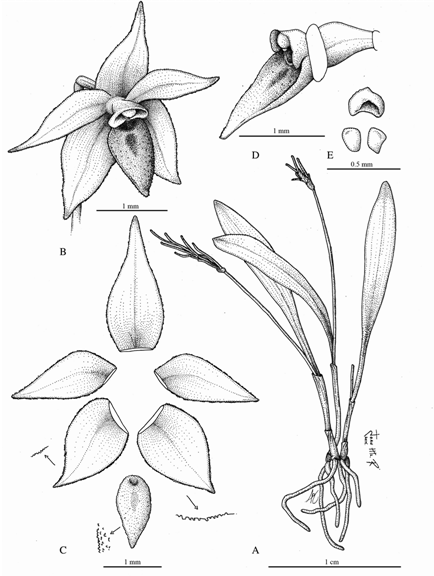
Figure 1 Platystele carl-lueriana Karremans & Bogarín. A. Habit. B. Flower. C. Dissected perianth. D. Ovary, column and lip, lateral view. E. Anther cap and pollinarium. Drawing by A.P. Karremans and Joan Ramírez from the holotype.
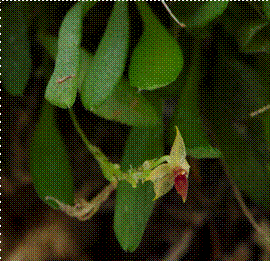
Figure 2 Platystele carl-lueriana Karremans & Bogarín showing the relatively elongate leaves and congested inflorescence. Based on the plant that served as type. Photograph by A. P. Karremans.
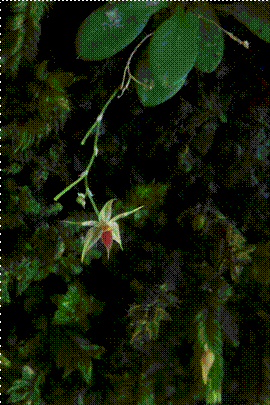
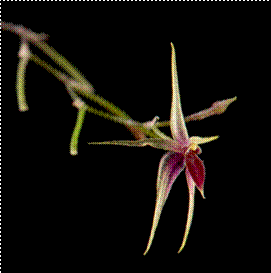
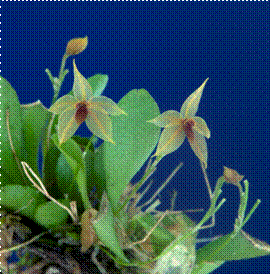
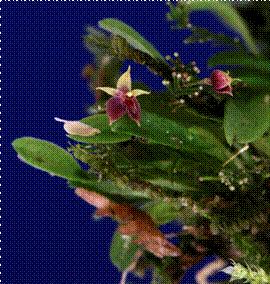
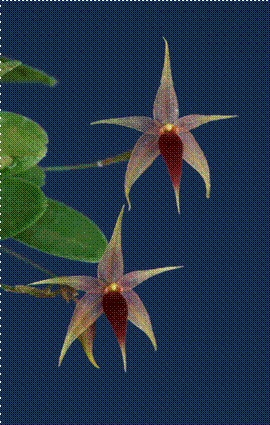
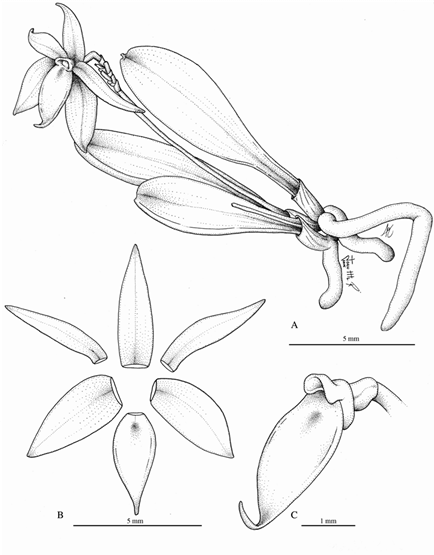
Figure 8 Platystele jane-lueriana Karremans & Bogarín. A. Habit and flower. B. Dissected perianth. C. Ovary, column and lip, lateral view. Drawing by A.P. Karremans and Joan Ramírez from the holotype.
Eponymy: The name honors Carlyle A. Luer on his 95th birthday. Luer has dedicated four decades to the study of Pleurothallidinae, his work set a solid base for other authors to study the species of this tremendously diverse and complex subtribe. It is in great part thanks to his monographs that we are now able to reveal the novelties here described.
Phenology: Plants were registered to flower in August. hABitAt And distriBution: Apparently endemic to Costa Rica, where it is known only from the type locality. Plants grow in secondary forest, at about 457 m in elevation.
The new species is a member of the Platystele oxyglossa species complex. It can be easily distinguished from the florally similar P. catiensis (Fig. 3) and P. oxyglossa Schltr. (Fig. 4) by the compact inflorescence that barely exceeds the leaf (versus an elongate, loosely flowered inflorescence). The most vegetatively similar species are P. pedicellaris (Schltr.) Garay (Fig. 5) and P. tausensis (Fig. 6), the first is easily distinguished by the shorter plants and larger flowers (sepals 1.7-2.0 × 1.0-1.1 mm vs up to 6 × 2.0 mm), and the second by the purple stained sepals and petals (vs. yellow-green) and the hirsute lip apex (vs. glabrous). The new species is also somewhat reminiscent of P. propinqua (Ames) Garay (Fig. 7), but differs in the narrow, acuminate lateral sepals, petals and lip (vs. lateral sepals and lip ovate and acute).
Platystele jane-lueriana Karremans & Bogarín, sp. nov. (Fig. 8).
TYPE: Costa Rica. Cartago: Turrialba, Moravia de Chirripó, hills north of Moravia across the plain with pasture, 9º50’18” N 83º26’45” W, ca. 1135 m, premontane wet forest, secondary mature vegetation and remnants of secondary vegetation in pastures, 12 June 2002, F. Pupulin 3971, M. Bonilla, R. Gómez, H. Léon-Páez & W. Schug (holotype, JBL-Spirit!).
Similar to Platystele pedicellaris, but is distinguished by tail-less sepals and the linear-ligulate petals (vs. acuminate sepals and elliptic petals).
Plant minuscule, epiphytic, caespitose, erect, up to 1.3 cm tall, including the inflorescence. Roots basal, flexuous, filiform. Ramicauls erect, slender, abbreviated, enclosed by tubular, imbricating, slightly compressed, membranous sheaths. Leaves elliptic, erect, thick, conduplicate, subacute, emarginate, abaxially keeled and terminating in a short apiculus, 6.5-9.0 × 2.1-2.7 mm, narrowed at the base into a conduplicate petiole. Inflorescence racemose, distichous, successively flowered, with one flower open at a time, up to 1 cm long, peduncle to 8.5 mm long, pedicels 1 mm long. Floral bracts acute, conduplicate, to 3-5 mm long. Ovary terete, smooth, to 5 mm long. Dorsal sepal narrowly lanceolate-elliptic, acute, with a conspicuous mid-vein, spreading widely, 4.8 × 1.4 mm. Lateral sepals subequal to the dorsal sepal, narrowly ovate, with a conspicuous mid-vein, acute, with a conspicuous mid-vein, spreading widely, 4.3- 4.5 × 1.8-2.0 mm. Petals spreading widely, narrowly linear-ligulate, acute, 1-veined, 4.5-4.8 × 0.8-1.1 mm. Lip ovate-elliptic, shortly acuminate, apically incurved (in the only specimen), glabrous, with a small glenion at the base, 4.0 × 1.7 mm. Column short, subcylindrical, 0.6 mm long. Anther apical, Pollinia not seen. Stigma subapical, transversely bilobed at each side of the anther.
Eponymy: The name honors Jane Luer, wife and long life companion of Carl Luer, and who undoubtedly has played a key role in these four decades of Luer’s studies of the Pleurothallidinae.
Phenology: The plant was registered to flower in June, however, likely its flowering period is much longer. hABitAt And distribution: Apparently endemic to Costa Rica, where it is known only from the type locality around Moravia de Chirripó in the Caribbean watershed of Cordillera de Talamanca. Plants grow in secondary forest at 1135 m in elevation.
Among the species of the P. oxyglossa complex, P. jane-lueriana can be distinguished by the glabrous flowers, and the conspicuously inflated, bulbous lip, with an incurved apex (at least in the studied specimen). It most closely resembles Platystele pedicellaris in the compact inflorescence that is subequal to the leaves, but is distinguished by tail-less sepals and the linearligulate petals (vs. acuminate sepals and elliptic petals).

