




 Inglês (pdf)
 Artigo em XML
 Referências do artigo

 Tradução automática
 Enviar este artigo por email
 Citado por SciELO
 Similares em
SciELO
 uBio

 Permalink


Introduction
Primary or true freshwater crabs inhabit tropical and subtropical regions around the world and are characterized by having adopted freshwater, semi-terrestrial or terrestrial modes of life, being completely independent of marine environments, and showing direct development, hatching as fully developed juveniles (Cumberlidge & Ng, 2009; Magalhães et al., 2016; Vogt, 2016; Yeo et al., 2008).
Freshwater crabs are highly diverse in the Neotropics, comprising 311 species within three families: Epiloboceridae, Pseudothelphusidae and Trichodactylidae (Álvarez et al., 2020; Cumberlidge et al., 2014; Magalhães et al., 2016). Colombia and Mexico are considered as hotspots of freshwater crab diversity (Cumberlidge et al., 2014), and in Central America Panama and Costa Rica have the highest diversity with 17 and 15 species, respectively (Magalhães et al., 2015).
A total of eight subfamilies have been recognized within the family Pseudothelphusidae, and the genus Ptychophallus forms part of the subfamily Ptychophallinae (see Álvarez et al., 2020). According to Magalhães et al. (2015), the genus Ptychophallus consists of 13 species, exclusively reported from Costa Rica and Panama. One of these species is Ptychophallus campylusPretzmann, 1968, only known from Costa Rica, presenting a somewhat enigmatic case since Pretzmann (1968) provided only a brief description from a single male collected in an unknown location in Costa Rica. Moreover, this description lacks illustrations of both the specimen and of its male first gonopod (G1), which is typically used for the species identification of freshwater crabs (Smalley, 1964a; Rodriguez, 1982). He later provided some low-resolution photographs of the carapace and G1 of P. campylus in his taxonomic revision of the pseudothelphusid crabs (Pretzmann, 1972). Judging solely from Pretzmann’s (1972) description, Rodriguez (1982) considered P. campylus indistinguishable from Ptychophallus tristani (Rathbun, 1896) regarding morphological characters of their G1s. Even though Magalhães et al. (2015) examined the holotype of P. campylus, they also preferred to keep it provisionally as a junior subjective synonym of P. tristani. Although these authors verified some morphological differences between the G1s of both species, they cautiously preferred to wait until additional collections could clearly show the differentiation between these taxa. Following the identification of a specimen as Ptychophallus campylus and its inclusion in a recent multigene study of several species within the genus PtychophallusSmalley, 1964b, (Mantelatto et al., 2024), the phylogenetic distinction between the two species was confirmed. Therefore, the present study aims to formalize the resurrection of P. campylus as a valid species.
Materials and methods
The specimens examined are deposited in the crustacean collection of the Museo de Zoología, Centro de Investigación en Biodiversidad y Ecología Tropical (CIBET), Universidad de Costa Rica, San José (UCR-MZ), Naturhistorisches Museum Wien, Vienna (NHMW), and National Museum of Natural History, Smithsonian Institution, Washington, DC (USNM). The following abbreviations were used: carapace width (cw), measured across the carapace at its widest point; carapace length (cl), measured along the midline, from the frontal to the posterior margin; male first gonopod (G1). Measurements are in millimeters. The terminology for the description of the gonopod morphology follows Magalhães et al. (2015).
Results
Family Pseudothelphusidae
Subfamily Ptychophallinae Álvarez, Ojeda, Souza-Carvalho, Villalobos, Magalhães, Wehrtmann & Mantelatto, 2020
Genus Ptychophallus Smalley, 1964b
Ptychophallus campylusPretzmann, 1968 stat. restit. (Fig. 1)
Ptychophallus (Ptychophallus) campylusPretzmann, 1968: 13. - Pretzmann, 1971: 21. - Pretzmann, 1972: 87, figs. 537-539, 559-561.
Ptychophallus campylus - Rodriguez, 1982: 80. - Mantelatto et al., 2024: 3 (table 1), 4 (fig. 1), 5.
Ptychophallus tristani - Magalhães et al., 2015: 320, fig. 41 (part; only holotype of P. (P.) campylus, NHMW 21849)
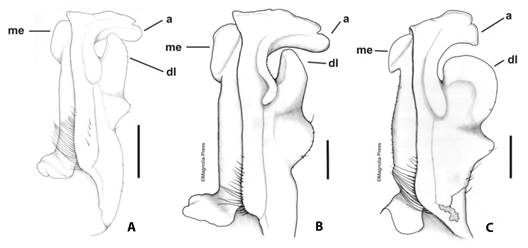
Fig. 1 Male left first gonopod, caudomesial view. A. Ptychophallus campylusPretzmann, 1968: UCR-MZ 3226-02; B. Ptychophallus campylus: holotype, NHMW 21849. C. Ptychophallus tristani (Rathbun, 1896): holotype, USNM 19047. Abbreviations: a, lateral end of the apex; me, mesial process; dl, distal lobe of the lateral process. Scale bar: A = 2 mm; B, C = 1 mm. B and C from Magalhães et al. (2015: 316, figs. 41 and 39, respectively), reproduced with permission from the copyright holder.
Description of G1 (Fig. 1A, B). Robust and straight in mesiocaudal view. Marginal suture on mesial side, nearly straight; marginal process rounded, not produced beyond distal border of apex, strongly bent to cephalic side. Mesial process large, subrectangular, axe-shaped. Lateral process long, approximately 60% of stem length (measured from proximal opening to caudal border of apex), clearly bilobed; lobes strongly asymmetric, with wide median concavity on caudal surface between lobes; proximal lobe rounded, slightly broader than distal lobe, with some scattered minute setae on caudal, lateral surfaces; distal lobe narrower, slightly transversal and thicker distally on cephalic surface, distinctly shorter than lateral end of apex. Distocaudal ridge narrow, somewhat sinuous, not reaching level of median depression of lateral process, well separated from distal border of lateral process by distinct depression. Apex bent approximately 90° towards lateral side; oblong, narrow in distal view; caudal border with narrow notch near lateral end. Field of apical spines well developed, facing towards cephalolateral side.
Material examined. Costa Rica: male (cw 29.4, cl 19.4), holotype, NHMW 21849, collection location unknown, 1913, Fassl leg.; 1 male (cw 35.2 mm, cl 22.4 mm), UCR-MZ 3226-02, province Limón, Veraguas Rainforest Adventure Park (09°55’34.75”N 83°11’26.75”W), quebrada Campamento, 26.vii.2013, D. Hernández and L. Vargas leg.
Distribution. The species is currently only known from eastern Costa Rica, in the Caribbean versant.
Genetic sequences accession number (GenBank): 16S ribosomal RNA - OR116815; Cytochrome Oxidase Subunit I - OR122823; Histone 3 (H3) OR141946.
Discussion
Despite some differences in the G1 morphology, Magalhães et al. (2015) did not recognize P. campylus as a valid species and preferred to treat it as a presumptive junior synomym of P. tristani until additional material was available. The G1 morphology of an adult male specimen from eastern Costa Rica (Fig. 2 A) proved to be nearly identical to that of the holotype of P. campylus (Fig. 2B). In the molecular phylogenetic analysis carried out by Mantelatto et al. (2024) using two mitochondrial (16 S rRNA and COI) and one nuclear (H3) genes, these two species were clearly recovered as separate lineages either in the concatenated phylogram: P. campylus in the Lineage A and P. tristani in Lineage C (Mantelatto et al., 2024: fig. 1) or in the individual phylograms for each gene (Supplementary material, figs. S2-S4 in Mantelatto et al., 2024). Considering these results, the authors recommended a reassessment of the taxonomic status of both species.
Although positioned in separate lineages in the Mantelatto’s et al. (2024) study, the G1 of P. campylus is morphologically similar to that of P. tristani in terms of the large, subrectangular, axe-shaped mesial process, a character only shared by these two among all the species of the genus. The G1 of both species can be differentiated by the shape of the lateral process: in the adult specimen of P. campylus examined herein, the distal lobe of the lateral process is less developed than in P. tristani (it is distinctly shorter than the lateral end of apex and narrower in the former species versus longer and broader in the latter one - see Fig. 1). The shape of the lateral process in P. tristani can be somewhat variable and, in a few cases, appears to be similar to that of P. campylus (see Magalhães et al., 2015). Their geographic distribution areas, however, are different: whereas P. tristani occurs in hydrographic basins of the Pacific versant of Costa Rica (Magalhães et al., 2015: 339, fig. 83), P. campylus seems to be restricted to the Caribbean slope in eastern Costa Rica (present paper).
After more than five decades since the original description and after serious doubts about the systematic position of the species, the revalidation of P. campylus is herein presented and increases the number of valid species of the genus Ptychophallus to a total of 14. Of these, nine species or 64.2% of all Ptychophallus species have been reported from Costa Rica.
Ethical statement: The authors declare that they all agree with this publication and made significant contributions; that there is no conflict of interest of any kind; and that we followed all pertinent ethical and legal procedures and requirements. All financial sources are fully and clearly stated in the acknowledgments section. A signed document has been filed in the journal archives.

