




 Inglês (pdf)
 Artigo em XML
 Referências do artigo

 Tradução automática
 Enviar este artigo por email
 Citado por SciELO
 Similares em
SciELO
 uBio

 Permalink


Introduction
Across taxa a wide diversity of behaviours is used to defend territories, including chemical signals (mainly in mammals and insects), vocalizations (mainly birds and amphibians), or visual displays (mainly birds and fishes; López-Sepulcre & Kokko, 2005; Nice, 1941; Stamps & Buechne, 1985). The purpose of these behaviours is to reduce probability of physical encounters, since they are energetically expensive and participants risk injury or even death (López-Sepulcre & Kokko, 2005; Stamps & Buechne, 1985). Territorial behavior can occur year-round or only during specific time periods (e.g., breeding season or food resource peak; Brown, 1963; Duca & Marini, 2014; Holland et al., 2017; Woltmann & Sherry 2011); but in all cases, territory defense is used to defend resources, including mates, food, nesting sites, or roosting sites. Importantly, these behaviours are not restricted to defending territories from intraspecific individuals (Grether, 2011; Ord et al., 2011). Some species display this behavior against heterospecific individuals and respond as intensely as they do towards conspecifics (Martin & Martin, 2001; Qvarnström et al., 2006; Sandoval et al., 2013).
Vocal duets are used by some tropical bird species to defend resources, including food, nesting sites, pair members, or territories (Hall, 2004, 2009; Kovach et al., 2014). Duets are defined as the coordination of vocalizations from two individuals (Hall, 2004; Hall, 2009), but not all duets are produced using solo songs. For example, in cranes and geese duets are produced by coordinating calls (Volodin et al., 2015); and in a small group of Neotropical bird species (Passerellidae sparrows), duets are produced using vocalizations exclusive for duetting, which are spectrotemporally different from solo songs (Benedict & McEntee, 2009; Sandoval & Mennill, 2014; Sandoval et al., 2016; Trejos-Araya & Barrantes, 2014). Overall, the duets produced using calls or vocalization exclusive for duetting are less studied than duets produced using coordinated solo songs (Farabaugh, 1982; Hall, 2004; Hall, 2009).
Temporal and frequency coordination in duets indicate the commitment of both individuals of the pair to act collectively (Dahlin & Benedict, 2014; Hall & Magrath, 2007; Hall, 2009; Kovach et al., 2014), with respect to defending or acquiring an existing resource. For example, in Canebrake Wrens (Cantorchilus zeledoni) highly coordinated duets occur in pairs that have formed longer pair bonds in comparison to birds with shorter or recently formed pair bonds (Rivera-Cáceres et al., 2016). By comparison, Magpie-lark (Grallina cyanoleuca) males and pairs respond more aggressively during territorial defense to acoustic and visually coordinated duets than poorly coordinated duets of intruders (Hall & Magrath, 2007; Ręk & Magrath, 2022). Therefore, it is also expected that duet coordination may be used as a signal to gain information about the threat that a rival pair poses during interactions, including the strength and aggressiveness of rival pairs (Dahlin & Benedict, 2014; Kovach et al., 2014; Méndez & Sandoval, 2017; Rivera-Cáceres et al., 2016).
It is possible to classify duets into two types, based on how they are produced (Hall, 2004; Hall, 2009). First, antiphonal duets that are produced by alternating vocalizations as observed for Cabanis’s Wren (Cantorchilus modestus), Plain-tailed wrens (Thryothorus euophrys), Spotted Morning-Thrush (Cichladusa guttata), and Slate-coloured Boubou (Laniarius funebris) (Cuthbert & Mennill, 2007; Mann et al., 2006; Sonnenschein & Reyer, 1983; Todt & Fiebelkorn, 1980). Antiphonal duets need high levels of coordination for both members of the pair to produce a duet, because individuals must avoid overlapping each other’s vocalizations (Kovach et al., 2014; Rivera-Cáceres et al., 2016; Thorpe & North, 1965; Thorpe, 1972). Polyphonal duets, however, are produced by overlapping the time and/or frequency of the song produced by the other individual of a pair, as observed in Barred Antshrike (Thamnophilus doliatus), Rufous-and-White Wren (Thryophilus rufalbus), Large-footed Finch (Pezopetes capitalis), Canyon Towhee (Melozone crissalis), and White-eared Ground-sparrow (M. leucotis; Benedict & McEntee, 2009; Koloff & Mennill, 2013; Mennill & Vehrencamp, 2005; Sandoval et al., 2016; Trejos-Araya & Barrantes, 2014). Given the overlap in polyphonal duets, pair members also coordinate their songs to produce duets (Kovach et al., 2014; Trejos-Araya & Barrantes, 2018). Therefore, in both antiphonal and polyphonal duets, coordination apparently plays an important role within and between pair interactions. Consequently, experimental studies examining the relationship between form and function in duet studies in the context of duet coordination are highly encouraged (Dahlin & Benedict, 2014).
We used White-eared Ground-sparrows as a model species to analyze the territorial response to duet coordination (i.e., temporal and frequency coordination; Farabaugh, 1982; Hall, 2009) because pairs are year-round territorial and use duets as the main vocalization to claim and defend territories after pair formation (Méndez & Sandoval, 2021; Sandoval et al., 2016). This species is socially monogamous and pair members stay together 1-3 years (LS unpub. data). Duets are produced with vocalizations exclusively used for duetting (Fig. 1), which are different from male solo songs (vocalization used to attract females) and male and female contact calls (see Sandoval et al., 2014; Sandoval et al., 2016 for sonograms of solo songs and calls). Duets are produced in two contexts: contact and territorial response (Méndez & Sandoval, 2021; Sandoval et al., 2016). Contact duets are produced when both members of the pair are foraging far apart and move closer to one another. In this scenario one individual (male or female) starts the duet and the second responds and fly closer to the position of the individual that started the duet after the duet is completed. These duets are also produced when one member of the pair approaches the other individual after they have been apart (Sandoval et al., 2016). Territorial duets are produced in response to a neighboring pairs duets, male solo songs, or conspecific and interspecific intruders’ (Sandoval et al., 2013; Sandoval et al., 2016). This duet type is produced by both pair members when they are together and is less coordinated than contact duets (Méndez & Sandoval, 2021).
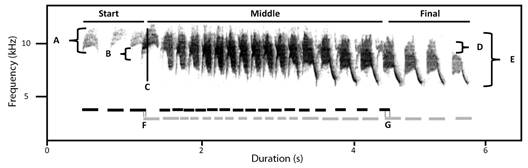
Fig. 1 White-eared Ground-sparrow duet showing the three sections and ten measurements (of duration and frequency) used to estimate duet coordination. A) Introduction section frequency range. B) Frequency differences between the introduction-middle section. C) Middle section frequency range. D) Frequency differences middle-terminal section. E) Terminal section frequency range. F) and G) Distance between vertical point lines are the difference in time between the end of the introduction and the beginning of the middle section and between the end of middle section and the beginning of the terminal section, respectively. This distance may be overlapped as in this example or not. Black lines on top of the duet represent duration of each section. Bottom black segments represent the duet contribution of the first individual. Bottom grey segments represent the duet contribution of the second individual. We indicate each individual duet element in each duet contribution, because this duet was one of the duets created for the playbacks using a single individual contribution, and we used this as a reference example because is clearer how measurements were obtained.
Our main objective in this study is to test the territorial defense hypothesis by examining how pair duet coordination influences territorial responses in year-round White-eared Ground-sparrow pairs. More specifically, we tested (1) how within pairs’ duet coordination influences the territory defense and (2) how territorial pairs respond to intruders with different levels of coordination (i.e., high coordinated duets vs. poor coordinated duets). We expect that if the within pairs duet coordination is a signal of the degree of commitment between paired individuals, as has been suggested by (Hall, 2004; Hall, 2009), highly coordinated pairs will be more committed to defend territories together. Therefore, we predicted a more aggressive behaviour against all stimuli in pairs with highly coordinated duets. We also expected that if duet coordination is a signal that indicates motivation to usurp a territory or greater aggression as suggested by Logue & Gammon (2004) and Méndez & Sandoval (2021), territorial pairs will be more committed to defend territories against intruder with highly coordinated duets. Therefore, we predict that pairs will respond more aggressively against simulated highly coordinated duets than simulated poorly coordinated duets independently of its own duet coordination. But, if duet coordination is a signal of pair time length as suggested by Rivera-Cáceres (2015), territorial pairs will be more committed to defend territories against intruder with poor coordinate duets. Therefore, we predict that territorial pairs will respond more aggressively against poorly coordinated duets than coordinated duets. The reason being that poorly coordinated duets are indicative of recently formed pairs that are searching for a new territory and are a greater threat to usurp the resident pair (et al., 2022; Méndez & Sandoval, 2021; Sandoval et al., 2018).
Materials and methods
Recording: We recorded 31 territorial mated pairs with a unique colour-banded code from three populations that belong to a long term study (Heredia: n = 9, Universidad de Costa Rica: n = 13, and Jardín Botánico Lankester: n = 9) from April 1 to May 31 2017. The three colour-banded populations of White-eared Ground-sparrows occur within the Central Valley of Costa Rica (Heredia: 10°01’ N & 84°05’ W, altitude: 1350 m; Universidad de Costa Rica: 09°56’ N & 84°05’ W, altitude: 1200 m; and Jardín Botánico Lankester: 09°50’ N & 83°53’ W, altitude: 1400 m). We carried out the study during the breeding season of the species (Sandoval & Mennill, 2012), when pairs actively defend territories against other pairs (Juárez et al., 2020; Sandoval et al., 2013). We recorded duet pairs using the focal method (Sandoval et al., 2024), which, in our case, consisted of observing a focal pair for 1.05 hours per day, from 04:55 to 06:00 h when this species is most vocally active. Each pair was recorded during a single recording session, but for pairs that did not produce duets during the first recording session, were recorded during a second session. We collected all recordings using a Marantz solid state recorder PMD661 with a shotgun microphone Sennheiser ME66/K6 in wav format, with a 44.1 kHz sampling rate, and 24 bits accuracy.
Coordination measurement: We measured duet coordination after conduct the playback experiment. Consequently, we were blind to the duet coordination status of the pair during the experiment, ensuring that our measurements of behavioral responses to the playback stimuli were unbiased. From all recorded duets, we were only able to measure 2-5 duets per pair (mean = 3.7 duets/pair), because for the study focus we required only contact context duets (produced spontaneously during recording period) with a high signal-to-noise ratio (>30 dB difference between background and signal), and no overlap from other sounds. We used only contact context duets for the analysis because we required that duet coordination had not the influence of other pairs as occurs in territorial duets (Méndez & Sandoval, 2021). Therefore, differences in duet coordination within pairs will be only influenced by both individuals’ commitment, allowing us to test the relationship between pair duet coordination and territorial response in the White-eared Ground-sparrows.
To measure duet coordination in White-eared Ground-sparrows, we did not use the traditional method that measure separately the duration of each individual duet contribution and the duration of silence between each individual contribution elements (Farabaugh, 1982; Hall & Magraht, 2007; Logue et al., 2008; Rivera-Cáceres, 2015) because it is nearly impossible to separate the elements, and so the contribution of each bird to the duet, as it occurs in a related group of Neotropical sparrows (Sandoval & Mennill, 2014; Sandoval et al., 2016; Trejos-Araya & Barrantes, 2014). In these sparrows, duets elements are highly overlapped, as described in detail by (Sandoval et al., 2016; Sandoval, 2018) and Méndez and Sandoval (2021). Therefore, we used the approach employed by Méndez and Sandoval (2021), which is a modification of the approach used by Hall and MaGrath (2007) and Hall and Peters (2008) to examine duet coordination for antiphonal duets. This approach divides each duet into three sections (Fig. 1): (1) the introductory section, which is the section produced to start the duet and is produced by a single individual (male or female); (2) the middle section, which is the section where both individuals of the pair overlap in time and frequency the duet elements (this section starts at the moment the second individual begins to vocalize, overlapping with the introductory elements of the first individual and finishes when the first individual stops vocalizing, which is detected because the maximum frequency of the elements produced by the second individual is lower than the frequency when the two individuals contribute to the duet); and (3) the terminal section, which is the section produced to finish the duet and is produced only by the second individual that participates in the duet. In each section we measured the duration (s) and frequency bandwidth (kHz), as well as the differences in frequencies (kHz) and duration (s) between sections as follow: (1) the difference between the minimum frequency of the introductory and middle section, (2) the difference between the maximum frequency of the middle section and final section, (3) the difference in duration between the end of introductory section and the beginning of the middle section, and (4) the difference in duration between the end of middle section and the beginning of the final section (Fig. 1). We distinguish sections using no overlap between elements (introductory and terminal section) and the differences in frequency, because the second individual always produce its duet contribution a lower frequency than the first one (Sandoval et al., 2016), allowing us to observe a step down in the maximum frequency when the final section begins (Fig. 1). With this approach, a pair with highly coordinate duets in frequency and duration will have little variation in the duration and frequency bandwidth of each duet section (Méndez & Sandoval, 2021). We used a combination of spectrogram window (to visually identify the duets), waveform window (to measure the duration), and power spectrum window (to measure the frequency) as has been recommended previously for other authors (Méndez & Sandoval, 2021; Podos, 2001) to obtain the measurements of duet coordination. We used the sound analysis software Raven Pro 1.6 (Cornell Lab of Ornithology, Ithaca, NY, U.S.A.) with the following settings: frequency resolution of 188 Hz and a temporal resolution of 5.8 ms in a Hann window with a hop size of 256 kHz samples and 50% overlap. We estimated a coefficient of variation (SD/mean X 100) for both measurements in each section (six coefficients of variation) and the two measurements between sections (four coefficients of variation). Finally, we used the average of all 10 coefficient of variations as our coordination measurement. A pair with a lower average of the coefficient of variation is considered more coordinated than a pair with a higher average of the coefficient of variation.
Playback treatments: We created playback treatments using male and female duet contributions (Fig. 2) recorded previously from the study populations using a solid-state digital recorder (Marantz PMD661; sampling rate: 44.1 kHz; accuracy: 24-bit; file format: WAV) and a shotgun microphone (Sennheiser ME66/K6). These duet contributions came from occasions when the second individual did not respond to the duet vocalization (Sandoval et al., 2016), and we identified (unique band color) the sex of the individual that vocalized. We used four males (two from Heredia and one from Universidad de Costa Rica and Lankester) and four females (one from Heredia and Universidad de Costa Rica and two from Lankester) duet contributions to create eight pairs of highly coordinated and poorly coordinated duets, with a high signal-to-noise ratio and were not overlapped by other sounds (Fig. 2). Each territorial pair was exposed to the same male and female contribution, but in the poorly coordinated duets they varied in the time when each contribution started to create the duet. Using these type of playbacks, we were confident that the response was influenced by coordination (or lack of it) and not by each duet contribution information. Prior to creating each playback, we filtered out all the background noise below 5 kHz and above 12.5 kHz of each duet contribution using the FFT function in Adobe Audition 1.0 (Adobe Systems, San Jose, CA, USA). Then, we uploaded each file to Adobe Audition 1.0 software and placed the two duet contributions in separate channels. To create the coordinated duets, we matched the male and female duet contribution in time following the species range for contact duets (0.1-0.18 s; Méndez & Sandoval, 2021) and repeated duets at a rate of 4 duets min-1 (Fig. 3). To create the poorly coordinated duets, we varied the start time of male and female contributions within the species range for territorial defense duets (0.05-0.3 s; Méndez & Sandoval, 2021) in each of the eight duets used to create a rate of 4 duets min-1 (Fig. 3). We used eight Cabanis’s Wren duets recorded in 2016 from the same experiment locations as controls (two duets per studied population). This wren species shares the habitat with White-eared Ground-sparrows but do not compete for food, breeding sites, or mates (Sandoval et al., 2014). Each control has one wren duet repeated at a rate of 4 duets min-1 (Fig. 3). We normalized all playback treatments to -1 dB using the normalize function of Adobe Audition 1.0.
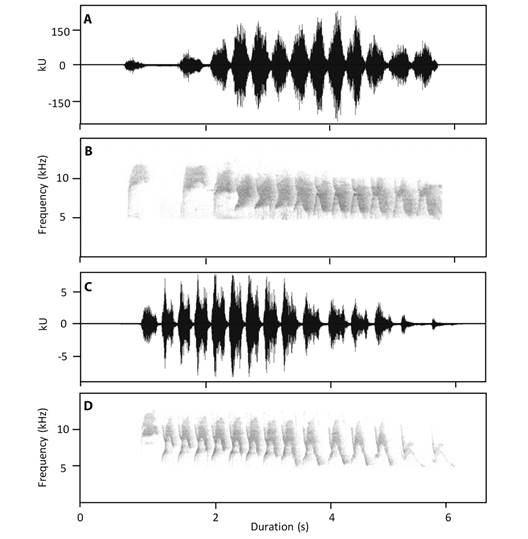
Fig. 2 White-eared Gound-sparrow duet contribution of female (A: waveform and B: sonogram) and male (C: wave form and D: sonogram) used to create the stimuli presented in the figure 3 (see below), with female contribution being the first individual and male being the second individual in the duet.
Experiment design: We conducted the playback experiments from June 3 - 23, 2017. Each pair was exposed to three playback treatments in a single 21 min trial between 0600 and 1 000 h during the same day to simulate territory intrusions. This approach that consists of presenting stimuli consecutively has been used previously in several playback experiment studies (e.g., Bolton, 2007; Geberzahn et al., 2009; Ripmeester et al., 2010; Sandoval et al., 2013; Sosa-López et al., 2016). Our three treatments were (Fig. 3): a) coordinated duets and b) poorly coordinated duets from White-eared Ground-sparrows, and c) a duet from Cabanis’s Wren (Cantorchilus modestus), which served as our control treatment. We varied the presentation order of each playback treatment, following a random design (Coordinated duets were presented: 13 in first, 12 in second, and 6 in third position). Poorly coordinated duets were presented: 12 in first, 7 in second, and 12 in third position. Control duets were presented: 6 in first, 12 in second, and 13 in third position). Each playback treatment lasted 2 min followed by 5 min of silence. We recorded a bird’s response behavior during the 2 min of playback and the first 3 min of silence. The remaining 2 min of silence were used to allow a territorial pair to recover from the playback stimulus and to return to the activities conducted prior to the previous playback. In the field we confirmed that all focal pairs left the playback area (see below for the area) before the end of the silence recovery period, which indicated that we allowed an appropriate amount of time for recovery.
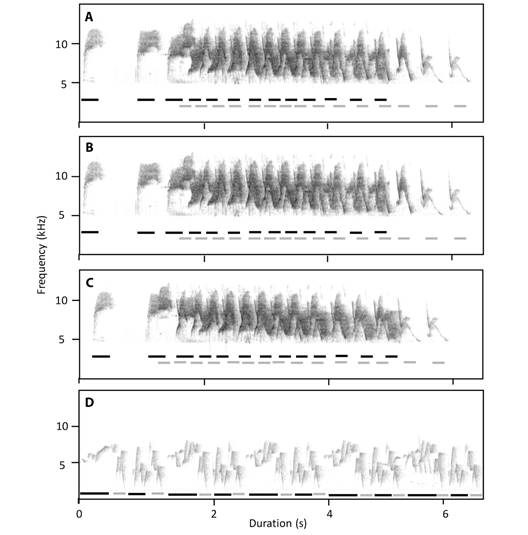
Fig. 3 Duet examples used in our playback stimuli. A-C) Artificially created White-eared Ground-sparrow duet with the same two individual contributions represented by the bottom black (first individual) and grey segments (second individual). D) Plain Wren control duet, where male contribution is the bottom black segments and female contribution is the bottom grey segment. Panels A and B show the appearance of the first and second duets in the highly coordinated duet stimulus. Panels B and C show the appearance of the first and second duets in the poorly coordinated duet stimulus.
We broadcasted playback treatments by positioning a loudspeaker (Anchor Audio; AN Mini, frequency response: 100-12 000 Hz) inside each pair’s territory, 5-10 m from the edge. The loudspeaker was connected to a portable audio player (iPod nano, Apple Cupertino, CA), and mounted on a pole at 1.5 m height to simulate the average height used by White-eared Ground-sparrows to produce duets. We hung flagging tape at 3 m from each side of the speaker to use as a reference during the playback trials. We broadcasted each playback at a constant volume of 80 dB SPL, measured at 1 m in front of the speaker with a Sper Scientific sound level meter (Model 850014, using A weight and fast response). This volume value has been used previously in playback studies of White-eared Ground-sparrows (Méndez & Sandoval, 2017; Sandoval et al., 2013), and emulates the natural volume level used by this species in the wild. The observer was located at 8 m from the loudspeaker.
Response measurements: We measured four behavioural responses for each playback treatment: (1) latency time to approach at 3 m from the speaker, in seconds (if pair did not approach we assigned a value of 301 s); (2) time inside 3 m radius from the speaker, in seconds (if pair did not approach we assigned a value of 0 s); (3) latency time of the first vocalization, in seconds (if pair did not vocalize we assigned a value of 301 s); and (4) total number of vocalizations produced (if pair did not vocalize we assigned a value of 0).
Statistical analysis: First, we tested that the average of all 10 coefficient of variations (our coordination measurement) was not affected by the number of duets analyzed in each pair (2-5 duets), using a one-way analysis of variance and the number of duets analyzed per pair as a grouping variable (four levels) and the average of coefficient of variation as our response variable. Second, contrary to the majority of studies that combine the behavioural responses into a single multivariate response using a principal component analysis, we conducted four generalized linear mixed-effects models with negative binomial distribution and log link function to analyze the relationship between treatments and duet coordination with each behavioural response (i.e., latency time to approach at 3 m from the speaker, latency time of the first vocalization, time inside 3 m radius from the speaker, and total number of vocalizations) using lme4 library (Bates et al., 2015). We used a negative binomial distribution to control for the overdispersion of the data caused primarily by the absence of response from territorial birds to the control. We used a Type 3 analysis of variance in R with the car library (Fox & Weisberg, 2019). In our analysis we included playback treatments (three levels), duet coordination (continuous variable), and playback treatment*duet coordination as the independent factors. The pair identity and population were used as crossed random factors, and playback used in each pair as random factors to account for the multiple tests per pair. We reported means ± SE.
Results
We found that the mean coefficient of variation was not influenced by the number of duets analyzed per pair (CV mean ± SE: 2 duets = 34.58 ± 4.37%, 3 duets = 32.93 ± 3.09%, 4 duets = 28.78 ± 3.57%, 5 duets = 38.60 ± 3.09%; F = 1.5, df = 3,22, P = 0.24). Of the ten measurements of duet coordination that we collected, eight had an average coefficient of variation lower than 50% (Table 1), reflecting high levels of duet coordination within most pairs.
Table 1 Coefficient of variation for the frequency range and duration of each duet section in White-eared Ground-sparrow duets.
| Section | Measurement | Mean ± SE | Min | Max | 25th percentile | 75th percentile |
| Start | Duration | 32.56 ± 3.41 | 3.16 | 74.86 | 19.94 | 42.86 |
| Freq. Bandwidth | 20.44 ± 2.28 | 1.86 | 59.63 | 15.15 | 23.95 | |
| Difference | Duration | 29.2 ± 3.53 | 4.30 | 89.11 | 17.7 | 34.69 |
| Start-Middle | Freq. Bandwidth | 75.21 ± 8.36 | 16.51 | 185.97 | 44.18 | 101.25 |
| Middle | Duration | 17.41 ± 2.06 | 0.57 | 43.20 | 8.95 | 23.38 |
| Freq. Bandwidth | 12.12 ± 1.45 | 1.37 | 38.09 | 7 | 14.95 | |
| Difference | Duration | 40.74 ± 3.58 | 8.76 | 80.42 | 27.98 | 55.16 |
| Middle-Final | Freq. Bandwidth | 58.58 ± 7.76 | 7.64 | 128.69 | 30.33 | 99.74 |
| Final | Duration | 35.95 ± 2.70 | 15.22 | 62.72 | 25.39 | 47.98 |
| Freq. Bandwidth | 17.5 ± 2.07 | 3.49 | 38.51 | 8.49 | 25.99 |
We found that territorial pairs vocalize faster (i.e., latency of the first vocalization; GLMM: Χ2 = 7.99, df = 2, P = 0.02; Fig. 4; Table 2) and spent more time inside the 3 m radius of the speaker (Χ2 = 31.43, df = 2, P < 0.001; Fig. 5; Table 2) when we played poorly coordinated duet stimuli, compared to coordinated duet stimuli, and control duet stimuli (Figs. 4 and 5). The total number of vocalizations (Χ2 = 3.54, df = 2, P = 0.17; Fig. 4; Table 2), and latency of approach to the 3 m radius of the speaker (Χ2 = 4.42, df = 2, P = 0.11; Fig. 5; Table 2) did not vary in response to the type of stimuli used.
Table 2 Results of the generalized linear mixed-effects models of the relationship between treatments and duet coordination with each behavioral response (i.e., latency time to approach at 3 m from the speaker, latency time of the first vocalization, time inside 3 m radius from the speaker, and total number of vocalizations) using lme4 library (Bates et al., 2015).
| Latency of first vocalization | Estimate | Std. Error | z-value | P-value |
| Intercept | 3.938 | 0.562 | 7.01 | <0.001 |
| TreatmentControl | 1.598 | 0.767 | 2.09 | 0.04 |
| TreatmentCoordinated | 0.678 | 0.77 | 0.88 | 0.38 |
| Coefficient of Variation | 0.026 | 0.015 | 1.68 | 0.09 |
| TreatmentControl : Coefficient of Variation | -0.022 | 0.021 | -1.05 | 0.29 |
| TreatmentCoordination : Coefficient of Variation | -0.007 | 0.021 | -0.35 | 0.72 |
| Latency time to approach | Estimate | Std. Error | z-value | P-value |
| Intercept | 4.097 | 0.495 | 8.28 | <0.001 |
| TreatmentControl | 1.61 | 0.682 | 2.36 | 0.02 |
| TreatmentCoordinated | -0.127 | 0.724 | -0.18 | 0.86 |
| Coefficient of Variation | 0.034 | 0.014 | 2.48 | 0.01 |
| TreatmentControl : Coefficient of Variation | -0.034 | 0.019 | -1.8 | 0.07 |
| TreatmentCoordination : Coefficient of Variation | 0.006 | 0.02 | 0.3 | 0.76 |
| Time inside | Estimate | Std. Error | z-value | P-value |
| Intercept | 6.719 | 0.573 | 11.73 | <0.001 |
| TreatmentControl | -4.423 | 0.79 | -5.6 | <0.001 |
| TreatmentCoordinated | -1.846 | 0.756 | -2.44 | 0.01 |
| Coefficient of Variation | -0.082 | 0.016 | -5.23 | <0.001 |
| TreatmentControl : Coefficient of Variation | 0.082 | 0.022 | 3.83 | <0.001 |
| TreatmentCoordination : Coefficient of Variation | 0.027 | 0.021 | 1.3 | 0.19 |
| Number of Vocalizations | Estimate | Std. Error | z-value | P-value |
| Intercept | 2.74 | 0.17 | 16.13 | <0.001 |
| TreatmentControl | -0.383 | 0.247 | -1.55 | 0.12 |
| TreatmentCoordinated | 0.125 | 0.254 | 0.49 | 0.62 |
| Coefficient of Variation | -0.004 | 0.005 | -0.78 | 0.43 |
| TreatmentControl : Coefficient of Variation | 0.003 | 0.007 | 0.4 | 0.69 |
| TreatmentCoordination : Coefficient of Variation | -0.005 | 0.007 | -0.77 | 0.44 |
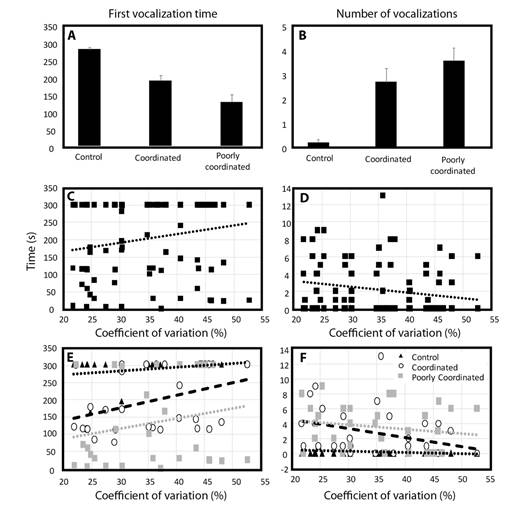
Fig. 4 Responses of White-eared Ground-sparrow territorial pairs (mean + SE) to different playback types and duet coordination levels: (A) and (B) show the time to the first vocalization and the total number of vocalizations produced in response to playback types simulating territory intrusion. (C) and (D) show the relationship between duet coordination (lower mean coefficient of variation indicates higher coordination) and the time to the first vocalization and the total number of vocalizations. (E) and (F) show the interaction between playback types and duet coordination on the time to the first vocalization and the total number of vocalizations.
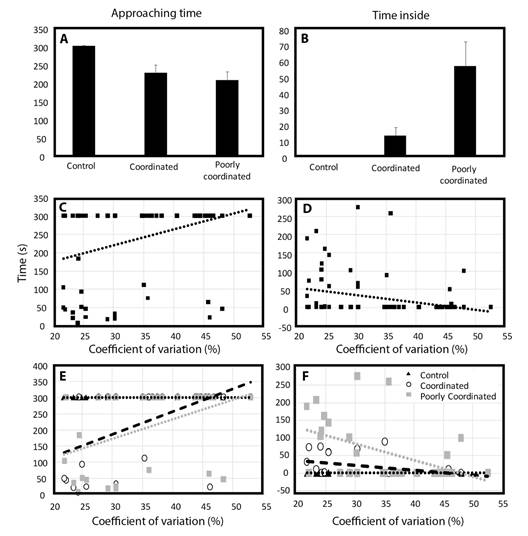
Fig. 5 Responses of White-eared Ground-sparrow territorial pairs (mean + SE) to different playback types and duet coordination levels: (A) and (B) show the approaching time and time inside the stimuli area produced in response to playback types simulating territory intrusion. (C) and (D) show the relationship between duet coordination (lower mean coefficient of variation indicates higher coordination) and the approaching time and time inside the stimuli area. (E) and (F) show the interaction between playback types and duet coordination on the approaching time and time inside the stimuli area.
We found that less well-coordinated pairs showed longer approach latencies (GLMM: Χ2 = 6.15, df = 1, P = 0.01; Fig. 5; Table 2) and spent less time close to the speaker (Χ2 = 27.33, df = 1, P < 0.001, Fig. 5; Table 2) than pairs with high coordinated duets. However, duet coordination within pairs did not affect the latency time of the first vocalization (Χ2 = 2.81, df = 1, P = 0.09; Fig. 4; Table 2), and total number of vocalizations (Χ2 = 0.61, df = 1, P = 0.43; Fig. 4; Table 2).
We found a significant interaction between treatment and coefficient of variation values for the time inside 3 m radius from the speaker, where pairs with lower duet coordination spent less time inside the 3 m radius from the speaker when responding to poorly-coordinate duets compared to the responses to coordinated duets (Χ2 = 15.10, df = 2, P < 0.001; Fig. 5). Finally, latency time to approach at 3 m from the speaker (Χ2 = 5.13, df = 2, P = 0.08; Fig. 5), latency time of the first vocalization (Χ2 = 1.17, df = 2, P = 0.56; Fig. 4; Table 2) and total number of vocalizations (Χ2 = 1.10, df = 2, P = 0.58; Fig. 4; Table 2) did not show a significant relationship between the interaction of treatment and average coefficient of variation values.
Discussion
Duet coordination has been used as an indicator of pair commitment for resource defense (e.g., territory, food, nesting place, or mate), pair bond duration, and the quality of the paired individuals (Dahlin & Benedict, 2014; Hall & Magrath, 2007; Kovach et al., 2014). In our case, White-eared Ground-sparrow pairs with highly coordinated duets responded more strongly towards simulated intruders (approached faster and spent more time closer), supporting the prediction that highly coordinated pairs are more committed to defend their territory together. Therefore, duet coordination in White-eared Ground-sparrows may act as a signal of pair stability and quality (Brumm & Slater, 2007). Variation in commitment may arise because duetting is a learned behaviour (Hall, 2004; Hall, 2009), and coordination needs time and attentiveness from both individuals in order to develop (Levin et al., 1996; Rivera-Cáceres et al., 2016; Trainer et al., 2002). Consequently, it is expected that White-eared Ground-sparrow pairs with highly coordinated duets had formed longer pair bonds and had occupied their territories longer, increasing the probability to successfully defend territories against intruders. This pattern has been reported for Cane-brake Wrens and Magpie-Larks (Grallina cyanoleuca) where highly coordinated pairs have stronger social bonds (e.g., less extra-pair copulations and more time as a pair) and respond stronger to intruders (Hall & Magrath, 2007; Rivera-Cáceres et al., 2016). By comparison, California Towhees (Melezone crissalis), a closely related species to White-eared Ground-sparrows, do not exhibit highly coordinated duets in pairs with longer pair bonds (Benedict, 2010), suggesting that pair coordination levels are not equally important for all species even when they are closely related.
Previous studies have reported that duet coordination provides information to the receiver about the signalers condition (e.g., time that pair has been together or pair identity) or threat during interactions (Kovach et al., 2014; Méndez & Sandoval, 2021). This probably occurs with the duet coordination of White-eared Ground-sparrows, because we found that stimuli coordination influenced the approach response displayed by the receiver pairs; territorial pairs of this ground-sparrow species approached faster and spent more time closer to the speaker than when they were exposed to poorly coordinated duet stimuli. Our results agree with our third prediction, which proposed that duet coordination is a signal of the pair bond length and strength (Hall, 2004, Hall, 2009; Rivera-Cáceres et al., 2016). Therefore, poorly coordinated duets may be indicative of recently established pairs that have not establish territory boundaries or pairs without territories. As a result, territorial pairs respond more aggressively to poorly coordinated duets than to coordinated duets, because newly formed pairs are more likely to invade neighboring territories and usurp part of their territory (Hamzaj et al., 2022).
We found that White-eared Ground-sparrows did vary in the vocal behavior (latency time of the first vocalization and total number of vocalizations produced) according to the stimuli. This was not surprising, because it was previously reported that this species used duets as a primary territorial signal against intruders (conspecifics and interspecific; Sandoval et al., 2013). White-eared Ground-sparrows inhabit very dense vegetation (Juárez et al., 2020; Sandoval & Mennill, 2012; Sandoval et al., 2016), which reduces long distance visibility and prevents visual identification of intruders before responding to a vocal stimulus. Consequently, if a territorial pair did not respond to intruders vocally when the intrusion occurs, the probability to lose part of the territory or resources may increase.
In conclusion, duet coordination provides information for territorial pairs to grade the aggressiveness of the intruders and respond accordingly as has been reported in Plain Wrens, Rufous-and-white Wrens, and Magpie-larks (Hall & Magrath, 2007; Kovach et al., 2014). Our data suggest that poorly coordinated duets are more threatening for territorial White-eared Ground-sparrows and elicit a stronger response from territorial pairs. Our findings provide new insight on the relevance that variation in duet coordination may have during territorial interactions, because territorial pairs respond more aggressively to poorly coordinate duets than well-coordinated duets.
Ethical statement: the authors declare that they all agree with this publication and made significant contributions; that there is no conflict of interest of any kind; and that we followed all pertinent ethical and legal procedures and requirements. All financial sources are fully and clearly stated in the acknowledgments section. A signed document has been filed in the journal archives.

