




 Inglês (pdf)
 Artigo em XML
 Referências do artigo

 Tradução automática
 Enviar este artigo por email
 Citado por SciELO
 Similares em
SciELO
 uBio

 Permalink


Introduction
Dioecious flowering plants (i.e., with separate sexes) require pollination vectors, mainly insects, to accomplish their sexual reproduction (Bawa, 1994). Pollinator abundance, pollen availability, competition for pollinators, and resources for fruit development limit the reproductive success of female plants (Lee, 1986). Ecological factors that determine the availability of pollen include population density, sex ratio (male:female ratio), and flowering time (Knight et al., 2005; Larson & Barrett, 2000). Tropical dioecious plants show high diversity of life forms and pollination systems, but the relative importance of ecological factors on female reproductive success is still poorly understood. This is significant because the reproductive success of female plants has a direct influence on the demography of dioecious species.
In low-density populations, female reproductive success (measured as fruit production or fruit set) generally decreases due to limited pollen availability (Knight et al., 2005). A low density of reproductive individuals may also increase the distance between male and female plants, affecting the chances of effective pollen transfer to female flowers and consequently reducing their reproductive success (House, 1992; House, 1993; Steven & Waller, 2007).
The sex ratio in dioecious plant populations is frequently skewed toward an excess of either males or females (Field et al., 2013). These biased sex ratios can potentially affect population fitness (Fisher, 1930). Some studies suggest that pollen limitation increases in populations with increasingly female-biased sex ratios (Öster & Eriksson 2007; Shelton, 2008). In contrast, female plants may experience greater pollen deposition in male-biased populations (Carlsson-Graner et al., 1998).
High flowering synchrony is expected between conspecifics of both sexes in dioecious plants (Bawa, 1980) to reduce competition between females for pollen (e.g., Augspurger, 1983). Although selection generally appears to favor early flowering individuals (Munguía-Rosas et al., 2011), for obligatory outbreeding plants (e.g., dioecious species), this may not be the case when a high degree of flowering synchrony is presumably necessary for effective pollination (Pires et al., 2013). Concurrently, individual phenology patterns may interact with population density and sex ratios, exacerbating their effect on the reproductive success of female plants. Early or late flowering plants may experience a lower effective population size and a highly skewed sex ratios, which in turn will negatively affect the amount and quality of pollen deposition, thus impacting fruit production (Fuchs et al., 2003). Again, this suggests that selection should favor female plants that are able to flower close to the flowering peak of male plants (e.g., Augspurger, 1983).
For female plants, the resources available for fruit and seed maturation will likely influence their reproductive success, even when pollen is not limited. Resource allocation for reproduction in perennial long-lived species typically increases with a plant’s age or size (Cheplick, 2005; Wenk & Falster, 2015). Therefore, seed production is likely to positively correlate with the size of female plants. However, plant size (e.g., height or number of leaves) can also affect other structural traits that affect pollination success and seed production. Floral display has been correlated to plant size (Ollerton & Lack, 1998), and bigger plants often produce a higher number of flowers that may promote pollinator attraction and visitation.
In this paper, we examine how flowering phenology, mate availability, co-flowering with other females, pollinator abundance, and plant size affect the female reproductive success of the understory palm Chamaedorea pinnatifrons (Jacq.) Øerst. (Arecaceae) in a Costa Rican montane forest. We estimated the flowering synchrony between sexes, the male and female pollination neighborhoods around focal plants, plant vigor (height and number of leaves), and changes in the abundance of pollinators on fruit production and fruit set of female plants. We expect a high flowering synchrony between sexes and a greater reproductive success of female plants that reproduce during the population’s flowering peak, as well as a positive correlation of fruit production and pollinator abundance.
In the neotropics, palms (Arecaceae) are a highly diverse, abundant, and representative plant group of humid forests. Even though most neotropical palms are monoecious, the genus Chamaedorea stands out for its dioecious condition and high diversity (ca. 100 spp.), with several species of ornamental interest (Hodel, 1992). Chamaedorea species inhabit humid and wet forests of Central and South America (Hodel, 1992). Pollination of Chamaedorea has been documented in several species (Porter-Morgan, 2007; Ríos et al., 2014), and it involves insects from a single species of thrips (Brooksithrips chamaedorea, Thysanoptera) and wind in an ambophylous pollination system (Ríos et al., 2014). Thrips use male inflorescences as brood sites and apparently pollinate female flowers by deception. Considering the prevalence of curculionid and sap beetles (Nitidulidae) in most palm pollination systems (Henderson, 2024), the pollination system of Chamaedorea can be regarded as highly specialized given the specificity of thrips pollinators. Despite its ecological and economical importance, information on the factors that influence seed production in natural conditions in Chamaedorea plants is limited (see Berry & Gorchov, 2004; Berry & Gorchov, 2007; Otero-Arnaiz & Oyama 2001; Oyama, 1990).
Materials and methods
Study species and site: Chamaedorea pinnatifrons has the widest geographic and elevation range of the genus, from Bolivia to southern Mexico and from near sea level to 2 600 m asl (Hodel, 1992). These long-lived palms develop a single stem up to 4 m high, produce three to eight pinnate leaves (Grayum, 2003; Hodel, 1992; Fig. 1A-B), and may live up to 61-66 years (Ataroff & Schwarzkopf, 1994). The small flowers (<3.5 mm in diameter) are greenish to yellow and are borne on branched, racemose inflorescences with several rachillae; pollen is dry and powdery (Hodel 1992; Fig. 1C-D). The petals of male flowers are apically connate at anthesis and open by vertical slits on their margins (Grayum, 2003; Fig. 1D). Fruits are bird dispersed (Orozco-Segovia et al., 2003) and develop a single seed. Upon ripening, the fruits turn yellow-orange and mature to a purplish black color (Fig. 1F). A voucher specimen was deposited at the Luis Fournier O. Herbarium (USJ) at the University of Costa Rica (Ríos 16, USJ102220).
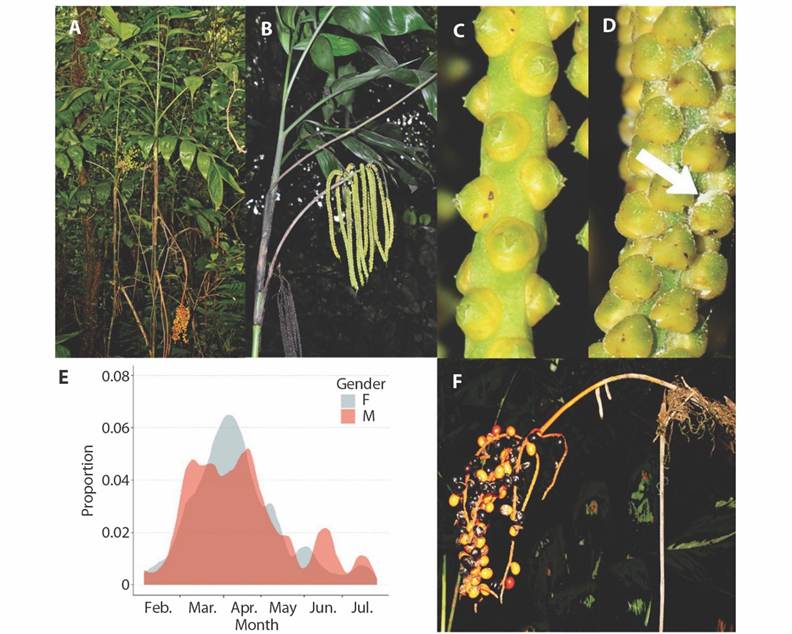
Fig. 1 Chamaedorea pinnatifrons (Arecaceae) at the studied population in a montane forest of Costa Rica: A. Reproductive female plant, B. Reproductive male plant, C. Pistillate flowers at anthesis, D. Staminate flowers with pollen (arrow) shed through lateral slits in the fused petals, E. Flowering phenology graph of pistillate (F) and staminate (M) plants during the reproductive season of 2012. The data on y-axis represent the proportion of individuals with inflorescences in anthesis in a sample of 79 female and 88 male plants, and F. Infructescence with maturing (orange) and ripen fruits (black).
Field work was conducted in a 2 400-ha cloud montane forest in the Costa Rican Talamanca Mountain range (9°53’ N; 83°58’ W; 1 750 m asl), within the La Carpintera Protective Zone. The forest primarily consists of old secondary forest (>50 years old), interspersed with older remnant forest patches. These patches include oaks (Quercus spp.), fig trees (Ficus spp.), and several tree species in the avocado family (Lauraceae), as reported by Sanchez et al. (2008). The area has an annual mean temperature of 16.1 °C and an average annual precipitation of 1 839.2 mm, with a seasonal decrease in precipitation (<60 mm per month) from December to April (Instituto Meteorológico Nacional, s. f.). Chamaedorea pinnatifrons is the only palm species occurring at the study site.
Study plot, population flowering phenology and female reproductive success: We established a 40 × 40 m plot in mature forest where we counted and tagged (aluminum tags) all reproductive C. pinnatifrons individuals (i.e., palms with developing inflorescences). We recorded 79 male and 88 female reproductive plants. For all individuals, we counted the number of leaves, measured plant height as a proxy of plant vigor and determined their X-Y coordinate position in the plot (Fig. S1). The spatial distribution of reproductive plants allows us to determine the relative positions of flowering males and females throughout the reproductive season.
We monitored the flowering phenology of all individuals every 3-4 days from February to July 2012, for a total of 39 visits. The time between visits was determined based on preliminary observations of the inflorescence’s anthesis pattern, which lasts between 3 and 7 days. During each census, we examined inflorescences for flowers in anthesis. For staminate plants, we checked that anthers were releasing pollen, and for pistillate plants, the stigma receptivity by noting the light green color of the stigma's lobes and the presence of a bright, transparent secretion. After the receptive period, the stigma turns dry and brown-colored. We marked the pistillate inflorescences, recorded the flowering date, and monitored them for fruit development. Female reproductive success was estimated as the number of mature fruits produced per inflorescence and as fruit set (fruits/flowers ratio) per inflorescence from 115 inflorescences (n = 74 individuals).
Data analysis: We compared the flowering patterns of pistillate and staminate plants using the temporal overlap index proposed by Schoener (1970):
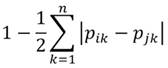
This index graphically depicts the intersection area of two genders’ phenological curves; where p ik and p jk represent the proportion of flowering individuals of genders i and j, respectively, at census k. A value of zero implies no overlap, while a value of one indicates complete overlap in phenological patterns.
We evaluated the effect of predictor variables that describe the male neighborhood (i.e., distance to nearest synchronous male, number of synchronous males at five and ten meters around focal female plants), female neighborhood (i.e., nearest synchronous female, number of synchronous females at five and ten meters around focal female plants), number of pistillate flowers per inflorescence, and variables related to plant vigor (i.e., stem height, number of leaves) on fruit number and fruit set per inflorescence (response variables). We used General Linear Mixed Models (GLMM) with census and each individual inflorescence ID as random factors (library lmerTest, Kuznetsova et al., 2017), with a Gaussian distribution of errors. For each response variable, we fitted a set of possible models and then chose the optimal model based on the Akaike information criterium (AIC; Zuur et al., 2009). We used the R statistical language (version 4.02; R Core Team, 2020) for all statistical and graphical analyses.
We also analyzed fruit production (i.e., number of mature fruits per inflorescence) throughout the flowering season by dividing it by terciles according to the number of female inflorescences. Each tercile represented different stages in the season: early flowering (n = 34 female inflorescences), flowering peak (n = 39), and late flowering (n = 42). We used a Kruskal-Wallis test to compare the three terciles’ number of fruits, and a Dunn test to look at differences after a significant result using the library FSA (Ogle et al., 2023) implemented on the R platform.
Thrips abundance: As previously reported (Ríos et al., 2014), the thrips Brooksithrips chamaedorea (Thysanoptera, Thripidae) is the main biotic pollinator of C. pinnatifrons in the study site. That study found that thrips use the male flowers for mating and feeding, thus they are more abundant in male inflorescences. Therefore, we estimated the abundance of pollinator insects by using staminate inflorescences as sampling units. We randomly selected three inflorescences per week, from early March to mid-May (11 weeks) and from different male plants outside the study plot (n = 33). We collected the insects during the morning hours (8:00-12:00 h) by placing the inflorescences in a plastic bag and gently shaking it to detach the insects. We then preserved them in 70 % ethanol and counted adult thrips in the laboratory using a stereomicroscope. We corrected for differences in inflorescence size by dividing the number of thrips per inflorescence by the number of rachillae, as the size of the sampling unit might influence the number of thrips caught (Lewis, 1997). Data are presented as the mean (± standard error) number of thrips/rachillae for each week.
Results
Phenology pattern: The flowering of C. pinnatifrons lasted five months and showed a seasonal pattern, beginning in early February, peaking in late March and early April (at the end of the dry season), and ending in early July (Fig. 1E). The sex ratio of reproductive plants was F:M ratio = 1.11 and did not statistically differ from a distribution with equal sex frequencies (Goodness of Fit Test: Chi-squared value = 0.48, P = 0.48). The flowering of staminate and pistillate plants overlapped significantly (Schoener index = 0.72; Fig. 1E). Individuals from both genders developed 1-4 inflorescences (mean = 1.9 females and 1.8 males) throughout the reproductive season and blooming in each inflorescence lasted 3-7 days. At the individual level, flowering was highly variable, with inflorescences in the same plant maturing either sequentially or separated by intervals of several weeks, from one to 5-6 weeks.
Reproductive success: The mean female floral display was 697 flowers per inflorescence (± 23.4 SE, min = 120, max = 1 662), while mean fruit production was 99.7 fruits (± 12.1 SE, min = 0, max = 735) per inflorescence. In general, nearly one-third of all inflorescences (35 %, or 40 out of 115), developed more than 100 fruits. A similar number (30 %) produced between 11 and 100 fruits, while the remaining 35 % of the inflorescences had less than 10 fruits (29 out of these 40 inflorescences did not produce fruits). The mean fruit set was relatively low (0.144 ± 0.016 SE), although variation among inflorescences was quite high (min = 0, max = 0.83, CV = 116 %).
The GLMM indicated that the number of fruits produced was significantly higher in plants with shorter stems and more leaves and flowers per inflorescence (Table 1A; Fig. 2A-C), but it was inversely correlated to the number of female plants around each fruiting palm (Table 1A; Fig. 2D). Similarly, fruit set was significantly higher in inflorescences from palms with shorter stems and decreased with the presence of co-flowering females in the neighborhood (Table 1B).
Table 1 GLMM results of the effect of stem height, number of leaves, number of flowers, and nearby co-flowering females in a 10-m radius (Fem-10) on (A) the number of fruits and (B) fruit set (fruits/flowers) per inflorescence of Chamaedorea pinnatifrons (Arecaceae) in a montane forest, Costa Rica. P-values in bold letters indicate significant effects (P < 0.05).
| Factor | Estimate | SE | df | T | P |
| A. Number of fruits | |||||
| Intercept | -10.67 | 69.60 | 97.24 | -0.153 | 0.878 |
| Height | -0.32 | 0.15 | 84.94 | -2.09 | 0.040 |
| Leaves | 21.52 | 11.60 | 95.13 | 1.86 | 0.067 |
| Flowers | 0.19 | 0.03 | 92.57 | 5.53 | <0.001 |
| Fem-10 | -14.60 | 6.20 | 107.72 | -2.35 | 0.020 |
| B. Fruit set | |||||
| Intercept | 2.20 e-01 | 8.11 e-02 | 102 | 2.71 | 0.008 |
| Height | -4.50 e-04 | 1.84 e-04 | 85 | -2.44 | 0.017 |
| Leaves | 2.05 e-02 | 1.42 e-02 | 94 | 1.44 | 0.153 |
| Fem-10 | -2.10 e-02 | 7.67 e-03 | 103 | -2.74 | 0.007 |
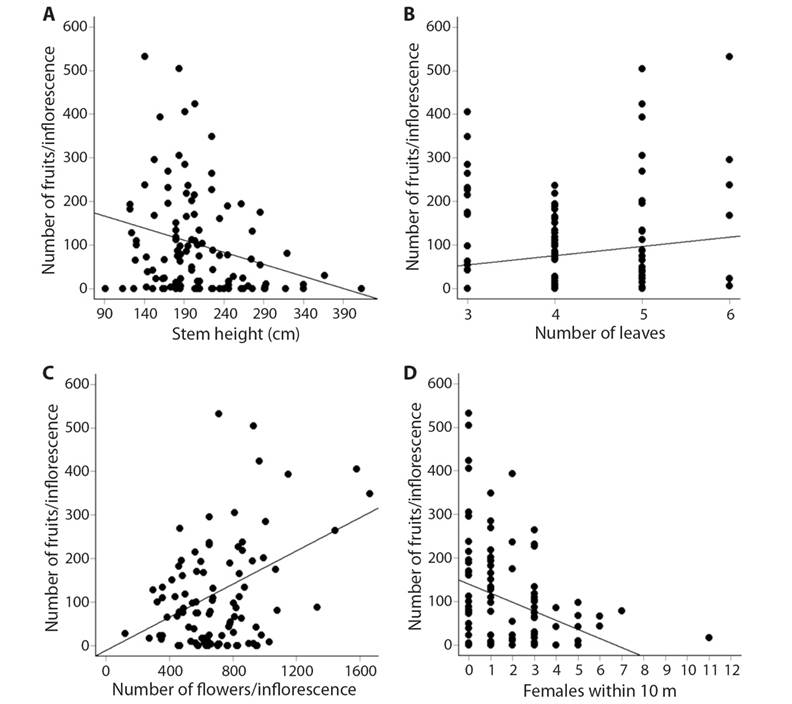
Fig. 2 Predictor variables with a significant effect on the number of fruits developed in Chamaedorea pinnatifrons (Arecaceae) at a Costa Rican montane forest. Results from GLMM analysis. Number of fruits per inflorescence decreases with height of the stem (a), increases with number of leaves (b), and number of flowers (c), and decreases with the number of conspecific females in the neighborhood (d).
When inflorescences were grouped by their flowering phenology, they showed significant differences in the number of developed fruits (H2 = 51.72, df = 2, P < 0.001). Early flowering inflorescences were less successful, producing less than 10 fruits each (65 %), and only 6 % (2/34) ripened more than 100 fruits. In contrast, 59 % (23/39) of the inflorescences that flowered during the flowering peak produced more than 10 fruits (Dunn test; P-value < 0.001). However, late flowering plants produced significantly more fruits per inflorescence (Fig. 3A). Of these late-flowering inflorescences, 74 % (31/42) set more than 100 fruits each; meanwhile, only 7 % (3/42) produced less than 10 fruits (Fig. 3A). Furthermore, when fruit-set was compared based on the plants’ flowering phenology, those inflorescences that flowered late had a greater fruit set (mean 0.296 ± 0.027 SE) than those that flowered early (0.030 ± 0.009 SE) or at the population's peak (0.079 ± 0.013 SE).
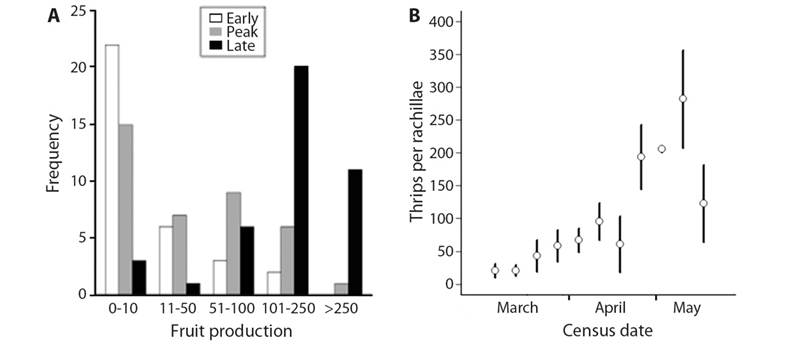
Fig. 3 Data from the understory palm Chamaedorea pinnatifrons during the reproductive season of 2012 in a montane forest, Costa Rica: A. Frequency of female inflorescences according to the number of developed fruits and ordered by flowering time (early, peak, and late). B. Mean number (± SE) of adult thrips (Brooksithrips chamaedorea, Thysanoptera) per rachillae caught on staminate inflorescences (n = 33) from 11 sampling census carried out on a weekly basis.
Thrips abundance: Thrips were the most abundant and frequent visitors to flowers of staminate and pistillate inflorescences of C. pinnatifrons. The mean number of thrips per staminate inflorescence was 1 044 ± 145 SE (min = 35, max = 2 893). From early March to mid-May, the abundance of adult thrips increased 13-fold, from 20.8 (± 10.6) individuals per rachilla in the first week of March (early flowering period) to 282.0 (± 74.4) in the third week of May (late flowering period) (Fig. 3B).
Additional floral visitors, albeit less frequent or occasional, comprised an unidentified beetle species from the family Cryptophagidae (Coleoptera) on both inflorescence types and the stingless bee Partamona orizabaensis (Strand, 1919) (Apidae, Meliponini). These insects were predominantly observed gathering pollen on staminate inflorescences. Two other leaf beetles (Chrysomelidae) from the genera Tretagonotes and Demotispa were exclusively observed on staminate flowers.
Discussion
Our analysis revealed that traits related to plant size, floral display, and the number of co-flowering female plants near focal plants best predicted female reproductive success in C. pinnatifrons. Plants with shorter stems, more leaves and flowers, and fewer female neighbors produced more fruits and had a higher fruit set. Contrary to our predictions, reproductive success was significantly higher for inflorescences that developed during the later part of the flowering season, which was correlated with increased abundance of pollinators. Moreover, the male neighborhood (i.e., proximity and number of staminate plants) as a proxy for pollen availability had no effect on female success.
Unexpectedly, the stem height of C. pinnatifrons females was not a positive predictor of a plant’s reproductive success. Otero-Arnaiz & Oyama (2001) reported similar results in the related C. alternans, and Berry & Gorchov (2004) in C. radicalis. Additionally, female plants with taller stems did not produce more leaves (r = -0.22, p = 0.021), but there was a marginal correlation between the number of leaves and a higher number of fruits. Neither of these plant size parameters were associated with floral display traits, including the number of inflorescences and flowers per inflorescence. These findings suggest that the development of reproductive structures and the reproductive success of pistillate plants of C. pinnatifrons are not exclusively limited by the plant's resources. However, research suggests that higher reproductive costs, i.e., females allocating more resources to reproduction than males, may reduce the vegetative growth of female dioecious plants (Obeso, 2002). Our findings indicate that using the number of leaves and plant height as proxies for the availability of resources for sexual reproduction in C. pinnatifrons may be misleading.
Among the variables examined, the number of flowers showed a positive correlation with the number of fruits, but no correlation with fruit-set. If pollen or resources are not limited, plants that produce a greater number of flowers are not constrained by the availability of ovules and may produce more fruits (Wyatt, 1982). Moreover, the number of flowers may be related to pollinator attraction (Fuchs et al., 2010). According to Hodel (1992), the majority of Chamaedorea species produce floral fragrances, which are believed to attract their thrips pollinators (Porter-Morgan, 2007). Floral visitors rely on floral scents to locate plants and estimate the amount of reward available in flowers (Schiestl, 2015). Thus, we hypothesize that an increase in the number of flowers per inflorescence in C. pinnatifrons would attract more pollinators to a more rewarding inflorescence, leading to higher rates of successful pollination and fruit production.
Although inflorescences with more flowers tend to produce more fruits in C. pinnatifrons, the proportion of flowers that developed into fruits was low and highly variable, as indicated by the fruit-set ratio per inflorescence (mean = 0.144, CV = 116%). This may be the result of pollen or pollinator limitation which can constrain fruit and seed set (Ashman et al., 2004; Burd, 1994; Fuchs et al., 2010). While similar fruit set results have been reported for other Chamaedorea species, ranging from 0.13 to 0.47 (Berry & Gorchov, 2007; Listabarth, 1992; Otero-Arnaiz & Oyama, 2001; Porter-Morgan, 2007; Ríos et al., 2014), pollen or pollinator limitation has not been experimentally tested in this group. Evidence from hand pollinations in a dioecious tree suggested the occurrence of pollen limitation (Voigt et al., 2005) and given that most tropical dioecious plants rely on specialized pollinators for reproduction (Renner & Feil, 1993), pollen limitation could be a widespread phenomenon among tropical species with separate genders. In C. pinnatifrons, contrary to our expectations, we found that the abundance of males (pollen donors) in the vicinity of female plants had little to no effect on the number of fruits per inflorescence or fruit set. Additionally, the unbiased sex ratio of reproductive individuals and the strong synchrony of flowering between pistillate and staminate individuals suggests that female reproductive success is not limited by the availability of pollen donors. Instead, it could be related to the abundance of pollinators that determines the degree of pollen transfer, as suggested by an increase in fruit production and thrips abundance at the end of the reproductive season.
Therefore, the alternative explanation for the low female reproductive success in general, but increased success in late-flowering plants of C. pinnatifrons is likely related to a combination of the time of flowering and pollinator abundance. Many research studies that looked at how phenology affects fruit production found that plants that flower early experience less competition for pollinators or give their seeds more time to mature (Munguía-Rosas et al., 2011). However, C. pinnatifrons showed an opposite trend, since late-flowering females had the highest reproductive success. This result seems counterintuitive since, in general, late-flowering female plants likely experience low pollen availability due to decreasing number of mates at the end of the flowering season. An increase in reproductive success when the number of flowering plants decreases suggests that changes in the abundance of pollinators occur during the flowering season of C. pinnatifrons. If pollinators are highly specific and their population grows as the flowering season progresses, then early flowering plants would receive fewer visits by pollinators in comparison to late-flowering plants (Augspurger, 1983). In this study, we found that the abundance of thrips increased during the flowering season of C. pinnatifrons, which coincided with a higher number of fruits in late-flowering plants. Porter-Morgan (2007) reported a similar pattern for other Chamaedorea species from Belize, noting that female plants that flowered early in the reproductive season had a lower seed set compared to those that flowered late.
Pollination in Chamaedorea is highly specialized, involving a mutualism with thrips (Thysanoptera) and this interaction has been observed in species from Belize (Porter-Morgan 2007) and Costa Rica (Ríos et al., 2014). According to these studies, thrips use male flowers to feed and oviposit and then visit female flowers for mating opportunities while depositing pollen on the stigmas, which resembles a nursery pollination system (Dufaÿ & Anstett, 2003). Both studies mentioned the same thrips species: Brooksithrips chamaedorea which was described from specimens obtained from Chamaedorea inflorescences (Retana-Salazar & Mound, 2005). According to Porter-Morgan (2007), thrips pupate in the topsoil during the rainy season, and the emergence of adult thrips coincides with the reduction of rains and increasing soil temperatures during the dry season, the period when C. pinnatifrons produces flowers.
Thrips are also effective pollinators of other dioecious tropical woody plants (Moog et al., 2002; Sakai, 2001; Zerega et al., 2004). These insects typically have a life cycle from egg to adult that lasts around two weeks (Bethke et al., 2014); thus, it is likely that several generations can occur during the flowering period of C. pinnatifrons. The growing number of male C. pinnatifrons inflorescences throughout the reproductive season increases the availability of food resources and breeding sites for thrips. This enables the thrips population to rapidly grow, potentially contributing to the high fruit production of late-flowering plants through an increase in the insects’ population and subsequently higher visitation rates to pistillate inflorescences.
In conclusion, the female reproductive success of the dioecious palm C. pinnatifrons appears to primarily depend on the floral display or number of flowers per inflorescence, rather than the plant size, the abundance, or the proximity of pollen donors. We hypothesized that a signal effect, where larger inflorescences with more flowers can attract more pollinators, could be partially responsible for fruit production. As expected, in our study site, the flowering of pistillate and staminate plants overlapped significantly; however, the flowering phenology of individual inflorescences seems to play a major role in female reproductive success. Late-flowering individuals had a higher fecundity, most likely due to an increase in pollinator abundance as the flowering season advances. These results contrast with previous research (Munguía-Rosas et al., 2011) in which early, rather than late, flowering plants had a higher reproduction. Because C. pinnatifrons and other Chamaedorea species rely on a single species of thrips for pollination, the reproductive success of these palms is susceptible to fluctuations in their pollinator populations.
Ethical statement: The authors declare that they all agree with this publication and made significant contributions; that there is no conflict of interest of any kind; and that we followed all pertinent ethical and legal procedures and requirements. All financial sources are fully and clearly stated in the acknowledgments section. A signed document has been filed in the journal archives.

