




 Inglês (pdf)
 Artigo em XML
 Referências do artigo

 Tradução automática
 Enviar este artigo por email
 Citado por SciELO
 Similares em
SciELO
 uBio

 Permalink


Introduction
Studies on tropical forests show that crucial ecological processes for wildlife thriving in fragmented habitats are complex and are highly influenced by the quality of the matrix where the fragments are imbedded (Crome, 1997; Debinski, 2006; García, 2011; Laurance & Bierregaard, 1997; Semper-Pascual et al., 2021). Animal populations may be negatively affected by the reduction of the original forests and the increase in isolation between forest fragments (Andrade-Núñez & Aide, 2010; Chetcuti et al., 2021; Murcia, 1995; Renjifo, 2001; Saunders et al., 1991). This is because the reduction in area and isolation of the fragments can modify the physical and biological conditions of animals, leading to the loss of species and a decline in population size (Andrade-Núñez & Aide, 2010). In addition, species in forest fragments may experience reduced immigration rates, suffer increased predation and parasitism, and may be affected by invasions of exotic species (Goodman & Rakotondravony, 2000; Lynam, 1997; Parsons, 1972; Ramos, 2004). These alterations can be further exacerbated by variable edge effect conditions (Bernard & Fenton, 2007; García, 2011; Semper-Pascual et al., 2021). The severity of the edge effects depends on the quality and composition of the matrix, which, in turn, may influence animal movements between fragments. Thus, the composition of the matrix may function as a buffering element or become additional habitats for some animal species (Kattan, 2002; Laurance & Peres, 2006; Medellín & Equihua, 1998; Pardini, 2004; Pardini et al., 2000; Prevedello & Vieira, 2010).
Many species of mammals are strongly affected by land modifications such as the ones described above (Chiarello, 2000; Da Silva & Mendes-Pontes, 2008). Some species may be sensitive to habitat loss and fragmentation (Chetcuti et al., 2021; Ewers & Didham, 2005; Harvey et al., 2006), while others benefit from agriculture or silviculture expansion (Lessa et al., 2012; Lyra-Jorge et al., 2008). For instance, large-sized species that have wide home ranges, specific habitat requirements, and low population densities may be particularly affected by habitat alterations (Brashares et al., 2001; García, 2011; Kinnaird et al., 2003; Michalski & Peres, 2005; Silver et al., 2004). Moreover, large-sized mammals might be more vulnerable to local extinction than small mammal species (Bennett, 1990; Daily et al., 2003; Elmhagen & Angerbjörn, 2001; Robinson, 1996). This can have ecological implications as it is known that large-sized to medium-sized mammals play an important role in tropical ecosystem function as seed dispersers and energy cycle regulators (De la Cruz, 2012; Howe & Smallwood, 1982; Silver et al., 2004; Terborgh, 1992). These attributes make some mammal species of special interest for conservation (Ceballos & Ehrlich, 2002; Chiarello, 2000; Da Silva & Mendes Pontes, 2008; Daily et al., 2003; Kerley et al., 2003; Lino et al., 2019), such as the Baird’s Tapirs (Tapirus bairdii) and Jaguars (Panthera onca), that have been recognized as flagship species for conservation programs because of their large forest area dependency, along with many other species that are listed under Appendix 1 of the Convention on International Trade in Endangered Species (CITES) (Caro & O’Doherty, 1999; Kinnaird et al., 2003).
In Costa Rica, the historical loss of forest cover has been attributed to agricultural development practices (e.g., monocultures) and cattle grazing, human population growth, and the expansion and construction of roads (Barrantes, 2000; Cove et al., 2013). Particularly during the ’80s, Costa Rica had the highest rates of deforestation in Central America with more than 70% of primary forests lost by the end of that decade (Sader & Joyce, 1998; Sánchez-Azofeifa et al., 2001; Watson et al., 1998). This deforestation process created landscape mosaics of disturbed habitats, pastures, and single-species crops. For example, the heavily deforested northern region of the country that includes the Sarapiquí region is now extensively covered by pineapple and banana plantations, mixed agriculture, forest fragments as well as private and state-owned protected areas (Butterfield, 1994; Chiarello, 2000; De la Cruz, 2012; Lyra-Jorge et al., 2008; Sánchez-Azofeifa et al., 2001; Semper-Pascual et al., 2021). Since the late 90’s, private initiatives in the area have augmented natural reserves that may have reduced pressure from agriculture and farming; however, the spread of large-scale pineapple and banana plantations, as well as cattle grazing are still posing pressure on the remaining forest habitats (Araya, 2017; Cove et al., 2012; Lino et al., 2019; Montagnini, 1994; Sánchez-Azofeifa et al., 2001).
Despite the increasing number of studies highlighting the importance of the quality of the matrix for the maintenance of biodiversity in fragmented landscapes (Fahrig et al., 2011; Perfecto & Vandermeer, 2010), there is still a lack of information about the land use characteristics that may favor or limit richness and composition of terrestrial mammal species in human-dominated landscapes (Cuarón, 2000; Daily et al., 2003; Lino et al., 2019; Urquiza-Haas et al., 2009). In tropical countries like Costa Rica, the dynamic turnover of land use types and its potential consequences for animal communities needs further investigation (De la Cruz, 2012; Gascon et al., 1999). The objective of this study is to assess the species composition of medium and large-sized mammals thriving in an agricultural landscape in the Caribbean slope of Costa Rica. We hypothesize that the amount of forest cover and proximity to large tracks of protected forest would increase habitat availability, thus favoring mammal species abundance. In addition, we expect that structurally low-quality matrices such as pasture and pineapple near or adjacent to forest fragments would decrease the abundance of mammal species.
Methods
Study Area: We conducted the study in Sarapiquí, near Puerto Viejo and La Virgen, province of Heredia, from November 2013 to May 2014. The area experiences a short dry season from March to May, followed by a prolonged rainy season from May to February. The average annual temperature is 25.3º C, and the mean annual precipitation is 3777 mm (Matlock & Hartshorn, 1999). The study area covered 32,716 hectares comprising 54% of forest fragments, 24 % pastures primarily for cattle grazing, and the remaining 22 % with pineapple and other scattered crop patches (Appendix 1). The study area is divided by the Sarapiquí River and the main road from Horquetas to La Virgen, containing important human settlements (Butterfield, 1994; Schelhas & Sánchez-Azofeifa, 2006). Large and continuous forest areas are found both in the northern and southern areas, adjacent to the northern limit of the Braulio Carrillo National Park (BCNP). With 47,586 hectares of forest, this park is the most extensive one in the region and has an ample altitudinal range, varying from 32 to 2,906 meters above sea level. In addition, the BCNP has a large proportion of primary forest that allows for suitable habitats for several threatened, endemic, and narrow-limited species in Sarapiquí (Butterfield, 1994; Schelhas & Sánchez-Azofeifa, 2006). Several forest fragments embedded in cattle pastures are found in proximity to this protected area, including Pozo Azul (161.8 ha), Selva Verde (202 ha), and Tirimbina (345 ha), which are private reserves for ecotourism and scientific research. The northern side of the study area contains the largest forest remnants within private reserves, including EcoVida (650 ha), Alfa Industrias (550 ha), and Santa Ines (526 ha) (Appendix 2). Given their relatively large size, these forest remnants may represent an important habitat for many species. Nonetheless, there is a significant amount of pressure from the expansion of the agricultural frontier, mainly pineapple. For example, Finca La Virgen, which cultivates pineapple, has several remnants of mostly riparian forests that are immersed both in pastures and pineapple plantations. There are also rivers, roads and small towns in the surrounding area.
Sampling site selection: We laid out a grid of hexagons of 1 km2 on a map of the study area using ArcGIS 10. We selected 30 hexagons with at least 10 % forest cover in a stratified manner and deployed autonomous camera traps at each of the 30 selected sampling sites. Each camera-trap was at least 1 km apart from one another.
Landscape analysis: We conducted a landscape analysis using ArcGIS 10 to classify the different landscape elements and land use types in all sites. Since no prior categorization was available, we performed the classification based on direct visual assessment of the satellite imagery (Hook et al., 2022). identifying distinct land cover types according to their composition and configuration. Specifically, we categorized areas based on forest density, the extent of pasturelands, and the presence of plantations, which were distinguishable in the images. When possible, we validated the classification through on-site verification. In addition, we measured the distances between forest fragments that could serve as potential suitable habitats for most mammals, which we defined in this study as forest remnants larger than 500 ha . This threshold was established based on internal research criteria, considering the need for sufficiently large areas to support viable populations of terrestrial mammals. While specific references using this exact threshold were not identified, previous studies have highlighted the importance of fragment size in biodiversity conservation. For instance, Hending et al. (2023) demonstrated that forest fragmentation and associated edge effects reduce tree species diversity and structural diversity in Madagascar’s transitional forests. Similarly, Ries et al. (2004) discussed how a decrease in fragment size results in an increased edge-to-core ratio, which can be disadvantageous to habitat specialist species. Furthermore, we assessed the distances between structural landscape elements, such as live fences and small forest patches, which can influence connectivity between these fragments, either facilitating or limiting species movement.
Camera-traps: We monitored medium (< 10 kg) and large terrestrial mammals (> 10 kg) in the study area with the use of camera traps (Bushnell Trophy Cam HD). This method is based on identification of animal species using photographs and videos taken by automatic cameras. A total of 45 permanent cameras remained active for a period of 6 months in 2013-2014. The number of camera-trapping days is defined as the 24-hour period that a camera operated from the moment the camera was mounted until it was removed, or when the last picture was taken. Each activation captured a sequence of three consecutive photos followed by a 10-second video, with a 30-second interval between detections. Sampling points were visited periodically to collect the recorded data and change the cameras’ location within the same site. This approach can maximize detection of species whose home ranges are less than 1 km2.
Cameras were strategically placed 50 cm above the ground on sites with evidence of animal presence (footprints, marks, or past sightings), close to trails, rivers, or streams. All cameras were geo-referenced with a portable GPS and placed under a forest canopy (protected from direct sunlight since they are activated by exposure to intense heat). Stations were baited with a mammal attractant (Calvin Klein Obsession®) on a cloth-impregnated sheltered stake, following a standardized protocol to ensure consistency in scent dispersion and avoid biases in detection differences between stations. This method has been previously used in similar studies to attract a variety of mammal species in tropical habitats (Wildlife Conservation Society, 2013; Holinda et al., 2020; Wildlife Conservation Society, 2010). Since people occasionally walked through the sites, we placed a warning sign explaining the purpose of the ongoing Project.
We identified all recorded animals to a species level, noting the time and date of the record. All species of more than 1 kg were considered, and taxonomic nomenclature follows Wilson and Reeder (2005) and Rodríguez-Herrera et al. (2014). We did not include species of rodents in the families Muridae and Cricetidae, nor the order Chiroptera, which were difficult to identify with this method. In addition, we used a comprehensive long-term database developed by the Panthera and TEAM (TEAM Network, 2011) and other monitoring projects in the area as a sound reference of the presence and absence of mammal species.
Data Analysis: We developed a detection history (1 = detected; 0 = undetected) for the total time the cameras were active at each site. For this study, a “detection” was defined as the occurrence of a species within the camera’s field of view, regardless of whether it was the same individual observed at different times. Therefore, repeated detections of the same species during different periods or frames were treated as separate events. This definition is important for the application of the occurrence models and the subsequent species richness estimation. We then ran a Cluster Analysis using PAST v 1.0.0.0, applying hierarchical clustering with complete linkage, using the detection history to determine Euclidian’s distance for grouping the sites according to their similarity.
The overall species richness of medium and large terrestrial mammals was estimated using both rarefaction analysis and capture-recapture models for closed populations, implemented in R v3.3.2 (R Development Core Team, 2016) for species detection records (Boulinier et al., 1998; Chao et al., 2014). In these models, a species was considered detected at a site if recorded at least once during the entire sampling period, regardless of repeated detections of the same or different individuals. This estimation method accounts for imperfect species detection, assuming that observed species richness underestimates the true richness in the area. Since the rarefaction curves were generated using capture-recapture models that incorporate detection probability and associated uncertainty, the resulting estimates directly reflect the expected species richness (Chao et al., 2014; Colwell et al., 2012; Hwang et al., 2002)
To assess the influence of landscape variables on species richness (forest cover, land use types such as pastures, pineapple plantations, and distance to the nearest forest fragment), we explored multiple occurrence models, combining the mentioned landscape variables. We used the Akaike’s Information Criterion (AIC) to maximize log-likelihood for the best approximating model and the true generating mechanism, where the best model would be the one with the lowest value of AIC (Anderson, 2008). To determine which variable best-explained species richness, we adjusted Repeated Count Data Analysis (Royle, 2004), taking into account detection probability for each species at each site. Using the ranked models and the determined variables, we constructed a species richness interpolation map. We used R v 3.3.2 (R Development Core Team, 2016) package ggplot 2 v. 0.8.9 (Wickham, 2016) to generate the graphs.
Results
We obtained 1 653 records of mammals (5 984 days/camera), representing 22 terrestrial native mammal species. This makes 86 % of the species reported for the area in the last 60 years (Appendix 3). Of the recorded mammals, 16 were medium-sized and six large-sized species distributed in nine orders and 16 families (Appendix 3); placing the order Carnivora as the most diverse group with 10 species. We highlight that nine of the 22 species detected are officially listed as threatened and have reduced populations in Costa Rica (Sistema Nacional de Áreas de Conservación (SINAC), Ministerio de Ambiente y Energía (MINAE), 2007). The names of the updated species are (Ramírez-Fernández et al., 2023): Baird’s Tapir, Ocelots (Leopardus pardalis), Margays (Leopardus wiedii), Oncillas (Leopardus tigrinus) and Jaguarundis (Herpailurus yagouaroundi), Spotted Pacas (Cuniculus paca), Central American Red Brockets (Mazama temama), Collared Peccary (Dicotyles tajacu) and Lesser Grison (Galictis vittata).
The most common species in the area were Nine-banded Armadillo (Dasypus novemcinctus), White-nosed Coati (Nasua narica), Northern Tamandua (Tamandua mexicana), Grey Four-eyed Opossum (Philander melanurus) and Ocelots. In contrast, rare species such as Striped Hog-nosed Skunk (Conepatus semiestriatus), Oncillas, Mexican Hary Dwarf Porcupine (Coendou mexicanus) and Lesser Grison were detected at one site; some recorded only once (Table 1).
Table 1 Medium and large-sized species of mammals recorded in thirty different sites. Camera trap detections in Sarapiquí, Costa Rica, 2013-2014.
| Order | Family | Species | Number of sites detected | Number of detections in different sites | ||
| A | B | C | ||||
| Didelphimorphia | Didelphidae | Didelphis marsupialis | 16 | 70 | 6 | 4 |
| Didelphimorphia | Didelphidae | Philander melanurus | 19 | 55 | 34 | 35 |
| Pilosa | Myrmecophagidae | Tamandua mexicana | 19 | 31 | 8 | 10 |
| Cingulata | Dasypodidae | Dasypus novemcinctus | 29 | 232 | 112 | 135 |
| Rodentia | Erethizontidae | Coendou mexicanus | 1 | 1 | 0 | 0 |
| Rodentia | Dasyproctidae | Dasyprocta punctata | 16 | 202 | 16 | 0 |
| Rodentia | Cuniculidae | Cuniculus paca | 8 | 31 | 1 | 0 |
| Lagomorpha | Leporidae | Sylvilagus gabbii | 3 | 3 | 0 | 0 |
| Carnivora | Canidae | Canis latrans | 5 | 9 | 1 | 3 |
| Carnivora | Felidae | Leopardus pardalis | 21 | 24 | 8 | 7 |
| Carnivora | Felidae | Leopardus tigrinus | 1 | 1 | 0 | 0 |
| Carnivora | Felidae | Leopardus wiedii | 5 | 7 | 0 | 0 |
| Carnivora | Felidae | Herpailurus yagouaroundi | 5 | 3 | 1 | 1 |
| Carnivora | Procyonidae | Nasua narica | 20 | 80 | 12 | 33 |
| Carnivora | Procyonidae | Procyon lotor | 13 | 13 | 25 | 32 |
| Carnivora | Mustelidae | Eira barbara | 15 | 30 | 8 | 8 |
| Carnivora | Mustelidae | Galictis vittata | 1 | 1 | 0 | 0 |
| Carnivora | Mephitidae | Conepatus semistriatus | 1 | 2 | 0 | 0 |
| Perissodactyla | Tapiridae | Tapirus bairdii | 4 | 14 | 0 | 0 |
| Artiodactyla | Tayassuidae | Dicotyles tajacu | 12 | 42 | 3 | 3 |
| Artiodactyla | Cervidae | Mazama temama | 4 | 15 | 1 | 0 |
| Artiodactyla | Cervidae | Odocoileus virginianus | 3 | 6 | 0 | 0 |
A. Forest fragments (18 Fragments) in high forest cover and in close proximity to extensive protected forests. / B. Forest fragments (6 Fragments) surrounded by pastures and far from extensive protected forests. / C. Forest fragments (6 Fragments) immersed in pineapple plantations.
The cluster analysis grouped sites based on species composition, indicating that fragments surrounded by forest and near large protected areas shared more similar species assemblages. In contrast, fragments embedded in pastures or pineapple plantations formed distinct clusters, suggesting an influence of land-use type on species composition (Fig. 1). In addition, the number of species increases faster in fragments surrounded by forest and in proximity to protected areas as compared with those embedded in land with pastures and pineapple plantations (Fig. 2).
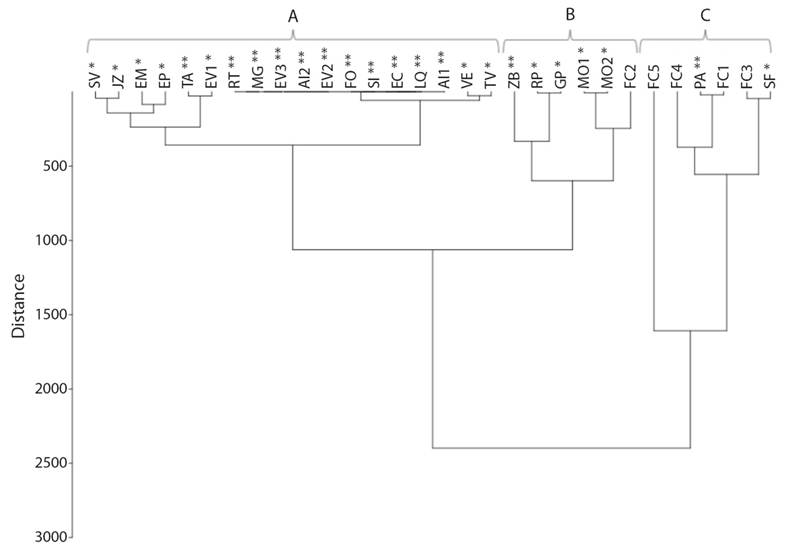
Fig. 1 Site Cluster Analysis of mammal species using Euclidian’s index in relation to the land use cover and distance to the nearest extensive protected forest. Sites with -indicate more than 75% of forest, sites with- indicate more than 30% of pineapple, and sites with * indicate more than 30% pastures. The clusters are labeled as A. Forest fragments in high forest cover and in close proximity to extensive protected forests, B. Forest fragments surrounded by pastures and far from extensive protected forests, and C. Forest fragments immersed in pineapple plantations.
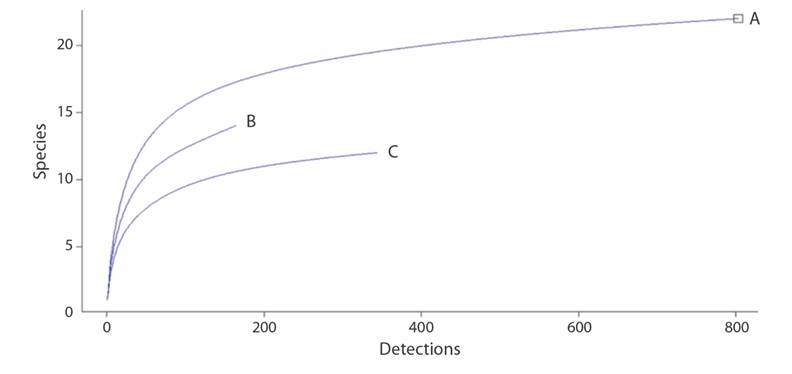
Fig. 2 Species rarefaction curves of the sites in clusters A. Forest fragments (18 Fragments) in high forest cover and in close proximity to extensive protected forests, B. Forest fragments (6 Fragments) surrounded by pastures and far from extensive protected forests, and C. Forest fragments (6 Fragments) immersed in pineapple plantations. Camera trap detections in Sarapiquí, Costa Rica, 2013-2014.
The best model that estimated 22 species as the overall richness in the area was Mh Darroch as shown in Table 2 (Darroch et al., 1993). Two different model types adequately describe the dynamics of these species, including one with an environmental covariate, assuming forest cover as the determinant variable for species richness and considering detectability within this land cover (Table 3).
Table 2 Capture and recapture models for closed populations to estimate overall species richness of medium and large terrestrial mammals in the area of Sarapiquí, Costa Rica, 2013-2014.
| Model | Richness | Standard deviation | deviance | AIC | |||
| Observed | Estimate | ||||||
| Mh Darroch | 22.0 | 22.3 | 0.6 | 34.144 | 72.347 | ||
| Mh Chao (LB) | 22.0 | 26.3 | 6.6 | 24.988 | 73.191 | ||
| Mh Gamma3.5 | 22.0 | 80.7 | 37.7 | 48.810 | 87.013 | ||
| Mh Poisson2 | 22.0 | 22.0 | 0.0 | 208.458 | 246.661 | ||
| M0 | 22.0 | 22.0 | 0.0 | 230.984 | 267.187 | ||
Table 3 Model selection for covariates affecting species richness in different types of landscapes in Sarapiquí, Heredia, Costa Rica, 2013-2014.
| Model | AIC | delta AIC | AIC wgt | K | R2 |
| λ (Forest), r (Forest) | 1766.58 | 0 | 0.480 | 4 | 0.160 |
| λ (.), r (.) | 1767.76 | 1.19 | 0.260 | 2 | 0.000 |
| λ (.), r (Pineapple) | 1769.40 | 2.82 | 0.120 | 3 | 0.012 |
| λ (.), r (Forest) | 1769.76 | 3.18 | 0.097 | 3 | 0.000 |
| λ (Pineapple), r (Pineaple) | 1771.19 | 4.61 | 0.048 | 4 | 0.019 |
| λ (Distance), r (.) | 1802.17 | 35.59 | 0.000 | 4 | 1.900 |
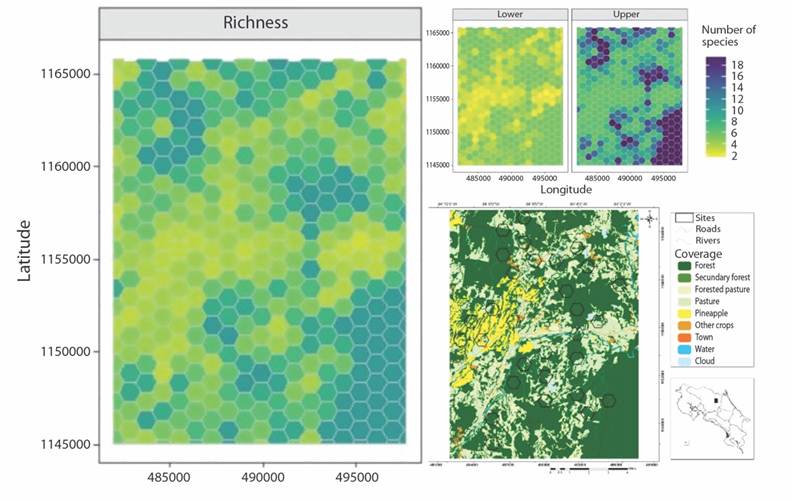
Our results show that the species richness of mammals varied according to landscape characteristics, where pineapple-dominated areas had the fewest species; and many of the sites with large forest cover had the largest number of species (Fig. 3).
Discussion
The amount of forest cover best explains the species richness and detectability in this area. Despite the level of habitat loss and fragmentation, most remnants of natural forests surveyed in this study represent potential habitats for many mammal species. Although distance from protected areas was not a determinant variable, mammal richness was greater in sites with large forest cover compared to fragments surrounded by less forest cover. For example, EcoVida (EV1) was the forest that provided a greater detection of medium and large land mammals with 16 species, despite being further away from the largest protected forest: Braulio Carrillo National Park (BCNP). This is probably because this site is connected with other relatively large forest fragments, supporting the idea that large forest areas support more species (Chiarello, 2000; Da Silva & Mendes-Pontes, 2008; Fahrig, 2003; Gurd et al., 2001; Michalski & Peres, 2007).
Mammal species composition in forest sites, such as the ones surveyed in this study, indicates that this type of heterogeneous landscape offers a variety of resources, favoring the dispersal of animals between fragments of forests. For instance, on the southern side of BCNP, we found that the closest site (MG) had high species detection, including several detections of Baird’s Tapir. Moreover, although a number of other sites close to BCNP had low species detection (e.g., ZB, SF, FO, and TV), many of the forests in this area are not discrete patches, but forest remnants bigger than XX ha that can provide greater habitat amount and connectivity between different environments. Habitat heterogeneity with highly permeable matrices (greater proportion of trees, crops and secondary forests) allow animal movements through the landscape, maintaining ecological dynamic processes that are essential for the persistence of mammal populations and diversity and thus are of great conservation importance (Asensio et al., 2009; Fahrig, 2013; Fahrig et al., 2011).
Major changes in landscape configuration like large pineapple plantations can negatively affect mammals, reducing species survival and population viability (Banks et al., 2005; Bélisle et al., 2001; Carroll et al., 2004; Trombulak & Frissell, 2000). For example, structural contrast between forest remnants and the matrix can be abrupt, increasing the edge effect for many species. In addition, the degree of forest loss and fragmentation in areas with pineapple plantations reduces connectivity between patches, exacerbating the negative effects that limit animal movements. Nonetheless, this type of cover maintains some forest remnants and riparian forests that act as corridors, while maintaining a certain degree of physical connectivity with other forest fragments. It has been reported that several species of mammals use this type of remnants to move, maintaining the connectivity of their populations and thus their survival in altered landscapes (Hermes-Calderón, 2008); this could be the case for Ocelots in our study. However, Ocelots or other species with relatively large habitat requirements have limited ability to move, since elongated fragments like the ones found in our study area have a greater perimeter relative to area, so the edge effect would be further exacerbated.
Conservation value of forest remnants: We estimated 86 % of the species of terrestrial native, medium and large sized mammals, reported for the area in the last six decades (Appendix 3). Species such as Common Opossum (Didelphis marsupialis) and Grey Four-eyed Opossum were documented regularly and in a variety of habitats. A similar case happened with Northern Tamandua and Nine-banded Armadillo (Wilson & Mittermeier, 2009). The latter was the most common species in our study. Although the Nine-banded Armadillo’s habits are poorly understood, it is known that it moves and uses different environments including secondary forests and agricultural fields (Cuarón, 2000; González-Zamora, 2011; Navarrete & Ortega, 2011; Nuñez-Perez et al., 2011; Wainwright & Arias-Sánchez, 2007; Wilson & Mittermeier, 2009), suggesting its tolerance towards habitat alteration (De Villa Meza et al., 2002).
The presence of other species, such as Central American Agouti (Dasyprocta punctata), are commonly reported in various types of land cover, and are presumed to be tolerant to deforestation (Reid, 2009; Wainwright & Arias-Sánchez, 2007; Wilson & Mittermeier, 2009). Although they were quite common in several sites, it was not detected at all in sites with pineapple coverage. Likewise, Spotted Paca was found mainly in sites with forest and pasture cover. Unlike the previously mentioned species, many carnivores require large-scale forest mosaics to meet their daily metabolic needs (Michalski & Peres, 2005). Such is the case of the Ocelots, which occur in both continuous and fragmented forests. However, this species was only detected once in pineapple plantations (Table 1), suggesting a transitory occurrence throughout the area. Ocelots are abundant opportunistic predators and relatively easy to study compared with the other wild cats (De Villa Meza et al., 2002; Di Bitetti et al., 2006; Wilson & Mittermeier, 2009). A similar finding was obtained for other small cats such as the Oncillas, Margays and Jaguarundis, whose detection was low, but they were still present in small fragments.
There is evidence that not all species are negatively affected or declining due to habitat fragmentation (Davies et al., 2000). For instance, Canis latrans was commonly detected in highly fragmented sites and pineapple plantations, occupying a variety of habitats such as open areas and forest edges (Bekoff, 1977; Wilson & Mittermeier, 2009). This flexible behavior allows them to venture into human-altered landscapes, invading otherwise unsuitable habitats (Cove et al., 2012). Other species like the Northern raccoon (Procyon lotor), White-nosed Coati and Tayras (Eira Barbara showed high tolerance to forest alterations. These mammals are generalist species that move across large areas of non-forest habitats and may use resources from habitat edges and the landscape matrices (Cassano et al., 2012; Cuarón, 2000; González-Zamora, 2011; Lessa et al., 2012; Lyra-Jorge et al., 2008; Massara et al., 2016; Mendes-Pontes et al., 2016; Wilson & Mittermeier, 2009) . Although we had few records of Lesser Grison and Striped Hog-nosed Skunks these species are reported to be able to traverse open areas and even use hostile matrices of actively managed grasslands and cultivated areas (Kasper et al., 2009; Michalski & Peres, 2007; Wilson & Mittermeier, 2009).
The Collared Peccary was mostly recorded in sites with high forest cover, and some in forest among pasture areas. However, both individuals and groups of Collared Peccaries were also detected in pineapple plantations, contrary to other studies (e.g. Cove et al., 2012; De la Cruz, 2012). This species uses resources in open areas (Keuroghlian & Eaton, 2008; Tejeda-Cruz et al., 2009), and it has been associated with levels of forest fragmentation (Garmendia et al., 2013; Wilson & Mittermeier, 2009). It seems that Collared Peccaries could benefit by a moderate degree of forest loss and fragmentation in the landscape (Tejeda-Cruz et al., 2009; Thornton et al., 2011; Urquiza-Haas et al., 2009). In contrast, White-tailed Deer (Odocoileus virginianus) and Central American Red Brocket (Mazama americana) were only recorded in sites with high forest cover; however, both species have been reported to benefit from open areas (Garmendia et al., 2013; Keuroghlian & Eaton, 2008; Tejeda-Cruz et al., 2009; Wilson & Mittermeier, 2009). Finally, Baird’s Tapir was only recorded in sites with high forest cover and close to water bodies; a habitat known to be preferred by the species (Bodmer et al., 1997; Wilson & Mittermeier, 2009). In addition, tapirs are usually sensitive to habitat loss and human disturbance (Cove et al., 2014; Garmendia et al., 2013), although at Selva Verde (SV) site, some individuals were detected not far from the lodge and main road.
We were unable to obtain records of some species expected in the region, such as the jaguar and puma, even in the sites closest to BCNP. However, both jaguar and pumas have been seen by locals in the study area (Mattey, personal communication 2015). Although these mammals tend to prefer trails where cameras were located (Arroyo-Arce et al., 2014; Chávez, 2010; Conde et al., 2010; Kelly, 2008; Silver et al., 2004; Trolle & Kéry, 2005), the lack of detections might have been the result of our sampling design and the relatively short period of time of the study. Another species not detected in our study area was the Northern Naked Tailed Armadillo (Cabassous centralis) which resides mostly underground (Wilson & Mittermeier, 2009), so it is a rare species in camera trap studies. Similarly, the Neotropical River otter (Lontra longicaudis) prefers aquatic environments, and the Mexican Hary Dwarf Porcupine is an arboreal mammal (Wilson & Mittermeier, 2009), so they may also go undetected by cameras. In contrast, the Giant Anteater (Myrmecophaga tridactyla) is believed to have been extirpated from the area (Wainwright & Arias-Sánchez, 2007), while the White-lipped peccary (Tayassu pecari), population now occurs mostly in Corcovado National Park (Carrillo et al., 2002). Although detection was reduced for other species like Central American Red Brocket and Forest rabbit (Sylvilagus gabbii), they are not extirpated from the area as some suggest (Cove et al., 2012). Their low incidence may be due to differences in habitat preferences or low population densitiesv (Wilson & Mittermeier, 2009), It is important to note that the lack of records of a given species during our study does not mean that it is absent or extinct. Indeed, the presence of domestic dogs and the robbery of four cameras suggest poaching pressure. It is likely that human pressure is causing the reduction of some species of mammals (e.g. Spotted Pacas, Central American Agouti, Collared Peccary and Central American Red Brocket), affecting forest ecosystems processes and interactions within mammal communities (Arias Le Claire, 2000; Asquith et al., 1997; Bodmeret al., 1997; Forget & Milleron, 1991; Guariguata et al., 2000). The fact that most of the species detected in sites near pineapple plantations are listed under the least concern category (Appendix 3), suggests that the persistence of generalist species such as raccoons, coatis and Grey Four-eyed opossums, are least affected by land modifications (Parry et al., 2007; Tejeda-Cruz et al., 2009). The absence of Central American Agouti in this area is of great concern, since this species’ home range is around 2 ha and they are territorial and locally common (Wainwright & Arias-Sánchez, 2007). It is possible that habitat alteration and poaching are heavily impacting this species.
The results of this study draw attention to the biological importance and conservation value of forest fragments, as many mammal species persist in fragmented landscapes (Bruna et al., 2010; Lyra-Jorge et al., 2008). Species-specific responses to habitat loss and fragmentation are related to interspecific differences in the perception of landscape structure and the scale of habitat alteration (Lima & Zollner, 1996; Lord & Norton, 1990; Vos et al., 2001; Zollner & Lima, 1997). For example, larger species with extensive home ranges are able to perceive landscapes as more homogenous than smaller and less vagile species (Elmhagen & Angerbjörn, 2001; Gehring & Swihart, 2003; Lyra-Jorge et al., 2008). In addition, some animals may even adapt to modifications to their original habitats (McDougall et al., 2006; Morán-López et al., 2006; Tabeni & Ojeda, 2005). Our results suggest that many large and medium sized mammals in fragmented landscapes explore the region as a whole, and are not necessarily restricted to the native vegetation patches (Donadio et al., 2001; Franklin et al., 1999; Lyra-Jorge et al., 2008), such as Coyotes and Tayras that adapt to human-modified landscapes (Lyra-Jorge et al., 2008).
In conclusion, it is necessary to preserve large as well as small forest fragments, including riparian forests that serve as corridors between otherwise isolated forest fragments. Also, scattered trees and living fences within the landscape enhance quality and increase the permeability of the matrix (Umetsu & Pardini, 2007). Finally, the conservation of private nature reserves can increase landscape connectivity and habitat availability, thus favoring inter-patch movements. Both forest cover and matrix quality are key in determining the complex ecological dynamics for the maintenance of mammal species diversity in agricultural landscapes (Fahrig, 2013; Kupfer et al., 2006).

