




 Inglês (pdf)
 Artigo em XML
 Referências do artigo

 Tradução automática
 Enviar este artigo por email
 Citado por SciELO
 Similares em
SciELO
 uBio

 Permalink


Introduction
The interaction between plants and pollinators has been widely studied from an ecological and evolutionary perspective and as part of the environmental services that pollinators provide (Percy et al., 2004; Pincebourde et al., 2017; Sargent & Ackerly, 2008; Strauss & Zangerl, 2009; Zebelo & Maffei, 2015). Animal-mediated pollination is estimated to contribute to the sexual reproduction of 90 % of the 250 000 angiosperm species (Kearns et al., 1998). Plant-pollinator interactions directly influence the development and sustainability of terrestrial ecosystems, as well as human life (Aizen et al., 2009), since many of the plants that animals pollinate are an important food source for people.
It is estimated that at least 35 % of global crop production depends on animal pollination (Nicholls & Altieri, 2012), and the importance of pollinators in agricultural production has been recognized worldwide (Intergovernmental Science-Policy Platform on Biodiversity and Ecosystem Services (IPBES), 2016). For instance, Nicholls and Altieri (2012) report that the number of crops pollinated by animals has rapidly increased in both developing and developed nations, with 58 % of crops in Latin America relying on insect pollination (Basualdo et al., 2022). This highlights the importance that service pollinators provides in natural and agricultural ecosystems.
Plant-pollinator interactions are threatened by different natural phenomena: climatic, hydrological, meteorological, and geophysical (Nicholson & Egan, 2019). However, anthropogenic factors, such as climate change and land use change, pose a more serious threat to the maintenance of pollination services (Hegland et al., 2009; Klein et al., 2006; Settele et al., 2016; Stoddard, 2017). The negative effects of these factors can directly affect entire communities of plants and pollinators. The ongoing decline of insect populations has influenced plants, as well as other organisms (Visser & Both, 2005; Abernethy et al., 2018; Cristóbal-Perez et al., 2024). The predicted changes in climate and land use will not only affect natural ecosystems but will also have a strong negative impact on the production of crops that rely on pollinators for their reproduction (Winfree, 2010). However, despite the urgency to maintain the viability of pollinators and plant-pollinator interactions (Galetto et al., 2022), information on the role that natural insect communities play on crop pollination is still scarce. There is a notable lack of information on pollination services in neotropical highlands, particularly in Costa Rica (Garibaldi et al., 2011; Celis-Diez et al., 2023; Montero et al., 2025).
In this study, we investigated the diversity and abundance of insect floral visitors in avocado, apple, plum, and blackberry crops in a Costa Rican highland region. Two of these crops-avocado and blackberry-are native and naturally occur in the study area, whereas apple and plum are exotic. To accomplish this goal, we estimated insect alpha diversity on each crop and compared the insect community composition among crops. Because floral morphology may influence the diversity and abundance of insects that visit them, we classified the flowers by crop family: Rosaceae (blackberry, apple, and plum) and Lauraceae (avocado). We predicted that insect community and abundance would differ between the two plant families based on their floral morphology. But the diversity and abundance of insects are expected to be similar in apples, plums, and blackberries.
Material and methods
Study site: We conducted this research in San Gerardo de Dota, Dota, San José, Costa Rica (9°33’00” N, 83°48’39” W, 2 300 m elevation) between August 2021 and November 2022. This site is located at the upper basin of the Savegre River and includes large tracts of montane forest dominated by Quercus spp. (Juárez et al., 2000). The region averages a temperature of 14 °C and an annual precipitation of 2 190 mm (Solano & Villalobos, 2001), with two seasons: the dry season from December to March and the rainy season from April through November.
Data collection: We sampled insects on two avocado (Persea americana Mill.) farms, two apple (Malus domestica Borkh.) farms, one plum farm (Prunus domestica L.), and two blackberry (Rubus spp.) farms. Avocado and blackberry are native to the region, although particularly avocado has been subject to artificial selection, while the other two crops are introduced. The farms are approximately four kilometers apart. The crops studied are the most abundant crops in the region and have a significant economic impact on local farmers.
We systematically selected avocado, apple, and plum trees to collect insects. In each crop, the first tree sampled corresponded to the first tree we observed with abundant insect visitors; we then moved northwesterly, collecting on every third tree. When the limit of the crop field was reached, we applied the same selection criteria, but in the opposite direction. For blackberry, we selected those plants with abundant open flowers due to the low flowering rate of this crop.
We concentrated our sampling efforts during the flowering peak of each crop between 6 and 13 sampling hours, depending on weather conditions. Each tree (or bush) was sampled for 15 min; if insects were not visiting the flowers, we waited for another 10 min, and then moved to another tree. Each crop was sampled between two and seven times (for one to four days each time), depending on their abundance and flowering patterns. Thus, the number of samplings was approximately proportional to the number of plants in each crop.
We collected each insect using one of following three methods: clear plastic bags, insect aspirators, or entomological nets. Each method was used based on the insect size and the height from the ground where it was foraging: an entomological net for large insects or foraging insects at > 1.60 m; a plastic bag for medium insects 1-2 cm; and an aspirator for smaller insects < 1 cm. We only collected insects whose mouthparts or legs were in direct contact with the flowers’ reproductive organs.
For very abundant insects (e.g., honeybees and some syrphid flies), we collected a maximum of five insects of the same species or morphospecies (in the case of syrphids) per tree. This allowed us to have an appropriate representation of the insects without impacting their populations. Each insect was stored in labeled vials with 70 % alcohol.
Taxonomic identification of insects: All insects were identified to the lowest taxonomic level possible, using specialized taxonomic keys and/or comparing them with specimens from the Diptera collection of the Department of Natural History of the National Museum and the criteria of expert taxonomists when needed. For flies, we used the keys published by Brown et al. (2009) & Brown (2009), and for bees the key published by Michener et al. (1994). To preserve individuals in better conditions for identification, we used an air-drying procedure with 100 % alcohol and hexamethyldisilazane (HDMS) for small, soft-cuticle insects such as flies (Nation, 1983). Vouchers of all collected insects were deposited in the Museo de Zoología, CIBET, Universidad de Costa Rica (MZUCR).
Data preparation: Each sampling unit consisted of at least two hours of sampling on a particular crop, where at least two insects were collected. We used a Pearson correlation to determine the effect of sampling effort (number of sampling units) on the number of collected insects.
Alpha diversity: To describe diversity patterns of crop insect floral visitors, we calculated alpha diversity for each crop using the iNEXT () function, and estimated the cover-based Hill diversity using the estimateD () function of the iNEXT package (Chao et al., 2014; Hsieh et al. 2016). We calculated three diversity metrics (0D, 1D, and 2D): 0D estimates the species richness and is more sensitive to sample size and influenced by rare species; 1D gives equal weight to rare species and abundant species; and (2D) gives greater weight to the dominant species (Chao et al., 2014; Roswell et al., 2021). We used confidence intervals to evaluate the differences across crops for each diversity indicator (Chao et al., 2014). We also generated rarefaction curves (ggiNEXT function, iNEXT package) for each crop, with a 95 % confidence interval (Chao et al., 2014). The curves were estimated based on the abundance method for both coverage and sampling to determine the completeness of insect collections on each crop. Coverage is a statistical procedure that determines the completeness of the samples collected.
Beta Diversity: To compare the composition of the visiting insect community among crops, we performed a non-metric multidimensional scaling (NMSD) analysis based on a Bray-Curtis dissimilarity matrix with 999 permutations with the metaMDS function from the vegan package (Oksanen, 2022). We then performed a non-parametric analysis of variance (PERMANOVA) using the adonis function from the same package, in which the independent variable consisted of the type of crop and the response was the distance matrix. The betadisper function (vegan package) was used to test the assumption of homogeneity of variances among insect communities (Oksanen, 2022). We used the R statistical language, version 2023.12.1 (R Core Team, 2023), for all statistical analyses.
Results
General information: We conducted 30 sampling sessions (137 hours) and identified 2 806 insects from 75 families (Appendix Table S1). After excluding the sampling units that did not meet our minimum criteria (see methods) and deteriorated insects that could not be identified, we ended up with a total of 2 774 insects. We identified 2 061 insects to the genus level representing 25 families, which were then classified as species or morphospecies (Appendix Table S1). From the remaining insects, 676 were classified only to family level and 37 to order level. The most abundant visitors were flies (e.g., Syrphidae) followed by bees (e.g., Apis mellifera and Bombus spp.). The number of species per sampling unit correlated with the number of sampling hours (r = 0.62, p = 0.0002). Persea americana was the crop with the highest number of trees sampled and insects collected, as well as the largest number of sampling sessions, while plum was the crop with the smallest sample size (Table 1).
Table 1 Summary of the data collected for each crop (Persea americana, Malus domestica, Rubus spp., and Prunus domestica). The number of visits, the number of trees sampled, and the number of insects collected are included.
| Crop | Field Visits | Sampled trees | Collected insects | Species/ morphospecies |
| Persea americana | 7 | 120 | 2083 | 224 |
| Malus domestica | 5 | 39 | 263 | 38 |
| Rubus spp. | 5 | 37 | 275 | 38 |
| Prunus domestica | 2 | 28 | 163 | 33 |
The most diverse group of floral visitors in avocado plants were flies (91 % of the total flies were collected in avocados), many of which were absent or in very low numbers in other crops. For example, 93 % of all syrphid flies collected were captured on avocado flowers; similarly, for Tachinidae (96.5 %), Calliphoridae (100 %), Sarcophagidae (99 %), Sciaridae (94 %), and Muscidae (95 %). These families account for 73 % of all flies collected on avocado flowers. We found 39 families of insects exclusively in avocado plants, but only two unique taxa (Scoliidae and the order Psocoptera) were found in plum. There were also some uncommon taxa collected exclusively in avocado, apple, or blackberry (Appendix Table S1).
Alpha diversity: Flowering periods differed in number and synchrony across crops. Avocado trees had more flowering events per year, followed by blackberry, apple and plum crops (Montero et al., 2025). Flowering was artificially induced twice a year (in July-August and January) in apples and plums, with flowering bouts lasting about one month each. As a result, sample completeness (coverage) varied across the four crops, with avocado having the highest (95 %), followed by blackberry (92 %), apple (91 %), and plum (89 %). Thus, we standardized our samples by coverage to reduce the effect of uneven sampling effort between crops, allowing diversity measures to be more comparable among crops. The richness and diversity of flower visitors (based on Hill-numbers, Appendix Table S2) in avocado flowers was much greater and differed notably from the diversity estimated for the other crops (Fig. 1, Fig. 2), as this crop attracts a larger diversity of visitor insects. However, the other three crops overlap in terms of richness and Hill-Shannon diversity. The Hill-Simpson diversity index, primarily affected by abundant species, was greater for blackberries in comparison to apple and plum crops (Fig. 2). Therefore, insect visitors on avocados, followed by insects on blackberry crops, had a higher proportion of abundant species. However, avocado flowers attracted the largest richness of visitor insects, which varied in abundance, as indicated by the higher values of all three Hill-diversity indices (Fig. 1, Fig. 2).
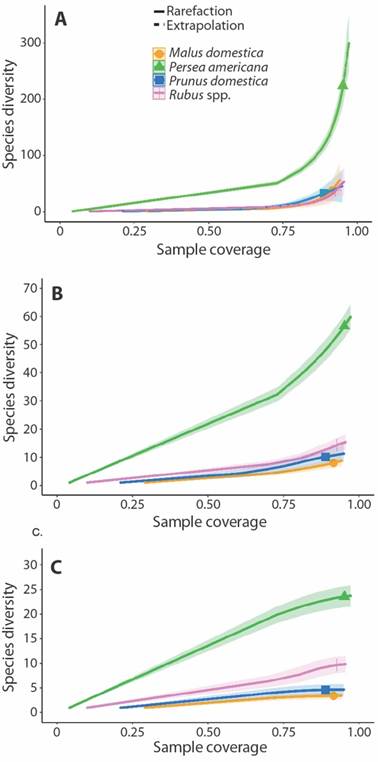
Fig. 1 Diversity estimates are divided into three panels: A. Richness (q = 0), B. Hill-Shannon (q = 1), and C. Hill-Simpson (q = 2). They are based on coverage-based rarefaction (solid line) for insect visitors sampled in apple (Malus domestica), avocado (Persea americana), plum (Prunus domestica, and blackberry (Rubus spp.).
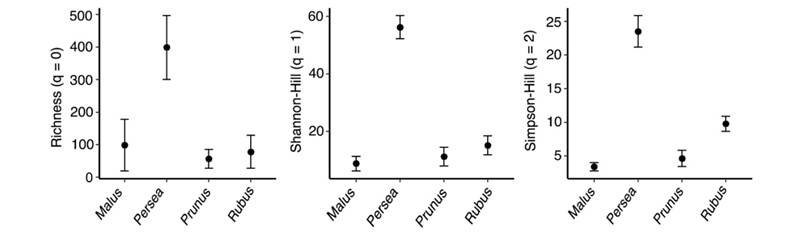
Fig. 2 Comparison of the three Hill-diversity estimates of insect visitors between fruit crops. Error bars depict 95 % CI.
Beta Diversity: The composition of insects visiting avocado flowers did not overlap with that of other crops (F = 2.62, P < 0.001, R² = 0.34). Whereas the insect communities that visit apple, plum, and blackberry flowers exhibited a nearly complete overlap, indicating that the insect communities of these crops are highly similar (Fig. 3). The variance is homogeneous across crops (F = 0.64, P = 0.579).
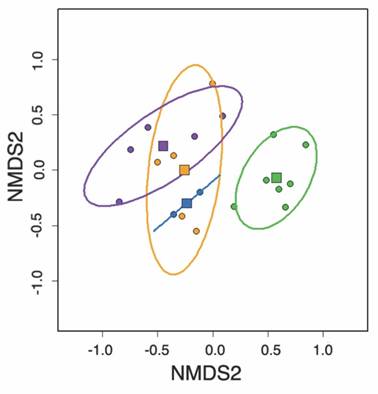
Fig. 3 Non-metric multidimensional scaling (NMDS) based on Bray-Curti’s index estimated from the abundance of insect visitors, illustrating the clustering of sampling units for each fruit crop (stress = 0.1922). Samples from fruits correspond to: Persea americana (green), Malus domestica (yellow), Rubus spp. (violet), and Prunus domestica (blue); centroids are represented by squares. Ellipses denote the standard 95 % confidence.
Discussion
We identified a rich community of insect visitors in the flowers of all four crops, with flies (181 species) and bees (19 species) being the most diverse and abundant groups. The diversity and number of insects varied by crop. Avocados had the greatest diversity and abundance of floral insect visitors, as well as a different composition of the insect visitor community. Most flies (91 % of the flies) were captured on avocado flowers. This group was represented by six diverse families found almost exclusively in avocado: Syrphidae, Calliphoridae, Tachinidae, Sarcophagidae, Sciaridae and Muscidae. On the contrary, apple, plum and blackberry flowers were visited primarily by bees (Appendix Table S1).
Honeybees (Apis mellifera), bumblebees (Bombus spp.), and sweat bees (Halictidae - Lasioglossum spp.) visit the flowers of all four crops, while stingless bees (Meliponini - Meliwillea bivea and Partamona grandipennis) were absent in plum. Managed honeybees were the most common visitor (as a species) of all four crops. Their abundance is influenced by their social behavior, recruitment foraging, construction of large colonies (Lowell et al., 2019), and the leasing of hives by local farmers to improve pollination of their crops. Our findings are congruent with those reported in other studies (Carabalí-Banguero et al., 2021; Celis-Diez et al., 2023; Ish-Am et al., 1999; Okello et al., 2021), in which flies and bees are the dominant flower visitors in these crops.
Alpha diversity: Avocados produce a large number of small flowers with a relatively simple floral morphology (Chanderbali et al., 2013), which attracts a large number of insect species, compared with apples, plums, and blackberry flowers. This species also has a synchronous dichogamy in which the female phase occurs in the morning while the male phase occurs in the afternoon (Davenport, 1986). This strategy increases the probability of insect visitation because pollen (male phase) and nectar (female phase) can attract different groups of insects. The diversity analyses plainly demonstrate the disparities in species richness. The number of species documented for the other crops is significantly lower than that of avocado. This abundant crop flowers during periods when other native and ruderal species produce fewer flowers, providing a valuable resource for insects (Montero et al., 2025). Many insects, especially flies, forage on a wide range of plants in the montane forest and are attracted to the relatively simple avocado flowers. Because avocado is a native species, insects may have evolved behaviors and adaptations to exploit these flowers, contributing to the higher alpha-diversity observed in avocado farms.
Differences in the other diversity estimators (q = 1 and q = 2) for insects collected in avocado flowers indicate that this crop attracts a significantly high number of species that vary in abundance. The flowers of this crop attract a greater diversity of common species, as shown by the Hill-Simpson estimator (q = 2), and a greater quantity of both uncommon and abundant species, as determined by the Hill-Shannon estimator (q = 1). These estimators are both influenced by the large number of fly species from families such as Syrphidae, Calliphoridae, Tachinidae, Sarcophagidae, Sciaridae, and Muscidae, and bees (Apis and Bombus) that visit avocado flowers. Flies represent 73 % of all insect visitors in avocado with some common species but also with many uncommon species.
Several studies have shown that honeybees are effective pollinators of avocado flowers and that introducing honeybees increases yield (Dymond et al., 2021; Vithanage, 1990). This is likely important in San Gerardo, as farmers frequently rent Apis mellifera colonies to increase yield. However, a recent meta-analysis studied the impact of insect pollinators on avocado yield and found that native pollinators are just as important as introduced bees (Dymond et al., 2021). Therefore, cutting down on their numbers through pesticide use or loss of natural habitat may lower pollinator abundance and crop yields (Dymond et al., 2021 and references therein). Like our findings, their review shows that in some countries, local insects, such as flies, are more prevalent and important pollinators (Celis-Diez et al., 2023). This emphasizes the need to preserve natural habitat, which can support populations of native insects that provide an ecosystem service by pollinating crops like avocado (Dainese et al., 2019; Garibaldi et al., 2011, Garibaldi et al., 2013).
Beta diversity: The community of floral insect visitors in avocado also differs from the community of insects that visit the other three crops (Fig. 3). The insect community visiting avocado flowers is mainly composed of flies (Diptera). The majority of Diptera with short lapping mouth parts typically consume nectar from small flowers that have accessible nectaries (Gilbert, 1981; Gilbert, 1985), and avocado flowers fit these characteristics. Other studies have also shown that flies are common visitors of avocado flowers (Campbell et al., 2012; Muñoz et al., 2021).
Role of insects on crop pollination: In apple, plum, and blackberry crops, the number of flies visiting the flowers was lower than the number of bees and wasps, particularly in apple and blackberry. Bumblebees visit flowers of all four crops but primarily those of apple, plum, and blackberry. With appropriate management, they could serve as a good alternative to managed honeybees, particularly because they are efficient pollinators adapted to local conditions (Freitas et al., 2009; Montero et al., 2025; Pérez-Méndez et al., 2020). This difference in insect community composition may be influenced by differences in the morphology of avocado flowers (Lauraceae) compared to apple, plum, and blackberry (Rosaceae) flowers, but also by differences in sample size between the abundant avocado and the other less abundant crops. Both factors need to be further explored.
We cannot be sure that the insect visitors identified in this study act as crop pollinators; however, flies, bees and other insects are likely to do so, as species of the same families have been reported as important pollinators of multiple crops. Syrphid flies and bees, for example, rely solely on nectar and pollen for energy to fly and lay eggs (Brown et al., 2009), playing an important role as pollinators (Willmer et al., 1994; Bataw, 1995; Mengual et al., 2009; Pardo & Borges, 2020). In this study, syrphids (Allograpta and Ocyptamus), bumble and honeybees were common flower visitors of all crops. Celis-Diez et al. (2023) also reported Allograpta as the most frequent genus of hoverflies in avocado crops. This study also found other flies (e.g., Calliphoridae) that have been reported as avocado pollinators (Cook et al., 2023). A recent study conducted in the same area reported that many of the insects, particularly flies and bees, collected on crop flowers carried pollen not only from the crop in which the insect was captured but also from other crops and many native and ruderal plants in the region (Montero et al., 2025). These findings provide clear evidence that native insects provide pollination services to crops.
It has been argued that a high abundance of managed honeybees (Apis mellifera) is sufficient to accomplish crop pollination (Breeze et al., 2014). However, a large body of evidence indicates that only a diverse community of pollinators can promote a long-term maintenance of crops and natural communities (Katumo et al., 2022), reducing pollen limitation and increasing genetic diversity and quality of fruit crops (Gómez et al., 2010; Katumo et al., 2022). We found a diverse community of native insect visitors in all crops that likely play an equal, if not more important role, than the managed bees because evidence indicates that maintaining a diverse community of pollinators will greatly increase crop production (see Table 1 in Katumo et al., 2022). To preserve this rich community of crop native pollinators, it is essential that natural and seminatural areas near crop fields are protected. These areas provide resources (e.g., pollen and nectar) for native pollinators during the non-flowering periods of crops (Carvalheiro et al., 2011; Garibaldi et al., 2013). As pointed out by Dymond et al. (2021), there is a significant information gap about wild pollinators in the tropics, particularly in Central America. Given the abundance of wild Lauraceae plants, including Persea america, in this region, natural pollinators may be better adapted to pollinate cultivated avocados, thus contributing significantly to yield increase. Therefore, our research contributes information on the relative importance of these wild pollinators for avocado cultivation in this region.
Among the four crops, avocado stands out due to the richness and abundance of insect assemblages that visit its flowers. Several factors likely contribute to this phenomenon. The dichogamous flowering pattern, the asynchrony in basipetal anthesis within and among inflorescences, the small size of the stigma, the release of a limited number of heavy pollen grains, and the production of nectar in both flower phases (female and male) all serve to attract a large number of insects (Davenport, 1986). Additionally, the neighborhood effect (Underwood et al., 2020) may further explain the diverse entomofauna visiting avocado flowers. The synchronized flowering at the crop-field level provides an abundant resource that attracts a larger number of insects compared to the other, less abundant crops. However, despite differences in the assemblages of insect visitors among crops, local insects provide an important ecosystem service to farmers, by acting as pollinating agents for all crops.
Conclusions: The Costa Rican highlands are highly diverse regions with extensive natural habitats, primarily consisting of tropical montane forests. San Gerardo de Dota combines low-level agriculture and ecotourism, and it is surrounded by natural protected montane forests. This is why San Gerardo supports a rich community of native insects that visit and likely pollinate the flowers of avocado, apple, plum, and blackberry crops. These crops include both exotic and native species. Despite this, native insects -particularly flies- abundantly visit all crops. This is an important finding, as studies have shown that a diverse pollinator community leads to larger yields and fruits of higher-quality (Garibaldi et al., 2013). It also opens the possibility of introducing other native and exotic insect-pollinated crops in the highlands of Costa Rica. However, avocado hosts a unique group of insects. Its flowers are visited by the largest community of insects, primarily flies, which clearly diverged from the visitors of apple, plum, and blackberry that are dominated by native and managed bees. Natural habitats serve as reservoirs for a wide range of potential pollinators, which play a crucial role in enhancing pollination, thus providing an important service to nearby farms by improving crop yield (Carvalheiro et al., 2011; Garibaldi et al., 2013).
Ethical statement: The authors declare that they all agree with this publication and made significant contributions; that there is no conflict of interest of any kind; and that we followed all pertinent ethical and legal procedures and requirements. All financial sources are fully and clearly stated in the acknowledgments section. A signed document has been filed in the journal archives.

