




 Artigo em XML
 Referências do artigo

 Tradução automática
 Enviar este artigo por email
 Citado por SciELO
 Similares em
SciELO
 uBio

 Permalink


Introduction
“Biological diversity must be treated more seriously as a global resource, to be indexed, used, and above all, preserved” (Wilson, 1988; p. 3). These words so wisely and warningly expressed by E. O. Wilson nearly four decades ago, resound louder at the present time than ever before. We continue losing species at an unprecedented and accelerated rate, particularly in the tropics (Gao et al., 2020; Janzen & Hallwachs, 2021; Pievani, 2014). The factors causing biodiversity loss are numerous and most of them (if not all) have a destructive synergetic effect on ecosystem diversity. The factors responsible for biodiversity loss can be visualized as a complex network, in which habitat destruction, fragmentation, urban expansion, species invasion, contaminants (e.g., pesticides, macro and microplastic, noise, light, etc.), and climate change interact and affect differently the community composition at each particular time and ecosystem (Aguirre-Gutiérrez et al., 2017; Sanchez-Azofeifa, 2000; Seymoure, 2018).
The destruction and fragmentation of large extensions of tropical forests and other ecosystems for agricultural and urbanization purposes are certainly the primary factors responsible for biological diversity loss (Joyce, 2006; Sanchez-Azofeifa, 2000). Once natural ecosystems are reduced to tracts of different size and with different degrees of deterioration, and separated by different distances and barriers, other factors that often have little impact in extensive natural ecosystems (e.g., hunting, fishing, invasive species, contamination) become a serious concern for the preservation of the biodiversity in the deteriorated tracts of tropical ecosystems (Cullen et al., 2000; Seymoure, 2018). The negative impact of these factors is exacerbated by the fluctuation and changes in the climatic conditions caused by the climate change (Karmalkar et al., 2008; Lyra et al., 2017).
In current discussions on biodiversity, tropical forests continue occupying a central stage, and a serious concern for its preservation is the enormous number of species remaining to be named (Erwin, 1982; Raven, 1988). We are losing most species inhabiting this planet without ever knowing them. These species are not only important for the scientific community, but they represent valuable resources for the entire society (Burton et al., 1992; Smith et al., 1992). The overwhelming task of cataloging species is far behind, and two main factors worsen this enormous task. First, worldwide governmental institutions cut (or eliminate) funding resources for taxonomy and natural history research, second and directly linked to the previous factor, taxonomists are rarer and rarer, in part because taxonomy and systematics are, at present, considered irrelevant study areas within the broad scope of biology. The scientific society, and the society in general, need to pause and rethink the importance of naming and preserving the species on the planet. Science has found and continues finding new uses for biological diversity, but without knowing a simple but important thing -the species name- we may be losing important resources. “We must know that (species) exist before we can understand or use them” (Raven, 1988, p. 120).
We show the problem that concerns biodiversity preservation by focusing on diversity of moths and butterflies in one the most diverse areas in the neotropics, the central and southwestern Costa Rican region (southwestern region hereafter) including the Península de Osa, a diversity hotspot (Cornejo et al., 2012; Haffer, 1974; Morera-Beita et al., 2019). This region embraces one of the most diverse lowland neotropical forest, with a large number of endemic species (Gilbert et al., 2016). It has been the focus of a large number of investigations in different groups of organisms, but it has also been subject to intense destruction and fragmentation as a consequence of timber exploitation (usually illegal), introduction of different crops (often unsuccessful), and gold mining (Gilbert et al., 2016; Lobo et al., 2007), which have gradually eroded the rich biodiversity of the region. In an attempt to show the diversity that fragments of this magnificent forest still maintain, we studied the diversity of moths and butterflies in six localities distributed over the southwestern region of Costa Rica. Lepidoptera is the third or fourth most diverse order of insects with over 155 000 described species (Eggleton, 2020), and they play diverse and important roles in the ecosystems (Eggleton, 2020; Ghazanfar et al., 2016). Larvae of nearly all moths and butterflies are herbivorous, with many highly specialized on one or a few plant species, and as adults they often serve as pollinators of different groups of plants, including some crops (Halder et al., 2019). From an evolutionary perspective, moth and butterfly herbivory and pollination are evolutionary forces that have shaped the evolution of entire groups of plants, and from an ecological perspective moths and butterflies interact with diverse groups (e.g., plants, parasites, predators), becoming a key component for the functioning (e.g., energy flow) of the ecosystem. Therefore, losing moth-butterfly diversity, entails not only species disappearances, but also the disappearance of the functions and interactions these insects play in the ecosystem.
In this study we focus on the following two objectives. (a) To describe and compare the diversity of moths and butterflies among different localities of the southwestern Costa Rican region, and (b) to identify the information gaps in this group of insects. For the second objective we specifically focused on the number of specimens which could not be assigned to a particular species, which could be primarily attributed to the fact that taxonomists are “a species in extinction”, and to the limited funding for taxonomy and systematics. To address these objectives, we used a data base from a monitoring project conducted in the region by INBio (National Institute of Biodiversity). This is the most comprehensive data base of moths and butterflies for a lowland neotropical rainforest.
Material and methods
Study sites: The study sites are in the southwestern region of Costa Rica, and include different forest types: wet forests, tropical moist forests, and tropical premontane wet forests (Holdridge, 1967), along an elevation from sea level to 745 m on Cerro Rincón. The geomorphology of the region is complex with narrow ridges, pronounced slopes, and sediment plains (Gilbert et al., 2016; Weissenhofer & Huber, 2001). The annual precipitation ranges from 4 000-6 000 mm, and the mean annual temperature fluctuates between 25 and 27 °C (Gilbert et al., 2016). The rainy season occurs between May and December, with a notable reduction in precipitation between January through April. Geomorphological and climatic conditions have been determinant factors influencing the complexity of the forest mosaic in the region.
Moths and butterflies were collected using different procedures (see below) in 12 different localities from 1973 to 2013, at the beginning only a few localities were sampled sporadically. However, from 1978 to 2013 samplings were more frequent and intense and included more localities. Each locality was sampled at irregular time intervals during the sampling period. Selection of localities was based on two criteria: that they were in a protected area (e.g., national park, biological reserve), and with access to electricity or an electric generator. Electricity was necessary to charge batteries to set light traps and prepare moth and butterfly specimens for later identification. All localities were within large tracts of protected mature lowland rainforest. This survey was part of the national biodiversity inventory led by INBio (National Biodiversity Institute). Field collections were carried out by parataxonomists and taxonomists, and identification of specimens was done by local and foreign taxonomists; names and affiliation of specialist taxonomists for each family are included in Supplementary Table 1. All specimens were catalogued and deposited at the INBio entomological collection, currently deposited at the Museo Nacional de Costa Rica.
Collecting procedures: Parataxonomists used three different methods to collect butterflies: light traps, fruit traps, and entomological net. Light trap was the method more extensively used and consisted of setting the traps for 5 nights/month (two before new moon, new moon, and two after new moon); these collecting methods are explained in detail by Janzen (1983). Samplings were non-systematic and were conducted at different time periods in each locality. In each locality, parataxonomists set 1 or 2 light traps, and 15 sampling stations for fruit traps. Each fruit trap station consisted of 2 traps, one set in the understory (at 2 m from the ground) and the other in the canopy (~ 20 m high). Despite the inconsistent sampling, such valuable data are still comparable using the appropriate statistical procedures (see Statistical analyses section). We excluded specimens captured with Malaise traps, because this method was used only in one site.
Statistical analyses: Richness surveys (INBio biodiversity inventory) are usually focused on collecting the most species possible in a particular locality; thus, different samplings in the same locality often vary spatially and temporarily (moving from one location to another in the same site, or during different times of the year). This is in contrast to systematic sampling procedures in which samplings are carried out in the same locations with a specific duration of time, but systematic samplings limit the number of species detected in a particular site. Hence, given the conditions of this inventory, we compared diversity parameters across sites, rather than between periods within sites.
We selected six different localities as the focal sampling units (Fig. 1; Table 1). Selection of these sites was based on coverage (sampling completeness - see Alpha diversity section), but data from other sites (indicated when necessary) were included in more general analyses (e.g., total number of species).
Table 1 Geographical location of the six localities most extensively sampled during the study period in the southwestern region of Costa Rica. The number of species and specimens collected in each of the six localities is included. Species and specimens correspond to the 12 families selected (see Beta Diversity section in methods).
| Locality | Latitude | Longitude | No. species | No. specimens |
| Cortes | 9°, 58’ | 83°, 31’ | 469 | 1350 |
| Piedras Blancas | 8°, 42’ | 83°, 16’ | 1865 | 12870 |
| Rancho Quemado | 8°, 40’ | 83°, 33’ | 619 | 2356 |
| Agujas | 8°, 32’ | 83°, 25’ | 1837 | 13221 |
| Los patos | 8°, 31’ | 83°, 34’ | 654 | 1868 |
| Sirena | 8°, 28’ | 83°, 35’ | 2027 | 22575 |
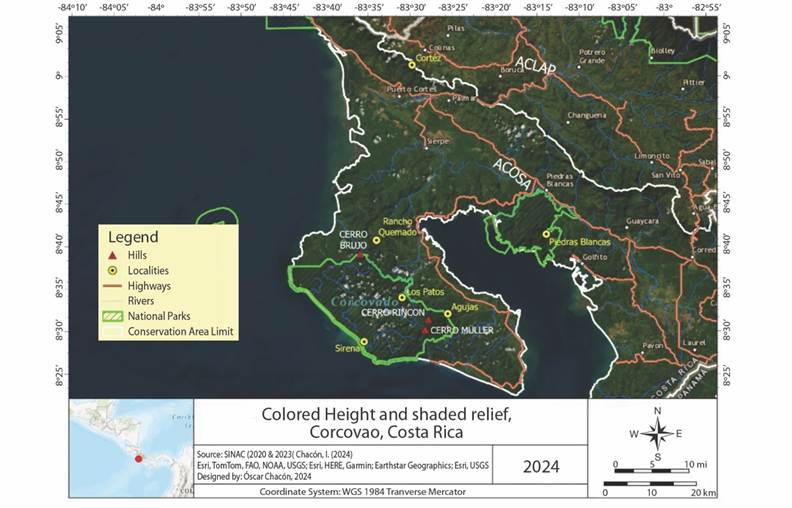
Fig. 1 Map of the study region showing the distribution of the six localities (in yellow) used in the analyses: 1- Cortés, 2- Piedras Blancas, 3- Rancho Quemado, 4- Agujas, 5- Los Patos, 6- Sirena.
Beta Diversity: For beta diversity analyses, we selected 12 families (Apatelodidae, Bombycidae, Crambidae, Erebidae, Geometridae, Lasiocampidae, Megalopygidae, Noctuidae, Notodontidae, Nymphalidae, Saturniidae) that were all present in the six localities most extensively sampled (Cortés, Piedras Blancas, Rancho Quemado, Agujas, Los Patos, Sirena; Fig. 1). We provided general comparative information on the number of species in the families selected. We also compared the dissimilarity of species for each family among sites using the Sorensen index. We conducted this analysis in two steps: first, we estimated the dissimilarity of species within each family among localities; second, we calculated the mean and 95%-confident intervals for each family, and compared them across the 12 families. Dissimilarity was calculated with the function beta.pair from the betapart package (Baselga, 2017), on a presence/absence data set. This type of data and analysis notably reduce the effect of differences of sampling effort among sites.
Alpha diversity: We calculated and compared alpha diversity for all species (not only for species in the six families included in previous analyses) in each of the six focal localities using the iNEXT () function, and estimated the cover-based Hill diversity using the estimateD () function of the iNEXT package (Chao et al., 2014; Hsieh et al., 2016). We calculated three diversity metrics (q = 0, q = 1, and q = 2): q = 0 estimates the species richness and is more sensitive to sample size and influenced by rare species; q = 1 provides equal weight to rare and common species; and q = 2 provides greater weight to the dominant species (Chao et al., 2014; Hsieh et al., 2016). We used confidence intervals to evaluate the differences across localities for each diversity indicator (Chao et al., 2014). We also generated rarefaction and extrapolation curves (ggiNEXT function, iNEXT package) for each site, with a 95% confidence interval (Chao et al., 2014). The curves were estimated based on the abundance method, for both coverage and sampling units, to determine the completeness of collections in each site. We then standardized the samples by coverage to reduce the effect of uneven sampling effort between localities, allowing diversity measures to be more comparable among sites.
Information gaps: We provided comparative tables to account for the information gaps of the study group. We used the R statistical language, version 4.4.0 (R Core Team, 2024) for all statistical analyses.
Results
The dataset consisted of 78 747 catalogued specimens. Of these, 2 097 were identified only to the order level. The remaining 76 650 specimens were classified to the family level (n = 48 families), genus, species, or morphospecies. Species and morphospecies were distributed across 37 families (Supplementary Tables 2 and 3). Specialist taxonomists for each family identify the collected specimens, ensuring that all specimens assigned to a specific morphospecies belong to recognized taxonomic species or, in many cases, to new, undescribed species (Supplementary Table 1). Moths and butterflies were collected at 12 different localities with a varying capture effort in each one, but to make data comparable, we focused on six localities (Cortés, Piedras Blancas, Rancho Quemado, Agujas, Los Patos, Sirena).
Beta diversity: The number of species varied considerably among the six localities (X 2 = 2116.1, df = 5, P < 0.001). This result was likely influenced by differences in sampling effort, since the number of species collected in each locality correlated with the number of sampling days (r 2 = 0.86, P = 0.028). In these six localities the two most species-rich families were consistently Erebidae and Geometridae, although the number of species of both families was greater in Agujas, Los Patos and Sirena (Fig. 2a). Similarly, Noctuidae and Notodontidae had more species in these three sites. But richness of other families did not have an apparent pattern with respect to the number of species across localities. The proportion of species by family also differed significantly (X 2 = 535.33, df = 55, P < 0.001; Fig. 2a) across localities and this test is much less influenced by uneven sampling, indicating that some local factors are likely affecting differently the species richness in different families.
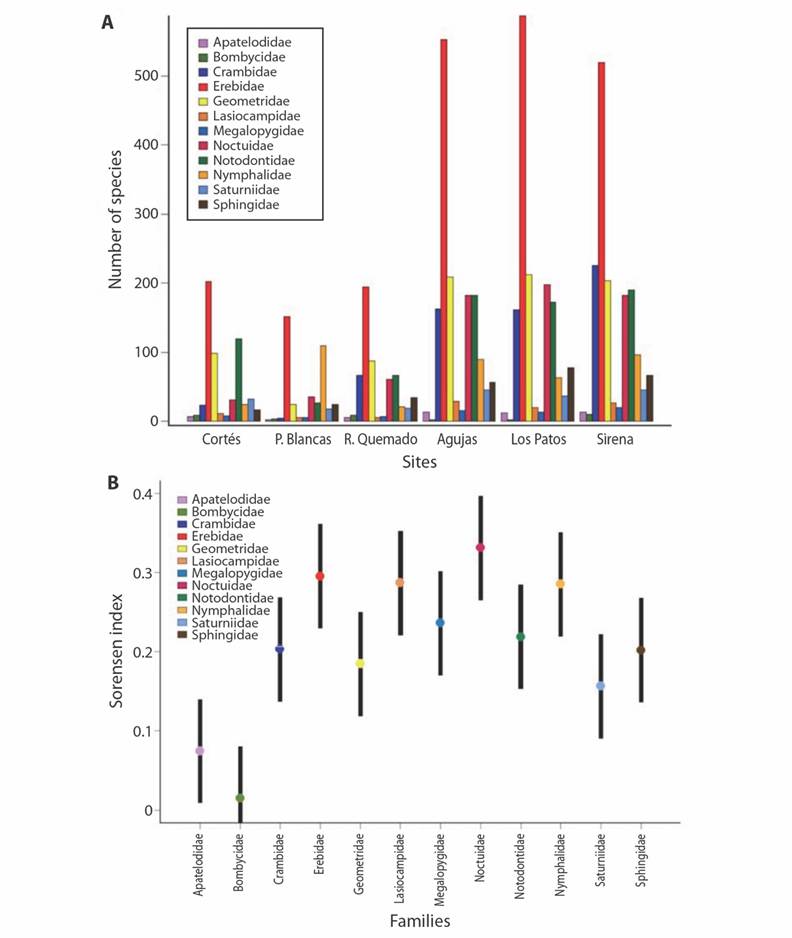
Fig. 2 Comparisons of number of species of moths and butterflies. a- Number of species of 12 families in six localities. b- Comparison of dissimilitude among 12 families. For each family we obtained the mean and the 95% confident interval of the dissimilitude of species in each family present in the six localities (Cortés, Piedras Blancas, Rancho Quemado, Agujas, Los Patos, Sirena).
The dissimilarity (values vary between 0 - total similarity to 1- total dissimilarity) comparing species within families across localities, was, in general, low for all families (Fig. 2b). The maximum mean dissimilarity (0.33) was obtained for Noctuidae, indicating that in average about 70% of Noctuidae species were shared among communities. Apatelodidae and Bombycidae, followed by Saturniidae presented a high similarity (low dissimilarity) of species among localities. Particularly Apatelodidae and Bombycidae had relatively few species, but they were present in all (or nearly all) localities, suggesting that these species have a wide distribution and they are adapted to a wide range of conditions (e.g., habitats, diet).
Noctuidae, Erebidae, Lasiocampidae, and Nymphalidae were species-rich families, which shared fewer species across localities (Fig. 2b). Species-rich families are usually composed of species that range from extremely rare to very common, and from specialists to generalists. Such conditions restrict some species to a particular microhabitat that may not be present in all localities or making species so rare that it drastically reduced the capture probability. Comparisons between all family pairs are included in Supplementary Table 4.
Alpha diversity: For this analysis we compared alpha diversity based on coverage, including all species in each of the six localities (Cortés, Piedras Blancas, Rancho Quemado, Agujas, Los Patos, Sirena). Localities differed for the three diversity indices (Richness, Hill-Shannon, and Hill-Simpson). The coverage (sampling completeness) was high and similar for the six localities (Fig. 3a), allowing for a fair comparison among them.
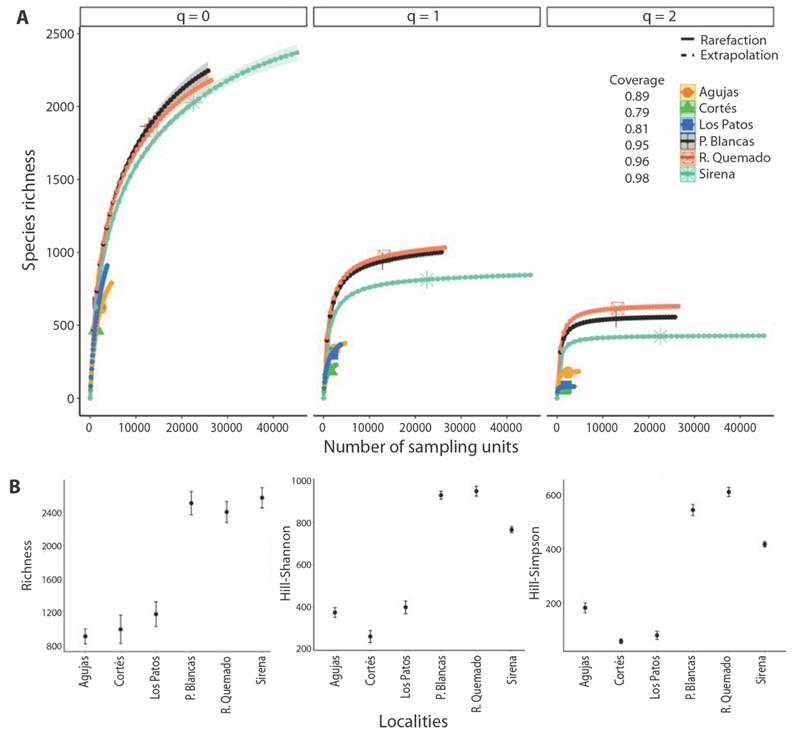
Fig. 3 Diversity of moths and butterflies in the southwestern region of Costa Rica. a- Diversity estimates separated by panels: Richness (q = 0), Hill-Shannon (q = 1), and Hill-Simpson (q-2). b- Hill-diversity estimates among the six localities studied in the southwestern region of Costa Rica. Error bars correspond to 95% CI.
Species richness (q = 0) differed among localities, with Piedras Blancas, Rancho Quemado, and Sirena standing out from the other localities (Fig. 3). These three localities had the largest number of species (estimated by coverage), but also included a wide range of rare and common species, particularly Piedras Blancas and Rancho Quemado; high estimates of Hill-Shannon indicate a high number of species, both rare and common. The Hill-Simpson index (q=2), which is influenced by abundant species, was higher for Rancho Quemado and Piedras Blancas (Fig. 3). This indicates that these two localities had a large number of common species. But, Rancho Quemado, Piedras Blancas, and Sirena were the localities with more species that range from rare to common (Hill-Shannon q = 1).
Discussion
We found that the Costa Rican southwestern lowland forests stand out as having one of the most diverse moth and butterfly fauna in the neotropical region, with more than 3030 species. The diversity (richness and abundance) of moths and butterflies changes across localities over a northern-southern gradient. Community composition - species richness and abundance- is not “static”, since it changes temporally and spatially (Enkhtur et al., 2021; Heimonen et al., 2013). Differences in communities over a geographical gradient or geographical mosaic can be attributed to historical and/or ecological factors (Barrantes, 2009). Historical factors, such as past geology (Bagley & Johnson, 2014) and climatic events (including recent events), have shaped the species composition in most if not all communities (Haffer, 1974). Ecological factors, through species interactions (e.g., parasitism, predation, competition) or by adaptation (of individuals of populations) to different microhabitats are more important in population dynamics, and thus in regulating species abundances (Stiling, 1988; Templeton, 1989). These factors underlie richness and abundance patterns of all communities.
Changes in richness and abundance occurred over the area, but not all families respond similarly. The region is an “island of lowland rain forest” surrounded by dry forests and the highest cordillera of the region, with a dynamic history of geological and climatic changes that have resulted in a mosaic of vegetation types (Gómez, 1986; Hofhansl et al., 2019). Consequently, this complex vegetation landscape has offered the opportunity for speciation (a region with high endemism) and variation in community composition of different organisms, through adaptation processes, within a small geographical scale (e.g., butterflies- Gilbert, 1973 plants- Hofhansl et al., 2019; birds- Pereira & Barrantes, 2009).
Moths and butterflies, as diverse as this group is, present an equally large range of ecological requirements that range from monophagous to polyphagous larvae (Brues, 1924; Chacón & Montero, 2007; DeVries, 1987; Ehrlich & Raven, 1964). Similarly, the feeding habits and habitat preference of adult moths and butterflies range from highly specialized (e.g., many Sphingidae species) to opportunistic (generalist) species (Haber & Frankie, 1989). Therefore, distribution of larval host plants, flowering and fruiting plants used as food resources by adult moths and butterflies, as well as floristic diversity and forest structure (e.g., vegetation strata; DeVries, 1988), are key factors determining the richness, abundance, and thus the distribution of butterflies and moths in this study region.
Although detailed studies of the distribution and abundance of host plants, and resources distribution for adult moths and butterflies are lacking, it is possible to cautiously make some extrapolation from small scale studies. Forest plant composition and vegetation structure change over the region, determined by soil, climatic, and topographic conditions (Harms et al., 2001; Hofhansl et al., 2019). Birds respond to topographic and vegetation variation in the region (Pereira & Barrantes, 2009). Some species have a discontinuous distribution (Corapipo altera, Ixothraupis guttata, Habia atrimaxillaris) associated with some particular habitats or microhabitats. Distribution of butterflies is tightly associated with vegetation structure which, in turn, correlates with the topography (Binz et al., 2014). The latter authors found that nymphalids were more diverse in ridge forests than in slopes and creek forests. This is possibly associated with the higher floristic diversity, which likely includes a larger variety of host plants for larvae and food resources for adults in ridge forests (Murdoch et al., 1972, Novotny et al., 2007).
The variation in beta diversity shown in this study may be associated with variation in climate, topography, and vegetation along the northern-southern gradient of localities. Each locality may likely offer a different set of resources for butterflies and moths, which may further explain the different patterns of diversity we detected across families. The local diversity (for the three estimators of alpha diversity) was higher in Piedras Blancas, Rancho Quemado and Sirena. These three localities not only have the highest richness (Fig. 3A-B, but also a large number of both rare and common species (Fig. 3A-B). Although we used conservative analyses (e.g., presence/absence data and coverage instead of number of individuals) we cannot completely reject the possibility that our results are influenced by uneven sampling. However, we are confident that the conservative analyses we used show the general patterns of diversity of moths and butterflies in the region. For instance, the patterns of richness in some families, such as Notodontidae and Nymphalidae, having a large number of species in localities with low sampling effort (Fig. 2), and the proportion of species across localities, support our argument.
Information gaps: Burton et al. (1992) pointed out many “solid reasons” for the importance of preserving biodiversity: productivity, pest control, aesthetic aspects, and more importantly - resources for the uncertain future (e.g., undiscovered drugs and food sources). More recently, the importance of insect pollination has become an important issue for maintaining crop production (Montero et al., 2024). In Costa Rica, nature-based tourism is attracted by high diversity places (Echeverri et al., 2022). However, despite the economic and social importance of preserving our diversity, very few resources are assigned by private (e.g., large hotels that directly benefit from the biodiversity) and public institutions, for even simple but important aspects, such as knowing the Costa Rican biodiversity. The data used in this study represent an important effort toward this end.
In conclusion, the southwestern lowland forested region of Costa Rica includes an extremely rich diversity of moths and butterflies. This diversity varies among localities and families. Piedras Blancas, Rancho Quemado and Sirena are the most diverse localities, and Erebidae, Geometridae, Noctuidae and Notodontidae stand out as the families with most species. The patterns of diversity observed are likely driven by variation of environmental conditions (e.g., topography, climate) that influence vegetation structure and floristic diversity, and so the variation and availability of resources to which different species of moths and butterflies (larvae and adults) are adapted (Aguirre-Gutiérrez et al., 2017). Despite the importance of knowing and protecting the diversity in Costa Rica, very little effort has been made to provide the resources for the continuity of these studies (Camacho-Sandoval & Duque 2001; Echeverri et al., 2022).
Ethical statement: the authors declare that they all agree with this publication and made significant contributions; that there is no conflict of interest of any kind; and that we followed all pertinent ethical and legal procedures and requirements. All financial sources are fully and clearly stated in the acknowledgments section. A signed document has been filed in the journal archives.

