




 Inglês (pdf)
 Artigo em XML
 Referências do artigo

 Tradução automática
 Enviar este artigo por email
 Citado por SciELO
 Similares em
SciELO
 uBio

 Permalink


Introduction
Litter decomposition is a process in which organic matter produced by mangrove forests is transferred to the sediment. This process involves at least four basic steps: 1) the removal of soluble compounds from leaves by water, 2) colonization by microorganisms, 3) consumption of plant matter by herbivores, and 4) the combined action of physical forces such as water movement, deposition, and sediment supply (Ashton et al., 1999; Dewiyanti, 2010; Kathiresan & Bingham, 2001; Palit et al., 2022; Swift et al., 1979). To study litter decomposition in mangroves, it is important to consider factors such as dissolved oxygen in sediments, soil salinity, forest type, and the composition of litter material (Galeano et al., 2010; Lugo & Snedaker, 1974; Matheri et al., 2024; Singh et al., 1993; Twilley & Day, 1999).
Several invertebrates play a crucial role in this process, especially in the later stages of decomposition of mangrove leaves. This group of organisms is called mesofauna, which ranges in size from 0.2 mm to 2 mm (Matheri et al., 2024). Mesofauna includes annelids, peracaridans, microarthropods, mollusks, nematodes, gastrotrichs, and others (Dittmann, 2001; Gray & Elliott, 2009; Maggenti & Maggenti, 2005). When considering other functional groups, such as microbes and macrofauna, it has been found that mesofauna contributes between 23 % and 27 % to the overall litter decomposition process in mangroves (Islam et al., 2024).
D’Croz et al. (1989) studied the mesofauna community associated with the leaf litter of Rhizophora mangle during the decomposition process in Panama Bay. In Brazil, de Oliveira et al. (2011) identified and quantified the benthic macrofauna present during the leaf decomposition of R. mangle and Laguncularia racemosa. Gladstone-Gallagher (2012) examined the benthic community associated with the detritus of Avicennia marina in two sites of a temperate mangrove forest in New Zealand. When mesofauna is excluded, the rate of litter decomposition can be reduced by up to 50 %, suggesting that these organisms play a significant role in explaining patterns of leaf litter decomposition (Powers et al., 2009). Therefore, the abundance and composition of mesofauna serve as bioindicators of the environmental quality of mangrove systems (Xiping et al., 2015).
In Panama, the most abundant mesofauna groups found in litter samples of R. mangle included polychaetes, bivalves, gastropods, crabs, and shrimps (D’Croz et al., 1989). In a mangrove forest in the State of Bahía, Brazil, annelids (Oligochaeta and Polychaeta) were the most abundant organisms during the decomposition of R. mangle leaves (de Oliveira et al., 2011).
In Costa Rica, Díaz-Navarro (1993) studied the decomposition of Rhizophora sp. leaves at Punta Morales in the Gulf of Nicoya. Recently, Loría-Naranjo et al. (2018) researched the decomposition process of Rhizophora racemosa leaf litter in the Térraba-Sierpe National Wetland (TSNW). The present study aims to determine the variation in mesofauna abundance and composition at different sites, seasons, and stages of leaf litter decomposition for the mangrove tree R. racemosa.
Materials and methods
The present study was conducted in the Térraba-Sierpe National Wetland (TSNW), which is the largest mangrove forest in Costa Rica, covering an area of 120.33 km² (Quesada-Alpízar et al., 2006). Rhizophora racemosa is the most common mangrove species along the Pacific coast of Costa Rica (Jiménez, 1994; Silva-Benavides, 2009). This species typically inhabits the inner regions of the forest (Barrantes-Leiva & Cerdas-Salas, 2015; Jiménez, 1988; Jiménez, 1994) and is the most abundant mangrove species within TSNW, occupying an area of 76.70 km² (Barrantes-Leiva & Cerdas-Salas, 2015).
Study Site: TSNW is in Osa, Puntarenas, Costa Rica, at coordinates 8°47’-9°03’ N and 83°29’-83°38’ W. The area is nourished by two major rivers: the Grande de Térraba and the Sierpe. TSNW encompasses approximately 40 % of Costa Rica’s total mangrove coverage (Windevoxhel-Lora, 1998). In 2013, the annual precipitation was recorded at 3 301 mm, with a mean atmospheric temperature of 26.6 °C (Instituto Meteorológico Nacional (IMN), 2014). The Talamanca Cordillera blocks the trade winds, leading to an extended rainy season and a limited dry season (Jiménez, 1999). Two sampling sites within TSNW were selected: Estero Caballo (Site 1, located at 8°53’11.11” N and 83°34’2.23” W) in the Sierpe basin, and Boca Nueva (Site 2, located at 8°59’16.46” N and 83°37’30.28” W) in the Grande de Térraba basin. At both sites, R. racemosa was the predominant species found along the riverbanks.
Methodology: Ten field trips were conducted during 2013, five during the dry season (from January to April), and five during the rainy season (from July to November). This resulted in two experimental periods. Each experiment period consisted of litter decomposition data after 0, 15, 30, 60, 90, and 120 days.
At each site, senescent leaves of R. racemosa were collected from the forest floor. Only leaves with a yellowish color but no evidence of any physical damage (holes or bites) were collected, to guarantee a similar initial level of decay. Litter bags of 10 x 20 cm and a mesh size of 1 mm (Roberts et al., 1987) were used. For both sites (Estero Caballo and Boca Nueva), 50 litter bags with 10 g of litter were attached to roots or trunks, so that they were exposed to wave action and different environmental conditions depending on the season. Five litter bags from each site were retrieved on each field trip.
In the laboratory, the samples contained in the bags were washed using a sieve with a pore size of 0.5 mm. The organisms retained into the sieve were fixed in 70 % ethanol. The organisms adhered to five leaf litter samples from each site were quantified and identified. For this purpose, a stereoscope along with taxonomic keys (de León-González, 2009; Giere, 1993; Glockner-Fagetti, 2009; Glockner-Fagetti & Egremi-Valdéz, 2009; Hernández-Alcántara & Solís-Weiss, 2009; Roldán, 1988; Salazar-Vallejo & Rizo, 2009) were used. Individuals were identified at the level of phylum, class, or order, depending on their characteristics and the level of detail achievable with the stereoscope. This methodology provided a chronological record of the types of fauna colonizing the samples over various decomposition periods (0, 15, 30, 60, 90, and 120 days). Additionally, the taxa were classified according to the different trophic groups they belong to, allowing to evaluate their influence on leaf decomposition.
Environmental data, including salinity (UPS), temperature (°C), and dissolved oxygen (mg O2/l), were recorded at both sites using a multiparametric sensor during each field trip. Precipitation (mm) and atmospheric temperature (°C) data were obtained from the closest meteorological station in Palmar Norte, Puntarenas (IMN, 2014).
Leaf mass loss: To estimate mass loss, dry leaf litter samples were analyzed. The leaf detritus collected in the sieve was dried in an oven at 70° C until it reached a constant weight. The remaining mass of leaves after 15, 30, 60, 90, and 120 days of decomposition was used to determine the Spearman correlation with total mesofauna abundance for each site and season.
Mesofauna community: To assess the similarity in the composition of taxa that colonized the samples, taxa abundance data were transformed using log (x + 1) and the Bray-Curtis similarity index was applied. To visualize differences in taxa composition between sample types (particularly those collected from Site 1 or Site 2, during dry or rainy season), a Multidimensional Scaling analysis (MDS) of the pooled samples was performed, considering decomposition time, site and season, using PRIMER 6.0.
Two-way similarity analysis (ANOSIM) were conducted on two occasions with the sample matrix (Clarke & Warwick, 1994) in PAST software. The first analysis included the time factor (15, 30, 60, 90 and 120 days) and the site factor (Estero Caballo or Boca Nueva). The second analysis considered the time factor alongside season (dry or rainy). An R value of ANOSIM with P < 0.05 indicated the degree of differentiation between levels of the analyzed factors. This value ranges from 0 to 1, where 1 represents a complete difference in taxa composition (Clarke & Warwick, 1994). The probabilities obtained in these tests were corrected using Bonferroni method, as the same data matrix was utilized by both analyzes. In addition, a posteriori comparisons were performed to determine the R values between sampling dates for each site according to the season (Clarke & Warwick, 1994). To identify which taxa contributed most to the difference observed between the levels of each factor (site, season, and time), three SIMPER tests were conducted in the PAST software. Similar ANOSIM and SIMPER tests were also executed for the trophic groups matrix of the invertebrates.
A BIO-ENV analysis was conducted to identify the environmental variables-such as water salinity, dissolved oxygen in water, water temperature, environmental temperature, and precipitation-that best explain the changes in taxa composition under each sampling condition (Clarke & Warwick, 1994). Additionally, Mantel tests were performed to assess whether there is a correlation between each individual environmental variable and the composition of the taxa.
Results
Mesofauna abundance: A total of 17 875 individuals were identified and classified in 46 taxa of mesofauna. The most abundant taxa included Bivalvia (4 648 ind.), Nematoda (3 478 ind.), Gastropoda (2 642 ind.), Nemertea (2 612 ind.), and Ostracoda (1 466 ind.) (Fig. 1). A complete list of organisms found in each sample can be found in Appendix 1.
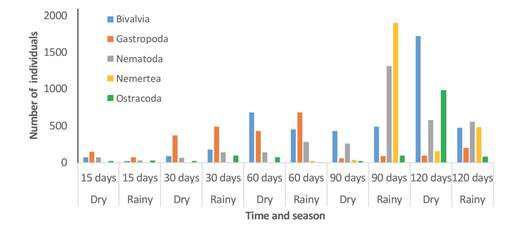
Fig. 1 Number of individuals from the most abundant taxa found in leaf litter samples according to decomposition time and season. TSNW, Puntarenas, Costa Rica.
The total abundance of mesofauna was not associated with the proportion of remaining leaf litter mass in Site 1 during the dry season (r = -0.3, P = 0.520) or in Site 2 during the rainy season (r = -0.66, P = 0.136). However, in Site 1 during the rainy season (r = -0.94, P = 0.003) and in Site 2 during the dry season (r = -0.94, P = 0.003), there was a significant relationship between mesofauna abundance and the proportional loss of mass: a greater number of organisms in the samples corresponded to a greater loss of mass over the decomposition period.
Taxonomic composition: The mesofauna composition varied significantly across sites, showing a 41 % difference (ANOSIM, R = 0.41, P < 0.001). Additionally, the composition differed by season (dry or rainy), with a 16 % variation noted (ANOSIM, R = 0.16, P < 0.001). Samples from Site 1 in both seasons exhibited greater similarity than those from Site 2. Notably, the mesofauna composition at Site 2 during the rainy season was the most distinct when compared to all other treatments (Fig. 2).
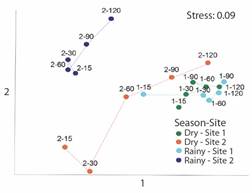
Fig. 2 Multidimensional Scaling analysis (MDS), showing the distance of similarity (Bray-Curtis) based on composition of mesofauna (pooled samples) between days of decomposition process, according to site and season. TSNW, Puntarenas, Costa Rica.
Significant differences in taxa composition, ranging from 14 % to 26 %, were observed throughout the leaf litter decomposition process (ANOSIM, R = 0.14 - 0.26, P < 0.001). During the dry season at Site 1, although the dates appeared relatively clustered on the MDS plot (Fig. 2), significant differences in taxa composition were found between different days (P < 0.05), with a complete 100 % difference observed between day 30 and day 120. In contrast, Site 2 exhibited a high level of differentiation in mesofauna composition between days during the dry season (Fig. 2).
Similarly, although the dates of the rainy season at Site 1 were closer to one another compared to other sites, all a posteriori comparisons indicated significant changes in taxa composition. Conversely, at Site 2, only the comparisons between days 90 and 120 showed significant differences in mesofauna composition when compared to earlier days (Fig. 2).
According to the SIMPER analysis, the taxa that primarily contributed to the differences in decomposition time and seasons were Bivalvia, Nematoda, Gastropoda, Ostracoda, and Gammaridea. The populations of Gastropoda and Gammaridea peaked at 60 days, while Nematoda reached its peak at 90 days. Bivalvia and Ostracoda presented their highest abundance at 120 days (Table 1). Furthermore, Gastropoda, Nematoda, Bivalvia, Ostracoda, and Harpacticoida were found to be more abundant in Site 1 compared to Site 2 (Table 2). Additionally, Bivalvia and Ostracoda were more prevalent during the dry season, whereas Nematoda, Gastropoda, and Gammaridea were more common during the rainy season (Table 3).
Table 1 SIMPER test for the time factor, showing the five most influential taxa for composition differences and their mean abundance between sampling decomposition days. TSNW, Puntarenas, Costa Rica.
| Taxa | Contribution to difference (%) | Mean abundance (15 days) | Mean abundance (30 days) | Mean abundance (60 days) | Mean abundance (90 days) | Mean abundance (120 days) |
| Bivalvia | 10.68 | 5.1 | 13.6 | 57.3 | 46.2 | 110 |
| Nematoda | 9.73 | 5.5 | 10.9 | 21.4 | 79 | 57.1 |
| Gastropoda | 9.31 | 11.7 | 42.1 | 56 | 7.6 | 14.8 |
| Ostracoda | 7.11 | 2.95 | 6.2 | 4.35 | 6 | 53.8 |
| Gammaridea | 5.62 | 1.1 | 5.1 | 11.3 | 1.2 | 3.55 |
Table 2 SIMPER test for site factor, showing the five most influential taxa for composition differences and their mean abundance between sites and seasons. TSNW, Puntarenas, Costa Rica.
| Taxa | Contribution to difference (%) | Mean abundance for Site 1 | Mean abundance for Site 2 |
| Gastropoda | 11.69 | 51 | 1.84 |
| Nematoda | 10.7 | 63.7 | 5.86 |
| Bivalvia | 10.38 | 54 | 39 |
| Ostracoda | 7.32 | 11.3 | 18 |
| Harparticoida | 6.17 | 6.42 | 0.8 |
Table 3 SIMPER test for season factor, showing the five most influential taxa for composition differences and their mean abundance between sampling decomposition days. TSNW, Puntarenas, Costa Rica.
| Taxa | Contribution to difference (%) | Mean abundance for dry season | Mean abundance for rainy season |
| Bivalvia | 10.52 | 60.2 | 32.8 |
| Nematoda | 9.49 | 22.8 | 46.8 |
| Gastropoda | 9.38 | 21.8 | 31 |
| Ostracoda | 6.91 | 22.8 | 6.48 |
| Gammaridea | 5.52 | 1.98 | 6.94 |
Composition by Trophic Groups: The classification of taxa into different trophic groups is displayed in Table 4. This classification includes multiple trophic groups for the same taxa to ensure that all potential representatives are considered. The differentiation in the composition of trophic groups between sites was found to be 37 % (ANOSIM, R = 0.37, P < 0.001). Additionally, the differentiation in trophic group composition between the dry and rainy seasons was 12 % (R = 0.12, P < 0.001). In terms of decomposition time, the differentiation ranged from 10 % to 18 % (R = 0.10-0.18, P < 0.001). Notably, the most significant differences in the composition of trophic groups occurred between the different sites.
Table 4 Classification by trophic groups for the taxa found in the samples and their mean total abundance according to season and site. TSNW, Puntarenas, Costa Rica.
| Site | Season | Total | |||||
| Dry | Rainy | ||||||
| Trophic group | Taxa | 1 | 2 | 1 | 2 | ||
| Carnivore | Hydrozoa; Platyhelminthes; Polychaeta: Chrysopetallidae, Nereididae, Phyllodocidae, Polynoidae, Syllidae, Halacaridae; Diptera: Ceratopogonidae; Chordata: Gobiidae | 214 | 213 | 291 | 84 | 802 | |
| Detritivore | Kinorhyncha; Oligochaeta; Sipuncula; Polychaeta: Ampharetidae, Maldanidae, Orbiniidae; Amphipoda: Hyperiidea; Decapoda: Anomura; Diptera: Chironomidae | 54 | 51 | 109 | 10 | 224 | |
| Herbivore | Tanaidacea; Insecta: Collembola, Lepidoptera | 134 | 17 | 205 | 83 | 439 | |
| Omnivore | Cnidaria: Actinaria; Decapoda: Alpheidae; Diptera: Dolichopododidae | 2 | 4 | 11 | 5 | 22 | |
| Sediment feeder | Polychaeta: Capitellidae, Cirratulidae, Paraonidae | 24 | 16 | 8 | 0 | 48 | |
| Suspensor feeder | Polychaeta: Chaetopteridae; Cirripedia; Bivalvia | 1 124 | 1 904 | 1 592 | 164 | 4 784 | |
| Detritivore, Herbivore | Foraminifera; Ostracoda; Copepoda: Harpacticoida; Amphipoda: Gammaroidea; Insecta: Hydrophilidae | 562 | 1 058 | 969 | 67 | 2 656 | |
| Herbivore, Carnivore | Nemertea; Gastropoda | 1 199 | 89 | 3 961 | 5 | 5 254 | |
| Herbivore, Omnivore | Isopoda; Decapoda: Brachyura | 8 | 19 | 51 | 63 | 141 | |
| Detritivore, Herbivorous, Carnivore, Omnivore | Nematoda | 932 | 207 | 2 253 | 86 | 3 478 | |
| Detritivore, Carnivore, Omnivore | Polychaeta: Pilargidae | 1 | 0 | 0 | 0 | 1 | |
The most abundant taxa, which were the same that mainly contributed to differences for decomposition time, belonged to the trophic groups: suspensor feeders (Bivalvia), herbivore-carnivore (Nemertea, Gastropoda), detritivore-herbivore (Ostracoda, Harpacticoida, Gammaridea), and detritivore-herbivore-carnivore-omnivore (Nematoda), respectively (Table 5). The herbivore-carnivore and suspensor feeders, were the groups that contributed the most to the differences of mesofaunal composition for site and season (Table 6).
Table 5 SIMPER test for time factor, showing the five most influential trophic groups for the difference composition and their mean abundance between sampling dates. TSNW, Puntarenas, Costa Rica.
| Trophic group | Difference contribution (%) | Mean Abundance (15 days) | Mean Abundance (30 days) | Mean Abundance (60 days) | Mean Abundance (90 days) | Mean Abundance (120 days) |
| Suspensor feeder | 26.76 | 5.65 | 15.2 | 60 | 47.1 | 111 |
| Herbivore, Carnivore | 24.35 | 11.7 | 42.1 | 57 | 105 | 47 |
| Detritivore, Herbivore, Carnivore, Omnivore | 18.05 | 5.5 | 10.9 | 21.4 | 79 | 57.1 |
| Detritivore, Herbivore | 15.17 | 7.9 | 16.2 | 24.9 | 16.5 | 67.3 |
| Carnivore | 6.33 | 7.75 | 5.6 | 7.85 | 6.15 | 12.8 |
Table 6 SIMPER test for site and season factor, showing the five most influence trophic groups for the difference composition and their mean abundance between sites and seasons. TSNW, Puntarenas, Costa Rica.
| Trophic groups | Difference contribution (%) | Mean abundance per site | Difference contribution (%) | Mean abundance per season | |||
| Site 1 | Site 2 | Dry season | Rainy season | ||||
| Herbivore, Carnivore | 30.91 | 103 | 1.88 | 24.83 | 25.8 | 79.3 | |
| Suspensor feeder | 22.96 | 54.3 | 41.4 | 26.53 | 60.6 | 35.1 | |
| Detritivore, Herbivore, Carnivore, Omnivore | 19.71 | 63.7 | 5.86 | 17.64 | 22.8 | 46.8 | |
| Detritivore, Herbivore | 14.41 | 30.6 | 22.5 | 15.15 | 32.4 | 20.7 | |
| Carnivore | 4.95 | 10.1 | 5.94 | 6.40 | 8.54 | 7.5 | |
Association with environmental variables: Water salinity and precipitation were notably different between seasons (Table 7).
Table 7 Mean value and standard deviation for the environmental parameters. TSNW, Puntarenas, Costa Rica.
| Season | Site | Dissolved oxygen (mg/l) | Water salinity (ppm) | Water temperature (ºC) | Precipitation (mm) | Environmental temperature (ºC) |
| Dry | 1 | 4.46 ± 0.84 | 22.76 ± 2.29 | 29.83 ± 0.17 | 4.64 ± 1.08 | 26.72 ± 0.95 |
| 2 | 6.81 ± 0.96 | 27.39 ± 3.32 | 30.08 ± 0.33 | 4.64 ± 1.08 | 26.72 ± 0.95 | |
| Rainy | 1 | 4.80 ± 0.29 | 9.62 ± 3.74 | 28.68 ± 0.76 | 11.01 ± 0.95 | 26.16 ± 0.14 |
| 2 | 6.84 ± 1.65 | 2.41 ± 1.85 | 27.10 ± 0.30 | 11.01 ± 0.95 | 26.16 ± 0.14 |
Precipitation (Mantel, P = 0.610) and environmental temperature (Mantel, P = 0.090) do not influence mesofauna composition. Individually, salinity (Mantel, P = 0.134), water temperature (Mantel, P = 0.988) and dissolved oxygen in water (Mantel, P = 0.331) fail to explain the changes observed in mesofaunal composition. However, together these three variables can contribute in part to explain the changes observed in mesofauna composition in litter samples over time (BIO-ENV, r = 0.25, P = 0.039).
Discussion
Correlations done in this investigation show that with a greater amount of mesofauna in the litter, the mass losses are greater, depending on the site and the season. However, a more specific identification of mesofauna must find another possible relation for the treatments that did not relate to mesofauna abundance (as in the case of Site 1 during the dry season and Site 2 during the rainy season). Melo et al. (2013) stated that mesofauna abundance and taxa diversity could depend on freshwater discharge from river flows, and, in this investigation, the biggest difference in mesofaunal abundance and composition was between sites, each one located in a different river basin (Sierpe and Grande de Térraba).
Regions of TSNW located in the Sierpe basin, such as Estero Caballo (Site 1) tend to have a major marine influence than regions located in Grande de Térraba, such as Boca Nueva (Site 2) (Picado, 2016). A combined action of water salinity, water temperature, and dissolved oxygen of water is necessary to achieve 25 % of the changes observed in the composition of mesofauna found in leaf litter samples throughout the sampling time, and this fact highlights a synergistic effect of these environmental variables on mesofauna composition. Other environmental variables not considered in this study, such as flood frequency, type of sediment, or microbial activity, can explain part of the changes observed in mesofauna community composition (Palit et al., 2022).
From the total number of individuals quantified and identified throughout this study, microbivalves were found to be the most abundant taxa in juvenile or adult forms. Although bivalves can be found adhering to the surface of the leaves (Hogarth, 2007), they feed mainly on suspended matter (Brusca & Brusca, 2005; Hogarth, 2007). Water characteristics such as salinity, dissolved oxygen, and temperature influence the presence of bivalves and other filter feeders on the mangrove litter (Vereycken & Aldridge, 2023). The degradation of mangrove leaves produces particulate organic matter, which serves as a crucial food source for these filter feeders (Wang et al., 2015).
The abundance of mesofauna in leaf litter samples was linked to mass loss, and consequently, to leaf litter decomposition at Site 1 during the rainy season and at Site 2 during the dry season. This indicates that the decomposition of leaf litter could be influenced by the presence of mesofauna, which varies according to the specific conditions of each site and season. These findings are consistent with Powers et al. (2009), who found that higher decomposition rates occurred in leaf litter samples that contained mesofauna.
In general, litter degradation tends to proceed more rapidly in tropical regions compared to temperate environments. This pattern has been attributed to lower biological activity from invertebrates in temperate mangroves (D’Croz et al., 1989; Gladstone-Gallagher, 2012). The absence of mesofauna can reduce the decomposition rate by as much as fifty percent (Powers et al., 2009). For the species R. racemosa in TSNW, Loría-Naranjo et al. (2018) reported a leaf litter decomposition rate of k = 0.012, which aligns with other values found in tropical regions and is relatively fast (Kulal et al., 2008). However, it is important to note that excluding certain functional groups of fauna using litter mesh bags can significantly affect the decay rate (Islam et al., 2024; Vinh et al., 2020).
Variations in the composition of mesofauna communities during different days of leaf litter decomposition can be partially attributed to changes in specific organisms or conditions within the leaves throughout this process. Matheri et al. (2024) established that mesofauna communities respond significantly to the duration of decomposition. Treplin & Zimmer (2012) noted that crabs tend to prefer aged, decaying leaves due to the decrease of soluble leaf compounds over time, which means these crabs do not necessarily play a crucial role in leaf breakdown during the early stages of decomposition.
In a mangrove ecosystem in southwestern Puerto Rico, Torres-Pratts & Schizas (2007) observed that the abundance of nematodes in the litter increases progressively as decomposition advances. For the leaf litter of R. racemosa in the TSNW, a significant abundance of nematodes was recorded at the end of the experimental period during the dry season. A peak in nematode abundance was observed after 90 days of decomposition during the rainy season. Many nematode species feed on the algae, fungi, and bacteria that colonize decomposing organic matter in estuarine habitats (Moens & Vincx, 1997; Sánchez-Monge & Cortés, 2024). Therefore, it is likely that the peak of nematodes corresponds to an increase in these microorganisms, which serve as food sources for the nematodes present in the leaf litter.
There was also a noticeable seasonal change in the mesofauna. Selviani et al. (2024) highlighted that climate and microclimate influence the presence of microbiota, which in turn affects the decomposition rate of mangrove litter. In this study, a total of 67 individuals of Brachyura (crabs from various families) were observed, with 57 of them identified during the rainy season. However, the brachyuran crabs were not among the most abundant taxa and did not significantly contribute to the differences observed between samples. Crabs are considered key organisms in the ecological processes of mangrove forests, as they are known to consume detritus from leaf litter, which influences leaf decomposition and nutrient cycling (Hogarth, 2007; Jiménez, 1994; Lacerda, 2002). These organisms play a vital role in the fragmentation of leaves by scraping the surface to consume algae and other epibionts.
Based on the trophic classification of the mesofauna present, it is expected that most organisms are indirect consumers of R. racemosa litter. For example, rest of fungi, diatoms and bacteria have been found in the stomach contents of springtails (Castaño-Meneses et al., 2004), and nematodes. This suggests that these organisms likely benefit from the decomposition process of the litter by feeding on their epibionts. On the decaying leaf litter of R. racemosa, taxa of aquatic insects were also observed, including Trichoptera, Lepidoptera larvae and Diptera families (Chironomidae, Ceratopogonidae and Dolichopodidae). Rincón & Covich (2014) noted that Trichoptera species Phylloicus pulchrus plays a significant role in litter decomposition despite its low density, as it scrapes the surface and consumes the fibrous components of the leaves. Similarly, Lepidoptera larvae also consume leaves in mangrove ecosystems (Lacerda, 2002). Diptera were the most abundant insects found in the samples analyzed in this study, which is consistent with findings from other mangrove ecosystems (Hogarth, 2007; Lacerda, 2002). Their mouthparts are adapted for licking or sucking other plant fluids (Brusca & Brusca, 2005).
In this investigation, some of the most abundant taxa found in leaf litter samples belonged to trophic groups that consume decayed leaves, including Nemertea, Gastropoda, Ostracoda, Harpacticoida, Gammaridea, and Nematoda. Among these, gastropods were particularly prominent (Hogarth, 2007) and represented the most abundant taxa in the leaf litter samples. Although some gastropods feed directly on leaf litter, such as Terebralia palustris (Potaminidae), which primarily consumes leaf litter and is one of the most significant leaf litter removers in mangrove forests (Hogarth, 2007), Melo et al. (2013) also identified another small gastropod, Olivella minuta, as one of the most abundant taxa of benthic macrofauna in Brazilian mangroves.
Thirteen polychaete families were identified (Ampharetidae, Capitellidae, Cirratulidae, Chaetopteridae, Chrysopetallidae, Maldanidae, Nereididae, Orbiniidae, Paraonidae, Pilargidae, Phyllodocidae, Polynoidea, Sylidae). Families Capitellidae, Chaetopteridae, Nereididae, Orbiniidae and Phyllodocidae in previous studies on polychaete communities in mangroves of tropical estuaries were described as herbivores or detritivores (López et al., 2002; Sarkar et al., 2005). The family Nereididae (many of its representatives are carnivorous or omnivorous) was the largest among the polychaete families found in the litter samples of R. racemosa in TSNW. Although López et al. (2002) and Sarkar et al. (2005) studied the community of polychaetes present in the sediment of the mangrove, these organisms can also act as herbivores or detritivores, turning into potential litter consumers, and therefore into collaborators of the decomposition process.
Ostracods are microcrustaceans that rank among the five most abundant taxa found in the litter of R. racemosa. Vargas (1987) noted that ostracods are one of the most prevalent groups of benthic fauna in the mangrove forest of Punta Morales, Costa Rica. In Puerto Rico, however, ostracods have been reported to occur in low quantities in the litter of R. mangle (Torres-Pratts & Schizas, 2007).
Copepods from the order Harpacticoida were not among the most abundant taxa, but they significantly contributed to the differences in composition between the sampling sites. Harpacticoid copepods, particularly those from the Darcythomsoniidae family, are known for their exclusive consumption of mangrove litter (Nagelkerken et al., 2008). In this study, Harpacticoida were classified as detritivores and herbivores; however, they were not linked to the rate of leaf litter decomposition.
There are notable changes in the composition of the mesofauna community that colonizes the samples over the decomposition period, as well as differences observed between sites and seasons. However, these changes do not appear to be directly linked to the loss of litter mass during decomposition, regardless of the site or season. Consequently, the diversity of taxa and trophic groups found in the samples does not have a direct relationship with the leaf litter decomposition rate. Instead of the variations in mesofauna composition, it is the abundance of this mesofauna that influences the leaf litter decomposition of R. racemosa.
The study of mesofauna presence during the leaf litter decomposition process of R. racemosa in TSNW mangrove evidences an abundant mesofauna community composed of diverse taxa that still needs deeper study efforts to achieve their total role in nutrient recycling, soil formation, primary productivity, and ecology of mangrove forests. The increase in the comprehension of these processes is vital for the conservation and sustainability of the ecosystem. Therefore, the research addressed here represents a contribution to this understanding.
Ethical statement: the authors declare that they all agree with this publication and made significant contributions; that there is no conflict of interest of any kind; and that we followed all pertinent ethical and legal procedures and requirements. All financial sources are fully and clearly stated in the acknowledgments section. A signed document has been filed in the journal archives.
See supplementary material

