




 Inglês (pdf)
 Artigo em XML
 Referências do artigo

 Tradução automática
 Enviar este artigo por email
 Citado por SciELO
 Similares em
SciELO
 uBio

 Permalink


Introduction
It is anticipated that future generations of geologists will identify fossilized plastic layers as markers of the Anthropocene epoch (Porta, 2021). Based on the preceding consumption rates, scientists estimated that in 2050, approximately 33 billion tons of plastic would be present on Earth (Rochman et al., 2013). As Gibb (2019) asserts, plastics have become an integral part of human life, with virtually every daily activity involving the use or contact with plastics in some way.
A considerable proportion of the plastics manufactured are ultimately released into the environment, where they are exposed to a range of physical, chemical, and biological conditions that result in the fragmentation of the material into increasingly smaller pieces (Moore, 2008). As a consequence of this fragmentation, a variety of plastic particles of differing sizes, shapes, and colors will be present in the natural environment (Hale et al., 2020). Based on the size of plastics, pieces smaller than 5 mm are designated as microplastics (MPs) (Dümichen et al., 2015; Moore, 2008). In addition to the fragmentation of larger plastics, MPs can be released directly into the environment through the discharge of cosmetic beads and clothing fibers into wastewater (Law & Thompson, 2014).
As MPs are produced, the abundance and availability of plastic increases, which can be ingested or incorporated by organisms (Shim & Thompson, 2015). This is a cause for concern, given that MPs are virtually ubiquitous in the environment. They have been found in the air (Gasperi et al., 2018; Sridharan et al., 2021), sea (Law & Thompson, 2014; Shim & Thomposon, 2015; Thompson et al., 2004), land (Ee-Ling et al., 2018) and freshwaters (Imhof et al., 2013; Pastorino et al., 2021; Wang et al., 2020). However, research on the effects of MPs is highly biased to certain areas. For example, in freshwater invertebrate organisms, studies conducted are relatively few when compared to marine vertebrate organisms (Blettler et al., 2018; Kim et al., 2018; Nel et al., 2018; Windsor et al., 2019) and are scarcer in tropical areas than in developed countries (Blettler et al., 2018).
Within the freshwater macroinvertebrates, one group that has received recent attention is Trichoptera, because of their ability to construct cases that serve as protection and camouflage against predators (Springer, 2010). Tibbetts et al. (2018), and Ehlers et al. (2019), found microplastics of different materials, colors, shapes and sizes incorporated into caddisfly larval cases in nature. Subsequently, Ehlers et al. (2020) conducted experiments in which they observed that the incorporation of MPs of polyvinyl chloride (PVC) and polyethylene terephthalate (PET) into the larval cases of Lepidostoma basale resulted in a reduction in stability. Gallitelli et al. (2021) found that MPs do not seem to be a direct stressor for Odontocerum albicorne larvae, as they incorporate them even in the presence of organic matter. Finally, Valentine et al. (2022) observed that Agrypnia sp. larvae can incorporate and fragment MPs of PLA (polylactic acid), thus generating more available MPs in the aquatic environment.
If there is one thing that all previous research agrees on, it is that a complex interaction between MPs and Trichoptera is occurring in nature. Hence, more research is needed on this interaction and its possible consequences at the individual, population and ecosystem levels. We asked two principal questions: (1) Can Limnephilus hamifer larvae incorporate MPs into their larval cases, even in the presence of organic matter? and if MPs are incorporated, (2) Are there patterns of MPs incorporation into larval cases, in terms of MPs color preferences, number of MPs incorporated, and whether it is possible for them to incorporate MPs into pupal cases? Therefore, our research aims to study the incorporation patterns of MPs of PET in the larval and pupal cases of Trichoptera in the Neotropics. In this way, we contribute to the generation of new knowledge on the interaction of MPs with freshwater species, from an area with few studies on the subject such as the Neotropics.
Materials and methods
Study species: For this experiment, we selected the species Limnephilus hamifer Flint 1963, of which Springer & Bermúdez (2018) described the larva and pupa. It is the only species of the Limnephilidae family reported for Costa Rica and is found in lentic environments of high-altitude zones (Springer & Bermúdez, 2018). We chose this species because it is relatively large, adapts well to laboratory conditions, and uses a variety of materials in the construction of its cases.
Collection and acclimatization of individuals: In February 2023, we collected 30 IV and V instar larvae of L. hamifer from a roadside ditch at Cerro de la Muerte, Costa Rica (9°38’53.99” N & 83°50’45.81” W), at an altitude of 2 764 m.a.s.l. We then transferred them in a container with water from the site to the entomology laboratory of the School of Biology of the University of Costa Rica (UCR). Additionally, we collected 2 gallons of water from the ditch, as well as leaves and organic particulate matter from the natural habitat, to acclimate the containers where we would conduct the experiments and to feed the individuals. We acclimated the insects for 72 hours in 30 x 22 x 6 cm trays with water from the ditch, leaves and natural sediment, and an aquarium air pump. Laboratory conditions throughout the experiment were constant (Temperature = 23 ºC, humidity = 62 %, Light cycle = 12 hours light/12 hours dark).
Obtaining MPs: We produced MPs from orange, blue, green and transparent PET plastic bottles. For this, we washed the bottles with abundant water, and rectangular pieces of plastic of 5x10 cm were cut to generate approximately 16-35 strips with a width of less than 5 mm (~1-3 mm). Subsequently, we cut 35-50 pieces for each strip, thus leaving pieces with a length of less than 5 mm (~1-3 mm). This procedure was performed until we obtained ~50 g of MPs of each selected color.
Experimental Design: We induced the larvae to leave their natural cases with entomological forceps and deposited five individuals without cases in each of the following treatments: 100 % MPs, 75 % MPs, 50 % MPs, 25 % MPs, and 0 % MPs (control), with the remaining percentage corresponding to natural organic matter (leaves, sand grains, and sediment from the ditch in which they were found). In a sixth treatment, we placed five larvae with their original cases in a substrate with a concentration of 50 % MPs to observe if they were able to incorporate MPs into their original cases, as well as to observe if they incorporated MPs into their pupal cases. In each treatment, 100 % substrate corresponded to a total of 24.32 g, and the MPs concentrations consisted of a mixture of the four colors in equal amounts. For example, the 50 % MPs treatment consisted of a mixture of 12.16 g MPs (3.04 g of each color) + 12.16 g organic matter, for a total mixture of 24.32 g.
Prior to use, we washed the MPs mixtures from each treatment again with ditch water and left them in the ditch water for two days. After completing this process, we placed each of the treatment mixtures in a cylindrical glass container that had been previously washed with drinking water and ditch water. Each container had a height of 9.5 cm and a diameter of 8 cm and was filled with 400 mL of ditch water. Additionally, each of the containers for each treatment had an aquarium air pump in constant operation.
After 72 hours, we induced the larvae again to leave the cases they constructed in the treatments (except in treatment 6), to store these cases in 70 % alcohol for subsequent analysis. We deconstructed the cases of the treatments following the methodology proposed by Ehlers et al. (2019), with some modifications: each case was individually subjected to hydrogen peroxide (H2O2 36 %) at a temperature of 50 °C in a water bath for 6 hours, and then taken to vortex agitation for 1 minute. We analyzed the cases five days after this procedure, when they were completely disintegrated.
Variables recorded: We recorded the construction of the new cases during the first 72 hours, because in experiments conducted on this subject, the larvae usually completed the construction of their cases within this time span or even earlier (Ehlers et al., 2020). We transferred the original cases from all treatments (except treatment 6) to an oven set at 32 °C for a period of three hours. During this time, the cases were completely dried and subsequently weighed on an analytical balance with a precision of 0.0001 g.
The length of the cases was then measured using the Leica LAS EZ software. We recorded the number, color, and size of the MPs incorporated in each treatment case, as well as the number and size of organic particles incorporated in each case. This was done using a stereomicroscope (Leica brand, model EZ4 W/E) with the aforementioned software. For treatment 6, we conducted observations every three days for six weeks, to determine if the larvae incorporated MPs into their original cases, as well as the possible incorporation of MPs in the construction of the pupal cases.
Statistical analysis: For each treatment, we considered each individual as a replicate of the treatment, i.e., as independent measures. This is because the case construction of each larva in a given treatment is not dependent on or influenced by the presence or absence of another larva in the same container at the same time, but it is a product of its particular biology, which induces case construction by having its body naked (Boyero et al., 2006; Zamora-Muñoz & Svensson, 1996). As previously noted by Colegrave & Ruxton (2018), equating physical separation with statistical independence without considering the particular biology of the organism is a mistake.
For all data sets obtained, we initially assessed using the Shapiro-Wilk test. Subsequently, we applied a parametric or non-parametric statistical test, as appropriate. The data on the number of MPs used in the cases exhibited a normal distribution, thus, we conducted a one-way ANOVA to ascertain whether there were discrepancies between the mean amount of MPs incorporated in the larval cases according to each treatment. In the event of such discrepancies, we used a Tukey test to identify which treatments were statistically different. The data on the number of fragments (MPs and natural leaves) incorporated into the cases exhibited a normal distribution, thus, we used a one-way ANOVA to ascertain whether there were differences between the average number of structures incorporated according to treatment (100 % MPs vs. 0 % MPs).
The data on color preference did not show a normal distribution, therefore, we applied the Kruskal-Wallis (KW) test. If differences were found, we performed post hoc comparisons using Dunn’s test to determine between which colors the differences occurred. To understand the relationships between the number of MPs incorporated, the height and weight of the larval cases, Pearson correlations were conducted.
The size (mm) of the fragments (MPs and natural leaves) incorporated into the larval cases did not exhibit a normal distribution. Consequently, we analyzed the data using the Kruskal-Wallis (KW) test, and post hoc comparisons were performed using Dunn’s test to determine if there were differences in size according to the fragment incorporated.
Results
In all treatments (aside from the control), we observed that Trichoptera larvae used MPs to construct their cases (Fig. 1). The mean number of MPs utilized by larvae in the 100-MPs treatment was 31.75 (Fig. 2A), while those in the 75-MPs treatment incorporated, on average, 28.75 MPs per case. The mean number of MPs incorporated by larvae in the 50-MPs treatment was 33.25, while those in the 25-MPs treatment incorporated, on average, 16.40 MPs per case. When relating the mean number of MPs incorporated in the cases to the mean height of the cases (MPs/mm of case height), we found that in the 100-MPs treatment, 2.52 MPs/mm were used, in the 75-MPs treatment, 2.26 MPs/mm were used, in the 50-MPs treatment, 2.42 MPs/mm were used, and in the 25-MPs treatment, 1.19 MPs/mm were used.
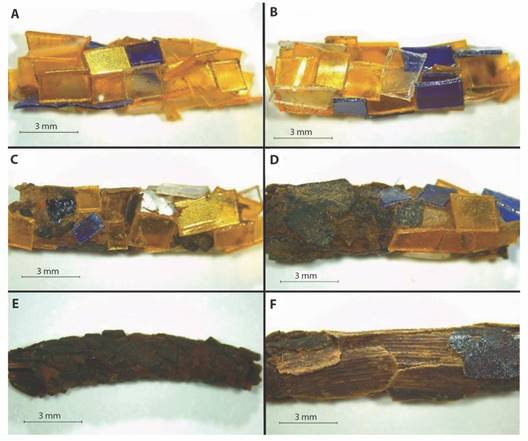
Fig. 1 Larval cases of Limnephilus hamifer constructed under experimental conditions with the use of four color PET-type MPs. A. 100 % MPs treatment. B. 75 % MPs treatment. C. 50 % MPs treatment. D. 25 % MPs treatment. E. Original cases of the larvae used in the experiments. F. 0 % MPs treatment (control).
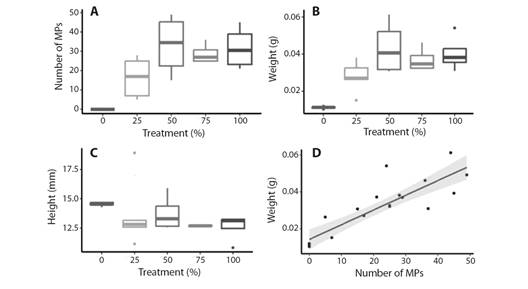
Fig. 2 Measurements of MPs incorporated in the larval cases of L. hamifer. A. Average number of MPs incorporated in larval cases according to treatment. B. Weight of larval cases on average according to treatment. C. Height of larval cases on average according to treatment. D. Weight of larval cases according to the number of MPs incorporated.
Although there is a variation between the number of MPs incorporated according to the treatments, we found differences only between the cases of the 100-MPs, 75-MPs and 50-MPs treatments with respect to the control group (F4/17 = 9.29, p = 0.0004). The 25-MPs, 50-MPs, 75-MPs and 100-MPs treatments did not show differences between themselves (p > 0.05) (Fig. 2A). We observed no difference between the height of the cases in the different treatments (Fig. 2C), but we found a difference between the weight of the cases in the treatments that had MPs compared to the control (Fig. 2B), with the cases being heavier as the quantity of MPs in them increased (r = 0.87, p < 0.05) (Fig. 2D).
In terms of color preferences, we found that larvae from all treatments incorporated a greater amount of orange MPs than the other colors (Fig. 3). Differences were found between the quantity of orange MPs relative to green for all treatments (p < 0.01), between the quantity of orange MPs relative to transparent for all treatments (p < 0.01), except for 100-MPs (p > 0.01). Although in all treatments the cases had a higher number of orange than blue MPs, there was no significant difference between the two colors (p > 0.01).
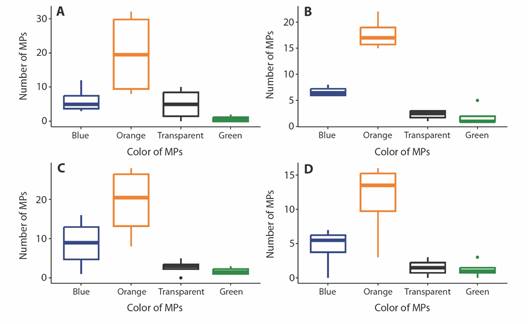
Fig. 3 Average number of MPs incorporated into L. hamifer larval cases according to MPs color. A. 100 % MPs treatment. B. 75 % MPs treatment. C. 50 % MPs treatment. D. 25 % MPs treatment.
The length of the microplastics and natural leaf cuts used for the construction of the cases did not vary greatly from each other (Fig. 4. A). However, we found differences between the length of natural leaves cuts and orange MPs (p > 0.01), with the natural leaf cuts being 0.44 mm longer on average. In addition, we found differences between the length of transparent MPs and MPs of all other colors (p > 0.01), with transparent MPs being 2.86 mm longer on average: 0.71 mm longer than green MPs, 0.52 mm longer than blue MPs, and 0.54 mm longer than orange MPs. The length of blue, green and orange MPs was not significantly different (p > 0.01). This result was to be expected, because we performed the cuts of MPs in the same way for each color.
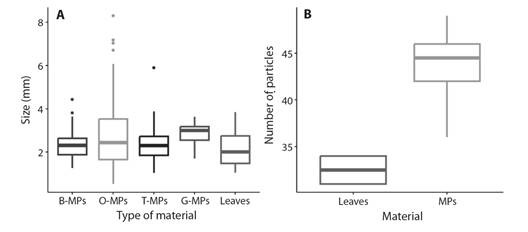
Fig. 4 A. Size of the material incorporated into the larval cases of L. hamifer. B. Number of particles incorporated into larval cases according to the type of material from which the case is constructed.
When analyzing the number of particles used in the cases constructed only with MPs vs. the cases constructed only with leaves, we observed differences in the number of particles incorporated by the caddisflies (F1/6 = 14.82, p = 0.008). Specifically, they incorporate more particles when the cases are constructed only from MPs, than when they are constructed only from leaf cuts (Fig. 4B). When they build the case with only MPs, they use on average 11 more particles per case than when they build it with only natural leaves cuts.
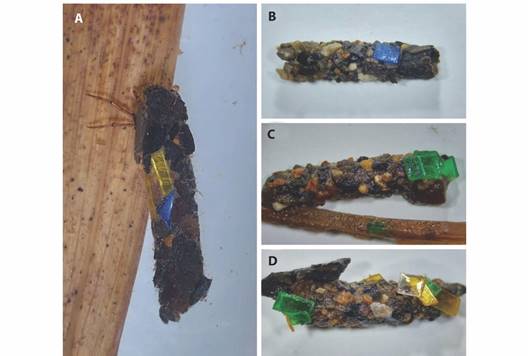
In treatment 6, we observed that one larva incorporated MPs into its original case (Fig. 5. A), while three of the five individuals formed pupae and incorporated MPs into all pupal cases (Fig. 5. B-D). Pupal case B contained two MPs (blue and green), pupal case C contained four green MPs, and pupal case D contained 17 MPs (eight orange, four green, three transparent, and two blue). None of the individuals managed to emerge from the pupae, and the experiments in this treatment were ended six weeks after the start date.
Discussion
Trichoptera incorporated MPs into their larval cases in all treatments where they were available, even when the quantity of MPs was low. This finding is consistent with that reported by Gallitelli et al. (2021) who observed that Odontocerum albicorne incorporated MPs regardless of the quantity of original substrate available. The studies conducted by Ehlers et al. (2020) and Gallitelli et al. (2021), as well as the present investigation, demonstrate that caddisfly larvae that construct cases, even from different families, have no rejection for MPs, but actively incorporate them if they are available. This is problematic because MPs were found to reduce the stability of trichopteran cases (Ehlers et al., 2020). Furthermore, it has been demonstrated that MPs may contain elevated levels of toxic substances, which could represent a significant risk for the development of the early stages of the life cycle, particularly in aquatic animals (Cormier et al., 2021).
Since PET plastic has a high density and is often deposited in river sediments (He et al., 2021; Jiang et al., 2019), it may be readily available in nature for caddisfly larvae. Our results show that when a case constructed entirely with MPs is compared to a case constructed with natural materials, the former will have a higher weight, even if it is the same size or smaller than the latter. Our results differ from those of Gallitelli et al. (2021), who found that cases with MPs were lighter than natural cases, but this may be due to two factors: first, they used MPs with different characteristics in their experiments (not only PET). Second, the species used in that study constructs its cases with gravel and sand, whereas our species constructs its cases mainly with leaves, a lighter material.
Considering our findings, the hypothesis that caddisfly larvae incorporating MPs may be affected in terms of drift (due to lighter cases) (Gallitelli et al., 2021) is not necessarily supported. On the contrary, our findings indicate that the problem lies in the fact that, the more MPs incorporated, the higher the weight of the cases. This could result in greater energetic expenditure when wanting to move over the sediment, and even decrease the movement capacity of the caddisflies due to the increased weight. Further studies are needed that focus on testing how displacement and movement capacity are altered as the quantity of MPs incorporated in the cases increases. It should also be considered that the MPs could make the cases heavier or lighter than the natural ones, depending on the natural material incorporated by the larvae (gravel/sand versus leaves/organic matter). Furthermore, the question of how the friction of the cases with the sediment is modified, when there are high concentrations of MPs in the cases, is unexplored.
About color preferences, larvae choose orange MPs over the other colors, although no significant difference was found between orange and blue, but between orange and the other colors. Larval vision in holometabolous insects is based on visual organs called stemmata, which can provide quite sophisticated vision (Gilbert, 1994). Studies of Lepidoptera larvae (sister group of Trichoptera) have demonstrated that they exhibit visual preferences based on color (Singh & Saxena, 2004; Villegas-Mendoza & Rosas-García, 2013). It is known that the visual systems of Lepidoptera and Trichoptera larvae are very similar (Gilbert, 1994), and thus it is not unexpected that Trichoptera larvae may be able to detect certain colors and have preferences for some. It is plausible that visual preferences for orange may be attributed to the fact that a significant proportion of the organic material utilized by these larvae for case construction exhibits orange or yellow hues. Therefore, it can be postulated that they possess a visual bias towards these colorations. Indeed, in the study conducted by Ehlers et al. (2019), certain orange or yellow MPs could not be visually differentiated from the natural material due to the similarity in color. The field of vision in Trichoptera larvae remains largely unexplored, suggesting that future studies focused on vision may provide further insights into the subject of color detection and color preference.
With respect to the quantity and size of the MPs, we observed that when the larvae construct a case entirely with MPs, they used a greater number of fragments than when they construct the case entirely with leaves. This is possibly related to the fact that on average, the leaf fragments have a larger size, so that, with fewer fragments of the material they cover the necessary area. At this juncture, the utilization of MPs may also be regarded as an additional energetic expenditure for the animal, given that their smaller size (which is not modifiable, unlike a leaf) necessitates the use of a greater number of fragments. Additionally, we observed loose MPs with silk on some larval cases, indicating that MPs are not as easy to incorporate into the case as natural material, or that MPs became detached from the case, agreeing with the observations of Ehlers et al. (2020). Although it is reasonable to hypothesize that in nature, caddisfly larvae utilize a greater amount of organic matter fragments relative to the number of MPs employed under experimental conditions, the ease with which they bind natural matter may necessitate the production of less silk than is required to bind MPs. Further investigation is needed to elucidate the relationship between silk production and the construction of cases using different materials (MPs vs. organic matter).
We are not aware of a record in the literature reporting the presence of MPs in Trichoptera pupal cases. Thus, we report a novel observation: the incorporation of MPs in Trichoptera pupal cases. This has important consequences, as incorporating MPs into fixed structures, such as pupal cases, may make caddisflies more susceptible to highly visual predators such as trout (Dedual & Collier, 1995; Luchiari & Pirhonen, 2008; Pope et al., 2009), which has been introduced in high mountain streams in Costa Rica and other tropical countries. Furthermore, MPs may contain trace toxins (Cormier et al., 2021) that could potentially impact pupal development. We think that the damage that can be caused by a chemical contaminant in a fixed structure such as the pupal case, may be greater because it is a fixed and closed structure compared to the larval case. In addition, the pupae could be affected in terms of gas exchange and higher temperature fluctuation inside the case. Finally, it would be important to conduct studies to determine the survival rate and emergence success of adults developing in cases with incorporated MPs compared to natural ones. Additionally, it is necessary to study in greater depth the possible chemical effects associated with the MPs on the insect.
Here we provide new data on MPs incorporation patterns in Trichoptera, using a family with few studies on the subject. It appears that if MPs are available, they will be incorporated into larval cases, not discriminating between natural matter and MPs. The cases built entirely with PET-type MPs are heavier than those built with organic matter without MPs, weight being an element that could affect mobility on the substrate. In addition, we conclude that larvae possibly have color preferences, as they incorporate more orange MPs, a color similar to that found in the sediments and grains that are available in the freshwater ecosystems to which they have naturally adapted. Finally, the incorporation of MPs in pupal cases could be a double risk for individuals, firstly, because of possible effects on predation, since MPs in fixed structures could attract visual predators such as trout, and secondly, because if toxins are present in the MPs, pupal development could be severely affected.
Further research is required to elucidate the potential effects of MPs on Trichoptera. The impact of incorporating high and low density MPs on displacement remains unknown, as does the effect of MPs on case construction time. Additionally, the influence of MPs on silk production and the potential toxicity of MPs to larvae and pupae have yet to be investigated. Furthermore, the response of visual predators to MPs-embedded cases remains unknown. It would be of great interest to ascertain the visual capabilities of Trichoptera larvae, particularly about color perception. We recommend that future studies address these identified knowledge gaps. It is essential to integrate the data being generated at the broader scale, to ascertain its impact on trophic relationships in freshwater ecosystems. This will facilitate a greater understanding of the potential interactions between microplastics and the different aquatic species.
Ethical statement: the authors declare that they all agree with this publication and made significant contributions; that there is no conflict of interest of any kind; and that we followed all pertinent ethical and legal procedures and requirements. All financial sources are fully and clearly stated in the acknowledgments section. A signed document has been filed in the journal archives.

