

SciELO - Scientific Electronic Library Online

 
vol.73 suppl.1Diversity of freshwater crab: new distributional data for four species (Decapoda: Pseudothelphusidae) from Meso- and South American countries índice de autoresíndice de assuntospesquisa de artigos
Home Pagelista alfabética de periódicos  

Serviços Personalizados

Journal

Artigo

Indicadores

Links relacionados

Compartilhar


Revista de Biología Tropical

versão On-line ISSN 0034-7744versão impressa ISSN 0034-7744

Rev. biol. trop vol.73  supl.1 San José Mar. 2025

http://dx.doi.org/10.15517/rev.biol.trop..v73is1.63624 

Artículo

A story of disturbance and loss: historical coral reef degradation in Bahía Culebra, North Pacific of Costa Rica

Una historia de perturbación y pérdida: degradación histórica de los arrecifes de coral en Bahía Culebra, Pacífico Norte de Costa Rica

Sònia Fabregat-Malé1 
http://orcid.org/0000-0001-6764-0502

Juan-José Alvarado1  2  3 
http://orcid.org/0000-0002-2620-9115

1. Centro de Investigación en Ciencias del Mar y Limnología (CIMAR), Universidad de Costa Rica, San Pedro, San José 11501-2060, Costa Rica; soniafabregat.m@gmail.com, juan.alvarado@ucr.ac.cr (*correspondence)

2. Centro de Investigación en Biodiversidad y Ecología Tropical (CIBET), Escuela de Biología, Universidad de Costa Rica, San Pedro, San José 11501-2060, Costa Rica.

3. Escuela de Biología, Universidad de Costa Rica, San Pedro, San José 11501-2060, Costa Rica.

Abstract

Introduction:

Climate change and other multiple stressors have globally caused the collapse of many coral reefs. Understanding how coral reefs have responded to previous disturbances is key to identify possible trajectories in the face of future more frequent and intense disturbances.

Objective:

We review the ecological history of coral reefs in Bahía Culebra, a historically important area for coral reef development in the North Pacific of Costa Rica, which has suffered extreme deterioration in the last decades.

Methods:

We assessed historical traits of coral reefs using both historical and recent data, divided as follows: (i) the “pre-disturbed” period (1970-2000), (ii) the early degradation period (2000-2010), and the degraded period (2010-present day).

Results:

Forty years ago, Bahía Culebra harbored the highest coral species richness in the Costa Rican Pacific, with high live coral cover (> 40 %). Signs of early degradation were observed after El Niño events and unprecedented coastal development that caused anthropic eutrophication, which led to coral death and a shift to macroalgae-dominated reefs. In the last decade, a steep decline in live coral cover (1-4 %), the loss of many reefs, and a decrease in reef fish diversity and abundance were recorded.

Conclusions:

To promote the recovery of coral reefs in the bay, we propose management actions such as marine spatial planning, mitigation and monitoring of stressors, and ecological restoration. The latter could help turn the tide by increasing live coral cover, eventually leading to ecosystem functionality recovery, with spill-over effects on reef-associated communities, including local coastal communities. Nonetheless, such actions need governmental and local support; thus, raising awareness through environmental education and citizen science programs is key for the long-needed conservation of coral reefs in Bahía Culebra.

Key words: coral cover; Eastern Tropical Pacific; ecosystem recovery; historical ecology; resilience; phase shift.

Resumen

Introducción:

El cambio climático y otros múltiples factores estresantes han provocado a nivel mundial el colapso de muchos arrecifes de coral. Comprender cómo han respondido los arrecifes de coral a perturbaciones anteriores es clave para identificar posibles trayectorias ante perturbaciones futuras más frecuentes e intensas.

Objetivo:

revisamos la historia ecológica de los arrecifes de coral en Bahía Culebra, un área históricamente importante para el desarrollo de arrecifes de coral en el Pacífico Norte de Costa Rica, que ha sufrido un deterioro extremo en las últimas décadas.

Métodos:

Evaluamos los rasgos históricos de los arrecifes de coral utilizando datos históricos y recientes, divididos de la siguiente manera: (i) el período “pre-disturbio” (1970-2000), (ii) el período de degradación temprana (2000-2010) y el período degradado (2010-actualidad).

Resultados:

Hace cuarenta años, Bahía Culebra albergaba la mayor riqueza de especies de coral en el Pacífico costarricense, con una alta cobertura de coral vivo (> 40 %). Se observaron signos de degradación temprana después de los fenómenos de El Niño y un desarrollo costero sin precedentes que provocó una eutrofización antrópica, que provocó la muerte de los corales y un cambio hacia arrecifes dominados por macroalgas. En la última década, se registró una fuerte disminución de la cobertura de coral vivo (1-4 %), la pérdida de muchos arrecifes y una disminución en la diversidad y abundancia de peces de arrecife.

Conclusiones:

Para promover la recuperación de los arrecifes de coral en la bahía, proponemos acciones de manejo como la planificación espacial marina, la mitigación y monitoreo de factores estresantes y la restauración ecológica. Esto último podría ayudar a cambiar la tendencia al aumentar la cobertura de coral vivo, lo que eventualmente conduciría a la recuperación de la funcionalidad del ecosistema, con efectos indirectos en las comunidades asociadas a los arrecifes, incluidas las comunidades costeras locales. No obstante, tales acciones necesitan apoyo gubernamental y local; por lo tanto, crear conciencia a través de programas de educación ambiental y ciencia ciudadana es clave para la tan necesaria conservación de los arrecifes de coral en Bahía Culebra.

Palabras clave: cobertura coralina; Pacífico Tropical Oriental; recuperación de ecosistemas; ecología histórica; resiliencia; cambio de fase.

Introduction

Worldwide, live coral cover is declining and coral reef ecosystems are collapsing at unprecedented rates due to several stressors acting in tandem (Dixon et al., 2022; Hughes et al., 2017; Knowlton et al., 2021). These disturbances (e.g., ocean warming, acidification, overfishing, unplanned coastal development) can jeopardize the structure and ecological functioning of coral reefs (Graham et al., 2011), by compromising coral growth and survival, reef composition, and functional diversity (Dietzel et al., 2020; Hughes et al., 2017; McWilliam et al., 2020). In some cases, several acute and chronic stressors occurring at once or in short periods can act as reinforcing feedback mechanisms which can impede the ability of corals to cope with these disturbances, and thus prevent ecosystem recovery or force it to remain below a certain coral-cover threshold (Bozec et al., 2021; de Bakker et al., 2016; Hughes et al., 2010; Zaneveld et al., 2016). A new stable benthic assemblage, such as those dominated by turf, cyanobacteria, and fleshy macroalgae, may establish and cause a phase shift, modifying ecosystem functionality (Bruno et al., 2009; Dudgeon et al., 2010; Fung et al., 2011; Lesser, 2021). As highly dynamic ecosystems, reefs could bounce back and recover (Rohr et al., 2018; Romero-Torres et al., 2020). However, as these disturbance events become more frequent and intense, they can compromise reef recovery time and thus, their resilience (Dixon et al., 2022; Hughes et al., 2017; Pratchett et al., 2020).

In the long term, coral reef degradation and ecological phase shifts to algal-dominated states modify the whole coral reef ecosystem, from benthic groups to top predators (Arias-Godínez et al., 2019; Arias-Godínez et al., 2021; Norström et al., 2009). Algal-dominated states generally may reduce habitat heterogeneity and structural complexity (Pratchett et al., 2014), which will also affect reef-associated species (Ainsworth & Mumby, 2015; Chong-Seng et al., 2012; Salas-Moya et al., 2021; Stella et al., 2011), which depend on corals for feeding, nursery, and shelter (Pratchett et al., 2014). Hence, these alternative stable states can lead to the local extinction of some species, weaken fisheries productivity (Ainsworth & Mumby, 2015), and undermine critical ecosystem functions and services (Cheal et al., 2013; Norström et al., 2009; Pratchett et al., 2014).

Multiple ecosystem trajectories can lead to coral reef recovery if disturbances are managed or cease entirely, although returning to their original states might not be possible (Hughes et al., 2018; Lamy et al., 2016; Romero-Torres et al., 2020). Nonetheless, predicting such trajectories is highly complex due to the numerous factors (e.g., disturbance intensity and frequency, ecosystem connectivity and ecological characteristics) that can influence reef resilience and determine trajectories of recovery (Done et al., 2010; Graham et al., 2011; Hughes & Tanner, 2000; McClanahan et al., 2014).

In the Eastern Tropical Pacific (ETP), coral reefs have shown resilience in response to historical disturbances, and coral loss events have not translated into lasting, region-wide decline, but to long-term cycles of loss and recovery (Romero-Torres et al., 2020). In this region, coral reefs are small, discontinuous, and dominated by few coral species (Glynn et al., 2017). They are influenced by a low aragonite saturation, fluctuations in nutrient and salinity levels (Rixen et al., 2012; Sánchez-Noguera et al., 2018a), and are periodically impacted by El Niño-Southern Oscillation (ENSO), considered their primary threat and main driver of reduction in coral cover (Manzello et al., 2008; Romero-Torres et al., 2020; Zapata et al., 2010). However, some regions have in fact shown coral reef recovery after ENSO events in Colombia (Zapata, 2017), Panama (Glynn et al., 2014), Galápagos Islands (Glynn et al., 2015), Mexico (Martínez-Castillo et al., 2022) and Costa Rica (Guzmán & Cortés, 2007), which recovered to pre-disturbance coral cover levels. The observed resilience of reefs in the ETP is promoted by (i) the fast-growth strategy of the dominant coral species, (ii) presence of thermotolerant symbionts, (iii) heterogeneous incidence of non-optimal conditions such as high irradiance and high-temperature stresses across the ETP, and (iv) the possible existence of ecological memory, by which the trajectory of frequently stressed coral reef ecosystems is shaped by previous conditions (Romero-Torres et al., 2020).

Within the Pacific of Costa Rica, the recovery of coral reefs has been disparate. While coral reefs in areas such as Isla del Coco (an oceanic island) or Isla del Caño (a continental island in the South Pacific of the country) have shown recovery after disturbance events, reefs in mainland areas, like Bahía Culebra (North Pacific coast), have not (Alvarado et al., 2012; Sánchez-Noguera et al., 2018b). These differences could be attributed to the degree and isolation from anthropogenic impacts, and protection status (Alvarado et al., 2019; Cortés et al., 2010). Whilst the first two areas are protected and relatively isolated from anthropogenic disturbances, Bahía Culebra has no level of protection and is in an extensive coastal development area (Sánchez-Noguera et al., 2018b). Merely two decades ago, coral reefs in Bahía Culebra were among the most extensive in the North Pacific of Costa Rica, had high live coral cover (44 % on average) and diversity of reef fish species and ecological roles (Arias-Godínez et al., 2019; Arias-Godínez et al., 2021; Jiménez, 2001a). However, due to ENSO events (e.g., 1997-1998), harmful algal blooms (HABs), macroalgal invasion mainly by Caulerpa sertularioides (S.G.Gmelin) M.Howe 1905, and other disturbances occurring in a short period of time in the early 2000s, coral reefs in the bay severely deteriorated, and many eventually collapsed, with effects on reef-associated communities (Arias-Godínez et al., 2019; Arias-Godínez et al., 2021; Fernández, 2007; Fernández-García et al., 2012; Jiménez, 2007a; Morales-Ramírez et al., 2001; Sánchez-Noguera et al., 2018b; Vargas-Montero et al., 2008). Even though in the last decade (2010s) some stressors have ceased (J. J. Alvarado, personal observation, November 2023), the future trajectory of these ecosystems is still uncertain and will depend on management actions that support natural recovery (Alvarado et al., 2018).

The response of coral ecosystems to previous environmental disturbances is especially relevant considering the predicted future changes in environmental conditions. Identifying and understanding coral reef decline drivers and their ability to recover from past disturbance through historical data is essential for conservation and management measures, such as coral restoration (Bruno et al., 2014; Cheal et al., 2010; Godfray & May, 2014; Kittinger et al., 2011; Knowlton & Jackson, 2008). This is especially pertinent in areas rapidly affected by coastal development (Cortés, 2012), like Bahía Culebra.

Here, we analyze the available evidence on coral reefs, coral ecosystems, and their environment in Bahía Culebra, and synthesize current knowledge as a tool to (1) identify the causes of coral reef decline over time and the recorded ecological consequences of such demise and (2) propose management actions for ecosystem recovery.

Materials and methods

To determine drivers and historical coral reef development in Bahía Culebra, we identified published and grey literature data focusing on coral reef ecology in the area. Additionally, we included unpublished data from the Laboratorio de Ecología y Conservación de Ecosistemas Arrecifales Neotropicales (LECAN) from Centro de Investigación en Ciencias del Mar y Limnología (CIMAR), Universidad de Costa Rica. Literature search was conducted via Web of Science, Google Scholar and SCOPUS, using the following keywords: “coral”, “reefs”, and “Bahía Culebra”, “Golfo de Papagayo”, “fish”, “bioerosion” and “algae”. We compiled and chronologically arranged information on the state of coral reefs and their drivers of degradation in Bahía Culebra, and divided their recent history into three periods, according to the level of intensity of anthropogenic disturbance and degradation state of the reef: (i) the “pre-disturbed” period (1970-2000s, when low anthropogenic pressure was recorded); (ii) the early degradation period (2000-2010, when anthropogenic stressors intensified); and (iii) the degraded and most recent period (2010s, when reef framework collapsed). For each period, we collected information on benthic cover, natural and anthropic disturbances on coral reefs, and their impacts on reef-associated communities.

Study area: Bahía Culebra (10°37’N, 85°39’W) is a semi-enclosed bay in the Gulf of Papagayo, North Pacific of Costa Rica (Fig. 1). For this review, we consider Bahía Culebra as the section of the coast from Islas Palmitas in the north to Punta Cacique (Playa La Penca) in the south, including the inner part of the bay, based on previously published studies from the same region. The bay extends for more than 20 km2 and reaches its maximum depth at about 42 m (Rodríguez-Sáenz & Rodríguez-Fonseca, 2004). The area is influenced by one of the three seasonal upwelling systems occurring in the ETP (Tehuantepec, Papagayo and Panama), which affects the region from December to April, lowering water temperature up to 10 ºC from the annual mean (27 ± 0.1 ºC) (Jiménez, 2001b; Jiménez et al., 2010).

Results and discussion

The “pre-disturbed” period (1970-2000):

Coral & benthic composition: Historical data that reef development in Bahía Culebra occurred 350 years ≈ ago (Glynn et al., 1983). Nonetheless, it is hypothesized that mass coral mortality was caused by the Little Ice Age (1675-1800 A.D.), which led to a decrease in seawater temperature, and intensified and extended the duration of the seasonal upwelling in the Gulf of Papagayo (Glynn et al., 1983). A few anecdotic reports exist on coral reefs in Bahía Culebra between the 1930s and the 1940s (Beebe, 1942; Fraser, 1943). In the late 1970s, the coral framework was covered by algae, with small and highly dispersed colonies (Glynn et al., 1983). It is not until the 1980s when national scientists from the Universidad de Costa Rica reported the area as important for coral reef development, with the highest richness on coral species in the Costa Rican Pacific and the presence of rare species, such as Leptoseris papyracea (Dana, 1846), Cycloseris curvata (Hoeksema, 1989), and Pocillopora meandrina Dana, 1846 (Cortés, 2012; Cortés & Murillo, 1985). However, intense non-controlled extraction of adult coral colonies in the early 1980s, especially for aquarism, led what once were abundant species in the bay to become rare (Cortés & Murillo, 1985). The extraction continued well into the 1990s, with more groups such as black corals and octocorals being targeted (C.E. Jiménez, personal communication, June 2021) Later, the area was affected by the particularly intense El Niño event in 1982-83, which caused mass coral mortality across the ETP (Glynn, 1984). Barren and dead coral platforms were observed, as well as dead coral colonies of several species of Pocillopora -which were the most affected- covered by algae (Cortés et al., 1984; C. E. Jiménez, personal communication, June 2021). Other coral species, such as Porites lobata Dana, 1846, Pavona clavus (Dana, 1846) and L. papyracea were also affected (Jiménez, 1998). Even though coral mortality in Bahía Culebra after the 1982-83 El Niño was enormous, it went largely understudied and only qualitative data exists (Jiménez, 2002).

It was not until the 1990s when coral reefs in Bahía Culebra were mapped for the first time (Cortés & Jiménez, 2003; Jiménez, 1998; Jiménez, 2001a; Jiménez, 2007a; Jiménez, 2007b). The results showed a total of nine coral reefs in the bay (Fig. 1) (Jiménez, 2001a), with a mean live coral cover of 44.0 ± 3.3 % (reaching up to 90 %), and an area that ranged from 0.8 to 2.3 hectares (Cortés & Jiménez, 2003; Jiménez et al., 2010), which is similar to other pre-disturbed fringing Pocillopora reefs in the ETP (Arias-Godínez et al., 2019; Glynn et al., 2014). Even though 20 coral species were reported during that time (Jiménez, 1997; Jiménez, 2001b), most sites were considered as monospecific, as they were dominated by pocilloporid corals (mainly Pocillopora elegans Dana, 1846), forming flat carpets that extended in between rocky reefs and sandy bottoms, and contributed to 42 % of all live coral cover (Jiménez, 1998; Jiménez, 2001a). In the deeper parts of the reef (> 13 m depth), P. clavus was the most abundant species (13.0 ± 3.6 % cover), followed by Pavona gigantea (Verrill 1869), Psammocora spp. and L. papyracea (Cortés & Jiménez, 2003; Jiménez, 2001a).
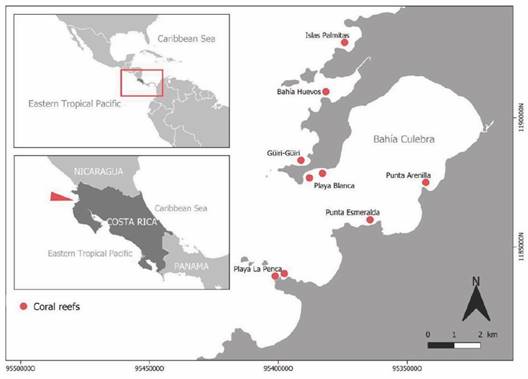
Fig. 1 Location of coral reefs in Bahía Culebra (North Pacific of Costa Rica) in 1995-1996. 

Back then, Bahía Culebra was also home to unique coral formations not commonly found in other areas of the ETP. The largest P. clavus reef in the ETP was found in Güiri-Güiri, with colonies up to 10 m in diameter (Cortés & Jiménez, 2003). On the other side of the bay, in Punta Esmeralda (Fig. 1), there used to be the only reef in the ETP built by L. papyracea, which extended over an area of 2 500 m2 (Cortés & Guzmán, 1998; Jiménez, 1997), and the site also held the only live population of C. curvata known in Costa Rica (Jiménez, 1998). Additionally, Bahía Culebra harbored a relatively large (0.3 ha) coral patch built mainly by Psammocora profundacella Gardiner, 1898 and Psammocora stellata (Verrill, 1866) in Playa La Penca (Fig. 1), with a live coral cover of 42.8 ± 20.8 % (Jiménez, 1998). Psammocora-dominated environments are rare throughout the ETP, and only four used to exist in Costa Rica (Bezy et al., 2006; Jiménez, 1998). Even though they do not provide high habitat heterogeneity and structural complexity (Bezy et al., 2006), they shelter high biodiversity of invertebrates such as polychaetes, amphipods, decapods, crustaceans, and mollusks, which attracts a broad range of predator fauna (Glynn, 1974).

While the moderate 1991-92 El Niño event had no notable effect on corals in Bahía Culebra (Jiménez & Cortés, 2001), the intense 1997-98 event did cause thermal anomalies of +0.2 to 3.9 ºC, which led to mass coral bleaching that mostly affected Pavona varians (Verrill, 1864), P. lobata, and Tubastraea coccinea Lesson, 1830 (Jiménez et al., 2001). Coral mortality was recorded in eight different species, such as Pocillopora spp. colonies (> 60 % of all beached and dead colonies), and a loss of > 90 % of L. papyracea. Despite the magnitude of the event, overall mortality was lower (7.2 %) than in other areas of the ETP (Alvarado et al., 2012; Cortés & Jiménez, 2003; Guzmán & Cortés, 2001; Jiménez et al., 2001), most likely due to the combined effects of upwelling and high cloud cover, which off-set the effects of high temperatures (Jiménez, 2002; Palmer et al., 2022). The natural recovery of Bahía Culebra’s coral reefs was possible most likely because of the absence of chronic anthropogenic stressors, the rapid growth rates of corals in the bay, which are higher than in other localities of the ETP (Jiménez & Cortés, 2003), and low densities (0.20 ± 0.02 ind. m-2) of the bioeroder sea urchin Diadema mexicanum A. Agassiz, 1863, which translated to high bioaccretion rates (18 kg CaCO3 m-2) and low bioerosion (Alvarado et al., 2012; Jiménez, 1998).

Despite densities of D. mexicanum being low during this period (Jiménez, 2001a), telltale signs of past population explosions were observed. During visits to Bahía Culebra in the late 1980s and early 1990s, remains of highly bioeroded coral colonies were reported in several sites, with undoubted signs of sea urchin effects. Such bioerosion mostly affected colonies of massive species, with little to no effect on the Pocillopora reefs (C. E. Jiménez, unpublished data).

Reef fish communities: During this period, a total of 78 reef fish species from 32 different families were found in Bahía Culebra (Arias-Godínez et al., 2019; Dominici-Arosemena et al., 2005), which is like the species richness estimated for other coral reefs in the ETP region (Cortés et al., 2017). Regarding trophic composition, invertebrate feeders and planktivores were the most abundant groups, followed by mesopredators, some of which were commercially important (Arias-Godínez et al., 2021; Dominici-Arosemena et al., 2005). Several predatory species were recorded during this period, such as the scalloped hammerhead shark (Sphyrna lewini (Griffith & Smith, 1834)) and the whitetip reef shark (Triaenodon obesus (Rüppell, 1837)) (Arias-Godínez et al., 2019). Most reef fish species in Bahía Culebra showed a positive correlation with live coral cover (Dominici, 1999), and higher diversity occurred in shallow Pocillopora reefs (Dominici-Arosemena et al., 2005). These habitats contributed to high structural complexity and presence of microhabitats, which provide multiple food sources, shelter and protection from predators for many reef species (Depczynski & Bellwood, 2004; Komyakova et al., 2013; Russ et al., 2020).

Anthropic disturbances: Bahía Culebra’s terrestrial and marine ecosystems have been exposed to both natural - such as ENSO events - and anthropogenic stressors over time (Sánchez-Noguera, 2012a). The strong interest in the bay’s marine resources at the end of the 20th century led to conflict between the different users with contrasting interests to represent (Dominici, 1999; Jiménez, 1997; Jiménez, 1998; Jiménez, 2001a; Sánchez-Noguera, 2012b; Sánchez-Noguera et al., 2018b). The lack of a management plan to protect marine ecosystems from anthropic activities brought localized degradation of some coral reefs and some of their associated ecological communities, such as species used in ornamental trade (Jiménez, 1998; Jiménez, 2001a) and artisanal fishing (Dominici-Arosemena et al., 2005; Gutiérrez, 1994; Jiménez, 1997; Sánchez-Noguera et al., 2018b).

The coral species most affected by ornamental trade were Pocillopora grandis (Dana, 1846), P. meandrina, and T. coccinea, as well as certain anemone species, mollusks, algae, and colorful invertebrates (Cortés & Jiménez, 2003; Jiménez, 1997; Jiménez, 2001a). Around 35-45 ornamental reef fish were also extracted for aquarium trade, but extraction was particularly intense for Thalassoma lucasanum (Gill, 1862), Pomacanthus zonipectus (Gill, 1862), Holacanthus passer Valenciennes, 1846, and Diodon holocanthus Linnaeus, 1758 (Dominici, 1999; Fournier, 2004). Dominici (1999) reported declines in catch between 1999 and 2000, and selective extraction of juveniles and male terminal phases of these species. Moreover, patches of coral reefs up to 25 m2 were destroyed to extract reef fish and shrimps for aquarium trade (Jiménez, 1997). Bahía Culebra’s coral reefs also suffered mechanical impacts, as it was already a snorkeling and diving hotspot in the 1990s (Jiménez, 1997), stirring up sediments, breaking coral colonies or turning them over (Cortés & Jiménez, 2003; Jiménez, 1998).

Finally, being the only large bay in the area, protected from wave action and relatively deep, Bahía Culebra had been a focal point for coastal development in the North Pacific of Costa Rica for many decades (Jiménez, 1998; Sánchez-Noguera, 2012b). The intensive development began in the 1990s, when the largest tourist complex in Central America was built (Jiménez, 1998), with no consideration of the potential negative effects on coral areas. For instance, urbanization caused the burial of a 100 m2 patch of a P. gigantea reef in Güiri-Güiri, causing 84 % coral mortality (Jiménez, 2001a). The following year, a P. clavus reef was also affected by sediment input caused by the erosion of an unpaved road, resulting in high sediment suspension and lower coral growth rates (Jiménez, 1998; Jiménez, 2001a). Mortality of L. papyracea was observed after land movements in Playa Panamá (Jiménez, 1998). In addition, sea currents carried sediments, sewage, and fuel leftover from the construction, and discharges of the new tourist development to coral reef patches, even relatively distant ones (Jiménez, 1998). This negative effect can be intensified due to the strong trade winds during upwelling season (Jiménez, 2001a; Jiménez, 2001b) and the semi-enclosed morphology of the bay, which promotes particle dispersion (García-Céspedes et al., 2004).

The early degradation period (2000-2010):

Anthropic disturbances: The picture for coral reefs in Bahía Culebra undoubtedly started changing in the early 2000s, when coral degradation was not localized but was observed throughout the area. The unprecedented coastal development and an increase in the number of visitors (Cortés & Reyes-Bonilla, 2017; Jiménez, 2001a; Sánchez-Noguera, 2012b) caused anthropic eutrophication and modified water quality (Alvarado et al., 2018; Beita-Jiménez et al., 2019; Fernández, 2007; Fernández-García et al., 2012). In addition, the synergistic effect of El Niño events (1997, 2003, 2007, 2009) triggered a series of reinforcing feedback mechanisms that acted in synergy and prevented coral reef ecosystems from recovering. The short time between disturbance events (proliferation of HABs, increase in algae cover, the propagation of the invasive macroalgae C. sertularioides, and a subsequent increase in the sea urchin D. mexicanum density), promoted a general decline in live coral cover, undermining the health of the whole ecosystem (Alvarado et al., 2012; Alvarado et al., 2016; Fernández-García et al., 2012; Jiménez, 2007a; Sánchez-Noguera, 2012a). Even though during the early 2000s (2003-2006) some sites (e.g., Cacique, Islas Palmitas, Pelonas, Playa La Penca) experienced a most impressive pulse of reef expansion and growth (C. E. Jiménez, unpublished data), they were nonetheless eventually affected by this generalized degradation.

At the beginning of this period (2000-2002), Bahía Culebra still had clear waters and low presence of heavy metals and total fecal coliforms, which were 3 μg/g in lead and < 4 MPN/100 ml, respectively (Acuña-González et al., 2004; García et al., 2006; García-Céspedes et al., 2004; Vargas et al., 2015; Vargas-Zamora et al., 2018). Moreover, petroleum hydrocarbons were absent in the bay’s waters (Acuña-González et al., 2004), and sedimentation and suspended matter (4.12 mg l-1) was also low (Vargas-Zamora et al., 2018). The minimal runoff discharges and wastes into the bay could explain these low concentrations (Vargas-Zamora et al., 2018). Despite this, intense HABs (also known as red tides) occurred and major disturbances occurred, but no specific data were recorded.

Harmful algal blooms; When coastal development first escalated, many tourist facilities lacked wastewater treatment plants (Cortés & Jiménez, 2003; Fernández-García et al., 2012; Jiménez, 1998). With changes in land use, nutrient wash-off during rainy season, and seasonal upwelling, nutrients in the bay’s waters and nearby areas increased (Alvarado et al., 2018; Fernández, 2007; Sánchez-Noguera, 2012a; Stuhldreier et al., 2015a). In consequence, HABs increased in frequency, magnitude and duration along the North Pacific coast of Costa Rica, especially between 2006 and 2009 (Cortés & Reyes-Bonilla, 2017; Jiménez 2001a; Jiménez, 2007a; Jiménez, 2007b; Morales-Ramírez et al., 2001; Sánchez-Noguera et al., 2018b; Vargas-Montero et al., 2008). These episodes can induce coral stress, bleaching, and mortality, as well as in fish and other marine taxa (Jiménez, 2007a; Jiménez, 2007b; Sánchez-Noguera et al., 2018b), through different mechanisms, such as the reduction of light penetration, direct toxicity, and the decrease in oxygen availability (Bauman et al., 2010; Guzmán et al., 1990). During the continuous episodes of HABs in 2007 in Bahía Culebra, which affected over 100 km of coastline, coral habitats in the bay experienced a most devastating decline in coral cover (Jiménez, 2007b).

Coral & benthic composition: Once corals died, their skeletons became available space for the recruitment of fleshy and filamentous macroalgae and turf. Both groups thrive in high-nutrient environments, particularly with phosphates and nitrates, which promote and accelerate their growth (Adam et al., 2021; De’ath & Fabricius, 2010; Fabricius, 2005; Fernández-García et al., 2012; Lapointe et al., 2005). This resulted in their highest cover in the early 2000s (Alvarado et al., 2012; Fernández-García et al., 2012), at the expense of reef-building corals, outcompeted then by algae, which limit -and, in some cases, inhibit- coral larval settlement (Kuffner et al., 2006; McCook et al., 2001; Roth et al., 2018). Hence, rates of coral recruitment are inversely correlated to algal abundance and cover (Kuffner & Paul, 2004), which, in the long term, can impede coral reef recovery after disturbance events (Adam et al., 2021). Furthermore, the synergistic effect of fishing pressure caused a decline in the density of herbivores in Bahía Culebra (Dominici-Arosemena et al., 2005; Villalobos-Rojas et al., 2014), therefore reducing top-down control on macroalgae and turf. Thus, previously coral-dominated reefs became dominated by turf and macroalgae, and coral cover decreased from 38.5 % in 2006 to 2.5 % in 2009 (Alvarado et al., 2012; Sánchez-Noguera, 2012a).

Another stressor which promoted the decline on live coral cover in the area was the spread of the green invasive macroalgae C. sertularioides (Fernández-García et al., 2012), a well-known species for its invasive-like growth in coastal waters (Lapointe et al., 2005; Meinesz, 1999). Even though this macroalgae has historically been found in Bahía Culebra, its densities had always remained low until 2001, when its proliferation began (Fernández, 2007). The first rise was recorded in areas where many boats anchored (i.e., Playas del Coco and Ocotal) and close to coastal development like hotels and human communities (Fernández, 2007). From there, it began to spread along the bay (Fig. 2), particularly where the substrate consisted of Pocillopora spp. fragments, which provide a suitable surface for the attachment of C. sertularioides stolons and rhizoids (Fernández-García et al., 2012). In 2001, several hectares of very dense mats were reported, smothering coral colonies > 50 cm in height (C. E. Jiménez, unpublished data). The maximum peak of C. sertularioides cover was recorded in 2005, when it reached 40 % during wet season and 70.7 % during the dry upwelling season, with a growth rate of 1.1 cm day-1 (Fernández, 2007; Fernández-García et al., 2012), coinciding with the increase in nutrients that occurs in upwelling events (Rixen et al., 2012; Stuhldreier et al., 2015b; Stuhldreier et al., 2015c). Additionally, its high asexual reproduction rate through fragmentation and low herbivory rates, partly due to the presence of toxins in its fronds (Davis et al., 2005; Doty & Aguilar-Santos, 1966), favored the dispersal and settlement of this macroalgae on the coral areas of the bay (Fernández, 2007; Fernández & Cortés, 2005).
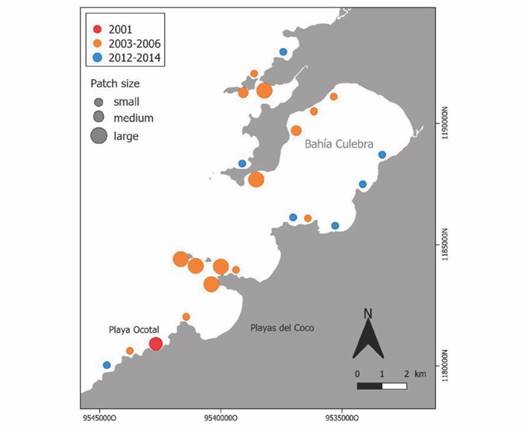
Fig. 2 Proliferation and expansion of the macroalgae Caulerpa sertularioides in Bahía Culebra (2001-2014) based on patch size and abundance categories in Fernández (2007). 

This accelerated spreading caused a 40.5 % reduction in the growth rate of P. elegans (Fernández, 2007), as C. sertularioides can affect coral growth through different mechanisms: (i) constant abrasion of fronds against coral tissue, which damages it and makes coral polyps retract, thus allocating more energy for tissue repair, and limiting access to energy and metabolites, crucial for non-essential and highly costly physiological processes such as growth (River & Edmunds, 2001), (ii) overgrowing of live coral tissue, and (iii) sediment trapping, which decreases available light (Fabricius, 2005; Sato, 1985). Under these stressful conditions, coral colonies may be partially damaged and eventually die, resulting in a reduction of live coral cover. For instance, the Psammocora-dominated coral reef in Playa Penca lost a 95 % of its live coral cover and was reduced to small patches (1-3 m2) found among dead corals and thick beds of C. sertularioides (Bezy et al., 2006). In 2006, the Psammocora reef had completely disappeared (J. J. Alvarado, personal observation, November 2023). Thus, where once were coral-dominated environments, a new benthic assemblage was established, forming Caulerpa prairies (Alvarado et al., 2018). Such a rapid spreading of a macroalgae, causing abrupt declines in coral cover, was at the time unheard of in the ETP (Bezy et al., 2006).

Diadema mexicanum bioerosion: The increase of turf and macroalgae cover resulted in a population explosion of the sea urchin D. mexicanum, due to the additional availability of food sources and strong fishing pressure in the area, which caused a reduction of sea urchin predators (Alvarado et al., 2012; Sánchez-Noguera et al., 2018a; Villalobos-Rojas et al., 2014). The densities of this herbivore bioeroder began to increase in 2009 (over 900 % increase since 2006) (Alvarado et al., 2012), not only due to anthropogenic factors but to the 2009-2010 ENSO event, as reported for other areas of the ETP (Eakin, 1996; Eakin, 2001; Alvarado et al., 2012; Glynn & Manzello, 2015).

The role of sea urchins in coral reef ecology and their carbonate budgets can change in accordance with their density. When sea urchins graze on algae growing on dead coral substrate, they reduce macroalgae and turf cover and facilitate the growth of crustose coralline algae, which promote coral larval recruitment, hence favoring ecosystem recovery (Alvarado et al., 2012; Glynn & Manzello, 2015). However, when found in moderate and high densities, they can cause significant erosion of reef framework (from 0.07 to 0.75 kg CaCO3 m-2 yr-1 in Bahía Culebra) (Alvarado et al., 2012; Glynn & Manzello, 2015). When their density surpasses 1.5 ind m-2, such as in the case of Bahía Culebra during this period, carbonate balance becomes negative and active bioerosion of reef framework takes place. In consequence, calcareous structures weakened, and reef structural complexity eventually diminished (Alvarado et al., 2012; Alvarado et al., 2016).

The degraded period (2010-present):

After almost a decade of being affected by several types of disturbances, ecological consequences of coral reef deterioration in Bahía Culebra started being notorious. Effects were seen not only in terms of changes in benthic cover and drastic reductions of live coral cover, but also in the loss of coral reef framework and structural complexity, which in turn affected the different coral-associated communities.

Coral & benthic composition: The most direct effects of coral reef deterioration in Bahía Culebra were a reduction in live coral cover and the number of coral species. Several rare coral species suffered local extinction (e.g., L. papyracea, C. curvata, P. meandrina), while dominant species in the 1990s were the ones that remained present in the bay’s coral reefs (Sánchez-Noguera, 2012a; Sánchez-Noguera et al., 2018b). Additionally, drastic reductions in live coral cover in many coral reefs were reported after the disturbance period: in 2010-2011, live coral cover was between 1-4 % (Sánchez-Noguera, 2012a), and during 2014-2016, it remained 1.3 ± 2.4 % (Arias-Godínez et al., 2019). Most recent reevaluations reveal that live coral cover is currently 1.1 ± 0.7 % (Alvarado et al., unpublished data) (Fig. 3).
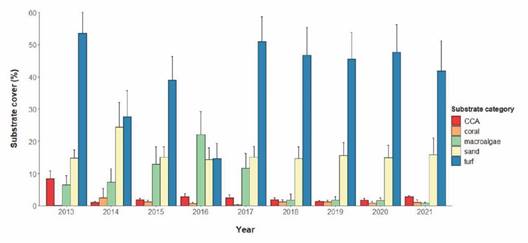
Fig. 3 Mean (±SE) substrate cover (%) in Bahía Culebra from 2013 to 2021 (North Pacific, Costa Rica) in the four reefs surveyed in Jiménez (1998) and Sánchez-Noguera et al. (2018b) (Güiri-Güiri, Punta Esmeralda, Islas Palmitas and Playa Blanca). CCA: Crustose calcareous algae. 

While in 2010-2011 the dominant substrate cover was dead coral, which exceeded 85 % of total cover in some cases (Sánchez-Noguera, 2012a), it was later (2014-2016) replaced by macroalgae, turf and sand (Arias-Godínez et al., 2019). During this period, turf reached 46.1 ± 15.6 % of substrate cover in the bay, similar to values reported for reefs in the ETP (Fong et al., 2017), and macroalgae cover (mainly C. sertularioides) was 14.0 ± 7.2 % (Alvarado et al., unpublished data). Even though there was an increase in herbivore abundance (Alvarado et al., 2012; Arias-Godínez et al., 2021), the high growth and dispersal rates of C. sertularioides ensured that it remained abundant in many coral reefs in Bahía Culebra and prevailed over coral cover (Arias-Godínez et al., 2019). Thus, the previously reported shifts from coral to macroalgae-dominated ecosystems intensified and took place in most coral reefs in the bay. For instance, the existing Pocillopora spp. reef in Playa Blanca was replaced by extensive mats of C. sertularioides (< 60 %) (Arias-Godínez, 2017). However, C. sertularioides cover has been declining during the last years (2021: 0.8 ± 0.3 %), especially after hurricane Otto (2016) and tropical storm Nate (2017) hit the Pacific coast of Costa Rica (J. J. Alvarado, personal observation, November 2023) (Fig. 3).

Moreover, while cyanobacteria were absent in the 1990s, they appeared as a new category of substrate cover during reef evaluations in 2010-2011, although their cover was < 1 % (Sánchez-Noguera, 2012a). While cyanobacteria are a natural component of coral reefs (Charpy et al., 2012), they can form dense and extensive mats in deteriorated reefs. Their presence inhibits coral larval settlement and recruitment, and they can act as pathogens for scleractinian corals, and produce secondary metabolites to deter grazing (Brocke et al., 2015; Charpy et al., 2012; Kuffner & Paul, 2004; Kuffner et al., 2006). Hence, when found in high densities, they are considered indicators of nutrient enrichment and declining reef health (Albert et al., 2005; Charpy et al., 2012; Paerl & Paul, 2012).

Coral mortality in the 2000s also caused a shift on composition and diversity of Pocillopora-associated fauna (i.e., cryptofauna), from obligate symbiotic species to boring opportunistic and facultative species (Salas-Moya et al., 2021). An increase in the abundance of bivalves of the genus Lithophaga (Leiosolenus) can contribute to a rise in internal bioerosion of coral colonies and carbonate substrate, particularly during upwelling season (Salas-Moya et al., 2021; Wizemann et al., 2018), thus weakening the little remaining reef framework. Shifts in cryptofauna communities can be promoted by changes in food resources and chemical cues once coral colonies die (Lecchini et al., 2014; Wee et al., 2019). Furthermore, obligate symbiotic species found in live coral colonies in the early 2000s, such as Trapezia sp. and Alpheus sp., are known for their territorial behavior, which could have prevented the settlement and recruitment of other coral-associated organisms (Tóth & Duffy, 2005; Wee et al., 2019), and thus explain the increase of cryptofauna species observed after coral death and reef degradation in Bahía Culebra (Salas-Moya et al., 2021). In the long term, however, species richness will abruptly drop after the high erosion of carbonate structures (Enochs & Manzello, 2012a; Enochs & Manzello, 2012b). Additionally, such a shift in cryptofauna composition could compromise reef recovery, since they are a key component for host colony health, and the maintenance and recovery of reef framework (Salas-Moya et al., 2021; Stella et al., 2011).

Diadema mexicanum bioerosion: After the population explosion in 2009, D. mexicanum densities kept increasing for some years (Fig. 4), which produced a subsequent increase in bioerosion rates, from 0.75 CaCO3 m-2 yr-1 in 2009 to 6.95 kg CaCO3 m-2 yr-1 in 2013 (Alvarado et al., 2012; Alvarado et al., unpublished data). Such bioerosion rates exceeded the bioaccretion capacity of coral reefs in Bahía Culebra (< 0.01 kg CaCO3 m-2 yr-1), which resulted in a debilitated structure and collapse of the reef (Arias-Godínez et al., 2019; Eakin, 2001; Sánchez-Noguera, 2012a). For instance, in Playa Blanca, where the highest sea urchin densities (4.12 ± 0.83 ind. m-2) occurred during 2010-2011 surveys (Sánchez-Noguera, 2012a; Sánchez-Noguera et al., 2018b), carbonate structure was destroyed, and no reef framework exists nowadays (J.J. Alvarado, personal observation, November 2023). The same occurred in other sites, where nearly vertical 1.8 m high coral scarps were grazed away, and reef framework crumbled (C.E. Jiménez, personal communication, June 2021). Instead, the substrate is now covered in coral rubble and sandy bottoms (Arias-Godínez et al., 2019; Sánchez-Noguera, 2012a).
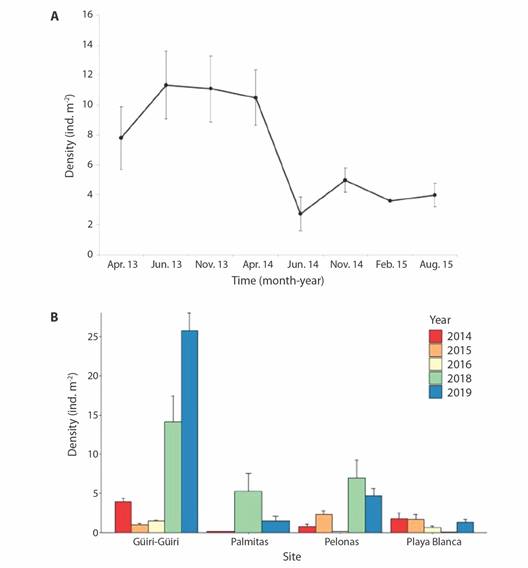
Fig. 4 Populations of the sea urchin Diadema mexicanum in Bahía Culebra coral reefs over time. (A) Density of D. mexicanum (ind. m-2) from April 2013 to August 2015; (B) Mean (±SE) density of D. mexicanum (ind. m-2) in four surveyed coral reefs in Bahía Culebra, from 2014 to 2019.  

When no more carbonate substrate was available to erode, D. mexicanum populations started to decline (Fig. 4a), and with them their bioerosive impact, especially in sites where densities were highest, like Playa Blanca (Alvarado et al., unpublished data; Sánchez-Noguera et al., 2018b), potentially allowing for coral recovery (Eakin, 2001; Guzmán & Cortés, 2007). This follows what has been established in other studies for coral reefs in the ETP (Eakin, 1996; Eakin, 2001). Nevertheless, densities of D. mexicanum are still high in the bay, particularly in reefs where carbonate framework remains, such as Güiri-Güiri, where during 2010-2011, its densities were 0.03 ± 0.01 ind. m-2 (Sánchez-Noguera et al., 2018b), and have increased to 18.1 ± 1.16 ind. m-2 ten years later (Fabregat-Malé et al., 2023) (Fig. 4b).

Reef fish communities: The loss of structural complexity caused by intense sea urchin bioerosion and loss of live coral cover influenced reef fish communities in Bahía Culebra (Arias-Godínez et al., 2019; Arias-Godínez et al., 2021). During 2014-2016 surveys, 56 reef fish species from 24 families were detected, which represents a significant reduction from species richness in the 1990s (78 species from 32 families), and 49 % of species sighted in the 1990s were not present in the latter degraded period (Arias-Godínez et al., 2021). Habitat composition and structural complexity are important drivers of reef fish abundance and diversity (Eisele et al., 2021; Ferrari et al., 2017). Habitats with high live coral cover tend to hold a larger diversity and abundance of reef fish, since they provide shelter and different resources, and thus promote species coexistence and key ecological interactions (Coker et al., 2012; Gratwicke & Speight, 2005). The severe degradation and phase shift to macroalgal-dominated states suffered by coral reefs in Bahía Culebra implied a reduction of microhabitats and food sources for reef fish (Arias-Godínez et al., 2019), particularly after the invasion of a sole macroalgae species, which could explain the observed reduction in both species’ diversity and abundance (Arias-Godínez et al., 2019). Coral-dependent species were particularly affected, such as the butterflyfish Chaetodon humeralis (Günther, 1860) (Arias-Godínez et al., 2019). These are one of the first groups affected by loss of live coral cover, as they depend on it for feeding and settlement (Graham et al., 2009; Pratchett et al., 2015). Hence, their reduction can be considered an indicator of early coral reef degradation (Flower et al., 2017; Pratchett et al., 2006).

Trophic structure of reef fish assemblages from this degraded period suffered a shift from those back in the 1990s (1995-1996). Even though planktivore fish remained as the dominant group, other trophic groups were greatly affected by coral reef degradation, such as coral-dependent omnivore and mesopredator species, which were more abundant on pre-disturbed coral reefs (Arias-Godínez et al., 2021). In fact, over half of the mesopredatory species (57 %) detected in the 1990s were not sighted in the 2014-2016 surveys (Arias-Godínez et al., 2021), including whitetip reef shark T. obesus and scalloped hammerhead shark S. lewini (Arias-Godínez et al., 2019). Their decrease in abundance could be seen as an indicator of strong fishing pressure in the area, since this group is primarily targeted by local fisheries (Beita-Jiménez et al., 2019; Villalobos-Rojas et al., 2014), and potentially declining reef health (Aburto-Oropeza et al., 2015). Declines in mesopredators and top predators could have had cascading effects on the whole ecosystem (Heithaus et al., 2008; Roff et al., 2016; Sandin et al., 2022), by prey-release mechanisms that led to predominance of lower trophic level consumers (macroalgae-feeders, herbivores-detritivores and invertivores) in the now algae-dominated environments in Bahía Culebra (Arias-Godínez et al., 2021).

Is recovery possible for coral reefs in Bahía Culebra?:

Historical insights of ecosystem changes can shed light on factors influencing ecosystem resilience and causing phase shifts among ecological states (Fong et al., 2006). How an ecosystem responded to previous environmental disturbances is particularly relevant considering future global change, in the face of which coral reefs are extremely vulnerable (Hoegh-Guldberg et al., 2018; Hughes et al., 2017; Kittinger et al., 2011; Knowlton & Jackson, 2008). Thus, understanding how changing environmental conditions and anthropic disturbances shaped current coral reefs is key to implement informed management actions (Bruno et al., 2014; Zu Ermgassen et al., 2015).

Bahía Culebra is one of the most intensively studied regions in the Pacific coast of Costa Rica (Cortés, 2012). Its marine environments, particularly coral reefs, have always received considerable attention for their ecologic and economic resources (Fernández, 2007; Sánchez-Noguera, 2012a). However, even though the first studies focusing on coral ecosystems occurred previously to intensive coastal development (Cortés & Murillo, 1985), human settlement in the bay, and thus disturbances to marine ecosystems, happened centuries before (Sánchez-Noguera, 2012b). Hence, even if such studies cannot be considered as historical baselines of pristine coral environments, they were nevertheless carried out before the major and intensive marine degradation that took place in the 2000s.

The extreme and rapid degradation observed in Bahía Culebra, with shifts from coral to macroalgal-dominated states (Arias-Godínez et al., 2019; Sánchez-Noguera et al., 2018b), was most likely caused by numerous disturbances acting synergistically and thus diminishing reef resilience (Jiménez, 2007a; Sánchez-Noguera et al., 2018b). The combined action of increased nutrients in the water column, HABs, invasion by the macroalgae C. sertularioides, and increased bioerosion triggered a series of reinforcing feedbacks that led to the collapse of coral reefs in less than 15 years (Alvarado et al., 2012; Alvarado et al., 2016; Fernández, 2007; Fernández & Cortés, 2005; Graham et al., 2013; Jiménez, 2001a; Jiménez, 2007a; Sánchez-Noguera, 2012a). This makes it difficult to identify the main drivers of degradation, and which factors have maintained the observed phase shifts and prevented natural ecological recovery. The change in dominance to fleshy macroalgal-states has led to stable regime shifts in other regions (Graham et al., 2015; Johns et al., 2018; Mumby, 2009), which made recovery of coral cover to pre-disturbed states impossible.

But is the recovery of coral reefs in Bahía Culebra possible or should we lose all hope? Existing evidence points that, after major disturbances, coral recovery can occur in relatively short periods when stressors cease or are managed (Emslie et al., 2008; Gilmour et al., 2013; Graham et al., 2011; Guzmán & Cortés, 2001). However, ecosystem recovery is much less likely if live coral cover is < 5 % and reef framework has collapsed (Graham et al., 2011). This is the exact case of Bahía Culebra’s coral reefs, where coral recruitment, and hence recovery, is limited by different factors. First, macroalgae and turf cover is still high in the bay, inhibiting coral larval settlement (Kuffner et al., 2006; Roth et al., 2018). The loss of carbonate framework due to intense bioerosion further contributes to the limitation of available substrate for coral larvae to recruit (Alvarado et al., 2012; Graham & Nash, 2012). Moreover, sexual reproduction rates of the main reef-building coral species of the ETP are lower than in other regions, which directly impacts natural recovery capacity after disturbances (Bezy, 2009; Guzmán & Cortés, 2001). Successful coral recruitment is essential for ecosystem recovery, and its inhibition or limitation by such factors could prevent reversion from phase shifts (Hughes & Tanner, 2000; Kuffner & Paul, 2004). It has also been observed that reef recovery tends to be slowest in the ETP, due to its geographic isolation from other oceanographic regions (through the 5 000-8 000 km Central Pacific Barrier) and low functional diversity of corals and reef fish (Graham et al., 2011). Compared to other regions, ETP’s coral reefs are formed by few coral species (Cortés, 1997; Veron, 2014), which translates to low functional redundancy (de Bakker et al., 2016).

Where we can go from here partly depends on management actions taken to enhance coral populations in Bahía Culebra and increase their chances of natural recovery. In Costa Rica, most coral reefs and important areas of coral development can be found within protected areas, except for Bahía Culebra (Cortés & Jiménez, 2003). This is particularly relevant considering the many reef resources used by different stakeholders in the bay (Dominici, 1999; Jiménez, 1997; Jiménez, 1998; Jiménez, 2001a; Sánchez-Noguera et al., 2012a), which can lead to conflict between users (Sánchez-Noguera et al., 2018b). The bay has no current management plan of its resources, and marine spatial planning is urgently needed to regulate marine activities that could potentially clash with coral reef conservation (Naranjo-Arriola, 2021). Continuing with existing monitoring programs for stressors such as nutrient concentration, benthic cover of C. sertularioides and turf, and sea urchin populations, requires special attention, since they can serve as early warnings of deterioration (Cooper et al., 2009; Flower et al., 2017; Gil et al., 2016). Nonetheless, while monitoring local stressors in the bay is relevant, upstream, and larger-scale stressors that may have caused local coral deterioration to require special attention. Integrated management actions like improving the region’s wastewater management and coastal land use are key to decrease HABs’ recurrence and intensity (Palmer et al., 2022). However, the current situation in the bay calls for the implementation of ecological restoration efforts to maintain remaining diversity and increase live coral cover back to a threshold where ecosystem functionality is enhanced, and effects can be seen on reef-associated communities. Coral reef restoration also allows us to maintain existing genetic diversity and coral populations while climate change and other local and regional anthropic stressors are managed or mitigated (Baums et al., 2019). The recovery of coral reefs, and thus restoration, can potentially provide a wide range of economic benefits due to its impact on ecosystem services, such as fisheries, coastal protection, tourism, and enhanced recreation opportunities (De Groot et al., 2013). Coupled with strong academic research and public enforcement, environmental education and citizen science programs could also increase public awareness and support of coral conservation efforts, long needed for coral reefs in Bahía Culebra (Dickinson et al., 2012; Hesley et al., 2017). This review sets a guide for coral restoration activities by providing a baseline and describing how coral reefs in Bahía Culebra have responded to past disturbances, and how these have shaped the structure and function of present-day coral reefs.

Ethical statement: the authors declare that they all agree with this publication and made significant contributions; that there is no conflict of interest of any kind; and that we followed all pertinent ethical and legal procedures and requirements. All financial sources are fully and clearly stated in the acknowledgments section. A signed document has been filed in the journal archives.

Acknowledgments

We are very grateful to all the people who contributed information and data to this work. We thank Carlos Jiménez, Jorge Cortés and Celeste Sanchez for their collaboration. Likewise, we thank Jeffrey Sibaja-Cordero and Alma Paola Rodriguez Troncoso for comments on a first version of this publication.

References

Aburto-Oropeza, O., Ezcurra, E., Moxley, J., Sánchez-Rodríguez, A., Mascareñas-Osorio, I., Sánchez-Ortiz, C., Erisman, B., & Ricketts, T. (2015). A framework to assess the health of rocky reefs linking geomorphology, community assemblage, and fish biomass. Ecological Indicators, 52, 353-361. https://doi.org/10.1016/j.ecolind.2014.12.006 [ Links ]

Acuña-González, J. A., Vargas-Zamora, J. A., Gómez-Ramírez, E., & García-Céspedes, J. (2004). Hidrocarburos de petróleo, disueltos y dispersos, en cuatro ambientes costeros de Costa Rica. Revista de Biología Tropical, 52(Suppl. 2), 43-50. [ Links ]

Adam, T. C., Burkepile, D. E., Holbrook, S. J., Carpenter, R. C., Claudet, J., Loiseau, C., Thiault, L., Brooks, A. J., Washburn, L., & Schmitt, R. J. (2021). Landscape-scale patterns of nutrient enrichment in a coral reef ecosystem: implications for coral to algae phase shifts. Ecological Applications, 31(1), e2227. https://doi.org/10.1002/eap.2227 [ Links ]

Ainsworth, C. H., & Mumby, P. J. (2015). Coral-algal phase shifts alter fish communities and reduce fisheries production. Global Change Biology, 21(1), 165-172. https://doi.org/10.1111/gcb.12667 [ Links ]

Albert, S., O’Neil, J. M., Udy, J. W., Ahern, K. S., O’Sullivan, C. M., & Dennison, W. C. (2005). Blooms of the cyanobacterium Lyngbya majuscula in coastal Queensland, Australia: disparate sites, common factors. Marine Pollution Bulletin, 51(1-4), 428-437. https://doi.org/10.1016/j.marpolbul.2004.10.016 [ Links ]

Alvarado, J. J., Beita-Jiménez, A., Mena, S., Fernández-García, C., Cortés, J., Sánchez-Noguera, C., Jiménez, C., & Guzmán-Mora, A. G. (2018). Cuando la conservación no puede seguir el ritmo del desarrollo: Estado de salud de los ecosistemas coralinos del Pacífico Norte de Costa Rica. Revista de Biología Tropical, 66(Suppl. 1), 280-308. https://doi.org/10.15517/rbt.v66i1.33300 [ Links ]

Alvarado, J. J., Cortés, J., Guzmán, H., & Reyes-Bonilla, H. (2016). Density, size, and biomass of Diadema mexicanum (Echinoidea) in Eastern Tropical Pacific coral reefs. Aquatic Biology, 24, 151-161. https://doi.org/10.3354/ab00645 [ Links ]

Alvarado, J. J., Cortés, J., & Reyes-Bonilla, H. (2012). Reconstruction of Diadema mexicanum bioerosion impact on three Costa Rican Pacific coral reefs. Revista de Biología Tropical, 60(Suppl. 2), 121-132. https://doi.org/10.15517/rbt.v60i2.19975 [ Links ]

Alvarado, J. J., Sánchez-Noguera, C., Arias-Godínez, G., Araya, T., Fernández-García, C., & Guzmán, A. G. (2019). Impact of El Niño 2015-2016 on the coral reefs of the Pacific of Costa Rica: the potential role of marine protection. Revista de Biología Tropical, 68(Suppl. 1), 271-282. https://doi.org/10.15517/rbt.v68iS1.41190 [ Links ]

Arias-Godínez, G. (2017). Comparación espacio-temporal de la estructura comunitaria de peces arrecifales en Bahía Culebra, Guanacaste, Costa Rica: 1995-1996 y 2014-2016 (Tesis de maestría). Universidad de Costa Rica, San José, Costa Rica. [ Links ]

Arias-Godínez, G., Jiménez, C., Gamboa, C., Cortés, J., Espinoza, M., & Alvarado, J. J. (2019). Spatial and temporal changes in reef fish assemblages on disturbed coral reefs, north Pacific coast of Costa Rica. Marine Ecology, 40(1), e12532. https://doi.org/10.1111/maec.12532 [ Links ]

Arias-Godínez, G., Jiménez, C., Gamboa, C., Cortés, J., Espinoza, M., Beita-Jiménez, A., & Alvarado, J. J. (2021). The effect of coral reef degradation on the trophic structure of reef fishes from Bahía Culebra, North Pacific coast of Costa Rica. Journal of Coastal Conservation, 25, 8. https://doi.org/10.1007/s11852-021-00802-x [ Links ]

Bauman, A. G., Burt, J. A., Feary, D. A., Marquis, E., & Usseglio, P. (2010). Tropical harmful algal blooms: An emerging threat to coral reef communities? Marine Pollution Bulletin, 60(11), 2117-2122. https://doi.org/10.1016/j.marpolbul.2010.08.015 [ Links ]

Baums, I. B., Baker, A. C., Davies, S. W., Grottoli, A. G., Kenkel, C. D., Kitchen, S. A., Kuffner, I. B., LaJeunesse, T. C., Matz, M. V., Miller, M. W., Parkinson, J. E., & Shantz, A. A. (2019). Considerations for maximizing the adaptive potential of restored coral populations in the western Atlantic. Ecological Applications, 29(8), e01978. https://doi.org/10.1002/eap.1978 [ Links ]

Beebe, W. (1942). Book of Bays. Barcourt, Brace & Company. [ Links ]

Beita-Jiménez, A., Alvarado, J. J., Mena, S., & Guzmán-Mora, A. G. (2019). Benefits of protection on reef fish assemblages in a human impacted region in Costa Rica. Ocean and Coastal Management, 169, 165-170. https://doi.org/10.1016/j.ocecoaman.2018.12.023 [ Links ]

Bezy, M. B. (2009). Reproducción sexual y reclutamiento del coral masivo Pavona clavus en Bahía Culebra, Golfo de Papagayo, Costa Rica (Tesis de maestría)). Universidad de Costa Rica, San José, Costa Rica. [ Links ]

Bezy, M. B., Jiménez, C., Cortés, J., Segura, A., León, A., Alvarado, J. J., Gillén, C., & Mejía, E. (January 2006). Contrasting Psammocora-dominated coral communities in Costa Rica, tropical eastern Pacific (Conference). Proceedings of the 10th International Coral Reef Symposium, Okinawa, 1, 376-381. [ Links ]

Bozec, Y. M., Hock, K., Mason, R. A. B., Baird, M. E., Castro-Sanguino, C., Condie, S. A., Puotinen, M., Thompson, A., & Mumby, P. J. (2021). Cumulative impacts across Australia’s Great Barrier Reef: a mechanistic evaluation. Ecology Monographs, 92(1), e01494. https://doi.org/10.1002/ecm.1494 [ Links ]

Brocke, H. J., Polerecky, L., de Beer, D., Weber, M., Claudet, J., & Nugues, M. M. (2015). Organic matter degradation drives benthic cyanobacterial mat abundance on Caribbean coral reefs. PLoS ONE, 10(5), e0125445. https://doi.org/10.1371/journal.pone.0125445 [ Links ]

Bruno, J. F., Sweatman, H., Precht, W. F., Selig, E. R., & Schutte, V. G. W. (2009). Assessing evidence of phase shifts from coral to macroalgal dominance on coral reefs. Ecology, 90(6), 1478-1484. https://doi.org/10.1890/08-1781.1 [ Links ]

Bruno, J. F., Precht, W. F., Vroom, P. S., & Aronson, R. B. (2014). Coral reef baselines: How much macroalgae is natural? Marine Pollution Bulletin, 80(1-2), 24-29. https://doi.org/10.1016/j.marpolbul.2014.01.010 [ Links ]

Charpy, L., Casareto, B. E., Langlade, M. J., & Suzuki, Y. (2012). Cyanobacteria in coral reef ecosystems: A review. Journal of Marine Sciences, 2012, 259571. https://doi.org/10.1155/2012/259571 [ Links ]

Cheal, A. J., Emslie, M., MacNeil, M. A., Miller, I., & Sweatman, H. (2013). Spatial variation in the functional characteristics of herbivorous fish communities and the resilience of coral reefs. Ecological Applications, 23(1), 174-188. https://doi.org/10.1890/11-2253.1 [ Links ]

Cheal, A. J., MacNeil, M. A., Cripps, E., Emslie, M. J., Jonker, M., Schaffelke, B., & Sweatman, H. (2010). Coral-macroalgal phase shifts or reef resilience: links with diversity and functional roles of herbivorous fishes on the Great Barrier Reef. Coral Reefs, 29, 1005-1015. https://doi.org/10.1007/s00338-010-0661-y [ Links ]

Chong-Seng, K. M., Mannering, T. D., Pratchett, M. S., Bellwood, D. R., & Graham, N. A. J. (2012). The influence of coral reef benthic condition on associated fish assemblages. PLoS ONE, 7(8), e42167. https://doi.org/10.1371/journal.pone.0042167 [ Links ]

Coker, D. J., Graham, N. A. J., & Pratchett, M. S. (2012). Interactive effects of live coral and structural complexity on the recruitment of reef fishes. Coral Reefs, 31, 919-927. https://doi.org/10.1007/s00338-012-0920-1 [ Links ]

Cooper, T. F., Gilmour, J. P., & Fabricius, K. E. (2009). Bioindicators of changes in water quality on coral reefs: review and recommendations for monitoring programmes. Coral Reefs, 28, 589-606. https://doi.org/10.1007/s00338-009-0512-x [ Links ]

Cortés, J. (1997). Biology and geology of eastern Pacific coral reefs. Coral Reefs, 16, S36-S46. https://doi.org/10.1007/s003380050240 [ Links ]

Cortés, J. (2012). Historia de la investigación marino-costera en Bahía Culebra, Pacífico Norte, Guanacaste, Costa Rica. Revista de Biología Tropical, 60(Suppl. 2), 19-37. https://doi.org/10.15517/rbt.v60i2.19961 [ Links ]

Cortés, J., & Guzmán, H. M. (1998). Organismos de los arrecifes coralinos de Costa Rica: descripción, distribución geográfica e historia natural de los corales zooxantelados (Anthozoa: Scleractinia) del Pacífico. Revista de Biología Tropical, 46(1), 55-92. https://doi.org/10.15517/rbt.v46i1.19353 [ Links ]

Cortés, J., & Jiménez, C. (2003). Corals and coral reefs of the Pacific of Costa Rica: history, research and status. In J. Cortés (Ed.), Latin American Coral Reefs (pp. 361-367). Elsevier Science. https://doi.org/10.1016/B978-044451388-5/50017-5 [ Links ]

Cortés, J., Jiménez, C. E., Fonseca, A., & Alvarado, J. J. (2010). Status and conservation of coral reefs in Costa Rica. Revista de Biología Tropical, 58(Suppl. 1), 33-50. https://doi.org/10.15517/rbt.v58i1.20022 [ Links ]

Cortés, J., & Murillo, M. M. (1985). Comunidades coralinas y arrecifes del Pacífico de Costa Rica. Revista de Biología Tropical, 33(2), 197-202. https://revistas.ucr.ac.cr/index.php/rbt/article/view/24452 [ Links ]

Cortés, J., Murillo, M. M., Guzmán, H. M., & Acuña, J. (1984). Pérdida de zooxantelas y muerte de corales y otros organismos arrecifales en el Atlántico y Pacífico de Costa Rica. Revista Biología Tropical, 32, 227-231. [ Links ]

Cortés, J., & Reyes-Bonilla, H. (2017). Human influences on Eastern Tropical Pacific coral communities and coral reefs. In P. W. Glynn, D. Manzello & I. Enochs (Eds.) Coral Reefs of the Eastern Tropical Pacific (Vol. 8, pp. 549-563). Springer+Business Media. https://doi.org/10.1007/978-94-017-7499-4_20 [ Links ]

Cortés, J., Sibaja-Cordero, J., Hernández, J., Alvarado, J. J., Breedy, O., Cruz-Barraza, J. A., Esquivel-Garrote, O., Fernández-García, C., Hermosillo, A., Kaiser, K. L., Medina-Rosas, P., Morales-Ramírez, A., Pachecho, C., Pérez-Matus, A., Reyes-Bonilla, H., Riosmena-Rodríguez, R., Sánchez-Noguera, C., Wieters, E. A., & Zapata, F. A. (2017). Marine biodiversity of the Eastern Tropical Pacific coral reefs. In P. W. Glynn, D. Manzello & I. Enochs (Eds.), Coral reefs of the Eastern Pacific: Persistence and loss in a dynamic environment (pp. 203-250). Springer Science+Business Media. https://doi.org/10.1007/978-94-017-7499-4_7 [ Links ]

Davis, A. R., Benkendorff, K., & Ward, D. W. (2005). Responses of common SE Australian herbivores to three suspected invasive Caulerpa spp. Marine Biology, 146, 859-868. https://doi.org/10.1007/s00227-004-1499-z [ Links ]

De’ath, G., & Fabricius, K. (2010). Water quality as a regional driver of coral biodiversity and macroalgae on the Great Barrier Reef. Ecological Applications, 20(3), 840-850. https://doi.org/10.1890/08-2023.1 [ Links ]

de Bakker, D. M., Meesters, E. H., Bak, R. P. M., Nieuwland, G., & van Duyl, F. C. (2016). Long-term shifts in coral communities on shallow to deep reef slopes of Curaçao and Bonaire: Are there any winners? Frontiers in Marine Science, 3, 247. https://doi.org/10.3389/fmars.2016.00247 [ Links ]

De Groot, R., Blignaut, J., van der Ploeg, S., Aronson, J., Elmqvist, T., & Farley, J. (2013). Benefits of investing in ecosystem restoration. Conservation Biology, 27(6), 1286-1293. https://doi.org/10.1111/cobi.12158 [ Links ]

Depczynski, M., & Bellwood, D. R. (2004). Microhabitat utilisation patterns in cryptobenthic coral reef fish communities. Marine Biology, 145, 455-463. https://doi.org/10.1007/s00227-004-1342-6 [ Links ]

Dickinson, J. L., Shirk, J., Bonter, D., Bonney, R., Crain, R. L., Martin, J., Phillips, T., & Purcell, K. (2012). The current state of citizen science as a tool for ecological research and public engagement. Frontiers in Ecology and the Environment, 10(6), 291-297. https://doi.org/10.1890/110236 [ Links ]

Dietzel, A., Bode, M., Connolly, S. R., & Hughes, T. P. (2020). Long-term shifts in the colony size structure of coral populations along the Great Barrier Reef. Proceedings of the Royal Society B, 287, 20201432. https://doi.org/10.1098/rspb.2020.1432 [ Links ]

Dixon, A. M., Forster, P. M., Heron, S. F., Stoner, A. M. K., & Beger, M. (2022). Future loss of local-scale thermal refugia in coral reef ecosystems. PLoS Climate, 1(2), e0000004. https://doi.org/10.1371/journal.pclm.0000004 [ Links ]

Dominici, A. (1999). Estructura poblacional de los peces de arrecife del Golfo de Papagayo, Guanacaste, Costa Rica, con énfasis en las especies de mayor importancia comercial como ornamentales (Tesis de maestría). Universidad de Costa Rica, San José, Costa Rica. [ Links ]

Dominici-Arosemena, A., Brugnoli-Oliveira, E., Cortés, J., Molina-Ureña, H., & Quesada-Alpizar, M. (2005). Community structure of Eastern Pacific reef fishes (Gulf of Papagayo, Costa Rica). Tecnociencia, 7, 19-41. [ Links ]

Done, T. J., DeVantier, L. M., Turak, E., Fisk, D. A., Wakeford, M., & van Woesik, R. (2010). Coral growth on three reefs: development of recovery benchmarks using a space for time approach. Coral Reefs, 29, 815-833. https://doi.org/10.1007/s00338-010-0637-y [ Links ]

Doty, M. S., & Aguilar-Santos, G. (1966). Caulerpicin, a toxic constituent of Caulerpa. Nature, 211, 990. https://doi.org/10.1038/211990a0 [ Links ]

Dudgeon, S. R., Aronson, R. B., Bruno, J. F., & Precht, W. F. (2010). Phase shifts and stable states on coral reefs. Marine Ecology Progress Series, 413, 201-216. https://doi.org/10.3354/meps08751 [ Links ]

Eakin, C. M. (1996). Where have all the carbonates gone? A model comparison of calcium carbonate budgets before and after the 1982-1983 El Niño at Uva Island, in the eastern Pacific. Coral Reefs, 15, 109-119. https://doi.org/10.1007/BF01771900 [ Links ]

Eakin, C. M. (2001). A tale of two ENSO events: carbonate budgets and the influence of two warming disturbances and intervening variability, Uva Island, Panama. Bulletin of Marine Science, 69(1), 171-186. [ Links ]

Eisele, M. H., Madrigal-Mora, S. M., & Espinoza, M. (2021). Drivers of reef fish assemblages in an upwelling region from the Eastern Tropical Pacific. Journal of Fish Biology, 98(4), 1074-1090. https://doi.org/10.1111/jfb.14639 [ Links ]

Emslie, M. J., Cheal, A. J., Sweatman, H., & Delean, S. (2008). Recovery from disturbance of coral and reef fish communities on the Great Barrier Reef, Australia. Marine Ecology Progress Series, 371, 177-190. https://doi.org/10.3354/meps07657 [ Links ]

Enochs, I. C., & Manzello, D. P. (2012a). Species richness of motile cryptofauna across a gradient of reef framework erosion. Coral Reefs, 31, 653-661. https://doi.org/10.1007/s00338-012-0886-z [ Links ]

Enochs, I. C., & Manzello, D. P. (2012b). Responses of cryptofaunal species richness and trophic potential to coral reef habitat degradation. Diversity, 2012, 94-104. https://doi.org/10.3390/d4010094 [ Links ]

Fabregat-Malé, S., Mena, S., & Alvarado, J. J. (2023). Nursery-reared coral outplanting succes in an upwelling-influenced area in Costa Rica. Revista de Biología Tropical, 71(Suppl. 1), e54879. https://doi.org/10.15517/rev.biol.trop..v71iS1.54879 [ Links ]

Fabricius, K. E. (2005). Effects of terrestrial runoff on the ecology of corals and coral reefs: review and synthesis. Marine Pollution Bulletin, 50, 125-146. https://doi.org/10.1016/j.marpolbul.2004.11.028 [ Links ]

Fernández, C. (2007). Propagación del alga Caulerpa sertularioides (Chlorophyta) en Bahía Culebra, Golfo de Papagayo, Pacífico norte de Costa Rica (Tesis de maestría). University of Costa Rica, San José, Costa Rica. [ Links ]

Fernández, C., & Cortés, J. (2005). Caulerpa sertularioides, a green alga spreading aggressively over coral reef communities in Culebra Bay, North Pacific of Costa Rica. Coral Reefs, 24, 10. https://doi.org/10.1007/s00338-004-0440-8 [ Links ]

Fernández-García, C., Cortés, J., Alvarado, J. J., & Nívia-Ruiz, J. (2012). Physical factors contributing to the benthic dominance of the algae Caulerpa sertularioides (Caulerpaceae, Chlorophyta) in the upwelling Bahía Culebra, North Pacific of Costa Rica. Revista de Biología Tropical, 60, 93-107. https://doi.org/10.15517/rbt.v60i2.19970 [ Links ]

Ferrari, R., Malcolm, H. A., Byrne, M., Friedman, A., Williams, S. B., Schultz, A., Jordan, A. R., & Figueira, W. F. (2017). Habitat structural complexity metrics improve predictions of fish abundance and distribution. Ecography, 41(7), 1077-1091. https://doi.org/10.1111/ecog.02580 [ Links ]

Flower, J., Ortiz, J. C., Chollett, I., Abdullah, S., Castro-Sanguino, C., Hock, K., Lam, V., & Mumby, P. J. (2017). Interpreting coral reef monitoring data: A guide for improved management decisions. Ecological Indicators, 72, 848-869. https://doi.org/10.1016/j.ecolind.2016.09.003 [ Links ]

Fong, P., Smith, T. B., & Muthukrishnan, R. (2017). Algal dynamics: Alternate stable states of reefs in the Eastern Tropical Pacific. In P. W. Glynn, D. Manzello & I. Enochs (Eds.), Coral reefs of the Eastern Pacific: Persistence and loss in a dynamic environment (pp. 339-367). Springer ScienceBusiness Media. https://doi.org/10.1007/978-94-017-7499-4_11 [ Links ]

Fong, P., Smith, T. B., & Wartian, M. J. (2006). Epiphytic cyanobacteria maintain shifts to macroalgal dominance on coral reefs following ENSO disturbance. Ecology, 87(5), 1162-1168. https://doi.org/10.1890/0012-9658(2006)87(1162:ECMSTM)2.0.CO;2 [ Links ]

Fournier, M. L. (2004). La Zona Marino-Costera. Décimo Informe Estado de la Nación. San José (Informe técnico). Programa Estado de la Nación y Biosfera Consultores S.A./IRET-UNA. [ Links ]

Fraser, C. M. (1943). General account of the scientific work of the Velero III in the eastern Pacific, 1931-1941, Part II: Geographic and biological associations. Allan Hancock Pacific Expeditions, 1, 49-258. [ Links ]

Fung, T., Seymour, R. M., & Johnson, C. R. (2011). Alternative stable states and phase shifts in coral reefs under anthropogenic stress. Ecology, 92(4), 967-982. https://doi.org/10.1890/10-0378.1 [ Links ]

García, V., Acuña-González, J., Vargas-Zamora, J. A., & García-Céspedes, J. (2006). Calidad bacteriológica y desechos sólidos en cinco ambientes costeros de Costa Rica. Revista de Biología Tropical, 54(Suppl. 1), 35-48. https://doi.org/10.15517/rbt.v54i1.26828 [ Links ]

García-Céspedes, J., Acuña-González, J. A., & Vargas-Zamora, J. A. (2004). Metales traza en sedimentos de cuatro ambientes costeros de Costa Rica. Revista de Biología Tropical, 52 (Suppl. 2), 51-60. [ Links ]

Gil, M. A., Goldenberg, S. U., Ly Thai Bach, A., Mills, S. C., & Claudet, J. (2016). Interactive effects of three pervasive marine stressors in a post-disturbance coral reef. Coral Reefs, 35, 1281-1293. https://doi.org/10.1007/s00338-016-1489-x [ Links ]

Gilmour, J. P., Smith, L. D., Heyward, A. J., Bairdand, A. H., & Pratchett, M. S. (2013). Recovery of an isolated coral reef system following severe disturbance. Science, 340(6128), 69-71. https://doi.org/10.1126/science.123231 [ Links ]

Glynn, P. W. (1974). Rolling stones among the Scleractinia: Mobile coraliths in the Gulf of Panama. Proceedings of the 2nd International Coral Reef Symposium, Great Barrier Reef, 1, 183-198, [ Links ]

Glynn, P. W. (1984). Widespread coral mortality and the 1982-83 El Niño warming event. Environmental Conservation, 11(2), 133-146. https://doi.org/10.1017/S0376892900013825 [ Links ]

Glynn, P. W., Alvarado, J. J., Banks, S., Cortés, J., Feingold, J. S., Jiménez, C., Maragos, J. E., Martínez, P., Maté, J. L., Moanga, D. A., Navarrete, S., Reyes-Bonilla, H., Riegl, B., Rivera, F., Vargas-Ángel, B., Wieters, E. A., & Zapata, F. A. (2017). Eastern Pacific coral reef provinces, coral community structure and composition: an overview. In P. W. Glynn, D. Manzello & I. Enochs (Eds.), Coral reefs of the Eastern Pacific: Persistence and loss in a dynamic environment (pp. 107-176). Springer Science+Business Media. https://doi.org/10.1007/978-94-017-7499-4_5 [ Links ]

Glynn, P. W., Druffel, E., & Dunbar, R. (1983). A dead Central American coral reef tract: possible link with the Little Ice Age. Journal of Marine Research, 41, 605-637. https://doi.org/10.1357/002224083788519740 [ Links ]

Glynn, P. W., Enochs, I. C., Afflerbach, J. A., Brandtneris, V. W., & Serafy, J. E. (2014). Eastern Pacific reef fish responses to coral recovery following El Niño disturbances. Marine Ecology Progress Series, 495, 233-247. https://doi.org/10.3354/meps10594 [ Links ]

Glynn, P. W., & Manzello, D. P. (2015). Bioerosion and Coral Reef Growth: A Dynamic Balance. In C. Birkeland (Ed.), Coral Reefs in the Anthropocene (pp. 67-97). Springer. https://doi.org/10.1007/978-94-017-7249-5_4 [ Links ]

Glynn, P. W., Riegl, B., Purkis, S., Kerr, J. M., & Smith, T. B. (2015). Coral reef recovery in the Galápagos Islands: the northernmost islands (Darwin and Wenman). Coral Reefs, 34, 421-436. https://doi.org/10.1007/s00338-015-1280-4 [ Links ]

Godfray, H. C. J., & May, R. M. (2014). Open questions: are the dynamics of ecological communities predictable? BMC Biology, 12, 12-14. https://doi.org/10.1186/1741-7007-12-22 [ Links ]

Graham, N. A. J., Bellwood, D. R., Cinner, J. E., Hughes, T. P., Norström, A. V., & Nyström, M. (2013). Managing resilience to reverse phase shifts in coral reefs. Frontiers in Ecology and the Environment, 11, 541-548. https://doi.org/10.1890/120305 [ Links ]

Graham, N. A. J., Jennings, S., MacNeil, M., Mouillot, D., & Wilson, S. K. (2015). Predicting climate-driven regime shifts versus rebound potential in coral reefs. Nature, 518, 94-97. https://doi.org/10.1038/nature14140 [ Links ]

Graham, N. A. J., & Nash, K. L. (2012). The importance of structural complexity in coral reef ecosystems. Coral Reefs, 32, 315-326. https://doi.org/10.1007/s00338-012-0984-y [ Links ]

Graham, N. A. J., Nash, K. L., & Kool, J. T. (2011). Coral reef recovery dynamics in a changing world. Coral Reefs, 30, 283-294. https://doi.org/10.1007/s00338-010-0717-z [ Links ]

Graham, N. A. J., Wilson, S. K., Pratchett, M. S., Polunin, N. V. C., & Spalding, M. D. (2009). Coral mortality versus structural collapse as drivers of corallivorous butterflyfish decline. Biodiversity and Conservation, 18, 3325-3336. https://doi.org/10.1007/s10531-009-9633-3 [ Links ]

Gratwicke, B., & Speight, M. R. (2005). The relationship between fish species richness, abundance and habitat complexity in a range of shallow tropical marine habitats. Journal of Fish Biology, 66, 650-667. https://doi.org/10.1111/j.0022-1112.2005.00629.x [ Links ]

Gutiérrez, R. (1994). Peces ornamentales de Guanacaste (Reporte Técnico). Dirección General de Guanacaste, Instituto Costarricense de Pesca y Acuacultura, Costa Rica. [ Links ]

Guzmán, H. M., & Cortés, J. (2001). Changes in reef community structure after fifteen years of natural disturbances in the eastern Pacific (Costa Rica). Bulletin of Marine Science, 69, 133-149. [ Links ]

Guzmán, H. M., & Cortés, J. (2007). Reef recovery 20 years after the 1982-1983 El Niño massive mortality. Marine Biology, 151, 401-411. https://doi.org/10.1007/s00227-006-0495-x [ Links ]

Guzmán, H. M., Cortés, J., Glynn, P. W., & Richmond, R. H. (1990). Coral mortality associated with dinoflagellate blooms in the eastern Pacific (Costa Rica and Panama). Marine Ecology Progress Series, 60, 299-303. [ Links ]

Heithaus, M. R., Frid, A., Wirsing, A. J., & Worm, B. (2008). Predicting ecological consequences of marine top predator declines. Trends in Ecology and Evolution, 23, 202-210. https://doi.org/10.1016/j.tree.2008.01.003 [ Links ]

Hesley, D., Burdeno, D., Drury, C., Schopmeyer, S., & Lirman, D. (2017). Citizen science benefits coral reef restoration activities. Journal for Nature Conservation, 40, 94-99. https://doi.org/10.1016/j.jnc.2017.09.001 [ Links ]

Hoegh-Guldberg, O., Kennedy, E. V., Beyer, H. L., McClennen, C., & Possingham, H. P. (2018). Securing a long-term future for coral reefs. Trends in Ecology and Evolution, 33, 936-944. https://doi.org/10.1016/j.tree.2018.09.006 [ Links ]

Hughes, T. P., Graham, N. A. J., Jackson, J. B. C., Mumby, P. J., & Steneck, R. S. (2010). Rising to the challenge of sustaining coral reef resilience. Trends in Ecology & Evolution, 25, 633-642. https://doi.org/10.1016/j.tree.2010.07.011 [ Links ]

Hughes, T. P., Kerry, J., Álvarez-Noriega, M., Álvarez-Romero, J. G., Anderson, K. D., Baird, A. H., Babcock, R. C., Beger, M., Bellwood, D. R., Berkelmans, R., Bridge, T. C., Butler, I. R., Byrne, M., Cantin, N. E., Comeau, S., Connolly, S. R., Cumming, G. S., Dalton, S. J., Diaz-Pulido, G., … Wilson, S. K. (2017). Global warming and recurrent mass bleaching of corals. Nature, 543, 373-377. https://doi.org/10.1038/nature21707 [ Links ]

Hughes, T. P., Kerry, J. T., Baird, A. H., Connolly, S. R., Dietzel, A., Eakin, C. M., Heron, S. F., Hoey, A. S., Hoogenboom, M. O., Liu, G., McWilliam, M. J., Pears, R. J., Pratchett, M. S., Skirving, W. J., Stella, J. S., & Torda, G. (2018). Global warming transforms coral reef assemblages. Nature, 556, 492-496. https://doi.org/10.1038/s41586-018-0041-2 [ Links ]

Hughes, T. P., & Tanner, J. E. (2000). Recruitment failure, life histories, and long-term decline of Caribbean corals. Ecology, 81, 2250-2263. https://doi.org/10.1890/0012-9658082 [ Links ]

Jiménez, C. (1997). Corals and coral reefs of Culebra Bay, Pacific coast of Costa Rica: anarchy in the reef. Proceedings of the 8th International Coral Reef Symposium, Panamá, 1, 329-334. [ Links ]

Jiménez, C. (1998). Arrecifes y comunidades coralinas de Bahía Culebra, Pacífico Norte de Costa Rica (Golfo de Papagayo) (Tesis de maestría). Universidad de Costa Rica, San José, Costa Rica. [ Links ]

Jiménez, C. (2001a). Arrecifes y ambientes coralinos de Bahía Culebra, Pacífico de Costa Rica: aspectos biológicos, económico-recreativos y de manejo. Revista de Biología Tropical, 49(Suppl. 2), 215-231. [ Links ]

Jiménez, C. (2001b). Seawater temperature measured at the surface and at two depths (7 and 12 m) in one coral reef at Culebra Bay, Gulf of Papagayo, Costa Rica. Revista de Biología Tropical, 49(Suppl. 2), 153-161. [ Links ]

Jiménez, C. (2002). Effects of recent warming events on coral reef communities of Costa Rica (Central America) (Tesis doctoral). University of Bremen, Bremen, Germany. [ Links ]

Jiménez, C. (2007a). Arrecifes coralinos, ¿víctimas de los cambios? Ambientico, 171, 5-7. [ Links ]

Jiménez, C. (2007b). Evaluación rápida del blanqueamiento y mortalidad de corales ocurrida en el Golfo de Papagayo (Septiembre-Diciembre 2007) (Unpublished report). Vicerrectoría de Investigación de la Universidad de Costa Rica, Costa Rica. [ Links ]

Jiménez, C., Bassey, G., Segura, Á., & Cortés, J. (2010). Characterization of the coral communities and reefs of two previously undescribed locations in the upwelling region of Gulf of Papagayo (Costa Rica). Revista Ciencias Marinas y Costeras, 2, 95-108. https://doi.org/10.15359/revmar.2.8 [ Links ]

Jiménez, C., & Cortés, J. (2001). Effects of the 1991-92 El Niño on scleractinian corals of the Costa Rican central Pacific coast. Revista de Biología Tropical, 49(Suppl. 2), 239-250. [ Links ]

Jiménez, C., & Cortés, J. (2003). Growth of seven species of scleractinian corals in an upwelling environment of the Eastern Pacific (Golfo de Papagayo, Costa Rica). Bulletin of Marine Science, 72(1), 187-198. [ Links ]

Jiménez, C., Cortés, J., León, A., & Ruíz, E. (2001). Coral bleaching and mortality associated with the 1997-1998 El Niño in an upwelling environment in the Eastern Pacific (Gulf of Papagayo, Costa Rica). Bulletin of Marine Science, 69(1), 151-169. [ Links ]

Johns, K. A., Emslie, M. J., Hoey, A. S., Osborne, K., Jonker, M. J., & Cheal, A. J. (2018). Macroalgal feedbacks and substrate properties maintain a coral reef regime shift. Ecosphere, 9(7), e02349. https://doi.org/10.1002/ecs2.2349 [ Links ]

Kittinger, J. N., Pandolfi, J. M., Blodgett, J. H., Hunt, T. L., Jiang, H., Maly, K., McClenachan, L. E., Schultz, J. A., & Wilcox, B. A. (2011). Historical reconstruction reveals recovery in Hawaiian coral reefs. PLoS ONE, 6(10), e25460. https://doi.org/10.1371/journal.pone.0025460 [ Links ]

Knowlton, N., & Jackson, J. B. C. (2008). Shifting baselines, local impacts, and global change on coral reefs. PLoS Biology, 6(2), e54. https://doi.org/10.1371/journal.pbio.0060054 [ Links ]

Knowlton, N., Grottoli, A. G., Kleypas, J., Obura, D., Corcoran, E., de Goeij, J., Felis, T., Harding, S., Mayfield, A., Miller, M., Osuka, K., Peixoto, R., Randall, C. J., Voolstra, C. R., Wells, S., Wild, C., & Ferse, S. (July 2021). Rebuilding coral reefs: a decadal grand challenge (Technical inform). International Coral Reef Society and Future Earth Coasts. https://doi.org/10.53642/NRKY9386 [ Links ]

Komyakova, V., Munday, P. L., & Jones, G. P. (2013). Relative importance of coral cover, habitat complexity and diversity in determining the structure of reef fish communities. PLoS ONE, 8(12), e83178. https://doi.org/10.1371/journal.pone.0083178 [ Links ]

Kuffner, I. B., & Paul, V. J. (2004). Effects of the benthic cyanobacterium Lyngbya majuscula on larval recruitment of the reef corals Acropora surculosa and Pocillopora damicornis. Coral Reefs, 23, 455-458. https://doi.org/10.1007/s00338-004-0416-8 [ Links ]

Kuffner, I. B., Walters, L. J., Becerro, M. A., Paul, V. J., Ritson-Williams, R., & Beach, K. S. (2006). Inhibition of coral recruitment by macroalgae and cyanobacteria. Marine Ecology Progress Series, 323, 107-117. https://doi.org/10.3354/meps323107 [ Links ]

Lamy, T., Galzin, R., Kulbicki, M., Lison de Loma, T., & Claudet, J. (2016). Three decades of recurrent declines and recoveries in corals belie ongoing change in fish assemblages. Coral Reefs, 35, 293-302. https://doi.org/10.1007/s00338-015-1371-2 [ Links ]

Lapointe, B. E., Barile, P. J., Littler, M. M., & Littler, D. S. (2005). Macroalgal blooms on southeast Florida coral reefs: II. Cross-shelf discrimination of nitrogen sources indicates widespread assimilation of sewage nitrogen. Harmful Algae, 4(6), 1106-1122. https://doi.org/10.1016/j.hal.2005.06.002 [ Links ]

Lecchini, D., Miura, T., Lecellier, G., Banaigs, B., & Nakamura, Y. (2014). Transmission distance of chemical cues from coral habitats: implications for marine larval settlement in context of reef degradation. Marine Biology, 161(7), 1677-1686. https://doi.org/10.1007/s00227-014-2451-5 [ Links ]

Lesser, M. P. (2021). Eutrophication on coral reefs: What is the evidence for phase shifts, nutrient limitation and coral bleaching. BioScience, 71(12), 1216-1233. https://doi.org/10.1093/biosci/biab101 [ Links ]

Manzello, D. P., Kleypas, J. A., Budd, D. A., & Langdon, C. (2008). Poorly cemented coral reefs of the eastern tropical Pacific: Possible insights into reef development in a high-CO2 world. Proceedings of the National Academy of Sciences, 105(30), 10450-10455. https://doi.org/10.1073/pnas.0712167105 [ Links ]

Martínez-Castillo, V., Rodríguez-Troncoso, A. P., Mayfield, A. B., Rodríguez-Zaragoza, F. A., & Cupul-Magaña, A. L. (2022). Coral recovery in the Central Mexican Pacific 20 years after the 1997-1998 El Niño event. Oceans, 3, 48-59. https://doi.org/10.3390/oceans3010005 [ Links ]

McClanahan, T. R., Graham, N. A. J., & Darling, E. S. (2014). Coral reefs in a crystal ball: predicting the future from the vulnerability of corals and reef fishes to multiple stressors. Current Opinion in Environmental Sustainability, 7, 59-64. https://doi.org/10.1016/j.cosust.2013.11.028 [ Links ]

McCook, L. J., Jompa, J., & Diaz-Pulido, G. (2001). Competition between corals and algae on coral reefs: a review of evidence and mechanisms. Coral Reefs, 19, 400-417. https://doi.org/10.1007/s003380000129 [ Links ]

McWilliam, M., Pratchett, M. S., Hoogenboom, M. O., & Hughes, T. P. (2020). Deficits in functional trait diversity following recovery on coral reefs. Proceedings of the Royal Society B, 287, 20192628. https://doi.org/10.1098/rspb.2019.2628 [ Links ]

Meinesz, A. (1999). Killer algae. The University of Chicago Press. [ Links ]

Morales-Ramírez, Á., Víquez, R., Rodríguez, K., & Vargas, M. (2001). Marea roja producida por Lingulodinium polyedrum (Peridiniales, Dinophyceae) en Bahía Culebra, Golfo de Papagayo, Costa Rica. Revista de Biología Tropical, 49(Suppl. 2), 19-23. [ Links ]

Mumby, P. J. (2009). Phase shifts and the stability of macroalgal communities on Caribbean coral reefs. Coral Reefs, 28, 761-773. https://doi.org/10.1007/s00338-009-0506-8 [ Links ]

Naranjo-Arriola, A. (2021). Tourist carrying capacity as a sustainability management tool for coral reefs in Caño Island Biological Reserve, Costa Rica. Ocean and Coastal Management, 212, 105857. https://doi.org/10.1016/j.ocecoaman.2021.105857 [ Links ]

Norström, A. V., Nyström, M., Lokrantz, J., & Folke, C. (2009). Alternative states on coral reefs: beyond coral-macroalgal phase shifts. Marine Ecology Progress Series, 376, 295-306. https://doi.org/10.3354/meps07815 [ Links ]

Paerl, H. W., & Paul, V. J. (2012). Climate change: Links to global expansion of harmful cyanobacteria. Water Research, 46(5), 1349-1363. https://doi.org/10.1016/j.watres.2011.08.002 [ Links ]

Palmer, C., Jiménez, C., Bassey, G., Ruiz, E., Villalobos-Cubero, T., Chavarria-Diaz, M. M., Harrison, X. A., & Puschendorf, R. (2022). Cold water and harmful algal blooms linked to coral reef collapse in the Eastern Tropical Pacific. PeerJ, 10, e1408. https://doi.org/10.7717/peerj.14081 [ Links ]

Pratchett, M. S., Blowes, S. A., Coker, D., Kubacki, E., Nowicki, J., & Hoey, A. S. (2015). Indirect benefits of high coral cover for non-corallivorous butterflyfishes. Coral Reefs, 34, 665-672. https://doi.org/10.1007/s00338-014-1254-y [ Links ]

Pratchett, M. S., Hoey, A. S., & Wilson, S. K. (2014). Reef degradation and the loss of critical ecosystem goods and services provided by coral reef fishes. Current Opinion in Environmental Sustainability, 7, 37-43. https://doi.org/10.1016/j.cosust.2013.11.022 [ Links ]

Pratchett, M. S., McWilliam, M. J., & Riegl, B. (2020). Contrasting shifts in coral assemblages with increasing disturbances. Coral Reefs, 39, 783-793. https://doi.org/10.1007/s00338-020-01936-4 [ Links ]

Pratchett, M. S., Wilson, S. K., & Baird, A. H. (2006). Declines in the abundance of Chaetodon butterflyfishes following extensive coral depletion. Journal of Fish Biology, 69(5), 1269-1280. https://doi.org/10.1111/j.1095-8649.2006.01161.x [ Links ]

River, G. F., & Edmunds, P. J. (2001). Mechanisms of interactions between macroalgae and scleractinians on a coral reef in Jamaica. Journal of Experimental Marine Biology and Ecology, 261, 159-172. https://doi.org/10.1016/S0022-0981(01)00266-0 [ Links ]

Rixen, T., Jiménez, C., & Cortés, J. (2012). Impact of upwelling events on the sea water carbonate chemistry and dissolved oxygen concentration in the Gulf of Papagayo (Culebra Bay), Costa Rica: Implications for coral reefs. Revista de Biología Tropical, 60(Suppl. 2), 187-195. https://doi.org/10.15517/rbt.v60i2.20004 [ Links ]

Rodríguez-Sáenz, K., & Rodríguez-Fonseca, J. (2004). Avistamientos del delfín manchado, Stenella attenuata (Cetacea: Delphinidae) en Bahía Culebra, Costa Rica, 1999-2000. Revista de Biología Tropical, 49(2), 189-193. [ Links ]

Roff, G., Doropoulos, C., Rogers, A., Bozec, Y. M., Krueck, N. C., Aurellado, E., Priest, M., Birrell, C., & Mumby, P. J. (2016). The ecological role of sharks on coral reefs. Trends in Ecology and Evolution, 31(5), 395-407. https://doi.org/10.1016/j.tree.2016.02.014 [ Links ]

Rohr, J. R., Bernhardt, E. S., Cadotte, M. W., & Clements, W. H. (2018). The ecology and economics of restoration: when, what, where, and how to restore ecosystems. Ecology and Society, 23(2), 15. https://doi.org/10.5751/ES-09876-230215 [ Links ]

Romero-Torres, M., Acosta, A., Palacio-Castro, A. M, Treml, E. A., Zapata, F. A., Paz-García, D. A., & Porter, J. W. (2020). Coral reef resilience to thermal stress in the Eastern Tropical Pacific. Global Change Biology, 26(7), 3880-3890. https://doi.org/10.1111/gcb.15126 [ Links ]

Roth, F., Saalmann, F., Thomson, T., Coker, D. J., Villalobos, R., Jones, B. H., Wild, C., & Carvalho, S. (2018). Coral reef degradation affects the potential for reef recovery after disturbance. Marine Environmental Research, 142, 48-58. https://doi.org/10.1016/j.marenvres.2018.09.022 [ Links ]

Russ, G. R., Rizzari, J. R., Abesamis, R. A., & Alcala, A. C. (2020). Coral cover a stronger driver of reef fish trophic biomass than fishing. Ecological Applications, 31(1), e02224. https://doi.org/10.1002/eap.2224 [ Links ]

Salas-Moya, C., Fabregat-Malé, S., Vargas-Castillo, R., Valverde, J. M., Vásquez-Fallas, F., Sibaja-Cordero, J., & Alvarado, J. J. (2021). Pocillopora cryptofauna and their response to host coral mortality. Symbiosis, 84, 91-103. https://doi.org/10.1007/s13199-021-00771-7 [ Links ]

Sánchez-Noguera, C. (2012a). Cambios socioeconómicos y ambientales en Bahía Culebra, Guanacaste, Costa Rica: implicaciones para su gestión (Tesis de maestría). Universidad de Costa Rica, San José, Costa Rica. [ Links ]

Sánchez-Noguera, C. (2012b). Entre historias y culebras: más que una bahía (Bahía Culebra, Guanacaste, Costa Rica). Revista de Biología Tropical, 60(Suppl. 2), 1-17. https://doi.org/10.15517/rbt.v60i2.19960 [ Links ]

Sánchez-Noguera, C., Jiménez, C., & Cortés, J. (2018b). Desarrollo costero y ambientes marino-costeros en Bahía Culebra, Guanacaste, Costa Rica. Revista de Biología Tropical, 66(Suppl. 1), 309-327. https://doi.org/10.15517/rbt.v66i1.33301 [ Links ]

Sánchez-Noguera, C., Stuhldreier, I., Cortés, J., Jiménez, C., Morales, Á., Wild, C., & Rixen, T. (2018a). Natural ocean acidification at Papagayo upwelling system (north Pacific Costa Rica): implications for reef development. Biogeosciences, 15, 2349-2360. https://doi.org/10.5194/bg-15-2349-2018 [ Links ]

Sandin, S. A., French, B. J., & Zgliczynski, B. J. (2022). Emerging insights on effects of sharks and other top predators on coral reefs. Emerging Topics in Life Sciences, 6(1), 57-65. https://doi.org/10.1042/ETLS20210238 [ Links ]

Sato, M. (1985). Mortality and growth of juvenile coral Pocillopora damicornis (Linnaeus). Coral Reefs, 4, 27-33. https://doi.org/10.1007/BF00302201 [ Links ]

Stella, J. S., Pratchett, M. S., Hutchings, P. A., & Jones, G. P. (2011). Coral-associated invertebrates: diversity, ecological importance and vulnerability to disturbance. Oceanography and Marine Biology: Annual Review, 49, 43-104. [ Links ]

Stuhldreier, I., Sánchez-Noguera, C., Rixen, T., Cortés, J., Morales, Á., & Wild, C. (2015a). Effects of seasonal upwelling on inorganic and organic matter dynamics in the water column of Eastern Pacific coral reefs. PLoS ONE, 10(11), e0142681. https://doi.org/10.1371/journal.pone.0142681 [ Links ]

Stuhldreier, I., Sánchez-Noguera, C., Roth, F., Cortés, J., Rixen, T., & Wild, C. (2015b). Upwelling increases net primary production of corals and reef-wide gross primary production along the Pacific coast of Costa Rica. Frontiers in Marine Science, 2, 113. https://doi.org/10.3389/fmars.2015.00113 [ Links ]

Stuhldreier, I., Sánchez-Noguera, C., Roth, F., Jiménez, C., Rixen, T., Cortés, J., & Wild, C. (2015c). Dynamics in benthic community composition and influencing factors in an upwelling-exposed coral reef on the Pacific coast of Costa Rica. PeerJ, 3, e1434. https://doi.org/10.7717/peerj.1434 [ Links ]

Tóth, E., & Duffy, J. E. (2005). Coordinated group response to nest intruders in social shrimp. Biology Letters, 1(1), 49-52. https://doi.org/10.1098/rsbl.2004.0237 [ Links ]

Vargas, J. A., Acuña-González, J., Gómez, E., & Molina, J. (2015). Metals in coastal mollusks of Costa Rica. Revista de Biología Tropical, 63, 1007-1019. https://doi.org/10.15517/rbt.v63i4.18143 [ Links ]

Vargas-Montero, M., Freer-Bustamante, E., Guzmán, J. C., & Vargas, J. C. (2008). Florecimientos de dinoflagelados nocivos en la costa Pacífica de Costa Rica. Hidrobiológica, 18(Suppl. 1), 15-23. [ Links ]

Vargas-Zamora, J. A., Acuña-González, J., Sibaja-Cordero, J. A., Gómez-Ramírez, E. H., Agüero-Alfaro, G., & García-Céspedes, J. (2018). Water parameters and primary productivity at four coastal embayments of Costa Rica (2000-2002). Revista de Biología Tropical, 66(Suppl. 1), 211-230. https://doi.org/10.15517/rbt.v66i1.33297 [ Links ]

Veron, J. E. N. (2014). Results of an update of the Corals of the World Information Base for the Listing Determination of 66 Coral Species under the Endangered Species Act. (Report). Western Pacific Regional Fishery Management Council, Honolulu, United States of America. [ Links ]

Villalobos-Rojas, F., Herrera-Correa, J., Garita-Alvarado, C. A., Clarke, T., & Beita-Jiménez, A. (2014). Actividades pesqueras dependientes de la ictiofauna en el Pacífico Norte de Costa Rica. Revista de Biología Tropical, 62(Suppl. 4), 119-138. https://doi.org/10.15517/rbt.v62i4.20038 [ Links ]

Wee, S. Y. C., Sam, S. O., Sim, W. T., Ng, C. S. L., Taira, D., Afiq-Rosli, L., Kikuzawa, Y. P., Toh, T. C., & Chou, L. M. (2019). The role of in situ coral nurseries in supporting mobile invertebrate epifauna. Journal for Nature Conservation, 50, 125710. https://doi.org/10.1016/j.jnc.2019.125710 [ Links ]

Wizemann, A., Nandini, S. D., Stuhldreier, I., Sánchez-Noguera, C., Wisshak, M., Westphal, H., Rixen, T., Wild, C., & Reymond, C. E. (2018). Rapid bioerosion in a tropical upwelling coral reef. PLoS ONE, 13(9), e0202887. https://doi.org/10.1371/journal.pone.0202887 [ Links ]

Zaneveld, J. R., Burkepile, D. E., Shantz, A. A., Pritchard, C. E., McMinds, R., Payet, J. P., Welsh, R., Correa, A. M. S., Lemoine, N. P., Rosales, S., Fuchs, C., Maynard, J. A., & Vega-Thurber, R. (2016). Overfishing and nutrient pollution interact with temperature to disrupt coral reefs down to microbial scales. Nature Communications, 7, 11833. https://doi.org/10.1038/ncomms11833 [ Links ]

Zapata, F. A. (2017). Temporal dynamics of coral and algal cover and their potential drivers on a coral reef of Gorgona Island, Colombia (Eastern Tropical Pacific). Revista de la Academia Colombiana de Ciencias Exactas Físicas y Naturales, 41(160), 306-318. https://doi.org/10.18257/raccefyn.486 [ Links ]

Zapata, F. A., Rodríguez-Ramírez, A., Caro-Zambrano, C., & Garzón-Ferreira, J. (2010). Mid-term coral-algal dynamics and conservation status of a Gorgona Island (Tropical Eastern Pacific) coral reef. Revista de Biología Tropical, 58(Suppl. 1), 81-94. https://doi.org/10.15517/rbt.v58i1.20025 [ Links ]

Zu Ermgassen, P. S. E., Spalding, M. D., & Brumbaugh, R. D. (2015). Estimates of historical ecosystem service provision can guide restoration efforts. In J. N. Kittinger, L. McClenachan, K. B. Gedan & L. K. Blight (Eds.). Marine Historical Ecology in Conservation (pp. 187-207). University of California. https://doi.org/10.1525/california/9780520276949.003.0009 [ Links ]

Received: March 05, 2024; Revised: August 20, 2024; Accepted: January 24, 2025

Creative Commons License This is an open-access article distributed under the terms of the Creative Commons Attribution License