




 Inglês (pdf)
 Artigo em XML
 Referências do artigo

 Tradução automática
 Enviar este artigo por email
 Citado por SciELO
 Similares em
SciELO
 uBio

 Permalink


Introduction
The Tropical Andes is an important center of biodiversity and endemism (Jiménez-Rivillas et al., 2018; Myers et al., 2000). The region is one of the most biological diverse hotspots globally (Baquero et al., 2004; Jiménez-Rivillas et al., 2018; Neill, 1999; Sarmiento, 2000), harboring one sixth of the terrestrial plant diversity on less than 1 % of the global surface (Myers et al., 2000). Páramo is the major vegetation type in the high Andes (> 3 000 m.a.s.l.) of Northern South America (Llambí et al., 2012). In Ecuador, the páramos are a mosaic of habitats, mainly characterized by native tussock grasses (páramo grassland), but also associated with small woody plants within marshes, bog plants in more humid areas (cushion páramo), taller vegetation in semi-open shrubland (shrubby páramo), and numerous patches of Polylepis woodlands (García et al., 2020; Neill, 1999; Sklenár & Ramsay, 2001).
This páramo ecosystem, like other biodiversity hotspots, is impacted by human activities such as burning to facilitate pastures for grazing, agricultural expansion and habitat modification at roadsides (Bagchi et al., 2018; Barros et al., 2020; Hofstede & Llambí, 2020; Matson & Bart, 2013; Sylvester et al., 2017). In Southern Ecuador, livestock grazing is the main activity affecting the páramo landscape (Astudillo et al., 2017; Suárez & Medina, 2001) resulting in the homogenization (i.e., botanically and structurally) of páramo vegetation (Astudillo et al., 2017; García et al., 2020; Hofstede & Llambí, 2020; Jørgensen et al., 2011; Smart et al., 2006; Sylvester et al., 2017). This region is also expected to experience changes in habitat structure and composition due to climate change (Carrillo-Rojas et al., 2019; Hofstede & Llambí, 2020). It is predicted that vegetation adaptable to more extreme climate ranges (e.g., longer and more intense droughts with shorter and more intense rainfalls) will become more dominant (Foster, 2001; Hudson et al., 2014). These actual and future pressures have led the páramo ecosystem to become a priority for biological conservation (Astudillo et al., 2024; Hofstede & Llambí, 2020; Madriñán et al., 2013).
The intensity and frequency of human-induced disturbances have been shown to result in changes to plant composition (González et al., 2023; He et al., 2019; Hofstede & Llambí, 2020; Suárez & Medina, 2001; Sylvester et al., 2017). For example, research shows that excluding fire leads to an increase in woody plants, such as shrubs and bushes (Brandt et al., 2013; Matson & Bart, 2014) with a consequent reduction of available grazing areas (Matson & Bart, 2014; Montané et al., 2007). Here, following a fire, the regeneration of vegetation typically begins with the establishment of species that have a patchy distribution, such as those belonging to the Poaceae family (Jantz & Behling, 2012; Sarango-Cobos et al., 2019). However, in the long term, woody plants colonize páramo soils when they are left to regenerate, mainly occupying areas lacking native grass cover (Matson & Bart, 2014). This final phenomenon occurs in conjunction with irregular topography (e.g., along elevation gradients and on steep slopes with minimal grass cover) and facilitates the encroachment of woody shrubs and bushes across the páramo landscape (Matson & Bart, 2013). Furthermore, in more extreme climate regime scenarios, plants with a wider geographic range, rapid dispersion, and presence in the montane forest tree line close to the lower limit of the páramo will also contribute to woody encroachment (Caballero-Villalobos et al., 2021; Foster, 2001; Jantz & Behling, 2012; Loughlin et al., 2018; McKinney & Lockwood, 1999; Montaño-Centellas et al., 2024). Nevertheless, the natural presence of shrubs may also create favorable conditions (e.g., shade and protection from the wind), which in turn may lead to an increase in the species richness of páramo plant communities (Sylvester et al., 2017; Vargas-Ríos & Ávila-Rodríguez, 2021).
Therefore, there is an urgent need to monitor páramo habitats to fully understand the effects of human disturbance and their associated changes in plant composition in order to improve conservation and restoration strategies for natural resource managers. Specifically, it is important to address how the increasing cover of woody plants is affecting páramo vegetation communities. Consequently, in the páramos of Southern Ecuador, an important region for plant diversity (Jiménez-Rivillas et al., 2018), we evaluated the effects of human disturbance on the vegetation composition of páramo habitats. We expected an increasing abundance of woody bushes and shrubs in areas with greater disturbance (mainly influenced by burning and livestock grazing). Principally, we expected disturbed areas to have a higher prevalence of widely distributed, generalist woody plant species (i.e., faster growing plants and those associated with the lower limits of páramo and the upper limits of montane forest).
Materials and methods
Study area: This study was conducted in the highlands (> 3 500 m.a.s.l.) of the Macizo del Cajas Biosphere Reserve in SouthWestern Ecuador (2°55’25’’ S & 79°21’57’’ W) (Fig. 1), a priority region for biological conservation (e.g., Astudillo et al., 2024). The study area is dominated by páramo grassland ecosystem and covers ~166 000 ha. The Macizo del Cajas has two protected areas forming the core area of this reserve, Cajas National Park (2°50’45’’’ S & 79°14’33’’ W) and Quimsacocha National Recreation Area (3°00’45’’ S & 79°14’12’’ W) (Rodríguez et al., 2014). These two protected areas encompass ~19 % of the total area of páramos within Macizo del Cajas (Fig. 1) (Barros et al., 2020). The average monthly temperature ranges between 5 and 12 °C. Average annual precipitation ranges between 1 200 and 1 500 mm, with two rainy seasons; intense precipitation between March and May and a second, less intense peak, between September and February. The lowest precipitation occurs between June and August (Ballari et al., 2018; Celleri et al., 2007).
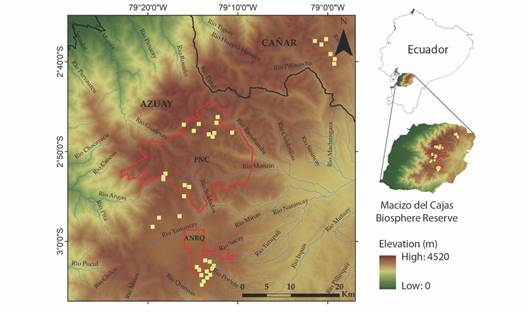
Fig. 1 Study area and location of 36 transects for vegetation sampling in the páramo landscape of the Macizo del Cajas Biosphere Reserve, Southern Andes of Ecuador. The yellow squares represent the central coordinate of each 1 km transect. The red polygons are the protected areas within the reserve (PNC = Cajas National Park. ANRQ = Quimsacocha National Recreation Area). / Fig. 1. Área de estudio y ubicación de los 36 transectos para el muestreo de vegetación en el paisaje de páramo de la Reserva de la Biosfera Macizo del Cajas, sur de los Andes de Ecuador. Los cuadrados amarillos representan la coordenada central de cada transecto de 1 km. Los polígonos rojos son las áreas protegidas dentro de la reserva (PNC = Parque Nacional Cajas. ANRQ = Área Nacional de Recreación Quimsacocha).
The study area has an elevation range between 3 600 and 4 050 m. The vegetation is dominated by tussock grasses of species of Calamagrostis and Festuca with cushion plants and rosette species, such as Plantago and Oreobolus, in smaller humid areas (Minga et al., 2016; Sklenár et al., 2005). In more heterogeneous páramo, the vegetation is associated with native shrub species mainly of the family Asteraceae such as Chuquiraga jussieui J.F. Gmel, Monticalia arbutifolia (Kunth) C. Jeffrey, Gynoxys miniphylla Cuatrec. (Ansaloni et al., 2022; Baquero et al., 2004; Minga et al., 2016; Neill, 1999). In addition, the páramo is interspersed with patches of Polylepis woodlands (Astudillo et al., 2020; Pinos, 2020). The main human activity is livestock grazing associated with burning to enhance pasture (Astudillo et al., 2017) with evident negative effects on páramo habitats (e.g., less complex habitat structure with lower plant diversity).
Vegetation sampling: We randomly established, in a suitable area (i.e., avoiding extreme slopes or mountain tops), 36 transects across protected areas and surrounding zones within the páramo ecosystem (Fig. 1). Each transect was 1 km in length and spaced at least 400 m apart and located in páramo habitats (e.g., páramo grassland, shrubby páramo, cushion páramo). All sampling was carried out between April 2017 and November 2019.
We used the vegetation sampling protocol provided by Astudillo et al. (2017), Astudillo et al. (2019) and Barros et al. (2020). These protocols have been widely used in monitoring páramo habitats and woody plants across the regional páramo. Thus, along each transect, ten circular plots with a radius of 12 m were installed, covering a total sampling area of 452.39 m². These plots were regularly spaced 100 m apart. In each circular plot, the proportion of two habitat types was visually estimated (Fig. 2): (i) páramo grassland (Fig. 2A), a natural open habitat with herbaceous vegetation (Ansaloni et al., 2022; Barros et al., 2020; Hofstede et al., 2002) dominated by tussock grasses, including species of Calamagrostis, Festuca, and Stipa, as well as cushion and bog plants, such as Azorella, Oreobolus, and Plantago (Beltrán et al., 2009; Minga et al., 2016) and (ii) disturbed area (Fig. 2B), defined as human-modified habitat with signs of paths, trails, exotic plants (e.g., Pinus sp., Polylepis racemosa Ruiz & Pav.), burns, evidence of livestock grazing (e.g., feces), and eroded soils. Additionally, within each circular plot, we established four 12 m sub-transects, oriented along the cardinal directions. Along each sub-transect, we sampled the vegetation by counting and identifying shrubs (< 3 cm diameter at breast height (DBH)) and trees (> 3 cm DBH) touched by an observer walking with arms extended along the transect.
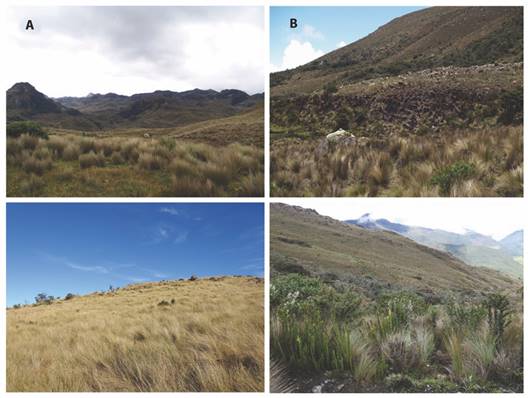
Fig. 2 Examples of photos of vegetation monitored in the páramo landscape of Macizo del Cajas Biosphere Reserve. We present two examples per habitat (upper and lower panels): A. A less human disturbed páramo grassland (e.g., without evidence of burns and grazing) located inside of Cajas National Park. B. A more human disturbed páramo grassland (e.g., with evidence of burns and eroded soils resulting in more presence of certain faster growing woody plants) located outside of the national system of protected areas. All habitat examples are located at the relatively same elevation (~3 750 m.a.s.l.). / Fig. 2. Fotos de ejemplo de la vegetación monitoreada en el paisaje de páramo de la Reserva de la Biósfera Macizo del Cajas. Presentamos dos ejemplos por hábitat (paneles superior e inferior): A. Un páramo herbáceo menos alterado por el humano (e.g., sin evidencia de quemas y pastoreo) localizado dentro del Parque Nacional Cajas. B. Un páramo herbáceo más alterado por el humano (e.g., con evidencia de quemas y de suelo erosionado que resulta en una mayor presencia de ciertas plantas leñosas de crecimiento rápido) localizado fuera del sistema nacional de áreas protegidas. Todos los hábitats de ejemplo están localizados relativamente a la misma elevación (~3 750 m.s.n.m.).
Data analysis: In order to evaluate the adequacy of the sampling effort, a species-accumulation curve was used based on the total abundance of shrubs, bushes and trees recorded across all transects (n = 36). We used rarefaction to standardize the observed richness (Colwell et al., 2012). The Chao 1 estimator was calculated based on 1 000 random permutations (Chao, 1984) to evaluate whether the observed richness was representative of the regional diversity (Colwell et al., 2012).
Community ordination: We used a non-metric multidimensional analysis (NMDS) to explore differences in the composition of woody plant species (2D solution). The NMDS used Bray-Curtis dissimilarity with the total abundance of shrub, bushes and tree species recorded across the 36 transects (i.e., samples). Samples closer in the ordination represent less dissimilarity in vegetation composition. In order to investigate differences in the community, the average the proportion of páramo grassland, the proportion of disturbed area, as well as the mean elevation (meters above the sea level) per transect were post-hoc linearly fitted and their significance was tested via random permutations (1 000 iterations). Correlations among the predictors (proportion of páramo grassland, proportion of disturbed area and elevation) were evaluated. We found a negative correlation between the proportion of disturbed area and the proportion of páramo grassland (R = -0.77). Consequently, to obtain an approximation of the ‘proportion of the páramo grassland’ independent of the proportion of the disturbed area, we performed a linear model on páramo grassland with disturbed area as a predictor and used the residuals as the predictor variable. Therefore, all predictors showed no correlation (R-range = -0.28 to 0.17). All analyses were carried out in R 4.4.1 (R Core Team, 2024). For estimators and species accumulation curves we used the ‘iNext’ package (Chao et al., 2024), while for community ordination we used the ‘vegan’ package (Oksanen et al., 2024).
Results
In total, we recorded 13 377 woody plants. The records are grouped in 29 species, 17 genera and 10 families (Table 1). The most abundant species was Hypericum aciculare Kunth (Hypericaceae) (22 %) followed by M. arbutifolia (Asteraceae) (12 %), Loricaria thuyoides (Lam.) Sch. Bip. (Asteraceae) (11 %), Diplostephium rupestre (Kunth) Wedd. (Asteraceae) (7 %) and Monticalia vaccinioides (Kunth) C. Jeffrey (Asteraceae) (6 %) (Table 1). The proportion of páramo grassland ranged from 30 % to 88 % (mean = 63 %) and the proportion of disturbed areas ranged from 0 % to 45 % (mean = 20 %) (Table 2).
Table 1 Total abundance and codes of woody plant species recorded across 36 transects located in the páramo landscape of the Macizo del Cajas Biosphere Reserve, Southern Andes of Ecuador / Tabla 1. Abundancia total y códigos de las especies leñosas registradas a través de 36 transectos ubicados en el paisaje de páramo de la Reserva de la Biosfera Macizo del Cajas, sur de los Andes de Ecuador.
| Family | Scientific name | Species code | Abundance |
| Asteraceae | Baccharis tricuneata (L. f.) Pers. | BATR | 476 |
| Chuquiraga jussieui J.F. Gmel. | CHJU | 660 | |
| Diplostephium oblanceolatum S.F. Blake | DIOB | 402 | |
| Diplostephium rupestre (Kunth) Wedd. | DIRU | 900 | |
| Diplostephium ericoides (Lam.) Cabrera | DIER | 178 | |
| Diplostephium glandulosum Hieron. | DIGL | 45 | |
| Gynoxys miniphylla Cuatrec. | GYMI | 789 | |
| Gynoxys cuicochensis Cuatrec. | GYCU | 188 | |
| Gynoxys baccharoides (Kunth) Cass. | GYBA | 19 | |
| Loricaria thuyoides (Lam.) Sch. Bip. | LOTH | 1 420 | |
| Monticalia arbutifolia (Kunth) C. Jeffrey | MOAR | 1 637 | |
| Monticalia vaccinioides (Kunth) C. Jeffrey | MOVA | 864 | |
| Monticalia andicola (Turcz.) C. Jeffrey | MOAN | 76 | |
| Monticalia empetroides (Cuatrec.) C. Jeffrey | MOEM | 137 | |
| Berberidaceae | Berberis lutea Ruiz & Pav. | BELU | 101 |
| Berberis rigida Hieron. | BERI | 43 | |
| Caprifoliaceae | Valeriana microphylla Kunth | VAMI | 753 |
| Valeriana hirtella Kunth | VAHI | 64 | |
| Ericaceae | Pernettya prostrata (Cav.) Sleumer | PEPR | 41 |
| Grossulariaceae | Ribes lehmannii Jancz. | RILE | 73 |
| Hypericaceae | Hypericum aciculare Kunth | HYAC | 2 964 |
| Hypericum quitense R. Keller | HYQU | 221 | |
| Melastomataceae | Brachyotum jamesonii Triana | BRJA | 767 |
| Miconia salicifolia Bonpl. ex Naudin | MISA | 267 | |
| Polygalaceae | Monnina crassifolia (Bonpl.) Kunth | MOCR | 46 |
| Rosaceae | Hesperomeles obtusifolia (Pers.) Lindl. | HEOB | 21 |
| Polylepis reticulata Hieron. | PORE | 111 | |
| Polylepis incana Kunth | POIN | 56 | |
| Rubiaceae | Arcytophyllum vernicosum Standl. | ARVE | 58 |
Table 2 Locality name, transect code, average proportions (see methods) of páramo grassland as well as disturbed area and mean elevation of the 36 transects located in the páramo landscape of the Macizo del Cajas Biosphere Reserve, Southern Andes of Ecuador / Tabla 2. Nombre de la localidad, código de los transectos, el promedio de las proporciones (véase los métodos) de páramo herbáceo así también de área alterada y la elevación media en los 36 transectos ubicados en el paisaje de páramo de la Reserva de la Biósfera Macizo del Cajas, sur de los Andes de Ecuador.
| Locality | Transect code | Páramo grassland (%) | Disturbed area (%) | Elevation (m) |
| Bermejos | BER001 | 80.5 | 12.3 | 3 794 |
| Bermejos | BER002 | 74.4 | 14.05 | 3 842 |
| Bermejos | BER003 | 75.31 | 14.9 | 3 795 |
| Burgay | BUR001 | 63.3 | 17.9 | 3 627 |
| Burgay | BUR002 | 67.6 | 25.1 | 3 818 |
| Burgay | BUR003 | 62.2 | 20.4 | 3 754 |
| Dublaicocha | DUB001 | 30.05 | 27.85 | 3 840 |
| Dublaicocha | DUB002 | 38.6 | 30.25 | 3 876 |
| Dublaicocha | DUB003 | 46.35 | 30.75 | 3 842 |
| Galgal | GAL001 | 53.8 | 36.7 | 3 767 |
| Galgal | GAL002 | 44.6 | 44.95 | 3 730 |
| Galgal | GAL003 | 42.25 | 46 | 3 684 |
| Miguir | MIG001 | 30.43 | 30.67 | 3 803 |
| Miguir | MIG002 | 66.1 | 9.3 | 4 049 |
| Miguir | MIG003 | 64.8 | 13.02 | 3 929 |
| Patococha | PAT001 | 58.35 | 28.85 | 3 910 |
| Patococha | PAT002 | 66.3 | 18.35 | 3 803 |
| Patococha | PAT003 | 61.5 | 25.3 | 3 812 |
| Rircay | RIR001 | 67.7 | 11.4 | 3 759 |
| Rircay | RIR002 | 75.35 | 9.73 | 3 782 |
| Rircay | RIR003 | 74.4 | 11.3 | 3 685 |
| Santa Ana | SAN001 | 65.25 | 24.85 | 3 787 |
| Santa Ana | SAN002 | 62.6 | 13.9 | 3 704 |
| Santa Ana | SAN003 | 62.2 | 31.2 | 3 797 |
| Taitachugo | TAI001 | 62.5 | 13.1 | 4 032 |
| Taitachugo | TAI002 | 57.9 | 16.2 | 3 941 |
| Taitachugo | TAI003 | 81.8 | 9.3 | 3 919 |
| Tarqui | TAR001 | 84.6 | 11.75 | 3 998 |
| Tarqui | TAR002 | 60.6 | 17.1 | 3 646 |
| Tarqui | TAR003 | 82.9 | 0 | 3 789 |
| Tomebamba | TOM001 | 71.78 | 10.5 | 3 809 |
| Tomebamba | TOM002 | 87.83 | 2.8 | 3 909 |
| Tomebamba | TOM003 | 50.25 | 23.7 | 3 733 |
| Ventanas | VEN001 | 53.3 | 25.35 | 3 841 |
| Ventanas | VEN002 | 62.85 | 7.74 | 3 865 |
| Ventanas | VEN003 | 63.75 | 23.5 | 3 898 |
The species accumulation curve reached its asymptote (Fig. 3), indicating that the sampling effort was sufficient and therefore, representative of the richness within the study area. Furthermore, the observed richness was the same as the estimated richness (observed richness = 29; Chao 1 estimator = 29).
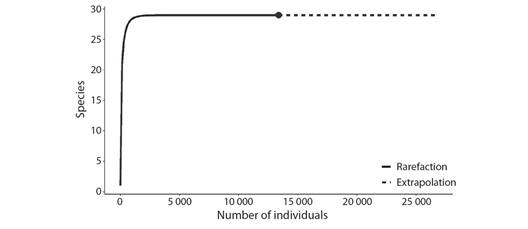
Fig. 3 Species-accumulation curve of woody plant species recorded in 36 transects located in the páramo landscape of the Macizo de Cajas Biosphere Reserve, Southern Andes of Ecuador. The solid line represents the accumulation of observed species via rarefaction. The dashed line shows the Chao 1 estimation. / Fig. 3. Curva de acumulación de especies de plantas leñosas registradas en 36 transectos ubicados en el paisaje de páramo de la Reserva de la Biósfera Macizo de Cajas, sur de los Andes de Ecuador. La línea continua representa la acumulación de especies observadas a través de rarefacción. La línea discontinua muestra la estimación Chao 1.
Community composition of woody plant species: The NMDS analysis showed a tendency to separate the woody plant community in relation to the proportion of disturbed area (2D solution, stress = 0.2, R 2 = 0.33, p < 0.001) (Fig. 4), while the proportion of páramo grassland (R 2 = 0.07, p =0.32) and elevation (R 2 = 0.10, p < 0.16) were not significant. Transects with a higher proportion of disturbed area were situated towards the central-bottom of the ordination, and were associated with a greater presence of D. ericoides, H. quitense, V. microphylla and Valeriana hirtella Kunth., and transects with a lower proportion of disturbed area were located towards the central-top of the plot, and were associated with a greater presence of M. arbutifolia, G. miniphylla, M. vaccinioides and, Hesperomeles obtusifolia (Pers.) Lindl. (Fig. 4).
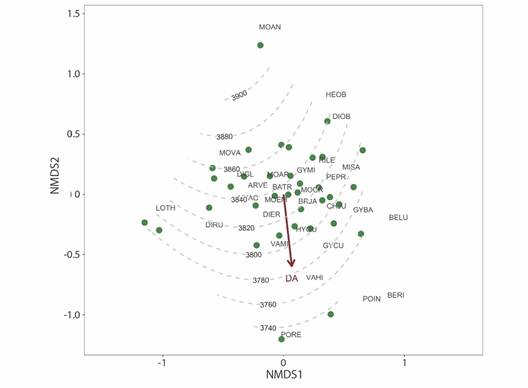
Fig. 4 Non-metric multidimensional scaling (NMDS) of the community of woody plant species recorded across 36 transects (green circles) located in the páramo landscape of the Macizo del Cajas Biosphere Reserve, Southern Andes of Ecuador. The red arrow represents the proportion of disturbed area (DA) as the environmental variable significantly influencing the ordination (p < 0.001). The elevation (contour lines) is also shown, although it is not significant (p > 0.05). The four-letter codes are the scientific names of the woody plant species (see Table 1). / Fig. 4. Escalamiento multidimensonal no métrico (NMDS) para la comunidad de plantas leñosas registradas a través de 36 transectos (círculos verdes) ubicados en el paisaje de páramo de la Reserva de la Biósfera del Macizo del Cajas, sur de los Andes del Ecuador. La flecha roja representa la proporción del área alterada (DA) como una variable ambiental que influye significativamente en la ordenación (p < 0.001). La elevación (curvas de nivel) también se muestra, aunque no influye significativamente (p > 0.05). Los códigos de cuatro letras son los nombres científicos de las especies de plantas leñosas (véase Tabla 1).
However, we included elevation in the ordination plot (via contour lines) as it followed the same tendency as disturbed area (i.e., from the central-top to the central-bottom of the ordination) (Fig. 4). This facilitates the interpretation of the spatial distribution of the transects and the description of woody plant species associations in relation to elevation. Thus, from ~3 800 m to ~4 000 m (in the central-top of the ordination) there is greater prevalence of Diplostephium oblanceolatum M. arbutifolia, M. vaccinioides, H. obtusifolia and Monticalia andicola (Turcz.) C. Jeffrey., while at lower elevations (i.e., from ~3 600 to 3 800 m) (in the central-bottom of the ordination) the woody plant community is associated with more presence of D. ericoides, V. microphylla, H. quitense and V. hirtella (Fig. 4).
Discussion
Our findings showed significant changes in the composition of the woody plant community along the increasing proportion of disturbed areas in the monitored transects. The proportion of páramo grassland and elevation did not affect the plant composition. Dense shrub species such as V. microphylla, H. quitense and V. hirtella were more dominant in transects with higher proportions of disturbed areas. Smaller shrub species such as M. arbutifolia, M. vaccinioides and H. obtusifolia are associated with transects with less disturbance. These changes in the plant composition of the páramo ecosystem suggests that the greater prevalence of some dense and fast-growing woody plant species is a response to human disturbance and could indicate that the native herbaceous species are gradually replaced by woody encroachment, particularly in human-accessible páramos.
Our approximation of the distribution of the woody plant community reveals that dense shrubs (e.g., H. quitense) are frequently observed in groups characterized as dwarf scrub and are adapted to rocky outcrops and hills where the evidence of human disturbance is higher. In fact, some Hypericum species are reported as opportunistic species that recover quickly after human disturbance such as fires (Matson & Bart, 2014). Their presence here may be related to an increasing cover of shrubs and a reduction in the cover of native grasses (e.g., Renison et al., 2006) due to human disturbance reducing the dominance of the tussock grasses and providing more opportunity for fast-growing woody plants (Sylvester et al., 2017).
In general, across the small valleys in the study region, páramo grassland is often associated with shrubby plants (Hofstede et al., 2002; Minga et al., 2016) creating a botanically and structurally diverse páramo (Gareca et al., 2010; Hofstede et al., 2002). However, woody encroachment is a common effect in disturbed grassland systems, including high elevation grasslands such as páramo (Matson & Bart, 2014). Our results, controlling for the proportion of the disturbed area, highlight that some transects are still characterized by a greater presence of woody plants such as H. quitense, V. hirtella and V. microphylla. Besides, more human accessible páramos (e.g., close to roads, lower elevations, outside of protected areas) are more prone to habitat disturbance such as fires and livestock grazing leading to less availability of native tussock grasses as well as cushion and bog plants. Consequently, in unprotected páramos of the study region, the native grasses are more sensitive to human disturbance (Astudillo et al., 2017; Hofstede & Llambí, 2020). Here, our findings suggest that fast-growing woody plant species are fostering changes in the plant community leading to more complex páramos (e.g., height profile vegetation) but with less availability of open habitats such as tussock grasses and cushion bogs.
A potential explanation for the pattern of woody plant species dispersal into the páramo grassland is the proximity to the tree line of Andean forests (Matson & Bart, 2013) across the lower páramo. In the study region, large and dense shrubs such as V. hirtella and V. microphylla are commonly found in the tree line of Andean forests and Polylepis woodlands (Minga et al., 2016). The frequent association of forest plants with herbaceous flora of páramo ecosystems has been reported previously (Domic & Capriles, 2021; Montalvo et al., 2018; Quispe-Melgar et al., 2020) and indeed, some native shrubs have been found to be positively associated with greater habitat complexity of páramos surrounding Polylepis forest within the Cajas National Park (Astudillo et al., 2019; Astudillo et al., 2020). However, as with other disturbance scenarios found outside the limit of protected areas (Caballero-Villalobos et al., 2021; Toivonen et al., 2011), our results highlight that some woody plant species are becoming more dominant. Within this framework, conservation and restoration efforts across the páramo should consider the dynamics between shrubs and other fast-growing plants with native grasses.
Conservation implications: In the high Andes, the restoration of disturbed habitats has been based on the importance of woody plant species for important pollinators (i.e., hummingbirds) (Cárdenas-Calle et al., 2020; Crespo et al., 2022; Hazlehurst et al., 2016) with a few shrubby plant species being identified as central for the restoration of high Andean ecosystems (Crespo et al., 2022). However, some of these identified woody plant species are characterized by faster growing strategies (i.e., year-round flowering) (e.g., Cárdenas-Calle et al., 2020; Hazlehurst et al., 2016) and are already widely distributed between the limit of Andean forests and the páramo ecosystem (Minga et al., 2016; Suárez et al., 2022). Furthermore, mutualistic interactions in disturbed páramos, such as seed dispersal by birds, are seen as a mechanism that facilitates increasing cover of shrubby plant species and subsequent woody encroachment (Matson & Bart, 2013; Matson & Bart, 2014). In consequence, habitat restoration focused on fast-growing plants may promote an acceleration of woody encroachment in human-accessible páramos with evident negative effects on native grasses and organisms that depend on more open páramo grassland habitats. Further studies are needed in order to generate conservation strategies more compatible to the páramo region. For instance, in open páramos of the study region, small, endemic rodents (e.g., Phyllotis haggardi) have been observed foraging on flowers of herbaceous species (i.e., Taraxacum officinale (Weber), Xenophyllum humile (Kunth) V.A. Funk and Eryngium humile Cav.) and are considered as potential pollinators (Nivelo-Villavicencio et al., 2021). Our findings indicate that the availability of páramo grassland habitats is declining in disturbed areas, while the presence of fast-growing shrubs is increasing. This ecological information could be crucial for improving restoration and conservation efforts aimed at enhancing the availability of páramo grasslands.
Ethical statement: The authors declare that they all agree with this publication and made significant contributions; that there is no conflict of interest of any kind; and that we followed all pertinent ethical and legal procedures and requirements. All financial sources are fully and clearly stated in the acknowledgments section. A signed document has been filed in the journal archives.

