




 Inglês (pdf)
 Artigo em XML
 Referências do artigo

 Tradução automática
 Enviar este artigo por email
 Citado por SciELO
 Similares em
SciELO
 uBio

 Permalink


Introduction
Lac resin is the unique and versatile resin of insect origin secreted by the lac insects belonging to Kerria spp. Uses of this unique animal resin encompass many fields, such as food, cosmetics, pharmaceutics, electrical appliances, printing ink, machinery, leather, plastics, ethnic jewelry, varnishes, paints, adhesives, perfumes, etc. (Siddiqui, 2004). Lac resin is a polyester complex comprising straight-chain fatty acids and sesquiterpenic acids linked by ester and lactide bonds (Sharma et al., 1983). Lac resin is characterized by adhesiveness on a wide range of surfaces; good electrical insulation properties; and resistance to moisture, corrosion, ultraviolet radiation, oil, and acid. Besides these characteristics, it is also a thermoplastic with a thermosetting nature (Sharma et al., 2020).
The value of the global shellac market was 167.84 million USD in 2022 and will reach 191.8 million USD in 2028, with a CAGR of 2.25 % during 2022-2028 (Industry Research, 2025).
United States Food and Drug Administration recognizes shellac as GRAS (Generally Regarded as Safe) and approves it as a food additive. European Food Safety Authority (EFSA) has given E 904 to shellac. Since lac resin is a natural product, it is assumed that it is biodegradable. On the other hand, it is also observed that shellac-coated objects are durable and resist microbial attack. Hence, it is imperative to study the rate of biodegradation of lac resin and microbes involved in its biodegradation, and the fate of soil bacteria when lac is disposed of in the soil.
Aleuritic acid is the most abundant fatty acid present in lac resin which is used extensively in cosmetics and pharmaceutical industries. Aleuritic acid is manufactured in the industries from shellac by alkaline hydrolysis method, by isolating its sodium salt by saponification, followed by decomposition of the salt to obtain free acid (Agarwal et al., 1988). It has been reported that out of 36 % of aleuritic acid present in lac resin, only 25 % of it could be recovered using alkaline hydrolysis method (Anees, 2016). A large amount of aleuritic acid remains unrecovered or degraded in this process. Biological hydrolysis employing microbes may help in increasing the yield of aleuritic acid from lac resin, quantitatively as well as qualitatively. Biological hydrolysis will also contribute to the release of other constituent acids such as jalaric acid, a principle sesquiterpenic acid, and other minor acids. Soil could be an efficient source of microbes that can hydrolyze lac resin and yield constituent acids.
A study of the soil metagenome of the control soil and lac sample buried soil sites would give us an idea about the different groups of bacteria present in each sample. Knowing their identity is the foremost criterion that would reveal the groups of bacteria having the potential to degrade lac resin. Metagenomics is the power of genomic analysis that is applied to entire communities of microbes, bypassing the need to isolate and culture individual microbial species (Handelsman, 2004). Metagenomics employs the molecular-based taxonomic investigation of bacteria by direct sequencing of PCR-amplified small sequences of 16S rRNA gene from extracted DNA. This approach allows the identification of new species and the investigation of low-abundance and uncultivated bacteria from a single analysis. In addition, they are faster and more accurate compared with classical identification methods.
No previous studies are available that focus on the safety of lac resin in terms of soil bacterial diversity. A study on the biodegradation of lac resin by soil burial method was undertaken by burying seedlac in the soil. Moreover, by comparing the microbial diversity of control and lac-buried soil the effect of lac on environmental safety could be assessed. Hence, in this study, seedlac buried soil samples were subjected to metabarcoding using 16S rRNA bacterial markers to find the fate of bacterial diversity in the soil due to lac exposure to assess the safety of lac resin to soil fauna, especially the soil bacteria.
Materials and methods
Seedlac preparation, soil burial, and sample collection: Kusmi sticklac (phunki) was procured from the Institute Research Farm (IRF) of ICAR-National Institute of Secondary Agriculture (ICAR-NISA), Ranchi, India. It was converted to seedlac through soda washing and cleaned thoroughly to remove any impurities from the samples. Seedlac samples were covered in synthetic mesh sleeve and buried in the soil (sandy loam soil with pH 4.5-5.0) at 1.5 ft depth on 17.6.2016 at IRF (23º19’51.2’’N & 85º22’06.3’’E). Similarly, the seedlac samples were also buried in the pot containing pot mixture (soil: sand: farm yard manure in the ratio 2 : 1 : 1) for 3 years. Control and soil-buried seedlac samples are shown in Fig. 1. Soil adhering to the seedlac samples was collected carefully in the sterile tube and stored at -80 ºC till further processing.
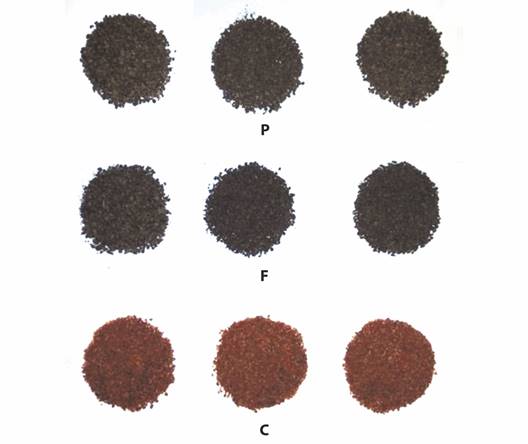
Fig. 1 Seedlac samples after 3 years of burial. P: Buried in pot soil; F: Buried in field soil and C: control seedlac.
Genomic DNA and PCR amplification of 16S ribosomal V3-V4 region: Genomic DNA was extracted from the soil samples using Qiagen DNeasy PowerSoil Kit (Qiagen, Germany) according to the manufacturer’s instructions. DNA concentration was estimated using Qubit Fluorimeter (V.3.0). V3-V4 region of 16S rRNA was amplified using specific V3 Forward primer Pro341F- 5’ CCTACGGGNBGCASCAG 3’ and V4 Reverse primer Pro805R- 5’ GACTACNVGGGTATCTAATCC 3’ (Takahashi et al., 2014). PCR was carried out in 25 μl reaction volume containing 30 ng template DNA, 200 μM dNTPs, 2 U Taq DNA polymerase and 10 μM of the forward and reverse primers. PCR conditions included initial denaturation at 95 °C for 30 s, followed by 35 cycles at 95 °C for 10 s, 56 °C for 15 s, 68 °C for 30 s, with a final extension step at 68 °C for 5 min. The amplified PCR products (~460 bp) from each sample were run on 1 % agarose gel and were subjected to gel extraction using GeneJet purification kit. The purified samples were quantified using Nanodrop spectrophotometer (Thermo Fisher).
Library preparation and 16S amplicon sequencing: Five nanograms of amplified products were used for library preparation using Next Ultra DNA library preparation kit (NEB) according to the manufacturer’s instructions. The library quantification and quality estimation were done in Agilent 2 200 TapeStation. PCR products with unique indices from each library were taken in equal (~2 ng) quantities and subjected to 250 paired-end multiplex sequencing using Illumina HiSeq 2 500 platform (Agrigenome Labs Private Limited, Cochin, India).
Initial processing and bioinformatics analysis of sequence reads: Raw reads obtained from the Illumina sequencing platform after Demultiplexing were subjected to the FastQC program (Version 0.11.8) to check the quality of the reads with default parameters. Base quality (Phred Score; Q), base composition, GC content, ambiguous bases (other than A, T, G, C), and adapter dimers were thoroughly checked before the Bioinformatics analysis. The forward V3 and reverse V4 specific primers were trimmed using the in-house PERL script. Properly paired-end reads with Phred score quality (Q > 20) were considered for V3-V4 consensus generation. Primer trimmed, high-quality paired-end reads were pair-wisely allowed to merge/stitch to get the V3-V4 amplicon consensus FASTA sequences. The reads were merged using FLASH program (Version 1.2.11) with a minimum overlap of 10 bp to a maximum overlap of 240 bp with zero mismatches. While making consensus of V3-V4 sequences, all consensus reads formed were with an average contig length of 350 to 450 bp. Chimeras were removed using the de-novo chimera removal method UCHIME (Version 11) implemented in the tool VSEARCH.
Operational Taxonomic Units (OTUs) picking and taxonomy classification were performed using the pre-processed consensus V3-V4 sequences. Pre-processed reads from all samples were pooled and clustered into OTUs based on their sequence similarity using Uclust program (similarity cutoff = 0.97) available in QIIME software. QIIME1 program (Version 1.9.1) was used for the entire downstream analysis (Caporaso et al., 2010). Representative sequences from each clustered OTU were picked and aligned against the SILVA core set of sequences using the PyNAST program. Further, taxonomy classification was performed using an RDP classifier by mapping each representative sequence against the SILVA OTUs database. The sequences that do not have any alignment against the taxonomic database are categorized as Unknown.
Statistical analysis: Rarefaction analysis and alpha diversity index (Shannon, Chao1, and observed species metrics) were used to estimate the differences in microbial communities between different samples used in the present study.
Results
Soil sample collection, DNA isolation, and PCR: Seedlac samples were buried in the soil (field soil and in pot soil) at the Institute Research Farm of ICAR-NISA, Ranchi, India. Significant weight loss (23-29 %) was observed for the buried seedlac samples after three years (unpublished data from our lab). Besides weight loss, the colour index of the buried samples was increased. One of the important physicochemical properties, flow (fluidity) of the seedlac samples became zero in just 12 months while the control samples showed fluidity up to 33-36 months. These parameters pointed out that the buried seedlac samples were undergoing biodegradation. Hence, the soil samples adhering to the seedlac were used in this study to analyze the bacterial metagenome.
DNA was isolated from different soil samples (control and seedlac buried field soil samples; control and seedlac buried pot soil samples). A 460 bp fragment of the hypervariable V3-V4 region of 16S rRNA gene was PCR amplified from isolated DNA using specific universal primers. The amplified product was checked on 2 % agarose gel and quantified using Nanodrop and Qubit. To check their quality, the OD 260 / 280 ratio was calculated and found to be ranged from 1.68 to 1.89.
Analysis of Illumina-HiSeq raw reads: Libraries (of V3-V4 region) prepared from 460 bp PCR-amplified fragments yielded raw reads ranging from 340 729 to 558 260 in the Illumina platform. Details about raw reads and QC of various samples are given in Table 1. In the pot burial experiment, Phred scores of more than 30 and 20-30 were obtained for ~87 % and 4 % of the sequences, respectively. In the field burial experiment, Phred scores of more than 30 and 20-30 were obtained for ~86 % and 5 % of the sequences, respectively. Raw data obtained from this study has been submitted to the NCBI Sequence Read Archive (SRA) under accession number PRJNA760653.
Table 1 Read particulars of all the samples used in the study.
| Sl. no | Sample | Run | Read orientation | Mean read quality (phred score) | Number of reads | % GC | %Q < 10 | %Q 10-20 | % Q 20-30 | % Q > 30 | Number of bases (MB) | Mean read length (bp) |
| Pot Soil Burial Experiment | ||||||||||||
| 1 | CONTROL-POT1 | R1 | 36.75 | 543 784 | 56.85 | 0.04 | 4.82 | 4.01 | 91.13 | 135.95 | 250.0 | |
| R2 | 34.05 | 543 784 | 53.7 | 5.13 | 6.61 | 4.9 | 83.36 | 135.95 | 250.0 | |||
| 2 | SEED-LAC-POT-1 | R1 | 36.76 | 534 150 | 57.28 | 0.04 | 4.81 | 4.03 | 91.12 | 133.54 | 250.0 | |
| R2 | 32.71 | 534 150 | 54.14 | 5.23 | 9.88 | 6.92 | 77.96 | 133.54 | 250.0 | |||
| 3 | SEED-LAC-POT-2 | R1 | 36.81 | 471 047 | 57.27 | 0.04 | 4.58 | 3.98 | 91.4 | 117.76 | 250.0 | |
| R2 | 32.72 | 471 047 | 54.16 | 5.17 | 9.95 | 6.96 | 77.92 | 117.76 | 250.0 | |||
| Field Soil Burial Experiment | ||||||||||||
| 1 | CONTROL-FIELD-1 | R1 | 36.72 | 558 260 | 57.56 | 0.04 | 4.75 | 4.17 | 91.05 | 139.56 | 250.0 | |
| R2 | 32.87 | 558 260 | 54.42 | 5.27 | 9.34 | 6.75 | 78.64 | 139.56 | 250.0 | |||
| 2 | CONTROL-FIELD-2 | R1 | 36.64 | 379 335 | 57.47 | 0.04 | 5.04 | 4.16 | 90.77 | 94.83 | 250.0 | |
| R2 | 32.57 | 379 335 | 54.41 | 5.04 | 10.54 | 7.26 | 77.16 | 94.83 | 250.0 | |||
| 3 | SEED-LAC-FIELD-1 | R1 | 36.7 | 470 104 | 57.1 | 0.04 | 4.91 | 4.08 | 90.97 | 117.53 | 250.0 | |
| R2 | 32.5 | 470 104 | 53.95 | 5.12 | 10.71 | 7.27 | 76.9 | 117.53 | 250.0 | |||
| 4 | SEED-LAC-FIELD-2 | R1 | 36.88 | 340 729 | 57.01 | 0.04 | 4.46 | 3.85 | 91.65 | 85.18 | 250.0 | |
| R2 | 32.8 | 340 729 | 53.81 | 5.25 | 9.7 | 6.73 | 78.32 | 85.18 | 250.0 | |||
Pot Burial Experiment Results: After removing primer containing sequences, possible adapter sequences, low-quality reads, and unique dual index barcode sequences containing 5-7 nucleotides, duplicates, and chimeras, from the raw reads, a total of 582 034 preprocessed consensuses were obtained for control pot soil and seedlac buried pot soil samples. A total of 10118 OTUs at a confidence limit of 0.8 were obtained for the pot experiment samples. The representative sequences from each clustered OTUs were aligned and taxonomy classification was performed against the SILVA database (Fig. 2).
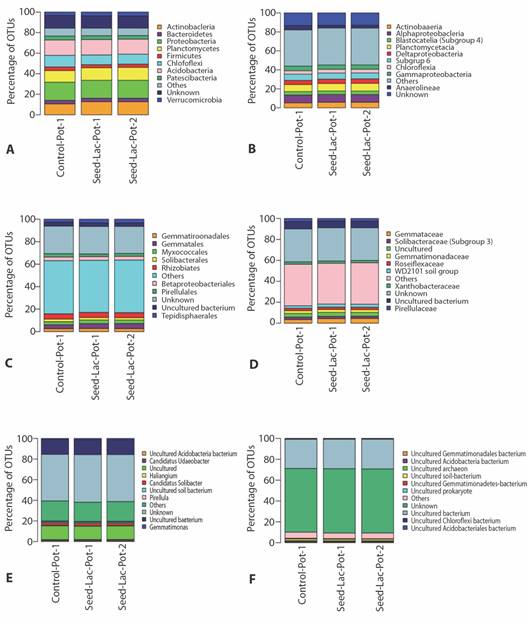
Fig. 2 Relative abundance of OTUs at different taxa levels for pot soil burial experiment A. phylum level; B. Class level; C. Order level; D. Family level; E. Genus level; F. Species level.
Results showed that most of the phylum, class, order, genus, and species OTUs were unknown. Besides them, the most abundant phylum OTUs were Proteobacteria and Acidobacteria in control and seedlac buried pot soil samples. The count of Actinobacteria was marginally higher in seedlac-buried pot soil, whereas the counts of Firmicutes and Chloroflexi were marginally lesser in seedlac-buried pot soil. The most abundant class OTUs belonged to Alphaproteobacteria and Planctomycetacia classes in both control and seedlac buried pot soil samples. Planctomycetacia counts were slightly higher in the seedlac buried pot soil sample. The most abundant order OTUs were Rhizobiales and uncultured bacterium in control whereas Rhizobiales and Gemmatales were the most abundant order OTUs in control and seedlac buried pot soil samples. Gemmatales and Myxococcales were higher in seedlac buried pot soil when compared with control soil. Gemmataceae and WD2101-soil group family counts were higher in seedlac buried pot soil in comparison with control pot soil. The most abundant genus OTUs included Candidatus-Solibacter and Candidatus-Udaeobacter. In seedlac buried pot soil samples, the genus Candidatus-Udaeobacter and Gemmatimonas were slightly higher than the control. The most abundant species OTUs were uncultured-Acidobacteria-bacterium and uncultured-archaeon in both samples.
Soil Burial Experiment Results: Results showed that most of the phylum, class, order, genus, and species OTUs were unknown. Besides them, the most abundant phylum OTUs were Proteobacteria and Acidobacteria in control and seedlac buried soil samples. The counts of Proteobacteria and Acidobacteria were slightly higher in treated soil when compared with the control soil. The most abundant class OTUs belonged to Planctomycetacia and Alphaproteobacteria classes in control and seedlac buried field soil samples. The most abundant order OTUs were Gemmatales and Rhizobiales in control and seedlac buried soil samples. The count of Betaproteobacteriales was slightly higher in seedlac buried soil samples compared to the control. The Gemmatimonadaceae family was slightly higher, and the family Chthonobacteraceae was less in the seedlac buried soil compared to the control. The most abundant genus OTUs included Candidatus-Solibacter and Candidatus-Udaeobacter. The count of Streptomyces was slightly less in the seedlac buried soil compared to the control soil. The most abundant species OTUs were uncultured-Acidobacteria-bacterium and uncultured-archaeon in both samples (Fig. 3). The unique OTUs in all the seedlac exposed soil samples including pot soils and field soils are majorly either uncultured or unclassified bacteria (Data not shown).
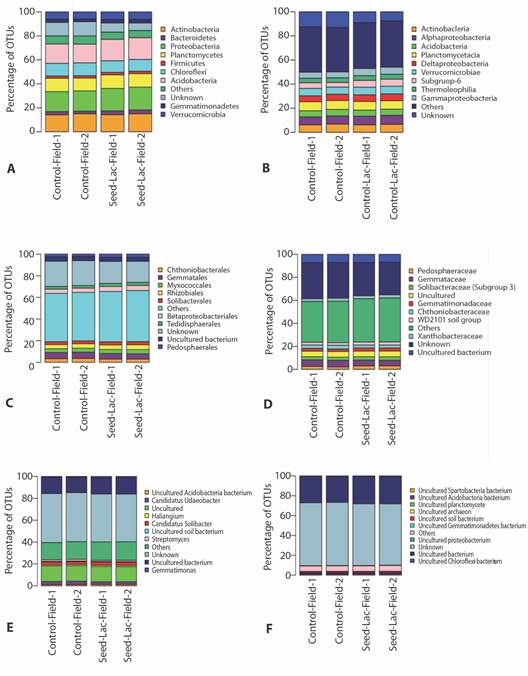
Fig. 3 Relative abundance of OTUs at different taxa levels for field soil burial experiment A. phylum level; B. Class level; C. Order level; D. Family level; E. Genus level; F. Species level.
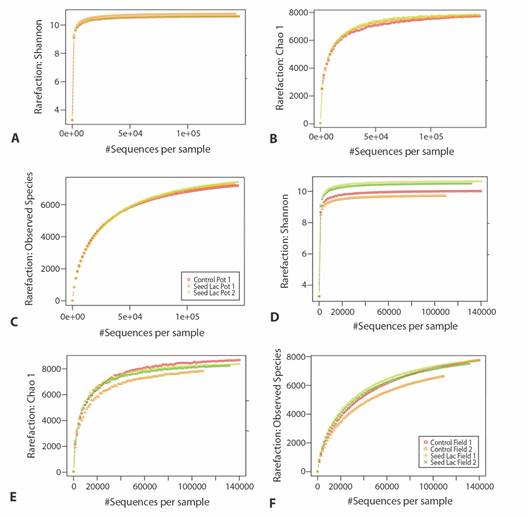
Diversity Indices: In both sets of experiments, the microbial diversity within the samples was analyzed by calculating Shannon, Chao1, and observed species metrics (Fig. 4). There is not much variation in the relative diversity of the bacterial species in all the samples as revealed by the different metrics of rarefaction. However, Shannon indices were slightly higher for seedlac buried field soil samples in comparison with control soil.
Discussion
Biodegradation is a process of degrading any complex material by microbes and converting it into its constituent parts which are environmentally safe and acceptable products. Biodegradation results in physical disintegration and weight loss of the material. Biodegradable polymers are used in various fields such as agriculture, medicine, and packaging. One such polymer is lac resin having applications in all these fields. Lac resin is degradable in the sense that it undergoes degradation in physico-chemical properties due to heat treatment, improper storage, and UV irradiation but degraded lac is not the same as biodegraded lac. It has been reported that lac resin is resistant to microbial and insect attacks and hence is used in the preservation of perishable items. Then, it becomes debatable whether lac resin would undergo biodegradation due to microbial activity or not. Therefore, this study was taken up to explore lac biodegradation and the bacterial players involved in it, and the safety of lac resin to soil microflora. Seedlac was used in this study since it is a semi-refined form of lac apparently without any particles from lac insect or its host plants. Seedlac consists of 88.5 % lac resin, 2.5 % dye, 4.5 % wax, 2.0 % gluten, and 2.5 % impurities (Sharma et al., 2020). Changes in weight, colour, and fluidity were observed for soil-buried seedlac, which suggested that seedlac underwent biodegradation in due course of time. Nonetheless, the fate of soil bacterial diversity due to soil burial of lac resin is the foremost indicator in describing the safety of lac resin to the environment. Hence, soil bacterial diversity in two sets of experiments was explored by metabarcoding to assess the safety of lac resin to the soil vis-a-vis the environment.
Pot burial experiment: Except for a few bacterial taxa, the relative abundance of most of the microbial communities present in control and seedlac buried pot soil were found to be the same (Fig. 2). The count of Actinobacteria in seedlac buried pot soil is more suggesting a role of seedlac decomposition for this phylum (Fig. 2A). Actinobacteria, the phylum of ubiquitous saprophytes can degrade recalcitrant carbon sources, and its role in the decomposition of dead organic matter in the soil is a well-known phenomenon (Anandan et al., 2016). Actinobacteria can thrive well even under oligotrophic conditions and low soil moisture due to their filamentous growth and can degrade poly lactic acid type bioplastic (Butbunchu & Pathom-Aree, 2019). On the other hand, the count of Firmicutes and Chloroflexi were marginally lesser in seedlac buried pot soil (Fig. 2A). In an earlier study, nitrogen addition to the soil also decreased the OTU richness of the phylum Chloroflexi (Zhang et al., 2013), pointing to the sensitive nature of this Phylum for extraneous addition of foreign material to the soil.
The counts of Myxococcales, a soil-dwelling bacterial group that feeds on insoluble organic substances were found to be higher in seedlac buried pot soil (Fig. 2C). The order Gemmatales and the family Gemmataceae within Gemmatales are strictly aerobic, neutrophilic, or mildly acidophilic bacteria, capable of growing on various sugars and polysaccharides, and few of them are capable of degrading chitin and cellulose (Dedysh, 2020). WD2101-soil group family of bacteria under phylum Planctomycetes are also capable of growing on xylan, pectin, starch, lichenan, cellulose, chitin, and polysaccharides of microbial origin due to the presence of versatile hydrolytic capabilities and repertoires of carbohydrate active enzymes such as glycoside hydrolases (Dedysh & Ivanova, 2018). Since the bacterial groups such as Actinobacteria, Myxococcales, Gemmatales, Gemmataceae, WD2101-soil group which are generally involved in the degradation of complex carbohydrate polymers are increased in the seedlac buried pot soil (Fig. 2A, Fig. 2C, Fig. 2D) it may be suggested that the same mechanism of degrading or metabolizing complex carbohydrates may be involved in the biodegradation of lac resin as well.
Field burial experiment: Although the count of Proteobacteria and Acidobacteria were higher in all the soil samples studied, seedlac buried soil had a slight increase in the counts of both these phyla (Fig. 3A). Though the bacterial species under the phylum Proteobacteria and Acidobacteria are physiologically and ecologically diverse, Proteobacteria are important players in carbon, nitrogen, and sulphur cycles in the environment (Kersters et al., 2006), whereas species under Acidobacteria are involved in carbohydrate and nitrogen metabolism (Kielak et al., 2016). We could observe a marginal increase in the classes Gammaproteobacteria (under Proteobacteria) and Subgroup 6 of Acidobacteria in the seedlac buried soil samples (Fig. 3B). Poly (butylene adipate-co-terephthalate) (PBAT) based blend film was shown to be biodegraded by the genus Marinobacter within Gammaproteobacteria (Meyer-Cifuentes et al., 2020). Betaproteobacteriales class and Gemmatimonadaceae family were marginally higher in seedlac-buried soil (Fig. 3B, Fig. 3D). It is intriguing to note that the Gemmatimonadaceae family which are denitrifiers utilizing nitrite (Aanderud et al., 2018) is higher in seedlac buried soil.
On the other hand, Chthoniobacteraceae family and Streptomyces genus were slightly less in the seedlac buried soil (Fig. 3D, Fig. 3E). The decreased count of Streptomyces bacteria having an important role in the turnover of organic material in the soil (Seipke et al., 2012) would suggest that this genus may not be directly involved in lac biodegradation. Although the count of Chthoniobacteraceae at family level is marginally reduced; one of its genera, Candidatus Udaeobacter did not show any difference between control and treated soil (Fig. 3E).
Chao1 metric estimates the species richness while Shannon metric is the measure to estimate observed OTU abundances, and accounts for both richness and evenness. The observed species metric is the count of unique OTUs identified in the sample. The rarefaction curves for each of the metrics reached near plateau for all samples, showing that the sequencing depth and coverage were adequate for all the samples studied (Fig. 4). Shannon indices were slightly more for seedlac buried field soil samples in comparison with control soil revealing a marginal increase in the OTU abundance in the soil buried with seedlac (Fig. 4D).
Lac biodegradation in the soil is expected to start with depolymerization to release oligomers and or monomers probably through esterases or enzymatic hydrolysis. Once the monomers, dimers and oligomers are released, they can be transported into microorganisms for the mineralization process to occur and release water and carbon dioxide. The bacterial groups that are relatively more in the seedlac buried soil samples could be actively involved in the hydrolysis and mineralization of seedlac. Since there are no tremendous changes in the diversity and structure of bacterial microbiome in the soil buried with seedlac, it can be concluded that the seedlac is not detrimental to the soil ecosystem. Earlier studies also showed the safety of shellac for consumption (Srivastava & Thombare, 2017) and for cosmetic purposes (Anonymous, 1986). This is the first report stating that the lac resin is safer for soil bacterial biodiversity and in turn environmental safety.
The scope of fungi in lac biodegradation may also be explored in the future to get a holistic view of the biodegradation process. Co-occurrence network analysis may also prove useful in exploring the players of lac biodegradation.
Since seedlac does not alter the soil bacterial biodiversity it may be largely concluded that lac resin specifically seedlac is safe to the soil microflora vis a vis environment. Our study also indicated that the bacterial groups such as Actinobacteria, Proteobacteria, Acidobacteria, Myxococcales, Gemmatales, Gemmataceae, WD2101-soil group would probably be involved in the biodegradation of seedlac in the soil.
Ethical statement: the authors declare that they all agree with this publication and made significant contributions; that there is no conflict of interest of any kind; and that we followed all pertinent ethical and legal procedures and requirements. All financial sources are fully and clearly stated in the acknowledgments section. A signed document has been filed in the journal archives.

