




 Inglês (pdf)
 Artigo em XML
 Referências do artigo

 Tradução automática
 Enviar este artigo por email
 Citado por SciELO
 Similares em
SciELO
 uBio

 Permalink


Introduction
Sea urchins (Echinodermata: Echinoidea) enhance the biodiversity of shallow benthic marine communities by providing microhabitats, shelter, and nutrients for a wide variety of organisms (Lawrence, 2020; Steneck, 2020). Sea urchins of the genus Echinometra are ecosystem engineers (Jones et al., 1994) that often burrow into subtitdal rocks, creating shelter for themselves and a variety of invertebrates and fishes (Asgaard & Bromley, 2008; McClanahan & Muthiga, 2001; McClanahan & Muthiga, 2020). In addition, the sharp spines of Echinometra sea urchins may protect associating organisms from predators (Cheh et al., 2021; Nunes et al., 2019). The motile macroinvertebrates and fishes sheltering in burrows excavated by Echinometra sea urchins have been studied for two species: the Atlantic Rock-boring Urchin Echinometra lucunter in the Western Atlantic Ocean (Hayes et al., 2016; Hayes et al., 2019; Monroy-López & Solano, 2006; Nunes et al., 2019; Schoppe, 1991; Schoppe & Werding, 1996; Wirtz et al., 2009; Yamarte et al., 2019) and the Central American Rock-boring Urchin Echinometra vanbrunti in the eastern Pacific Ocean (Hayes et al., 2022; Schoppe & Werding, 1996; Vallejo, 2007).
The Indo-Pacific Rock-boring Urchin Echinometra mathaei is widely distributed throughout the Indian Ocean and Western Pacific Ocean (Clark & Rowe, 1971). It typically inhabits burrows excavated in rock and coral substrates in lower intertidal and shallow subtidal (usually < 10 m) depths along the coast and outer coral reefs, but it does not burrow into softer sediments in reef flats and seagrass beds (Khamala, 1971; McClanahan & Muthiga, 2001; McClanahan & Muthiga, 2020; Neill, 1988; Russo, 1980; Suzuki, 2005; Yamamori & Kato, 2017). In soft mudstone in Japan, E. mathaei occupies burrows excavated and subsequently abandoned by the Burrowing Fine Spine Urchin Echinostrephus molaris, sharing the burrows with 18 species of invertebrates and one species of fish (Yamamori & Kato, 2017; Yamamori, 2022). In burrows excavated by E. mathaei, two species of crustaceans, Sea-urchin Snapping Shrimp Arete indicus and the shrimp Tuleariocaris holthuis (Brasseur et al., 2018; Dabbagh et al., 2019a, Dabbagh et al., 2019b; Gherardi, 1991; Gherardi & Calloni, 1993; Ghory et al., 2018) and one species of fish, Dusky Gregory Stegastes nigricans (Cheh et al., 2021), associate with E. mathaei.
In this study, we provide the first description of the motile macroinvertebrate and fish communities sheltering in burrows excavated by E. mathaei. Furthermore, we test the hypothesis that motile macroinvertebrates and fishes shelter proportionately more frequently in burrows with E. mathaei, whose spines potentially offer additional protection, than in burrows without E. mathaei.
Materials and methods
Study area: Mana Island is a small island (1.75 km2) with a maximum elevation of 70 m in the Mamanuca Islands of western Fiji (Fig. 1). The shores are formed of volcanic rock headlands alternating with sandy beaches. A barrier reef and lagoon occur to the west and South of the island, patch reefs occur within the lagoon, and a fringing reef occurs along the north and east shores. The coral reefs of the Mamanuca Islands, including Mana Island, support a rich diversity of marine life but are threatened by human activities (Fenner, 2006; Harborne et al., 2001).
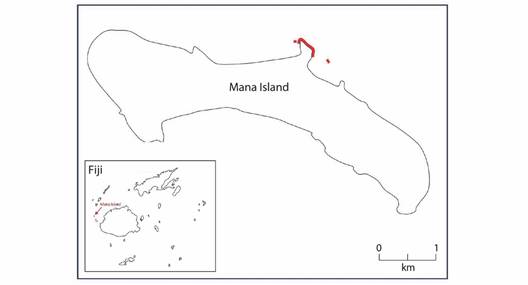
Sampling methods: We studied the motile (non-sessile, free moving) macroinvertebrates (large enough to see without the aid of a microscope) and fishes sheltering in the burrows of E. mathaei along 150 m of the shore of a rocky promontory and on adjacent submerged rocks on the north coast of Mana Island (17°40’14” S, 177°6’34” E, Fig. 1) during 21-24 June 2019, 25 March 2023, and 11 September 2023. Three morphs of E. mathaei, Type A (white-tipped or entirely white spines), Type C (entirely dark spines), and a rare type undesignated by a letter (entirely maroon spines), occur in Fiji and possibly represent distinct species (Appana et al., 2004). All E. mathaei at our study site represented Type C. We used snorkeling gear in shallow water < 6 m deep to search for motile macroinvertebrates and fishes within each burrow. Not all burrows were occupied by E. mathaei. We sampled organisms in burrows with E. mathaei and in burrows without E. mathaei (Fig. 2). We measured the length (nearest cm) of a subset of burrows of both types with a wooden ruler. Underwater writing slates were used to record data. Each species was identified as the surveys were taking place or photographed and subsequently identified with the assistance of published field guides (Allen et al., 2003; Humann & Deloach, 2010; Rosenstein, 2019) and experts identifying our photos posted at iNaturalist (www.inaturalist.org). All organisms were observed in situ; we did not attempt to remove any organisms for subsequent identification. The English and scientific names follow iNaturalist, which frequently incorporates taxonomic revisions.
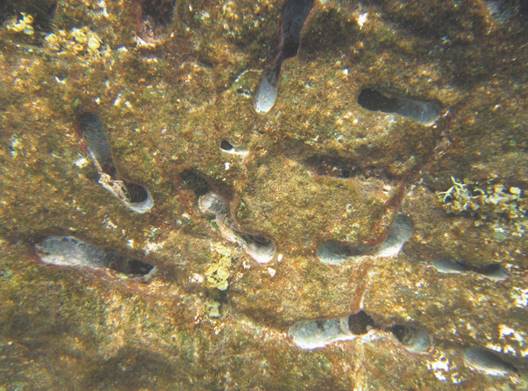
Fig. 2 Burrows with and without Echinometra mathaei at Mana Island, Fiji. Photograph by Floyd E. Hayes.
Statistical analyses: A Mann-Whitney U test (z statistic) (Zar, 2010) was calculated to compare the lengths of burrows with and without urchins. We calculated the number of individuals and the percent of burrows occupied for each species of motile macroinvertebrate and fish observed in burrows with and without E. mathaei. Chi-square analyses of contingency tables (X2 statistic) (Zar, 2010) were calculated to compare the proportions of burrows with motile macroinvertebrates and fishes between burrows with E. mathaei and burrows without E. mathaei. The statistical tests were calculated with Statistix 10 software (Nimis, 2013).
Results
Burrow characteristics: The burrows of E. mathaei comprised irregularly shaped grooves on rock surfaces, usually wider at the ends than in the middle (Fig. 1), and varied greatly in length, ranging from 4 to 57 cm (mean = 16.5, SD = 9.8). The burrows with urchins averaged shorter in length (mean = 15.9 cm, SD = 10.6, range = 4-57 cm, n = 94) than burrows without urchins (mean = 17.6 cm, SD = 7.8, range = 6-46 cm, n = 47; Mann-Whitney U test, z = 2.04, p = 0.04).
Motile macroinvertebrates: We observed 42 motile macroinvertebrates of at least eight species in burrows with E. mathaei (n = 1 147), and six motile macroinvertebrates of three species in burrows lacking E. mathaei (n = 243; Table 1). Motile macroinvertebrates occurred with statistically equal frequencies in burrows with E. mathaei (3.6 %) and in burrows without E. mathaei (2.5 %; Yates corrected X2 = 0.51, d.f. = 1, p = 0.48; Table 1).
Table 1 Number (% of burrows occupied) of motile macroinvertebrates and fishes observed in burrows with (n = 1 127) and without (n = 243) the sea urchin Echinometra mathaei at Mana Island, Fiji.
| Phylum, class, order Family, genus and specific epithet | Burrows with E. mathaei | Burrows without E. mathaei |
| Mollusca, Gastropoda, Neogastropoda | ||
| Muricidae, Tenguella marginalba | 1 (0.09) | ‒ |
| Pisaniidae, Engina mendicaria | 2 (0.18) | ‒ |
| Conidae, Conus ebraeus | ‒ | 3 (1.23) |
| Conidae, Conus sp. | 2 (0.18) | ‒ |
| Unidentified | 3 (0.27) | ‒ |
| Mollusca, Gastropoda, Littorinomorpha | ||
| Cypraeidae, Monetaria annulus | ‒ | 1 (0.41) |
| Mollusca, Cephalopoda, Octopoda | ||
| Unidentified | ‒ | 1 (0.41) |
| Arthropoda, Malacostraca, Decapoda | ||
| Panuliridae, Panulirus versicolor | 1 (0.09) | ‒ |
| Calcinidae, Calcinus gaimardii | 5 (0.44) | 1 (0.41) |
| Calcinidae, Calcinus minutus | 3 (0.27) | |
| Calcinidae, unidentified | 1 (0.09) | ‒ |
| Echinodermata, Echinoidea, Diadematoida | ||
| Diadematidae, Diadema or Echinothrix sp. | 17 (1.51) | ‒ |
| Echinodermata, Crinoidea, Comatulida | ||
| Comasteridae, Oxycomanthus bennetti | 1 (0.09) | ‒ |
| Unidentified | 6 (0.53) | |
| Chordata, Actinopterygii, Gobiiformes | ||
| Gobiidae, Eviota teresae | 3 (0.27) | ‒ |
| Gobiidae, Eviota fasciola | 3 (0.27) | ‒ |
| Chordata, Actinopterygii, Bleniiformes | ||
| Tripterygiidae, Enneapterygius sp. | 1 (0.09) | ‒ |
| Blenniidae, Cirripectes castaneus | 4 (0.41) | ‒ |
| Blenniidae, unidentified | 3 (0.27) | ‒ |
| Chordata, Actinopterygii, Ovalentaria | ||
| Pomacentridae, Chrysiptera leucopoma | 6 (0.53) | ‒ |
| Pomacentridae, Chrysiptera unimaculata | 1 (0.09) | ‒ |
| Pomacentridae, Plectroglyphidodon leucozona | 8 (0.71) | ‒ |
| Pomacentridae, Stegastes nigricans | 17 (1.75) | 1 (0.41) |
| Chordata, Actinopterygii | ||
| Unidentified | 3 (0.27) | ‒ |
Adult gastropod molluscs of three species comprised 19.0 % of the motile macroinvertebrates in burrows with E. mathaei (Table 1), including the Mulberry Whelk Tenguella marginalba (family Muricidae, 2.4 %), Striped Engina Engina mendicaria (family Pisaniidae, 4.8 %, Fig. 3A), and unidentified cone snails Conus sp. (family Conidae, 4.8 %, Fig. 3B). Decapod crustaceans of three species comprised 23.8 % of the motile macroinvertebrates in burrows with E. mathaei (Table 1), including a juvenile Painted Spiny Lobster Panulirus versicolor (family Panuliridae, 2.4 %) and adults of the Gaimard’s Hermit Crab Calcinus gaimardii (family Calcinidae, 11.9 %, Fig. 3C) and Small White Hermit Crab Calcinus minutus (2.4 %, Fig. 3D). Unidentified juvenile sea urchins Diadema or Echinothrix spp. (family Diadematidae) comprised 40.5 % of the motile macroinvertebrates in burrows with E. mathaei (Table 1, Fig. 3B). Feather stars (order Comatulida) comprised 16.7 % of motile macroinvertebrates in burrows with E. mathaei (Table 1), including an adult Bennett’s Bushy Feather Star Oxycomanthus bennetti (family Comasteridae, 2.4 %). An unidentified Conus sp. and a juvenile Diadema or Echinothrix sp. were the only motile macroinvertebrates observed sharing a burrow together with an E. mathaei (Fig. 3B).
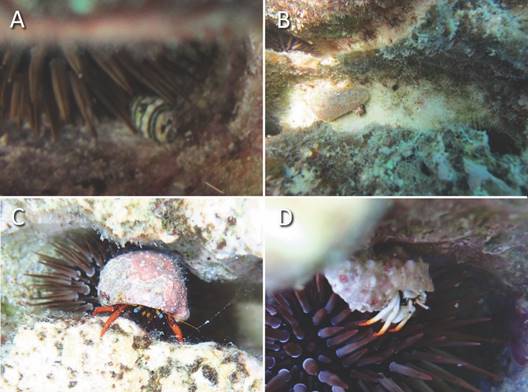
Fig. 3 Examples of motile macroinvertebrates in the burrows of Echinometra mathaei: A. Engina mendicaria; B. Conus sp. (left center) and Diadema sp. or Echinometra sp. (lower right); C. Calcinus gaimardii; D. Calcinus minutus. Photographs by Floyd E. Hayes (A, C, D) and John C. Duncan (B).
Adults of the Black-and-white Cone Snail Conus ebraeus (family Conidae) comprised 50 % of the motile macroinvertebrates in burrows without E. mathaei, followed by an adult Money Cowry Monetaria aunnulus (family Cypraeidae, 16.7 %), a small unidentified octopus (order Octopoda, 16.7 %), and an adult C. gaimardii (family Calcinidae, 16.7 %, Table 1).
Fishes: We observed 49 fishes of at least eight species in burrows with E. mathaei (n = 1 147), but only one fish of one species in burrows lacking E. mathaei (n = 243, Table 1). The fishes occurred significantly more frequently in burrows with E. mathaei (4.3 %) than in burrows without E. mathaei (0.4 %; Yates corrected X2 = 7.50, d.f. = 1, p = 0.006, Table 1).
Adult gobies (family Gobiidae) of two species comprised 12.2 % of the fishes in burrows with E. mathaei (Table 1), including the Terry’s Shrimpgoby Eviota teresae (6.1 %, Fig. 4A) and Barred Eviota Eviota fasciola (6.1 %, Fig. 4B). An adult triplefin, possibly a Blackcheek Threefin Enneapterygius rufopileus (family Tripterygiidae, Fig. 4C), comprised 2.0 % of the fishes in burrows with E. mathaei (Table 1). Adult blennies (family Blenniidae) of one or more species accounted for 14.3 % of the fishes in burrows with E. mathaei (Table 1), including the Chestnut Blenny Cirripectes castaneus (8.2 %) and unidentified blennies (6.1 %). Juvenile and adult damselfishes (family Pomacentridae) of four species accounted for 65.3 % of the fishes in burrows with E. mathaei (Table 1), including the Pacific Surge Demoiselle Chrysiptera leucopoma (12.2 %, Fig. 4D), Onespot Demoiselle Chrysiptera unimaculata (2.0 %), Whiteband Damsel Plectroglyphidodon leucozona (16.3 %), and Dusky Gregory Stegastes nigricans (34.7 %). The remaining 6.1 % of fishes in burrows with E. mathaei were unidentified cryptobenthic species (Table 1).
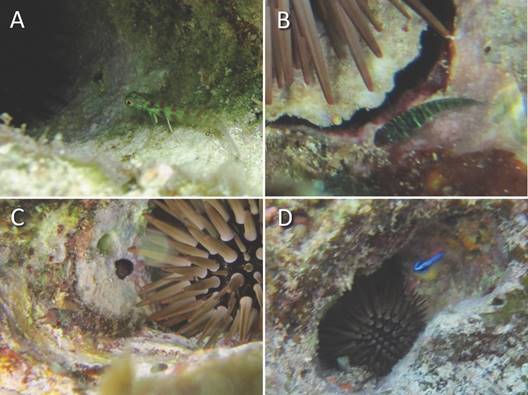
Fig. 4 Examples of fishes in the burrows of Echinometra mathaei: A. Eviota teresae; B. Eviota fasciola; C. Enneapterygius sp., possibly E. rufopileus; D. Chrysiptera leucopoma. Photographs by Floyd E. Hayes.
An E. fasciola and an unidentified fish were the only fishes observed sharing a burrow together with an E. mathaei. We did not observe any fishes cohabiting a burrow with any motile macroinvertebrate other than E. mathaei.
The only fish observed in a burrow without E. matthaei was an adult C. leucopoma (Table 1). The adults of all fishes were relatively small, never exceeding 10 cm in length.
Discussion
The burrows of E. mathaei are usually inhabited by a single individual, gradually increase in size through bioerosion by the sea urchin, and are reused by multiple generations of sea urchins (Russo, 1980). The preference by E. mathaei for shorter burrows in our study suggests that the conditions of the longest burrows are suboptimal for foraging or defense from predators, which needs further study.
Of the eight species of motile macroinvertebrates and eight species of fishes observed sheltering in burrows of E. mathaei, only one species, the damselfish S. nigricans, had been previously reported associating with E. mathaei (Cheh et al., 2021). None of the organisms sheltering in E. mathaei burrows associated exclusively with E. mathaei or appeared to be specialized for associating with sea urchins, indicating that the associations are facultative rather than obligatory.
Organisms inhabiting E. mathaei burrows potentially benefit from reduced predation by sheltering within burrows, by associating closely with the sharp spines of E. mathaei, or synergistically by both. Organisms may also benefit by finding prey within the burrows. None of the organisms that we observed in E. mathaei burrows are known predators of E. mathaei (McClanahan, 2000; McClanahan & Muthiga, 1989; McClanahan & Muthiga, 2001; McClanahan & Muthiga, 2020). The largest carnivore was the unidentified octopus, which sheltered in a burrow without E. mathaei. Octopuses have been reported preying on sea urchins elsewhere (Smith, 2003; Villegas et al., 2014). All of the fishes observed sheltering in E. mathaei burrows were small, < 10 cm long, comprising juveniles or adults of relatively small species. Although several species of fishes comprise the dominant predators of E. mathaei (McClanahan, 2000; McClanahan & Muthiga, 1989; McClanahan & Muthiga, 2001), small fishes such as those that we observed in the burrows pose no existential threat to sea urchins and are more likely to benefit from the spines of sea urchins than larger fishes (Hayes et al., 2019; Hayes et al., 2022; Karplus, 2014).
Our data are too limited to evaluate whether macroinvertebrates benefit more by sheltering in burrows or associating directly with E. mathaei. Most species of molluscs and decapod crustaceans possessed or lived within calcium carbonate shells, which provide protection against predators. Juvenile Diadema or Echinothrix urchins, which were the most common motile macroinvertebates, sheltered only in burrows occupied by E. mathaei, but always in opposite ends of the burrows, presumably to reduce interspecific competition (McClanahan, 1988). Because Diadema and Echinothrix sea urchins have proportionately longer spines than E. mathaei (McClanahan, 1988), which presumably provide more protection against predators (Hayes et al., 2016; Hayes et al., 2019; Hayes et al., 2022), Diadema sea urchins more likely benefit from the shelter of a burrow than by associating with the spines of E. mathaei.
Our data for all fish species combined provide evidence that fishes prefer sheltering in burrows with E. mathaei, even though they averaged shorter in length than burrows without E. mathaei, presumably because of the potential additional benefit of associating directly with the spines of E. mathaei. Cheh et al. (2021) provided evidence that the damselfish S. nigricans, which was the most common fish species sheltering in E. mathaei burrows in our study, perceived E. mathaei as providing extra security from approaching threats, such as larger predatory fishes or cephalopods. Similarly, the Brazilian Fanged Blenny Ophioblennius trinitatis perceived E. lucunter as providing extra security from threats (Nunes et al., 2019). In contrast with the burrows of E. mathaei, fewer species of animals occurred in burrows occupied by an urchin than in empty burrows of the Pacific Purple Sea Urchin Strongylocentrotus purpuratus (Davidson & Grupe, 2013) and Pot-hole Urchin Stomopneustes variolaris (Chanket & Wangkulangkul, 2019). However, these two species excavate a smaller burrow, described as a “pit,” with less space available for sheltering ectosymbionts. Thus, both the size of a burrow and the presence or absence of an urchin may affect the efficacy of an urchin burrow as a shelter from predators.
Ethical statement: The authors declare that they all agree with this publication and made significant contributions; that there is no conflict of interest of any kind; and that we followed all pertinent ethical and legal procedures and requirements. All financial sources are fully and clearly stated in the Acknowledgements section. A signed document has been filed in the journal archives.

