




 Inglês (pdf)
 Artigo em XML
 Referências do artigo

 Tradução automática
 Enviar este artigo por email
 Citado por SciELO
 Similares em
SciELO
 uBio

 Permalink

Introduction
Cities represent highly modified environments where loss and fragmentation of animal habitats lead to reduced species richness and community homogenization at several scales (Aronson et al., 2014; Clergeau et al., 2001; Faeth et al., 2011). Furthermore, urban areas undergo habitat transformation with negative effects on community structure, especially for birds, including species richness and changes of species composition (Beninde et al., 2015), at a landscape scale (Aronson et al., 2014; Bellocq et al., 2016), and this effect is exacerbated in tropical regions (Leveau et al., 2017; MacGregor-Fors et al., 2021). Local communities in urban areas have low alpha diversity because native bird species have reduced occupancy or abundance, and at a landscape scale, beta diversity has high similarity of composition between local communities, due to the dominance in distribution and abundance of synurbic species (Francis & Chadwick, 2011), whether they are exotic or urban exploiters (MacGregor-Fors et al., 2010; Martin-Etchegaray et al., 2018). Conversely, tolerant native species occurring in cities can increase the local community dissimilarity by restricted dispersion between remnant fragments of habitat on urban landscapes thus bird community structure and species composition change (Clergeau et al. 2001; Escobar-Ibañez et al. 2020).
The community structure of species from a metacommunity perspective can be described based on abundance and distribution patterns of the species, within dispersal restricted landscapes as the disturbed heterogeneous or urban gradient landscapes (Alberti & Wang, 2022). The distribution of three components, coherence as the degree of spatial continuity of species across a major gradient; turnover as the species replacement from site to site and boundary clumping as the extent to which the limits of ranges of the different species are clustered together produce at least, six possible idealized composition patterns (Leibold & Mikelson, 2002; Presley et al., 2010). These vary, from a random arrangement (Gleasonian pattern) to an arrangement of sites grouped by a composition of similar species (Clementsian pattern, Presley et al., 2010). Based on this spatial distribution arrangement of species of a metacommunity in a landscape can be related to an underlying emergent process, such as species sorting or mass effect (Holyoak et al., 2005; Leibold et al., 2004). Bird community composition has been described in urban and non-urban settings (Beninde et al., 2015; MacGregor-Fors & Schondube, 2012). However, studies focusing on bird metacommunity structure in an urban landscape gradient has been very little explored (Ferenc et al., 2014).
Habitat reduction has been identified as the main driver of native bird richness reduction in urban settings. Urbanization, typically reduces the proportion of vegetation cover compared to build area and consequently reduces the distribution and abundance of most sensitive native bird species (Clergeau et al., 2001; Escobar-Ibañez et al., 2020). Heterogeneity of land cover types and configuration inside urban landscape can soften the filtering effect of urban cover for these birds and may be a major determinant for species distribution (Lepczyk et al., 2017), and community structure (Beninde et al., 2015; Silva et al., 2016). The dominance of synurbic bird species seems to be regulated by the extension of non-vegetative covers and the heterogeneity of urban landscapes (Silva et al., 2016). Those aspects of the urban landscape have not been studied for bird communities in the Neotropical region (Bellocq et al., 2016), where there are many endemic birds (Gordon & Ornelas, 2000).
Under the metacommunity perspective, beta diversity properties like nestedness, turnover and similarity allow identification of the metacommunity structure of species composition in heterogeneous landscapes or environmental gradients. In particular urbanization is expected to produce a random composition of synurbic species with a low beta diversity due to the effect of homogenization (Presley et al., 2010; Wang et al., 2019), a nested structure of native species between local communities (Baselga, 2010), and a positive coherence and low local (alfa) diversity (Presley et al., 2010; Wang et al., 2019). These patterns are due to abundance change of native species with synurbic dominant species (Francis & Chadwick, 2011). Likewise, under urbanization diversity partitioning patterns predict low beta diversity and a small difference between range of alfa and gamma diversity (Wang et al., 2019). The aim of this study is to determine whether there was a homogenized (Gleasonian pattern) or discrete subset of species (Clementsian pattern) composition of land bird in the urban landscape on the tropical city of Tuxtla Gutiérrez, Chiapas, Mexico, and determine what land cover of urban landscape are related to the occurrence and abundance of dominant, abundant and rare bird species.
Materials and methods
Study area: The study was carried out in Tuxtla Gutiérrez city (TG), the largest city and capital of the Southern state of Chiapas in México. It covers around 83.5 km2 (Silva et al., 2015), and is located at 600-750 m.a.s.l. Tuxtla Gutiérrez is surrounded by hills with remnants of preserved natural vegetation, some of these fragments contain a surrounding corridor of protected areas (Altamirano-González-Ortega et al., 2007). The original vegetation that surrounds the city is tropical dry forest, which is distributed along the Central Valley region of Chiapas. Small remnants of this vegetation are scattered within the city with different successional phases along the banks of the Sabinal River basin which crosses the city from West to east, (Díaz-Pascacio et al., 2018). The urban area is dominated by buildings, pavement and dirt roads, the vegetation cover within the city is currently reduced and fragmented to only 10 % of the original surface (Silva et al., 2015). The landscape is heterogeneous, with altered vegetation covers represented by urban parks, gardens, wastelands and some remaining agricultural plots. On the outskirts of the city, there are tree vegetation fragments, such as suburban, parks and reserves, as “Cañon del Sumidero” National Park which represent a regional reservoirs of bird diversity (Altamirano-González-Ortega et al., 2007).
Bird sampling design: Sixty bird point count locations were established along the heterogeneous urban landscape on TG, in which the different types of land covers were estimated (Fig. 1). There was a minimum distance of 600 m between each point to represent the heterogeneity of the city’s landscape and maintain the independence of the bird records, and maximize sample size (Buckland, 2006). The point counts had a fixed radius of 25 m (Ralph et al., 1993), and all the land birds seen or heard were recorded during a time of 10 min, early in the morning between 6:30 and 9:30 h. Each point was visited on four occasions between May 2015 and February 2016. With this sampling method, average of relative abundance (ab) and species richness (r) was estimated for all resident land birds. Migratory birds were excluded from the analysis, as well as birds that fly over the vegetation of land city covers, such as swifts (Apodidae), swallows (Hirundinidae) and vultures (Cathartidae) because they do not use the urban landscape (Pineda-Diez de Bonilla et al. 2012).
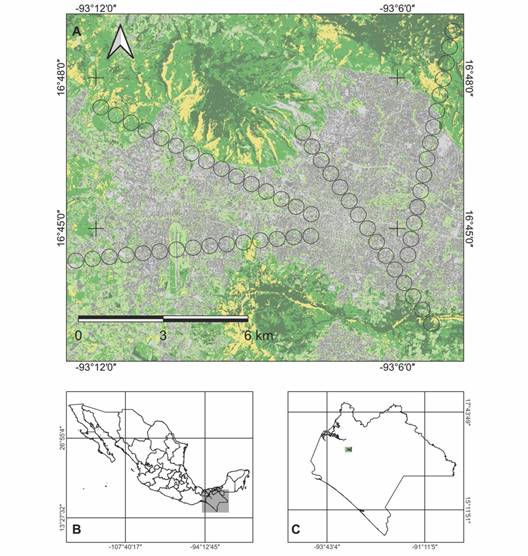
Fig. 1 A. Distribution of bird sampling points centered in (black circles) areas of estimated land cover types within Tuxtla Gutiérrez urban landscape. Vegetation covers in green shades and urban covers in gray shades. B. location of Chiapas state in Southern México. C. location of Tuxtla Gutiérrez urban landscape in the Chiapas state.
Urban landscape description: To describe the landscape properties of TG, we estimated the amount of seven land cover classes within a circular area of 280 m radius (24.6 ha), associated with each point count. Seven class covers were used in an unsupervised classification with an ISODATA clustering of a Landsat 8 satellite image of 30 m resolution provided by U.S. Geological Survey (2016) from November 2015 (Fig. 1). This classification defines limits between different types of natural and artificial land covers, based on the vegetation structure and density, human bare ground covers were defined, based on previous experience of surveys, these covers can be extrapolated to the entire urban area of the study landscape (Feeley et al., 2007). The area of each cover class is within 24.6 ha. circular area was estimated in QGIS 2.8 (QGIS Development Team, 2015) (Fig. 1). To describe the landscape properties commonly related with specie richness and diversity in disturbed landscapes (Beninde et al., 2015; Rojas et al., 2017), nine landscape indices were estimated from the area amount of the land cover classes with the Fragstat program (McGarigal & Marks, 1995), These were, the number of patches (NP), class richness (PR), the habitat heterogeneity index (SHDI), the landscape fragmentation with the Interspersion and juxtaposition index (IJI), the coverage of largest patch index (LPI), landscape shape index (LSI), mean perimeter- area ratio (PARA), fractal dimension irregularity index of perimeter- area ratio (PAFRAC), and class fragmentation index (MESH) was calculated.
Bird species subsets: To analyze separately the effect of synurbic and native species on the structure of the urban bird metacommunity, we divided the total bird species registered into dominant (D), abundant (A) and rare (R) species, based on similarity-based entropy (Grabchak et al., 2017). Then, we used Hill numbers (Chiu & Chao, 2014) to decompose the effective species richness into the three exponent values of Q (0, 1, 2). These numbers allow us to separate the number of dominant species (Q 2), abundant species (Q 1 -Q 2) and rare species (Q 0 -Q 1 ) from total species (Q 0 ) in the metacommunity. Additionally, with this partitioning scheme we estimate the relative contribution of relative species abundance of local community assemblage (alpha diversity), into the metacommunity assemblage (gamma diversity), between local assemblages (beta diversity) or effective number of local communities (Marcon & Hérault, 2015). For these purposes of decomposition of diversity entropy, we used the DivPart function of the entropart package (Marcon & Herault, 2015) in the R software (R Core Team, 2015).
Metacommunity structure: To determine the bird metacommunity structure, and the change in the idealized structure for the three species subset (dominant, abundant, rare species), we analyzed the coherence, turnover and boundary clumping and their fit to a metacommunity structure (Dallas, 2014; Leibold & Mikkelson, 2002; Presley et al., 2010). A species by sites matrix was arranged for each species subset and total species metacommunity. Coherence was estimated testing the number of embedded absences in the ordered matrix of species by sampling locations, a coherence analysis was used for each subset species group. Turnover analysis was evaluated to compare the number of observed replacements of paired species along sites, the observed replacements is compared against to a random null model patterns, to pick out between a negative significance (nestedness), positive significance (clumped) or not significance (quasi-structure), subsequently boundary clumping analysis was tested for a positive significance to Clementsian structure, negative significance to Gleasonian structure and evenly spaced structure for non-significance arrange. Boundary clumping was evaluated by a goodness of fit test of the observed distribution with the expected equiprobable distribution of range boundaries of species with the Morisita’s index. All these metacommunity measures were analyzed in R (R Core Team, 2015) with the use of the metacom (Dallas, 2014) package.
Correlation of bird and urban landscape variables: To determine the association of the species of each group with cover types and landscape indices variables, we performed a redundancy analysis (RDA). This analysis tested the association of area land cover and landscape indexes to each group of land bird species and determined the influence of urban landscape variables on the presence and structure of bird species community (Legendre & Anderson, 1999). We implemented the RDA procedure in the R package vegan (Oksanen et al., 2007) in R (R Core Team, 2015).
Results
We recorded an overall of 4 006 individuals and 63 bird species, along the 60-point counts. We found four exotic species present in most of the urbanized sites (Rock Dove Columba livia, House Sparrow Passer domesticus, Eurasian Collared-dove Streptopelia decaocto and Monk Parakeet Myiopsitta monachus), and four native species considered synurbic to Mexico (Common Ground-dove Columbina passerina, Great-tailed Grackle Quiscalus mexicanus, Clay-colored Thrush Turdus grayi and Tropical Kingbird Tyrannus melancholicus), most of these species belonged to the subset of dominant species. The remaining bird species were native species present in the mosaic of tropical dry forest, as the natural vegetation in the region (Fig. 2).
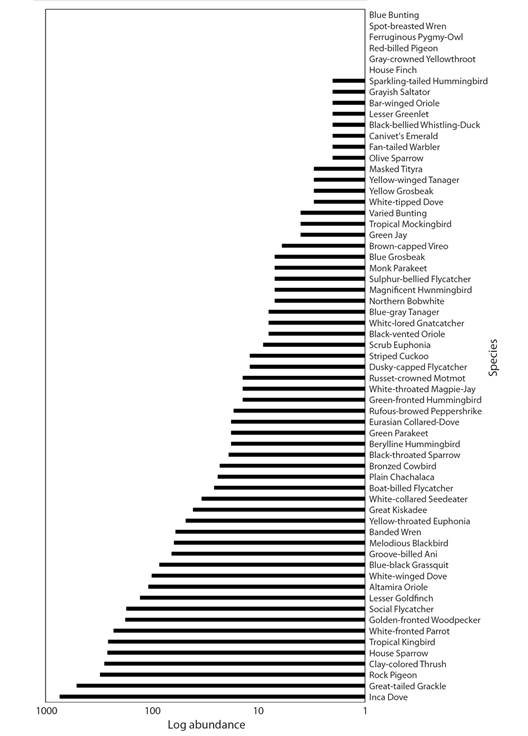
Fig. 2 Rank abundance distribution of the 63 land bird species metacommunity recorded in the landscape of Tuxtla Gutierrez city.
According to expected species richness a completeness of 89 % was of the maximum number of expected species estimated with the Clench accumulation model (Soberón & Llorente, 1993). This result suggested that our sampling effort represents the compositional pattern of dominant, abundant and rare bird species presence occurring in TG. Land cover distribution in the urban landscape of TG shows an urbanization gradient pattern (Fig. 3), represented by a total average extent of 35 % of urban cover (n = 56), 22 % for herbaceous (n = 60) and 20 % for bare ground cover (n = 54) respectively, and an average richness cover of five cover types for all sampling points.
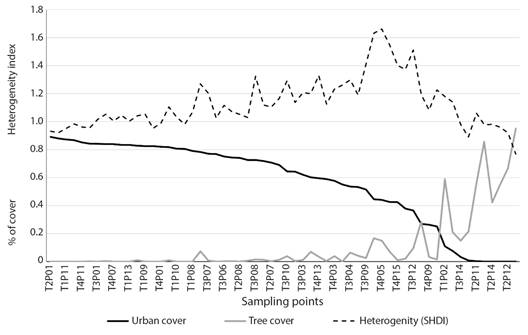
Fig. 3 Distribution of % cover and heterogeneity index (SHDI) values of the seven cover types of 60 sampling sites inside the urban landscape of Tuxtla Gutierrez city.
According to the diversity decomposition based on entropy, bird metacommunity of TG has an average of 10.25 effective richness value to local communities as alpha diversity, and 6.14 effective local communities in the metacommunity as beta diversity with 63 species richness to gamma diversity. This result indicates that spatial scale used in our study to describe the metacommunity structure of birds in the urban landscape seems to be adequate, according to the effective number of local communities estimated with the decomposition of diversity (Marcon & Hérault, 2015) and homogeneous distribution across the urban landscape of the commonly considered as urban exploiters species (Table 1).
Table 1 Diversity partition in effective number of total species (Q 0), abundant species (Q 1) and dominant species (Q 2), for alpha, beta and gamma components of the bird metacommunity of the Tuxtla Gutiérrez city of Chiapas.
| Diversity | Q 0 | Q 1 | Q 2 |
| Alpha | 10.25 | 7.34 | 5.61 |
| Beta | 6.14 | 3.05 | 2.55 |
| Gamma | 63 | 22.44 | 14.34 |
We use the results to the bird metacommunity structure analysis to fit one of the metacommunity structure models to the birds of TG. We found a variation on the urban land bird metacommunity structure within each species subset, the total bird metacommunity and dominant subset has a Clementsian structure, whereas abundant and rare species subsets shows a nestedness structure (Table 2). Dominant species subset of bird was made of native opportunistic species and exotic species, and according to their spread distribution in the point counts and two groups of birds were formed, the rare species group composition represents terrestrial native species present on the TDF vegetation.
Table 2 Elements of a metacommunity structure pattern of land birds in the urban landscape of Tuxtla Gutiérrez city, Chiapas.
| Elements | E. Abs | Total | Dominants | Abundant | Rare |
| Coherence | E. Abs | 1.54E + 03 | 3.49E + 02 | 1.44E + 02 | 7.56E + 00 |
| P | 1.40E - 09 | 3.57E - 17 | 5.99E - 07 | 1.30E - 01 | |
| Mean | 2.41E + 03 | 4.24E + 02 | 2.12E + 02 | 8.26E + 02 | |
| SD | 3.94E + 01 | 8.90E + 00 | 1.37E + 01 | 4.60E + 01 | |
| Turnover | Rep | 2.31E + 05 | 6.85E + 03 | 1.31E + 03 | 1.49E + 03 |
| P | 6.75E - 01 | 1.59E - 03 | 1.62E - 06 | 5.06E - 02 | |
| Mean | 2.43E + 05 | 4.37E + 03 | 3.34E + 03 | 1.62E + 04 | |
| SD | 2.98E + 04 | 7.88E + 02 | 4.14E + 02 | 1.40E + 03 | |
| Boundary Clumping | Morisita Index | 5.23 | 1.79 | 1.86 | 1.87 |
| P | 0.000 | 5.00E-10 | 1.73E - 13 | 3.40E - 08 | |
| Df | 60 | 12 | 6 | 38 | |
| Interpretation | Clementsian | Clementsian | Nestedness | Nestedness |
E. Abs: Observed embedded absences; Rep: Number observed replacements; P: Probability test; Mean: Estimated random values; SD: Standard deviation; Df: degree freedom.
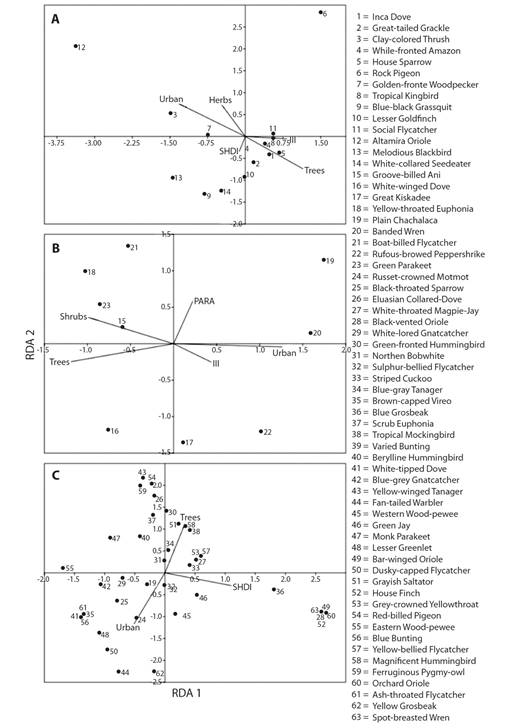
The association of each subset bird species to urban landscape properties in the RDA showed different relationships for dominant, abundant and rare species. Interspersion and juxtaposition index (IJI), heterogeneity index (SHDI) and mean perimeter area ratio (PARA) were the most important landscape index, and amount of cover area of trees, shrubs, herbs and urban were the most important land cover for dominant bird species (Fig. 4).
Discussion
The structure of bird metacommunity and spread distribution of native and synurbic bird species in tropical urban landscapes has been poorly described (Martin & Bonier, 2018). Bird species composition of TG city resembling a metacommunity like vertebrates in other cities studied in Mexico (e.g., Charre et al., 2013; Escobar-Ibañez et al., 2020). However, a homogenization effect by the dominant species and a lower diversity was found in sites with predominant urban cover, it was similarly to urban mosaic in many cities (Leveau et al., 2017; Marzluff, 2016), where exotic and synurbic species dominate the metacommunity structure.
The results of decomposition of total bird diversity according to the entropy analysis between sampling sites (alpha diversity), suggest that the metacommunity is composed of 6.14 effective local communities. A metacommunity structure is maintained even when we discard the subset of rare species, reducing the structure to three local communities. This is due on the one hand, to the fact that rare species with restricted distribution in the urban landscape tend to increase dissimilarity and gamma diversity within the city of TG. On the other hand, the reduction in the number of local communities is due to unlimited dispersal capacity of the dominant species with a generalist habitat use, and present in different habitat types, such as the ground pigeon Columbina passerina, the large-tailed grackle Quiscalus mexicanus or the wood thrush Turdus grayi, which increase the similarity between local communities (MacGregor-Fors et al., 2021). This result of bird community composition in the urban landscape of TG is consistent with a not homogeneous effect of environmental filtering in bird communities (Silva et al., 2016). Two different metacommunity structures were found with the analysis of coherence, turnover and boundary clustering, between the subset species groups and the association within the environmental gradient. A Clementsian structure (Presley et al., 2012) for both the total number of birds and the subset of dominant species, this structure is associated with local communities with a discrete and coherent replacement of a species subset composition between local communities or sites, in response to distribution processes of similar environmental factors along the urban gradient (Leibold et al., 2004). This metacommunity structure coincides with the structure of other Neotropical vertebrates (López-González et al., 2012; Ochoa-Ochoa & Whittaker, 2014). A nested metacommunity structure shown by both the abundant and rare subset species, is associated to a loss of distribution of habitat specialized species within a narrow gradient of habitat availability due to the size and extent of fragments of vegetation cover within the urban landscape (Gómez-Moreno et al., 2023; Henriques-Silva et al., 2013), all abundant and rare species are native residents of tropical dry forest surrounding of TG.
The affinity for a different type of structure is due to differences in the distribution of species between sites, which show an important gradient of the urban landscape, which describes the increase in the extent of urban coverage and the decrease in tree vegetation. and by the gradient of coverage heterogeneity in the landscape (Fig. 3). The positive affinity of the dominant species subset with urban cover and habitat heterogeneity is consistent with the results of other studies that evaluate the relationship of habitat quantity hypotheses (Beninde et al., 2015) and habitat diversity (Mateo-Tomás et al., 2019). This is due to the widespread distribution pattern, the abundance of these synurbic species (MacGregor-Fors et al., 2010; Martin-Etchegaray et al., 2018) and the fact that they may have behavioral adjustment to the urban environment (MacGregor-Fors et al., 2010), which allows them to have an advantage over other species in the use of resources, avoid disturbances and improve their communication (Sol et al., 2013).
Isolation and patch size of different land covers interact to promote bird diversity within a complex landscape mosaic to generate a bird composition with a metacommunity structure. The differential association of each of the subsets of birds with landscape properties such as the extent of tree cover, the heterogeneity of covers and the intermixing of covers, allows the urban landscape of TG to function as a stepping stone of corridors facilitating dispersal and being a regulatory mechanism as an environmental filter for species (Beninde et al., 2015; Eyster et al. 2022), favoring their presence in landscapes dominated by urban coverage (Martin & Bonier, 2018).
The intense transformation and urbanization of the Neotropical region, especially of the tropical dry forest, is of important interest for the conservation of biodiversity (Gordon & Ornelas, 2000). The persistence of native birds in cities and their conservation requires a broad spatial scale perspective that allows us to understand diversity patterns in the urban landscape (McDonnell & Hahs, 2008). For the city of TG, the remaining and sparse habitat fragments of tree cover represent an important refuge for native species, because several of these birds are endemic or specialists in the tropical dry forest habitat (Gordon & Ornelas, 2000). Finally, understanding the organization patterns of species in a spatial context of transformed landscapes allows us to recognize metacommunity structures that can help us detect possible species association mechanisms and environmental factors involved in the maintenance of diversity in highly fragmented environments such as tropical dry forests.
Ethical statement: The author(s) declared no potential conflicts of interest with respect to the research, authorship, and/or publication of this article, and followed all pertinent ethical or legal procedures and requirements. A signed document has been filed in the journal archives.

