<?xml version="1.0" encoding="ISO-8859-1"?><article xmlns:mml="http://www.w3.org/1998/Math/MathML" xmlns:xlink="http://www.w3.org/1999/xlink" xmlns:xsi="http://www.w3.org/2001/XMLSchema-instance">
<front>
<journal-meta>
<journal-id>1659-1321</journal-id>
<journal-title><![CDATA[Agronomía Mesoamericana]]></journal-title>
<abbrev-journal-title><![CDATA[Agron. Mesoam]]></abbrev-journal-title>
<issn>1659-1321</issn>
<publisher>
<publisher-name><![CDATA[Universidad de Costa Rica]]></publisher-name>
</publisher>
</journal-meta>
<article-meta>
<article-id>S1659-13212013000200006</article-id>
<title-group>
<article-title xml:lang="es"><![CDATA[Heredabilidad de características reproductivas de Vacas InduBrasil]]></article-title>
</title-group>
<contrib-group>
<contrib contrib-type="author">
<name>
<surname><![CDATA[Ríos-Utrera]]></surname>
<given-names><![CDATA[Ángel]]></given-names>
</name>
<xref ref-type="aff" rid="A02"/>
</contrib>
<contrib contrib-type="author">
<name>
<surname><![CDATA[Hernández-Hernández]]></surname>
<given-names><![CDATA[Víctor Delio]]></given-names>
</name>
<xref ref-type="aff" rid="A02"/>
</contrib>
<contrib contrib-type="author">
<name>
<surname><![CDATA[Villagómez Amezcua-Manjarréz]]></surname>
<given-names><![CDATA[Eugenio]]></given-names>
</name>
<xref ref-type="aff" rid="A03"/>
</contrib>
<contrib contrib-type="author">
<name>
<surname><![CDATA[Zárate-Martínez]]></surname>
<given-names><![CDATA[Juan Prisciliano]]></given-names>
</name>
<xref ref-type="aff" rid="A02"/>
</contrib>
</contrib-group>
<aff id="A01">
<institution><![CDATA[,Instituto Nacional de Investigaciones Forestales, Agrícolas y Pecuarias (INIFAP)  ]]></institution>
<addr-line><![CDATA[ ]]></addr-line>
<country>México</country>
</aff>
<aff id="A02">
<institution><![CDATA[,Instituto Nacional de Investigaciones Forestales, Agrícolas y Pecuarias (INIFAP) Campo Experimental La Posta ]]></institution>
<addr-line><![CDATA[Municipio de Medellín de Bravo Veracruz]]></addr-line>
<country>México</country>
</aff>
<aff id="A03">
<institution><![CDATA[,Instituto Nacional de Investigaciones Forestales, Agrícolas y Pecuarias (INIFAP) Centro Nacional de Investigación Disciplinaria en Microbiología ]]></institution>
<addr-line><![CDATA[Cuajimalpa Distrito Federal]]></addr-line>
<country>México</country>
</aff>
<pub-date pub-type="pub">
<day>00</day>
<month>12</month>
<year>2013</year>
</pub-date>
<pub-date pub-type="epub">
<day>00</day>
<month>12</month>
<year>2013</year>
</pub-date>
<volume>24</volume>
<numero>2</numero>
<fpage>293</fpage>
<lpage>300</lpage>
<copyright-statement/>
<copyright-year/>
<self-uri xlink:href="http://www.scielo.sa.cr/scielo.php?script=sci_arttext&amp;pid=S1659-13212013000200006&amp;lng=en&amp;nrm=iso"></self-uri><self-uri xlink:href="http://www.scielo.sa.cr/scielo.php?script=sci_abstract&amp;pid=S1659-13212013000200006&amp;lng=en&amp;nrm=iso"></self-uri><self-uri xlink:href="http://www.scielo.sa.cr/scielo.php?script=sci_pdf&amp;pid=S1659-13212013000200006&amp;lng=en&amp;nrm=iso"></self-uri><abstract abstract-type="short" xml:lang="es"><p><![CDATA[Heredabilidad de características reproductivas de vacas Indubrasil. El objetivo del presente trabajo fue estimar componentes de varianza y parámetros genéticos de características reproductivas de vacas Indubrasil mantenidas en clima tropical húmedo en México. El estudio se realizó en el sitio experimental Playa Vicente (Veracruz, México) perteneciente al Instituto Nacional de Investigaciones Forestales, Agrícolas y Pecuarias (INIFAP) con vacas Indubrasil (N=264) nacidas de 1974 a 2004. Las vacas se empadraron dos veces al año, en primavera y otoño. Los empadres iniciaban el 1 de abril y 1 de octubre, y finalizaban el 30 de junio y 30 de noviembre, respectivamente. La edad al primer servicio (EPS), edad al primer parto (EPP), duración de la gestación (DG), días abiertos (DA), intervalo entre partos (IEP), servicios por concepción (SPC) y peso al parto (PP) se analizaron con un modelo animal que solo incluyó el efecto genético aditivo, mientras que PP se analizó con un modelo animal de repetibilidad que incluyó el efecto genético aditivo y el efecto del ambiente permanente de la vaca. Los análisis se realizaron con el programa MTDFREML. Los estimadores de heredabilidad fueron: 0,31 ± 0,152, 0,39 ± 0,196, 0,08 ± 0,033, 0,03 ± 0,028, 0,13 ± 0,056, 0,03 ± 0,027 y 0,49 ± 0,098 para EPS, EPP, DG, DA, IEP, SPC y PP, respectivamente. El ambiente permanente de la vaca solo explicó el 2% de la variación total de PP, por lo que el estimador de repetibilidad para dicha característica fue 0,51. La edad a primer servicio, EPP, IEP y PP mostraron considerable variación genética, por lo que podrían ser consideradas en un programa de selección.]]></p></abstract>
<abstract abstract-type="short" xml:lang="en"><p><![CDATA[Heritability of fertility traits of Indubrazil cows. The objective of this study was to estimate variance components and genetic parameters for age at first service (AFS), age at first calving (AFC), gestation length (GL), days open (DO), calving interval (CI), services per conception (SPC) and cow weight at calving (CW) of Indubrazil cows (N=264) born from 1974 to 2004. The study was carried out at the Playa Vicente research station (Veracruz, México) from Instituto Nacional de Investigaciones Forestales, Agrícolas y Pecuarias (INIFAP). The cows were bred twice a year, in spring and autumn. The breeding seasons initiated on April 1 and October 1, and ended on June 30 and November 30, respectively. Age at first service, AFC, GL, DO, CI and SPC were analyzed with an animal model that included the additive genetic effect, while CW was analyzed with a repeatability animal model that included the additive genetic effect and the permanent environmental effect of the cow. The analyses were carried out with the MTDFREML program. The estimates of heritability were: 0.31 ± 0.152, 0.39 ± 0.196, 0.08 ± 0.033, 0.03 ± 0.028, 0.13 ± 0.056, 0.03 ± 0.027 and 0.49 ± 0.098 for AFS, AFC, GL, DO, CI, SPC and CW, respectively. The permanent environmental effect of the cow explained 2% of the total phenotypic variance of CW, hence the estimate of repeatability for this trait was 0.51. Age at first service, AFC, CI and CW showed substantial genetic variation; therefore, they could be considered in a selection program.]]></p></abstract>
<kwd-group>
<kwd lng="es"><![CDATA[índice de herencia]]></kwd>
<kwd lng="es"><![CDATA[fertilidad en vacas]]></kwd>
<kwd lng="es"><![CDATA[Cebú]]></kwd>
<kwd lng="en"><![CDATA[heritability]]></kwd>
<kwd lng="en"><![CDATA[fertility in cows]]></kwd>
<kwd lng="en"><![CDATA[Zebu]]></kwd>
</kwd-group>
</article-meta>
</front><body><![CDATA[ <div style="text-align: justify;">     <div style="text-align: center;"><font  style="font-family: verdana; font-weight: bold;" size="4">Heredabilidad de caracter&iacute;sticas reproductivas de Vacas InduBrasil    <br> </font><font style="font-family: verdana;" size="2"><span  style="font-weight: bold;">    <br> </span></font><font style="font-family: verdana; font-weight: bold;"  size="4">Heritability of fertility trais of Indubrazil cows</font>    <br> </div>     <br>     <div style="text-align: center;"><font style="font-family: verdana;"  size="2">&Aacute;ngel R&iacute;os-Utrera<sup><a href="#2">2</a><a name="4"></a>*</sup>, V&iacute;ctor Delio Hern&aacute;ndez-Hern&aacute;ndez<a href="#2"><sup>2</sup></a>, Eugenio Villag&oacute;mez Amezcua-Manjarr&eacute;z<sup><a href="#3">3</a><a name="5"></a>*</sup>, Juan Prisciliano Z&aacute;rate-Mart&iacute;nez<a href="#2"><sup>2</sup></a></font>    <br> </div>     <br> <font style="font-family: verdana;" size="-1"><a name="Corres2"></a>*<a  href="#Corres1">Direcci&oacute;n para correspondencia</a></font>    <br> <hr style="width: 100%; height: 2px;"><font  style="font-family: verdana; font-weight: bold;" size="3">Resumen</font>    ]]></body>
<body><![CDATA[<br> <font style="font-family: verdana;" size="2"></font>    <br> <font style="font-family: verdana;" size="2"><span  style="font-weight: bold;"></span>El objetivo del presente trabajo fue estimar componentes de varianza y par&aacute;metros gen&eacute;ticos de caracter&iacute;sticas reproductivas de vacas Indubrasil mantenidas en clima tropical h&uacute;medo en M&eacute;xico. El estudio se realiz&oacute; en el sitio experimental Playa Vicente (Veracruz, M&eacute;xico) perteneciente al Instituto Nacional de Investigaciones Forestales, Agr&iacute;colas y Pecuarias (INIFAP) con vacas Indubrasil (N=264) nacidas de 1974 a 2004. Las vacas se empadraron dos veces al a&ntilde;o, en primavera y oto&ntilde;o. Los empadres iniciaban el 1 de abril y 1 de octubre, y finalizaban el 30 de junio y 30 de noviembre, respectivamente. La edad al primer servicio (EPS), edad al primer parto (EPP), duraci&oacute;n de la gestaci&oacute;n (DG), d&iacute;as abiertos (DA), intervalo entre partos (IEP), servicios por concepci&oacute;n (SPC) y peso al parto (PP) se analizaron con un modelo animal que solo incluy&oacute; el efecto gen&eacute;tico aditivo, mientras que PP se analiz&oacute; con un modelo animal de repetibilidad que incluy&oacute; el efecto gen&eacute;tico aditivo y el efecto del ambiente permanente de la vaca. Los an&aacute;lisis se realizaron con el programa MTDFREML. Los estimadores de heredabilidad fueron: 0,31 &plusmn; 0,152, 0,39 &plusmn; 0,196, 0,08 &plusmn; 0,033, 0,03 &plusmn; 0,028, 0,13 &plusmn; 0,056, 0,03 &plusmn; 0,027 y 0,49 &plusmn; 0,098 para EPS, EPP, DG, DA, IEP, SPC y PP, respectivamente. El ambiente permanente de la vaca solo explic&oacute; el 2% de la variaci&oacute;n total de PP, por lo que el estimador de repetibilidad para dicha caracter&iacute;stica fue 0,51. La edad a primer servicio, EPP, IEP y PP mostraron considerable variaci&oacute;n gen&eacute;tica, por lo que podr&iacute;an ser consideradas en un programa de selecci&oacute;n.</font>    <br> <font style="font-family: verdana;" size="2"></font>    <br> <font style="font-family: verdana;" size="2"><span  style="font-weight: bold;">Palabras clave:</span> &iacute;ndice de herencia, fertilidad en vacas, Ceb&uacute;.</font>    <br> <font style="font-family: verdana;" size="2">&nbsp;</font>    <br> <font style="font-family: verdana; font-weight: bold;" size="3">Abstract</font>    <br> <font style="font-family: verdana;" size="2"></font><br  style="font-weight: bold;"> <font style="font-family: verdana;" size="2"><span  style="font-weight: bold;"></span>The objective of this study was to estimate variance components and genetic parameters for age at first service (AFS), age at first calving (AFC), gestation length (GL), days open (DO), calving interval (CI), services per conception (SPC) and cow weight at calving (CW) of Indubrazil cows (N=264) born from 1974 to 2004. The study was carried out at the Playa Vicente research station (Veracruz, M&eacute;xico) from Instituto Nacional de Investigaciones Forestales, Agr&iacute;colas y Pecuarias (INIFAP). The cows were bred twice a year, in spring and autumn. The breeding seasons initiated on April 1 and October 1, and ended on June 30 and November 30, respectively. Age at first service, AFC, GL, DO, CI and SPC were analyzed with an animal model that included the additive genetic effect, while CW was analyzed with a repeatability animal model that included the additive genetic effect and the permanent environmental effect of the cow. The analyses were carried out with the MTDFREML program. The estimates of heritability were: 0.31 &plusmn; 0.152, 0.39 &plusmn; 0.196, 0.08 &plusmn; 0.033, 0.03 &plusmn; 0.028, 0.13 &plusmn; 0.056, 0.03 &plusmn; 0.027 and 0.49 &plusmn; 0.098 for AFS, AFC, GL, DO, CI, SPC and CW, respectively. The permanent environmental effect of the cow explained 2% of the total phenotypic variance of CW, hence the estimate of repeatability for this trait was 0.51. Age at first service, AFC, CI and CW showed substantial genetic variation; therefore, they could be considered in a selection program.</font>    <br> <font style="font-family: verdana;" size="2"></font><br  style="font-weight: bold;"> <font style="font-family: verdana;" size="2"><span  style="font-weight: bold;">Keywords:</span> heritability, fertility in cows, Zebu.</font>    <br> <hr style="width: 100%; height: 2px;"><font  style="font-family: verdana; font-weight: bold;" size="3">Introducci&oacute;n</font>    <br> <font style="font-family: verdana;" size="2"></font>    ]]></body>
<body><![CDATA[<br> <font style="font-family: verdana;" size="2">En M&eacute;xico, existen diferentes razas Ceb&uacute; (<span style="font-style: italic;">Bos indicus</span>) que son explotadas en los sistemas para producci&oacute;n de carne, entre las que se encuentran la Brahman, Guzerat, Gyr e Indubrasil, las cuales est&aacute;n distribuidas principalmente en las &aacute;reas tropicales. La raza Indubrasil es de origen brasile&ntilde;o y fue introducida a M&eacute;xico entre los a&ntilde;os 1945 y 1946. Debido a su gran aceptaci&oacute;n, se distribuy&oacute; desde Yucat&aacute;n, por toda la Costa del Golfo de M&eacute;xico, hasta Coahuila y Nuevo Le&oacute;n, en el norte de la Rep&uacute;blica Mexicana. Es el resultado de cruzamientos entre Gyr y Guzerat, y en menor proporci&oacute;n Nelore. Sus principales caracter&iacute;sticas son su gran talla y sus largas orejas curvas. Su pelaje es gris en diferentes tonalidades, pero tambi&eacute;n puede ser rojo; en ambos casos sin manchas de otro color. En las zonas tropicales de M&eacute;xico es muy valorada por productores de leche (doble prop&oacute;sito), ya que la utilizan para cruzarla con Pardo Suizo y, en menor proporci&oacute;n, con Holstein (AMCC 2013).</font>    <br> <font style="font-family: verdana;" size="2"></font>    <br> <font style="font-family: verdana;" size="2">La explotaci&oacute;n del ganado Ceb&uacute; en las &aacute;reas tropicales de M&eacute;xico y de otros pa&iacute;ses obedece a su resistencia natural a altas temperaturas, a los endo y ectopar&aacute;sitos, y a su habilidad para aprovechar forraje de baja calidad (Chan <span style="font-style: italic;">et al.</span> 2010). La raza Indubrasil es una de las dos razas Ceb&uacute; para producci&oacute;n de carne m&aacute;s importantes en M&eacute;xico, despu&eacute;s de la Brahman (AMCC 2013), pero se desconoce la magnitud de la variabilidad gen&eacute;tica que esta presente en las caracter&iacute;sticas de fertilidad.</font>    <br> <font style="font-family: verdana;" size="2"></font>    <br> <font style="font-family: verdana;" size="2">Las caracter&iacute;sticas reproductivas de las vacas son econ&oacute;micamente importantes debido a los costos relacionados con el semen, la inseminaci&oacute;n artificial, y a la diferencia en calidad y valor entre becerros procedentes de inseminaci&oacute;n artificial y aquellos producto de inseminaci&oacute;n natural; adem&aacute;s, las hembras que se pre&ntilde;an con el primer servicio paren antes, teniendo mayor probabilidad de pre&ntilde;arse el siguiente a&ntilde;o (Bormann <span style="font-style: italic;">et al.</span> 2006). Conocer y estimar la variabilidad gen&eacute;tica y otros par&aacute;metros gen&eacute;ticos es de vital importancia para la implementaci&oacute;n de programas de selecci&oacute;n, ya que permitir&iacute;a obtener el valor gen&eacute;tico del animal y crear de esta manera un &iacute;ndice de selecci&oacute;n. El objetivo del presente trabajo fue estimar componentes de varianza y par&aacute;metros gen&eacute;ticos de caracter&iacute;sticas reproductivas de vacas Indubrasil mantenidas en clima tropical h&uacute;medo en M&eacute;xico.</font>    <br> <font style="font-family: verdana;" size="2"></font><br  style="font-weight: bold;"> <font style="font-family: verdana; font-weight: bold;" size="3">Materiales y M&eacute;todos</font>    <br> <font style="font-family: verdana;" size="2"></font>    <br> <font style="font-family: verdana; font-weight: bold;" size="2">Localizaci&oacute;n y descripci&oacute;n del ambiente</font>    <br> <font style="font-family: verdana;" size="2"></font>    <br> <font style="font-family: verdana;" size="2">El presente estudio se realiz&oacute; de abril de 1974 a septiembre de 2007, en el sitio experimental Playa Vicente, perteneciente al Instituto Nacional de Investigaciones Forestales, Agr&iacute;colas y Pecuarias (INIFAP). El sitio experimental se encuentra localizado a 17&deg; 19&#8217; latitud norte y 95&deg; 41&#8217; longitud oeste, a 95 msnm, en el municipio de Playa Vicente, en el estado de Veracruz, M&eacute;xico. El clima es tropical h&uacute;medo (Am), con temperatura y precipitaci&oacute;n media anual de 26,8&deg;C y 2200 mm, respectivamente.</font>    ]]></body>
<body><![CDATA[<br> <font style="font-family: verdana;" size="2"></font><br  style="font-weight: bold;"> <font style="font-family: verdana; font-weight: bold;" size="2">Poblaci&oacute;n de estudio</font>    <br> <font style="font-family: verdana;" size="2"></font>    <br> <font style="font-family: verdana;" size="2">Se analizaron registros de 264 vacas de la raza Indubrasil nacidas entre 1974 a 2004, producto del cruzamiento entre 31 sementales y 193 hembras. Los cruces se realizaron a trav&eacute;s de inseminaci&oacute;n artificial </font><font  style="font-family: verdana;" size="2">(principalmente) y monta natural.</font>    <br> <font style="font-family: verdana;" size="2"></font>    <br> <font style="font-family: verdana; font-weight: bold;" size="2">Manejo de los animales</font>    <br> <font style="font-family: verdana;" size="2"></font>    <br> <font style="font-family: verdana;" size="2">Las vacas se mantuvieron en una superficie de 70 hect&aacute;reas y distribuidas en potreros de 1,5 - 2,5 hect&aacute;reas cada uno. El pastoreo fue rotacional con pastos introducidos: Estrella de &Aacute;frica (<span style="font-style: italic;">Cynodon plectostachyus</span>), Se&ntilde;al (<span style="font-style: italic;">Brachyaria decumbens</span>), Insurgente (<span style="font-style: italic;">Brachyaria brizantha</span>) y Mombasa (<span style="font-style: italic;">Panicum maximum</span>), mientras que en las partes bajas e inundables los potreros conten&iacute;an Par&aacute; (<span style="font-style: italic;">Brachyaria mutica</span>) y Alem&aacute;n (<span style="font-style: italic;">Echynocloa polistachya</span>).</font>    <br> <font style="font-family: verdana;" size="2"></font>    <br> <font style="font-family: verdana;" size="2">Quince d&iacute;as previos al inicio del empadre y hasta finalizar este, las vaquillas recib&iacute;an un kilogramo por d&iacute;a de un suplemento que conten&iacute;a 16 a 18% de prote&iacute;na cruda, 2,8 Mcal de energ&iacute;a metabolizable y 70% de nutrientes digestibles totales. Por su parte, las vacas recib&iacute;an 2 kg/d&iacute;a del mismo alimento, un mes antes del parto y hasta finalizar el empadre.</font>    <br> <font style="font-family: verdana;" size="2"></font>    ]]></body>
<body><![CDATA[<br> <font style="font-family: verdana;" size="2">Se realizaron dos empadres al a&ntilde;o; uno en primavera (1 abril - 30 junio) y otro en oto&ntilde;o (1 octubre - 30 noviembre). Primero, las vaquillas ingresaron al empadre 15 d&iacute;as antes que las vacas. Posteriormente, se observ&oacute; el celo de las hembras durante la ma&ntilde;ana (6:30 - 7:30 am) y la tarde (4:30 - 5:30 pm). Aproximadamente 12 horas despu&eacute;s de identificado el celo con ayuda de un toro con pene desviado, se realiz&oacute; la inseminaci&oacute;n artificial. Por &uacute;ltimo, a los 45-60 d&iacute;as de finalizado el empadre se realiz&oacute; el diagn&oacute;stico de gestaci&oacute;n de las vacas y vaquillas, mediante palpaci&oacute;n rectal.</font>    <br> <font style="font-family: verdana;" size="2"></font>    <br> <font style="font-family: verdana;" size="2">Del nacimiento al destete, los becerros fueron criados con amamantamiento restringido, el cual dur&oacute; una hora en la ma&ntilde;ana (07:00 - 08:00 a.m.) y una hora en la tarde (05:00 - 06:00 p.m.). El resto del d&iacute;a los becerros se mantuvieron en pastoreo rotacional de zacate Estrella de &Aacute;frica (Cynodon plectostachyus). El destete se realiz&oacute; aproximadamente a los siete meses de edad. Quince d&iacute;as antes y 30 d&iacute;as despu&eacute;s del destete, los becerros fueron suplementados con 1 kg/becerro/d&iacute;a de alimento concentrado con 18% de prote&iacute;na cruda, 70% de nutrientes digestibles totales y 2,7 Mcal energ&iacute;a metabolizable por kilogramo de materia seca.</font>    <br> <font style="font-family: verdana;" size="2"></font>    <br> <font style="font-family: verdana; font-weight: bold;" size="2">Caracter&iacute;sticas estudiadas</font>    <br> <font style="font-family: verdana;" size="2"></font>    <br> <font style="font-family: verdana;" size="2">Las caracter&iacute;sticas que se analizaron son: 1) edad al primer servicio, calculada como el n&uacute;mero de d&iacute;as que transcurrieron del nacimiento al primer servicio registrado; 2) edad al primer parto, definida como el n&uacute;mero de d&iacute;as que transcurrieron desde el nacimiento al primer parto; 3) duraci&oacute;n de la gestaci&oacute;n, calculada como el n&uacute;mero de d&iacute;as que transcurrieron de la gestaci&oacute;n al parto; 4) d&iacute;as abiertos, que se defini&oacute; como los d&iacute;as que transcurrieron del parto a la concepci&oacute;n; 5) intervalo entre partos, medido como el n&uacute;mero de d&iacute;as que transcurrieron entre dos partos consecutivos; 6) servicios por concepci&oacute;n, definido como el n&uacute;mero de inseminaciones requeridas para que la hembra quedara gestante; y 7) peso de la vaca al parto.</font>    <br> <font style="font-family: verdana;" size="2"></font>    <br> <font style="font-family: verdana; font-weight: bold;" size="2">An&aacute;lisis estad&iacute;sticos</font>    <br> <font style="font-family: verdana;" size="2"></font><br  style="font-style: italic;"> <font style="font-family: verdana; font-style: italic;" size="2">Modelo animal en notaci&oacute;n matricial</font>    ]]></body>
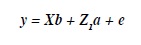
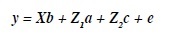
<body><![CDATA[<br> <font style="font-family: verdana;" size="2"></font>    <br> <font style="font-family: verdana;" size="2">Para la estimaci&oacute;n de los componentes de varianza y par&aacute;metros gen&eacute;ticos de edad al primer servicio, edad al primer parto, duraci&oacute;n de la gestaci&oacute;n, d&iacute;as abiertos, intervalo entre partos y servicios por concepci&oacute;n, se asumi&oacute; el siguiente modelo animal univariado:    <br>     <br> </font>     <div style="text-align: center;"><img alt=""  src="/img/revistas/am/v24n2/a06f1.jpg"  style="width: 141px; height: 45px;">    <br> </div> <font style="font-family: verdana;" size="2"></font>    <br> <font style="font-family: verdana;" size="2">Para peso de la vaca al parto, se asumi&oacute; un modelo animal de repetibilidad:    <br>     <br> </font>     <div style="text-align: center;"><img alt=""  src="/img/revistas/am/v24n2/a06f2.jpg"  style="width: 171px; height: 37px;"></div>     ]]></body>
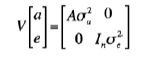
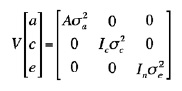
<body><![CDATA[<br> <font style="font-family: verdana;" size="2">donde y es un vector de observaciones para cada una de las diferentes caracter&iacute;sticas, <span style="font-style: italic;">b</span> un vector de efectos fijos (a&ntilde;o de empadre, &eacute;poca de empadre y edad de la madre al parto en forma lineal y cuadr&aacute;tica), <span style="font-style: italic;">a</span> un vector aleatorio desconocido de efectos gen&eacute;ticos aditivos directos, <span  style="font-style: italic;">c</span> un vector aleatorio desconocido de efectos ambientales permanentes de la vaca, <span  style="font-style: italic;">e</span> un vector aleatorio desconocido de efectos ambientales temporales, y X, Z<sub>1</sub>, y Z<sub>2</sub>, son matrices conocidas de incidencia que relacionan los registros con<span  style="font-style: italic;"> b, a y c,</span> respectivamente. Se asumi&oacute; que los efectos gen&eacute;tico aditivo, ambiental permanente de la vaca y residual se distribuyeron normalmente con media 0. Para edad al primer servicio, edad al primer parto, duraci&oacute;n de la gestaci&oacute;n, d&iacute;as abiertos, intervalo entre partos y servicios por concepci&oacute;n, se asumi&oacute; la siguiente estructura de varianzas y covarianzas:    <br>     <br> </font>     <div style="text-align: center;"><img alt=""  src="/img/revistas/am/v24n2/a06f3.jpg"  style="width: 143px; height: 61px;">    <br> </div> <font style="font-family: verdana;" size="2"></font>    <br> <font style="font-family: verdana;" size="2">En el caso del modelo m&aacute;s complejo (para peso de la vaca al parto) se asumi&oacute; la siguiente estructura:    <br>     <br> </font>     <div style="text-align: center;"><img alt=""  src="/img/revistas/am/v24n2/a06f4.jpg"  style="width: 182px; height: 91px;">    <br> </div> <font style="font-family: verdana;" size="2"></font>    ]]></body>
<body><![CDATA[<br> <font style="font-family: verdana;" size="2">donde <span  style="font-weight: bold;">A</span> es la matriz de relaciones aditivas de Wright entre todos los animales en el pedigr&iacute;, <span style="font-weight: bold;">&#963;<sup>2</sup><sub>a</sub></span> es la varianza gen&eacute;tica aditiva, <span style="font-weight: bold;">&#963;<sup>2</sup><sub>c</sub></span><sub> </sub>es la varianza del ambiente permanente de la vaca, <span  style="font-weight: bold;">&#963;<sup>2</sup><sub>e</sub></span> es la varianza del ambiente temporal, e <span style="font-weight: bold;">I<sub>c</sub></span> e <span style="font-weight: bold;">I<sub>n</sub></span> son matrices identidad de dimensi&oacute;n igual al n&uacute;mero de vacas y n&uacute;mero de observaciones, respectivamente.</font>    <br> <font style="font-family: verdana;" size="2"></font><br  style="font-style: italic;"> <font style="font-family: verdana; font-style: italic;" size="2">Estimaci&oacute;n de componentes de varianza</font>    <br> <font style="font-family: verdana;" size="2"></font>    <br> <font style="font-family: verdana;" size="2">Las varianzas se estimaron con M&aacute;xima Verosimilitud Restringida Libre de Derivadas (Smith y Graser 1986), usando el programa MTDFREML (Boldman <span style="font-style: italic;">et al.</span> 1995). Se asumi&oacute; que la convergencia se alcanz&oacute; cuando la varianza de menos dos veces el logaritmo de la verosimilitud en el simplex fue menor que 10<sup>-8</sup>. Despu&eacute;s de que el programa convergi&oacute; por primera vez, se realizaron varios reinicios para asegurarse que se hab&iacute;a alcanzado un m&aacute;ximo global, en lugar de un m&aacute;ximo local. En cada nuevo an&aacute;lisis, se usaron como valores iniciales los estimadores de los par&aacute;metros obtenidos en el an&aacute;lisis previo. Las soluciones de los efectos aleatorios se obtuvieron del &uacute;ltimo ciclo de iteraci&oacute;n donde se alcanz&oacute; el m&aacute;ximo global.</font>    <br> <font style="font-family: verdana;" size="2"></font><br  style="font-style: italic;"> <font style="font-family: verdana; font-style: italic;" size="2">Estimadores de par&aacute;metros gen&eacute;ticos</font>    <br> <font style="font-family: verdana;" size="2"></font>    <br> <font style="font-family: verdana;" size="2">Se obtuvieron estimadores para la varianza fenot&iacute;pica (&#963;<sup>2</sup>p=&#963;<sup>2</sup><sub>a</sub>+&#963;<sup>2</sup><sub>e</sub>o&#963;<sup>2</sup><sub>p</sub>=&#963;<sup>2</sup><sub>a</sub>+&#963;<sup>2</sup><sub>c</sub>+&#963;<sup>2</sup><sub>e</sub>), heredabilidad para efectos gen&eacute;ticos aditivos (h<sup>2</sup>=&#963;<sup>2</sup><sub>a</sub>/&#963;<sup>2</sup><sub>p</sub>), repetibilidad (r<sup>2</sup>=[&#963;<sup>2</sup><sub>a</sub>+&#963;<sup>2</sup><sub>c</sub>]/&#963;<sup>2</sup><sub>p</sub>), fracci&oacute;n de la varianza fenot&iacute;pica debida a efectos del ambiente permanente de la vaca (c<sup>2</sup>=&#963;<sup>2</sup><sub>c</sub>/&#963;<sup><sub>2</sub></sup><sub>p</sub>), y varianza residual como proporci&oacute;n de la varianza fenot&iacute;pica (e<sup>2</sup>=&#963;<sup>2</sup><sub>e</sub>/&#963;<sup>2</sup><sub>p</sub>). Los errores est&aacute;ndar para los estimadores de los par&aacute;metros gen&eacute;ticos fueron aproximados y fueron calculados usando la matriz de informaci&oacute;n promedio (Johnson y Thompson 1995) y el M&eacute;todo Delta (Dodenhoff <span style="font-style: italic;">et al.</span> 1998).</font>    <br> <font style="font-family: verdana;" size="2"></font><br  style="font-weight: bold;"> <font style="font-family: verdana; font-weight: bold;" size="3">Resultados y Discusi&oacute;n</font>    <br> <font style="font-family: verdana;" size="2"></font>    <br> <font style="font-family: verdana;" size="2">Las estad&iacute;sticas descriptivas de la informaci&oacute;n analizada se muestran en el <a href="/img/revistas/am/v24n2/a06t1.gif">Cuadro 1</a>. Las medias de edad al primer servicio, edad al primer parto, duraci&oacute;n de la gestaci&oacute;n, d&iacute;as abiertos, intervalo entre partos, servicios por concepci&oacute;n y peso de la vaca al parto fueron: 30,0 meses, 39,5 meses, 288 d&iacute;as, 180 d&iacute;as, 416 d&iacute;as, 1,6 servicios y 518 kg, respectivamente. Las medias de edad al primer parto e intervalo entre partos son similares a las reportadas por Mercadante <span  style="font-style: italic;">et al.</span> (2000) para vacas Nelore brasile&ntilde;as. Los estimadores de los componentes de varianza se presentan en el <a href="/img/revistas/am/v24n2/a06t2.gif">Cuadro 2</a>, mientras que los estimadores de los par&aacute;metros gen&eacute;ticos para cada una de las caracter&iacute;sticas analizadas se muestran en el <a  href="/img/revistas/am/v24n2/a06t3.gif">Cuadro 3</a>. Los altos coeficientes de variaci&oacute;n de d&iacute;as abiertos y servicios por concepci&oacute;n se debieron a que todos los registros fueron incluidos, independientemente de su magnitud, excepto los registros afectados por enfermedad o muerte, los cuales fueron excluidos. Ngere <span style="font-style: italic;">et al.</span> (1973) demostr&oacute; que la eliminaci&oacute;n de lactancias extremas no afectadas por enfermedad o muerte, al evaluar la producci&oacute;n de leche, conduce a serios sesgos, afectando las conclusiones acerca de una raza o hato.    ]]></body>
<body><![CDATA[<br> </font><font style="font-family: verdana;" size="2">    <br> </font><font style="font-family: verdana; font-weight: bold;" size="2">Edad al primer servicio</font>    <br> <font style="font-family: verdana;" size="2"></font>    <br> <font style="font-family: verdana;" size="2">La edad al primer servicio registrado es un indicador de la edad a la pubertad. El an&aacute;lisis de la edad al primer servicio revel&oacute; que esta caracter&iacute;stica fue moderadamente heredable en el hato de hembras Indubrasil evaluado en el presente estudio (0.39<span style="text-decoration: underline;">+</span>1.52). Toelle y Robison (1985), en un estudio realizado con vacas Hereford, encontraron que el estimador de heredabilidad de la edad al primer servicio de vaquillas apareadas a 1 o 2 a&ntilde;os de edad fue de 0,35. Bennett y Gregory (2001), al evaluar nueve razas paternas (Angus, Braunvieh, Charolais, Gelbvieh, Hereford, Limousin, Pinzgauer, Red Poll, Simmental) y tres razas sint&eacute;ticas (MARC I, MARC II, MARC III), determinaron que la edad a la pubertad tuvo una heredabilidad de 0,27, siendo tambi&eacute;n este &uacute;ltimo valor similar al presente estimador de heredabilidad. En otros estudios realizados con vaquillas Brahman (Vargas <span  style="font-style: italic;">et al.</span> 1998) y cruzadas (Splan <span style="font-style: italic;">et al.</span> 1998) se obtuvieron estimadores de heredabilidad para edad a la pubertad poco mayores, con valores de 0,42 y 0,47, respectivamente.</font>    <br> <font style="font-family: verdana;" size="2"></font>    <br> <font style="font-family: verdana; font-weight: bold;" size="2">Edad al primer parto</font>    <br> <font style="font-family: verdana;" size="2"></font>    <br> <font style="font-family: verdana;" size="2">La heredabilidad estimada para edad al primer parto (0,39&plusmn;0,196) es similar a las heredabilidades estimadas por van der Westhuizen <span  style="font-style: italic;">et al.</span> (2001), Azev&ecirc;do <span style="font-style: italic;">et al.</span> (2006a) y Bormann y Wilson (2010) en diferentes razas productoras de carne (Angus, Sint&eacute;tica, Chianina). Otros investigadores (L&ocirc;bo 1998, Yilmaz <span  style="font-style: italic;">et al.</span> 2004, Roughsedge <span style="font-style: italic;">et al.</span> 2005, Azev&ecirc;do <span style="font-style: italic;">et al.</span> 2006b, Boligon <span style="font-style: italic;">et al.</span> 2012) han reportado menores estimadores con valores que van de 0,21 a 0,29. Sin embargo, Mart&iacute;nez-Vel&aacute;zquez <span  style="font-style: italic;">et al.</span> (2003), Silveira <span style="font-style: italic;">et al.</span> (2004) y Forni y Albuquerque (2005) reportaron estimadores de heredabilidad cercanos a cero, sugiriendo que la varianza gen&eacute;tica aditiva para edad a primer parto es escasa. Bajos estimadores de heredabilidad para edad a primer parto pueden deberse a la corta duraci&oacute;n de los empadres de las vaquillas, ya que con empadres m&aacute;s largos se pueden concebir m&aacute;s hembras, lo que puede contribuir a la identificaci&oacute;n de diferencias gen&eacute;ticas entre animales (Forni y Albuquerque 2005). El valor de heredabilidad obtenido en el presente trabajo para edad a primer parto indica que esta caracter&iacute;stica puede ser disminuida mediante selecci&oacute;n. Las consecuencias favorables de seleccionar para precocidad ser&iacute;an una mayor longevidad y un menor costo de producci&oacute;n de hembras de reemplazo, las cuales no est&aacute;n produciendo becerros, pero consumen alimento (Azev&ecirc;do <span  style="font-style: italic;">et al.</span> 2006a).</font>    <br> <font style="font-family: verdana;" size="2"></font>    <br> <font style="font-family: verdana; font-weight: bold;" size="2">Servicios por concepci&oacute;n</font>    ]]></body>
<body><![CDATA[<br> <font style="font-family: verdana;" size="2"></font>    <br> <font style="font-family: verdana;" size="2">Servicios por concepci&oacute;n result&oacute; ser una caracter&iacute;stica bajamente heredable, con un valor menor a 0,05. Azev&ecirc;do <span style="font-style: italic;">et al.</span> (2006b), para vacas Nelore brasile&ntilde;as, y Yag&uuml;e <span style="font-style: italic;">et al.</span> (2009), para vacas Rubia Gallega espa&ntilde;olas, reportaron que los d&iacute;as abiertos tuvieron una heredabilidad cercana a cero (0,05, 0,07, respectivamente), lo cual es acorde con lo encontrado en el presente estudio. Por el contrario, N&uacute;&ntilde;ez (2006) encontr&oacute; que la heredabilidad para servicios por concepci&oacute;n en vacas de doble prop&oacute;sito (Holstein, Pardo Suizo y Simmental x Ceb&uacute;) en condiciones tropicales de M&eacute;xico fue pr&aacute;cticamente nula, con un valor de 0,006.</font>    <br> <font style="font-family: verdana;" size="2"></font><br  style="font-weight: bold;"> <font style="font-family: verdana; font-weight: bold;" size="2">Duraci&oacute;n de la gestaci&oacute;n</font>    <br> <font style="font-family: verdana;" size="2"></font>    <br> <font style="font-family: verdana;" size="2">El presente estimador de heredabilidad para la duraci&oacute;n de la gestaci&oacute;n fue cercano al 10% y se encuentra dentro del intervalo de estimadores reportados en la literatura cient&iacute;fica. Sin embargo, dichos estimadores muestran una considerable variabilidad con magnitudes que van de 0,002 (Manatrinon <span  style="font-style: italic;">et al.</span> 2009) y 0,04 (Yag&uuml;e <span style="font-style: italic;">et al.</span> 2009) hasta 0,12 (Azev&ecirc;do <span style="font-style: italic;">et al.</span> 2006b) y 0,15 (van Graan <span style="font-style: italic;">et al.</span> 2004), pasando por valores intermedios de 0,07 (Cervantes <span  style="font-style: italic;">et al.</span> 2010) y 0,09 (Crews 2006). La duraci&oacute;n de la gestaci&oacute;n es una caracter&iacute;stica importante porque las vacas con gestaciones m&aacute;s cortas tienen m&aacute;s tiempo para recuperarse y ciclar nuevamente, adem&aacute;s de que sus cr&iacute;as disponen de un periodo m&aacute;s largo para alimentarse de leche materna.</font>    <br> <font style="font-family: verdana;" size="2"></font>    <br> <font style="font-family: verdana; font-weight: bold;" size="2">Intervalo entre partos</font>    <br> <font style="font-family: verdana;" size="2"></font>    <br> <font style="font-family: verdana;" size="2">Intervalo entre partos result&oacute; ser una caracter&iacute;stica reproductiva m&aacute;s heredable que d&iacute;as abiertos y servicios por concepci&oacute;n con un valor de 0,13&plusmn;0,056, el cual se encuentra dentro del intervalo 0,09 - 0,14 reportado por L&ocirc;bo (1998), Goyache y Guti&eacute;rrez (2001), Goyache <span  style="font-style: italic;">et al.</span> (2005), Roughsedge <span style="font-style: italic;">et al.</span> (2005), Azev&ecirc;do <span style="font-style: italic;">et al.</span> (2006a), Guti&eacute;rrez <span style="font-style: italic;">et al.</span> (2007) y Yag&uuml;e <span style="font-style: italic;">et al.</span> (2009) para bovinos productores de carne. Por el contrario, Frazier <span  style="font-style: italic;">et al.</span> (1999) con ganado Angus, Oyama <span style="font-style: italic;">et al.</span> (2002) con ganado Japon&eacute;s Negro y Azev&ecirc;do <span style="font-style: italic;">et al.</span> (2006b) con ganado Nelore encontraron que intervalo entre partos es escasamente heredable con valores de 0,03, 0,05 y 0,05, respectivamente. Se ha reportado que bajos estimadores de heredabilidad para intervalo entre partos se pueden deber a: 1) la poca disponibilidad de animales en la estimaci&oacute;n, 2) la fuerte influencia ambiental sobre la caracter&iacute;stica, 3) la necesidad de ajustar mejor los efectos fijos, y 4) al uso de modelos que no pueden explicar adecuadamente la estructura de la poblaci&oacute;n evaluada (Goyache y Guti&eacute;rrez 2001).</font>    <br> <font style="font-family: verdana;" size="2"></font>    ]]></body>
<body><![CDATA[<br> <font style="font-family: verdana; font-weight: bold;" size="2">D&iacute;as abiertos</font>    <br> <font style="font-family: verdana;" size="2"></font>    <br> <font style="font-family: verdana;" size="2">D&iacute;as abiertos result&oacute; ser igualmente heredable que servicios por concepci&oacute;n. El bajo estimador de heredabilidad en este caso, concuerda con los reportados para las razas productoras de carne Japon&eacute;s Negro (Oyama <span style="font-style: italic;">et al.</span> 2002) y Rubia Gallega (Yag&uuml;e <span style="font-style: italic;">et al.</span> 2009). Por el contrario, para la raza espa&ntilde;ola Asturiana de los Valles, Goyache <span  style="font-style: italic;">et al.</span> (2005) encontraron que d&iacute;as abiertos es una caracter&iacute;stica reproductiva con considerable variabilidad gen&eacute;tica, en relaci&oacute;n con lo que usualmente se ha encontrado para caracter&iacute;sticas reproductivas, especialmente para vaquillas y vacas de segundo parto. En dicho estudio, los estimadores de heredabilidad para d&iacute;as abiertos fueron de 0,091 para vacas de diez o m&aacute;s partos y 0,197 para vacas de segundo parto. Por su parte, Morris <span style="font-style: italic;">et al.</span> (2000) reportaron que d&iacute;as abiertos fue 11% heredable en la raza Angus en un experimento de selecci&oacute;n implementado para reducir la pubertad.</font>    <br> <font style="font-family: verdana;" size="2"></font>    <br> <font style="font-family: verdana; font-weight: bold;" size="2">Peso de la vaca</font><br style="font-weight: bold;"> <font style="font-family: verdana; font-weight: bold;" size="2"></font>    <br> <font style="font-family: verdana;" size="2">El estimador de heredabilidad obtenido para el peso de la vaca al parto fue moderadamente alto (0,49), mientras que la fracci&oacute;n de la varianza del ambiente permanente fue relativamente baja (&lt; 5%). En consecuencia, el estimador de repetibilidad fue similar al estimador de heredabilidad. Este &uacute;ltimo sugiere que la selecci&oacute;n ser&iacute;a efectiva; adem&aacute;s, es similar a los estimadores reportados para vacas Angus (0,45; Northcutt y Wilson 1993) y Nelore (0,45; Boligon <span style="font-style: italic;">et al.</span> 2012). Con vacas Angus, Hereford y F1 Angus x Hereford, Arango <span style="font-style: italic;">et al.</span> (2002) obtuvieron una heredabilidad para peso maduro de 0,49, valor que es igual al estimado en el presente estudio. Similarmente, el an&aacute;lisis de estimadores de par&aacute;metros gen&eacute;ticos publicados en la literatura para caracter&iacute;sticas de bovinos de razas c&aacute;rnicas, realizado por Koots <span style="font-style: italic;">et al.</span> (1994), revel&oacute; que el peso maduro tiene una heredabilidad promedio de 0,50, lo que tambi&eacute;n concuerda con lo hallado en la presente investigaci&oacute;n. Por su parte, Marlowe y Morrow (1985) y Roughsedge <span style="font-style: italic;">et al.</span> (2005) reportaron valores de heredabilidad de 0,38, 0,39 y 0,40, para vacas Angus, Simmental y Limousin, respectivamente, siendo estos poco menores que el del presente trabajo.</font>    <br> <font style="font-family: verdana;" size="2"></font>    <br> <font style="font-family: verdana;" size="2"></font><font  style="font-family: verdana;" size="2">En conclusi&oacute;n, edad al primer servicio, edad al primer parto y peso de la vaca al parto fueron caracter&iacute;sticas m&aacute;s heredables que servicios por concepci&oacute;n, duraci&oacute;n de la gestaci&oacute;n, d&iacute;as abiertos e intervalo entre partos, por lo que las primeras tres caracter&iacute;sticas responder&iacute;an mejor o m&aacute;s eficientemente a la selecci&oacute;n. En general, los estimadores de heredabilidad obtenidos en el presente trabajo para el hato de vacas Indubrasil evaluado son similares a los estimadores reportados en la literatura. Sin embargo, no se encontraron estudios que reportaran estimadores de heredabilidad para caracter&iacute;sticas reproductivas de vacas Indubrasil criadas en M&eacute;xico u otros pa&iacute;ses. Las peque&ntilde;as diferencias encontradas en relaci&oacute;n con los estimadores reportados en la literatura se pudieron deber a diferencias en: 1) las razas evaluadas, 2) el manejo, 3) el n&uacute;mero de observaciones, y 4) el ambiente.</font>    <br> <hr style="width: 100%; height: 2px;"><font  style="font-family: verdana; font-weight: bold;" size="3">Literatura citada</font>    <br> <font style="font-family: verdana;" size="2"></font>    ]]></body>
<body><![CDATA[<!-- ref --><br> <font style="font-family: verdana;" size="2">AMCC (Asociaci&oacute;n Mexicana de Criadores de Ceb&uacute;). 2013. Las razas Ceb&uacute; (en l&iacute;nea). Consultado 7 de junio de 2013. Disponible en <a  href="http://www.cebumexico.com/%20home/index.php?option=com_content&amp;view=article%20&amp;id=95&amp;Itemid=65">http://www.cebumexico.com/ home/index.php?option=com_content&amp;view=article &amp;id=95&amp;Itemid=65</a></font>    &nbsp;&nbsp;&nbsp;&nbsp;&nbsp;&nbsp;&nbsp;&nbsp;[&#160;<a href="javascript:void(0);" onclick="javascript: window.open('/scielo.php?script=sci_nlinks&ref=326244&pid=S1659-1321201300020000600001&lng=','','width=640,height=500,resizable=yes,scrollbars=1,menubar=yes,');">Links</a>&#160;]<!-- end-ref --><br> <font style="font-family: verdana;" size="2"></font>    <!-- ref --><br> <font style="font-family: verdana;" size="2">Arango, JA; Cundiff, LV; Van Vleck, LD. 2002. Genetic parameters for weight, weight adjusted for body condition score, height, and body condition score in beef cows. Journal of Animal Science 80:3112-3122.    &nbsp;&nbsp;&nbsp;&nbsp;&nbsp;&nbsp;&nbsp;&nbsp;[&#160;<a href="javascript:void(0);" onclick="javascript: window.open('/scielo.php?script=sci_nlinks&ref=326246&pid=S1659-1321201300020000600002&lng=','','width=640,height=500,resizable=yes,scrollbars=1,menubar=yes,');">Links</a>&#160;]<!-- end-ref --></font>    <br> <font style="font-family: verdana;" size="2"></font>    <!-- ref --><br> <font style="font-family: verdana;" size="2">Azev&ecirc;do, DMMR; Filho, RM; Bozzi, R; Forabosco, F; Malhado, CHM. 2006a. Par&acirc;metros gen&eacute;ticos e fenot&iacute;picos do desempenho reprodutivo de f&ecirc;meas Chianina. Revista Brasileira de Zootecnia 35(3):982-987.    &nbsp;&nbsp;&nbsp;&nbsp;&nbsp;&nbsp;&nbsp;&nbsp;[&#160;<a href="javascript:void(0);" onclick="javascript: window.open('/scielo.php?script=sci_nlinks&ref=326249&pid=S1659-1321201300020000600003&lng=','','width=640,height=500,resizable=yes,scrollbars=1,menubar=yes,');">Links</a>&#160;]<!-- end-ref --></font>    <br> <font style="font-family: verdana;" size="2"></font>    <!-- ref --><br> <font style="font-family: verdana;" size="2">Azev&ecirc;do, DMMR; Filho, RM; L&ocirc;bo, RNB; Malhado, CHM; L&ocirc;bo, RB; Moura, AAA; Pimenta Filho, EC. 2006b. Desempenho reprodutivo de vacas Nelore no Norte e Nordeste do Brasil. Revista Brasileira de Zootecnia 35(3):988-996.    &nbsp;&nbsp;&nbsp;&nbsp;&nbsp;&nbsp;&nbsp;&nbsp;[&#160;<a href="javascript:void(0);" onclick="javascript: window.open('/scielo.php?script=sci_nlinks&ref=326252&pid=S1659-1321201300020000600004&lng=','','width=640,height=500,resizable=yes,scrollbars=1,menubar=yes,');">Links</a>&#160;]<!-- end-ref --></font>    ]]></body>
<body><![CDATA[<br> <font style="font-family: verdana;" size="2"></font>    <!-- ref --><br> <font style="font-family: verdana;" size="2">Bennett, GL; Gregory, KE. 2001. Genetic (co)variances for calving difficulty score in composite and parental populations of beef cattle: II. Reproductive, skeletal, and carcass traits. Journal of Animal Science 79:52-59.    &nbsp;&nbsp;&nbsp;&nbsp;&nbsp;&nbsp;&nbsp;&nbsp;[&#160;<a href="javascript:void(0);" onclick="javascript: window.open('/scielo.php?script=sci_nlinks&ref=326255&pid=S1659-1321201300020000600005&lng=','','width=640,height=500,resizable=yes,scrollbars=1,menubar=yes,');">Links</a>&#160;]<!-- end-ref --></font>    <br> <font style="font-family: verdana;" size="2"></font>    <!-- ref --><br> <font style="font-family: verdana;" size="2">Boldman, KG; Kriese, LA; Van Vleck, LD; Van Tassell, CP; Kachman, SD. 1995. A manual for use of MTDFREML: A set of programs to obtain estimates of variances and covariances [Draft]. Washington, DC, USA, ARS, USDA. 114 p.    &nbsp;&nbsp;&nbsp;&nbsp;&nbsp;&nbsp;&nbsp;&nbsp;[&#160;<a href="javascript:void(0);" onclick="javascript: window.open('/scielo.php?script=sci_nlinks&ref=326258&pid=S1659-1321201300020000600006&lng=','','width=640,height=500,resizable=yes,scrollbars=1,menubar=yes,');">Links</a>&#160;]<!-- end-ref --></font>    <br> <font style="font-family: verdana;" size="2"></font>    <!-- ref --><br> <font style="font-family: verdana;" size="2">Boligon, AA; Baldi, F; Albuquerque, LG. 2012. Genetic correlations between heifer subsequent rebreeding and age at first calving and growth traits in Nellore cattle by bayesian inference. Genetics and Molecular Research 11(4):4516-4524.    &nbsp;&nbsp;&nbsp;&nbsp;&nbsp;&nbsp;&nbsp;&nbsp;[&#160;<a href="javascript:void(0);" onclick="javascript: window.open('/scielo.php?script=sci_nlinks&ref=326261&pid=S1659-1321201300020000600007&lng=','','width=640,height=500,resizable=yes,scrollbars=1,menubar=yes,');">Links</a>&#160;]<!-- end-ref --></font>    <br> <font style="font-family: verdana;" size="2"></font>    ]]></body>
<body><![CDATA[<!-- ref --><br> <font style="font-family: verdana;" size="2">Bormann, JM; Totir, LR; Kachman, SD; Fernando, RL; Wilson, DE. 2006. Pregnancy rate and first-service conception rate in Angus heifers. Journal of Animal Science 84:2022-2025.    &nbsp;&nbsp;&nbsp;&nbsp;&nbsp;&nbsp;&nbsp;&nbsp;[&#160;<a href="javascript:void(0);" onclick="javascript: window.open('/scielo.php?script=sci_nlinks&ref=326264&pid=S1659-1321201300020000600008&lng=','','width=640,height=500,resizable=yes,scrollbars=1,menubar=yes,');">Links</a>&#160;]<!-- end-ref --></font>    <br> <font style="font-family: verdana;" size="2"></font>    <!-- ref --><br> <font style="font-family: verdana;" size="2">Bormann, MJ; Wilson, DE. 2010. Calving day and age at first calving in Angus heifers. Journal of Animal Science 88:1947-1956.    &nbsp;&nbsp;&nbsp;&nbsp;&nbsp;&nbsp;&nbsp;&nbsp;[&#160;<a href="javascript:void(0);" onclick="javascript: window.open('/scielo.php?script=sci_nlinks&ref=326267&pid=S1659-1321201300020000600009&lng=','','width=640,height=500,resizable=yes,scrollbars=1,menubar=yes,');">Links</a>&#160;]<!-- end-ref --></font>    <br> <font style="font-family: verdana;" size="2"></font>    <!-- ref --><br> <font style="font-family: verdana;" size="2"></font><font  style="font-family: verdana;" size="2">Cervantes, I; Guti&eacute;rrez, JP; Fern&aacute;ndez, I; Goyache, F. 2010. Genetic relationships among calving ease, gestation length, and calf survival to weaning in the Asturiana de los Valles beef cattle breed. Journal of Animal Science 88:96-101.    &nbsp;&nbsp;&nbsp;&nbsp;&nbsp;&nbsp;&nbsp;&nbsp;[&#160;<a href="javascript:void(0);" onclick="javascript: window.open('/scielo.php?script=sci_nlinks&ref=326270&pid=S1659-1321201300020000600010&lng=','','width=640,height=500,resizable=yes,scrollbars=1,menubar=yes,');">Links</a>&#160;]<!-- end-ref --></font>    <br> <font style="font-family: verdana;" size="2"></font>    <!-- ref --><br> <font style="font-family: verdana;" size="2">Chan, EKF; Nagaraj, SH; Reverter, A. 2010. The evolution of tropical adaptation: comparing Taurine and Zebu cattle. Animal Genetics 41:467-477.    &nbsp;&nbsp;&nbsp;&nbsp;&nbsp;&nbsp;&nbsp;&nbsp;[&#160;<a href="javascript:void(0);" onclick="javascript: window.open('/scielo.php?script=sci_nlinks&ref=326273&pid=S1659-1321201300020000600011&lng=','','width=640,height=500,resizable=yes,scrollbars=1,menubar=yes,');">Links</a>&#160;]<!-- end-ref --></font>    <br> <font style="font-family: verdana;" size="2"></font>    <!-- ref --><br> <font style="font-family: verdana;" size="2">Crews, DH. 2006. Age of dam and sex of calf adjustments and genetic parameters for gestation length in Charolais cattle. Journal of Animal Science 84:25-31.    &nbsp;&nbsp;&nbsp;&nbsp;&nbsp;&nbsp;&nbsp;&nbsp;[&#160;<a href="javascript:void(0);" onclick="javascript: window.open('/scielo.php?script=sci_nlinks&ref=326276&pid=S1659-1321201300020000600012&lng=','','width=640,height=500,resizable=yes,scrollbars=1,menubar=yes,');">Links</a>&#160;]<!-- end-ref --></font>    <br> <font style="font-family: verdana;" size="2"></font>    <!-- ref --><br> <font style="font-family: verdana;" size="2">Dodenhoff, J; Van Vleck, LD; Kachman, SD; Koch, RM. 1998. Parameter estimates for direct, maternal, and grandmaternal genetic effects for birth weight and weaning weight in Hereford cattle. Journal of Animal Science 76:2521-2527.    &nbsp;&nbsp;&nbsp;&nbsp;&nbsp;&nbsp;&nbsp;&nbsp;[&#160;<a href="javascript:void(0);" onclick="javascript: window.open('/scielo.php?script=sci_nlinks&ref=326279&pid=S1659-1321201300020000600013&lng=','','width=640,height=500,resizable=yes,scrollbars=1,menubar=yes,');">Links</a>&#160;]<!-- end-ref --></font>    <br> <font style="font-family: verdana;" size="2"></font>    <!-- ref --><br> <font style="font-family: verdana;" size="2">Forni, S; Albuquerque, LG. 2005. Estimates of genetic correlations between days to calving and reproductive and weight traits in Nelore cattle. Journal of Animal Science 83:1511-1515.    &nbsp;&nbsp;&nbsp;&nbsp;&nbsp;&nbsp;&nbsp;&nbsp;[&#160;<a href="javascript:void(0);" onclick="javascript: window.open('/scielo.php?script=sci_nlinks&ref=326282&pid=S1659-1321201300020000600014&lng=','','width=640,height=500,resizable=yes,scrollbars=1,menubar=yes,');">Links</a>&#160;]<!-- end-ref --></font>    ]]></body>
<body><![CDATA[<br> <font style="font-family: verdana;" size="2"></font>    <!-- ref --><br> <font style="font-family: verdana;" size="2">Frazier, EL; Sprott, LR; Sanders, JO; Dahm, PF; Crouch, JR; Turner, JW. 1999. Sire marbling score expected progeny difference and weaning weight maternal expected progeny difference associations with age at first calving and calving interval in Angus beef cattle. Journal of Animal Science 77:1322-1328.    &nbsp;&nbsp;&nbsp;&nbsp;&nbsp;&nbsp;&nbsp;&nbsp;[&#160;<a href="javascript:void(0);" onclick="javascript: window.open('/scielo.php?script=sci_nlinks&ref=326285&pid=S1659-1321201300020000600015&lng=','','width=640,height=500,resizable=yes,scrollbars=1,menubar=yes,');">Links</a>&#160;]<!-- end-ref --></font>    <br> <font style="font-family: verdana;" size="2"></font>    <!-- ref --><br> <font style="font-family: verdana;" size="2"></font><font  style="font-family: verdana;" size="2">Goyache, F; Guti&eacute;rrez, JP. 2001. Heritability of reproductive traits in Asturiana de los Valles beef cattle breed. Archiv Tierzucht 44(5):489-496.    &nbsp;&nbsp;&nbsp;&nbsp;&nbsp;&nbsp;&nbsp;&nbsp;[&#160;<a href="javascript:void(0);" onclick="javascript: window.open('/scielo.php?script=sci_nlinks&ref=326288&pid=S1659-1321201300020000600016&lng=','','width=640,height=500,resizable=yes,scrollbars=1,menubar=yes,');">Links</a>&#160;]<!-- end-ref --></font>    <br> <font style="font-family: verdana;" size="2"></font>    <!-- ref --><br> <font style="font-family: verdana;" size="2"></font><font  style="font-family: verdana;" size="2">Goyache, F; Guti&eacute;rrez, JP; Fern&aacute;ndez, I; Royo, LJ; &Aacute;lvarez, I. 2005. Genetic analysis of days open in beef cattle. Livestock Production Science 93:283-289.    &nbsp;&nbsp;&nbsp;&nbsp;&nbsp;&nbsp;&nbsp;&nbsp;[&#160;<a href="javascript:void(0);" onclick="javascript: window.open('/scielo.php?script=sci_nlinks&ref=326291&pid=S1659-1321201300020000600017&lng=','','width=640,height=500,resizable=yes,scrollbars=1,menubar=yes,');">Links</a>&#160;]<!-- end-ref --></font>    <br> <font style="font-family: verdana;" size="2"></font>    ]]></body>
<body><![CDATA[<!-- ref --><br> <font style="font-family: verdana;" size="2"></font><font  style="font-family: verdana;" size="2">Guti&eacute;rrez, JP; Goyache, F; Fern&aacute;ndez, I; Alvarez, I; Royo, LJ. 2007. Genetic relationships among calving ease, calving interval, birth weight, and weaning weight in the Asturiana de los Valles beef cattle breed. Journal of Animal Science 85:69-75.    &nbsp;&nbsp;&nbsp;&nbsp;&nbsp;&nbsp;&nbsp;&nbsp;[&#160;<a href="javascript:void(0);" onclick="javascript: window.open('/scielo.php?script=sci_nlinks&ref=326294&pid=S1659-1321201300020000600018&lng=','','width=640,height=500,resizable=yes,scrollbars=1,menubar=yes,');">Links</a>&#160;]<!-- end-ref --></font>    <br> <font style="font-family: verdana;" size="2"></font>    <!-- ref --><br> <font style="font-family: verdana;" size="2">Johnson, DL; Thompson, R. 1995. Restricted maximum likelihood&nbsp; estimation&nbsp;&nbsp; &nbsp;of&nbsp;&nbsp; &nbsp;variance&nbsp; components&nbsp;&nbsp;&nbsp; for univariate animal models using sparse matrix&nbsp;&nbsp;&nbsp; techniques and average information. Journal of Dairy&nbsp; </font><font style="font-family: verdana;" size="2">Science 78:449-456.    &nbsp;&nbsp;&nbsp;&nbsp;&nbsp;&nbsp;&nbsp;&nbsp;[&#160;<a href="javascript:void(0);" onclick="javascript: window.open('/scielo.php?script=sci_nlinks&ref=326297&pid=S1659-1321201300020000600019&lng=','','width=640,height=500,resizable=yes,scrollbars=1,menubar=yes,');">Links</a>&#160;]<!-- end-ref -->&nbsp;&nbsp; &nbsp;&nbsp;&nbsp; </font>    <br> <font style="font-family: verdana;" size="-1">    <!-- ref --><br> </font><font style="font-family: verdana;" size="-1"></font><font  style="font-family: verdana;" size="-1">Koots, KR; Gibson, JP; Wilton, JW. 1994. Analyses of published genetic parameter estimates for beef production traits. 2. Phenotypic and genetic correlations. Animal Breeding Abstract 62:825-853.    &nbsp;&nbsp;&nbsp;&nbsp;&nbsp;&nbsp;&nbsp;&nbsp;[&#160;<a href="javascript:void(0);" onclick="javascript: window.open('/scielo.php?script=sci_nlinks&ref=326300&pid=S1659-1321201300020000600020&lng=','','width=640,height=500,resizable=yes,scrollbars=1,menubar=yes,');">Links</a>&#160;]<!-- end-ref --></font>    <br> <font style="font-family: verdana;" size="2"></font>    <!-- ref --><br> <font style="font-family: verdana;" size="2">L&ocirc;bo, RNB. 1998. Genetic parameters for reproductive traits of Zebu cows in the semiarid region of Brazil. Livestock Production Science 55(3):245-248.    &nbsp;&nbsp;&nbsp;&nbsp;&nbsp;&nbsp;&nbsp;&nbsp;[&#160;<a href="javascript:void(0);" onclick="javascript: window.open('/scielo.php?script=sci_nlinks&ref=326303&pid=S1659-1321201300020000600021&lng=','','width=640,height=500,resizable=yes,scrollbars=1,menubar=yes,');">Links</a>&#160;]<!-- end-ref --></font>    <br> <font style="font-family: verdana;" size="2"></font>    <!-- ref --><br> <font style="font-family: verdana;" size="2">Manatrinon, S; Furst-Waltl, B; Baumung, R. 2009. Genetic parameters for calving ease, gestation length and stillbirth in three endangered Austrian Blond cattle breeds. Archiv Tierzucht 52:553-560.    &nbsp;&nbsp;&nbsp;&nbsp;&nbsp;&nbsp;&nbsp;&nbsp;[&#160;<a href="javascript:void(0);" onclick="javascript: window.open('/scielo.php?script=sci_nlinks&ref=326306&pid=S1659-1321201300020000600022&lng=','','width=640,height=500,resizable=yes,scrollbars=1,menubar=yes,');">Links</a>&#160;]<!-- end-ref --></font>    <br> <font style="font-family: verdana;" size="2"></font>    <!-- ref --><br> <font style="font-family: verdana;" size="2">Marlowe, TJ; Morrow, GA. 1985. Heritabilities and phenotypic, genetic and environmental correlations for weight, grade and condition of Angus cows. Journal of Animal Science 60:82-88.    &nbsp;&nbsp;&nbsp;&nbsp;&nbsp;&nbsp;&nbsp;&nbsp;[&#160;<a href="javascript:void(0);" onclick="javascript: window.open('/scielo.php?script=sci_nlinks&ref=326309&pid=S1659-1321201300020000600023&lng=','','width=640,height=500,resizable=yes,scrollbars=1,menubar=yes,');">Links</a>&#160;]<!-- end-ref --></font>    <br> <font style="font-family: verdana;" size="2"></font>    <!-- ref --><br> <font style="font-family: verdana;" size="2">Mart&iacute;nez-Vel&aacute;zquez, G; Gregory, KE; Bennett, GL; Van Vleck, LD. 2003. Genetic relationships between scrotal circumference and female reproductive traits. Journal of Animal Science 81:395-401.    &nbsp;&nbsp;&nbsp;&nbsp;&nbsp;&nbsp;&nbsp;&nbsp;[&#160;<a href="javascript:void(0);" onclick="javascript: window.open('/scielo.php?script=sci_nlinks&ref=326312&pid=S1659-1321201300020000600024&lng=','','width=640,height=500,resizable=yes,scrollbars=1,menubar=yes,');">Links</a>&#160;]<!-- end-ref --></font>    ]]></body>
<body><![CDATA[<br> <font style="font-family: verdana;" size="2"></font>    <!-- ref --><br> <font style="font-family: verdana;" size="2">Mercadante, MEZ; L&ocirc;bo, RB; Oliveira, HN. 2000. Estimativas de (co)vari&acirc;ncias entre caracter&iacute;sticas de reprodu&ccedil;&atilde;o e de crescimento em f&ecirc;meas de um rebanho Nelore. Revista Brasileira de Zootecnia 29(4):997-1004.    &nbsp;&nbsp;&nbsp;&nbsp;&nbsp;&nbsp;&nbsp;&nbsp;[&#160;<a href="javascript:void(0);" onclick="javascript: window.open('/scielo.php?script=sci_nlinks&ref=326315&pid=S1659-1321201300020000600025&lng=','','width=640,height=500,resizable=yes,scrollbars=1,menubar=yes,');">Links</a>&#160;]<!-- end-ref --></font>    <br> <font style="font-family: verdana;" size="2"></font>    <!-- ref --><br> <font style="font-family: verdana;" size="2">Morris, CA; Wilson, JA; Bennett, GL; Cullen, NG; Hickey, SM; Hunter, JC. 2000. Genetic parameters for growth, puberty, and beef cow reproductive traits in a puberty selection experiment. New Zealand Journal of Agricultural Research 43:83-91.    &nbsp;&nbsp;&nbsp;&nbsp;&nbsp;&nbsp;&nbsp;&nbsp;[&#160;<a href="javascript:void(0);" onclick="javascript: window.open('/scielo.php?script=sci_nlinks&ref=326318&pid=S1659-1321201300020000600026&lng=','','width=640,height=500,resizable=yes,scrollbars=1,menubar=yes,');">Links</a>&#160;]<!-- end-ref --></font>    <br> <font style="font-family: verdana;" size="2"></font>    <!-- ref --><br> <font style="font-family: verdana;" size="2">Ngere, LO; McDowell, RE; Bhattacharya, S; Guha, H. 1973. Factors influencing milk yield of Hariana cattle. Journal of Animal Science 36:457-465.    &nbsp;&nbsp;&nbsp;&nbsp;&nbsp;&nbsp;&nbsp;&nbsp;[&#160;<a href="javascript:void(0);" onclick="javascript: window.open('/scielo.php?script=sci_nlinks&ref=326321&pid=S1659-1321201300020000600027&lng=','','width=640,height=500,resizable=yes,scrollbars=1,menubar=yes,');">Links</a>&#160;]<!-- end-ref --></font>    <br> <font style="font-family: verdana;" size="2"></font>    ]]></body>
<body><![CDATA[<!-- ref --><br> <font style="font-family: verdana;" size="2">Northcutt, SL; Wilson, DE. 1993. Genetic parameter estimates and expected progeny differences for mature size in Angus cattle. Journal of Animal Science 71:1148-1153.    &nbsp;&nbsp;&nbsp;&nbsp;&nbsp;&nbsp;&nbsp;&nbsp;[&#160;<a href="javascript:void(0);" onclick="javascript: window.open('/scielo.php?script=sci_nlinks&ref=326324&pid=S1659-1321201300020000600028&lng=','','width=640,height=500,resizable=yes,scrollbars=1,menubar=yes,');">Links</a>&#160;]<!-- end-ref --></font>    <br> <font style="font-family: verdana;" size="2"></font>    <!-- ref --><br> <font style="font-family: verdana;" size="2">N&uacute;&ntilde;ez, SSG. 2006. Estimaci&oacute;n de efectos gen&eacute;ticos para caracter&iacute;sticas reproductivas en poblaciones multirraciales de bovinos de doble prop&oacute;sito en el tr&oacute;pico h&uacute;medo de M&eacute;xico. Tesis de Maestr&iacute;a en Ciencias. Universidad Nacional Aut&oacute;noma de M&eacute;xico, Distrito Federal, M&eacute;xico. 89 p.    &nbsp;&nbsp;&nbsp;&nbsp;&nbsp;&nbsp;&nbsp;&nbsp;[&#160;<a href="javascript:void(0);" onclick="javascript: window.open('/scielo.php?script=sci_nlinks&ref=326327&pid=S1659-1321201300020000600029&lng=','','width=640,height=500,resizable=yes,scrollbars=1,menubar=yes,');">Links</a>&#160;]<!-- end-ref --></font>    <br> <font style="font-family: verdana;" size="2"></font>    <!-- ref --><br> <font style="font-family: verdana;" size="2">Oyama, K; Katsuta, T; Anada, K; Mukai, F. 2002. Heritability and repeatability estimates for reproductive traits of Japanese Black cows. Asian-Australasian Journal of Animal Science 15(12):1680-1685.    &nbsp;&nbsp;&nbsp;&nbsp;&nbsp;&nbsp;&nbsp;&nbsp;[&#160;<a href="javascript:void(0);" onclick="javascript: window.open('/scielo.php?script=sci_nlinks&ref=326330&pid=S1659-1321201300020000600030&lng=','','width=640,height=500,resizable=yes,scrollbars=1,menubar=yes,');">Links</a>&#160;]<!-- end-ref --></font>    <br> <font style="font-family: verdana;" size="2"></font>    <!-- ref --><br> <font style="font-family: verdana;" size="2">Roughsedge, T; Amer, PR; Thompson, R; Simm, G. 2005. Genetic parameters for a maternal breeding goal in beef production. Journal of Animal Science 83:2319-2329.    &nbsp;&nbsp;&nbsp;&nbsp;&nbsp;&nbsp;&nbsp;&nbsp;[&#160;<a href="javascript:void(0);" onclick="javascript: window.open('/scielo.php?script=sci_nlinks&ref=326333&pid=S1659-1321201300020000600031&lng=','','width=640,height=500,resizable=yes,scrollbars=1,menubar=yes,');">Links</a>&#160;]<!-- end-ref --></font>    <br> <font style="font-family: verdana;" size="2"></font>    <!-- ref --><br> <font style="font-family: verdana;" size="2">Silveira, JC; McManus, C; Mascioli, AS; Silva, LOC; Silveira, AC; Garcia, JAS; Louvandini, H. 2004. Fatores ambientais e par&acirc;metros gen&eacute;ticos para caracter&iacute;sticas produtivas e reprodutivas em um rebanho Nelore no Estado do Mato Grosso do Sul. Revista Brasileira de Zootecnia 33(6):1432-1444.    &nbsp;&nbsp;&nbsp;&nbsp;&nbsp;&nbsp;&nbsp;&nbsp;[&#160;<a href="javascript:void(0);" onclick="javascript: window.open('/scielo.php?script=sci_nlinks&ref=326336&pid=S1659-1321201300020000600032&lng=','','width=640,height=500,resizable=yes,scrollbars=1,menubar=yes,');">Links</a>&#160;]<!-- end-ref --></font>    <br> <font style="font-family: verdana;" size="2"></font>    <!-- ref --><br> <font style="font-family: verdana;" size="2">Smith, SP; Graser, HU. 1986. Estimating variance components in a class of mixed models by restricted maximum likelihood. Journal of Dairy Science 69:1156-1165.    &nbsp;&nbsp;&nbsp;&nbsp;&nbsp;&nbsp;&nbsp;&nbsp;[&#160;<a href="javascript:void(0);" onclick="javascript: window.open('/scielo.php?script=sci_nlinks&ref=326339&pid=S1659-1321201300020000600033&lng=','','width=640,height=500,resizable=yes,scrollbars=1,menubar=yes,');">Links</a>&#160;]<!-- end-ref --></font>    <br> <font style="font-family: verdana;" size="2"></font>    <!-- ref --><br> <font style="font-family: verdana;" size="2">Splan, RK; Cundiff, LV; Van Vleck, LD. 1998. Genetic parameters for sex-specific traits in beef cattle. Journal of Animal Science 76:2272-2278.    &nbsp;&nbsp;&nbsp;&nbsp;&nbsp;&nbsp;&nbsp;&nbsp;[&#160;<a href="javascript:void(0);" onclick="javascript: window.open('/scielo.php?script=sci_nlinks&ref=326342&pid=S1659-1321201300020000600034&lng=','','width=640,height=500,resizable=yes,scrollbars=1,menubar=yes,');">Links</a>&#160;]<!-- end-ref --></font>    ]]></body>
<body><![CDATA[<br> <font style="font-family: verdana;" size="2"></font>    <!-- ref --><br> <font style="font-family: verdana;" size="2">Toelle, VD; Robison, OW. 1985. Estimates of genetic correlations between testicular measurements and female reproductive traits in cattle. Journal of Animal Science 60:89-100.    &nbsp;&nbsp;&nbsp;&nbsp;&nbsp;&nbsp;&nbsp;&nbsp;[&#160;<a href="javascript:void(0);" onclick="javascript: window.open('/scielo.php?script=sci_nlinks&ref=326345&pid=S1659-1321201300020000600035&lng=','','width=640,height=500,resizable=yes,scrollbars=1,menubar=yes,');">Links</a>&#160;]<!-- end-ref --></font>    <br> <font style="font-family: verdana;" size="2"></font>    <!-- ref --><br> <font style="font-family: verdana;" size="2">van der Westhuizen, RR; Schoeman, SJ; Jordaan, GF; van Wyk, JB. 2001. Genetic parameters for reproductive traits in a beef cattle herd estimated using multitrait analysis. South African Journal of Animal Science 31(1):41-48.    &nbsp;&nbsp;&nbsp;&nbsp;&nbsp;&nbsp;&nbsp;&nbsp;[&#160;<a href="javascript:void(0);" onclick="javascript: window.open('/scielo.php?script=sci_nlinks&ref=326348&pid=S1659-1321201300020000600036&lng=','','width=640,height=500,resizable=yes,scrollbars=1,menubar=yes,');">Links</a>&#160;]<!-- end-ref --></font>    <br> <font style="font-family: verdana;" size="2"></font>    <!-- ref --><br> <font style="font-family: verdana;" size="2">van Graan, AC; Neser, FWC; van der Westhuizen, J; Theron, HE. 2004. Genetic and phenotypic parameter estimates of gestation length and birth weight in Bonsmara cattle. South African Journal of Animal Science 34(2):95-97.    &nbsp;&nbsp;&nbsp;&nbsp;&nbsp;&nbsp;&nbsp;&nbsp;[&#160;<a href="javascript:void(0);" onclick="javascript: window.open('/scielo.php?script=sci_nlinks&ref=326351&pid=S1659-1321201300020000600037&lng=','','width=640,height=500,resizable=yes,scrollbars=1,menubar=yes,');">Links</a>&#160;]<!-- end-ref --></font>    <br> <font style="font-family: verdana;" size="2"></font>    ]]></body>
<body><![CDATA[<!-- ref --><br> <font style="font-family: verdana;" size="2">Vargas, CA; Elzo, MA; Chase, CC; Chenoweth, PJ; Olson, TA. 1998. Estimation of genetic parameters for scrotal circumference, age at puberty in heifers, and hip height in Brahman cattle. Journal of Animal Science 76:2536-2541.    &nbsp;&nbsp;&nbsp;&nbsp;&nbsp;&nbsp;&nbsp;&nbsp;[&#160;<a href="javascript:void(0);" onclick="javascript: window.open('/scielo.php?script=sci_nlinks&ref=326354&pid=S1659-1321201300020000600038&lng=','','width=640,height=500,resizable=yes,scrollbars=1,menubar=yes,');">Links</a>&#160;]<!-- end-ref --></font>    <br> <font style="font-family: verdana;" size="2"></font>    <!-- ref --><br> <font style="font-family: verdana;" size="2">Yag&uuml;e, G; Goyache, F; Becerra, J; Moreno, C; S&aacute;nchez, L; Altarriba, J. 2009. Bayesian estimates of genetic parameters for pre-conception traits, gestation length and calving interval in beef cattle. Animal Reproduction Science 114(1):72-80.    &nbsp;&nbsp;&nbsp;&nbsp;&nbsp;&nbsp;&nbsp;&nbsp;[&#160;<a href="javascript:void(0);" onclick="javascript: window.open('/scielo.php?script=sci_nlinks&ref=326357&pid=S1659-1321201300020000600039&lng=','','width=640,height=500,resizable=yes,scrollbars=1,menubar=yes,');">Links</a>&#160;]<!-- end-ref --></font>    <br> <font style="font-family: verdana;" size="2"></font>    <!-- ref --><br> <font style="font-family: verdana;" size="2">Yilmaz, A; Davis, ME; Simmen, RCM. 2004. Estimation of (co)variance components for reproductive traits in Angus beef cattle divergently selected for blood serum IGF-I concentration. Journal of Animal Science 82:2285-2292.    &nbsp;&nbsp;&nbsp;&nbsp;&nbsp;&nbsp;&nbsp;&nbsp;[&#160;<a href="javascript:void(0);" onclick="javascript: window.open('/scielo.php?script=sci_nlinks&ref=326360&pid=S1659-1321201300020000600040&lng=','','width=640,height=500,resizable=yes,scrollbars=1,menubar=yes,');">Links</a>&#160;]<!-- end-ref --></font>    <br> <font style="font-family: verdana;" size="2"></font>    <br> <font size="-1"><span style="font-family: verdana;"><a name="Corres1"></a><a  href="#Corres2">*</a>Correspondencia a:</span></font>    ]]></body>
<body><![CDATA[<br> <font style="font-family: verdana;" size="2"><sup><a name="2"></a><a  href="#4">2</a></sup>&Aacute;ngel R&iacute;os-Utrera. </font><font style="font-family: verdana;" size="2">Campo Experimental La Posta, Instituto Nacional de Investigaciones Forestales, Agr&iacute;colas y Pecuarias (INIFAP), kil&oacute;metro 22.5 carretera Veracruz-C&oacute;rdoba, Paso del Toro, Municipio de Medell&iacute;n de Bravo, Veracruz, M&eacute;xico, 94277. Tel&eacute;fono: +55 (229) 2622222. rios.angel@ inifap.gob.mx.</font>    <br> <font style="font-family: verdana;" size="2"><a href="#4"><sup>2</sup></a>V&iacute;ctor Delio Hern&aacute;ndez-Hern&aacute;ndez. </font><font  style="font-family: verdana;" size="2">Campo Experimental La Posta, Instituto Nacional de Investigaciones Forestales, Agr&iacute;colas y Pecuarias (INIFAP), kil&oacute;metro 22.5 carretera Veracruz-C&oacute;rdoba, Paso del Toro, Municipio de Medell&iacute;n de Bravo, Veracruz, M&eacute;xico, 94277. Tel&eacute;fono: +55 (229) 2622222. hernandez.delio@inifap.gob.mx</font>    <br> <font style="font-family: verdana;" size="2"><sup><a name="3"></a><a  href="#5">3</a></sup>Eugenio Villag&oacute;mez Amezcua-Manjarr&eacute;z. </font><font style="font-family: verdana;"  size="2">Centro Nacional de Investigaci&oacute;n Disciplinaria en Microbiolog&iacute;a, Instituto Nacional de Investigaciones Forestales, Agr&iacute;colas&nbsp;&nbsp; Pecuarias (INIFAP). Kil&oacute;metro 15.5 carretera M&eacute;xico-Toluca, Col. Palo Alto, Cuajimalpa, Distrito Federal, M&eacute;xico, 05110. Tel&eacute;fono: +55 (55) 36180800. villagomez.eugenio@inifap.gob.m</font>    <br> <font style="font-family: verdana;" size="2"><a href="#4"><sup>2</sup></a>Juan Prisciliano Z&aacute;rate-Mart&iacute;nez. </font><font  style="font-family: verdana;" size="2">Campo Experimental La Posta, Instituto Nacional de Investigaciones Forestales, Agr&iacute;colas y Pecuarias (INIFAP), kil&oacute;metro 22.5 carretera Veracruz-C&oacute;rdoba, Paso del Toro, Municipio de Medell&iacute;n de Bravo, Veracruz, M&eacute;xico, 94277. Tel&eacute;fono: +55 (229) 2622222. zarate.juan@inifap.gob.mx     <br> </font><font style="font-family: verdana;" size="2">Este trabajo form&oacute; parte de un proyecto de investigaci&oacute;n financiado por el Instituto Nacional de Investigaciones Forestales, Agr&iacute;colas y Pecuarias (INIFAP), M&eacute;xico. </font>    <br> <hr style="width: 100%; height: 2px;">     <div style="text-align: center;"><font  style="font-family: verdana; font-weight: bold;" size="2">Recibido: 7 de junio, 2013. Aceptado: 28 de octubre, 2013</font><br  style="font-family: verdana;"> </div> </div>      ]]></body><back>
<ref-list>
<ref id="B1">
<nlm-citation citation-type="">
<collab>AMCC (Asociación Mexicana de Criadores de Cebú)</collab>
<source><![CDATA[Las razas Cebú]]></source>
<year>2013</year>
</nlm-citation>
</ref>
<ref id="B2">
<nlm-citation citation-type="journal">
<person-group person-group-type="author">
<name>
<surname><![CDATA[Arango]]></surname>
<given-names><![CDATA[JA]]></given-names>
</name>
<name>
<surname><![CDATA[Cundiff]]></surname>
<given-names><![CDATA[LV]]></given-names>
</name>
<name>
<surname><![CDATA[Van Vleck]]></surname>
<given-names><![CDATA[LD]]></given-names>
</name>
</person-group>
<article-title xml:lang="en"><![CDATA[Genetic parameters for weight, weight adjusted for body condition score, height, and body condition score in beef cows]]></article-title>
<source><![CDATA[Journal of Animal Science]]></source>
<year>2002</year>
<volume>80</volume>
<page-range>3112-3122</page-range></nlm-citation>
</ref>
<ref id="B3">
<nlm-citation citation-type="journal">
<person-group person-group-type="author">
<name>
<surname><![CDATA[Azevêdo]]></surname>
<given-names><![CDATA[DMMR]]></given-names>
</name>
<name>
<surname><![CDATA[Filho]]></surname>
<given-names><![CDATA[RM]]></given-names>
</name>
<name>
<surname><![CDATA[Bozzi]]></surname>
<given-names><![CDATA[R]]></given-names>
</name>
<name>
<surname><![CDATA[Forabosco]]></surname>
<given-names><![CDATA[F]]></given-names>
</name>
<name>
<surname><![CDATA[Malhado]]></surname>
<given-names><![CDATA[CHM]]></given-names>
</name>
</person-group>
<article-title xml:lang="pt"><![CDATA[Parâmetros genéticos e fenotípicos do desempenho reprodutivo de fêmeas Chianina]]></article-title>
<source><![CDATA[Revista Brasileira de Zootecnia]]></source>
<year>2006</year>
<volume>35</volume>
<numero>3</numero>
<issue>3</issue>
<page-range>982-987</page-range></nlm-citation>
</ref>
<ref id="B4">
<nlm-citation citation-type="journal">
<person-group person-group-type="author">
<name>
<surname><![CDATA[Azevêdo]]></surname>
<given-names><![CDATA[DMMR]]></given-names>
</name>
<name>
<surname><![CDATA[Filho]]></surname>
<given-names><![CDATA[RM]]></given-names>
</name>
<name>
<surname><![CDATA[Lôbo]]></surname>
<given-names><![CDATA[RNB]]></given-names>
</name>
<name>
<surname><![CDATA[Malhado]]></surname>
<given-names><![CDATA[CHM]]></given-names>
</name>
<name>
<surname><![CDATA[Lôbo]]></surname>
<given-names><![CDATA[RB]]></given-names>
</name>
<name>
<surname><![CDATA[Moura]]></surname>
<given-names><![CDATA[AAA]]></given-names>
</name>
<name>
<surname><![CDATA[Pimenta Filho]]></surname>
<given-names><![CDATA[EC]]></given-names>
</name>
</person-group>
<article-title xml:lang="pt"><![CDATA[Desempenho reprodutivo de vacas Nelore no Norte e Nordeste do Brasil]]></article-title>
<source><![CDATA[Revista Brasileira de Zootecnia]]></source>
<year>2006</year>
<volume>35</volume>
<numero>3</numero>
<issue>3</issue>
<page-range>988-996</page-range></nlm-citation>
</ref>
<ref id="B5">
<nlm-citation citation-type="journal">
<person-group person-group-type="author">
<name>
<surname><![CDATA[Bennett]]></surname>
<given-names><![CDATA[GL]]></given-names>
</name>
<name>
<surname><![CDATA[Gregory]]></surname>
<given-names><![CDATA[KE]]></given-names>
</name>
</person-group>
<article-title xml:lang="en"><![CDATA[Genetic (co)variances for calving difficulty score in composite and parental populations of beef cattle: II. Reproductive, skeletal, and carcass traits]]></article-title>
<source><![CDATA[Journal of Animal Science]]></source>
<year>2001</year>
<volume>79</volume>
<page-range>52-59</page-range></nlm-citation>
</ref>
<ref id="B6">
<nlm-citation citation-type="book">
<person-group person-group-type="author">
<name>
<surname><![CDATA[Boldman]]></surname>
<given-names><![CDATA[KG]]></given-names>
</name>
<name>
<surname><![CDATA[Kriese]]></surname>
<given-names><![CDATA[LA]]></given-names>
</name>
<name>
<surname><![CDATA[Van Vleck]]></surname>
<given-names><![CDATA[LD]]></given-names>
</name>
<name>
<surname><![CDATA[Van Tassell]]></surname>
<given-names><![CDATA[CP]]></given-names>
</name>
<name>
<surname><![CDATA[Kachman]]></surname>
<given-names><![CDATA[SD]]></given-names>
</name>
</person-group>
<source><![CDATA[A manual for use of MTDFREML: A set of programs to obtain estimates of variances and covariances]]></source>
<year>1995</year>
<page-range>114</page-range><publisher-loc><![CDATA[^eWashington, DC Washington, DC]]></publisher-loc>
<publisher-name><![CDATA[ARS, USDA]]></publisher-name>
</nlm-citation>
</ref>
<ref id="B7">
<nlm-citation citation-type="journal">
<person-group person-group-type="author">
<name>
<surname><![CDATA[Boligon]]></surname>
<given-names><![CDATA[AA]]></given-names>
</name>
<name>
<surname><![CDATA[Baldi]]></surname>
<given-names><![CDATA[F]]></given-names>
</name>
<name>
<surname><![CDATA[Albuquerque]]></surname>
<given-names><![CDATA[LG]]></given-names>
</name>
</person-group>
<article-title xml:lang="en"><![CDATA[Genetic correlations between heifer subsequent rebreeding and age at first calving and growth traits in Nellore cattle by bayesian inference]]></article-title>
<source><![CDATA[Genetics and Molecular Research]]></source>
<year>2012</year>
<volume>11</volume>
<numero>4</numero>
<issue>4</issue>
<page-range>4516-4524</page-range></nlm-citation>
</ref>
<ref id="B8">
<nlm-citation citation-type="journal">
<person-group person-group-type="author">
<name>
<surname><![CDATA[Bormann]]></surname>
<given-names><![CDATA[JM]]></given-names>
</name>
<name>
<surname><![CDATA[Totir]]></surname>
<given-names><![CDATA[LR]]></given-names>
</name>
<name>
<surname><![CDATA[Kachman]]></surname>
<given-names><![CDATA[SD]]></given-names>
</name>
<name>
<surname><![CDATA[Fernando]]></surname>
<given-names><![CDATA[RL]]></given-names>
</name>
<name>
<surname><![CDATA[Wilson]]></surname>
<given-names><![CDATA[DE]]></given-names>
</name>
</person-group>
<article-title xml:lang="en"><![CDATA[Pregnancy rate and first-service conception rate in Angus heifers]]></article-title>
<source><![CDATA[Journal of Animal Science]]></source>
<year>2006</year>
<volume>84</volume>
<page-range>2022-2025</page-range></nlm-citation>
</ref>
<ref id="B9">
<nlm-citation citation-type="journal">
<person-group person-group-type="author">
<name>
<surname><![CDATA[Bormann]]></surname>
<given-names><![CDATA[MJ]]></given-names>
</name>
<name>
<surname><![CDATA[Wilson]]></surname>
<given-names><![CDATA[DE]]></given-names>
</name>
</person-group>
<article-title xml:lang="en"><![CDATA[Calving day and age at first calving in Angus heifers]]></article-title>
<source><![CDATA[Journal of Animal Science]]></source>
<year>2010</year>
<volume>88</volume>
<page-range>1947-1956</page-range></nlm-citation>
</ref>
<ref id="B10">
<nlm-citation citation-type="journal">
<person-group person-group-type="author">
<name>
<surname><![CDATA[Cervantes]]></surname>
<given-names><![CDATA[I]]></given-names>
</name>
<name>
<surname><![CDATA[Gutiérrez]]></surname>
<given-names><![CDATA[JP]]></given-names>
</name>
<name>
<surname><![CDATA[Fernández]]></surname>
<given-names><![CDATA[I]]></given-names>
</name>
<name>
<surname><![CDATA[Goyache]]></surname>
<given-names><![CDATA[F.]]></given-names>
</name>
</person-group>
<article-title xml:lang="en"><![CDATA[Genetic relationships among calving ease, gestation length, and calf survival to weaning in the Asturiana de los Valles beef cattle breed]]></article-title>
<source><![CDATA[Journal of Animal Science]]></source>
<year>2010</year>
<volume>88</volume>
<page-range>96-101</page-range></nlm-citation>
</ref>
<ref id="B11">
<nlm-citation citation-type="journal">
<person-group person-group-type="author">
<name>
<surname><![CDATA[Chan]]></surname>
<given-names><![CDATA[EKF]]></given-names>
</name>
<name>
<surname><![CDATA[Nagaraj]]></surname>
<given-names><![CDATA[SH]]></given-names>
</name>
<name>
<surname><![CDATA[Reverter]]></surname>
<given-names><![CDATA[A]]></given-names>
</name>
</person-group>
<article-title xml:lang="en"><![CDATA[The evolution of tropical adaptation: comparing Taurine and Zebu cattle]]></article-title>
<source><![CDATA[Animal Genetics]]></source>
<year>2010</year>
<volume>41</volume>
<page-range>467-477</page-range></nlm-citation>
</ref>
<ref id="B12">
<nlm-citation citation-type="journal">
<person-group person-group-type="author">
<name>
<surname><![CDATA[Crews]]></surname>
<given-names><![CDATA[DH]]></given-names>
</name>
</person-group>
<article-title xml:lang="en"><![CDATA[Age of dam and sex of calf adjustments and genetic parameters for gestation length in Charolais cattle]]></article-title>
<source><![CDATA[Journal of Animal Science]]></source>
<year>2006</year>
<volume>84</volume>
<page-range>25-31</page-range></nlm-citation>
</ref>
<ref id="B13">
<nlm-citation citation-type="journal">
<person-group person-group-type="author">
<name>
<surname><![CDATA[Dodenhoff]]></surname>
<given-names><![CDATA[J]]></given-names>
</name>
<name>
<surname><![CDATA[Van Vleck]]></surname>
<given-names><![CDATA[LD]]></given-names>
</name>
<name>
<surname><![CDATA[Kachman]]></surname>
<given-names><![CDATA[SD]]></given-names>
</name>
<name>
<surname><![CDATA[Koch]]></surname>
<given-names><![CDATA[RM]]></given-names>
</name>
</person-group>
<article-title xml:lang="en"><![CDATA[Parameter estimates for direct, maternal, and grandmaternal genetic effects for birth weight and weaning weight in Hereford cattle]]></article-title>
<source><![CDATA[Journal of Animal Science]]></source>
<year>1998</year>
<volume>76</volume>
<page-range>2521-2527</page-range></nlm-citation>
</ref>
<ref id="B14">
<nlm-citation citation-type="journal">
<person-group person-group-type="author">
<name>
<surname><![CDATA[Forni]]></surname>
<given-names><![CDATA[S]]></given-names>
</name>
<name>
<surname><![CDATA[Albuquerque]]></surname>
<given-names><![CDATA[LG]]></given-names>
</name>
</person-group>
<article-title xml:lang="en"><![CDATA[Estimates of genetic correlations between days to calving and reproductive and weight traits in Nelore cattle]]></article-title>
<source><![CDATA[Journal of Animal Science]]></source>
<year>2005</year>
<volume>83</volume>
<page-range>1511-1515</page-range></nlm-citation>
</ref>
<ref id="B15">
<nlm-citation citation-type="journal">
<person-group person-group-type="author">
<name>
<surname><![CDATA[Frazier]]></surname>
<given-names><![CDATA[EL]]></given-names>
</name>
<name>
<surname><![CDATA[Sprott]]></surname>
<given-names><![CDATA[LR]]></given-names>
</name>
<name>
<surname><![CDATA[Sanders]]></surname>
<given-names><![CDATA[JO]]></given-names>
</name>
<name>
<surname><![CDATA[Dahm]]></surname>
<given-names><![CDATA[PF]]></given-names>
</name>
<name>
<surname><![CDATA[Crouch]]></surname>
<given-names><![CDATA[JR]]></given-names>
</name>
<name>
<surname><![CDATA[Turner]]></surname>
<given-names><![CDATA[JW]]></given-names>
</name>
</person-group>
<article-title xml:lang="en"><![CDATA[Sire marbling score expected progeny difference and weaning weight maternal expected progeny difference associations with age at first calving and calving interval in Angus beef cattle]]></article-title>
<source><![CDATA[Journal of Animal Science]]></source>
<year>1999</year>
<volume>77</volume>
<page-range>1322-1328</page-range></nlm-citation>
</ref>
<ref id="B16">
<nlm-citation citation-type="journal">
<person-group person-group-type="author">
<name>
<surname><![CDATA[Goyache]]></surname>
<given-names><![CDATA[F]]></given-names>
</name>
<name>
<surname><![CDATA[Gutiérrez]]></surname>
<given-names><![CDATA[JP]]></given-names>
</name>
</person-group>
<article-title xml:lang="en"><![CDATA[Heritability of reproductive traits in Asturiana de los Valles beef cattle breed]]></article-title>
<source><![CDATA[Archiv Tierzucht]]></source>
<year>2001</year>
<volume>44</volume>
<numero>5</numero>
<issue>5</issue>
<page-range>489-496</page-range></nlm-citation>
</ref>
<ref id="B17">
<nlm-citation citation-type="journal">
<person-group person-group-type="author">
<name>
<surname><![CDATA[Goyache]]></surname>
<given-names><![CDATA[F]]></given-names>
</name>
<name>
<surname><![CDATA[Gutiérrez]]></surname>
<given-names><![CDATA[JP]]></given-names>
</name>
<name>
<surname><![CDATA[Fernández]]></surname>
<given-names><![CDATA[I]]></given-names>
</name>
<name>
<surname><![CDATA[Royo]]></surname>
<given-names><![CDATA[LJ]]></given-names>
</name>
<name>
<surname><![CDATA[Álvarez]]></surname>
<given-names><![CDATA[I.]]></given-names>
</name>
</person-group>
<article-title xml:lang="en"><![CDATA[Genetic analysis of days open in beef cattle]]></article-title>
<source><![CDATA[Livestock Production Science]]></source>
<year>2005</year>
<volume>93</volume>
<page-range>283-289</page-range></nlm-citation>
</ref>
<ref id="B18">
<nlm-citation citation-type="journal">
<person-group person-group-type="author">
<name>
<surname><![CDATA[Gutiérrez]]></surname>
<given-names><![CDATA[JP]]></given-names>
</name>
<name>
<surname><![CDATA[Goyache]]></surname>
<given-names><![CDATA[F]]></given-names>
</name>
<name>
<surname><![CDATA[Fernández]]></surname>
<given-names><![CDATA[I]]></given-names>
</name>
<name>
<surname><![CDATA[Alvarez]]></surname>
<given-names><![CDATA[I]]></given-names>
</name>
<name>
<surname><![CDATA[Royo]]></surname>
<given-names><![CDATA[LJ]]></given-names>
</name>
</person-group>
<article-title xml:lang="en"><![CDATA[Genetic relationships among calving ease, calving interval, birth weight, and weaning weight in the Asturiana de los Valles beef cattle breed]]></article-title>
<source><![CDATA[Journal of Animal Science]]></source>
<year>2007</year>
<volume>85</volume>
<page-range>69-75</page-range></nlm-citation>
</ref>
<ref id="B19">
<nlm-citation citation-type="journal">
<person-group person-group-type="author">
<name>
<surname><![CDATA[Johnson]]></surname>
<given-names><![CDATA[DL]]></given-names>
</name>
<name>
<surname><![CDATA[Thompson]]></surname>
<given-names><![CDATA[R.]]></given-names>
</name>
</person-group>
<article-title xml:lang="en"><![CDATA[Restricted maximum likelihood estimation of variance components for univariate animal models using sparse matrix techniques and average information]]></article-title>
<source><![CDATA[Journal of Dairy Science]]></source>
<year>1995</year>
<volume>78</volume>
<page-range>449-456</page-range></nlm-citation>
</ref>
<ref id="B20">
<nlm-citation citation-type="journal">
<person-group person-group-type="author">
<name>
<surname><![CDATA[Koots]]></surname>
<given-names><![CDATA[KR]]></given-names>
</name>
<name>
<surname><![CDATA[Gibson]]></surname>
<given-names><![CDATA[JP]]></given-names>
</name>
<name>
<surname><![CDATA[Wilton]]></surname>
<given-names><![CDATA[JW]]></given-names>
</name>
</person-group>
<article-title xml:lang="en"><![CDATA[Analyses of published genetic parameter estimates for beef production traits. 2. Phenotypic and genetic correlations]]></article-title>
<source><![CDATA[Animal Breeding Abstract]]></source>
<year>1994</year>
<volume>62</volume>
<page-range>825-853</page-range></nlm-citation>
</ref>
<ref id="B21">
<nlm-citation citation-type="journal">
<person-group person-group-type="author">
<name>
<surname><![CDATA[Lôbo]]></surname>
<given-names><![CDATA[RNB]]></given-names>
</name>
</person-group>
<article-title xml:lang="en"><![CDATA[Genetic parameters for reproductive traits of Zebu cows in the semiarid region of Brazil.]]></article-title>
<source><![CDATA[Livestock Production Science]]></source>
<year>1998</year>
<volume>55</volume>
<numero>3</numero>
<issue>3</issue>
<page-range>245-248</page-range></nlm-citation>
</ref>
<ref id="B22">
<nlm-citation citation-type="journal">
<person-group person-group-type="author">
<name>
<surname><![CDATA[Manatrinon]]></surname>
<given-names><![CDATA[S]]></given-names>
</name>
<name>
<surname><![CDATA[Furst-Waltl]]></surname>
<given-names><![CDATA[B]]></given-names>
</name>
<name>
<surname><![CDATA[Baumung]]></surname>
<given-names><![CDATA[R.]]></given-names>
</name>
</person-group>
<article-title xml:lang="en"><![CDATA[Genetic parameters for calving ease, gestation length and stillbirth in three endangered Austrian Blond cattle breeds]]></article-title>
<source><![CDATA[Archiv Tierzucht]]></source>
<year>2009</year>
<volume>52</volume>
<page-range>553-560</page-range></nlm-citation>
</ref>
<ref id="B23">
<nlm-citation citation-type="journal">
<person-group person-group-type="author">
<name>
<surname><![CDATA[Marlowe]]></surname>
<given-names><![CDATA[TJ]]></given-names>
</name>
<name>
<surname><![CDATA[Morrow]]></surname>
<given-names><![CDATA[GA]]></given-names>
</name>
</person-group>
<article-title xml:lang="en"><![CDATA[Heritabilities and phenotypic, genetic and environmental correlations for weight, grade and condition of Angus cows]]></article-title>
<source><![CDATA[Journal of Animal Science]]></source>
<year>1985</year>
<volume>60</volume>
<page-range>82-88</page-range></nlm-citation>
</ref>
<ref id="B24">
<nlm-citation citation-type="journal">
<person-group person-group-type="author">
<name>
<surname><![CDATA[Martínez-Velázquez]]></surname>
<given-names><![CDATA[G]]></given-names>
</name>
<name>
<surname><![CDATA[Gregory]]></surname>
<given-names><![CDATA[KE]]></given-names>
</name>
<name>
<surname><![CDATA[Bennett]]></surname>
<given-names><![CDATA[GL]]></given-names>
</name>
<name>
<surname><![CDATA[Van Vleck]]></surname>
<given-names><![CDATA[LD]]></given-names>
</name>
</person-group>
<article-title xml:lang="en"><![CDATA[Genetic relationships between scrotal circumference and female reproductive traits]]></article-title>
<source><![CDATA[Journal of Animal Science]]></source>
<year>2003</year>
<volume>81</volume>
<page-range>395-401</page-range></nlm-citation>
</ref>
<ref id="B25">
<nlm-citation citation-type="journal">
<person-group person-group-type="author">
<name>
<surname><![CDATA[Mercadante]]></surname>
<given-names><![CDATA[MEZ]]></given-names>
</name>
<name>
<surname><![CDATA[Lôbo]]></surname>
<given-names><![CDATA[RB]]></given-names>
</name>
<name>
<surname><![CDATA[Oliveira]]></surname>
<given-names><![CDATA[HN]]></given-names>
</name>
</person-group>
<article-title xml:lang="pt"><![CDATA[Estimativas de (co)variâncias entre características de reprodução e de crescimento em fêmeas de um rebanho Nelore]]></article-title>
<source><![CDATA[Brasileira de Zootecnia]]></source>
<year>2000</year>
<volume>29</volume>
<numero>4</numero>
<issue>4</issue>
<page-range>997-1004</page-range></nlm-citation>
</ref>
<ref id="B26">
<nlm-citation citation-type="journal">
<person-group person-group-type="author">
<name>
<surname><![CDATA[Morris]]></surname>
<given-names><![CDATA[CA]]></given-names>
</name>
<name>
<surname><![CDATA[Wilson]]></surname>
<given-names><![CDATA[JA]]></given-names>
</name>
<name>
<surname><![CDATA[Bennett]]></surname>
<given-names><![CDATA[GL]]></given-names>
</name>
<name>
<surname><![CDATA[Cullen]]></surname>
<given-names><![CDATA[NG]]></given-names>
</name>
<name>
<surname><![CDATA[Hickey]]></surname>
<given-names><![CDATA[SM]]></given-names>
</name>
<name>
<surname><![CDATA[Hunter]]></surname>
<given-names><![CDATA[JC]]></given-names>
</name>
</person-group>
<article-title xml:lang="en"><![CDATA[Genetic parameters for growth, puberty, and beef cow reproductive traits in a puberty selection experiment]]></article-title>
<source><![CDATA[New Zealand Journal of Agricultural Research]]></source>
<year>2000</year>
<volume>43</volume>
<page-range>83-91</page-range></nlm-citation>
</ref>
<ref id="B27">
<nlm-citation citation-type="journal">
<person-group person-group-type="author">
<name>
<surname><![CDATA[Ngere]]></surname>
<given-names><![CDATA[LO]]></given-names>
</name>
<name>
<surname><![CDATA[McDowell]]></surname>
<given-names><![CDATA[RE]]></given-names>
</name>
<name>
<surname><![CDATA[Bhattacharya]]></surname>
<given-names><![CDATA[S]]></given-names>
</name>
<name>
<surname><![CDATA[Guha]]></surname>
<given-names><![CDATA[H.]]></given-names>
</name>
</person-group>
<article-title xml:lang="en"><![CDATA[Factors influencing milk yield of Hariana cattle]]></article-title>
<source><![CDATA[Journal of Animal Science]]></source>
<year>1973</year>
<volume>36</volume>
<page-range>457-465</page-range></nlm-citation>
</ref>
<ref id="B28">
<nlm-citation citation-type="journal">
<person-group person-group-type="author">
<name>
<surname><![CDATA[Northcutt]]></surname>
<given-names><![CDATA[SL]]></given-names>
</name>
<name>
<surname><![CDATA[Wilson]]></surname>
<given-names><![CDATA[DE]]></given-names>
</name>
</person-group>
<article-title xml:lang="en"><![CDATA[Genetic parameter estimates and expected progeny differences for mature size in Angus cattle]]></article-title>
<source><![CDATA[Journal of Animal Science]]></source>
<year>1993</year>
<volume>71</volume>
<page-range>1148-1153</page-range></nlm-citation>
</ref>
<ref id="B29">
<nlm-citation citation-type="">
<person-group person-group-type="author">
<name>
<surname><![CDATA[Núñez]]></surname>
<given-names><![CDATA[SSG]]></given-names>
</name>
</person-group>
<source><![CDATA[Estimación de efectos genéticos para características reproductivas en poblaciones multirraciales de bovinos de doble propósito en el trópico húmedo de México]]></source>
<year>2006</year>
<page-range>89</page-range></nlm-citation>
</ref>
<ref id="B30">
<nlm-citation citation-type="journal">
<person-group person-group-type="author">
<name>
<surname><![CDATA[Oyama]]></surname>
<given-names><![CDATA[K]]></given-names>
</name>
<name>
<surname><![CDATA[Katsuta]]></surname>
<given-names><![CDATA[T]]></given-names>
</name>
<name>
<surname><![CDATA[Anada]]></surname>
<given-names><![CDATA[K]]></given-names>
</name>
<name>
<surname><![CDATA[Mukai]]></surname>
<given-names><![CDATA[F.]]></given-names>
</name>
</person-group>
<article-title xml:lang="en"><![CDATA[Heritability and repeatability estimates for reproductive traits of Japanese Black cows.]]></article-title>
<source><![CDATA[Asian-Australasian Journal of Animal Science]]></source>
<year>2002</year>
<volume>15</volume>
<numero>12</numero>
<issue>12</issue>
<page-range>1680-1685</page-range></nlm-citation>
</ref>
<ref id="B31">
<nlm-citation citation-type="journal">
<person-group person-group-type="author">
<name>
<surname><![CDATA[Roughsedge]]></surname>
<given-names><![CDATA[T]]></given-names>
</name>
<name>
<surname><![CDATA[Amer]]></surname>
<given-names><![CDATA[PR]]></given-names>
</name>
<name>
<surname><![CDATA[Thompson]]></surname>
<given-names><![CDATA[R]]></given-names>
</name>
<name>
<surname><![CDATA[Simm]]></surname>
<given-names><![CDATA[G.]]></given-names>
</name>
</person-group>
<article-title xml:lang="en"><![CDATA[Genetic parameters for a maternal breeding goal in beef production]]></article-title>
<source><![CDATA[Journal of Animal Science]]></source>
<year>2005</year>
<volume>83</volume>
<page-range>2319-2329</page-range></nlm-citation>
</ref>
<ref id="B32">
<nlm-citation citation-type="journal">
<person-group person-group-type="author">
<name>
<surname><![CDATA[Silveira]]></surname>
<given-names><![CDATA[JC]]></given-names>
</name>
<name>
<surname><![CDATA[McManus]]></surname>
<given-names><![CDATA[C]]></given-names>
</name>
<name>
<surname><![CDATA[Mascioli]]></surname>
<given-names><![CDATA[AS]]></given-names>
</name>
<name>
<surname><![CDATA[Silva]]></surname>
<given-names><![CDATA[LOC]]></given-names>
</name>
<name>
<surname><![CDATA[Silveira]]></surname>
<given-names><![CDATA[AC]]></given-names>
</name>
<name>
<surname><![CDATA[Garcia]]></surname>
<given-names><![CDATA[JAS]]></given-names>
</name>
<name>
<surname><![CDATA[Louvandini]]></surname>
<given-names><![CDATA[H]]></given-names>
</name>
</person-group>
<article-title xml:lang="pt"><![CDATA[Fatores ambientais e parâmetros genéticos para características produtivas e reprodutivas em um rebanho Nelore no Estado do Mato Grosso do Sul]]></article-title>
<source><![CDATA[Revista Brasileira de Zootecnia]]></source>
<year>2004</year>
<volume>33</volume>
<numero>6</numero>
<issue>6</issue>
<page-range>1432-1444</page-range></nlm-citation>
</ref>
<ref id="B33">
<nlm-citation citation-type="journal">
<person-group person-group-type="author">
<name>
<surname><![CDATA[Smith]]></surname>
<given-names><![CDATA[SP]]></given-names>
</name>
<name>
<surname><![CDATA[Graser]]></surname>
<given-names><![CDATA[HU]]></given-names>
</name>
</person-group>
<article-title xml:lang="en"><![CDATA[Estimating variance components in a class of mixed models by restricted maximum likelihood]]></article-title>
<source><![CDATA[Journal of Dairy Science]]></source>
<year>1986</year>
<volume>69</volume>
<page-range>1156-1165</page-range></nlm-citation>
</ref>
<ref id="B34">
<nlm-citation citation-type="journal">
<person-group person-group-type="author">
<name>
<surname><![CDATA[Splan]]></surname>
<given-names><![CDATA[RK]]></given-names>
</name>
<name>
<surname><![CDATA[Cundiff]]></surname>
<given-names><![CDATA[LV]]></given-names>
</name>
<name>
<surname><![CDATA[Van Vleck]]></surname>
<given-names><![CDATA[LD]]></given-names>
</name>
</person-group>
<article-title xml:lang="en"><![CDATA[Genetic parameters for sex-specific traits in beef cattle]]></article-title>
<source><![CDATA[Journal of Animal Science]]></source>
<year>1998</year>
<volume>76</volume>
<page-range>2272-2278</page-range></nlm-citation>
</ref>
<ref id="B35">
<nlm-citation citation-type="journal">
<person-group person-group-type="author">
<name>
<surname><![CDATA[Toelle]]></surname>
<given-names><![CDATA[VD]]></given-names>
</name>
<name>
<surname><![CDATA[Robison]]></surname>
<given-names><![CDATA[OW]]></given-names>
</name>
</person-group>
<article-title xml:lang="en"><![CDATA[Estimates of genetic correlations between testicular measurements and female reproductive traits in cattle]]></article-title>
<source><![CDATA[Journal of Animal Science]]></source>
<year>1985</year>
<volume>60</volume>
<page-range>89-100</page-range></nlm-citation>
</ref>
<ref id="B36">
<nlm-citation citation-type="journal">
<person-group person-group-type="author">
<name>
<surname><![CDATA[van der Westhuizen]]></surname>
<given-names><![CDATA[RR]]></given-names>
</name>
<name>
<surname><![CDATA[Schoeman]]></surname>
<given-names><![CDATA[SJ]]></given-names>
</name>
<name>
<surname><![CDATA[Jordaan]]></surname>
<given-names><![CDATA[GF]]></given-names>
</name>
<name>
<surname><![CDATA[van Wyk]]></surname>
<given-names><![CDATA[JB]]></given-names>
</name>
</person-group>
<article-title xml:lang="en"><![CDATA[Genetic parameters for reproductive traits in a beef cattle herd estimated using multitrait analysis]]></article-title>
<source><![CDATA[South African Journal of Animal Science]]></source>
<year>2001</year>
<volume>31</volume>
<numero>1</numero>
<issue>1</issue>
<page-range>41-48</page-range></nlm-citation>
</ref>
<ref id="B37">
<nlm-citation citation-type="journal">
<person-group person-group-type="author">
<name>
<surname><![CDATA[van Graan]]></surname>
<given-names><![CDATA[AC]]></given-names>
</name>
<name>
<surname><![CDATA[Neser]]></surname>
<given-names><![CDATA[FWC]]></given-names>
</name>
<name>
<surname><![CDATA[van der Westhuizen]]></surname>
<given-names><![CDATA[J]]></given-names>
</name>
<name>
<surname><![CDATA[Theron]]></surname>
<given-names><![CDATA[HE]]></given-names>
</name>
</person-group>
<article-title xml:lang="en"><![CDATA[Genetic and phenotypic parameter estimates of gestation length and birth weight in Bonsmara cattle]]></article-title>
<source><![CDATA[South African Journal of Animal Science]]></source>
<year>2004</year>
<volume>34</volume>
<numero>2</numero>
<issue>2</issue>
<page-range>95-97</page-range></nlm-citation>
</ref>
<ref id="B38">
<nlm-citation citation-type="journal">
<person-group person-group-type="author">
<name>
<surname><![CDATA[Vargas]]></surname>
<given-names><![CDATA[CA]]></given-names>
</name>
<name>
<surname><![CDATA[Elzo]]></surname>
<given-names><![CDATA[MA]]></given-names>
</name>
<name>
<surname><![CDATA[Chase]]></surname>
<given-names><![CDATA[CC]]></given-names>
</name>
<name>
<surname><![CDATA[Chenoweth]]></surname>
<given-names><![CDATA[PJ]]></given-names>
</name>
<name>
<surname><![CDATA[Olson]]></surname>
<given-names><![CDATA[TA]]></given-names>
</name>
</person-group>
<article-title xml:lang="en"><![CDATA[Estimation of genetic parameters for scrotal circumference, age at puberty in heifers, and hip height in Brahman cattle]]></article-title>
<source><![CDATA[Journal of Animal Science]]></source>
<year>1998</year>
<volume>76</volume>
<page-range>2536-2541</page-range></nlm-citation>
</ref>
<ref id="B39">
<nlm-citation citation-type="journal">
<person-group person-group-type="author">
<name>
<surname><![CDATA[Yagüe]]></surname>
<given-names><![CDATA[G]]></given-names>
</name>
<name>
<surname><![CDATA[Goyache]]></surname>
<given-names><![CDATA[F]]></given-names>
</name>
<name>
<surname><![CDATA[Becerra]]></surname>
<given-names><![CDATA[J]]></given-names>
</name>
<name>
<surname><![CDATA[Moreno]]></surname>
<given-names><![CDATA[C]]></given-names>
</name>
<name>
<surname><![CDATA[Sánchez]]></surname>
<given-names><![CDATA[L]]></given-names>
</name>
<name>
<surname><![CDATA[Altarriba]]></surname>
<given-names><![CDATA[J.]]></given-names>
</name>
</person-group>
<article-title xml:lang="en"><![CDATA[Bayesian estimates of genetic parameters for pre-conception traits, gestation length and calving interval in beef cattle]]></article-title>
<source><![CDATA[Reproduction Science]]></source>
<year>2009</year>
<volume>114</volume>
<numero>1</numero>
<issue>1</issue>
<page-range>72-80</page-range></nlm-citation>
</ref>
<ref id="B40">
<nlm-citation citation-type="journal">
<person-group person-group-type="author">
<name>
<surname><![CDATA[Yilmaz]]></surname>
<given-names><![CDATA[A]]></given-names>
</name>
<name>
<surname><![CDATA[Davis]]></surname>
<given-names><![CDATA[ME]]></given-names>
</name>
<name>
<surname><![CDATA[Simmen]]></surname>
<given-names><![CDATA[RCM]]></given-names>
</name>
</person-group>
<article-title xml:lang="en"><![CDATA[Estimation of (co)variance components for reproductive traits in Angus beef cattle divergently selected for blood serum IGF-I concentration]]></article-title>
<source><![CDATA[Journal of Animal Science]]></source>
<year>2004</year>
<volume>82</volume>
<page-range>2285-2292</page-range></nlm-citation>
</ref>
</ref-list>
</back>
</article>