<?xml version="1.0" encoding="ISO-8859-1"?><article xmlns:mml="http://www.w3.org/1998/Math/MathML" xmlns:xlink="http://www.w3.org/1999/xlink" xmlns:xsi="http://www.w3.org/2001/XMLSchema-instance">
<front>
<journal-meta>
<journal-id>1659-1321</journal-id>
<journal-title><![CDATA[Agronomía Mesoamericana]]></journal-title>
<abbrev-journal-title><![CDATA[Agron. Mesoam]]></abbrev-journal-title>
<issn>1659-1321</issn>
<publisher>
<publisher-name><![CDATA[Universidad de Costa Rica]]></publisher-name>
</publisher>
</journal-meta>
<article-meta>
<article-id>S1659-13212012000100015</article-id>
<title-group>
<article-title xml:lang="es"><![CDATA[Efecto tóxico de Acremonium zeae en pollos de engorda en iniciación]]></article-title>
<article-title xml:lang="en"><![CDATA[Toxic effect of Acremonium zeae on chicken in initiation]]></article-title>
</title-group>
<contrib-group>
<contrib contrib-type="author">
<name>
<surname><![CDATA[Sánchez-Bautista]]></surname>
<given-names><![CDATA[Alma]]></given-names>
</name>
<xref ref-type="aff" rid="A01"/>
</contrib>
<contrib contrib-type="author">
<name>
<surname><![CDATA[De León García-de Alba]]></surname>
<given-names><![CDATA[Carlos]]></given-names>
</name>
<xref ref-type="aff" rid="A01"/>
</contrib>
<contrib contrib-type="author">
<name>
<surname><![CDATA[Cuca-García]]></surname>
<given-names><![CDATA[Juan Manuel]]></given-names>
</name>
<xref ref-type="aff" rid="A01"/>
</contrib>
<contrib contrib-type="author">
<name>
<surname><![CDATA[Hernández-Anguiano]]></surname>
<given-names><![CDATA[Ana María]]></given-names>
</name>
<xref ref-type="aff" rid="A01"/>
</contrib>
</contrib-group>
<aff id="A01">
<institution><![CDATA[,Postgrado de Fitosanidad  ]]></institution>
<addr-line><![CDATA[Texcoco Estado de México]]></addr-line>
</aff>
<pub-date pub-type="pub">
<day>00</day>
<month>06</month>
<year>2012</year>
</pub-date>
<pub-date pub-type="epub">
<day>00</day>
<month>06</month>
<year>2012</year>
</pub-date>
<volume>23</volume>
<numero>1</numero>
<fpage>141</fpage>
<lpage>150</lpage>
<copyright-statement/>
<copyright-year/>
<self-uri xlink:href="http://www.scielo.sa.cr/scielo.php?script=sci_arttext&amp;pid=S1659-13212012000100015&amp;lng=en&amp;nrm=iso"></self-uri><self-uri xlink:href="http://www.scielo.sa.cr/scielo.php?script=sci_abstract&amp;pid=S1659-13212012000100015&amp;lng=en&amp;nrm=iso"></self-uri><self-uri xlink:href="http://www.scielo.sa.cr/scielo.php?script=sci_pdf&amp;pid=S1659-13212012000100015&amp;lng=en&amp;nrm=iso"></self-uri><abstract abstract-type="short" xml:lang="es"><p><![CDATA[El objetivo de este trabajo fue determinar si Acremonium zeae afecta el desarrollo de pollos de engorde. En el Colegio de Postgraduados, Campus Montecillo, en el Estado de México de agosto a diciembre de 2010, se realizó un experimento con pollos recién nacidos bajo un diseño experimental completamente al azar con cinco dietas (tratamientos) y cinco repeticiones, cada una constó de cinco pollos. Los animales fueron alimentados durante tres semanas con cada una de las dietas, en las que se adicionaron porcentajes de avena contaminada con A. zeae en sustitución del maíz. Los tratamientos fueron: T1, 0% avena contaminada: 100% de maíz; T2, 25% avena contaminada: 75% de maíz; T3, 50% avena contaminada: 50% de maíz; T4, 75% avena contaminada: 25% de maíz; y, T5, 100% avena contaminada: 0% de maíz. Durante tres semanas cada siete días se registró el incremento en peso de los pollos y el consumo de alimento. Hubo efecto negativo en el peso a partir de la segunda semana de alimentación, con una composición de dieta elaborada con un mínimo de 50% de avena contaminada con el hongo.]]></p></abstract>
<abstract abstract-type="short" xml:lang="en"><p><![CDATA[The objective os this work was to determine if Acremonium zeae affects the develpment of chicks. The study was condducted at the Colegio de Postgraduados, Campus Montecillo, the State of Mexico, from August to December, 2010. Hatchlings were used for the experiment under a totallyrandom design with five diets (treatments) and five repetitions, each repetition with five chicks. The animals were fed for three weeks with each of the diets with different percentages of added oatmeal, contaminated with A. zeae, and mixed with corn to cover the nutritional requirements of chicken in initiation. The treatments were: T1, 0% contaminated oatmeal: 100% corn, (control); T2, 25% contaminated oatmeal: 75% corn; T3, 50% contaminated oatmeal: 50% corn; T4, 75% contaminated oatmeal: 25% corn; and, T5, 100% contaminated oatmeal: 0% corn. The chickens were measured for weight gain and food intake every seven days for three weeks. The statistical analysis shows that the negative effect on weight gain and food intake is more evident from the second week of feeding with a diet composition of minimum 50% oatmeal contaminated with the fungus.]]></p></abstract>
<kwd-group>
<kwd lng="es"><![CDATA[Micotoxinas]]></kwd>
<kwd lng="es"><![CDATA[consumo de alimento]]></kwd>
<kwd lng="es"><![CDATA[avena contaminada]]></kwd>
<kwd lng="en"><![CDATA[Mycotoxins]]></kwd>
<kwd lng="en"><![CDATA[food intake]]></kwd>
<kwd lng="en"><![CDATA[contaminated oatmeal]]></kwd>
</kwd-group>
</article-meta>
</front><body><![CDATA[ <div style="text-align: center;"><font style="font-weight: bold;"  size="4"><span style="font-family: verdana;">Efecto t&oacute;xico de <span  style="font-style: italic;">Acremonium zeae</span> en pollos de engorda en iniciaci&oacute;n</span></font><br style="font-family: verdana;"> </div>     <div style="text-align: justify;"><br style="font-family: verdana;">     <div style="text-align: center;"><font style="font-style: italic;"      size="2"><span style="font-family: verdana;">Alma     S&aacute;nchez-Bautista<sup><a href="#1">1</a><a name="2"></a>*</sup>,     Carlos De Le&oacute;n Garc&iacute;a-de     Alba</span></font><a href="#1"><font style="font-style: italic;"      size="2"><span style="font-family: verdana;"><sup>1</sup></span></font></a><font      style="font-style: italic;" size="2"><span      style="font-family: verdana;">, Juan Manuel Cuca-Garc&iacute;a</span></font><a     ]]></body>
<body><![CDATA[ href="#1"><font style="font-style: italic;" size="2"><span      style="font-family: verdana;"><sup>1</sup></span></font></a><font      style="font-style: italic;" size="2"><span      style="font-family: verdana;">, Ana     Mar&iacute;a     Hern&aacute;ndez-Anguiano</span></font><a href="#1"><font      style="font-style: italic;" size="2"><span      style="font-family: verdana;"><sup>1</sup></span></font></a><br      style="font-family: verdana;">     </div>     ]]></body>
<body><![CDATA[<font size="2"><span style="font-family: verdana;"></span></font><a      href="#correspondencia"><font size="-1"><br      style="font-family: verdana;">     </font></a><font size="-1"><span style="font-family: verdana;"><a      name="Correspondencia2"></a>*<a href="#Correspondencia1">Direcci&oacute;n     para     correspondencia</a></span></font><br style="font-family: verdana;">     <font style="font-weight: bold;" size="3"><span      style="font-family: verdana;"></span></font>     <hr style="width: 100%; height: 2px;"><font style="font-weight: bold;"     ]]></body>
<body><![CDATA[ size="3"><span style="font-family: verdana;">Resumen</span></font><br      style="font-family: verdana;">     <br style="font-family: verdana;">     <font size="2"><span style="font-family: verdana;"><span      style="font-weight: bold;">Efecto t&oacute;xico de </span><span      style="font-style: italic; font-weight: bold;">Acremonium     zeae</span><span style="font-weight: bold;"> en pollos de engorda en     iniciaci&oacute;n.</span> El objetivo de este trabajo fue determinar si     <span style="font-style: italic;">Acremonium zeae</span> afecta el     desarrollo de pollos de engorde. En el     ]]></body>
<body><![CDATA[Colegio de Postgraduados, Campus Montecillo, en el Estado de     M&eacute;xico de agosto a diciembre de 2010, se realiz&oacute; un&nbsp;     experimento con pollos reci&eacute;n nacidos bajo un&nbsp;     dise&ntilde;o experimental completamente al azar con&nbsp; cinco dietas     (tratamientos) y cinco repeticiones, cada&nbsp; una const&oacute; de     cinco pollos. Los animales fueron&nbsp; alimentados durante tres     semanas con cada una de las dietas, en las que se adicionaron     porcentajes de avena contaminada con A. zeae en sustituci&oacute;n del     ma&iacute;z. Los tratamientos fueron: T1, 0% avena contaminada: 100% de     ma&iacute;z; T2, 25% avena contaminada: 75% de ma&iacute;z; T3, 50%     ]]></body>
<body><![CDATA[avena contaminada: 50% de ma&iacute;z; T4, 75% avena contaminada: 25%     de ma&iacute;z;&nbsp; y,&nbsp; T5, 100% avena contaminada: 0% de     ma&iacute;z.&nbsp; Durante tres semanas cada siete d&iacute;as se     registr&oacute; el incremento en peso de los pollos y el consumo de     alimento. Hubo efecto negativo en el peso a partir de la segunda semana     de alimentaci&oacute;n, con una composici&oacute;n de dieta elaborada     con un m&iacute;nimo de 50% de avena contaminada con el hongo.</span></font><br      style="font-family: verdana;">     <br style="font-family: verdana; font-weight: bold;">     <font size="2"><span style="font-family: verdana;"><span     ]]></body>
<body><![CDATA[ style="font-weight: bold;">Palabras&nbsp; clave:</span> Micotoxinas,     consumo de&nbsp; alimento, avena     contaminada.</span></font><br style="font-family: verdana;">     <br style="font-family: verdana;">     <font style="font-weight: bold;" size="3"><span      style="font-family: verdana;">Abstract</span></font><br      style="font-family: verdana;">     <br style="font-family: verdana; font-weight: bold;">     <font size="2"><span style="font-family: verdana;"><span      style="font-weight: bold;">Toxic&nbsp; effect&nbsp; of&nbsp;     ]]></body>
<body><![CDATA[</span><span style="font-style: italic; font-weight: bold;">Acremonium&nbsp;     zeae</span><span style="font-weight: bold;">&nbsp;     on&nbsp;&nbsp; chicken&nbsp; in initiation. </span>The objective os     this     work&nbsp; was to determine if <span style="font-style: italic;">Acremonium     zeae</span> affects the develpment     of chicks. The study was condducted at&nbsp; the&nbsp; Colegio de     Postgraduados, Campus Montecillo, the State of Mexico, from August to     December, 2010. Hatchlings were used for the experiment under a     totallyrandom design with five diets (treatments) and five     ]]></body>
<body><![CDATA[repetitions, each repetition with five chicks. The&nbsp; animals were     fed for three weeks with each of the diets with different percentages     of&nbsp; added&nbsp; oatmeal,&nbsp; contaminated&nbsp; with <span      style="font-style: italic;">A.&nbsp;     zeae</span>,&nbsp; and&nbsp; mixed with corn to cover the nutritional     requirements of chicken in initiation. The treatments were: T1, 0%     contaminated oatmeal: 100% corn, (control); T2, 25% contaminated     oatmeal:&nbsp; 75% corn; T3, 50% contaminated oatmeal: 50%&nbsp;     corn;&nbsp; T4, 75% contaminated oatmeal: 25% corn; and, T5, 100%     contaminated oatmeal: 0% corn. The&nbsp; chickens were measured for     ]]></body>
<body><![CDATA[weight gain and food intake every seven days for three weeks. The     statistical analysis shows that the negative effect on&nbsp; weight     gain and food intake is more evident from the second week of feeding     with a diet composition of minimum 50% oatmeal contaminated with the     fungus.</span></font><br style="font-family: verdana;">     <br style="font-family: verdana;">     <font size="2"><span style="font-family: verdana;"><span      style="font-weight: bold;">Key words:</span> Mycotoxins, food     intake,&nbsp; contaminated oatmeal.</span></font><font size="2"><span      style="font-family: verdana;"> </span></font><br     ]]></body>
<body><![CDATA[ style="font-family: verdana;">     <font style="font-weight: bold;" size="3"><span      style="font-family: verdana;"></span></font>     <hr style="width: 100%; height: 2px;"><font style="font-weight: bold;"      size="3"><span style="font-family: verdana;">Introducci&oacute;n</span></font><br      style="font-family: verdana;">     <br style="font-family: verdana;">     <font size="2"><span style="font-family: verdana;">La&nbsp; mayor&nbsp;     cantidad&nbsp;     de&nbsp; la&nbsp;     ]]></body>
<body><![CDATA[producci&oacute;n&nbsp; mundial de ma&iacute;z se usa en la     alimentaci&oacute;n animal de aves de corral, cerdos, bovinos y equinos     (Carvajal y De Le&oacute;n 2010). En M&eacute;xico existen factores que     afectan su producci&oacute;n en las regiones tropicales, donde es     da&ntilde;ado por un gran n&uacute;mero de pat&oacute;genos que causan     da&ntilde;os econ&oacute;micos importantes. Dentro de las principales     enfermedades causadas por hongos que afectan el cultivo del     ma&iacute;z est&aacute;n tizones foliares, mildius, pudriciones de     ca&ntilde;a y mazorca, manchas foliares, marchitez, carbones y royas     (CIMMYT 2004), siendo de especial importancia las pudriciones de tallo     ]]></body>
<body><![CDATA[causadas por <span style="font-style: italic;">Fusarium </span>y<span      style="font-style: italic;"> Botryodiplodia</span>, as&iacute; como     las     pudriciones de mazorca causadas por varias especies de los     g&eacute;neros <span style="font-style: italic;">Aspergillus,     Fusarium, Nigrospora y Acremonium (sin.     Cephalosporium).</span></span></font><br style="font-family: verdana;">     <br style="font-family: verdana;">     <font size="2"><span style="font-family: verdana;">Los hongos no solo     reducen el valor     ]]></body>
<body><![CDATA[nutritivo de los granos por la     degradaci&oacute;n de prote&iacute;nas, grasas, carbohidratos y     vitaminas (Carvajal y De Le&oacute;n 2010). Sino tambi&eacute;n la     calidad sanitaria de los mismos al formar metabolitos secundarios     conocidos como micotoxinas que da&ntilde;an o matan a los animales     (Duarte y Villamil 2006). Se estima que el 25% de la producci&oacute;n     mundial de cereales se encuentra contaminada con micotoxinas (Duarte y     Villamil 2006), entre las que se encuentran las aflatoxinas, los     tricoticenos, la ocratoxina A, las fumonisinas y la zearalenona     producidas por algunos g&eacute;neros como <span     ]]></body>
<body><![CDATA[ style="font-style: italic;">Aspergillus </span>spp.<span      style="font-style: italic;">,     Penicillium </span>spp.<span style="font-style: italic;"> y Fusarium </span>spp<span      style="font-style: italic;">.</span> (CAST 2003, Cuca <span      style="font-style: italic;">et al.</span> 2009).</span></font><br      style="font-family: verdana;">     <br style="font-family: verdana;">     <font size="2"><span style="font-family: verdana;">Algunos de los     efectos que pueden     observarse en aves por la presencia     ]]></body>
<body><![CDATA[de micotoxinas en el alimento son: a) reducci&oacute;n del consumo y     peso de aves, b) alteraci&oacute;n en el contenido de nutrientes del     alimento, absorci&oacute;n y metabolismo de los nutrientes, c)     efectos en los sistemas endocrinos y ex&oacute;crinos, d)     supresi&oacute;n de las funciones del sistema inmune y e) muerte     celular (Whitlow y Hagler 2005, Cuca <span style="font-style: italic;">et     al.</span> 2009).</span></font><br style="font-family: verdana;">     <br style="font-family: verdana;">     <font size="2"><span style="font-family: verdana;">Existen especies de <span      style="font-style: italic;">Acremonium</span>     ]]></body>
<body><![CDATA[consideradas importantes productoras de     toxinas en forrajes, ya que llegan a producir alcaloides similares a     los producidos por <span style="font-style: italic;">Claviceps</span>     spp. (Towers y Siegel 1993). Galdames     (1995), indica que existen especies de Acremonium que producen diversos     metabolitos, algunos de los cuales se consideran responsables de causar     intoxicaci&oacute;n animal como es el caso del denominado temblor de     ballicas o &#8220;ryegrass staggers&#8221;, reportado en Nueva Zelanda donde el     ballico perenne es la principal gram&iacute;nea forrajera,&nbsp;     detectando un 90% de las praderas infectadas con <span     ]]></body>
<body><![CDATA[ style="font-style: italic;">Acremonium lolii     </span>(Siegel <span style="font-style: italic;">et al.</span> 1985).</span></font><br      style="font-family: verdana;">     <br style="font-family: verdana;">     <font size="2"><span style="font-family: verdana;">Por otra parte     varios compuestos     producidos por endofiticos del     g&eacute;nero Acremonium son principalmente alcaloides del tipo     ergopeptinas, los cuales se encuentran en concentraciones variables y     han sido determinados en las asociaciones de endofiticos con la     ]]></body>
<body><![CDATA[<span style="font-style: italic;">Ballica </span>y<span      style="font-style: italic;"> Festuca</span>, as&iacute; como en     cultivos puros de algunos de los     hongos, a los que se considera principales responsables de los     problemas de toxicidad animal (Scott <span style="font-style: italic;">et     al.</span> 1999).</span></font><br style="font-family: verdana;">     <br style="font-family: verdana;">     <font size="2"><span style="font-family: verdana;">El endofitico de la <span      style="font-style: italic;">Festuca</span> fue     inicialmente clasificado como     ]]></body>
<body><![CDATA[Sphacelia typhina Sacc., la forma anam&oacute;rfica o asexual de     <span style="font-style: italic;">Ephiclo&euml; typhina</span> (Pers.)     Tul. Posteriormente, Morgan-Jones y     Gams, renombran a <span style="font-style: italic;">Sphacelia</span>     como <span style="font-style: italic;">Acremonium</span> y lo llama     finalmente     <span style="font-style: italic;">Acremonium coenophialum</span>     (Morgan-Jones y Gams 1982). Siguiendo este     mismo esquema, Latch <span style="font-style: italic;">et al.</span>     (1984), clasifican al endofitico del     ]]></body>
<body><![CDATA[ballico como<span style="font-style: italic;"> Acremonium lolii</span>.</span></font><br      style="font-family: verdana;">     <br style="font-family: verdana;">     <font size="2"><span style="font-family: verdana;">El t&eacute;rmino     alcaloide fue     acu&ntilde;ado por el farmac&eacute;utico W. Meissner en 1819 y se     aplica a metabolitos     secundarios alcalinos que contienen nitr&oacute;geno (Gros <span      style="font-style: italic;">et al.</span>     1985). La presencia de alcaloides en Poaceae se debe a simbiontes     ]]></body>
<body><![CDATA[f&uacute;ngicos asociados par&aacute;sitos (Claviceps y Balansia) y a     end&oacute;fitos f&uacute;ngicos mutualistas (Neotyphodium) (Chapman,     1996). <span style="font-style: italic;">Neotyphodium</span> llega a     producir alcaloides del tipo de lolitrem     B, ergovalina y peramina, entre otros (Spiering <span      style="font-style: italic;">et al.</span> 2005).</span></font><br      style="font-family: verdana;">     <br style="font-family: verdana;">     <font size="2"><span style="font-family: verdana;">El hongo     deuteromiceto <span style="font-style: italic;">Neotyphodium     ]]></body>
<body><![CDATA[coenophialum </span>(sin.<span style="font-style: italic;"> Acremonium     coenophialum) </span>(Glenn <span style="font-style: italic;">et al.</span>     </span></font><font size="2"><span style="font-family: verdana;">1996,     Morgan-Jones y Gams 1982)     infecta sist&eacute;micamente plantas     de Festuca arundinacea. El micelio invade el espacio intercelular en     las plantas sin que &eacute;stas presenten ning&uacute;n s&iacute;ntoma     externo. <span style="font-style: italic;">N. coenophialum</span> es     una especie asexual cercana al     g&eacute;nero ascomiceto Epichlo&euml; (Tsai <span     ]]></body>
<body><![CDATA[ style="font-style: italic;">et al.</span> 1994). Este     &uacute;ltimo pertenece a la familia&nbsp; Clavicipitaceae,&nbsp;     cuyas&nbsp; especies par&aacute;sitas de plantas son conocidas     por producir varios tipos de alcaloides t&oacute;xicos. Las plantas de     <span style="font-style: italic;">F. arundinacea</span> infectadas por <span      style="font-style: italic;">N. coenophialum </span>contienen     alcaloides     t&oacute;xicos (Lyons <span style="font-style: italic;">et al.</span>     1986).</span></font><br style="font-family: verdana;">     <br style="font-family: verdana;">     ]]></body>
<body><![CDATA[<font size="2"><span style="font-family: verdana;">Existen reportes de     la     regi&oacute;n central de Argentina donde,     dentro de las gram&iacute;neas nativas conocidas como t&oacute;xicas     para el ganado, se ha aislado el end&oacute;fito f&uacute;ngico     <span style="font-style: italic;">Neotyphodium tembladerae</span>     Cabral &amp; White (Cabral <span style="font-style: italic;">et al.</span>     1999) y se     han determinado los alcaloides sintetizados por el simbionte, los que     corresponder&iacute;an a an&aacute;logos de indol-diterpenos     ]]></body>
<body><![CDATA[tremorg&eacute;nicos (Miles <span style="font-style: italic;">et al.</span>     1998, Benavente <span style="font-style: italic;">et al.</span> 2008).</span></font><br      style="font-family: verdana;">     <br style="font-family: verdana;">     <font size="2"><span style="font-family: verdana;">En un estudio     realizado por Bacon     <span style="font-style: italic;">et al.</span> (1977), se     demostr&oacute; que     una serie de trastornos del ganado vacuno, hasta entonces asociados al     consumo de pastos de <span style="font-style: italic;">F. arundinacea</span>,     ]]></body>
<body><![CDATA[se presentaban cuando las plantas     estaban&nbsp; infectadas&nbsp; por&nbsp; el&nbsp; hongo&nbsp; <span      style="font-style: italic;">N.&nbsp;     coenophialum</span>. Los s&iacute;ntomas de la toxicosis son diversos y     van     desde elevaci&oacute;n de la temperatura corporal, inapetencia,     aspereza y p&eacute;rdida del brillo del pelo, a un n&uacute;mero     elevado     de abortos y gangrenas en extremidades, orejas y cola (Bacon <span      style="font-style: italic;">et al.</span>     ]]></body>
<body><![CDATA[1986). Un s&iacute;ntoma m&aacute;s sutil, pero importante para la     producci&oacute;n ganadera, es la reducci&oacute;n de la ganancia media     diaria de peso en aproximadamente 50% (Paterson <span      style="font-style: italic;">et al.</span> 1995).</span></font><br      style="font-family: verdana;">     <br style="font-family: verdana;">     <font size="2"><span style="font-family: verdana;">Otra&nbsp;     especie&nbsp;     forrajera&nbsp; atacada&nbsp; por&nbsp;     endofiticos del g&eacute;nero <span style="font-style: italic;">Acremonium</span>     ]]></body>
<body><![CDATA[es el ballico perene (<span style="font-style: italic;">Lolium     perene</span>) ampliamente distribu&iacute;do en el mundo. Este     endofitico fue     identificado por Latch <span style="font-style: italic;">et al.</span>     (1984) como <span style="font-style: italic;">Acremonium lolii</span>.     Fletcher y     Harvey (1981), se&ntilde;alan una asociaci&oacute;n entre este     endofitico y los des&oacute;rdenes nerviosos en ovejas. A partir de     cultivos puros de <span style="font-style: italic;">A. lolii</span>,     han sido aislados alcaloides como la     ]]></body>
<body><![CDATA[peramina, por lo cual este puede ser sintetizado en ausencia de la     planta. Asimismo, se han encontrado compuestos neurot&oacute;xicos que     corresponden a toxinas tremog&eacute;nicas conocidas com&uacute;nmente     como lolitremos (Galdames y Rojas 1996).</span></font><br      style="font-family: verdana;">     <br style="font-family: verdana;">     <font size="2"><span style="font-family: verdana;">El lolitrem B es     considerado el     principal responsable del     s&iacute;ndrome del temblor en ovejas (ryegrass staggers), ocasionando     ]]></body>
<body><![CDATA[en los animales una reducci&oacute;n de su funci&oacute;n     neuromuscular, que provoca temblores que puede variar desde leves     atrofias musculares hasta ataxia e incoordinaci&oacute;n que puede     llevar a la muerte (Fletcher y Harvey 1981).</span></font><br      style="font-family: verdana;">     <br style="font-family: verdana;">     <font size="2"><span style="font-family: verdana;">Dentro de los     efectos identificados     por la presencia de <span style="font-style: italic;">A. lolii     </span>destaca que existe una correlaci&oacute;n significativa entre la     ]]></body>
<body><![CDATA[disminuci&oacute;n de ganancia de peso y los niveles de alcaloide del     endofitico (Fletcher 1993). En el ganado bovino el efecto del     endofitico sobre la ganancia de peso ha sido m&aacute;s leve y     est&aacute; influenciado por la &eacute;poca del a&ntilde;o (Cosgove <span      style="font-style: italic;">et     al.</span> 1996).</span></font><br style="font-family: verdana;">     <br style="font-family: verdana;">     <font size="2"><span style="font-family: verdana;">Espec&iacute;ficamente,     <span style="font-style: italic;">Acremonium     zeae</span> es considerado end&oacute;fito     ]]></body>
<body><![CDATA[del ma&iacute;z (Wicklow y Poling 2009), por lo cual no se descarta que     esta especie pueda producir micotoxinas que puedan afectar la salud     humana y animal. El objetivo de este trabajo fue determinar si <span      style="font-style: italic;">A. zeae</span>     afecta el desarrollo de pollos de engorde.</span></font><br      style="font-family: verdana;">     <br style="font-family: verdana;">     <font style="font-weight: bold;" size="3"><span      style="font-family: verdana;">Materiales y M&eacute;todos</span></font><br      style="font-family: verdana;">     ]]></body>
<body><![CDATA[<br style="font-family: verdana;">     <font style="font-weight: bold;" size="2"><span      style="font-family: verdana;">Colecta de mazorcas infectadas con     <span style="font-style: italic;">A. zeae</span></span></font><br      style="font-family: verdana;">     <br style="font-family: verdana;">     <font size="2"><span style="font-family: verdana;">La colecta de granos     de ma&iacute;z     infectados por <span style="font-style: italic;">A. zeae</span> se     realiz&oacute; en la regi&oacute;n de Los Tuxtlas, al sur del estado de     ]]></body>
<body><![CDATA[Veracruz, M&eacute;xico, en el ciclo oto&ntilde;o-invierno de 2009.     Debido a su topograf&iacute;a irregular, las altitudes de las     localidades donde se colectaron las muestras de ma&iacute;z fueron     variables, de 450 a 600 msnm con clima c&aacute;lido-h&uacute;medo y     una precipitaci&oacute;n anual de 4 500 mm. Se colectaron mazorcas de     ma&iacute;z con granos con s&iacute;ntomas parecidos a los causados     por <span style="font-style: italic;">Acremonium zeae</span> (sin. <span      style="font-style: italic;">Cephalosporium acremonium</span>).</span></font><br      style="font-family: verdana;">     <br style="font-family: verdana;">     ]]></body>
<body><![CDATA[<font style="font-weight: bold;" size="2"><span      style="font-family: verdana;">Aislamiento del hongo</span></font><br      style="font-family: verdana;">     <br style="font-family: verdana;">     <font size="2"><span style="font-family: verdana;">Granos de     ma&iacute;z con     s&iacute;ntomas de pudrici&oacute;n por <span      style="font-style: italic;">A.     zeae</span> se desinfestaron por inmersi&oacute;n en hipoclorito de     sodio al     ]]></body>
<body><![CDATA[3% durante dos minutos y se enjuagaron en dos ocasiones en agua     destilada est&eacute;ril para eliminar el exceso de hipoclorito de     sodio por otros dos minutos, finalmente se colocaron en toallas de     papel est&eacute;riles para eliminar el exceso de humedad. En     condiciones as&eacute;pticas, 400 de estos granos se distribuyeron en     20 cajas Petri con papel absorbente h&uacute;medo en el fondo a manera     de c&aacute;mara h&uacute;meda. Las cajas se colocaron a temperatura     ambiente por 72 h, para favorecer el crecimiento micelial del     hongo. Del micelio obtenido, se prepararon suspenciones     conidiales de las cuales se&nbsp; tomaron 100 &#956;l (25     ]]></body>
<body><![CDATA[conidios/&#956;l) para depositarse en cajas Petri con agua-agar. De los     cultivos monosp&oacute;ricos desarrollados se tomaron fragmentos del     medio con micelio y se transfirieron a cajas Petri con     papa-dextrosaagar (PDA), para incrementar el crecimiento del hongo.     Posteriormente     se aument&oacute; el hongo utilizando 40 kg de avena entera     est&eacute;ril como sustrato (Tuite 1969).</span></font><br      style="font-family: verdana;">     <br style="font-family: verdana;">     <font style="font-weight: bold;" size="2"><span     ]]></body>
<body><![CDATA[ style="font-family: verdana;">Identificaci&oacute;n     taxon&oacute;mica y molecular del hongo</span></font><br      style="font-family: verdana;">     <br style="font-family: verdana;">     <font size="2"><span style="font-family: verdana;">La     identificaci&oacute;n     taxon&oacute;mica se realiz&oacute; a nivel de     g&eacute;nero con las claves de Barnett y Hunter (1998). En     aislamientos de diez d&iacute;as de edad se realizaron preparaciones     temporales de micelio, conidi&oacute;foros y conidios. De las     ]]></body>
<body><![CDATA[estructuras se registr&oacute; la forma, color, posici&oacute;n de     conidi&oacute;foro y tama&ntilde;o de conidios.</span></font><br      style="font-family: verdana;">     <br style="font-family: verdana;">     <font size="2"><span style="font-family: verdana;">De&nbsp; los&nbsp;     aislamientos&nbsp; monosp&oacute;ricos&nbsp;     en&nbsp; PDA se obtuvo micelio para la extracci&oacute;n de ADN de     acuerdo al protocolo de CTAB 3% con modificaciones (Sambrook <span      style="font-style: italic;">et al.</span>     1989). El micelio se deposit&oacute; en un tubo Eppendorf fr&iacute;o     ]]></body>
<body><![CDATA[etiquetado, al que se agreg&oacute; 600 &#956;l de CTAB a 60&deg;C y se     incub&oacute; a 60&deg;C por una hora. Se adicionaron 600 &#956;l de     cloroformo-alcohol isoam&iacute;lico (24:1) y se centrifug&oacute; a 10     000 rpm&nbsp; por ocho minutos. La fase acuosa se recuper&oacute; en     un tubo Eppendorf al que se adicionaron 600 &#956;l de isopropanol     fr&iacute;o, se incub&oacute; a -20&deg;C por una hora.</span></font><br      style="font-family: verdana;">     <br style="font-family: verdana;">     <font size="2"><span style="font-family: verdana;">Despu&eacute;s de     ese periodo se     ]]></body>
<body><![CDATA[centrifug&oacute; a 8 500 rpm por ocho     minutos, se elimin&oacute; el sobrenadante y la pastilla (hebras de     ADN) se lav&oacute; dos veces con etanol al 70%. La suspensi&oacute;n     se centrifug&oacute; nuevamente a 10 000 rpm por 8 min., eliminando el     sobrenadante. Finalmente se recuper&oacute; el ADN en 100 &#956;l de agua     destilada est&eacute;ril, se evalu&oacute; la calidad por     electroforesis en gel de agarosa (Agarose Ultra Pure) al 1% y se     cuantific&oacute; en un espectrofot&oacute;metro.</span></font><br      style="font-family: verdana;">     <br style="font-family: verdana;">     ]]></body>
<body><![CDATA[<font size="2"><span style="font-family: verdana;">Para&nbsp; la&nbsp;     amplificaci&oacute;n&nbsp; de&nbsp; las&nbsp;     regiones&nbsp; internas ITS4&nbsp; y&nbsp; ITS5&nbsp; se&nbsp;     usaron&nbsp; los&nbsp; iniciadores&nbsp; universales ITS4 (5&acute;TCC     TCC GCT TAT TGA TAT GC 3&acute;) e ITS5 (5&acute;GGA AGT AAA     GTC GTA ACA AGG 3&acute;) (Gomes <span style="font-style: italic;">et     al.</span>, 2002). La mezcla de la     reacci&oacute;n fue: Buffer 1x (2,5 &#956;L), MgCl2&nbsp;&nbsp; 35 mM (2,0     &#956;L), dNTP&acute;s 2,5 mM (1 &#956;L), ITS 4 a 10 pm (2 &#956;L), ITS 5 a 10 pm (2     &#956;L), Taq polimerasa 1U (0,2 &#956;L), DNA 80 ng (2 &#956;L), agua libre de     ]]></body>
<body><![CDATA[nucleasas (completada para 25 &#956;L por reacci&oacute;n).</span></font><br      style="font-family: verdana;">     <br style="font-family: verdana;">     <font size="2"><span style="font-family: verdana;">La reacci&oacute;n     se     efectu&oacute; en un termociclador (Modelo PCR     System 2400) con el siguiente programa: predesnaturalizaci&oacute;n de     95&deg;C por dos minutos; treinta ciclos de desnaturalizaci&oacute;n de     95&deg;C por un minuto; alineamiento a 55&deg;C por 30 seg;     preextensi&oacute;n de 72&deg;C por dos minutos, y una extensi&oacute;n     ]]></body>
<body><![CDATA[final de 72&deg;C por diez minutos. El producto de PCR se     analiz&oacute; por electroforesis en gel de agarosa al 1% y     ti&ntilde;&oacute; con bromuro de etidio. Posteriormente las muestras     se enviaron a secuenciar sin purificar al Instituto de     Biotecnolog&iacute;a de la Universidad Nacional Aut&oacute;noma de     M&eacute;xico. La comparaci&oacute;n de secuencias se realiz&oacute; en     GenBank alineando con <span style="font-style: italic;">A. zeae</span>     con el n&uacute;mero de acceso HQ402899.</span></font><br      style="font-family: verdana;">     <br style="font-family: verdana;">     ]]></body>
<body><![CDATA[<font style="font-weight: bold;" size="2"><span      style="font-family: verdana;">Incremento del hongo en sustrato de     avena</span></font><br style="font-family: verdana;">     <br style="font-family: verdana;">     <font size="2"><span style="font-family: verdana;">La&nbsp;     decisi&oacute;n&nbsp;     de&nbsp; contaminar&nbsp; avena&nbsp;     en&nbsp; lugar&nbsp; de ma&iacute;z se debi&oacute; a que el     ma&iacute;z es un grano con una testa m&aacute;s dura por lo cual su     inoculaci&oacute;n resultaba casi imposible ya que se requer&iacute;a     ]]></body>
<body><![CDATA[m&aacute;s tiempo para logran un crecimiento considerable, tiempo en el     cual tambi&eacute;n se desarrollaban otros pat&oacute;genos que no eran     de inter&eacute;s en esta investigaci&oacute;n.</span></font><br      style="font-family: verdana;">     <br style="font-family: verdana;">     <font size="2"><span style="font-family: verdana;">Para incrementar la     cantidad de     hongo, se inocularon 40 kg de avena     en grano como sustrato previamente esterilizados (Tuite 1969). La     avena entera se lav&oacute; tres veces en agua corriente para retirar     ]]></body>
<body><![CDATA[impurezas, se sumergi&oacute; en agua por 16 horas y despu&eacute;s de     un lavado final con agua, se colocaron 500 g de avena en doble bolsa de     polipapel para esterilizarse por dos horas a 15 psi. Despu&eacute;s de     dejarse enfriar la bolsa a temperatura ambiente, se coloc&oacute; un     fragmento de un cent&iacute;metro de di&aacute;metro del medio de     cultivo con crecimiento micelial de <span style="font-style: italic;">A.     zeae</span> sobre el sustrato de avena     en condiciones est&eacute;riles. Diariamente durante cinco semanas el     contenido de la bolsa se agit&oacute; para mejorar la     distribuci&oacute;n y desarrollo micelial en el sustrato.</span></font><br     ]]></body>
<body><![CDATA[ style="font-family: verdana;">     <br style="font-family: verdana;">     <font style="font-weight: bold;" size="2"><span      style="font-family: verdana;">Elaboraci&oacute;n de dietas</span></font><br      style="font-family: verdana;">     <br style="font-family: verdana;">     <font size="2"><span style="font-family: verdana;">Una vez que la avena     inoculada     mostr&oacute; buen desarrollo micelial     del hongo, se elaboraron cinco dietas con las que se aliment&oacute; a     ]]></body>
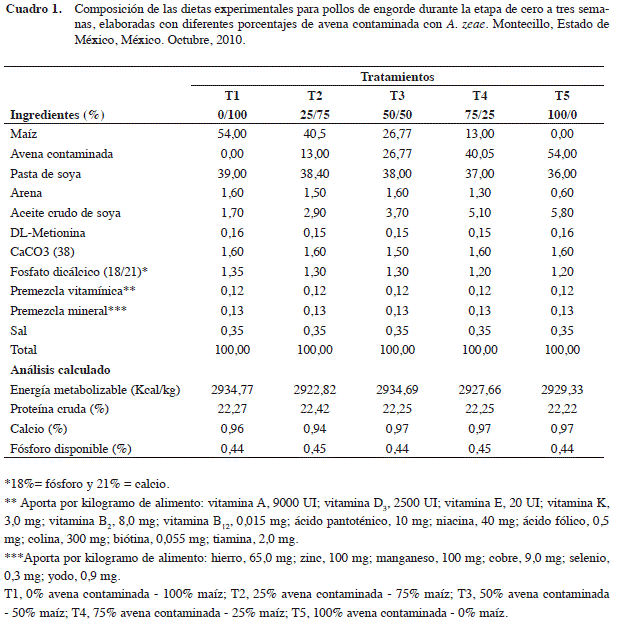
<body><![CDATA[los pollos de los diferentes tratamientos, estas se probaron siguiendo     un dise&ntilde;o experimental completamente al azar. Cada tratamiento     se prepar&oacute; con mezclas de grano entero de avena molida sana o     contaminada con <span style="font-style: italic;">A. zeae</span>     a&ntilde;adiendo otros componentes como     ma&iacute;z sano, pasta de soya, carbonato de calcio, fosfato,     vitaminas y minerales (<a href="/img/revistas/am/v23n1/a15t1.gif">Cuadro     1</a>). Es importante mencionar que no se     realiz&oacute; una medici&oacute;n final de la cantidad de hongo en     cada dieta puesto que en este trabajo el objetivo principal es     ]]></body>
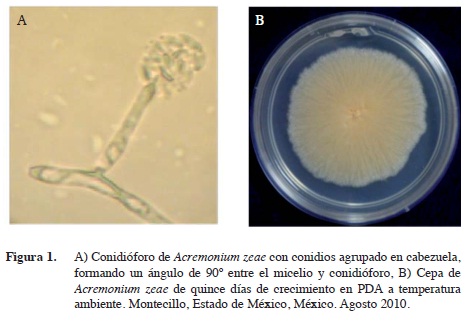
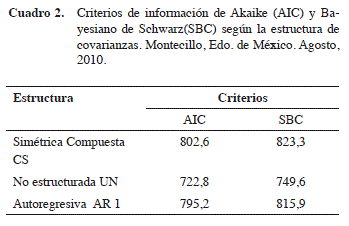
<body><![CDATA[determinar si la presencia de <span style="font-style: italic;">A. zeae</span>     tiene efectos negativos o no.    <br>     <br> </span></font><font size="2"><span style="font-family: verdana;">Para la elaboraci&oacute;n de las dietas, se realizaron an&aacute;lisis previos en el Laboratorio de Nutrici&oacute;n Animal del Depto. de Zootecnia, en la Universidad Aut&oacute;noma Chapingo, Texcoco, Estado de M&eacute;xico. Se determin&oacute; la cantidad de prote&iacute;na, en ma&iacute;z (7,76%), avena (10,36%) y pasta de soya (48%). Se elaboraron las dietas considerando los requerimientos de amino&aacute;cidos, energ&iacute;a y minerales para llenar las necesidades de los pollos en iniciaci&oacute;n (Cuca <span  style="font-style: italic;">et al.</span> 2009).</span></font><br  style="font-family: verdana;"> <br style="font-family: verdana;"> <font style="font-weight: bold;" size="2"><span  style="font-family: verdana;">Establecimiento del ensayo para evaluar efecto de dieta</span></font><br style="font-family: verdana;"> <br style="font-family: verdana;"> <font size="2"><span style="font-family: verdana;">La investigaci&oacute;n fue realizada en el Colegio de Postgraduados,&nbsp; campus&nbsp; Montecillo&nbsp; en&nbsp; el&nbsp; municipio de Texcoco, Estado de M&eacute;xico. Se adquirieron 125 pollitos de la l&iacute;nea Ross reci&eacute;n nacidos en la empresa Reproductora Uni&oacute;n Tepexpan, del Estado de M&eacute;xico. Los animales se pesaron individualmente y se distribuyeron&nbsp; aleatoriamente&nbsp; en&nbsp; cinco&nbsp; repeticiones&nbsp; cada una con cinco pollos por tratamiento (T). Durante el ensayo, los pollos se mantuvieron en jaulas el&eacute;ctricas en bater&iacute;a con temperatura controlada, asimismo se midi&oacute; la temperatura y humedad relativa del ambiente con ayuda de un data logger. La ganancia de peso y consumo de alimento se registr&oacute; en gramos en tres ocasiones.</span></font><br style="font-family: verdana;"> <br style="font-family: verdana;"> <font style="font-weight: bold;" size="3"><span  style="font-family: verdana;">Resultados y Discusi&oacute;n</span></font><br  style="font-family: verdana;"> <br style="font-family: verdana; font-weight: bold;"> <font style="font-weight: bold;" size="2"><span  style="font-family: verdana;">Identificaci&oacute;n del hongo causante de la pudrici&oacute;n en mazorca</span></font><br style="font-family: verdana;"> <br style="font-family: verdana;"> <font size="2"><span style="font-family: verdana;">De los granos de ma&iacute;z con s&iacute;ntomas de pudrici&oacute;n colectados&nbsp; en&nbsp; regiones&nbsp; productoras&nbsp; de&nbsp; ma&iacute;z&nbsp; del estado de Veracruz, se obtuvieron colonias con un crecimiento moderado y micelio algodonoso blanco, el cual se torn&oacute; de color salm&oacute;n tenue despu&eacute;s de cuatro&nbsp; d&iacute;as&nbsp; de&nbsp; crecimiento&nbsp; en&nbsp; PDA&nbsp; (<a href="#fig_1">Figura&nbsp; 1&nbsp; A</a>). Las&nbsp; colonias&nbsp; no&nbsp; desarrollaron&nbsp; crecimiento&nbsp; micelial a&eacute;reo pero si abundante micelio hialino acompa&ntilde;ado de&nbsp; conidios&nbsp; unicelulares&nbsp; agrupados&nbsp; en&nbsp; cabezuela sobre un conidi&oacute;foro caracter&iacute;stico de las especies de <span  style="font-style: italic;">Acremonium</span> (sin. <span style="font-style: italic;">Cephalosporium</span>) (Barnett y Hunter 1998) (<a href="#fig_1">Figura 1 B</a>).    <br>     <br> </span></font>     <div style="text-align: center;"><font size="2"><a name="fig_1"></a><img  alt="" src="/img/revistas/am/v23n1/a15i1.jpg"  style="width: 476px; height: 322px;"><span  style="font-family: verdana;"></span></font><br  style="font-family: verdana;"> <font size="2"><span style="font-family: verdana;"></span></font></div> <br style="font-family: verdana;"> <font size="2"><span style="font-family: verdana;">La secuencia del producto de PCR de los aislamientos monosp&oacute;ricos se aline&oacute; con las secuencias de <span  style="font-style: italic;">Acremonium zeae</span> del Banco de Genes del NCBI.&nbsp; El &iacute;ndice de similaridad de nucle&oacute;tidos entre la secuencia de los cultivos monosp&oacute;ricos, con n&uacute;mero de acceso HQ402899 de este estudio, respecto al de la especie alineada en el Banco de genes fue de 99%. Confirmando que el agente causal de la pudrici&oacute;n de granos de ma&iacute;z en las regiones productoras de ma&iacute;z muestreadas del estado de Veracruz es <span style="font-style: italic;">A. zeae</span>.</span></font><br style="font-family: verdana;"> <br style="font-family: verdana;"> <font size="2"><span style="font-family: verdana;">Los granos de avena con un crecimiento micelial abundante se obtuvieron en un periodo de seis semanas a temperatura ambiente.</span></font><br  style="font-family: verdana;"> <br style="font-family: verdana; font-weight: bold;"> <font style="font-weight: bold;" size="2"><span  style="font-family: verdana;">Evaluaci&oacute;n del efecto de <span style="font-style: italic;">Acremonium zeae</span> en la ganancia de peso de pollos de engorda en iniciaci&oacute;n</span></font><br  style="font-family: verdana;"> <br style="font-family: verdana;"> <font size="2"><span style="font-family: verdana;">En el &aacute;rea donde se estableci&oacute; el experimento, se registr&oacute; una temperatura media de 22,8&ordm;C y humedad relativa del 59,83%. Para el an&aacute;lisis de los datos se probaron las tres estructuras de covarianza antes se&ntilde;aladas haciendo uso del PROC MIXED, los criterios AIC y SBC obtenidos para cada modelo de estructura se presentan en el <a href="#tab_2">Cuadro 2</a>. De acuerdo a estos criterios se seleccion&oacute; como estructura de covarianza m&aacute;s adecuada para los datos de ganancia de peso la covarianza sin estructura (UN).    <br>     <br> </span></font>     <div style="text-align: center;"><font size="2"><a name="tab_2"></a><img  alt="" src="/img/revistas/am/v23n1/a15t2.gif"  style="width: 349px; height: 226px;"><span  style="font-family: verdana;"></span></font><br  style="font-family: verdana;"> <font size="2"><span style="font-family: verdana;"></span></font></div> <br style="font-family: verdana;"> <font size="2"><span style="font-family: verdana;">Con un nivel de significancia del 5%, la interacci&oacute;n de los tratamientos y el tiempo influyeron en la ganancia de peso (<a  href="/img/revistas/am/v23n1/a15t3.gif">Cuadro 3</a>). El efecto del tratamiento tambi&eacute;n fue significativo a un nivel de significancia del 5% es decir, que la composici&oacute;n de las dietas influy&oacute; en la ganancia de peso de los pollos. As&iacute; mismo se muestra que existi&oacute; diferencia entre cada uno de los periodos de evaluaci&oacute;n con el mismo nivel de significancia.    ]]></body>
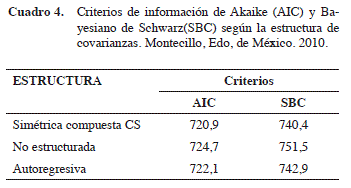
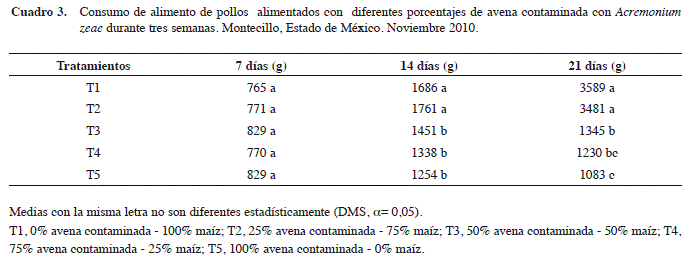
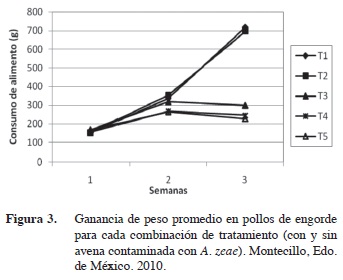
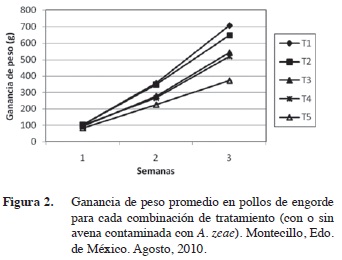
<body><![CDATA[<br>     <br> </span></font><font size="2"><span style="font-family: verdana;">Adicionalmente se construy&oacute; una gr&aacute;fica de ganancia de peso promedio para cada combinaci&oacute;n de tratamiento y evaluaci&oacute;n (<a href="#fig_2">Figura 2</a>) en la cual se muestra que existieron diferencias en la ganancia de peso para cada una de las evaluaciones semanas. Hubo una ganancia de peso entre todos los tratamientos durante la primera semana de evaluaci&oacute;n, este comportamiento no se mantuvo as&iacute; para la segunda evaluaci&oacute;n ya que existe una ganancia de peso muy similar entre los tratamientos T1 y T2 y T3 y T4, no siendo el caso del T5 en el que se observa una menor ganancia de peso respecto al testigo y el resto de los tratamientos. Para la tercera evaluaci&oacute;n la diferencia en la ganancia de peso en cada uno de los tratamientos se hace m&aacute;s evidente; aunque se conserva la misma tendencia.    <br>     <br> </span></font>     <div style="text-align: center;"><font size="2"><a name="fig_2"></a><img  alt="" src="/img/revistas/am/v23n1/a15i2.jpg"  style="width: 342px; height: 260px;"><span  style="font-family: verdana;"></span></font><br  style="font-family: verdana;"> <font size="2"><span style="font-family: verdana;"></span></font></div> <br style="font-family: verdana;"> <font style="font-weight: bold;" size="2"><span  style="font-family: verdana;">Evaluaci&oacute;n del efecto de <span style="font-style: italic;">Acremonium zeae</span> en el consumo de alimento de pollos de engorde en iniciaci&oacute;n</span></font><br  style="font-family: verdana;"> <br style="font-family: verdana;"> <font size="2"><span style="font-family: verdana;">Despu&eacute;s de realizar las tres evaluaciones semanales, nuevamente se realiz&oacute; un an&aacute;lisis estad&iacute;stico de los datos de consumo de alimento en el cual se evaluaron las tres estructuras de covarianza antes se&ntilde;aladas haciendo uso del PROC MIXED, los criterios AIC y SBC obtenidos para cada modelo de estructura se presentan en el <a href="#tab_4">Cuadro 4</a>. De acuerdo a estos criterios se seleccion&oacute; como estructura de covarianza m&aacute;s adecuada para los datos de ganancia de peso la estructura sim&eacute;trica compuesta (CS).    <br>     <br> </span></font>     <div style="text-align: center;"><font size="2"><a name="tab_4"></a><img  alt="" src="/img/revistas/am/v23n1/a15t4.gif"  style="width: 351px; height: 188px;"><span  style="font-family: verdana;"></span></font><br  style="font-family: verdana;"> <font size="2"><span style="font-family: verdana;"></span></font></div> <br style="font-family: verdana;"> <font size="2"><span style="font-family: verdana;">Los valores obtenidos del an&aacute;lisis de varianza demuestran que el efecto de la interacci&oacute;n fue significativo a un nivel de significancia del 5% esto es, la interacci&oacute;n de los tratamientos y el tiempo influyeron en el consumo de alimento. El efecto de los tratamientos tambi&eacute;n fue significativo a un nivel de significancia del 5% es decir, que la composici&oacute;n de las dietas influy&oacute; en la cantidad de alimento consumido por los pollos.</span></font><br style="font-family: verdana;"> <br style="font-family: verdana;"> <font size="2"><span style="font-family: verdana;">As&iacute; mismo se muestra que existe diferencia entre cada uno de los periodos de evaluaci&oacute;n con el mismo nivel de significancia.</span></font><br  style="font-family: verdana;"> <br style="font-family: verdana;"> <font size="2"><span style="font-family: verdana;">Se construy&oacute; una gr&aacute;fica para analizar el consumo de alimento promedio para cada combinaci&oacute;n tratamiento y evaluaci&oacute;n (<a href="#fig_3">Figura 3</a>) con la cual se puede observar que existi&oacute; diferente consumo de alimento para cada momento evaluado.    <br>     <br> </span></font>     ]]></body>
<body><![CDATA[<div style="text-align: center;"><font size="2"><a name="fig_3"></a><img  alt="" src="/img/revistas/am/v23n1/a15i3.jpg"  style="width: 343px; height: 280px;"><span  style="font-family: verdana;"></span></font><br  style="font-family: verdana;"> <font size="2"><span style="font-family: verdana;"></span></font></div> <br style="font-family: verdana;"> <font size="2"><span style="font-family: verdana;">Se puede observar que adem&aacute;s un consumo similar entre los tratamientos al momento de la primera evaluaci&oacute;n, por lo que se puede concluir que es dif&iacute;cil apreciar el efecto de las diferentes dietas proporcionadas como alimento para pollos a siete d&iacute;as de su consumo. Para la siguiente evaluaci&oacute;n (semana 2) el consumo de alimento se increment&oacute; en todos los tratamientos, apreci&aacute;ndose una diferencia de T4 y T5 con respecto al resto, estos a pesar de haber incrementado el consumo difieren significativamente de los tratamientos T1, T2 y T3. Las dietas elaboradas con una proporci&oacute;n 75% avena contaminada 25% ma&iacute;z o m&aacute;s tuvieron un efecto en el consumo de alimento. En la tercera evaluaci&oacute;n se observ&oacute; una clara diferencia en el consumo de alimento para cada tratamiento, para los T1 y T2 este aument&oacute; significativamente mientras que para T3, T4 y T5 el consumo de alimento se redujo respecto al de la segunda evaluaci&oacute;n.</span></font><br style="font-family: verdana;"> <br style="font-family: verdana;"> <font size="2"><span style="font-family: verdana;">Despu&eacute;s de la tercera semana, la reducci&oacute;n en el consumo de alimento con los tratamientos T3, T4 y T5 fue de 58%, 66% y 68% respecto al testigo. En este periodo se observa que los pollos del tratamiento T5, registraron el menor consumo de alimento, lo cual se atribuye a que esta dieta estuvo elaborada con el mayor porcentaje de avena contaminada. En contraste, con el tratamiento T2 no se encontr&oacute; diferencia significativa en el consumo de alimento respecto al tratamiento testigo T1, se puede observar que esta cantidad de avena contaminada es aun tolerable por el ave.</span></font><br  style="font-family: verdana;"> <br style="font-family: verdana;"> <font size="2"><span style="font-family: verdana;">El coeficiente de correlaci&oacute;n muestra que las variables peso y consumo de alimento tuvieron una correlaci&oacute;n&nbsp; positiva, en la que, a altos valores de peso le correspondieron altos valores de consumo de alimento. Con una probabilidad de error &lt;0,0001, se confirma que el coeficiente de correlaci&oacute;n de Pearson (r = 0,8173) fue estad&iacute;sticamente diferente a cero.</span></font><br  style="font-family: verdana;"> <br style="font-family: verdana;"> <font size="2"><span style="font-family: verdana;">Los resultados anteriores confirman que la presencia de especies del hongo <span style="font-style: italic;">Acremonium</span> en el alimento puede resultar en cuadros de intoxicaci&oacute;n animal como lo reportaron previamente Towers y Siegel (1993) y Galdames (1995). En aves, Whitlow y Hagler (2005) y Cuca <span style="font-style: italic;">et al.</span> (2009) reportan la reducci&oacute;n de consumo de alimento y peso como uno de los principales efectos ocasionados por la presencia de micotoxinas en el alimento, tal como puede observarse en las <a href="#fig_2">Figuras 2</a> y <a href="#fig_3">3</a>. Hasta ahora no se ha demostrado que <span style="font-style: italic;">Acremonium zeae</span>&nbsp; produzca&nbsp; alg&uacute;n&nbsp; metabolito&nbsp; que&nbsp; pueda&nbsp; actuar como micotoxina; sin embargo, esta hip&oacute;tesis no se descarta ya que en los par&aacute;metros analizados en la presente investigaci&oacute;n, peso y consumo de alimento, mostraron efectos negativos en el crecimiento de pollos por la presencia de este hongo en una dieta balanceada para pollos de engorde de iniciaci&oacute;n.</span></font><br style="font-family: verdana;"> <br style="font-family: verdana;"> <font size="2"><span style="font-family: verdana;">La presencia de <span  style="font-style: italic;">Acremonium zeae</span> en la dieta afect&oacute; el incremento de peso y consumo de alimento en pollos de engorde, efecto que se hace m&aacute;s evidente a partir de la segunda semana de alimentaci&oacute;n con una composici&oacute;n de dieta elaborada con un m&iacute;nimo de </span></font><font size="2"><span  style="font-family: verdana;">50% de avena contaminada con el hongo.</span></font><br style="font-family: verdana;"> <br style="font-family: verdana;"> <font style="font-weight: bold;" size="3"><span  style="font-family: verdana;">Agradecimientos</span></font><br  style="font-family: verdana;"> <br style="font-family: verdana;"> <font size="2"><span style="font-family: verdana;">Al CONACYT por el apoyo econ&oacute;mico a trav&eacute;s de la beca de maestr&iacute;a, con n&uacute;mero de becario 294360.</span></font><br  style="font-family: verdana;"> <font style="font-weight: bold;" size="3"><span  style="font-family: verdana;"></span></font> <hr style="width: 100%; height: 2px;">    <!-- ref --><br> <font style="font-weight: bold;" size="3"><span  style="font-family: verdana;">Literatura Citada</span></font><br  style="font-family: verdana;"> <br style="font-family: verdana;"> <font size="2"><span style="font-family: verdana;">Bacon, CW; Lyons, PC; Porter, JK; Robbins, JD. 1986. Ergot toxicity&nbsp; from&nbsp; endophyte-infected&nbsp; grasses:&nbsp; a&nbsp; review. Agron. J. 78, 106-116.    &nbsp;&nbsp;&nbsp;&nbsp;&nbsp;&nbsp;&nbsp;&nbsp;[&#160;<a href="javascript:void(0);" onclick="javascript: window.open('/scielo.php?script=sci_nlinks&ref=310468&pid=S1659-1321201200010001500001&lng=','','width=640,height=500,resizable=yes,scrollbars=1,menubar=yes,');">Links</a>&#160;]<!-- end-ref --><!-- ref --></span></font><br  style="font-family: verdana;"> <br style="font-family: verdana;"> <font size="2"><span style="font-family: verdana;">Bacon, CW; Porter, JK; Robbins, JD; Luttrell, ES.&nbsp; 1977. <span style="font-style: italic;">Ephichlo&euml; typhina</span> from toxic tall fescue grasses. Appl. Environ. Microbiol. 34:576-581.    &nbsp;&nbsp;&nbsp;&nbsp;&nbsp;&nbsp;&nbsp;&nbsp;[&#160;<a href="javascript:void(0);" onclick="javascript: window.open('/scielo.php?script=sci_nlinks&ref=310469&pid=S1659-1321201200010001500002&lng=','','width=640,height=500,resizable=yes,scrollbars=1,menubar=yes,');">Links</a>&#160;]<!-- end-ref --><!-- ref --></span></font><br style="font-family: verdana;"> <br style="font-family: verdana;"> <font size="2"><span style="font-family: verdana;">Barnett, O;&nbsp; Hunter, B. 1998. Illustrated genera of imperfect fungi. Burg. Publ. Co. Minneapolis, MN. USA. 218 p.    &nbsp;&nbsp;&nbsp;&nbsp;&nbsp;&nbsp;&nbsp;&nbsp;[&#160;<a href="javascript:void(0);" onclick="javascript: window.open('/scielo.php?script=sci_nlinks&ref=310470&pid=S1659-1321201200010001500003&lng=','','width=640,height=500,resizable=yes,scrollbars=1,menubar=yes,');">Links</a>&#160;]<!-- end-ref --><!-- ref --> </span></font><br  style="font-family: verdana;"> <br style="font-family: verdana;"> <font size="2"><span style="font-family: verdana;">Benavente, AC; Kurina, SM; Lugo, AM.&nbsp; 2008. Micofilas, end&oacute;fitos&nbsp; f&uacute;ngicos&nbsp; y&nbsp; alcaloides&nbsp; en&nbsp; poblaciones&nbsp; de <span style="font-style: italic;">Melica stuckertii</span> (Poaceae) del Centro de Argentina. Bol. Soc. Argent. Bot. 43 (3-4):189-195.    &nbsp;&nbsp;&nbsp;&nbsp;&nbsp;&nbsp;&nbsp;&nbsp;[&#160;<a href="javascript:void(0);" onclick="javascript: window.open('/scielo.php?script=sci_nlinks&ref=310471&pid=S1659-1321201200010001500004&lng=','','width=640,height=500,resizable=yes,scrollbars=1,menubar=yes,');">Links</a>&#160;]<!-- end-ref --><!-- ref --></span></font><br  style="font-family: verdana;"> <br style="font-family: verdana;"> <font size="2"><span style="font-family: verdana;">Cabral, D; Cafaro, MJ; Reddy, PV; Lugo, MA; White,&nbsp; JF. 1999.&nbsp; Evidence supporting the ocurrence of a&nbsp; new species of endophyte in some South American grasses. Mycologia 91:315-325.    &nbsp;&nbsp;&nbsp;&nbsp;&nbsp;&nbsp;&nbsp;&nbsp;[&#160;<a href="javascript:void(0);" onclick="javascript: window.open('/scielo.php?script=sci_nlinks&ref=310472&pid=S1659-1321201200010001500005&lng=','','width=640,height=500,resizable=yes,scrollbars=1,menubar=yes,');">Links</a>&#160;]<!-- end-ref --><!-- ref --></span></font><br  style="font-family: verdana;"> <br style="font-family: verdana;"> <font size="2"><span style="font-family: verdana;">Carvajal,&nbsp; M; De Le&oacute;n, C. 2010. Toxinas&nbsp; importantes de los hongos <span style="font-style: italic;">Aspergillus</span> (aflatoxinas),&nbsp;&nbsp; <span style="font-style: italic;">Fusarium</span> (fumonisina), <span style="font-style: italic;">Diplodia</span> (diplodiatoxina) y diplodiol en ma&iacute;z.&nbsp;<span  style="font-style: italic;"> In</span> El cultivo de ma&iacute;z, Temas Selectos, Vol II. Edit. Mundi-Prensa. p. 36-47.    &nbsp;&nbsp;&nbsp;&nbsp;&nbsp;&nbsp;&nbsp;&nbsp;[&#160;<a href="javascript:void(0);" onclick="javascript: window.open('/scielo.php?script=sci_nlinks&ref=310473&pid=S1659-1321201200010001500006&lng=','','width=640,height=500,resizable=yes,scrollbars=1,menubar=yes,');">Links</a>&#160;]<!-- end-ref --><!-- ref --></span></font><br  style="font-family: verdana;"> <br style="font-family: verdana;"> <font size="2"><span style="font-family: verdana;">CAST (Council for Agricultural Sciense and&nbsp; Technology). 2003. Mycotoxins: Risk in plant, animal and&nbsp; human systems. Report No.139. Ames, IO. USA. p. 4-5.    &nbsp;&nbsp;&nbsp;&nbsp;&nbsp;&nbsp;&nbsp;&nbsp;[&#160;<a href="javascript:void(0);" onclick="javascript: window.open('/scielo.php?script=sci_nlinks&ref=310474&pid=S1659-1321201200010001500007&lng=','','width=640,height=500,resizable=yes,scrollbars=1,menubar=yes,');">Links</a>&#160;]<!-- end-ref --><!-- ref --></span></font><br  style="font-family: verdana;"> <br style="font-family: verdana;"> <font size="2"><span style="font-family: verdana;">Chapman,&nbsp; GP.&nbsp; 1996.&nbsp; Grass&nbsp; diversity.&nbsp; <span style="font-style: italic;">In</span>&nbsp; The&nbsp; Biology&nbsp; of grasses. CAB Internatl. Oxon, UK. p. 14-35.    &nbsp;&nbsp;&nbsp;&nbsp;&nbsp;&nbsp;&nbsp;&nbsp;[&#160;<a href="javascript:void(0);" onclick="javascript: window.open('/scielo.php?script=sci_nlinks&ref=310475&pid=S1659-1321201200010001500008&lng=','','width=640,height=500,resizable=yes,scrollbars=1,menubar=yes,');">Links</a>&#160;]<!-- end-ref --><!-- ref --></span></font><br style="font-family: verdana;"> <br style="font-family: verdana;"> <font size="2"><span style="font-family: verdana;">CIMMYT (Centro Internacional de Mejoramiento de Ma&iacute;z y Trigo). 2004. Enfermedades del ma&iacute;z. Una gu&iacute;a para su identificaci&oacute;n en el campo. El Bat&aacute;n, M&eacute;xico 4 ed. 118 p.    &nbsp;&nbsp;&nbsp;&nbsp;&nbsp;&nbsp;&nbsp;&nbsp;[&#160;<a href="javascript:void(0);" onclick="javascript: window.open('/scielo.php?script=sci_nlinks&ref=310476&pid=S1659-1321201200010001500009&lng=','','width=640,height=500,resizable=yes,scrollbars=1,menubar=yes,');">Links</a>&#160;]<!-- end-ref --><!-- ref --></span></font><br style="font-family: verdana;"> <br style="font-family: verdana;"> <font size="2"><span style="font-family: verdana;">Cosgove,&nbsp; G;&nbsp; Anderson,&nbsp; C;&nbsp; Berquist,&nbsp; T.&nbsp; 1996.&nbsp;&nbsp; Fungal endophyte effects on intake, health&nbsp; and&nbsp; live weight gain of grazind cattle. Proc. New Zealand Grassland Assoc. 57:43-48.    &nbsp;&nbsp;&nbsp;&nbsp;&nbsp;&nbsp;&nbsp;&nbsp;[&#160;<a href="javascript:void(0);" onclick="javascript: window.open('/scielo.php?script=sci_nlinks&ref=310477&pid=S1659-1321201200010001500010&lng=','','width=640,height=500,resizable=yes,scrollbars=1,menubar=yes,');">Links</a>&#160;]<!-- end-ref --><!-- ref --></span></font><br  style="font-family: verdana;"> <br style="font-family: verdana;"> <font size="2"><span style="font-family: verdana;">Cuca G, M; &Aacute;vila G, E; Pro M, A. 2009. Alimentaci&oacute;n de las aves. Univ. Aut&oacute;noma Chapingo, Dpto. de Zootecnia. M&eacute;xico. 276 p.    &nbsp;&nbsp;&nbsp;&nbsp;&nbsp;&nbsp;&nbsp;&nbsp;[&#160;<a href="javascript:void(0);" onclick="javascript: window.open('/scielo.php?script=sci_nlinks&ref=310478&pid=S1659-1321201200010001500011&lng=','','width=640,height=500,resizable=yes,scrollbars=1,menubar=yes,');">Links</a>&#160;]<!-- end-ref --><!-- ref --></span></font><br style="font-family: verdana;"> <br style="font-family: verdana;"> <font size="2"><span style="font-family: verdana;">CIMMYT (Centro Internacional de Mejoramiento de Ma&iacute;z y Trigo). 2004. Enfermedades del ma&iacute;z. Una gu&iacute;a para su identificaci&oacute;n en el campo. El Bat&aacute;n, M&eacute;xico 4 ed. 118 p.    &nbsp;&nbsp;&nbsp;&nbsp;&nbsp;&nbsp;&nbsp;&nbsp;[&#160;<a href="javascript:void(0);" onclick="javascript: window.open('/scielo.php?script=sci_nlinks&ref=310479&pid=S1659-1321201200010001500012&lng=','','width=640,height=500,resizable=yes,scrollbars=1,menubar=yes,');">Links</a>&#160;]<!-- end-ref --><!-- ref --></span></font><br style="font-family: verdana;"> <br style="font-family: verdana;"> <font size="2"><span style="font-family: verdana;">Duarte V, S; Villamil J, L. 2006. Micotoxinas en la salud p&uacute;blica. Revista Salud P&uacute;blica. Supl. 8:129-135.    &nbsp;&nbsp;&nbsp;&nbsp;&nbsp;&nbsp;&nbsp;&nbsp;[&#160;<a href="javascript:void(0);" onclick="javascript: window.open('/scielo.php?script=sci_nlinks&ref=310480&pid=S1659-1321201200010001500013&lng=','','width=640,height=500,resizable=yes,scrollbars=1,menubar=yes,');">Links</a>&#160;]<!-- end-ref --><!-- ref --></span></font><br  style="font-family: verdana;"> <br style="font-family: verdana;"> <font size="2"><span style="font-family: verdana;">FAO. 2008. FAOSTAT. Consultado 8 Sept. 2010. Disponible en http://faostat.fao.org.    &nbsp;&nbsp;&nbsp;&nbsp;&nbsp;&nbsp;&nbsp;&nbsp;[&#160;<a href="javascript:void(0);" onclick="javascript: window.open('/scielo.php?script=sci_nlinks&ref=310481&pid=S1659-1321201200010001500014&lng=','','width=640,height=500,resizable=yes,scrollbars=1,menubar=yes,');">Links</a>&#160;]<!-- end-ref --><!-- ref --></span></font><br style="font-family: verdana;"> <br style="font-family: verdana;"> <font size="2"><span style="font-family: verdana;">Fletcher, L. 1993. Grazing ryegrass/endophyte associations and their effect on animal&nbsp;&nbsp; health&nbsp; and performance. Proc.&nbsp; 2<sup>nd&nbsp;</sup>&nbsp;&nbsp;&nbsp; Internatl.&nbsp; Symp.&nbsp;&nbsp; on&nbsp; <span style="font-style: italic;">Acremonium</span>/grass interactions. Ed.Hume, Lech and Easton. Palmerston North, N.Z. p. 115-120.    &nbsp;&nbsp;&nbsp;&nbsp;&nbsp;&nbsp;&nbsp;&nbsp;[&#160;<a href="javascript:void(0);" onclick="javascript: window.open('/scielo.php?script=sci_nlinks&ref=310482&pid=S1659-1321201200010001500015&lng=','','width=640,height=500,resizable=yes,scrollbars=1,menubar=yes,');">Links</a>&#160;]<!-- end-ref --><!-- ref --></span></font><br style="font-family: verdana;"> <font size="2"><span style="font-family: verdana;">&nbsp;</span></font><br  style="font-family: verdana;"> <font size="2"><span style="font-family: verdana;">Fletcher, LR; Harvey, IC. 1981. An association of a Lolium endophyte with ryegrass staggers. New Zealand Vet. J. 29:185-186.    &nbsp;&nbsp;&nbsp;&nbsp;&nbsp;&nbsp;&nbsp;&nbsp;[&#160;<a href="javascript:void(0);" onclick="javascript: window.open('/scielo.php?script=sci_nlinks&ref=310483&pid=S1659-1321201200010001500016&lng=','','width=640,height=500,resizable=yes,scrollbars=1,menubar=yes,');">Links</a>&#160;]<!-- end-ref --><!-- ref --></span></font><br  style="font-family: verdana;"> <br style="font-family: verdana;"> <font size="2"><span style="font-family: verdana;">Galdames,&nbsp; R.&nbsp; 1995.&nbsp; El&nbsp; hongo&nbsp; endofitico&nbsp; de&nbsp; la&nbsp; festuca, <span  style="font-style: italic;">Acremonium coenophialum</span> Morgan-Jones &amp; Gams, y su incidencia en el sur de chile. Agricultura T&eacute;cnica de Chile 55(1):67-70.    &nbsp;&nbsp;&nbsp;&nbsp;&nbsp;&nbsp;&nbsp;&nbsp;[&#160;<a href="javascript:void(0);" onclick="javascript: window.open('/scielo.php?script=sci_nlinks&ref=310484&pid=S1659-1321201200010001500017&lng=','','width=640,height=500,resizable=yes,scrollbars=1,menubar=yes,');">Links</a>&#160;]<!-- end-ref --><!-- ref --></span></font><br  style="font-family: verdana;"> <br style="font-family: verdana;"> <font size="2"><span style="font-family: verdana;">Galdames,&nbsp; GR;&nbsp; Rojas,&nbsp; GC.&nbsp; 1996.&nbsp; Hongos&nbsp; end&oacute;fitos&nbsp; en gram&iacute;neas forrajeras y su asociaci&oacute;n con la producci&oacute;n animal en praderas de Chile. Inst. Invest. Agrop. Consultado 8 set. 2010. Disponible en http://www.inia.cl/medios/biblioteca/libros/NR30980.pdf.    &nbsp;&nbsp;&nbsp;&nbsp;&nbsp;&nbsp;&nbsp;&nbsp;[&#160;<a href="javascript:void(0);" onclick="javascript: window.open('/scielo.php?script=sci_nlinks&ref=310485&pid=S1659-1321201200010001500018&lng=','','width=640,height=500,resizable=yes,scrollbars=1,menubar=yes,');">Links</a>&#160;]<!-- end-ref --><!-- ref --></span></font><br  style="font-family: verdana;"> <br style="font-family: verdana;"> <font size="2"><span style="font-family: verdana;">Glenn,&nbsp; AE;&nbsp; Bacon,&nbsp; CW;&nbsp; Price,&nbsp; R;&nbsp; Hanlin,&nbsp; RT.&nbsp;&nbsp; 1996. </span></font><font size="2"><span  style="font-family: verdana;">Molecular&nbsp;&nbsp; phylogeny&nbsp;&nbsp; of&nbsp;&nbsp; Acremonium&nbsp;&nbsp; and&nbsp;&nbsp;&nbsp; its taxonomic implications. Mycologia 88:369-383.    &nbsp;&nbsp;&nbsp;&nbsp;&nbsp;&nbsp;&nbsp;&nbsp;[&#160;<a href="javascript:void(0);" onclick="javascript: window.open('/scielo.php?script=sci_nlinks&ref=310486&pid=S1659-1321201200010001500019&lng=','','width=640,height=500,resizable=yes,scrollbars=1,menubar=yes,');">Links</a>&#160;]<!-- end-ref --><!-- ref --></span></font><br  style="font-family: verdana;"> <br style="font-family: verdana;"> <font size="2"><span style="font-family: verdana;">Gomes, E; Kasuya, MC; De Barros, E; Borges, A; Araujo, E.&nbsp; 2002.&nbsp; Polymorphism&nbsp; in&nbsp; the&nbsp; internal&nbsp; transcribed spacer (ITS) of the&nbsp; ribosomal DNA of 26 isolates of ectomycorrhizal fungi. Genet. Molec. Biol. 25:477-483.    &nbsp;&nbsp;&nbsp;&nbsp;&nbsp;&nbsp;&nbsp;&nbsp;[&#160;<a href="javascript:void(0);" onclick="javascript: window.open('/scielo.php?script=sci_nlinks&ref=310487&pid=S1659-1321201200010001500020&lng=','','width=640,height=500,resizable=yes,scrollbars=1,menubar=yes,');">Links</a>&#160;]<!-- end-ref --><!-- ref --></span></font><br  style="font-family: verdana;"> <br style="font-family: verdana;"> <font size="2"><span style="font-family: verdana;">Gros, EG; Pomilio, AB; Seldes, AM; Burton, G. 1985. Introducci&oacute;n al estudio de los productos naturales. Sria. Gral. Organizaci&oacute;n de Estados Americanos, Washington DC. 146 p.    &nbsp;&nbsp;&nbsp;&nbsp;&nbsp;&nbsp;&nbsp;&nbsp;[&#160;<a href="javascript:void(0);" onclick="javascript: window.open('/scielo.php?script=sci_nlinks&ref=310488&pid=S1659-1321201200010001500021&lng=','','width=640,height=500,resizable=yes,scrollbars=1,menubar=yes,');">Links</a>&#160;]<!-- end-ref --><!-- ref --></span></font><br  style="font-family: verdana;"> <br style="font-family: verdana;"> <font size="2"><span style="font-family: verdana;">Latch, G. C. M; Christensen, M. J; Samuels, G. J. 1984. Fice endophytes of <span style="font-style: italic;">Lolium </span>and<span  style="font-style: italic;"> Festuca</span>&nbsp; in&nbsp; New Zealand. Mycotaxon. 20(2):535-550.    &nbsp;&nbsp;&nbsp;&nbsp;&nbsp;&nbsp;&nbsp;&nbsp;[&#160;<a href="javascript:void(0);" onclick="javascript: window.open('/scielo.php?script=sci_nlinks&ref=310489&pid=S1659-1321201200010001500022&lng=','','width=640,height=500,resizable=yes,scrollbars=1,menubar=yes,');">Links</a>&#160;]<!-- end-ref --><!-- ref --></span></font><br style="font-family: verdana;"> <br style="font-family: verdana;"> <font size="2"><span style="font-family: verdana;">Lyons, PC; Plattner, RD; Bacon, CW. 1986. Occurrence of peptide and clavine ergot alkaloids in tall fescue grass. Science 232:487-489.    &nbsp;&nbsp;&nbsp;&nbsp;&nbsp;&nbsp;&nbsp;&nbsp;[&#160;<a href="javascript:void(0);" onclick="javascript: window.open('/scielo.php?script=sci_nlinks&ref=310490&pid=S1659-1321201200010001500023&lng=','','width=640,height=500,resizable=yes,scrollbars=1,menubar=yes,');">Links</a>&#160;]<!-- end-ref --><!-- ref --></span></font><br  style="font-family: verdana;"> <br style="font-family: verdana;"> <font size="2"><span style="font-family: verdana;">Miles,&nbsp; CO;&nbsp; Di&nbsp; Menna,&nbsp; ME;&nbsp; Jacobs,&nbsp; SW;&nbsp; Garthwaite,&nbsp; I; Lane, GA; Prestidge, RA;&nbsp; Marshall, SL; Wilkinson, HH;&nbsp; Schardl,&nbsp; CL;&nbsp; Ball,&nbsp; OJP;&nbsp; Latch,&nbsp; GCM.&nbsp; 1998. Endophytic&nbsp; fungi in indigenous australasian grasses associated with toxicity to livestock. Appl.&nbsp; Environ. Microbiol. 64:601-606.    &nbsp;&nbsp;&nbsp;&nbsp;&nbsp;&nbsp;&nbsp;&nbsp;[&#160;<a href="javascript:void(0);" onclick="javascript: window.open('/scielo.php?script=sci_nlinks&ref=310491&pid=S1659-1321201200010001500024&lng=','','width=640,height=500,resizable=yes,scrollbars=1,menubar=yes,');">Links</a>&#160;]<!-- end-ref --><!-- ref --></span></font><br  style="font-family: verdana;"> <br style="font-family: verdana;"> <font size="2"><span style="font-family: verdana;">Morgan-Jones, G; Gams, W. 1982. Notes on Hyphomycetes, XLI. An endophyte of <span style="font-style: italic;">Festuca&nbsp; arundinacea</span> and the anamorph of <span style="font-style: italic;">Epichlo&euml; typhina</span>, new taxa in one of two new sections of <span style="font-style: italic;">Acremonium</span>. Mycotaxon 15:311-318.    &nbsp;&nbsp;&nbsp;&nbsp;&nbsp;&nbsp;&nbsp;&nbsp;[&#160;<a href="javascript:void(0);" onclick="javascript: window.open('/scielo.php?script=sci_nlinks&ref=310492&pid=S1659-1321201200010001500025&lng=','','width=640,height=500,resizable=yes,scrollbars=1,menubar=yes,');">Links</a>&#160;]<!-- end-ref --><!-- ref --></span></font><br style="font-family: verdana;"> <br style="font-family: verdana;"> <font size="2"><span style="font-family: verdana;">Paterson, J; Forcherio, C; Larson, B; Samford, M;&nbsp; Kerley, M. 1995. The effects of fescue toxicosis on beef cattle productivity. J. Anim. Sci. 73:889-898.    &nbsp;&nbsp;&nbsp;&nbsp;&nbsp;&nbsp;&nbsp;&nbsp;[&#160;<a href="javascript:void(0);" onclick="javascript: window.open('/scielo.php?script=sci_nlinks&ref=310493&pid=S1659-1321201200010001500026&lng=','','width=640,height=500,resizable=yes,scrollbars=1,menubar=yes,');">Links</a>&#160;]<!-- end-ref --><!-- ref --></span></font><br style="font-family: verdana;"> <br style="font-family: verdana;"> <font size="2"><span style="font-family: verdana;">Sambrook, J; Fritsch E; Maniatis, T. 1989. Molecular&nbsp; cloning. A laboratory manual. Cold Spring Harbor Lab. Press. New York, E. U. A.    &nbsp;&nbsp;&nbsp;&nbsp;&nbsp;&nbsp;&nbsp;&nbsp;[&#160;<a href="javascript:void(0);" onclick="javascript: window.open('/scielo.php?script=sci_nlinks&ref=310494&pid=S1659-1321201200010001500027&lng=','','width=640,height=500,resizable=yes,scrollbars=1,menubar=yes,');">Links</a>&#160;]<!-- end-ref --><!-- ref --></span></font><br  style="font-family: verdana;"> <br style="font-family: verdana;"> <font size="2"><span style="font-family: verdana;">SAS&reg; (Statistical Analysis System). 2002. Software Versi&oacute;n 9.0.    &nbsp;&nbsp;&nbsp;&nbsp;&nbsp;&nbsp;&nbsp;&nbsp;[&#160;<a href="javascript:void(0);" onclick="javascript: window.open('/scielo.php?script=sci_nlinks&ref=310495&pid=S1659-1321201200010001500028&lng=','','width=640,height=500,resizable=yes,scrollbars=1,menubar=yes,');">Links</a>&#160;]<!-- end-ref --><!-- ref --></span></font><br style="font-family: verdana;"> <font size="2"><span style="font-family: verdana;">&nbsp;</span></font><br  style="font-family: verdana;"> <font size="2"><span style="font-family: verdana;">Scott, BD; Young, C; Mc Millan, L. 1999. Molecular biology of <span style="font-style: italic;">Epichloe</span> endophyte toxin biosintesis. Ryegrass endophyte:&nbsp; an&nbsp; essencial&nbsp;&nbsp; New&nbsp; Zealand&nbsp; Simbiosis. Grassland Res. Pract. Series 7:77-83.    &nbsp;&nbsp;&nbsp;&nbsp;&nbsp;&nbsp;&nbsp;&nbsp;[&#160;<a href="javascript:void(0);" onclick="javascript: window.open('/scielo.php?script=sci_nlinks&ref=310496&pid=S1659-1321201200010001500029&lng=','','width=640,height=500,resizable=yes,scrollbars=1,menubar=yes,');">Links</a>&#160;]<!-- end-ref --><!-- ref --></span></font><br  style="font-family: verdana;"> <br style="font-family: verdana;"> <font size="2"><span style="font-family: verdana;">Siegel, MR; Latch, GC; Johnson, MC. 1985.&nbsp; Acremonium fungal endophytes of tall fescue and perennial rygrass: significance and control. Plant Disease 69(2):179-183.    &nbsp;&nbsp;&nbsp;&nbsp;&nbsp;&nbsp;&nbsp;&nbsp;[&#160;<a href="javascript:void(0);" onclick="javascript: window.open('/scielo.php?script=sci_nlinks&ref=310497&pid=S1659-1321201200010001500030&lng=','','width=640,height=500,resizable=yes,scrollbars=1,menubar=yes,');">Links</a>&#160;]<!-- end-ref --><!-- ref --> </span></font><br  style="font-family: verdana;"> <br style="font-family: verdana;"> <font size="2"><span style="font-family: verdana;">Spiering, MJ; Lane, GA; Christensen, MJ; Schmid, J. 2005. Distribution of the&nbsp; dungal endophyte <span style="font-style: italic;">Neotyphodium lolii</span>&nbsp; is&nbsp; not&nbsp; major&nbsp; determinat&nbsp; of&nbsp; the&nbsp; distribution&nbsp; of fungal alkaloids in <span  style="font-style: italic;">Lolium</span> <span  style="font-style: italic;">perenne</span> plants. Phytochemistry 66:195-202.    &nbsp;&nbsp;&nbsp;&nbsp;&nbsp;&nbsp;&nbsp;&nbsp;[&#160;<a href="javascript:void(0);" onclick="javascript: window.open('/scielo.php?script=sci_nlinks&ref=310498&pid=S1659-1321201200010001500031&lng=','','width=640,height=500,resizable=yes,scrollbars=1,menubar=yes,');">Links</a>&#160;]<!-- end-ref --><!-- ref --></span></font><br  style="font-family: verdana;"> <br style="font-family: verdana;"> <font size="2"><span style="font-family: verdana;">Towers, NR; Siegel, MR. 1993. Coping with&nbsp; mycotoxins that constrain animal production.&nbsp; <span style="font-style: italic;">In</span>&nbsp; Grasslands forn our world. M.J. Baker (ed) SIR Publi. Wellington, N. Zealand. p. 548-554.    &nbsp;&nbsp;&nbsp;&nbsp;&nbsp;&nbsp;&nbsp;&nbsp;[&#160;<a href="javascript:void(0);" onclick="javascript: window.open('/scielo.php?script=sci_nlinks&ref=310499&pid=S1659-1321201200010001500032&lng=','','width=640,height=500,resizable=yes,scrollbars=1,menubar=yes,');">Links</a>&#160;]<!-- end-ref --><!-- ref --></span></font><br  style="font-family: verdana;"> <br style="font-family: verdana;"> <font size="2"><span style="font-family: verdana;">Tsai, HF; Liu, JS; Staben, C; Christensen, MJ; Latch, GCM; Siegel, MR; Schardl, CL. 1994. Evolutionary diversification of fungal endophytes of tall fescue grass by hybridization with <span  style="font-style: italic;">Epichlo&euml;</span> species. USA 91:2542-2546.    &nbsp;&nbsp;&nbsp;&nbsp;&nbsp;&nbsp;&nbsp;&nbsp;[&#160;<a href="javascript:void(0);" onclick="javascript: window.open('/scielo.php?script=sci_nlinks&ref=310500&pid=S1659-1321201200010001500033&lng=','','width=640,height=500,resizable=yes,scrollbars=1,menubar=yes,');">Links</a>&#160;]<!-- end-ref --><!-- ref --></span></font><br style="font-family: verdana;"> <br style="font-family: verdana;"> <font size="2"><span style="font-family: verdana;">Tuite, J. 1969. Plant pathological methods. Purdue University, IN. 239 p.    &nbsp;&nbsp;&nbsp;&nbsp;&nbsp;&nbsp;&nbsp;&nbsp;[&#160;<a href="javascript:void(0);" onclick="javascript: window.open('/scielo.php?script=sci_nlinks&ref=310501&pid=S1659-1321201200010001500034&lng=','','width=640,height=500,resizable=yes,scrollbars=1,menubar=yes,');">Links</a>&#160;]<!-- end-ref --><!-- ref --></span></font><br style="font-family: verdana;"> <br style="font-family: verdana;"> <font size="2"><span style="font-family: verdana;">Whitlow, L; Hagler, W. 2005. Mycotoxins in dairy&nbsp; cattle: Occurrence, toxicity, prevention and treatment. Proc. Southwest Nutr. Conf. p. 124-138.    &nbsp;&nbsp;&nbsp;&nbsp;&nbsp;&nbsp;&nbsp;&nbsp;[&#160;<a href="javascript:void(0);" onclick="javascript: window.open('/scielo.php?script=sci_nlinks&ref=310502&pid=S1659-1321201200010001500035&lng=','','width=640,height=500,resizable=yes,scrollbars=1,menubar=yes,');">Links</a>&#160;]<!-- end-ref --></span></font><br style="font-family: verdana;"> <br style="font-family: verdana;"> <font size="2"><span style="font-family: verdana;">Wicklow, DT; Poling, SM. 2009. Antimicrobial&nbsp; activity of pyrrocidines from <span style="font-style: italic;">Acremonium zeae</span> against endophytes and pathogens of maize. Phytopathology 99:109-115.    <!-- ref --><br>     &nbsp;&nbsp;&nbsp;&nbsp;&nbsp;&nbsp;&nbsp;&nbsp;[&#160;<a href="javascript:void(0);" onclick="javascript: window.open('/scielo.php?script=sci_nlinks&ref=310504&pid=S1659-1321201200010001500036&lng=','','width=640,height=500,resizable=yes,scrollbars=1,menubar=yes,');">Links</a>&#160;]<!-- end-ref --><br>     <br> <a name="Correspondencia1"></a><a href="#Correspondencia2">*</a>Correspondencia a:    ]]></body>
<body><![CDATA[<br> </span></font><font style="font-style: italic;" size="2"><span  style="font-family: verdana;">Alma S&aacute;nchez-Bautista. </span></font><font  size="2"><span style="font-family: verdana;">Postgrado&nbsp; de Fitosanidad, zancheza@gmail.com y Colegio de Postgraduados, <a href="mailto:cdeleon@colpos.mx">cdeleon@colpos.mx</a>, <a href="mailto:jmcuca@colpos.mx">jmcuca@colpos.mx</a>, <a href="mailto:ahernandez@colpos.mx">ahernandez@colpos.mx</a> Campus Montecillo. Carretera M&eacute;xico-Texcoco Km.36.5. C.P. 56230 Montecillo, Texcoco, Estado de M&eacute;xico.</span></font>    <br> <font style="font-style: italic;" size="2"><span  style="font-family: verdana;">Carlos De Le&oacute;n Garc&iacute;a-de Alba. </span></font><font size="2"><span style="font-family: verdana;">Postgrado&nbsp; de Fitosanidad, zancheza@gmail.com y Colegio de Postgraduados, <a href="mailto:cdeleon@colpos.mx">cdeleon@colpos.mx</a>, <a href="mailto:jmcuca@colpos.mx">jmcuca@colpos.mx</a>, <a href="mailto:ahernandez@colpos.mx">ahernandez@colpos.mx</a> Campus Montecillo. Carretera M&eacute;xico-Texcoco Km.36.5. C.P. 56230 Montecillo, Texcoco, Estado de M&eacute;xico.</span></font>    <br> <font style="font-style: italic;" size="2"><span  style="font-family: verdana;">Juan Manuel Cuca-Garc&iacute;a. </span></font><font  size="2"><span style="font-family: verdana;">Postgrado&nbsp; de Fitosanidad, zancheza@gmail.com y Colegio de Postgraduados, <a href="mailto:cdeleon@colpos.mx">cdeleon@colpos.mx</a>, <a href="mailto:jmcuca@colpos.mx">jmcuca@colpos.mx</a>, <a href="mailto:ahernandez@colpos.mx">ahernandez@colpos.mx</a> Campus Montecillo. Carretera M&eacute;xico-Texcoco Km.36.5. C.P. 56230 Montecillo, Texcoco, Estado de M&eacute;xico.</span></font>    <br> <font style="font-style: italic;" size="2"><span  style="font-family: verdana;">Ana Mar&iacute;a Hern&aacute;ndez-Anguiano. </span></font><font size="2"><span  style="font-family: verdana;">Postgrado&nbsp; de Fitosanidad, zancheza@gmail.com y Colegio de Postgraduados, <a href="mailto:cdeleon@colpos.mx">cdeleon@colpos.mx</a>, <a href="mailto:jmcuca@colpos.mx">jmcuca@colpos.mx</a>, <a href="mailto:ahernandez@colpos.mx">ahernandez@colpos.mx</a> Campus Montecillo. Carretera M&eacute;xico-Texcoco Km.36.5. C.P. 56230 Montecillo, Texcoco, Estado de M&eacute;xico.    <br>     <br> </span></font><font size="2"><span style="font-family: verdana;"><a  name="1"></a><a href="#2">1</a>. Postgrado&nbsp; de Fitosanidad, zancheza@gmail.com y Colegio de Postgraduados, <a href="mailto:cdeleon@colpos.mx">cdeleon@colpos.mx</a>, <a href="mailto:jmcuca@colpos.mx">jmcuca@colpos.mx</a>, <a href="mailto:ahernandez@colpos.mx">ahernandez@colpos.mx</a> Campus Montecillo. Carretera M&eacute;xico-Texcoco Km.36.5. C.P. 56230 Montecillo, Texcoco, Estado de M&eacute;xico.</span></font><font  size="2"><span style="font-family: verdana;"></span></font><br  style="font-family: verdana;">     <div style="text-align: center;"><font style="font-weight: bold;"  size="2"><span style="font-family: verdana;"></span></font> <hr style="width: 100%; height: 2px;"><font style="font-weight: bold;"  size="2"><span style="font-family: verdana;">Recibido: 12 de mayo, 2011. Aceptado: 10 de enero, 2012.</span></font></div> </div>      ]]></body><back>
<ref-list>
<ref id="B1">
<nlm-citation citation-type="journal">
<person-group person-group-type="author">
<name>
<surname><![CDATA[Bacon]]></surname>
<given-names><![CDATA[CW]]></given-names>
</name>
<name>
<surname><![CDATA[Lyons]]></surname>
<given-names><![CDATA[PC]]></given-names>
</name>
<name>
<surname><![CDATA[Porter]]></surname>
<given-names><![CDATA[JK]]></given-names>
</name>
<name>
<surname><![CDATA[Robbins]]></surname>
<given-names><![CDATA[JD]]></given-names>
</name>
</person-group>
<article-title xml:lang="en"><![CDATA[Ergot toxicity from endophyte-infected grasses: a review]]></article-title>
<source><![CDATA[Agron. J.]]></source>
<year>1986</year>
<volume>78</volume>
<page-range>106-116</page-range></nlm-citation>
</ref>
<ref id="B2">
<nlm-citation citation-type="journal">
<person-group person-group-type="author">
<name>
<surname><![CDATA[Bacon]]></surname>
<given-names><![CDATA[CW]]></given-names>
</name>
<name>
<surname><![CDATA[Porter]]></surname>
<given-names><![CDATA[JK]]></given-names>
</name>
<name>
<surname><![CDATA[Robbins]]></surname>
<given-names><![CDATA[JD]]></given-names>
</name>
<name>
<surname><![CDATA[Luttrell]]></surname>
<given-names><![CDATA[ES]]></given-names>
</name>
</person-group>
<article-title xml:lang="en"><![CDATA[Ephichloë typhina from toxic tall fescue grasses]]></article-title>
<source><![CDATA[Appl. Environ. Microbiol.]]></source>
<year>1977</year>
<volume>34</volume>
<page-range>576-581</page-range></nlm-citation>
</ref>
<ref id="B3">
<nlm-citation citation-type="book">
<person-group person-group-type="author">
<name>
<surname><![CDATA[Barnett]]></surname>
<given-names><![CDATA[O]]></given-names>
</name>
<name>
<surname><![CDATA[Hunter]]></surname>
<given-names><![CDATA[B]]></given-names>
</name>
</person-group>
<source><![CDATA[Illustrated genera of imperfect fungi]]></source>
<year>1998</year>
<page-range>218</page-range><publisher-loc><![CDATA[^eMN MN]]></publisher-loc>
<publisher-name><![CDATA[Burg. Publ. Co. Minneapolis]]></publisher-name>
</nlm-citation>
</ref>
<ref id="B4">
<nlm-citation citation-type="journal">
<person-group person-group-type="author">
<name>
<surname><![CDATA[Benavente]]></surname>
<given-names><![CDATA[AC]]></given-names>
</name>
<name>
<surname><![CDATA[Kurina]]></surname>
<given-names><![CDATA[SM]]></given-names>
</name>
<name>
<surname><![CDATA[Lugo]]></surname>
<given-names><![CDATA[AM]]></given-names>
</name>
</person-group>
<article-title xml:lang="es"><![CDATA[Micofilas, endófitos fúngicos y alcaloides en poblaciones de Melica stuckertii (Poaceae) del Centro de Argentina]]></article-title>
<source><![CDATA[Bol. Soc. Argent. Bot.]]></source>
<year>2008</year>
<volume>43</volume>
<numero>3-4</numero>
<issue>3-4</issue>
<page-range>189-195</page-range></nlm-citation>
</ref>
<ref id="B5">
<nlm-citation citation-type="journal">
<person-group person-group-type="author">
<name>
<surname><![CDATA[Cabral]]></surname>
<given-names><![CDATA[D]]></given-names>
</name>
<name>
<surname><![CDATA[Cafaro]]></surname>
<given-names><![CDATA[MJ]]></given-names>
</name>
<name>
<surname><![CDATA[Reddy]]></surname>
<given-names><![CDATA[PV]]></given-names>
</name>
<name>
<surname><![CDATA[Lugo]]></surname>
<given-names><![CDATA[MA]]></given-names>
</name>
<name>
<surname><![CDATA[White]]></surname>
<given-names><![CDATA[JF]]></given-names>
</name>
</person-group>
<article-title xml:lang="en"><![CDATA[Evidence supporting the ocurrence of a new species of endophyte in some South American grasses]]></article-title>
<source><![CDATA[Mycologia]]></source>
<year>1999</year>
<volume>91</volume>
<page-range>315-325</page-range></nlm-citation>
</ref>
<ref id="B6">
<nlm-citation citation-type="book">
<person-group person-group-type="author">
<name>
<surname><![CDATA[Carvajal]]></surname>
<given-names><![CDATA[M]]></given-names>
</name>
<name>
<surname><![CDATA[De León]]></surname>
<given-names><![CDATA[C]]></given-names>
</name>
</person-group>
<source><![CDATA[Toxinas importantes de los hongos Aspergillus (aflatoxinas), Fusarium (fumonisina), Diplodia (diplodiatoxina) y diplodiol en maíz: El cultivo de maíz, Temas Selectos]]></source>
<year>2010</year>
<volume>II</volume>
<page-range>36-47</page-range><publisher-name><![CDATA[Edit. Mundi-Prensa]]></publisher-name>
</nlm-citation>
</ref>
<ref id="B7">
<nlm-citation citation-type="book">
<collab>CAST (Council for Agricultural Sciense and Technology)</collab>
<source><![CDATA[Mycotoxins: Risk in plant, animal and human systems]]></source>
<year>2003</year>
<page-range>4-5</page-range><publisher-loc><![CDATA[^eIO IO]]></publisher-loc>
<publisher-name><![CDATA[Ames]]></publisher-name>
</nlm-citation>
</ref>
<ref id="B8">
<nlm-citation citation-type="book">
<person-group person-group-type="author">
<name>
<surname><![CDATA[Chapman]]></surname>
<given-names><![CDATA[GP]]></given-names>
</name>
</person-group>
<source><![CDATA[Grass diversity: The Biology of grasses]]></source>
<year>1996</year>
<page-range>14-35</page-range><publisher-loc><![CDATA[^eOxon Oxon]]></publisher-loc>
<publisher-name><![CDATA[CAB Internatl]]></publisher-name>
</nlm-citation>
</ref>
<ref id="B9">
<nlm-citation citation-type="book">
<collab>CIMMYT (Centro Internacional de Mejoramiento de Maíz y Trigo)</collab>
<source><![CDATA[Enfermedades del maíz. Una guía para su identificación en el campo]]></source>
<year>2004</year>
<edition>4</edition>
<page-range>118</page-range><publisher-name><![CDATA[El Batán]]></publisher-name>
</nlm-citation>
</ref>
<ref id="B10">
<nlm-citation citation-type="journal">
<person-group person-group-type="author">
<name>
<surname><![CDATA[Cosgove]]></surname>
<given-names><![CDATA[G]]></given-names>
</name>
<name>
<surname><![CDATA[Anderson]]></surname>
<given-names><![CDATA[C]]></given-names>
</name>
<name>
<surname><![CDATA[Berquist]]></surname>
<given-names><![CDATA[T]]></given-names>
</name>
</person-group>
<article-title xml:lang="en"><![CDATA[Fungal endophyte effects on intake, health and live weight gain of grazind cattle.]]></article-title>
<source><![CDATA[Proc. New Zealand Grassland Assoc.]]></source>
<year>1996</year>
<volume>57</volume>
<page-range>43-48</page-range></nlm-citation>
</ref>
<ref id="B11">
<nlm-citation citation-type="book">
<person-group person-group-type="author">
<name>
<surname><![CDATA[Cuca]]></surname>
<given-names><![CDATA[G, M]]></given-names>
</name>
<name>
<surname><![CDATA[Ávila]]></surname>
<given-names><![CDATA[G, E]]></given-names>
</name>
<name>
<surname><![CDATA[Pro]]></surname>
<given-names><![CDATA[M, A]]></given-names>
</name>
</person-group>
<source><![CDATA[Alimentación de las aves]]></source>
<year>2009</year>
<page-range>276</page-range><publisher-name><![CDATA[Univ. Autónoma ChapingoDpto. de Zootecnia]]></publisher-name>
</nlm-citation>
</ref>
<ref id="B12">
<nlm-citation citation-type="book">
<collab>CIMMYT (Centro Internacional de Mejoramiento de Maíz y Trigo)</collab>
<source><![CDATA[Enfermedades del maíz.: Una guía para su identificación en el campo]]></source>
<year>2004</year>
<edition>4</edition>
<page-range>118</page-range><publisher-name><![CDATA[El Batán]]></publisher-name>
</nlm-citation>
</ref>
<ref id="B13">
<nlm-citation citation-type="journal">
<person-group person-group-type="author">
<name>
<surname><![CDATA[Duarte]]></surname>
<given-names><![CDATA[V, S]]></given-names>
</name>
<name>
<surname><![CDATA[Villamil]]></surname>
<given-names><![CDATA[J, L]]></given-names>
</name>
</person-group>
<article-title xml:lang="es"><![CDATA[Micotoxinas en la salud pública]]></article-title>
<source><![CDATA[Revista Salud Pública. Supl]]></source>
<year>2006</year>
<volume>8</volume>
<page-range>129-135</page-range></nlm-citation>
</ref>
<ref id="B14">
<nlm-citation citation-type="">
<collab>FAO</collab>
<source><![CDATA[FAOSTAT]]></source>
<year>2008</year>
</nlm-citation>
</ref>
<ref id="B15">
<nlm-citation citation-type="book">
<person-group person-group-type="author">
<name>
<surname><![CDATA[Fletcher]]></surname>
<given-names><![CDATA[L]]></given-names>
</name>
</person-group>
<source><![CDATA[Grazing ryegrass/endophyte associations and their effect on animal health and performance: Proc. 2nd Internatl. Symp. on Acremonium/grass interactions]]></source>
<year>1993</year>
<page-range>115-120</page-range><publisher-loc><![CDATA[Palmerston North ]]></publisher-loc>
<publisher-name><![CDATA[Ed.Hume, Lech and Easton]]></publisher-name>
</nlm-citation>
</ref>
<ref id="B16">
<nlm-citation citation-type="journal">
<person-group person-group-type="author">
<name>
<surname><![CDATA[Fletcher]]></surname>
<given-names><![CDATA[LR]]></given-names>
</name>
<name>
<surname><![CDATA[Harvey]]></surname>
<given-names><![CDATA[IC]]></given-names>
</name>
</person-group>
<article-title xml:lang="en"><![CDATA[An association of a Lolium endophyte with ryegrass staggers]]></article-title>
<source><![CDATA[New Zealand Vet. J.]]></source>
<year>1981</year>
<volume>29</volume>
<page-range>185-186</page-range></nlm-citation>
</ref>
<ref id="B17">
<nlm-citation citation-type="journal">
<person-group person-group-type="author">
<name>
<surname><![CDATA[Galdames]]></surname>
<given-names><![CDATA[R.]]></given-names>
</name>
</person-group>
<article-title xml:lang="es"><![CDATA[El hongo endofitico de la festuca, Acremonium coenophialum Morgan-Jones & Gams, y su incidencia en el sur de chile]]></article-title>
<source><![CDATA[Agricultura Técnica de Chile]]></source>
<year>1995</year>
<volume>55</volume>
<numero>1</numero>
<issue>1</issue>
<page-range>67-70</page-range></nlm-citation>
</ref>
<ref id="B18">
<nlm-citation citation-type="book">
<person-group person-group-type="author">
<name>
<surname><![CDATA[Galdames]]></surname>
<given-names><![CDATA[GR]]></given-names>
</name>
<name>
<surname><![CDATA[Rojas]]></surname>
<given-names><![CDATA[GC]]></given-names>
</name>
</person-group>
<source><![CDATA[Hongos endófitos en gramíneas forrajeras y su asociación con la producción animal en praderas de Chile]]></source>
<year>1996</year>
<publisher-name><![CDATA[Inst. Invest. Agrop]]></publisher-name>
</nlm-citation>
</ref>
<ref id="B19">
<nlm-citation citation-type="journal">
<person-group person-group-type="author">
<name>
<surname><![CDATA[Glenn]]></surname>
<given-names><![CDATA[AE]]></given-names>
</name>
<name>
<surname><![CDATA[Bacon]]></surname>
<given-names><![CDATA[CW]]></given-names>
</name>
<name>
<surname><![CDATA[Price]]></surname>
<given-names><![CDATA[R]]></given-names>
</name>
<name>
<surname><![CDATA[Hanlin]]></surname>
<given-names><![CDATA[RT]]></given-names>
</name>
</person-group>
<article-title xml:lang="en"><![CDATA[Molecular phylogeny of Acremonium and its taxonomic implications]]></article-title>
<source><![CDATA[Mycologia]]></source>
<year>1996</year>
<volume>88</volume>
<page-range>369-383</page-range></nlm-citation>
</ref>
<ref id="B20">
<nlm-citation citation-type="journal">
<person-group person-group-type="author">
<name>
<surname><![CDATA[Gomes]]></surname>
<given-names><![CDATA[E]]></given-names>
</name>
<name>
<surname><![CDATA[Kasuya]]></surname>
<given-names><![CDATA[MC]]></given-names>
</name>
<name>
<surname><![CDATA[De Barros]]></surname>
<given-names><![CDATA[E]]></given-names>
</name>
<name>
<surname><![CDATA[Borges]]></surname>
<given-names><![CDATA[A]]></given-names>
</name>
<name>
<surname><![CDATA[Araujo]]></surname>
<given-names><![CDATA[E.]]></given-names>
</name>
</person-group>
<article-title xml:lang="en"><![CDATA[Polymorphism in the internal transcribed spacer (ITS) of the ribosomal DNA of 26 isolates of ectomycorrhizal fungi]]></article-title>
<source><![CDATA[Genet. Molec. Biol.]]></source>
<year>2002</year>
<volume>25</volume>
<page-range>477-483</page-range></nlm-citation>
</ref>
<ref id="B21">
<nlm-citation citation-type="book">
<person-group person-group-type="author">
<name>
<surname><![CDATA[Gros]]></surname>
<given-names><![CDATA[EG]]></given-names>
</name>
<name>
<surname><![CDATA[Pomilio]]></surname>
<given-names><![CDATA[AB]]></given-names>
</name>
<name>
<surname><![CDATA[Seldes]]></surname>
<given-names><![CDATA[AM]]></given-names>
</name>
<name>
<surname><![CDATA[Burton]]></surname>
<given-names><![CDATA[G]]></given-names>
</name>
</person-group>
<source><![CDATA[Introducción al estudio de los productos naturales]]></source>
<year>1985</year>
<page-range>146</page-range><publisher-loc><![CDATA[^eWashington DC. Washington DC.]]></publisher-loc>
<publisher-name><![CDATA[Sria. Gral. Organización de Estados Americanos]]></publisher-name>
</nlm-citation>
</ref>
<ref id="B22">
<nlm-citation citation-type="journal">
<person-group person-group-type="author">
<name>
<surname><![CDATA[Latch]]></surname>
<given-names><![CDATA[G. C. M]]></given-names>
</name>
<name>
<surname><![CDATA[Christensen]]></surname>
<given-names><![CDATA[M. J]]></given-names>
</name>
<name>
<surname><![CDATA[Samuels]]></surname>
<given-names><![CDATA[G. J.]]></given-names>
</name>
</person-group>
<article-title xml:lang="en"><![CDATA[Fice endophytes of Lolium and Festuca in New Zealand]]></article-title>
<source><![CDATA[Mycotaxon]]></source>
<year>1984</year>
<volume>20</volume>
<numero>2</numero>
<issue>2</issue>
<page-range>535-550</page-range></nlm-citation>
</ref>
<ref id="B23">
<nlm-citation citation-type="journal">
<person-group person-group-type="author">
<name>
<surname><![CDATA[Lyons]]></surname>
<given-names><![CDATA[PC]]></given-names>
</name>
<name>
<surname><![CDATA[Plattner]]></surname>
<given-names><![CDATA[RD]]></given-names>
</name>
<name>
<surname><![CDATA[Bacon]]></surname>
<given-names><![CDATA[CW]]></given-names>
</name>
</person-group>
<article-title xml:lang="en"><![CDATA[Occurrence of peptide and clavine ergot alkaloids in tall fescue grass]]></article-title>
<source><![CDATA[Science]]></source>
<year>1986</year>
<volume>232</volume>
<page-range>487-489</page-range></nlm-citation>
</ref>
<ref id="B24">
<nlm-citation citation-type="journal">
<person-group person-group-type="author">
<name>
<surname><![CDATA[Miles]]></surname>
<given-names><![CDATA[CO]]></given-names>
</name>
<name>
<surname><![CDATA[Di Menna]]></surname>
<given-names><![CDATA[ME]]></given-names>
</name>
<name>
<surname><![CDATA[Jacobs]]></surname>
<given-names><![CDATA[SW]]></given-names>
</name>
<name>
<surname><![CDATA[Garthwaite]]></surname>
<given-names><![CDATA[I]]></given-names>
</name>
<name>
<surname><![CDATA[Lane]]></surname>
<given-names><![CDATA[GA]]></given-names>
</name>
<name>
<surname><![CDATA[Prestidge]]></surname>
<given-names><![CDATA[RA]]></given-names>
</name>
<name>
<surname><![CDATA[Marshall]]></surname>
<given-names><![CDATA[SL]]></given-names>
</name>
<name>
<surname><![CDATA[Wilkinson]]></surname>
<given-names><![CDATA[HH]]></given-names>
</name>
<name>
<surname><![CDATA[Schardl]]></surname>
<given-names><![CDATA[CL]]></given-names>
</name>
<name>
<surname><![CDATA[Ball]]></surname>
<given-names><![CDATA[OJP]]></given-names>
</name>
<name>
<surname><![CDATA[Latch]]></surname>
<given-names><![CDATA[GCM]]></given-names>
</name>
</person-group>
<article-title xml:lang="en"><![CDATA[Endophytic fungi in indigenous australasian grasses associated with toxicity to livestock]]></article-title>
<source><![CDATA[Appl. Environ. Microbiol.]]></source>
<year>1998</year>
<volume>64</volume>
<page-range>601-606</page-range></nlm-citation>
</ref>
<ref id="B25">
<nlm-citation citation-type="journal">
<person-group person-group-type="author">
<name>
<surname><![CDATA[Morgan-Jones]]></surname>
<given-names><![CDATA[G]]></given-names>
</name>
<name>
<surname><![CDATA[Gams]]></surname>
<given-names><![CDATA[W]]></given-names>
</name>
</person-group>
<article-title xml:lang="en"><![CDATA[Notes on Hyphomycetes, XLI. An endophyte of Festuca arundinacea and the anamorph of Epichloë typhina, new taxa in one of two new sections of Acremonium]]></article-title>
<source><![CDATA[Mycotaxon]]></source>
<year>1982</year>
<volume>15</volume>
<page-range>311-318</page-range></nlm-citation>
</ref>
<ref id="B26">
<nlm-citation citation-type="journal">
<person-group person-group-type="author">
<name>
<surname><![CDATA[Paterson]]></surname>
<given-names><![CDATA[J]]></given-names>
</name>
<name>
<surname><![CDATA[Forcherio]]></surname>
<given-names><![CDATA[C]]></given-names>
</name>
<name>
<surname><![CDATA[Larson]]></surname>
<given-names><![CDATA[B]]></given-names>
</name>
<name>
<surname><![CDATA[Samford]]></surname>
<given-names><![CDATA[M]]></given-names>
</name>
<name>
<surname><![CDATA[Kerley]]></surname>
<given-names><![CDATA[M]]></given-names>
</name>
</person-group>
<article-title xml:lang="en"><![CDATA[The effects of fescue toxicosis on beef cattle productivity]]></article-title>
<source><![CDATA[J. Anim. Sci.]]></source>
<year>1995</year>
<volume>73</volume>
<page-range>889-898</page-range></nlm-citation>
</ref>
<ref id="B27">
<nlm-citation citation-type="book">
<person-group person-group-type="author">
<name>
<surname><![CDATA[Sambrook]]></surname>
<given-names><![CDATA[J]]></given-names>
</name>
<name>
<surname><![CDATA[Fritsch]]></surname>
<given-names><![CDATA[E]]></given-names>
</name>
<name>
<surname><![CDATA[Maniatis]]></surname>
<given-names><![CDATA[T]]></given-names>
</name>
</person-group>
<source><![CDATA[Molecular cloning: A laboratory manual]]></source>
<year>1989</year>
<publisher-loc><![CDATA[^eNew York New York]]></publisher-loc>
<publisher-name><![CDATA[Cold Spring Harbor Lab. Press]]></publisher-name>
</nlm-citation>
</ref>
<ref id="B28">
<nlm-citation citation-type="">
<collab>SAS® (Statistical Analysis System).</collab>
<source><![CDATA[Software Versión 9.0.]]></source>
<year>2002</year>
</nlm-citation>
</ref>
<ref id="B29">
<nlm-citation citation-type="journal">
<person-group person-group-type="author">
<name>
<surname><![CDATA[Scott]]></surname>
<given-names><![CDATA[BD]]></given-names>
</name>
<name>
<surname><![CDATA[Young]]></surname>
<given-names><![CDATA[C]]></given-names>
</name>
<name>
<surname><![CDATA[Mc Millan]]></surname>
<given-names><![CDATA[L.]]></given-names>
</name>
</person-group>
<article-title xml:lang="en"><![CDATA[Molecular biology of Epichloe endophyte toxin biosintesis. Ryegrass endophyte: an essencial New Zealand Simbiosis]]></article-title>
<source><![CDATA[Grassland Res. Pract. Series]]></source>
<year>1999</year>
<volume>7</volume>
<page-range>77-83</page-range></nlm-citation>
</ref>
<ref id="B30">
<nlm-citation citation-type="journal">
<person-group person-group-type="author">
<name>
<surname><![CDATA[Siegel]]></surname>
<given-names><![CDATA[MR]]></given-names>
</name>
<name>
<surname><![CDATA[Latch]]></surname>
<given-names><![CDATA[GC]]></given-names>
</name>
<name>
<surname><![CDATA[Johnson]]></surname>
<given-names><![CDATA[MC]]></given-names>
</name>
</person-group>
<article-title xml:lang="en"><![CDATA[Acremonium fungal endophytes of tall fescue and perennial rygrass: significance and control]]></article-title>
<source><![CDATA[Plant Disease]]></source>
<year>1985</year>
<volume>69</volume>
<numero>2</numero>
<issue>2</issue>
<page-range>179-183</page-range></nlm-citation>
</ref>
<ref id="B31">
<nlm-citation citation-type="journal">
<person-group person-group-type="author">
<name>
<surname><![CDATA[Spiering]]></surname>
<given-names><![CDATA[MJ]]></given-names>
</name>
<name>
<surname><![CDATA[Lane]]></surname>
<given-names><![CDATA[GA]]></given-names>
</name>
<name>
<surname><![CDATA[Christensen]]></surname>
<given-names><![CDATA[MJ]]></given-names>
</name>
<name>
<surname><![CDATA[Schmid]]></surname>
<given-names><![CDATA[J]]></given-names>
</name>
</person-group>
<article-title xml:lang="en"><![CDATA[Distribution of the dungal endophyte Neotyphodium lolii is not major determinat of the distribution of fungal alkaloids in Lolium perenne plants]]></article-title>
<source><![CDATA[Phytochemistry]]></source>
<year>2005</year>
<volume>66</volume>
<page-range>195-202</page-range></nlm-citation>
</ref>
<ref id="B32">
<nlm-citation citation-type="book">
<person-group person-group-type="author">
<name>
<surname><![CDATA[Towers]]></surname>
<given-names><![CDATA[NR]]></given-names>
</name>
<name>
<surname><![CDATA[Siegel]]></surname>
<given-names><![CDATA[MR]]></given-names>
</name>
</person-group>
<article-title xml:lang="en"><![CDATA[Coping with mycotoxins that constrain animal production]]></article-title>
<person-group person-group-type="editor">
<name>
<surname><![CDATA[Baker]]></surname>
<given-names><![CDATA[M.J.]]></given-names>
</name>
</person-group>
<source><![CDATA[Grasslands forn our world]]></source>
<year>1993</year>
<page-range>548-554</page-range><publisher-loc><![CDATA[^eWellington Wellington]]></publisher-loc>
<publisher-name><![CDATA[SIR Publi.]]></publisher-name>
</nlm-citation>
</ref>
<ref id="B33">
<nlm-citation citation-type="journal">
<person-group person-group-type="author">
<name>
<surname><![CDATA[Tsai]]></surname>
<given-names><![CDATA[HF]]></given-names>
</name>
<name>
<surname><![CDATA[Liu]]></surname>
<given-names><![CDATA[JS]]></given-names>
</name>
<name>
<surname><![CDATA[Staben]]></surname>
<given-names><![CDATA[C]]></given-names>
</name>
<name>
<surname><![CDATA[Christensen]]></surname>
<given-names><![CDATA[MJ]]></given-names>
</name>
<name>
<surname><![CDATA[Latch]]></surname>
<given-names><![CDATA[GCM]]></given-names>
</name>
<name>
<surname><![CDATA[Siegel]]></surname>
<given-names><![CDATA[MR]]></given-names>
</name>
<name>
<surname><![CDATA[Schardl]]></surname>
<given-names><![CDATA[CL]]></given-names>
</name>
</person-group>
<article-title xml:lang="en"><![CDATA[Evolutionary diversification of fungal endophytes of tall fescue grass by hybridization with Epichloë species]]></article-title>
<source><![CDATA[USA]]></source>
<year>1994</year>
<volume>91</volume>
<page-range>2542-2546</page-range></nlm-citation>
</ref>
<ref id="B34">
<nlm-citation citation-type="book">
<person-group person-group-type="author">
<name>
<surname><![CDATA[Tuite]]></surname>
<given-names><![CDATA[J.]]></given-names>
</name>
</person-group>
<source><![CDATA[Plant pathological methods]]></source>
<year>1969</year>
<page-range>239</page-range><publisher-name><![CDATA[Purdue University]]></publisher-name>
</nlm-citation>
</ref>
<ref id="B35">
<nlm-citation citation-type="journal">
<person-group person-group-type="author">
<name>
<surname><![CDATA[Whitlow]]></surname>
<given-names><![CDATA[L]]></given-names>
</name>
<name>
<surname><![CDATA[Hagler]]></surname>
<given-names><![CDATA[W]]></given-names>
</name>
</person-group>
<article-title xml:lang="en"><![CDATA[Mycotoxins in dairy cattle: Occurrence, toxicity, prevention and treatment]]></article-title>
<source><![CDATA[Proc. Southwest Nutr. Conf.]]></source>
<year>2005</year>
<page-range>124-138</page-range></nlm-citation>
</ref>
<ref id="B36">
<nlm-citation citation-type="journal">
<person-group person-group-type="author">
<name>
<surname><![CDATA[Wicklow]]></surname>
<given-names><![CDATA[DT]]></given-names>
</name>
<name>
<surname><![CDATA[Poling]]></surname>
<given-names><![CDATA[SM]]></given-names>
</name>
</person-group>
<article-title xml:lang="en"><![CDATA[Antimicrobial activity of pyrrocidines from Acremonium zeae against endophytes and pathogens of maize]]></article-title>
<source><![CDATA[Phytopathology]]></source>
<year>2009</year>
<volume>99</volume>
<page-range>109-115</page-range></nlm-citation>
</ref>
</ref-list>
</back>
</article>