<?xml version="1.0" encoding="ISO-8859-1"?><article xmlns:mml="http://www.w3.org/1998/Math/MathML" xmlns:xlink="http://www.w3.org/1999/xlink" xmlns:xsi="http://www.w3.org/2001/XMLSchema-instance">
<front>
<journal-meta>
<journal-id>1409-4142</journal-id>
<journal-title><![CDATA[Revista Costarricense de Cardiología]]></journal-title>
<abbrev-journal-title><![CDATA[Rev. costarric. cardiol]]></abbrev-journal-title>
<issn>1409-4142</issn>
<publisher>
<publisher-name><![CDATA[Asociación Costarricense de Cardiología]]></publisher-name>
</publisher>
</journal-meta>
<article-meta>
<article-id>S1409-41422003000300005</article-id>
<title-group>
<article-title xml:lang="es"><![CDATA[Disfunción Endotelial en el paciente diabético Tipo 2]]></article-title>
</title-group>
<contrib-group>
<contrib contrib-type="author">
<name>
<surname><![CDATA[Poveda]]></surname>
<given-names><![CDATA[Jonathan]]></given-names>
</name>
<xref ref-type="aff" rid="A01"/>
</contrib>
<contrib contrib-type="author">
<name>
<surname><![CDATA[Nuñez]]></surname>
<given-names><![CDATA[Sonia]]></given-names>
</name>
<xref ref-type="aff" rid="A02"/>
</contrib>
<contrib contrib-type="author">
<name>
<surname><![CDATA[Arauz]]></surname>
<given-names><![CDATA[Gloria]]></given-names>
</name>
<xref ref-type="aff" rid="A02"/>
</contrib>
</contrib-group>
<aff id="A01">
<institution><![CDATA[,C.C.S.S. Hospital Calderón Guardia Departamento de Cardiología]]></institution>
<addr-line><![CDATA[San José ]]></addr-line>
<country>Costa Rica</country>
</aff>
<aff id="A02">
<institution><![CDATA[,C.C.S.S. Hospital México Departamento de Imágenes Médicas]]></institution>
<addr-line><![CDATA[San José ]]></addr-line>
<country>Costa Rica</country>
</aff>
<pub-date pub-type="pub">
<day>00</day>
<month>12</month>
<year>2003</year>
</pub-date>
<pub-date pub-type="epub">
<day>00</day>
<month>12</month>
<year>2003</year>
</pub-date>
<volume>5</volume>
<numero>3</numero>
<fpage>19</fpage>
<lpage>23</lpage>
<copyright-statement/>
<copyright-year/>
<self-uri xlink:href="http://www.scielo.sa.cr/scielo.php?script=sci_arttext&amp;pid=S1409-41422003000300005&amp;lng=en&amp;nrm=iso"></self-uri><self-uri xlink:href="http://www.scielo.sa.cr/scielo.php?script=sci_abstract&amp;pid=S1409-41422003000300005&amp;lng=en&amp;nrm=iso"></self-uri><self-uri xlink:href="http://www.scielo.sa.cr/scielo.php?script=sci_pdf&amp;pid=S1409-41422003000300005&amp;lng=en&amp;nrm=iso"></self-uri><abstract abstract-type="short" xml:lang="es"><p><![CDATA[Introducción: La disfunción endotelial es un marcador temprano de la enfermedad arterioesclerótica, y su detección nos permite determinar cuáles pacientes son potenciales sujetos de tratamiento para revertir la progresión del padecimiento vascular. Dado que el paciente diabético es un paciente con alta prevalencia de complicaciones arterioscleróticas, la detección de éste fenómeno en el mismo, es de capital importancia. Métodos y Resultados: Mediante Doppler braquial en estado basal, isquemia y post-itroglicerina, se determinó la capacidad vascular de aumentar el flujo sanguíneo en 10 pacientes sanos y 20 pacientes diabéticos, con el objetivo de correlacionarlos con su HbA1c y perfil lipídico. La vasodilatación mediada por endotelio (VMF) y la vasodilatación mediada por nitroglicerina (VMN) expresadas en porcentaje de cambio del diámetro vascular, se encontraron reducidas en forma estadísticamente significativa en el grupo de diabéticos, (5.57% vs. 9.97% para el grupo control p= 0.04, y 21.49% vs. 12.64% para el grupo control p = 0.04 respectivamente) éstas alteraciones correlacionaron con los años de evolución de la enfermedad y los niveles de colesterol total, LDL y triglicéridos en éstos pacientes. Conclusión: El estudio doppler braquial es un instrumento útil para determinar mediante la disfunción endotelial, las fases tempranas de la arterioesclerosis en pacientes de alto riesgo para ésta, y los factores potencialmente reversibles que alteran este fenómeno podrían ser intervenidos en aras de mejorar el pronóstico de estos pacientes.]]></p></abstract>
<abstract abstract-type="short" xml:lang="en"><p><![CDATA[Introduction: Endothelial dysfunction is a common accepted surrogate marker of atherosclerotic disease. It’s early detection allows us to determine which patients need attention in order to stop the progression of the vascular disease. Since diabetic patients have a high prevalence of cardiovascular complications, the early detection of this phenomenon is of capital importance for their prognosis. Methods: Using brachial Doppler during rest, ischemia and post- nitroglycerin ischemia, the vascular reactivity of the vessel was obtained in 10 healthy patients and 20 type 2 diabetic patients. This data was correlated with their glycosilated hemoglobin levels and lipid profiles. Their endothelium derived vasodilatation and their nitroglycerin derived vasodilatation were expressed as the percentage of change in the luminal diameter of the vessel and both of them were reduced in the diabetic patients with a statistical significance (5.57% vs. 9.97% for the control patients p =0.04, y 21.49% vs. 12.64%, p= 0.04 for the diabetic patients). These alterations correlated with the years of evolution of the disease and the total colesterol levels as well as the LDL and tryglicerides levels. Conclusion: The Brachial Doppler study is a useful tool to detect endothelial dysfunction as an early stage of atherosclerosis in high risk patients and allows the treatment of the factors that might influence this phenomenon in order to improve their prognosis.]]></p></abstract>
<kwd-group>
<kwd lng="es"><![CDATA[Disfunción Endotelial]]></kwd>
<kwd lng="es"><![CDATA[Diabetes Mellitus]]></kwd>
</kwd-group>
</article-meta>
</front><body><![CDATA[  <B><FONT FACE="Arial"><FONT SIZE=-1>TRABAJO ORIGINAL</FONT></FONT></B>     <CENTER></CENTER>      <CENTER><B><FONT FACE="Arial">Disfunci&oacute;n Endotelial en el paciente diab&eacute;tico Tipo 2</FONT></B></CENTER>      <CENTER>&nbsp;</CENTER>      <CENTER>&nbsp;</CENTER>      <CENTER><FONT FACE="Arial"><FONT SIZE=-1>Dr.Jonathan Poveda<A NAME="*R"></A><A HREF="#*A">*</A>, Dra.Sonia Nu&ntilde;ez<A HREF="#*A">**</A>, Dra.Gloria Arauz<A HREF="#*A">**</A></FONT></FONT></CENTER>      <CENTER>&nbsp;</CENTER>      <CENTER>&nbsp;</CENTER> <B><FONT FACE="Arial"><FONT SIZE=-1>Resumen</FONT></FONT></B>      <P><FONT FACE="Arial"><FONT SIZE=-1><U>Introducci&oacute;n:</U> La disfunci&oacute;n endotelial es un marcador temprano de la enfermedad arterioescler&oacute;tica, y su detecci&oacute;n nos permite determinar cu&aacute;les pacientes son potenciales sujetos de tratamiento para revertir la progresi&oacute;n del padecimiento vascular. Dado que el paciente diab&eacute;tico es un paciente con alta prevalencia de complicaciones arterioscler&oacute;ticas, la detecci&oacute;n de &eacute;ste fen&oacute;meno en el mismo, es de capital importancia.</FONT></FONT>      <P><FONT FACE="Arial"><FONT SIZE=-1><U>M&eacute;todos y Resultados:</U> Mediante Doppler braquial en estado basal, isquemia y post-itroglicerina, se determin&oacute; la capacidad vascular de aumentar el flujo sangu&iacute;neo en 10 pacientes sanos y 20 pacientes diab&eacute;ticos, con el objetivo de correlacionarlos con su HbA1c y perfil lip&iacute;dico. La vasodilataci&oacute;n mediada por endotelio (VMF) y la vasodilataci&oacute;n mediada por nitroglicerina (VMN) expresadas en porcentaje de cambio del di&aacute;metro vascular, se encontraron reducidas en forma estad&iacute;sticamente significativa en el grupo de diab&eacute;ticos, (5.57% vs. 9.97% para el grupo control p= 0.04, y 21.49% vs. 12.64% para el grupo control p = 0.04 respectivamente) &eacute;stas alteraciones correlacionaron con los a&ntilde;os de evoluci&oacute;n de la enfermedad y los niveles de colesterol total, LDL y triglic&eacute;ridos en &eacute;stos pacientes.</FONT></FONT>      ]]></body>
<body><![CDATA[<P><FONT FACE="Arial"><FONT SIZE=-1><U>Conclusi&oacute;n:</U> El estudio doppler braquial es un instrumento &uacute;til para determinar mediante la disfunci&oacute;n endotelial, las fases tempranas de la arterioesclerosis en pacientes de alto riesgo para &eacute;sta, y los factores potencialmente reversibles que alteran este fen&oacute;meno podr&iacute;an ser intervenidos en aras de mejorar el pron&oacute;stico de estos pacientes.</FONT></FONT>      <P><FONT FACE="Arial"><FONT SIZE=-1><B>Palabras Claves:</B> Disfunci&oacute;n Endotelial, Diabetes Mellitus.</FONT></FONT>      <P><B><FONT FACE="Arial"><FONT SIZE=-1>Summary</FONT></FONT></B>      <P><FONT FACE="Arial"><FONT SIZE=-1><U>Introduction:</U> Endothelial dysfunction is a common accepted surrogate marker of atherosclerotic disease. It’s early detection allows us to determine which patients need attention in order to stop the progression of the vascular disease. Since diabetic patients have a high prevalence of cardiovascular complications, the early detection of this phenomenon is of capital importance for their prognosis.</FONT></FONT>      <P><FONT FACE="Arial"><FONT SIZE=-1><U>Methods:</U> Using brachial Doppler during rest, ischemia and post- nitroglycerin ischemia, the vascular reactivity of the vessel was obtained in 10 healthy patients and 20 type 2 diabetic patients. This data was correlated with their glycosilated hemoglobin levels and lipid profiles. Their endothelium derived vasodilatation and their nitroglycerin derived vasodilatation were expressed as the percentage of change in the luminal diameter of the vessel and both of them were reduced in the diabetic patients with a statistical significance (5.57% vs. 9.97% for the control patients p =0.04, y 21.49% vs. 12.64%, p= 0.04 for the diabetic patients). These alterations correlated with the years of evolution of the disease and the total colesterol levels as well as the LDL and tryglicerides levels.</FONT></FONT>      <P><FONT FACE="Arial"><FONT SIZE=-1><U>Conclusion:</U> The Brachial Doppler study is a useful tool to detect endothelial dysfunction as an early stage of atherosclerosis in high risk patients and allows the treatment of the factors that might influence this phenomenon in order to improve their prognosis.</FONT></FONT>      <P><B><FONT FACE="Arial"><FONT SIZE=-1>Introducci&oacute;n</FONT></FONT></B>      <P><FONT FACE="Arial"><FONT SIZE=-1>La Diabetes Mellitus(DM), est&aacute; asociada a una mayor prevalencia de enfermedad arterial coronaria. La prevalencia de la enfermedad coronaria es del 35% en pacientes con DM comparada con 2.4% en la poblaci&oacute;n general. (<A HREF="#1">1</A>) A la vez, la morbilidad asociada a los accidentes cardiovasculares, tambi&eacute;n es de mayor consideraci&oacute;n en el paciente diab&eacute;tico. (<A HREF="#2">2</A>) La disfunci&oacute;n endotelial, (<A HREF="#3">3</A>) las anormalidades de la coagulaci&oacute;n (<A HREF="#4">4</A>) y el trastorno metab&oacute;lico, (<A HREF="#5">5</A>, <A HREF="#6">6</A>) juegan un papel importante en el desarrollo temprano y la aceleraci&oacute;n del proceso arteroscler&oacute;tico de estos pacientes. La disfunci&oacute;n endotelial probablemente sea uno de los eventos iniciales en el desarrollo de la arteriosclerosis, y su rol es determinante en las manifestaciones isqu&eacute;micas de la enfermedad coronaria. (<A HREF="#7">7</A>) La liberaci&oacute;n vascular local de mediadores vasoactivos tales como &oacute;xido n&iacute;trico, endotelina, angiotensina II y factor hiperpolarizante se encuentra severamente distorsionada en presencia de &eacute;se fen&oacute;meno. (<A HREF="#8">8</A>)</FONT></FONT>      <P><FONT FACE="Arial"><FONT SIZE=-1>Celermajer y cols. Han descrito la determinaci&oacute;n de la dilataci&oacute;n mediada por flujo (DMF) en la arteria braquial o femoral, (<A HREF="#9">9</A>) como m&eacute;todo indirecto del grado de disfunci&oacute;n endotelial de los pacientes as&iacute; como la utilizaci&oacute;n de la vasodilataci&oacute;n mediada por nitroglicerina (VMN) como m&eacute;todo para demostrar la capacidad vasodilatadora intr&iacute;nseca del m&uacute;sculo liso vascular ante el est&iacute;mulo ex&oacute;geno. La naturaleza no invasiva de &eacute;ste test y la capacidad de poder realizarle m&uacute;ltiples tests al mismo paciente, han favorecido que este m&eacute;todo sea hoy en d&iacute;a el m&aacute;s utilizado para determinar la disfunci&oacute;n endotelial. (<A HREF="#10">10</A>)</FONT></FONT>      <P><FONT FACE="Arial"><FONT SIZE=-1>El presente estudio describe la presencia y grado de disfunci&oacute;n endotelial en pacientes diab&eacute;ticos tipo 2 sin enfermedad coronaria manifiesta, en una poblaci&oacute;n hisp&aacute;nica.</FONT></FONT>      ]]></body>
<body><![CDATA[<P><B><FONT FACE="Arial"><FONT SIZE=-1>Materiales y M&eacute;todos</FONT></FONT></B>      <P><B><FONT FACE="Arial"><FONT SIZE=-1>Dise&ntilde;o del estudio:</FONT></FONT></B>      <P><FONT FACE="Arial"><FONT SIZE=-1><U>Pacientes:</U> Para el presente estudio, se organizaron dos grupos de pacientes. El primer grupo consiste de 10 pacientes adultos, no diab&eacute;ticos, voluntarios.</FONT></FONT>      <P><FONT FACE="Arial"><FONT SIZE=-1>El segundo grupo consiste de 20 pacientes diab&eacute;ticos tipo 2 controlados en forma ambulatoria en el Departamento de Medicina Interna del Hospital M&eacute;xico, quienes asist&iacute;an en el momento de su selecci&oacute;n, a la consulta externa. A ambos grupos de pacientes se les explic&oacute; el procedimiento y se les solicit&oacute; su participaci&oacute;n en el estudio. Todos dieron su aprobaci&oacute;n y consentimiento antes de incluirlos en el protocolo. Al momento de realizarles los estudios, todos los pacientes tenian 12 o m&aacute;s horas de ayuno.</FONT></FONT>      <P><FONT FACE="Arial"><FONT SIZE=-1><U>Protocolo:</U> A todos los pacientes se les tomaron sus antecedentes, los cu&aacute;les inclu&iacute;an: edad, antecedentes heredofamiliares, antecedentes personales de inicio de su enfermedad diab&eacute;tica, a&ntilde;os de duraci&oacute;n de la misma, complicaciones micro y macrovasculares, tabaquismo, tratamiento para su DM, peso, talla, tensi&oacute;n arterial y pulsaciones. Posteriormente se les tomaron las muestras para an&aacute;lisis de laboratorio cl&iacute;nico y se les realiz&oacute; el procedimiento ultrasonogr&aacute;fico.</FONT></FONT>      <P><FONT FACE="Arial"><FONT SIZE=-1><U>An&aacute;lisis de muestras sangu&iacute;neas:</U> A los dos grupos de pacientes se les realizaron las siguientes pruebas en estado de ayuno, en el laboratorio cl&iacute;nico del Hospital M&eacute;xico:</FONT></FONT>      <P><FONT FACE="Arial"><FONT SIZE=-1>• Glucosa: La glucosa plasm&aacute;tica se determin&oacute; mediante un autoanalizador, con el m&eacute;todo de la glucosa oxidasa (Beckman / Coulter, corporation USA.)</FONT></FONT>      <P><FONT FACE="Arial"><FONT SIZE=-1>• La Hemoglobina glicada (HbA1c) se determin&oacute; mediante el m&eacute;todo de electrofor&eacute;sis de Hemoglobina (Beckman / Coulter Corporation, USA.)</FONT></FONT>      <P><FONT FACE="Arial"><FONT SIZE=-1>• El colesterol total, HDL, LDL y los triglic&eacute;ridos se determinaron mediante el metodo de colorimetr&iacute;a utlizando el autoanalizador Synghcon CX9 (Beckman / Coulter Corporation USA.)</FONT></FONT>      <P><FONT FACE="Arial"><FONT SIZE=-1><U>Estudio Doppler sonogr&aacute;fico:</U> El estudio Doppler se realiz&oacute; de acuerdo al protocolo descrito por Celermajer y cols. (<A HREF="#9">9</A>) Todos los pacientes se encontraban con 12 o m&aacute;s horas de ayuno y ten&iacute;an 30 o m&aacute;s minutos de encontrarse en reposo. A cada paciente se le realizaron tres estudios ultrasonogr&aacute;ficos diferentes:</FONT></FONT>      ]]></body>
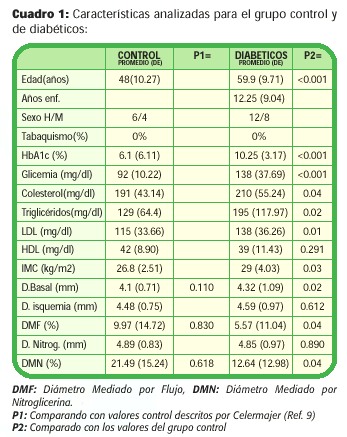
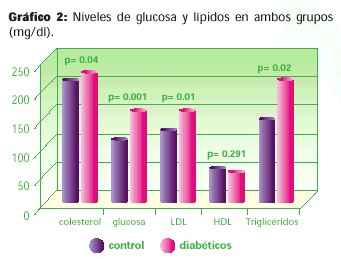
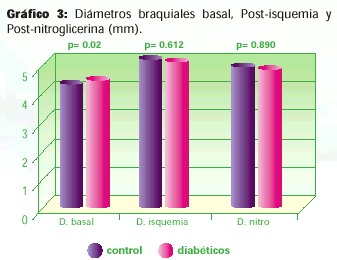
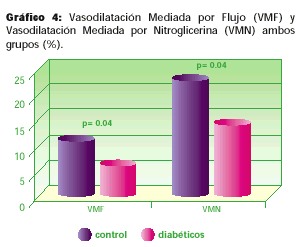
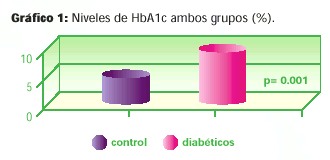
<body><![CDATA[<P><FONT FACE="Arial"><FONT SIZE=-1>1. El di&aacute;metro y la vasodilataci&oacute;n mediada por flujo (VMF) de la arteria braquial derecha fue medida utilizando un transductor linear ultrasonogr&aacute;fico de 7.5 Mhz (SSHP-140A, Toshiba, Japan). En el primer estudio se les determin&oacute; previamente tensi&oacute;n arterial y pulso, posteriormente el di&aacute;metro braquial vascular basal se determin&oacute; mediante doppler pulsado a un angulo de 60&ordm; con respecto al vaso, el cu&aacute;l fue localizado a no menos de 7 cm. de la fosa antecubital, y abordado de forma longitudinal. El di&aacute;metro del vaso se midi&oacute; desde la linea M (uni&oacute;n &iacute;ntima/media) anterior a la posterior y durante s&iacute;stole. Se realizaron tres mediciones y el reporte final es el promedio de las mismas. La velocidad del flujo se determin&oacute; de acuerdo al an&aacute;lisis de la onda de flujo. Luego de 5 minutos de reposo, se inici&oacute; el segundo estudio.</FONT></FONT>      <P><FONT FACE="Arial"><FONT SIZE=-1>2. En &eacute;ste estudio, el brazo del paciente se somete a isquemia mediante la insuflaci&oacute;n del manguito del esfingoman&oacute;metro 100 mmHg por encima de la tensi&oacute;n arterial sist&oacute;lica basal del paciente y se mantiene de &eacute;ste modo durante cuatro minutos. Luego de ser liberada la presi&oacute;n, se toman de nuevo tres mediciones del di&aacute;metro vascular, la velocidad de flujo y los signos vitales. Estas determinaciones se realizan en un peri&oacute;do no menor a 70 segundos despu&eacute;s de liberado el vaso. El reporte final del di&aacute;metro corresponde a la media de las 3 mediciones hechas. El porcentaje de vasodilataci&oacute;n mediada por flujo se calcula a partir de la f&oacute;rmula: (%VMF =(DIAMETRO POSTISQUEMIA – DIAMETRO BASAL) / DIAMETRO BASAL x 100). Luego de 5 minutos de reposo se realiza el tercer procedimiento.</FONT></FONT>      <P><FONT FACE="Arial"><FONT SIZE=-1>3. En esta oportunidad se le administran al paciente 0.5 mg de Nitroglicerina sublingual y luego se somete el brazo de nuevo a isquemia por un per&iacute;odo de 4 minutos. Finalmente se toman 3 mediciones del di&aacute;metro vascular y se reporta la media de &eacute;stas mediciones, se determina velocidad de flujo y signos vitales, el porcentaje de vasodilataci&oacute;n mediada por nitroglicerina (VMN) se estima utilizando la f&oacute;rmula previamente descrita.</FONT></FONT>      <P><FONT FACE="Arial"><FONT SIZE=-1><U>An&aacute;lisis estad&iacute;stico:</U> Para el an&aacute;lisis estad&iacute;stico de los datos se utiliz&oacute; el paquete estad&iacute;stico SPSS para Windows 98 versi&oacute;n 8.0, se calcularon las medidas de frecuencia de cada variable y mediante T’student de medidas &uacute;nicas se compararon los grupos control y de diab&eacute;ticos.</FONT></FONT>      <P><FONT FACE="Arial"><FONT SIZE=-1>Las correlaciones entre la HbA1c, colesterol, HDL, LDL y triglic&eacute;ridos con el DMF y la VMN en el grupo control y de diab&eacute;ticos, se determinaron mediante correlaci&oacute;n multivariada de Pearson. La significancia estad&iacute;stica se defini&oacute; como una p=0.05</FONT></FONT>      <P><B><FONT FACE="Arial"><FONT SIZE=-1>Resultados</FONT></FONT></B>      <P><FONT FACE="Arial"><FONT SIZE=-1>Todos los pacientes toleraron el estudio en forma adecuada, en ning&uacute;n paciente hubo cambios importantes en la tensi&oacute;n arterial sist&oacute;lica o diast&oacute;lica (> 10 mm Hg). Ninguno de los pacientes ten&iacute;a antecedentes de enfermedad coronaria al momento del estudio, un paciente del grupo de diab&eacute;ticos ten&iacute;a el antecedente de un accidente vascular cerebral previo.</FONT></FONT>      <P><FONT FACE="Arial"><FONT SIZE=-1><U>Controles:</U> En los 10 pacientes del grupo control, el di&aacute;metro promedio vascular fue de 4.1 mm. El di&aacute;metro promedio post-isquemia fue 4.48 mm, La vasodilataci&oacute;n mediada por flujo promedio fue de 9.97%, el di&aacute;metro promedio post-nitroglicerina fue de 4.89 mm. y la vasodilataci&oacute;n mediada por nitroglicerina promedio fue de 21.49%. Ninguno de los controles era tabaquista, y los valores promedio de HbA1c, glicemia, colesterol, LDL, HDL y Triglic&eacute;ridos, estuvieron dentro del rango normal. En el an&aacute;lisis multivariado la VMF correlacion&oacute; en forma inversa y significativa, con el nivel de triglic&eacute;ridos s&eacute;ricos ( r =-0.892 p =0.001) y con el &iacute;ndice de masa corporal (r = -0.688 p = 0.038)</FONT></FONT>      <P><B><FONT FACE="Arial"><FONT SIZE=-1>Diab&eacute;ticos</FONT></FONT></B>      <P><FONT FACE="Arial"><FONT SIZE=-1>Se estudiaron 20 pacientes diab&eacute;ticos, 40% mujeres y 60% hombres, 10 pacientes (50%) controlados con insulina, 9(45%) controlados con hipoglicemiantes orales y 1 (5%) con dieta. En &eacute;stos pacientes, los niveles de HbA1c, glicemia, colesterol, LDL, Triglic&eacute;ridos, IMC y el di&aacute;metro basal fueron m&aacute;s altos que en el grupo control (estad&iacute;sticamente significativo) (<A HREF="#cuadro1">Cuadro 1</A> y <A HREF="#graf1">Gr&aacute;ficos 1</A>-<A HREF="#graf4">4</A>), el nivel de HDL, fue menor, pero no estad&iacute;sticamente significativo. El di&aacute;metro post-isquemia y post-nitroglicerina fue menor (no estad&iacute;sticamente significativo) pero los valores de VMF y VMN fueron considerablemente menores (estad&iacute;sticamente significativo) con respecto al grupo control. En el an&aacute;lisis multivariado, el di&aacute;metro postisquemia correlaciona en forma significativa con el di&aacute;metro basal (r =0.830 p &lt; 0.0001).</FONT></FONT><FONT FACE="Arial"><FONT SIZE=-1></FONT></FONT>     ]]></body>
<body><![CDATA[<CENTER><A NAME="cuadro1"></A><IMG SRC="/img/fbpe/rcc/v5n3/2271i05.JPG" HEIGHT=437 WIDTH=347></CENTER>      
<CENTER>&nbsp;</CENTER>      <CENTER><A NAME="graf1"></A><IMG SRC="/img/fbpe/rcc/v5n3/2271i01.JPG" HEIGHT=160 WIDTH=330></CENTER>      
<CENTER>&nbsp;</CENTER>      <CENTER><IMG SRC="/img/fbpe/rcc/v5n3/2271i02.JPG" HEIGHT=259 WIDTH=341></CENTER>      
<CENTER>&nbsp;</CENTER>      <CENTER><IMG SRC="/img/fbpe/rcc/v5n3/2271i03.JPG" HEIGHT=260 WIDTH=337></CENTER>      
<CENTER>&nbsp;</CENTER>      <CENTER><A NAME="graf4"></A><IMG SRC="/img/fbpe/rcc/v5n3/2271i04.JPG" HEIGHT=247 WIDTH=301></CENTER> <FONT FACE="Arial"><FONT SIZE=-1></FONT></FONT>&nbsp;<FONT FACE="Arial"><FONT SIZE=-1></FONT></FONT>      
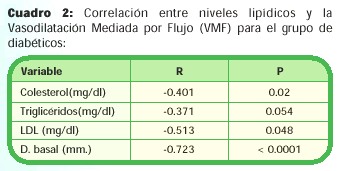
<P><FONT FACE="Arial"><FONT SIZE=-1>En cuanto a la VMF con respecto a las otras variables, se establecieron correlaciones moderadas (&lt; 0.6) para, el colesterol total, el LDL y los niveles de triglic&eacute;ridos. (<A HREF="#cuadro2">Cuadro 2</A>).</FONT></FONT>     ]]></body>
<body><![CDATA[<BR><FONT FACE="Arial"><FONT SIZE=-1>&nbsp;</FONT></FONT>     <CENTER><A NAME="cuadro2"></A><IMG SRC="/img/fbpe/rcc/v5n3/2271i06.JPG" BORDER=0 HEIGHT=171 WIDTH=341></CENTER> &nbsp;     
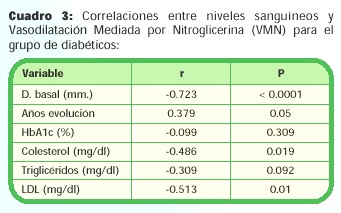
<BR><FONT FACE="Arial"><FONT SIZE=-1>La VMN correlacion&oacute; en forma significativa con: los a&ntilde;os de duraci&oacute;n de la enfermedad, los niveles de colesterol, LDL y el di&aacute;metro basal del vaso. (<A HREF="#cuadro3">Cuadro 3</A>)</FONT></FONT>     <BR><FONT FACE="Arial"><FONT SIZE=-1>&nbsp;</FONT></FONT>     <CENTER><A NAME="cuadro3"></A><IMG SRC="/img/fbpe/rcc/v5n3/2271i07.JPG" HEIGHT=213 WIDTH=341></CENTER>       
<P><B><FONT FACE="Arial"><FONT SIZE=-1>Discusi&oacute;n</FONT></FONT></B>      <P><FONT FACE="Arial"><FONT SIZE=-1>La VMF y la VMN parecieran estar deterioradas en el diab&eacute;tico tipo 2. Nuestros resultados muestran que ambas variables son significativcamente menores en este grupo de pacientes, que en el grupo control. Esta disminuci&oacute;n de la VMF pareciera ser una manifestaci&oacute;n temprana de la enfermedad arterioscler&oacute;tica, detectable antes de la aparici&oacute;n de eventos cl&iacute;nicos cardiovasculares. (<A HREF="#11">11</A>) En modelos animales, se ha demostrado, que la disfunci&oacute;n endotelial aparece tempranamente, antes de que se presenten los cambios estructurales arterioescler&oacute;ticos (<A HREF="#12">12</A>) vasculares. La disfunci&oacute;n endotelial acelera la interacci&oacute;n entre endotelio, plaquetas neutr&oacute;filos y macr&oacute;fagos que culmina con la formaci&oacute;n de la placa. (<A HREF="#7">7</A>, <A HREF="#13">13</A>)</FONT></FONT>      <P><FONT FACE="Arial"><FONT SIZE=-1>La VMN tambi&eacute;n se encuentra deteriorada en &eacute;ste grupo de pacientes. Previamente se ha demostrado que pacientes con DM tipo 1 tambi&eacute;n ten&iacute;an una VMN disminu&iacute;da con respecto a los no diab&eacute;ticos, (<A HREF="#14">14</A>) lo que sugiere que los nitratos podr&iacute;an ejercer un efecto vasodilatador menor en esta poblaci&oacute;n. Sin embargo otro estudio posterior mostr&oacute; resultados contrarios. (<A HREF="#15">15</A>) La VMN tambi&eacute;n est&aacute; afectada en la DM tipo 2 seg&uacute;n un peque&ntilde;o estudio previo, (<A HREF="#16">16</A>) pero &eacute;ste fen&oacute;meno debe ser estudiado en una mayor cantidad de pacientes para ser clarificado adecuadamente.</FONT></FONT>      <P><FONT FACE="Arial"><FONT SIZE=-1>La disfunci&oacute;n endotelial tambi&eacute;n se asocia a hiperglicemia aguda en la DM tipo 2 y a la presencia de resistencia insul&iacute;nica (<A HREF="#17">17</A>, <A HREF="#18">18</A>) en la aparici&oacute;n temprana de la arteriosclerosis en pacientes con tasa de aclaramiento metab&oacute;lico de glucosa disminuido.</FONT></FONT>      <P><FONT FACE="Arial"><FONT SIZE=-1>La glicemia promedio al momento del an&aacute;lisis sonogr&aacute;fico se mantuvo en un rango adecuado, evitando que esta interacci&oacute;n afecte la interpretaci&oacute;n de los datos; a los pacientes no se les realiz&oacute; insulinemia, sin embargo correlacionar la resistencia insul&iacute;nica con la VMF es un objetivo deseable para un pr&oacute;ximo trabajo a realizar.</FONT></FONT>      ]]></body>
<body><![CDATA[<P><FONT FACE="Arial"><FONT SIZE=-1>Los niveles de triglic&eacute;ridos y el IMC correlacionaron inversamente con la VMF en el grupo control, Wilmink y cols, ya han descrito este hallazgo en pacientes hiperlip&eacute;micos (<A HREF="#19">19</A>) sin embargo el grupo control fu&eacute; normotriglicerid&eacute;mico, lo que sugiere un rol importante de los niveles de triglic&eacute;ridos en el desarrollo temprano de la enfermedad arterioescler&oacute;tica.</FONT></FONT>      <P><FONT FACE="Arial"><FONT SIZE=-1>En el grupo de pacientes diab&eacute;ticos, existe una correlaci&oacute;n inversa moderada pero estad&iacute;sticamente significativa entre la VMF y la VMN, con los niveles de colesterol, triglic&eacute;ridos y LDL, pero no as&iacute; para los niveles de HbA1c. Esta correlaci&oacute;n entre los niveles de l&iacute;pidos y la disfunci&oacute;n endotelial ya ha sido corroborada en otros trabajos de pacientes no diab&eacute;ticos, (<A HREF="#9">9</A>) y probablemente est&eacute; relacionada al efecto inflamatorio de los remanentes lip&iacute;dicos sobre la pared vascular al unirse a los receptores secuestradores endoteliales, (<A HREF="#7">7</A>) evento que tambi&eacute;n ocurre en la hipertrigliceridemia. (<A HREF="#19">19</A>)</FONT></FONT>      <P><FONT FACE="Arial"><FONT SIZE=-1>La VMF depende de los niveles de &oacute;xido n&iacute;trico, el cu&aacute;l siendo un radical por s&iacute; mismo, reacciona con radicales libres de ox&iacute;geno e interfiere con los mecanismos de oxido-reducci&oacute;n, inactiva la transcripci&oacute;n estimulada por el Facto Nuclear NFkb, el cu&aacute;l estimula la transcripci&oacute;n de genes involucrados en la g&eacute;nesis arterioscler&oacute;tica. (<A HREF="#20">20</A>, <A HREF="#21">21</A>)</FONT></FONT>      <P><FONT FACE="Arial"><FONT SIZE=-1>La interacci&oacute;n del &oacute;xido n&iacute;trico con los radicales de ox&iacute;geno formados a partir de los remanentes de colesterol en la pared vascular, reduce la disponibilidad del mismo para mediar la relajaci&oacute;n vascular. (<A HREF="#22">22</A>) En base a este tipo de observaciones, en numerosos estudios se ha intentado utilizar f&aacute;rmacos hipolipemiantes por per&iacute;odos relativamente prolongados, para mejorar la cantidad de &oacute;xido n&iacute;trico disponible localmente y as&iacute; "revertir" la disfunci&oacute;n endotelial, sin embargo el efecto de estas intervenciones farmacol&oacute;gicas sobre la morbimortalidad cardiovascular del paciente, todav&iacute;a no han sido claramente dilucidadas, pues los resultados han sido variados y contradictorios. (<A HREF="#23">23</A>)</FONT></FONT>      <P><FONT FACE="Arial"><FONT SIZE=-1>Los niveles de HbA1c no correlacionaron en forma estad&iacute;sticamente significativa con el grado de VMF o VMN, tal como ha sido descrito para pacientes con DM tipo 1, (<A HREF="#14">14</A>) sin embargo la escasa cantidad de pacientes diab&eacute;ticos enrolados, no permite estratificarlos seg&uacute;n sus niveles de HbA1c para realizar un an&aacute;lisis de mayor significancia. Los niveles de HbA1c s&iacute; se han correlacionado, aunque no en forma estad&iacute;sticamente significativa con mayor morbi-mortalidad cardiovascular en la DM tipo 2, (<A HREF="#24">24</A>) sin embargo la utilizacion de inhibidores de la enzima convertidora de angiotensina (ECA) (<A HREF="#25">25</A>, <A HREF="#26">26</A>) y de angiotensina II (AT-II) en pacientes diab&eacute;ticos, (<A HREF="#18">18</A>) para revertir la disfunci&oacute;n endotelial, dada la capacidad de estos medicamentos de activar la sintetasa de &oacute;xido n&iacute;trico, se ha estudiado; y a &eacute;ste efecto farmacol&oacute;gico se le han atribuido disminuciones considerables en la morbi-mortalidad cardiovascular de estos pacientes. (<A HREF="#27">27</A>, <A HREF="#28">28</A>)</FONT></FONT>      <P><B><FONT FACE="Arial"><FONT SIZE=-1>Conclusiones</FONT></FONT></B>      <P><FONT FACE="Arial"><FONT SIZE=-1>El uso del Doppler braquial para detectar la disfunci&oacute;n endotelial en el paciente con riesgo de enfermedad cardiovascular es un m&eacute;todo relativamente sencillo y reproducible en un laboratorio de alta calidad, que nos permite detectar a los pacientes con enfermedad arterioscler&oacute;tica temprana, a la vez convierte &eacute;stos pacientes en candidatos a recibir una intervenci&oacute;n en sus estilos de vida y farmacol&oacute;gica, que permita revertir &eacute;sta condici&oacute;n.</FONT></FONT>      <P><FONT FACE="Arial"><FONT SIZE=-1>Los pacientes diab&eacute;ticos tipo 2 quienes tiene una funci&oacute;n endotelial m&aacute;s alterada que la de la poblaci&oacute;n general, son un grupo que podr&iacute;a resultar particularmente beneficiado de la intervenci&oacute;n y correcci&oacute;n de los factores de riesgo cardiovascular.</FONT></FONT>      <P><FONT FACE="Arial"><FONT SIZE=-1>Estudios a &eacute;ste respecto, con mayor cantidad de pacientes, deben realizarse en los a&ntilde;os por venir, que nos aclaren cu&aacute;les son los tipos de intervenci&oacute;n de los cuales se obtendr&aacute; mayor beneficio para los pacientes.</FONT></FONT>      <P><B><FONT FACE="Arial"><FONT SIZE=-1>Bibliograf&iacute;a</FONT></FONT></B>      ]]></body>
<body><![CDATA[<!-- ref --><P><A NAME="1"></A><FONT FACE="Arial"><FONT SIZE=-1>1. Fein F, Scheir J. Heart Disease in Diabetes Mellitus: Theory and practice. Rifkin H, Porte J, Editors. New York : Elsevier 1990: 821-23.</FONT></FONT>    &nbsp;&nbsp;&nbsp;&nbsp;&nbsp;&nbsp;&nbsp;&nbsp;[&#160;<a href="javascript:void(0);" onclick="javascript: window.open('/scielo.php?script=sci_nlinks&ref=734556&pid=S1409-4142200300030000500001&lng=','','width=640,height=500,resizable=yes,scrollbars=1,menubar=yes,');">Links</a>&#160;]<!-- end-ref --><!-- ref --><P><A NAME="2"></A><FONT FACE="Arial"><FONT SIZE=-1>2. Sementovich CF, Heinecke JW. The mystery of diabetes and atherosclerosis. Diabetes 1997; 46: 327-34.</FONT></FONT>    &nbsp;&nbsp;&nbsp;&nbsp;&nbsp;&nbsp;&nbsp;&nbsp;[&#160;<a href="javascript:void(0);" onclick="javascript: window.open('/scielo.php?script=sci_nlinks&ref=734557&pid=S1409-4142200300030000500002&lng=','','width=640,height=500,resizable=yes,scrollbars=1,menubar=yes,');">Links</a>&#160;]<!-- end-ref --><!-- ref --><P><A NAME="3"></A><FONT FACE="Arial"><FONT SIZE=-1>3. Cohen RA. Disfunction of vascular endothelium in Diabetes Mellitus. Circulation 1993; 87 Suppl V: V 67-76. (11-14)</FONT></FONT>    &nbsp;&nbsp;&nbsp;&nbsp;&nbsp;&nbsp;&nbsp;&nbsp;[&#160;<a href="javascript:void(0);" onclick="javascript: window.open('/scielo.php?script=sci_nlinks&ref=734558&pid=S1409-4142200300030000500003&lng=','','width=640,height=500,resizable=yes,scrollbars=1,menubar=yes,');">Links</a>&#160;]<!-- end-ref --><!-- ref --><P><A NAME="4"></A><FONT FACE="Arial"><FONT SIZE=-1>4. Winocour PP. Platelet anormalities in diabetes mellitus. Diabetes 1992; 41 Suppl. 2: 26-31.</FONT></FONT>    &nbsp;&nbsp;&nbsp;&nbsp;&nbsp;&nbsp;&nbsp;&nbsp;[&#160;<a href="javascript:void(0);" onclick="javascript: window.open('/scielo.php?script=sci_nlinks&ref=734559&pid=S1409-4142200300030000500004&lng=','','width=640,height=500,resizable=yes,scrollbars=1,menubar=yes,');">Links</a>&#160;]<!-- end-ref --><!-- ref --><P><A NAME="5"></A><FONT FACE="Arial"><FONT SIZE=-1>5. Reaven GM. Role of insulin resistance in human disease. Diabetes 1988; 37: 1595-607.</FONT></FONT>    &nbsp;&nbsp;&nbsp;&nbsp;&nbsp;&nbsp;&nbsp;&nbsp;[&#160;<a href="javascript:void(0);" onclick="javascript: window.open('/scielo.php?script=sci_nlinks&ref=734560&pid=S1409-4142200300030000500005&lng=','','width=640,height=500,resizable=yes,scrollbars=1,menubar=yes,');">Links</a>&#160;]<!-- end-ref --><!-- ref --><P><A NAME="6"></A><FONT FACE="Arial"><FONT SIZE=-1>6. Godsland IK. Stevenson JC. Insulin Resistance: Syndrome or tendency? Lancet 1995; 346: 100-3.</FONT></FONT>    &nbsp;&nbsp;&nbsp;&nbsp;&nbsp;&nbsp;&nbsp;&nbsp;[&#160;<a href="javascript:void(0);" onclick="javascript: window.open('/scielo.php?script=sci_nlinks&ref=734561&pid=S1409-4142200300030000500006&lng=','','width=640,height=500,resizable=yes,scrollbars=1,menubar=yes,');">Links</a>&#160;]<!-- end-ref --><!-- ref --><P><A NAME="7"></A><FONT FACE="Arial"><FONT SIZE=-1>7. Ross R. Atherosclerosis and inflammatory disease. N. Eng. J. Med.; 312: 744-45. (27-28)</FONT></FONT>    &nbsp;&nbsp;&nbsp;&nbsp;&nbsp;&nbsp;&nbsp;&nbsp;[&#160;<a href="javascript:void(0);" onclick="javascript: window.open('/scielo.php?script=sci_nlinks&ref=734562&pid=S1409-4142200300030000500007&lng=','','width=640,height=500,resizable=yes,scrollbars=1,menubar=yes,');">Links</a>&#160;]<!-- end-ref --><!-- ref --><P><A NAME="8"></A><FONT FACE="Arial"><FONT SIZE=-1>8. Hasdai D, Holmes DR. Jr, Garret KN, et al. Mechanical pressure and stress release endothelin –1 from human atherosclerotic coronary arteries in vivo. Circulation 1997; 95 : 357-62.</FONT></FONT>    &nbsp;&nbsp;&nbsp;&nbsp;&nbsp;&nbsp;&nbsp;&nbsp;[&#160;<a href="javascript:void(0);" onclick="javascript: window.open('/scielo.php?script=sci_nlinks&ref=734563&pid=S1409-4142200300030000500008&lng=','','width=640,height=500,resizable=yes,scrollbars=1,menubar=yes,');">Links</a>&#160;]<!-- end-ref --><!-- ref --><P><A NAME="9"></A><FONT FACE="Arial"><FONT SIZE=-1>9. Celermajer DS, Sorensen KE, Goock WM, et al. Non invasive detection of endothelial disfunction in children and adults at risk of atherosclerosis. Lancet 1992; 340: 1111-5.(32)</FONT></FONT>    &nbsp;&nbsp;&nbsp;&nbsp;&nbsp;&nbsp;&nbsp;&nbsp;[&#160;<a href="javascript:void(0);" onclick="javascript: window.open('/scielo.php?script=sci_nlinks&ref=734564&pid=S1409-4142200300030000500009&lng=','','width=640,height=500,resizable=yes,scrollbars=1,menubar=yes,');">Links</a>&#160;]<!-- end-ref --><!-- ref --><P><A NAME="10"></A><FONT FACE="Arial"><FONT SIZE=-1>10. Celermajer D, Sorensen K, Bull C, et al. Endothelium dependent vasodilatation in the systemic arteries of asymptomatic subjects relates to coronary risk factor and their interaction. J. American Coll. Cardiol. 1994; 24: 1468-74.(35)</FONT></FONT>    &nbsp;&nbsp;&nbsp;&nbsp;&nbsp;&nbsp;&nbsp;&nbsp;[&#160;<a href="javascript:void(0);" onclick="javascript: window.open('/scielo.php?script=sci_nlinks&ref=734565&pid=S1409-4142200300030000500010&lng=','','width=640,height=500,resizable=yes,scrollbars=1,menubar=yes,');">Links</a>&#160;]<!-- end-ref --><!-- ref --><P><A NAME="11"></A><FONT FACE="Arial"><FONT SIZE=-1>11. McLenachan SM, Vita J, Fish RD, et al. Early evidence of endothelial vasodilator disfunction at coronary branch points. Circulation 1990; 82:1169-73. (39)</FONT></FONT>    &nbsp;&nbsp;&nbsp;&nbsp;&nbsp;&nbsp;&nbsp;&nbsp;[&#160;<a href="javascript:void(0);" onclick="javascript: window.open('/scielo.php?script=sci_nlinks&ref=734566&pid=S1409-4142200300030000500011&lng=','','width=640,height=500,resizable=yes,scrollbars=1,menubar=yes,');">Links</a>&#160;]<!-- end-ref --><P><A NAME="12"></A><FONT FACE="Arial"><FONT SIZE=-1>12. Osborne A, Lento PH, Sigfried MR, et al. Cardiovascular effects of acute hypercolesterolemia in rabbits, reversal with lovastatin treatment. J. Clin. Invest. 1989; 83: 465-73. (40)</FONT></FONT>      <!-- ref --><P><A NAME="13"></A><FONT FACE="Arial"><FONT SIZE=-1>13. Ross R. The pathogenesis of atherosclerosis a perspective for the 1990’s. Nature 1993; 44: 406-12 (25)</FONT></FONT>    &nbsp;&nbsp;&nbsp;&nbsp;&nbsp;&nbsp;&nbsp;&nbsp;[&#160;<a href="javascript:void(0);" onclick="javascript: window.open('/scielo.php?script=sci_nlinks&ref=734568&pid=S1409-4142200300030000500013&lng=','','width=640,height=500,resizable=yes,scrollbars=1,menubar=yes,');">Links</a>&#160;]<!-- end-ref --><!-- ref --><P><A NAME="14"></A><FONT FACE="Arial"><FONT SIZE=-1>14. Jensen-Ustar KJ, Reichard DE, Rosfors JJ, et al. Early atherosclerosis is retarded by improved blood glucose control in patients with IDDM. Diabetes 1996; 45: 1253-58 (41)</FONT></FONT>    &nbsp;&nbsp;&nbsp;&nbsp;&nbsp;&nbsp;&nbsp;&nbsp;[&#160;<a href="javascript:void(0);" onclick="javascript: window.open('/scielo.php?script=sci_nlinks&ref=734569&pid=S1409-4142200300030000500014&lng=','','width=640,height=500,resizable=yes,scrollbars=1,menubar=yes,');">Links</a>&#160;]<!-- end-ref --><!-- ref --><P><A NAME="15"></A><FONT FACE="Arial"><FONT SIZE=-1>15. Lanbert S, Aarsen M. Denker AJM, et al. Endothelium dependent and independent vasodilatation of large arteries in normoalbuminuric IDDM. Artheriosescler. Thromb. Vasc. Biol. 1996; 16: 705-11. (42)</FONT></FONT>    &nbsp;&nbsp;&nbsp;&nbsp;&nbsp;&nbsp;&nbsp;&nbsp;[&#160;<a href="javascript:void(0);" onclick="javascript: window.open('/scielo.php?script=sci_nlinks&ref=734570&pid=S1409-4142200300030000500015&lng=','','width=640,height=500,resizable=yes,scrollbars=1,menubar=yes,');">Links</a>&#160;]<!-- end-ref --><!-- ref --><P><A NAME="16"></A><FONT FACE="Arial"><FONT SIZE=-1>16. Goodfellow J, Ramsey MW, Luddintong LA, et al. Endothelium and inelastic arteries: and early marker of vascular disfunction in non insulin dependent diabetes mellitus. BMJ; 312: 744-45. (38)</FONT></FONT>    &nbsp;&nbsp;&nbsp;&nbsp;&nbsp;&nbsp;&nbsp;&nbsp;[&#160;<a href="javascript:void(0);" onclick="javascript: window.open('/scielo.php?script=sci_nlinks&ref=734571&pid=S1409-4142200300030000500016&lng=','','width=640,height=500,resizable=yes,scrollbars=1,menubar=yes,');">Links</a>&#160;]<!-- end-ref --><!-- ref --><P><A NAME="17"></A><FONT FACE="Arial"><FONT SIZE=-1>17. Kawano H. Motoyama T, Hiroshima O, et al. Hyperglicemia rapidly suppresses FMD dependent vasodilatation of brachial artery. J. Am. Coll. Cardiol. 1999; 39: 146-54.</FONT></FONT>    &nbsp;&nbsp;&nbsp;&nbsp;&nbsp;&nbsp;&nbsp;&nbsp;[&#160;<a href="javascript:void(0);" onclick="javascript: window.open('/scielo.php?script=sci_nlinks&ref=734572&pid=S1409-4142200300030000500017&lng=','','width=640,height=500,resizable=yes,scrollbars=1,menubar=yes,');">Links</a>&#160;]<!-- end-ref --><!-- ref --><P><A NAME="18"></A><FONT FACE="Arial"><FONT SIZE=-1>18. Balletshofer BM, Rittig K, Enderle MD, et al. Endothelial dysfunction is detectable in young normotensive first degree relatives of subjects with type 2 diabetes in association with insulin resistance. Circulation 2000; 101: 1780-84.</FONT></FONT>    &nbsp;&nbsp;&nbsp;&nbsp;&nbsp;&nbsp;&nbsp;&nbsp;[&#160;<a href="javascript:void(0);" onclick="javascript: window.open('/scielo.php?script=sci_nlinks&ref=734573&pid=S1409-4142200300030000500018&lng=','','width=640,height=500,resizable=yes,scrollbars=1,menubar=yes,');">Links</a>&#160;]<!-- end-ref --><P><A NAME="19"></A><FONT FACE="Arial"><FONT SIZE=-1>19. Wilmink HW, Banga JP, Hijmering MD, et al. Effect of ACE inhibition and AT-II type 1 receptor antagonism on postprandial endothelial function. J. Am. Coll. Cardiol. 1999; 39: 140-5. (43-45)</FONT></FONT>      <!-- ref --><P><A NAME="20"></A><FONT FACE="Arial"><FONT SIZE=-1>20. Kavin M, Barnes PJ. Mechanisms of Disease : Nuclear transcription factor (Kappa) b a pivotal transcription factor in chronic inflammatory diseases. N. Eng. J. Med. 1997; 336: 1066-1071.</FONT></FONT>    &nbsp;&nbsp;&nbsp;&nbsp;&nbsp;&nbsp;&nbsp;&nbsp;[&#160;<a href="javascript:void(0);" onclick="javascript: window.open('/scielo.php?script=sci_nlinks&ref=734575&pid=S1409-4142200300030000500020&lng=','','width=640,height=500,resizable=yes,scrollbars=1,menubar=yes,');">Links</a>&#160;]<!-- end-ref --><!-- ref --><P><A NAME="21"></A><FONT FACE="Arial"><FONT SIZE=-1>21. Zeiher AM, Fisstthaler B, Scrhay- Utz B, et al. NO modulates the expression of monocite chemoattractant protein 1 in cultured human endothelial cells. Circ. Res. 115; 76: 980-86.</FONT></FONT>    &nbsp;&nbsp;&nbsp;&nbsp;&nbsp;&nbsp;&nbsp;&nbsp;[&#160;<a href="javascript:void(0);" onclick="javascript: window.open('/scielo.php?script=sci_nlinks&ref=734576&pid=S1409-4142200300030000500021&lng=','','width=640,height=500,resizable=yes,scrollbars=1,menubar=yes,');">Links</a>&#160;]<!-- end-ref --><!-- ref --><P><A NAME="22"></A><FONT FACE="Arial"><FONT SIZE=-1>22. Zeiher AM. Endothelial vasodilation dysfunction pathogenetic link to myocardial ischemia or epiphenomenona? Lancet 1996; 348 (Suppl. 1): 510-12.</FONT></FONT>    &nbsp;&nbsp;&nbsp;&nbsp;&nbsp;&nbsp;&nbsp;&nbsp;[&#160;<a href="javascript:void(0);" onclick="javascript: window.open('/scielo.php?script=sci_nlinks&ref=734577&pid=S1409-4142200300030000500022&lng=','','width=640,height=500,resizable=yes,scrollbars=1,menubar=yes,');">Links</a>&#160;]<!-- end-ref --><!-- ref --><P><A NAME="23"></A><FONT FACE="Arial"><FONT SIZE=-1>23. Cannon RO. Cardiovascular benefit of cholesterol lowering therapy does improved endothelial vasodilator function matter. Circulation 2000; 102: 820-22. (46-49)</FONT></FONT>    &nbsp;&nbsp;&nbsp;&nbsp;&nbsp;&nbsp;&nbsp;&nbsp;[&#160;<a href="javascript:void(0);" onclick="javascript: window.open('/scielo.php?script=sci_nlinks&ref=734578&pid=S1409-4142200300030000500023&lng=','','width=640,height=500,resizable=yes,scrollbars=1,menubar=yes,');">Links</a>&#160;]<!-- end-ref --><!-- ref --><P><A NAME="24"></A><FONT FACE="Arial"><FONT SIZE=-1>24. Hamnoud T, Tanguay JF, Bourassa MG. Management of coronary artery disease: Therapeutic options in patients with diabetes. J. American Coll. Cardiol. 2000; 36: 355-65.</FONT></FONT>    &nbsp;&nbsp;&nbsp;&nbsp;&nbsp;&nbsp;&nbsp;&nbsp;[&#160;<a href="javascript:void(0);" onclick="javascript: window.open('/scielo.php?script=sci_nlinks&ref=734579&pid=S1409-4142200300030000500024&lng=','','width=640,height=500,resizable=yes,scrollbars=1,menubar=yes,');">Links</a>&#160;]<!-- end-ref --><!-- ref --><P><A NAME="25"></A><FONT FACE="Arial"><FONT SIZE=-1>25. Mancini GBJ, Henry GC, Macaya C, et al. ACE inhibition with quinapril improves endothelial vasomotor dysfunction in patients with coronary artherioesclerotic disease. TREND study.Circulation 1996; 54: 258-65.</FONT></FONT>    &nbsp;&nbsp;&nbsp;&nbsp;&nbsp;&nbsp;&nbsp;&nbsp;[&#160;<a href="javascript:void(0);" onclick="javascript: window.open('/scielo.php?script=sci_nlinks&ref=734580&pid=S1409-4142200300030000500025&lng=','','width=640,height=500,resizable=yes,scrollbars=1,menubar=yes,');">Links</a>&#160;]<!-- end-ref --><!-- ref --><P><A NAME="26"></A><FONT FACE="Arial"><FONT SIZE=-1>26. O’ Driscoll G, Green D, Maiorana A, et al. Improvement in endothelialfunction by angiotensin convertoing enzyme inhibition in NIDDM. J. Am. Coll. Cardiol. 1999; 33: 1506</FONT></FONT>    &nbsp;&nbsp;&nbsp;&nbsp;&nbsp;&nbsp;&nbsp;&nbsp;[&#160;<a href="javascript:void(0);" onclick="javascript: window.open('/scielo.php?script=sci_nlinks&ref=734581&pid=S1409-4142200300030000500026&lng=','','width=640,height=500,resizable=yes,scrollbars=1,menubar=yes,');">Links</a>&#160;]<!-- end-ref --><!-- ref --><P><A NAME="27"></A><FONT FACE="Arial"><FONT SIZE=-1>27. HOPE investigators. Effects of an angiotensin converting enzyme inhibition, ramipril, on cardiovascular events in high risk patients. N Engl J Med 2000; 342:145-53.</FONT></FONT>    &nbsp;&nbsp;&nbsp;&nbsp;&nbsp;&nbsp;&nbsp;&nbsp;[&#160;<a href="javascript:void(0);" onclick="javascript: window.open('/scielo.php?script=sci_nlinks&ref=734582&pid=S1409-4142200300030000500027&lng=','','width=640,height=500,resizable=yes,scrollbars=1,menubar=yes,');">Links</a>&#160;]<!-- end-ref --><!-- ref --><P><A NAME="28"></A><FONT FACE="Arial"><FONT SIZE=-1>28. HOPE study investigators. Effects of ramipril on cardiovascular and microvascular outcomes in people with diabetes mellitus: results of the HOPE study and micro-HOPE substudy. Lancet 355: 253-259.(52-53)</FONT></FONT>    &nbsp;&nbsp;&nbsp;&nbsp;&nbsp;&nbsp;&nbsp;&nbsp;[&#160;<a href="javascript:void(0);" onclick="javascript: window.open('/scielo.php?script=sci_nlinks&ref=734583&pid=S1409-4142200300030000500028&lng=','','width=640,height=500,resizable=yes,scrollbars=1,menubar=yes,');">Links</a>&#160;]<!-- end-ref --><BR>&nbsp;      <P><A NAME="*A"></A><FONT FACE="Arial"><FONT SIZE=-1><A HREF="#*R">*</A> Departamento de Cardiolog&iacute;a,Hospital Calder&oacute;n Guardia,C.C.S.S.,San Jos&eacute;,Costa Rica.</FONT></FONT>      ]]></body>
<body><![CDATA[<P><FONT FACE="Arial"><FONT SIZE=-1><A HREF="#*R">**</A> Departamento de Im&aacute;genes M&eacute;dicas Hospital M&eacute;xico, C.C.S.S., San Jos&eacute;, Costa Rica.</FONT></FONT>     <BR><FONT SIZE=-1><FONT FACE="Arial">Correspondencia: Dr.Jonathan Poveda F.Apdo. 223-1300 San Jos&eacute;, Costa Rica.e-</FONT><FONT FACE="Arial,Helvetica">mail: <A HREF="mailto:jonathanpoveda@hotmail.com">jonathanpoveda@hotmail.com</A></FONT></FONT><FONT FACE="Arial,Helvetica"></FONT>      <P><FONT FACE="Arial"><FONT SIZE=-1>&nbsp;</FONT></FONT>      ]]></body><back>
<ref-list>
<ref id="B1">
<label>1</label><nlm-citation citation-type="book">
<person-group person-group-type="author">
<name>
<surname><![CDATA[Fein]]></surname>
<given-names><![CDATA[F]]></given-names>
</name>
<name>
<surname><![CDATA[Scheir]]></surname>
<given-names><![CDATA[J]]></given-names>
</name>
<name>
<surname><![CDATA[Rifkin]]></surname>
<given-names><![CDATA[H]]></given-names>
</name>
<name>
<surname><![CDATA[Porte]]></surname>
<given-names><![CDATA[J]]></given-names>
</name>
</person-group>
<source><![CDATA[Heart Disease in Diabetes Mellitus: Theory and practice]]></source>
<year>1990</year>
<page-range>821-23</page-range><publisher-loc><![CDATA[New York ]]></publisher-loc>
<publisher-name><![CDATA[Elsevier]]></publisher-name>
</nlm-citation>
</ref>
<ref id="B2">
<label>2</label><nlm-citation citation-type="journal">
<person-group person-group-type="author">
<name>
<surname><![CDATA[Sementovich]]></surname>
<given-names><![CDATA[CF]]></given-names>
</name>
<name>
<surname><![CDATA[Heinecke]]></surname>
<given-names><![CDATA[JW]]></given-names>
</name>
</person-group>
<article-title xml:lang="en"><![CDATA[The mystery of diabetes and atherosclerosis]]></article-title>
<source><![CDATA[Diabetes]]></source>
<year>1997</year>
<volume>46</volume>
<page-range>327-34</page-range></nlm-citation>
</ref>
<ref id="B3">
<label>3</label><nlm-citation citation-type="journal">
<person-group person-group-type="author">
<name>
<surname><![CDATA[Cohen]]></surname>
<given-names><![CDATA[RA]]></given-names>
</name>
</person-group>
<article-title xml:lang="en"><![CDATA[Disfunction of vascular endothelium in Diabetes Mellitus]]></article-title>
<source><![CDATA[Circulation]]></source>
<year>1993</year>
<volume>87</volume>
<numero>^sV</numero>
<issue>^sV</issue>
<supplement>V</supplement>
<page-range>67-76</page-range></nlm-citation>
</ref>
<ref id="B4">
<label>4</label><nlm-citation citation-type="journal">
<person-group person-group-type="author">
<name>
<surname><![CDATA[Winocour]]></surname>
<given-names><![CDATA[PP]]></given-names>
</name>
</person-group>
<article-title xml:lang="en"><![CDATA[Platelet anormalities in diabetes mellitus]]></article-title>
<source><![CDATA[Diabetes]]></source>
<year>1992</year>
<volume>41</volume>
<numero>^s2</numero>
<issue>^s2</issue>
<supplement>2</supplement>
<page-range>26-31</page-range></nlm-citation>
</ref>
<ref id="B5">
<label>5</label><nlm-citation citation-type="journal">
<person-group person-group-type="author">
<name>
<surname><![CDATA[Reaven]]></surname>
<given-names><![CDATA[GM]]></given-names>
</name>
</person-group>
<article-title xml:lang="en"><![CDATA[Role of insulin resistance in human disease]]></article-title>
<source><![CDATA[Diabetes]]></source>
<year>1988</year>
<volume>37</volume>
<page-range>1595-607</page-range></nlm-citation>
</ref>
<ref id="B6">
<label>6</label><nlm-citation citation-type="journal">
<person-group person-group-type="author">
<name>
<surname><![CDATA[Godsland]]></surname>
<given-names><![CDATA[IK]]></given-names>
</name>
<name>
<surname><![CDATA[Stevenson]]></surname>
<given-names><![CDATA[JC]]></given-names>
</name>
</person-group>
<article-title xml:lang="en"><![CDATA[Insulin Resistance: Syndrome or tendency?]]></article-title>
<source><![CDATA[Lancet]]></source>
<year>1995</year>
<volume>346</volume>
<page-range>100-3</page-range></nlm-citation>
</ref>
<ref id="B7">
<label>7</label><nlm-citation citation-type="journal">
<person-group person-group-type="author">
<name>
<surname><![CDATA[Ross]]></surname>
<given-names><![CDATA[R]]></given-names>
</name>
</person-group>
<article-title xml:lang="en"><![CDATA[Atherosclerosis and inflammatory disease]]></article-title>
<source><![CDATA[N. Eng. J. Med]]></source>
<year></year>
<volume>312</volume>
<page-range>744-45</page-range></nlm-citation>
</ref>
<ref id="B8">
<label>8</label><nlm-citation citation-type="journal">
<person-group person-group-type="author">
<name>
<surname><![CDATA[Hasdai]]></surname>
<given-names><![CDATA[D]]></given-names>
</name>
<name>
<surname><![CDATA[Holmes]]></surname>
<given-names><![CDATA[DR]]></given-names>
</name>
<name>
<surname><![CDATA[Garret]]></surname>
<given-names><![CDATA[KN]]></given-names>
</name>
</person-group>
<article-title xml:lang="en"><![CDATA[Mechanical pressure and stress release endothelin -1 from human atherosclerotic coronary arteries in vivo]]></article-title>
<source><![CDATA[Circulation]]></source>
<year>1997</year>
<volume>95</volume>
<page-range>357-62</page-range></nlm-citation>
</ref>
<ref id="B9">
<label>9</label><nlm-citation citation-type="journal">
<person-group person-group-type="author">
<name>
<surname><![CDATA[Celermajer]]></surname>
<given-names><![CDATA[DS]]></given-names>
</name>
<name>
<surname><![CDATA[Sorensen]]></surname>
<given-names><![CDATA[KE]]></given-names>
</name>
<name>
<surname><![CDATA[Goock]]></surname>
<given-names><![CDATA[WM]]></given-names>
</name>
</person-group>
<article-title xml:lang="en"><![CDATA[Non invasive detection of endothelial disfunction in children and adults at risk of atherosclerosis]]></article-title>
<source><![CDATA[Lancet]]></source>
<year>1992</year>
<volume>340</volume>
<page-range>1111-5</page-range></nlm-citation>
</ref>
<ref id="B10">
<label>10</label><nlm-citation citation-type="journal">
<person-group person-group-type="author">
<name>
<surname><![CDATA[Celermajer]]></surname>
<given-names><![CDATA[D]]></given-names>
</name>
<name>
<surname><![CDATA[Sorensen]]></surname>
<given-names><![CDATA[K]]></given-names>
</name>
<name>
<surname><![CDATA[Bull]]></surname>
<given-names><![CDATA[C]]></given-names>
</name>
</person-group>
<article-title xml:lang="en"><![CDATA[Endothelium dependent vasodilatation in the systemic arteries of asymptomatic subjects relates to coronary risk factor and their interaction]]></article-title>
<source><![CDATA[J. American Coll. Cardiol]]></source>
<year>1994</year>
<volume>24</volume>
<page-range>1468-74</page-range></nlm-citation>
</ref>
<ref id="B11">
<label>11</label><nlm-citation citation-type="journal">
<person-group person-group-type="author">
<name>
<surname><![CDATA[McLenachan]]></surname>
<given-names><![CDATA[SM]]></given-names>
</name>
<name>
<surname><![CDATA[Vita]]></surname>
<given-names><![CDATA[J]]></given-names>
</name>
<name>
<surname><![CDATA[Fish]]></surname>
<given-names><![CDATA[RD]]></given-names>
</name>
</person-group>
<article-title xml:lang="en"><![CDATA[Early evidence of endothelial vasodilator disfunction at coronary branch points]]></article-title>
<source><![CDATA[Circulation]]></source>
<year>1990</year>
<volume>82</volume>
<page-range>1169-73</page-range></nlm-citation>
</ref>
<ref id="B12">
<label>12</label><nlm-citation citation-type="journal">
<person-group person-group-type="author">
<name>
<surname><![CDATA[Osborne]]></surname>
<given-names><![CDATA[A]]></given-names>
</name>
<name>
<surname><![CDATA[Lento]]></surname>
<given-names><![CDATA[PH]]></given-names>
</name>
<name>
<surname><![CDATA[Sigfried]]></surname>
<given-names><![CDATA[MR]]></given-names>
</name>
</person-group>
<article-title xml:lang="en"><![CDATA[Cardiovascular effects of acute hypercolesterolemia in rabbits, reversal with lovastatin treatment]]></article-title>
<source><![CDATA[J. Clin. Invest]]></source>
<year>1989</year>
<volume>83</volume>
<page-range>465-73</page-range></nlm-citation>
</ref>
<ref id="B13">
<label>13</label><nlm-citation citation-type="journal">
<person-group person-group-type="author">
<name>
<surname><![CDATA[Ross]]></surname>
<given-names><![CDATA[R]]></given-names>
</name>
</person-group>
<article-title xml:lang="en"><![CDATA[The pathogenesis of atherosclerosis a perspective for the 1990’s]]></article-title>
<source><![CDATA[Nature]]></source>
<year>1993</year>
<volume>44</volume>
<page-range>406-12</page-range></nlm-citation>
</ref>
<ref id="B14">
<label>14</label><nlm-citation citation-type="journal">
<person-group person-group-type="author">
<name>
<surname><![CDATA[Jensen-Ustar]]></surname>
<given-names><![CDATA[KJ]]></given-names>
</name>
<name>
<surname><![CDATA[Reichard]]></surname>
<given-names><![CDATA[DE]]></given-names>
</name>
<name>
<surname><![CDATA[Rosfors]]></surname>
<given-names><![CDATA[JJ]]></given-names>
</name>
</person-group>
<article-title xml:lang="en"><![CDATA[Early atherosclerosis is retarded by improved blood glucose control in patients with IDDM]]></article-title>
<source><![CDATA[Diabetes]]></source>
<year>1996</year>
<volume>45</volume>
<page-range>1253-58</page-range></nlm-citation>
</ref>
<ref id="B15">
<label>15</label><nlm-citation citation-type="journal">
<person-group person-group-type="author">
<name>
<surname><![CDATA[Lanbert]]></surname>
<given-names><![CDATA[S]]></given-names>
</name>
<name>
<surname><![CDATA[Aarsen]]></surname>
<given-names><![CDATA[M]]></given-names>
</name>
<name>
<surname><![CDATA[Denker]]></surname>
<given-names><![CDATA[AJM]]></given-names>
</name>
</person-group>
<article-title xml:lang="en"><![CDATA[Endothelium dependent and independent vasodilatation of large arteries in normoalbuminuric IDDM]]></article-title>
<source><![CDATA[Artheriosescler. Thromb. Vasc. Biol]]></source>
<year>1996</year>
<volume>16</volume>
<page-range>705-11</page-range></nlm-citation>
</ref>
<ref id="B16">
<label>16</label><nlm-citation citation-type="journal">
<person-group person-group-type="author">
<name>
<surname><![CDATA[Goodfellow]]></surname>
<given-names><![CDATA[J]]></given-names>
</name>
<name>
<surname><![CDATA[Ramsey]]></surname>
<given-names><![CDATA[MW]]></given-names>
</name>
<name>
<surname><![CDATA[Luddintong]]></surname>
<given-names><![CDATA[LA]]></given-names>
</name>
</person-group>
<article-title xml:lang="en"><![CDATA[Endothelium and inelastic arteries: and early marker of vascular disfunction in non insulin dependent diabetes mellitus]]></article-title>
<source><![CDATA[BMJ]]></source>
<year></year>
<volume>312</volume>
<page-range>744-45</page-range></nlm-citation>
</ref>
<ref id="B17">
<label>17</label><nlm-citation citation-type="journal">
<person-group person-group-type="author">
<name>
<surname><![CDATA[Kawano]]></surname>
<given-names><![CDATA[H]]></given-names>
</name>
<name>
<surname><![CDATA[Motoyama]]></surname>
<given-names><![CDATA[T]]></given-names>
</name>
<name>
<surname><![CDATA[Hiroshima]]></surname>
<given-names><![CDATA[O]]></given-names>
</name>
</person-group>
<article-title xml:lang="en"><![CDATA[Hyperglicemia rapidly suppresses FMD dependent vasodilatation of brachial artery]]></article-title>
<source><![CDATA[J. Am. Coll. Cardiol]]></source>
<year>1999</year>
<volume>39</volume>
<page-range>146-54</page-range></nlm-citation>
</ref>
<ref id="B18">
<label>18</label><nlm-citation citation-type="journal">
<person-group person-group-type="author">
<name>
<surname><![CDATA[Balletshofer]]></surname>
<given-names><![CDATA[BM]]></given-names>
</name>
<name>
<surname><![CDATA[Rittig]]></surname>
<given-names><![CDATA[K]]></given-names>
</name>
<name>
<surname><![CDATA[Enderle]]></surname>
<given-names><![CDATA[MD]]></given-names>
</name>
</person-group>
<article-title xml:lang="en"><![CDATA[Endothelial dysfunction is detectable in young normotensive first degree relatives of subjects with type 2 diabetes in association with insulin resistance]]></article-title>
<source><![CDATA[Circulation]]></source>
<year>2000</year>
<volume>101</volume>
<page-range>1780-84</page-range></nlm-citation>
</ref>
<ref id="B19">
<label>19</label><nlm-citation citation-type="journal">
<person-group person-group-type="author">
<name>
<surname><![CDATA[Wilmink]]></surname>
<given-names><![CDATA[HW]]></given-names>
</name>
<name>
<surname><![CDATA[Banga]]></surname>
<given-names><![CDATA[JP]]></given-names>
</name>
<name>
<surname><![CDATA[Hijmering]]></surname>
<given-names><![CDATA[MD]]></given-names>
</name>
</person-group>
<article-title xml:lang="en"><![CDATA[Effect of ACE inhibition and AT-II type 1 receptor antagonism on postprandial endothelial function]]></article-title>
<source><![CDATA[J. Am. Coll. Cardiol]]></source>
<year>1999</year>
<volume>39</volume>
<page-range>140-5</page-range></nlm-citation>
</ref>
<ref id="B20">
<label>20</label><nlm-citation citation-type="journal">
<person-group person-group-type="author">
<name>
<surname><![CDATA[Kavin]]></surname>
<given-names><![CDATA[M]]></given-names>
</name>
<name>
<surname><![CDATA[Barnes]]></surname>
<given-names><![CDATA[PJ]]></given-names>
</name>
</person-group>
<article-title xml:lang="en"><![CDATA[Mechanisms of Disease : Nuclear transcription factor (Kappa) b a pivotal transcription factor in chronic inflammatory diseases]]></article-title>
<source><![CDATA[N. Eng. J. Med]]></source>
<year>1997</year>
<volume>336</volume>
<page-range>1066-1071</page-range></nlm-citation>
</ref>
<ref id="B21">
<label>21</label><nlm-citation citation-type="journal">
<person-group person-group-type="author">
<name>
<surname><![CDATA[Zeiher]]></surname>
<given-names><![CDATA[AM]]></given-names>
</name>
<name>
<surname><![CDATA[Fisstthaler]]></surname>
<given-names><![CDATA[B]]></given-names>
</name>
<name>
<surname><![CDATA[Scrhay- Utz]]></surname>
<given-names><![CDATA[B]]></given-names>
</name>
</person-group>
<article-title xml:lang="en"><![CDATA[NO modulates the expression of monocite chemoattractant protein 1 in cultured human endothelial cells]]></article-title>
<source><![CDATA[Circ. Res]]></source>
<year></year>
<volume>115</volume>
<numero>^s76</numero>
<issue>^s76</issue>
<supplement>76</supplement>
<page-range>980-86</page-range></nlm-citation>
</ref>
<ref id="B22">
<label>22</label><nlm-citation citation-type="journal">
<person-group person-group-type="author">
<name>
<surname><![CDATA[Zeiher]]></surname>
<given-names><![CDATA[AM]]></given-names>
</name>
</person-group>
<article-title xml:lang="en"><![CDATA[Endothelial vasodilation dysfunction pathogenetic link to myocardial ischemia or epiphenomenona?]]></article-title>
<source><![CDATA[Lancet]]></source>
<year>1996</year>
<volume>348</volume>
<numero>^s1</numero>
<issue>^s1</issue>
<supplement>1</supplement>
<page-range>510-12</page-range></nlm-citation>
</ref>
<ref id="B23">
<label>23</label><nlm-citation citation-type="journal">
<person-group person-group-type="author">
<name>
<surname><![CDATA[Cannon]]></surname>
<given-names><![CDATA[RO]]></given-names>
</name>
</person-group>
<article-title xml:lang="en"><![CDATA[Cardiovascular benefit of cholesterol lowering therapy does improved endothelial vasodilator function matter]]></article-title>
<source><![CDATA[Circulation]]></source>
<year>2000</year>
<volume>102</volume>
<page-range>820-22</page-range></nlm-citation>
</ref>
<ref id="B24">
<label>24</label><nlm-citation citation-type="journal">
<person-group person-group-type="author">
<name>
<surname><![CDATA[Hamnoud]]></surname>
<given-names><![CDATA[T]]></given-names>
</name>
<name>
<surname><![CDATA[Tanguay]]></surname>
<given-names><![CDATA[JF]]></given-names>
</name>
<name>
<surname><![CDATA[Bourassa]]></surname>
<given-names><![CDATA[MG]]></given-names>
</name>
</person-group>
<article-title xml:lang="en"><![CDATA[Management of coronary artery disease: Therapeutic options in patients with diabetes]]></article-title>
<source><![CDATA[J. American Coll. Cardiol]]></source>
<year>2000</year>
<volume>36</volume>
<page-range>355-65</page-range></nlm-citation>
</ref>
<ref id="B25">
<label>25</label><nlm-citation citation-type="journal">
<person-group person-group-type="author">
<name>
<surname><![CDATA[Mancini]]></surname>
<given-names><![CDATA[GBJ]]></given-names>
</name>
<name>
<surname><![CDATA[Henry]]></surname>
<given-names><![CDATA[GC]]></given-names>
</name>
<name>
<surname><![CDATA[Macaya]]></surname>
<given-names><![CDATA[C]]></given-names>
</name>
</person-group>
<article-title xml:lang="en"><![CDATA[ACE inhibition with quinapril improves endothelial vasomotor dysfunction in patients with coronary artherioesclerotic disease]]></article-title>
<source><![CDATA[Circulation]]></source>
<year>1996</year>
<volume>54</volume>
<page-range>258-65</page-range></nlm-citation>
</ref>
<ref id="B26">
<label>26</label><nlm-citation citation-type="journal">
<person-group person-group-type="author">
<name>
<surname><![CDATA[O’ Driscoll]]></surname>
<given-names><![CDATA[G]]></given-names>
</name>
<name>
<surname><![CDATA[Green]]></surname>
<given-names><![CDATA[D]]></given-names>
</name>
<name>
<surname><![CDATA[Maiorana]]></surname>
<given-names><![CDATA[A]]></given-names>
</name>
</person-group>
<article-title xml:lang="en"><![CDATA[Improvement in endothelialfunction by angiotensin convertoing enzyme inhibition in NIDDM]]></article-title>
<source><![CDATA[J. Am. Coll. Cardiol]]></source>
<year>1999</year>
<volume>33</volume>
<page-range>1506</page-range></nlm-citation>
</ref>
<ref id="B27">
<label>27</label><nlm-citation citation-type="journal">
<collab>HOPE investigators</collab>
<article-title xml:lang="en"><![CDATA[Effects of an angiotensin converting enzyme inhibition, ramipril, on cardiovascular events in high risk patients]]></article-title>
<source><![CDATA[N Engl J Med]]></source>
<year>2000</year>
<volume>342</volume>
<page-range>145-53</page-range></nlm-citation>
</ref>
<ref id="B28">
<label>28</label><nlm-citation citation-type="journal">
<collab>HOPE study investigators</collab>
<article-title xml:lang="en"><![CDATA[Effects of ramipril on cardiovascular and microvascular outcomes in people with diabetes mellitus: results of the HOPE study and micro-HOPE substudy]]></article-title>
<source><![CDATA[Lancet]]></source>
<year></year>
<volume>355</volume>
<page-range>253-259</page-range></nlm-citation>
</ref>
</ref-list>
</back>
</article>