<?xml version="1.0" encoding="ISO-8859-1"?><article xmlns:mml="http://www.w3.org/1998/Math/MathML" xmlns:xlink="http://www.w3.org/1999/xlink" xmlns:xsi="http://www.w3.org/2001/XMLSchema-instance">
<front>
<journal-meta>
<journal-id>1409-0015</journal-id>
<journal-title><![CDATA[Medicina Legal de Costa Rica]]></journal-title>
<abbrev-journal-title><![CDATA[Med. leg. Costa Rica]]></abbrev-journal-title>
<issn>1409-0015</issn>
<publisher>
<publisher-name><![CDATA[Asociación Costarricense de Medicina Forense]]></publisher-name>
</publisher>
</journal-meta>
<article-meta>
<article-id>S1409-00151998000200005</article-id>
<title-group>
<article-title xml:lang="es"><![CDATA[Marcadores biológicos en el alcohólico actual]]></article-title>
</title-group>
<contrib-group>
<contrib contrib-type="author">
<name>
<surname><![CDATA[Cuevas Badenes]]></surname>
<given-names><![CDATA[Joaquín]]></given-names>
</name>
<xref ref-type="aff" rid="A01"/>
</contrib>
<contrib contrib-type="author">
<name>
<surname><![CDATA[Betancourt Pulsan]]></surname>
<given-names><![CDATA[Anselma]]></given-names>
</name>
<xref ref-type="aff" rid="A02"/>
</contrib>
<contrib contrib-type="author">
<name>
<surname><![CDATA[Sanchis Fortea]]></surname>
<given-names><![CDATA[Manuel]]></given-names>
</name>
<xref ref-type="aff" rid="A03"/>
</contrib>
<contrib contrib-type="author">
<name>
<surname><![CDATA[Torres Hernández]]></surname>
<given-names><![CDATA[Miguel Ángel]]></given-names>
</name>
<xref ref-type="aff" rid="A04"/>
</contrib>
<contrib contrib-type="author">
<name>
<surname><![CDATA[Beauge]]></surname>
<given-names><![CDATA[Bertha]]></given-names>
</name>
<xref ref-type="aff" rid="A05"/>
</contrib>
</contrib-group>
<aff id="A01">
<institution><![CDATA[,Unidad de Alcohología  ]]></institution>
<addr-line><![CDATA[Valencia ]]></addr-line>
</aff>
<aff id="A02">
<institution><![CDATA[,Facultad Medicina  ]]></institution>
<addr-line><![CDATA[Guantánamo ]]></addr-line>
</aff>
<aff id="A03">
<institution><![CDATA[,Hospital Psiquiátrico de Bétera  ]]></institution>
<addr-line><![CDATA[Valencia ]]></addr-line>
</aff>
<aff id="A04">
<institution><![CDATA[,Unidad de Toxicomanías Torrent  ]]></institution>
<addr-line><![CDATA[Valencia ]]></addr-line>
</aff>
<aff id="A05">
<institution><![CDATA[,Hospital Dr. Agostino Neto  ]]></institution>
<addr-line><![CDATA[Guantánamo ]]></addr-line>
</aff>
<pub-date pub-type="pub">
<day>00</day>
<month>12</month>
<year>1998</year>
</pub-date>
<pub-date pub-type="epub">
<day>00</day>
<month>12</month>
<year>1998</year>
</pub-date>
<volume>15</volume>
<numero>1-2</numero>
<fpage>07</fpage>
<lpage>11</lpage>
<copyright-statement/>
<copyright-year/>
<self-uri xlink:href="http://www.scielo.sa.cr/scielo.php?script=sci_arttext&amp;pid=S1409-00151998000200005&amp;lng=en&amp;nrm=iso"></self-uri><self-uri xlink:href="http://www.scielo.sa.cr/scielo.php?script=sci_abstract&amp;pid=S1409-00151998000200005&amp;lng=en&amp;nrm=iso"></self-uri><self-uri xlink:href="http://www.scielo.sa.cr/scielo.php?script=sci_pdf&amp;pid=S1409-00151998000200005&amp;lng=en&amp;nrm=iso"></self-uri><abstract abstract-type="short" xml:lang="es"><p><![CDATA[Cuando se estudia cualquier tratado sobre Alcohología, resalta la gran repercusión que el etanol produce en el organismo, afectando a los tejidos, órganos y sistemas. El presente trabajo fue un estudio de una población actual de alcohólicos cuyo objetivo fue reflejar las modificaciones analíticas que el consumo de etanol producía en ellos. Se estudiaron 170 pacientes ingresados en al Unidad de Desintoxicación Hospitalaria del Hospital Psiquiátrico Provincial de Bétera (Valencia, España), durante un período de 7 meses. De entre todos los parámetros de laboratorio se tuvieron en cuenta las siguientes variables: edad, sexo, consumo de etanol, Sideremia, VCM, GGT, GOT, GPT, Fosfadatas Alcalinas. Se destacan los resultados siguientes: un aumento de la sideremia en el 40% de los casos, dato trascendente por dos hechos fundamentales: el primero porque se siguen utilizando protocolos de tratamiento para enfermos alcohólicos en los que se prescriben suplementos férricos que favorecen la sobrecarga de este mineral y por ende pueden agravar los cuadros clínicos y en segundo lugar, porque el aumento de la sideremia puede tener un rol protagonista en la fisiopatología de la Enfermedad Alcohólica; un aumento significativo del VCM relacionado con el aumento de la edad en los varones y un consumo medio diario de 273 g. de etanol puro.]]></p></abstract>
<abstract abstract-type="short" xml:lang="en"><p><![CDATA[When we study about any essay about alcoholism, the big repercussion that alcohol produces on the organism is throw into relief, and it has an effect on tissues, organs and systems. This research is a study of a present population of alcoholics which target has been to reflect the analytic modifications produced on it by the consumption of ethane. 170 subjects admited in the Curing Of Drug Addiction Hospitable Unit in the Psyquiatric Provincial Hospital in Bétera (Valencia, Spain), have been under consideration for 7 months. Between all the parameters of laboratory, we have considered the following variables: age, sex, consumption of alcohol, sideremy, VCM, GGT, GOT, GPT, Alkaline phosphate. We have got the following outcome: an increase of sideremy in a proportion of 40%, an interesting information because of the two following facts: the first one because the records of treatment are being used for alcoholic, with a prescription of ferric supplement originating an excess of this mineral and making worse the clinical case, and the increase of sideremy can have a leading role in the physiopathology of the alcoholism; an important increase or the VCM related to the increase of the increase of the age of male and an average daily consumption of 273g, of pure alcohol.]]></p></abstract>
<kwd-group>
<kwd lng="es"><![CDATA[Alcoholismo]]></kwd>
<kwd lng="es"><![CDATA[marcadores biológicos]]></kwd>
<kwd lng="es"><![CDATA[sideremia]]></kwd>
<kwd lng="es"><![CDATA[consumo etanol]]></kwd>
<kwd lng="en"><![CDATA[alcoholism]]></kwd>
<kwd lng="en"><![CDATA[biologic markers]]></kwd>
<kwd lng="en"><![CDATA[sideremy]]></kwd>
<kwd lng="en"><![CDATA[consumption of alcohol]]></kwd>
</kwd-group>
</article-meta>
</front><body><![CDATA[ <CENTER><B><FONT FACE="Arial,Helvetica">Marcadores biol&oacute;gicos en el alcoh&oacute;lico actial</FONT></B></CENTER>      <CENTER>&nbsp;</CENTER>      <CENTER>&nbsp;</CENTER>      <CENTER><B><FONT FACE="Arial,Helvetica"><FONT SIZE=-1>Dr. Joaqu&iacute;n Cuevas Badenes&nbsp;<A NAME="*"></A><A HREF="#*a">*</A>,&nbsp; Dra. Anselma Betancourt Pulsan<A HREF="#*a">**</A>,&nbsp; Dr. Manuel Sanchis Fortea<A HREF="#*a">***</A>,</FONT></FONT></B></CENTER>      <CENTER><B><FONT FACE="Arial,Helvetica"><FONT SIZE=-1>Dr. Miguel &Aacute;ngel Torres Hern&aacute;ndez <A HREF="#&a">&amp;</A>,&nbsp;&nbsp; Dra. Bertha Beauge <A HREF="#&a">&amp;&amp;</A></FONT></FONT></B></CENTER>      <CENTER>&nbsp;</CENTER> &nbsp;      <P><B><FONT FACE="Arial,Helvetica"><FONT SIZE=-1>Resumen</FONT></FONT></B>      <P><FONT FACE="Arial,Helvetica"><FONT SIZE=-1>Cuando se estudia cualquier tratado sobre Alcoholog&iacute;a, resalta la gran repercusi&oacute;n que el etanol produce en el organismo, afectando a los tejidos, &oacute;rganos y sistemas. El presente trabajo fue un estudio de una poblaci&oacute;n actual de alcoh&oacute;licos cuyo objetivo fue reflejar las modificaciones anal&iacute;ticas que el consumo de etanol produc&iacute;a en ellos. Se estudiaron 170 pacientes ingresados en al Unidad de Desintoxicaci&oacute;n Hospitalaria del Hospital Psiqui&aacute;trico Provincial de B&eacute;tera (Valencia, Espa&ntilde;a), durante un per&iacute;odo de 7 meses. De entre todos los par&aacute;metros de laboratorio se tuvieron en cuenta las siguientes variables: edad, sexo, consumo de etanol, Sideremia, VCM, GGT, GOT, GPT, Fosfadatas Alcalinas. Se destacan los resultados siguientes: un aumento de la sideremia en el 40% de los casos, dato trascendente por dos hechos fundamentales: el primero porque se siguen utilizando protocolos de tratamiento para enfermos alcoh&oacute;licos en los que se prescriben suplementos f&eacute;rricos que favorecen la sobrecarga de este mineral y por ende pueden agravar los cuadros cl&iacute;nicos y en segundo lugar, porque el aumento de la sideremia puede tener un rol protagonista en la fisiopatolog&iacute;a de la Enfermedad Alcoh&oacute;lica; un aumento significativo del VCM relacionado con el aumento de la edad en los varones y un consumo medio diario de 273 g. de etanol puro.</FONT></FONT>     <BR><B><I><FONT FACE="Arial,Helvetica"><FONT SIZE=-1>&nbsp;</FONT></FONT></I></B>     <BR><B><FONT FACE="Arial,Helvetica"><FONT SIZE=-1>Palabras clave</FONT></FONT></B><FONT FACE="Arial,Helvetica"><FONT SIZE=-1></FONT></FONT>      ]]></body>
<body><![CDATA[<P><FONT FACE="Arial,Helvetica"><FONT SIZE=-1>Alcoholismo, marcadores biol&oacute;gicos, sideremia, consumo etanol.</FONT></FONT>     <BR>&nbsp;     <BR>&nbsp;     <BR><B><FONT FACE="Arial,Helvetica"><FONT SIZE=-1>Summary</FONT></FONT></B>     <BR><B><FONT FACE="Arial,Helvetica"><FONT SIZE=-1>&nbsp;</FONT></FONT></B>     <BR><FONT FACE="Arial,Helvetica"><FONT SIZE=-1>When we study about any essay about alcoholism, the big repercussion that alcohol produces on the organism is throw into relief, and it has an effect on tissues, organs and systems. This research is&nbsp; a study of a present population of alcoholics which target has been to reflect the analytic modifications produced on it by the consumption of ethane.</FONT></FONT>     <BR><FONT FACE="Arial,Helvetica"><FONT SIZE=-1>170 subjects admited in the Curing Of Drug Addiction Hospitable Unit in the Psyquiatric Provincial Hospital in B&eacute;tera (Valencia, Spain), have been under consideration for 7 months. Between all the parameters of laboratory, we have considered the following variables: age, sex, consumption of alcohol, sideremy, VCM, GGT, GOT, GPT, Alkaline phosphate. We have got the following outcome: an increase of sideremy in a proportion of 40%, an interesting information because of the two following facts: the first one because the records of treatment are being used for alcoholic, with a prescription of ferric supplement originating an excess of this mineral and making worse the clinical case, and the increase of sideremy can have a leading role in the physiopathology of the alcoholism; an important increase or the VCM related to the increase of the increase of the age of male and an average daily consumption of 273g, of pure alcohol.</FONT></FONT>     <BR>&nbsp;     <BR>&nbsp;     <BR><B><FONT FACE="Arial,Helvetica"><FONT SIZE=-1>Key words</FONT></FONT></B><FONT FACE="Arial,Helvetica"><FONT SIZE=-1></FONT></FONT>      ]]></body>
<body><![CDATA[<P><FONT FACE="Arial,Helvetica"><FONT SIZE=-1>alcoholism, biologic markers, sideremy, consumption of alcohol.</FONT></FONT>     <BR>&nbsp;<B><I><FONT FACE="Arial,Helvetica"><FONT SIZE=-1></FONT></FONT></I></B>      <P><B><FONT FACE="Arial,Helvetica"><FONT SIZE=-1>Introducci&oacute;n</FONT></FONT></B><FONT FACE="Arial,Helvetica"><FONT SIZE=-1></FONT></FONT>      <P><FONT FACE="Arial,Helvetica"><FONT SIZE=-1>El alcoholismo es una enfermedad de la cual no se dispone de marcadores de laboratorio o histopatol&oacute;gicos espec&iacute;ficos; pero s&iacute; de m&uacute;ltiples marcadores biol&oacute;gicos para la exploraci&oacute;n indirecta del consumo de etanol, y &eacute;stos son bastante &uacute;tiles en el diagn&oacute;stico y tratamiento de las patolog&iacute;as derivadas del consumo cr&oacute;nico de etanol (<A HREF="#Caballería,">Caballer&iacute;a, 1996</A>; <A HREF="#Casas">Casas, Guti&eacute;rrez; San. 1994</A>; <A HREF="#Rodés">Rod&eacute;s, Urbano-M&aacute;rquez; Bach I Bach. 1990</A>).</FONT></FONT><FONT FACE="Arial,Helvetica"><FONT SIZE=-1></FONT></FONT>      <P><FONT FACE="Arial,Helvetica"><FONT SIZE=-1>Las alteraciones de laboratorio suelen indicar el consumo excesivo de alcohol; pero las mismas se encuentran en otros estados patol&oacute;gicos y no son, pues, espec&iacute;ficas del alcoholismo (<A HREF="#Soler-Insa,">Soler-Insa; Freixa; Reina,1988</A>, Rodrigo; Escudero 1993).</FONT></FONT><FONT FACE="Arial,Helvetica"><FONT SIZE=-1></FONT></FONT>      <P><FONT FACE="Arial,Helvetica"><FONT SIZE=-1>Los indicadores convencionales de laboratorio proceden del efecto del alcohol sobre las enzimas hep&aacute;ticas, las c&eacute;lulas sangu&iacute;neas, los l&iacute;pidos s&eacute;ricos, las inmunoglobulinas y otros valores de la bioqu&iacute;mica de la sangre. Un valor aislado no se considera espec&iacute;fico del efecto reciente del alcohol, pero la combinaci&oacute;n de m&aacute;s de un par&aacute;metro alterado conforma un patr&oacute;n muy sugerente del efecto del alcohol. El diagn&oacute;stico de certeza del alcoholismo sigue bas&aacute;ndose en los criterios cl&iacute;nicos (<A HREF="#Miller,">Miller y Gold, 1993</A>).</FONT></FONT>     <BR><FONT FACE="Arial,Helvetica"><FONT SIZE=-1>El presente trabajo tiene como objetivo reflejar las modificaciones anal&iacute;ticas que el consumo de etanol produce en una muestra de alcoh&oacute;licos.</FONT></FONT>     <BR>&nbsp;     <BR>&nbsp;     <BR><B><FONT FACE="Arial,Helvetica"><FONT SIZE=-1>M&eacute;todo</FONT></FONT></B>      ]]></body>
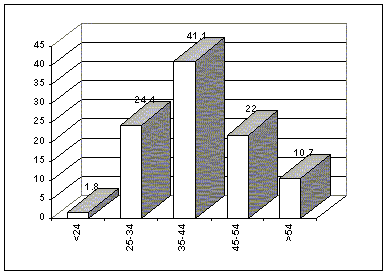
<body><![CDATA[<P><FONT FACE="Arial,Helvetica"><FONT SIZE=-1>Se realiz&oacute; un estudio descriptivo en 170 pacientes (n=170) ingresados en la Unidad de Desintoxicaci&oacute;n Hospitalaria (UDH) del Hospital Psiqui&aacute;trico de B&eacute;tera (Valencia), con el diagn&oacute;stico de “S&iacute;ndrome de Dependencia Alcoh&oacute;lica” en un per&iacute;odo de seis meses.</FONT></FONT><FONT FACE="Arial,Helvetica"><FONT SIZE=-1></FONT></FONT>      <P><FONT FACE="Arial,Helvetica"><FONT SIZE=-1>Se tuvieron en cuenta las siguientes variables; edad, sexo, consumo diario de etanol, Sideremia, Volumen Corpuscular medio de los eritrocitos (VCM), Gamma Glutamil Transpeptidasa (GGT) s&eacute;rica, Transaminasa Glut&aacute;mico Pir&uacute;vico (GPT) s&eacute;rica, Transaminasa Glut&aacute;mico Oxalac&eacute;tica (GOT) s&eacute;rica y Fosfadatas Alcalinas.</FONT></FONT>     <BR><FONT FACE="Arial,Helvetica"><FONT SIZE=-1>&nbsp;</FONT></FONT>     <BR><FONT FACE="Arial,Helvetica"><FONT SIZE=-1>Los an&aacute;lisis de laboratorio se practicaron las primeras 24 horas posteriores al ingreso, con las t&eacute;cnicas tradicionales y los rangos de valores propios de cada una. La edad, el sexo y el consumo de etanol se recogieron de las historias cl&iacute;nicas de los pacientes</FONT></FONT>     <BR>&nbsp;     <BR>&nbsp;     <BR><B><FONT FACE="Arial,Helvetica"><FONT SIZE=-1>Resultados y discusi&oacute;n</FONT></FONT></B>      <P><B><FONT FACE="Arial,Helvetica"><FONT SIZE=-1>Edad</FONT></FONT></B><B></B>      <P><FONT FACE="Arial,Helvetica"><FONT SIZE=-1>La edad media de la muestra fue de 41.6 a&ntilde;os, con una DT=9.45 a&ntilde;os, siendo los valores extremos de 18 y 69 a&ntilde;os.</FONT></FONT><FONT FACE="Arial,Helvetica"><FONT SIZE=-1></FONT></FONT>      <P><FONT FACE="Arial,Helvetica"><FONT SIZE=-1>El rango de 35-44 a&ntilde;os concentr&oacute; m&aacute;s del 40% de la muestra, estando el 87.5% entre los 25 y los 54 a&ntilde;os (<A HREF="#FIGURA 1">fig.1</A>).</FONT></FONT><FONT FACE="Arial,Helvetica"><FONT SIZE=-1></FONT></FONT>      ]]></body>
<body><![CDATA[<P><FONT FACE="Arial,Helvetica"><FONT SIZE=-1>Este resultado es similar al encontrado en otros estudios (<A HREF="#Cuevas">Cuevas, Gisbert y Betancourt 1996</A>; <A HREF="#Mateo">Mateo, Gum&aacute; y Gonz&aacute;lez, 195</A>; <A HREF="#Cortés">Cort&eacute;s, Pascual y Torres 1994</A>; <A HREF="#Alonso,">Alonso, Mart&iacute;nez y Morales 1994</A>; <A HREF="#González93">Gonz&aacute;lez, Mateo y Buitrago 1993</A>; <A HREF="#Rodríguez">Rodr&iacute;guez, Montan&eacute;, Crespo et al., 1993</A>; <A HREF="#González91">Gonz&aacute;lez, Garriga, Ceiro et al., 1991</A>), corroborando que el alcoholismo es una enfermedad que se manifiesta en los adultos en edades de mayor rendimiento laboral e intelectual entre otros.</FONT></FONT>     <CENTER></CENTER>      <CENTER><A NAME="FIGURA 1"></A><B><FONT FACE="Arial,Helvetica"><FONT SIZE=-1>Figura 1</FONT></FONT></B></CENTER>      <CENTER><B><FONT FACE="Arial,Helvetica"><FONT SIZE=-1>&nbsp;</FONT></FONT></B></CENTER>      <CENTER><B><FONT FACE="Arial,Helvetica"><FONT SIZE=-1>DISTRIBUCION&nbsp; POR EDAD</FONT></FONT></B></CENTER>      <CENTER><IMG SRC="/img/fbpe/mlcr/v15n1-2/0250i1.GIF" HEIGHT=274 WIDTH=386></CENTER> <B><FONT FACE="Arial,Helvetica"><FONT SIZE=-1>&nbsp;</FONT></FONT></B>     
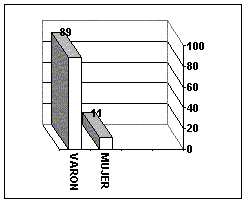
<BR><B><FONT FACE="Arial,Helvetica"><FONT SIZE=-1>Sexo</FONT></FONT></B>     <BR><FONT FACE="Arial,Helvetica"><FONT SIZE=-1>Fue evidente el predominio de la poblaci&oacute;n masculina en el estudio, siendo de un 89.4% (n=152), mientras el 10.6% (n=18) correspondi&oacute; a mujeres (<A HREF="#FIGURA 2">fig,2</A>).</FONT></FONT>     <CENTER>&nbsp;</CENTER>      <CENTER><A NAME="FIGURA 2"></A><B><FONT FACE="Arial,Helvetica"><FONT SIZE=-1>Figura 2</FONT></FONT></B></CENTER>      ]]></body>
<body><![CDATA[<CENTER><B><FONT FACE="Arial,Helvetica"><FONT SIZE=-1>&nbsp;</FONT></FONT></B></CENTER>      <CENTER><B><FONT FACE="Arial,Helvetica"><FONT SIZE=-1>DISTRIBUCION POR SEXO</FONT></FONT></B></CENTER>      <CENTER><IMG SRC="/img/fbpe/mlcr/v15n1-2/0250i2.GIF" HEIGHT=202 WIDTH=245></CENTER> <FONT FACE="Arial,Helvetica"><FONT SIZE=-1>&nbsp;</FONT></FONT>     
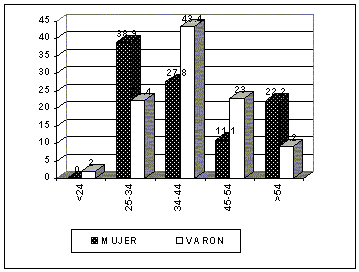
<BR>&nbsp;     <BR><FONT FACE="Arial,Helvetica"><FONT SIZE=-1>M&uacute;ltiples trabajos avalan el predominio del alcoholismo en el sexo masculino, aunque la tendencia en la relaci&oacute;n hombre-mujer se va acortando (<A HREF="#Cuevas">Cuevas, Gisbert, Betancourt 1996</A>, <A HREF="#Secades">Secades 1996</A>, <A HREF="#Cortés">Cort&eacute;s, Pascual, Torres 1994</A>; <A HREF="#González93">Gonz&aacute;lez, Mateo, Buitrago 1993</A>; <A HREF="#Centro">Centro Valenciano 1993</A>; <A HREF="#Plan">Plan Nacional 1991</A>; <A HREF="#Shullr">Sh&uuml;ller 1991</A>).</FONT></FONT>      <P><FONT FACE="Arial,Helvetica"><FONT SIZE=-1>Analizando, conjuntamente, las variables sexo y edad, encontramos que entre los 25-34 a&ntilde;os el sexo femenino representaron el 38.9%, mientras que entre los 35-44 a&ntilde;os el relevante fue el sexo masculino con un 43.4% (<A HREF="#FIGURA 3">fig. 3</A>).</FONT></FONT>     <CENTER>&nbsp;</CENTER>      <CENTER>&nbsp;</CENTER>      <CENTER><A NAME="FIGURA 3"></A><B><FONT FACE="Arial,Helvetica"><FONT SIZE=-1>Figura 3</FONT></FONT></B></CENTER>      <CENTER><B><FONT FACE="Arial,Helvetica"><FONT SIZE=-1>&nbsp;</FONT></FONT></B></CENTER>      ]]></body>
<body><![CDATA[<CENTER><B><FONT FACE="Arial,Helvetica"><FONT SIZE=-1>EDAD - SEXO</FONT></FONT></B></CENTER>      <CENTER><IMG SRC="/img/fbpe/mlcr/v15n1-2/0250i3.GIF" HEIGHT=272 WIDTH=359></CENTER> <B><FONT FACE="Arial,Helvetica"><FONT SIZE=-1>&nbsp;</FONT></FONT></B>     
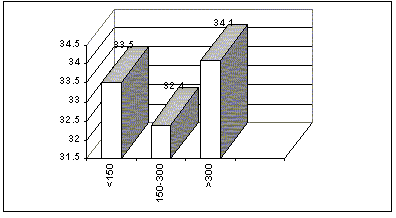
<BR><B><FONT FACE="Arial,Helvetica"><FONT SIZE=-1>Consumo de Etanol</FONT></FONT></B>     <BR><B><FONT FACE="Arial,Helvetica"><FONT SIZE=-1>&nbsp;</FONT></FONT></B>     <BR><FONT FACE="Arial,Helvetica"><FONT SIZE=-1>El consumo medio de etanol puro por d&iacute;a fue de 273g., siendo la DT. de 182g/d&iacute;a (<A HREF="#FIGURA 4">fig. 4</A>).</FONT></FONT>     <BR><FONT FACE="Arial,Helvetica"><FONT SIZE=-1>Los valores extremos encontrados fueron de 20 y 900 g. de etanol puro/d&iacute;a. Los pacientes con un consumo superior a 60g, representaron el 63.7%.</FONT></FONT>     <BR><FONT FACE="Arial,Helvetica"><FONT SIZE=-1>&nbsp;</FONT></FONT>     <BR><FONT FACE="Arial,Helvetica"><FONT SIZE=-1>Los consumidores de menos de 150g/d&iacute;a de etanol, representaron el 33.5 % de la muestra, frente al 32.4% que consum&iacute;an cantidades entre los 150 y 300g. Finalmente el 34.1% inger&iacute;an m&aacute;s de 300g/d&iacute;a; seg&uacute;n el estudio que realizaron Cuevas y colaboradores (<A HREF="#Cuevas94">Cuevas, Torres, Rubio; 1994</A>).</FONT></FONT>     <BR><FONT FACE="Arial,Helvetica"><FONT SIZE=-1>&nbsp;</FONT></FONT>     <BR><FONT FACE="Arial,Helvetica"><FONT SIZE=-1>Los resultados se&ntilde;alados son comparables a los obtenidos por Cort&eacute;s y colaboradores en una muestra de alcoh&oacute;licos donde el 78.5% de la misma tiene un consumo superior a los 160g de etanol diario (<A HREF="#Cortés">Cort&eacute;s, Pascual y Torres, 1994</A>). En reciente estudio realizado por Cuevas y colaboradores, obtienen una media de 245g de etanol, donde el 63% de los sujetos en estudio consumen m&aacute;s de 150g al d&iacute;a (<A HREF="#Cuevas">Cuevas, Gisbert y Betancourt; 1996</A>).</FONT></FONT>     ]]></body>
<body><![CDATA[<CENTER></CENTER>      <CENTER><A NAME="FIGURA 4"></A><B><FONT FACE="Arial,Helvetica"><FONT SIZE=-1>Figura 4</FONT></FONT></B></CENTER>      <CENTER><B><FONT FACE="Arial,Helvetica"><FONT SIZE=-1>&nbsp;</FONT></FONT></B></CENTER>      <CENTER><B><FONT FACE="Arial,Helvetica"><FONT SIZE=-1>CONSUMO DE ETANOL</FONT></FONT></B></CENTER>      <CENTER><B><FONT FACE="Arial,Helvetica"><FONT SIZE=-1>(GRAMOS/DIA)</FONT></FONT></B></CENTER>      <CENTER><IMG SRC="/img/fbpe/mlcr/v15n1-2/0250i4.GIF" HEIGHT=218 WIDTH=396></CENTER> <FONT FACE="Arial,Helvetica"><FONT SIZE=-1>&nbsp;</FONT></FONT>     
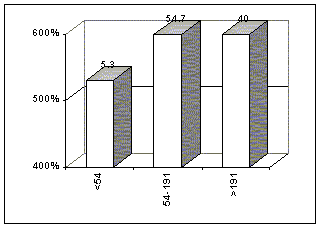
<BR><FONT FACE="Arial,Helvetica"><FONT SIZE=-1>Resulta imprescindible cuantificar el consumo de etanol en gramos, al ser esta una medida que puede unificar criterios en cuanto a este par&aacute;metro (<A HREF="#Cuevas">Cuevas, Gisbert, Betancourt; 1996</A>).</FONT></FONT>      <P><B><FONT FACE="Arial,Helvetica"><FONT SIZE=-1>Sideremia</FONT></FONT></B>     <BR>&nbsp;     <BR><FONT FACE="Arial,Helvetica"><FONT SIZE=-1>La media de la sideremia, en el estudio, fue de 173.82 microgramos/cc, siendo la DT= 72.4, para esta variable (<A HREF="#FIGURA 5">fig. 5</A>).</FONT></FONT>     ]]></body>
<body><![CDATA[<BR><FONT FACE="Arial,Helvetica"><FONT SIZE=-1>Presentaban ferropenia s&oacute;lo el 5.3% de la muestra, destacando que en los menores de 34 a&ntilde;os no aparec&iacute;a esta carencia; y por el contrario entre los mayores de 54 a&ntilde;os esta era del 11%.</FONT></FONT>     <CENTER><A NAME="FIGURA 5"></A><B><FONT FACE="Arial,Helvetica"><FONT SIZE=-1>Figura 5</FONT></FONT></B></CENTER>      <CENTER><B><FONT FACE="Arial,Helvetica"><FONT SIZE=-1>&nbsp;</FONT></FONT></B></CENTER>      <CENTER><B><FONT FACE="Arial,Helvetica"><FONT SIZE=-1>SIDEREMIA</FONT></FONT></B></CENTER>      <CENTER><B><FONT FACE="Arial,Helvetica"><FONT SIZE=-1>(MICRO.GR/CC)</FONT></FONT></B></CENTER>      <CENTER><IMG SRC="/img/fbpe/mlcr/v15n1-2/0250i5.GIF" HEIGHT=227 WIDTH=319></CENTER> <FONT FACE="Arial,Helvetica"><FONT SIZE=-1>&nbsp;</FONT></FONT>     
<BR><FONT FACE="Arial,Helvetica"><FONT SIZE=-1>&nbsp;Presentaban hipersideremia el 40% de los alcoh&oacute;licos estudiados, siendo el 33.3% de las mujeres y el 40.8% de los varones. Hay que destacar que el 51.4% de los pacientes comprendidos entre los 45 y los 54 a&ntilde;os, se encontraban en esta situaci&oacute;n.</FONT></FONT>     <BR><FONT FACE="Arial,Helvetica"><FONT SIZE=-1>El etanol favorece la absorci&oacute;n del hierro, lo que aumenta si concomitantemente existe una pacreatitis cr&oacute;nica alcoh&oacute;lica (<A HREF="#Shullr">Sh&uuml;ller, 1991</A>).</FONT></FONT>     <BR><FONT FACE="Arial,Helvetica"><FONT SIZE=-1>&nbsp;</FONT></FONT>     <BR><FONT FACE="Arial,Helvetica"><FONT SIZE=-1>Las conclusiones de los trabajos publicados sobre la sideremia en alcoh&oacute;licos son sumamente discrepantes y contrapuestos, defendi&eacute;ndose criterios que van desde hipersideremias a hiposideremias (<A HREF="#Conde">Conde, 1993</A>; <A HREF="#Parés">Par&eacute;s, 1990</A>; <A HREF="#Chapa">Chapa, 1988</A>; <A HREF="#Herrerías">Herrer&iacute;a y P&eacute;rez,1979</A>; <A HREF="#Lundín">Lundin et al., 1969</A>; <A HREF="#Lunwal">Lunwall et al., 1969</A>); pero lo innegable es que el hierro es un oligoelemento de la gran trascendencia en la cl&iacute;nica del paciente alcoh&oacute;lico haci&eacute;ndose imprescindible su determinaci&oacute;n en la bater&iacute;a anal&iacute;tica que se le solicite a un consumidor de etanol (<A HREF="#Cuevas95">Cuevas, 1995</A>).</FONT></FONT>      ]]></body>
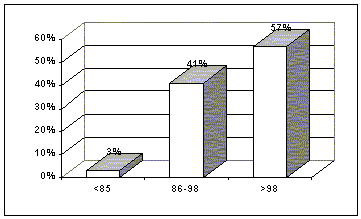
<body><![CDATA[<P><B><FONT FACE="Arial,Helvetica"><FONT SIZE=-1>VCM</FONT></FONT></B>      <P><FONT FACE="Arial,Helvetica"><FONT SIZE=-1>En el presente trabajo s&oacute;lo se tuvo en cuenta los valores para el VCM mayores a 99 micras c&uacute;bicas (l&iacute;mite del valor normal), al ser estos valores elevados los que se correlacionan a los consumos cr&oacute;nicos elevados de etanol.</FONT></FONT>     <BR>&nbsp;     <CENTER><A NAME="FIGURA6"></A><B><FONT FACE="Arial,Helvetica"><FONT SIZE=-1>Figura 6</FONT></FONT></B></CENTER>      <CENTER><B><FONT FACE="Arial,Helvetica"><FONT SIZE=-1>&nbsp;</FONT></FONT></B></CENTER>      <CENTER><B><FONT FACE="Arial,Helvetica"><FONT SIZE=-1>V.C.M.</FONT></FONT></B></CENTER>      <CENTER><IMG SRC="/img/fbpe/mlcr/v15n1-2/0250i6.GIF" HEIGHT=219 WIDTH=361></CENTER> <FONT FACE="Arial,Helvetica"><FONT SIZE=-1>&nbsp;</FONT></FONT>     
<BR><FONT FACE="Arial,Helvetica"><FONT SIZE=-1>En el 56.5%se observ&oacute; un VCM elevado, siendo este aumento significativo con el incremento de la edad en los varones (<A HREF="#FIGURA6">fig.6</A>).</FONT></FONT>     <BR><FONT FACE="Arial,Helvetica"><FONT SIZE=-1>El sistema hem&aacute;tico proporciona una medida fiable, aunque no espec&iacute;fica, del consumo cr&oacute;nico de alcohol, se&ntilde;al&aacute;ndose que entre un 31-96% de los pacientes alcoh&oacute;licos presenta un elevado VCM. La respuesta del VCM es lenta, tanto frente a la abstinencia como a la reca&iacute;da en la bebida (<A HREF="#Miller,">Miller y Gold, 1993</A>).</FONT></FONT>     <BR><FONT FACE="Arial,Helvetica"><FONT SIZE=-1>&nbsp;</FONT></FONT>     ]]></body>
<body><![CDATA[<BR><FONT FACE="Arial,Helvetica"><FONT SIZE=-1>Aunque el VCM tambi&eacute;n pueda aumentar por d&eacute;ficits de vitamina B12, &aacute;cido f&oacute;lico, hepatopat&iacute;as, reticulosis, la edad y el tabaquismo, otros estudios se&ntilde;alan el aumento de los valores de esta variable en el consumo et&iacute;lico (<A HREF="#Freixa">Freixa, 1995</A>; <A HREF="#Díaz94">D&iacute;az, Gual, 1994</A>; <A HREF="#González92">Gonz&aacute;lez, 1992</A>; <A HREF="#González91">Gonz&aacute;lez, Garriga, Ceiro, 1991</A>).</FONT></FONT>     <BR>&nbsp;     <BR><B><FONT FACE="Arial,Helvetica"><FONT SIZE=-1>GGT</FONT></FONT></B>     <BR>&nbsp;     <BR><FONT FACE="Arial,Helvetica"><FONT SIZE=-1>Los pacientes con cifras de GGT superiores a 54mU/cc (valor l&iacute;mite superior de normalidad seg&uacute;n las normas del laboratorio de la Unidad) fueron estudiados, encontr&aacute;ndose que el 53.5% de los mismos ten&iacute;an cifras elevadas (<A HREF="#FIGURA 7">fig.7</A>).</FONT></FONT>     <BR><FONT FACE="Arial,Helvetica"><FONT SIZE=-1>Se encontr&oacute; que el 44.4% de las mujeres y el 54.6% de los varones ten&iacute;an cifras por encima de las normales; en relaci&oacute;n con la edad, el 33.3% correspondi&oacute; a menores de 24 a&ntilde;os, siendo el rango de edad m&aacute;s afectado el 35-44 a&ntilde;os con un 56.3%.</FONT></FONT>     <BR><FONT FACE="Arial,Helvetica"><FONT SIZE=-1>El marcador de laboratorio m&aacute;s utilizado para detectar un consumo excesivo de alcohol o un alcoholismo es la gamma glutamil transferasa (GGT), por su elevada sensibilidad y por la facilidad de realizaci&oacute;n. Seg&uacute;n los diferentes estudios, la elevaci&oacute;n de la GGT se observa entre el 34 y el 85% de los alcoh&oacute;licos cr&oacute;nicos (<A HREF="#Hales">Hales, Yudofsky, Talbott, 1996</A>; <A HREF="#Miller,">Miller, Gold, 1993</A>; <A HREF="#Rodés">Rod&eacute;s, Urbano-Marqu&eacute;z, Bach I Bach, 1990</A>).</FONT></FONT>     <BR>&nbsp;     <CENTER><A NAME="FIGURA 7"></A><B><FONT FACE="Arial,Helvetica"><FONT SIZE=-1>Figura 7</FONT></FONT></B></CENTER>      <CENTER><B><FONT FACE="Arial,Helvetica"><FONT SIZE=-1>&nbsp;</FONT></FONT></B></CENTER>      ]]></body>
<body><![CDATA[<CENTER><B><FONT FACE="Arial,Helvetica"><FONT SIZE=-1>G.G.T. (mU/cc)</FONT></FONT></B></CENTER>      <CENTER><IMG SRC="/img/fbpe/mlcr/v15n1-2/0250i7.GIF" HEIGHT=178 WIDTH=290></CENTER> <FONT FACE="Arial,Helvetica"><FONT SIZE=-1>&nbsp;</FONT></FONT>     
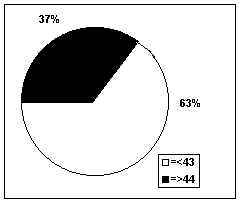
<BR><B><FONT FACE="Arial,Helvetica"><FONT SIZE=-1>G.O.T./ASAT</FONT></FONT></B>     <BR>&nbsp;     <BR><FONT FACE="Arial,Helvetica"><FONT SIZE=-1>Se consideraron los valores de la GOT superiores a 44mU/cc (l&iacute;mite del valor normal); encontr&aacute;ndose que el 37.1% de la muestra ten&iacute;an aumentada la GOT, representando el 33.3% de la mujeres y el 37.5% de los hombres. El 55.6% de los mayores de 54 a&ntilde;os tuvieron niveles altos, mientras en el resto de las edades oscilaron alrededor del 30-35% (<A HREF="#FIGURA 8">fig.8</A>).</FONT></FONT>     <BR><FONT FACE="Arial,Helvetica"><FONT SIZE=-1>En un estudio realizado por Gonz&aacute;lez et al., en una muestra de 200 pacientes encuentran que el 32.5% tienen un aumento de la GOT datos muy similares a los nuestros (<A HREF="#González91">Gonz&aacute;lez, Garriga, Ceiro et al.;1991</A>).</FONT></FONT>     <CENTER>&nbsp;</CENTER>      <CENTER><A NAME="FIGURA 8"></A><B><FONT FACE="Arial,Helvetica"><FONT SIZE=-1>Figura 8</FONT></FONT></B></CENTER>      <CENTER><B><FONT FACE="Arial,Helvetica"><FONT SIZE=-1>&nbsp;</FONT></FONT></B></CENTER>      <CENTER><B><FONT FACE="Arial,Helvetica"><FONT SIZE=-1>G.O.T. (mU/cc)</FONT></FONT></B></CENTER>      ]]></body>
<body><![CDATA[<CENTER><IMG SRC="/img/fbpe/mlcr/v15n1-2/0250i8.GIF" HEIGHT=202 WIDTH=239></CENTER> <FONT FACE="Arial,Helvetica"><FONT SIZE=-1>&nbsp;</FONT></FONT>     
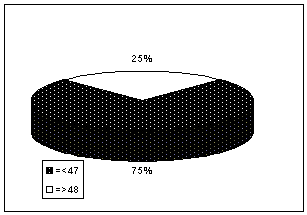
<BR><B><FONT FACE="Arial,Helvetica"><FONT SIZE=-1>G.P.T./ALAT</FONT></FONT></B>     <BR>&nbsp;     <BR><FONT FACE="Arial,Helvetica"><FONT SIZE=-1>S&oacute;lo se tuvieron en cuenta a los pacientes con valores para la GPT superiores a 48mU/cc (l&iacute;mite del valor normal), los cuales representaron el 24.7% del total de la muestra. El 11.1% de las mujeres y el 26.3% de los varones presentaron estas cifras elevadas. Destac&oacute; el hecho de que no hubiese ning&uacute;n sujeto menor de 24 a&ntilde;os con la GPT elevada (<A HREF="#FIGURA 9">fig.9</A>).</FONT></FONT>     <BR><FONT FACE="Arial,Helvetica"><FONT SIZE=-1>&nbsp;</FONT></FONT>     <BR><FONT FACE="Arial,Helvetica"><FONT SIZE=-1>La aspartato aminotransferasa ASAT/GPT y la alanino amino transferasa ALAT/GPT son dos enzimas muy sensibles para detectar da&ntilde;o hep&aacute;tico, de manera que cualquier situaci&oacute;n que curse con una lesi&oacute;n hepatocelular, entre ellas la hepatopat&iacute;a alcoh&oacute;lica, se asocia a una elevaci&oacute;n m&aacute;s o menos importante de la</FONT></FONT> <FONT FACE="Arial,Helvetica"><FONT SIZE=-1>cifra de transaminasas (Rod&eacute;s, Urbano-Marqu&eacute;z, Bach i Bach, 1990). Dado que la ALT no existe en el m&uacute;sculo, cuando el cociente GOT/GPT es superior a 1.5, es sugestivo de hepatopat&iacute;a en&oacute;lica y cuando es igual o superior a 2, entonces, la probabilidad es muy alta. En general, en las hepatopat&iacute;as alcoh&oacute;licas la ALT no se eleva por encima de 500 UI/dl (<A HREF="#Freixa">Freixa, 1995</A>; <A HREF="#Shullr">Sh&uuml;ller, 1991</A>).</FONT></FONT>     <BR>&nbsp;     <CENTER><A NAME="FIGURA 9"></A><B><FONT FACE="Arial,Helvetica"><FONT SIZE=-1>Figura 9</FONT></FONT></B></CENTER>      <CENTER><B><FONT FACE="Arial,Helvetica"><FONT SIZE=-1>&nbsp;</FONT></FONT></B></CENTER>      <CENTER><B><FONT FACE="Arial,Helvetica"><FONT SIZE=-1>G.P.T.&nbsp; (mU/cc)</FONT></FONT></B></CENTER>      ]]></body>
<body><![CDATA[<CENTER><IMG SRC="/img/fbpe/mlcr/v15n1-2/0250i9.GIF" HEIGHT=215 WIDTH=307></CENTER> <FONT FACE="Arial,Helvetica"><FONT SIZE=-1>&nbsp;</FONT></FONT>      
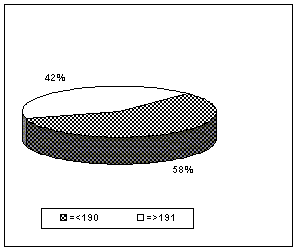
<P>&nbsp;     <BR><B><FONT FACE="Arial,Helvetica"><FONT SIZE=-1>Fosfatasas alcalinas</FONT></FONT></B>     <BR>&nbsp;     <BR><FONT FACE="Arial,Helvetica"><FONT SIZE=-1>En este apartado se tuvo en cuenta a los pacientes con cifras para las Fosfatasas Alcalinas superiores a 191mU/cc (l&iacute;mite del valor normal). El 41% de la muestra tuvieron elevadas las mismas, siendo afectadas el 38.9% de las mujeres y el 41.4% de los varones (<A HREF="#FIGURA 10">fig.10</A>).</FONT></FONT>     <BR><FONT FACE="Arial,Helvetica"><FONT SIZE=-1>En los mayores de 54 a&ntilde;os esta elevaci&oacute;n comprendi&oacute; al 55.6%, mientras en los menores de 24 s&oacute;lo afect&oacute; al 33.3%.</FONT></FONT>      <P>&nbsp;     <BR><B><FONT FACE="Arial,Helvetica"><FONT SIZE=-1>Conclusiones</FONT></FONT></B>     <BR>&nbsp;     <BR><FONT FACE="Arial,Helvetica"><FONT SIZE=-1>El alcoholismo es una enfermedad de adultos j&oacute;venes que se manifiesta con m&aacute;s intensidad en la tercera y cuarta d&eacute;cadas de la vida; siendo todav&iacute;a el sexo masculino el predominante, aunque cada vez la relaci&oacute;n entre los sexos es m&aacute;s exigua.</FONT></FONT>     ]]></body>
<body><![CDATA[<BR><FONT FACE="Arial,Helvetica"><FONT SIZE=-1>Considerando las recomendaciones de la OMS sobre las cantidades de alcohol consumidas y los riesgos de patolog&iacute;a, el colectivo estudiado tendr&iacute;a las m&aacute;ximas probabilidades de padecer las enfermedades producidas por el consumo cr&oacute;nico de etanol, en dosis abusivas. Las cantidades de etanol consumidas por este grupo ponen de manifiesto la extraordinaria tolerancia de los alcoh&oacute;licos de larga evoluci&oacute;n. Aunque el alcoholismo no es una enfermedad alcohol-dependiente la cuantificaci&oacute;n de etanol en gramos permitir&iacute;a la correlaci&oacute;n del estado cl&iacute;nico de los enfermos y su ingesta de etanol; y ser&iacute;a una medida unificadora de criterios a la hora de comparar resultados obtenidos en diversas muestras.</FONT></FONT><FONT FACE="Arial,Helvetica"><FONT SIZE=-1></FONT></FONT>      <P><FONT FACE="Arial,Helvetica"><FONT SIZE=-1>La sideremia est&aacute; elevada en 40% de los casos, dato muy relevante, teniendo en cuenta que se contin&uacute;an utilizando protocolos de tratamiento para enfermos alcoh&oacute;licos en los que se prescriben suplementos f&eacute;rricos que favorecen la sobrecarga de este mineral y por ende, pueden agravar los cuadros cl&iacute;nicos, resultando imprescindible la determinaci&oacute;n de este oligoelemento en los ex&aacute;menes complementarios que se realizan a los pacientes consumidores de etanol.</FONT></FONT>     <CENTER>&nbsp;</CENTER>      <CENTER><A NAME="FIGURA 10"></A><B><FONT FACE="Arial,Helvetica"><FONT SIZE=-1>Figura 10</FONT></FONT></B></CENTER>      <CENTER><B><FONT FACE="Arial,Helvetica"><FONT SIZE=-1>&nbsp;</FONT></FONT></B></CENTER>      <CENTER><B><FONT FACE="Arial,Helvetica"><FONT SIZE=-1>&nbsp;&nbsp;&nbsp; FOSFATASAS ALCALINAS</FONT></FONT></B></CENTER>      <CENTER><B><FONT FACE="Arial,Helvetica"><FONT SIZE=-1>(mU/CC)</FONT></FONT></B></CENTER>      <CENTER><IMG SRC="/img/fbpe/mlcr/v15n1-2/0250i10.GIF" HEIGHT=250 WIDTH=296></CENTER> <FONT FACE="Arial,Helvetica"><FONT SIZE=-1></FONT></FONT>      
<P><FONT FACE="Arial,Helvetica"><FONT SIZE=-1>El aumento de la sideremia puede tener un rol protagonista en la fisiopatolog&iacute;a de la enfermedad alcoh&oacute;lica, por lo que se hacen aconsejables estudios sobre el tema.</FONT></FONT><FONT FACE="Arial,Helvetica"><FONT SIZE=-1></FONT></FONT>      <P><FONT FACE="Arial,Helvetica"><FONT SIZE=-1>El VCM y la GGT contin&uacute;an siendo los marcadores habituales m&aacute;s sensibles para determinar el consumo de etanol, as&iacute; como la permanencia en abstinencia de los sujetos. Otros marcadores como las Fosfadatas Alcalinas, la GOT y GPT contin&uacute;an siendo par&aacute;metros &uacute;tiles en la cl&iacute;nica del enfermo alcoh&oacute;lico.</FONT></FONT>      ]]></body>
<body><![CDATA[<P><B><FONT FACE="Arial,Helvetica"><FONT SIZE=-1>Bibliograf&iacute;a</FONT></FONT></B>     <BR>&nbsp;     <!-- ref --><BR><A NAME="Alonso,"></A><FONT FACE="Arial,Helvetica"><FONT SIZE=-1>Alonso, O, Mart&iacute;nez, F, Morales, M (1994). Caracterizaci&oacute;n del alcoholismo en el municipio de Camaguey, Cuba: 1986’1990. Rev. Esp. Drog. 19(2):117-130.</FONT></FONT>    &nbsp;&nbsp;&nbsp;&nbsp;&nbsp;&nbsp;&nbsp;&nbsp;[&#160;<a href="javascript:void(0);" onclick="javascript: window.open('/scielo.php?script=sci_nlinks&ref=589475&pid=S1409-0015199800020000500001&lng=','','width=640,height=500,resizable=yes,scrollbars=1,menubar=yes,');">Links</a>&#160;]<!-- end-ref --><!-- ref --><P><A NAME="Caballería,"></A><FONT FACE="Arial,Helvetica"><FONT SIZE=-1>Caballer&iacute;a, J, Caballer&iacute;a, L.: (1996) Marcadores biol&oacute;gicos en el diagn&oacute;stico de alcoholismo. Jano L (1157):28-32.</FONT></FONT>    &nbsp;&nbsp;&nbsp;&nbsp;&nbsp;&nbsp;&nbsp;&nbsp;[&#160;<a href="javascript:void(0);" onclick="javascript: window.open('/scielo.php?script=sci_nlinks&ref=589476&pid=S1409-0015199800020000500002&lng=','','width=640,height=500,resizable=yes,scrollbars=1,menubar=yes,');">Links</a>&#160;]<!-- end-ref --><!-- ref --><P><A NAME="Casas"></A><FONT FACE="Arial,Helvetica"><FONT SIZE=-1>Casas, M, Guti&eacute;rrez, M, San, L, (1994) Psicolog&iacute;a y alcoholismo. Ed. Neurociencias, Barcelona.</FONT></FONT>    &nbsp;&nbsp;&nbsp;&nbsp;&nbsp;&nbsp;&nbsp;&nbsp;[&#160;<a href="javascript:void(0);" onclick="javascript: window.open('/scielo.php?script=sci_nlinks&ref=589477&pid=S1409-0015199800020000500003&lng=','','width=640,height=500,resizable=yes,scrollbars=1,menubar=yes,');">Links</a>&#160;]<!-- end-ref --><!-- ref --><P><A NAME="Centro"></A><FONT FACE="Arial,Helvetica"><FONT SIZE=-1>Centro Valenciano de Documentaci&oacute;n sobre Drogodependencias. (1993). Bolet&iacute;n de Informaci&oacute;n sobre Drogodependencias, (14/2/93)</FONT></FONT>    &nbsp;&nbsp;&nbsp;&nbsp;&nbsp;&nbsp;&nbsp;&nbsp;[&#160;<a href="javascript:void(0);" onclick="javascript: window.open('/scielo.php?script=sci_nlinks&ref=589478&pid=S1409-0015199800020000500004&lng=','','width=640,height=500,resizable=yes,scrollbars=1,menubar=yes,');">Links</a>&#160;]<!-- end-ref --><P><A NAME="Chapa"></A><FONT FACE="Arial,Helvetica"><FONT SIZE=-1>Chapa, E. (1988). Alcoholismo y nutrici&oacute;n. En: Alcoholismo visi&oacute;n integral. Ed Trillas, M&eacute;xico, 224-257.</FONT></FONT>      <!-- ref --><P><A NAME="Conde"></A><FONT FACE="Arial,Helvetica"><FONT SIZE=-1>Conde, J.M., De La Gandara, J, Medina, M.A, Blanco, M, (1993). Transferrina y diagn&oacute;stico del alcoholismo. An. Acad. Med. y Cir. Vall. Vol XXXI:115-123.</FONT></FONT>    &nbsp;&nbsp;&nbsp;&nbsp;&nbsp;&nbsp;&nbsp;&nbsp;[&#160;<a href="javascript:void(0);" onclick="javascript: window.open('/scielo.php?script=sci_nlinks&ref=589480&pid=S1409-0015199800020000500006&lng=','','width=640,height=500,resizable=yes,scrollbars=1,menubar=yes,');">Links</a>&#160;]<!-- end-ref --><!-- ref --><P><A NAME="Cortés"></A><FONT FACE="Arial,Helvetica"><FONT SIZE=-1>Cort&eacute;s, M, Pascual, M, Torres, M.A, (1994) Estudio del alcoholismo en un &aacute;rea sanitaria de la Comunidad Valenciana. Adicciones 6(1):23-50.</FONT></FONT>    &nbsp;&nbsp;&nbsp;&nbsp;&nbsp;&nbsp;&nbsp;&nbsp;[&#160;<a href="javascript:void(0);" onclick="javascript: window.open('/scielo.php?script=sci_nlinks&ref=589481&pid=S1409-0015199800020000500007&lng=','','width=640,height=500,resizable=yes,scrollbars=1,menubar=yes,');">Links</a>&#160;]<!-- end-ref --><!-- ref --><P><A NAME="Cuevas"></A><FONT FACE="Arial,Helvetica"><FONT SIZE=-1>Cuevas, J, Gisbert, J, Betancourt, A, (1996). Caracter&iacute;sticas del alcoh&oacute;lico de la provincia de Valencia. II Jornadas sobre Drogodependencia. Univ. Politec. de Valencia. 10 y 11 Mayo. Comunicaci&oacute;n: 191-205</FONT></FONT>    &nbsp;&nbsp;&nbsp;&nbsp;&nbsp;&nbsp;&nbsp;&nbsp;[&#160;<a href="javascript:void(0);" onclick="javascript: window.open('/scielo.php?script=sci_nlinks&ref=589482&pid=S1409-0015199800020000500008&lng=','','width=640,height=500,resizable=yes,scrollbars=1,menubar=yes,');">Links</a>&#160;]<!-- end-ref --><!-- ref --><P><A NAME="Cuevas95"></A><FONT FACE="Arial,Helvetica"><FONT SIZE=-1>Cuevas, J, (1995). Metabolismo del hierro. Su rol en la cl&iacute;nica del alcoholismo. Rev. Esp. Drog. 20(4): 307-323.</FONT></FONT>    &nbsp;&nbsp;&nbsp;&nbsp;&nbsp;&nbsp;&nbsp;&nbsp;[&#160;<a href="javascript:void(0);" onclick="javascript: window.open('/scielo.php?script=sci_nlinks&ref=589483&pid=S1409-0015199800020000500009&lng=','','width=640,height=500,resizable=yes,scrollbars=1,menubar=yes,');">Links</a>&#160;]<!-- end-ref --><!-- ref --><P><A NAME="Cuevas94"></A><FONT FACE="Arial,Helvetica"><FONT SIZE=-1>Cuevas, J, Torres, M.A, Rubio, J, (1994). Estudio descriptivo de los pacientes alcoh&oacute;licos ingresados en una Unidad de Desintoxicaci&oacute;n Hospitalaria. Rev. Esp. Drog. 19(4): 325-345.</FONT></FONT>    &nbsp;&nbsp;&nbsp;&nbsp;&nbsp;&nbsp;&nbsp;&nbsp;[&#160;<a href="javascript:void(0);" onclick="javascript: window.open('/scielo.php?script=sci_nlinks&ref=589484&pid=S1409-0015199800020000500010&lng=','','width=640,height=500,resizable=yes,scrollbars=1,menubar=yes,');">Links</a>&#160;]<!-- end-ref --><!-- ref --><P><A NAME="Díaz94"></A><FONT FACE="Arial,Helvetica"><FONT SIZE=-1>D&iacute;az, R, Gual, A, (1994). &iquest;Bebe usted alcohol en exceso? Adicciones. 6(2):211-229.</FONT></FONT>    &nbsp;&nbsp;&nbsp;&nbsp;&nbsp;&nbsp;&nbsp;&nbsp;[&#160;<a href="javascript:void(0);" onclick="javascript: window.open('/scielo.php?script=sci_nlinks&ref=589485&pid=S1409-0015199800020000500011&lng=','','width=640,height=500,resizable=yes,scrollbars=1,menubar=yes,');">Links</a>&#160;]<!-- end-ref --><!-- ref --><P><A NAME="Freixa"></A><FONT FACE="Arial,Helvetica"><FONT SIZE=-1>Freixa, F, (1995=. Interacciones entre bebidas alcoh&oacute;licas y f&aacute;rmacos. Riesgos de los f&aacute;rmacos en pacientes alcoh&oacute;licos. Rev. Esp. Drog. 20(4): 259-296.</FONT></FONT>    &nbsp;&nbsp;&nbsp;&nbsp;&nbsp;&nbsp;&nbsp;&nbsp;[&#160;<a href="javascript:void(0);" onclick="javascript: window.open('/scielo.php?script=sci_nlinks&ref=589486&pid=S1409-0015199800020000500012&lng=','','width=640,height=500,resizable=yes,scrollbars=1,menubar=yes,');">Links</a>&#160;]<!-- end-ref --><!-- ref --><P><A NAME="González93"></A><FONT FACE="Arial,Helvetica"><FONT SIZE=-1>Gonz&aacute;lez, R, Mateo, A, Buitrago, J, (1993). Las motivaciones para beber. Estudio en alcoh&oacute;licos y bebedores sociales. Rev. Esp. Drog. 18(2): 85-92.</FONT></FONT>    &nbsp;&nbsp;&nbsp;&nbsp;&nbsp;&nbsp;&nbsp;&nbsp;[&#160;<a href="javascript:void(0);" onclick="javascript: window.open('/scielo.php?script=sci_nlinks&ref=589487&pid=S1409-0015199800020000500013&lng=','','width=640,height=500,resizable=yes,scrollbars=1,menubar=yes,');">Links</a>&#160;]<!-- end-ref --><!-- ref --><P><A NAME="González91"></A><FONT FACE="Arial,Helvetica"><FONT SIZE=-1>Gonz&aacute;lez, R, Garriga, L, Ceiro, L, Reyes, J, Calzadilla, l, (1991). Los cuestionarios breves y las pruebas hematol&oacute;gicas inespec&iacute;ficas: estudio comparativo en dependientes alcoh&oacute;licos y bebedores sociales. Rev. Esp. Drog. 16(4): 305-319.</FONT></FONT>    &nbsp;&nbsp;&nbsp;&nbsp;&nbsp;&nbsp;&nbsp;&nbsp;[&#160;<a href="javascript:void(0);" onclick="javascript: window.open('/scielo.php?script=sci_nlinks&ref=589488&pid=S1409-0015199800020000500014&lng=','','width=640,height=500,resizable=yes,scrollbars=1,menubar=yes,');">Links</a>&#160;]<!-- end-ref --><!-- ref --><P><A NAME="González92"></A><FONT FACE="Arial,Helvetica"><FONT SIZE=-1>Gonz&aacute;lez, R, (1992). El alcoholismo y su atenci&oacute;n espec&iacute;fica. Ed. Ciencias M&eacute;dicas. Ciudad de La Habana.</FONT></FONT>    &nbsp;&nbsp;&nbsp;&nbsp;&nbsp;&nbsp;&nbsp;&nbsp;[&#160;<a href="javascript:void(0);" onclick="javascript: window.open('/scielo.php?script=sci_nlinks&ref=589489&pid=S1409-0015199800020000500015&lng=','','width=640,height=500,resizable=yes,scrollbars=1,menubar=yes,');">Links</a>&#160;]<!-- end-ref --><!-- ref --><P><A NAME="Hales"></A><FONT FACE="Arial,Helvetica"><FONT SIZE=-1>Hales, R, Yudofsky, S, Talbott, J, (1996). Tratado de Psiquiatr&iacute;a. 2da. ed. Ancora S.A., Barcelona.</FONT></FONT>    &nbsp;&nbsp;&nbsp;&nbsp;&nbsp;&nbsp;&nbsp;&nbsp;[&#160;<a href="javascript:void(0);" onclick="javascript: window.open('/scielo.php?script=sci_nlinks&ref=589490&pid=S1409-0015199800020000500016&lng=','','width=640,height=500,resizable=yes,scrollbars=1,menubar=yes,');">Links</a>&#160;]<!-- end-ref --><P><A NAME="Herrerías"></A><FONT FACE="Arial,Helvetica"><FONT SIZE=-1>Herrer&iacute;as, J, P&eacute;rez, R, (1979). Tratamiento. En: H&iacute;gado y alcohol. hepatitis alcoh&oacute;lica. Lab. Delagrange, Madrid: 187-210</FONT></FONT>      <!-- ref --><P><A NAME="Lundín"></A><FONT FACE="Arial,Helvetica"><FONT SIZE=-1>Lund&iacute;n, P, Lunwal, O, Weinfeld, A, (1969). Iron storage in alcoholic fatty liver. Acta Med. Scand: 185:259.</FONT></FONT>    &nbsp;&nbsp;&nbsp;&nbsp;&nbsp;&nbsp;&nbsp;&nbsp;[&#160;<a href="javascript:void(0);" onclick="javascript: window.open('/scielo.php?script=sci_nlinks&ref=589492&pid=S1409-0015199800020000500018&lng=','','width=640,height=500,resizable=yes,scrollbars=1,menubar=yes,');">Links</a>&#160;]<!-- end-ref --><!-- ref --><P><A NAME="Lunwal"></A><FONT FACE="Arial,Helvetica"><FONT SIZE=-1>Lunwal, O, Weinfeld, A, Lund&iacute;n, P, (1969). Iron storage in alcoholics abusers. Liver iron. Acta Med. Scand: 185-259</FONT></FONT>    &nbsp;&nbsp;&nbsp;&nbsp;&nbsp;&nbsp;&nbsp;&nbsp;[&#160;<a href="javascript:void(0);" onclick="javascript: window.open('/scielo.php?script=sci_nlinks&ref=589493&pid=S1409-0015199800020000500019&lng=','','width=640,height=500,resizable=yes,scrollbars=1,menubar=yes,');">Links</a>&#160;]<!-- end-ref --><!-- ref --><P><A NAME="Mateo"></A><FONT FACE="Arial,Helvetica"><FONT SIZE=-1>Mateo, A, Gum&aacute;, E, Gonz&aacute;lez, R., (1995). Estudio comparativo de tres grupos de alcoh&oacute;licos. Rev. Esp. Drog. 20(1): 41-47.</FONT></FONT>    &nbsp;&nbsp;&nbsp;&nbsp;&nbsp;&nbsp;&nbsp;&nbsp;[&#160;<a href="javascript:void(0);" onclick="javascript: window.open('/scielo.php?script=sci_nlinks&ref=589494&pid=S1409-0015199800020000500020&lng=','','width=640,height=500,resizable=yes,scrollbars=1,menubar=yes,');">Links</a>&#160;]<!-- end-ref --><!-- ref --><P><A NAME="Miller,"></A><FONT FACE="Arial,Helvetica"><FONT SIZE=-1>Miller, N, Gold, M, (1993). Alcohol. Ed. Neurociencias. Barcelona.</FONT></FONT>    &nbsp;&nbsp;&nbsp;&nbsp;&nbsp;&nbsp;&nbsp;&nbsp;[&#160;<a href="javascript:void(0);" onclick="javascript: window.open('/scielo.php?script=sci_nlinks&ref=589495&pid=S1409-0015199800020000500021&lng=','','width=640,height=500,resizable=yes,scrollbars=1,menubar=yes,');">Links</a>&#160;]<!-- end-ref --><!-- ref --><P><A NAME="Parés"></A><FONT FACE="Arial,Helvetica"><FONT SIZE=-1>Par&eacute;s, A. (1990). Lesiones hep&aacute;ticas inducidas por el alcohol. Cl&iacute;nica y anatom&iacute;a patol&oacute;gica. En: Alcohol y enfermedad. J.R. Proust, S.A. Barcelona: 141-158.</FONT></FONT>    &nbsp;&nbsp;&nbsp;&nbsp;&nbsp;&nbsp;&nbsp;&nbsp;[&#160;<a href="javascript:void(0);" onclick="javascript: window.open('/scielo.php?script=sci_nlinks&ref=589496&pid=S1409-0015199800020000500022&lng=','','width=640,height=500,resizable=yes,scrollbars=1,menubar=yes,');">Links</a>&#160;]<!-- end-ref --><!-- ref --><P><A NAME="Plan"></A><FONT FACE="Arial,Helvetica"><FONT SIZE=-1>Plan Nacional sobre Drogodependencias (1991), Unidades de Desintoxicaci&oacute;n Hospitalaria (UDH). Informe a&ntilde;o 1990. Ministerio de Sanidad y Consumo. Madrid.</FONT></FONT>    &nbsp;&nbsp;&nbsp;&nbsp;&nbsp;&nbsp;&nbsp;&nbsp;[&#160;<a href="javascript:void(0);" onclick="javascript: window.open('/scielo.php?script=sci_nlinks&ref=589497&pid=S1409-0015199800020000500023&lng=','','width=640,height=500,resizable=yes,scrollbars=1,menubar=yes,');">Links</a>&#160;]<!-- end-ref --><!-- ref --><P><A NAME="Rodés"></A><FONT FACE="Arial,Helvetica"><FONT SIZE=-1>Rod&eacute;s, J, Urbano-Marqu&eacute;s, A, Bach I, Bach, L, (1990). Alcohol y enfermedad. J.K. Proust Editores. Barcelona.    &nbsp;&nbsp;&nbsp;&nbsp;&nbsp;&nbsp;&nbsp;&nbsp;[&#160;<a href="javascript:void(0);" onclick="javascript: window.open('/scielo.php?script=sci_nlinks&ref=589498&pid=S1409-0015199800020000500024&lng=','','width=640,height=500,resizable=yes,scrollbars=1,menubar=yes,');">Links</a>&#160;]<!-- end-ref --><!-- ref -->Rodrigo, J, Escudero, A, (1993). H&iacute;gado y alcohol. Cuadernos de CVDD: 4to. Congreso de la SET. 5(3):85-89.</FONT></FONT>    &nbsp;&nbsp;&nbsp;&nbsp;&nbsp;&nbsp;&nbsp;&nbsp;[&#160;<a href="javascript:void(0);" onclick="javascript: window.open('/scielo.php?script=sci_nlinks&ref=589499&pid=S1409-0015199800020000500025&lng=','','width=640,height=500,resizable=yes,scrollbars=1,menubar=yes,');">Links</a>&#160;]<!-- end-ref --><!-- ref --><P><A NAME="Rodríguez"></A><FONT FACE="Arial,Helvetica"><FONT SIZE=-1>Rodr&iacute;guez, T, Montan&eacute;, A, Crespo, R, Sierra, M, (1993). Motivaciones influyentes en la habituaci&oacute;n alcoh&oacute;lica. Rev. Esp. Drog. 18(3): 173-180.</FONT></FONT>    &nbsp;&nbsp;&nbsp;&nbsp;&nbsp;&nbsp;&nbsp;&nbsp;[&#160;<a href="javascript:void(0);" onclick="javascript: window.open('/scielo.php?script=sci_nlinks&ref=589500&pid=S1409-0015199800020000500026&lng=','','width=640,height=500,resizable=yes,scrollbars=1,menubar=yes,');">Links</a>&#160;]<!-- end-ref --><!-- ref --><P><A NAME="Secades"></A><FONT FACE="Arial,Helvetica"><FONT SIZE=-1>Secades, R, (1996). Alcoholismo juvenil. Ed. Pir&aacute;mide. Col. Ojos Solares. Madrid.</FONT></FONT>    &nbsp;&nbsp;&nbsp;&nbsp;&nbsp;&nbsp;&nbsp;&nbsp;[&#160;<a href="javascript:void(0);" onclick="javascript: window.open('/scielo.php?script=sci_nlinks&ref=589501&pid=S1409-0015199800020000500027&lng=','','width=640,height=500,resizable=yes,scrollbars=1,menubar=yes,');">Links</a>&#160;]<!-- end-ref --><!-- ref --><P><A NAME="Shullr"></A><FONT FACE="Arial,Helvetica"><FONT SIZE=-1>Shullr, A, (1991). Alcohol y Enfermedad. Eudema. Madrid.</FONT></FONT>    &nbsp;&nbsp;&nbsp;&nbsp;&nbsp;&nbsp;&nbsp;&nbsp;[&#160;<a href="javascript:void(0);" onclick="javascript: window.open('/scielo.php?script=sci_nlinks&ref=589502&pid=S1409-0015199800020000500028&lng=','','width=640,height=500,resizable=yes,scrollbars=1,menubar=yes,');">Links</a>&#160;]<!-- end-ref --><!-- ref --><P><A NAME="Soler-Insa,"></A><FONT FACE="Arial,Helvetica"><FONT SIZE=-1>Soler-Insa, P, Freixa, F, Reina, F, (1988). Trastornos por dependencia del alcohol. Conceptos actuales. Lab. de Lagrange. Madrid.</FONT></FONT>    &nbsp;&nbsp;&nbsp;&nbsp;&nbsp;&nbsp;&nbsp;&nbsp;[&#160;<a href="javascript:void(0);" onclick="javascript: window.open('/scielo.php?script=sci_nlinks&ref=589503&pid=S1409-0015199800020000500029&lng=','','width=640,height=500,resizable=yes,scrollbars=1,menubar=yes,');">Links</a>&#160;]<!-- end-ref --><BR>&nbsp;      <P><A NAME="*a"></A><FONT FACE="Arial,Helvetica"><FONT SIZE=-1><A HREF="#*">*</A> M&aacute;ster Drogodependencias. Jefe Unidad de Alcoholog&iacute;a (Avex. Valencia)</FONT></FONT>     <BR><FONT FACE="Arial,Helvetica"><FONT SIZE=-1>&nbsp;</FONT></FONT>     <BR><FONT FACE="Arial,Helvetica"><FONT SIZE=-1><A HREF="#*">**</A> Fisi&oacute;loga. Profesora asistente. Facultad Medicina Guant&aacute;namo.</FONT></FONT>     <BR><FONT FACE="Arial,Helvetica"><FONT SIZE=-1>&nbsp;</FONT></FONT>     <BR><FONT FACE="Arial,Helvetica"><FONT SIZE=-1><A HREF="#*">***</A>Internista. UDH Hospital Psiqui&aacute;trico de B&eacute;tera (Valencia).</FONT></FONT>     <BR>&nbsp;     <BR><A NAME="&a"></A><FONT FACE="Arial,Helvetica"><FONT SIZE=-1><A HREF="#*">&amp;</A> Psiquiatra. Unidad de Toxicoman&iacute;as Torrent (Valencia)</FONT></FONT>     <BR><FONT FACE="Arial,Helvetica"><FONT SIZE=-1>&nbsp;</FONT></FONT>     ]]></body>
<body><![CDATA[<BR><FONT FACE="Arial,Helvetica"><FONT SIZE=-1><A HREF="#*">&amp;&amp;</A> Oftalm&oacute;loga. Hospital “Dr. Agostino Neto”, Guant&aacute;namo.</FONT></FONT>      ]]></body><back>
<ref-list>
<ref id="B1">
<nlm-citation citation-type="journal">
<person-group person-group-type="author">
<name>
<surname><![CDATA[Alonso]]></surname>
<given-names><![CDATA[O]]></given-names>
</name>
<name>
<surname><![CDATA[Martínez]]></surname>
<given-names><![CDATA[F]]></given-names>
</name>
<name>
<surname><![CDATA[Morales]]></surname>
<given-names><![CDATA[M]]></given-names>
</name>
</person-group>
<article-title xml:lang="es"><![CDATA[Caracterización del alcoholismo en el municipio de Camaguey, Cuba: 986’1990]]></article-title>
<source><![CDATA[Rev. Esp. Drog.]]></source>
<year>1994</year>
<volume>19</volume>
<numero>2</numero>
<issue>2</issue>
<page-range>117-130</page-range></nlm-citation>
</ref>
<ref id="B2">
<nlm-citation citation-type="journal">
<person-group person-group-type="author">
<name>
<surname><![CDATA[Caballería]]></surname>
<given-names><![CDATA[J]]></given-names>
</name>
<name>
<surname><![CDATA[Caballería]]></surname>
<given-names><![CDATA[L]]></given-names>
</name>
</person-group>
<article-title xml:lang="es"><![CDATA[Marcadores biológicos en el diagnóstico de alcoholismo.]]></article-title>
<source><![CDATA[Jano L]]></source>
<year>1996</year>
<numero>1157</numero>
<issue>1157</issue>
<page-range>28-32</page-range></nlm-citation>
</ref>
<ref id="B3">
<nlm-citation citation-type="book">
<person-group person-group-type="author">
<name>
<surname><![CDATA[Casas]]></surname>
<given-names><![CDATA[M]]></given-names>
</name>
<name>
<surname><![CDATA[Gutiérrez]]></surname>
<given-names><![CDATA[M]]></given-names>
</name>
<name>
<surname><![CDATA[San]]></surname>
<given-names><![CDATA[L]]></given-names>
</name>
</person-group>
<source><![CDATA[Psicología y alcoholismo]]></source>
<year>1994</year>
<publisher-loc><![CDATA[Barcelona ]]></publisher-loc>
<publisher-name><![CDATA[Ed. Neurociencias]]></publisher-name>
</nlm-citation>
</ref>
<ref id="B4">
<nlm-citation citation-type="journal">
<collab>Centro Valenciano de Documentación sobre Drogodependencias</collab>
<source><![CDATA[Boletín de Información sobre Drogodependencias]]></source>
<year>1993</year>
<volume>14</volume>
<numero>2</numero>
<issue>2</issue>
</nlm-citation>
</ref>
<ref id="B5">
<nlm-citation citation-type="book">
<person-group person-group-type="author">
<name>
<surname><![CDATA[Chapa]]></surname>
<given-names><![CDATA[E.]]></given-names>
</name>
</person-group>
<source><![CDATA[Alcoholismo y nutrición: Alcoholismo visión integral]]></source>
<year>1988</year>
<page-range>224-257</page-range><publisher-name><![CDATA[Ed Trillas]]></publisher-name>
</nlm-citation>
</ref>
<ref id="B6">
<nlm-citation citation-type="journal">
<person-group person-group-type="author">
<name>
<surname><![CDATA[Conde]]></surname>
<given-names><![CDATA[J.M]]></given-names>
</name>
<name>
<surname><![CDATA[De La Gandara]]></surname>
<given-names><![CDATA[J]]></given-names>
</name>
<name>
<surname><![CDATA[Medina]]></surname>
<given-names><![CDATA[M.A]]></given-names>
</name>
<name>
<surname><![CDATA[Blanco]]></surname>
<given-names><![CDATA[M]]></given-names>
</name>
</person-group>
<article-title xml:lang="es"><![CDATA[Transferrina y diagnóstico del alcoholismo]]></article-title>
<source><![CDATA[An. Acad. Med. y Cir. Vall.]]></source>
<year>1993</year>
<volume>XXXI</volume>
<page-range>115-123</page-range></nlm-citation>
</ref>
<ref id="B7">
<nlm-citation citation-type="">
<person-group person-group-type="author">
<name>
<surname><![CDATA[Cortés]]></surname>
<given-names><![CDATA[M]]></given-names>
</name>
<name>
<surname><![CDATA[Pascual]]></surname>
<given-names><![CDATA[M]]></given-names>
</name>
<name>
<surname><![CDATA[Torres]]></surname>
<given-names><![CDATA[M.A]]></given-names>
</name>
</person-group>
<article-title xml:lang="es"><![CDATA[Estudio del alcoholismo en un área sanitaria de la Comunidad Valenciana]]></article-title>
<source><![CDATA[]]></source>
<year>1994</year>
</nlm-citation>
</ref>
<ref id="B8">
<nlm-citation citation-type="confpro">
<person-group person-group-type="author">
<name>
<surname><![CDATA[Cuevas]]></surname>
<given-names><![CDATA[J]]></given-names>
</name>
<name>
<surname><![CDATA[Gisbert]]></surname>
<given-names><![CDATA[J]]></given-names>
</name>
<name>
<surname><![CDATA[Betancourt]]></surname>
<given-names><![CDATA[A]]></given-names>
</name>
</person-group>
<source><![CDATA[Características del alcohólico de la provincia de Valencia]]></source>
<year>1996</year>
<conf-name><![CDATA[II Jornadas sobre Drogodependencia.]]></conf-name>
<conf-date>10 y 11 Mayo</conf-date>
<conf-loc> </conf-loc>
</nlm-citation>
</ref>
<ref id="B9">
<nlm-citation citation-type="journal">
<person-group person-group-type="author">
<name>
<surname><![CDATA[Cuevas]]></surname>
<given-names><![CDATA[J]]></given-names>
</name>
</person-group>
<article-title xml:lang="es"><![CDATA[Metabolismo del hierro: Su rol en la clínica del alcoholismo.]]></article-title>
<source><![CDATA[Rev. Esp. Drog.]]></source>
<year>1995</year>
<volume>20</volume>
<numero>4</numero>
<issue>4</issue>
<page-range>307-323</page-range></nlm-citation>
</ref>
<ref id="B10">
<nlm-citation citation-type="journal">
<person-group person-group-type="author">
<name>
<surname><![CDATA[Cuevas]]></surname>
<given-names><![CDATA[J]]></given-names>
</name>
<name>
<surname><![CDATA[Torres]]></surname>
<given-names><![CDATA[M.A]]></given-names>
</name>
<name>
<surname><![CDATA[Rubio]]></surname>
<given-names><![CDATA[J]]></given-names>
</name>
</person-group>
<article-title xml:lang="es"><![CDATA[Estudio descriptivo de los pacientes alcohólicos ingresados en una Unidad de Desintoxicación Hospitalaria.]]></article-title>
<source><![CDATA[Rev. Esp. Drog.]]></source>
<year>1994</year>
<volume>19</volume>
<numero>4</numero>
<issue>4</issue>
<page-range>325-345</page-range></nlm-citation>
</ref>
<ref id="B11">
<nlm-citation citation-type="journal">
<person-group person-group-type="author">
<name>
<surname><![CDATA[Díaz]]></surname>
<given-names><![CDATA[R]]></given-names>
</name>
<name>
<surname><![CDATA[Gual]]></surname>
<given-names><![CDATA[A]]></given-names>
</name>
</person-group>
<source><![CDATA[Adicciones]]></source>
<year>1994</year>
<volume>6</volume>
<numero>2</numero>
<issue>2</issue>
<page-range>211-229</page-range></nlm-citation>
</ref>
<ref id="B12">
<nlm-citation citation-type="journal">
<person-group person-group-type="author">
<name>
<surname><![CDATA[Freixa]]></surname>
<given-names><![CDATA[F]]></given-names>
</name>
</person-group>
<article-title xml:lang="es"><![CDATA[Interacciones entre bebidas alcohólicas y fármacos.: Riesgos de los fármacos en pacientes alcohólicos]]></article-title>
<source><![CDATA[Rev. Esp. Drog.]]></source>
<year>1995</year>
<volume>20</volume>
<numero>4</numero>
<issue>4</issue>
<page-range>259-296</page-range></nlm-citation>
</ref>
<ref id="B13">
<nlm-citation citation-type="journal">
<person-group person-group-type="author">
<name>
<surname><![CDATA[González]]></surname>
<given-names><![CDATA[R]]></given-names>
</name>
<name>
<surname><![CDATA[Mateo]]></surname>
<given-names><![CDATA[A]]></given-names>
</name>
<name>
<surname><![CDATA[Buitrago]]></surname>
<given-names><![CDATA[J]]></given-names>
</name>
</person-group>
<article-title xml:lang="es"><![CDATA[Las motivaciones para beber.: Estudio en alcohólicos y bebedores sociales]]></article-title>
<source><![CDATA[Rev. Esp. Drog.]]></source>
<year>1993</year>
<volume>18</volume>
<numero>2</numero>
<issue>2</issue>
<page-range>85-92</page-range></nlm-citation>
</ref>
<ref id="B14">
<nlm-citation citation-type="journal">
<person-group person-group-type="author">
<name>
<surname><![CDATA[González]]></surname>
<given-names><![CDATA[R]]></given-names>
</name>
<name>
<surname><![CDATA[Garriga]]></surname>
<given-names><![CDATA[L]]></given-names>
</name>
<name>
<surname><![CDATA[Ceiro]]></surname>
<given-names><![CDATA[L]]></given-names>
</name>
<name>
<surname><![CDATA[Reyes]]></surname>
<given-names><![CDATA[J]]></given-names>
</name>
<name>
<surname><![CDATA[Calzadilla]]></surname>
<given-names><![CDATA[l]]></given-names>
</name>
</person-group>
<article-title xml:lang="es"><![CDATA[Los cuestionarios breves y las pruebas hematológicas inespecíficas: estudio comparativo en dependientes alcohólicos y bebedores sociales]]></article-title>
<source><![CDATA[Rev. Esp. Drog.]]></source>
<year>1991</year>
<numero>4</numero>
<issue>4</issue>
<page-range>305-319</page-range></nlm-citation>
</ref>
<ref id="B15">
<nlm-citation citation-type="book">
<person-group person-group-type="author">
<name>
<surname><![CDATA[González]]></surname>
<given-names><![CDATA[R]]></given-names>
</name>
</person-group>
<source><![CDATA[El alcoholismo y su atención específica]]></source>
<year>1992</year>
<publisher-loc><![CDATA[Ciudad de La Habana ]]></publisher-loc>
<publisher-name><![CDATA[Ed. Ciencias Médicas.]]></publisher-name>
</nlm-citation>
</ref>
<ref id="B16">
<nlm-citation citation-type="book">
<person-group person-group-type="author">
<name>
<surname><![CDATA[Hales]]></surname>
<given-names><![CDATA[R]]></given-names>
</name>
<name>
<surname><![CDATA[Yudofsky]]></surname>
<given-names><![CDATA[S]]></given-names>
</name>
<name>
<surname><![CDATA[Talbott]]></surname>
<given-names><![CDATA[J]]></given-names>
</name>
</person-group>
<source><![CDATA[Tratado de Psiquiatría]]></source>
<year>1996</year>
<edition>2</edition>
<publisher-loc><![CDATA[Barcelona ]]></publisher-loc>
<publisher-name><![CDATA[Ancora S.A]]></publisher-name>
</nlm-citation>
</ref>
<ref id="B17">
<nlm-citation citation-type="book">
<person-group person-group-type="author">
<name>
<surname><![CDATA[Herrerías]]></surname>
<given-names><![CDATA[J]]></given-names>
</name>
<name>
<surname><![CDATA[Pérez]]></surname>
<given-names><![CDATA[R]]></given-names>
</name>
</person-group>
<source><![CDATA[Tratamiento: Hígado y alcohol. hepatitis alcohólica.]]></source>
<year>1979</year>
<page-range>187-210</page-range><publisher-loc><![CDATA[Madrid ]]></publisher-loc>
<publisher-name><![CDATA[Lab. Delagrange,]]></publisher-name>
</nlm-citation>
</ref>
<ref id="B18">
<nlm-citation citation-type="journal">
<person-group person-group-type="author">
<name>
<surname><![CDATA[Lundín]]></surname>
<given-names><![CDATA[P]]></given-names>
</name>
<name>
<surname><![CDATA[Lunwal]]></surname>
<given-names><![CDATA[O]]></given-names>
</name>
<name>
<surname><![CDATA[Weinfeld]]></surname>
<given-names><![CDATA[A]]></given-names>
</name>
</person-group>
<article-title xml:lang="es"><![CDATA[Iron storage in alcoholic fatty liver.]]></article-title>
<source><![CDATA[Acta Med. Scand:]]></source>
<year>1969</year>
<volume>185</volume>
</nlm-citation>
</ref>
<ref id="B19">
<nlm-citation citation-type="journal">
<person-group person-group-type="author">
<name>
<surname><![CDATA[Lunwal]]></surname>
<given-names><![CDATA[O]]></given-names>
</name>
<name>
<surname><![CDATA[Weinfeld]]></surname>
<given-names><![CDATA[A]]></given-names>
</name>
<name>
<surname><![CDATA[Lundín]]></surname>
<given-names><![CDATA[P]]></given-names>
</name>
</person-group>
<article-title xml:lang="en"><![CDATA[Iron storage in alcoholics abusers.: Liver iron]]></article-title>
<source><![CDATA[Acta Med. Scand:]]></source>
<year>1969</year>
<page-range>185-259</page-range></nlm-citation>
</ref>
<ref id="B20">
<nlm-citation citation-type="journal">
<person-group person-group-type="author">
<name>
<surname><![CDATA[Mateo]]></surname>
<given-names><![CDATA[A]]></given-names>
</name>
<name>
<surname><![CDATA[Gumá]]></surname>
<given-names><![CDATA[E]]></given-names>
</name>
<name>
<surname><![CDATA[González]]></surname>
<given-names><![CDATA[R]]></given-names>
</name>
</person-group>
<article-title xml:lang="en"><![CDATA[Estudio comparativo de tres grupos de alcohólicos.]]></article-title>
<source><![CDATA[Rev. Esp. Drog.]]></source>
<year>1995</year>
<volume>20</volume>
<numero>1</numero>
<issue>1</issue>
<page-range>41-47</page-range></nlm-citation>
</ref>
<ref id="B21">
<nlm-citation citation-type="book">
<person-group person-group-type="author">
<name>
<surname><![CDATA[Miller]]></surname>
<given-names><![CDATA[N]]></given-names>
</name>
<name>
<surname><![CDATA[Gold]]></surname>
<given-names><![CDATA[M]]></given-names>
</name>
</person-group>
<source><![CDATA[Alcohol]]></source>
<year>1993</year>
<publisher-loc><![CDATA[Barcelona ]]></publisher-loc>
<publisher-name><![CDATA[Ed. Neurociencias]]></publisher-name>
</nlm-citation>
</ref>
<ref id="B22">
<nlm-citation citation-type="book">
<person-group person-group-type="author">
<name>
<surname><![CDATA[Parés]]></surname>
<given-names><![CDATA[A.]]></given-names>
</name>
</person-group>
<article-title xml:lang="es"><![CDATA[Lesiones hepáticas inducidas por el alcohol: Clínica y anatomía patológica]]></article-title>
<source><![CDATA[Alcohol y enfermedad]]></source>
<year>1990</year>
<page-range>141-158</page-range><publisher-loc><![CDATA[Barcelona ]]></publisher-loc>
<publisher-name><![CDATA[J.R. Proust, S.A.]]></publisher-name>
</nlm-citation>
</ref>
<ref id="B23">
<nlm-citation citation-type="book">
<collab>Plan Nacional sobre Drogodependencias^dUnidades de Desintoxicación Hospitalaria (UDH)</collab>
<source><![CDATA[Informe año 1990]]></source>
<year></year>
<publisher-loc><![CDATA[Madrid ]]></publisher-loc>
<publisher-name><![CDATA[Ministerio de Sanidad y Consumo.]]></publisher-name>
</nlm-citation>
</ref>
<ref id="B24">
<nlm-citation citation-type="book">
<person-group person-group-type="author">
<name>
<surname><![CDATA[Rodés]]></surname>
<given-names><![CDATA[J]]></given-names>
</name>
<name>
<surname><![CDATA[Urbano-Marqués]]></surname>
<given-names><![CDATA[A]]></given-names>
</name>
<name>
<surname><![CDATA[Bach]]></surname>
<given-names><![CDATA[I]]></given-names>
</name>
<name>
<surname><![CDATA[Bach]]></surname>
<given-names><![CDATA[L]]></given-names>
</name>
</person-group>
<source><![CDATA[Alcohol y enfermedad]]></source>
<year>1990</year>
<publisher-loc><![CDATA[Barcelona ]]></publisher-loc>
<publisher-name><![CDATA[J.K. Proust Editores]]></publisher-name>
</nlm-citation>
</ref>
<ref id="B25">
<nlm-citation citation-type="journal">
<person-group person-group-type="author">
<name>
<surname><![CDATA[Rodrigo]]></surname>
<given-names><![CDATA[J]]></given-names>
</name>
<name>
<surname><![CDATA[Escudero]]></surname>
<given-names><![CDATA[A]]></given-names>
</name>
</person-group>
<article-title xml:lang="es"><![CDATA[Hígado y alcohol]]></article-title>
<source><![CDATA[Cuadernos de CVDD]]></source>
<year>1993</year>
<volume>5</volume>
<numero>3</numero>
<issue>3</issue>
<page-range>85-89</page-range></nlm-citation>
</ref>
<ref id="B26">
<nlm-citation citation-type="journal">
<person-group person-group-type="author">
<name>
<surname><![CDATA[Rodríguez]]></surname>
<given-names><![CDATA[T]]></given-names>
</name>
<name>
<surname><![CDATA[Montané]]></surname>
<given-names><![CDATA[A]]></given-names>
</name>
<name>
<surname><![CDATA[Crespo]]></surname>
<given-names><![CDATA[R]]></given-names>
</name>
<name>
<surname><![CDATA[Sierra]]></surname>
<given-names><![CDATA[M]]></given-names>
</name>
</person-group>
<article-title xml:lang="es"><![CDATA[Motivaciones influyentes en la habituación alcohólica]]></article-title>
<source><![CDATA[Rev. Esp. Drog.]]></source>
<year>1993</year>
<volume>18</volume>
<numero>3</numero>
<issue>3</issue>
<page-range>173-180</page-range></nlm-citation>
</ref>
<ref id="B27">
<nlm-citation citation-type="">
<person-group person-group-type="author">
<name>
<surname><![CDATA[Secades]]></surname>
<given-names><![CDATA[R]]></given-names>
</name>
</person-group>
<source><![CDATA[Alcoholismo juvenil.]]></source>
<year>1996</year>
<publisher-loc><![CDATA[Col. Ojos Solares ]]></publisher-loc>
</nlm-citation>
</ref>
<ref id="B28">
<nlm-citation citation-type="book">
<person-group person-group-type="author">
<name>
<surname><![CDATA[Shullr]]></surname>
<given-names><![CDATA[A]]></given-names>
</name>
</person-group>
<source><![CDATA[Alcohol y Enfermedad]]></source>
<year>1991</year>
<publisher-loc><![CDATA[Madrid ]]></publisher-loc>
<publisher-name><![CDATA[Eudema]]></publisher-name>
</nlm-citation>
</ref>
<ref id="B29">
<nlm-citation citation-type="book">
<person-group person-group-type="author">
<name>
<surname><![CDATA[Soler-Insa]]></surname>
<given-names><![CDATA[P]]></given-names>
</name>
<name>
<surname><![CDATA[Freixa]]></surname>
<given-names><![CDATA[F]]></given-names>
</name>
<name>
<surname><![CDATA[Reina]]></surname>
<given-names><![CDATA[F]]></given-names>
</name>
</person-group>
<source><![CDATA[Trastornos por dependencia del alcohol.: Conceptos actuales]]></source>
<year>1988</year>
<publisher-loc><![CDATA[Madrid ]]></publisher-loc>
<publisher-name><![CDATA[Lab. de Lagrange]]></publisher-name>
</nlm-citation>
</ref>
</ref-list>
</back>
</article>