<?xml version="1.0" encoding="ISO-8859-1"?><article xmlns:mml="http://www.w3.org/1998/Math/MathML" xmlns:xlink="http://www.w3.org/1999/xlink" xmlns:xsi="http://www.w3.org/2001/XMLSchema-instance">
<front>
<journal-meta>
<journal-id>0377-9424</journal-id>
<journal-title><![CDATA[Agronomía Costarricense]]></journal-title>
<abbrev-journal-title><![CDATA[Agron. Costarricense]]></abbrev-journal-title>
<issn>0377-9424</issn>
<publisher>
<publisher-name><![CDATA[Universidad de Costa Rica. Colegio de Ingenieros y Agrónomos. Ministerio de Agricultura y Ganadería]]></publisher-name>
</publisher>
</journal-meta>
<article-meta>
<article-id>S0377-94242013000200011</article-id>
<title-group>
<article-title xml:lang="es"><![CDATA[Biodegradación de Queroseno en la Rizósfera de Gramíneas en condiciones de invernadero]]></article-title>
</title-group>
<contrib-group>
<contrib contrib-type="author">
<name>
<surname><![CDATA[García]]></surname>
<given-names><![CDATA[Elizabeth]]></given-names>
</name>
<xref ref-type="aff" rid="A01"/>
</contrib>
<contrib contrib-type="author">
<name>
<surname><![CDATA[Ferrera]]></surname>
<given-names><![CDATA[Ronald]]></given-names>
</name>
<xref ref-type="aff" rid="A02"/>
</contrib>
<contrib contrib-type="author">
<name>
<surname><![CDATA[Almaráz]]></surname>
<given-names><![CDATA[Juan José]]></given-names>
</name>
<xref ref-type="aff" rid="A02"/>
</contrib>
<contrib contrib-type="author">
<name>
<surname><![CDATA[Rodríguez]]></surname>
<given-names><![CDATA[Refugio]]></given-names>
</name>
<xref ref-type="aff" rid="A03"/>
</contrib>
<contrib contrib-type="author">
<name>
<surname><![CDATA[García]]></surname>
<given-names><![CDATA[Edelmira]]></given-names>
</name>
<xref ref-type="aff" rid="A01"/>
</contrib>
</contrib-group>
<aff id="A01">
<institution><![CDATA[,Universidad Autónoma de Tlaxcala Centro de Investigación en Genética y Ambiente ]]></institution>
<addr-line><![CDATA[ Tlaxcala]]></addr-line>
<country>México</country>
</aff>
<aff id="A02">
<institution><![CDATA[,Instituto de Recursos Naturales Colegio de Posgraduados en Ciencias Agrícolas ]]></institution>
<addr-line><![CDATA[Montecillo Estado de México]]></addr-line>
</aff>
<aff id="A03">
<institution><![CDATA[,Instituto Politécnico Nacional Departamento de Biotecnología y Bioingeniería del CINVESTAV ]]></institution>
<addr-line><![CDATA[ D.F]]></addr-line>
<country>México</country>
</aff>
<pub-date pub-type="pub">
<day>00</day>
<month>12</month>
<year>2013</year>
</pub-date>
<pub-date pub-type="epub">
<day>00</day>
<month>12</month>
<year>2013</year>
</pub-date>
<volume>37</volume>
<numero>2</numero>
<fpage>125</fpage>
<lpage>134</lpage>
<copyright-statement/>
<copyright-year/>
<self-uri xlink:href="http://www.scielo.sa.cr/scielo.php?script=sci_arttext&amp;pid=S0377-94242013000200011&amp;lng=en&amp;nrm=iso"></self-uri><self-uri xlink:href="http://www.scielo.sa.cr/scielo.php?script=sci_abstract&amp;pid=S0377-94242013000200011&amp;lng=en&amp;nrm=iso"></self-uri><self-uri xlink:href="http://www.scielo.sa.cr/scielo.php?script=sci_pdf&amp;pid=S0377-94242013000200011&amp;lng=en&amp;nrm=iso"></self-uri><abstract abstract-type="short" xml:lang="es"><p><![CDATA[El queroseno afecta de manera negativa la actividad biológica del suelo, así como el crecimiento y desarrollo de las plantas. Para analizar lo anterior, se evaluó este contaminante en avena (Avena sativa), cebada (Hordeum vulgare), pasto (Chloris gayana) y trigo (Triticum aestivum), en las poblaciones microbianas de la rizósfera y el rizoplano, así como el porcentaje de degradación del contaminante en suelo rizosférico. Se empleó un diseño experimental completamente al azar con un arreglo factorial 2 x 4, con 8 tratamientos y 5 repeticiones en cada uno. Los factores fueron dosis de queroseno (0 y 2000 mg.kg-1) y especie de planta. A los 56 días de haber establecido el experimento, el suelo contaminado redujo de manera significativa (p&#8804;0,05) el área foliar, la materia seca total y el volumen radical de las 4 gramíneas, con respecto a las establecidas en el suelo sin contaminar. En el suelo contaminado se incrementaron las poblaciones de bacterias tota-les en el rizoplano y la rizósfera de las plantas; mientras que las que emplearon el hidrocarburo como fuente de carbono se incrementaron en el rizoplano. La colonización micorrízica fue del 28,8 al 15,7% y al contaminar el suelo se redujo del 11,4 al 5%; sin embargo, el hongo endomicorrízico realizó sus funciones aun con la presencia del hidrocarburo en el suelo. La rizósfera de avena permitió una degradación de queroseno del 84,4%, mientras que la de pasto sólo del 39,6%. Es conveniente ampliar los estu-dios rizosféricos con otro contaminante orgánico para determinar la efectividad de la rizósfera de avena y evaluar si el hidrocarburo se acumula en sus tejidos.]]></p></abstract>
<abstract abstract-type="short" xml:lang="en"><p><![CDATA[Kerosene biodegradation in the grasses&#8217; rizosphere under greenhouse conditions. Kerosene affects in a negative way the soil biological activity, also the growth and development of the plant. To examine the aforesaid, this contaminant was evaluated in oats plants (Avena sativa), barley (Hordeum vulgare), grass (Chloris gayana) and wheat (Triticum aestivum), in the microbial populations of the rizosphere and rhizoplane. Also determined was the contaminant&#8217;s degradation percentage in the rizospheric soil of the different grasses. A completely at random experimental design with a 2x4 factorial arrangement, was used, with 8 treatments and 5 repetitions each. The factors were kerosene doses (0 and 2000 mg.kg -1) and plant species. At 56 days after establishment of the experiment, the contaminated soil reduced significantly (p&#8804;0.05), the foliar area, the total dry matter and the root volume of the 4 grasses, compared to those established in soil without contamination. In the contaminated soil the total microbial populations in the rhizoplane and the plant rizosphere increased; while those that used the hydrocarbon as carbon source increased in the rhizoplane. The mycorrhizal colonization went from 28.8 to 15.7%, and when the soil was contaminated it was reduced from 11.4 to 5%; however, the endomycorrizal fungus performed its functions even with the hydrocarbon present in the soil. The oats rizosphere allowed a kerosene degradation of 84.4%, while that of the grass only 39.6%. It is convenient to expand the rizospheric studies with another organic contaminant, to determine the oats&#8217; rizospheric effectiveness and to evaluate if the hydrocarbon is accumulated in its tissues.]]></p></abstract>
<kwd-group>
<kwd lng="es"><![CDATA[Hidrocarburos]]></kwd>
<kwd lng="es"><![CDATA[contaminación]]></kwd>
<kwd lng="es"><![CDATA[gramíneas]]></kwd>
<kwd lng="es"><![CDATA[poblaciones microbianas]]></kwd>
<kwd lng="en"><![CDATA[Hydrocarbons]]></kwd>
<kwd lng="en"><![CDATA[contamination]]></kwd>
<kwd lng="en"><![CDATA[grasses]]></kwd>
<kwd lng="en"><![CDATA[microbial populations]]></kwd>
</kwd-group>
</article-meta>
</front><body><![CDATA[  <font style="font-weight: bold;" size="2"><span  style="font-family: verdana;">Nota t&eacute;cnica</span></font><br  style="font-family: verdana;">     <div style="text-align: justify;"><br style="font-family: verdana;">     <div style="text-align: center;"><font style="font-weight: bold;"  size="4"><span style="font-family: verdana;">Biodegradaci&oacute;n de Queroseno en la Riz&oacute;sfera de Gram&iacute;neas en condiciones de invernadero</span></font>    <br> </div>     <br> <font style="font-family: verdana;" size="2"><a name="autor1"></a>Elizabeth Garc&iacute;a<sup><a href="#1">1</a>/<a href="#a1">*</a></sup>, <a name="autor2"></a>Ronald Ferrera<a href="#a2"><sup>**</sup></a>, <a name="autor3"></a>Juan Jos&eacute; Almar&aacute;z<a href="#a3"><sup>**</sup></a>, <a name="autor4"></a>Refugio Rodr&iacute;guez<a href="#a4"><sup>***</sup></a>, <a name="autor5"></a>Edelmira Garc&iacute;a<a href="#a5"><sup>*</sup></a></font>    <br>     <br> <font size="2"><span style="font-family: verdana;">     <br> <a href="#Correspondencia_a" name="1"></a><a href="#Correspondencia_a">correpsondencia</a><br  style="font-family: verdana;"> </span></font> <hr style="width: 100%; height: 2px;"><font style="font-weight: bold;"  size="3"><span style="font-family: verdana;">Resumen </span></font><br  style="font-family: verdana;"> <br style="font-family: verdana;"> <font size="2"><span style="font-family: verdana;">El queroseno afecta de manera negativa la actividad biol&oacute;gica del suelo, as&iacute; como el crecimiento y desarrollo de las plantas. Para analizar lo anterior, se evalu&oacute; este contaminante en avena (<span  style="font-style: italic;">Avena sativa</span>), cebada (<span style="font-style: italic;">Hordeum vulgare</span>), pasto (<span  style="font-style: italic;">Chloris gayana</span>) y trigo (<span  style="font-style: italic;">Triticum aestivum</span>), en las poblaciones microbianas de la riz&oacute;sfera y el rizoplano, as&iacute; como el porcentaje de degradaci&oacute;n del contaminante en suelo rizosf&eacute;rico. Se emple&oacute; un dise&ntilde;o experimental completamente al azar con un arreglo factorial 2 x 4, con 8 tratamientos y 5 repeticiones en cada uno. Los factores fueron dosis de queroseno (0 y 2000 mg.kg<sup>-1</sup>) y especie de planta. A los 56 d&iacute;as de haber establecido el experimento, el suelo contaminado redujo de manera significativa (p&#8804;0,05) el &aacute;rea foliar, la materia seca total y el volumen radical de las 4 gram&iacute;neas, con respecto a las establecidas en el suelo sin contaminar. En el suelo contaminado se incrementaron las poblaciones de bacterias tota-les en el rizoplano y la riz&oacute;sfera de las plantas; mientras que las que emplearon el hidrocarburo como fuente de carbono se incrementaron en el rizoplano. La colonizaci&oacute;n micorr&iacute;zica fue del 28,8 al 15,7% y al contaminar el suelo se redujo del 11,4 al 5%; sin embargo, el hongo endomicorr&iacute;zico realiz&oacute; sus funciones aun con la presencia del hidrocarburo en el suelo. La riz&oacute;sfera de avena permiti&oacute; una degradaci&oacute;n de queroseno del 84,4%, mientras que la de pasto s&oacute;lo del 39,6%. Es conveniente ampliar los estu-dios rizosf&eacute;ricos con otro contaminante org&aacute;nico para determinar la efectividad de la riz&oacute;sfera de avena y evaluar si el hidrocarburo se acumula en sus tejidos.</span></font><br  style="font-family: verdana;"> <br style="font-family: verdana;"> <font size="2"><span style="font-family: verdana;"><span  style="font-weight: bold;">Palabras clave:</span> Hidrocarburos, contaminaci&oacute;n, gram&iacute;neas, poblaciones microbianas.</span></font><br  style="font-family: verdana;"> <br style="font-family: verdana;"> <font style="font-weight: bold;" size="3"><span  style="font-family: verdana;">Abstract </span></font><br  style="font-family: verdana;"> <br style="font-family: verdana;"> <font size="2"><span style="font-family: verdana;"><span  style="font-weight: bold;">Kerosene biodegradation in the grasses&#8217; rizosphere under greenhouse conditions. </span>Kerosene affects in a negative way the soil biological activity, also the growth and development of the plant. To examine the aforesaid, this contaminant was evaluated in oats plants (<span style="font-style: italic;">Avena sativa</span>), barley (<span style="font-style: italic;">Hordeum vulgare</span>), grass (<span style="font-style: italic;">Chloris gayana</span>) and wheat (<span style="font-style: italic;">Triticum aestivum</span>), in the microbial populations of the rizosphere and rhizoplane. Also determined was the contaminant&#8217;s degradation percentage in the rizospheric soil of the different grasses. A completely at random experimental design with a 2x4 factorial arrangement, was used, with 8 treatments and 5 repetitions each. The factors were kerosene doses (0 and 2000 mg.kg <sup>-1</sup>) and plant species. At 56 days after establishment of the experiment, the contaminated soil reduced significantly (p&#8804;0.05), the foliar area, the total dry matter and the root volume of the 4 grasses, compared to those established in soil without contamination. In the contaminated soil the total microbial populations in the rhizoplane and the plant rizosphere increased; while those that used the hydrocarbon as carbon source increased in the rhizoplane. The mycorrhizal colonization went from 28.8 to 15.7%, and when the soil was contaminated it was reduced from 11.4 to 5%; however, the endomycorrizal fungus performed its functions even with the hydrocarbon present in the soil. The oats rizosphere allowed a kerosene degradation of 84.4%, while that of the grass only 39.6%. It is convenient to expand the rizospheric studies with another organic contaminant, to determine the oats&#8217; rizospheric effectiveness and to evaluate if the hydrocarbon is accumulated in its tissues. </span></font><br style="font-family: verdana;"> <br style="font-family: verdana;"> <font size="2"><span style="font-family: verdana;"><span  style="font-weight: bold;">Keywords:</span> Hydrocarbons, contamination, grasses, microbial populations.    <br>     <br style="font-family: verdana;">     ]]></body>
<body><![CDATA[</span></font>     <hr style="width: 100%; height: 2px;"><font style="font-weight: bold;"      size="3"><span style="font-family: verdana;">Introducci&oacute;n</span></font><br      style="font-family: verdana;">     <br style="font-family: verdana;">     <font size="2"><span style="font-family: verdana;">La actividad     petrolera en     M&eacute;xico es de suma importancia por las divisas que genera; sin     embargo, es una fuente potencial de contamina-ci&oacute;n, en donde los     mayores problemas ocurren durante la explotaci&oacute;n, la     ]]></body>
<body><![CDATA[refinaci&oacute;n, el alma-cenamiento y el transporte (P&eacute;rez et     &aacute;l. 2000). Uno de los compuestos derivados del petr&oacute;leo     es el queroseno, el cual al derramarse en el suelo se convierte en un     contaminante que afecta de manera negativa sus propiedades. El     queroseno es una mezcla compleja de hasta 260 compuestos     alif&aacute;ticos y arom&aacute;ticos (C6-C17, m&aacute;s posible-mente     2000 formas isom&eacute;ricas), que incluye diversas concentraciones de     t&oacute;xicos potencia-les, tales como el benceno, n-hexano, tolueno,     xileno, trimetilpentano, metoxietanol y algunos hidrocarburos     arom&aacute;ticos polic&iacute;clicos como el naftaleno y     ]]></body>
<body><![CDATA[n-propilbenceno e is&oacute;meros como el trimetilbenceno (Ritchie et     &aacute;l. 2003).</span></font><br style="font-family: verdana;">     <br style="font-family: verdana;">     <font size="2"><span style="font-family: verdana;">La riz&oacute;sfera     de las plantas     proporcio-na condiciones favorables para las poblaciones microbianas y     su diversidad, constituida prin-cipalmente por bacterias y hongos,     provee un microambiente complejo y din&aacute;mico, donde la microflora     en asociaci&oacute;n con las ra&iacute;ces forman comunidades     &uacute;nicas que responden a exudados radicales (L&oacute;pez et     ]]></body>
<body><![CDATA[&aacute;l. 2005). La endomicorri-za es una simbiosis mutualista entre     plantas y hongos, facilita la absorci&oacute;n de nutrimentos al     aumentar el volumen de absorci&oacute;n de la ra&iacute;z, y mejora el     establecimiento y desarrollo de las plantas en suelos contaminados     (Gaspar et &aacute;l. 2002). La intensidad del da&ntilde;o a las     plantas y la capacidad para la degradaci&oacute;n a trav&eacute;s de la     riz&oacute;sfera dependen de la concentraci&oacute;n y tipo del     contaminante, la especie vegetal, la edad, sus exudados, el tipo de     suelos y sus propiedades (Cha&iacute;neau et &aacute;l. 2000, Ferrera     et &aacute;l. 2007). Yateem et &aacute;l. (2000) investigaron la     ]]></body>
<body><![CDATA[degradaci&oacute;n de hidrocarburos totales del petr&oacute;leo en un     suelo rizosf&eacute;rico de alfalfa (<span style="font-style: italic;">Medicago     sativa</span>), haba (<span style="font-style: italic;">Vicia     faba</span>) y pasto Ryegrass (<span style="font-style: italic;">Lolium     perenne</span>), aunque las plantas exhibieron     un crecimiento normal con el 1% de hidrocarburos en el suelo; la     degradaci&oacute;n fue mayor en alfalfa y haba con el 36,6 y 35,6%,     respectivamente, comparado con el 24% de la riz&oacute;sfera de pasto.     Por otro lado, P&eacute;rez et &aacute;l. (2000) y Hern&aacute;ndez et     &aacute;l. (2003) menciona-ron que en la riz&oacute;sfera de frijol     ]]></body>
<body><![CDATA[contaminada con queroseno se encuentran poblaciones de bacterias     fijadoras de nitr&oacute;geno atmosf&eacute;rico capaces de uti-lizar     al contaminante como fuente de carbono y energ&iacute;a, lo que las     coloca como microorganismos biodegradadores (hidrocarbonoclastas).     Qui&ntilde;ones et &aacute;l. (2003) reportaron que una     concentraci&oacute;n de 25 000 mg.kg<sup>-1</sup> de petr&oacute;leo en     el suelo     favoreci&oacute; el crecimiento de pl&aacute;ntulas de ma&iacute;z,     debido a que en su riz&oacute;sfera proliferaron rizobacterias, las     cuales promueven el crecimiento de las plan-tas; mientras que con una     ]]></body>
<body><![CDATA[concentraci&oacute;n de 30 000 mg.kg<sup>-1</sup> de petr&oacute;leo y     con la     adici&oacute;n de enmiendas org&aacute;nicas, se beneficia el     desarrollo de ma&iacute;z (Marques et &aacute;l. 2010).</span></font><br      style="font-family: verdana;">     <br style="font-family: verdana;">     <font size="2"><span style="font-family: verdana;">Por lo anterior, el     objetivo del     estudio fue evaluar el efecto de 2000 mg.kg-1 de queroseno sobre el     crecimiento y el desarrollo de avena (<span style="font-style: italic;">Avena     ]]></body>
<body><![CDATA[sativa</span>), cebada (<span style="font-style: italic;">Hordeum     vulgare</span>), trigo (<span style="font-style: italic;">Triticum     aestivum</span>) y pasto Rhodes (<span style="font-style: italic;">Chloris     gayana</span>), y     su degradaci&oacute;n en la riz&oacute;sfera.</span></font><br      style="font-family: verdana;">     <br style="font-family: verdana;">     <font style="font-weight: bold;" size="2"><span      style="font-family: verdana;">Materiales y M&eacute;todos</span></font><br      style="font-family: verdana;">     ]]></body>
<body><![CDATA[<br style="font-family: verdana;">     <font size="2"><span style="font-family: verdana;">El experimento se     desarroll&oacute;     bajo condiciones de invernadero; el suelo se colect&oacute; en el     campo experimental de Lomas de San Juan, per-teneciente a la     Universidad Aut&oacute;noma Chapingo, Municipio de Texcoco, Estado de     M&eacute;xico. Una vez que el suelo se traslad&oacute; al laboratorio,     se tom&oacute; una muestra para determinar pH, materia     org&aacute;ni-ca, capacidad de intercambio cati&oacute;nico, textura,     densidad aparente, N-inorg&aacute;nico, P, K, Ca, Mg, Fe, Cu, Zn y Mn,     ]]></body>
<body><![CDATA[con base en los m&eacute;todos que estable-ce la NOM-021-SEMARNAT-2000     (DOF 2002).</span></font><br style="font-family: verdana;">     <br style="font-family: verdana;">     <font size="2"><span style="font-family: verdana;">Se emplearon     semillas de avena,     cebada, trigo y pasto, con un porcentaje de germinaci&oacute;n de 80,     85, 95 y 95%, respectivamente. Se agreg&oacute; a charolas de     pl&aacute;stico una mezcla est&eacute;ril de suelo-germinaza (1:1 v/v)     y se colocaron las diferentes semillas. Despu&eacute;s de la emergencia     de las pl&aacute;ntulas (7 d&iacute;as) se realiz&oacute; el     ]]></body>
<body><![CDATA[trasplante a macetas. En ese momento se inocul&oacute; con la cepa del     hongo endomicorriz&oacute;geno <span style="font-style: italic;">Glomus     intraradix</span>, propagado en plantas     de sorgo; el in&oacute;culo consisti&oacute; en ra&iacute;ces con 81,7%     de colonizaci&oacute;n total y 680 esporas por 100 g de arena.</span></font><br      style="font-family: verdana;">     <br style="font-family: verdana;">     <font size="2"><span style="font-family: verdana;">El dise&ntilde;o     experimental fue     completamente al azar con un arreglo factorial 2 x 4 (8 tratamientos     ]]></body>
<body><![CDATA[con 5 repeticiones en cada uno). Los factores fueron dosis de queroseno     (0 y 2000 mg.kg<sup>-1</sup>) y tipo de planta (avena, cebada, pasto y     trigo).     Para la contaminaci&oacute;n del suelo, se realiz&oacute; una mezcla     homog&eacute;nea de agua y queroseno mediante una agitaci&oacute;n     r&aacute;pida, para enseguida incorporarla al suelo. Se trasplantaron     las pl&aacute;ntulas a cada unidad experimental y al mismo tiempo se     agregaron 15 g de inocul&oacute; del hongo endomicorr&iacute;zico. El     suelo se mantuvo a humedad constante por 56 d&iacute;as. Al     t&eacute;rmino, las plantas se cortaron a ras de suelo, se separaron     ]]></body>
<body><![CDATA[las hojas para medir el &aacute;rea foliar con un medidor, modelo     LI-31000 A LICOR. La ra&iacute;z se separ&oacute; de la parte     a&eacute;rea, se lav&oacute; con agua destilada y luego se     determin&oacute; el volumen radical mediante el volumen desplazado de     agua por la ra&iacute;z. Las plantas se secaron a 75<sup>o</sup>C hasta     obtener     peso constante. Las ra&iacute;ces libres de suelo de las diferentes     gram&iacute;neas se colocaron en c&aacute;psulas esterilizables y se     depositaron en un vaso de precipitado al que se le agreg&oacute; KOH al     10%, el clareo se realiz&oacute; en una olla de presi&oacute;n por 10     ]]></body>
<body><![CDATA[min a 10 lb. Se retir&oacute; el KOH y se agreg&oacute; H<sub>2</sub>O<sub>2</sub>     al 10% por     3 min (blanqueo); se realiz&oacute; un enjuague y se cubrieron las     c&aacute;psulas con HCl al 10% por 3 min (acidificaci&oacute;n); se     agreg&oacute; azul de tripano con lactoglicerol al 0,05% y se     coloc&oacute; el vaso de precipitado con las c&aacute;psulas en una     olla de presi&oacute;n por 10 min a 10 lb (tinci&oacute;n). Los     segmentos de ra&iacute;z se colocaron en un portaobjetos para     observarlos al microscopio &oacute;ptico; se registr&oacute; la     presencia o ausencia de hifas, ves&iacute;culas y arb&uacute;sculos     ]]></body>
<body><![CDATA[para determinar el porcentaje de colonizaci&oacute;n total (Phillips y     Hayman 1970).     <br>     <br>     Las poblaciones microbianas totales (bac-terias,     bacterias fijadoras de nitr&oacute;geno atmosf&eacute;ri-co de vida     libre y hongos) y aquellas que toleran queroseno se determinaron por el     m&eacute;todo de diluci&oacute;n y cuenta viable de unidades formadoras     de colonias (UFC) crecidas en cajas Petri con medio de cultivo     espec&iacute;fico para cada grupo microbiano (Clark 1965 y Parkinson     ]]></body>
<body><![CDATA[1982). De los tratamientos se tomaron 10 g de ra&iacute;z sin lavar     (suelo de rizoplano) y 10 g de suelo circundan-te a la ra&iacute;z     (suelo rizosf&eacute;rico). Para cuantificar bacterias totales se     us&oacute; agar nutritivo (Marca Baker), para hongos totales papa     dextrosa agar (PDA, Marca Baker) y para bacterias fijadoras de     nitr&oacute;geno atm&oacute;sferico (BFNA) medio de carb&oacute;n     combinado (Rennie 1981) (por l: 0,2 g KH<sub>2</sub>PO<sub>4</sub>; 0,8     g K<sub>2</sub>HPO<sub>4</sub>; 0,1 g     NaCl; 4,9 ml FeEDTA; 0,025 g Na<sub>2</sub>MoO<sub>4</sub>.2H<sub>2</sub>     O; 0,2 g MgSO<sub>4</sub>.7H<sub>2</sub>O; 0,06 g     ]]></body>
<body><![CDATA[CaCl<sub>2</sub> .2H<sub>2</sub>O; 0,1 g extracto de levadura; 5 g     manitol; 5 g sacarosa; 0,5     ml lactato de sodio (60% v/v): 5 <span style="font-style: italic;">&micro;</span>g     biotina y 10 <span style="font-style: italic;">&micro;</span>g     &aacute;cido <span style="font-style: italic;">p</span>-amino     benzoico; pH 7). Para las poblaciones de bacterias     tolerantes al queroseno se us&oacute; el medio mine-ral (Morales 1969)     (por l: 5 g KH<sub>2</sub>PO<sub>4</sub>; 2,5 g MgSO<sub>4</sub>.7H<sub>2</sub>O;     0,8 g CaCl<sub>2</sub>.2H<sub>2</sub>O; 7 g NH<sub>4</sub> Cl; 80     &micro;g CuSO<sub>4</sub>.5H2 O; 200 <span style="font-style: italic;">&micro;</span>g     ]]></body>
<body><![CDATA[KI; 400 <span style="font-style: italic;">&micro;</span>g FeCl<sub>3</sub>.6H<sub>2</sub>O;     800     <span style="font-style: italic;">&micro;</span>g MnSO<sub>4</sub>.7H<sub>2</sub>O;     800 <span style="font-style: italic;">&micro;</span>g ZnSO<sub>4</sub>.7H<sub>2</sub>O;     400 <span style="font-style: italic;">&micro;</span>g Na<sub>2</sub>     MoO<sub>4</sub>.7H<sub>2</sub>O: 30 <span style="font-style: italic;">&micro;</span>g     actidiona; pH 7. Para las bacterias fijadoras de     nitr&oacute;geno tolerantes al contaminante el medio carb&oacute;n     combinado; modificado por Hern&aacute;ndez et &aacute;l. (2003) (por l:     0,2 g KH<sub>2</sub>PO<sub>4</sub>; 0,8 g K<sub>2</sub>HPO<sub>4</sub>;     ]]></body>
<body><![CDATA[0,1 g NaCl; 4,9 ml FeEDTA; 0,025 g     Na<sub>2</sub>MoO<sub>4</sub>.2H<sub>2</sub>O; 0,2 g MgSO<sub>4</sub>.7H<sub>2</sub>O;     0,06 g CaCl<sub>2</sub>.2H<sub>2</sub>O: 5 <span      style="font-style: italic;">&micro;</span>g biotina y     10 <span style="font-style: italic;">&micro;</span>g &aacute;cido <span      style="font-style: italic;">p</span>-amino benzoico; pH 7) y     finalmente para las     poblaciones de hongos tolerantes a queroseno el medio mineral agar+rosa     de bengala (por l: 3 g NH<sub>4</sub>NO<sub>3</sub>; 1 g KH<sub>2</sub>PO<sub>4</sub>;     0,5 g MgSO<sub>4</sub>.7H<sub>2</sub>O; 0,5 g KCl:     ]]></body>
<body><![CDATA[40 <span style="font-style: italic;">&micro;</span>g de     estreptomicina; pH 7). En los 3 casos el queroseno se     aplic&oacute; en papel embebido y adherido en el interior de la     contratapa de la caja de Petri. Las cajas se incu-baron de 24-72 h a     28&ordm;C.</span></font><br style="font-family: verdana;">     <br style="font-family: verdana;">     <font size="2"><span style="font-family: verdana;">A los 56 d&iacute;as     se     determin&oacute; la degradaci&oacute;n del queroseno en suelo     rizosf&eacute;rico; la extracci&oacute;n se realiz&oacute; con hexano     ]]></body>
<body><![CDATA[grado HPLC (Marca SIGMA) en un equipo soxhlet con un reflujo de 8 h a     69oC. Los extractos se llevaron a sequedad en un rotavapor; luego se     agregaron 2 ml de hexano y nuevamente a sequedad; posteriormente se     agregaron 5 ml de iso-octano y se filtraron por un cartucho C<sub>18</sub>.     Para     la lectura de las muestras se utiliz&oacute; un cromat&oacute;grafo de     l&iacute;quidos (HPLC) marca Varian 9012 con un detector UV-VIS Varian     9050, columna C18; la fase m&oacute;vil fue ace-tonitrilo (CH3CN) 80% y     agua 20% con un flujo de 0,5 ml min<sup>-1</sup>, la longitud de onda     utilizada     ]]></body>
<body><![CDATA[para la detecci&oacute;n fue de 254 nm (Wild et &aacute;l. 1990). Los     datos se sometieron a un an&aacute;lisis de varianza y se us&oacute; la     prueba de comparaci&oacute;n de medias de Tukey (p&#8804;0,05) con el     programa Statgraphics Centurion XVI (StatPoint Technologies 2011).</span></font><br      style="font-family: verdana;">     <br style="font-family: verdana;">     <font style="font-weight: bold;" size="3"><span      style="font-family: verdana;">Resultados y Discusi&oacute;n </span></font><br      style="font-family: verdana;">     <br style="font-family: verdana;">     ]]></body>
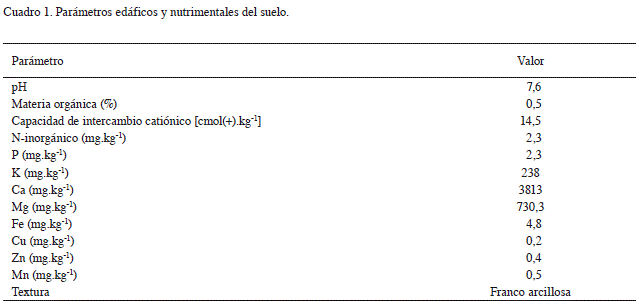
<body><![CDATA[<font style="font-weight: bold;" size="2"><span      style="font-family: verdana;">Efecto del queroseno en la planta</span></font><br      style="font-family: verdana;">     <br style="font-family: verdana;">     <font size="2"><span style="font-family: verdana;">En el (<a      href="/img/revistas/ac/v37n2/a11t1.gif">Cuadro 1</a>) se     presentan los     valores de los par&aacute;metros ed&aacute;ficos y nutrimentales del     suelo utilizado en el experimento.</span></font><br      style="font-family: verdana;">     ]]></body>
<body><![CDATA[<br style="font-family: verdana;">     <font size="2"><span style="font-family: verdana;">El suelo     present&oacute; una baja     fertilidad, el pH fue medianamente alcalino; la materia     org&aacute;nica, capacidad de intercambio cati&oacute;nico,     N-inorg&aacute;nico y P se encontraron en concentraciones bajas, K, Ca     y Mg fueron aceptables. Fe y Cu se encontraron en niveles adecuados,     mientras que Zn y Mn en concentraciones deficientes, de acuerdo con la     clasificaci&oacute;n que establece la NOM-021- SEMARNAT-2000 (DOF     2002). La textura del suelo empleado present&oacute; un contenido de     ]]></body>
<body><![CDATA[arcilla importante y con ello una superficie espec&iacute;fica mayor     que en consecuencia propor-ciona un incremento en el contacto     microorganismo-hidrocarburo. Garc&iacute;a et &aacute;l. (2012)     se&ntilde;alan que una textura franco-arcillo -arenosa favorece el     proceso de biodegradaci&oacute;n de los hidrocarbu-ros totales,     particularmente en los componentes saturados, en comparaci&oacute;n con     el suelo de textura arenosa.</span></font><br      style="font-family: verdana;">     <br style="font-family: verdana;">     <font size="2"><span style="font-family: verdana;">Las plantas a los 56     ]]></body>
<body><![CDATA[d&iacute;as     presentaron una reducci&oacute;n significativa (p&#8804;0,05) en &aacute;rea     foliar, materia seca y volumen radical cuando se contamin&oacute; el     suelo. En el suelo sin contaminar se encontraron diferencias     estad&iacute;sticas (p&#8804;0,05) entre las especies de plantas para las 3     variables estudiadas (<a href="/img/revistas/ac/v37n2/a11t2.gif">Cuadro     2</a>). La interacci&oacute;n especie de     planta X dosis fue significativa (p&#8804;0,05) en todas las variables, lo     que indica que por lo menos alguna de las especies evaluadas es     m&aacute;s sensible al efecto negativo del queroseno. Las plantas al     ]]></body>
<body><![CDATA[crecer en el suelo contaminado presentaron una clorosis y     reducci&oacute;n en su crecimiento, lo que pudo deberse a la presencia     de queroseno, a la deficiencia de nutrimentos en el suelo empleado o a     la capa hidrof&oacute;bica que forman los hidrocarburos alrededor de     la ra&iacute;z, lo que impide la absorci&oacute;n de nutrimentos y agua     (Gaspar et &aacute;l. 2002). Con una concentraci&oacute;n de queroseno     de 400 mg.kg<sup>-1</sup>, P&eacute;rez et &aacute;l. (2010) reportaron     que     plantas de ma&iacute;z presentaron una mayor altura; sin embargo,     existi&oacute; un menor desarrollo radical. Thompson et &aacute;l.     ]]></body>
<body><![CDATA[(2008) reportaron que en suelos contaminados con pireno 1000 mg.kg<sup>-1</sup>     el     pasto <span style="font-style: italic;">Cynodon dactylon</span> L.,     tuvo una reducci&oacute;n en el crecimiento     del tallo, biomasa radical y la longitud de la ra&iacute;z. Por otro     lado, las plantas de trigo y ma&iacute;z son gram&iacute;neas que     mostraron un mayor crecimiento en un suelo contaminado con una mezcla     de hidrocarburos (1% diesel/aceite) a diferencia de lo encontrado en     este trabajo con la planta de trigo. </span></font><br      style="font-family: verdana;">     ]]></body>
<body><![CDATA[<br style="font-family: verdana;">     <font style="font-weight: bold;" size="2"><span      style="font-family: verdana;">Poblaciones microbianas</span></font><br      style="font-family: verdana;">     <br style="font-family: verdana;">     <font size="2"><span style="font-family: verdana;">El tipo de planta,     la dosis de     queroseno y la interacci&oacute;n de ambos factores tuvieron un efecto     significativo en la poblaci&oacute;n total de bacterias, las BFNA y los     hongos totales (p&#8804;0,05) tanto en el suelo de rizoplano como en el     ]]></body>
<body><![CDATA[rizosf&eacute;rico (<a href="/img/revistas/ac/v37n2/a11t3.gif">Cuadro 3</a>).     En el suelo de rizoplano sin     contaminar, las bacterias fueron significativamente mayores en trigo,     las BFNA en cebada y el n&uacute;mero de hongos totales en avena     (p&#8804;0,05). En el suelo rizosf&eacute;rico, las bacterias y las BFNA     fueron significativamente m&aacute;s altas en el pasto, mientras que     los hongos en cebada (p&#8804;0,05). Por otro lado, en el suelo de rizoplano     contaminado las bacte-rias y hongos totales fueron significativamente     mayores en trigo (p&#8804;0,05) y las poblaciones de BFNA en cebada (p&#8804;0,05).     Al comparar las poblaciones microbianas en el rizoplano entre los     ]]></body>
<body><![CDATA[tratamientos no-contaminados y contaminados, se observ&oacute; que la     poblaci&oacute;n de bacterias totales se increment&oacute;     substancialmente con la adici&oacute;n de queroseno (<a      href="/img/revistas/ac/v37n2/a11t3.gif">Cuadro 3</a>). En     tanto, en la riz&oacute;sfera la poblaci&oacute;n de bacterias fue     significativamente mayor en trigo y las BFNA en el pasto; mientras que,     los hongos en cebada. La riz&oacute;sfera provee un microambiente     complejo y din&aacute;mico, donde las bacterias y hongos en     asociaci&oacute;n con las ra&iacute;ces forman comunidades     &uacute;nicas que responden a exudados radicales, los cuales cumplen un     ]]></body>
<body><![CDATA[papel significativo en la degradaci&oacute;n de contaminantes. Algunos     compuestos org&aacute;nicos exudados por las ra&iacute;ces; por     ejemplo, fen&oacute;licos, &aacute;cidos org&aacute;nicos, alcoholes y     prote&iacute;nas son fuente de carbono y nitr&oacute;geno para el     crecimiento y supervivencia de microorganismos que son capaces de     tolerar y degradar contaminantes org&aacute;nicos (Hong et &aacute;l.     2011). Etuk et &aacute;l. (2012) reportan que en un suelo contaminado     con queroseno se tuvo un intervalo de 2,2 x 10<sup>3 </sup>a 3,4 x 10<sup>6</sup>     UFC/g de     bacterias y 1,4 x 10<sup>2</sup> a 2,3 x 10<sup>4</sup> UFC/g de     ]]></body>
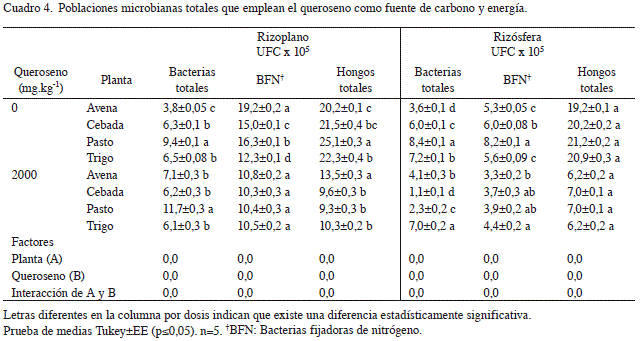
<body><![CDATA[hongos, poblaciones menores     a las encontradas en este trabajo.</span></font><br      style="font-family: verdana;">     <br style="font-family: verdana;">     <font size="2"><span style="font-family: verdana;">En el (<a      href="/img/revistas/ac/v37n2/a11t4.gif">Cuadro 4</a>) se     observan las     pobla-ciones de microorganismos que utilizan a los hidrocarburos del     queroseno como fuente de carbono y energ&iacute;a. En el suelo sin     contaminar, en el rizoplano del pasto se observ&oacute; un mayor     ]]></body>
<body><![CDATA[n&uacute;mero de bacterias y hongos; mientras que, las BFNA fueron     significativamente (p&#8804;0,05) m&aacute;s altas en avena que en las otras     especies. En la riz&oacute;sfera, las bacterias y las BFNA fueron     significativamente mayores en el pasto y no existieron diferencias     significativas entre plantas con respecto a las poblaciones totales de     hongos. Con 2000 mg.kg<sup>-1</sup> de queroseno las poblaciones     totales de     bacterias fueron mayores en el rizopla-no del pasto, con respecto a las     otras gram&iacute;neas y no existieron diferencias significativas entre     plantas con respecto a las poblaciones de BFNA; en cambio, las     ]]></body>
<body><![CDATA[poblaciones de hongos fueron m&aacute;s altas en avena (p&#8804;0,05). En el     suelo rizosf&eacute;rico, las mayores poblaciones de bacterias y BFNA     se presentaron en el pasto y no hubo diferencias significativas entre     especies de plantas, con res-pecto a la poblaci&oacute;n de hongos     totales (p&#8804;0,05). Los consorcios microbianos (bacterias y hongos)     aislados de la riz&oacute;sfera de especies vegetales han probado su     eficiencia en la biodegradaci&oacute;n de hidrocarburos     (Mikeskov&aacute; et &aacute;l. 2012). Sin embargo, se reportan     bacterias de los g&eacute;neros <span style="font-style: italic;">Sphingobacterium     </span>sp., <span style="font-style: italic;">Bacillus </span>sp., y     ]]></body>
<body><![CDATA[<span style="font-style: italic;">Achromobacter </span>sp., aisladas     de la riz&oacute;sfera de ma&iacute;z     (Marques et &aacute;l. 2010), <span style="font-style: italic;">Pseudomonas     aeruginosa </span>AT18 (P&eacute;rez     et &aacute;l. 2010) y <span style="font-style: italic;">Pseudomonas </span>sp.,     bacteria que se desarrolla     favorablemente en un suelo con 6400 mg.kg<sup>-1</sup> de queroseno     (Kabelitz et     &aacute;l. 2009), <span style="font-style: italic;">Pseudomonas     desmolyticum </span>NCIM 2112 (Pd 2112) y     ]]></body>
<body><![CDATA[<span style="font-style: italic;">Nocardia hydrocarbonoxydans </span>NCIM     2386 (Nh 2386) (Kalme et &aacute;l.     2008), <span style="font-style: italic;">Cladosporium</span>, <span      style="font-style: italic;">Candida</span>, <span      style="font-style: italic;">Bacillus </span>y <span      style="font-style: italic;">Microoccus </span>(Etuk et &aacute;l.     2012) que toleran y son capaces de realizar su metabolismo a     trav&eacute;s del empleo de los hidrocarburos del petr&oacute;leo como     fuente de carbono y energ&iacute;a. Respecto a las BFNA, se ha     reportado que <span style="font-style: italic;">Azotobacter nigricans </span>(Garc&iacute;a     ]]></body>
<body><![CDATA[et &aacute;l. 2009),     <span style="font-style: italic;">Nitrosomonas </span>y <span      style="font-style: italic;">Nitrobacter </span>(John y Okpokwasili     2012), son bacterias     nitrificantes capaces de utilizar el queroseno como fuente de carbono.     Por otro lado, Muratova et &aacute;l. (2005) reportaron que poblaciones     de <span style="font-style: italic;">Azospirillum </span>sp.,     aisladas de la riz&oacute;sfera de la planta de     trigo incre-mentaron la degradaci&oacute;n de los hidrocarburos del     petr&oacute;leo, adem&aacute;s de promover el desarrollo del sistema     ]]></body>
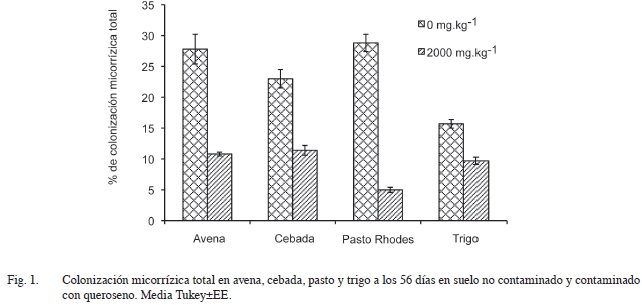
<body><![CDATA[radical.</span></font><br style="font-family: verdana;">     <br style="font-family: verdana;">     <font size="2"><span style="font-family: verdana;">En la (<a      href="/img/revistas/ac/v37n2/a11i1.jpg">Figura 1</a>) se     muestra que en el     suelo sin contaminar el pasto y avena presentaron el mayor porcentaje     de colonizaci&oacute;n micorr&iacute;zica, respecto a lo encontrado en     las plantas de cebada y trigo (p&#8804;0,05). En cambio, con la presencia de     queroseno, las plantas de cebada y avena tuvieron una     colonizaci&oacute;n por el hongo <span style="font-style: italic;">Glomus     ]]></body>
<body><![CDATA[intraradix </span>significativamente     mayor que en las plantas de trigo y pasto.</span></font><br      style="font-family: verdana;">     <br style="font-family: verdana;">     <font size="2"><span style="font-family: verdana;">Por lo que con base     en estos     resultados, las gram&iacute;neas cebada y avena se pueden considerar     para incrementar la biodegradaci&oacute;n de sitios contaminados por     queroseno. En este sentido, Chen et &aacute;l. (2013) mencionan que     actualmente la rizoremediaci&oacute;n es un proceso de     ]]></body>
<body><![CDATA[degradaci&oacute;n complejo con m&uacute;ltiples interacciones que     involucra a la ra&iacute;z, el suelo rizosf&eacute;rico y los     microor-ganismos, entre los que se incluyen a los hongos     endomicorr&iacute;zicos arbusculares. Joner y Leyval (2001) al evaluar     la colonizaci&oacute;n micorr&iacute;zica con el hongo <span      style="font-style: italic;">Glomus mosseae     </span>P2, BEG69 en el pasto Ryegrass establecido en un suelo     contaminado con     una mezcla de 500 mg.kg<sup>-1</sup> de antraceno, 500 mg.kg<sup>-1</sup>     de criseno y 50     ]]></body>
<body><![CDATA[mg.kg<sup>-1</sup> de dibenzo(a,h) antraceno, encontraron una     colonizaci&oacute;n     total del 4%, menor a lo reportado en este trabajo con el pasto Rhodes     y <span style="font-style: italic;">Glomus intraradix</span>.     Alarc&oacute;n et &aacute;l. (2006) reportaron que     la disipaci&oacute;n del benzo[a] pireno de la rizosfera fue mayor en     plantas no inoculadas en comparaci&oacute;n con plantas micorrizadas     con <span style="font-style: italic;">Gigaspora margarita</span>. <span      style="font-style: italic;">Echinochloa polystachya </span>(pasto     alem&aacute;n)     ]]></body>
<body><![CDATA[al parecer tiene una capacidad intr&iacute;nseca para disipar     benzo[a]pireno de su rizosfera. Gaspar et &aacute;l. (2002) y Verdin et     &aacute;l. (2006) mencionaron que <span style="font-style: italic;">Glomus     geosporum </span>y <span style="font-style: italic;">Glomus     intraradices </span>pueden absorber fenan-treno y antraceno del suelo     y     acumularlo en sus esporas. Sin embargo, cuando se absorbe por las hifas     el contaminante no se degrada, se mantiene sin modificaciones; por lo     que al inmovilizarse el contaminante en las esporas se reduce la     con-centraci&oacute;n alrededor de las ra&iacute;ces de las plantas.</span></font><br     ]]></body>
<body><![CDATA[ style="font-family: verdana;">     <br style="font-family: verdana;">     <font style="font-weight: bold;" size="2"><span      style="font-family: verdana;">Degradaci&oacute;n de queroseno</span></font><br      style="font-family: verdana;">     <br style="font-family: verdana;">     <font size="2"><span style="font-family: verdana;">A los 56 d&iacute;as     se     observ&oacute; una degradaci&oacute;n de queroseno en avena del 84,4% y     en cebada del 81,5%; mientras que en pasto fue del 39,6% y en trigo del     ]]></body>
<body><![CDATA[25,3%. Estos resultados indican que en la riz&oacute;sfera de avena y     cebada existe una degradaci&oacute;n importante del queroseno,     posiblemente el hongo endomicorr&iacute;zico y las poblaciones     micro-bianas tuvieron un papel fundamental en la transformaci&oacute;n     de los hidrocarburos del contaminante, debido a que generan compuestos     intermediarios que pueden subsecuentemente ser empleados por los     propios microorganismos o beneficiar a otros, al establecer entre ellos     relaciones sin&eacute;rgicas que generan un proceso de     degradaci&oacute;n mayor. P&eacute;rez et &aacute;l. (2010) evaluaron     la degradaci&oacute;n de</span></font><font size="2"><span     ]]></body>
<body><![CDATA[ style="font-family: verdana;"> 200 mg.kg<sup>-1</sup> de antraceno a     trav&eacute;s de la riz&oacute;sfera de ma&iacute;z. A los 30     d&iacute;as se logr&oacute; una degradaci&oacute;n del 54,9%. En otro     estudio, se reporta que en la riz&oacute;sfera de ma&iacute;z     existi&oacute; una degradaci&oacute;n de diesel del 84,5% y al inocular     el suelo con la bacteria Gordonia sp. S2RP-17 m&aacute;s la presencia     de la planta existi&oacute; una degradaci&oacute;n del 95,8%, por lo     que ambos, la planta de ma&iacute;z y <span style="font-style: italic;">Gordonia     </span>sp. S2RP-17 son una     prometedora estrategia para incrementar la eficiencia de la     ]]></body>
<body><![CDATA[degradaci&oacute;n de suelos contaminados por diesel (Hong et     &aacute;l. 2011). Diab (2008) report&oacute; que en la riz&oacute;sfera     de ma&iacute;z y trigo existi&oacute; una biodegradaci&oacute;n de     hidrocarburos totales de petr&oacute;leo del 16,8% y 13,7%,     respectivamente, menor que lo reportado en este trabajo con avena y     cebada. A los 60 d&iacute;as despu&eacute;s de haber inoculado     <span style="font-style: italic;">Azospirillum brasilense </span>a un     suelo contaminado con 30 mg.kg<sup>-1</sup> de     fenantreno, la riz&oacute;sfera del pasto alem&aacute;n (<span      style="font-style: italic;">Echinochloa     ]]></body>
<body><![CDATA[polystachya</span>) present&oacute; una degradaci&oacute;n del 57%     (Mart&iacute;nez et &aacute;l. 2007). Agarry et &aacute;l. (2010)     mencionaron que una baja poblaci&oacute;n microbiana en un proceso de     degradaci&oacute;n se puede deber a la deficiencia de nutrimentos en el     suelo, los cuales son necesarios para el crecimiento bacteriano e     incrementar la biodegradaci&oacute;n. En este sentido, Ghulam et     &aacute;l. (2008) evaluaron la biodegradaci&oacute;n de queroseno en el     suelo (4% p/p) con un cultivo bacteriano mixto estimulado con la     adici&oacute;n de N, P y K. A las 6 semanas se obtuvo una     degrada-ci&oacute;n del 65% y el contenido de N se redujo del 54 al     ]]></body>
<body><![CDATA[24%, el P de 43 al 3% y del K de 35 al 2%.</span></font><br      style="font-family: verdana;">     <br style="font-family: verdana;">     <font style="font-weight: bold;" size="3"><span      style="font-family: verdana;">Conclusiones</span></font><br      style="font-family: verdana;">     <br style="font-family: verdana;">     <font size="2"><span style="font-family: verdana;">El queroseno     provoc&oacute; una     disminuci&oacute;n significativa del &aacute;rea foliar, la materia     ]]></body>
<body><![CDATA[seca y el volumen radical de las gram&iacute;neas; aun as&iacute; se     estableci&oacute; la simbiosis micorr&iacute;zica y existi&oacute; un     crecimiento importante en la zona de rizoplano y riz&oacute;sfera de     bacterias totales capaces de utilizar al queroseno como fuente de     carbono y energ&iacute;a lo que caus&oacute; una degradaci&oacute;n del     contaminante, por lo que la avena, cebada, trigo y el pasto tienen la     capacidad de degradar a trav&eacute;s de su riz&oacute;sfera     contaminantes org&aacute;nicos, pero al ser plantas comestibles es     importante evaluar la concentra-ci&oacute;n del contaminante en los     diferentes tejidos, adem&aacute;s de ampliar los estudios     ]]></body>
<body><![CDATA[rizosf&eacute;ricos con otro tipo de hidrocarburo para poder determinar     la efectividad de la riz&oacute;sfera, principalmente de avena con     prop&oacute;sitos de fitorremediaci&oacute;n.</span></font>    <br> <hr style="width: 100%; height: 2px;"><font style="font-weight: bold;"  size="3">Literatura Citada</font>    <br>     <!-- ref --><br> <font style="font-family: verdana;" size="2">AGARRY S.E., OWABOR C.N., YUSUF R.O. 2010. Studies on biodegradation of kerosene in soil under different bioremediation strategies. Bioremediation J. 14:135-141.    &nbsp;&nbsp;&nbsp;&nbsp;&nbsp;&nbsp;&nbsp;&nbsp;[&#160;<a href="javascript:void(0);" onclick="javascript: window.open('/scielo.php?script=sci_nlinks&ref=262469&pid=S0377-9424201300020001100001&lng=','','width=640,height=500,resizable=yes,scrollbars=1,menubar=yes,');">Links</a>&#160;]<!-- end-ref --><!-- ref --></font><br  style="font-family: verdana;"> <br style="font-family: verdana;"> <font size="2"><span style="font-family: verdana;">ALARC&Oacute;N A., DELGADILLO J., FRANCO A., DAVIES F.T., FERRERA C.R. 2006. Influence of two polycyclic aromatic hydrocarbons on spore germination, and phytoremediation potential of <span style="font-style: italic;">Gigaspora margarita-Echynochloa polystachya</span> symbiosis in benzo[a]pyrene-polluted substrate. Rev. Int. Contam. Ambient. 22(1):39-47.    &nbsp;&nbsp;&nbsp;&nbsp;&nbsp;&nbsp;&nbsp;&nbsp;[&#160;<a href="javascript:void(0);" onclick="javascript: window.open('/scielo.php?script=sci_nlinks&ref=262470&pid=S0377-9424201300020001100002&lng=','','width=640,height=500,resizable=yes,scrollbars=1,menubar=yes,');">Links</a>&#160;]<!-- end-ref --><!-- ref --></span></font><br style="font-family: verdana;"> <br style="font-family: verdana;"> <font size="2"><span style="font-family: verdana;">CHA&Iacute;NEAU C.H., MOREL J.L., OUDOT J. 2000. Bioremediation and biodegradation of fuel oil hydrocarbons in the rhizosphere of maize. J. Environ Qual. 29:569-578.    &nbsp;&nbsp;&nbsp;&nbsp;&nbsp;&nbsp;&nbsp;&nbsp;[&#160;<a href="javascript:void(0);" onclick="javascript: window.open('/scielo.php?script=sci_nlinks&ref=262471&pid=S0377-9424201300020001100003&lng=','','width=640,height=500,resizable=yes,scrollbars=1,menubar=yes,');">Links</a>&#160;]<!-- end-ref --><!-- ref --></span></font><br  style="font-family: verdana;"> <br style="font-family: verdana;"> <font size="2"><span style="font-family: verdana;">CHEN J., XU Q.X., SU Y., SHI Z.Q., HAN F.X. 2013. Phytoremediation of organic polluted soil. J. Bioremed. Biodeg. 4:132-134.    &nbsp;&nbsp;&nbsp;&nbsp;&nbsp;&nbsp;&nbsp;&nbsp;[&#160;<a href="javascript:void(0);" onclick="javascript: window.open('/scielo.php?script=sci_nlinks&ref=262472&pid=S0377-9424201300020001100004&lng=','','width=640,height=500,resizable=yes,scrollbars=1,menubar=yes,');">Links</a>&#160;]<!-- end-ref --><!-- ref --></span></font><br style="font-family: verdana;"> <br style="font-family: verdana;"> <font size="2"><span style="font-family: verdana;">CLARK F.E. 1965. Agar plate method for total microbial count, pp. 1460-1466. In: C.A. Black (ed.). Methods of soil analysis. Agronomy N&ordm;. 9. Part 2. American Society of Agronomy. Madison, WI.    &nbsp;&nbsp;&nbsp;&nbsp;&nbsp;&nbsp;&nbsp;&nbsp;[&#160;<a href="javascript:void(0);" onclick="javascript: window.open('/scielo.php?script=sci_nlinks&ref=262473&pid=S0377-9424201300020001100005&lng=','','width=640,height=500,resizable=yes,scrollbars=1,menubar=yes,');">Links</a>&#160;]<!-- end-ref --><!-- ref --></span></font><br style="font-family: verdana;"> <br style="font-family: verdana;"> <font size="2"><span style="font-family: verdana;">DIAB E.A. 2008. Phytoremediation of oil contaminated desert soil using the rhizosphere effects of some plants. Res. J. Agricul. Biol. Sci. 4:604-610.    &nbsp;&nbsp;&nbsp;&nbsp;&nbsp;&nbsp;&nbsp;&nbsp;[&#160;<a href="javascript:void(0);" onclick="javascript: window.open('/scielo.php?script=sci_nlinks&ref=262474&pid=S0377-9424201300020001100006&lng=','','width=640,height=500,resizable=yes,scrollbars=1,menubar=yes,');">Links</a>&#160;]<!-- end-ref --><!-- ref --></span></font><br  style="font-family: verdana;"> <br style="font-family: verdana;"> <font size="2"><span style="font-family: verdana;">DIARIO OFICIAL DE LA FEDERACI&Oacute;N (DOF). 2002. NOM-021-RECNAT-2000. Norma oficial Mexicana que establece las especificaciones de fertilidad, salinidad y clasificaci&oacute;n de suelos. Estudios, muestreos y an&aacute;lisis. 31 de diciembre 2002. 85 p.    &nbsp;&nbsp;&nbsp;&nbsp;&nbsp;&nbsp;&nbsp;&nbsp;[&#160;<a href="javascript:void(0);" onclick="javascript: window.open('/scielo.php?script=sci_nlinks&ref=262475&pid=S0377-9424201300020001100007&lng=','','width=640,height=500,resizable=yes,scrollbars=1,menubar=yes,');">Links</a>&#160;]<!-- end-ref --><!-- ref --></span></font><br  style="font-family: verdana;"> <br style="font-family: verdana;"> <font size="2"><span style="font-family: verdana;">ETUK C.U., JHON R.C., EKONG U.E., AKPAN M.M. 2012. Growth study and hydrocarbonoclastic potential of microorganisms isolated from aviation fuel spill site in Ibeno, Nigeria. Bull. Environ. Contam. Toxicol. 89:727-732.    &nbsp;&nbsp;&nbsp;&nbsp;&nbsp;&nbsp;&nbsp;&nbsp;[&#160;<a href="javascript:void(0);" onclick="javascript: window.open('/scielo.php?script=sci_nlinks&ref=262476&pid=S0377-9424201300020001100008&lng=','','width=640,height=500,resizable=yes,scrollbars=1,menubar=yes,');">Links</a>&#160;]<!-- end-ref --><!-- ref --></span></font><br  style="font-family: verdana;"> <br style="font-family: verdana;"> <font size="2"><span style="font-family: verdana;">GARC&Iacute;A E.G., CALVA C.G., FERRERA C.R., FERN&Aacute;NDEZ L.L.C., RODR&Iacute;GUEZ V.R., ESPARZA G.F.J. 2009. Encystment of <span style="font-style: italic;">Azotobacter nigricans </span>grown diazotrophically on kerosene as sole carbon source. Arch. Microbiol. 191:275-281.    &nbsp;&nbsp;&nbsp;&nbsp;&nbsp;&nbsp;&nbsp;&nbsp;[&#160;<a href="javascript:void(0);" onclick="javascript: window.open('/scielo.php?script=sci_nlinks&ref=262477&pid=S0377-9424201300020001100009&lng=','','width=640,height=500,resizable=yes,scrollbars=1,menubar=yes,');">Links</a>&#160;]<!-- end-ref --><!-- ref --></span></font><br  style="font-family: verdana;"> <br style="font-family: verdana;"> <font size="2"><span style="font-family: verdana;">GARC&Iacute;A MA.G., INFANTE C., L&Oacute;PEZ L. 2012. Biodegradaci&oacute;n de un crudo mediano en suelos de diferente textura con y sin agente estructurante. Bioagro 24:93-102.    &nbsp;&nbsp;&nbsp;&nbsp;&nbsp;&nbsp;&nbsp;&nbsp;[&#160;<a href="javascript:void(0);" onclick="javascript: window.open('/scielo.php?script=sci_nlinks&ref=262478&pid=S0377-9424201300020001100010&lng=','','width=640,height=500,resizable=yes,scrollbars=1,menubar=yes,');">Links</a>&#160;]<!-- end-ref --><!-- ref --></span></font><br style="font-family: verdana;"> <br style="font-family: verdana;"> <font size="2"><span style="font-family: verdana;">GASPAR M.L., CABELLO M.N., CAZAU M.C., POLLERO R.J. 2002. Effect of phenanthrene and <span  style="font-style: italic;">Rhodotorula</span> <span style="font-style: italic;">glutinis </span>on arbuscular mycorrhizal fungus colonization of maize roots. Mycorrhiza 12:55-59.    &nbsp;&nbsp;&nbsp;&nbsp;&nbsp;&nbsp;&nbsp;&nbsp;[&#160;<a href="javascript:void(0);" onclick="javascript: window.open('/scielo.php?script=sci_nlinks&ref=262479&pid=S0377-9424201300020001100011&lng=','','width=640,height=500,resizable=yes,scrollbars=1,menubar=yes,');">Links</a>&#160;]<!-- end-ref --><!-- ref --> </span></font><br style="font-family: verdana;"> <br style="font-family: verdana;"> <font size="2"><span style="font-family: verdana;">GHULAM S., AFZAL M., ANWAR F., TAHSEEN R., KHALID Z. M. 2008. Biodegradation of kerosene in soil by a mixed bacterial culture under different nutrient conditions. Inter. Biodeterioration and Biodegradation 61:161-166.    &nbsp;&nbsp;&nbsp;&nbsp;&nbsp;&nbsp;&nbsp;&nbsp;[&#160;<a href="javascript:void(0);" onclick="javascript: window.open('/scielo.php?script=sci_nlinks&ref=262480&pid=S0377-9424201300020001100012&lng=','','width=640,height=500,resizable=yes,scrollbars=1,menubar=yes,');">Links</a>&#160;]<!-- end-ref --><!-- ref --></span></font><br  style="font-family: verdana;"> <br style="font-family: verdana;"> <font size="2"><span style="font-family: verdana;">HERN&Aacute;NDEZ A.E., FERRERA R., RODR&Iacute;GUEZ R. 2003. Bacterias de vida libre fijadoras de nitr&oacute;geno atmosf&eacute;rico en riz&oacute;sfera de frijol contaminada con queroseno. Terra Latinoamericana 21:81-89.    &nbsp;&nbsp;&nbsp;&nbsp;&nbsp;&nbsp;&nbsp;&nbsp;[&#160;<a href="javascript:void(0);" onclick="javascript: window.open('/scielo.php?script=sci_nlinks&ref=262481&pid=S0377-9424201300020001100013&lng=','','width=640,height=500,resizable=yes,scrollbars=1,menubar=yes,');">Links</a>&#160;]<!-- end-ref --><!-- ref --></span></font><br  style="font-family: verdana;"> <br style="font-family: verdana;"> <font size="2"><span style="font-family: verdana;">HONG S.H., RYU H.W., KIM J., CHO K.S. 2011. Rhizoremediation of diesel-contaminated soil using the plant growth-promoting rhizobacterium Gordonia sp. S2RP-17. Biodegradation 22:593-601.    &nbsp;&nbsp;&nbsp;&nbsp;&nbsp;&nbsp;&nbsp;&nbsp;[&#160;<a href="javascript:void(0);" onclick="javascript: window.open('/scielo.php?script=sci_nlinks&ref=262482&pid=S0377-9424201300020001100014&lng=','','width=640,height=500,resizable=yes,scrollbars=1,menubar=yes,');">Links</a>&#160;]<!-- end-ref --><!-- ref --></span></font><br style="font-family: verdana;"> <br style="font-family: verdana;"> <font size="2"><span style="font-family: verdana;">JHON R.C., OKPOKWASILI G.C. 2012. Crude oil-degradation and plasmid profile of nitrifying bacteria isolated from oil-impacted mangrove sediment in the Niger Delta of Nigeria. Bull. Environ. Contam. Toxicol. 88:1020-1026.    &nbsp;&nbsp;&nbsp;&nbsp;&nbsp;&nbsp;&nbsp;&nbsp;[&#160;<a href="javascript:void(0);" onclick="javascript: window.open('/scielo.php?script=sci_nlinks&ref=262483&pid=S0377-9424201300020001100015&lng=','','width=640,height=500,resizable=yes,scrollbars=1,menubar=yes,');">Links</a>&#160;]<!-- end-ref --><!-- ref --></span></font><br  style="font-family: verdana;"> <br style="font-family: verdana;"> <font size="2"><span style="font-family: verdana;">JONER E.J., LEYVAL C. 2001. Influence of arbuscular mycorrhiza on clover and ryegrass grow together in a soil spiked with polycyclic aromatic hydrocarbons. Mycorrhiza 10:155-159.    &nbsp;&nbsp;&nbsp;&nbsp;&nbsp;&nbsp;&nbsp;&nbsp;[&#160;<a href="javascript:void(0);" onclick="javascript: window.open('/scielo.php?script=sci_nlinks&ref=262484&pid=S0377-9424201300020001100016&lng=','','width=640,height=500,resizable=yes,scrollbars=1,menubar=yes,');">Links</a>&#160;]<!-- end-ref --><!-- ref --></span></font><br style="font-family: verdana;"> <br style="font-family: verdana;"> <font size="2"><span style="font-family: verdana;">KABELITZ N., MACHACKOVA J., IMFELD G., BRENNEROVA M., HEIPPIEPER D.H., JUNCA H. 2009. Enhancement of the microbial community biomass and diversity during air sparging bioremediation of a soil highly contaminated with kerosene and BTEX. Appl. Microbiol. Biotechnol. 82:565-577.    &nbsp;&nbsp;&nbsp;&nbsp;&nbsp;&nbsp;&nbsp;&nbsp;[&#160;<a href="javascript:void(0);" onclick="javascript: window.open('/scielo.php?script=sci_nlinks&ref=262485&pid=S0377-9424201300020001100017&lng=','','width=640,height=500,resizable=yes,scrollbars=1,menubar=yes,');">Links</a>&#160;]<!-- end-ref --><!-- ref --></span></font><br  style="font-family: verdana;"> <br style="font-family: verdana;"> <font size="2"><span style="font-family: verdana;">KALME S., PARSHETTI G., GOMARE S., GOVINDWAR S. 2008. Diesel and kerosene degradation by</span></font> <font  size="2"><span style="font-family: verdana;"><span  style="font-style: italic;">Pseudomonas desmolyticum </span>NCIM 2112 and <span style="font-style: italic;">Nocardia hydrocarbonoxydans </span>NCIM 2386. Curr. Microbiol. 56:581-586.    &nbsp;&nbsp;&nbsp;&nbsp;&nbsp;&nbsp;&nbsp;&nbsp;[&#160;<a href="javascript:void(0);" onclick="javascript: window.open('/scielo.php?script=sci_nlinks&ref=262486&pid=S0377-9424201300020001100018&lng=','','width=640,height=500,resizable=yes,scrollbars=1,menubar=yes,');">Links</a>&#160;]<!-- end-ref --><!-- ref --></span></font><br  style="font-family: verdana;"> <br style="font-family: verdana;"> <font size="2"><span style="font-family: verdana;">MARQUES A.P.G.C., PIRES C., MOREIRA H., RANGEL A.O.S.S., CASTRO P.M.L. 2010. Assessment of the plant growth promotion abilities of six bacterial isolates using <span  style="font-style: italic;">Zea mays </span>as indicator plant. Soil Biol. Biochem. 42:1229 -1235.    &nbsp;&nbsp;&nbsp;&nbsp;&nbsp;&nbsp;&nbsp;&nbsp;[&#160;<a href="javascript:void(0);" onclick="javascript: window.open('/scielo.php?script=sci_nlinks&ref=262487&pid=S0377-9424201300020001100019&lng=','','width=640,height=500,resizable=yes,scrollbars=1,menubar=yes,');">Links</a>&#160;]<!-- end-ref --><!-- ref --></span></font><br  style="font-family: verdana;"> <br style="font-family: verdana;"> <font size="2"><span style="font-family: verdana;">MART&Iacute;NEZ M.MA.R., DELGADILLO J., ALARC&Oacute;N A., FERRERA C.R. 2007. Degradaci&oacute;n de fenantreno por microorganismos de la riz&oacute;sfera del pasto alem&aacute;n. Terra Latinoamericana 25:25-33.    &nbsp;&nbsp;&nbsp;&nbsp;&nbsp;&nbsp;&nbsp;&nbsp;[&#160;<a href="javascript:void(0);" onclick="javascript: window.open('/scielo.php?script=sci_nlinks&ref=262488&pid=S0377-9424201300020001100020&lng=','','width=640,height=500,resizable=yes,scrollbars=1,menubar=yes,');">Links</a>&#160;]<!-- end-ref --><!-- ref --></span></font><br  style="font-family: verdana;"> <br style="font-family: verdana;"> <font size="2"><span style="font-family: verdana;">MIKESKOV&Aacute; H., NOVOTN&Yacute; C., SVOBODOV&Aacute; K. 2012. Interspecific interactions in mixed microbial cultures in a biodegradation perspective. Appl. Microbiol. Biotechnol. 95:861-870.    &nbsp;&nbsp;&nbsp;&nbsp;&nbsp;&nbsp;&nbsp;&nbsp;[&#160;<a href="javascript:void(0);" onclick="javascript: window.open('/scielo.php?script=sci_nlinks&ref=262489&pid=S0377-9424201300020001100021&lng=','','width=640,height=500,resizable=yes,scrollbars=1,menubar=yes,');">Links</a>&#160;]<!-- end-ref --><!-- ref --></span></font><br style="font-family: verdana;"> <br style="font-family: verdana;"> <font size="2"><span style="font-family: verdana;">MORALES P.J.L. 1969. Propagaci&oacute;n de hongos filamentosos en fracciones del petr&oacute;leo. Tesis profesional. Instituto Polit&eacute;cnico Nacional, M&eacute;xico, D.F. 80 p.    &nbsp;&nbsp;&nbsp;&nbsp;&nbsp;&nbsp;&nbsp;&nbsp;[&#160;<a href="javascript:void(0);" onclick="javascript: window.open('/scielo.php?script=sci_nlinks&ref=262490&pid=S0377-9424201300020001100022&lng=','','width=640,height=500,resizable=yes,scrollbars=1,menubar=yes,');">Links</a>&#160;]<!-- end-ref --><!-- ref --></span></font><br  style="font-family: verdana;"> <br style="font-family: verdana;"> <font size="2"><span style="font-family: verdana;">MURATOVA A.Y., TURKOVSKAYA O.V., ANTONYUK L.P., MAKAROV O.E., POZDNYAKOVA L.I., IGNATOV V.V. 2005. Oil-oxidizing potential of associative rhizobacteria of the genus <span style="font-style: italic;">Azospirillum</span>. Microbiology 74:210-215.    &nbsp;&nbsp;&nbsp;&nbsp;&nbsp;&nbsp;&nbsp;&nbsp;[&#160;<a href="javascript:void(0);" onclick="javascript: window.open('/scielo.php?script=sci_nlinks&ref=262491&pid=S0377-9424201300020001100023&lng=','','width=640,height=500,resizable=yes,scrollbars=1,menubar=yes,');">Links</a>&#160;]<!-- end-ref --><!-- ref --></span></font><br style="font-family: verdana;"> <br style="font-family: verdana;"> <font size="2"><span style="font-family: verdana;">PARKINSON D. 1982. Filamentous fungi, pp. 949-953. In: A.L. Page (ed.). Methods of soil analysis. Agronomy 9. Part 2. American Society of Agronomy. Madison, WI.    &nbsp;&nbsp;&nbsp;&nbsp;&nbsp;&nbsp;&nbsp;&nbsp;[&#160;<a href="javascript:void(0);" onclick="javascript: window.open('/scielo.php?script=sci_nlinks&ref=262492&pid=S0377-9424201300020001100024&lng=','','width=640,height=500,resizable=yes,scrollbars=1,menubar=yes,');">Links</a>&#160;]<!-- end-ref --><!-- ref --></span></font><br  style="font-family: verdana;"> <br style="font-family: verdana;"> <font size="2"><span style="font-family: verdana;">P&Eacute;REZ V.J., POGGI H.M., CALVA G., R&Iacute;OS E., RODR&Iacute;GUEZ R., FERRERA R., ESPARZA F. 2000. Nitrogen-fixing bacteria capable of utilizing kerosene hydrocarbon as a sole carbon source. Water Sci. Technol. 42:407-410.    &nbsp;&nbsp;&nbsp;&nbsp;&nbsp;&nbsp;&nbsp;&nbsp;[&#160;<a href="javascript:void(0);" onclick="javascript: window.open('/scielo.php?script=sci_nlinks&ref=262493&pid=S0377-9424201300020001100025&lng=','','width=640,height=500,resizable=yes,scrollbars=1,menubar=yes,');">Links</a>&#160;]<!-- end-ref --><!-- ref --></span></font><br  style="font-family: verdana;"> <br style="font-family: verdana;"> <font size="2"><span style="font-family: verdana;">P&Eacute;REZ A.B., CASTA&Ntilde;EDA A., CASTELLANOS G., JIM&Eacute;NEZ T., TAPIA A., MART&Iacute;NEZ D. 2010. Efecto del antraceno en la estimulaci&oacute;n del crecimiento en ma&iacute;z y frijol. Terra Latinoamericana 29:95-102.    &nbsp;&nbsp;&nbsp;&nbsp;&nbsp;&nbsp;&nbsp;&nbsp;[&#160;<a href="javascript:void(0);" onclick="javascript: window.open('/scielo.php?script=sci_nlinks&ref=262494&pid=S0377-9424201300020001100026&lng=','','width=640,height=500,resizable=yes,scrollbars=1,menubar=yes,');">Links</a>&#160;]<!-- end-ref --><!-- ref --></span></font><br  style="font-family: verdana;"> <br style="font-family: verdana;"> <font size="2"><span style="font-family: verdana;">PHILLIPS J.M., HAYMAN D.S. 1970. Improved procedures clearing roots and staining parasitic and vesicular-arbuscular mycorrhizal fungi for rapid assessment of infection. Trans. Br. Mycol. Soc. 55:158-161.    &nbsp;&nbsp;&nbsp;&nbsp;&nbsp;&nbsp;&nbsp;&nbsp;[&#160;<a href="javascript:void(0);" onclick="javascript: window.open('/scielo.php?script=sci_nlinks&ref=262495&pid=S0377-9424201300020001100027&lng=','','width=640,height=500,resizable=yes,scrollbars=1,menubar=yes,');">Links</a>&#160;]<!-- end-ref --><!-- ref --></span></font><br  style="font-family: verdana;"> <br style="font-family: verdana;"> <font size="2"><span style="font-family: verdana;">QUI&Ntilde;ONES A.E.E., FERRERA C.R., GAVI R.F., FERN&Aacute;NDEZ L.L., RODR&Iacute;GUEZ R., ALARC&Oacute;N A. 2003. Emergence and growth of maize in a crude oil polluted soil. Agrociencia 37:585-594.    &nbsp;&nbsp;&nbsp;&nbsp;&nbsp;&nbsp;&nbsp;&nbsp;[&#160;<a href="javascript:void(0);" onclick="javascript: window.open('/scielo.php?script=sci_nlinks&ref=262496&pid=S0377-9424201300020001100028&lng=','','width=640,height=500,resizable=yes,scrollbars=1,menubar=yes,');">Links</a>&#160;]<!-- end-ref --><!-- ref --></span></font><br  style="font-family: verdana;"> <br style="font-family: verdana;"> <font size="2"><span style="font-family: verdana;">RENNIE R.J. 1981. A single medium for isolation of acetylenereducing (dinitrogen-fixing) bacteria from soils. Can. J. Microbiol. 27:8-14.    &nbsp;&nbsp;&nbsp;&nbsp;&nbsp;&nbsp;&nbsp;&nbsp;[&#160;<a href="javascript:void(0);" onclick="javascript: window.open('/scielo.php?script=sci_nlinks&ref=262497&pid=S0377-9424201300020001100029&lng=','','width=640,height=500,resizable=yes,scrollbars=1,menubar=yes,');">Links</a>&#160;]<!-- end-ref --><!-- ref --></span></font><br  style="font-family: verdana;"> <br style="font-family: verdana;"> <font size="2"><span style="font-family: verdana;">RITCHIE G.D., STILL R.K., ROSS J., BECKKEDAL V.Y.M., BOBB J.A., ARFSTEN P.D. 2003. Biological and health effects of exposure to kerosene-based jet fuels and performance additives. J. Toxicology and Environ. Health. Part B. 6:357-451.    &nbsp;&nbsp;&nbsp;&nbsp;&nbsp;&nbsp;&nbsp;&nbsp;[&#160;<a href="javascript:void(0);" onclick="javascript: window.open('/scielo.php?script=sci_nlinks&ref=262498&pid=S0377-9424201300020001100030&lng=','','width=640,height=500,resizable=yes,scrollbars=1,menubar=yes,');">Links</a>&#160;]<!-- end-ref --><!-- ref --></span></font><br  style="font-family: verdana;"> <br style="font-family: verdana;"> <font size="2"><span style="font-family: verdana;">STATPOINT TECHNOLOGIES. 2011. Statgraphics Centurion XVI. Software estad&iacute;stico versi&oacute;n en espa&ntilde;ol. United States.    &nbsp;&nbsp;&nbsp;&nbsp;&nbsp;&nbsp;&nbsp;&nbsp;[&#160;<a href="javascript:void(0);" onclick="javascript: window.open('/scielo.php?script=sci_nlinks&ref=262499&pid=S0377-9424201300020001100031&lng=','','width=640,height=500,resizable=yes,scrollbars=1,menubar=yes,');">Links</a>&#160;]<!-- end-ref --><!-- ref --></span></font><br  style="font-family: verdana;"> <br style="font-family: verdana;"> <font size="2"><span style="font-family: verdana;">THOMPSON O.A., DUANE C.W., MATTICE J.D., THOMA G.J. 2008. Influence of nitrogen addition and plant root parameters on phytoremediation of pyrene-contaminated soil. Water Air Soil Pollut. 189:37-47.    &nbsp;&nbsp;&nbsp;&nbsp;&nbsp;&nbsp;&nbsp;&nbsp;[&#160;<a href="javascript:void(0);" onclick="javascript: window.open('/scielo.php?script=sci_nlinks&ref=262500&pid=S0377-9424201300020001100032&lng=','','width=640,height=500,resizable=yes,scrollbars=1,menubar=yes,');">Links</a>&#160;]<!-- end-ref --><!-- ref --></span></font><br style="font-family: verdana;"> <br style="font-family: verdana;"> <font size="2"><span style="font-family: verdana;">VERDIN A., SAHRAOUI L., FONTAINE J., GRANDMOUGIN A., DURAND R. 2006. Effects of anthracene on development of a arbuscular mycorrhizal fungus and contribution of the symbiotic association to pollutant dissipation. Mycorrhiza 16:397-405.    &nbsp;&nbsp;&nbsp;&nbsp;&nbsp;&nbsp;&nbsp;&nbsp;[&#160;<a href="javascript:void(0);" onclick="javascript: window.open('/scielo.php?script=sci_nlinks&ref=262501&pid=S0377-9424201300020001100033&lng=','','width=640,height=500,resizable=yes,scrollbars=1,menubar=yes,');">Links</a>&#160;]<!-- end-ref --><!-- ref --></span></font><br  style="font-family: verdana;"> <br style="font-family: verdana;"> <font size="2"><span style="font-family: verdana;">WILD S.R., WATERHOUSE K.S., McGRATH S.P., JONES K.C. 1990. Organic contaminants in an agricultural soil with a known history of sewage sludge amendments: polynuclear aromatic hydrocarbons. Environ. Sci. Technol. 24:1706-1711.    &nbsp;&nbsp;&nbsp;&nbsp;&nbsp;&nbsp;&nbsp;&nbsp;[&#160;<a href="javascript:void(0);" onclick="javascript: window.open('/scielo.php?script=sci_nlinks&ref=262502&pid=S0377-9424201300020001100034&lng=','','width=640,height=500,resizable=yes,scrollbars=1,menubar=yes,');">Links</a>&#160;]<!-- end-ref --><!-- ref --></span></font><br  style="font-family: verdana;"> <br style="font-family: verdana;"> <font size="2"><span style="font-family: verdana;">YATEEM A., BALBA A.T., NAWAWY A.S., AL-AWANDHI N. 2000. Plants associated microflora and the remediation of oil-contaminated soil. Int. J. Phytorem. 2:183-191.    &nbsp;&nbsp;&nbsp;&nbsp;&nbsp;&nbsp;&nbsp;&nbsp;[&#160;<a href="javascript:void(0);" onclick="javascript: window.open('/scielo.php?script=sci_nlinks&ref=262503&pid=S0377-9424201300020001100035&lng=','','width=640,height=500,resizable=yes,scrollbars=1,menubar=yes,');">Links</a>&#160;]<!-- end-ref --><br>     <br> </span></font><font size="2"><span style="font-family: verdana;"><a  name="Correspondencia_a"></a><a href="#1">Correspondencia a</a>:     <br> <a name="a1"></a><a href="#autor1">*</a>Elizabeth Garc&iacute;a: </span></font><font  size="2"><span style="font-family: verdana;">Centro de Investigaci&oacute;n en Gen&eacute;tica y Ambiente de la Universidad Aut&oacute;noma de Tlaxcala, Tlaxcala, M&eacute;xico.</span></font><font  size="2"><span style="font-family: verdana;"><a name="1_"></a><a  href="#autor1">1</a> Autor para correspondencia. Correo electr&oacute;nico: <a href="mailto:gallegoseg@hotmail.com">gallegoseg@hotmail.com</a></span></font><font  size="2"><span style="font-family: verdana;">     <br> </span></font><font size="2"><span style="font-family: verdana;"><a  name="a2"></a><a href="#autor2">**</a>Ronald Ferrera: </span></font><font size="2"><span  style="font-family: verdana;">Instituto de Recursos Naturales, Colegio de Posgraduados en Ciencias Agr&iacute;colas, Montecillo, Estado de M&eacute;xico. </span></font>    <br> <font size="2"><span style="font-family: verdana;"><a name="a3"></a><a  href="#autor3">**</a>Juan Jos&eacute; Almar&aacute;z:</span></font><font size="2"><span  style="font-family: verdana;">Instituto de Recursos Naturales, Colegio de Posgraduados en Ciencias Agr&iacute;colas, Montecillo, Estado de M&eacute;xico. </span></font>    <br> <font size="2"><span style="font-family: verdana;"><a name="a4"></a><a  href="#autor4">***</a>Refugio Rodr&iacute;guez: </span></font><font size="2"><span  style="font-family: verdana;"> Departamento de Biotecnolog&iacute;a y Bioingenier&iacute;a del CINVESTAV-Instituto Polit&eacute;cnico Nacional, M&eacute;xico, D.F.</span></font>    <br> <font size="2"><span style="font-family: verdana;"><a name="a5"></a><a  href="#autor5">*</a>Edelmira Garc&iacute;a</span></font>: <font size="2"><span  style="font-family: verdana;">Centro de Investigaci&oacute;n en Gen&eacute;tica y Ambiente de la Universidad Aut&oacute;noma de Tlaxcala, Tlaxcala, M&eacute;xico.</span></font><font  size="2"><span style="font-family: verdana;"> </span></font><font  size="2"><span style="font-family: verdana;"></span></font>    <br> <font size="2"><span style="font-family: verdana;"><br  style="font-family: verdana;"> </span></font><font size="2"><span style="font-family: verdana;"></span></font> <hr style="width: 100%; height: 2px;">     <div style="text-align: center;"><font size="2"><span  style="font-family: verdana;"></span></font><font  style="font-weight: bold;" size="2"><span style="font-family: verdana;">Recibido: 04/03/13&nbsp;&nbsp; &nbsp;Aceptado: 24/06/13</span></font></div> </div>      ]]></body><back>
<ref-list>
<ref id="B1">
<nlm-citation citation-type="journal">
<person-group person-group-type="author">
<name>
<surname><![CDATA[AGARRY]]></surname>
<given-names><![CDATA[S.E.]]></given-names>
</name>
<name>
<surname><![CDATA[OWABOR]]></surname>
<given-names><![CDATA[C.N.]]></given-names>
</name>
<name>
<surname><![CDATA[YUSUF]]></surname>
<given-names><![CDATA[R.O.]]></given-names>
</name>
</person-group>
<article-title xml:lang="en"><![CDATA[Studies on biodegradation of kerosene in soil under different bioremediation strategies.]]></article-title>
<source><![CDATA[Bioremediation J.]]></source>
<year>2010</year>
<volume>14</volume>
<page-range>135-141</page-range></nlm-citation>
</ref>
<ref id="B2">
<nlm-citation citation-type="journal">
<person-group person-group-type="author">
<name>
<surname><![CDATA[ALARCÓN]]></surname>
<given-names><![CDATA[A.]]></given-names>
</name>
<name>
<surname><![CDATA[DELGADILLO]]></surname>
<given-names><![CDATA[J.]]></given-names>
</name>
<name>
<surname><![CDATA[FRANCO]]></surname>
<given-names><![CDATA[A.]]></given-names>
</name>
<name>
<surname><![CDATA[DAVIES]]></surname>
<given-names><![CDATA[F.T.]]></given-names>
</name>
<name>
<surname><![CDATA[FERRERA]]></surname>
<given-names><![CDATA[C.R.]]></given-names>
</name>
</person-group>
<article-title xml:lang="en"><![CDATA[Influence of two polycyclic aromatic hydrocarbons on spore germination, and phytoremediation potential of Gigaspora margarita-Echynochloa polystachya symbiosis in benzo[a]pyrene-polluted substrate.]]></article-title>
<source><![CDATA[Rev. Int. Contam. Ambient.]]></source>
<year>2006</year>
<volume>22</volume>
<numero>1</numero>
<issue>1</issue>
<page-range>39-47</page-range></nlm-citation>
</ref>
<ref id="B3">
<nlm-citation citation-type="journal">
<person-group person-group-type="author">
<name>
<surname><![CDATA[CHAÍNEAU]]></surname>
<given-names><![CDATA[C.H.]]></given-names>
</name>
<name>
<surname><![CDATA[MOREL]]></surname>
<given-names><![CDATA[J.L.]]></given-names>
</name>
<name>
<surname><![CDATA[OUDOT]]></surname>
<given-names><![CDATA[J.]]></given-names>
</name>
</person-group>
<article-title xml:lang="en"><![CDATA[Bioremediation and biodegradation of fuel oil hydrocarbons in the rhizosphere of maize]]></article-title>
<source><![CDATA[J. Environ Qual.]]></source>
<year>2000</year>
<volume>29</volume>
<page-range>569-578</page-range></nlm-citation>
</ref>
<ref id="B4">
<nlm-citation citation-type="journal">
<person-group person-group-type="author">
<name>
<surname><![CDATA[CHEN]]></surname>
<given-names><![CDATA[J.]]></given-names>
</name>
<name>
<surname><![CDATA[XU]]></surname>
<given-names><![CDATA[Q.X.]]></given-names>
</name>
<name>
<surname><![CDATA[SU]]></surname>
<given-names><![CDATA[Y.]]></given-names>
</name>
<name>
<surname><![CDATA[SHI]]></surname>
<given-names><![CDATA[Z.Q.]]></given-names>
</name>
<name>
<surname><![CDATA[HAN]]></surname>
<given-names><![CDATA[F.X.]]></given-names>
</name>
</person-group>
<article-title xml:lang="en"><![CDATA[Phytoremediation of organic polluted soil.]]></article-title>
<source><![CDATA[J. Bioremed. Biodeg.]]></source>
<year>2013</year>
<volume>4</volume>
<page-range>132-134</page-range></nlm-citation>
</ref>
<ref id="B5">
<nlm-citation citation-type="book">
<person-group person-group-type="author">
<name>
<surname><![CDATA[CLARK]]></surname>
<given-names><![CDATA[F.E.]]></given-names>
</name>
</person-group>
<article-title xml:lang="en"><![CDATA[Agar plate method for total microbial count]]></article-title>
<person-group person-group-type="editor">
<name>
<surname><![CDATA[Black]]></surname>
<given-names><![CDATA[C.A]]></given-names>
</name>
</person-group>
<source><![CDATA[Methods of soil analysis: Agronomy Nº. 9. Part 2.]]></source>
<year>1965</year>
<page-range>1460-1466</page-range><publisher-loc><![CDATA[Madison^eWI WI]]></publisher-loc>
<publisher-name><![CDATA[American Society of Agronomy]]></publisher-name>
</nlm-citation>
</ref>
<ref id="B6">
<nlm-citation citation-type="journal">
<person-group person-group-type="author">
<name>
<surname><![CDATA[DIAB]]></surname>
<given-names><![CDATA[E.A.]]></given-names>
</name>
</person-group>
<article-title xml:lang="en"><![CDATA[Phytoremediation of oil contaminated desert soil using the rhizosphere effects of some plants.]]></article-title>
<source><![CDATA[Res. J. Agricul. Biol. Sci.]]></source>
<year>2008</year>
<volume>4</volume>
<page-range>604-610</page-range></nlm-citation>
</ref>
<ref id="B7">
<nlm-citation citation-type="">
<collab>DIARIO OFICIAL DE LA FEDERACIÓN (DOF)</collab>
<source><![CDATA[NOM-021-RECNAT-2000.: Norma oficial Mexicana que establece las especificaciones de fertilidad, salinidad y clasificación de suelos. Estudios, muestreos y análisis.]]></source>
<year>2002</year>
<page-range>85</page-range></nlm-citation>
</ref>
<ref id="B8">
<nlm-citation citation-type="journal">
<person-group person-group-type="author">
<name>
<surname><![CDATA[ETUK]]></surname>
<given-names><![CDATA[C.U.]]></given-names>
</name>
<name>
<surname><![CDATA[JHON]]></surname>
<given-names><![CDATA[R.C.]]></given-names>
</name>
<name>
<surname><![CDATA[EKONG]]></surname>
<given-names><![CDATA[U.E.]]></given-names>
</name>
<name>
<surname><![CDATA[AKPAN]]></surname>
<given-names><![CDATA[M.M.]]></given-names>
</name>
</person-group>
<article-title xml:lang="en"><![CDATA[Growth study and hydrocarbonoclastic potential of microorganisms isolated from aviation fuel spill site in Ibeno, Nigeria.]]></article-title>
<source><![CDATA[Bull. Environ. Contam. Toxicol.]]></source>
<year>2012</year>
<volume>89</volume>
<page-range>727-732</page-range></nlm-citation>
</ref>
<ref id="B9">
<nlm-citation citation-type="journal">
<person-group person-group-type="author">
<name>
<surname><![CDATA[GARCÍA]]></surname>
<given-names><![CDATA[E.G.]]></given-names>
</name>
<name>
<surname><![CDATA[CALVA]]></surname>
<given-names><![CDATA[C.G.]]></given-names>
</name>
<name>
<surname><![CDATA[FERRERA]]></surname>
<given-names><![CDATA[C.R.]]></given-names>
</name>
<name>
<surname><![CDATA[FERNÁNDEZ]]></surname>
<given-names><![CDATA[L.L.C.]]></given-names>
</name>
<name>
<surname><![CDATA[RODRÍGUEZ]]></surname>
<given-names><![CDATA[V.R.]]></given-names>
</name>
<name>
<surname><![CDATA[ESPARZA]]></surname>
<given-names><![CDATA[G.F.J.]]></given-names>
</name>
</person-group>
<article-title xml:lang="en"><![CDATA[Encystment of Azotobacter nigricans grown diazotrophically on kerosene as sole carbon source.]]></article-title>
<source><![CDATA[Arch. Microbiol.]]></source>
<year>2009</year>
<volume>191</volume>
<page-range>275-281</page-range></nlm-citation>
</ref>
<ref id="B10">
<nlm-citation citation-type="journal">
<person-group person-group-type="author">
<name>
<surname><![CDATA[GARCÍA]]></surname>
<given-names><![CDATA[MA.G.]]></given-names>
</name>
<name>
<surname><![CDATA[INFANTE]]></surname>
<given-names><![CDATA[C.]]></given-names>
</name>
<name>
<surname><![CDATA[LÓPEZ]]></surname>
<given-names><![CDATA[L.]]></given-names>
</name>
</person-group>
<article-title xml:lang="es"><![CDATA[Biodegradación de un crudo mediano en suelos de diferente textura con y sin agente estructurante.]]></article-title>
<source><![CDATA[Bioagro]]></source>
<year>2012</year>
<volume>24</volume>
<page-range>93-102</page-range></nlm-citation>
</ref>
<ref id="B11">
<nlm-citation citation-type="journal">
<person-group person-group-type="author">
<name>
<surname><![CDATA[GASPAR]]></surname>
<given-names><![CDATA[M.L.]]></given-names>
</name>
<name>
<surname><![CDATA[CABELLO]]></surname>
<given-names><![CDATA[M.N.]]></given-names>
</name>
<name>
<surname><![CDATA[CAZAU]]></surname>
<given-names><![CDATA[M.C.]]></given-names>
</name>
<name>
<surname><![CDATA[POLLERO]]></surname>
<given-names><![CDATA[R.J.]]></given-names>
</name>
</person-group>
<article-title xml:lang="en"><![CDATA[Effect of phenanthrene and Rhodotorula glutinis on arbuscular mycorrhizal fungus colonization of maize roots.]]></article-title>
<source><![CDATA[Mycorrhiza]]></source>
<year>2002</year>
<volume>12</volume>
<page-range>55-59</page-range></nlm-citation>
</ref>
<ref id="B12">
<nlm-citation citation-type="journal">
<person-group person-group-type="author">
<name>
<surname><![CDATA[GHULAM]]></surname>
<given-names><![CDATA[S.]]></given-names>
</name>
<name>
<surname><![CDATA[AFZAL]]></surname>
<given-names><![CDATA[M.]]></given-names>
</name>
<name>
<surname><![CDATA[ANWAR]]></surname>
<given-names><![CDATA[F.]]></given-names>
</name>
<name>
<surname><![CDATA[TAHSEEN]]></surname>
<given-names><![CDATA[R.]]></given-names>
</name>
<name>
<surname><![CDATA[KHALID]]></surname>
<given-names><![CDATA[Z. M.]]></given-names>
</name>
</person-group>
<article-title xml:lang="en"><![CDATA[Biodegradation of kerosene in soil by a mixed bacterial culture under different nutrient conditions.]]></article-title>
<source><![CDATA[Inter. Biodeterioration and Biodegradation]]></source>
<year>2008</year>
<volume>61</volume>
<page-range>161-166</page-range></nlm-citation>
</ref>
<ref id="B13">
<nlm-citation citation-type="journal">
<person-group person-group-type="author">
<name>
<surname><![CDATA[HERNÁNDEZ]]></surname>
<given-names><![CDATA[A.E.]]></given-names>
</name>
<name>
<surname><![CDATA[FERRERA]]></surname>
<given-names><![CDATA[R.]]></given-names>
</name>
<name>
<surname><![CDATA[RODRÍGUEZ]]></surname>
<given-names><![CDATA[R.]]></given-names>
</name>
</person-group>
<article-title xml:lang="es"><![CDATA[Bacterias de vida libre fijadoras de nitrógeno atmosférico en rizósfera de frijol contaminada con queroseno]]></article-title>
<source><![CDATA[Terra Latinoamericana]]></source>
<year>2003</year>
<volume>21</volume>
<page-range>81-89</page-range></nlm-citation>
</ref>
<ref id="B14">
<nlm-citation citation-type="journal">
<person-group person-group-type="author">
<name>
<surname><![CDATA[HONG]]></surname>
<given-names><![CDATA[S.H.]]></given-names>
</name>
<name>
<surname><![CDATA[RYU]]></surname>
<given-names><![CDATA[H.W.]]></given-names>
</name>
<name>
<surname><![CDATA[KIM]]></surname>
<given-names><![CDATA[J.]]></given-names>
</name>
<name>
<surname><![CDATA[CHO]]></surname>
<given-names><![CDATA[K.S.]]></given-names>
</name>
</person-group>
<article-title xml:lang="en"><![CDATA[Rhizoremediation of diesel-contaminated soil using the plant growth-promoting rhizobacterium Gordonia sp. S2RP-17.]]></article-title>
<source><![CDATA[Biodegradation]]></source>
<year>2011</year>
<volume>22</volume>
<page-range>593-601</page-range></nlm-citation>
</ref>
<ref id="B15">
<nlm-citation citation-type="journal">
<person-group person-group-type="author">
<name>
<surname><![CDATA[JHON]]></surname>
<given-names><![CDATA[R.C.]]></given-names>
</name>
<name>
<surname><![CDATA[OKPOKWASILI]]></surname>
<given-names><![CDATA[G.C.]]></given-names>
</name>
</person-group>
<article-title xml:lang="en"><![CDATA[Crude oil-degradation and plasmid profile of nitrifying bacteria isolated from oil-impacted mangrove sediment in the Niger Delta of Nigeria.]]></article-title>
<source><![CDATA[Bull. Environ. Contam. Toxicol.]]></source>
<year>2012</year>
<volume>88</volume>
<page-range>1020-1026</page-range></nlm-citation>
</ref>
<ref id="B16">
<nlm-citation citation-type="journal">
<person-group person-group-type="author">
<name>
<surname><![CDATA[JONER]]></surname>
<given-names><![CDATA[E.J.]]></given-names>
</name>
<name>
<surname><![CDATA[LEYVAL]]></surname>
<given-names><![CDATA[C]]></given-names>
</name>
</person-group>
<article-title xml:lang="en"><![CDATA[Influence of arbuscular mycorrhiza on clover and ryegrass grow together in a soil spiked with polycyclic aromatic hydrocarbons.]]></article-title>
<source><![CDATA[Mycorrhiza]]></source>
<year>2001</year>
<volume>10</volume>
<page-range>155-159</page-range></nlm-citation>
</ref>
<ref id="B17">
<nlm-citation citation-type="journal">
<person-group person-group-type="author">
<name>
<surname><![CDATA[KABELITZ]]></surname>
<given-names><![CDATA[N.]]></given-names>
</name>
<name>
<surname><![CDATA[MACHACKOVA]]></surname>
<given-names><![CDATA[J.]]></given-names>
</name>
<name>
<surname><![CDATA[IMFELD]]></surname>
<given-names><![CDATA[G.]]></given-names>
</name>
<name>
<surname><![CDATA[BRENNEROVA]]></surname>
<given-names><![CDATA[M.]]></given-names>
</name>
<name>
<surname><![CDATA[HEIPPIEPER]]></surname>
<given-names><![CDATA[D.H.]]></given-names>
</name>
<name>
<surname><![CDATA[JUNCA]]></surname>
<given-names><![CDATA[H.]]></given-names>
</name>
</person-group>
<article-title xml:lang="en"><![CDATA[Enhancement of the microbial community biomass and diversity during air sparging bioremediation of a soil highly contaminated with kerosene and BTEX.]]></article-title>
<source><![CDATA[Appl. Microbiol. Biotechnol.]]></source>
<year>2009</year>
<volume>82</volume>
<page-range>565-577</page-range></nlm-citation>
</ref>
<ref id="B18">
<nlm-citation citation-type="journal">
<person-group person-group-type="author">
<name>
<surname><![CDATA[KALME]]></surname>
<given-names><![CDATA[S.]]></given-names>
</name>
<name>
<surname><![CDATA[PARSHETTI]]></surname>
<given-names><![CDATA[G.]]></given-names>
</name>
<name>
<surname><![CDATA[GOMARE]]></surname>
<given-names><![CDATA[S]]></given-names>
</name>
<name>
<surname><![CDATA[GOVINDWAR]]></surname>
<given-names><![CDATA[S.]]></given-names>
</name>
</person-group>
<article-title xml:lang="en"><![CDATA[Diesel and kerosene degradation by Pseudomonas desmolyticum NCIM 2112 and Nocardia hydrocarbonoxydans NCIM 2386.]]></article-title>
<source><![CDATA[Curr. Microbiol.]]></source>
<year>2008</year>
<volume>56</volume>
<page-range>581-586</page-range></nlm-citation>
</ref>
<ref id="B19">
<nlm-citation citation-type="journal">
<person-group person-group-type="author">
<name>
<surname><![CDATA[MARQUES]]></surname>
<given-names><![CDATA[A.P.G.C.]]></given-names>
</name>
<name>
<surname><![CDATA[PIRES]]></surname>
<given-names><![CDATA[C.]]></given-names>
</name>
<name>
<surname><![CDATA[MOREIRA]]></surname>
<given-names><![CDATA[H.]]></given-names>
</name>
<name>
<surname><![CDATA[RANGEL]]></surname>
<given-names><![CDATA[A.O.S.S.]]></given-names>
</name>
<name>
<surname><![CDATA[CASTRO]]></surname>
<given-names><![CDATA[P.M.L.]]></given-names>
</name>
</person-group>
<article-title xml:lang="en"><![CDATA[Assessment of the plant growth promotion abilities of six bacterial isolates using Zea mays as indicator plant.]]></article-title>
<source><![CDATA[Soil Biol. Biochem]]></source>
<year>2010</year>
<volume>42</volume>
<page-range>1229 -1235</page-range></nlm-citation>
</ref>
<ref id="B20">
<nlm-citation citation-type="journal">
<person-group person-group-type="author">
<name>
<surname><![CDATA[MARTÍNEZ]]></surname>
<given-names><![CDATA[M.MA.R.]]></given-names>
</name>
<name>
<surname><![CDATA[DELGADILLO]]></surname>
<given-names><![CDATA[J.]]></given-names>
</name>
<name>
<surname><![CDATA[ALARCÓN]]></surname>
<given-names><![CDATA[A.]]></given-names>
</name>
<name>
<surname><![CDATA[FERRERA]]></surname>
<given-names><![CDATA[C.R.]]></given-names>
</name>
</person-group>
<article-title xml:lang="es"><![CDATA[Degradación de fenantreno por microorganismos de la rizósfera del pasto alemán.]]></article-title>
<source><![CDATA[Terra Latinoamericana]]></source>
<year>2007</year>
<volume>25</volume>
<page-range>25-33.</page-range></nlm-citation>
</ref>
<ref id="B21">
<nlm-citation citation-type="journal">
<person-group person-group-type="author">
<name>
<surname><![CDATA[MIKESKOVÁ]]></surname>
<given-names><![CDATA[H.]]></given-names>
</name>
<name>
<surname><![CDATA[NOVOTNÝ]]></surname>
<given-names><![CDATA[C.]]></given-names>
</name>
<name>
<surname><![CDATA[SVOBODOVÁ]]></surname>
<given-names><![CDATA[K.]]></given-names>
</name>
</person-group>
<article-title xml:lang="en"><![CDATA[Interspecific interactions in mixed microbial cultures in a biodegradation perspective.]]></article-title>
<source><![CDATA[Appl. Microbiol. Biotechnol.]]></source>
<year>2012</year>
<volume>95</volume>
<page-range>861-870</page-range></nlm-citation>
</ref>
<ref id="B22">
<nlm-citation citation-type="">
<person-group person-group-type="author">
<name>
<surname><![CDATA[MORALES]]></surname>
<given-names><![CDATA[P.J.L.]]></given-names>
</name>
</person-group>
<source><![CDATA[Propagación de hongos filamentosos en fracciones del petróleo]]></source>
<year>1969</year>
<page-range>80</page-range></nlm-citation>
</ref>
<ref id="B23">
<nlm-citation citation-type="journal">
<person-group person-group-type="author">
<name>
<surname><![CDATA[MURATOVA]]></surname>
<given-names><![CDATA[A.Y.]]></given-names>
</name>
<name>
<surname><![CDATA[TURKOVSKAYA]]></surname>
<given-names><![CDATA[O.V.]]></given-names>
</name>
<name>
<surname><![CDATA[ANTONYUK]]></surname>
<given-names><![CDATA[L.P.]]></given-names>
</name>
<name>
<surname><![CDATA[MAKAROV]]></surname>
<given-names><![CDATA[O.E.]]></given-names>
</name>
<name>
<surname><![CDATA[POZDNYAKOVA]]></surname>
<given-names><![CDATA[L.I.]]></given-names>
</name>
<name>
<surname><![CDATA[IGNATOV]]></surname>
<given-names><![CDATA[V.V.]]></given-names>
</name>
</person-group>
<article-title xml:lang="en"><![CDATA[Oil-oxidizing potential of associative rhizobacteria of the genus Azospirillum.]]></article-title>
<source><![CDATA[Microbiology]]></source>
<year>2005</year>
<volume>74</volume>
<page-range>210-215</page-range></nlm-citation>
</ref>
<ref id="B24">
<nlm-citation citation-type="book">
<person-group person-group-type="author">
<name>
<surname><![CDATA[PARKINSON]]></surname>
<given-names><![CDATA[D.]]></given-names>
</name>
</person-group>
<article-title xml:lang="en"><![CDATA[Filamentous fungi]]></article-title>
<person-group person-group-type="editor">
<name>
<surname><![CDATA[Page]]></surname>
<given-names><![CDATA[A.L]]></given-names>
</name>
</person-group>
<source><![CDATA[Methods of soil analysis.: Agronomy 9. Part 2.]]></source>
<year>1982</year>
<page-range>949-953</page-range><publisher-loc><![CDATA[Madison^eWI WI]]></publisher-loc>
<publisher-name><![CDATA[American Society of Agronomy]]></publisher-name>
</nlm-citation>
</ref>
<ref id="B25">
<nlm-citation citation-type="journal">
<person-group person-group-type="author">
<name>
<surname><![CDATA[PÉREZ]]></surname>
<given-names><![CDATA[V.J.]]></given-names>
</name>
<name>
<surname><![CDATA[POGGI]]></surname>
<given-names><![CDATA[H.M.]]></given-names>
</name>
<name>
<surname><![CDATA[CALVA]]></surname>
<given-names><![CDATA[G.]]></given-names>
</name>
<name>
<surname><![CDATA[RÍOS]]></surname>
<given-names><![CDATA[E.]]></given-names>
</name>
<name>
<surname><![CDATA[RODRÍGUEZ]]></surname>
<given-names><![CDATA[R.]]></given-names>
</name>
<name>
<surname><![CDATA[FERRERA]]></surname>
<given-names><![CDATA[R.]]></given-names>
</name>
<name>
<surname><![CDATA[ESPARZA]]></surname>
<given-names><![CDATA[F.]]></given-names>
</name>
</person-group>
<article-title xml:lang="en"><![CDATA[Nitrogen-fixing bacteria capable of utilizing kerosene hydrocarbon as a sole carbon source.]]></article-title>
<source><![CDATA[Water Sci. Technol.]]></source>
<year>2000</year>
<volume>42</volume>
<page-range>407-410</page-range></nlm-citation>
</ref>
<ref id="B26">
<nlm-citation citation-type="journal">
<person-group person-group-type="author">
<name>
<surname><![CDATA[PÉREZ]]></surname>
<given-names><![CDATA[A.B.]]></given-names>
</name>
<name>
<surname><![CDATA[CASTAÑEDA]]></surname>
<given-names><![CDATA[A.]]></given-names>
</name>
<name>
<surname><![CDATA[CASTELLANOS]]></surname>
<given-names><![CDATA[G.]]></given-names>
</name>
<name>
<surname><![CDATA[JIMÉNEZ]]></surname>
<given-names><![CDATA[T.]]></given-names>
</name>
<name>
<surname><![CDATA[TAPIA]]></surname>
<given-names><![CDATA[A.]]></given-names>
</name>
<name>
<surname><![CDATA[MARTÍNEZ]]></surname>
<given-names><![CDATA[D.]]></given-names>
</name>
</person-group>
<article-title xml:lang="es"><![CDATA[Efecto del antraceno en la estimulación del crecimiento en maíz y frijol.]]></article-title>
<source><![CDATA[Terra Latinoamericana]]></source>
<year>2010</year>
<volume>29</volume>
<page-range>95-102</page-range></nlm-citation>
</ref>
<ref id="B27">
<nlm-citation citation-type="journal">
<person-group person-group-type="author">
<name>
<surname><![CDATA[PHILLIPS]]></surname>
<given-names><![CDATA[J.M.]]></given-names>
</name>
<name>
<surname><![CDATA[HAYMAN]]></surname>
<given-names><![CDATA[D.S.]]></given-names>
</name>
</person-group>
<article-title xml:lang="en"><![CDATA[Improved procedures clearing roots and staining parasitic and vesicular-arbuscular mycorrhizal fungi for rapid assessment of infection.]]></article-title>
<source><![CDATA[Trans. Br. Mycol. Soc.]]></source>
<year>1970</year>
<volume>55</volume>
<page-range>158-161</page-range></nlm-citation>
</ref>
<ref id="B28">
<nlm-citation citation-type="journal">
<person-group person-group-type="author">
<name>
<surname><![CDATA[QUIÑONES]]></surname>
<given-names><![CDATA[A.E.E.]]></given-names>
</name>
<name>
<surname><![CDATA[FERRERA]]></surname>
<given-names><![CDATA[C.R.]]></given-names>
</name>
<name>
<surname><![CDATA[GAVI]]></surname>
<given-names><![CDATA[R.F.]]></given-names>
</name>
<name>
<surname><![CDATA[FERNÁNDEZ]]></surname>
<given-names><![CDATA[L.L.]]></given-names>
</name>
<name>
<surname><![CDATA[RODRÍGUEZ]]></surname>
<given-names><![CDATA[R.]]></given-names>
</name>
<name>
<surname><![CDATA[ALARCÓN]]></surname>
<given-names><![CDATA[A.]]></given-names>
</name>
</person-group>
<article-title xml:lang="en"><![CDATA[Emergence and growth of maize in a crude oil polluted soil]]></article-title>
<source><![CDATA[Agrociencia]]></source>
<year>2003</year>
<volume>37</volume>
<page-range>585-594</page-range></nlm-citation>
</ref>
<ref id="B29">
<nlm-citation citation-type="journal">
<person-group person-group-type="author">
<name>
<surname><![CDATA[RENNIE]]></surname>
<given-names><![CDATA[R.J.]]></given-names>
</name>
</person-group>
<article-title xml:lang="en"><![CDATA[A single medium for isolation of acetylenereducing (dinitrogen-fixing) bacteria from soils.]]></article-title>
<source><![CDATA[Can. J. Microbiol.]]></source>
<year>1981</year>
<volume>27</volume>
<page-range>8-14</page-range></nlm-citation>
</ref>
<ref id="B30">
<nlm-citation citation-type="journal">
<person-group person-group-type="author">
<name>
<surname><![CDATA[RITCHIE]]></surname>
<given-names><![CDATA[G.D.]]></given-names>
</name>
<name>
<surname><![CDATA[STILL]]></surname>
<given-names><![CDATA[R.K.]]></given-names>
</name>
<name>
<surname><![CDATA[ROSS]]></surname>
<given-names><![CDATA[J.]]></given-names>
</name>
<name>
<surname><![CDATA[BECKKEDAL]]></surname>
<given-names><![CDATA[V.Y.M.]]></given-names>
</name>
<name>
<surname><![CDATA[BOBB]]></surname>
<given-names><![CDATA[J.A.]]></given-names>
</name>
<name>
<surname><![CDATA[ARFSTEN]]></surname>
<given-names><![CDATA[P.D.]]></given-names>
</name>
</person-group>
<article-title xml:lang="en"><![CDATA[Biological and health effects of exposure to kerosene-based jet fuels and performance additives. J. Toxicology and Environ.]]></article-title>
<source><![CDATA[Health. Part B.]]></source>
<year>2003</year>
<volume>6</volume>
<page-range>357-451</page-range></nlm-citation>
</ref>
<ref id="B31">
<nlm-citation citation-type="">
<collab>STATPOINT TECHNOLOGIES</collab>
<source><![CDATA[Statgraphics Centurion XVI: Software estadístico versión en español]]></source>
<year>2011</year>
</nlm-citation>
</ref>
<ref id="B32">
<nlm-citation citation-type="journal">
<person-group person-group-type="author">
<name>
<surname><![CDATA[THOMPSON]]></surname>
<given-names><![CDATA[O.A.]]></given-names>
</name>
<name>
<surname><![CDATA[DUANE]]></surname>
<given-names><![CDATA[C.W.]]></given-names>
</name>
<name>
<surname><![CDATA[MATTICE]]></surname>
<given-names><![CDATA[J.D.]]></given-names>
</name>
<name>
<surname><![CDATA[THOMA]]></surname>
<given-names><![CDATA[G.J.]]></given-names>
</name>
</person-group>
<article-title xml:lang="en"><![CDATA[Influence of nitrogen addition and plant root parameters on phytoremediation of pyrene-contaminated soil.]]></article-title>
<source><![CDATA[Water Air Soil Pollut.]]></source>
<year>2008</year>
<volume>189</volume>
<page-range>37-47</page-range></nlm-citation>
</ref>
<ref id="B33">
<nlm-citation citation-type="journal">
<person-group person-group-type="author">
<name>
<surname><![CDATA[VERDIN]]></surname>
<given-names><![CDATA[A.]]></given-names>
</name>
<name>
<surname><![CDATA[SAHRAOUI]]></surname>
<given-names><![CDATA[L.]]></given-names>
</name>
<name>
<surname><![CDATA[FONTAINE]]></surname>
<given-names><![CDATA[J.]]></given-names>
</name>
<name>
<surname><![CDATA[GRANDMOUGIN]]></surname>
<given-names><![CDATA[A.]]></given-names>
</name>
<name>
<surname><![CDATA[DURAND]]></surname>
<given-names><![CDATA[R.]]></given-names>
</name>
</person-group>
<article-title xml:lang="en"><![CDATA[Effects of anthracene on development of a arbuscular mycorrhizal fungus and contribution of the symbiotic association to pollutant dissipation]]></article-title>
<source><![CDATA[Mycorrhiza]]></source>
<year>2006</year>
<volume>16</volume>
<page-range>397-405</page-range></nlm-citation>
</ref>
<ref id="B34">
<nlm-citation citation-type="journal">
<person-group person-group-type="author">
<name>
<surname><![CDATA[WILD]]></surname>
<given-names><![CDATA[S.R.]]></given-names>
</name>
<name>
<surname><![CDATA[WATERHOUSE]]></surname>
<given-names><![CDATA[K.S.]]></given-names>
</name>
<name>
<surname><![CDATA[McGRATH]]></surname>
<given-names><![CDATA[S.P.]]></given-names>
</name>
<name>
<surname><![CDATA[JONES]]></surname>
<given-names><![CDATA[K.C.]]></given-names>
</name>
</person-group>
<article-title xml:lang="en"><![CDATA[Organic contaminants in an agricultural soil with a known history of sewage sludge amendments: polynuclear aromatic hydrocarbons]]></article-title>
<source><![CDATA[Environ. Sci. Technol.]]></source>
<year>1990</year>
<volume>24</volume>
<page-range>1706-1711</page-range></nlm-citation>
</ref>
<ref id="B35">
<nlm-citation citation-type="journal">
<person-group person-group-type="author">
<name>
<surname><![CDATA[YATEEM]]></surname>
<given-names><![CDATA[A.]]></given-names>
</name>
<name>
<surname><![CDATA[BALBA]]></surname>
<given-names><![CDATA[A.T.]]></given-names>
</name>
<name>
<surname><![CDATA[NAWAWY]]></surname>
<given-names><![CDATA[A.S.]]></given-names>
</name>
<name>
<surname><![CDATA[AL-AWANDHI]]></surname>
<given-names><![CDATA[N.]]></given-names>
</name>
</person-group>
<article-title xml:lang="en"><![CDATA[Plants associated microflora and the remediation of oil-contaminated soil.]]></article-title>
<source><![CDATA[Int. J. Phytorem.]]></source>
<year>2000</year>
<volume>2</volume>
<page-range>183-191</page-range></nlm-citation>
</ref>
</ref-list>
</back>
</article>