<?xml version="1.0" encoding="ISO-8859-1"?><article xmlns:mml="http://www.w3.org/1998/Math/MathML" xmlns:xlink="http://www.w3.org/1999/xlink" xmlns:xsi="http://www.w3.org/2001/XMLSchema-instance">
<front>
<journal-meta>
<journal-id>0377-9424</journal-id>
<journal-title><![CDATA[Agronomía Costarricense]]></journal-title>
<abbrev-journal-title><![CDATA[Agron. Costarricense]]></abbrev-journal-title>
<issn>0377-9424</issn>
<publisher>
<publisher-name><![CDATA[Universidad de Costa Rica. Colegio de Ingenieros y Agrónomos. Ministerio de Agricultura y Ganadería]]></publisher-name>
</publisher>
</journal-meta>
<article-meta>
<article-id>S0377-94242010000100002</article-id>
<title-group>
<article-title xml:lang="es"><![CDATA[Efecto de la aplicación de abonos orgánicos en la supresión de Pythium myriotylum en plantas de tiquisque (Xanthosoma sagittifolium)]]></article-title>
</title-group>
<contrib-group>
<contrib contrib-type="author">
<name>
<surname><![CDATA[Artavia]]></surname>
<given-names><![CDATA[Silvia]]></given-names>
</name>
<xref ref-type="aff" rid="A02"/>
</contrib>
<contrib contrib-type="author">
<name>
<surname><![CDATA[Uribe]]></surname>
<given-names><![CDATA[Lidieth]]></given-names>
</name>
<xref ref-type="aff" rid="A03"/>
</contrib>
<contrib contrib-type="author">
<name>
<surname><![CDATA[Saborío]]></surname>
<given-names><![CDATA[Francisco]]></given-names>
</name>
</contrib>
<contrib contrib-type="author">
<name>
<surname><![CDATA[Arauz]]></surname>
<given-names><![CDATA[Luis Felipe]]></given-names>
</name>
<xref ref-type="aff" rid="A04"/>
</contrib>
<contrib contrib-type="author">
<name>
<surname><![CDATA[Castro]]></surname>
<given-names><![CDATA[Leida]]></given-names>
</name>
<xref ref-type="aff" rid="A03"/>
</contrib>
</contrib-group>
<aff id="A02">
<institution><![CDATA[,Instituto Tecnológico de Costa Rica  ]]></institution>
<addr-line><![CDATA[Cartago ]]></addr-line>
<country>Costa Rica</country>
</aff>
<aff id="A03">
<institution><![CDATA[,Universidad de Costa Rica Centro de Investigaciones Agronómicas ]]></institution>
<addr-line><![CDATA[San José ]]></addr-line>
<country>Costa Rica</country>
</aff>
<aff id="A04">
<institution><![CDATA[,Universidad de Costa Rica Centro de Investigación en Protección de Cultivos ]]></institution>
<addr-line><![CDATA[San José ]]></addr-line>
<country>Costa Rica</country>
</aff>
<pub-date pub-type="pub">
<day>00</day>
<month>06</month>
<year>2010</year>
</pub-date>
<pub-date pub-type="epub">
<day>00</day>
<month>06</month>
<year>2010</year>
</pub-date>
<volume>34</volume>
<numero>1</numero>
<fpage>17</fpage>
<lpage>29</lpage>
<copyright-statement/>
<copyright-year/>
<self-uri xlink:href="http://www.scielo.sa.cr/scielo.php?script=sci_arttext&amp;pid=S0377-94242010000100002&amp;lng=en&amp;nrm=iso"></self-uri><self-uri xlink:href="http://www.scielo.sa.cr/scielo.php?script=sci_abstract&amp;pid=S0377-94242010000100002&amp;lng=en&amp;nrm=iso"></self-uri><self-uri xlink:href="http://www.scielo.sa.cr/scielo.php?script=sci_pdf&amp;pid=S0377-94242010000100002&amp;lng=en&amp;nrm=iso"></self-uri><abstract abstract-type="short" xml:lang="es"><p><![CDATA[Los abonos orgánicos ejercen efecto supresivo sobre patógenos de planta; su capacidad supresora varía de acuerdo al tipo de abono y al sistema planta-patógeno. Se evaluó el efecto supresor de diferentes abonos orgánicos en el sistema tiquisque-Pythium myriotylum. Se determinó la madurez, estabilidad, y actividad microbiana de los diferentes abonos, así como el efecto del tipo de compostaje (compost vs vermicompost), el material de origen (estiércol vs broza de café) y el grado de madurez, sobre la supresión del patógeno. El efecto supresivo sobre el desarrollo de la enfermedad en plantas de tiquisque se estableció por medio de una escala visual de síntomas a los 3, 6 y 9 días del transplante. Los abonos presentaron relaciones C/N entre 6 y 15 y ninguno afectó la germinación o la longitud de las raíces de plántulas de pepino. Los abonos maduros clasificaron como estables y los inmaduros, con excepción del compost de broza, como inestables. La menor incidencia de pudrición de raíces por P. myriotylum se obtuvo con el uso de vermicompost a base de estiércol maduro, mientras que la menor severidad de la enfermedad ocurrió cuando el suelo se enmendó con el compost y el vermicompost maduro a base de estiércol. En términos generales los abonos obtenidos a partir de estiércol fueron más supresivos, y presentaron una mayor actividad microbiana, que los producidos a base de broza de café. Se concluye que el tipo de compostaje, el origen y el grado de madurez tienen influencia sobre la capacidad supresora.]]></p></abstract>
<abstract abstract-type="short" xml:lang="en"><p><![CDATA[Effect of the application of compost and vermicompost on the suppression of pythium myriotylum in cocoyam plants (Xanthosoma sagittifolium). Organic amendments have been used as a substrate which is able to suppress soil-borne plant pathogens. Since these effects vary depending on the type of compost and the plant-pathogen system, the aim of this work was to evaluate the suppressive effect of different organic fertilizers against cocoyam root rot disease, caused by Pythium myriotylum. For this purpose, the effect of the composting process (compost vs. vermicompost), origin (animal manure vs. coffee fruit-peel pulp) and degree of maturity were tested. Stability and microbial activity of the organic amendment were also determined. The suppressive effect over disease development on cocoyam was established by using a visual severity-scale on days 3, 6, and 9after transplant. The organic fertilizers presented C/N ratios between 6 and 15. Neither affected the germination or root-length of cucumber seedlings. The mature organic fertilizers classified as stable; and the immature ones, with the exception of the coffee-pulp compost, as unstable. The treatment with the best result in reducing root rot disease incidence was the mature, vermicomposted animal manure. The lowest disease severity was obtained when the soil was amended with the mature, composted or vermicomposted, animal manure. In general, the organic amendments based on animal manure were more suppressive than the ones based on coffee pulp. These results indicate that the type of composting, original material and maturity influence the suppressivity of the organic amendments.]]></p></abstract>
<kwd-group>
<kwd lng="es"><![CDATA[Compost]]></kwd>
<kwd lng="es"><![CDATA[vermicompost]]></kwd>
<kwd lng="es"><![CDATA[Pythium myriotylum]]></kwd>
<kwd lng="es"><![CDATA[abonos orgánicos]]></kwd>
<kwd lng="es"><![CDATA[tiquisque]]></kwd>
<kwd lng="es"><![CDATA[Xanthosoma sagittifolium]]></kwd>
<kwd lng="en"><![CDATA[Compost]]></kwd>
<kwd lng="en"><![CDATA[vermicompost]]></kwd>
<kwd lng="en"><![CDATA[Pythium myriotylum]]></kwd>
<kwd lng="en"><![CDATA[organic amendments cocoyam]]></kwd>
<kwd lng="en"><![CDATA[Xanthosoma sagittifolium]]></kwd>
</kwd-group>
</article-meta>
</front><body><![CDATA[ <div style="text-align: center;"><font style="font-weight: bold;"  size="4"><span style="font-family: verdana;">Efecto de la aplicaci&oacute;n de abonos org&aacute;nicos </span></font><font style="font-weight: bold;"  size="4"><span style="font-family: verdana;">en la supresi&oacute;n de <span style="font-style: italic;">Pythium myriotylum</span> en plantas de tiquisque </span></font><font  style="font-weight: bold;" size="4"><span style="font-family: verdana;">(<span  style="font-style: italic;">Xanthosoma sagittifolium</span>)</span></font><br style="font-family: verdana;"> </div> <font size="2"><br style="font-family: verdana;"> </font>     <div style="text-align: justify;"><font size="2"><span  style="font-family: verdana;">Silvia Artavia<a href="#autor2"><sup>*</sup></a>, Lidieth Uribe<sup><a href="#autor1">1</a>/<a href="#autor3">**</a></sup>, Francisco Sabor&iacute;o<a href="#autor3"><sup>**</sup></a>, Luis Felipe Arauz<a href="#autor4"><sup>***</sup></a>, Leida Castro<a  href="#autor3"><sup>**</sup></a></span></font><br  style="font-family: verdana;"> </div> <font size="2"><br style="font-family: verdana;"> <span style="font-family: verdana;"><a name="autor1"></a>1/ Correo electr&oacute;nico: <a href="mailto:lidieth.uribe@ucr.ac.cr">lidieth.uribe@ucr.ac.cr</a></span><br  style="font-family: verdana;"> <span style="font-family: verdana;"><a name="autor2"></a>* Instituto Tecnol&oacute;gico de Costa Rica. Cartago, Costa Rica.</span><br style="font-family: verdana;"> <span style="font-family: verdana;"><a name="autor3"></a>** Centro de Investigaciones Agron&oacute;micas, Universidad de Costa Rica. San Jos&eacute;, Costa Rica.</span><br  style="font-family: verdana;"> <span style="font-family: verdana;"><a name="autor4"></a>*** Centro de Investigaci&oacute;n en Protecci&oacute;n de Cultivos, Universidad de Costa Rica. San Jos&eacute;, Costa Rica.    <br>     <br> <a href="#correspondencia">Direcci&oacute;n para correspondencia</a><br  style="font-family: verdana;"> </span><br style="font-family: verdana;"> </font>     <div style="text-align: justify;"><font size="3"><span      style="font-family: verdana; font-weight: bold;"></span></font>     <hr style="width: 100%; height: 2px;"><font size="3"><span      style="font-family: verdana; font-weight: bold;">Resumen</span></font><br      style="font-family: verdana;">     <br style="font-family: verdana;">     ]]></body>
<body><![CDATA[<font size="2"><span style="font-family: verdana;">Los abonos     org&aacute;nicos ejercen     efecto supresivo sobre     pat&oacute;genos de planta; su capacidad supresora var&iacute;a de     acuerdo al tipo de abono y al sistema planta-pat&oacute;geno. Se     evalu&oacute; el efecto supresor de diferentes abonos org&aacute;nicos     en el sistema tiquisque-<span style="font-style: italic;">Pythium     myriotylum</span>. Se determin&oacute; la     madurez, estabilidad, y actividad microbiana de los diferentes abonos,     as&iacute; como el efecto del tipo de compostaje (compost vs     ]]></body>
<body><![CDATA[vermicompost), el material de origen (esti&eacute;rcol vs broza de     caf&eacute;) y el grado de madurez, sobre la supresi&oacute;n del     pat&oacute;geno. El efecto supresivo sobre el desarrollo de la     enfermedad en plantas de tiquisque se estableci&oacute; por medio de     una escala visual de s&iacute;ntomas a los 3, 6 y 9 d&iacute;as del     transplante. Los abonos presentaron relaciones C/N entre 6 y 15 y     ninguno afect&oacute; la germinaci&oacute;n o la longitud de las     ra&iacute;ces de pl&aacute;ntulas de pepino. Los abonos maduros     clasificaron como estables y los inmaduros, con excepci&oacute;n del     compost de broza, como inestables. La menor incidencia de     ]]></body>
<body><![CDATA[pudrici&oacute;n de ra&iacute;ces por <span style="font-style: italic;">P.     myriotylum</span> se obtuvo con el     uso de vermicompost a base de esti&eacute;rcol maduro, mientras que la     menor severidad de la enfermedad ocurri&oacute; cuando el suelo se     enmend&oacute; con el compost y el vermicompost maduro a base de     esti&eacute;rcol. En t&eacute;rminos generales los abonos obtenidos a     partir de esti&eacute;rcol fueron m&aacute;s supresivos, y presentaron     una mayor actividad microbiana, que los producidos a base de broza de     caf&eacute;. Se concluye que el tipo de compostaje, el origen y el     grado de madurez tienen influencia sobre la capacidad supresora.</span></font><br     ]]></body>
<body><![CDATA[ style="font-family: verdana;">     <br style="font-family: verdana;">     <font size="2"><span style="font-family: verdana;"><span      style="font-weight: bold;">Palabras clave:</span> Compost,     vermicompost, <span style="font-style: italic;">Pythium myriotylum</span>,     abonos     org&aacute;nicos, tiquisque, <span style="font-style: italic;">Xanthosoma     sagittifolium</span>.</span></font><br style="font-family: verdana;">     <br style="font-family: verdana;">     <font size="3"><span style="font-family: verdana; font-weight: bold;">Abstract</span></font><br     ]]></body>
<body><![CDATA[ style="font-family: verdana;">     <br style="font-family: verdana;">     <font size="2"><span style="font-family: verdana;"><span      style="font-weight: bold;">Effect of the application of     compost and vermicompost on the     suppression of <span style="font-style: italic;">Pythium myriotylum</span>     in cocoyam plants (<span style="font-style: italic;">Xanthosoma     sagittifolium</span>).</span> Organic amendments have been used as a     substrate     which     ]]></body>
<body><![CDATA[is able to suppress soil-borne plant pathogens. Since these effects     vary depending on the type of compost and the plant-pathogen system,     the aim of this work was to evaluate the suppressive effect of     different organic fertilizers against cocoyam root rot disease, caused     by <span style="font-style: italic;">Pythium myriotylum</span>. For     this purpose, the effect of the composting     process (compost vs. vermicompost), origin (animal manure vs. coffee     fruit-peel pulp) and degree of maturity were tested. Stability and     microbial activity of the organic amendment were also determined. The     suppressive effect over disease development on cocoyam was established     ]]></body>
<body><![CDATA[by using a visual severity-scale on days 3, 6, and 9 after transplant.     The organic fertilizers presented C/N ratios between 6 and 15. Neither     affected the germination or root-length of cucumber seedlings. The     mature organic fertilizers classified as stable; and the immature ones,     with the exception of the coffee-pulp compost, as unstable. The     treatment with the best result in reducing root rot disease incidence     was the mature, vermicomposted animal manure. The lowest disease     severity was obtained when the soil was amended with the mature,     composted or vermicomposted, animal manure. In general, the organic     amendments based on animal manure were more suppressive than the ones     ]]></body>
<body><![CDATA[based on coffee pulp. These results indicate that the type of     composting, original material and maturity influence the suppressivity     of the organic amendments.</span></font><br      style="font-family: verdana;">     <br style="font-family: verdana;">     <font size="2"><span style="font-family: verdana;"><span      style="font-weight: bold;">Keywords:</span> Compost, vermicompost,     <span style="font-style: italic;">Pythium myriotylum</span>, organic     amendments     cocoyam, <span style="font-style: italic;">Xanthosoma sagittifolium</span>.</span></font><br     ]]></body>
<body><![CDATA[ style="font-family: verdana;">     <br style="font-family: verdana;">     <font size="3"><span style="font-family: verdana; font-weight: bold;"></span></font>     <hr style="width: 100%; height: 2px;"><font size="3"><span      style="font-family: verdana; font-weight: bold;">Introducci&oacute;n</span></font><br      style="font-family: verdana;">     <br style="font-family: verdana;">     <font size="2"><span style="font-family: verdana;">El compost y otros     tipos de abonos     org&aacute;nicos aplicados al suelo     ]]></body>
<body><![CDATA[tienen el potencial de promover el control biol&oacute;gico de     enfermedades de plantas (Hoitink y Grebus 1994, Craft y Nelson 1996,     Hoitink y Boehm 2001, Noble y Coventry 2005, Termorshuizen et al. 2006,     Danon et al. 2007). Estos abonos pueden introducir agentes de     biocontrol al suelo y proporcionar alimento para su establecimiento y     actividad (Hoitink y Grebus 1994, Termorshuizen et al. 2006, Danon et     al. 2007); pueden mejorar la condici&oacute;n de la ra&iacute;z y     aportar nutrientes a la planta, lo que favorece un crecimiento adecuado     del cultivo que le permita tolerar las enfermedades o escapar de la     infecci&oacute;n (Huber 1980, Huber 1991). Esta caracter&iacute;stica     ]]></body>
<body><![CDATA[de los abonos org&aacute;nicos para impedir el desarrollo de     enfermedades en las plantas se conoce como supresividad. La     supresi&oacute;n biol&oacute;gica por medio del compost involucra     mecanismos de antagonismo directo como la competencia, la antibiosis y     el hiperparasitismo, as&iacute; como mecanismos no antag&oacute;nicos     tales como la resistencia sist&eacute;mica inducida en las plantas     (Hoitink et al. 1997, Lievens et al. 2001, Di&aacute;nez et al. 2007,     Su&aacute;rez-Estrella et al. 2007, Malandraki et al. 2008). Con base     en estos mecanismos existen 2 tipos de supresividad: la general, debida     a la alta diversidad de microorganismos presentes en el abono que crea     ]]></body>
<body><![CDATA[condiciones desfavorables para el desarrollo de la enfermedad, y la     espec&iacute;fica, en la cual uno o pocos microorganismos son     responsables del control de un determinado pat&oacute;geno (Hoitink et     al. 1997). </span></font><br style="font-family: verdana;">     <br style="font-family: verdana;">     <font size="2"><span style="font-family: verdana;">Los abonos     org&aacute;nicos mejor     conocidos son el compost y el     vermicompost. En el proceso de compostaje acontece la     transformaci&oacute;n microbiana de la materia org&aacute;nica bajo     ]]></body>
<body><![CDATA[condiciones controladas: en los primeros d&iacute;as ocurre un ligero     incremento de la temperatura que va de 20 a 45&ordm;C, producto de la     descomposici&oacute;n de az&uacute;cares (fase mesof&iacute;lica), que     puede alcanzar posteriormente temperaturas de 55 a 70&ordm;C (fase     termof&iacute;lica) durante la degradaci&oacute;n de la celulosa, en la     que ocurre la disminuci&oacute;n de la poblaci&oacute;n microbiana. Una     vez transcurrida &eacute;sta fase se da inicio al proceso de     maduraci&oacute;n del compost, donde al disminuir la temperatura,     ocurre la recolonizaci&oacute;n por microorganismos que pueden ser     antag&oacute;nicos a organismos fitopat&oacute;genos (Bollen 1993, Paul     ]]></body>
<body><![CDATA[y Clark 1996, Hoitink et al. 1997, Atlas y Bartha 2002, Scheuerell y     Mahaffee 2005, Di&aacute;nez et al. 2007). En esta fase, los remanentes     org&aacute;nicos son degradados a una tasa m&aacute;s lenta (Lazcano et     al. 2008).</span></font><br style="font-family: verdana;">     <br style="font-family: verdana;">     <font size="2"><span style="font-family: verdana;">Por su parte, el     vermicompostaje     involucra la bio-oxidaci&oacute;n y     estabilizaci&oacute;n del material org&aacute;nico por la acci&oacute;n     de lombrices que aerean, acondicionan y fragmentan el sustrato y por     ]]></body>
<body><![CDATA[microorganismos que degradan bioqu&iacute;micamente la materia     org&aacute;nica. En este proceso se distingue una fase activa donde las     lombrices procesan el desecho y modifican su estado f&iacute;sico,     composici&oacute;n microbiana y una fase similar a la de     maduraci&oacute;n, marcada por el desplazamiento de las lombrices hacia     capas m&aacute;s frescas del desecho (Dom&iacute;nguez 1997, Lazcano et     al. 2008). </span></font><br style="font-family: verdana;">     <br style="font-family: verdana;">     <font size="2"><span style="font-family: verdana;">La estabilidad y la     madurez del     ]]></body>
<body><![CDATA[compost han sido estudiadas como     factores influyentes en la supresividad de enfermedades (Hoitink y     Grebus 1994, Hoitink et al. 1997, Suarez-Estrella et al. 2007). La     estabilidad est&aacute; relacionada con el grado de     descomposici&oacute;n de la materia org&aacute;nica y puede ser     expresada como una funci&oacute;n de la actividad microbiana en el     compost, que se eval&uacute;a por pruebas respirom&eacute;tricas (Chen     y Inbar 1993, Wu et al. 2000, Adani et al. 2006). La madurez se refiere     al grado de descomposici&oacute;n de los compuestos fitot&oacute;xicos     org&aacute;nicos producidos durante la fase de composteo y se     ]]></body>
<body><![CDATA[eval&uacute;a a trav&eacute;s de bioensayos con plantas indicadoras (Wu     et al. 2000, CCREF 2001, G&oacute;mez Brandon et al. 2008). </span></font><br      style="font-family: verdana;">     <br style="font-family: verdana;">     <font size="2"><span style="font-family: verdana;">El efecto supresor     de los abonos     sobre pat&oacute;genos de plantas     var&iacute;a de acuerdo al tipo de abono y al sistema     planta-pat&oacute;geno (Termorshuizen et al. 2006). Encontraron en     estudios realizados a partir de 120 bioensayos, que involucran 18 tipos     ]]></body>
<body><![CDATA[de compost y 7 patosistemas, que en el 54% de los casos hubo     supresi&oacute;n significativa de la enfermedad, mientras que solo en     el 3% ocurri&oacute; un aumento; y que los pat&oacute;genos fueron     afectados en forma diferente por los compost. Por otro lado Bonanomi et     al. (2007) indican, que la capacidad de las enmiendas org&aacute;nicas     para suprimir la enfermedad vari&oacute; con el pat&oacute;geno     estudiado, observ&aacute;ndose supresi&oacute;n en m&aacute;s del 50%     de los casos de <span style="font-style: italic;">Verticillium,     Thielaviopsis, Fusarium y Phytophthora</span>,     mientras que para <span style="font-style: italic;">Rhizoctonia solani</span>     ]]></body>
<body><![CDATA[la supresi&oacute;n fue alcanzada     solo en el 26% de los casos. Estos resultados indican que existe gran     potencial para el uso de abonos org&aacute;nicos, por lo que hay que     realizar mayor investigaci&oacute;n sobre los mecanismos que     act&uacute;an en la supresi&oacute;n de enfermedades. </span></font><br      style="font-family: verdana;">     <br style="font-family: verdana;">     <font size="2"><span style="font-family: verdana;">La supresividad se     eval&uacute;a     normalmente al adicionar el abono     ]]></body>
<body><![CDATA[org&aacute;nico a un sustrato inoculado con el pat&oacute;geno de     inter&eacute;s y en el cual se cultiva una planta hospedera. Es     conveniente adem&aacute;s, evaluar el compost en un sustrato no     inoculado, para estudiar su efecto directo sobre el crecimiento de la     planta (Erhart y Burian 1997). </span></font><br      style="font-family: verdana;">     <br style="font-family: verdana;">     <font size="2"><span style="font-family: verdana;">El cultivo del     tiquisque     (<span style="font-style: italic;">Xanthosoma sagittifolium</span> (L.)     ]]></body>
<body><![CDATA[Schoot &amp;     Endl.), que pertenece a la familia de las ar&aacute;ceas (<span      style="font-style: italic;">Araceae</span>) y se     cultiva en regiones tropicales al oeste de &Aacute;frica,     Am&eacute;rica Central y el Caribe, Ocean&iacute;a y Asia (Tambong     2001, Perneel et al. 2006), es afectado por el pat&oacute;geno <span      style="font-style: italic;">Pythium     myriotylum</span> var. araceanum que causa la enfermedad conocida como     mal     seco (Pacumbaba et al. 1992, Perneel et al. 2006, Sabor&iacute;o 2007).     ]]></body>
<body><![CDATA[Este organismo causa pudrici&oacute;n de ra&iacute;ces y en la     mayor&iacute;a de las plantas termina por destruir completamente el     sistema radical. Como s&iacute;ntoma indirecto de la destrucci&oacute;n     de las ra&iacute;ces ocurre el marchitamientom en el &aacute;rea     foliar, que se inicia por las hojas m&aacute;s viejas. En plantas     adultas se producen peri&oacute;dicamente ra&iacute;ces, lo que     mantiene la planta viva permitiendo el brote de algunas hojas nuevas     (Laguna et al. 1983, G&oacute;mez 1993, Arauz 1998, Perneel et al.     2006). El efecto supresor de abonos org&aacute;nicos sobre <span      style="font-style: italic;">Pythium     ]]></body>
<body><![CDATA[ultimum</span> (Sch&uuml;ler et al. 1989, Garcia et al. 2004,     Scheuerell y     Mahaffee 2005, Veeken et al. 2005), <span style="font-style: italic;">P.     gramin&iacute;cola</span> (Craft y     Nelson 1996) <span style="font-style: italic;">P. aphanidermatum</span>     (Zmora-Nahum et al. 2008), <span style="font-style: italic;">Pythium </span>sp     (Di&aacute;nez et al. 2007) ha sido documentado. Existe sin embargo     poca informaci&oacute;n del efecto de abonos org&aacute;nicos sobre el     sistema Tiquisque- <span style="font-style: italic;">Pythium myriotylum</span>.     Adiobo (2006) encontr&oacute;     ]]></body>
<body><![CDATA[una incidencia significativamente menor de la enfermedad causada por <span      style="font-style: italic;">P.     myriotylum</span> en tiquisque, en 3 suelos que fueron enmendados con     compost     que en el suelo sin enmendar; sin embargo, el nivel de supresi&oacute;n     fue satisfactorio solo en uno de los sitios estudiados. </span></font><br      style="font-family: verdana;">     <br style="font-family: verdana;">     <font size="2"><span style="font-family: verdana;">En este trabajo se     analiza el uso     ]]></body>
<body><![CDATA[de abonos org&aacute;nicos de     diferentes or&iacute;genes y en distintos grados del proceso de     preparaci&oacute;n, en el control del da&ntilde;o ocasionado por <span      style="font-style: italic;">P.     myriotylum</span> var. Aracearum en plantas de tiquisque.</span></font><br      style="font-family: verdana;">     <br style="font-family: verdana;">     <font size="3"><span style="font-family: verdana; font-weight: bold;">Materiales     y m&eacute;todos</span></font><br style="font-family: verdana;">     <br style="font-family: verdana;">     ]]></body>
<body><![CDATA[<font size="2"><span style="font-family: verdana;">La     investigaci&oacute;n se     realiz&oacute; en el Centro de     Investigaciones Agron&oacute;micas (CIA) de la Universidad de Costa     Rica.</span></font><br style="font-family: verdana;">     <br style="font-family: verdana;">     <font size="2"><span style="font-family: verdana; font-weight: bold;">Establecimiento     del in&oacute;culo</span></font><br style="font-family: verdana;">     <br style="font-family: verdana;">     <font size="2"><span style="font-family: verdana;">Se utiliz&oacute; el     ]]></body>
<body><![CDATA[hongo <span style="font-style: italic;">Pythium     myriotylum</span> var. aracearum     proveniente de una planta de tiquisque con s&iacute;ntomas de     da&ntilde;o por mal seco. El hongo se cultiv&oacute; en placas con     medio Parc (Singleton et al. 1992) y se subcultiv&oacute; en agar agua     (Somasegaran y Hoben 1985). Posteriormente se inocul&oacute; en arroz a     fin de obtener un sustrato para la&nbsp; subsecuente inoculaci&oacute;n     del hongo en el suelo. Para esto se utilizaron erlenmeyers de 125 ml     con 26 g de arroz y 14 ml de agua, que se autoclavaron 2 veces, en     d&iacute;as consecutivos, durante 25 min a 121&ordm;C. Cada erlenmeyer     ]]></body>
<body><![CDATA[se inocul&oacute; con 4 secciones (5 mm de di&aacute;metro) de agar y     dentro el cultivo puro de <span style="font-style: italic;">P.     myriotylum</span>. Estos cultivos se incubaron a     25&ordm;C en oscuridad durante una semana, agitando el frasco cada 2     d&iacute;as y hasta que los granos estuviesen colonizados.</span></font><br      style="font-family: verdana;">     <br style="font-family: verdana;">     <font size="2"><span style="font-family: verdana;"><span      style="font-weight: bold;">Material Vegetal</span> Se utilizaron     plantas provenientes de cultivo in vitro     ]]></body>
<body><![CDATA[con 12 semanas de aclimatizaci&oacute;n. </span></font><br      style="font-family: verdana;">     <br style="font-family: verdana;">     <font size="2"><span style="font-family: verdana;"><span      style="font-weight: bold;">Abonos</span> Los abonos fueron     recolectados a partir de diferentes     productores. Se utiliz&oacute; compost a base de esti&eacute;rcol de     cabra, vermicompost a partir de esti&eacute;rcol bovino, compost y     vermicompost a partir de broza de caf&eacute;. Los abonos se colectaron     para su uso en su etapa final de compostaje (abono maduro) y cuando el     ]]></body>
<body><![CDATA[proceso estaba incompleto (abono inmaduro). </span></font><br      style="font-family: verdana;">     <br style="font-family: verdana;">     <font size="2"><span style="font-family: verdana;"><span      style="font-weight: bold;">Madurez y estabilidad del abono</span> </span></font><br      style="font-family: verdana;">     <br style="font-family: verdana;">     <font size="2"><span style="font-family: verdana;">Para evaluar la     madurez de los     abonos, a una muestra compuesta de     ]]></body>
<body><![CDATA[cada&nbsp; bono se le midi&oacute; la relaci&oacute;n carbono     nitr&oacute;geno (C/N), y el efecto del abono sobre la     germinaci&oacute;n y crecimiento radicular de plantas de pepino (CCREF     2001). La relaci&oacute;n C/N se determin&oacute; de acuerdo a las     t&eacute;cnicas de Bremner y Tabatabai (1971) y Walkley y Black (1938).     El efecto de los abonos sobre las plantas de pepino se evalu&oacute; a     trav&eacute;s del uso de extractos del abono. Los extractos se     prepararon con 240 ml de cada compost y 150 ml de agua destilada; las     mezclas se agitaron por 2 h en un agitador rotatorio y se centrifugaron     a 2000 rpm durante 30 min. El sobrenadante se filtr&oacute; a&nbsp;     ]]></body>
<body><![CDATA[trav&eacute;s de un filtro Wattman N&ordm; 2 y el filtrado se     utiliz&oacute; para el bioensayo. Los extractos se evaluaron por     triplicado; se adicionaron 3 ml de cada extracto en una placa de petri     en la que se colocaron previamente 10 semillas de pepino sobre un papel     de filtro. Como control se utiliz&oacute; agua destilada. Las placas se     incubaron en la oscuridad a temperatura ambiente. Se midi&oacute; el     porcentaje de germinaci&oacute;n y la longitud de la rad&iacute;cula al     d&iacute;a 4. La estabilidad de los abonos se evalu&oacute; por medio     de la determinaci&oacute;n de la evoluci&oacute;n de CO<sub>2</sub>     (CCREF 2001) y     ]]></body>
<body><![CDATA[la respiraci&oacute;n, por el m&eacute;todo de Anderson (1982).</span></font><br      style="font-family: verdana;">     <br style="font-family: verdana;">     <font size="2"><span style="font-family: verdana; font-weight: bold;">Evaluaci&oacute;n     de la     supresividad de diferentes abonos sobre <span      style="font-style: italic;">Pythium     myriotylum</span> en pl&aacute;ntulas de tiquisque</span></font><br      style="font-family: verdana;">     <br style="font-family: verdana;">     ]]></body>
<body><![CDATA[<font size="2"><span style="font-family: verdana;">Se establecieron los     siguientes     tratamientos:</span></font><br style="font-family: verdana;">     <br style="font-family: verdana;">     <font size="2"><span style="font-family: verdana;">1. Suelo + <span      style="font-style: italic;">Pythium</span>     (Control)</span></font><br style="font-family: verdana;">     <font size="2"><span style="font-family: verdana;">2. Suelo + Compost     broza inmaduro +     <span style="font-style: italic;">Pythium</span> (CBI)</span></font><br     ]]></body>
<body><![CDATA[ style="font-family: verdana;">     <font size="2"><span style="font-family: verdana;">3. Suelo + Compost     broza maduro +     <span style="font-style: italic;">Pythium</span> (CBM)</span></font><br      style="font-family: verdana;">     <font size="2"><span style="font-family: verdana;">4. Suelo + Compost     esti&eacute;rcol     de cabra inmaduro + <span style="font-style: italic;">Pythium</span>     (CEI)</span></font><br style="font-family: verdana;">     <font size="2"><span style="font-family: verdana;">5. Suelo + Compost     ]]></body>
<body><![CDATA[esti&eacute;rcol     de cabra maduro + <span style="font-style: italic;">Pythium</span>     (CEM)</span></font><br style="font-family: verdana;">     <font size="2"><span style="font-family: verdana;">6. Suelo +     Vermicompost broza     inmaduro + <span style="font-style: italic;">Pythium</span> (VBI)</span></font><br      style="font-family: verdana;">     <font size="2"><span style="font-family: verdana;">7. Suelo +     Vermicompost broza     maduro + <span style="font-style: italic;">Pythium</span> (VBM)</span></font><br     ]]></body>
<body><![CDATA[ style="font-family: verdana;">     <font size="2"><span style="font-family: verdana;">8. Suelo +     Vermicompost     esti&eacute;rcol bovino inmaduro + <span style="font-style: italic;">Pythium</span>     (VEI)</span></font><br style="font-family: verdana;">     <font size="2"><span style="font-family: verdana;">9. Suelo +     Vermicompost     esti&eacute;rcol bovino maduro + <span style="font-style: italic;">Pythium</span>     (VEM)</span></font><br style="font-family: verdana;">     <br style="font-family: verdana;">     ]]></body>
<body><![CDATA[<font size="2"><span style="font-family: verdana;">Para evaluar el     efecto de los     abonos sobre el crecimiento de la planta     sana se implementaron adem&aacute;s los mismos tratamientos sin la     inoculaci&oacute;n con <span style="font-style: italic;">Pythium     myriotylum</span>. Se midi&oacute; el     incremento en la altura de la planta despu&eacute;s de 13 d&iacute;as     de aplicados los tratamientos. </span></font><br      style="font-family: verdana;">     <br style="font-family: verdana;">     ]]></body>
<body><![CDATA[<font size="2"><span style="font-family: verdana;">El suelo utilizado     proven&iacute;a     de la zona productora de tiquisque     en la localidad de Muelle de San Carlos, Costa Rica. Este se     desinfect&oacute; 2 veces, en d&iacute;as consecutivos, mediante el     autoclavado a 120&ordm;C durante 1 h. Posteriormente se mezcl&oacute;     con cada uno de los abonos en una proporci&oacute;n de (90:10 %v/v)     suelo: abono, se distribuy&oacute; en macetas de 650 ml de capacidad y     se incub&oacute; por 4 d&iacute;as antes de la siembra de las plantas.     En cada maceta se transplantaron 4 plantas de 3 meses de haber sido     ]]></body>
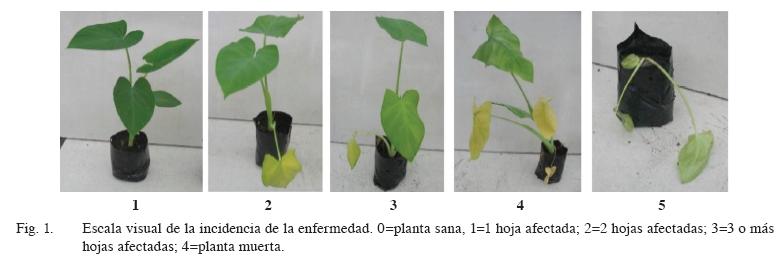
<body><![CDATA[aclimatadas. Siete d&iacute;as despu&eacute;s del transplante (ddt), se     inocul&oacute; el suelo con el pat&oacute;geno en los tratamientos     correspondientes. En cada pote se distribuy&oacute; 20 granos de arroz     colonizado con <span style="font-style: italic;">P. myriotylum</span>,     colocados en 5 puntos alrededor de las     plantas. Se observ&oacute; y evalu&oacute; el avance de la enfermedad y     se utiliz&oacute; como base, la presencia de s&iacute;ntomas en las     plantas, mediante la escala visual de severidad establecida en la     <a href="/img/revistas/ac/v34n1/a02i1.jpg">Figura 1</a>, la cual se     dise&ntilde;o espec&iacute;ficamente para el     ]]></body>
<body><![CDATA[ensayo. Se determin&oacute; la incidencia y la severidad como se     describe a continuaci&oacute;n. </span></font><br      style="font-family: verdana;">     <br style="font-family: verdana;">     <font size="2"><span style="font-family: verdana;">Incidencia=N&uacute;mero     de plantas     que presentan alg&uacute;n grado de     lesi&oacute;n por repetici&oacute;n.</span></font><br      style="font-family: verdana;">     <br style="font-family: verdana;">     ]]></body>
<body><![CDATA[<font size="2"><span style="font-family: verdana;">&Iacute;ndice de     severidad=&#8721;nigi/N,     donde: ni=n&uacute;mero de plantas     en la categor&iacute;a i, gi es el grado de la categor&iacute;a i.     N=n&uacute;mero total de plantas evaluadas por repetici&oacute;n.</span></font><br      style="font-family: verdana;">     <br style="font-family: verdana;">     <font size="2"><span style="font-family: verdana; font-weight: bold;">Reaislamiento     del pat&oacute;geno</span></font><br style="font-family: verdana;">     <br style="font-family: verdana;">     ]]></body>
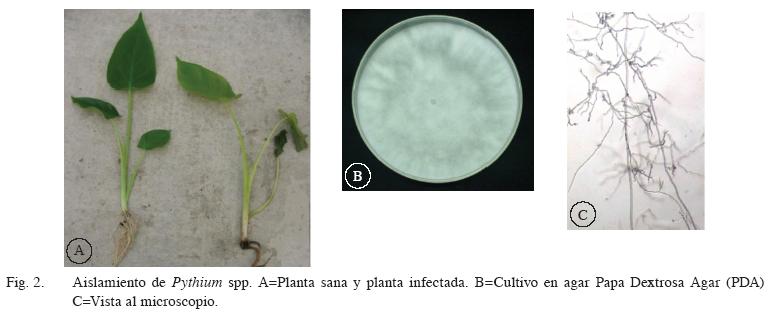
<body><![CDATA[<font size="2"><span style="font-family: verdana;">Para comprobar la     presencia del     pat&oacute;geno, 15 d&iacute;as     despu&eacute;s del transplante, se colocaron en agar agua secciones de     ra&iacute;z extra&iacute;das a partir de plantas que presentaron     s&iacute;ntomas de la enfermedad. Los platos se incubaron y se     observ&oacute; el crecimiento del pat&oacute;geno sobre el medio de     cultivo y al microscopio (<a href="/img/revistas/ac/v34n1/a02i2.jpg">Figura     2</a>), donde se identificaron las formas     y estructuras caracter&iacute;sticas de <span     ]]></body>
<body><![CDATA[ style="font-style: italic;">P. myriotylum</span>.<br      style="font-family: verdana;">     </span></font><br style="font-family: verdana;">     <font size="2"><span style="font-family: verdana; font-weight: bold;">An&aacute;lisis     estad&iacute;sticos</span></font><br style="font-family: verdana;">     <br style="font-family: verdana;">     <font size="2"><span style="font-family: verdana;">Para las variables     germinaci&oacute;n y longitud de la rad&iacute;cula     de pepino, se us&oacute; un dise&ntilde;o completamente al azar con 3     repeticiones y se realiz&oacute; an&aacute;lisis de varianza a las     ]]></body>
<body><![CDATA[variables utilizadas. La comparaci&oacute;n de medias se hizo en todos     los casos utilizando LSD Fisher (p=0,05). Para el an&aacute;lisis del     efecto de los diferentes abonos sobre la supresi&oacute;n de <span      style="font-style: italic;">Pythium</span> se     utiliz&oacute; un dise&ntilde;o irrestricto al azar con 9 tratamientos     y 4 repeticiones por tratamiento; cada repetici&oacute;n const&oacute;     de 4 plantas. A las variables incidencia y severidad se les     realiz&oacute; un an&aacute;lisis de varianza a los 3, 6 y 9     d&iacute;as. Para la separaci&oacute;n de medias se utiliz&oacute; LSD     Fisher (p=0,05).</span></font><br style="font-family: verdana;">     ]]></body>
<body><![CDATA[<br style="font-family: verdana;">     <font size="3"><span style="font-family: verdana; font-weight: bold;">Resultados     y discusi&oacute;n</span></font><br style="font-family: verdana;">     <br style="font-family: verdana;">     <font size="2"><span style="font-family: verdana; font-weight: bold;">Madurez,     estabilidad y actividad     microbiana de los abonos</span></font><br style="font-family: verdana;">     <br style="font-family: verdana;">     <font size="2"><span style="font-family: verdana;">Al comparar el     contenido de carbono     ]]></body>
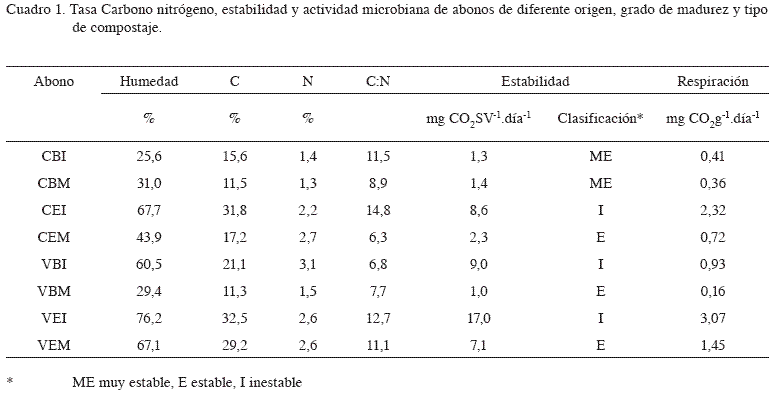
<body><![CDATA[en los distintos abonos, se     encontr&oacute; que este fue mayor en los abonos inmaduros que en los     abonos maduros (<a href="/img/revistas/ac/v34n1/a02t1.gif">Cuadro 1</a>),     lo cu&aacute;l se debe a que durante la     bioxidaci&oacute;n de los productos ocurre la p&eacute;rdida de CO<sub>2</sub>     (Paul y Clark 1996, Lazcano et al. 2008), principalmente por la     disminuci&oacute;n de compuestos carbonados f&aacute;cilmente     degradables (G&oacute;mez-Brand&oacute;n et al. 2008). El contenido de     N, por el contrario, fue similar entre abonos maduros e inmaduros del     mismo origen, con excepci&oacute;n del vermicompost de broza; esta     ]]></body>
<body><![CDATA[similitud se debe a que durante el proceso de compostaje, el N se     pierde a una tasa m&aacute;s baja que el carbono     (G&oacute;mez-Brand&oacute;n et al. 2008, Lazcano et al. 2008). Los     abonos a base de esti&eacute;rcol tuvieron contenidos de N m&aacute;s     altos que los abonos a base de broza (con excepci&oacute;n del VBI), ya     que el esti&eacute;rcol es un material naturalmente rico en N     (Zmora-Nahum et al. 2007). <br style="font-family: verdana;">     </span></font><br style="font-family: verdana;">     <font size="2"><span style="font-family: verdana;">Todos los abonos     estudiados     ]]></body>
<body><![CDATA[presentaron una tasa C/N menor de 20,     considerada apropiada para los abonos org&aacute;nicos (Paul and Clark     1996), ya que altas tasas C/N causan la inmovilizaci&oacute;n de N     (Chen and Inbar 1993, Paul and Clark 1996). En este trabajo, la tasa     C/N fue mayor en los compost inmaduros que en los compost maduros;     cuando el desecho org&aacute;nico es composteado, la tasa C:N     generalmente decrece y luego se estabiliza en el rango de 10 a 15     (Chefetz et al. 1996, Paul y Clark 1996, Lazcano et al. 2008). Si bien     la disminuci&oacute;n en la relaci&oacute;n C/N es un indicador     &uacute;til de la madurez del abono, debe utilizarse con     ]]></body>
<body><![CDATA[precauci&oacute;n y para cada compost por separado, ya que var&iacute;a     mucho de un compost a otro (Ouatmane et al. 2000). Esto es     particularmente importante en esti&eacute;rcoles en los que la     relaci&oacute;n C/N puede estar dentro de valores considerados como     maduros a pesar de que el proceso se encuentre en las etapas iniciales     de composteo (G&oacute;mez-Brandon et al. 2008). En el caso del     vermicompost, las lombrices modifican el estatus qu&iacute;mico y     f&iacute;sico de los residuos org&aacute;nicos, lo que reduce     gradualmente la tasa C/N (Dominguez et al. 1997). </span></font><br      style="font-family: verdana;">     ]]></body>
<body><![CDATA[<br style="font-family: verdana;">     <font size="2"><span style="font-family: verdana;">Como se observa en     el <a href="/img/revistas/ac/v34n1/a02t1.gif">Cuadro 1</a>, los     abonos maduros clasificaron como     estables y los inmaduros, con excepci&oacute;n del compost de broza     inmaduro, clasificaron como inestables. El compost a base de broza     inmaduro present&oacute; adem&aacute;s una actividad microbiana muy     baja, que puede deberse al bajo contenido de humedad presente en la     muestra de abono, o a que el abono haya sido recolectado en un     per&iacute;odo tard&iacute;o del proceso de maduraci&oacute;n ya que     ]]></body>
<body><![CDATA[seg&uacute;n los an&aacute;lisis qu&iacute;micos, se trata de un abono     cuyas caracter&iacute;sticas corresponden m&aacute;s a un abono maduro     (<a href="/img/revistas/ac/v34n1/a02t1.gif">Cuadro 1</a>). </span></font><br      style="font-family: verdana;">     <br style="font-family: verdana;">     <font size="2"><span style="font-family: verdana;">Cuando se     evalu&oacute; el efecto     de los extractos de los diferentes     abonos sobre la germinaci&oacute;n y la longitud de la rad&iacute;cula     de plantas de pepino, no se observ&oacute; diferencias significativas     ]]></body>
<body><![CDATA[en el porcentaje de germinaci&oacute;n (97,8%&plusmn;2,4) y la longitud     de la rad&iacute;cula (7,1 cm&plusmn;0,5), lo que indica que los abonos     no tuvieron un efecto fitot&oacute;xico sobre las plantas.</span></font><br      style="font-family: verdana;">     <br style="font-family: verdana;">     <font size="2"><span style="font-family: verdana; font-weight: bold;">Evaluaci&oacute;n     de la     supresividad de diferentes abonos sobre <span      style="font-style: italic;">Pythium     myriotylum</span> en invernadero</span></font><br     ]]></body>
<body><![CDATA[ style="font-family: verdana;">     <br style="font-family: verdana;">     <font size="2"><span style="font-family: verdana;">Las plantas de     tiquisque que no     fueron inoculadas con <span style="font-style: italic;">P. myriotylum</span>     no     presentaron s&iacute;ntomas de la enfermedad durante los 9 d&iacute;as     de evaluaci&oacute;n; tanto el suelo autoclavado como los abonos     utilizados, se encontraban libres de <span style="font-style: italic;">P.     myriotylum</span>. No se     ]]></body>
<body><![CDATA[observ&oacute; tampoco efecto fitot&oacute;xico sobre las plantas de     tiquisque (<a href="#cuadro2">Cuadro 2</a>), lo que concuerda con los     resultados obtenidos en     el bioensayo con plantas de pepino. Si bien no hubo diferencias entre     los abonos aplicados con respecto al control, las plantas a las que se     les adicion&oacute; compost de esti&eacute;rcol inmaduro (CEI)     presentaron un incremento en la altura significativamente mayor que las     plantas a las que se aplic&oacute; compost a base de broza, compost y     vermicompost de esti&eacute;rcol maduro (<a href="#cuadro2">Cuadro 2</a>).     Este efecto puede     ]]></body>
<body><![CDATA[deberse a la mayor cantidad de C en este abono inmaduro, as&iacute;     como a una mayor descomposici&oacute;n reflejada en la medida de     estabilidad del abono y que podr&iacute;a traducirse en un mayor aporte     de nutrientes.     <br>     <br>     <br> </span></font>     <div style="text-align: center;"><font size="2"><a name="cuadro2"></a><img  alt="" src="../img/a02t2.GIF" style="width: 379px; height: 411px;">    <br>     <span style="font-family: verdana;"></span></font><br     ]]></body>
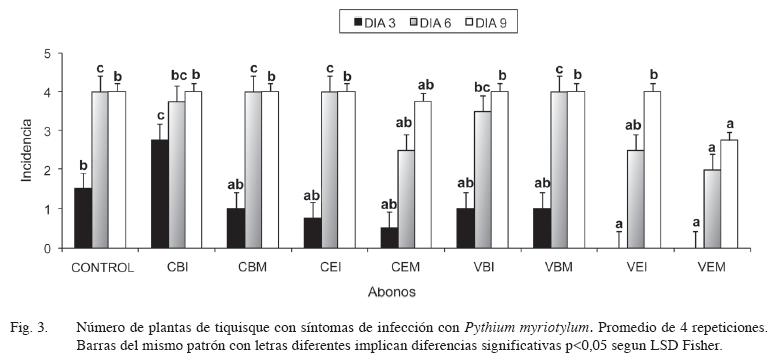
<body><![CDATA[ style="font-family: verdana;">     <font size="2"><span style="font-family: verdana;"></span></font></div>     <br style="font-family: verdana;">     <font size="2"><span style="font-family: verdana;">Las plantas     cultivadas en suelo sin     abono y luego inoculadas con el     pat&oacute;geno (tratamiento control), empezaron a mostrar     s&iacute;ntomas a partir del tercer d&iacute;a del transplante (<a      href="/img/revistas/ac/v34n1/a02i3.jpg">Figura     3</a>) y la enfermedad avanz&oacute; r&aacute;pidamente hasta producir     ]]></body>
<body><![CDATA[la     muerte de todas las plantas en el transcurso de una semana, lo que     indica que P. miriotylium present&oacute; un alto potencial de     patogenicidad sobre las planas de tiquisque y que el suelo autoclavado     utilizado en el experimento, no present&oacute; factores evidentes de     supresividad sobre el pat&oacute;geno. </span></font><br      style="font-family: verdana;">     <br style="font-family: verdana;">     <font size="2"><span style="font-family: verdana;">Los resultados     indican que a los 3     ]]></body>
<body><![CDATA[d&iacute;as despu&eacute;s de la     inoculaci&oacute;n (ddi), &uacute;nicamente los 2 tratamientos de     vermicompost a base de esti&eacute;rcol (VEI y VEM) no presentaron     plantas con s&iacute;ntomas de la enfermad y la incidencia fue     significativamente menor que el control (<a      href="/img/revistas/ac/v34n1/a02i3.jpg">Figura 3</a>). El tratamiento     CBI     present&oacute; una mayor incidencia de la enfermedad que los     tratamientos restantes. A los 6 ddi, los tratamientos CEM, VEI y VEM     tuvieron significativamente menos plantas enfermas que el tratamiento     ]]></body>
<body><![CDATA[control, mientras que a los 9 d&iacute;as solamente el tratamiento VEM     present&oacute; una menor incidencia que el control. </span></font><br      style="font-family: verdana;">     <br style="font-family: verdana;">     <font size="2"><span style="font-family: verdana;">En cuanto a la     severidad, en los     tratamientos enmendados con     vermicompost de esti&eacute;rcol (VEI, VEM), la severidad fue     significativamente menor que en el control; de manera contrastante, la     adici&oacute;n de compost de broza inmaduro (CBI) caus&oacute;, a los 3     ]]></body>
<body><![CDATA[d&iacute;as de la inoculaci&oacute;n, una severidad significativamente     mayor que dichos tratamientos (<a      href="/img/revistas/ac/v34n1/a02i4.jpg">Figura 4</a>). A los 6     d&iacute;as, el     tratamiento correspondiente al compost de esti&eacute;rcol maduro (CEM)     y los vermicompost a base de esti&eacute;rcol tanto maduro (VEM) como     inmaduro (VEI), fueron los que presentaron menor &iacute;ndice de     severidad. Al d&iacute;a 9 solamente los tratamientos VEM y CEM     presentaron una severidad significativamente menor que el tratamiento     control. </span></font><br style="font-family: verdana;">     ]]></body>
<body><![CDATA[<br style="font-family: verdana;">     <font size="2"><span style="font-family: verdana;">En t&eacute;rminos     generales, los     abonos a base de esti&eacute;rcol     fueron m&aacute;s supresivos para la enfermedad causada por <span      style="font-style: italic;">P.     myriotylum</span>, que los abonos a base de broza de caf&eacute;, lo     que     podr&iacute;a deberse a que los abonos de esti&eacute;rcol presentaron     una mayor actividad microbiana que los abonos a base de broza;     ]]></body>
<body><![CDATA[as&iacute;, su adici&oacute;n al suelo podr&iacute;a crear un ambiente     de alta actividad microbiana, donde los microorganismos compiten por     nutrientes y/o producen antibi&oacute;ticos que reducen la     sobrevivencia y crecimiento del pat&oacute;geno (Hoitink et al. 1997,     Di&aacute;nez et al. 2007). El uso de abonos org&aacute;nicos provee,     en este trabajo, un in&oacute;culo microbiano que puede aportar un     factor supresivo al suelo autoclavado e inoculado con <span      style="font-style: italic;">Pythium</span>. Este     tipo de supresi&oacute;n, debida a la competencia con microorganismos     presentes en el compost, es especialmente importante en el caso de     ]]></body>
<body><![CDATA[pat&oacute;genos con prop&aacute;gulos peque&ntilde;os como <span      style="font-style: italic;">Pythium</span> y     <span style="font-style: italic;">Phytophthora</span> que, al tener     pocas reservas, requieren de fuentes     externas de C y otros nutrientes y por lo tanto se ven afectados por la     competencia con las altas poblaciones de microorganismos presentes en     el compost (Hoitink et al. 1997, Di&aacute;nez et al. 2007). En forma     concordante, van Os et al. (2001), en estudios realizados con <span      style="font-style: italic;">Pythium     macrosporum</span>, encontraron que una alta biomasa y actividad     ]]></body>
<body><![CDATA[microbiana     indujeron la supresi&oacute;n de crecimiento de <span      style="font-style: italic;">Pythium</span>. En este mismo     sentido Craft y Nelson (1996) indican que altas poblaciones de     microorganismos, hongos y actinomicetos presentes en el compost, fueron     los agentes supresivos en la enfermedad &#8220;dampingoff&#8221; causada por     <span style="font-style: italic;">Pythium graminicola</span>. Adiobo     (2006) encontr&oacute; que la supresividad     de 3 tipos de compost sobre <span style="font-style: italic;">P.     myriotylum</span> se perdi&oacute; al     ]]></body>
<body><![CDATA[autoclavar los abonos y que fue parcialmente recuperada al restaurar la     microflora original ya que inocul&oacute; los abonos con     peque&ntilde;as cantidades del abono no tratado. Adem&aacute;s, el     compost que present&oacute; una mayor supresividad fue el que contuvo     una mayor cantidad de microorganismos. </span></font><br      style="font-family: verdana;">     <br style="font-family: verdana;">     <font size="2"><span style="font-family: verdana;">Adicionalmente, en     el rumen de     herb&iacute;voros, en el     ]]></body>
<body><![CDATA[esti&eacute;rcol y en abonos org&aacute;nicos a base de     esti&eacute;rcol, se encuentran altas poblaciones de microorganismos     celulol&iacute;ticos (Varel y Dehority 1989, Galindo et al. 2008);     estos microorganismos producen celulasas, enzimas que son especialmente     importantes en la degradaci&oacute;n de la pared celular de oomycetes     tales como <span style="font-style: italic;">Pythium</span>,     constituida principalmente por celulosa y beta     glucanos (Inglis y Kawchuk 2002, El-Tarabily 2006, Rossman y Palm     2006). Los abonos de origen animal han sido utilizados como fuente de     microorganismos celulol&iacute;ticos para la degradaci&oacute;n de     ]]></body>
<body><![CDATA[broza, residuos animales (Kim et al. 2004, Terry et al. 2004) y como     fuente de microorganismos supresores de <span      style="font-style: italic;">Pythium</span> (Inglis y Kawchuk     2002). </span></font><br style="font-family: verdana;">     <br style="font-family: verdana;">     <font size="2"><span style="font-family: verdana;">Al respecto, Ringer     et al. (1997)     encontraron que abonos obtenidos de     diferentes tipos de desechos animales presentaron supresividad hacia     <span style="font-style: italic;">Pythium</span> y <span     ]]></body>
<body><![CDATA[ style="font-style: italic;">Rhizoctonia</span>.     Espec&iacute;ficamente, compost obtenidos de     esti&eacute;rcol de vaca causaron una mayor supresi&oacute;n sobre     <span style="font-style: italic;">Pythium</span>. Mora et al. 1987 en     el dise&ntilde;o de un manejo integrado de     la tristeza del aguacate, causada por <span style="font-style: italic;">Phytophthora     cinamoni</span>,     encontraron que los tratamientos en los que se aplic&oacute;     esti&eacute;rcoles presentaron la menor cantidad de aislamientos de     <span style="font-style: italic;">Phytophthora</span>, mayor peso seco     ]]></body>
<body><![CDATA[de ra&iacute;ces, mejor apariencia de     follaje y mayor producci&oacute;n de frutos; estos tratamientos     exhibieron los niveles mas bajos de incidencia de la enfermedad. Los     autores sugieren que el esti&eacute;rcol induce supresividad del hongo,     aumenta el n&uacute;mero de hongos y bacterias antag&oacute;nicas y el     contenido de nutrientes de los suelos. Asi mismo,     Rodr&iacute;guez-Guzm&aacute;n et al. 1992 encontraron para este mismo     cultivo que la aplicaci&oacute;n de esti&eacute;rcol disminuy&oacute;     la poblaci&oacute;n de <span style="font-style: italic;">Phytophthora</span>     y <span style="font-style: italic;">Pythium</span>, la incidencia de     ]]></body>
<body><![CDATA[la     enfermedad y aument&oacute; el desarrollo radical del hospedero     present&aacute;ndose, con la adici&oacute;n del esti&eacute;rcol,     condiciones similares a los obtenidos en suelos supresivos.</span></font><br      style="font-family: verdana;">     <br style="font-family: verdana;">     <font size="2"><span style="font-family: verdana;">Un factor a     considerar en el uso de     abonos para el control de     enfermedades es que abonos maduros muy estabilizados podr&iacute;an     ]]></body>
<body><![CDATA[tener poblaciones de microorganismos poco activas y con poco efecto     supresor como en el caso de CBM y el VBM, o una capacidad limitada para     sostener la actividad de la biomasa microbiana en el suelo (Hoitink et     al. 1993, Su&aacute;rez-Estrella et al. 2007). Zmora-Nahum et al.     (2008), analiz&oacute; el efecto del proceso de maduraci&oacute;n sobre     3 tipos de compost supresivos contra <span style="font-style: italic;">Slerotium     rolfsii</span> y <span style="font-style: italic;">Pythium     aphanidermatum</span> y encontraron que la p&eacute;rdida de     supresi&oacute;n     se asoci&oacute; entre otros, a una disminuci&oacute;n en la actividad     ]]></body>
<body><![CDATA[microbiana. De acuerdo con Hoitink et al. (1997), el compost demasiado     estabilizado no mantiene poblaciones de biocontroladores eficaces y no     es por lo tanto adecuado para la supresi&oacute;n de enfermedades. </span></font><br      style="font-family: verdana;">     <br style="font-family: verdana;">     <font size="2"><span style="font-family: verdana;">Los abonos     org&aacute;nicos     var&iacute;an en su efecto para suprimir     enfermedades de la planta. En la presente investigaci&oacute;n, los     abonos obtenidos a partir de esti&eacute;rcol fueron m&aacute;s     ]]></body>
<body><![CDATA[supresivos, posiblemente por una mayor actividad microbiana, que los     producidos a base de broza de caf&eacute;. Se concluye que el     vermicompost a base de esti&eacute;rcol de vaca tiene un efecto     supresivo sobre el sistema Tiquisque -<span style="font-style: italic;">P.     myriotylum</span>, por lo que debe     investigarse el origen de esta supresividad. En investigaciones futuras     se debe evaluar el uso de proporciones mayores de abono, las cuales     podr&iacute;an mejorar el nivel de supresi&oacute;n obtenido.</span></font><br      style="font-family: verdana;">     <br style="font-family: verdana; font-weight: bold;">     ]]></body>
<body><![CDATA[<div style="text-align: justify;"><font size="3"><span  style="font-family: verdana; font-weight: bold;">Agradecimientos</span></font><br  style="font-family: verdana;"> <br style="font-family: verdana;"> <font size="2"><span style="font-family: verdana;">Este trabajo se financi&oacute; con fondos de los proyectos 230-04-FI. Uso de abonos org&aacute;nicos para el control de enfermedades de importancia agr&iacute;cola, Fondo de Incentivos MICIT-CONICIT y VI 733-A5-008, Vicerrector&iacute;a de Investigaci&oacute;n, Universidad de Costa Rica.</span></font><br style="font-family: verdana;"> </div> </div>     <!-- ref --><div style="text-align: justify;"><br style="font-family: verdana;"> <font size="3"><span style="font-family: verdana; font-weight: bold;"></span></font> &nbsp;&nbsp;&nbsp;&nbsp;&nbsp;&nbsp;&nbsp;&nbsp;[&#160;<a href="javascript:void(0);" onclick="javascript: window.open('/scielo.php?script=sci_nlinks&ref=284693&pid=S0377-9424201000010000200001&lng=','','width=640,height=500,resizable=yes,scrollbars=1,menubar=yes,');">Links</a>&#160;]<!-- end-ref --><!-- ref --></span></font><br  style="font-family: verdana;"> <br style="font-family: verdana;"> <font size="2"><span style="font-family: verdana;">Adiobo A. 2006. Biological control of cocoyam (<span style="font-style: italic;">Xanthosoma sagittifolium</span> (L.) Schott) root rot disease caused by <span  style="font-style: italic;">Pythium myriotylum</span> Dreschl.: importance of soil organic matter content and cultural practices. Tesis de doctorado, Universidad de Gante, Flandes, B&eacute;lgica. 181 p.    &nbsp;&nbsp;&nbsp;&nbsp;&nbsp;&nbsp;&nbsp;&nbsp;[&#160;<a href="javascript:void(0);" onclick="javascript: window.open('/scielo.php?script=sci_nlinks&ref=284694&pid=S0377-9424201000010000200002&lng=','','width=640,height=500,resizable=yes,scrollbars=1,menubar=yes,');">Links</a>&#160;]<!-- end-ref --><!-- ref --></span></font><br  style="font-family: verdana;"> <br style="font-family: verdana;"> <font size="2"><span style="font-family: verdana;">Anderson J. 1982. Soil Respiration, pp. 831-895. In: A. Page, R. Miller y D. Keeney (eds). Methods of Soil Analysis. Part 2: Chemical and Microbiological Properties. Soil Science Soc. Am. Inc.    &nbsp;&nbsp;&nbsp;&nbsp;&nbsp;&nbsp;&nbsp;&nbsp;[&#160;<a href="javascript:void(0);" onclick="javascript: window.open('/scielo.php?script=sci_nlinks&ref=284695&pid=S0377-9424201000010000200003&lng=','','width=640,height=500,resizable=yes,scrollbars=1,menubar=yes,');">Links</a>&#160;]<!-- end-ref --><!-- ref --> </span></font><br  style="font-family: verdana;"> <br style="font-family: verdana;"> <font size="2"><span style="font-family: verdana;">Arauz L.F. 1998. Fitopatolog&iacute;a, un enfoque agroecol&oacute;gico. Editorial de la Universidad de Costa Rica, Costa Rica. 467 p.    &nbsp;&nbsp;&nbsp;&nbsp;&nbsp;&nbsp;&nbsp;&nbsp;[&#160;<a href="javascript:void(0);" onclick="javascript: window.open('/scielo.php?script=sci_nlinks&ref=284696&pid=S0377-9424201000010000200004&lng=','','width=640,height=500,resizable=yes,scrollbars=1,menubar=yes,');">Links</a>&#160;]<!-- end-ref --><!-- ref --></span></font><br  style="font-family: verdana;"> <br style="font-family: verdana;"> <font size="2"><span style="font-family: verdana;">Atlas R.M., Bartha R. 2002. Ecolog&iacute;a microbiana y microbiolog&iacute;a ambiental. 4&ordm; edici&oacute;n en espa&ntilde;ol. Pearson Educaci&oacute;n S.A, Madrid. 677 p.    &nbsp;&nbsp;&nbsp;&nbsp;&nbsp;&nbsp;&nbsp;&nbsp;[&#160;<a href="javascript:void(0);" onclick="javascript: window.open('/scielo.php?script=sci_nlinks&ref=284697&pid=S0377-9424201000010000200005&lng=','','width=640,height=500,resizable=yes,scrollbars=1,menubar=yes,');">Links</a>&#160;]<!-- end-ref --><!-- ref --></span></font><br  style="font-family: verdana;"> <br style="font-family: verdana;"> <font size="2"><span style="font-family: verdana;">Bollen G.J. 1993. Factors involved in inactivation of plant pathogens during composting of crop residues, pp. 301-318. In: H.A.J. Hoitink y H.M. Keener (eds).</span></font><font size="2"><span  style="font-family: verdana;"> Science and Engineering of Composting: Design, Environmental, Microbiological and Utilization Aspects. Renaissance Publications.    &nbsp;&nbsp;&nbsp;&nbsp;&nbsp;&nbsp;&nbsp;&nbsp;[&#160;<a href="javascript:void(0);" onclick="javascript: window.open('/scielo.php?script=sci_nlinks&ref=284698&pid=S0377-9424201000010000200006&lng=','','width=640,height=500,resizable=yes,scrollbars=1,menubar=yes,');">Links</a>&#160;]<!-- end-ref --><!-- ref --></span></font><br  style="font-family: verdana;"> <br style="font-family: verdana;"> <font size="2"><span style="font-family: verdana;">Bonanomi G., Antignani V., Pane C., Scala F. 2007. Suppression of soilborne fungal diseases with organic amendments. Journal of Plant Pathology 89:311-324.    &nbsp;&nbsp;&nbsp;&nbsp;&nbsp;&nbsp;&nbsp;&nbsp;[&#160;<a href="javascript:void(0);" onclick="javascript: window.open('/scielo.php?script=sci_nlinks&ref=284699&pid=S0377-9424201000010000200007&lng=','','width=640,height=500,resizable=yes,scrollbars=1,menubar=yes,');">Links</a>&#160;]<!-- end-ref --><!-- ref --></span></font><br style="font-family: verdana;"> <br style="font-family: verdana;"> <font size="2"><span style="font-family: verdana;">Bremner J.M., Tabatabai M.A. 1971. Use of automated combustion techniques for total carbon, total nitrogen and total sulphur analysis of soil, pp. 1-16. In: L.M. Walsh (ed). Instrumental Methods for Analysis of Soils and Plant Tissue. Soil Science Society of America.    &nbsp;&nbsp;&nbsp;&nbsp;&nbsp;&nbsp;&nbsp;&nbsp;[&#160;<a href="javascript:void(0);" onclick="javascript: window.open('/scielo.php?script=sci_nlinks&ref=284700&pid=S0377-9424201000010000200008&lng=','','width=640,height=500,resizable=yes,scrollbars=1,menubar=yes,');">Links</a>&#160;]<!-- end-ref --><!-- ref --></span></font><br  style="font-family: verdana;"> <br style="font-family: verdana;"> <font size="2"><span style="font-family: verdana;">Chefetz B., Hatcher P.G., Hadar Y., Chen Y. 1996. Chemical and biological characterization of organic matter during composting of municipal solid waste. Journal of Environment Quality 25:776-785.    &nbsp;&nbsp;&nbsp;&nbsp;&nbsp;&nbsp;&nbsp;&nbsp;[&#160;<a href="javascript:void(0);" onclick="javascript: window.open('/scielo.php?script=sci_nlinks&ref=284701&pid=S0377-9424201000010000200009&lng=','','width=640,height=500,resizable=yes,scrollbars=1,menubar=yes,');">Links</a>&#160;]<!-- end-ref --><!-- ref --></span></font><br  style="font-family: verdana;"> <br style="font-family: verdana;"> <font size="2"><span style="font-family: verdana;">Chen Y., Inbar Y. 1993. Chemical and spectroscopical analyses of organic matter transformations during composting in relation to compost maturity, pp. 551-600. In: H.A.J. Hoitink y H.M. Keener (eds). Science and Engineering of Composting: Design,</span></font><font size="2"><span  style="font-family: verdana;"> Environmental, Microbiological and Utilization Aspects. Renaissance Pubblications.    &nbsp;&nbsp;&nbsp;&nbsp;&nbsp;&nbsp;&nbsp;&nbsp;[&#160;<a href="javascript:void(0);" onclick="javascript: window.open('/scielo.php?script=sci_nlinks&ref=284702&pid=S0377-9424201000010000200010&lng=','','width=640,height=500,resizable=yes,scrollbars=1,menubar=yes,');">Links</a>&#160;]<!-- end-ref --><!-- ref --></span></font><br style="font-family: verdana;"> <br style="font-family: verdana;"> <font size="2"><span style="font-family: verdana;">Composting Council Research and Education Foundation (CCREF) 2001.Test Methods for the Examination of Composting and Compost (TMECC). Disco compacto. Houston, USA. United States Composting Council (USCC), USDA. 2001, August 21.    &nbsp;&nbsp;&nbsp;&nbsp;&nbsp;&nbsp;&nbsp;&nbsp;[&#160;<a href="javascript:void(0);" onclick="javascript: window.open('/scielo.php?script=sci_nlinks&ref=284703&pid=S0377-9424201000010000200011&lng=','','width=640,height=500,resizable=yes,scrollbars=1,menubar=yes,');">Links</a>&#160;]<!-- end-ref --><!-- ref --></span></font><br style="font-family: verdana;"> <br style="font-family: verdana;"> <font size="2"><span style="font-family: verdana;">Craft C., Nelson E. 1996. Microbial properties of composts that suppress damping-off and root rot of creeping bentgrass caused by <span style="font-style: italic;">Pythium graminicola</span>. Applied and Environmental Microbiology 62:1550- 1557.    &nbsp;&nbsp;&nbsp;&nbsp;&nbsp;&nbsp;&nbsp;&nbsp;[&#160;<a href="javascript:void(0);" onclick="javascript: window.open('/scielo.php?script=sci_nlinks&ref=284704&pid=S0377-9424201000010000200012&lng=','','width=640,height=500,resizable=yes,scrollbars=1,menubar=yes,');">Links</a>&#160;]<!-- end-ref --><!-- ref --></span></font><br style="font-family: verdana;"> <br style="font-family: verdana;"> <font size="2"><span style="font-family: verdana;">Danon M., Zmora-nahum S., Chen Y., Hadar Y. 2007. Prolonged compost curing reduces suppression of <span style="font-style: italic;">Sclerotium rolfsii</span>. Soil Biology and Biochemistry</span></font><font size="2"><span  style="font-family: verdana;"> 39:1936&#8211;1946.    &nbsp;&nbsp;&nbsp;&nbsp;&nbsp;&nbsp;&nbsp;&nbsp;[&#160;<a href="javascript:void(0);" onclick="javascript: window.open('/scielo.php?script=sci_nlinks&ref=284705&pid=S0377-9424201000010000200013&lng=','','width=640,height=500,resizable=yes,scrollbars=1,menubar=yes,');">Links</a>&#160;]<!-- end-ref --><!-- ref --> </span></font><br  style="font-family: verdana;"> <br style="font-family: verdana;"> <font size="2"><span style="font-family: verdana;">Di&aacute;nez F., Santos M., Tello J.C. 2007. Suppressive effects of grape marc compost on phytopathogenic oomycetes. Archives of Phytopathology and Plant</span></font><font size="2"><span  style="font-family: verdana;"> Protection 40:1-18.    &nbsp;&nbsp;&nbsp;&nbsp;&nbsp;&nbsp;&nbsp;&nbsp;[&#160;<a href="javascript:void(0);" onclick="javascript: window.open('/scielo.php?script=sci_nlinks&ref=284706&pid=S0377-9424201000010000200014&lng=','','width=640,height=500,resizable=yes,scrollbars=1,menubar=yes,');">Links</a>&#160;]<!-- end-ref --><!-- ref --> </span></font><br  style="font-family: verdana;"> <br style="font-family: verdana;"> <font size="2"><span style="font-family: verdana;">Dom&iacute;nguez J., Edwards C.A., Subler S. 1997. A comparison of composting and vermicomposting. BioCycle: 57-59.    &nbsp;&nbsp;&nbsp;&nbsp;&nbsp;&nbsp;&nbsp;&nbsp;[&#160;<a href="javascript:void(0);" onclick="javascript: window.open('/scielo.php?script=sci_nlinks&ref=284707&pid=S0377-9424201000010000200015&lng=','','width=640,height=500,resizable=yes,scrollbars=1,menubar=yes,');">Links</a>&#160;]<!-- end-ref --><!-- ref --></span></font><br  style="font-family: verdana;"> <br style="font-family: verdana;"> <font size="2"><span style="font-family: verdana;">El-Tarabily K.A. 2006. Rhizosphere-competent isolates of streptomycete and non-streptomycete actinomycetes capable of producing cellwall-degrading enzymes to control <span style="font-style: italic;">Pythium aphanidermatum</span> damping-off disease of cucumber. Canadian Journal of Botany 84:211-222.    &nbsp;&nbsp;&nbsp;&nbsp;&nbsp;&nbsp;&nbsp;&nbsp;[&#160;<a href="javascript:void(0);" onclick="javascript: window.open('/scielo.php?script=sci_nlinks&ref=284708&pid=S0377-9424201000010000200016&lng=','','width=640,height=500,resizable=yes,scrollbars=1,menubar=yes,');">Links</a>&#160;]<!-- end-ref --><!-- ref --></span></font><br  style="font-family: verdana;"> <br style="font-family: verdana;"> <font size="2"><span style="font-family: verdana;">Erhart E., Burian K. 1997. Evaluating quality and suppressiveness of Austrian biowaste composts. Compost Science and Utilization 5:15-25.    &nbsp;&nbsp;&nbsp;&nbsp;&nbsp;&nbsp;&nbsp;&nbsp;[&#160;<a href="javascript:void(0);" onclick="javascript: window.open('/scielo.php?script=sci_nlinks&ref=284709&pid=S0377-9424201000010000200017&lng=','','width=640,height=500,resizable=yes,scrollbars=1,menubar=yes,');">Links</a>&#160;]<!-- end-ref --><!-- ref --></span></font><br  style="font-family: verdana;"> <br style="font-family: verdana;"> <font size="2"><span style="font-family: verdana;">Galindo J., Gonz&aacute;lez N., Delgado D., Sosa A., Marrero Y., Gonz&aacute;lez R., Aldana A.I., Moreira O. 2008. Efecto modulador de Leucaena leucocephala sobre la microbiota ruminal. Zootecnia Tropical 26(3):249-252.    &nbsp;&nbsp;&nbsp;&nbsp;&nbsp;&nbsp;&nbsp;&nbsp;[&#160;<a href="javascript:void(0);" onclick="javascript: window.open('/scielo.php?script=sci_nlinks&ref=284710&pid=S0377-9424201000010000200018&lng=','','width=640,height=500,resizable=yes,scrollbars=1,menubar=yes,');">Links</a>&#160;]<!-- end-ref --><!-- ref --></span></font><br style="font-family: verdana;"> <br style="font-family: verdana;"> <font size="2"><span style="font-family: verdana;">Garcia C., Pascal J.A., Mena E., Hern&aacute;ndez T. 2004. Influence of the stabilisation of organic materials on their biopesticide effect in soils. Bioresource Technology 95:215-221.    &nbsp;&nbsp;&nbsp;&nbsp;&nbsp;&nbsp;&nbsp;&nbsp;[&#160;<a href="javascript:void(0);" onclick="javascript: window.open('/scielo.php?script=sci_nlinks&ref=284711&pid=S0377-9424201000010000200019&lng=','','width=640,height=500,resizable=yes,scrollbars=1,menubar=yes,');">Links</a>&#160;]<!-- end-ref --><!-- ref --></span></font><br  style="font-family: verdana;"> <br style="font-family: verdana;"> <font size="2"><span style="font-family: verdana;">G&oacute;mez L. 1993. El &#8220;mal seco&#8221; del tiquisque. Taller Aplicaciones de la biotecnolog&iacute;a en ra&iacute;ces, tub&eacute;rculos y pejibaye. Cultivo de Tejidos. Centro de Investigaciones Agron&oacute;micas. Universidad de Costa Rica. s.p.    &nbsp;&nbsp;&nbsp;&nbsp;&nbsp;&nbsp;&nbsp;&nbsp;[&#160;<a href="javascript:void(0);" onclick="javascript: window.open('/scielo.php?script=sci_nlinks&ref=284712&pid=S0377-9424201000010000200020&lng=','','width=640,height=500,resizable=yes,scrollbars=1,menubar=yes,');">Links</a>&#160;]<!-- end-ref --><!-- ref --></span></font><br  style="font-family: verdana;"> <br style="font-family: verdana;"> <font size="2"><span style="font-family: verdana;">G&oacute;mez-Brand&oacute;n M., Lazcano C., Dom&iacute;ngez J. 2008. The evaluation of stability and maturity during the composting of cattle manure. Chemosphere 70:436-444.    &nbsp;&nbsp;&nbsp;&nbsp;&nbsp;&nbsp;&nbsp;&nbsp;[&#160;<a href="javascript:void(0);" onclick="javascript: window.open('/scielo.php?script=sci_nlinks&ref=284713&pid=S0377-9424201000010000200021&lng=','','width=640,height=500,resizable=yes,scrollbars=1,menubar=yes,');">Links</a>&#160;]<!-- end-ref --><!-- ref --></span></font><br  style="font-family: verdana;"> <br style="font-family: verdana;"> <font size="2"><span style="font-family: verdana;">Hoitink H.A.J., Boehm M.J. 2001. Control biol&oacute;gico en comunidades microbianas del suelo: un fen&oacute;meno de dependencia de sustrato FORO. Manejo Integrado de Plagas (Costa Rica) N&deg;. 62 p 4-17.    &nbsp;&nbsp;&nbsp;&nbsp;&nbsp;&nbsp;&nbsp;&nbsp;[&#160;<a href="javascript:void(0);" onclick="javascript: window.open('/scielo.php?script=sci_nlinks&ref=284714&pid=S0377-9424201000010000200022&lng=','','width=640,height=500,resizable=yes,scrollbars=1,menubar=yes,');">Links</a>&#160;]<!-- end-ref --><!-- ref --></span></font><br style="font-family: verdana;"> <br style="font-family: verdana;"> <font size="2"><span style="font-family: verdana;">Hoitink H.A.J., Boehm M.J., Hadar Y. 1993. Mechanisms of suppression of soilborne plant pathogens in composts-amended substrates, pp. 601-621. In: H.A.J. Hoitink y H.M. Keener (eds). Science and Engineering of Composting: Design, Environmental, Microbiological and Utilization Aspects. Renaissance Pubblications.    &nbsp;&nbsp;&nbsp;&nbsp;&nbsp;&nbsp;&nbsp;&nbsp;[&#160;<a href="javascript:void(0);" onclick="javascript: window.open('/scielo.php?script=sci_nlinks&ref=284715&pid=S0377-9424201000010000200023&lng=','','width=640,height=500,resizable=yes,scrollbars=1,menubar=yes,');">Links</a>&#160;]<!-- end-ref --><!-- ref --></span></font><br  style="font-family: verdana;"> <br style="font-family: verdana;"> <font size="2"><span style="font-family: verdana;">Hoitink H.A.J., Grebus M. 1994. Status of biological control of plant diseases with composts. Compost Science and Utilization 2:6-12.    &nbsp;&nbsp;&nbsp;&nbsp;&nbsp;&nbsp;&nbsp;&nbsp;[&#160;<a href="javascript:void(0);" onclick="javascript: window.open('/scielo.php?script=sci_nlinks&ref=284716&pid=S0377-9424201000010000200024&lng=','','width=640,height=500,resizable=yes,scrollbars=1,menubar=yes,');">Links</a>&#160;]<!-- end-ref --><!-- ref --></span></font><br  style="font-family: verdana;"> <br style="font-family: verdana;"> <font size="2"><span style="font-family: verdana;">Hoitink H.A.J., Stone A.G., Han D.Y. 1997. Supresi&oacute;n de enfermedades mediante compost. Agronom&iacute;a Costarricense 21(1):25-33.    &nbsp;&nbsp;&nbsp;&nbsp;&nbsp;&nbsp;&nbsp;&nbsp;[&#160;<a href="javascript:void(0);" onclick="javascript: window.open('/scielo.php?script=sci_nlinks&ref=284717&pid=S0377-9424201000010000200025&lng=','','width=640,height=500,resizable=yes,scrollbars=1,menubar=yes,');">Links</a>&#160;]<!-- end-ref --><!-- ref --></span></font><br style="font-family: verdana;"> <br style="font-family: verdana;"> <font size="2"><span style="font-family: verdana;">Huber D.M. 1980. The role of mineral nutrition in disease, pp. 381-406. In: J.G. Horsfall y E.B. Cowling (eds). Plant Disease, an Advanced Treatise Vol 3. Academic Press.    &nbsp;&nbsp;&nbsp;&nbsp;&nbsp;&nbsp;&nbsp;&nbsp;[&#160;<a href="javascript:void(0);" onclick="javascript: window.open('/scielo.php?script=sci_nlinks&ref=284718&pid=S0377-9424201000010000200026&lng=','','width=640,height=500,resizable=yes,scrollbars=1,menubar=yes,');">Links</a>&#160;]<!-- end-ref --><!-- ref --></span></font><br  style="font-family: verdana;"> <br style="font-family: verdana;"> <font size="2"><span style="font-family: verdana;">Huber D.M. 1991. The use of fertilizers and organic amendments in the control of plant disease, pp. 405-494. In: D. Pimentel (ed). Handbook of Pest Management in Agriculture. CRC Press.    &nbsp;&nbsp;&nbsp;&nbsp;&nbsp;&nbsp;&nbsp;&nbsp;[&#160;<a href="javascript:void(0);" onclick="javascript: window.open('/scielo.php?script=sci_nlinks&ref=284719&pid=S0377-9424201000010000200027&lng=','','width=640,height=500,resizable=yes,scrollbars=1,menubar=yes,');">Links</a>&#160;]<!-- end-ref --><!-- ref --></span></font><br  style="font-family: verdana;"> <br style="font-family: verdana;"> <font size="2"><span style="font-family: verdana;">Inglis G.D., Kawchuk L.M. 2002. Comparative degradation of oomycete, ascomycete, and basidiomycete cell walls by mycoparasitic and biocontrol fungi. Canadian Journal of Microbiology 48:60-70.    &nbsp;&nbsp;&nbsp;&nbsp;&nbsp;&nbsp;&nbsp;&nbsp;[&#160;<a href="javascript:void(0);" onclick="javascript: window.open('/scielo.php?script=sci_nlinks&ref=284720&pid=S0377-9424201000010000200028&lng=','','width=640,height=500,resizable=yes,scrollbars=1,menubar=yes,');">Links</a>&#160;]<!-- end-ref --><!-- ref --></span></font><br  style="font-family: verdana;"> <br style="font-family: verdana;"> <font size="2"><span style="font-family: verdana;">Kim T.I., Jeong K.H., Ham J.S., Yang C.B., Chung I.B., Kim M.K., Kim K.N. 2004. Isolation and characterization of cellulase secreting bacterium from cattle manure: Application to Composting. Compost Science &amp; Utilization 12:242-248.    &nbsp;&nbsp;&nbsp;&nbsp;&nbsp;&nbsp;&nbsp;&nbsp;[&#160;<a href="javascript:void(0);" onclick="javascript: window.open('/scielo.php?script=sci_nlinks&ref=284721&pid=S0377-9424201000010000200029&lng=','','width=640,height=500,resizable=yes,scrollbars=1,menubar=yes,');">Links</a>&#160;]<!-- end-ref --><!-- ref --></span></font><br  style="font-family: verdana;"> <br style="font-family: verdana;"> <font size="2"><span style="font-family: verdana;">Laguna I., Salazar L., L&oacute;pez J. 1983. Enfermedades fungosas y bacterianas de ar&aacute;ceas: <span style="font-style: italic;">Xanthosoma </span>spp. y <span style="font-style: italic;">Colocasia esculenta</span> (L.) Schott en Costa Rica. Turrialba, Costa Rica. CATIE. 32 p.    &nbsp;&nbsp;&nbsp;&nbsp;&nbsp;&nbsp;&nbsp;&nbsp;[&#160;<a href="javascript:void(0);" onclick="javascript: window.open('/scielo.php?script=sci_nlinks&ref=284722&pid=S0377-9424201000010000200030&lng=','','width=640,height=500,resizable=yes,scrollbars=1,menubar=yes,');">Links</a>&#160;]<!-- end-ref --><!-- ref --></span></font><br  style="font-family: verdana;"> <br style="font-family: verdana;"> <font size="2"><span style="font-family: verdana;">Lazcano C., G&oacute;mez-Brand&oacute;n M., Dom&iacute;ngez J. 2008. Comparison of the effectiveness of composting and vermicomposting for the biological stabilization</span></font><font size="2"><span  style="font-family: verdana;"> of cattle manure. Chemosphere 72:1013-1019.    &nbsp;&nbsp;&nbsp;&nbsp;&nbsp;&nbsp;&nbsp;&nbsp;[&#160;<a href="javascript:void(0);" onclick="javascript: window.open('/scielo.php?script=sci_nlinks&ref=284723&pid=S0377-9424201000010000200031&lng=','','width=640,height=500,resizable=yes,scrollbars=1,menubar=yes,');">Links</a>&#160;]<!-- end-ref --><!-- ref --></span></font><br style="font-family: verdana;"> <br style="font-family: verdana;"> <font size="2"><span style="font-family: verdana;">Lievens B., VAES K., Coosemans J., Ryckeboer J. 2001. Systemic resistance induced in cucumber against <span  style="font-style: italic;">Pythium</span> root rot by source separated household waste and yard trimmings composts. Compost Science and Utilization 9:221-229.    &nbsp;&nbsp;&nbsp;&nbsp;&nbsp;&nbsp;&nbsp;&nbsp;[&#160;<a href="javascript:void(0);" onclick="javascript: window.open('/scielo.php?script=sci_nlinks&ref=284724&pid=S0377-9424201000010000200032&lng=','','width=640,height=500,resizable=yes,scrollbars=1,menubar=yes,');">Links</a>&#160;]<!-- end-ref --><!-- ref --></span></font><br  style="font-family: verdana;"> <br style="font-family: verdana;"> <font size="2"><span style="font-family: verdana;">Malandraki I., Tjamos S.E., Pantelides I.S., Paplomatas E.J. 2008. Thermal inactivation of compost suppressiveness implicates possible biological factors in disease management. Biological Control 44:180-187.    &nbsp;&nbsp;&nbsp;&nbsp;&nbsp;&nbsp;&nbsp;&nbsp;[&#160;<a href="javascript:void(0);" onclick="javascript: window.open('/scielo.php?script=sci_nlinks&ref=284725&pid=S0377-9424201000010000200033&lng=','','width=640,height=500,resizable=yes,scrollbars=1,menubar=yes,');">Links</a>&#160;]<!-- end-ref --><!-- ref --></span></font><br  style="font-family: verdana;"> <br style="font-family: verdana;"> <font size="2"><span style="font-family: verdana;">Mora G., Teliz D., Garcia R. 1987. Manejo integrado de la tristeza (<span style="font-style: italic;">Phytophthora cinnamomi</span>) del aguacate (<span style="font-style: italic;">Persea americana</span>). Cuarta evaluaci&oacute;n anual. Revista Mexicana de Fitopatolog&iacute;a 6:76-81.    &nbsp;&nbsp;&nbsp;&nbsp;&nbsp;&nbsp;&nbsp;&nbsp;[&#160;<a href="javascript:void(0);" onclick="javascript: window.open('/scielo.php?script=sci_nlinks&ref=284726&pid=S0377-9424201000010000200034&lng=','','width=640,height=500,resizable=yes,scrollbars=1,menubar=yes,');">Links</a>&#160;]<!-- end-ref --><!-- ref --></span></font><br style="font-family: verdana;"> <br style="font-family: verdana;"> <font size="2"><span style="font-family: verdana;">Noble R., Coventry E. 2005. Suppression of soil-borne plant diseases with composts: A review. Biocontrol Science and Technology 15:3-20.    &nbsp;&nbsp;&nbsp;&nbsp;&nbsp;&nbsp;&nbsp;&nbsp;[&#160;<a href="javascript:void(0);" onclick="javascript: window.open('/scielo.php?script=sci_nlinks&ref=284727&pid=S0377-9424201000010000200035&lng=','','width=640,height=500,resizable=yes,scrollbars=1,menubar=yes,');">Links</a>&#160;]<!-- end-ref --><!-- ref --></span></font><br  style="font-family: verdana;"> <br style="font-family: verdana;"> <font size="2"><span style="font-family: verdana;">Ouatmane A., Provenzano M.R., Hafidi M., Senesi N. 2000. Compost maturity assessment using calorimetry, spectroscopy and chemical analysis. Compost Science and Utilization 8:124- 134.    &nbsp;&nbsp;&nbsp;&nbsp;&nbsp;&nbsp;&nbsp;&nbsp;[&#160;<a href="javascript:void(0);" onclick="javascript: window.open('/scielo.php?script=sci_nlinks&ref=284728&pid=S0377-9424201000010000200036&lng=','','width=640,height=500,resizable=yes,scrollbars=1,menubar=yes,');">Links</a>&#160;]<!-- end-ref --><!-- ref --></span></font><br  style="font-family: verdana;"> <br style="font-family: verdana;"> <font size="2"><span style="font-family: verdana;">Pacumbaba R.P., Wutoh J.G., Eyango S.A., Tambong J.T., Nyochembeng L.M. 1992. Isolation and pathogenicity of rhizosphere fungi of cocoyam in relation to cocoyam root rot disease&nbsp; Journal of Phytopathology 135:265-273.    &nbsp;&nbsp;&nbsp;&nbsp;&nbsp;&nbsp;&nbsp;&nbsp;[&#160;<a href="javascript:void(0);" onclick="javascript: window.open('/scielo.php?script=sci_nlinks&ref=284729&pid=S0377-9424201000010000200037&lng=','','width=640,height=500,resizable=yes,scrollbars=1,menubar=yes,');">Links</a>&#160;]<!-- end-ref --><!-- ref --></span></font><br style="font-family: verdana;"> <br style="font-family: verdana;"> <font size="2"><span style="font-family: verdana;">Paul E.A., Clark F.E. 1996. Soil Microbiology and Biochemistry. 2&deg; ed. Academic Press, California. 340 p.    &nbsp;&nbsp;&nbsp;&nbsp;&nbsp;&nbsp;&nbsp;&nbsp;[&#160;<a href="javascript:void(0);" onclick="javascript: window.open('/scielo.php?script=sci_nlinks&ref=284730&pid=S0377-9424201000010000200038&lng=','','width=640,height=500,resizable=yes,scrollbars=1,menubar=yes,');">Links</a>&#160;]<!-- end-ref --><!-- ref --></span></font><br  style="font-family: verdana;"> <br style="font-family: verdana;"> <font size="2"><span style="font-family: verdana;">Perneel M., Tambong J.T., Adiobo A., Floren C., Saborio F., L&eacute;vesque A., H&ouml;fte M. 2006. Intraspecific variability of <span style="font-style: italic;">Pythium myriotylum</span> isolated from cocoyam and other host crops. Mycological Research 110:583-593.    &nbsp;&nbsp;&nbsp;&nbsp;&nbsp;&nbsp;&nbsp;&nbsp;[&#160;<a href="javascript:void(0);" onclick="javascript: window.open('/scielo.php?script=sci_nlinks&ref=284731&pid=S0377-9424201000010000200039&lng=','','width=640,height=500,resizable=yes,scrollbars=1,menubar=yes,');">Links</a>&#160;]<!-- end-ref --><!-- ref --></span></font><br  style="font-family: verdana;"> <br style="font-family: verdana;"> <font size="2"><span style="font-family: verdana;">Ringer C., Millner P., Teerlink L., Lyman B. 1997. Suppression of Seedling Damping-Off Disease in Potting Mix Containing Animal Manure Composts. Compost Science and Utilization 5:6-14.    &nbsp;&nbsp;&nbsp;&nbsp;&nbsp;&nbsp;&nbsp;&nbsp;[&#160;<a href="javascript:void(0);" onclick="javascript: window.open('/scielo.php?script=sci_nlinks&ref=284732&pid=S0377-9424201000010000200040&lng=','','width=640,height=500,resizable=yes,scrollbars=1,menubar=yes,');">Links</a>&#160;]<!-- end-ref --><!-- ref --></span></font><br  style="font-family: verdana;"> <br style="font-family: verdana;"> <font size="2"><span style="font-family: verdana;">Rodr&iacute;guez-Guzman M.P., Garcia R., Teliz D., Salazar G. 1992. Ecolog&iacute;a de la enfermedad &#8220;tristeza del aguacatero&#8221; bajo manejo experimental del cultivo del aguacate en la regi&oacute;n de Atlixco, Puebla, M&eacute;xico. Agrociencia serie Protecci&oacute;n vegetal 3:115-135.    &nbsp;&nbsp;&nbsp;&nbsp;&nbsp;&nbsp;&nbsp;&nbsp;[&#160;<a href="javascript:void(0);" onclick="javascript: window.open('/scielo.php?script=sci_nlinks&ref=284733&pid=S0377-9424201000010000200041&lng=','','width=640,height=500,resizable=yes,scrollbars=1,menubar=yes,');">Links</a>&#160;]<!-- end-ref --><!-- ref --></span></font><br style="font-family: verdana;"> <br style="font-family: verdana;"> <font size="2"><span style="font-family: verdana;">Rossman A.Y., Palm M.E. 2006. Why are <span style="font-style: italic;">Phytophthora</span> and other Oomycota not true Fungi? APSnet, The American Phytopathological Society, 3340 Pilot Knob Road, St. Paul, MN 55121-2097, USA. (Downlowded 29/01/2010. Available online: <a  href="http://www.apsnet.org/online/feature/oomycetes/">http://</a></span></font><font  size="2"><span style="font-family: verdana;"><a  href="http://www.apsnet.org/online/feature/oomycetes/">www.apsnet.org/online/feature/oomycetes/</a>).    &nbsp;&nbsp;&nbsp;&nbsp;&nbsp;&nbsp;&nbsp;&nbsp;[&#160;<a href="javascript:void(0);" onclick="javascript: window.open('/scielo.php?script=sci_nlinks&ref=284734&pid=S0377-9424201000010000200042&lng=','','width=640,height=500,resizable=yes,scrollbars=1,menubar=yes,');">Links</a>&#160;]<!-- end-ref --><!-- ref --></span></font><br  style="font-family: verdana;"> <br style="font-family: verdana;"> <font size="2"><span style="font-family: verdana;">Sabor&iacute;o F. 2007. Cocoyam and Breeding. In: S. Ochatt y S.M. Jain (eds). Breeding of neglected and underutilized crops, species and herbs., Science Publishers, New Hampshire, USA. 447 p.    &nbsp;&nbsp;&nbsp;&nbsp;&nbsp;&nbsp;&nbsp;&nbsp;[&#160;<a href="javascript:void(0);" onclick="javascript: window.open('/scielo.php?script=sci_nlinks&ref=284735&pid=S0377-9424201000010000200043&lng=','','width=640,height=500,resizable=yes,scrollbars=1,menubar=yes,');">Links</a>&#160;]<!-- end-ref --><!-- ref --></span></font><br  style="font-family: verdana;"> <br style="font-family: verdana;"> <font size="2"><span style="font-family: verdana;">Scheuerell S.J., Mahaffee W.F. 2005. Microbial recolonization of compost after peak heating needed for the rapid development of damping-off suppression. Compost Science and Utilization 13:65-71.    &nbsp;&nbsp;&nbsp;&nbsp;&nbsp;&nbsp;&nbsp;&nbsp;[&#160;<a href="javascript:void(0);" onclick="javascript: window.open('/scielo.php?script=sci_nlinks&ref=284736&pid=S0377-9424201000010000200044&lng=','','width=640,height=500,resizable=yes,scrollbars=1,menubar=yes,');">Links</a>&#160;]<!-- end-ref --><!-- ref --></span></font><br  style="font-family: verdana;"> <br style="font-family: verdana;"> <font size="2"><span style="font-family: verdana;">Sch&uuml;ler C., Biala J., Bruns C., Gottschall R., Ahlers S., Vogtmann H. 1989. Suppression of root rot on peas, beans and beetroots caused by <span style="font-style: italic;">Pythium ultimum</span> and <span  style="font-style: italic;">Rhizoctonia solani</span> through the amendment of growing media with composted organic household waste. Journal of Phytopathology 127:227-238.    &nbsp;&nbsp;&nbsp;&nbsp;&nbsp;&nbsp;&nbsp;&nbsp;[&#160;<a href="javascript:void(0);" onclick="javascript: window.open('/scielo.php?script=sci_nlinks&ref=284737&pid=S0377-9424201000010000200045&lng=','','width=640,height=500,resizable=yes,scrollbars=1,menubar=yes,');">Links</a>&#160;]<!-- end-ref --><!-- ref --></span></font><br style="font-family: verdana;"> <br style="font-family: verdana;"> <font size="2"><span style="font-family: verdana;">Singleton L., Mihail J., Rush C. 1992. Methods for research on soilborne phytopathogenic fungi. APS Press, Minnesota. 265 p.    &nbsp;&nbsp;&nbsp;&nbsp;&nbsp;&nbsp;&nbsp;&nbsp;[&#160;<a href="javascript:void(0);" onclick="javascript: window.open('/scielo.php?script=sci_nlinks&ref=284738&pid=S0377-9424201000010000200046&lng=','','width=640,height=500,resizable=yes,scrollbars=1,menubar=yes,');">Links</a>&#160;]<!-- end-ref --><!-- ref --></span></font><br  style="font-family: verdana;"> <br style="font-family: verdana;"> <font size="2"><span style="font-family: verdana;">Somasegaran P., Hoben H. 1985. Methods in legume-<span style="font-style: italic;">Rhizobium</span> technology. University of Hawai. Niftal Project and Mircen. Hawai. 367 p.    &nbsp;&nbsp;&nbsp;&nbsp;&nbsp;&nbsp;&nbsp;&nbsp;[&#160;<a href="javascript:void(0);" onclick="javascript: window.open('/scielo.php?script=sci_nlinks&ref=284739&pid=S0377-9424201000010000200047&lng=','','width=640,height=500,resizable=yes,scrollbars=1,menubar=yes,');">Links</a>&#160;]<!-- end-ref --><!-- ref --></span></font><br  style="font-family: verdana;"> <br style="font-family: verdana;"> <font size="2"><span style="font-family: verdana;">Su&aacute;rez-Estrella F., Vargas-Garc&iacute;a C., L&oacute;pez M.J., Capel C., Moreno J. 2007. Antagonistic activity of bacteria and fungi from horticultural compost against <span style="font-style: italic;">Fusarium oxysporum f.sp.melonis</span> Crop Protection 26:46-53.    &nbsp;&nbsp;&nbsp;&nbsp;&nbsp;&nbsp;&nbsp;&nbsp;[&#160;<a href="javascript:void(0);" onclick="javascript: window.open('/scielo.php?script=sci_nlinks&ref=284740&pid=S0377-9424201000010000200048&lng=','','width=640,height=500,resizable=yes,scrollbars=1,menubar=yes,');">Links</a>&#160;]<!-- end-ref --><!-- ref --></span></font><br style="font-family: verdana;"> <br style="font-family: verdana;"> <font size="2"><span style="font-family: verdana;">Tambong J.T. 2001. The cocoyam root rot disease pathogen, <span style="font-style: italic;">Pythium myriotylum</span>: Pathogenicity, isozyme characterization, nature of resistance and biological control. Thesis submitted in fulfillment of the requirements of the degree of doctor (Ph.D.)</span></font><font  size="2"><span style="font-family: verdana;"> in Applied Biological Sciences-Agronomy. Faculteit Landbouwk Undige en Toegepaste Biologische Wetenschappen. Universiteit Gent. p 1-17.    &nbsp;&nbsp;&nbsp;&nbsp;&nbsp;&nbsp;&nbsp;&nbsp;[&#160;<a href="javascript:void(0);" onclick="javascript: window.open('/scielo.php?script=sci_nlinks&ref=284741&pid=S0377-9424201000010000200049&lng=','','width=640,height=500,resizable=yes,scrollbars=1,menubar=yes,');">Links</a>&#160;]<!-- end-ref --><!-- ref --></span></font><br  style="font-family: verdana;"> <br style="font-family: verdana;"> <font size="2"><span style="font-family: verdana;">Termorshuizen A.J., Van Rijn E., Van Der Gaag D.J., Alabouvette C., Chen Y., Lagerl&ouml;f J., Malandrakis A.A., Paplomatas E.J., R&auml;mert B., Ryckeboer J., Steinberg C., Zmora-Nahum S. 2006. Suppressiveness of 18 composts against 7 pathosystems: Variability in pathogen response. Soil Biology and Biochemistry 38:2461-2477.    &nbsp;&nbsp;&nbsp;&nbsp;&nbsp;&nbsp;&nbsp;&nbsp;[&#160;<a href="javascript:void(0);" onclick="javascript: window.open('/scielo.php?script=sci_nlinks&ref=284742&pid=S0377-9424201000010000200050&lng=','','width=640,height=500,resizable=yes,scrollbars=1,menubar=yes,');">Links</a>&#160;]<!-- end-ref --><!-- ref --></span></font><br  style="font-family: verdana;"> <br style="font-family: verdana;"> <font size="2"><span style="font-family: verdana;">Terry A.I., Berm&uacute;dez R.C., Rodr&iacute;guez S., Fern&aacute;ndez M. 2004. Selecci&oacute;n de un in&oacute;culo para labiodegradaci&oacute;n anaerobia de la pulpa de caf&eacute;. Tecnolog&iacute;a Qu&iacute;mica 24:64-71.    &nbsp;&nbsp;&nbsp;&nbsp;&nbsp;&nbsp;&nbsp;&nbsp;[&#160;<a href="javascript:void(0);" onclick="javascript: window.open('/scielo.php?script=sci_nlinks&ref=284743&pid=S0377-9424201000010000200051&lng=','','width=640,height=500,resizable=yes,scrollbars=1,menubar=yes,');">Links</a>&#160;]<!-- end-ref --><!-- ref --> </span></font><br  style="font-family: verdana;"> <br style="font-family: verdana;"> <font size="2"><span style="font-family: verdana;">Van Os G.J., Van Ginkel J.H. 2001. Suppression of <span style="font-style: italic;">Pythium</span> root rot in bulbous <span style="font-style: italic;">Iris</span> in relation to biomass and activity of the soil microflora. Soil Biology and Biochemistry 33:1447-1454.    &nbsp;&nbsp;&nbsp;&nbsp;&nbsp;&nbsp;&nbsp;&nbsp;[&#160;<a href="javascript:void(0);" onclick="javascript: window.open('/scielo.php?script=sci_nlinks&ref=284744&pid=S0377-9424201000010000200052&lng=','','width=640,height=500,resizable=yes,scrollbars=1,menubar=yes,');">Links</a>&#160;]<!-- end-ref --><!-- ref --></span></font><br  style="font-family: verdana;"> <br style="font-family: verdana;"> <font size="2"><span style="font-family: verdana;">Varel V.H., Dehority B.A. 1989. Ruminal cellulolytic bacteria and protozoa from bison, cattle-bison hybrids, and cattle fed three alfalfa-corn diets. Applied and Environmental Microbiology 55:148-153.    &nbsp;&nbsp;&nbsp;&nbsp;&nbsp;&nbsp;&nbsp;&nbsp;[&#160;<a href="javascript:void(0);" onclick="javascript: window.open('/scielo.php?script=sci_nlinks&ref=284745&pid=S0377-9424201000010000200053&lng=','','width=640,height=500,resizable=yes,scrollbars=1,menubar=yes,');">Links</a>&#160;]<!-- end-ref --><!-- ref --></span></font><br  style="font-family: verdana;"> <br style="font-family: verdana;"> <font size="2"><span style="font-family: verdana;">Veeken A.H.M., Blok W.J., Curci F., Coenen G.C.M., Termorshuizen A.J., Hamelers H.V.M. 2005. Improving quality of composted biowaste to enhance disease sppressiveness of compost-amended, peat-based potting mixes. Soil Biology and Biochemistry: 2131-2140.    &nbsp;&nbsp;&nbsp;&nbsp;&nbsp;&nbsp;&nbsp;&nbsp;[&#160;<a href="javascript:void(0);" onclick="javascript: window.open('/scielo.php?script=sci_nlinks&ref=284746&pid=S0377-9424201000010000200054&lng=','','width=640,height=500,resizable=yes,scrollbars=1,menubar=yes,');">Links</a>&#160;]<!-- end-ref --><!-- ref --></span></font><br  style="font-family: verdana;"> <br style="font-family: verdana;"> <font size="2"><span style="font-family: verdana;">Walkley A., Black C.A. 1938. An examination of the Degtajareff&#8217;s method for determination soil organic matter and a proposed modification of the chromic acid titration method. Soil Science 37:29-38.    &nbsp;&nbsp;&nbsp;&nbsp;&nbsp;&nbsp;&nbsp;&nbsp;[&#160;<a href="javascript:void(0);" onclick="javascript: window.open('/scielo.php?script=sci_nlinks&ref=284747&pid=S0377-9424201000010000200055&lng=','','width=640,height=500,resizable=yes,scrollbars=1,menubar=yes,');">Links</a>&#160;]<!-- end-ref --><!-- ref --></span></font><br  style="font-family: verdana;"> <br style="font-family: verdana;"> <font size="2"><span style="font-family: verdana;">Wu L., Ma L.Q., Martinez G.A. 2000. Comparison of methods for evaluating stability and madurity of biosolids compost. Journal of Environmental Quality 29:424-429.    &nbsp;&nbsp;&nbsp;&nbsp;&nbsp;&nbsp;&nbsp;&nbsp;[&#160;<a href="javascript:void(0);" onclick="javascript: window.open('/scielo.php?script=sci_nlinks&ref=284748&pid=S0377-9424201000010000200056&lng=','','width=640,height=500,resizable=yes,scrollbars=1,menubar=yes,');">Links</a>&#160;]<!-- end-ref --><!-- ref --></span></font><br  style="font-family: verdana;"> <br style="font-family: verdana;"> <font size="2"><span style="font-family: verdana;">Zmora-Nahum S., Danon M., Hadar Y., Chen Y. 2008. Compost curing reduces suppression of plant diseases. Compost Science and Utilization 16:250-256.    &nbsp;&nbsp;&nbsp;&nbsp;&nbsp;&nbsp;&nbsp;&nbsp;[&#160;<a href="javascript:void(0);" onclick="javascript: window.open('/scielo.php?script=sci_nlinks&ref=284749&pid=S0377-9424201000010000200057&lng=','','width=640,height=500,resizable=yes,scrollbars=1,menubar=yes,');">Links</a>&#160;]<!-- end-ref --><!-- ref --></span></font><br style="font-family: verdana;"> <br style="font-family: verdana;"> <font size="2"><span style="font-family: verdana;">Zmora-Nahum S., Hadar Y., Chen Y. 2007. Physico-chemical properties of commercial composts varying in their source materials and country of origin. Soil Biology and Biochemistry 39:1263-1276.    &nbsp;&nbsp;&nbsp;&nbsp;&nbsp;&nbsp;&nbsp;&nbsp;[&#160;<a href="javascript:void(0);" onclick="javascript: window.open('/scielo.php?script=sci_nlinks&ref=284750&pid=S0377-9424201000010000200058&lng=','','width=640,height=500,resizable=yes,scrollbars=1,menubar=yes,');">Links</a>&#160;]<!-- end-ref --><br>     ]]></body>
<body><![CDATA[<br>     <br> <a name="correspondencia"></a>Correspondencia a: </span></font><font  size="2"><span style="font-family: verdana;">Silvia Artavia. </span></font><font  size="2"><span style="font-family: verdana;">Instituto Tecnol&oacute;gico de Costa Rica. Cartago, Costa Rica.    <br> </span></font><font size="2"><span style="font-family: verdana;">Lidieth Uribe. </span></font><font size="2"><span style="font-family: verdana;">Centro de Investigaciones Agron&oacute;micas, Universidad de Costa Rica. San Jos&eacute;, Costa Rica /</span></font><font size="2"><span  style="font-family: verdana;"> </span></font><font size="2"><span  style="font-family: verdana;">Correo electr&oacute;nico: <a href="mailto:lidieth.uribe@ucr.ac.cr">lidieth.uribe@ucr.ac.cr</a>    <br> </span></font><font size="2"><span style="font-family: verdana;">Francisco Sabor&iacute;o &amp; </span></font><font size="2"><span  style="font-family: verdana;">Leida Castro. </span></font><font  size="2"><span style="font-family: verdana;">Centro de Investigaciones Agron&oacute;micas, Universidad de Costa Rica. San Jos&eacute;, Costa Rica.    <br> </span></font><font size="2"><span style="font-family: verdana;">Luis Felipe Arauz. </span></font><font size="2"><span  style="font-family: verdana;">Centro de Investigaci&oacute;n en Protecci&oacute;n de Cultivos, Universidad de Costa Rica. San Jos&eacute;, Costa Rica.</span></font>    <br> <font size="2"><span style="font-family: verdana;"><br  style="font-family: verdana;"> </span></font></div> <font size="2"></font>     <div style="text-align: center; font-family: verdana;"> <hr style="width: 100%; height: 2px;"><font size="2">Recibido: 18/02/10&nbsp;&nbsp;&nbsp;&nbsp;&nbsp; Aceptado: 12/05/10    <br> </font></div> <font size="2"><br style="font-family: verdana;"> <br style="font-family: verdana;"> </font>      ]]></body><back>
<ref-list>
<ref id="B1">
<nlm-citation citation-type="journal">
<person-group person-group-type="author">
<name>
<surname><![CDATA[Adani]]></surname>
<given-names><![CDATA[F]]></given-names>
</name>
<name>
<surname><![CDATA[Ubbiali]]></surname>
<given-names><![CDATA[C]]></given-names>
</name>
<name>
<surname><![CDATA[Generini]]></surname>
<given-names><![CDATA[P]]></given-names>
</name>
</person-group>
<article-title xml:lang="en"><![CDATA[The determination of biological stability of composts using the Dynamic respiration index: The results of experience after two years]]></article-title>
<source><![CDATA[Waste Management]]></source>
<year>2006</year>
<volume>26</volume>
<page-range>41-48</page-range></nlm-citation>
</ref>
<ref id="B2">
<nlm-citation citation-type="">
<person-group person-group-type="author">
<name>
<surname><![CDATA[Adiobo]]></surname>
<given-names><![CDATA[A]]></given-names>
</name>
</person-group>
<source><![CDATA[Biological control of cocoyam (Xanthosoma sagittifolium (L.) Schott) root rot disease caused by Pythium myriotylum Dreschl: importance of soil organic matter content and cultural practices]]></source>
<year>2006</year>
<page-range>181</page-range></nlm-citation>
</ref>
<ref id="B3">
<nlm-citation citation-type="book">
<person-group person-group-type="author">
<name>
<surname><![CDATA[Anderson]]></surname>
<given-names><![CDATA[J]]></given-names>
</name>
</person-group>
<article-title xml:lang="en"><![CDATA[Soil Respiration]]></article-title>
<person-group person-group-type="editor">
<name>
<surname><![CDATA[Page]]></surname>
<given-names><![CDATA[A]]></given-names>
</name>
<name>
<surname><![CDATA[Miller]]></surname>
<given-names><![CDATA[R]]></given-names>
</name>
<name>
<surname><![CDATA[Keeney]]></surname>
<given-names><![CDATA[D]]></given-names>
</name>
</person-group>
<source><![CDATA[Methods of Soil Analysis. Part 2: Chemical and Microbiological Properties]]></source>
<year>1982</year>
<page-range>831-895</page-range><publisher-name><![CDATA[Soil Science Soc. Am. Inc]]></publisher-name>
</nlm-citation>
</ref>
<ref id="B4">
<nlm-citation citation-type="book">
<person-group person-group-type="author">
<name>
<surname><![CDATA[Arauz]]></surname>
<given-names><![CDATA[L.F]]></given-names>
</name>
</person-group>
<source><![CDATA[Fitopatología, un enfoque agroecológico]]></source>
<year>1998</year>
<page-range>467</page-range><publisher-name><![CDATA[Universidad de Costa Rica]]></publisher-name>
</nlm-citation>
</ref>
<ref id="B5">
<nlm-citation citation-type="book">
<person-group person-group-type="author">
<name>
<surname><![CDATA[Atlas]]></surname>
<given-names><![CDATA[R.M]]></given-names>
</name>
<name>
<surname><![CDATA[Bartha]]></surname>
<given-names><![CDATA[R]]></given-names>
</name>
</person-group>
<source><![CDATA[Ecología microbiana y microbiología ambiental]]></source>
<year>2002</year>
<edition>4º</edition>
<page-range>677</page-range><publisher-name><![CDATA[Pearson Educación]]></publisher-name>
</nlm-citation>
</ref>
<ref id="B6">
<nlm-citation citation-type="book">
<person-group person-group-type="author">
<name>
<surname><![CDATA[Bollen]]></surname>
<given-names><![CDATA[G.J]]></given-names>
</name>
</person-group>
<article-title xml:lang="en"><![CDATA[Factors involved in inactivation of plant pathogens during composting of crop residues]]></article-title>
<person-group person-group-type="editor">
<name>
<surname><![CDATA[Hoitink]]></surname>
<given-names><![CDATA[H.A.J]]></given-names>
</name>
<name>
<surname><![CDATA[Keener]]></surname>
<given-names><![CDATA[H.M]]></given-names>
</name>
</person-group>
<source><![CDATA[Science and Engineering of Composting: Design, Environmental, Microbiological and Utilization Aspects]]></source>
<year>1993</year>
<page-range>301-318</page-range><publisher-name><![CDATA[Renaissance Publications]]></publisher-name>
</nlm-citation>
</ref>
<ref id="B7">
<nlm-citation citation-type="journal">
<person-group person-group-type="author">
<name>
<surname><![CDATA[Bonanomi]]></surname>
<given-names><![CDATA[G]]></given-names>
</name>
<name>
<surname><![CDATA[Antignani]]></surname>
<given-names><![CDATA[V]]></given-names>
</name>
<name>
<surname><![CDATA[Pane]]></surname>
<given-names><![CDATA[C]]></given-names>
</name>
<name>
<surname><![CDATA[Scala]]></surname>
<given-names><![CDATA[F]]></given-names>
</name>
</person-group>
<article-title xml:lang="en"><![CDATA[Suppression of soilborne fungal diseases with organic amendments]]></article-title>
<source><![CDATA[Journal of Plant Pathology]]></source>
<year>2007</year>
<volume>89</volume>
<page-range>311-324</page-range></nlm-citation>
</ref>
<ref id="B8">
<nlm-citation citation-type="book">
<person-group person-group-type="author">
<name>
<surname><![CDATA[Bremner]]></surname>
<given-names><![CDATA[J.M]]></given-names>
</name>
<name>
<surname><![CDATA[Tabatabai]]></surname>
<given-names><![CDATA[M.A]]></given-names>
</name>
</person-group>
<article-title xml:lang="en"><![CDATA[Use of automated combustion techniques for total carbon, total nitrogen and total sulphur analysis of soil]]></article-title>
<person-group person-group-type="editor">
<name>
<surname><![CDATA[Walsh]]></surname>
<given-names><![CDATA[L.M]]></given-names>
</name>
</person-group>
<source><![CDATA[Instrumental Methods for Analysis of Soils and Plant Tissue]]></source>
<year>1971</year>
<page-range>1-16</page-range><publisher-name><![CDATA[Soil Science Society of America]]></publisher-name>
</nlm-citation>
</ref>
<ref id="B9">
<nlm-citation citation-type="journal">
<person-group person-group-type="author">
<name>
<surname><![CDATA[Chefetz]]></surname>
<given-names><![CDATA[B]]></given-names>
</name>
<name>
<surname><![CDATA[Hatcher]]></surname>
<given-names><![CDATA[P.G]]></given-names>
</name>
<name>
<surname><![CDATA[Hadar]]></surname>
<given-names><![CDATA[Y]]></given-names>
</name>
<name>
<surname><![CDATA[Chen]]></surname>
<given-names><![CDATA[Y]]></given-names>
</name>
</person-group>
<article-title xml:lang="en"><![CDATA[Chemical and biological characterization of organic matter during composting of municipal solid waste]]></article-title>
<source><![CDATA[Journal of Environment Quality]]></source>
<year>1996</year>
<volume>25</volume>
<page-range>776-785</page-range></nlm-citation>
</ref>
<ref id="B10">
<nlm-citation citation-type="book">
<person-group person-group-type="author">
<name>
<surname><![CDATA[Chen]]></surname>
<given-names><![CDATA[Y]]></given-names>
</name>
<name>
<surname><![CDATA[Inbar]]></surname>
<given-names><![CDATA[Y]]></given-names>
</name>
</person-group>
<article-title xml:lang="en"><![CDATA[Chemical and spectroscopical analyses of organic matter transformations during composting in relation to compost maturity]]></article-title>
<person-group person-group-type="editor">
<name>
<surname><![CDATA[Hoitink]]></surname>
<given-names><![CDATA[H.A.J]]></given-names>
</name>
<name>
<surname><![CDATA[Keener]]></surname>
<given-names><![CDATA[H.M]]></given-names>
</name>
</person-group>
<source><![CDATA[Science and Engineering of Composting: Design, Environmental, Microbiological and Utilization Aspects]]></source>
<year>1993</year>
<page-range>551-600</page-range><publisher-name><![CDATA[Renaissance Pubblications]]></publisher-name>
</nlm-citation>
</ref>
<ref id="B11">
<nlm-citation citation-type="book">
<collab>Composting Council Research and Education Foundation</collab>
<source><![CDATA[Test Methods for the Examination of Composting and Compost (TMECC)]]></source>
<year>2001</year>
<publisher-loc><![CDATA[USA^eHouston Houston]]></publisher-loc>
<publisher-name><![CDATA[United States Composting Council (USCC), USDA]]></publisher-name>
</nlm-citation>
</ref>
<ref id="B12">
<nlm-citation citation-type="journal">
<person-group person-group-type="author">
<name>
<surname><![CDATA[Craft]]></surname>
<given-names><![CDATA[C]]></given-names>
</name>
<name>
<surname><![CDATA[Nelson]]></surname>
<given-names><![CDATA[E]]></given-names>
</name>
</person-group>
<article-title xml:lang="en"><![CDATA[Microbial properties of composts that suppress damping-off and root rot of creeping bentgrass caused by Pythium graminicola]]></article-title>
<source><![CDATA[Applied and Environmental Microbiology]]></source>
<year>1996</year>
<volume>62</volume>
<page-range>1550- 1557</page-range></nlm-citation>
</ref>
<ref id="B13">
<nlm-citation citation-type="journal">
<person-group person-group-type="author">
<name>
<surname><![CDATA[Danon]]></surname>
<given-names><![CDATA[M]]></given-names>
</name>
<name>
<surname><![CDATA[Zmora-nahum]]></surname>
<given-names><![CDATA[S]]></given-names>
</name>
<name>
<surname><![CDATA[Chen]]></surname>
<given-names><![CDATA[Y]]></given-names>
</name>
<name>
<surname><![CDATA[Hadar]]></surname>
<given-names><![CDATA[Y]]></given-names>
</name>
</person-group>
<article-title xml:lang="en"><![CDATA[Prolonged compost curing reduces suppression of Sclerotium rolfsii]]></article-title>
<source><![CDATA[Soil Biology and Biochemistry]]></source>
<year>2007</year>
<volume>39</volume>
<page-range>1936-1946</page-range></nlm-citation>
</ref>
<ref id="B14">
<nlm-citation citation-type="journal">
<person-group person-group-type="author">
<name>
<surname><![CDATA[Diánez]]></surname>
<given-names><![CDATA[F]]></given-names>
</name>
<name>
<surname><![CDATA[Santos]]></surname>
<given-names><![CDATA[M]]></given-names>
</name>
<name>
<surname><![CDATA[Tello]]></surname>
<given-names><![CDATA[J.C]]></given-names>
</name>
</person-group>
<article-title xml:lang="en"><![CDATA[Suppressive effects of grape marc compost on phytopathogenic oomycetes]]></article-title>
<source><![CDATA[Archives of Phytopathology and Plant Protection]]></source>
<year>2007</year>
<volume>40</volume>
<page-range>1-18</page-range></nlm-citation>
</ref>
<ref id="B15">
<nlm-citation citation-type="journal">
<person-group person-group-type="author">
<name>
<surname><![CDATA[Domínguez]]></surname>
<given-names><![CDATA[J]]></given-names>
</name>
<name>
<surname><![CDATA[Edwards]]></surname>
<given-names><![CDATA[C.A]]></given-names>
</name>
<name>
<surname><![CDATA[Subler]]></surname>
<given-names><![CDATA[S]]></given-names>
</name>
</person-group>
<article-title xml:lang="en"><![CDATA[A comparison of composting and vermicomposting]]></article-title>
<source><![CDATA[BioCycle]]></source>
<year>1997</year>
<page-range>57-59</page-range></nlm-citation>
</ref>
<ref id="B16">
<nlm-citation citation-type="journal">
<person-group person-group-type="author">
<name>
<surname><![CDATA[El-Tarabily]]></surname>
<given-names><![CDATA[K.A]]></given-names>
</name>
</person-group>
<article-title xml:lang="en"><![CDATA[Rhizosphere-competent isolates of streptomycete and non-streptomycete actinomycetes capable of producing cellwall-degrading enzymes to control Pythium aphanidermatum damping-off disease of cucumber]]></article-title>
<source><![CDATA[Canadian Journal of Botany]]></source>
<year>2006</year>
<volume>84</volume>
<page-range>211-222</page-range></nlm-citation>
</ref>
<ref id="B17">
<nlm-citation citation-type="journal">
<person-group person-group-type="author">
<name>
<surname><![CDATA[Erhart]]></surname>
<given-names><![CDATA[E]]></given-names>
</name>
<name>
<surname><![CDATA[Burian]]></surname>
<given-names><![CDATA[K]]></given-names>
</name>
</person-group>
<article-title xml:lang="en"><![CDATA[Evaluating quality and suppressiveness of Austrian biowaste composts]]></article-title>
<source><![CDATA[Compost Science and Utilization]]></source>
<year>1997</year>
<volume>5</volume>
<page-range>15-25</page-range></nlm-citation>
</ref>
<ref id="B18">
<nlm-citation citation-type="journal">
<person-group person-group-type="author">
<name>
<surname><![CDATA[Galindo]]></surname>
<given-names><![CDATA[J]]></given-names>
</name>
<name>
<surname><![CDATA[González]]></surname>
<given-names><![CDATA[N]]></given-names>
</name>
<name>
<surname><![CDATA[Delgado]]></surname>
<given-names><![CDATA[D]]></given-names>
</name>
<name>
<surname><![CDATA[Sosa]]></surname>
<given-names><![CDATA[A]]></given-names>
</name>
<name>
<surname><![CDATA[Marrero]]></surname>
<given-names><![CDATA[Y]]></given-names>
</name>
<name>
<surname><![CDATA[González]]></surname>
<given-names><![CDATA[R]]></given-names>
</name>
<name>
<surname><![CDATA[Aldana]]></surname>
<given-names><![CDATA[A.I]]></given-names>
</name>
<name>
<surname><![CDATA[Moreira]]></surname>
<given-names><![CDATA[O]]></given-names>
</name>
</person-group>
<article-title xml:lang="es"><![CDATA[Efecto modulador de Leucaena leucocephala sobre la microbiota ruminal]]></article-title>
<source><![CDATA[Zootecnia Tropical]]></source>
<year>2008</year>
<volume>26</volume>
<numero>3</numero>
<issue>3</issue>
<page-range>249-252</page-range></nlm-citation>
</ref>
<ref id="B19">
<nlm-citation citation-type="journal">
<person-group person-group-type="author">
<name>
<surname><![CDATA[Garcia]]></surname>
<given-names><![CDATA[C]]></given-names>
</name>
<name>
<surname><![CDATA[Pascal]]></surname>
<given-names><![CDATA[J.A]]></given-names>
</name>
<name>
<surname><![CDATA[Mena]]></surname>
<given-names><![CDATA[E]]></given-names>
</name>
<name>
<surname><![CDATA[Hernández]]></surname>
<given-names><![CDATA[T]]></given-names>
</name>
</person-group>
<article-title xml:lang="en"><![CDATA[Influence of the stabilisation of organic materials on their biopesticide effect in soils]]></article-title>
<source><![CDATA[Bioresource Technology]]></source>
<year>2004</year>
<volume>95</volume>
<page-range>215-221</page-range></nlm-citation>
</ref>
<ref id="B20">
<nlm-citation citation-type="confpro">
<person-group person-group-type="author">
<name>
<surname><![CDATA[Gómez]]></surname>
<given-names><![CDATA[L]]></given-names>
</name>
</person-group>
<source><![CDATA[El &#8220;mal seco&#8221; del tiquisque]]></source>
<year>1993</year>
<conf-name><![CDATA[ Taller Aplicaciones de la biotecnología en raíces, tubérculos y pejibaye. Cultivo de Tejidos]]></conf-name>
<conf-loc> </conf-loc>
</nlm-citation>
</ref>
<ref id="B21">
<nlm-citation citation-type="journal">
<person-group person-group-type="author">
<name>
<surname><![CDATA[Gómez-Brandón]]></surname>
<given-names><![CDATA[M]]></given-names>
</name>
<name>
<surname><![CDATA[Lazcano]]></surname>
<given-names><![CDATA[C]]></given-names>
</name>
<name>
<surname><![CDATA[Domíngez]]></surname>
<given-names><![CDATA[J]]></given-names>
</name>
</person-group>
<article-title xml:lang="en"><![CDATA[The evaluation of stability and maturity during the composting of cattle manure]]></article-title>
<source><![CDATA[Chemosphere]]></source>
<year>2008</year>
<volume>70</volume>
<page-range>436-444</page-range></nlm-citation>
</ref>
<ref id="B22">
<nlm-citation citation-type="confpro">
<person-group person-group-type="author">
<name>
<surname><![CDATA[Hoitink]]></surname>
<given-names><![CDATA[H.A.J]]></given-names>
</name>
<name>
<surname><![CDATA[Boehm]]></surname>
<given-names><![CDATA[M.J]]></given-names>
</name>
</person-group>
<source><![CDATA[]]></source>
<year>2001</year>
<volume>62</volume>
<conf-name><![CDATA[ Control biológico en comunidades microbianas del suelo: un fenómeno de dependencia de sustrato]]></conf-name>
<conf-loc> </conf-loc>
<page-range>4-17</page-range></nlm-citation>
</ref>
<ref id="B23">
<nlm-citation citation-type="book">
<person-group person-group-type="author">
<name>
<surname><![CDATA[Hoitink]]></surname>
<given-names><![CDATA[H.A.J]]></given-names>
</name>
<name>
<surname><![CDATA[Boehm]]></surname>
<given-names><![CDATA[M.J]]></given-names>
</name>
<name>
<surname><![CDATA[Hadar]]></surname>
<given-names><![CDATA[Y]]></given-names>
</name>
</person-group>
<article-title xml:lang="en"><![CDATA[Mechanisms of suppression of soilborne plant pathogens in composts-amended substrates]]></article-title>
<person-group person-group-type="editor">
<name>
<surname><![CDATA[Hoitink]]></surname>
<given-names><![CDATA[H.A.J]]></given-names>
</name>
<name>
<surname><![CDATA[Keener]]></surname>
<given-names><![CDATA[H.M]]></given-names>
</name>
</person-group>
<source><![CDATA[Science and Engineering of Composting: Design, Environmental, Microbiological and Utilization Aspects]]></source>
<year>1993</year>
<page-range>601-621</page-range><publisher-name><![CDATA[Renaissance Pubblications]]></publisher-name>
</nlm-citation>
</ref>
<ref id="B24">
<nlm-citation citation-type="journal">
<person-group person-group-type="author">
<name>
<surname><![CDATA[Hoitink]]></surname>
<given-names><![CDATA[H.A.J]]></given-names>
</name>
<name>
<surname><![CDATA[Grebus]]></surname>
<given-names><![CDATA[M]]></given-names>
</name>
</person-group>
<article-title xml:lang="en"><![CDATA[Status of biological control of plant diseases with composts]]></article-title>
<source><![CDATA[Compost Science and Utilization]]></source>
<year>1994</year>
<volume>2</volume>
<page-range>6-12</page-range></nlm-citation>
</ref>
<ref id="B25">
<nlm-citation citation-type="journal">
<person-group person-group-type="author">
<name>
<surname><![CDATA[Hoitink]]></surname>
<given-names><![CDATA[H.A.J]]></given-names>
</name>
<name>
<surname><![CDATA[Stone]]></surname>
<given-names><![CDATA[A.G]]></given-names>
</name>
<name>
<surname><![CDATA[Han]]></surname>
<given-names><![CDATA[D.Y]]></given-names>
</name>
</person-group>
<article-title xml:lang="es"><![CDATA[Supresión de enfermedades mediante compost]]></article-title>
<source><![CDATA[Agronomía Costarricense]]></source>
<year>1997</year>
<volume>21</volume>
<numero>1</numero>
<issue>1</issue>
<page-range>25-33</page-range></nlm-citation>
</ref>
<ref id="B26">
<nlm-citation citation-type="book">
<person-group person-group-type="author">
<name>
<surname><![CDATA[Huber]]></surname>
<given-names><![CDATA[D.M]]></given-names>
</name>
</person-group>
<article-title xml:lang="en"><![CDATA[The role of mineral nutrition in disease]]></article-title>
<person-group person-group-type="editor">
<name>
<surname><![CDATA[Horsfall]]></surname>
<given-names><![CDATA[J.G]]></given-names>
</name>
<name>
<surname><![CDATA[Cowling]]></surname>
<given-names><![CDATA[E.B]]></given-names>
</name>
</person-group>
<source><![CDATA[Plant Disease, an Advanced Treatise]]></source>
<year>1980</year>
<volume>3</volume>
<page-range>381-406</page-range><publisher-name><![CDATA[Academic Press]]></publisher-name>
</nlm-citation>
</ref>
<ref id="B27">
<nlm-citation citation-type="book">
<person-group person-group-type="author">
<name>
<surname><![CDATA[Huber]]></surname>
<given-names><![CDATA[D.M]]></given-names>
</name>
</person-group>
<article-title xml:lang="en"><![CDATA[The use of fertilizers and organic amendments in the control of plant disease]]></article-title>
<person-group person-group-type="editor">
<name>
<surname><![CDATA[Pimentel]]></surname>
<given-names><![CDATA[D]]></given-names>
</name>
</person-group>
<source><![CDATA[]]></source>
<year>1991</year>
<page-range>405-494</page-range><publisher-name><![CDATA[CRC Press]]></publisher-name>
</nlm-citation>
</ref>
<ref id="B28">
<nlm-citation citation-type="journal">
<person-group person-group-type="author">
<name>
<surname><![CDATA[Inglis]]></surname>
<given-names><![CDATA[G.D]]></given-names>
</name>
<name>
<surname><![CDATA[Kawchuk]]></surname>
<given-names><![CDATA[L.M]]></given-names>
</name>
</person-group>
<article-title xml:lang="en"><![CDATA[Comparative degradation of oomycete, ascomycete, and basidiomycete cell walls by mycoparasitic and biocontrol fungi]]></article-title>
<source><![CDATA[Canadian Journal of Microbiology]]></source>
<year>2002</year>
<volume>48</volume>
<page-range>60-70</page-range></nlm-citation>
</ref>
<ref id="B29">
<nlm-citation citation-type="journal">
<person-group person-group-type="author">
<name>
<surname><![CDATA[Kim]]></surname>
<given-names><![CDATA[T.I]]></given-names>
</name>
<name>
<surname><![CDATA[Jeong]]></surname>
<given-names><![CDATA[K.H]]></given-names>
</name>
<name>
<surname><![CDATA[Ham]]></surname>
<given-names><![CDATA[J.S]]></given-names>
</name>
<name>
<surname><![CDATA[Yang]]></surname>
<given-names><![CDATA[C.B]]></given-names>
</name>
<name>
<surname><![CDATA[Chung]]></surname>
<given-names><![CDATA[I.B]]></given-names>
</name>
<name>
<surname><![CDATA[Kim]]></surname>
<given-names><![CDATA[M.K]]></given-names>
</name>
<name>
<surname><![CDATA[Kim]]></surname>
<given-names><![CDATA[K.N]]></given-names>
</name>
</person-group>
<article-title xml:lang="en"><![CDATA[Isolation and characterization of cellulase secreting bacterium from cattle manure: Application to Composting]]></article-title>
<source><![CDATA[Compost Science & Utilization]]></source>
<year>2004</year>
<volume>12</volume>
<page-range>242-248</page-range></nlm-citation>
</ref>
<ref id="B30">
<nlm-citation citation-type="book">
<person-group person-group-type="author">
<name>
<surname><![CDATA[Laguna]]></surname>
<given-names><![CDATA[I]]></given-names>
</name>
<name>
<surname><![CDATA[Salazar]]></surname>
<given-names><![CDATA[L]]></given-names>
</name>
<name>
<surname><![CDATA[López]]></surname>
<given-names><![CDATA[J]]></given-names>
</name>
</person-group>
<source><![CDATA[Enfermedades fungosas y bacterianas de aráceas: Xanthosoma spp. y Colocasia esculenta (L.) Schott en Costa Rica]]></source>
<year>1983</year>
<page-range>32</page-range><publisher-loc><![CDATA[Turrialba ]]></publisher-loc>
<publisher-name><![CDATA[CATIE]]></publisher-name>
</nlm-citation>
</ref>
<ref id="B31">
<nlm-citation citation-type="journal">
<person-group person-group-type="author">
<name>
<surname><![CDATA[Lazcano]]></surname>
<given-names><![CDATA[C]]></given-names>
</name>
<name>
<surname><![CDATA[Gómez-Brandón]]></surname>
<given-names><![CDATA[M]]></given-names>
</name>
<name>
<surname><![CDATA[Domíngez]]></surname>
<given-names><![CDATA[J]]></given-names>
</name>
</person-group>
<article-title xml:lang="en"><![CDATA[Comparison of the effectiveness of composting and vermicomposting for the biological stabilization of cattle manure]]></article-title>
<source><![CDATA[Chemosphere]]></source>
<year>2008</year>
<volume>72</volume>
<page-range>1013-1019</page-range></nlm-citation>
</ref>
<ref id="B32">
<nlm-citation citation-type="journal">
<person-group person-group-type="author">
<name>
<surname><![CDATA[Lievens]]></surname>
<given-names><![CDATA[B]]></given-names>
</name>
<name>
<surname><![CDATA[Vaes]]></surname>
<given-names><![CDATA[K]]></given-names>
</name>
<name>
<surname><![CDATA[Coosemans]]></surname>
<given-names><![CDATA[J]]></given-names>
</name>
<name>
<surname><![CDATA[Ryckeboer]]></surname>
<given-names><![CDATA[J]]></given-names>
</name>
</person-group>
<article-title xml:lang="en"><![CDATA[Systemic resistance induced in cucumber against Pythium root rot by source separated household waste and yard trimmings composts]]></article-title>
<source><![CDATA[Compost Science and Utilization]]></source>
<year>2001</year>
<volume>9</volume>
<page-range>221-229</page-range></nlm-citation>
</ref>
<ref id="B33">
<nlm-citation citation-type="journal">
<person-group person-group-type="author">
<name>
<surname><![CDATA[Malandraki]]></surname>
<given-names><![CDATA[I]]></given-names>
</name>
<name>
<surname><![CDATA[Tjamos]]></surname>
<given-names><![CDATA[S.E]]></given-names>
</name>
<name>
<surname><![CDATA[Pantelides]]></surname>
<given-names><![CDATA[I.S]]></given-names>
</name>
<name>
<surname><![CDATA[Paplomatas]]></surname>
<given-names><![CDATA[E.J]]></given-names>
</name>
</person-group>
<article-title xml:lang="en"><![CDATA[Thermal inactivation of compost suppressiveness implicates possible biological factors in disease management]]></article-title>
<source><![CDATA[Biological Control]]></source>
<year>2008</year>
<volume>44</volume>
<page-range>180-187</page-range></nlm-citation>
</ref>
<ref id="B34">
<nlm-citation citation-type="journal">
<person-group person-group-type="author">
<name>
<surname><![CDATA[Mora]]></surname>
<given-names><![CDATA[G]]></given-names>
</name>
<name>
<surname><![CDATA[Teliz]]></surname>
<given-names><![CDATA[D]]></given-names>
</name>
<name>
<surname><![CDATA[Garcia]]></surname>
<given-names><![CDATA[R]]></given-names>
</name>
</person-group>
<article-title xml:lang="es"><![CDATA[Manejo integrado de la tristeza (Phytophthora cinnamomi) del aguacate (Persea americana): Cuarta evaluación anual]]></article-title>
<source><![CDATA[Revista Mexicana de Fitopatología]]></source>
<year>1987</year>
<volume>6</volume>
<page-range>76-81</page-range></nlm-citation>
</ref>
<ref id="B35">
<nlm-citation citation-type="journal">
<person-group person-group-type="author">
<name>
<surname><![CDATA[Noble]]></surname>
<given-names><![CDATA[R]]></given-names>
</name>
<name>
<surname><![CDATA[Coventry]]></surname>
<given-names><![CDATA[E]]></given-names>
</name>
</person-group>
<article-title xml:lang="en"><![CDATA[Suppression of soil-borne plant diseases with composts: A review]]></article-title>
<source><![CDATA[Biocontrol Science and Technology]]></source>
<year>2005</year>
<volume>15</volume>
<page-range>3-20</page-range></nlm-citation>
</ref>
<ref id="B36">
<nlm-citation citation-type="journal">
<person-group person-group-type="author">
<name>
<surname><![CDATA[Ouatmane]]></surname>
<given-names><![CDATA[A]]></given-names>
</name>
<name>
<surname><![CDATA[Provenzano]]></surname>
<given-names><![CDATA[M.R]]></given-names>
</name>
<name>
<surname><![CDATA[Hafidi]]></surname>
<given-names><![CDATA[M]]></given-names>
</name>
<name>
<surname><![CDATA[Senesi]]></surname>
<given-names><![CDATA[N]]></given-names>
</name>
</person-group>
<article-title xml:lang="en"><![CDATA[Compost maturity assessment using calorimetry, spectroscopy and chemical analysis]]></article-title>
<source><![CDATA[Compost Science and Utilization]]></source>
<year>2000</year>
<volume>8</volume>
<page-range>124- 134</page-range></nlm-citation>
</ref>
<ref id="B37">
<nlm-citation citation-type="journal">
<person-group person-group-type="author">
<name>
<surname><![CDATA[Pacumbaba]]></surname>
<given-names><![CDATA[R.P]]></given-names>
</name>
<name>
<surname><![CDATA[Wutoh]]></surname>
<given-names><![CDATA[J.G]]></given-names>
</name>
<name>
<surname><![CDATA[Eyango]]></surname>
<given-names><![CDATA[S.A]]></given-names>
</name>
<name>
<surname><![CDATA[Tambong]]></surname>
<given-names><![CDATA[J.T]]></given-names>
</name>
<name>
<surname><![CDATA[Nyochembeng]]></surname>
<given-names><![CDATA[L.M]]></given-names>
</name>
</person-group>
<article-title xml:lang="en"><![CDATA[Isolation and pathogenicity of rhizosphere fungi of cocoyam in relation to cocoyam root rot disease]]></article-title>
<source><![CDATA[Journal of Phytopathology]]></source>
<year>1992</year>
<volume>135</volume>
<page-range>265-273</page-range></nlm-citation>
</ref>
<ref id="B38">
<nlm-citation citation-type="book">
<person-group person-group-type="author">
<name>
<surname><![CDATA[Paul]]></surname>
<given-names><![CDATA[E.A]]></given-names>
</name>
<name>
<surname><![CDATA[Clark]]></surname>
<given-names><![CDATA[F.E]]></given-names>
</name>
</person-group>
<source><![CDATA[Soil Microbiology and Biochemistry]]></source>
<year>1996</year>
<edition>2°</edition>
<page-range>340</page-range><publisher-loc><![CDATA[California ]]></publisher-loc>
<publisher-name><![CDATA[Academic Press]]></publisher-name>
</nlm-citation>
</ref>
<ref id="B39">
<nlm-citation citation-type="journal">
<person-group person-group-type="author">
<name>
<surname><![CDATA[Perneel]]></surname>
<given-names><![CDATA[M]]></given-names>
</name>
<name>
<surname><![CDATA[Tambong]]></surname>
<given-names><![CDATA[J.T]]></given-names>
</name>
<name>
<surname><![CDATA[Adiobo]]></surname>
<given-names><![CDATA[A]]></given-names>
</name>
<name>
<surname><![CDATA[Floren]]></surname>
<given-names><![CDATA[C]]></given-names>
</name>
<name>
<surname><![CDATA[Saborio]]></surname>
<given-names><![CDATA[F]]></given-names>
</name>
<name>
<surname><![CDATA[Lévesque]]></surname>
<given-names><![CDATA[A]]></given-names>
</name>
<name>
<surname><![CDATA[Höfte]]></surname>
<given-names><![CDATA[M]]></given-names>
</name>
</person-group>
<article-title xml:lang="en"><![CDATA[Intraspecific variability of Pythium myriotylum isolated from cocoyam and other host crops]]></article-title>
<source><![CDATA[Mycological Research]]></source>
<year>2006</year>
<volume>110</volume>
<page-range>583-593</page-range></nlm-citation>
</ref>
<ref id="B40">
<nlm-citation citation-type="journal">
<person-group person-group-type="author">
<name>
<surname><![CDATA[Ringer]]></surname>
<given-names><![CDATA[C]]></given-names>
</name>
<name>
<surname><![CDATA[Millner]]></surname>
<given-names><![CDATA[P]]></given-names>
</name>
<name>
<surname><![CDATA[Teerlink]]></surname>
<given-names><![CDATA[L]]></given-names>
</name>
<name>
<surname><![CDATA[Lyman]]></surname>
<given-names><![CDATA[B]]></given-names>
</name>
</person-group>
<article-title xml:lang="en"><![CDATA[Suppression of Seedling Damping-Off Disease in Potting Mix Containing Animal Manure Composts]]></article-title>
<source><![CDATA[Compost Science and Utilization]]></source>
<year>1997</year>
<volume>5</volume>
<page-range>6-14</page-range></nlm-citation>
</ref>
<ref id="B41">
<nlm-citation citation-type="journal">
<person-group person-group-type="author">
<name>
<surname><![CDATA[Rodríguez-Guzman]]></surname>
<given-names><![CDATA[M.P]]></given-names>
</name>
<name>
<surname><![CDATA[Garcia]]></surname>
<given-names><![CDATA[R]]></given-names>
</name>
<name>
<surname><![CDATA[Teliz]]></surname>
<given-names><![CDATA[D]]></given-names>
</name>
<name>
<surname><![CDATA[Salazar]]></surname>
<given-names><![CDATA[G]]></given-names>
</name>
</person-group>
<article-title xml:lang="es"><![CDATA[Ecología de la enfermedad &#8220;tristeza del aguacatero&#8221; bajo manejo experimental del cultivo del aguacate en la región de Atlixco, Puebla, México]]></article-title>
<source><![CDATA[Agrociencia serie Protección vegetal]]></source>
<year>1992</year>
<volume>3</volume>
<page-range>115-135</page-range></nlm-citation>
</ref>
<ref id="B42">
<nlm-citation citation-type="book">
<person-group person-group-type="author">
<name>
<surname><![CDATA[Rossman]]></surname>
<given-names><![CDATA[A.Y]]></given-names>
</name>
<name>
<surname><![CDATA[Palm]]></surname>
<given-names><![CDATA[M.E]]></given-names>
</name>
</person-group>
<source><![CDATA[Why are Phytophthora and other Oomycota not true Fungi?: APSnet]]></source>
<year>2006</year>
<publisher-name><![CDATA[The American Phytopathological Society]]></publisher-name>
</nlm-citation>
</ref>
<ref id="B43">
<nlm-citation citation-type="book">
<person-group person-group-type="author">
<name>
<surname><![CDATA[Saborío]]></surname>
<given-names><![CDATA[F]]></given-names>
</name>
</person-group>
<article-title xml:lang="en"><![CDATA[Cocoyam and Breeding]]></article-title>
<person-group person-group-type="editor">
<name>
<surname><![CDATA[Ochatt]]></surname>
<given-names><![CDATA[S]]></given-names>
</name>
<name>
<surname><![CDATA[Jain]]></surname>
<given-names><![CDATA[S.M]]></given-names>
</name>
</person-group>
<source><![CDATA[Breeding of neglected and underutilized crops, species and herbs]]></source>
<year>2007</year>
<page-range>447</page-range><publisher-loc><![CDATA[New Hampshire ]]></publisher-loc>
<publisher-name><![CDATA[Science Publishers]]></publisher-name>
</nlm-citation>
</ref>
<ref id="B44">
<nlm-citation citation-type="journal">
<person-group person-group-type="author">
<name>
<surname><![CDATA[Scheuerell]]></surname>
<given-names><![CDATA[S.J]]></given-names>
</name>
<name>
<surname><![CDATA[Mahaffee]]></surname>
<given-names><![CDATA[W.F]]></given-names>
</name>
</person-group>
<article-title xml:lang="en"><![CDATA[Microbial recolonization of compost after peak heating needed for the rapid development of damping-off suppression]]></article-title>
<source><![CDATA[Compost Science and Utilization]]></source>
<year>2005</year>
<volume>13</volume>
<page-range>65-71</page-range></nlm-citation>
</ref>
<ref id="B45">
<nlm-citation citation-type="journal">
<person-group person-group-type="author">
<name>
<surname><![CDATA[Schüler]]></surname>
<given-names><![CDATA[C]]></given-names>
</name>
<name>
<surname><![CDATA[Biala]]></surname>
<given-names><![CDATA[J]]></given-names>
</name>
<name>
<surname><![CDATA[Bruns]]></surname>
<given-names><![CDATA[C]]></given-names>
</name>
<name>
<surname><![CDATA[Gottschall]]></surname>
<given-names><![CDATA[R]]></given-names>
</name>
<name>
<surname><![CDATA[Ahlers]]></surname>
<given-names><![CDATA[S]]></given-names>
</name>
<name>
<surname><![CDATA[Vogtmann]]></surname>
<given-names><![CDATA[H]]></given-names>
</name>
</person-group>
<article-title xml:lang="en"><![CDATA[Suppression of root rot on peas, beans and beetroots caused by Pythium ultimum and Rhizoctonia solani through the amendment of growing media with composted organic household waste]]></article-title>
<source><![CDATA[Journal of Phytopathology]]></source>
<year>1989</year>
<volume>127</volume>
<page-range>227-238</page-range></nlm-citation>
</ref>
<ref id="B46">
<nlm-citation citation-type="book">
<person-group person-group-type="author">
<name>
<surname><![CDATA[Singleton]]></surname>
<given-names><![CDATA[L]]></given-names>
</name>
<name>
<surname><![CDATA[Mihail]]></surname>
<given-names><![CDATA[J]]></given-names>
</name>
<name>
<surname><![CDATA[Rush]]></surname>
<given-names><![CDATA[C]]></given-names>
</name>
</person-group>
<source><![CDATA[Methods for research on soilborne phytopathogenic fungi]]></source>
<year>1992</year>
<page-range>265</page-range><publisher-loc><![CDATA[Minnesota ]]></publisher-loc>
<publisher-name><![CDATA[APS Press]]></publisher-name>
</nlm-citation>
</ref>
<ref id="B47">
<nlm-citation citation-type="book">
<person-group person-group-type="author">
<name>
<surname><![CDATA[Somasegaran]]></surname>
<given-names><![CDATA[P]]></given-names>
</name>
<name>
<surname><![CDATA[Hoben]]></surname>
<given-names><![CDATA[H]]></given-names>
</name>
</person-group>
<source><![CDATA[Methods in legume-Rhizobium technology]]></source>
<year>1985</year>
<page-range>367</page-range><publisher-loc><![CDATA[Hawai ]]></publisher-loc>
<publisher-name><![CDATA[University of Hawai Niftal Project and Mircen]]></publisher-name>
</nlm-citation>
</ref>
<ref id="B48">
<nlm-citation citation-type="journal">
<person-group person-group-type="author">
<name>
<surname><![CDATA[Suárez-Estrella]]></surname>
<given-names><![CDATA[F]]></given-names>
</name>
<name>
<surname><![CDATA[Vargas-García]]></surname>
<given-names><![CDATA[C]]></given-names>
</name>
<name>
<surname><![CDATA[López]]></surname>
<given-names><![CDATA[M.J]]></given-names>
</name>
<name>
<surname><![CDATA[Capel]]></surname>
<given-names><![CDATA[C]]></given-names>
</name>
<name>
<surname><![CDATA[Moreno]]></surname>
<given-names><![CDATA[J]]></given-names>
</name>
</person-group>
<article-title xml:lang="en"><![CDATA[Antagonistic activity of bacteria and fungi from horticultural compost against Fusarium oxysporum f.sp.melonis]]></article-title>
<source><![CDATA[Crop Protection]]></source>
<year>2007</year>
<volume>26</volume>
<page-range>46-53</page-range></nlm-citation>
</ref>
<ref id="B49">
<nlm-citation citation-type="">
<person-group person-group-type="author">
<name>
<surname><![CDATA[Tambong]]></surname>
<given-names><![CDATA[J.T]]></given-names>
</name>
</person-group>
<source><![CDATA[The cocoyam root rot disease pathogen, Pythium myriotylum: Pathogenicity, isozyme characterization, nature of resistance and biological control]]></source>
<year>2001</year>
<page-range>1-17</page-range></nlm-citation>
</ref>
<ref id="B50">
<nlm-citation citation-type="">
<person-group person-group-type="author">
<name>
<surname><![CDATA[Termorshuizen]]></surname>
<given-names><![CDATA[A.J]]></given-names>
</name>
<name>
<surname><![CDATA[Van Rijn]]></surname>
<given-names><![CDATA[E]]></given-names>
</name>
<name>
<surname><![CDATA[Van Der Gaag]]></surname>
<given-names><![CDATA[D.J]]></given-names>
</name>
<name>
<surname><![CDATA[Alabouvette]]></surname>
<given-names><![CDATA[C]]></given-names>
</name>
<name>
<surname><![CDATA[Chen]]></surname>
<given-names><![CDATA[Y]]></given-names>
</name>
<name>
<surname><![CDATA[Lagerlöf]]></surname>
<given-names><![CDATA[J]]></given-names>
</name>
<name>
<surname><![CDATA[Malandrakis]]></surname>
<given-names><![CDATA[A.A]]></given-names>
</name>
<name>
<surname><![CDATA[Paplomatas]]></surname>
<given-names><![CDATA[E.J]]></given-names>
</name>
<name>
<surname><![CDATA[Rämert]]></surname>
<given-names><![CDATA[B]]></given-names>
</name>
<name>
<surname><![CDATA[Ryckeboer]]></surname>
<given-names><![CDATA[J]]></given-names>
</name>
<name>
<surname><![CDATA[Steinberg]]></surname>
<given-names><![CDATA[C]]></given-names>
</name>
<name>
<surname><![CDATA[Zmora-Nahum]]></surname>
<given-names><![CDATA[S]]></given-names>
</name>
</person-group>
<article-title xml:lang="en"><![CDATA[Suppressiveness of 18 composts against 7 pathosystems: Variability in pathogen response]]></article-title>
<source><![CDATA[]]></source>
<year>2006</year>
<volume>38</volume>
<page-range>2461-2477</page-range></nlm-citation>
</ref>
<ref id="B51">
<nlm-citation citation-type="journal">
<person-group person-group-type="author">
<name>
<surname><![CDATA[Terry]]></surname>
<given-names><![CDATA[A.I]]></given-names>
</name>
<name>
<surname><![CDATA[Bermúdez]]></surname>
<given-names><![CDATA[R.C]]></given-names>
</name>
<name>
<surname><![CDATA[Rodríguez]]></surname>
<given-names><![CDATA[S]]></given-names>
</name>
<name>
<surname><![CDATA[Fernández]]></surname>
<given-names><![CDATA[M]]></given-names>
</name>
</person-group>
<article-title xml:lang="es"><![CDATA[Selección de un inóculo para labiodegradación anaerobia de la pulpa de café.]]></article-title>
<source><![CDATA[Tecnología Química]]></source>
<year>2004</year>
<volume>24</volume>
<page-range>64-71</page-range></nlm-citation>
</ref>
<ref id="B52">
<nlm-citation citation-type="journal">
<person-group person-group-type="author">
<name>
<surname><![CDATA[Van Os]]></surname>
<given-names><![CDATA[G.J]]></given-names>
</name>
<name>
<surname><![CDATA[Van Ginkel]]></surname>
<given-names><![CDATA[J.H]]></given-names>
</name>
</person-group>
<article-title xml:lang="en"><![CDATA[Suppression of Pythium root rot in bulbous Iris in relation to biomass and activity of the soil microflora.]]></article-title>
<source><![CDATA[Soil Biology and Biochemistry]]></source>
<year>2001</year>
<volume>33</volume>
<page-range>1447-1454</page-range></nlm-citation>
</ref>
<ref id="B53">
<nlm-citation citation-type="journal">
<person-group person-group-type="author">
<name>
<surname><![CDATA[Varel]]></surname>
<given-names><![CDATA[V.H]]></given-names>
</name>
<name>
<surname><![CDATA[Dehority]]></surname>
<given-names><![CDATA[B.A]]></given-names>
</name>
</person-group>
<article-title xml:lang="en"><![CDATA[Ruminal cellulolytic bacteria and protozoa from bison, cattle-bison hybrids, and cattle fed three alfalfa-corn diets.]]></article-title>
<source><![CDATA[Applied and Environmental Microbiology]]></source>
<year>1989</year>
<volume>55</volume>
<page-range>148-153</page-range></nlm-citation>
</ref>
<ref id="B54">
<nlm-citation citation-type="journal">
<person-group person-group-type="author">
<name>
<surname><![CDATA[Veeken]]></surname>
<given-names><![CDATA[A.H.M]]></given-names>
</name>
<name>
<surname><![CDATA[Blok]]></surname>
<given-names><![CDATA[W.J]]></given-names>
</name>
<name>
<surname><![CDATA[Curci]]></surname>
<given-names><![CDATA[F]]></given-names>
</name>
<name>
<surname><![CDATA[Coenen]]></surname>
<given-names><![CDATA[G.C.M]]></given-names>
</name>
<name>
<surname><![CDATA[Termorshuizen]]></surname>
<given-names><![CDATA[A.J]]></given-names>
</name>
<name>
<surname><![CDATA[Hamelers]]></surname>
<given-names><![CDATA[H.V.M]]></given-names>
</name>
</person-group>
<article-title xml:lang="en"><![CDATA[Improving quality of composted biowaste to enhance disease sppressiveness of compost-amended, peat-based potting mixes.]]></article-title>
<source><![CDATA[Soil Biology and Biochemistry]]></source>
<year>2005</year>
<page-range>2131-2140</page-range></nlm-citation>
</ref>
<ref id="B55">
<nlm-citation citation-type="journal">
<person-group person-group-type="author">
<name>
<surname><![CDATA[Walkley]]></surname>
<given-names><![CDATA[A]]></given-names>
</name>
<name>
<surname><![CDATA[Black]]></surname>
<given-names><![CDATA[C.A]]></given-names>
</name>
</person-group>
<article-title xml:lang="en"><![CDATA[An examination of the Degtajareff&#8217;s method for determination soil organic matter and a proposed modification of the chromic acid titration method]]></article-title>
<source><![CDATA[Soil Science]]></source>
<year>1938</year>
<volume>37</volume>
<page-range>29-38</page-range></nlm-citation>
</ref>
<ref id="B56">
<nlm-citation citation-type="journal">
<person-group person-group-type="author">
<name>
<surname><![CDATA[Wu]]></surname>
<given-names><![CDATA[L]]></given-names>
</name>
<name>
<surname><![CDATA[Ma]]></surname>
<given-names><![CDATA[L.Q]]></given-names>
</name>
<name>
<surname><![CDATA[Martinez]]></surname>
<given-names><![CDATA[G.A]]></given-names>
</name>
</person-group>
<article-title xml:lang="en"><![CDATA[Comparison of methods for evaluating stability and madurity of biosolids compost.]]></article-title>
<source><![CDATA[Journal of Environmental Quality]]></source>
<year>2000</year>
<volume>29</volume>
<page-range>424-429</page-range></nlm-citation>
</ref>
<ref id="B57">
<nlm-citation citation-type="journal">
<person-group person-group-type="author">
<name>
<surname><![CDATA[Zmora-Nahum]]></surname>
<given-names><![CDATA[S]]></given-names>
</name>
<name>
<surname><![CDATA[Danon]]></surname>
<given-names><![CDATA[M]]></given-names>
</name>
<name>
<surname><![CDATA[Hadar]]></surname>
<given-names><![CDATA[Y]]></given-names>
</name>
<name>
<surname><![CDATA[Chen]]></surname>
<given-names><![CDATA[Y]]></given-names>
</name>
</person-group>
<article-title xml:lang="en"><![CDATA[Compost curing reduces suppression of plant diseases.]]></article-title>
<source><![CDATA[Compost Science and Utilization]]></source>
<year>2008</year>
<volume>16</volume>
<page-range>250-256</page-range></nlm-citation>
</ref>
<ref id="B58">
<nlm-citation citation-type="journal">
<person-group person-group-type="author">
<name>
<surname><![CDATA[Zmora-Nahum]]></surname>
<given-names><![CDATA[S]]></given-names>
</name>
<name>
<surname><![CDATA[Hadar]]></surname>
<given-names><![CDATA[Y]]></given-names>
</name>
<name>
<surname><![CDATA[Chen]]></surname>
<given-names><![CDATA[Y]]></given-names>
</name>
</person-group>
<article-title xml:lang="en"><![CDATA[Physico-chemical properties of commercial composts varying in their source materials and country of origin.]]></article-title>
<source><![CDATA[Soil Biology and Biochemistry]]></source>
<year>2007</year>
<volume>39</volume>
<page-range>1263-1276.</page-range></nlm-citation>
</ref>
</ref-list>
</back>
</article>