<?xml version="1.0" encoding="ISO-8859-1"?><article xmlns:mml="http://www.w3.org/1998/Math/MathML" xmlns:xlink="http://www.w3.org/1999/xlink" xmlns:xsi="http://www.w3.org/2001/XMLSchema-instance">
<front>
<journal-meta>
<journal-id>0034-7744</journal-id>
<journal-title><![CDATA[Revista de Biología Tropical]]></journal-title>
<abbrev-journal-title><![CDATA[Rev. biol. trop]]></abbrev-journal-title>
<issn>0034-7744</issn>
<publisher>
<publisher-name><![CDATA[Universidad de Costa Rica]]></publisher-name>
</publisher>
</journal-meta>
<article-meta>
<article-id>S0034-77442014000700015</article-id>
<title-group>
<article-title xml:lang="en"><![CDATA[Genet and reef position effects in out-planting of nursery-grown Acropora cervicornis (Scleractinia:Acroporidae) in Montego Bay, Jamaica]]></article-title>
<article-title xml:lang="es"><![CDATA[Efectos de la posición en el arrecife y del linaje en el crecimiento de Acropora cervicornis (Scleractinia:Acroporidae) en una plantación de vivero en Bahía Montego, Jamaica]]></article-title>
</title-group>
<contrib-group>
<contrib contrib-type="author">
<name>
<surname><![CDATA[Ross]]></surname>
<given-names><![CDATA[Andrew M.]]></given-names>
</name>
<xref ref-type="aff" rid="A01"/>
</contrib>
</contrib-group>
<aff id="A01">
<institution><![CDATA[,Seascape Caribbean  ]]></institution>
<addr-line><![CDATA[ ]]></addr-line>
</aff>
<pub-date pub-type="pub">
<day>00</day>
<month>09</month>
<year>2014</year>
</pub-date>
<pub-date pub-type="epub">
<day>00</day>
<month>09</month>
<year>2014</year>
</pub-date>
<volume>62</volume>
<fpage>318</fpage>
<lpage>329</lpage>
<copyright-statement/>
<copyright-year/>
<self-uri xlink:href="http://www.scielo.sa.cr/scielo.php?script=sci_arttext&amp;pid=S0034-77442014000700015&amp;lng=en&amp;nrm=iso"></self-uri><self-uri xlink:href="http://www.scielo.sa.cr/scielo.php?script=sci_abstract&amp;pid=S0034-77442014000700015&amp;lng=en&amp;nrm=iso"></self-uri><self-uri xlink:href="http://www.scielo.sa.cr/scielo.php?script=sci_pdf&amp;pid=S0034-77442014000700015&amp;lng=en&amp;nrm=iso"></self-uri><abstract abstract-type="short" xml:lang="en"><p><![CDATA[The reef-building coral Acropora cervicornis was a dominant ecosystem element on the Caribbean reef until the 1980s, when it declined by some 97% due primarily to anthropogenic ecosystem changes and disease. This branching species expanded its colony footprint and achieved local dominance largely through fragmentation and regrowth, thus is suited to nursery culture towards restoration. In this experiment, fragments of Acropora cervicornis of four lineages or genets were followed and measured for growth and health over 12 months in 2006 and 2007 on buoyant drop-loop line nurseries at one shallow and one deep fore-reef site in Montego Bay, Jamaica. Sixty-five of these corals were then out-planted to wild reef sites of similar depth and condition to their respective nurseries and monitored photographically for 11 months through 2007 and 2008. A period of rapid death was seen in the out-planted material at both sites over the first four months, followed by a period of relative stability or recuperation. Hermodice carunculata predation was the primary problem in the shallow fore-reef, and was combined with a banding syndrome at the deeper site. This syndrome was noted in the samples prior to planting, during a one week storage period on the seafloor. Continued slow decline occurred in the subsequent seven months in the shallow fore-reef site; however, regrowth was noted in the deeper site in the remaining material. Including these losses, final total live coral length was more than fourfold greater than the initial wild harvest: a net increase through multi-stage propagative restoration or coral gardening. Returns were noted particularly in the faster-growing genets of the nursery and larger planted corals tended to retain more material at eleven months, suggesting that propagative restoration programmes invest in stronger genets and larger corals. Adaptive management and maintenance gardening of the planted material and reef would likely have greatly improved outcomes.]]></p></abstract>
<abstract abstract-type="short" xml:lang="es"><p><![CDATA[La especie constructora de arrecifes de coral Acropora cervicornis era un elemento dominante del ecosistema en el arrecife caribeño hasta la década de 1980, cuando disminuyó en un 97% a nivel regional principalmente debido a cambios antropogénicos y por enfermedad. Esta especie de ramificación amplió su huella de colonia para lograr un dominio local a través de la fragmentación y el rebrote, así se adapta al cultivo de vivero para la restauración. En este experimento, fragmentos de Acropora cervicornis de cuatro linajes fueron seguidos y medidos para el crecimiento y la salud durante 12 meses en 2006 y 2007 en viveros en línea tipo &#8220;buoyant drop-loop&#8220; en un sitio somero y otro profundo en el arrecife frontal de Bahía Montego, Jamaica. Sesenta y cinco de estos corales fueron plantados en sitios de arrecife silvestre con condiciones y profundidad similar a sus respectivos viveros y monitoreados mediante fotográfias por 11 meses durante el 2007 y 2008. Se observó un período de muerte rápida en el material plantado en ambos sitios durante los primeros cuatro meses, seguidos por un período de relativa estabilidad o recuperación. La depredación de Hermodice carunculata fue el principal problema en el arrecife frontal poco profundo y se combinó con un síndrome de bandas en el sitio más profundo. Este síndrome se observó en las muestras antes de la siembra, durante un período de almacenamiento de una semana en el suelo marino. A continuación ocurrió un lento descenso en los posteriores siete meses en el sitio de arrecife frontal poco profundo; sin embargo, se observó un rebrote en el sitio más profundo con el material restante. Aún incluyendo estas pérdidas, al final la longitud de coral vivo total fue más de cuatro veces que la inicial: un aumento neto a través de varias etapas de restauración propagativa o de jardinería de coral. Los rechazos fueron observados especialmente en el linaje de crecimiento más rápido del vivero y corales plantados más grandes que tienden a retener más material en once meses, lo que sugiere que los programas de restauración propagativo deben invertir en linajes de coral más fuertes y más grandes. Probablemente se obtengan mayores resultados con un manejo adaptativo y mantenimiento de jardinería del material plantado y de arrecife.]]></p></abstract>
<kwd-group>
<kwd lng="en"><![CDATA[Acropora cervicornis]]></kwd>
<kwd lng="en"><![CDATA[coral gardening]]></kwd>
<kwd lng="en"><![CDATA[coral restoration]]></kwd>
<kwd lng="en"><![CDATA[coral propagation]]></kwd>
<kwd lng="en"><![CDATA[Hermodice carunculata]]></kwd>
<kwd lng="es"><![CDATA[Acropora cervicornis]]></kwd>
<kwd lng="es"><![CDATA[coral cuerno de ciervo]]></kwd>
<kwd lng="es"><![CDATA[propagación de cultivo de coral]]></kwd>
<kwd lng="es"><![CDATA[jardinería de coral]]></kwd>
<kwd lng="es"><![CDATA[restauración]]></kwd>
<kwd lng="es"><![CDATA[Hermodice carunculata]]></kwd>
</kwd-group>
</article-meta>
</front><body><![CDATA[ <div style="text-align: justify;">     <div style="text-align: center;"><font style="font-weight: bold;"  size="4"><span style="font-family: verdana;">Genet and reef position effects in out-planting of nursery-grown <span style="font-style: italic;">Acropora cervicornis</span> (Scleractinia:Acroporidae) in Montego Bay, Jamaica    <br>     <br> </span></font><font style="font-weight: bold;" size="4"><span  style="font-family: verdana;">Efectos de la posici&oacute;n en el arrecife y del linaje en el crecimiento de </span></font><font  style="font-weight: bold;" size="4"><span style="font-family: verdana;"><span  style="font-style: italic;">Acropora cervicornis</span> (Scleractinia:Acroporidae) en una plantaci&oacute;n de vivero en Bah&iacute;a Montego, Jamaica</span></font><font  style="font-weight: bold;" size="2"><span style="font-family: verdana;"></span></font></div> <br style="font-family: verdana;">     <div style="text-align: center;"><font size="2"><span      style="font-family: verdana;">Andrew M. Ross<sup><a href="#1">1</a><a      name="2"></a>*</sup></span></font><br style="font-family: verdana;">     </div>     <hr style="width: 100%; height: 2px;"><font style="font-weight: bold;"      size="3"><span style="font-family: verdana;">Abstract</span></font><br     ]]></body>
<body><![CDATA[ style="font-family: verdana;">     <font size="2"></font><br style="font-family: verdana;">     <font size="2"><span style="font-family: verdana;">The reef-building     coral <span style="font-style: italic;">Acropora     cervicornis</span> was a dominant ecosystem element on the Caribbean     reef     until the 1980s, when it declined by some 97% due primarily to     anthropogenic ecosystem changes and disease. This branching species     expanded its colony footprint and achieved local dominance largely     through fragmentation and regrowth, thus is suited to nursery culture     ]]></body>
<body><![CDATA[towards restoration. In this experiment, fragments of </span></font><font      size="2"><span style="font-family: verdana;"><span      style="font-style: italic;">Acropora     cervicornis</span></span></font><font size="2"><span      style="font-family: verdana;"> of four lineages or genets were     followed and measured for     growth and health over 12 months in 2006 and 2007 on buoyant drop-loop     line nurseries at one shallow and one deep fore-reef site in Montego     Bay, Jamaica. Sixty-five of these corals were then out-planted to wild     reef sites of similar depth and condition to their respective nurseries     ]]></body>
<body><![CDATA[and monitored photographically for 11 months through 2007 and 2008. A     period of rapid death was seen in the out-planted material at both     sites over the first four months, followed by a period of relative     stability or recuperation. <span style="font-style: italic;">Hermodice     carunculata</span> predation was the     primary problem in the shallow fore-reef, and was combined with a     banding syndrome at the deeper site. This syndrome was noted in the     samples prior to planting, during a one week storage period on the     seafloor. Continued slow decline occurred in the subsequent seven     months in the shallow fore-reef site; however, regrowth was noted in     ]]></body>
<body><![CDATA[the deeper site in the remaining material. Including these losses,     final total live coral length was more than fourfold greater than the     initial wild harvest: a net increase through multi-stage propagative     restoration or coral gardening. Returns were noted particularly in the     faster-growing genets of the nursery and larger planted corals tended     to retain more material at eleven months, suggesting that propagative     restoration programmes invest in stronger genets and larger corals.     Adaptive management and maintenance gardening of the planted material     and reef would likely have greatly improved outcomes. </span></font><br      style="font-family: verdana;">     ]]></body>
<body><![CDATA[<font size="2"><span style="font-family: verdana;">&nbsp;</span></font><br      style="font-family: verdana;">     <font size="2"><span style="font-family: verdana;"><span      style="font-weight: bold;">Key words:</span> </span></font><font      size="2"><span style="font-family: verdana;"><span      style="font-style: italic;">Acropora     cervicornis</span></span></font><font size="2"><span      style="font-family: verdana;">,     coral gardening, coral restoration, coral propagation, </span></font><font      size="2"><span style="font-family: verdana;"><span     ]]></body>
<body><![CDATA[ style="font-style: italic;">Hermodice carunculata</span></span></font><font      size="2"><span style="font-family: verdana;">.</span></font><br      style="font-family: verdana;">     <font size="2"></font><br style="font-family: verdana;">     <font style="font-weight: bold;" size="3"><span      style="font-family: verdana;">Resumen</span></font><br      style="font-family: verdana;">     <font size="2"></font><br style="font-family: verdana;">     <font style="font-weight: bold;" size="2"><span      style="font-family: verdana;"></span></font><font size="2"><span     ]]></body>
<body><![CDATA[ style="font-family: verdana;"><span style="font-weight: bold;"></span>     La especie constructora de     arrecifes de     coral </span></font><font size="2"><span style="font-family: verdana;"><span      style="font-style: italic;">Acropora     cervicornis</span></span></font><font size="2"><span      style="font-family: verdana;"> era un elemento dominante del     ecosistema en     el arrecife caribe&ntilde;o hasta la d&eacute;cada de 1980, cuando     disminuy&oacute; en un 97% a nivel regional principalmente debido a     ]]></body>
<body><![CDATA[cambios antropog&eacute;nicos y por enfermedad. Esta especie de     ramificaci&oacute;n ampli&oacute; su huella de colonia para lograr un     dominio local a trav&eacute;s de la fragmentaci&oacute;n y el rebrote,     as&iacute; se adapta al cultivo de vivero para la restauraci&oacute;n.     En este experimento, fragmentos de </span></font><font size="2"><span      style="font-family: verdana;"><span style="font-style: italic;">Acropora     cervicornis</span></span></font><font size="2"><span      style="font-family: verdana;"> de cuatro     linajes fueron seguidos y medidos para el crecimiento y la salud     durante 12 meses en 2006 y 2007 en viveros en l&iacute;nea tipo     ]]></body>
<body><![CDATA[&#8220;buoyant drop-loop&#8220; en un sitio somero y otro profundo en el arrecife     frontal de Bah&iacute;a Montego, Jamaica. Sesenta y cinco de estos     corales fueron plantados en sitios de arrecife silvestre con     condiciones y profundidad similar a sus respectivos viveros y     monitoreados mediante fotogr&aacute;fias por 11 meses durante el 2007 y     2008. Se observ&oacute; un per&iacute;odo de muerte r&aacute;pida en el     material plantado en ambos sitios durante los primeros cuatro meses,     seguidos por un per&iacute;odo de relativa estabilidad o     recuperaci&oacute;n. La depredaci&oacute;n de </span></font><font      size="2"><span style="font-family: verdana;"><span     ]]></body>
<body><![CDATA[ style="font-style: italic;">Hermodice carunculata</span></span></font><font      size="2"><span style="font-family: verdana;"> fue     el principal problema en el arrecife frontal poco profundo y se     combin&oacute; con un s&iacute;ndrome de bandas en el sitio m&aacute;s     profundo. Este s&iacute;ndrome se observ&oacute; en las muestras antes     de la siembra, durante un per&iacute;odo de almacenamiento de una     semana en el suelo marino. A continuaci&oacute;n ocurri&oacute; un     lento descenso en los posteriores siete meses en el sitio de arrecife     frontal poco profundo; sin embargo, se observ&oacute; un rebrote en el     sitio m&aacute;s profundo con el material restante. A&uacute;n     ]]></body>
<body><![CDATA[incluyendo estas p&eacute;rdidas, al final la longitud de coral vivo     total fue m&aacute;s de cuatro veces que la inicial: un aumento neto a     trav&eacute;s de varias etapas de restauraci&oacute;n propagativa o de     jardiner&iacute;a de coral. Los rechazos fueron observados     especialmente en el linaje de crecimiento m&aacute;s r&aacute;pido del     vivero y corales plantados m&aacute;s grandes que tienden a retener     m&aacute;s material en once meses, lo que sugiere que los programas de     restauraci&oacute;n propagativo deben invertir en linajes de coral     m&aacute;s fuertes y m&aacute;s grandes. Probablemente se obtengan     mayores resultados con un manejo adaptativo y mantenimiento de     ]]></body>
<body><![CDATA[jardiner&iacute;a del material plantado y de arrecife.</span></font><br      style="font-family: verdana;">     <font size="2"></font><br style="font-family: verdana;">     <font style="font-weight: bold;" size="2"><span      style="font-family: verdana;">Palabras clave: </span></font><font      size="2"><span style="font-family: verdana;"><span      style="font-style: italic;">Acropora     cervicornis</span></span></font><font size="2"><span      style="font-family: verdana;">, coral cuerno de ciervo,     propagaci&oacute;n de cultivo de     ]]></body>
<body><![CDATA[coral, jardiner&iacute;a de coral, restauraci&oacute;n, </span></font><font      size="2"><span style="font-family: verdana;"><span      style="font-style: italic;">Hermodice carunculata</span></span></font><font      size="2"><span style="font-family: verdana;">.</span></font><br      style="font-family: verdana;">     <br style="font-family: verdana;">     <hr style="width: 100%; height: 2px;"><font size="2"><span      style="font-family: verdana;">The </span></font><font size="2"><span      style="font-family: verdana;"><span style="font-style: italic;">Acropora</span></span></font><font      size="2"><span style="font-family: verdana;"> of the tropical     ]]></body>
<body><![CDATA[western Atlantic are in jeopardy, as are the ecosystems dependent on     the intricate branching habitat or defensive reefal accumulations     developed by these corals historically (ABRT, 2005). </span></font><font      size="2"><span style="font-family: verdana;"><span      style="font-style: italic;">Acropora</span></span></font><font size="2"><span      style="font-family: verdana;"><span style="font-style: italic;">     cervicornis</span></span></font><font size="2"><span      style="font-family: verdana;"> was the dominant coral from 5m through     20m depths, an area     coined by Goreau (1959) as the </span></font><font size="2"><span     ]]></body>
<body><![CDATA[ style="font-family: verdana;"><span style="font-style: italic;">Acropora</span></span></font><font      size="2"><span style="font-family: verdana;"><span      style="font-style: italic;">     cervicornis</span></span></font><font size="2"><span      style="font-family: verdana;"> zone, through most     of the Caribbean prior to the early 1980s. Today this species is sparse     throughout its range with only a handful of such thicketed habitats     remaining and some authors paint a bleak picture for its future. They     suggest that a naturally relatively low level of sexual reproduction, a     lack of larger spawning animals, the distance between them, chronic     ]]></body>
<body><![CDATA[stress and the lack of planular settlement habitats has led to an allee     effect. Under this effect replacement through sexual reproduction is no     longer occurring, yet adult death is continuing in a downward spiral to     local extirpation, if not extinction (Stephens &amp; Sutherland, 1999;     Knowlton, 2001; Miller &amp; Szmant, 2006).</span></font><br      style="font-family: verdana;">     <font size="2"></font><br style="font-family: verdana;">     <font size="2"><span style="font-family: verdana;">Several authors have     explored the     potential for coral gardening to begin to preserve or restore these     ]]></body>
<body><![CDATA[keystone corals (Bowden-Kerby, 1997; 2001; Rinkevich, 2008). Coral     gardening suggests using multi-stage processes akin to silviculture for     coral ecosystem restoration, wherein small amounts of coral are     harvested from the wild reef and grown in nurseries. After a period of     growth these may then be refragmented, propagated for further nursery     growth, planted out in reef restoration or used in experimentation,     with no further collection from the wild stocks (Bowden-Kerby, 1997;     Epstein, Bak &amp; Rinkevich, 2003; Rinkevich, 2006; Shafir &amp;     Rinkevich, 2008). As such, an initial harvest may be very small yet     provide large amounts of propagated material. Bowden-Kerby (2001) and     ]]></body>
<body><![CDATA[Ross (2013a) both report more than an order of magnitude increase in     useable <span style="font-style: italic;">A. cervicornis</span>     material within a single year of nursery growth.     It is interesting that corals that grow so well in the nursery are     still in decline in the wild (Miller, Bourque &amp; Bohnsack, 2002;     ABRT, 2005; Alcolano, Caballero &amp; Perera, 2009). This suggests that     one may separate the corals from their problems by simply separating     them from the substrate: their issues appear to be particularly benthic     and not waterborne or intrinsic to the corals themselves. Planting this     growth from the nursery to the reef is the next step in elucidating     ]]></body>
<body><![CDATA[these issues and resurrecting the Caribbean&#8217;s reefs.</span></font><br      style="font-family: verdana;">     <font size="2"></font><br style="font-family: verdana;">     <font size="2"><span style="font-family: verdana;">This work is the     final in a series     of studies in nursery growth of </span></font><font size="2"><span      style="font-family: verdana;"><span style="font-style: italic;">A.     cervicornis</span></span></font><font size="2"><span      style="font-family: verdana;"> wherein strong     differences in growth rate and susceptibility to temperature, fouling     ]]></body>
<body><![CDATA[and abrasion stresses were noted between genets. In these genets the     fastest growers tended to also be the least susceptible to stress     (Ross, 2013c), so, here we out-plant propagated corals and follow their     progress to see if the differences seen in the nursery hold in the     wild. The experimental queries of this work include: i) following the     progress of out-planted corals grown in a novel nursery design to     assess the efficacy of nursery propagation in ecosystem restoration,     ii) following each of the genets to assess whether the relative     strength and weakness shown in the nursery carries to the wild reef and     its various and different issues.</span></font><br     ]]></body>
<body><![CDATA[ style="font-family: verdana;">     <font size="2"></font><br style="font-family: verdana;">     <font style="font-weight: bold;" size="3"><span      style="font-family: verdana;">Methods</span></font><br      style="font-family: verdana;">     <font size="2"></font><br style="font-family: verdana;">     <font size="2"><span style="font-family: verdana;">In April 2006, two     Buoyant     Drop-Loop Line (BDL) nurseries (Ross, 2013a) were set at each of two     sites in Montego Bay, Jamaica: a large sand area adjacent to a large     ]]></body>
<body><![CDATA[reefal stone at 15m depth at the popular dive site Widowmaker&#8217;s Cave at     18&deg;29&#8217;51.59&#8221;N, 077&deg;56&#8217;5.00&#8221;W, and in a sand-channel of the well     developed buttress formations of the Airport Reef dive site at     18&deg;29&#8217;50.83&#8221;N, 077&deg;55&#8217;56.24&#8221;W. These nurseries were each     populated with 5 unbranched 5cm fragments from each of four presumed     distinct (Ross, 2013b) coral genets marked with colour-coded wires     (N=80). These corals were partially harvested in June 2007 and set to     new nurseries, with the remaining nurseries moved intact to concrete     block-anchors immediately to one side where they were maintained for a     further five months.</span></font><br style="font-family: verdana;">     ]]></body>
<body><![CDATA[<font size="2"></font><br style="font-family: verdana;">     <font size="2"><span style="font-family: verdana;">Hurricane Dean     passed the western     tip of Jamaica on August 20, 2007. These maintenance nurseries were     sequestered from August 19 for approximately one week by placing them     into sediment-free hollows in the reef. Shortly after this storm these     corals were planted to adjacent clean reef substrate.</span></font><br      style="font-family: verdana;">     <font size="2"></font><br style="font-family: verdana;">     <font size="2"><span style="font-family: verdana;">At the deep nursery     ]]></body>
<body><![CDATA[site the coral     nurseries were tucked into a shallow depression immediately adjacent to     the nurseries that was clear of sediment; however, there was macroalgae     present. Out-planting occurred prior to September 3, 2007 to this same     reefal stone at depths of between 14m and 12.5m. No live or dead </span></font><font      size="2"><span style="font-family: verdana;"><span      style="font-style: italic;">A. cervicornis</span></span></font><font      size="2"><span style="font-family: verdana;"> was present on the     reefal stone, though it was present on     the continental shelf some 30m away and no active disease was noted in     ]]></body>
<body><![CDATA[this natural population.</span></font><br style="font-family: verdana;">     <font size="2"></font><br style="font-family: verdana;">     <font size="2"><span style="font-family: verdana;">For planting,     diseased portions     were cut away with clean side-cut pliers 1cm to 2cm ahead of the     advancing disease front, as a banding syndrome (likely WBD1) had beset     many samples during sequestration. Where the disease front was in the     middle of the coral, it was cut into two or more independent fragments,     1cm to 2cm of live-tissue waste was cut away before the advancing     disease front in this experiment. In trials at the Doctor&#8217;s Cave Beach     ]]></body>
<body><![CDATA[Club and elsewhere in Montego Bay waste of &lt;5mm has proven ample     (unpublished), though the author recognizes that every infection or     location may be different.</span></font><br      style="font-family: verdana;">     <font size="2"></font><br style="font-family: verdana;">     <font size="2"><span style="font-family: verdana;">Galvanized masonry     nails were     immersed in seawater and left outdoors in a mesh bag until they     developed a uniform flat grey patina, for approximately two weeks.     Fresh galvanized wire or nails will kill the contacting coral tissue;     ]]></body>
<body><![CDATA[however, aging the galvanizing coating has proven effective in     eliminating this contact toxicity in propagated </span></font><font      size="2"><span style="font-family: verdana;"><span      style="font-style: italic;">A. cervicornis</span></span></font><font      size="2"><span style="font-family: verdana;"> planting     trials at the Doctor&#8217;s Cave Beach Club, Montego Bay, Jamaica     (unpublished).</span></font><br style="font-family: verdana;">     <font size="2"></font><br style="font-family: verdana;">     <font size="2"><span style="font-family: verdana;">To plant each coral,     one pre-aged     ]]></body>
<body><![CDATA[nail was driven into an exposed, upper portion of reefal stone or dead     coral head atop the planting stone and the area around that nail picked     clean of macroalgae or any accumulated sediment, though the specific     planting locations were chosen to be cleaner points of bare stone. A     coral was then cut from the nursery line at random, clipped of any     disease and set to the nail with live tissue touching both the nail and     substrate to promote attachment. The genet-indicator wire was checked     by gently breaking away the thin coral venire at its free end to see     its colour. A nylon cable-tie of that same colour was then used to     secure the coral to the nail. As necessary, aged galvanized (steel)     ]]></body>
<body><![CDATA[binding wire was used to make the fragment tight and still. Fragments     tended to be horizontal; however, as they were on the upper points of     the reef structure they contacted the substrate at a single point.     Where a sample was cut into two or more segments to remove disease     these were set bundled together, straddling the anchoring nail. Corals     were set with a reasonably even distribution around the stone, though     somewhat concentrated to the eastern end. The corals were mapped and     numbered for repeat monitoring. Twenty-nine corals were planted and     followed at this reefal stone.</span></font><br      style="font-family: verdana;">     ]]></body>
<body><![CDATA[<font size="2"></font><br style="font-family: verdana;">     <font size="2"><span style="font-family: verdana;">The nurseries within     the buttress     system were anchored at 7m depth, thus the nursery corals were growing     elevated to between 6.2m and 5.5m from the surface. For Hurricane Dean     these shallow nurseries were bundled into a clean, shallow cave at 8m     depth within the buttress system. After the storm, these bundles were     moved atop a partially urchin-grazed buttress-end at 3m depth at the     top, surrounded by caverns on the shoreward sides and a large sand     patch on the seaward side all at 9m depth making the planting area     ]]></body>
<body><![CDATA[something of an island at 18&deg;29&#8217;51.49&#8221;N, 077&deg;55&#8217;57.35&#8221;W. This     stone held two natural colonies of </span></font><font size="2"><span      style="font-family: verdana;"><span style="font-style: italic;">A.     cervicornis</span></span></font><font size="2"><span      style="font-family: verdana;">, both of which were     small and stressed, the larger (&lt;0.25m2) hosting a <span      style="font-style: italic;">Stegastes     planifrons</span> nest. Between 3m and 5m depth and concentrating on     the     southern face of the planting stone was an area of reasonably urchin-     ]]></body>
<body><![CDATA[and fish-grazed stone with occasional live coral and macroalgae.     Several <span style="font-style: italic;">Diadema antillarum</span>     urchins were present.</span></font><br style="font-family: verdana;">     <font size="2"></font><br style="font-family: verdana;">     <font size="2"><span style="font-family: verdana;">Small limestone     projections, knobs     and nodules are common on such shallow patch reef-tops, remnants of     small massive and branching corals long dead. In coral planting, such     knobs were held firmly and shaken to ascertain the knob&#8217;s strength     given boring organisms, primarily <span style="font-style: italic;">Cliona</span>     ]]></body>
<body><![CDATA[sponge colonization: if stone     strength was insufficient the piece would break away. For each chosen     planting point a coral was cut at random from the nursery bundle and     its genet indicator wire exposed. The coral was then fastened against     the tested reef nodule with a cable-tie of the genet&#8217;s indicator     colour. The planted corals were then mapped and numbered. Thirty-six     corals were planted and followed at this site.</span></font><br      style="font-family: verdana;">     <font size="2"></font><br style="font-family: verdana;">     <font size="2"><span style="font-family: verdana;">The planted corals     ]]></body>
<body><![CDATA[of each site     were each photographed in turn according to their mapped location and     number with a scale bar or measuring tape from the angle judged by the     photographer to provide the largest size for each sample. The     cable-tie&#8217;s colour was visible in the photograph. Photo-sessions     occurred three times over the first four months (September 3, October     23 and December 22) then again at 11 months (shallow site on July 30     and deep site on August 8). A supplemental set of photographs was taken     on September 14 at the deeper site to observe the advancing disease,     though this is not discussed in detail here.</span></font><br     ]]></body>
<body><![CDATA[ style="font-family: verdana;">     <font size="2"></font><br style="font-family: verdana;">     <font size="2"><span style="font-family: verdana;">The photographs were     evaluated     using CPCe&#8217;s Accumulated Lengths function taking both total skeletal     and living tissue lengths. Live and dead lengths were taken for each     branch and sources of death were assessed, where possible. No     consideration was made for error associated with parallax (Ross, 2012a).</span></font><br      style="font-family: verdana;">     <font size="2"></font><br style="font-family: verdana;">     ]]></body>
<body><![CDATA[<font size="2"><span style="font-family: verdana;">Preliminary analysis     of CPCe data     was carried out using Microsoft Excel software for Macintosh.     Statistical tests, including ANOVA, non-parametric correlations and     graphing were performed using SPSS18 statistical software.     Nonparametric correlations between i) apical polyp count, ii) worm bite     count, iii) active disease front count, iv) total live plus dead     length, v) dead length and vi) living coral length were assessed using     Spearman&#8217;s rho. Correlations between Log base-10 transformation of the     initial live and the final live coral lengths were provided by a     ]]></body>
<body><![CDATA[Pearson&#8217;s correlation. General Linear Model (GLM) ANOVA testing used     the Natural Log transformed live coral length data with the factors     site, visit and genet, hypothesizing:</span></font><br      style="font-family: verdana;">     <font size="2"></font><br style="font-family: verdana;">     <font size="2"><span style="font-family: verdana;">1. There is no     significant difference in living coral length between the deep and     shallow sites,</span></font><font size="2"><span      style="font-family: verdana;">    <br>     ]]></body>
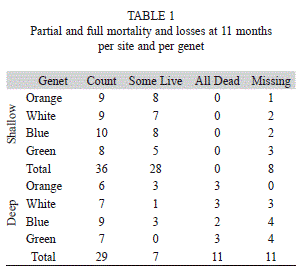
<body><![CDATA[<br> 2. There are no significant differences in living coral length between the different visit dates,</span></font><font size="2"><span  style="font-family: verdana;">    <br>     <br> 3. There are no significant differences in living coral length between the different coral genets,</span></font><font size="2"><span  style="font-family: verdana;">    <br>     <br> 4. There is no significant interaction between the site, visit and/or genet with regard to living coral length.</span></font><br  style="font-family: verdana;"> <br style="font-family: verdana;"> <font style="font-weight: bold;" size="3"><span  style="font-family: verdana;">Results</span></font><br  style="font-family: verdana;"> <font size="2"></font><br style="font-family: verdana;"> <font size="2"><span style="font-family: verdana;">The shallow site saw greater survivorship than the deeper site. Sixty-five corals were set in September 2007. Forty-six (70.8%) were still in place and 35 (53.8%) were still alive by the summer of 2008. Of the 36 corals planted at the shallower site, eight were missing and much partial mortality was observed, but all 28 corals present were alive at 11 months (77.8%). At the deeper reefal stone site, of the 29 samples set, 11 were lost (37.9%) and 11 died entirely, leaving only seven surviving (24.1%, <a href="#Tab1">Table 1</a>). Damages were observed by the first measurement and continued through the first four months with every coral in this experiment suffering partial mortality.    <br>     <br> </span></font>     <div style="text-align: center;"><font size="2"><span      style="font-family: verdana;"><a name="Tab1"></a><img alt=""      src="/img/revistas/rbt/v62s3/a15t1.gif"     ]]></body>
<body><![CDATA[ style="width: 301px; height: 273px;"></span></font><br      style="font-family: verdana;">     <font size="2"><span style="font-family: verdana;"></span></font></div>     <br style="font-family: verdana;">     <font size="2"><span style="font-family: verdana;">At both sites     partial mortality was     substantial, with 47% of tissue lost in the shallow site and 91% in the     deep (<a href="/img/revistas/rbt/v62s3/a15t3.gif">Table 3</a>). Losses     were continuous from planting through the final     measure in the deep site even after the initial pulse of predation and     ]]></body>
<body><![CDATA[disease; however, the shallow site saw a short period of growth prior     to its period of decline (<a href="/img/revistas/rbt/v62s3/a15t3.gif">Table     3</a>). The deep site saw a rapid decline     early, with disease killing corals entirely. However, after an initial     pulse, the continued decline was primarily through remaining or     continuing disease and sample loss after the December visit. Lost     corals may have been attributed to waves in the shallow site, though     curious or clumsy spear-fishermen and recreational snorkelers may also     have played culprit. At the deeper site an Antillean Z-trap (fish trap)     was removed from atop the reefal stone and samples on one occasion, and     ]]></body>
<body><![CDATA[the location is a popular recreational SCUBA site. Later in the     experiment the decomposition of the distal skeleton was rapid, such     that dead samples may have simply broken or rotted away.</span></font><br      style="font-family: verdana;">     <font size="2"></font><br style="font-family: verdana;">     <font size="2"><span style="font-family: verdana;">The September 14     interim     observations at the deep site show disease starting either at the     benthic contact point, possibly associated with damages incurred during     planting, or at the branch tips suggesting vectoring or facilitation by     ]]></body>
<body><![CDATA[</span></font><font size="2"><span style="font-family: verdana;"><span      style="font-style: italic;">Hermodice carunculata</span></span></font><font      size="2"><span style="font-family: verdana;"> (Fire-Worm) with     pathogen entry at the bite or     lesion. <span style="font-style: italic;">H. carunculata</span>     attacks were common in this interim visit but     were obscured by more general (disease) death by the time of the formal     monitoring visit in October. There was no indication that disease     started at the points where disease was cut away as an advancing     disease front was not necessarily discernable from a </span></font><font     ]]></body>
<body><![CDATA[ size="2"><span style="font-family: verdana;"><span      style="font-style: italic;">H. carunculata</span></span></font><font      size="2"><span style="font-family: verdana;">     bite.</span></font><br style="font-family: verdana;">     <font size="2"></font><br style="font-family: verdana;">     <font size="2"><span style="font-family: verdana;">The trend over time     for mean live     coral length is great initial partial mortality, followed by a     levelling out in mortality and slight growth at the deep site but a     continued slow reduction at the shallow site (<a     ]]></body>
<body><![CDATA[ href="/img/revistas/rbt/v62s3/a15t4.gif">Table 4</a>). In the month     after planting, the shallow buttress site saw growth, with a per-coral     average increase of 3.4%, or 2.4cm per coral. However, in the following     period </span></font><font size="2"><span style="font-family: verdana;"><span      style="font-style: italic;">H. carunculata</span></span></font><font      size="2"><span style="font-family: verdana;"> worms found these new     corals and consumed some     30.8% of the total crop over two months; an average of 22.2cm per     coral. This site continued to decline slightly in average live coral     length through the remainder of the experimental period through     ]]></body>
<body><![CDATA[continued </span></font><font size="2"><span      style="font-family: verdana;"><span style="font-style: italic;">H.     carunculata</span></span></font><font size="2"><span      style="font-family: verdana;"> predation.</span></font><br      style="font-family: verdana;">     <font size="2"></font><br style="font-family: verdana;">     <font size="2"><span style="font-family: verdana;">The deeper site saw     damage almost     immediately with disease present in the first photo. Between loss,     disease and </span></font><font size="2"><span     ]]></body>
<body><![CDATA[ style="font-family: verdana;"><span style="font-style: italic;">H.     carunculata</span></span></font><font size="2"><span      style="font-family: verdana;"> feeding this site&#8217;s mean coral length     declined by some 82.6% in the first six weeks and a further 28.6% by     December. However, from this greatly depressed state it was able to     regrow by some 10.7% in the remaining seven months (<a      href="/img/revistas/rbt/v62s3/a15t4.gif">Table 4</a>) during     which it was monitored.</span></font><br style="font-family: verdana;">     <font size="2"></font><br style="font-family: verdana;">     <font size="2"><span style="font-family: verdana;">New apical polyp     ]]></body>
<body><![CDATA[formation occurred     in the initial period at the shallow site, often associated with     healing cut-points or undocumented damage to apical areas from storage.     They also formed on the branch trunk as they would in nursery corals     and in areas associated with a worm bite or halted disease front. This     did not occur immediately afterwards, but after an often-prolonged     period of rest or healing, and often only once the dead portions had     rotted or broken away. New apical formation was the source of restarted     growth between the third and final visit as worm damage left few apical     polyps for growth.</span></font><br style="font-family: verdana;">     ]]></body>
<body><![CDATA[<font size="2"></font><br style="font-family: verdana;">     <font size="2"><span style="font-family: verdana;">Both the shallow and     deep sites saw     an increase in the average number of apical polyps per coral between     the third and final visits as the remaining tissue started to re-grow     (<a href="/img/revistas/rbt/v62s3/a15i1.jpg">Fig. 1</a>). The     difference between this and <a href="/img/revistas/rbt/v62s3/a15t3.gif">Table     3</a> at the shallow site     was that, as apical polyp and branch formation continued, predation     also continued.</span></font><br style="font-family: verdana;">     ]]></body>
<body><![CDATA[<font size="2"></font><br style="font-family: verdana;">     <font size="2"><span style="font-family: verdana;">A decline was noted     generally     through the experimental period in each genet. At the shallow site,     Orange and Green lost 28% and 41% tissue respectively until day 110     (visit 3). Orange then held at 28% while Green declined by 61% by the     final visit. Blue lost 21% of its average length by day 110 and     declined a further 25% by the final visit. White also declined by 21%     by day 110 but had regained an average of some 3.1cm per coral by the     final visit (<a href="/img/revistas/rbt/v62s3/a15t5.gif">Table 5</a>).</span></font><br     ]]></body>
<body><![CDATA[ style="font-family: verdana;">     <font size="2"></font><br style="font-family: verdana;">     <font size="2"><span style="font-family: verdana;">At the deep site,     Orange again     remained relatively steady between days 110 and 340, with 77% and 78%     loss respectively. White and Blue saw greater losses, losing 94% and     89% respectively at day 110, with White remaining steady through day     340 while Blue improved its average coral size by some 3.8cm per coral.     Green expired entirely within the experimental period at this site. A     marked decline in dead skeleton length was noted between days 110 and     ]]></body>
<body><![CDATA[331/340, by as much as or more than 50% in some cases, due to breakage     and erosion.</span></font><br style="font-family: verdana;">     <font size="2"></font><br style="font-family: verdana;">     <font size="2"><span style="font-family: verdana;">General Linear Model     (GLM) ANOVA     testing (Adjusted R Squared 0.235) showed the live length to be     significantly different between sites (p &lt;0.001), between different     measurement visits (p &lt;0.001) and between genets (p= 0.008). Post     hoc testing showed that Blue, White and Green genets made up the subset     with the least coral length and White, Green and Orange made up the     ]]></body>
<body><![CDATA[subset with the most coral. As may be seen in <a      href="/img/revistas/rbt/v62s3/a15i4.jpg">Figures 4</a> and 6, these     post hoc differences were largely associated with uneven initial     amounts of coral and the particular failure of the Green genet at both     sites. A significant interaction between site and day (p= 0.022) speaks     to rapid disease onset in the early measurements at the deeper site and     </span></font><font size="2"><span style="font-family: verdana;"><span      style="font-style: italic;">H. carunculata</span></span></font><font      size="2"><span style="font-family: verdana;"> attack in between visits     at the shallower site.</span></font><br style="font-family: verdana;">     ]]></body>
<body><![CDATA[<font size="2"></font><br style="font-family: verdana;">     <font size="2"><span style="font-family: verdana;">The differences     between the genets     seen in <a href="/img/revistas/rbt/v62s3/a15t4.gif">Table 4</a> are     illustrated in <a href="/img/revistas/rbt/v62s3/a15i2.jpg">Figure 2</a>,     whereby a rapid decline in     live coral length is seen in the deep site in all genets with a     continued fall in the Green genet to zero, but a mild increase in the     Blue genet to the final visit. In the shallow site a brief period of     growth may be seen in the White and Orange genets and a mild decline in     ]]></body>
<body><![CDATA[the Green and Blue, followed by a general decline in all genets. After     this early decline, the Blue genet saw a further mild decline while the     Green genet suffered a much more pronounced decline and the White genet     began to regrow. In both cases the Orange genet remained relatively     stable after the initial decline, with no particular re-growth or     further decline after day 110. Green declined generally throughout and     could be described as the weaker performer based on this figure,     whereas the Blue and White saw some improvements in mean length and     could be described as the stronger performers.</span></font><br      style="font-family: verdana;">     ]]></body>
<body><![CDATA[<font size="2"></font><br style="font-family: verdana;">     <font size="2"><span style="font-family: verdana;">There was no     correlation between     recent </span></font><font size="2"><span style="font-family: verdana;"><span      style="font-style: italic;">H. carunculata</span></span></font><font      size="2"><span style="font-family: verdana;"> attack and length of     living tissue occurring     through the 11 months (Spearman&#8217;s rho r= -.064, p= 0.356). This was in     part due to the worm&#8217;s apparent lack of preference in coral size, but     also that once the coral was attacked the amount of living coral for     ]]></body>
<body><![CDATA[assessment was reduced. Similarly, a strongly negative correlation     occurred between </span></font><font size="2"><span      style="font-family: verdana;"><span style="font-style: italic;">H.     carunculata</span></span></font><font size="2"><span      style="font-family: verdana;"> bites and the apical polyp count     (Spearman&#8217;s rho r= -0.333, p &lt;0.001) as the worms actively ate the     branch tips.</span></font><br style="font-family: verdana;">     <font size="2"></font><br style="font-family: verdana;">     <font size="2"><span style="font-family: verdana;">The worms in this     reef patch were     ]]></body>
<body><![CDATA[large, the largest single bite being 10.6cm long and bite lengths     averaging 3.2cm overall. Worm bite count was positively correlated with     the amount of dead coral (Spearman&#8217;s rho r= 0.544, p &lt;0.001) but not     with the total coral size including live and dead lengths (Spearman&#8217;s     rho r= 0.199, p= 0.086) again suggesting that worm feeding preferences     are not associated with the size of the coral. Worm attacks were     prevalent in the deep site but were particularly problematic in the     shallow buttress site (<a href="/img/revistas/rbt/v62s3/a15i3.jpg">Fig.     3A</a>) and were the primary factor limiting     coral growth at the shallow site.</span></font><br     ]]></body>
<body><![CDATA[ style="font-family: verdana;">     <font size="2"></font><br style="font-family: verdana;">     <font size="2"><span style="font-family: verdana;">Disease was     negatively correlated     to living tissue length (Spearman&#8217;s rho r= -0.396, p &lt;0.001). This     did not mean that disease tended to occur in smaller corals, but rather     disease shortened the living portion of the coral for assessment.     Similarly, the count of disease fronts was negatively correlated with     the number of apical polyps (Spearman&#8217;s rho r= -0.387, p &lt;0.001) as     apical polyps were either killed by the disease or associated with worm     ]]></body>
<body><![CDATA[attacks. Worm attacks may have played a role in disease distribution,     though worm bite count was not significantly correlated with the number     of disease fronts in this experiment (Spearman&#8217;s rho r= -0.025, p=     0.723). Disease front count was positively correlated with the length     of dead skeleton (Spearman&#8217;s rho r=0.520, p &lt;0.001) as the disease     was actively killing coral and producing dead skeleton. Disease front     count was not correlated with the total amount of coral (Spearman&#8217;s rho     r= 0.051, p= 0.461) suggesting that disease susceptibility was not     related to the size of the coral. Banding disease occurred occasionally     in the shallow buttress site but was particularly prevalent on the     ]]></body>
<body><![CDATA[deeper reefal stone where it was the primary killer of tissue and     corals (<a href="/img/revistas/rbt/v62s3/a15i3.jpg">Fig. 3B</a>).</span></font><br      style="font-family: verdana;">     <font size="2"></font><br style="font-family: verdana;">     <font size="2"><span style="font-family: verdana;"><a      href="/img/revistas/rbt/v62s3/a15i4.jpg">Figure 4A</a> suggests     that there is     little difference between the genets with respect to worm attack, which     may be expected in a coral reliant on rapid growth and overgrowth as     its strategy for reef dominance: it would not invest much in chemical     ]]></body>
<body><![CDATA[defences. <a href="/img/revistas/rbt/v62s3/a15i4.jpg">Figure 4B</a>     suggests a weak trend towards Green being more     susceptible to disease than the other genets. This would corroborate     its general weakness, though Orange trends towards being the least     susceptible to disease.</span></font><br style="font-family: verdana;">     <font size="2"></font><br style="font-family: verdana;">     <font size="2"><span style="font-family: verdana;">There was a     significant positive     correlation between the initial live and the final live coral lengths     (Pearson r= 0.387, p= 0.023).</span></font><br     ]]></body>
<body><![CDATA[ style="font-family: verdana;">     <font size="2"></font><br style="font-family: verdana;">     <font size="2"><span style="font-family: verdana;">Occasional partial     mortality with     banding disease was seen where portions of the total coral were not     killed. These were often sections that were somehow physically     separated from the primary coral, e.g. sections broken away by fish-pot     or diver damage or broken portions of the drop-loop overgrowth held     attached by the underlying nylon line without tissue contact.</span></font><br      style="font-family: verdana;">     ]]></body>
<body><![CDATA[<font size="2"></font><br style="font-family: verdana;">     <font size="2"><span style="font-family: verdana;">Bleaching occurred     at the shallow     site likely associated with the stress of sequestration, a reduction in     depth from the shallow nursery at some 5m and 6m depth to the planting     site at 5m to 3m depth and from the seasonal temperatures regardless of     relocation activities, though these factors were not assessed in this     study. Bleaching did not kill any samples and was only prevalent in the     Green genet.</span></font><br style="font-family: verdana;">     <font size="2"></font><br style="font-family: verdana;">     ]]></body>
<body><![CDATA[<font style="font-weight: bold;" size="3"><span      style="font-family: verdana;">Discussion</span></font><br      style="font-family: verdana;">     <font size="2"></font><br style="font-family: verdana;">     <font size="2"><span style="font-family: verdana;">Publishing or     inclusion of negative     outcomes and experimental failures in reporting and published     literature is necessary to build a larger picture of the lessons     learned by the restoration and manipulation community (Edwards &amp;     Gomez, 2007), but also to shed larger light on the factors affecting     ]]></body>
<body><![CDATA[corals generally including the reasons for presence or absence of a     given species in a location. Failure may be as informative as success     in restoration, as failure poses its own, arguably more interesting and     fundamental questions.</span></font><br style="font-family: verdana;">     <font size="2"></font><br style="font-family: verdana;">     <font size="2"><span style="font-family: verdana;">At first glance this     study may     suggest that propagative coral enhancement of </span></font><font      size="2"><span style="font-family: verdana;"><span      style="font-style: italic;">A. cervicornis</span></span></font><font     ]]></body>
<body><![CDATA[ size="2"><span style="font-family: verdana;"> is folly,     as the successes of the nursery are not immediately translated into     successes on the planted reef. In fact the opposite is true. The amount     of coral initially harvested from the wild reef for 65 fragments at     five cm each, some 325 linear centimetres, with nursery growth yielded     some 4 277.5 centimetres for planting after a preliminary harvest for     nursery re-sets and disease pruning. After 11 months, 1 521.15cm     remained, giving a net increase of 1196cm or 4.7-fold from the initial     wild harvest. Had this been a direct parent-to-planting relocation     without an interim nursery phase, the 64.48% decline seen here would     ]]></body>
<body><![CDATA[amount to some 115cm of total coral length remaining. Considering that     this study and others (Knowlton, Lang &amp; Keller, 1990; Bowden-Kerby,     2001) have found greater survivorship in larger disturbed or relocated     corals, this final figure would likely have been less.</span></font><br      style="font-family: verdana;">     <font size="2"></font><br style="font-family: verdana;">     <font size="2"><span style="font-family: verdana;">In this study the     corals of the     shallow, buttress-end reef grew and attached to the substrate for the     first measurements, but by day 100 were heavily set upon by at least     ]]></body>
<body><![CDATA[one large </span></font><font size="2"><span      style="font-family: verdana;"><span style="font-style: italic;">Hermodice     carunculata</span></span></font><font size="2"><span      style="font-family: verdana;"> (fire-worm) that consumed much of the     branch and apical material, essentially halting growth. After the     initial attack period these corals remained at a similar size, with no     particular re-growth or further decline noted in the 11 months in mean     coral length, though some apical growth and further worm bites were     noted. This suggests that a critical mass of coral may be planted on an     appropriate area that will maintain a reasonably steady population     ]]></body>
<body><![CDATA[through predation in the absence of disease, storm or similar     catastrophic change.</span></font><br style="font-family: verdana;">     <font size="2"></font><br style="font-family: verdana;">     <font size="2"><span style="font-family: verdana;">At the deeper reefal     stone site     fewer worm attacks were combined with a banding syndrome that was     apparently inherent in the sediments, as per Patterson et al. (2002),     and possibly exacerbated by macroalgae as this site was largely     ungrazed (Nugues et al., 2004) as some corals were showing disease     during pre-planting storage, before they were planted to the reef. This     ]]></body>
<body><![CDATA[combination possibly vectored or facilitated by the worms themselves     (Sussman, Loya, Fine &amp; Rosenberg, 2003) was able to kill some 91%     of the total live coral length by day 340. This illustrates the     importance of adaptive management and site choice (Rogers &amp;     Montalvo, 2004; Edwards &amp; Gomez, 2007). Had adaptive management     been employed, the shallow site would have seen particular investment     in worm control, including active hunting and trapping. The deep reefal     stone would have been abandoned and the remaining samples either     returned to the nursery or moved to another location once disease was     seen to be prevalent, likely in limited trials in a cooler season     ]]></body>
<body><![CDATA[(Patterson et al., 2002; Jones, Bowyer, Hoegh &amp; Blackall, 2004;     Bruno et al., 2007). Such adaptive management is also an aspect of     coral gardening (Rinkevich, 2005; 2006).</span></font><br      style="font-family: verdana;">     <font size="2"></font><br style="font-family: verdana;">     <font size="2"><span style="font-family: verdana;">Control of     corallivores is a vital     aspect of restoration of </span></font><font size="2"><span      style="font-family: verdana;"><span style="font-style: italic;">Acropora</span></span></font><font      size="2"><span style="font-family: verdana;">, and the first, simplest     ]]></body>
<body><![CDATA[and only     viably scalable way to do so is to focus restoration efforts into     protected or managed ecosystems with an appropriate compliment of     grazers and invertivores. Although it was not assessed here, the     shallow site in this study was at a depth that urchin grazing kept the     substrate relatively bare of macroalgae and disease was rare relative     to the deeper site beyond the habitual urchin-grazing depths. Upright     and frondos macroalgae may harbour cryptic corallivores (Bruckner,     Bruckner &amp; William, 1997) and develop boundary layers to water flow     that collect and harbour sediments (Smith, Smith &amp; Hunter, 2001)     ]]></body>
<body><![CDATA[including those that may hold disease (Patterson et al., 2002). Thus     site choice should look for locations with appropriate grazing and     water flow on both macro and micro scales.</span></font><br      style="font-family: verdana;">     <font size="2"></font><br style="font-family: verdana;">     <font size="2"><span style="font-family: verdana;">Larger corals had     significantly     more living tissue at the end of the experiment. This suggests that a     restoration programme use the largest fragments possible to maximize     the amount of material remaining after predation or disease, as well as     ]]></body>
<body><![CDATA[to maximize productivity through the improved extension rates of larger     corals (Ross, 2013d). Although correlations were not found with these     assessments, </span></font><font size="2"><span      style="font-family: verdana;"><span style="font-style: italic;">H.     carunculata</span></span></font><font size="2"><span      style="font-family: verdana;"> only bites as far as it may engulf the     branch, thus larger corals should be less susceptible per unit length     to this type of attack. Relatedly, once a branch has been bitten it     will not be attacked again: the coral&#8217;s own exposed, dead skeleton     protects it from further attack so long at the next worm is not larger.     ]]></body>
<body><![CDATA[As these worms also only bite down to the first branch fork, a project     manager may also maximize branching in the planting stock by targeted     damage (Soong &amp; Chen, 2003), nursery site choice (Bottjer, 1980;     Ross, 2013b) and even parent coral choice (Bowden-Kerby, 2001; Ross,     2013c) to limit fire-worm feeding efficiency, though it also stands to     reason that a coral with more branches for attack would be attacked     more often. Had the worms been smaller in this experiment, the corals     may have seen more protection due to their relative size, and had the     corals been larger or more branched they might have also seen     protection from these large worms. Disease or smaller predators, such     ]]></body>
<body><![CDATA[as snails, may not be so restricted.</span></font><br      style="font-family: verdana;">     <font size="2"></font><br style="font-family: verdana;">     <font size="2"><span style="font-family: verdana;">The patterns of     strong (Blue and     White) and weak (Orange and Green) genets seen in the nursery (in Ross,     2013c) were not overtly apparent in these wild out-plants. Predation     and disease were the primary issues and apparently not subject to genet     influences, as opposed to the bleaching and fouling abrasion seen in     the nurseries. The Green genet was the only genet to bleach with the     ]]></body>
<body><![CDATA[stresses of relocation and summer temperatures, suggesting that the     heritable susceptibilities to the nursery stresses persist. The Orange     genet did not show particular regrowth, recovery or improvement at     either site, remaining at a similar total length from the penultimate     to the final measurement, whereas the Green genet continued to decline     throughout and eventually disappeared entirely from the deeper site.     The White and Blue genets similarly fared poorly early in the     experimental period in both locations; however, in the final visit,     they showed a modicum of recovery not seen in the weaker genets. Slight     regrowth was seen in the shallow site for the White genet and in the     ]]></body>
<body><![CDATA[deep site for the Blue. Based on these observations, the relative     strengths and weaknesses seen in the nursery for improved growth,     branching and resistance to bleaching stress continued into the     out-planted coral. A trend of increased disease susceptibility in the     Green genet also suggests that disease, abrasion and other stresses     facilitating disease, will also be more problematic in weaker genets.</span></font><br      style="font-family: verdana;">     <font size="2"></font><br style="font-family: verdana;">     <font style="font-weight: bold;" size="3"><span      style="font-family: verdana;">Acknowledgments</span></font><br     ]]></body>
<body><![CDATA[ style="font-family: verdana;">     <font size="2"></font><br style="font-family: verdana;">     <font size="2"><span style="font-family: verdana;">This author would     like to thank the     late Kevin Kohler for adding the &#8220;combined lengths&#8221; function to CPCe in     a single afternoon, the Doctor&#8217;s Cave Beach Club for their logistical     support and Dale Webber of the Centre for Marine Sciences, UWI Mona,     for pointing out that there is valuable data in photographic notes. The     author would further like to thank the reviewers of this manuscript for     their time and guidance.</span></font><br style="font-family: verdana;">     ]]></body>
<body><![CDATA[<br style="font-family: verdana;">     <hr style="width: 100%; height: 2px;"><font style="font-weight: bold;"      size="3"><span style="font-family: verdana;">References</span></font><br      style="font-family: verdana;">     <br style="font-family: verdana;">     <!-- ref --><div style="text-align: left;"><font size="2"><span  style="font-family: verdana;">ABRT (</span></font><font size="2"><span  style="font-family: verdana;"><span style="font-style: italic;">Acropora</span></span></font><font  size="2"><span style="font-family: verdana;"> Biological Review Team). (2005). <span style="font-style: italic;">Atlantic </span></span></font><font  style="font-style: italic;" size="2"><span  style="font-family: verdana;">Acropora</span></font><font size="2"><span  style="font-family: verdana;"><span style="font-style: italic;"> Status Review Document.</span> Southeast Regional Office, Report to National Marine Fisheries Service, Southeast Regional Office.    &nbsp;&nbsp;&nbsp;&nbsp;&nbsp;&nbsp;&nbsp;&nbsp;[&#160;<a href="javascript:void(0);" onclick="javascript: window.open('/scielo.php?script=sci_nlinks&ref=1799862&pid=S0034-7744201400070001500001&lng=','','width=640,height=500,resizable=yes,scrollbars=1,menubar=yes,');">Links</a>&#160;]<!-- end-ref --><!-- ref --></span></font><br style="font-family: verdana;"> <br style="font-family: verdana;"> <font size="2"><span style="font-family: verdana;">Alcolano, M., Caballero, H., &amp; Perera, S. (2009). Trend of Change of Live Stony Coral Cover in Cuban Coral Reefs. <span style="font-style: italic;">Serie Oceanol&oacute;gica, 5, </span>15.    &nbsp;&nbsp;&nbsp;&nbsp;&nbsp;&nbsp;&nbsp;&nbsp;[&#160;<a href="javascript:void(0);" onclick="javascript: window.open('/scielo.php?script=sci_nlinks&ref=1799863&pid=S0034-7744201400070001500002&lng=','','width=640,height=500,resizable=yes,scrollbars=1,menubar=yes,');">Links</a>&#160;]<!-- end-ref --><!-- ref --></span></font><br  style="font-family: verdana;"> <br style="font-family: verdana;"> <font size="2"><span style="font-family: verdana;">Bottjer, D. J. (1980). Branching Morphology of the Reef Coral </span></font><font size="2"><span  style="font-family: verdana;"><span style="font-style: italic;">Acropora</span></span></font><font  size="2"><span style="font-family: verdana;"><span  style="font-style: italic;"> cervicornis</span></span></font><font size="2"><span  style="font-family: verdana;"> in Different Hydraulic Regimes. <span style="font-style: italic;">Journal of Paleontology, 54</span>(5), 1102-1107.    &nbsp;&nbsp;&nbsp;&nbsp;&nbsp;&nbsp;&nbsp;&nbsp;[&#160;<a href="javascript:void(0);" onclick="javascript: window.open('/scielo.php?script=sci_nlinks&ref=1799864&pid=S0034-7744201400070001500003&lng=','','width=640,height=500,resizable=yes,scrollbars=1,menubar=yes,');">Links</a>&#160;]<!-- end-ref --><!-- ref --></span></font><br  style="font-family: verdana;"> <br style="font-family: verdana;"> <font size="2"><span style="font-family: verdana;">Bowden-Kerby, A. (1997). Coral Transplantation in Sheltered Habitats Using Unattached Fragments and Cultured Colonies. <span style="font-style: italic;">8th International Coral Reef Symposium, Panama, 2</span>, 2063-2068.    &nbsp;&nbsp;&nbsp;&nbsp;&nbsp;&nbsp;&nbsp;&nbsp;[&#160;<a href="javascript:void(0);" onclick="javascript: window.open('/scielo.php?script=sci_nlinks&ref=1799865&pid=S0034-7744201400070001500004&lng=','','width=640,height=500,resizable=yes,scrollbars=1,menubar=yes,');">Links</a>&#160;]<!-- end-ref --><!-- ref --></span></font><br style="font-family: verdana;"> <br style="font-family: verdana;"> <font size="2"><span style="font-family: verdana;">Bowden-Kerby, A. (2001). Low-Tech Coral Reef Restoration Methods Modeled after Natural Transplantation Processes. <span style="font-style: italic;">Bulletin of Marine Science, 69</span>, 915-931.    &nbsp;&nbsp;&nbsp;&nbsp;&nbsp;&nbsp;&nbsp;&nbsp;[&#160;<a href="javascript:void(0);" onclick="javascript: window.open('/scielo.php?script=sci_nlinks&ref=1799866&pid=S0034-7744201400070001500005&lng=','','width=640,height=500,resizable=yes,scrollbars=1,menubar=yes,');">Links</a>&#160;]<!-- end-ref --><!-- ref --></span></font><br  style="font-family: verdana;"> <br style="font-family: verdana;"> <font size="2"><span style="font-family: verdana;">Bruckner, R. J., Bruckner, A. W., &amp; William, E. H. (1997). Life History Strategies of Coralliophila abbreviata Lamarck (Gastropoda: Coralliophilidae) on the Southwest Coast of Puerto Rico. <span style="font-style: italic;">8th International Coral Reef Symposium, Panama, 1,</span> 627-632.    &nbsp;&nbsp;&nbsp;&nbsp;&nbsp;&nbsp;&nbsp;&nbsp;[&#160;<a href="javascript:void(0);" onclick="javascript: window.open('/scielo.php?script=sci_nlinks&ref=1799867&pid=S0034-7744201400070001500006&lng=','','width=640,height=500,resizable=yes,scrollbars=1,menubar=yes,');">Links</a>&#160;]<!-- end-ref --><!-- ref --></span></font><br style="font-family: verdana;"> <br style="font-family: verdana;"> <font size="2"><span style="font-family: verdana;">Bruno, J. F., Selig, E. R., Casey, K. S., Page, C. A., Willis, B. L., Harvell, C. D., Sweatman, H., &amp; Melendy, A. M. (2007). Thermal Stress and Coral Cover as Drivers of Coral Disease Outbreaks. <span style="font-style: italic;">PLoS Biology, 5</span>(6), e124.    &nbsp;&nbsp;&nbsp;&nbsp;&nbsp;&nbsp;&nbsp;&nbsp;[&#160;<a href="javascript:void(0);" onclick="javascript: window.open('/scielo.php?script=sci_nlinks&ref=1799868&pid=S0034-7744201400070001500007&lng=','','width=640,height=500,resizable=yes,scrollbars=1,menubar=yes,');">Links</a>&#160;]<!-- end-ref --><!-- ref --></span></font><br  style="font-family: verdana;"> <br style="font-family: verdana;"> <font size="2"><span style="font-family: verdana;">Donahue, W. F., &amp; Schindler, D. W. (1998). Diel Emigration and Colonization Responses Of Blackfly Larvae (Diptera: Simuliidae) To Ultraviolet Radiation. <span  style="font-style: italic;">Freshwater Biology, 40</span>, 357-365.    &nbsp;&nbsp;&nbsp;&nbsp;&nbsp;&nbsp;&nbsp;&nbsp;[&#160;<a href="javascript:void(0);" onclick="javascript: window.open('/scielo.php?script=sci_nlinks&ref=1799869&pid=S0034-7744201400070001500008&lng=','','width=640,height=500,resizable=yes,scrollbars=1,menubar=yes,');">Links</a>&#160;]<!-- end-ref --><!-- ref --></span></font><br  style="font-family: verdana;"> <br style="font-family: verdana;"> <font size="2"><span style="font-family: verdana;">Edwards, A. J., &amp; Gomez, E. D. (2007). Reef Restoration Concepts and Guidelines: Making Sensible Management Choices in the Face of Uncertainty. T<span  style="font-style: italic;">he Coral Reef Targeted Research &amp; Capacity Building for Management Program, 38.    &nbsp;&nbsp;&nbsp;&nbsp;&nbsp;&nbsp;&nbsp;&nbsp;[&#160;<a href="javascript:void(0);" onclick="javascript: window.open('/scielo.php?script=sci_nlinks&ref=1799870&pid=S0034-7744201400070001500009&lng=','','width=640,height=500,resizable=yes,scrollbars=1,menubar=yes,');">Links</a>&#160;]<!-- end-ref --><!-- ref --></span></span></font><br  style="font-family: verdana;"> <br style="font-family: verdana;"> <font size="2"><span style="font-family: verdana;">Epstein, N., Bak, R. P. M., &amp; Rinkevich, B. (2003). Applying Forest Restoration Principles to Coral Reef Rehabilitation. <span style="font-style: italic;">Aquatic Conservation: Marine and Fresh Water Ecosystems, 13</span>, 387&#8211;395.    &nbsp;&nbsp;&nbsp;&nbsp;&nbsp;&nbsp;&nbsp;&nbsp;[&#160;<a href="javascript:void(0);" onclick="javascript: window.open('/scielo.php?script=sci_nlinks&ref=1799871&pid=S0034-7744201400070001500010&lng=','','width=640,height=500,resizable=yes,scrollbars=1,menubar=yes,');">Links</a>&#160;]<!-- end-ref --><!-- ref --></span></font><br  style="font-family: verdana;"> <br style="font-family: verdana;"> <font size="2"><span style="font-family: verdana;">Goreau, T. F. (1959). The Ecology of Jamaican Coral Reefs I. Species Composition and Zonation. <span  style="font-style: italic;">Ecology, 40</span>(1), 69-90.    &nbsp;&nbsp;&nbsp;&nbsp;&nbsp;&nbsp;&nbsp;&nbsp;[&#160;<a href="javascript:void(0);" onclick="javascript: window.open('/scielo.php?script=sci_nlinks&ref=1799872&pid=S0034-7744201400070001500011&lng=','','width=640,height=500,resizable=yes,scrollbars=1,menubar=yes,');">Links</a>&#160;]<!-- end-ref --><!-- ref --></span></font><br style="font-family: verdana;"> <br style="font-family: verdana;"> <font size="2"><span style="font-family: verdana;">Jones, R. J., Bowyer, J., Hoegh-Guldberg, O., &amp; Blackall, L. L. (2004). Dymanmics of a Temperature-Related Coral Disease Outbreak. <span  style="font-style: italic;">Marine Ecology Progress Series, 281</span>, 63-77.    &nbsp;&nbsp;&nbsp;&nbsp;&nbsp;&nbsp;&nbsp;&nbsp;[&#160;<a href="javascript:void(0);" onclick="javascript: window.open('/scielo.php?script=sci_nlinks&ref=1799873&pid=S0034-7744201400070001500012&lng=','','width=640,height=500,resizable=yes,scrollbars=1,menubar=yes,');">Links</a>&#160;]<!-- end-ref --><!-- ref --></span></font><br  style="font-family: verdana;"> <br style="font-family: verdana;"> <font size="2"><span style="font-family: verdana;">Knowlton, N. (2001). The Future of Coral Reefs. <span style="font-style: italic;">Proceedings of the National Academy of Science of the United States of America, 98</span>, 5419-5425.    &nbsp;&nbsp;&nbsp;&nbsp;&nbsp;&nbsp;&nbsp;&nbsp;[&#160;<a href="javascript:void(0);" onclick="javascript: window.open('/scielo.php?script=sci_nlinks&ref=1799874&pid=S0034-7744201400070001500013&lng=','','width=640,height=500,resizable=yes,scrollbars=1,menubar=yes,');">Links</a>&#160;]<!-- end-ref --><!-- ref --></span></font><br  style="font-family: verdana;"> <br style="font-family: verdana;"> <font size="2"><span style="font-family: verdana;">Knowlton, N., Lang, J. C., &amp; Keller. B. D. (1990). Case Study of Natural Population Collapse: Post-Hurricane Predation on Jamaican Staghorn Corals. <span  style="font-style: italic;">Smithsonian Contributions to the Marine Sciences, 31</span>, 25.    &nbsp;&nbsp;&nbsp;&nbsp;&nbsp;&nbsp;&nbsp;&nbsp;[&#160;<a href="javascript:void(0);" onclick="javascript: window.open('/scielo.php?script=sci_nlinks&ref=1799875&pid=S0034-7744201400070001500014&lng=','','width=640,height=500,resizable=yes,scrollbars=1,menubar=yes,');">Links</a>&#160;]<!-- end-ref --><!-- ref --></span></font><br  style="font-family: verdana;"> <br style="font-family: verdana;"> <font size="2"><span style="font-family: verdana;">Miller, M. W., Bourque, A. S., &amp; Bohnsack, J. A. (2002). An Analysis of the Loss of Acroporid Corals at Looe Key. Florida, USA: 1983-2000. <span  style="font-style: italic;">Coral Reefs, 21</span>, 179-182.    &nbsp;&nbsp;&nbsp;&nbsp;&nbsp;&nbsp;&nbsp;&nbsp;[&#160;<a href="javascript:void(0);" onclick="javascript: window.open('/scielo.php?script=sci_nlinks&ref=1799876&pid=S0034-7744201400070001500015&lng=','','width=640,height=500,resizable=yes,scrollbars=1,menubar=yes,');">Links</a>&#160;]<!-- end-ref --><!-- ref --></span></font><br  style="font-family: verdana;"> <br style="font-family: verdana;"> <font size="2"><span style="font-family: verdana;">Miller, M. W., &amp; Szmant, A. M. (2006). Lessons Learned from Experimental Key-Species Restoration. pp. 219-234. In Precht, W. F. (ed.). Coral Reef Restoration Handbook. Boca Raton, FL.: CRS/Taylor &amp; Francis.    &nbsp;&nbsp;&nbsp;&nbsp;&nbsp;&nbsp;&nbsp;&nbsp;[&#160;<a href="javascript:void(0);" onclick="javascript: window.open('/scielo.php?script=sci_nlinks&ref=1799877&pid=S0034-7744201400070001500016&lng=','','width=640,height=500,resizable=yes,scrollbars=1,menubar=yes,');">Links</a>&#160;]<!-- end-ref --><!-- ref --></span></font><br  style="font-family: verdana;"> <br style="font-family: verdana;"> <font size="2"><span style="font-family: verdana;">Nugues, M. M., Smith, G. W., Van Hooidonk, R. J., Seabra, M. I., &amp; Bak, R. P. M. (2004). Algal Contact as a Trigger for Coral Disease. <span  style="font-style: italic;">Ecology Letters, 7,</span> 919-923.    &nbsp;&nbsp;&nbsp;&nbsp;&nbsp;&nbsp;&nbsp;&nbsp;[&#160;<a href="javascript:void(0);" onclick="javascript: window.open('/scielo.php?script=sci_nlinks&ref=1799878&pid=S0034-7744201400070001500017&lng=','','width=640,height=500,resizable=yes,scrollbars=1,menubar=yes,');">Links</a>&#160;]<!-- end-ref --><!-- ref --></span></font><br  style="font-family: verdana;"> <br style="font-family: verdana;"> <font size="2"><span style="font-family: verdana;">Rinkevich, B. (2005). Conservation of Coral Reefs Though Active Restoration Measures: Recent Approaches and Last Decade. <span style="font-style: italic;">Processes in Environmental Science Technology, 39</span>, 4333-4342.    &nbsp;&nbsp;&nbsp;&nbsp;&nbsp;&nbsp;&nbsp;&nbsp;[&#160;<a href="javascript:void(0);" onclick="javascript: window.open('/scielo.php?script=sci_nlinks&ref=1799879&pid=S0034-7744201400070001500018&lng=','','width=640,height=500,resizable=yes,scrollbars=1,menubar=yes,');">Links</a>&#160;]<!-- end-ref --><!-- ref --></span></font><br style="font-family: verdana;"> <br style="font-family: verdana;"> <font size="2"><span style="font-family: verdana;">Rinkevich, B. (2006). The Coral Gardening Concept and the Use of Underwater Nurseries: Lessons Learned From Silvics and Silviculture. pp. 219-234. In Precht, W. F. (ed.). Coral Reef Restoration Handbook. Boca Raton, FL.: CRS/Taylor &amp; Francis.    &nbsp;&nbsp;&nbsp;&nbsp;&nbsp;&nbsp;&nbsp;&nbsp;[&#160;<a href="javascript:void(0);" onclick="javascript: window.open('/scielo.php?script=sci_nlinks&ref=1799880&pid=S0034-7744201400070001500019&lng=','','width=640,height=500,resizable=yes,scrollbars=1,menubar=yes,');">Links</a>&#160;]<!-- end-ref --><!-- ref --></span></font><br style="font-family: verdana;"> <br style="font-family: verdana;"> <font size="2"><span style="font-family: verdana;">Rinkevich, B. (2008). Management of Coral Reefs: We Have Gone Wrong When Neglecting Active Reef Restoration. <span style="font-style: italic;">Marine Pollution Bulletin, 56</span>, 1821-1824.    &nbsp;&nbsp;&nbsp;&nbsp;&nbsp;&nbsp;&nbsp;&nbsp;[&#160;<a href="javascript:void(0);" onclick="javascript: window.open('/scielo.php?script=sci_nlinks&ref=1799881&pid=S0034-7744201400070001500020&lng=','','width=640,height=500,resizable=yes,scrollbars=1,menubar=yes,');">Links</a>&#160;]<!-- end-ref --><!-- ref --></span></font><br  style="font-family: verdana;"> <br style="font-family: verdana;"> <font size="2"><span style="font-family: verdana;">Rogers, D., &amp; Montalvo, L. A. M. (2004). <span style="font-style: italic;">Genetically Appropriate Choices for Plant Materials to Maintain Biological Diversity. University of California.</span> Report to the USDA Forest Service. Rocky Mountain Region, Lakewood, CO. Retrieved from http://www.fs.fed.us/r2/publications/botany/plantgenetics.pdf.    &nbsp;&nbsp;&nbsp;&nbsp;&nbsp;&nbsp;&nbsp;&nbsp;[&#160;<a href="javascript:void(0);" onclick="javascript: window.open('/scielo.php?script=sci_nlinks&ref=1799882&pid=S0034-7744201400070001500021&lng=','','width=640,height=500,resizable=yes,scrollbars=1,menubar=yes,');">Links</a>&#160;]<!-- end-ref --><!-- ref --></span></font><br  style="font-family: verdana;"> <br style="font-family: verdana;"> <font size="2"><span style="font-family: verdana;">Ross, A. M. (2013a). <span style="font-style: italic;">The Buoyant Drop-Loop Line Nursery: A Novel Coral Nursery for In Situ Propagation of </span></span></font><font style="font-style: italic;" size="2"><span  style="font-family: verdana;">Acropora</span></font><font  style="font-style: italic;" size="2"><span  style="font-family: verdana;"></span></font><font  style="font-style: italic;" size="2"><span  style="font-family: verdana;"> cervicornis</span></font><font size="2"><span  style="font-family: verdana;"><span style="font-style: italic;">, Growth Performance Outcomes and a Rapid Measurement Option. Chapter 2. </span>Ph.D. Thesis, UWI Mona, Dept of Life Sciences.    &nbsp;&nbsp;&nbsp;&nbsp;&nbsp;&nbsp;&nbsp;&nbsp;[&#160;<a href="javascript:void(0);" onclick="javascript: window.open('/scielo.php?script=sci_nlinks&ref=1799883&pid=S0034-7744201400070001500022&lng=','','width=640,height=500,resizable=yes,scrollbars=1,menubar=yes,');">Links</a>&#160;]<!-- end-ref --><!-- ref --></span></font><br style="font-family: verdana;"> <br style="font-family: verdana;"> <font size="2"><span style="font-family: verdana;">Ross, A. M. (2013b). <span style="font-style: italic;">The Effect of Reef Position on Genets of </span></span></font><font  style="font-style: italic;" size="2"><span  style="font-family: verdana;">Acropora</span></font><font  style="font-style: italic;" size="2"><span  style="font-family: verdana;"> cervicornis</span></font><font size="2"><span  style="font-family: verdana;"><span style="font-style: italic;"> in Buoyant Line Nursery Culture at Montego Bay, Jamaica. Chapter 3.</span> Ph.D. Thesis, UWI Mona, Dept of Life Sciences.    &nbsp;&nbsp;&nbsp;&nbsp;&nbsp;&nbsp;&nbsp;&nbsp;[&#160;<a href="javascript:void(0);" onclick="javascript: window.open('/scielo.php?script=sci_nlinks&ref=1799884&pid=S0034-7744201400070001500023&lng=','','width=640,height=500,resizable=yes,scrollbars=1,menubar=yes,');">Links</a>&#160;]<!-- end-ref --><!-- ref --></span></font><br style="font-family: verdana;"> <br style="font-family: verdana;"> <font size="2"><span style="font-family: verdana;">Ross, A. M. (2013c). <span style="font-style: italic;">Genet Considerations in Line Nursery Propagation of&nbsp;</span></span></font><font  style="font-style: italic;" size="2"><span  style="font-family: verdana;">Acropora</span></font><font  style="font-style: italic;" size="2"><span  style="font-family: verdana;"> cervicornis</span></font><font size="2"><span  style="font-family: verdana;"> Towards Restoration, with Observations of Growth and Bleaching. Chapter 4. Ph.D. Thesis, UWI Mona, Dept of Life Sciences.    &nbsp;&nbsp;&nbsp;&nbsp;&nbsp;&nbsp;&nbsp;&nbsp;[&#160;<a href="javascript:void(0);" onclick="javascript: window.open('/scielo.php?script=sci_nlinks&ref=1799885&pid=S0034-7744201400070001500024&lng=','','width=640,height=500,resizable=yes,scrollbars=1,menubar=yes,');">Links</a>&#160;]<!-- end-ref --><!-- ref --></span></font><br  style="font-family: verdana;"> <br style="font-family: verdana;"> <font size="2"><span style="font-family: verdana;">Ross, A. M. (2013d). T<span style="font-style: italic;">he Efficacy of Nursery Head-Starting in Restoration of </span></span></font><font  style="font-style: italic;" size="2"><span  style="font-family: verdana;">Acropora cervicornis</span></font><font size="2"><span  style="font-family: verdana;"><span style="font-style: italic;">. Chapter 5.</span> Ph.D. Thesis, UWI Mona, Dept of Life Sciences.    &nbsp;&nbsp;&nbsp;&nbsp;&nbsp;&nbsp;&nbsp;&nbsp;[&#160;<a href="javascript:void(0);" onclick="javascript: window.open('/scielo.php?script=sci_nlinks&ref=1799886&pid=S0034-7744201400070001500025&lng=','','width=640,height=500,resizable=yes,scrollbars=1,menubar=yes,');">Links</a>&#160;]<!-- end-ref --><!-- ref --></span></font><br  style="font-family: verdana;"> <br style="font-family: verdana;"> <font size="2"><span style="font-family: verdana;">Patterson, K. L., J. W. Porter, K. B. Ritchie, S. W. Polson, E. Mueller, E. C. Peters, D. L. Santavy, and G. W. Smith. 2002. &#8220;The Etiology of the White Pox, A Lethal Disease of the Caribbean Elkhorn Coral, </span></font><font size="2"><span  style="font-family: verdana;"><span style="font-style: italic;">Acropora</span></span></font><font  size="2"><span style="font-family: verdana;"> palmata.&#8221; In <span  style="font-style: italic;">Proceedings of the National Academy of Sciences of the United States of America 99</span>(13): 8725-8730.    &nbsp;&nbsp;&nbsp;&nbsp;&nbsp;&nbsp;&nbsp;&nbsp;[&#160;<a href="javascript:void(0);" onclick="javascript: window.open('/scielo.php?script=sci_nlinks&ref=1799887&pid=S0034-7744201400070001500026&lng=','','width=640,height=500,resizable=yes,scrollbars=1,menubar=yes,');">Links</a>&#160;]<!-- end-ref --><!-- ref --></span></font><br style="font-family: verdana;"> <br style="font-family: verdana;"> <font size="2"><span style="font-family: verdana;">Shafir, S., &amp; Rinkevich, B. (2008). The Underwater Silviculture Approach For Coral Reef Restoration: An Emergent Aquaculture Theme. pp. 279-295. In Schwartz, S. H. (ed.). <span style="font-style: italic;">Aquaculture Research Trends.</span> Nova Science Publishers Inc.    &nbsp;&nbsp;&nbsp;&nbsp;&nbsp;&nbsp;&nbsp;&nbsp;[&#160;<a href="javascript:void(0);" onclick="javascript: window.open('/scielo.php?script=sci_nlinks&ref=1799888&pid=S0034-7744201400070001500027&lng=','','width=640,height=500,resizable=yes,scrollbars=1,menubar=yes,');">Links</a>&#160;]<!-- end-ref --><!-- ref --></span></font><br  style="font-family: verdana;"> <br style="font-family: verdana;"> <font size="2"><span style="font-family: verdana;">Smith, J. E., Smith, C. M., &amp; Hunter, C. L. (2001). An Experimental Analysis of the Effects of Herbivory and Nutrient Enrichment on Benthic Community Dynamics on a Hawaiian Reef. <span style="font-style: italic;">Coral Reefs, 19</span>, 332-342.    &nbsp;&nbsp;&nbsp;&nbsp;&nbsp;&nbsp;&nbsp;&nbsp;[&#160;<a href="javascript:void(0);" onclick="javascript: window.open('/scielo.php?script=sci_nlinks&ref=1799889&pid=S0034-7744201400070001500028&lng=','','width=640,height=500,resizable=yes,scrollbars=1,menubar=yes,');">Links</a>&#160;]<!-- end-ref --><!-- ref --></span></font><br style="font-family: verdana;"> <br style="font-family: verdana;"> <font size="2"><span style="font-family: verdana;">Soong, K., &amp; Chen, T. (2003). Coral Transplantation: Regeneration and Growth of </span></font><font  size="2"><span style="font-family: verdana;"><span  style="font-style: italic;">Acropora</span></span></font><font size="2"><span  style="font-family: verdana;"> Fragments in a Nursery. <span style="font-style: italic;">Restoration Ecology, 11</span>(1), 62-71.    &nbsp;&nbsp;&nbsp;&nbsp;&nbsp;&nbsp;&nbsp;&nbsp;[&#160;<a href="javascript:void(0);" onclick="javascript: window.open('/scielo.php?script=sci_nlinks&ref=1799890&pid=S0034-7744201400070001500029&lng=','','width=640,height=500,resizable=yes,scrollbars=1,menubar=yes,');">Links</a>&#160;]<!-- end-ref --><!-- ref --></span></font><br style="font-family: verdana;"> <br style="font-family: verdana;"> <font size="2"><span style="font-family: verdana;">Stephens, P. A., &amp; Sutherland, W. J. (1999). Consequences of the Allee Efect For Behaviour, Ecolory and Conservation. <span style="font-style: italic;">Trends in Ecology and Evolution, 14</span>, 401-405.    &nbsp;&nbsp;&nbsp;&nbsp;&nbsp;&nbsp;&nbsp;&nbsp;[&#160;<a href="javascript:void(0);" onclick="javascript: window.open('/scielo.php?script=sci_nlinks&ref=1799891&pid=S0034-7744201400070001500030&lng=','','width=640,height=500,resizable=yes,scrollbars=1,menubar=yes,');">Links</a>&#160;]<!-- end-ref --><!-- ref --></span></font><br  style="font-family: verdana;"> <br style="font-family: verdana;"> <font size="2"><span style="font-family: verdana;">Sussman, M. Loya, Y., Fine, M., &amp; Rosenberg, E. (2003). The Marine Fireworm </span></font><font  size="2"><span style="font-family: verdana;"><span  style="font-style: italic;">Hermodice carunculata</span></span></font><font  size="2"><span style="font-family: verdana;"><span  style="font-style: italic;">Hermodice carunculata</span></span></font><font  size="2"><span style="font-family: verdana;"> is a Winter Reservoir and Spring-Summer Vector for the Coral Bleaching Pathogen Vibrio shiloi. <span style="font-style: italic;">Environmental Microbiology, 5</span>(4), 250-255.    &nbsp;&nbsp;&nbsp;&nbsp;&nbsp;&nbsp;&nbsp;&nbsp;[&#160;<a href="javascript:void(0);" onclick="javascript: window.open('/scielo.php?script=sci_nlinks&ref=1799892&pid=S0034-7744201400070001500031&lng=','','width=640,height=500,resizable=yes,scrollbars=1,menubar=yes,');">Links</a>&#160;]<!-- end-ref --></span></font>    <br> <font size="2"><span style="font-family: verdana;"></span></font></div> <font size="2"><span style="font-family: verdana;">    <br> </span></font><font size="2"><span style="font-family: verdana;"><a  name="1"></a><a href="#2">1</a>. Seascape Caribbean; ross.andrew@mac.com</span></font><font size="2"><span  style="font-family: verdana;"><a href="mailto:ross.andrew@mac.com"></a></span></font><br  style="font-family: verdana;"> <hr style="width: 100%; height: 2px;">     <div style="text-align: center;"><font style="font-weight: bold;"  size="2"><span style="font-family: verdana;">Received 15-VIII-2013 Corrected 14-III-2014 Accepted 24-III-2014</span></font></div> <font style="font-weight: bold;" size="2"></font></div>     ]]></body>
<body><![CDATA[ ]]></body><back>
<ref-list>
<ref id="B1">
<nlm-citation citation-type="book">
<collab>ABRT (Acropora Biological Review Team)</collab>
<source><![CDATA[Atlantic Acropora Status Review Document.]]></source>
<year>2005</year>
<publisher-loc><![CDATA[Southeast Regional Office ]]></publisher-loc>
<publisher-name><![CDATA[Southeast Regional Office, Report to National Marine Fisheries Service]]></publisher-name>
</nlm-citation>
</ref>
<ref id="B2">
<nlm-citation citation-type="journal">
<person-group person-group-type="author">
<name>
<surname><![CDATA[Alcolano]]></surname>
<given-names><![CDATA[M.]]></given-names>
</name>
<name>
<surname><![CDATA[Caballero]]></surname>
<given-names><![CDATA[H.]]></given-names>
</name>
<name>
<surname><![CDATA[Perera]]></surname>
<given-names><![CDATA[S.]]></given-names>
</name>
</person-group>
<article-title xml:lang="en"><![CDATA[Trend of Change of Live Stony Coral Cover in Cuban Coral Reefs]]></article-title>
<source><![CDATA[Serie Oceanológica]]></source>
<year>2009</year>
<volume>5</volume>
<page-range>15</page-range></nlm-citation>
</ref>
<ref id="B3">
<nlm-citation citation-type="journal">
<person-group person-group-type="author">
<name>
<surname><![CDATA[Bottjer]]></surname>
<given-names><![CDATA[D. J.]]></given-names>
</name>
</person-group>
<article-title xml:lang="en"><![CDATA[Branching Morphology of the Reef Coral Acropora cervicornis in Different Hydraulic Regimes]]></article-title>
<source><![CDATA[Journal of Paleontology]]></source>
<year>1980</year>
<volume>54</volume>
<numero>5</numero>
<issue>5</issue>
<page-range>1102-1107</page-range></nlm-citation>
</ref>
<ref id="B4">
<nlm-citation citation-type="journal">
<person-group person-group-type="author">
<name>
<surname><![CDATA[Bowden-Kerby]]></surname>
<given-names><![CDATA[A.]]></given-names>
</name>
</person-group>
<article-title xml:lang="en"><![CDATA[Coral Transplantation in Sheltered Habitats Using Unattached Fragments and Cultured Colonies]]></article-title>
<source><![CDATA[8th International Coral Reef Symposium, Panama]]></source>
<year>1997</year>
<volume>2</volume>
<page-range>2063-2068</page-range></nlm-citation>
</ref>
<ref id="B5">
<nlm-citation citation-type="journal">
<person-group person-group-type="author">
<name>
<surname><![CDATA[Bowden-Kerby]]></surname>
<given-names><![CDATA[A.]]></given-names>
</name>
</person-group>
<article-title xml:lang="en"><![CDATA[Low-Tech Coral Reef Restoration Methods Modeled after Natural Transplantation Processes]]></article-title>
<source><![CDATA[Bulletin of Marine Science]]></source>
<year>2001</year>
<volume>69</volume>
<page-range>915-931</page-range></nlm-citation>
</ref>
<ref id="B6">
<nlm-citation citation-type="journal">
<person-group person-group-type="author">
<name>
<surname><![CDATA[Bruckner]]></surname>
<given-names><![CDATA[R. J.]]></given-names>
</name>
<name>
<surname><![CDATA[Bruckner]]></surname>
<given-names><![CDATA[A. W.]]></given-names>
</name>
<name>
<surname><![CDATA[William]]></surname>
<given-names><![CDATA[E. H.]]></given-names>
</name>
</person-group>
<article-title xml:lang="en"><![CDATA[Life History Strategies of Coralliophila abbreviata Lamarck (Gastropoda: Coralliophilidae) on the Southwest Coast of Puerto Rico]]></article-title>
<source><![CDATA[8th International Coral Reef Symposium, Panama]]></source>
<year>1997</year>
<volume>1</volume>
<page-range>627-632</page-range></nlm-citation>
</ref>
<ref id="B7">
<nlm-citation citation-type="journal">
<person-group person-group-type="author">
<name>
<surname><![CDATA[Bruno]]></surname>
<given-names><![CDATA[J. F.]]></given-names>
</name>
<name>
<surname><![CDATA[Selig]]></surname>
<given-names><![CDATA[E. R.]]></given-names>
</name>
<name>
<surname><![CDATA[Casey]]></surname>
<given-names><![CDATA[K. S.]]></given-names>
</name>
<name>
<surname><![CDATA[Page]]></surname>
<given-names><![CDATA[C. A.]]></given-names>
</name>
<name>
<surname><![CDATA[Willis]]></surname>
<given-names><![CDATA[B. L.]]></given-names>
</name>
<name>
<surname><![CDATA[Harvell]]></surname>
<given-names><![CDATA[C. D.]]></given-names>
</name>
<name>
<surname><![CDATA[Sweatman]]></surname>
<given-names><![CDATA[H.]]></given-names>
</name>
<name>
<surname><![CDATA[Melendy]]></surname>
<given-names><![CDATA[A. M.]]></given-names>
</name>
</person-group>
<article-title xml:lang="en"><![CDATA[Thermal Stress and Coral Cover as Drivers of Coral Disease Outbreaks]]></article-title>
<source><![CDATA[PLoS Biology]]></source>
<year>2007</year>
<volume>5</volume>
<numero>6</numero>
<issue>6</issue>
<page-range>e124</page-range></nlm-citation>
</ref>
<ref id="B8">
<nlm-citation citation-type="journal">
<person-group person-group-type="author">
<name>
<surname><![CDATA[Donahue]]></surname>
<given-names><![CDATA[W. F.]]></given-names>
</name>
<name>
<surname><![CDATA[Schindler]]></surname>
<given-names><![CDATA[D. W.]]></given-names>
</name>
</person-group>
<article-title xml:lang="en"><![CDATA[Diel Emigration and Colonization Responses Of Blackfly Larvae (Diptera: Simuliidae) To Ultraviolet Radiation]]></article-title>
<source><![CDATA[Freshwater Biology]]></source>
<year>1998</year>
<volume>40</volume>
<page-range>357-365</page-range></nlm-citation>
</ref>
<ref id="B9">
<nlm-citation citation-type="journal">
<person-group person-group-type="author">
<name>
<surname><![CDATA[Edwards]]></surname>
<given-names><![CDATA[A. J.]]></given-names>
</name>
<name>
<surname><![CDATA[Gomez]]></surname>
<given-names><![CDATA[E. D.]]></given-names>
</name>
</person-group>
<article-title xml:lang="en"><![CDATA[Reef Restoration Concepts and Guidelines: Making Sensible Management Choices in the Face of Uncertainty]]></article-title>
<source><![CDATA[The Coral Reef Targeted Research & Capacity Building for Management Program]]></source>
<year>2007</year>
<volume>38</volume>
</nlm-citation>
</ref>
<ref id="B10">
<nlm-citation citation-type="journal">
<person-group person-group-type="author">
<name>
<surname><![CDATA[Epstein]]></surname>
<given-names><![CDATA[N.]]></given-names>
</name>
<name>
<surname><![CDATA[Bak]]></surname>
<given-names><![CDATA[R. P. M.]]></given-names>
</name>
<name>
<surname><![CDATA[Rinkevich]]></surname>
<given-names><![CDATA[B.]]></given-names>
</name>
</person-group>
<article-title xml:lang="en"><![CDATA[Applying Forest Restoration Principles to Coral Reef Rehabilitation]]></article-title>
<source><![CDATA[Aquatic Conservation: Marine and Fresh Water Ecosystems]]></source>
<year>2003</year>
<volume>13</volume>
<page-range>387-395</page-range></nlm-citation>
</ref>
<ref id="B11">
<nlm-citation citation-type="journal">
<person-group person-group-type="author">
<name>
<surname><![CDATA[Goreau]]></surname>
<given-names><![CDATA[T. F.]]></given-names>
</name>
</person-group>
<article-title xml:lang="en"><![CDATA[The Ecology of Jamaican Coral Reefs I. Species Composition and Zonation.]]></article-title>
<source><![CDATA[Ecology]]></source>
<year>1959</year>
<volume>40</volume>
<numero>1</numero>
<issue>1</issue>
<page-range>69-90</page-range></nlm-citation>
</ref>
<ref id="B12">
<nlm-citation citation-type="journal">
<person-group person-group-type="author">
<name>
<surname><![CDATA[Jones]]></surname>
<given-names><![CDATA[R. J.]]></given-names>
</name>
<name>
<surname><![CDATA[Bowyer]]></surname>
<given-names><![CDATA[J.]]></given-names>
</name>
<name>
<surname><![CDATA[Hoegh-Guldberg]]></surname>
<given-names><![CDATA[O.]]></given-names>
</name>
<name>
<surname><![CDATA[Blackall]]></surname>
<given-names><![CDATA[L. L.]]></given-names>
</name>
</person-group>
<article-title xml:lang="en"><![CDATA[Dymanmics of a Temperature-Related Coral Disease Outbreak]]></article-title>
<source><![CDATA[Marine Ecology Progress Series]]></source>
<year>2004</year>
<volume>281</volume>
<page-range>63-77</page-range></nlm-citation>
</ref>
<ref id="B13">
<nlm-citation citation-type="journal">
<person-group person-group-type="author">
<name>
<surname><![CDATA[Knowlton]]></surname>
<given-names><![CDATA[N.]]></given-names>
</name>
</person-group>
<article-title xml:lang="en"><![CDATA[The Future of Coral Reefs]]></article-title>
<source><![CDATA[Proceedings of the National Academy of Science of the United States of America]]></source>
<year>2001</year>
<volume>98</volume>
<page-range>5419-5425</page-range></nlm-citation>
</ref>
<ref id="B14">
<nlm-citation citation-type="journal">
<person-group person-group-type="author">
<name>
<surname><![CDATA[Knowlton]]></surname>
<given-names><![CDATA[N.]]></given-names>
</name>
<name>
<surname><![CDATA[Lang]]></surname>
<given-names><![CDATA[J. C.]]></given-names>
</name>
<name>
<surname><![CDATA[Keller.]]></surname>
<given-names><![CDATA[B. D.]]></given-names>
</name>
</person-group>
<article-title xml:lang="en"><![CDATA[Case Study of Natural Population Collapse: Post-Hurricane Predation on Jamaican Staghorn Corals]]></article-title>
<source><![CDATA[Smithsonian Contributions to the Marine Sciences]]></source>
<year>1990</year>
<volume>31</volume>
<page-range>25</page-range></nlm-citation>
</ref>
<ref id="B15">
<nlm-citation citation-type="journal">
<person-group person-group-type="author">
<name>
<surname><![CDATA[Miller]]></surname>
<given-names><![CDATA[M. W.]]></given-names>
</name>
<name>
<surname><![CDATA[Bourque]]></surname>
<given-names><![CDATA[A. S.]]></given-names>
</name>
<name>
<surname><![CDATA[Bohnsack]]></surname>
<given-names><![CDATA[J. A.]]></given-names>
</name>
</person-group>
<article-title xml:lang="en"><![CDATA[An Analysis of the Loss of Acroporid Corals at Looe Key. Florida, USA: 1983-2000.]]></article-title>
<source><![CDATA[Coral Reefs]]></source>
<year>2002</year>
<volume>21</volume>
<page-range>179-182</page-range></nlm-citation>
</ref>
<ref id="B16">
<nlm-citation citation-type="book">
<person-group person-group-type="author">
<name>
<surname><![CDATA[Miller]]></surname>
<given-names><![CDATA[M. W.]]></given-names>
</name>
<name>
<surname><![CDATA[Szmant]]></surname>
<given-names><![CDATA[A. M.]]></given-names>
</name>
</person-group>
<article-title xml:lang="en"><![CDATA[Lessons Learned from Experimental Key-Species Restoration.]]></article-title>
<person-group person-group-type="editor">
<name>
<surname><![CDATA[Precht]]></surname>
<given-names><![CDATA[W. F.]]></given-names>
</name>
</person-group>
<source><![CDATA[Coral Reef Restoration Handbook.]]></source>
<year>2006</year>
<page-range>219-234</page-range><publisher-loc><![CDATA[Boca Raton^eFL FL]]></publisher-loc>
<publisher-name><![CDATA[CRS/Taylor & Francis]]></publisher-name>
</nlm-citation>
</ref>
<ref id="B17">
<nlm-citation citation-type="journal">
<person-group person-group-type="author">
<name>
<surname><![CDATA[Nugues]]></surname>
<given-names><![CDATA[M. M.]]></given-names>
</name>
<name>
<surname><![CDATA[Smith]]></surname>
<given-names><![CDATA[G. W.]]></given-names>
</name>
<name>
<surname><![CDATA[Van Hooidonk]]></surname>
<given-names><![CDATA[R. J.]]></given-names>
</name>
<name>
<surname><![CDATA[Seabra]]></surname>
<given-names><![CDATA[M. I.]]></given-names>
</name>
<name>
<surname><![CDATA[Bak]]></surname>
<given-names><![CDATA[R. P. M.]]></given-names>
</name>
</person-group>
<article-title xml:lang="en"><![CDATA[Algal Contact as a Trigger for Coral Disease]]></article-title>
<source><![CDATA[Ecology Letters]]></source>
<year>2004</year>
<volume>7</volume>
<page-range>919-923</page-range></nlm-citation>
</ref>
<ref id="B18">
<nlm-citation citation-type="journal">
<person-group person-group-type="author">
<name>
<surname><![CDATA[Rinkevich]]></surname>
<given-names><![CDATA[B.]]></given-names>
</name>
</person-group>
<article-title xml:lang="en"><![CDATA[Conservation of Coral Reefs Though Active Restoration Measures: Recent Approaches and Last Decade]]></article-title>
<source><![CDATA[Processes in Environmental Science Technology]]></source>
<year>2005</year>
<volume>39</volume>
<page-range>4333-4342</page-range></nlm-citation>
</ref>
<ref id="B19">
<nlm-citation citation-type="book">
<person-group person-group-type="author">
<name>
<surname><![CDATA[Rinkevich]]></surname>
<given-names><![CDATA[B.]]></given-names>
</name>
</person-group>
<article-title xml:lang="en"><![CDATA[The Coral Gardening Concept and the Use of Underwater Nurseries: Lessons Learned From Silvics and Silviculture]]></article-title>
<person-group person-group-type="editor">
<name>
<surname><![CDATA[Precht]]></surname>
<given-names><![CDATA[W. F.]]></given-names>
</name>
</person-group>
<source><![CDATA[Coral Reef Restoration Handbook]]></source>
<year>2006</year>
<page-range>219-234</page-range><publisher-loc><![CDATA[Boca Raton^eFL FL]]></publisher-loc>
<publisher-name><![CDATA[CRS/Taylor & Francis]]></publisher-name>
</nlm-citation>
</ref>
<ref id="B20">
<nlm-citation citation-type="journal">
<person-group person-group-type="author">
<name>
<surname><![CDATA[Rinkevich]]></surname>
<given-names><![CDATA[B.]]></given-names>
</name>
</person-group>
<article-title xml:lang="en"><![CDATA[Management of Coral Reefs: We Have Gone Wrong When Neglecting Active Reef Restoration]]></article-title>
<source><![CDATA[Marine Pollution Bulletin]]></source>
<year>2008</year>
<volume>56</volume>
<page-range>1821-1824</page-range></nlm-citation>
</ref>
<ref id="B21">
<nlm-citation citation-type="book">
<person-group person-group-type="author">
<name>
<surname><![CDATA[Rogers]]></surname>
<given-names><![CDATA[D.]]></given-names>
</name>
<name>
<surname><![CDATA[Montalvo]]></surname>
<given-names><![CDATA[L. A. M.]]></given-names>
</name>
</person-group>
<source><![CDATA[Genetically Appropriate Choices for Plant Materials to Maintain Biological Diversity]]></source>
<year>2004</year>
<publisher-loc><![CDATA[Rocky Mountain Region, Lakewood^eCO CO]]></publisher-loc>
<publisher-name><![CDATA[University of CaliforniaUSDA Forest Service]]></publisher-name>
</nlm-citation>
</ref>
<ref id="B22">
<nlm-citation citation-type="">
<person-group person-group-type="author">
<name>
<surname><![CDATA[Ross]]></surname>
<given-names><![CDATA[A. M.]]></given-names>
</name>
</person-group>
<source><![CDATA[The Buoyant Drop-Loop Line Nursery:: A Novel Coral Nursery for In Situ Propagation of Acropora cervicornis, Growth Performance Outcomes and a Rapid Measurement Option.]]></source>
<year>2013</year>
</nlm-citation>
</ref>
<ref id="B23">
<nlm-citation citation-type="">
<person-group person-group-type="author">
<name>
<surname><![CDATA[Ross]]></surname>
<given-names><![CDATA[A. M.]]></given-names>
</name>
</person-group>
<source><![CDATA[The Effect of Reef Position on Genets of Acropora cervicornis in Buoyant Line Nursery Culture at Montego Bay, Jamaica.]]></source>
<year>2013</year>
</nlm-citation>
</ref>
<ref id="B24">
<nlm-citation citation-type="">
<person-group person-group-type="author">
<name>
<surname><![CDATA[Ross]]></surname>
<given-names><![CDATA[A. M.]]></given-names>
</name>
</person-group>
<source><![CDATA[Genet Considerations in Line Nursery Propagation of Acropora cervicornis Towards Restoration, with Observations of Growth and Bleaching.]]></source>
<year>2013</year>
</nlm-citation>
</ref>
<ref id="B25">
<nlm-citation citation-type="">
<person-group person-group-type="author">
<name>
<surname><![CDATA[Ross]]></surname>
<given-names><![CDATA[A. M.]]></given-names>
</name>
</person-group>
<source><![CDATA[The Efficacy of Nursery Head-Starting in Restoration of Acropora cervicornis.]]></source>
<year>2013</year>
</nlm-citation>
</ref>
<ref id="B26">
<nlm-citation citation-type="journal">
<person-group person-group-type="author">
<name>
<surname><![CDATA[Patterson]]></surname>
<given-names><![CDATA[K. L.]]></given-names>
</name>
<name>
<surname><![CDATA[Porter]]></surname>
<given-names><![CDATA[J. W.]]></given-names>
</name>
<name>
<surname><![CDATA[Ritchie]]></surname>
<given-names><![CDATA[K. B.]]></given-names>
</name>
<name>
<surname><![CDATA[Polson]]></surname>
<given-names><![CDATA[S. W.]]></given-names>
</name>
<name>
<surname><![CDATA[Mueller]]></surname>
<given-names><![CDATA[E.]]></given-names>
</name>
<name>
<surname><![CDATA[Peters]]></surname>
<given-names><![CDATA[E. C.]]></given-names>
</name>
<name>
<surname><![CDATA[Santavy]]></surname>
<given-names><![CDATA[D. L.]]></given-names>
</name>
<name>
<surname><![CDATA[Smith]]></surname>
<given-names><![CDATA[G. W.]]></given-names>
</name>
</person-group>
<article-title xml:lang="en"><![CDATA[The Etiology of the White Pox, A Lethal Disease of the Caribbean Elkhorn Coral, Acropora palmata.&#8221;]]></article-title>
<source><![CDATA[Proceedings of the National Academy of Sciences of the United States of America]]></source>
<year>2002</year>
<volume>99</volume>
<numero>13</numero>
<issue>13</issue>
<page-range>8725-8730</page-range></nlm-citation>
</ref>
<ref id="B27">
<nlm-citation citation-type="book">
<person-group person-group-type="author">
<name>
<surname><![CDATA[Shafir]]></surname>
<given-names><![CDATA[S.]]></given-names>
</name>
<name>
<surname><![CDATA[Rinkevich]]></surname>
<given-names><![CDATA[B.]]></given-names>
</name>
</person-group>
<article-title xml:lang="en"><![CDATA[The Underwater Silviculture Approach For Coral Reef Restoration: An Emergent Aquaculture Theme]]></article-title>
<person-group person-group-type="editor">
<name>
<surname><![CDATA[Schwartz]]></surname>
<given-names><![CDATA[S. H.]]></given-names>
</name>
</person-group>
<source><![CDATA[Aquaculture Research Trends.]]></source>
<year>2008</year>
<page-range>279-295</page-range><publisher-name><![CDATA[Nova Science Publishers Inc]]></publisher-name>
</nlm-citation>
</ref>
<ref id="B28">
<nlm-citation citation-type="journal">
<person-group person-group-type="author">
<name>
<surname><![CDATA[Smith]]></surname>
<given-names><![CDATA[J. E.]]></given-names>
</name>
<name>
<surname><![CDATA[Smith]]></surname>
<given-names><![CDATA[C. M.]]></given-names>
</name>
<name>
<surname><![CDATA[Hunter]]></surname>
<given-names><![CDATA[C. L.]]></given-names>
</name>
</person-group>
<article-title xml:lang="en"><![CDATA[An Experimental Analysis of the Effects of Herbivory and Nutrient Enrichment on Benthic Community Dynamics on a Hawaiian Reef]]></article-title>
<source><![CDATA[Coral Reefs]]></source>
<year>2001</year>
<volume>19</volume>
<page-range>332-342</page-range></nlm-citation>
</ref>
<ref id="B29">
<nlm-citation citation-type="journal">
<person-group person-group-type="author">
<name>
<surname><![CDATA[Soong]]></surname>
<given-names><![CDATA[K.]]></given-names>
</name>
<name>
<surname><![CDATA[Chen]]></surname>
<given-names><![CDATA[T.]]></given-names>
</name>
</person-group>
<article-title xml:lang="en"><![CDATA[Coral Transplantation: Regeneration and Growth of Acropora Fragments in a Nursery]]></article-title>
<source><![CDATA[Restoration Ecology]]></source>
<year>2003</year>
<volume>11</volume>
<numero>1</numero>
<issue>1</issue>
<page-range>62-71</page-range></nlm-citation>
</ref>
<ref id="B30">
<nlm-citation citation-type="journal">
<person-group person-group-type="author">
<name>
<surname><![CDATA[Stephens]]></surname>
<given-names><![CDATA[P. A.]]></given-names>
</name>
<name>
<surname><![CDATA[Sutherland]]></surname>
<given-names><![CDATA[W. J.]]></given-names>
</name>
</person-group>
<article-title xml:lang="en"><![CDATA[Consequences of the Allee Efect For Behaviour, Ecolory and Conservation]]></article-title>
<source><![CDATA[Trends in Ecology and Evolution]]></source>
<year>1999</year>
<volume>14</volume>
<page-range>401-405</page-range></nlm-citation>
</ref>
<ref id="B31">
<nlm-citation citation-type="journal">
<person-group person-group-type="author">
<name>
<surname><![CDATA[Sussman, M. Loya]]></surname>
<given-names><![CDATA[Y.]]></given-names>
</name>
<name>
<surname><![CDATA[Fine]]></surname>
<given-names><![CDATA[M.]]></given-names>
</name>
<name>
<surname><![CDATA[Rosenberg]]></surname>
<given-names><![CDATA[E.]]></given-names>
</name>
</person-group>
<article-title xml:lang="en"><![CDATA[The Marine Fireworm Hermodice carunculataHermodice carunculata is a Winter Reservoir and Spring-Summer Vector for the Coral Bleaching Pathogen Vibrio shiloi]]></article-title>
<source><![CDATA[Environmental Microbiology]]></source>
<year>2003</year>
<volume>5</volume>
<numero>4</numero>
<issue>4</issue>
<page-range>250-255</page-range></nlm-citation>
</ref>
</ref-list>
</back>
</article>
