<?xml version="1.0" encoding="ISO-8859-1"?><article xmlns:mml="http://www.w3.org/1998/Math/MathML" xmlns:xlink="http://www.w3.org/1999/xlink" xmlns:xsi="http://www.w3.org/2001/XMLSchema-instance">
<front>
<journal-meta>
<journal-id>0034-7744</journal-id>
<journal-title><![CDATA[Revista de Biología Tropical]]></journal-title>
<abbrev-journal-title><![CDATA[Rev. biol. trop]]></abbrev-journal-title>
<issn>0034-7744</issn>
<publisher>
<publisher-name><![CDATA[Universidad de Costa Rica]]></publisher-name>
</publisher>
</journal-meta>
<article-meta>
<article-id>S0034-77442014000200019</article-id>
<title-group>
<article-title xml:lang="en"><![CDATA[Nupela species (Naviculales: Bacillariophyceae) from Colombian lowland waters including N. acaciensis nov. sp. and N. catatumbensis nov. sp.]]></article-title>
<article-title xml:lang="es"><![CDATA[Especies de Nupela (Naviculales: Bacillariophyceae) en aguas de tierras bajas de Colombia que incluyen a N. acaciensis nov. sp. y N. catatumbensis nov. sp.]]></article-title>
</title-group>
<contrib-group>
<contrib contrib-type="author">
<name>
<surname><![CDATA[Sala]]></surname>
<given-names><![CDATA[Silvia]]></given-names>
</name>
</contrib>
<contrib contrib-type="author">
<name>
<surname><![CDATA[Vouilloud]]></surname>
<given-names><![CDATA[Amelia Alejandra]]></given-names>
</name>
</contrib>
<contrib contrib-type="author">
<name>
<surname><![CDATA[Plata-Díaz]]></surname>
<given-names><![CDATA[Yasmin]]></given-names>
</name>
</contrib>
<contrib contrib-type="author">
<name>
<surname><![CDATA[Pedraza]]></surname>
<given-names><![CDATA[Edna]]></given-names>
</name>
</contrib>
<contrib contrib-type="author">
<name>
<surname><![CDATA[Pimienta]]></surname>
<given-names><![CDATA[Astrid]]></given-names>
</name>
</contrib>
</contrib-group>
<aff id="A01">
<institution><![CDATA[,Universidad Nacional de la Plata  ]]></institution>
<addr-line><![CDATA[ ]]></addr-line>
<country>Argentina</country>
</aff>
<aff id="A02">
<institution><![CDATA[,Instituto Colombiano del Petróleo  ]]></institution>
<addr-line><![CDATA[Piedecuesta Santander]]></addr-line>
<country>Colombia</country>
</aff>
<aff id="A03">
<institution><![CDATA[,Instituto Colombiano del Petróleo  ]]></institution>
<addr-line><![CDATA[Piedecuesta Santander]]></addr-line>
<country>Colombia</country>
</aff>
<pub-date pub-type="pub">
<day>00</day>
<month>03</month>
<year>2014</year>
</pub-date>
<pub-date pub-type="epub">
<day>00</day>
<month>03</month>
<year>2014</year>
</pub-date>
<volume>62</volume>
<numero>1</numero>
<fpage>250</fpage>
<lpage>265</lpage>
<copyright-statement/>
<copyright-year/>
<self-uri xlink:href="http://www.scielo.sa.cr/scielo.php?script=sci_arttext&amp;pid=S0034-77442014000200019&amp;lng=en&amp;nrm=iso"></self-uri><self-uri xlink:href="http://www.scielo.sa.cr/scielo.php?script=sci_abstract&amp;pid=S0034-77442014000200019&amp;lng=en&amp;nrm=iso"></self-uri><self-uri xlink:href="http://www.scielo.sa.cr/scielo.php?script=sci_pdf&amp;pid=S0034-77442014000200019&amp;lng=en&amp;nrm=iso"></self-uri><abstract abstract-type="short" xml:lang="en"><p><![CDATA[The genus Nupela comprises ca. 50 species that generally have a distribution restricted by bioclimatic frontiers. As part of an integrated analysis of the diatom flora of Colombia, in this study we focused our interest on the genus Nupela from lowland waters. Periphyton samples were collected from 150 sites of lotic water bodies in Colombia, taking into account hidrogeomorfological variability. In each sampling station, periphyton samples were obtained by scraping, and temperature, pH, dissolved oxygen and conductivity variables were measured. Samples were processed by both light microscopy (LM; Carl Zeiss Axio Scope.A1) and scanning electron microscopy (SEM; FEI-Quanta 450 and a Jeol JSM-6360 LV). The genus Nupela was found in 28 sites. Five taxa were identified, described and illustrated from tropical or subtropical environments: N. lesothensis, N. praecipua y N. subpallavicinii; these were new records for Colombia, and N. acaciensis and N. catatumbensis two new species for science. N. acaciensis is characterized by raphe branches of both valves equally long combined with cymbelloid symmetry, striae built by 2 transapically elongated areolae that delimit a longitudinal line at each hemivalve. N. catatumbensis is characterized by the presence of a well developed raphe in both valves; valves lanceolate with subcapitated to capitated ends and cymbelloid symmetry, striae built by 3-4 transapically elongated areolae, interestriae elevated as transapical ribs and internal proximal raphe ends hook-shaped. The genus Nupela was widely distributed in the studied basins but showed different distribution patterns: N. acaciensis and N. subpallavicini had a restricted distribution, while N. catatumbensis, N. lesothensis and N. praecipua had a wider distribution, and were collected in sites with significant variations in their ecomorphology, altitude, temperature, pH and electrolyte content.]]></p></abstract>
<abstract abstract-type="short" xml:lang="es"><p><![CDATA[El género Nupela comprende alrededor de 50 especies que tienen en general una distribución restringida por fronteras bioclimáticas. Como parte de un estudio integral de la flora diatomológica de Colombia, en este trabajo focalizamos nuestro interés en el género Nupela en cuerpos de agua de tierras bajas. Muestras de perifiton fueron recolectadas en 150 sitios en cuerpos de agua lóticos seleccionados por su variabilidad hidrogeomorfológica. En cada estación de muestreo se obtuvieron muestras por raspado de varios sustratos, y adicionalmente se registraron: temperatura, pH, oxígeno disuelto y conductividad. Las muestras fueron procesadas para su análisis con microscopio óptico (MO, Carl Zeiss Axio Scope. A1) y de barrido (MEB; FEI- Quanta 450 and a Jeol JSM-6360 LV). El género Nupela fue hallado en 28 sitios. Cinco especies fueron identificadas, descritas e ilustradas, tres de ellas: N. lesothensis, N. praecipua y N. subpallavicinii fueron descritas para ambientes tropicales y subtropicales y representan nuevas citas para Colombia. Además fueron descritas N. acaciensis y N. catatumbensis, dos especies nuevas para la ciencia. N. acaciensis se caracteriza por poseer rafe desarrollado en ambas valvas, simetría cymbelloide, estrías formadas por dos aréolas transapicalmente alargadas que definen una línea longitudinal en cada hemivalva. N. catatumbensis se caracteriza poseer rafe desarrollado en ambas valvas. Valvas lanceoladas con extremos subcapitados a capitados y simetría cymbelloide. Estrías formadas por 3-4 aréolas transapicalmente alargadas, interestrías elevadas a modo de costillas transapicales y extremos proximales internos del rafe en forma de gancho. El género Nupela estuvo ampliamente representado en el área de estudio, sin embargo, las especies mostraron diferentes patrones de distribución. N. acaciensis y N. subpallavicini estuvieron presentes en una única cuenca, mientras que N. catatumbensis, N. lesothensis y N. praecipua presentaron una distribución más amplia, y fueron recolectadas en sitios con variaciones significativas en ecomorfología, altitud, temperatura, pH y contenido electrolítico.]]></p></abstract>
<kwd-group>
<kwd lng="en"><![CDATA[Nupela]]></kwd>
<kwd lng="en"><![CDATA[Nupela acaciensis]]></kwd>
<kwd lng="en"><![CDATA[Nupela catatumbensis]]></kwd>
<kwd lng="en"><![CDATA[diatoms]]></kwd>
<kwd lng="en"><![CDATA[Bacillariophyceae]]></kwd>
<kwd lng="en"><![CDATA[neotropics]]></kwd>
<kwd lng="en"><![CDATA[Colombia]]></kwd>
<kwd lng="es"><![CDATA[Nupela]]></kwd>
<kwd lng="es"><![CDATA[Nupela acaciensis]]></kwd>
<kwd lng="es"><![CDATA[Nupela catatumbensis]]></kwd>
<kwd lng="es"><![CDATA[diatomeas]]></kwd>
<kwd lng="es"><![CDATA[Bacillariophyceae]]></kwd>
<kwd lng="es"><![CDATA[neotropical]]></kwd>
<kwd lng="es"><![CDATA[Colombia]]></kwd>
</kwd-group>
</article-meta>
</front><body><![CDATA[ <div style="text-align: justify;">     <div style="text-align: center;"><font style="font-style: italic;"  size="4"><span style="font-family: verdana;">Nupela </span></font><font  style="font-weight: bold;" size="4"><span style="font-family: verdana;">species (Naviculales: Bacillariophyceae) from Colombian lowland waters including </span></font><font  style="font-style: italic;" size="4"><span  style="font-family: verdana;">N. acaciensis</span></font><font style="font-weight: bold;" size="4"><span  style="font-family: verdana;"> nov. sp. and </span></font><font  size="4"><span style="font-family: verdana;"><span  style="font-style: italic;">N. catatumbensis</span></span></font><font  style="font-weight: bold;" size="4"><span style="font-family: verdana;"> nov. sp.    <br>     <br> </span></font><font size="2"><span style="font-family: verdana;"><span  style="font-weight: bold;"></span></span></font><font  style="font-weight: bold;" size="4"><span style="font-family: verdana;">Especies de </span></font><font style="font-style: italic;" size="4"><span  style="font-family: verdana;">Nupela<span style="font-weight: bold;"> </span></span></font><font  style="font-weight: bold;" size="4"><span style="font-family: verdana;">(Naviculales: Bacillariophyceae) en aguas de tierras bajas en Colombia que incluyen a </span></font><font style="font-style: italic;" size="4"><span  style="font-family: verdana;">N. acaciensis</span></font><font style="font-weight: bold;" size="4"><span  style="font-family: verdana;"> nov. sp. and </span></font><font  size="4"><span style="font-family: verdana;"><span  style="font-style: italic;">N. catatumbensis</span></span></font><font  style="font-weight: bold;" size="4"><span style="font-family: verdana;"> nov. sp.    <br> </span></font><font size="2"><span style="font-family: verdana;"><span  style="font-weight: bold;"></span><span style="font-weight: bold;"></span></span></font><br  style="font-family: verdana;"> </div>     <div style="text-align: center;"><font size="2"><span  style="font-family: verdana;">Silvia Sala<sup>1*</sup>, Amelia Alejandra Vouilloud<sup>1</sup>, Yasmin Plata-D&iacute;az2, Edna Pedraza<sup>2*</sup> &amp; Astrid Pimienta<sup>3*</sup></span></font><br style="font-family: verdana;"> </div> <font size="2"><span style="font-family: verdana;">     <br>     *Direcci&oacute;n para correspondencia:<br style="font-family: verdana;">     </span></font><font size="2"></font>     <hr style="width: 100%; height: 2px;"><font style="font-weight: bold;"     ]]></body>
<body><![CDATA[ size="3"><span style="font-family: verdana;">Abstract</span></font><br      style="font-family: verdana;">     <font size="2"></font><br style="font-family: verdana;">     <font size="2"><span style="font-family: verdana;">The genus <span      style="font-style: italic;">Nupela </span>comprises ca. 50     species that generally have a distribution restricted by bioclimatic     frontiers. As part of an integrated analysis of the diatom flora of     Colombia, in this study we focused our interest on the genus <span      style="font-style: italic;">Nupela     </span>from lowland waters. Periphyton samples were collected from 150     ]]></body>
<body><![CDATA[sites     of lotic water bodies in Colombia, taking into account     hidrogeomorfological variability. In each sampling station, periphyton     samples were obtained by scraping, and temperature, pH, dissolved     oxygen and conductivity variables were measured. Samples were processed     by both light microscopy (LM; Carl Zeiss Axio Scope.A1) and scanning     electron microscopy (SEM; FEI-Quanta 450 and a Jeol JSM-6360 LV). The     genus Nupela was found in 28 sites. Five taxa were identified,     described and illustrated from tropical or subtropical environments: <span      style="font-style: italic;">N.     ]]></body>
<body><![CDATA[lesothensis, N. praecipua</span> y <span style="font-style: italic;">N.     subpallavicinii;</span> these were new records     for Colombia, and <span style="font-style: italic;">N. acaciensis</span>     and <span style="font-style: italic;">N. catatumbensis</span> two new     species     for science. <span style="font-style: italic;">N. acaciensis</span> is     characterized by raphe branches of both     valves equally long combined with cymbelloid symmetry, striae built     by 2 transapically elongated areolae that delimit a longitudinal line     at each hemivalve. <span style="font-style: italic;">N. catatumbensis</span>     ]]></body>
<body><![CDATA[is characterized by the presence of     a well developed raphe in both valves; valves lanceolate with     subcapitated to capitated ends and cymbelloid symmetry, striae built by     3-4 transapically elongated areolae, interestriae elevated as     transapical ribs and internal proximal raphe ends hook-shaped. The     genus <span style="font-style: italic;">Nupela </span>was widely     distributed in the studied basins but showed     different distribution patterns: <span style="font-style: italic;">N.     acaciensis </span>and <span style="font-style: italic;">N.     subpallavicini</span>     ]]></body>
<body><![CDATA[had a restricted distribution, while <span style="font-style: italic;">N.     catatumbensis</span>, <span style="font-style: italic;">N. lesothensis</span>     and <span style="font-style: italic;">N. praecipua</span> had a wider     distribution, and were collected in sites     with significant variations in their ecomorphology, altitude,     temperature, pH and electrolyte content. </span></font><br      style="font-family: verdana;">     <font size="2"></font><br style="font-family: verdana;">     <font size="2"><span style="font-family: verdana;"><span      style="font-weight: bold;">Key words: </span><span     ]]></body>
<body><![CDATA[ style="font-style: italic;">Nupela, Nupela     acaciensis, Nupela catatumbensis</span>, diatoms, Bacillariophyceae,     neotropics, Colombia.</span></font><br style="font-family: verdana;">     <font size="2"></font><br style="font-family: verdana;">     <font style="font-weight: bold;" size="3"><span      style="font-family: verdana;">Resumen</span></font><br      style="font-family: verdana;">     <font size="2"></font><br style="font-family: verdana;">     <font size="2"><span style="font-family: verdana;"><span      style="font-weight: bold;"></span>El g&eacute;nero     ]]></body>
<body><![CDATA[<span style="font-style: italic;">Nupela</span> comprende alrededor de     50 especies que tienen en general una     distribuci&oacute;n restringida por fronteras bioclim&aacute;ticas.     Como parte de un estudio integral de la flora diatomol&oacute;gica de     Colombia, en este trabajo focalizamos nuestro inter&eacute;s en el     g&eacute;nero <span style="font-style: italic;">Nupela </span>en     cuerpos de agua de tierras bajas. Muestras de     perifiton fueron recolectadas en 150 sitios en cuerpos de agua     l&oacute;ticos seleccionados por su variabilidad     hidrogeomorfol&oacute;gica. En cada estaci&oacute;n de muestreo se     ]]></body>
<body><![CDATA[obtuvieron muestras por raspado de varios sustratos,&nbsp; y&nbsp;     adicionalmente&nbsp; se&nbsp; registraron:&nbsp; temperatura, pH,     ox&iacute;geno disuelto y conductividad. Las muestras fueron procesadas     para su an&aacute;lisis con microscopio &oacute;ptico (MO, Carl&nbsp;     Zeiss Axio&nbsp; Scope. A1)&nbsp; y&nbsp; de&nbsp; barrido&nbsp;     (MEB;&nbsp; FEI- Quanta 450 and a Jeol JSM-6360 LV). El g&eacute;nero     <span style="font-style: italic;">Nupela </span>fue hallado en 28     sitios. Cinco especies fueron identificadas,     descritas e ilustradas, tres de ellas: <span      style="font-style: italic;">N. lesothensis</span>, <span     ]]></body>
<body><![CDATA[ style="font-style: italic;">N. praecipua</span> y     <span style="font-style: italic;">N. subpallavicinii </span>fueron     descritas para ambientes tropicales y     subtropicales y representan nuevas citas para Colombia. Adem&aacute;s     fueron descritas <span style="font-style: italic;">N. acaciensis</span>     y <span style="font-style: italic;">N. catatumbensis,</span> dos     especies nuevas     para la ciencia. <span style="font-style: italic;">N. acaciensis</span>     se caracteriza por poseer rafe     desarrollado en ambas valvas, simetr&iacute;a cymbelloide,     ]]></body>
<body><![CDATA[estr&iacute;as formadas por dos ar&eacute;olas transapicalmente     alargadas que definen una l&iacute;nea&nbsp; longitudinal&nbsp;     en&nbsp; cada&nbsp; hemivalva.&nbsp; <span style="font-style: italic;">N.&nbsp;     catatumbensis </span>se     caracteriza poseer rafe desarrollado en ambas valvas. Valvas     lanceoladas con extremos subcapitados a capitados y simetr&iacute;a     cymbelloide. Estr&iacute;as formadas por 3-4 ar&eacute;olas     transapicalmente alargadas, interestr&iacute;as elevadas a modo de     costillas transapicales y extremos proximales internos del rafe en     forma de gancho. El g&eacute;nero Nupela estuvo ampliamente     ]]></body>
<body><![CDATA[representado en el &aacute;rea de estudio, sin embargo, las     especies&nbsp; mostraron&nbsp; diferentes&nbsp; patrones&nbsp; de&nbsp;     distribuci&oacute;n. <span style="font-style: italic;">N.&nbsp;     acaciensis</span>&nbsp; y&nbsp; <span style="font-style: italic;">N.&nbsp;     subpallavicini</span>&nbsp; estuvieron&nbsp; presentes en una     &uacute;nica     cuenca, mientras que <span style="font-style: italic;">N.     catatumbensis, N. lesothensis</span> y<span style="font-style: italic;">     N. praecipua     </span>presentaron una distribuci&oacute;n m&aacute;s amplia, y fueron     ]]></body>
<body><![CDATA[recolectadas en sitios con variaciones significativas en     ecomorfolog&iacute;a, altitud, temperatura, pH y contenido     electrol&iacute;tico.</span></font><br style="font-family: verdana;">     <font size="2"></font><br style="font-family: verdana;">     <font size="2"><span style="font-family: verdana;"><span      style="font-weight: bold;">Palabras clave:</span> <span      style="font-style: italic;">Nupela, Nupela     acaciensis, Nupela catatumbensis</span>, diatomeas, Bacillariophyceae,     neotropical, Colombia.    <br>     ]]></body>
<body><![CDATA[<br style="font-family: verdana;">     </span></font><font size="2"></font>     <hr style="width: 100%; height: 2px;"><font size="2"><span      style="font-family: verdana;">The genus <span      style="font-style: italic;">Nupela </span>was erected by     Vyverman &amp; Comp&egrave;re in 1991, based on materials collected in     acid waters at Mont Giluwe, New Guinea. The most important character     that defines the genus is the areolae structure, transapically     elongated, with external big foramina and internal hymen perforated at     the centre. Each stria is built by few areolae and presents a hyaline     ]]></body>
<body><![CDATA[marginal area. Valves are sometimes transapically curved (cymbelloid     frustules) and sometimes they are curved on the pervalvaraxis combined     with the presence of rudimentary or shortened raphe in one valve     (achnanthoid frustules).</span></font><br style="font-family: verdana;">     <font size="2"></font><br style="font-family: verdana;">     <font size="2"><span style="font-family: verdana;">Although the genus     was erected on     the basis of <span style="font-style: italic;">N. giluwensis</span>     Vyverman &amp; Comp&egrave;re, after-wards     Lange-Bertalot (1993) and Lange-Bertalot &amp; Moser (1994) described     ]]></body>
<body><![CDATA[new species and transferred other taxa from the genera <span      style="font-style: italic;">Achnanthes,     Anomoeoneis, Navicula, Rhoicosphenia </span>and <span      style="font-style: italic;">Stauroneis </span>to <span      style="font-style: italic;">Nupela</span>. Later     other authors studied the genus, transfered more species and described     new taxa (Monnier, Lange-Bertalot, &amp; Bertrand, 2003; Potapova,     Ponader, Lowe, Clason, &amp; Bahls, 2003; Siver, Hamilton, &amp;     Morales, 2007; Kulikovskiy, Lange-Bertalot, &amp; Witkowski, 2009;     Wojtal, 2009; Siver, Wolfe, &amp; Edlund, 2010; Potapova, 2013). In the     ]]></body>
<body><![CDATA[original description heterovalvar frustules are not mentioned.&nbsp;     Lange-Bertalot&nbsp; &amp;&nbsp; Moser&nbsp; (1994) and Potapova et al.     (2003) described heterovalvar species, but did not redefine the genus.     Monnier et al. (2003) considered that the presence of one valve with     reduced raphe is a character of <span style="font-style: italic;">Nupela</span>     and pointed out that it is a     character defined by practice.</span></font><br      style="font-family: verdana;">     <font size="2"></font><br style="font-family: verdana;">     <font size="2"><span style="font-family: verdana;">At present, the     ]]></body>
<body><![CDATA[genus <span style="font-style: italic;">Nupela</span>     comprises around 50 species (Wotjal, 2009; Siver et al., 2010;     Fourtanier &amp; Kociolek, 2011; Potapova, 2013). Since its initial     discovery in high elevation ponds of New Guinea, <span      style="font-style: italic;">Nupela</span> has been     reported in neutral pH, low conductivity waters across Europe, South     America, North America, Asia and Africa (Spaulding &amp; Edlund, 2008).</span></font><br      style="font-family: verdana;">     <font size="2"></font><br style="font-family: verdana;">     <font size="2"><span style="font-family: verdana;">In Colombia, three     ]]></body>
<body><![CDATA[species of the     genus were mentioned (Montoya-Moreno, pers. com.): <span      style="font-style: italic;">Nupela</span> <span      style="font-style: italic;">pallavicinii     </span>(Krasske) Lange- Bertalot in Lange-Bertalot &amp; Moser (1994)     described at El Boquer&oacute;n (Bogot&aacute;); Donato (2001)     mentioned <span style="font-style: italic;">N. paludigena</span>     Lange-Berta- lot at Lago Buitrago     (Cundinamarca) and Lago Santiago (Cauca) and V&eacute;lez &amp;     Hooghiemstra (2005) mentioned <span style="font-style: italic;">N.     ]]></body>
<body><![CDATA[tenuistriata</span> (Hustedt) Metzeltin &amp;     Lange-Bertalot at Lago Las Margaritas, Lago Carimagua (Meta).</span></font><br      style="font-family: verdana;">     <font size="2"></font><br style="font-family: verdana;">     <font size="2"><span style="font-family: verdana;">The aim of this     paper is to     describe and illustrate <span style="font-style: italic;">Nupela</span>     species collected in lowland waters of     the Eastern part of the country, as part of the study of benthic     diatoms from different Colombian basins held by the Laboratorio de     ]]></body>
<body><![CDATA[Biotecnolog&iacute;a del Instituto Colombiano del Petr&oacute;leo.</span></font><br      style="font-family: verdana;">     <font size="2"></font><br style="font-family: verdana;">     <font style="font-weight: bold;" size="3"><span      style="font-family: verdana;">Material and Methods</span></font><br      style="font-family: verdana;">     <font size="2"></font><br style="font-family: verdana;">     <font size="2"><span style="font-family: verdana;">Samples were     collected from the     sampling sites where Ecopetrol S.A. helds physical, chemical and     ]]></body>
<body><![CDATA[biological assessments, according to requirements of the environmental     authorities&nbsp; in&nbsp; each&nbsp; region.&nbsp; A&nbsp; total&nbsp;     of&nbsp; 150 samples were collected from selected sites, taking into     account hidrogeomorphological variability. The study area comprised the     Amazon region, the interandean valleys, the Andean region,&nbsp;     the&nbsp; &#8220;Llanos&nbsp; Orientales&#8221;,&nbsp; high&nbsp; plains and the     Catatumbo. These regions are contrasting in their hydrogeomorphology.     The rivers in the foothills of the Andes (Magdalena Alto) have beds of     blocks, stones, and gravel. The water flow is turbulent and forms     cascades and rapids. In lowlands of Catatumbo and the interandean     ]]></body>
<body><![CDATA[valleys (Magdalena Medio) the streams are broad and beds have soft     sediments, silt and/or&nbsp; clay;&nbsp; accumulations&nbsp; of&nbsp;     woody&nbsp; debris are frequent and the water flow is smooth. For the     high plains rivers (Meta and Cravo Sur and Tomo basins), the stream bed     consists of soft sediments, sand and/or fine organic matter, leaf packs     are formed frequently. The streams of the Putumayo and Caquet&aacute;     basins here studied are small, with rocky substrates and coverage     dominated by trees, well preserved (Ovalle, Plata-D&iacute;az, Reyes,     Pimienta, &amp; Riss, 2013).</span></font><br      style="font-family: verdana;">     ]]></body>
<body><![CDATA[<font size="2"></font><br style="font-family: verdana;">     <font size="2"><span style="font-family: verdana;">For each site,     information about     water temperature, pH, conductivity and dissolved oxygen was also     obtained. Phytoplankton samples were collected by brushing the surface     of a variable number of substrates delimited with a 25cm<sup>2</sup>     acrylic     frame, and were preserved with 1:1 Transeau solution. Samples were     treated to eliminate organic matter following the method     described&nbsp; in&nbsp; CEN/TC&nbsp; 230&nbsp; (2003).&nbsp;     ]]></body>
<body><![CDATA[Posteriorly, they were analysed using two microscopic techniques.     Samples for light microscopy (LM) were mounted in Naphrax&reg;, and for     scanning electron&nbsp; microscopy&nbsp; (SEM)&nbsp; on&nbsp;     glass&nbsp; stubs and then coated with gold-palladium in a     FEI-Quanta&nbsp; 450&nbsp; microscope&nbsp; of&nbsp; the&nbsp;     Laboratorio de Microscop&iacute;a of Instituto Colombiano del     Petr&oacute;leo. Analyses were held with a LM Carl Zeiss Axio Scope.A1     and with FEI-Quanta 450 SEM and a Jeol JSM-6360 LV SEM at the Servicio     de Microscop&iacute;a Electr&oacute;nica de la Facultad de Ciencias     Naturales y Museo de La Plata. Uncleaned and cleaned subsamples and     ]]></body>
<body><![CDATA[permanent slides were deposited at the Laboratorio de     Biotecnolog&iacute;a of Instituto Colombiano del Petr&oacute;leo     (Piedecuesta, Colombia).</span></font><br style="font-family: verdana;">     <font size="2"></font><br style="font-family: verdana;">     <font size="2"><span style="font-family: verdana;">The terminology used     is the one     proposed by Anonymous (1975), Ross et al. (1979) and Barber &amp;     Haworth (1981).</span></font><br style="font-family: verdana;">     <font size="2"></font><br style="font-family: verdana;">     <font size="2"><span style="font-family: verdana;">The samples for in <span     ]]></body>
<body><![CDATA[ style="font-style: italic;">Nupela</span> species     were found are listed bellow:</span></font><br      style="font-family: verdana;">     <font size="2"></font><br style="font-family: verdana;">     <font size="2"><span style="font-family: verdana;">200418858: Abejas     Stream.     04/27/2009. Collector: Guillermo Alem&aacute;n.</span></font><br      style="font-family: verdana;">     <font size="2"></font><br style="font-family: verdana;">     <font size="2"><span style="font-family: verdana;">200420431: Bilibil     ]]></body>
<body><![CDATA[Stream.     05/06/2009. Collector: Guillermo Alem&aacute;n.</span></font><br      style="font-family: verdana;">     <font size="2"></font><br style="font-family: verdana;">     <font size="2"><span style="font-family: verdana;">200527650: Bilibil     Stream.     05/14/2010. Collector: Guillermo Alem&aacute;n.</span></font><br      style="font-family: verdana;">     <font size="2"></font><br style="font-family: verdana;">     <font size="2"><span style="font-family: verdana;">200468182: Bilibil     ]]></body>
<body><![CDATA[Stream.     10/26/2009. Collector: Guillermo Alem&aacute;n.</span></font><br      style="font-family: verdana;">     <font size="2"></font><br style="font-family: verdana;">     <font size="2"><span style="font-family: verdana;">200423382: La Pita     Stream     .05/19/2009. Collector: Guillermo Alem&aacute;n.</span></font><br      style="font-family: verdana;">     <font size="2"></font><br style="font-family: verdana;">     <font size="2"><span style="font-family: verdana;">200424905: La     ]]></body>
<body><![CDATA[Hormiga Stream.     05/20/2009. Collector: Guillermo Alem&aacute;n.</span></font><br      style="font-family: verdana;">     <font size="2"></font><br style="font-family: verdana;">     <font size="2"><span style="font-family: verdana;">200432427: Zancudo     Stream.     Upstream. 06/25/2009. Collector: Guillermo Alem&aacute;n.</span></font><br      style="font-family: verdana;">     <font size="2"></font><br style="font-family: verdana;">     <font size="2"><span style="font-family: verdana;">200432428: Zancudo     ]]></body>
<body><![CDATA[Stream.     Downstream. 06/25/2009. Collector: Guillermo Alem&aacute;n.</span></font><br      style="font-family: verdana;">     <font size="2"></font><br style="font-family: verdana;">     <font size="2"><span style="font-family: verdana;">200476086: Zancudo     Stream.     11/25/2009. Collector: Guillermo Alem&aacute;n.</span></font><br      style="font-family: verdana;">     <font size="2"></font><br style="font-family: verdana;">     <font size="2"><span style="font-family: verdana;">200436356:     ]]></body>
<body><![CDATA[Fortalecillas River.     07/08/2009. Collector: Giovani Espinel.</span></font><br      style="font-family: verdana;">     <font size="2"></font><br style="font-family: verdana;">     <font size="2"><span style="font-family: verdana;">200436357:     Fortalecillas River.     Downstream. 07/08/2009. Collector: Giovani Espinel.</span></font><br      style="font-family: verdana;">     <font size="2"></font><br style="font-family: verdana;">     <font size="2"><span style="font-family: verdana;">200436532. El Aceite     ]]></body>
<body><![CDATA[Stream.     07/09/2009. Collector: Giovani Espinel.</span></font><br      style="font-family: verdana;">     <font size="2"></font><br style="font-family: verdana;">     <font size="2"><span style="font-family: verdana;">200438022: La Azul     Stream,     upstream. 07/17/2009. Collector: Giovani Espinel.</span></font><br      style="font-family: verdana;">     <font size="2"></font><br style="font-family: verdana;">     <font size="2"><span style="font-family: verdana;">200438023: La Azul     ]]></body>
<body><![CDATA[Stream.     downstream. 07/17/2009. Collector: Giovani Espinel.</span></font><br      style="font-family: verdana;">     <font size="2"></font><br style="font-family: verdana;">     <font size="2"><span style="font-family: verdana;">200439228: Veradita     Stream.     07/20/2009. Collector: Giovani Espinel.</span></font><br      style="font-family: verdana;">     <font size="2"></font><br style="font-family: verdana;">     <font size="2"><span style="font-family: verdana;">200439233: El Boral     ]]></body>
<body><![CDATA[Stream.     07/23/2009. Collector: Jaime Orejarena.</span></font><br      style="font-family: verdana;">     <font size="2"></font><br style="font-family: verdana;">     <font size="2"><span style="font-family: verdana;">200440779: Agua     Clara River.     07/28/2009. Collector: Giovani Espinel.</span></font><br      style="font-family: verdana;">     <font size="2"></font><br style="font-family: verdana;">     <font size="2"><span style="font-family: verdana;">200441028: Tate     ]]></body>
<body><![CDATA[River. 07/30/2009.     Collector: Hernando Ovalle.</span></font><br      style="font-family: verdana;">     <font size="2"></font><br style="font-family: verdana;">     <font size="2"><span style="font-family: verdana;">200446180: Cravo     Norte River.     08/13/2009. Collector: Giovani Espinel.</span></font><br      style="font-family: verdana;">     <font size="2"></font><br style="font-family: verdana;">     <font size="2"><span style="font-family: verdana;">200454443: La     ]]></body>
<body><![CDATA[Cortezana Stream.     09/09/2009. Collector: Hernando Ovalle.</span></font><br      style="font-family: verdana;">     <font size="2"></font><br style="font-family: verdana;">     <font size="2"><span style="font-family: verdana;">200461115: Grande     Stream.     09/26/2009. Collector: Guillermo Alem&aacute;n.</span></font><br      style="font-family: verdana;">     <font size="2"></font><br style="font-family: verdana;">     <font size="2"><span style="font-family: verdana;">200476922: Grande     ]]></body>
<body><![CDATA[Stream.     11/26/2009. Collector: Guillermo Alem&aacute;n.</span></font><br      style="font-family: verdana;">     <font size="2"></font><br style="font-family: verdana;">     <font size="2"><span style="font-family: verdana;">200462477: La Cira     Stream.     09/29/2009. Collector: Hernando Ovalle.</span></font><br      style="font-family: verdana;">     <font size="2"></font><br style="font-family: verdana;">     <font size="2"><span style="font-family: verdana;">200463448: El Zarzal     ]]></body>
<body><![CDATA[Stream.     10/07/2009. Collector: Fredy Yepes.</span></font><br      style="font-family: verdana;">     <font size="2"></font><br style="font-family: verdana;">     <font size="2"><span style="font-family: verdana;">200465803: Palagua     Stream.     10/14/2009. Collector: Fredy Yepes.</span></font><br      style="font-family: verdana;">     <font size="2"></font><br style="font-family: verdana;">     <font size="2"><span style="font-family: verdana;">200469503:     ]]></body>
<body><![CDATA[Pamplonita Stream (San     Rafael Bridge). 10/29/2009. Collector: Guillermo Alem&aacute;n.</span></font><br      style="font-family: verdana;">     <font size="2"></font><br style="font-family: verdana;">     <font size="2"><span style="font-family: verdana;">200470667: Magdalena     River,     downstream. 11/05/2009. Collector: Fredy Yepes.</span></font><br      style="font-family: verdana;">     <font size="2"></font><br style="font-family: verdana;">     <font size="2"><span style="font-family: verdana;">200473754: Gavilan     ]]></body>
<body><![CDATA[Stream after     confluence with Negro Stream. 11/16/2009. Collector: Jaime Orejarena.</span></font><br      style="font-family: verdana;">     <font size="2"></font><br style="font-family: verdana;">     <font size="2"><span style="font-family: verdana;">200476490: Agua     Blanca Stream.     11/21/2009. Collector: Giovani Espinel.</span></font><br      style="font-family: verdana;">     <font size="2"></font><br style="font-family: verdana;">     <font size="2"><span style="font-family: verdana;">200476494: No1     ]]></body>
<body><![CDATA[Stream. 11/21/2009.     Collector: Giovani Espinel.</span></font><br      style="font-family: verdana;">     <font size="2"></font><br style="font-family: verdana;">     <font size="2"><span style="font-family: verdana;">200484429: El     Diamante Stream.     12/19/2009. Collector: Fredy Yepes.</span></font><br      style="font-family: verdana;">     <font size="2"></font><br style="font-family: verdana;">     <font size="2"><span style="font-family: verdana;">200568525: Santa     ]]></body>
<body><![CDATA[Rita Stream.     0/10/2021: Collector: Fredy Yepes.</span></font><br      style="font-family: verdana;">     <font size="2"></font><br style="font-family: verdana;">     <font size="2"><span style="font-family: verdana;">200570641: Venado     Stream.     10/11/2003. Collector: Guillermo Alem&aacute;n.</span></font><br      style="font-family: verdana;">     <font size="2"></font><br style="font-family: verdana;">     <font size="2"><span style="font-family: verdana;">200640901: Blanca     ]]></body>
<body><![CDATA[stream.     11/07/2001. Collector: Giovani Espinel.</span></font><br      style="font-family: verdana;">     <font size="2"></font><br style="font-family: verdana;">     <font size="2"><span style="font-family: verdana;">200642952: Jarama     Stream     11/07/2007. Collector: Hernando Ovalle.</span></font><br      style="font-family: verdana;">     <font size="2"></font><br style="font-family: verdana;">     <font style="font-weight: bold;" size="3"><span     ]]></body>
<body><![CDATA[ style="font-family: verdana;">Results</span></font><br      style="font-family: verdana;">     <font size="2"></font><br style="font-family: verdana;">     <font size="2"><span style="font-family: verdana;">The genus <span      style="font-style: italic;">Nupela</span> was present at 28     sites located in streams and rivers from eight basins of&nbsp;     different&nbsp; regions&nbsp; of&nbsp; the&nbsp; country:&nbsp; Magda-     lena Alto and Medio, Catatumbo, Cravo Sur, Putumayo, Caquet&aacute;,     Tomo and Meta (<a href="/img/revistas/rbt/v62n1/a19t1.gif">Table 1</a>).     In this paper five species were described and     ]]></body>
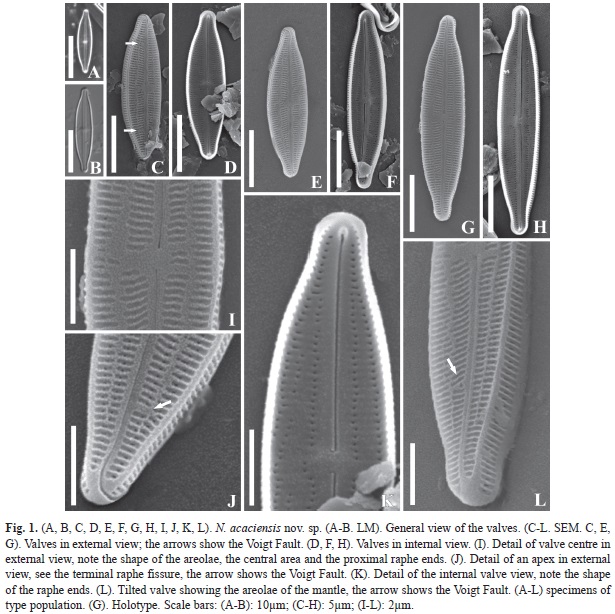
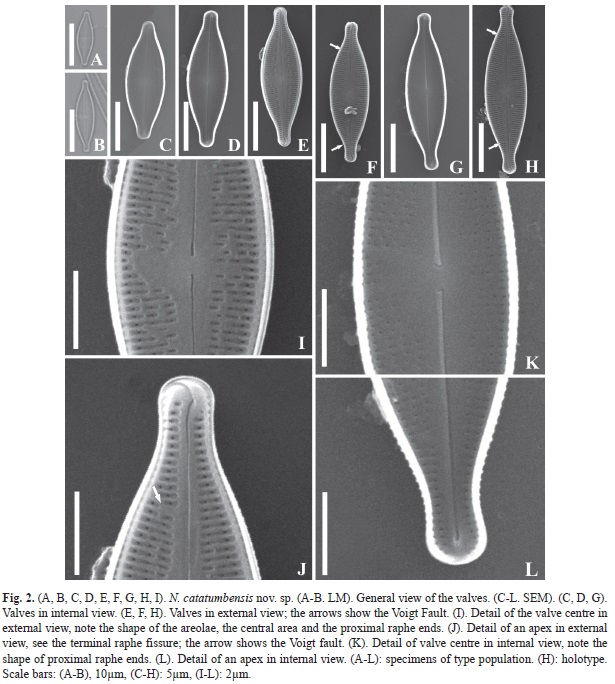
<body><![CDATA[illustrated:&nbsp; two&nbsp; of&nbsp; them&nbsp; are&nbsp;     reported&nbsp; here as&nbsp; new&nbsp; species&nbsp; and&nbsp;     three&nbsp; are&nbsp; new&nbsp; records for Colombia.</span></font><br      style="font-family: verdana;">     <font size="2"></font><br style="font-family: verdana;">     <font style="font-weight: bold;" size="2"></font>     <div style="text-align: center;"><font style="font-weight: bold;"  size="2"><span style="font-family: verdana;"><span  style="font-style: italic;">Nupela</span> acaciensis nov. sp.    <br> <br style="font-family: verdana;"> </span></font><font size="2"></font><font size="2"><span  style="font-family: verdana;">Vouilloud &amp; Sala    <br> <br style="font-family: verdana;"> </span></font><a href="/img/revistas/rbt/v62n1/a19i1.jpg"><font  style="font-weight: bold;" size="2"><span style="font-family: verdana;">Figs. 1. A, B, C, D, E, F, G, H, I, J, K, L.</span></font></a><br style="font-family: verdana;"> </div> <font size="2"></font><br style="font-family: verdana;"> <font size="2"><span style="font-family: verdana;"><span  style="font-weight: bold;">Description</span>: Valves lanceolated with subrostrated to subcapitated ends, slightly asymmetric with respect to the apical axis (cymbelloid symmetry). Voigt Fault evident at the dorsal side of the valve. Striae built by two transapically elongated areolae that delimit a hyaline longitudinal line, to the ends the striae are composed only by one areola. Striae parallel to slightly radial at valve centre, parallel to the apices. Valve mantle with a row of are-olae continuous at the valve poles. Raphe well developed&nbsp; at both&nbsp; valves. External&nbsp; proximal raphe ends pore like, slightly expanded; terminal fissures hook-like and bent to the secondary valve side. Internal proximal raphe ends also hooked to the secondary side, central nodule notorious; distal ends straight finishing in small helictoglossae. Central area irregular, quadrangular at the primary valve side, missing the most internal areolae of the 2-3 central striae, at the secondary side more rounded due to the smaller internal areolae of the 2-3 central striae, sometimes one is missing.</span></font><br  style="font-family: verdana;"> <font size="2"></font><br style="font-family: verdana;"> <font size="2"><span style="font-family: verdana;">Morphometric data: length: 5-12.5&micro;m; width: 3-3.5&micro;m; l/w: 3.9-5.6; 44-54 striae/10&micro;m; 2 areolae/stria.</span></font><br  style="font-family: verdana;"> <font size="2"></font><br style="font-family: verdana;"> <font size="2"><span style="font-family: verdana;">Type&nbsp;&nbsp; material:&nbsp;&nbsp; Holotype&nbsp;&nbsp; (Iconotype): specimen&nbsp; illustrated&nbsp; in&nbsp; <a href="/img/revistas/rbt/v62n1/a19i1.jpg">Fig.&nbsp; 1C</a>;&nbsp; Isotype: 200640901.</span></font><br  style="font-family: verdana;"> <font size="2"></font><br style="font-family: verdana;"> <font size="2"><span style="font-family: verdana;">Type&nbsp; locality:&nbsp; 04&deg;&nbsp; 10&#8217; 57.00&#8217;&#8217;N-73&deg;&nbsp; 37&#8217; 31.70&#8217;&#8217;&nbsp; W,&nbsp; Blanca&nbsp; Stream,&nbsp; Acacias,&nbsp; Meta Department, Llanos Orientales, Colombia.</span></font><br style="font-family: verdana;"> <font size="2"></font><br style="font-family: verdana;"> <font size="2"><span style="font-family: verdana;">Etymology: the specific epithet refers to the name of municipality of the type locality.</span></font><br  style="font-family: verdana;"> <font size="2"></font><br style="font-family: verdana;"> <font size="2"><span style="font-family: verdana;">Distribution: only collected at the type locality.</span></font><br style="font-family: verdana;"> <font size="2"></font><br style="font-family: verdana;"> <font size="2"><span style="font-family: verdana;"><span  style="font-weight: bold;">Remaks</span>: the closest taxon is <span  style="font-style: italic;">N. schoemaniana</span> Lange-Bertalot, from which it differs in having striae composed by 3-4 areolae, the shape of the central area and internal straight proximal raphe ends (<a  href="/img/revistas/rbt/v62n1/a19t2.gif">Table 2</a>). Other similar taxon is <span style="font-style: italic;">N. florideana</span> Metzeltin &amp; Lange- Bertalot that differs in striae composed by 3-4 areolae, stauroid central area and straight internal proximal raphe ends. <span style="font-style: italic;">N. acaciensis</span> also resembles <span style="font-style: italic;">N. giluwensis</span> Vyverman &amp; Comp&eacute;re that differs in valve outline thinner with broadly capitated ends. Besides, at the dorsal side the latter has 2 hyaline longitudinal lines at valve centre that are reduced to one towards the ends and internal proximal raphe ends T-shaped.</span></font><br  style="font-family: verdana;"> <font size="2"></font><br style="font-family: verdana;"> <font size="2"><span style="font-family: verdana;">This species was collected in samples with DO 7.4mg/L, conductivity 10.3&micro;S/cm, pH 5, temperature 21.3&ordm;C and altitude 370m.a.s.l.</span></font><br  style="font-family: verdana;"> <font size="2"></font><br style="font-family: verdana;"> <font style="font-weight: bold;" size="2"></font>     <div style="text-align: center;"><font style="font-weight: bold;"  size="2"><span style="font-family: verdana;"><span  style="font-style: italic;">Nupela</span> catatumbensis nov. sp.</span></font><br  style="font-family: verdana; font-weight: bold;"> <font style="font-weight: bold;" size="2"></font><br  style="font-family: verdana; font-weight: bold;"> <font size="2"><span style="font-family: verdana;">Vouilloud &amp; Plata-D&iacute;az</span></font><br  style="font-family: verdana; font-weight: bold;"> <font style="font-weight: bold;" size="2"></font><br  style="font-family: verdana; font-weight: bold;"> <a href="/img/revistas/rbt/v62n1/a19i2.jpg"><font  style="font-weight: bold;" size="2"><span style="font-family: verdana;">Fig. 2. A, B, C, D, E, F, G, H, I, J, K, L.</span></font></a><br style="font-family: verdana;"> </div> <font size="2"></font><br style="font-family: verdana;"> <font size="2"><span style="font-family: verdana;"><span  style="font-weight: bold;">Description</span>: Valves lanceolate with sub- capitated to capitated ends, slightly asymmetrical in relation to the apical axis (cymbelloid symmetry). Voigt Fault conspicuous, on the dorsal side of the valve. Raphe filiform straight, external proximal ends simple, terminal fis- sures question mark-like, curved to the dorsal side. Striae radial and parallel towards the api- ces. Striae uniseriate; areolae with external big foramina and internal hymen perforated at the centre, interestriae rib-like. Axial area narrow to the apices, broaden and with irregular limits to the valve centre, central area wide, irregular, more developed on the dorsal side, where the striae are composed of 1-2 areolae less and sometimes 1-2 striae are missing and the central area reaches the valve margin. Axial and central area more silicified. In internal view, the raphe is filiform and straight, proximal ends hook-like, curved to the dorsal side; distal ends finish in small helictoglossae. Valve mantle with a row of elongated areolae interrupted at the poles at the level of the terminal fissure.</span></font><br style="font-family: verdana;"> <font size="2"></font><br style="font-family: verdana;"> <font size="2"><span style="font-family: verdana;">Morphometric data: length: 12-20&micro;m; width: 3.5-4.5&micro;m; l/w: 3-4.6; 44-51 striae/10&micro;m; 3-4 areolae/stria. </span></font><br  style="font-family: verdana;"> <font size="2"></font><br style="font-family: verdana;"> <font size="2"><span style="font-family: verdana;">Type material: Holotype (Iconotype): specimen illustrated in <a  href="/img/revistas/rbt/v62n1/a19i2.jpg">fig. 2D.</a> Isotype: 200432427.</span></font><br style="font-family: verdana;"> <font size="2"></font><br style="font-family: verdana;"> <font size="2"><span style="font-family: verdana;">Type locality: 08&deg; 12&#8217; 47.30&#8217;&#8217; N-72&deg; 26&#8217; 50.1&#8217;&#8217; W. Zancudo Stream, R&iacute;o Zulia Basin, Catatumbo, Colombia.</span></font><br style="font-family: verdana;"> <font size="2"></font><br style="font-family: verdana;"> <font size="2"><span style="font-family: verdana;">Etymology:&nbsp; the&nbsp; specific&nbsp; epithet&nbsp; refers to&nbsp; Catatumbo,&nbsp; the&nbsp; region&nbsp; were&nbsp; the&nbsp; species was found.</span></font><br  style="font-family: verdana;"> <font size="2"></font><br style="font-family: verdana;"> <font size="2"><span style="font-family: verdana;">Distribution: the species is widely distributed&nbsp; in&nbsp; the&nbsp; study&nbsp; area,&nbsp; at&nbsp; the&nbsp; Catatumbo,&nbsp; Meta&nbsp; River,&nbsp; Caquet&aacute;&nbsp; River,&nbsp; Magdalena Alto and Medio River and Tomo River basins.&nbsp; 200432427, 200432428,&nbsp; 200476086, 200570641,&nbsp;&nbsp;&nbsp;&nbsp;&nbsp;&nbsp; 200439228,&nbsp;&nbsp;&nbsp;&nbsp;&nbsp;&nbsp; 200438022, 200454443,&nbsp;&nbsp;&nbsp;&nbsp;&nbsp;&nbsp; 200476494,&nbsp;&nbsp;&nbsp;&nbsp;&nbsp;&nbsp; 200476922, 200473754, 200484429 (<a href="/img/revistas/rbt/v62n1/a19t2.gif">Table 2</a>).</span></font><br  style="font-family: verdana;"> <font size="2"></font><br style="font-family: verdana;"> <font size="2"><span style="font-family: verdana;"><span  style="font-weight: bold;">Remarks</span>: the closest species is <span style="font-style: italic;">Nupela</span> encyonopsis Metzeltin &amp; Lange-Bertalot, both species have costa like interstriae. Nevertheless, this species differs from <span  style="font-style: italic;">N. catatumbensis</span> in the shape of the central and axial areas, poorly&nbsp; developed&nbsp; and&nbsp; with&nbsp; regular&nbsp; bounderies, in the number of areolae per striae and in the shape of the external proximal raphe ends pore-like (<a href="/img/revistas/rbt/v62n1/a19t3.gif">Table 3</a>). Other similar species is <span style="font-style: italic;">N. brachysiroides</span>&nbsp; Lange-Bertalot&nbsp; that&nbsp; differs&nbsp; in the presence of a sinuous line sunken at both sides of the central and axial areas, besides it differs in the straight external proximal raphe ends and in the lower striae density and number of areolae per striae (<a href="/img/revistas/rbt/v62n1/a19t3.gif">Table 3</a>).</span></font><br  style="font-family: verdana;"> <font size="2"></font><br style="font-family: verdana;"> <font size="2"><span style="font-family: verdana;">This species was collected in samples with DO 5.1-7.6mg/L, conductivity 3.6-748&micro;S/cm, pH 5.2-7.9, temperature 21.1-29.1&ordm;C and altitude 97-575m.a.s.l.</span></font><br  style="font-family: verdana;"> <font size="2"></font><br style="font-family: verdana;"> <font size="2"></font>     ]]></body>
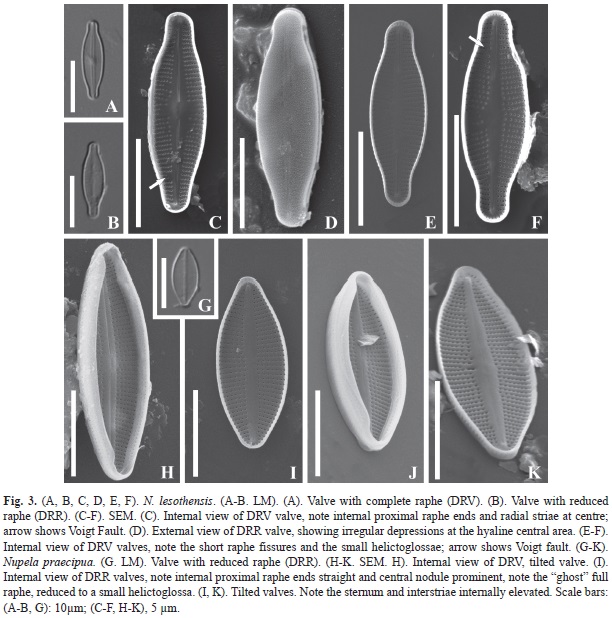
<body><![CDATA[<div style="text-align: center;"><font style="font-weight: bold;"  size="2"><span style="font-family: verdana;"><span  style="font-style: italic;">Nupela</span> <span  style="font-style: italic;">lesothensis </span>(Schoeman) </span></font><br  style="font-family: verdana; font-weight: bold;"> <font style="font-weight: bold;" size="2"></font><br  style="font-family: verdana; font-weight: bold;"> <font size="2"><span style="font-family: verdana;">Lange-Bertalot in Rumrich, Lange-Bertalot &amp; Rumrich. 2000</span></font><br  style="font-family: verdana; font-weight: bold;"> <font style="font-weight: bold;" size="2"></font><br  style="font-family: verdana; font-weight: bold;"> <a href="/img/revistas/rbt/v62n1/a19i3.jpg"><font  style="font-weight: bold;" size="2"><span style="font-family: verdana;">Fig. 3. A, B, C, D, E, F.</span></font></a><br style="font-family: verdana;"> </div> <font size="2"></font><br style="font-family: verdana;"> <font size="2"><span style="font-family: verdana;">Basionym: <span  style="font-style: italic;">Rhoicosphenia lesothensis</span> Schoeman (Schoeman &amp; Archibald, 1976-1980).</span></font><br style="font-family: verdana;"> <font size="2"></font><br style="font-family: verdana;"> <font size="2"><span style="font-family: verdana;">Type locality: Spring in the Berea district of Lesotho.</span></font><br style="font-family: verdana;"> <font size="2"></font><br style="font-family: verdana;"> <font size="2"><span style="font-family: verdana;">Valves lanceolate with rostrate ends, slightly transapically asymmetrical. One valve has a well-developed raphe (DRV) and the other with reduced raphe branches to approximately half of its full length (VRR). Voigt Fault conspicuous. DRV: raphe filiform sligthly sinuous, internal proximal&nbsp; ends&nbsp; straight,&nbsp; distal&nbsp; ends&nbsp; finish&nbsp; in small helictoglosae. Striae radial at most of the valve extension, parallel and convergent at the ends. Axial area narrow at the ends widening to the valve centre where it merges with the wide irregular central area. VRR: it differs from the other valve in the short raphe fissures, externally it presents irregular depressions at the hyaline central area. One row of elongated areolae at valve mantle, interrupted at the apices.</span></font><br style="font-family: verdana;"> <font size="2"></font><br style="font-family: verdana;"> <font size="2"><span style="font-family: verdana;">Morphometric data: length: 9-12&micro;m; width: 3-3.5&micro;m;&nbsp; l/w:&nbsp; 3-3.6&micro;m;&nbsp; 38-46&nbsp; striae/10&micro;m; 50-74 areolae/10&micro;m.</span></font><br style="font-family: verdana;"> <font size="2"></font><br style="font-family: verdana;"> <font size="2"><span style="font-family: verdana;">Distribution&nbsp; in&nbsp; Colombia:&nbsp; it&nbsp; is&nbsp; recorded&nbsp; for&nbsp; the&nbsp; first&nbsp; time&nbsp; in&nbsp; the&nbsp; country&nbsp; in&nbsp; different&nbsp; basins&nbsp; with&nbsp; significant&nbsp; variations&nbsp; in their ecomorphology and electrolyte content. Samples 200570641, 200527650, 200418858, 200469503,&nbsp;&nbsp;&nbsp;&nbsp;&nbsp;&nbsp; 200436532,&nbsp;&nbsp;&nbsp;&nbsp;&nbsp;&nbsp; 200438023, 200440779,&nbsp;&nbsp;&nbsp;&nbsp;&nbsp;&nbsp; 200446180,&nbsp;&nbsp;&nbsp;&nbsp;&nbsp;&nbsp; 200454443, 200465803, 200463448, 200441028 (<a href="/img/revistas/rbt/v62n1/a19t2.gif">Table 2</a>).</span></font><br style="font-family: verdana;"> <font size="2"></font><br style="font-family: verdana;"> <font size="2"><span style="font-family: verdana;">Remarks: this species was collected in samples&nbsp;&nbsp; with&nbsp;&nbsp; DO&nbsp;&nbsp; 1-8.6mg/L,&nbsp;&nbsp; conductiv- ity 13.5-302.5&micro;S/cm, pH 6.0-8.3, temperature 21.1-30.6&ordm;C and altitude 70-542m.a.s.l.</span></font><br  style="font-family: verdana;"> <font size="2"></font><br style="font-family: verdana;"> <font style="font-weight: bold;" size="2"></font>     <div style="text-align: center;"><font style="font-weight: bold;"  size="2"><span style="font-family: verdana;"><span  style="font-style: italic;">Nupela</span> praecipua </span></font><font  size="2"><span style="font-family: verdana;">(Reichardt) </span></font><br  style="font-family: verdana; font-weight: bold;"> <font style="font-weight: bold;" size="2"></font><br  style="font-family: verdana; font-weight: bold;"> <font size="2"><span style="font-family: verdana;">Reichardt in Rumrich et al. 2000</span></font><br  style="font-family: verdana; font-weight: bold;"> <font style="font-weight: bold;" size="2"></font><br  style="font-family: verdana; font-weight: bold;"> <a href="/img/revistas/rbt/v62n1/a19i3.jpg"><font  style="font-weight: bold;" size="2"><span style="font-family: verdana;">Fig. 3. G, H, I, J, K.</span></font></a><br  style="font-family: verdana; font-weight: bold;"> </div> <font style="font-weight: bold;" size="2"></font><br  style="font-family: verdana;"> <font size="2"><span style="font-family: verdana;">Basionym: <span  style="font-style: italic;">Achnanthes praecipua</span> Reichardt (Reichardt, 1988)</span></font><br  style="font-family: verdana;"> <font size="2"></font><br style="font-family: verdana;"> <font size="2"><span style="font-family: verdana;">Type locality: Custepec River, M&eacute;xico. </span></font><br style="font-family: verdana;"> <font size="2"></font><br style="font-family: verdana;"> <font size="2"><span style="font-family: verdana;">Valves&nbsp; broadly&nbsp; lanceolate&nbsp; with&nbsp; obtuse ends. Achnanthoid&nbsp; frustules,&nbsp; heterovalvar. A valve&nbsp; with&nbsp; complete&nbsp; raphe&nbsp; (VDR)&nbsp; and&nbsp; the other with rudimentary raphe branches (VRR). Voigt Fault inconspicuous. VDR: raphe filiform straight, internally proximal ends simple and the distal ends terminated in small helictoglossae. Axial area in internal view and central nodule prominent. Striae radial throughout the valve. Central area unmarked, wide axial area with irregular boundaries. VRR, raphe reduced to a small helictoglossa, &#8220;ghost&#8221; full raphe, sternum internally elevated. A row of elongated areolae on the mantle interrupted at the apices.</span></font><br  style="font-family: verdana;"> <font size="2"></font><br style="font-family: verdana;"> <font size="2"><span style="font-family: verdana;">Morphometric data: length: 8-13.5&micro;m; width: 4-5&micro;m; l/w: 2-2.8&micro;m; 30-39 striae/10&micro;m; 35-43 areolas/10&micro;m.</span></font><br  style="font-family: verdana;"> <font size="2"></font><br style="font-family: verdana;"> <font size="2"><span style="font-family: verdana;">Distribution in Colombia: it is recorded for the first time in the country in a high variety of habitats from an ecomorphological point of view. Found in samples</span></font><br  style="font-family: verdana;"> <font size="2"></font><br style="font-family: verdana;"> <font size="2"><span style="font-family: verdana;">200468182, 200568525, 200642952, 200424905 200527650, 200420431, 200423382, 200424905, 200436357, 200436356, 200436532, 200438023,&nbsp; 200438022, 200439228, 200461115, 200462477, 200476490, 200476494, 200470667, 200439233 (<a  href="/img/revistas/rbt/v62n1/a19t2.gif">Table 2</a>).</span></font><br  style="font-family: verdana;"> <font size="2"></font><br style="font-family: verdana;"> <font size="2"><span style="font-family: verdana;">Remarks: this species was collected in samples&nbsp; with&nbsp; DO&nbsp; 3.6-8.6mg/L,&nbsp; conductivity</span></font><br  style="font-family: verdana;"> <font size="2"><span style="font-family: verdana;">3.7-649&micro;S/cm, pH 5.1-8.3, temperature 22.6- 30.1&ordm;C and altitude 69-575m.a.s.l.</span></font><br  style="font-family: verdana;"> <font size="2"></font><br style="font-family: verdana;"> <font size="2"></font>     <div style="text-align: center; font-weight: bold;"><font size="2"><span      style="font-family: verdana;"><span style="font-style: italic;">Nupela</span>     <span style="font-style: italic;">subpallavicini </span></span></font><br      style="font-family: verdana;">     <font size="2"></font><br style="font-family: verdana;">     <font style="font-weight: normal;" size="2"><span      style="font-family: verdana;">Metzeltin &amp; Lange-Bertalot in</span></font><br      style="font-family: verdana; font-weight: normal;">     ]]></body>
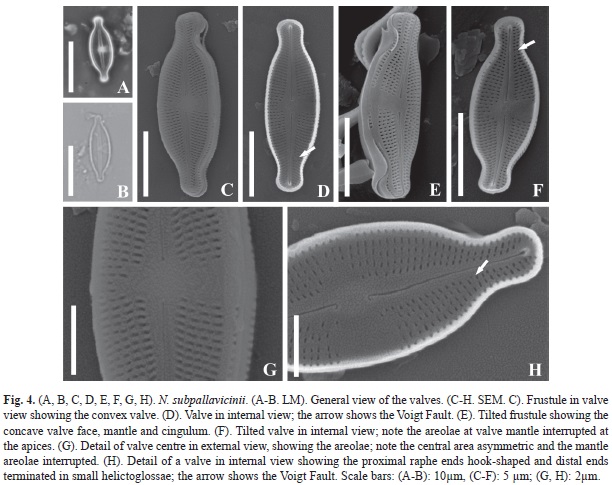
<body><![CDATA[<font style="font-weight: normal;" size="2"><span      style="font-family: verdana;">Metzeltin &amp; Lange-Bertalot, 1998</span></font><br      style="font-family: verdana; font-weight: normal;">     <font style="font-weight: normal;" size="2"></font><br      style="font-family: verdana;">     <a href="/img/revistas/rbt/v62n1/a19i4.jpg"><font size="2"><span      style="font-family: verdana;">Fig. 4. A, B, C, D,     E, F, G, H.</span></font></a><br style="font-family: verdana;">     </div>     <font size="2"></font><br style="font-family: verdana;">     ]]></body>
<body><![CDATA[<font size="2"><span style="font-family: verdana;">Type&nbsp;     locality:&nbsp;     river&nbsp; of&nbsp; black&nbsp; waters&nbsp; in Tepui Avayan,     Venezuela.</span></font><br style="font-family: verdana;">     <font size="2"></font><br style="font-family: verdana;">     <font size="2"><span style="font-family: verdana;">Valves broadly     lanceolate with     capitate ends. Both valves with developed raphe, slightly asymmetric     with respect to the transapical axis, frustules curved in girdle view.     Achnanthoid symmetry, one valve face concave and the&nbsp; other&nbsp;     ]]></body>
<body><![CDATA[convexe. Voigt&nbsp; Fault&nbsp; sligthly&nbsp; conspicuous. Secondary     valve margin more con- vex than the primary margin. Raphe filiform     straight, external proximal raphe ends pore- like, slightly expanded,     distal ends curved towards the secondary valve side; internally     proximal raphe ends hook-shaped bent towards the&nbsp; secondary&nbsp;     side&nbsp; of&nbsp; the&nbsp; valve&nbsp; and&nbsp; distal ends     terminated in small helictoglossae. Striae radial throughout the valve.     Axial area tapers towards the apex, and gently broadens towards the     centre; central area asymmetric rounded at the primary side bounded by     shorter striae, at the secondary side it extends up to the margin.     ]]></body>
<body><![CDATA[Interstriae prominent in external view. A row of elongated areolae on     the valve mantle, interrupted at the apices and at the fascia on the     secondary margin.</span></font><br style="font-family: verdana;">     <font size="2"></font><br style="font-family: verdana;">     <font size="2"><span style="font-family: verdana;">Morphometric data:     length:     10-17&micro;m; width: 4-5.5&micro;m; l/w: 2.5-3&micro;m; 37-48     striae/10&micro;m; 28-37 areolae/10&micro;m.</span></font><br      style="font-family: verdana;">     <font size="2"></font><br style="font-family: verdana;">     ]]></body>
<body><![CDATA[<font size="2"><span style="font-family: verdana;">Distribution&nbsp;     in&nbsp;     Colombia:&nbsp; it&nbsp; is&nbsp; recorded for the first time in the     country. Found only in sample 200640901 (<a      href="/img/revistas/rbt/v62n1/a19t2.gif">Table 2</a>).</span></font><br      style="font-family: verdana;">     <font size="2"></font><br style="font-family: verdana;">     <font size="2"><span style="font-family: verdana;">Remarks:&nbsp;&nbsp;     this&nbsp;&nbsp; species&nbsp;&nbsp; was&nbsp;&nbsp; collected in&nbsp;     samples&nbsp; with&nbsp; DO&nbsp; 7.4mg/L,&nbsp; conductivity     ]]></body>
<body><![CDATA[10.3&micro;S/cm, pH 5, temperature 21.3&ordm;C and altitude 370m.a.s.l.</span></font><br      style="font-family: verdana;">     <font size="2"></font><br style="font-family: verdana;">     <font style="font-weight: bold;" size="3"><span      style="font-family: verdana;">Discussion</span></font><br      style="font-family: verdana;">     <font size="2"></font><br style="font-family: verdana;">     <font size="2"><span style="font-family: verdana;">Colombia is     considered the second     most biodiverse&nbsp; country&nbsp; in&nbsp; the&nbsp; world&nbsp;     ]]></body>
<body><![CDATA[(An&oacute;nimo, 2010) and this may be due to its geographical location     and topography. Diatom studies conducted&nbsp; to&nbsp; date,&nbsp;     showed&nbsp; that&nbsp; this&nbsp; group has high diversity the same as     other groups of organisms and many new taxa for science have been     recently described (Vouilloud, Sala, N&uacute;&ntilde;ez-Avellaneda,     &amp; Duque, 2010; Montoya- Moreno, Sala, Vouilloud &amp; Aguirre,     2012).</span></font><br style="font-family: verdana;">     <font size="2"></font><br style="font-family: verdana;">     <font size="2"><span style="font-family: verdana;">In&nbsp; the&nbsp;     framework&nbsp;     ]]></body>
<body><![CDATA[of&nbsp; a&nbsp; project&nbsp; to&nbsp; con- struct an index for water     quality evaluation for Colombia and through the analyses undertaken     with LM and SEM of 150 benthic diatom samples collected in lotic     waterbodies from low-lands, we have identified approximatly 2 000     morphotypes. In the study area the genus <span      style="font-style: italic;">Nupela </span>was well represented     and five species were identified: <span style="font-style: italic;">N.     acaciensis</span> and <span style="font-style: italic;">N.     catatumbensis</span>     are new for science and <span style="font-style: italic;">N.     ]]></body>
<body><![CDATA[lesothensis</span>,<span style="font-style: italic;"> N. prae- cipua </span>and     <span style="font-style: italic;">N.     subpallavicinii</span> are recorded for the first time in Colombia. <span      style="font-style: italic;">Nupela</span>     <span style="font-style: italic;">acaciensis </span>is&nbsp;     characterized&nbsp; by&nbsp; having&nbsp;     developed&nbsp; raphe in both valves, cymbelloid symmetry, striae built     by two elongated areolae that delimit a longitudinal line at each     hemivalve. The closest taxa are <span style="font-style: italic;">N.     schoemaniana</span> Lange-Bertalot     ]]></body>
<body><![CDATA[(Lange-Bertalot, 1993) and <span style="font-style: italic;">N.     florideana</span> Metzeltin &amp; Lange-Bertalot     (Metzeltin &amp; Lange-Bertalot, 2007) from which it differs in striae,     central area and internal proximal raphe ends. <span      style="font-style: italic;">N. acaciensis</span> also     resembles <span style="font-style: italic;">N. giluwensis </span>Vyverman     &amp; Comp&egrave;re (Vyverman &amp;     Comp&egrave;re, 1991) that differs in valve outline, presence of     hyaline longitudinal lines on the valve face, internal proximal raphe     ends, and distribution of the mantle areolae, continuous or interrupted     ]]></body>
<body><![CDATA[at valve apices. <span style="font-style: italic;">Nupela</span> <span      style="font-style: italic;">catatumbensis </span>is characterized by     having     developed raphe in both valves, cymbelloid symmetry, striae built by     3-4 transapically elongated areolae, interstriae elevated conforming     transapical ribs and internal proximal raphe ends hook-shaped. Its     closest species is <span style="font-style: italic;">N. encyonopsis</span>     Metzeltin &amp; Lange-Bertalot&nbsp;     (Metzeltin&nbsp; &amp;&nbsp; Lange-Bertalot, 1998) which differs in the     shape of the central and axial areas, in the number of areolae per     ]]></body>
<body><![CDATA[striae, and in the shape of the external proximal raphe ends. Another     similar species is <span style="font-style: italic;">N. brachysiroides</span>     Lange-Bertalot (Lange- Bertalot,     1993) that differs in the presence of a sinuous line sunken at both     sides of the central and axial areas, in the external proximal raphe     ends, and in striae density and number of are-olae per stria.</span></font><br      style="font-family: verdana;">     <font size="2"></font><br style="font-family: verdana;">     <font size="2"><span style="font-family: verdana;">The genus <span      style="font-style: italic;">Nupela</span> was originally     ]]></body>
<body><![CDATA[described from high elevation ponds of Papua, New Guinea. Since its     initial discovery, several species have been reported across Europe,     South America, North America, Asia and Africa in neutral pH and low     conductivity waters (Spaulding &amp; Edlund, 2008). In the studied     area, the genus was present in 28 sites located in&nbsp; 22&nbsp;     streams&nbsp; and&nbsp; rivers,&nbsp; and&nbsp; eight&nbsp; basins of     different regions of the country, with low conductivity but a medium     range of variation in other environmental characteristics. The     Caquet&aacute;, Tomo, Cravo Sur and Meta River Basins, placed at the     Eastern lowlands were characterized by waters with acid to neutral pH.     ]]></body>
<body><![CDATA[On the other hand, rivers from the Putumayo River basin had neutral pH.     The streams from the Upper Magdalena River Basin were characterized by     high temporal variation of water flows, a high coverage of hard     substrates and a relatively basic pH, while those of the Catatumbo     Basin comprise mountain rivers with predominantly hard substrates (like     gravel and rocks) and also lowland water bodies with soft substrates     (clay); pH sligthly acid to neutral, with exception of the Pamplonita     River (San Rafael Bridge) a hipereutrophic site with frequent algal     blooms.</span></font><br style="font-family: verdana;">     <font size="2"></font><br style="font-family: verdana;">     ]]></body>
<body><![CDATA[<font size="2"><span style="font-family: verdana;">Although the genus     was widely     distributed in these basins, the studied species showed different     distribution patterns. <span style="font-style: italic;">N. acaciensis     </span>and <span style="font-style: italic;">N. subpallavicini</span>     have a     restricted distribution, while <span style="font-style: italic;">N.     catatumbensis, N. lesothensis </span>and <span      style="font-style: italic;">N.     praecipua</span> have a wider distribution and were collected&nbsp;     ]]></body>
<body><![CDATA[in&nbsp;     sites&nbsp; with&nbsp; significant&nbsp; variations in their     ecomorphology, altitude, temperature, pH and electrolyte content.<span      style="font-style: italic;"> N.     acaciensis</span> was only recorded in Meta River basin, placed at the     Eastern     lowlands, characterized by waters with very low electrolithic content,     and acid to neutral pH.<span style="font-style: italic;"> N.     subpallavicini</span> was originally described from     a river of black waters in Tepui Avayan, Venezuela&nbsp;     ]]></body>
<body><![CDATA[(Metzeltin&nbsp; &amp;&nbsp; Lange-Bertalot, 1998), and in Colombia it     was collected only in a site with very low conductivity and pH, and at     a medium altitude. <span style="font-style: italic;">N. catatumbensis</span>     was found both in small rough     streams (with beds of gravel and stones) with turbulent flow as well as     in rivers with beds with soft sediments (silt and clay). <span      style="font-style: italic;">N.     lesothensis</span>, originally described from South Africa (Schoeman     &amp;     Archibald, 1976-1980), and <span style="font-style: italic;">N.     ]]></body>
<body><![CDATA[praecipua</span>, described from the Custepec     River, M&eacute;xico (Reichardt,&nbsp; 1988),&nbsp; were&nbsp;     collected&nbsp; in&nbsp; different basins with significant variations     in their ecomorphology, altitude, temperature, pH and electrolyte     content.</span></font><br style="font-family: verdana;">     <font size="2"></font><br style="font-family: verdana;">     <font style="font-weight: bold;" size="3"><span      style="font-family: verdana;">Acknowledgments</span></font><br      style="font-family: verdana;">     <font size="2"></font><br style="font-family: verdana;">     ]]></body>
<body><![CDATA[<font size="2"><span style="font-family: verdana;">The authors want to     thanks to the     biologists of the Biotechnology Laboratory of ECO- PETROL, S.A. who     participated in the field work and especially to Hernando Ovalle who     facilitate the historical inquiry of the variables in the database.    <br> <br style="font-family: verdana;"> </span></font><font size="2"></font> <hr style="width: 100%; height: 2px;"><font style="font-weight: bold;"  size="3"><span style="font-family: verdana;">References</span></font><br  style="font-family: verdana;"> <br style="font-family: verdana;">     <!-- ref --><div style="text-align: left;"><font size="2"><span  style="font-family: verdana;">An&oacute;nimo (2010). Instituto de Investigaci&oacute;n Alexander Von Humboldt. Recuperado de </span></font><font size="2"><span style="font-family: verdana;"></span></font><font  style="font-family: verdana;" size="2">http://www.humboldt.org. co/chmcolombia/ biodiversidad.htm.    &nbsp;&nbsp;&nbsp;&nbsp;&nbsp;&nbsp;&nbsp;&nbsp;[&#160;<a href="javascript:void(0);" onclick="javascript: window.open('/scielo.php?script=sci_nlinks&ref=1647757&pid=S0034-7744201400020001900001&lng=','','width=640,height=500,resizable=yes,scrollbars=1,menubar=yes,');">Links</a>&#160;]<!-- end-ref --><!-- ref --></font><br  style="font-family: verdana;"> <br style="font-family: verdana;"> <font size="2"><span style="font-family: verdana;">Anonymous. (1975). Proposal for a standardization of diatom terminology and diagnosis. <span  style="font-style: italic;">Nova Hedwigia Beiheft, 53</span>, 323-354.    &nbsp;&nbsp;&nbsp;&nbsp;&nbsp;&nbsp;&nbsp;&nbsp;[&#160;<a href="javascript:void(0);" onclick="javascript: window.open('/scielo.php?script=sci_nlinks&ref=1647758&pid=S0034-7744201400020001900002&lng=','','width=640,height=500,resizable=yes,scrollbars=1,menubar=yes,');">Links</a>&#160;]<!-- end-ref --><!-- ref --></span></font><br  style="font-family: verdana;"> <br style="font-family: verdana;"> <font size="2"><span style="font-family: verdana;">Barber, H. G. &amp; Haworth, E. Y. (1981). <span style="font-style: italic;">A guide to the morphology of the diatom frustule.</span> Freshwater Biological Association, Scientific Publication No 44.&nbsp;&nbsp; United Kingdom: Acanthophyllum Books.    &nbsp;&nbsp;&nbsp;&nbsp;&nbsp;&nbsp;&nbsp;&nbsp;[&#160;<a href="javascript:void(0);" onclick="javascript: window.open('/scielo.php?script=sci_nlinks&ref=1647759&pid=S0034-7744201400020001900003&lng=','','width=640,height=500,resizable=yes,scrollbars=1,menubar=yes,');">Links</a>&#160;]<!-- end-ref --><!-- ref --></span></font><br  style="font-family: verdana;"> <br style="font-family: verdana;"> <font size="2"><span style="font-family: verdana;">CEN/TC 230. (2003). <span  style="font-style: italic;">Water quality-Guidance standard for the routine sampling and pretreatment of benthic diatoms from rivers.</span> Comit&eacute; European de Normalisation, Geneva. Retrieved from www.techind.fi/standard/ uusitet/tilaajat/sfs_en_12952-6.pdf</span></font><br  style="font-family: verdana;    &nbsp;&nbsp;&nbsp;&nbsp;&nbsp;&nbsp;&nbsp;&nbsp;[&#160;<a href="javascript:void(0);" onclick="javascript: window.open('/scielo.php?script=sci_nlinks&ref=1647760&pid=S0034-7744201400020001900004&lng=','','width=640,height=500,resizable=yes,scrollbars=1,menubar=yes,');">Links</a>&#160;]<!-- end-ref --><!-- ref -->"> <br style="font-family: verdana;"> <font size="2"><span style="font-family: verdana;">Donato, J. C. (2001). <span style="font-style: italic;">Fitoplancton de los lagos andinos del&nbsp; Norte&nbsp; de&nbsp; Suram&eacute;rica&nbsp; (Colombia):&nbsp; Composici&oacute;n y Factores de distribuci&oacute;n. </span>Bogot&aacute;: Academia Colombiana de Ciencias Exactas, F&iacute;sicas y Naturales. Colecci&oacute;n Jorge &Aacute;lvarez Lleras N&deg;    &nbsp;&nbsp;&nbsp;&nbsp;&nbsp;&nbsp;&nbsp;&nbsp;[&#160;<a href="javascript:void(0);" onclick="javascript: window.open('/scielo.php?script=sci_nlinks&ref=1647761&pid=S0034-7744201400020001900005&lng=','','width=640,height=500,resizable=yes,scrollbars=1,menubar=yes,');">Links</a>&#160;]<!-- end-ref --><!-- ref --> 19.</span></font><br  style="font-family: verdana;"> <br style="font-family: verdana;"> <font size="2"><span style="font-family: verdana;">Fourtanier,&nbsp; E.&nbsp; &amp;&nbsp; Kociolek,&nbsp; J.&nbsp; P.&nbsp; (2011).&nbsp; <span style="font-style: italic;">Introduction and Acknowledgements to the Catalogue of Diatom Names.</span> Retrieved from http://researcharchive.calaca-demy.org/research/diatoms/names/intro.html.    &nbsp;&nbsp;&nbsp;&nbsp;&nbsp;&nbsp;&nbsp;&nbsp;[&#160;<a href="javascript:void(0);" onclick="javascript: window.open('/scielo.php?script=sci_nlinks&ref=1647762&pid=S0034-7744201400020001900006&lng=','','width=640,height=500,resizable=yes,scrollbars=1,menubar=yes,');">Links</a>&#160;]<!-- end-ref --><!-- ref --> </span></font><br style="font-family: verdana;"> <br style="font-family: verdana;"> <font size="2"><span style="font-family: verdana;">Kulikovskiy,&nbsp; M.,&nbsp; Lange-Bertalot,&nbsp; H.,&nbsp; &amp;&nbsp; Witkowski, A. (2009). <span style="font-style: italic;">Nupela</span> <span  style="font-style: italic;">matrioschka </span>sp. nov., <span  style="font-style: italic;">Nupela</span> <span  style="font-style: italic;">thurstonensis </span>comb. nov. and <span  style="font-style: italic;">Nupela</span> <span style="font-style: italic;">neogracillima </span>comb. &amp; nom. nov. (Bacillariophyceae): critical analysis of their&nbsp; morphology.&nbsp; <span  style="font-style: italic;">Polish&nbsp; Bototanical&nbsp; Journal,&nbsp; 54</span>, 13-20.    &nbsp;&nbsp;&nbsp;&nbsp;&nbsp;&nbsp;&nbsp;&nbsp;[&#160;<a href="javascript:void(0);" onclick="javascript: window.open('/scielo.php?script=sci_nlinks&ref=1647763&pid=S0034-7744201400020001900007&lng=','','width=640,height=500,resizable=yes,scrollbars=1,menubar=yes,');">Links</a>&#160;]<!-- end-ref --><!-- ref --></span></font><br  style="font-family: verdana;"> <br style="font-family: verdana;"> <font size="2"><span style="font-family: verdana;">Lange-Bertalot, H. (1993). 85 neue taxa und &uuml;ber 100 weitere neu definierte Taxa erg&auml;nzend zur S&uuml;sswasserflo- ra von Mitteleuropa, Vol. 2/1-4.. In J. Cramer (Ed.), <span style="font-style: italic;">Bibliotheca Diatomologic</span>a <span style="font-style: italic;">27</span>. Berlin-Stuttgart.    &nbsp;&nbsp;&nbsp;&nbsp;&nbsp;&nbsp;&nbsp;&nbsp;[&#160;<a href="javascript:void(0);" onclick="javascript: window.open('/scielo.php?script=sci_nlinks&ref=1647764&pid=S0034-7744201400020001900008&lng=','','width=640,height=500,resizable=yes,scrollbars=1,menubar=yes,');">Links</a>&#160;]<!-- end-ref --><!-- ref --></span></font><br  style="font-family: verdana;"> <br style="font-family: verdana;"> <font size="2"><span style="font-family: verdana;">Lange-Bertalot, H. &amp; Moser, G. (1994). Brachysira, Monographie der Gattung. <span  style="font-style: italic;">Bibliotheca Diatomologica 29</span>. In J. Cramer. (Ed.), Berlin-Stuttgart.    &nbsp;&nbsp;&nbsp;&nbsp;&nbsp;&nbsp;&nbsp;&nbsp;[&#160;<a href="javascript:void(0);" onclick="javascript: window.open('/scielo.php?script=sci_nlinks&ref=1647765&pid=S0034-7744201400020001900009&lng=','','width=640,height=500,resizable=yes,scrollbars=1,menubar=yes,');">Links</a>&#160;]<!-- end-ref --><!-- ref --></span></font><br  style="font-family: verdana;"> <br style="font-family: verdana;"> <font size="2"><span style="font-family: verdana;">Metzeltin, D. &amp; Lange-Bertalot, H. (1998). Tropical dia- toms of South America I. In: H. Lange-Bertalot. (Ed.), <span style="font-style: italic;">Iconographia Diatomologica 5. </span>Germany: Koeltz Scientific Books.    &nbsp;&nbsp;&nbsp;&nbsp;&nbsp;&nbsp;&nbsp;&nbsp;[&#160;<a href="javascript:void(0);" onclick="javascript: window.open('/scielo.php?script=sci_nlinks&ref=1647766&pid=S0034-7744201400020001900010&lng=','','width=640,height=500,resizable=yes,scrollbars=1,menubar=yes,');">Links</a>&#160;]<!-- end-ref --><!-- ref --></span></font><br style="font-family: verdana;"> <br style="font-family: verdana;"> <font size="2"><span style="font-family: verdana;">Metzeltin, D. &amp; Lange-Bertalot, H. (2007). Tropical diatoms of South America II. In H. Lange-Bertalot (Ed.), <span style="font-style: italic;">Iconographia Diatomologica 18. </span>A.R.G. Germany: Gantner Verlag K.G.    &nbsp;&nbsp;&nbsp;&nbsp;&nbsp;&nbsp;&nbsp;&nbsp;[&#160;<a href="javascript:void(0);" onclick="javascript: window.open('/scielo.php?script=sci_nlinks&ref=1647767&pid=S0034-7744201400020001900011&lng=','','width=640,height=500,resizable=yes,scrollbars=1,menubar=yes,');">Links</a>&#160;]<!-- end-ref --><!-- ref --></span></font><br style="font-family: verdana;"> <br style="font-family: verdana;"> <font size="2"><span style="font-family: verdana;">Monnier, O., Lange-Bertalot, H., &amp; Bertrand, J. (2003). <span style="font-style: italic;">Nupela</span> exotica species nova: une diatom&eacute;e d&#8217;un aquarium tropical d&#8217;eau douce. Avec des remarques sur la biog&eacute;ographie du genre.<span style="font-style: italic;"> Diatom Research, 18</span>, 273-291.    &nbsp;&nbsp;&nbsp;&nbsp;&nbsp;&nbsp;&nbsp;&nbsp;[&#160;<a href="javascript:void(0);" onclick="javascript: window.open('/scielo.php?script=sci_nlinks&ref=1647768&pid=S0034-7744201400020001900012&lng=','','width=640,height=500,resizable=yes,scrollbars=1,menubar=yes,');">Links</a>&#160;]<!-- end-ref --><!-- ref --></span></font><br  style="font-family: verdana;"> <br style="font-family: verdana;"> <font size="2"><span style="font-family: verdana;">Montoya-Moreno,&nbsp; Y.,&nbsp; Sala,&nbsp; S.&nbsp; E.,&nbsp; Vouilloud, A. A.,&nbsp; &amp; Aguirre, N. (2012). Diatomeas (Bacilla riophyta) perif&iacute;ticas del Complejo Cenagoso de Ayapel, Colombia. I. <span style="font-style: italic;">Caldasia, 34</span>, 457-474.    &nbsp;&nbsp;&nbsp;&nbsp;&nbsp;&nbsp;&nbsp;&nbsp;[&#160;<a href="javascript:void(0);" onclick="javascript: window.open('/scielo.php?script=sci_nlinks&ref=1647769&pid=S0034-7744201400020001900013&lng=','','width=640,height=500,resizable=yes,scrollbars=1,menubar=yes,');">Links</a>&#160;]<!-- end-ref --><!-- ref --></span></font><br style="font-family: verdana;"> <br style="font-family: verdana;"> <font size="2"><span style="font-family: verdana;">Ovalle,&nbsp; H.,&nbsp; Plata-D&iacute;az,&nbsp; Y.,&nbsp; Reyes,&nbsp; F.,&nbsp; Pimienta,&nbsp; A.,&nbsp; &amp; Riss, H. W. (2013). Biodiversity of South American lowland streams natural scenery and anthropogenic facts. <span style="font-style: italic;">Symposium for European Freshwater Sciences</span> (SEFS). Retrieved from http://www.sefs2013.de/_ medien/_content/files/Abstract_Book_SEFS8_2013. Pdf</span></font><br  style="font-family: verdana;    &nbsp;&nbsp;&nbsp;&nbsp;&nbsp;&nbsp;&nbsp;&nbsp;[&#160;<a href="javascript:void(0);" onclick="javascript: window.open('/scielo.php?script=sci_nlinks&ref=1647770&pid=S0034-7744201400020001900014&lng=','','width=640,height=500,resizable=yes,scrollbars=1,menubar=yes,');">Links</a>&#160;]<!-- end-ref --><!-- ref -->"> <br style="font-family: verdana;"> <font size="2"><span style="font-family: verdana;">Potapova, M. (2013). Transfer of <span style="font-style: italic;">Achnanthes decipiens </span>to the genus <span style="font-style: italic;">Nupela</span>. <span  style="font-style: italic;">Diatom Research, 28,</span> 139-142.    &nbsp;&nbsp;&nbsp;&nbsp;&nbsp;&nbsp;&nbsp;&nbsp;[&#160;<a href="javascript:void(0);" onclick="javascript: window.open('/scielo.php?script=sci_nlinks&ref=1647771&pid=S0034-7744201400020001900015&lng=','','width=640,height=500,resizable=yes,scrollbars=1,menubar=yes,');">Links</a>&#160;]<!-- end-ref --><!-- ref --></span></font><br  style="font-family: verdana;"> <br style="font-family: verdana;"> <font size="2"><span style="font-family: verdana;">Potapova, M. G., Ponader, K. C., Lowe, R. L., Clason, T. A., &amp; Bahls, L. L. (2003). Small-celled <span style="font-style: italic;">Nupela</span> species from North America. <span style="font-style: italic;">Diatom Research, 18</span>, 293-306.    &nbsp;&nbsp;&nbsp;&nbsp;&nbsp;&nbsp;&nbsp;&nbsp;[&#160;<a href="javascript:void(0);" onclick="javascript: window.open('/scielo.php?script=sci_nlinks&ref=1647772&pid=S0034-7744201400020001900016&lng=','','width=640,height=500,resizable=yes,scrollbars=1,menubar=yes,');">Links</a>&#160;]<!-- end-ref --><!-- ref --></span></font><br style="font-family: verdana;"> <br style="font-family: verdana;"> <font size="2"><span style="font-family: verdana;">Reichardt, E. (1988). Achnanthes praecipua n. sp., a new freshwater diatom from Mexico. In F. E. Round (Ed.), <span style="font-style: italic;">Proceedings of 9th International Diatom Symposium</span> (391-395). Biopress Ltd, Bristol &amp; Koeltz Scientific Books, Koeningstein.    &nbsp;&nbsp;&nbsp;&nbsp;&nbsp;&nbsp;&nbsp;&nbsp;[&#160;<a href="javascript:void(0);" onclick="javascript: window.open('/scielo.php?script=sci_nlinks&ref=1647773&pid=S0034-7744201400020001900017&lng=','','width=640,height=500,resizable=yes,scrollbars=1,menubar=yes,');">Links</a>&#160;]<!-- end-ref --><!-- ref --></span></font><br  style="font-family: verdana;"> <br style="font-family: verdana;"> <font size="2"><span style="font-family: verdana;">Ross, R., Cox, E. J., Karayeva, D. G., Mann, D. G., Padock, T. B., Simonsen, R., &amp; Sims, P. A. (1979). An emended terminology for the siliceous components of the diatom cell. <span style="font-style: italic;">Nova Hedwigia, 64</span>, 513-533.    &nbsp;&nbsp;&nbsp;&nbsp;&nbsp;&nbsp;&nbsp;&nbsp;[&#160;<a href="javascript:void(0);" onclick="javascript: window.open('/scielo.php?script=sci_nlinks&ref=1647774&pid=S0034-7744201400020001900018&lng=','','width=640,height=500,resizable=yes,scrollbars=1,menubar=yes,');">Links</a>&#160;]<!-- end-ref --><!-- ref --></span></font><br style="font-family: verdana;"> <br style="font-family: verdana;"> <font size="2"><span style="font-family: verdana;">Rumrich, U., Lange-Bertalot, H., &amp; Rumrich, M. (2000). Diatoms of the Andes. From Venezuela to Patagonia/ Tierra del Fuego and two additional contributions. <span style="font-style: italic;">Iconographia Diatomologica 9</span>. Koeltz Scientific Books.    &nbsp;&nbsp;&nbsp;&nbsp;&nbsp;&nbsp;&nbsp;&nbsp;[&#160;<a href="javascript:void(0);" onclick="javascript: window.open('/scielo.php?script=sci_nlinks&ref=1647775&pid=S0034-7744201400020001900019&lng=','','width=640,height=500,resizable=yes,scrollbars=1,menubar=yes,');">Links</a>&#160;]<!-- end-ref --><!-- ref --></span></font><br style="font-family: verdana;"> <br style="font-family: verdana;"> <font size="2"><span style="font-family: verdana;">Schoeman,&nbsp; F.&nbsp; R.&nbsp; &amp;&nbsp; Archibald,&nbsp; R.&nbsp; E.&nbsp; M.&nbsp; (1976-1980). <span style="font-style: italic;">The diatom flora of Southern Africa.</span> CISR special report-Wat 50. National Institute for Water Researchk, Council for Scientific and Industrial Research, Pretoria.    &nbsp;&nbsp;&nbsp;&nbsp;&nbsp;&nbsp;&nbsp;&nbsp;[&#160;<a href="javascript:void(0);" onclick="javascript: window.open('/scielo.php?script=sci_nlinks&ref=1647776&pid=S0034-7744201400020001900020&lng=','','width=640,height=500,resizable=yes,scrollbars=1,menubar=yes,');">Links</a>&#160;]<!-- end-ref --><!-- ref --></span></font><br  style="font-family: verdana;"> <br style="font-family: verdana;"> <font size="2"><span style="font-family: verdana;">Siver, P. A., Hamilton, P. B., &amp; Morales, E. A. (2007). Notes on the genus <span  style="font-style: italic;">Nupela</span> (Bacillariophyceae) including the description of a new species, <span  style="font-style: italic;">Nupela</span> scissura sp. nov. and an expanded description of <span  style="font-style: italic;">Nupela</span> <span  style="font-style: italic;">paludigena</span>. <span style="font-style: italic;">Phycological Research, 55</span>, 125-134.    &nbsp;&nbsp;&nbsp;&nbsp;&nbsp;&nbsp;&nbsp;&nbsp;[&#160;<a href="javascript:void(0);" onclick="javascript: window.open('/scielo.php?script=sci_nlinks&ref=1647777&pid=S0034-7744201400020001900021&lng=','','width=640,height=500,resizable=yes,scrollbars=1,menubar=yes,');">Links</a>&#160;]<!-- end-ref --><!-- ref --></span></font><br style="font-family: verdana;"> <br style="font-family: verdana;"> <font size="2"><span style="font-family: verdana;">Siver, P. A., Wolfe, A. P., &amp; Edlund, M. B. (2010). Taxonomic&nbsp; descriptions&nbsp; and&nbsp; evolutionary&nbsp; implications of Middle Eocene pinnate diatoms representing the extant genera <span style="font-style: italic;">Oxyneis</span>, <span style="font-style: italic;">Actinella </span>and <span  style="font-style: italic;">Nupela</span> (Baci- llariophyceae).&nbsp; <span style="font-style: italic;">Plant&nbsp; Ecology&nbsp; &amp;&nbsp; Evolution,&nbsp; 143</span>, 340-351.    &nbsp;&nbsp;&nbsp;&nbsp;&nbsp;&nbsp;&nbsp;&nbsp;[&#160;<a href="javascript:void(0);" onclick="javascript: window.open('/scielo.php?script=sci_nlinks&ref=1647778&pid=S0034-7744201400020001900022&lng=','','width=640,height=500,resizable=yes,scrollbars=1,menubar=yes,');">Links</a>&#160;]<!-- end-ref --><!-- ref --></span></font><br  style="font-family: verdana;"> <br style="font-family: verdana;"> <font size="2"><span style="font-family: verdana;">Spaulding, S. &amp; Edlund, M. B. (2008). <span style="font-style: italic;">Nupela</span>. In Diatoms of the United States. Retrieved, from&nbsp;</span></font><font size="2"><span  style="font-family: verdana;">http://western-diatoms.colorado.edu/taxa/genus/<span  style="font-style: italic;">Nupela.    &nbsp;&nbsp;&nbsp;&nbsp;&nbsp;&nbsp;&nbsp;&nbsp;[&#160;<a href="javascript:void(0);" onclick="javascript: window.open('/scielo.php?script=sci_nlinks&ref=1647779&pid=S0034-7744201400020001900023&lng=','','width=640,height=500,resizable=yes,scrollbars=1,menubar=yes,');">Links</a>&#160;]<!-- end-ref --><!-- ref --></span></span></font><br  style="font-family: verdana;"> <br style="font-family: verdana;"> <font size="2"><span style="font-family: verdana;">V&eacute;lez,&nbsp; M.&nbsp; I.&nbsp; &amp;&nbsp; Hooghiemstra,&nbsp; H.&nbsp; (2005).&nbsp; Fossil&nbsp; and modern diatom assemblages from the savanna lake El Pi&ntilde;al, Colombia: an environmental reconstruction. <span  style="font-style: italic;">Diatom Research, 20,</span> 387-407.    &nbsp;&nbsp;&nbsp;&nbsp;&nbsp;&nbsp;&nbsp;&nbsp;[&#160;<a href="javascript:void(0);" onclick="javascript: window.open('/scielo.php?script=sci_nlinks&ref=1647780&pid=S0034-7744201400020001900024&lng=','','width=640,height=500,resizable=yes,scrollbars=1,menubar=yes,');">Links</a>&#160;]<!-- end-ref --><!-- ref --></span></font><br  style="font-family: verdana;"> <br style="font-family: verdana;"> <font size="2"><span style="font-family: verdana;">Vouilloud, A. A., Sala, S. E., N&uacute;&ntilde;ez-Avellaneda, M., &amp; Duque, S. R. (2010). Diatoms from the Colombian and Peruvian Amazon: the Genera <span  style="font-style: italic;">Encyonema</span>, <span  style="font-style: italic;">Encyonopsis </span>and <span  style="font-style: italic;">Gomphonema</span>. <span  style="font-style: italic;">Revista de Biolog&iacute;a Tropical, 58</span>, 45-62.    &nbsp;&nbsp;&nbsp;&nbsp;&nbsp;&nbsp;&nbsp;&nbsp;[&#160;<a href="javascript:void(0);" onclick="javascript: window.open('/scielo.php?script=sci_nlinks&ref=1647781&pid=S0034-7744201400020001900025&lng=','','width=640,height=500,resizable=yes,scrollbars=1,menubar=yes,');">Links</a>&#160;]<!-- end-ref --><!-- ref --></span></font><br style="font-family: verdana;"> <br style="font-family: verdana;"> <font size="2"><span style="font-family: verdana;">Vyverman, W. &amp; Comp&egrave;re, P. (1991). <span style="font-style: italic;">Nupela</span> <span  style="font-style: italic;">giluwensis </span>gen. &amp; spec. nov. A new genus of naviculoid diatoms. <span style="font-style: italic;">Diatom Research, 6,</span> 175-179.    &nbsp;&nbsp;&nbsp;&nbsp;&nbsp;&nbsp;&nbsp;&nbsp;[&#160;<a href="javascript:void(0);" onclick="javascript: window.open('/scielo.php?script=sci_nlinks&ref=1647782&pid=S0034-7744201400020001900026&lng=','','width=640,height=500,resizable=yes,scrollbars=1,menubar=yes,');">Links</a>&#160;]<!-- end-ref --><!-- ref --></span></font><br style="font-family: verdana;"> <br style="font-family: verdana;"> <font size="2"><span style="font-family: verdana;">Wotjal, A. Z. (2009). <span style="font-style: italic;">Nupela</span> <span style="font-style: italic;">marvanii </span>sp. nov., and <span  style="font-style: italic;">N. lapidosa</span> (Krasske) Lange-Bertalot in Poland with notes on the distribution and ecology of the genus <span  style="font-style: italic;">Nupela</span> (Bacillariophyta). <span style="font-style: italic;">Fottea, 9</span>, 233-242.    &nbsp;&nbsp;&nbsp;&nbsp;&nbsp;&nbsp;&nbsp;&nbsp;[&#160;<a href="javascript:void(0);" onclick="javascript: window.open('/scielo.php?script=sci_nlinks&ref=1647783&pid=S0034-7744201400020001900027&lng=','','width=640,height=500,resizable=yes,scrollbars=1,menubar=yes,');">Links</a>&#160;]<!-- end-ref --></span></font>    <br> <font size="2"><span style="font-family: verdana;"></span></font></div> <font size="2"><span style="font-family: verdana;">    <br> *Correspondencia: </span></font><font size="2"> <span style="font-family: verdana;">Silvia Sala: </span></font><font  size="2"><span style="font-family: verdana;">Departamento Cient&iacute;fico Ficolog&iacute;a, Universidad Nacional de La Plata, Argentina; sesala@fcnym.unlp.edu.ar</span></font>    <br> <font size="2"><span style="font-family: verdana;">Amelia Alejandra Vouilloud:</span></font><font size="2"><span  style="font-family: verdana;"> Departamento Cient&iacute;fico Ficolog&iacute;a, Universidad Nacional de La Plata, Argentina; avouilloud@fcnym.unlp.edu.ar</span></font>    <br> <font size="2"><span style="font-family: verdana;">Yasmin Plata-D&iacute;az: </span></font><font size="2"><span  style="font-family: verdana;">TIP LTDA. Instituto Colombiano del Petr&oacute;leo. Ecopetrol. Piedecuesta/Santander/Colombia; </span></font><font  size="2"><span style="font-family: verdana;">_labbiohidro@ecopetrol.com.co</span></font>    <br> <font size="2"><span style="font-family: verdana;">Edna Pedraza: </span></font><font  size="2"><span style="font-family: verdana;">TIP LTDA. Instituto Colombiano del Petr&oacute;leo. Ecopetrol. Piedecuesta/Santander/Colombia; </span></font><font  size="2"><span style="font-family: verdana;">_labbiohidro@ecopetrol.com.co</span></font>    <br> <font size="2"><span style="font-family: verdana;">Astrid Pimienta:&nbsp;</span></font><font size="2"><span  style="font-family: verdana;"></span></font><font size="2"><span  style="font-family: verdana;">Instituto Colombiano del Petr&oacute;leo. Ecopetrol. Piedecuesta/Santander/Colombia; Astrid.Pimienta@ecopetrol.com.co</span></font>    ]]></body>
<body><![CDATA[<br> <font size="2"><span style="font-family: verdana;">1. Departamento Cient&iacute;fico Ficolog&iacute;a, Universidad Nacional de La Plata, Argentina; sesala@fcnym.unlp.edu.ar, avouilloud@fcnym.unlp.edu.ar</span></font><br  style="font-family: verdana;"> <font size="2"><span style="font-family: verdana;">2. TIP LTDA. Instituto Colombiano del Petr&oacute;leo. Ecopetrol. Piedecuesta/Santander/Colombia;</span></font><font  size="2"><span style="font-family: verdana;">_labbiohidro@ecopetrol.com.co</span></font><br  style="font-family: verdana;"> <font size="2"><span style="font-family: verdana;">3. Instituto Colombiano del Petr&oacute;leo. Ecopetrol. Piedecuesta/Santander/Colombia; Astrid.Pimienta@ecopetrol.com.co</span></font><br  style="font-family: verdana;"> <hr style="width: 100%; height: 2px;">     <div style="text-align: center;"><font style="font-weight: bold;"  size="2"><span style="font-family: verdana;">Received 21-III-2013.&nbsp;&nbsp;&nbsp;&nbsp;&nbsp;&nbsp;&nbsp; Corrected 04-X-2013.&nbsp;&nbsp;&nbsp;&nbsp;&nbsp;&nbsp; Accepted 05-XI-2013. </span></font>    <br> </div> </div>      ]]></body><back>
<ref-list>
<ref id="B1">
<nlm-citation citation-type="">
<person-group person-group-type="author">
<name>
</name>
<name>
</name>
</person-group>
<source><![CDATA[Instituto de Investigación Alexander Von Humboldt.]]></source>
<year>2010</year>
</nlm-citation>
</ref>
<ref id="B2">
<nlm-citation citation-type="journal">
<person-group person-group-type="author">
<name>
</name>
<name>
</name>
</person-group>
<article-title xml:lang="en"><![CDATA[Proposal for a standardization of diatom terminology and diagnosis.]]></article-title>
<source><![CDATA[Nova Hedwigia Beiheft]]></source>
<year>1975</year>
<volume>53</volume>
<page-range>323-354</page-range></nlm-citation>
</ref>
<ref id="B3">
<nlm-citation citation-type="book">
<person-group person-group-type="author">
<name>
<surname><![CDATA[Barber]]></surname>
<given-names><![CDATA[H. G.]]></given-names>
</name>
<name>
<surname><![CDATA[Haworth]]></surname>
<given-names><![CDATA[E. Y.]]></given-names>
</name>
</person-group>
<source><![CDATA[A guide to the morphology of the diatom frustule.]]></source>
<year>1981</year>
<publisher-name><![CDATA[Acanthophyllum Books]]></publisher-name>
</nlm-citation>
</ref>
<ref id="B4">
<nlm-citation citation-type="book">
<collab>CEN/TC 230</collab>
<source><![CDATA[Water quality-Guidance standard for the routine sampling and pretreatment of benthic diatoms from rivers.]]></source>
<year>2003</year>
<publisher-name><![CDATA[Comité European de Normalisation, Geneva]]></publisher-name>
</nlm-citation>
</ref>
<ref id="B5">
<nlm-citation citation-type="book">
<person-group person-group-type="author">
<name>
<surname><![CDATA[Donato]]></surname>
<given-names><![CDATA[J. C.]]></given-names>
</name>
</person-group>
<source><![CDATA[Fitoplancton de los lagos andinos del Norte de Suramérica (Colombia): Composición y Factores de distribución.]]></source>
<year>2001</year>
<publisher-loc><![CDATA[^eBogotá Bogotá]]></publisher-loc>
<publisher-name><![CDATA[Academia Colombiana de Ciencias Exactas, Físicas y Naturales]]></publisher-name>
</nlm-citation>
</ref>
<ref id="B6">
<nlm-citation citation-type="">
<person-group person-group-type="author">
<name>
<surname><![CDATA[Fourtanier]]></surname>
<given-names><![CDATA[E.]]></given-names>
</name>
<name>
<surname><![CDATA[Kociolek]]></surname>
<given-names><![CDATA[J. P.]]></given-names>
</name>
</person-group>
<source><![CDATA[Introduction and Acknowledgements to the Catalogue of Diatom Names.]]></source>
<year>2011</year>
</nlm-citation>
</ref>
<ref id="B7">
<nlm-citation citation-type="journal">
<person-group person-group-type="author">
<name>
<surname><![CDATA[Kulikovskiy]]></surname>
<given-names><![CDATA[M.]]></given-names>
</name>
<name>
<surname><![CDATA[Lange-Bertalot]]></surname>
<given-names><![CDATA[H.]]></given-names>
</name>
<name>
<surname><![CDATA[Witkowski]]></surname>
<given-names><![CDATA[A.]]></given-names>
</name>
</person-group>
<article-title xml:lang="en"><![CDATA[Nupela matrioschka sp. nov., Nupela thurstonensis comb. nov. and Nupela neogracillima comb. & nom. nov. (Bacillariophyceae): critical analysis of their morphology]]></article-title>
<source><![CDATA[Polish Bototanical Journal]]></source>
<year>2009</year>
<volume>54</volume>
<page-range>13-20</page-range></nlm-citation>
</ref>
<ref id="B8">
<nlm-citation citation-type="book">
<person-group person-group-type="author">
<name>
<surname><![CDATA[Lange-Bertalot]]></surname>
<given-names><![CDATA[H.]]></given-names>
</name>
</person-group>
<article-title xml:lang="fr"><![CDATA[85 neue taxa und über 100 weitere neu definierte Taxa ergänzend zur Süsswasserflo- ra von Mitteleuropa, Vol. 2/1-4..]]></article-title>
<person-group person-group-type="editor">
<name>
<surname><![CDATA[Cramer]]></surname>
<given-names><![CDATA[J.]]></given-names>
</name>
</person-group>
<source><![CDATA[Bibliotheca Diatomologica 27]]></source>
<year>1993</year>
<publisher-name><![CDATA[Berlin-Stuttgart]]></publisher-name>
</nlm-citation>
</ref>
<ref id="B9">
<nlm-citation citation-type="book">
<person-group person-group-type="author">
<name>
<surname><![CDATA[Lange-Bertalot]]></surname>
<given-names><![CDATA[H.]]></given-names>
</name>
<name>
<surname><![CDATA[Moser]]></surname>
<given-names><![CDATA[G.]]></given-names>
</name>
</person-group>
<article-title xml:lang="en"><![CDATA[Brachysira, Monographie der Gattung. Bibliotheca Diatomologica 29.]]></article-title>
<person-group person-group-type="editor">
<name>
<surname><![CDATA[Cramer]]></surname>
<given-names><![CDATA[J.]]></given-names>
</name>
</person-group>
<source><![CDATA[]]></source>
<year>1994</year>
<publisher-name><![CDATA[Berlin-Stuttgart]]></publisher-name>
</nlm-citation>
</ref>
<ref id="B10">
<nlm-citation citation-type="book">
<person-group person-group-type="author">
<name>
<surname><![CDATA[Metzeltin]]></surname>
<given-names><![CDATA[D.]]></given-names>
</name>
<name>
<surname><![CDATA[Lange-Bertalot]]></surname>
<given-names><![CDATA[H.]]></given-names>
</name>
</person-group>
<article-title xml:lang="en"><![CDATA[Tropical dia- toms of South America I.]]></article-title>
<person-group person-group-type="editor">
<name>
<surname><![CDATA[Lange-Bertalot]]></surname>
<given-names><![CDATA[H.]]></given-names>
</name>
</person-group>
<source><![CDATA[Iconographia Diatomologica 5.]]></source>
<year>1998</year>
<publisher-name><![CDATA[Koeltz Scientific Books]]></publisher-name>
</nlm-citation>
</ref>
<ref id="B11">
<nlm-citation citation-type="book">
<person-group person-group-type="author">
<name>
<surname><![CDATA[Metzeltin]]></surname>
<given-names><![CDATA[D.]]></given-names>
</name>
<name>
<surname><![CDATA[Lange-Bertalot]]></surname>
<given-names><![CDATA[H.]]></given-names>
</name>
</person-group>
<article-title xml:lang="en"><![CDATA[Tropical diatoms of South America II.]]></article-title>
<person-group person-group-type="editor">
<name>
<surname><![CDATA[Lange-Bertalot]]></surname>
<given-names><![CDATA[H.]]></given-names>
</name>
</person-group>
<source><![CDATA[Iconographia Diatomologica 18.]]></source>
<year>2007</year>
<publisher-name><![CDATA[Gantner Verlag K.G.]]></publisher-name>
</nlm-citation>
</ref>
<ref id="B12">
<nlm-citation citation-type="journal">
<person-group person-group-type="author">
<name>
<surname><![CDATA[Monnier]]></surname>
<given-names><![CDATA[O.]]></given-names>
</name>
<name>
<surname><![CDATA[Lange-Bertalot]]></surname>
<given-names><![CDATA[H.]]></given-names>
</name>
<name>
<surname><![CDATA[Bertrand]]></surname>
<given-names><![CDATA[J.]]></given-names>
</name>
</person-group>
<article-title xml:lang="fr"><![CDATA[Nupela exotica species nova: une diatomée d&#8217;un aquarium tropical d&#8217;eau douce. Avec des remarques sur la biogéographie du genre]]></article-title>
<source><![CDATA[Diatom Research]]></source>
<year>2003</year>
<volume>18</volume>
<page-range>273-291</page-range></nlm-citation>
</ref>
<ref id="B13">
<nlm-citation citation-type="journal">
<person-group person-group-type="author">
<name>
<surname><![CDATA[Montoya-Moreno]]></surname>
<given-names><![CDATA[Y.]]></given-names>
</name>
<name>
<surname><![CDATA[Sala]]></surname>
<given-names><![CDATA[S. E.]]></given-names>
</name>
<name>
<surname><![CDATA[Vouilloud]]></surname>
<given-names><![CDATA[A. A.]]></given-names>
</name>
<name>
<surname><![CDATA[Aguirre]]></surname>
<given-names><![CDATA[N.]]></given-names>
</name>
</person-group>
<article-title xml:lang="es"><![CDATA[Diatomeas (Bacilla riophyta) perifíticas del Complejo Cenagoso de Ayapel, Colombia. I.]]></article-title>
<source><![CDATA[Caldasia]]></source>
<year>2012</year>
<volume>34</volume>
<page-range>457-474</page-range></nlm-citation>
</ref>
<ref id="B14">
<nlm-citation citation-type="">
<person-group person-group-type="author">
<name>
<surname><![CDATA[Ovalle]]></surname>
<given-names><![CDATA[H.]]></given-names>
</name>
<name>
<surname><![CDATA[Plata-Díaz]]></surname>
<given-names><![CDATA[Y.]]></given-names>
</name>
<name>
<surname><![CDATA[Reyes]]></surname>
<given-names><![CDATA[F.]]></given-names>
</name>
<name>
<surname><![CDATA[Pimienta]]></surname>
<given-names><![CDATA[A.]]></given-names>
</name>
<name>
<surname><![CDATA[Riss]]></surname>
<given-names><![CDATA[H. W.]]></given-names>
</name>
</person-group>
<source><![CDATA[Biodiversity of South American lowland streams natural scenery and anthropogenic facts.]]></source>
<year>2013</year>
</nlm-citation>
</ref>
<ref id="B15">
<nlm-citation citation-type="journal">
<person-group person-group-type="author">
<name>
<surname><![CDATA[Potapova]]></surname>
<given-names><![CDATA[M.]]></given-names>
</name>
</person-group>
<article-title xml:lang="en"><![CDATA[Transfer of Achnanthes decipiens to the genus Nupela.]]></article-title>
<source><![CDATA[Diatom Research]]></source>
<year>2013</year>
<volume>28</volume>
<page-range>139-142</page-range></nlm-citation>
</ref>
<ref id="B16">
<nlm-citation citation-type="journal">
<person-group person-group-type="author">
<name>
<surname><![CDATA[Potapova]]></surname>
<given-names><![CDATA[M. G.]]></given-names>
</name>
<name>
<surname><![CDATA[Ponader]]></surname>
<given-names><![CDATA[K. C.]]></given-names>
</name>
<name>
<surname><![CDATA[Lowe]]></surname>
<given-names><![CDATA[R. L.]]></given-names>
</name>
<name>
<surname><![CDATA[Clason]]></surname>
<given-names><![CDATA[T. A.]]></given-names>
</name>
<name>
<surname><![CDATA[Bahls]]></surname>
<given-names><![CDATA[L. L.]]></given-names>
</name>
</person-group>
<article-title xml:lang="en"><![CDATA[Small-celled Nupela species from North America]]></article-title>
<source><![CDATA[Diatom Research]]></source>
<year>2003</year>
<volume>18</volume>
<page-range>293-306</page-range></nlm-citation>
</ref>
<ref id="B17">
<nlm-citation citation-type="book">
<person-group person-group-type="author">
<name>
<surname><![CDATA[Reichardt]]></surname>
<given-names><![CDATA[E.]]></given-names>
</name>
</person-group>
<article-title xml:lang="en"><![CDATA[Achnanthes praecipua n. sp., a new freshwater diatom from Mexico.]]></article-title>
<person-group person-group-type="editor">
<name>
<surname><![CDATA[Round]]></surname>
<given-names><![CDATA[F. E.]]></given-names>
</name>
</person-group>
<source><![CDATA[Proceedings of 9th International Diatom Symposium]]></source>
<year>1988</year>
<publisher-loc><![CDATA[^eKoeningstein Koeningstein]]></publisher-loc>
<publisher-name><![CDATA[Biopress Ltd, Bristol & Koeltz Scientific Books]]></publisher-name>
</nlm-citation>
</ref>
<ref id="B18">
<nlm-citation citation-type="journal">
<person-group person-group-type="author">
<name>
<surname><![CDATA[Ross]]></surname>
<given-names><![CDATA[R.]]></given-names>
</name>
<name>
<surname><![CDATA[Cox]]></surname>
<given-names><![CDATA[E. J.]]></given-names>
</name>
<name>
<surname><![CDATA[Karayeva]]></surname>
<given-names><![CDATA[D. G.]]></given-names>
</name>
<name>
<surname><![CDATA[Mann]]></surname>
<given-names><![CDATA[D. G.]]></given-names>
</name>
<name>
<surname><![CDATA[Padock]]></surname>
<given-names><![CDATA[T. B.]]></given-names>
</name>
<name>
<surname><![CDATA[Simonsen]]></surname>
<given-names><![CDATA[R.]]></given-names>
</name>
<name>
<surname><![CDATA[Sims]]></surname>
<given-names><![CDATA[P. A.]]></given-names>
</name>
</person-group>
<article-title xml:lang="en"><![CDATA[An emended terminology for the siliceous components of the diatom cell.]]></article-title>
<source><![CDATA[Nova Hedwigia]]></source>
<year>1979</year>
<volume>64</volume>
<page-range>513-533</page-range></nlm-citation>
</ref>
<ref id="B19">
<nlm-citation citation-type="book">
<person-group person-group-type="author">
<name>
<surname><![CDATA[Rumrich]]></surname>
<given-names><![CDATA[U.]]></given-names>
</name>
<name>
<surname><![CDATA[Lange-Bertalot]]></surname>
<given-names><![CDATA[H.]]></given-names>
</name>
<name>
<surname><![CDATA[Rumrich]]></surname>
<given-names><![CDATA[M.]]></given-names>
</name>
</person-group>
<source><![CDATA[Diatoms of the Andes. From Venezuela to Patagonia/ Tierra del Fuego and two additional contributions.]]></source>
<year>2000</year>
<publisher-name><![CDATA[Koeltz Scientific Books]]></publisher-name>
</nlm-citation>
</ref>
<ref id="B20">
<nlm-citation citation-type="book">
<person-group person-group-type="author">
<name>
<surname><![CDATA[Schoeman]]></surname>
<given-names><![CDATA[F. R.]]></given-names>
</name>
<name>
<surname><![CDATA[Archibald]]></surname>
<given-names><![CDATA[R. E. M.]]></given-names>
</name>
</person-group>
<source><![CDATA[The diatom flora of Southern Africa.]]></source>
<year>1976</year>
<publisher-loc><![CDATA[^ePretoria Pretoria]]></publisher-loc>
<publisher-name><![CDATA[National Institute for Water Researchk, Council for Scientific and Industrial Research]]></publisher-name>
</nlm-citation>
</ref>
<ref id="B21">
<nlm-citation citation-type="journal">
<person-group person-group-type="author">
<name>
<surname><![CDATA[Siver]]></surname>
<given-names><![CDATA[P. A.]]></given-names>
</name>
<name>
<surname><![CDATA[Hamilton]]></surname>
<given-names><![CDATA[P. B.]]></given-names>
</name>
<name>
<surname><![CDATA[Morales]]></surname>
<given-names><![CDATA[E. A.]]></given-names>
</name>
</person-group>
<article-title xml:lang="en"><![CDATA[Notes on the genus Nupela (Bacillariophyceae) including the description of a new species, Nupela scissura sp. nov. and an expanded description of Nupela paludigena.]]></article-title>
<source><![CDATA[Phycological Research]]></source>
<year>2007</year>
<volume>55</volume>
<page-range>125-134</page-range></nlm-citation>
</ref>
<ref id="B22">
<nlm-citation citation-type="journal">
<person-group person-group-type="author">
<name>
<surname><![CDATA[Siver]]></surname>
<given-names><![CDATA[P. A.]]></given-names>
</name>
<name>
<surname><![CDATA[Wolfe]]></surname>
<given-names><![CDATA[A. P.]]></given-names>
</name>
<name>
<surname><![CDATA[Edlund]]></surname>
<given-names><![CDATA[M. B.]]></given-names>
</name>
</person-group>
<article-title xml:lang="en"><![CDATA[Taxonomic descriptions and evolutionary implications of Middle Eocene pinnate diatoms representing the extant genera Oxyneis, Actinella and Nupela (Baci- llariophyceae).]]></article-title>
<source><![CDATA[Plant Ecology & Evolution]]></source>
<year>2010</year>
<volume>143</volume>
<page-range>340-351</page-range></nlm-citation>
</ref>
<ref id="B23">
<nlm-citation citation-type="book">
<person-group person-group-type="author">
<name>
<surname><![CDATA[Spaulding]]></surname>
<given-names><![CDATA[S.]]></given-names>
</name>
<name>
<surname><![CDATA[Edlund]]></surname>
<given-names><![CDATA[M. B.]]></given-names>
</name>
</person-group>
<source><![CDATA[Nupela]]></source>
<year>2008</year>
<publisher-name><![CDATA[In Diatoms of the United States.]]></publisher-name>
</nlm-citation>
</ref>
<ref id="B24">
<nlm-citation citation-type="journal">
<person-group person-group-type="author">
<name>
<surname><![CDATA[Vélez]]></surname>
<given-names><![CDATA[M. I.]]></given-names>
</name>
<name>
<surname><![CDATA[Hooghiemstra]]></surname>
<given-names><![CDATA[H.]]></given-names>
</name>
</person-group>
<article-title xml:lang="en"><![CDATA[Fossil and modern diatom assemblages from the savanna lake El Piñal, Colombia: an environmental reconstruction]]></article-title>
<source><![CDATA[Diatom Research]]></source>
<year>2005</year>
<volume>20</volume>
<page-range>387-407</page-range></nlm-citation>
</ref>
<ref id="B25">
<nlm-citation citation-type="journal">
<person-group person-group-type="author">
<name>
<surname><![CDATA[Vouilloud]]></surname>
<given-names><![CDATA[A. A.]]></given-names>
</name>
<name>
<surname><![CDATA[Sala]]></surname>
<given-names><![CDATA[S. E.]]></given-names>
</name>
<name>
<surname><![CDATA[Núñez-Avellaneda]]></surname>
<given-names><![CDATA[M.]]></given-names>
</name>
<name>
<surname><![CDATA[Duque]]></surname>
<given-names><![CDATA[S. R.]]></given-names>
</name>
</person-group>
<article-title xml:lang="en"><![CDATA[Diatoms from the Colombian and Peruvian Amazon: the Genera Encyonema, Encyonopsis and Gomphonema]]></article-title>
<source><![CDATA[Revista de Biología Tropical]]></source>
<year>2010</year>
<volume>58</volume>
<page-range>45-62</page-range></nlm-citation>
</ref>
<ref id="B26">
<nlm-citation citation-type="journal">
<person-group person-group-type="author">
<name>
<surname><![CDATA[Vyverman]]></surname>
<given-names><![CDATA[W.]]></given-names>
</name>
<name>
<surname><![CDATA[Compère]]></surname>
<given-names><![CDATA[P.]]></given-names>
</name>
</person-group>
<article-title xml:lang="en"><![CDATA[Nupela giluwensis gen. & spec. nov. A new genus of naviculoid diatoms.]]></article-title>
<source><![CDATA[Diatom Research]]></source>
<year>1991</year>
<volume>6</volume>
<page-range>175-179</page-range></nlm-citation>
</ref>
<ref id="B27">
<nlm-citation citation-type="journal">
<person-group person-group-type="author">
<name>
<surname><![CDATA[Wotjal]]></surname>
<given-names><![CDATA[A. Z.]]></given-names>
</name>
</person-group>
<article-title xml:lang="en"><![CDATA[Nupela marvanii sp. nov., and N. lapidosa (Krasske) Lange-Bertalot in Poland with notes on the distribution and ecology of the genus Nupela (Bacillariophyta).]]></article-title>
<source><![CDATA[Fottea]]></source>
<year>2009</year>
<volume>9</volume>
<page-range>233-242</page-range></nlm-citation>
</ref>
</ref-list>
</back>
</article>