<?xml version="1.0" encoding="ISO-8859-1"?><article xmlns:mml="http://www.w3.org/1998/Math/MathML" xmlns:xlink="http://www.w3.org/1999/xlink" xmlns:xsi="http://www.w3.org/2001/XMLSchema-instance">
<front>
<journal-meta>
<journal-id>0034-7744</journal-id>
<journal-title><![CDATA[Revista de Biología Tropical]]></journal-title>
<abbrev-journal-title><![CDATA[Rev. biol. trop]]></abbrev-journal-title>
<issn>0034-7744</issn>
<publisher>
<publisher-name><![CDATA[Universidad de Costa Rica]]></publisher-name>
</publisher>
</journal-meta>
<article-meta>
<article-id>S0034-77442014000200005</article-id>
<title-group>
<article-title xml:lang="en"><![CDATA[Growth parameters and density variation of a queen conch, Strombus gigas (Neotaenioglossa: Strombidae), population from Xel-Ha park, a marine protected area]]></article-title>
<article-title xml:lang="es"><![CDATA[Parámetros de crecimiento y variaciones de densidad de una población de Strombus gigas (Neotaenio- glossa: Strombidae), del parque Xel-Ha área natural protegida]]></article-title>
</title-group>
<contrib-group>
<contrib contrib-type="author">
<name>
<surname><![CDATA[Baqueiro Cárdenas]]></surname>
<given-names><![CDATA[Erick]]></given-names>
</name>
<xref ref-type="aff" rid="A01"/>
</contrib>
<contrib contrib-type="author">
<name>
<surname><![CDATA[Aldana Aranda]]></surname>
<given-names><![CDATA[Dalila]]></given-names>
</name>
<xref ref-type="aff" rid="A02"/>
</contrib>
</contrib-group>
<aff id="A01">
<institution><![CDATA[,Instituto Tecnológico Superior de Champotón  ]]></institution>
<addr-line><![CDATA[ ]]></addr-line>
<country>Mexico</country>
</aff>
<aff id="A02">
<institution><![CDATA[,Universidad Merida  ]]></institution>
<addr-line><![CDATA[ ]]></addr-line>
<country>Mexico</country>
</aff>
<pub-date pub-type="pub">
<day>00</day>
<month>03</month>
<year>2014</year>
</pub-date>
<pub-date pub-type="epub">
<day>00</day>
<month>03</month>
<year>2014</year>
</pub-date>
<volume>62</volume>
<numero>1</numero>
<fpage>59</fpage>
<lpage>72</lpage>
<copyright-statement/>
<copyright-year/>
<self-uri xlink:href="http://www.scielo.sa.cr/scielo.php?script=sci_arttext&amp;pid=S0034-77442014000200005&amp;lng=en&amp;nrm=iso"></self-uri><self-uri xlink:href="http://www.scielo.sa.cr/scielo.php?script=sci_abstract&amp;pid=S0034-77442014000200005&amp;lng=en&amp;nrm=iso"></self-uri><self-uri xlink:href="http://www.scielo.sa.cr/scielo.php?script=sci_pdf&amp;pid=S0034-77442014000200005&amp;lng=en&amp;nrm=iso"></self-uri><abstract abstract-type="short" xml:lang="en"><p><![CDATA[The queen conch, Strombus gigas, is a gastropod of commercial importance in the Caribbean. Population studies are based on size frequency analysis, using either length or weight parameters for the whole live organism. This contribution used mark-recapture data to estimate the von Bertalanffy equation parameters and population number variation within a non harvest population from a protected area, to clarify the biometric parameters that better suit for the whole population, or for the juvenile and adult fractions. Conchs from Xel- Ha Park were monthly sampled from November 2001 to August 2005. Every conch found was measured and marked with a numbered tag that identified month and locality; and monthly abundance was estimated with Jolly&#8217;s method. Length, lip thickness and weight increments were used to estimate the von Bertalanffy growth equation parameters with Appeldoorn&#8217;s subroutine of FISAT program. The population number varied through the study, with a minimum of 49 in April 2003 and maximum of 9 848 during June 2005. Conchs make only temporary use of Xel-Ha cove. Shell length gave the best fit for the juvenile fraction: L&#8734;=251, K=0.3, C=0.8 Wp=0.3; and lip thickness for adults: L&#8734;=47.78, K=0.17, C=0.1, Wp=0.86, while, the whole population was bet- ter represented by weight: L&#8734;=3850, K=0.36, C=0.8, Wp=0.3. A maximum age of 19 years was estimated from the population. Natural mortality was 0.49/year for juveniles and 0.29/year for adults. There were two pulses of recruitment: fall-winter and summer. It is concluded that population studies from length frequency data, should be analyzed independently in two groups, shell for the juvenile fraction and lip thickness for the adult fraction, or if it is not possible to analyze the population fractions separately, weight should be used to avoid miss calculation of the age structure.]]></p></abstract>
<abstract abstract-type="short" xml:lang="es"><p><![CDATA[El caracol reina, Strombus gigas, es un gasterópodo de importancia comercial en el Caribe. Los estudios poblacionales se basan en el análisis de las fluctuaciones de las frecuencias de tallas, usando ya sea la longitud de la concha o el peso total de los organismos vivos. Este aporte usa datos de marcaje recaptura para estimar los parámetros de la ecuación de von Bertalanffy y variaciones en el número de la población, para una población sin captura dentro de un área protegida, para aclarar que parámetros se adaptan mejor para estudios de la población entera o para las fracciones de juveniles y adultos por separado. Se muestrearon mensualmente, caracoles del parque Xel-Ha, de Noviembre 2001 a Agosto 2005. Todas las conchas encontradas se se midieron y marcaron con una etiqueta numerada que identificó la fecha de muestréo y la localidad. Las variaciones en abundancia mensual se estimó con el método de Jolly. Se emplearon la longitud de la concha, el grosor de labio y el peso vivo de los animales para determinar los parámeros de la ecuación de crecimiento de von Bertalanffy, usando la subrutina de Appeldoorn del programa FISAT. La población varía a lo largo del estudio, con un mínimo de 49 organismos en abril 2003 y un máximo de 9 848 durante junio 2005. Los caracoles solo hacen uso temporal de la caleta de Xel-Ha. El mejor ajuste para juveniles se obtuvo con la longitud de la concha: L&#8734;=251, K=0.3, C=0.8 Wp=0.3: mientras que para adultos se obtuvo con el grosor del labio: L&#8734;=47.78, K=0.17, C=0.1, Wp=0.86; y la población total se ve mejor representada por el peso: L&#8734;=3850, K=0.36, C=0.8, Wp=0.3. Se estimó una edad máxima para el total de la población de 19 años. Con mortalidad natural de 0.49 año-1 para juveniles y 0.29 año-1 para adultos. Hubieron dos pulsos de reclutamiento: otoño-invierno y verano. Se concluye que los estudios poblacionales realizados a partir de estructura de tallas, deben de analizar por separado dos grupos o fracciones de la población, usando el peso para juveniles y grosor del labio para adultos, de no ser posible analizar la población por separado, debe de emplearse el peso para evitar una subestimación en la estructura de edad.]]></p></abstract>
<kwd-group>
<kwd lng="en"><![CDATA[conch]]></kwd>
<kwd lng="en"><![CDATA[growth]]></kwd>
<kwd lng="en"><![CDATA[population parameters]]></kwd>
<kwd lng="en"><![CDATA[marine protected area]]></kwd>
<kwd lng="en"><![CDATA[Caribbean]]></kwd>
<kwd lng="en"><![CDATA[MPA]]></kwd>
<kwd lng="es"><![CDATA[concha]]></kwd>
<kwd lng="es"><![CDATA[crecimiento]]></kwd>
<kwd lng="es"><![CDATA[parámetros poblacionales]]></kwd>
<kwd lng="es"><![CDATA[área marina protegida]]></kwd>
<kwd lng="es"><![CDATA[Caribe]]></kwd>
<kwd lng="es"><![CDATA[AMP]]></kwd>
</kwd-group>
</article-meta>
</front><body><![CDATA[ <div style="text-align: justify;">     <div style="text-align: justify;">     <div style="text-align: center;"><font  style="font-family: verdana; font-weight: bold;" size="4">Growth parameters and density variation of a queen conch, </font><font  style="font-family: verdana;" size="4"><span  style="font-style: italic;">Strombus gigas</span></font><font  style="font-family: verdana;" size="4"><span  style="font-style: italic;"></span></font><font  style="font-family: verdana; font-weight: bold;" size="4"> (Neotaenioglossa: Strombidae), population from Xel-Ha park, a marine protected area    <br>     <br> </font><font style="font-family: verdana; font-weight: bold;" size="4">Par&aacute;metros de crecimiento y variaciones de densidad de una poblaci&oacute;n de </font><font  style="font-family: verdana;" size="4"><span  style="font-style: italic;">Strombus gigas</span></font><font  style="font-family: verdana;" size="4"><span  style="font-style: italic;"></span></font><font  style="font-family: verdana; font-weight: bold;" size="4"> </font><font style="font-family: verdana; font-weight: bold;" size="4"> (</font><font style="font-family: verdana; font-weight: bold;" size="4">Neotaenioglossa: Strombidae), del parque </font><font  style="font-family: verdana; font-weight: bold;" size="4"> Xel-Ha &aacute;rea natural protegida</font><font style="font-family: verdana;"  size="2"><span style="font-weight: bold;"></span> </font>    <br> </div>     <br>     <div style="text-align: center;"><font style="font-family: verdana;"  size="2">Erick Baqueiro C&aacute;rdenas<sup><a href="#1">1</a><a name="3"></a>*</sup> &amp; Dalila Aldana Aranda<sup><a href="#2">2</a><a name="4"></a>*</sup></font>    <br> </div> <font style="font-family: verdana;" size="2">    <br> <a name="Correspondencia2"></a>*<a href="#Correspondencia1">Direcci&oacute;n para correspondencia:</a>    ]]></body>
<body><![CDATA[<br> </font><font style="font-family: verdana;" size="2"></font> <hr style="width: 100%; height: 2px;"><font  style="font-family: verdana; font-weight: bold;" size="2">Abstract</font>    <br> <font style="font-family: verdana;" size="2"></font>    <br> <font style="font-family: verdana;" size="2">The queen conch, <span  style="font-style: italic;">Strombus gigas</span>, is a gastropod of commercial importance in the Caribbean. Population studies are based on size frequency analysis, using either length or weight parameters for the whole live organism. This contribution used mark-recapture data to estimate the von Bertalanffy equation parameters and population number variation within a non harvest population from a protected area, to clarify the biometric parameters that better suit for the whole population, or for the juvenile and adult fractions. Conchs from Xel- Ha Park were monthly sampled from November 2001 to August 2005. Every conch found was measured and marked with a numbered tag that identified month and locality; and monthly abundance was estimated with Jolly&#8217;s method. Length, lip thickness and weight increments were used to estimate the von Bertalanffy growth equation parameters with Appeldoorn&#8217;s subroutine of FISAT program. The population number varied through the study, with a minimum of 49 in April 2003 and maximum of 9 848 during June 2005. Conchs make only temporary use of Xel-Ha cove. Shell length gave the best fit for the juvenile fraction: L&#8734;=251, K=0.3, C=0.8 Wp=0.3; and lip thickness for adults: L&#8734;=47.78, K=0.17, C=0.1, Wp=0.86, while, the whole population was bet- ter represented by weight: L&#8734;=3850, K=0.36, C=0.8, Wp=0.3. A maximum age of 19 years was estimated from the population. Natural mortality was 0.49/year for juveniles and 0.29/year for adults. There were two pulses of recruitment: fall-winter and summer. It is concluded that population studies from length frequency data, should be analyzed independently in two groups, shell for the juvenile fraction and lip thickness for the adult fraction, or if it is not possible to analyze the population fractions separately, weight should be used to avoid miss calculation of the age structure. </font>    <br> <font style="font-family: verdana;" size="2"></font>    <br> <font style="font-family: verdana;" size="2"><span  style="font-weight: bold;">Key words:</span> conch, growth, population parameters, marine protected area, Caribbean, MPA. </font>    <br> <font style="font-family: verdana;" size="2"></font>    <br> <font style="font-family: verdana; font-weight: bold;" size="2">Resumen</font>    <br> <font style="font-family: verdana;" size="2"></font>    <br> <font style="font-family: verdana;" size="2"><span  style="font-weight: bold;"></span>El caracol reina, <span  style="font-style: italic;">Strombus gigas</span>, es un gaster&oacute;podo de importancia comercial en el Caribe. Los estudios poblacionales se basan en el an&aacute;lisis de las fluctuaciones de las frecuencias de tallas, usando ya sea la longitud de la concha o el peso total de los organismos vivos. Este aporte usa datos de marcaje recaptura para estimar los par&aacute;metros de la ecuaci&oacute;n de von Bertalanffy y variaciones en el n&uacute;mero de la poblaci&oacute;n, para una poblaci&oacute;n sin captura dentro de un &aacute;rea protegida, para aclarar que par&aacute;metros se adaptan mejor para estudios de la poblaci&oacute;n entera o para las fracciones de juveniles y adultos por separado. Se muestrearon mensualmente, caracoles del parque Xel-Ha, de Noviembre 2001 a Agosto 2005. Todas las conchas encontradas se se midieron y marcaron con una etiqueta numerada que identific&oacute; la fecha de muestr&eacute;o y la localidad. Las variaciones en abundancia mensual se estim&oacute; con el m&eacute;todo de Jolly. Se emplearon la longitud de la concha, el grosor de labio y el peso vivo de los animales para determinar los par&aacute;meros de la ecuaci&oacute;n de crecimiento de von Bertalanffy, usando la subrutina de Appeldoorn del programa FISAT. La poblaci&oacute;n var&iacute;a a lo largo del estudio, con un m&iacute;nimo de 49 organismos en abril 2003 y un m&aacute;ximo de 9 848 durante junio 2005. Los caracoles solo hacen uso temporal de la caleta de Xel-Ha. El mejor ajuste para juveniles se obtuvo con la longitud de la concha: L&#8734;=251, K=0.3, C=0.8 Wp=0.3: mientras que para adultos se obtuvo con el grosor del labio: L&#8734;=47.78, K=0.17, C=0.1, Wp=0.86; y la poblaci&oacute;n total se ve mejor representada por el peso: L&#8734;=3850, K=0.36, C=0.8, Wp=0.3. Se estim&oacute; una edad m&aacute;xima para el total de la poblaci&oacute;n de 19 a&ntilde;os. Con mortalidad natural de 0.49 a&ntilde;o-1 para juveniles y 0.29 a&ntilde;o-1 para adultos. Hubieron dos pulsos de reclutamiento: oto&ntilde;o-invierno y verano. Se concluye que los estudios poblacionales realizados a partir de estructura de tallas, deben de analizar por separado dos grupos o fracciones de la poblaci&oacute;n, usando el peso para juveniles y grosor del labio para adultos, de no ser posible analizar la poblaci&oacute;n por separado, debe de emplearse el peso para evitar una subestimaci&oacute;n en la estructura de edad.</font>    <br> <font style="font-family: verdana;" size="2"></font>    ]]></body>
<body><![CDATA[<br> <font style="font-family: verdana;" size="2"><span  style="font-weight: bold;">Palabras clave:</span> concha, crecimiento, par&aacute;metros poblacionales, &aacute;rea marina protegida, Caribe, AMP.</font><font  style="font-family: verdana;" size="2">&nbsp;</font>    <br> <hr style="width: 100%; height: 2px;"><font  style="font-family: verdana;" size="2">The queen conch <span  style="font-style: italic;">Strombus gigas</span> Linneaus, 1758 is a gastropod of economic importance in the Caribbean, with a distribution ranging from venezuela to Florida and the Bahamas, including the lesser and mayor Antilles. Due to the high fishing pressure that is exerted upon its populations, most stocks have been reduced to levels where the population can no longer recover, and commercial fishing is no more feasible (Appeldoorn 1994a). Consequently, <span  style="font-style: italic;">S. gigas</span> has been included in the Convention on International Trade in Endangered Species of Wild Fauna and Flora (CITES) since 1992, and in 1994, it was added to the International Union for the Conservation of the Nature&#8217;s Red List.</font>    <br> <font style="font-family: verdana;" size="2"></font>    <br> <font style="font-family: verdana;" size="2">Nowadays, conch populations from Honduras, Belize, Nicaragua and Dominican Republic are reported to be over exploited (FAO 2009). In Mexico <span style="font-style: italic;">S. gigas</span>, populations have also been severely reduced (Perez Perez &amp; Aldana Aranda, 2000, Basurto, Basurto, Cadena,&nbsp; Escobedo,&nbsp; Fern&aacute;ndez&nbsp; &amp;&nbsp; Figueroa,&nbsp; 2005 Ch&aacute;vez &amp; Constanza-Mora, 2009, Bal&aacute;n-Dzul &amp; de Jes&uacute;s-Navarrete, 2011), and urgent management policies are required.</font>    <br> <font style="font-family: verdana;" size="2"></font>    <br> <font style="font-family: verdana;" size="2">Along the Caribbean, different management strategies are used, and the most common is the protection of the reproductive stocks or populations in recovery, through the establishment of closed areas to fishing activities, and the Marine Protected Areas (MPA) (Appel- doorn 1994a, Aldana Aranda, Baqueiro C&aacute;rdenas &amp; Manzanilla Naim, 2003).</font>    <br> <font style="font-family: verdana;" size="2"></font>    <br> <font style="font-family: verdana;" size="2">To establish adequate strategies for population management and recovery, basic biological information is imperative. For this species,&nbsp; different&nbsp; studies&nbsp; have&nbsp; been&nbsp; made, and growth parameters are routinely assessed from&nbsp; shell-length-frequency&nbsp; analysis,&nbsp; which is acceptable for the Queen conch for the first four years of life, or until animals reach sexual maturity, when length growth ceases, and the characteristic flared lip is formed. Once maturity is reached, growth in length stops and growth can only be checked from lip thickness and weight increments (Alcolado 1976, Appeldoorn 1994b). Therefore, the use of shell length fails to estimate the growth parameters for the adult fraction of the populations. The objective of this contribution was to use mark recapture data obtained from a protected <span  style="font-style: italic;">S. gigas</span> population, to evaluate the most adequate biometric parameter to be used when studying natural populations. </font>    <br> <font style="font-family: verdana;" size="2"></font>    <br> <font style="font-family: verdana; font-weight: bold;" size="3">Materials and Methods</font>    ]]></body>
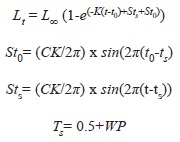
<body><![CDATA[<br> <font style="font-family: verdana;" size="2"></font>    <br> <font style="font-family: verdana;" size="2"><span  style="font-weight: bold;">Sampling area:</span> Xel-Ha Park is located within the Mesoamerican reef system. It is a cove on the East coast of the Yucatan Peninsula, 20&deg;15&#8217;54&#8221; N - 87&deg;24&#8217;08&#8221; W (<a  href="img/revistas/rbt/v62n1/a05i1.jpg">Fig. 1</a>). Communication to the Caribbean Sea is through a 70m wide mouth extending 800m inland with a total area of 14Ha. The climate in the region is hot subhumid, with dominant rains during summer (June to September). Average rain fall is 2 500mm a year with a total evaporation of 2 300mm. Mean annual temperature is 24.9&ordm;C. </font>    <br> <font style="font-family: verdana;" size="2"></font>    <br> <font style="font-family: verdana;" size="2">For this study, the cove was divided into three sections from the mouth connecting to the sea &#8220;La Bocana&#8221;, inward, the &#8220;Centro&#8221; or central zone, and &#8220;La Cueva&#8221; or inner section of the cove. The principal difference between areas is the effect of underground fresh water runoff,&nbsp; which&nbsp; runs&nbsp; into&nbsp; La&nbsp; Cueva&nbsp; section, with increasing salinity towards La Bocana. The sediment type also changes inward from La Bocana, from sand to muddy-sand in the central part and sandy-mud in La Cueva. The presence and type of vegetation also has a significant difference between areas; in La Bocana, the prevailing vegetation is made up of macroalgaes like <span style="font-style: italic;">Halimeda</span> sp., <span  style="font-style: italic;">Ulva</span> sp., <span  style="font-style: italic;">Acetabularia</span> sp., <span  style="font-style: italic;">Caulerpa</span> sp. as the most conspicuous. Whereas, in the Central section is covered by patches of <span style="font-style: italic;">Syringodium</span> sp. and <span  style="font-style: italic;">Thalassia</span> sp.; La Cueva has no fixed vegetation, but decaying land vegetation as mangrove leafs are frequent. </font>    <br> <font style="font-family: verdana;" size="2"></font>    <br> <font style="font-family: verdana;" size="2"><span  style="font-weight: bold;">Sampling strategies:</span> Water quality parameters like temperature, salinity and dissolved oxygen were taken from bottom waters at La Bocana, Centro and La Cueva stations, with a YSI-50 multi-parameter water analyzer, for all the study period.</font>    <br> <font style="font-family: verdana;" size="2"></font>    <br> <font style="font-family: verdana;" size="2">Mark-recaptured data started in November 2001 and continue in a monthly basis until October 2005; nevertheless, weather conditions prevented sampling some months. The survey was made by three free divers following a pre- fixed pattern of transects 20m apart, that covered the whole area of the cove, making sure that the visual field of divers overlapped. Dives were made daily in the morning for three hours. A total of 2 590 conchs were marked through the four years of study. All captured organisms were taken to the side of the cove, in order to be marked with a nylon ribbon with a plastic identification tag fasten to the spire, and measured in shell length with a fish measuring board; lip thickness was measured with a vernier caliper (0.1mm precision), and the total live weight was obtained with an mechanic plate scale with 0.1g precision. All animals were released in the same location where they were found.</font>    <br> <font style="font-family: verdana;" size="2"></font>    <br> <font style="font-family: verdana;" size="2">During successive recaptures only unmarked organisms were marked, and all of them were measured and registered. The number of organisms within Xel-Ha was estimated by the Jolly&#8217;s method for multiple recaptures (Poole, 1974). Increments in shell length, weight and lip thickness were analyzed using Appeldoorn&#8217;s subroutines of the FISAT II program (Gayanilo &amp; Pauly, 1997) to estimate the basic parameters of the Von Bertalanffy, for juveniles (conchs without a flare lip), adults (conchs with a flare lip) and the whole population. Once the five basic parameters of the seasonalized von Bertalanffy equation (Equation 1) (L&#8734;, K, T<sub>0</sub>, C and Wp) were estimated for each group, size frequency tables were generated and used to run FISAT II recruitment and mortality subroutines. Mortality was estimated with the &#8220;length converted catch curve&#8221; subroutine.    ]]></body>
<body><![CDATA[<br>     <br> </font>     <div style="text-align: center;"><img alt=""  src="/img/revistas/rbt/v62n1/a05f1.jpg"  style="width: 180px; height: 142px;">    <br> </div> <font style="font-family: verdana;" size="2">Where:</font>    <br> <font style="font-family: verdana;" size="2">Lt is the length at time t; L&#8734; the maximum hypothetical length expressed by the asymptote of the growth curve; t<sub>0</sub> the time when the growth function starts; C is the intensity of cessation of growth; during summer (St<sub>s</sub>) and winter (St<sub>0</sub>); WP is the time of the year of the lowest growth. </font>    <br> <font style="font-family: verdana;" size="2"></font>    <br> <font style="font-family: verdana; font-weight: bold;" size="3">Results</font>    <br> <font style="font-family: verdana;" size="2"></font>    <br> <font style="font-family: verdana;" size="2"><span  style="font-weight: bold;">Water quality:</span> Temperature, salinity and dissolved oxygen fluctuations of bottom waters found through the studied years for La Bocana, Centro and La Cueva are presented in <a  href="img/revistas/rbt/v62n1/a05t1.gif">table 1</a>. </font>    <br> <font style="font-family: verdana;" size="2"></font>    ]]></body>
<body><![CDATA[<br> <font style="font-family: verdana;" size="2">Bottom&nbsp; water&nbsp; temperatures&nbsp; varied&nbsp; over the range of 12.9 to 29.4&deg;C in all three sampling sections. Mean temperature for La Cueva was 21.6&deg;C, 19&ordm;C for Centro and 28.2&deg;C in La Bocana.</font>    <br> <font style="font-family: verdana;" size="2"></font>    <br> <font style="font-family: verdana;" size="2">The highest bottom salinity was registered during April 2002 with 35PSU in la Bocana, and&nbsp; the&nbsp; minimum&nbsp; during&nbsp; April&nbsp; 2003,&nbsp; with 10PSU in la Cueva. Salinity at Centro was generally lower than in La Bocana, but higher than La Cueva, with the exception of higher precipitation months that resulted lower. </font>    <br> <font style="font-family: verdana;" size="2"></font>    <br> <font style="font-family: verdana;" size="2">The highest oxygen concentration value was recorded during March 2002 with 7.8mg/L in La Bocana, where oxygen concentration was always higher than for the other two sections. The lowest concentration was registered at Centro 3.6mg/L.</font>    <br> <font style="font-family: verdana;" size="2"></font>    <br> <font style="font-family: verdana;" size="2"><span  style="font-weight: bold;">Population&nbsp; size&nbsp; variations:</span>&nbsp; The&nbsp; number of sampled organisms and estimated total numbers from the mark-recapture data after the density Jolly&acute;s analysis are presented in table2. Our data shows that this population of queen conch fluctuates from a minimum of 49 to a maximum of 9 848 conchs. The lowest number of conchs were found during March and April, 2003 (67 and 49, respectively), while the maximum densities were found during July and December 2002 (1 741 and 4 652, respectively) and June, 2005 (9 848) (<a  href="img/revistas/rbt/v62n1/a05i2.jpg">Fig. 2</a>).</font>    <br> <font style="font-family: verdana;" size="2"></font>    <br> <font style="font-family: verdana;" size="2"><span  style="font-weight: bold;">Population structure:</span> For the whole population, the best fit of the von Bertalanffy equation was attained with weight (<a  href="img/revistas/rbt/v62n1/a05i3.jpg">Fig. 3</a>). For the juvenile fraction of the population, the best fit of the von Bertalanffy equation was accomplished with shell length (<a  href="img/revistas/rbt/v62n1/a05i4.jpg">Fig. 4</a>); and for the adult fraction, it was achieved with lip thickness (<a  href="img/revistas/rbt/v62n1/a05i5.jpg">Fig. 5</a>). The accumulated size structure from shell length, live weight and lip thickness are presented in figure 6, their corresponding modal progression analyses, which present the number&nbsp; of&nbsp; cohort&nbsp; components&nbsp; are&nbsp; presented in figure 7.</font>    <br> <font style="font-family: verdana;" size="2"></font>    ]]></body>
<body><![CDATA[<br> <font style="font-family: verdana;" size="2">From the length frequency distribution, the juveniles presented a poly-modal distribution with a mean of 179mm (<a  href="img/revistas/rbt/v62n1/a05i6.jpg">Fig. 6</a>a and <a  href="img/revistas/rbt/v62n1/a05i7.jpg">7</a>a), while the adult fraction was unimodal with a mean of 220mm and a dominant class of 222.5mm (<a href="img/revistas/rbt/v62n1/a05i6.jpg">Fig. 6</a>a and <a href="img/revistas/rbt/v62n1/a05i7.jpg">7</a>b). The mean length for the whole population was 209mm (<a href="img/revistas/rbt/v62n1/a05i6.jpg">Fig. 6</a>a). The modal progression analysis identified only three components for the entire population (<a  href="img/revistas/rbt/v62n1/a05i7.jpg">Fig. 7</a>a) and one for the adult fraction, conchs with flare lip (<a  href="img/revistas/rbt/v62n1/a05i7.jpg">Fig. 7</a>b), while the analysis of the juvenile fraction identified eight components (<a  href="img/revistas/rbt/v62n1/a05i7.jpg">Fig. 7</a>c).</font>    <br> <font style="font-family: verdana;" size="2"></font>    <br> <font style="font-family: verdana;" size="2">The weight distribution histogram shows a total overlap of both groups (<a href="img/revistas/rbt/v62n1/a05i6.jpg">Fig. 6</a>b) made up of ten cohorts (Fig 7d). Maximum weight for adult conchs was 3 930g, with a mean of 2 235g. Besides, juvenile conchs reached a maximum weight of 3 055g with a mean of 1 882g. Mean weight for the whole population was 2 058g.</font>    <br> <font style="font-family: verdana;" size="2"></font>    <br> <font style="font-family: verdana;" size="2">Lip thickness frequency distribution (<a href="img/revistas/rbt/v62n1/a05i6.jpg">Fig. 6</a>c) shows a poly-modal distribution with four components (<a  href="img/revistas/rbt/v62n1/a05i7.jpg">Fig. 7</a>e), with a mean of 15.7mm, maximum of 41mm and minimum of 0.4mm.</font>    <br> <font style="font-family: verdana;" size="2"></font>    <br> <font style="font-family: verdana;" size="2"><span  style="font-weight: bold;">Growth&nbsp;&nbsp; equations&nbsp;&nbsp; and&nbsp;&nbsp; age&nbsp;&nbsp; estimates:</span>&nbsp; The von Bertalanffy&nbsp; growth&nbsp; parameters estimated from shell length, weight and lip thickness&nbsp; are&nbsp; given&nbsp; in&nbsp; <a  href="img/revistas/rbt/v62n1/a05t3.gif">table&nbsp; 3</a>.&nbsp; For&nbsp; juveniles and adults, two different equations have been estimated from shell length; weight was estimated for the whole population and lip thickness for adults only. The four equations presented a better fit when seasonalized. All of them presented similar periods of growth cessation (Wp=0.3 and 0.5). Cessation of growth in juveniles, analyzed through shell length, and for the whole population, analyzed through weight, was high (C=0.8). The adult cessation of growth obtained from shell length was C = 0.5, and from lip thickness was C=0.1.</font>    <br> <font style="font-family: verdana;" size="2"></font>    <br> <font style="font-family: verdana;" size="2">The estimated maximum age from shell length for adults was of 15 years, which added to the mean four year age for juveniles, give a total age of 19 years. On the other hand, growth parameters from weight for the whole population gave a maximum age of 11 years, which was reflected on the modal progression analysis, where only seven years were identified. The growth equation estimated from lip thickness gave an age composition of 14 years, which added to the four years for lip formation, gave a total age of 18 years.</font>    <br> <font style="font-family: verdana;" size="2"></font>    ]]></body>
<body><![CDATA[<br> <font style="font-family: verdana;" size="2"><span  style="font-weight: bold;">Recruitment&nbsp; pattern:</span>&nbsp; Recruitment&nbsp; can be inferred from the size frequency distribution histograms from the presence of the smallest classes (<a href="img/revistas/rbt/v62n1/a05i3.jpg">Fig. 3</a>, 4 and 5), where a constant recruitment is observed with two pulses: January to April and June to August. The smallest organism found was 12g (103mm) included in class of 50g. Recruitment patterns estimated by the FISAT program showed very different trends (<a href="img/revistas/rbt/v62n1/a05i8.jpg">Fig. 8</a>). The best fits for the observed data were given by the parameters from lip thickness (<a  href="img/revistas/rbt/v62n1/a05i6.jpg">Fig. 6</a>d), which showed a constant recruitment with two pulses.</font>    <br> <font style="font-family: verdana;" size="2"></font>    <br> <font style="font-family: verdana;" size="2"><span  style="font-weight: bold;">Mortality:</span> Mortality&nbsp; &#8220;Z&#8221;&nbsp; was&nbsp; estimated separately for the juvenile and adult fractions of the population from total shell length. Mortality for juveniles was 0.49/year, and for the adult estimated from lip thickness was 0.29/ year (<a  href="img/revistas/rbt/v62n1/a05t2.gif">Table 2</a>). </font>    <br> <font style="font-family: verdana;" size="2"></font>    <br> <font style="font-family: verdana; font-weight: bold;" size="3">Discussion</font>    <br> <font style="font-family: verdana;" size="2"></font>    <br> <font style="font-family: verdana;" size="2">This study was undertaken without considering the analysis of the effect of environmental conditions on the conch population, but only to estimate the variations on the population structure and its growth parameters within the cove. Nevertheless, after the first years of the study, we realized that there was a tendency of juveniles to migrate towards the inner cove (La Cueva), where, opposed to what was expected, bottom salinity was similar to the values found in la Bocana. This resulted different from the Centro section, where salinity, temperature and oxygen concentrations were lower. This condition may be explained by the runoff from the Northern canal of the cove, where no conchs were found. Temperature at la Cueva differed markedly&nbsp; from&nbsp; the&nbsp; outer&nbsp; cove,&nbsp; La&nbsp; Bocana. The population in this study was treated as a whole and the migratory patterns and effects of environmental conditions will be analysed on a later contribution.</font>    <br> <font style="font-family: verdana;" size="2"></font>    <br> <font style="font-family: verdana;" size="2">The dominance of juveniles (78%) over adult organisms (22%), the very low recapture rate,&nbsp; and&nbsp; the&nbsp; mean&nbsp; number&nbsp; of&nbsp; three&nbsp; successive months that organisms were recaptured, suggested that conchs enter the Xel-Ha cove as juveniles, and have a maximum residence time from one to two years. The low numbers occasionally found, may be explained by the burrowing habit during storms (Hesse, 1979; Stoner &amp; Sandt 1992), which could have skewed to under estimate the population size.</font>    <br> <font style="font-family: verdana;" size="2"></font>    ]]></body>
<body><![CDATA[<br> <font style="font-family: verdana;" size="2">Lip&nbsp; thickness&nbsp; is&nbsp; a&nbsp; measure&nbsp; of&nbsp; growth once shell length ceases, and it can be registered in conchs once they have attained sexual maturity (Appeldoorn, 1994b). It is generally accepted that maturity is attained in the fourth year (Alcolado, 1976; Appeldoorn, 1994b). Stoner &amp; Glazer (1998) gave mortality rates for 100mm conchs without flared lip of 0.5 to 12, and for conchs of 200mm from 2 to 12. These authors associated high mortality rates to anomalous behavior and shell shape correlated with hatchery rearing. Lara Per&eacute;z-Soto (1992) reported for juvenile&#8217;s mortality rates of 0.23 to 0.54 and for adults of 0.55 to 0.75 for a population subject to commercial fishing. Juvenile&#8217;s mortality in this work&nbsp; (0.49) coincides with estimates made by Lara Per&eacute;z-Soto (1992). Given&nbsp; that&nbsp; mortality&nbsp; estimates&nbsp; in&nbsp; this&nbsp; work were obtained from a non catch population, these data can be accepted as natural mortality for juveniles (0.49) and 0.29 as natural morality of the adult population. Given the absence of dead shells within the cove, it is presumed that mortality should be interpreted as emigration.</font>    <br> <font style="font-family: verdana;" size="2"></font>    <br> <font style="font-family: verdana;" size="2">The maximum age of conchs coincides with the time Xel-Ha Park has been actively promoting the protection of <span style="font-style: italic;">Strombus gigas</span>. Maximum age mean from different authors fluctuates&nbsp; from&nbsp; eight&nbsp; to&nbsp; nine&nbsp; years,&nbsp; which could be a result of fishing activity on those populations, or that these authors have under estimated&nbsp; age.&nbsp; Growth&nbsp; parameters&nbsp; for&nbsp; different localities on the coast of Quintana Roo, Mexico, present a larger maximum shell length (L&#8734;=297mm), and higher growth rate (K=4) (Castro de Anda, 1994; Cruz, Basurto, Martinez, Cadena &amp; Fanjul, 1994; D&iacute;az, 1991; De Jes&uacute;s Navarrete, 2001), except for the locality of Mahahual, where D&iacute;az (1991) reported for a juvenile population with a L&#8734;=227mm, but much lower growth rate (K=0.036). This may suggest that Xel-Ha cove does not fulfill the optimum conditions for growth. Total age estimated by the von Bertalanffy equation may give a larger number of age classes than those estimated by a modal progression analysis At the older age classes they can be superimposed and masked, this is frequent on the older conchs where growth increments are small and if the shell becomes eroded they can even appear as having lost weight.</font>    <br> <font style="font-family: verdana;" size="2"></font>    <br> <font style="font-family: verdana;" size="2">The&nbsp; absence&nbsp; of&nbsp; dead&nbsp; shells&nbsp; within&nbsp; the cove, suggested that the mortality obtained could be interpreted as migration; this condition, together with the maximum estimated age obtained, allowed us to presume that the cove is actively protecting this conch population from the adjacent reef.</font>    <br> <font style="font-family: verdana;" size="2"></font>    <br> <font style="font-family: verdana;" size="2">The marked differences attained from the variables used for juveniles, adults and the whole&nbsp; populations,&nbsp; emphasize&nbsp; the&nbsp; need&nbsp; to use the correct variable for each size group. Juvenile&#8217;s growth parameters should be estimated from length frequency data, whereas for adults, growth parameters should be estimated from lip thickness, and when the study covers the whole size range, weight frequency analysis should be used. </font>    <br> <font style="font-family: verdana;" size="2"></font>    <br> <font style="font-family: verdana; font-weight: bold;" size="3">Acknowledgments</font>    <br> <font style="font-family: verdana;" size="2"></font>    ]]></body>
<body><![CDATA[<br> <font style="font-family: verdana;" size="2">The authors wish to express their gratitude&nbsp; to&nbsp; the&nbsp; Xel-Ha&nbsp; park&nbsp; executive&nbsp; manager for&nbsp; the&nbsp; financial&nbsp; and&nbsp; logistical&nbsp; support&nbsp; and to the&nbsp; personnel&nbsp; of&nbsp; the&nbsp; sustainable&nbsp; development&nbsp; department&nbsp; for&nbsp; their&nbsp; assistance&nbsp; in&nbsp; the field work. This project was supported by the Biology and Aquaculture of Mollusk laboratory&nbsp; of&nbsp; CINVESTAV&nbsp; and&nbsp; grant:&nbsp; CONACyT 24210 connectivity of the Queen Conch in the Caribbean. We want to express our gratitude to Gemma Franklin, native English speaker for the review of the manuscript. </font>    <br> <font style="font-family: verdana;" size="2"></font> <hr style="width: 100%; height: 2px;"><font  style="font-family: verdana; font-weight: bold;" size="3">References</font>    <br>     <br>     <!-- ref --><div style="text-align: left;"></div> <font style="font-family: verdana;" size="2">Alcolado, P. M. (1976). Crecimiento, variaciones morfol&oacute;gicas de La concha y algunos datos biol&oacute;gicos del cobo <span  style="font-style: italic;">Strombus gigas</span> L. (Mollusca, Mesogastropoda). <span style="font-style: italic;">Academia Ciencias Cuba Serie Oceanolog&iacute;a</span>, 34-36.    &nbsp;&nbsp;&nbsp;&nbsp;&nbsp;&nbsp;&nbsp;&nbsp;[&#160;<a href="javascript:void(0);" onclick="javascript: window.open('/scielo.php?script=sci_nlinks&ref=1636435&pid=S0034-7744201400020000500001&lng=','','width=640,height=500,resizable=yes,scrollbars=1,menubar=yes,');">Links</a>&#160;]<!-- end-ref --></font>    <br>     <!-- ref --><br> <font style="font-family: verdana;" size="2">Aldana Aranda, D., Baqueiro C&aacute;rdenas, E., &amp; Manzanilla Naim, S. (2003). Mexican marine parks as a fishery management&nbsp; tool&nbsp; for&nbsp; the&nbsp; queen&nbsp; conch&nbsp; <span  style="font-style: italic;">Strombus gigas</span>. In D. Aldana-Aranda (Ed.), <span style="font-style: italic;">El caracol Strombus gigas: conocimiento integral para su manejo sustentable en el Caribe</span> (pp. 101-108). M&eacute;xico: CYTED Press.    &nbsp;&nbsp;&nbsp;&nbsp;&nbsp;&nbsp;&nbsp;&nbsp;[&#160;<a href="javascript:void(0);" onclick="javascript: window.open('/scielo.php?script=sci_nlinks&ref=1636438&pid=S0034-7744201400020000500002&lng=','','width=640,height=500,resizable=yes,scrollbars=1,menubar=yes,');">Links</a>&#160;]<!-- end-ref --></font>    <br>     ]]></body>
<body><![CDATA[<!-- ref --><br> <font style="font-family: verdana;" size="2">Appeldoorn,&nbsp; R.&nbsp; S.&nbsp; (1994a).&nbsp; Queen&nbsp; conch&nbsp; management and research: status, needs and priorities. In R. S. Appeldoorn, &amp; B. Rodr&iacute;guez (Eds.), <span  style="font-style: italic;">Strombus gigas Queen conch biology, fisheries and mariculture</span> (pp. 301-319). Caracas, Venezuela: Fundaci&oacute;n Cient&iacute;fica Los Roques.    &nbsp;&nbsp;&nbsp;&nbsp;&nbsp;&nbsp;&nbsp;&nbsp;[&#160;<a href="javascript:void(0);" onclick="javascript: window.open('/scielo.php?script=sci_nlinks&ref=1636441&pid=S0034-7744201400020000500003&lng=','','width=640,height=500,resizable=yes,scrollbars=1,menubar=yes,');">Links</a>&#160;]<!-- end-ref --></font>    <br>     <!-- ref --><br> <font style="font-family: verdana;" size="2">Appeldoorn, R. S. (1994b). Spatial variability in the morphology of Queen Conch and its implications for management regulations. In R. S. Appeldoorn, &amp; B. Rodr&iacute;guez (Eds.), <span  style="font-style: italic;">Strombus gigas Queen conch biology, fisheries and mariculture</span> (pp. 145-157). Caracas, venezuela: Fundaci&oacute;n Cient&iacute;fica Los Roques.    &nbsp;&nbsp;&nbsp;&nbsp;&nbsp;&nbsp;&nbsp;&nbsp;[&#160;<a href="javascript:void(0);" onclick="javascript: window.open('/scielo.php?script=sci_nlinks&ref=1636444&pid=S0034-7744201400020000500004&lng=','','width=640,height=500,resizable=yes,scrollbars=1,menubar=yes,');">Links</a>&#160;]<!-- end-ref --></font>    <br>     <!-- ref --><br> <font style="font-family: verdana;" size="2">Bal&aacute;n-Dzul, V., &amp; de Jes&uacute;s-Navarrete, A. (2011). Densidad, abundancia y estructura poblacional del caracol blanco Strombus costatus en el Caribe Mexicano. <span  style="font-style: italic;">Revista de Biolog&iacute;a Marina y Oceanograf&iacute;a 46</span>(1), 1-8.    &nbsp;&nbsp;&nbsp;&nbsp;&nbsp;&nbsp;&nbsp;&nbsp;[&#160;<a href="javascript:void(0);" onclick="javascript: window.open('/scielo.php?script=sci_nlinks&ref=1636447&pid=S0034-7744201400020000500005&lng=','','width=640,height=500,resizable=yes,scrollbars=1,menubar=yes,');">Links</a>&#160;]<!-- end-ref --></font>    <br>     <!-- ref --><br> <font style="font-family: verdana;" size="2">Basurto, M., Cadena, P., Escobedo, G., Fern&aacute;ndez, F., &amp; Figueroa, F. (2005). <span style="font-style: italic;">Evaluaci&oacute;n de la poblaci&oacute;n de Strombus gigas en los bancos de Cozumel y Chinchorro y recomendaciones para su aprovechamiento sostenible. Centro Regional de Investigaci&oacute;n Pesquera de Puerto Morelos, Quintana Roo.</span> Informe de Investigaci&oacute;n.    &nbsp;&nbsp;&nbsp;&nbsp;&nbsp;&nbsp;&nbsp;&nbsp;[&#160;<a href="javascript:void(0);" onclick="javascript: window.open('/scielo.php?script=sci_nlinks&ref=1636450&pid=S0034-7744201400020000500006&lng=','','width=640,height=500,resizable=yes,scrollbars=1,menubar=yes,');">Links</a>&#160;]<!-- end-ref --></font>    <br>     <!-- ref --><br> <font style="font-family: verdana;" size="2">Castro De Anda, A. (1994). <span style="font-style: italic;">Comparaci&oacute;n de tasas de crecimiento del caracol Rosado Strombus gigas Linneaus 1758 en diferentes ambientes del Sur de Quintana Roo.</span> (Tesis de licenciatura). Universidad Aut&oacute;noma de Baja California, M&eacute;xico.    &nbsp;&nbsp;&nbsp;&nbsp;&nbsp;&nbsp;&nbsp;&nbsp;[&#160;<a href="javascript:void(0);" onclick="javascript: window.open('/scielo.php?script=sci_nlinks&ref=1636453&pid=S0034-7744201400020000500007&lng=','','width=640,height=500,resizable=yes,scrollbars=1,menubar=yes,');">Links</a>&#160;]<!-- end-ref --></font>    <br>     <!-- ref --><br> <font style="font-family: verdana;" size="2">Ch&aacute;vez, E., &amp; Constanza-Mora, S. (2009). Conceptual Framework for Estimating Annual Quotas in Mexican Queen Conch (<span  style="font-style: italic;">Strombus gigas</span>) Fisheries. <span style="font-style: italic;">Proceedings of the Gulf and Caribbean Fisheries Institute, 62</span>, 376-382.    &nbsp;&nbsp;&nbsp;&nbsp;&nbsp;&nbsp;&nbsp;&nbsp;[&#160;<a href="javascript:void(0);" onclick="javascript: window.open('/scielo.php?script=sci_nlinks&ref=1636456&pid=S0034-7744201400020000500008&lng=','','width=640,height=500,resizable=yes,scrollbars=1,menubar=yes,');">Links</a>&#160;]<!-- end-ref --></font>    <br>     <!-- ref --><br> <font style="font-family: verdana;" size="2">Cruz, D. O., Basurto, M., Martinez, D., Cadena, V., &amp; Fanjul, R. (1994). <span style="font-style: italic;">Contribuci&oacute;n al conocimiento biol&oacute;gico pesquero del caracol rosado, Strombus gigas, en Banco Chinchorro, Quintana Roo, Mexico.</span> Informe T&eacute;cnico, Centro Regional de Investigaci&oacute;n Pesquera, Instituto Nacional de la Pesca, M&eacute;xico.    &nbsp;&nbsp;&nbsp;&nbsp;&nbsp;&nbsp;&nbsp;&nbsp;[&#160;<a href="javascript:void(0);" onclick="javascript: window.open('/scielo.php?script=sci_nlinks&ref=1636459&pid=S0034-7744201400020000500009&lng=','','width=640,height=500,resizable=yes,scrollbars=1,menubar=yes,');">Links</a>&#160;]<!-- end-ref --></font>    ]]></body>
<body><![CDATA[<br>     <!-- ref --><br> <font style="font-family: verdana;" size="2">De Jes&uacute;s Navarrete, A. (2001). Crecimiento del caracol <span style="font-style: italic;">Strombus gigas</span> (Gastropoda: Strombidae) en cuatro ambientes de Quintana Roo, M&eacute;xico. <span style="font-style: italic;">Revista Biolog&iacute;a Tropical, 49</span>(1): 83-89.    &nbsp;&nbsp;&nbsp;&nbsp;&nbsp;&nbsp;&nbsp;&nbsp;[&#160;<a href="javascript:void(0);" onclick="javascript: window.open('/scielo.php?script=sci_nlinks&ref=1636462&pid=S0034-7744201400020000500010&lng=','','width=640,height=500,resizable=yes,scrollbars=1,menubar=yes,');">Links</a>&#160;]<!-- end-ref --></font>    <br>     <!-- ref --><br> <font style="font-family: verdana;" size="2">De&nbsp; Jes&uacute;s-Navarrete, A.,&nbsp; Oliva-Rivera,&nbsp; J.,&nbsp; Medina-Quej, A., &amp; Dom&iacute;nguez-Viveros, M. (1999). Crecimiento, reclutamiento&nbsp; y&nbsp; estructura&nbsp; poblacional&nbsp; del&nbsp; caracol rosado (<span  style="font-style: italic;">Strombus gigas</span>) en punta Gavil&aacute;n, Quintana Roo, M&eacute;xico. <span  style="font-style: italic;">Proceedings of the Gulf and Caribbean Fisheries Institute, 46</span>, 74-83.    &nbsp;&nbsp;&nbsp;&nbsp;&nbsp;&nbsp;&nbsp;&nbsp;[&#160;<a href="javascript:void(0);" onclick="javascript: window.open('/scielo.php?script=sci_nlinks&ref=1636465&pid=S0034-7744201400020000500011&lng=','','width=640,height=500,resizable=yes,scrollbars=1,menubar=yes,');">Links</a>&#160;]<!-- end-ref --></font>    <br>     <!-- ref --><br> <font style="font-family: verdana;" size="2">Diaz, A. C. (1991). Crecimiento y mortalidad de juveniles del caracol rosado <span style="font-style: italic;">Strombus gigas</span> en punta Gavil&aacute;n, Quintana Roo. Algunas consideraciones sobre el aprovechamiento de su pesquer&iacute;a. <span style="font-style: italic;">Ciencia Pesquera, M&eacute;xico 8</span>, 63-70.    &nbsp;&nbsp;&nbsp;&nbsp;&nbsp;&nbsp;&nbsp;&nbsp;[&#160;<a href="javascript:void(0);" onclick="javascript: window.open('/scielo.php?script=sci_nlinks&ref=1636468&pid=S0034-7744201400020000500012&lng=','','width=640,height=500,resizable=yes,scrollbars=1,menubar=yes,');">Links</a>&#160;]<!-- end-ref --></font>    <br>     ]]></body>
<body><![CDATA[<!-- ref --><br> <font style="font-family: verdana;" size="2">FAO.&nbsp; (2009).&nbsp; <span  style="font-style: italic;">Conversion&nbsp; factors&nbsp; for&nbsp; processed&nbsp; queen conch to nominal weight.</span> FAO Fisheries and Aquaculture Circular No. 1042.    &nbsp;&nbsp;&nbsp;&nbsp;&nbsp;&nbsp;&nbsp;&nbsp;[&#160;<a href="javascript:void(0);" onclick="javascript: window.open('/scielo.php?script=sci_nlinks&ref=1636471&pid=S0034-7744201400020000500013&lng=','','width=640,height=500,resizable=yes,scrollbars=1,menubar=yes,');">Links</a>&#160;]<!-- end-ref --></font>    <br>     <!-- ref --><br> <font style="font-family: verdana;" size="2">Gayanilo, F. C., &amp; Pauly, D. (1997). The FAO-ICLARM Stock Assessment Tools (FISAT). FAO Computerized Information Series. <span style="font-style: italic;">Fisheries, 8</span>, 262.    &nbsp;&nbsp;&nbsp;&nbsp;&nbsp;&nbsp;&nbsp;&nbsp;[&#160;<a href="javascript:void(0);" onclick="javascript: window.open('/scielo.php?script=sci_nlinks&ref=1636474&pid=S0034-7744201400020000500014&lng=','','width=640,height=500,resizable=yes,scrollbars=1,menubar=yes,');">Links</a>&#160;]<!-- end-ref --></font>    <br>     <!-- ref --><br> <font style="font-family: verdana;" size="2">Hesse,&nbsp; K.&nbsp; O.&nbsp; (1979).&nbsp; Movement&nbsp; and&nbsp; migration&nbsp; of&nbsp; the queen conch, <span  style="font-style: italic;">Strombus gigas</span>, in the Turks and Caicos Islands. <span style="font-style: italic;">Bulletin of Marine Science, 29</span>, 303-311.    &nbsp;&nbsp;&nbsp;&nbsp;&nbsp;&nbsp;&nbsp;&nbsp;[&#160;<a href="javascript:void(0);" onclick="javascript: window.open('/scielo.php?script=sci_nlinks&ref=1636477&pid=S0034-7744201400020000500015&lng=','','width=640,height=500,resizable=yes,scrollbars=1,menubar=yes,');">Links</a>&#160;]<!-- end-ref --></font>    <br>     <!-- ref --><br> <font style="font-family: verdana;" size="2">Lara P&eacute;rez-Soto, M. (1992). <span style="font-style: italic;">Tabla de vida y par&aacute;metros demogr&aacute;ficos de Strombus gigas en Quintana Roo, M&eacute;xico.</span> (Tesis de maestr&iacute;a). Universidad Nacional Aut&oacute;noma de M&eacute;xico, M&eacute;xico.    &nbsp;&nbsp;&nbsp;&nbsp;&nbsp;&nbsp;&nbsp;&nbsp;[&#160;<a href="javascript:void(0);" onclick="javascript: window.open('/scielo.php?script=sci_nlinks&ref=1636480&pid=S0034-7744201400020000500016&lng=','','width=640,height=500,resizable=yes,scrollbars=1,menubar=yes,');">Links</a>&#160;]<!-- end-ref --></font>    <br>     <!-- ref --><br> <font style="font-family: verdana;" size="2">P&eacute;rez P&eacute;rez, M., &amp; Aldana Aranda, D. (2000). Distribuci&oacute;n, abundancia, densidad y morfometr&iacute;a de <span style="font-style: italic;">Strombus gigas</span> (Mesogasteropoda: Strombidae) en el Arrecife Alacranes, Yucat&aacute;n, M&eacute;xico. <span style="font-style: italic;">Revista Biolog&iacute;a Tropical, 48</span>(1), 51-57</font>    &nbsp;&nbsp;&nbsp;&nbsp;&nbsp;&nbsp;&nbsp;&nbsp;[&#160;<a href="javascript:void(0);" onclick="javascript: window.open('/scielo.php?script=sci_nlinks&ref=1636483&pid=S0034-7744201400020000500017&lng=','','width=640,height=500,resizable=yes,scrollbars=1,menubar=yes,');">Links</a>&#160;]<!-- end-ref --><br>     <!-- ref --><br> <font style="font-family: verdana;" size="2">Poole, R. W. (1974). <span  style="font-style: italic;">An introduction to quantitative ecology</span>. London: Series in Population Biology McGraw Hill.    &nbsp;&nbsp;&nbsp;&nbsp;&nbsp;&nbsp;&nbsp;&nbsp;[&#160;<a href="javascript:void(0);" onclick="javascript: window.open('/scielo.php?script=sci_nlinks&ref=1636485&pid=S0034-7744201400020000500018&lng=','','width=640,height=500,resizable=yes,scrollbars=1,menubar=yes,');">Links</a>&#160;]<!-- end-ref --></font>    <br>     <!-- ref --><br> <font style="font-family: verdana;" size="2">Stoner, A. W., &amp; Sandt, V. J. (1992). Population structure, seasonal movements and feeding of queen conch, <span  style="font-style: italic;">Strombus gigas</span>, in deep-water habitats of the Bahamas. <span style="font-style: italic;">Bulletin of Marine Science, 5</span>, 287-300.    &nbsp;&nbsp;&nbsp;&nbsp;&nbsp;&nbsp;&nbsp;&nbsp;[&#160;<a href="javascript:void(0);" onclick="javascript: window.open('/scielo.php?script=sci_nlinks&ref=1636488&pid=S0034-7744201400020000500019&lng=','','width=640,height=500,resizable=yes,scrollbars=1,menubar=yes,');">Links</a>&#160;]<!-- end-ref --></font>    <br>     ]]></body>
<body><![CDATA[<!-- ref --><br> <font style="font-family: verdana;" size="2">Stoner, A. W., &amp; Glazer, R. A. (1998). Variation in natural mortality: implications for queen conch marine stock enhancement. <span style="font-style: italic;">Bulletin of Marine Science, 62</span>, 427-442.    &nbsp;&nbsp;&nbsp;&nbsp;&nbsp;&nbsp;&nbsp;&nbsp;[&#160;<a href="javascript:void(0);" onclick="javascript: window.open('/scielo.php?script=sci_nlinks&ref=1636491&pid=S0034-7744201400020000500020&lng=','','width=640,height=500,resizable=yes,scrollbars=1,menubar=yes,');">Links</a>&#160;]<!-- end-ref --></font>    <br> <font style="font-family: verdana;" size="2">    <br> <a name="Correspondencia1"></a><a href="#Correspondencia2">*</a>Correspondencia a:</font>    <br> <font style="font-family: verdana;" size="2">Erick Baqueiro C&aacute;rdenas. </font><font style="font-family: verdana;" size="2">Instituto Tecnol&oacute;gico Superior de Champot&oacute;n. Carretera Champot&oacute;n-Isla Aguda Km 2, Colonia el Arenal, Champot&oacute;n, Camp. 24400, Mexico. Correo electr&oacute;nico ebaqueiro@gmail.com</font>    <br> <small><span style="font-family: verdana;">Dalila Aldana Aranda. </span></small><font  style="font-family: verdana;" size="2">Centro de Investigaci&oacute;n y Estudios Avanzados del Instituto Polit&eacute;cnico Nacional, Unidad Merida antigua carretera a Progreso Merida Yucat&aacute;n Mexico. Correo electr&oacute;nico daldana@mda.cinvestav.mx    <br> </font><font style="font-family: verdana;" size="2"><a name="1"></a><a  href="#3">1</a>. Instituto Tecnol&oacute;gico Superior de Champot&oacute;n. Carretera Champot&oacute;n-Isla Aguda Km 2, Colonia el Arenal, Champot&oacute;n, Camp. 24400, Mexico. Correo a</font><font style="font-family: verdana;"  size="2">electr&oacute;nico ebaqueiro@gm</font><font  style="font-family: verdana;" size="2">il.com</font>    <br> <font style="font-family: verdana;" size="2"><a name="2"></a><a  href="#4">2</a>. Centro de Investigaci&oacute;n y Estudios Avanzados del Instituto Polit&eacute;cnico Nacional, Unidad Merida antigua carretera a Progreso Merida Yucat&aacute;n Mexico. Correo electr&oacute;nico daldana@mda.cinvestav.mx</font>    <br> <hr style="width: 100%; height: 2px;">     <div style="text-align: center;"><font  style="font-family: verdana; font-weight: bold;" size="2">Received 25-II-2013. Corrected 20-vII-2013. Accepted 22-vIII-2013. </font><br style="font-weight: bold;"> </div> </div> </div> <font style="font-family: verdana;" size="2"></font>     ]]></body>
<body><![CDATA[ ]]></body><back>
<ref-list>
<ref id="B1">
<nlm-citation citation-type="journal">
<person-group person-group-type="author">
<name>
<surname><![CDATA[Alcolado]]></surname>
<given-names><![CDATA[P. M.]]></given-names>
</name>
</person-group>
<article-title xml:lang="es"><![CDATA[Crecimiento, variaciones morfológicas de La concha y algunos datos biológicos del cobo Strombus gigas L. (Mollusca, Mesogastropoda)]]></article-title>
<source><![CDATA[Academia Ciencias Cuba Serie Oceanología]]></source>
<year>1976</year>
<page-range>34-36</page-range></nlm-citation>
</ref>
<ref id="B2">
<nlm-citation citation-type="book">
<person-group person-group-type="author">
<name>
<surname><![CDATA[Aldana Aranda]]></surname>
<given-names><![CDATA[D.]]></given-names>
</name>
<name>
<surname><![CDATA[Baqueiro Cárdenas]]></surname>
<given-names><![CDATA[E.]]></given-names>
</name>
<name>
<surname><![CDATA[Manzanilla Naim]]></surname>
<given-names><![CDATA[S.]]></given-names>
</name>
</person-group>
<article-title xml:lang="en"><![CDATA[Mexican marine parks as a fishery management tool for the queen conch Strombus gigas]]></article-title>
<person-group person-group-type="editor">
<name>
<surname><![CDATA[Aldana-Aranda]]></surname>
<given-names><![CDATA[D.]]></given-names>
</name>
</person-group>
<source><![CDATA[El caracol Strombus gigas: conocimiento integral para su manejo sustentable en el Caribe]]></source>
<year>2003</year>
<page-range>101-108</page-range><publisher-name><![CDATA[CYTED Press]]></publisher-name>
</nlm-citation>
</ref>
<ref id="B3">
<nlm-citation citation-type="book">
<person-group person-group-type="author">
<name>
<surname><![CDATA[Appeldoorn]]></surname>
<given-names><![CDATA[R. S.]]></given-names>
</name>
</person-group>
<article-title xml:lang="en"><![CDATA[Queen conch management and research: status, needs and priorities]]></article-title>
<person-group person-group-type="editor">
<name>
<surname><![CDATA[Appeldoorn]]></surname>
<given-names><![CDATA[R. S.]]></given-names>
</name>
<name>
<surname><![CDATA[Rodríguez]]></surname>
<given-names><![CDATA[B.]]></given-names>
</name>
</person-group>
<source><![CDATA[Strombus gigas Queen conch biology, fisheries and mariculture]]></source>
<year>1994</year>
<page-range>301-319</page-range><publisher-loc><![CDATA[^eCaracas Caracas]]></publisher-loc>
<publisher-name><![CDATA[Fundación Científica Los Roques]]></publisher-name>
</nlm-citation>
</ref>
<ref id="B4">
<nlm-citation citation-type="book">
<person-group person-group-type="author">
<name>
<surname><![CDATA[Appeldoorn]]></surname>
<given-names><![CDATA[R. S.]]></given-names>
</name>
</person-group>
<article-title xml:lang="en"><![CDATA[Spatial variability in the morphology of Queen Conch and its implications for management regulations]]></article-title>
<person-group person-group-type="editor">
<name>
<surname><![CDATA[Appeldoorn]]></surname>
<given-names><![CDATA[R. S.]]></given-names>
</name>
<name>
<surname><![CDATA[Rodríguez]]></surname>
<given-names><![CDATA[B.]]></given-names>
</name>
</person-group>
<source><![CDATA[Strombus gigas Queen conch biology, fisheries and mariculture]]></source>
<year>1994</year>
<page-range>145-157</page-range><publisher-loc><![CDATA[^eCaracas Caracas]]></publisher-loc>
<publisher-name><![CDATA[Fundación Científica Los Roques]]></publisher-name>
</nlm-citation>
</ref>
<ref id="B5">
<nlm-citation citation-type="journal">
<person-group person-group-type="author">
<name>
<surname><![CDATA[Balán-Dzul]]></surname>
<given-names><![CDATA[V.]]></given-names>
</name>
<name>
<surname><![CDATA[de Jesús-Navarrete]]></surname>
<given-names><![CDATA[A.]]></given-names>
</name>
</person-group>
<article-title xml:lang="es"><![CDATA[Densidad, abundancia y estructura poblacional del caracol blanco Strombus costatus en el Caribe Mexicano]]></article-title>
<source><![CDATA[Revista de Biología Marina y Oceanografía]]></source>
<year>2011</year>
<volume>46</volume>
<numero>1</numero>
<issue>1</issue>
<page-range>1-8</page-range></nlm-citation>
</ref>
<ref id="B6">
<nlm-citation citation-type="">
<person-group person-group-type="author">
<name>
<surname><![CDATA[Basurto]]></surname>
<given-names><![CDATA[M.]]></given-names>
</name>
<name>
<surname><![CDATA[Cadena]]></surname>
<given-names><![CDATA[P.]]></given-names>
</name>
<name>
<surname><![CDATA[Escobedo]]></surname>
<given-names><![CDATA[G.]]></given-names>
</name>
<name>
<surname><![CDATA[Fernández]]></surname>
<given-names><![CDATA[F.]]></given-names>
</name>
<name>
<surname><![CDATA[Figueroa]]></surname>
<given-names><![CDATA[F.]]></given-names>
</name>
</person-group>
<source><![CDATA[Evaluación de la población de Strombus gigas en los bancos de Cozumel y Chinchorro y recomendaciones para su aprovechamiento sostenible. Centro Regional de Investigación Pesquera de Puerto Morelos, Quintana Roo]]></source>
<year>2005</year>
</nlm-citation>
</ref>
<ref id="B7">
<nlm-citation citation-type="">
<person-group person-group-type="author">
<name>
<surname><![CDATA[Castro De Anda]]></surname>
<given-names><![CDATA[A.]]></given-names>
</name>
</person-group>
<source><![CDATA[Comparación de tasas de crecimiento del caracol Rosado Strombus gigas Linneaus 1758 en diferentes ambientes del Sur de Quintana Roo]]></source>
<year>1994</year>
</nlm-citation>
</ref>
<ref id="B8">
<nlm-citation citation-type="journal">
<person-group person-group-type="author">
<name>
<surname><![CDATA[Chávez]]></surname>
<given-names><![CDATA[E.]]></given-names>
</name>
<name>
<surname><![CDATA[Constanza-Mora]]></surname>
<given-names><![CDATA[S.]]></given-names>
</name>
</person-group>
<article-title xml:lang="en"><![CDATA[Conceptual Framework for Estimating Annual Quotas in Mexican Queen Conch (Strombus gigas) Fisheries]]></article-title>
<source><![CDATA[Proceedings of the Gulf and Caribbean Fisheries Institute]]></source>
<year>2009</year>
<volume>62</volume>
<page-range>376-382</page-range></nlm-citation>
</ref>
<ref id="B9">
<nlm-citation citation-type="book">
<person-group person-group-type="author">
<name>
<surname><![CDATA[Cruz]]></surname>
<given-names><![CDATA[D. O.]]></given-names>
</name>
<name>
<surname><![CDATA[Basurto]]></surname>
<given-names><![CDATA[M.]]></given-names>
</name>
<name>
<surname><![CDATA[Martinez]]></surname>
<given-names><![CDATA[D.]]></given-names>
</name>
<name>
<surname><![CDATA[Cadena]]></surname>
<given-names><![CDATA[V.]]></given-names>
</name>
<name>
<surname><![CDATA[Fanjul]]></surname>
<given-names><![CDATA[R.]]></given-names>
</name>
</person-group>
<source><![CDATA[Contribución al conocimiento biológico pesquero del caracol rosado, Strombus gigas, en Banco Chinchorro, Quintana Roo, Mexico]]></source>
<year>1994</year>
<publisher-name><![CDATA[Informe Técnico, Centro Regional de Investigación Pesquera, Instituto Nacional de la Pesca, México]]></publisher-name>
</nlm-citation>
</ref>
<ref id="B10">
<nlm-citation citation-type="journal">
<person-group person-group-type="author">
<name>
<surname><![CDATA[De Jesús Navarrete]]></surname>
<given-names><![CDATA[A.]]></given-names>
</name>
</person-group>
<article-title xml:lang="es"><![CDATA[Crecimiento del caracol Strombus gigas (Gastropoda: Strombidae) en cuatro ambientes de Quintana Roo, México]]></article-title>
<source><![CDATA[Revista Biología Tropical]]></source>
<year>2001</year>
<volume>49</volume>
<numero>1</numero>
<issue>1</issue>
<page-range>83-89</page-range></nlm-citation>
</ref>
<ref id="B11">
<nlm-citation citation-type="journal">
<person-group person-group-type="author">
<name>
<surname><![CDATA[De Jesús-Navarrete]]></surname>
<given-names><![CDATA[A.]]></given-names>
</name>
<name>
<surname><![CDATA[Oliva-Rivera]]></surname>
<given-names><![CDATA[J.]]></given-names>
</name>
<name>
<surname><![CDATA[Medina-Quej]]></surname>
<given-names><![CDATA[A.]]></given-names>
</name>
<name>
<surname><![CDATA[Domínguez-Viveros]]></surname>
<given-names><![CDATA[M.]]></given-names>
</name>
</person-group>
<article-title xml:lang="es"><![CDATA[Crecimiento, reclutamiento y estructura poblacional del caracol rosado (Strombus gigas) en punta Gavilán, Quintana Roo, México]]></article-title>
<source><![CDATA[Proceedings of the Gulf and Caribbean Fisheries Institute]]></source>
<year>1999</year>
<volume>46</volume>
<page-range>74-83</page-range></nlm-citation>
</ref>
<ref id="B12">
<nlm-citation citation-type="journal">
<person-group person-group-type="author">
<name>
<surname><![CDATA[Diaz]]></surname>
<given-names><![CDATA[A. C.]]></given-names>
</name>
</person-group>
<article-title xml:lang="es"><![CDATA[Crecimiento y mortalidad de juveniles del caracol rosado Strombus gigas en punta Gavilán, Quintana Roo. Algunas consideraciones sobre el aprovechamiento de su pesquería]]></article-title>
<source><![CDATA[Ciencia Pesquera, México]]></source>
<year>1991</year>
<volume>8</volume>
<page-range>63-70</page-range></nlm-citation>
</ref>
<ref id="B13">
<nlm-citation citation-type="">
<collab>FAO</collab>
<source><![CDATA[Conversion factors for processed queen conch to nominal weight]]></source>
<year>2009</year>
</nlm-citation>
</ref>
<ref id="B14">
<nlm-citation citation-type="journal">
<person-group person-group-type="author">
<name>
<surname><![CDATA[Gayanilo]]></surname>
<given-names><![CDATA[F. C.]]></given-names>
</name>
<name>
<surname><![CDATA[Pauly]]></surname>
<given-names><![CDATA[D.]]></given-names>
</name>
</person-group>
<article-title xml:lang="en"><![CDATA[The FAO-ICLARM Stock Assessment Tools (FISAT). FAO Computerized Information Series]]></article-title>
<source><![CDATA[Fisheries]]></source>
<year>1997</year>
<volume>8</volume>
<page-range>262</page-range></nlm-citation>
</ref>
<ref id="B15">
<nlm-citation citation-type="journal">
<person-group person-group-type="author">
<name>
<surname><![CDATA[Hesse]]></surname>
<given-names><![CDATA[K. O.]]></given-names>
</name>
</person-group>
<article-title xml:lang="en"><![CDATA[Movement and migration of the queen conch, Strombus gigas, in the Turks and Caicos Islands]]></article-title>
<source><![CDATA[Bulletin of Marine Science]]></source>
<year>1979</year>
<volume>29</volume>
<page-range>303-311</page-range></nlm-citation>
</ref>
<ref id="B16">
<nlm-citation citation-type="">
<person-group person-group-type="author">
<name>
<surname><![CDATA[Lara Pérez-Soto]]></surname>
<given-names><![CDATA[M.]]></given-names>
</name>
</person-group>
<source><![CDATA[Tabla de vida y parámetros demográficos de Strombus gigas en Quintana Roo, México]]></source>
<year>1992</year>
</nlm-citation>
</ref>
<ref id="B17">
<nlm-citation citation-type="journal">
<person-group person-group-type="author">
<name>
<surname><![CDATA[Pérez Pérez]]></surname>
<given-names><![CDATA[M.]]></given-names>
</name>
<name>
<surname><![CDATA[Aldana Aranda]]></surname>
<given-names><![CDATA[D.]]></given-names>
</name>
</person-group>
<article-title xml:lang="es"><![CDATA[Distribución, abundancia, densidad y morfometría de Strombus gigas (Mesogasteropoda: Strombidae) en el Arrecife Alacranes, Yucatán, México]]></article-title>
<source><![CDATA[Revista Biología Tropical]]></source>
<year>2000</year>
<volume>48</volume>
<numero>1</numero>
<issue>1</issue>
<page-range>51-57</page-range></nlm-citation>
</ref>
<ref id="B18">
<nlm-citation citation-type="book">
<person-group person-group-type="author">
<name>
<surname><![CDATA[Poole]]></surname>
<given-names><![CDATA[R. W.]]></given-names>
</name>
</person-group>
<source><![CDATA[An introduction to quantitative ecology]]></source>
<year>1974</year>
<publisher-loc><![CDATA[^eLondon London]]></publisher-loc>
<publisher-name><![CDATA[Series in Population Biology McGraw Hill]]></publisher-name>
</nlm-citation>
</ref>
<ref id="B19">
<nlm-citation citation-type="journal">
<person-group person-group-type="author">
<name>
<surname><![CDATA[Stoner]]></surname>
<given-names><![CDATA[A. W.]]></given-names>
</name>
<name>
<surname><![CDATA[Sandt]]></surname>
<given-names><![CDATA[V. J.]]></given-names>
</name>
</person-group>
<article-title xml:lang="en"><![CDATA[Population structure, seasonal movements and feeding of queen conch, Strombus gigas, in deep-water habitats of the Bahamas]]></article-title>
<source><![CDATA[Bulletin of Marine Science]]></source>
<year>1992</year>
<volume>5</volume>
<page-range>287-300</page-range></nlm-citation>
</ref>
<ref id="B20">
<nlm-citation citation-type="journal">
<person-group person-group-type="author">
<name>
<surname><![CDATA[Stoner]]></surname>
<given-names><![CDATA[A. W.]]></given-names>
</name>
<name>
<surname><![CDATA[Glazer]]></surname>
<given-names><![CDATA[R. A.]]></given-names>
</name>
</person-group>
<article-title xml:lang="en"><![CDATA[Variation in natural mortality: implications for queen conch marine stock enhancement]]></article-title>
<source><![CDATA[Bulletin of Marine Science]]></source>
<year>1998</year>
<volume>62</volume>
<page-range>427-442</page-range></nlm-citation>
</ref>
</ref-list>
</back>
</article>