<?xml version="1.0" encoding="ISO-8859-1"?><article xmlns:mml="http://www.w3.org/1998/Math/MathML" xmlns:xlink="http://www.w3.org/1999/xlink" xmlns:xsi="http://www.w3.org/2001/XMLSchema-instance">
<front>
<journal-meta>
<journal-id>0034-7744</journal-id>
<journal-title><![CDATA[Revista de Biología Tropical]]></journal-title>
<abbrev-journal-title><![CDATA[Rev. biol. trop]]></abbrev-journal-title>
<issn>0034-7744</issn>
<publisher>
<publisher-name><![CDATA[Universidad de Costa Rica]]></publisher-name>
</publisher>
</journal-meta>
<article-meta>
<article-id>S0034-77442012000200029</article-id>
<title-group>
<article-title xml:lang="en"><![CDATA[In vitro antimalarial activity of extracts of some plants from a biological reserve in Costa Rica]]></article-title>
</title-group>
<contrib-group>
<contrib contrib-type="author">
<name>
<surname><![CDATA[Chinchilla]]></surname>
<given-names><![CDATA[Misael]]></given-names>
</name>
<xref ref-type="aff" rid="A01"/>
</contrib>
<contrib contrib-type="author">
<name>
<surname><![CDATA[Valerio]]></surname>
<given-names><![CDATA[Idalia]]></given-names>
</name>
<xref ref-type="aff" rid="A01"/>
</contrib>
<contrib contrib-type="author">
<name>
<surname><![CDATA[Sánchez]]></surname>
<given-names><![CDATA[Ronald]]></given-names>
</name>
<xref ref-type="aff" rid="A02"/>
</contrib>
<contrib contrib-type="author">
<name>
<surname><![CDATA[Mora]]></surname>
<given-names><![CDATA[Víctor]]></given-names>
</name>
<xref ref-type="aff" rid="A02"/>
</contrib>
<contrib contrib-type="author">
<name>
<surname><![CDATA[Bagnarello]]></surname>
<given-names><![CDATA[Vanessa]]></given-names>
</name>
<xref ref-type="aff" rid="A01"/>
</contrib>
<contrib contrib-type="author">
<name>
<surname><![CDATA[Martínez]]></surname>
<given-names><![CDATA[Laura]]></given-names>
</name>
<xref ref-type="aff" rid="A01"/>
</contrib>
<contrib contrib-type="author">
<name>
<surname><![CDATA[Gonzalez]]></surname>
<given-names><![CDATA[Antonieta]]></given-names>
</name>
<xref ref-type="aff" rid="A02"/>
</contrib>
<contrib contrib-type="author">
<name>
<surname><![CDATA[Vanegas]]></surname>
<given-names><![CDATA[Juan Carlos]]></given-names>
</name>
<xref ref-type="aff" rid="A01"/>
</contrib>
<contrib contrib-type="author">
<name>
<surname><![CDATA[Apestegui]]></surname>
<given-names><![CDATA[Álvaro]]></given-names>
</name>
<xref ref-type="aff" rid="A01"/>
</contrib>
</contrib-group>
<aff id="A01">
<institution><![CDATA[,Universidad de Ciencias Médicas Laboratorio de Investigación ]]></institution>
<addr-line><![CDATA[San José ]]></addr-line>
<country>Costa Rica</country>
</aff>
<aff id="A02">
<institution><![CDATA[,Universidad de Costa Rica Sede Occidente Sección de Biología]]></institution>
<addr-line><![CDATA[ ]]></addr-line>
</aff>
<pub-date pub-type="pub">
<day>00</day>
<month>06</month>
<year>2012</year>
</pub-date>
<pub-date pub-type="epub">
<day>00</day>
<month>06</month>
<year>2012</year>
</pub-date>
<volume>60</volume>
<numero>2</numero>
<fpage>881</fpage>
<lpage>891</lpage>
<copyright-statement/>
<copyright-year/>
<self-uri xlink:href="http://www.scielo.sa.cr/scielo.php?script=sci_arttext&amp;pid=S0034-77442012000200029&amp;lng=en&amp;nrm=iso"></self-uri><self-uri xlink:href="http://www.scielo.sa.cr/scielo.php?script=sci_abstract&amp;pid=S0034-77442012000200029&amp;lng=en&amp;nrm=iso"></self-uri><self-uri xlink:href="http://www.scielo.sa.cr/scielo.php?script=sci_pdf&amp;pid=S0034-77442012000200029&amp;lng=en&amp;nrm=iso"></self-uri><abstract abstract-type="short" xml:lang="en"><p><![CDATA[Treatment with the usual antimalarial drugs, have induced parasite resistance, reinforcing the need to finding natural antimalarial components that would be found on plants from the forest. Therefore, we decided to look for these components in Costa Rican plants from a protected forest area. Fresh and dry extracts of roots, bark, leaves, flowers and fruits of 25 plants from a biological reserve in Costa Rica, Reserva Biológica Alberto Manuel Brenes (REBAMB), were studied in vitro for the presence of substances with antimalarial activity. By studying the inhibition of P. berghei schizogony, we assessed the antimalarial activity of several plant extracts: Aphelandra aurantiaca, A. tridentata (Acanthaceae); Xanthosoma undipes (Araceae); Iriartea deltoidea (Arecaceae); Neurolaena lobata (Asteraceae); Senna papillosa, Pterocarpus hayessi, Lonchocarpus pentaphyllus (Fabaceae); Nectandra membranacea, Persea povedae, Cinamomum chavarrianum (Lauraceae); Hampea appendiculata (Malvaceae); Ruagea glabra, Guarea glabra (Meliaceae); Psidium guajava (Myrtaceae); Bocconia frutescens (Papaveraceae); Piper friedrichsthalii (Piperaceae); Clematis dioica (Ranunculaceae); Prunus annularis (Rosaceae); Siparuna thecaphora (Siparunaceae); Solanum arboreum, Witheringia solanácea (Solanaceae); Ticodendrum incognitum (Ticodendraceae); Heliocarpus appendiculatus (Tiliaceae) and Myriocarpa longipes (Urticaceae). We used different parts of the plants as well as fresh and dried extracts for testing IC50. The solid content of the extracts ranged from 1-71.9&#956;g/mL. The fresh extracts showed stronger activity than the dry ones. Since the plants showing the strongest antimalarial activity are very common in Central America, and some similar genera of these plants have shown positives results in South America, we considered important to present these findings for discussion. On the other hand, this is the first systematic study of this kind ever realized in a circumscribed and protected area of Costa Rica. Rev. Biol. Trop. 60 (2): 881-891. Epub 2012 June 01.]]></p></abstract>
<abstract abstract-type="short" xml:lang="es"><p><![CDATA[El tratamiento con las drogas antimaláricas de uso común han inducido resistencia por parte del parásito, lo que obliga a buscar en las plantas de los bosques, componentes naturales con actividad en contra de esta enfermedad. Por lo tanto, decidimos buscar dichos componentes en plantas de una Reserva Forestal de Costa Rica. Extractos tanto frescos como secos de raíz, corteza, hojas, flores y frutos, de 25 plantas de la Reserva Biológica Alberto Manuel Brenes (REBAMB), fueron estudiados in vitro en busca de sustancias con actividad antimalárica. Las plantas estudiadas fueron: Aphelandra aurantiaca, A. tridentata (Acanthaceae); Xanthosoma undipes (Araceae); Iriartea deltoidea (Arecaceae); Neurolaena lobata (Asteraceae); Senna papillosa, Pterocarpus hayessi, Lonchocarpus pentaphyllus (Fabaceae); Nectandra membranacea, Persea povedae, Cinamomum chavarrianum (Lauraceae); Hampea appendiculata (Malvaceae); Ruagea glabra, Guarea glabra (Meliaceae); Psidium guajava (Myrtaceae); Bocconia frutescens (Papaveraceae); Piper friedrichsthalii (Piperaceae); Clematis dioica (Ranunculaceae); Prunus annularis (Rosaceae); Siparuna thecaphora (Siparunaceae); Solanum arboreum, Witheringia solanacea (Solanaceae); Ticodendrum incognitum (Ticodendraceae); Heliocarpus appendiculatus (Tiliaceae) y Myriocarpa longipes (Urticaceae). Los extractos frescos y secos de las diferentes partes de las plantas fueron estudiadas y se determinó la IC50, el cual osciló entre 1-71.9mg/mL; los extractos frescos mostraron mayor actividad antimalárica. Las plantas que presentaron mayor actividad son muy comunes en Centroamérica y algunos géneros similares, aunque no las mismas especies, han sido encontrados positivos en América del Sur; por esta razón consideramos importante estos resultados como información y materia de discusión en este tema. Además este es el primer estudio sistemático de esta naturaleza realizado en un área boscosa circunscrita y protegida de Costa Rica.]]></p></abstract>
<kwd-group>
<kwd lng="en"><![CDATA[malaria]]></kwd>
<kwd lng="en"><![CDATA[antimalarial plants]]></kwd>
<kwd lng="en"><![CDATA[in vitro antimalarial activity]]></kwd>
<kwd lng="en"><![CDATA[Costa Rican plants]]></kwd>
<kwd lng="en"><![CDATA[Plasmodium berghei]]></kwd>
<kwd lng="es"><![CDATA[malaria]]></kwd>
<kwd lng="es"><![CDATA[antimaláricos]]></kwd>
<kwd lng="es"><![CDATA[in vitro]]></kwd>
<kwd lng="es"><![CDATA[plantas]]></kwd>
<kwd lng="es"><![CDATA[Costa Rica]]></kwd>
<kwd lng="es"><![CDATA[Plasmodium berghei]]></kwd>
</kwd-group>
</article-meta>
</front><body><![CDATA[ <div style="text-align: justify;">     <div style="text-align: center;"><font style="font-style: italic;"  size="4"><span style="font-family: verdana;">In vitro</span></font><font  style="font-weight: bold;" size="4"><span style="font-family: verdana;"> antimalarial activity of extracts of some plants from a biological reserve in Costa Rica</span></font><br  style="font-family: verdana;"> </div> <br style="font-family: verdana;">     <div style="text-align: center;"><font size="2"><span  style="font-family: verdana;">Misael Chinchilla<sup><a href="#1">1</a><a  name="3"></a>*</sup>, Idalia Valerio<a href="#1"><sup>1</sup></a>, Ronald S&aacute;nchez<sup><a  href="#2">2</a><a name="4"></a>*</sup>, V&iacute;ctor Mora<a href="#2"><sup>2</sup></a>, Vanessa Bagnarello<a href="#1"><sup>1</sup></a>, Laura Mart&iacute;nez<a  href="#1"><sup>1</sup></a>, Antonieta Gonzalez<a href="#2"><sup>2</sup></a>, Juan Carlos Vanegas<a href="#1"><sup>1</sup></a> &amp; &Aacute;lvaro Apestegui<a  href="#1"><sup>1</sup></a></span></font>    <br> <font size="2"><span style="font-family: verdana;"></span></font></div> <font size="2"><span style="font-family: verdana;"></span></font><font  size="2"><span style="font-family: verdana;">    <br>     <a name="Correspondencia2"></a>*<a href="#Correspondencia1">Direcci&oacute;n     para correspondencia:</a></span></font><br style="font-family: verdana;">     <font style="font-weight: bold;" size="2"><span      style="font-family: verdana;"></span></font>     <hr style="width: 100%; height: 2px;"><font style="font-weight: bold;"     ]]></body>
<body><![CDATA[ size="3"><span style="font-family: verdana;">Abstract</span></font><br      style="font-family: verdana;">     <font size="2"></font><br style="font-family: verdana;">     <font size="2"><span style="font-family: verdana;">Treatment with the     usual     antimalarial drugs, have induced parasite resistance, reinforcing the     need to finding natural antimalarial components that would be found on     plants from the forest. Therefore, we decided to look for these     components in Costa Rican plants from a protected forest area. Fresh     and dry extracts of roots, bark, leaves, flowers and fruits of 25     ]]></body>
<body><![CDATA[plants from a biological reserve in Costa Rica, Reserva     Biol&oacute;gica Alberto Manuel Brenes (REBAMB), were studied <span      style="font-style: italic;">in vitro</span>     for the presence of substances with antimalarial activity. By studying     the inhibition of <span style="font-style: italic;">P. berghei</span>     schizogony, we assessed the antimalarial     activity of several plant extracts: <span style="font-style: italic;">Aphelandra     aurantiaca, A.     tridentata</span> (Acanthaceae); <span style="font-style: italic;">Xanthosoma     undipes</span> (Araceae); <span style="font-style: italic;">Iriartea     ]]></body>
<body><![CDATA[deltoidea</span> (Arecaceae); <span style="font-style: italic;">Neurolaena     lobata </span>(Asteraceae); <span style="font-style: italic;">Senna     papillosa,     Pterocarpus hayessi, Lonchocarpus pentaphyllus</span> (Fabaceae); <span      style="font-style: italic;">Nectandra     membranacea, Persea povedae, Cinamomum chavarrianum</span> (Lauraceae);     <span style="font-style: italic;">Hampea     appendiculata </span>(Malvaceae); <span style="font-style: italic;">Ruagea     glabra, Guarea glabra</span> (Meliaceae);     <span style="font-style: italic;">Psidium guajava</span> (Myrtaceae); </span></font><font     ]]></body>
<body><![CDATA[ size="2"><span style="font-family: verdana;"><span      style="font-style: italic;">Bocconia frutescens</span> (Papaveraceae);     <span style="font-style: italic;">Piper friedrichsthalii </span>(Piperaceae);     <span style="font-style: italic;">Clematis dioica</span>     (Ranunculaceae);     <span style="font-style: italic;">Prunus annularis</span> (Rosaceae); <span      style="font-style: italic;">Siparuna thecaphora</span> (Siparunaceae);<span      style="font-style: italic;">     Solanum arboreum,</span> <span style="font-style: italic;">Witheringia     solan&aacute;cea</span> (Solanaceae);     ]]></body>
<body><![CDATA[<span style="font-style: italic;">Ticodendrum incognitum</span>     (Ticodendraceae); <span style="font-style: italic;">Heliocarpus     appendiculatus</span>     (Tiliaceae) and <span style="font-style: italic;">Myriocarpa longipes</span>     (Urticaceae). We used different     parts of the plants as well as fresh and dried extracts for testing     IC50. The solid content of the extracts ranged from 1-71.9&#956;g/mL. The     fresh extracts showed stronger activity than the dry ones. Since the     plants showing the strongest antimalarial activity are very common in     Central America, and some similar genera of these plants have shown     ]]></body>
<body><![CDATA[positives results in South America, we considered important to present     these findings for discussion. On the other hand, this is the first     systematic study of this kind ever realized in a circumscribed and     protected area of Costa Rica. Rev. Biol. Trop. 60 (2): 881-891. Epub     2012 June 01.</span></font><br style="font-family: verdana;">     <font size="2"></font><br      style="font-family: verdana; font-weight: bold;">     <font size="2"><span style="font-family: verdana;"><span      style="font-weight: bold;">Key words: </span>malaria, antimalarial     plants, <span style="font-style: italic;">in vitro</span> antimalarial     ]]></body>
<body><![CDATA[activity, Costa Rican plants, <span style="font-style: italic;">Plasmodium     berghei.</span></span></font><br style="font-family: verdana;">     <font size="2"></font><br style="font-family: verdana;">     <font style="font-weight: bold;" size="3"><span      style="font-family: verdana;">Resumen </span></font><br      style="font-family: verdana;">     <font size="2"></font><br style="font-family: verdana;">     <font size="2"><span style="font-family: verdana;">El tratamiento con     las drogas     antimal&aacute;ricas de uso com&uacute;n han inducido resistencia por     ]]></body>
<body><![CDATA[parte del par&aacute;sito, lo que obliga a buscar en las plantas de los     bosques, componentes naturales con actividad en contra de esta     enfermedad. Por lo tanto, decidimos buscar dichos componentes en     plantas de una Reserva Forestal de Costa Rica. Extractos tanto frescos     como secos de ra&iacute;z, corteza, hojas, flores y frutos, de 25     plantas de la Reserva Biol&oacute;gica Alberto Manuel Brenes (REBAMB),     fueron estudiados <span style="font-style: italic;">in vitro </span>en     busca de sustancias con actividad     antimal&aacute;rica. Las plantas estudiadas fueron: <span      style="font-style: italic;">Aphelandra     ]]></body>
<body><![CDATA[aurantiaca, A. tridentata</span> (Acanthaceae); <span      style="font-style: italic;">Xanthosoma undipes </span>(Araceae);     <span style="font-style: italic;">Iriartea deltoidea</span>     (Arecaceae); <span style="font-style: italic;">Neurolaena lobata</span>     (Asteraceae); <span style="font-style: italic;">Senna     papillosa, Pterocarpus hayessi, Lonchocarpus pentaphyllus</span>     (Fabaceae);     <span style="font-style: italic;">Nectandra membranacea, Persea     povedae, Cinamomum chavarrianum</span>     (Lauraceae); <span style="font-style: italic;">Hampea appendiculata</span>     ]]></body>
<body><![CDATA[(Malvaceae); <span style="font-style: italic;">Ruagea glabra, Guarea     glabra</span> (Meliaceae); <span style="font-style: italic;">Psidium     guajava</span> (Myrtaceae); <span style="font-style: italic;">Bocconia     frutescens</span>     (Papaveraceae); <span style="font-style: italic;">Piper     friedrichsthalii</span> (Piperaceae); <span style="font-style: italic;">Clematis     dioica</span>     (Ranunculaceae); <span style="font-style: italic;">Prunus annularis </span>(Rosaceae);     <span style="font-style: italic;">Siparuna thecaphora</span>     (Siparunaceae); <span style="font-style: italic;">Solanum arboreum,     ]]></body>
<body><![CDATA[Witheringia solanacea</span> (Solanaceae);     <span style="font-style: italic;">Ticodendrum incognitum</span>     (Ticodendraceae); <span style="font-style: italic;">Heliocarpus     appendiculatus</span>     (Tiliaceae) y <span style="font-style: italic;">Myriocarpa longipes</span>     (Urticaceae). Los extractos frescos y     secos de las diferentes partes de las plantas fueron estudiadas y se     determin&oacute; la IC50, el cual oscil&oacute; entre 1-71.9mg/mL; los     extractos frescos mostraron mayor actividad antimal&aacute;rica. Las     plantas que presentaron mayor actividad son muy comunes en     ]]></body>
<body><![CDATA[Centroam&eacute;rica y algunos g&eacute;neros similares, aunque no las     mismas especies, han sido encontrados positivos en Am&eacute;rica del     Sur; por esta raz&oacute;n consideramos importante estos resultados     como informaci&oacute;n y materia </span></font><font size="2"><span      style="font-family: verdana;">de discusi&oacute;n en este tema.     Adem&aacute;s este es el primer estudio sistem&aacute;tico de esta     naturaleza realizado en un &aacute;rea boscosa circunscrita y protegida     de Costa Rica.</span></font><br style="font-family: verdana;">     <font size="2"></font><br style="font-family: verdana;">     <font size="2"><span style="font-family: verdana;"><span     ]]></body>
<body><![CDATA[ style="font-weight: bold;">Palabras clave:</span> malaria,     antimal&aacute;ricos,<span style="font-style: italic;"> in vitro</span>,     plantas, Costa Rica, <span style="font-style: italic;">Plasmodium     berghei.</span></span></font><br style="font-family: verdana;">     <font size="2"></font><br style="font-family: verdana;">     <font size="2"></font><font size="2"><span style="font-family: verdana;"></span></font>     <hr style="width: 100%; height: 2px;"><font size="2"><span      style="font-family: verdana;">Malaria is a very important     tropical disease, with a reported human morbidity approaching 300-500     million worldwide and a mortality of 1-2 million deaths per year (WHO     ]]></body>
<body><![CDATA[2005, Wrigth 2005). <span style="font-style: italic;">Plasmodium     falciparum</span>, the most pathogenic     representative of this species, is responsible for the great majority     of cases (Tramputz <span style="font-style: italic;">et al.</span>     2003, Batista et al. 2009, Kakkilaya 2008).     Confirming this fact, the geographical areas where this species is more     frequent, such as Africa, also have the greater incidence of deaths due     to malaria infection.</span></font><br style="font-family: verdana;">     <font size="2"></font><br style="font-family: verdana;">     <font size="2"><span style="font-family: verdana;">From 1973-1983,     ]]></body>
<body><![CDATA[Costa Rica     implemented strong antimalarial programs, that virtually eradicated the     disease and the incidence became near zero for many years (Vargas     2001). The epidemiological control was neglected for the same reason     and new infection outbreaks appeared again, as a consequence of     disordered immigrations and immune deficiencies in segments of the     population (AIDS). The outbreaks are not as important as they were in     1991-2000, but are certainly increasing with time (Trejos<span      style="font-style: italic;"> et al.</span> 2010).     </span></font><br style="font-family: verdana;">     ]]></body>
<body><![CDATA[<font size="2"></font><br style="font-family: verdana;">     <font size="2"><span style="font-family: verdana;">Unfortunately,     continuous and     frequent treatments with antimalarial drugs, such as chloroquine, have     induced parasite resistance (Baird 2004), reinforcing the need for     finding more natural antimalarial components. We believe that the best     candidates for that would be found on plants from the forest.</span></font><br      style="font-family: verdana;">     <font size="2"></font><br style="font-family: verdana;">     <font size="2"><span style="font-family: verdana;">Besides, the World     ]]></body>
<body><![CDATA[Health     Organization (WHO), aiming to reduce parasite resistance and to find     natural products for this purpose, has promoted research in this area     (Simpson 2002, Anthony <span style="font-style: italic;">et al. </span>2005).     Quinine was the first natural drug     found for malaria treatment, but because of its high toxicity, its use     is limited to only some very qualified cases (WHO 2010). For<span      style="font-style: italic;"> P.     falciparum</span> resistant strains, the alternative treatment actually     is the     ]]></body>
<body><![CDATA[use of artemisin derivatives from plants of the genus <span      style="font-style: italic;">Artemisia.</span>     (Kakkilaya 2008, WHO 2010). Research has continued in laboratories of     many developed as well as undeveloped countries (Saxena<span      style="font-style: italic;"> et al. </span>2003).     Several studies regarding this matter have made important contributions     to this subject in the past in Costa Rica (Castro <span      style="font-style: italic;">et al.</span> 1996,     Chinchilla <span style="font-style: italic;">et al.</span> 1998, 2001,     2003).</span></font><br style="font-family: verdana;">     ]]></body>
<body><![CDATA[<font size="2"></font><br style="font-family: verdana;">     <font size="2"><span style="font-family: verdana;">While, in Africa and     Asia there     have been many studies that have reported active substances against <span      style="font-style: italic;">P.     falciparum</span> (Pillay et al. 2008, Soh &amp; Benoit-Vical 2007). In     Latin-America most of the studies came from South America (Krettli <span      style="font-style: italic;">et     al.</span> 2001, Botsaris 2007, Valadeu <span      style="font-style: italic;">et al. </span>2009 among others) and very     ]]></body>
<body><![CDATA[few     from Central America (Kohler <span style="font-style: italic;">et al</span>.     2002, Franssen <span style="font-style: italic;">et al.</span> 1997);     we     believe that our study represents a new contribution to this scientific     area.</span></font><br style="font-family: verdana;">     <font size="2"></font><br style="font-family: verdana;">     <font size="2"><span style="font-family: verdana;">WHO and OPS     (Organizaci&oacute;n     Panamericana de la Salud) recommend, as an oficial model for research     ]]></body>
<body><![CDATA[with antimalarial components, the use of <span      style="font-style: italic;">Plasmodium berghei</span> strains     (Ramesar <span style="font-style: italic;">et al.</span> 2008).</span></font><br      style="font-family: verdana;">     <font size="2"></font><br style="font-family: verdana;">     <font size="2"><span style="font-family: verdana;">Based on the     previous knowledge, we     decided to perform a more integral study of Costa Rican plants for     antimalarial activity. We choose to work in a more protected and less     disturbed forest area called &#8220;Reserva Biol&oacute;gica Alberto Manuel     ]]></body>
<body><![CDATA[Brenes&#8221; (REBAMB).</span></font><br style="font-family: verdana;">     <font size="2"></font><br style="font-family: verdana;">     <font size="2"><span style="font-family: verdana;">This study have     three fundamental     objectives: 1) Reveal the natural diversity present in REBAMB, 2)     Demonstrate the importance of our biodiversity in ethnobotany,     especially concerning the treatment of important diseases, such as     malaria, and finally, 3) disseminate our studies, in an attempt to help     the discovery of new drugs that could improve human health.</span></font><br      style="font-family: verdana;">     ]]></body>
<body><![CDATA[<font size="2"></font><br style="font-family: verdana;">     <font style="font-weight: bold;" size="3"><span      style="font-family: verdana;">Material and methods</span></font><br      style="font-family: verdana;">     <font size="2"></font><br style="font-family: verdana;">     <font size="2"><span style="font-family: verdana;"><span      style="font-weight: bold;">Plants: </span>A total of 25 different     plants (Table 1) were collected from October 2007-December 2008 in the     biological reserve, previously mentioned (REBAMB), owned by the     University of Costa Rica. This reserve is located 42km Northeast from     ]]></body>
<body><![CDATA[San Ram&oacute;n, (10&deg;13&#8217;49&#8217;&#8217; N - 84&deg;36&#8217;10&#8217;&#8217; W), Alajuela,     Costa Rica, with an altitude that varies from 600-1 640 meters above     sea level, and an average temperatura of 210C, a relative humidity of     98% and rainfall of 3 461mm per year, thus representing a variety of     climates and ecological niches (S&aacute;nchez 2000).</span></font><br      style="font-family: verdana;">     <font size="2"></font><br style="font-family: verdana;">     <font size="2"><span style="font-family: verdana;">Plants were selected     according to     previous works (Sittenfeld <span style="font-style: italic;">et al. </span>1999,     ]]></body>
<body><![CDATA[Chinchilla <span style="font-style: italic;">et al.</span> 2008) that     showed that extracts obtained from insects feeding from certain plants,     had antimalarial activity. Identification and selection of those host     families and species was definitive in choosing the plants for this     study.</span></font><br style="font-family: verdana;">     <font size="2"></font><br style="font-family: verdana;">     <font size="2"><span style="font-family: verdana;">All the plants were     identified by     an expert botanist, who based his findings on previous publications     (G&oacute;mez-Laurito &amp; Ort&iacute;z 2004, Barrantes 2004), the     ]]></body>
<body><![CDATA[geographical location was established with the help of a GPS. All the     fresh material collected, was carefully labeled and stored at our     herbarium in UCIMED. A photographic register and phenologic analysis     was performed for all plants directly in the field. </span></font><br      style="font-family: verdana;">     <font size="2"></font><br style="font-family: verdana;">     <font size="2"><span style="font-family: verdana;">In all cases, the     samples obtained     consisted of bark, roots, young and mature leaves, as well as flowers     and ripe or unripe fruits. All these materials were placed in     ]]></body>
<body><![CDATA[individual </span></font><font size="2"><span      style="font-family: verdana;">plastic bags and transported in a     cold container to the laboratory.</span></font><br      style="font-family: verdana;">     <font size="2"></font><br style="font-family: verdana;">     <font size="2"><span style="font-family: verdana;">Each part of the     plant was further     divided into two portions: one was kept as fresh material, while the     other was dried for subsequent analysis.</span></font><br      style="font-family: verdana;">     ]]></body>
<body><![CDATA[<font size="2"></font><br style="font-family: verdana;">     <font size="2"><span style="font-family: verdana;"><span      style="font-weight: bold;">Preparation of extracts:</span> The fresh     material coming from all parts of the plants was </span></font><font      size="2"><span style="font-family: verdana;">carefully washed and then     finely     chopped; the other portion was dried and prepared as a coarse powder in     order to ease extraction. For screening purposes, we used 15g of fresh     or 10g of dried material. They were placed in separate 250mL amber     bottles, and then extracted with 100mL of 70% ethanol for a week at     ]]></body>
<body><![CDATA[room temperature, with occasional agitation. These extracts, were     vacuum filtered through a Buchner funnel using Whatman 1 paper and then     concentrated at 40&deg;C with a rotary evaporator (Buchi R-114); this     procedure completely eliminated ethanol.</span></font><br      style="font-family: verdana;">     <font size="2"></font><br style="font-family: verdana;">     <font size="2"><span style="font-family: verdana;"><span      style="font-weight: bold;">In vitro antimalarial assay: </span>    <br> <br style="font-family: verdana;"> </span></font><font size="2"><span style="font-family: verdana;">&#8226; Parasite strain: A <span style="font-style: italic;">P. bergheis</span> strain (NK 65) obtained from American Type Culture Collection (ATCC) was used to assess the antimalarial activity of the extracts. This strain was kept alive by weekly re-infection in Swiss mice following the recommendations given by WHO for these type of studies.</span></font><br  style="font-family: verdana;"> <font size="2"><span style="font-family: verdana;">&#8226; Experimental animals: Male and female mice (<span style="font-style: italic;">Mus musculus</span> Swiss) weighing 22-24g originally obtained from the University of Costa Rica were used through the experiments. The animals were maintained in an air-conditioned environment in the animal house of UCIMED, feeding with standard pet food and drinking w&aacute;ter <span style="font-style: italic;">ad libitum.</span> They were caged in groups of 5-10 and all studies were performed in agreement with international rules for laboratory animal use, under the ACCMAL control in Costa Rica.</span></font><br  style="font-family: verdana;"> <font size="2"><span style="font-family: verdana;">&#8226; Inoculum: Parasitized erythrocytes were obtained from a previously infected mouse by cardiac puncture using heparin as anticoagulant and then diluted in RPMI 1640 medium, supplemented with 10% fetal calf serum plus antibiotics (RPMI 1640). Animals were inoculated by intraperitoneal injection with a blood suspension (0.2 mL) containing 10<sup>6</sup>-10<sup>7</sup> parasitized erythrocytes. After 24h infection, mice showing a parasitic presence in blood of ten to 15% of the erythrocytes infected with ring stages, were used in all the <span style="font-style: italic;">in vitro</span> studies.</span></font><br  style="font-family: verdana;"> <font size="2"><span style="font-family: verdana;">&#8226; <span  style="font-style: italic;">In vitro</span> antimalarial assays: We followed general procedures for <span style="font-style: italic;">P. berghei </span>cultura and also for testing in vitro antimalarial effect (Ager <span style="font-style: italic;">et al.</span> 1984, Deharo <span style="font-style: italic;">et al. </span>2000). Briefly, erythrocytes (final cell suspensi&oacute;n 1%, v/v, blood/culture medium), from a one day infected mice, suspended in RPMI 1640 medium, were mixed with the intact plant extracts (0.05mL blood and 0.05mL diluted extract per well), the mixture was transferred to plates and then incubated in a candle jar at 37&deg;C for 24h in a low speed shaker (Mini-Shaker 3D Boeco, Germany). For each experiment we used a positive control with chloroquine in standard concentration and a negative control with only culture medium. </span></font><br  style="font-family: verdana;"> <font size="2"></font><br style="font-family: verdana;"> <font size="2"><span style="font-family: verdana;">To determine the IC<sub>50</sub> (minimal concentration that inhibits 50% of parasite schizogony), we made serial dilutions of the extract according to the dry weight obtained in each case. After the incubation period, we made blood smears from each well, stained with Giemsa dye, and the number of schizonts was determined by counting at least 500 red blood cells under the microscope&acute;s 100X objective. The percentage of the parasite schizogony inhibition was calculated by the following formula (Deharo <span  style="font-style: italic;">et al.</span> 2000):    <br>     ]]></body>
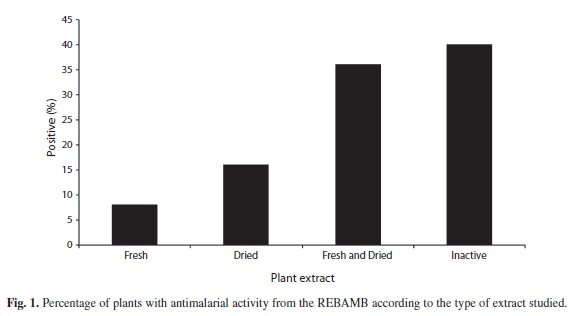
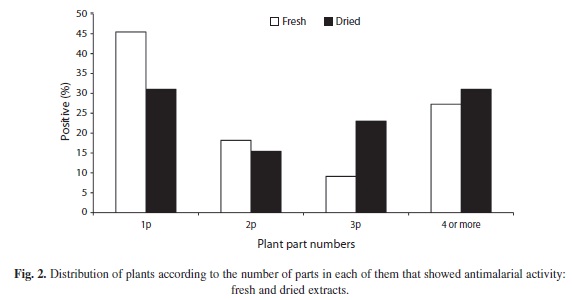
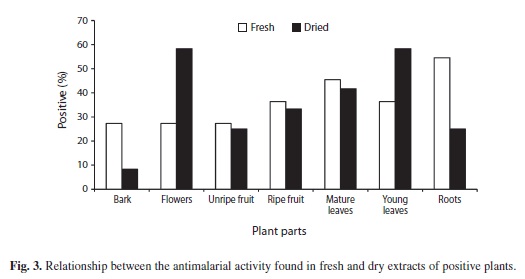
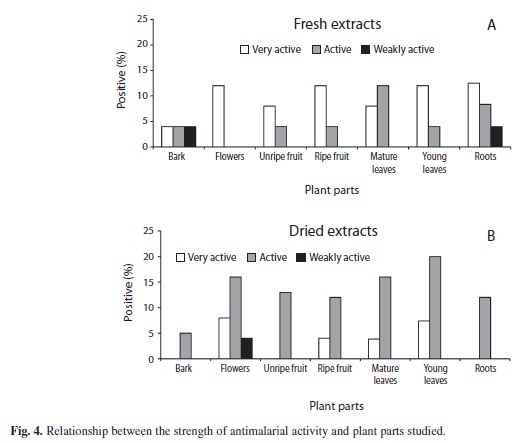
<body><![CDATA[<br> Schizogony inhibition (%) = schizonts in control - schizonts with extract x 100/ schizonts in control.<br style="font-family: verdana;"> </span></font><font size="2"></font><br style="font-family: verdana;"> <font size="2"><span style="font-family: verdana;">For calculations and statistical analysis the Probit method (Deharo <span style="font-style: italic;">et al.</span> 2000, Diaz <span style="font-style: italic;">et al. </span>2004) was used. To classify the activity levels of each extract the Rasoanaivo table (1999) was used. Accordingly the term &#8220;very active&#8221; means a IC50 less than 5&#956;g/mL; <span style="font-style: italic;">active</span> from &gt;5-50&#956;g/ mL; &#8220;weakly active&#8221; from &gt;50-100&#956;g/mL and &#8220;inactive&#8221; more than 100&#956;g/mL.</span></font><br  style="font-family: verdana;"> <font size="2"></font><br style="font-family: verdana;"> <font style="font-weight: bold;" size="3"><span  style="font-family: verdana;">Results</span></font><br  style="font-family: verdana;"> <font size="2"></font><br style="font-family: verdana;"> <font size="2"><span style="font-family: verdana;">The crude alcoholic extracts obtained from the different plant structures of the 25 varieties studied (<a href="/img/revistas/rbt/v60n2/a29t1.gif">Table 1</a>) showed some antimalarial activity (<a href="#Fig_1">Fig. 1</a>). The plants with the highest activity consistently showed it in both fresh and dried material. Not all plant structures showed the antimalarial effect. Figure 2 show the percentages of plants with one, two, three, four or more structures with potential effect against<span  style="font-style: italic;"> P. berghei.    <br>     <br> </span></span></font>     <div style="text-align: center;"><font size="2"><a name="Fig_1"></a><img  alt="" src="/img/revistas/rbt/v60n2/a29i1.jpg"  style="width: 573px; height: 316px;">    <br>     <br>     <br> <span style="font-family: verdana;"><span style="font-style: italic;"></span></span></font><font  size="2"><a name="Fig_2"></a></font><img alt=""  src="/img/revistas/rbt/v60n2/a29i2.jpg"  style="width: 572px; height: 300px;"><br style="font-family: verdana;"> <font size="2"><span style="font-family: verdana;"><span  style="font-style: italic;"></span></span></font></div> <br style="font-family: verdana;"> <font size="2"><span style="font-family: verdana;">There were more plants showing antimalarial activity in only one type of structure, (<a href="#Fig_2">Figs. 2</a>, <a href="#Fig_3">3</a>) but three plants showed it in four or more parts. When comparing extracts of fresh and dried plant with antimalarial activity (<a href="#Fig_3">Fig. 3</a>), no significant differences were found for structures, except in flowers and young leaves where the dry material showed higher antimalarial activity. Root fresh extracts showed more activity as well.    <br>     <br> </span></font>     <div style="text-align: center;"><font size="2"><a name="Fig_3"></a><img  alt="" src="/img/revistas/rbt/v60n2/a29i3.jpg"  style="width: 525px; height: 279px;"><span  style="font-family: verdana;"></span></font><br  style="font-family: verdana;"> <font size="2"><span style="font-family: verdana;"></span></font></div> <br style="font-family: verdana;"> <font size="2"><span style="font-family: verdana;">IC50 tests on fresh (<a href="/img/revistas/rbt/v60n2/a29t2.gif">Table 2</a>) and dried extracts (<a href="/img/revistas/rbt/v60n2/a29t3.gif">Table 3</a>) yielded the results presented </span></font><font size="2"><span  style="font-family: verdana;">in <a href="#Fig_4">figure 4</a>. Fresh material (<a href="#Fig_4">Fig. 4A</a>) showed the highest antimalarial activity (&#8220;very active&#8221;) as compared to the other categories; it was also independent of the part of the plant studied. In contrast, for dry samples (<a href="#Fig_4">Fig. 4B</a>), the &#8220;active&#8221; category presented higher values than the others, again regardless of the plant structure studied.    ]]></body>
<body><![CDATA[<br>     <br> </span></font>     <div style="text-align: center;"><font size="2"><a name="Fig_4"></a><img      alt="" src="/img/revistas/rbt/v60n2/a29i4.jpg"      style="border: 0px solid ; width: 521px; height: 443px;"><span      style="font-family: verdana;"></span></font><br      style="font-family: verdana;">     <font size="2"><span style="font-family: verdana;"></span></font></div>     <br style="font-family: verdana;">     <font style="font-weight: bold;" size="3"><span     ]]></body>
<body><![CDATA[ style="font-family: verdana;">Discussion</span></font><br      style="font-family: verdana;">     <font size="2"></font><br style="font-family: verdana;">     <font size="2"><span style="font-family: verdana;">Several authors have     pursued the     search for natural products with antimalarial effect in plants in the     past and in recent years (Rafatro <span style="font-style: italic;">et     al.</span> 2005, Ogbonna <span style="font-style: italic;">et al.</span>     2008,     Pillay <span style="font-style: italic;">et al.</span> 2008, Kayser <span     ]]></body>
<body><![CDATA[ style="font-style: italic;">et al.</span> 2003). The rationale for     such studies     is based on the resistance of the parasites to conventional treatment     as observed in the case of malaria (Fidock <span      style="font-style: italic;">et al.</span> 2008).</span></font><br      style="font-family: verdana;">     <font size="2"></font><br style="font-family: verdana;">     <font size="2"><span style="font-family: verdana;">This resistance     began with <span style="font-style: italic;">P.     falciparum</span> near the &#8216;60s and today is extremely common,     ]]></body>
<body><![CDATA[especially in     Africa, Central and South America (Bloland 2001). This resistance has     also been documented for <span style="font-style: italic;">P. vivax</span>     (Baird 2004, Anstey <span style="font-style: italic;">et al. </span>2009)     the     most common species found outside Africa (Wells <span      style="font-style: italic;">et al.</span> 2010) and in     Costa Rica, were reports account for 95-98% of the cases (Vargas 2001).</span></font><br      style="font-family: verdana;">     <font size="2"></font><br style="font-family: verdana;">     ]]></body>
<body><![CDATA[<font size="2"><span style="font-family: verdana;">Malaria parasites     also exhibit     resistance to Fansidar, a treatment involving Sulfadoxine and     Pyrimethamine, that act inhibiting the formation of nucleic acids     (Bloland 2001, Hastings 2004, Kakkilaya 2008).</span></font><br      style="font-family: verdana;">     <font size="2"></font><br style="font-family: verdana;">     <font size="2"><span style="font-family: verdana;">Based on the     foregoing, we started     in Costa Rica the search for antimalarial components in plants, as     ]]></body>
<body><![CDATA[previously documented (Chinchilla <span style="font-style: italic;">et     al. </span>1998, 2001, Castro <span style="font-style: italic;">et al.</span>     1996).</span></font><br style="font-family: verdana;">     <font size="2"></font><br style="font-family: verdana;">     <font size="2"><span style="font-family: verdana;">In conducting this     research, we     took into account not only the traditional observations on the     treatment of malaria and its symptoms, but also the findings of a     previous study (Chinchilla <span style="font-style: italic;">et al. </span>2008),     in which, antimalarial     ]]></body>
<body><![CDATA[activity was found in extracts of certain arthropods, especially those     that feed on plants during any stage of its life cycle. The plants     found as a feeding source of these insects, guided us in choosing     species or similar families as the ones studied in this investigation.     This selection system led us to obtain 60% positivity in the 25 plants     tested.</span></font><br style="font-family: verdana;">     <font size="2"></font><br style="font-family: verdana;">     <font size="2"><span style="font-family: verdana;">Very few papers in     other countries     mention plants with higher antimalarial activity than the ones found in     ]]></body>
<body><![CDATA[this work. It could be explained by the fact that these plants are     characteristically from Central America (Jenett-Siems <span      style="font-style: italic;">et al.</span> 1999), and     no other researchers have done any work with them.</span></font><br      style="font-family: verdana;">     <font size="2"></font><br style="font-family: verdana;">     <font size="2"><span style="font-family: verdana;"><span      style="font-style: italic;">H. appendiculata</span> is found only in     Panama, Honduras and Costa Rica (Tropicos 2010) and <span      style="font-style: italic;">T. incognitum</span> is a     ]]></body>
<body><![CDATA[recently classified plant that has not been tested for antiparasitic     activity. <span style="font-style: italic;">S. thecaphora, N.     membranaceae</span> and <span style="font-style: italic;">B. frutescens</span>     have a     greater distribution in the Americas, but were not found in any other     places (Tropicos 2010). In Africa and Asia there has been an intense     and enthusiastic search for active compounds against <span      style="font-style: italic;">P. falciparum</span>     especially (Aderounmu 2002, Mariath <span style="font-style: italic;">et     al.</span> 2009, Titanji <span style="font-style: italic;">et al.</span>     ]]></body>
<body><![CDATA[2008);     the opposite is true in America where many of the studies come from     South America (Krettli <span style="font-style: italic;">et al</span>.     2001, Rodr&iacute;guez-P&eacute;rez <span style="font-style: italic;">et     al.</span> 2006, Batista <span style="font-style: italic;">et al.</span>     2009, Valadeau <span style="font-style: italic;">et al</span>. 2009     among others) and     very few from Central America (Franssen 1997, Kohler <span      style="font-style: italic;">et al.</span> 2002).     Antimalarial components have been found in <span     ]]></body>
<body><![CDATA[ style="font-style: italic;">S. andina, S. pauciflora, S.     tonduziana</span> and <span style="font-style: italic;">S. aspera,</span>     but not in <span style="font-style: italic;">S. thecaphora</span>. The     present study     represents an important contribution to this field since the data     obtained, together with that already reported, has shown to be     inedited. </span></font><br style="font-family: verdana;">     <font size="2"></font><br style="font-family: verdana;">     <font size="2"><span style="font-family: verdana;">Most of the studies     mentioned, have     ]]></body>
<body><![CDATA[focused their attention in just a few parts of the plant, but we     studied every plant structure, included bark, roots, leaves and fruits     in order to optimize the results.</span></font><br      style="font-family: verdana;">     <font size="2"></font><br style="font-family: verdana;">     <font size="2"><span style="font-family: verdana;">Almost every one of     the studies     referred before used dried material for extraction. Since the     traditional way of using plants for healing is by using fresh material     (Blair &amp; Madrigal 2005, Togola <span style="font-style: italic;">et     ]]></body>
<body><![CDATA[al.</span> 2005) we included this     modality as part of our research. Shows that the activity in different     structures of the plant was very similar independently of the use of     the dry or fresh extract. However, when analyzing the potency of IC50,     the fresh material showed, except for bark and mature leaves, a     dominance of the condition &#8220;very active&#8221; over &#8220;active&#8221;. The opposite is     true for dry extracts; it can be deducted that although the     antimalarial activity was detectable in both types of extracts, the     potency of this activity appears to decrease by drying the structure.     The implication of this observation concludes that if only dry samples     ]]></body>
<body><![CDATA[were to be studied, some plants with antimalarial activity could be     missed. </span></font><br style="font-family: verdana;">     <font size="2"></font><br style="font-family: verdana;">     <font size="2"><span style="font-family: verdana;">Since this study was     performed in a     biological reserve, there is a guarantee for the permanence, for many     years, of plants with active components against malaria. In addition,     all samples were collected in a fairly restricted area, which reduces     the risk of changes due to external factors such as climate, soil type     and other (Martin 2001). Factors such as stage of development of the     ]]></body>
<body><![CDATA[plant and the presence of arthropods, also might affect the data, since     the plant needs to synthesize new metabolites in order to defend from     them (Coley &amp; Barone 1996). These metabolites could also be active     against malaria parasites, but this will be the subject of analysis in     other publications.</span></font><br style="font-family: verdana;">     <font size="2"></font><br style="font-family: verdana;">     <font size="2"><span style="font-family: verdana;">This work seeks to     offer a     contribution to Ethnobotany applied to Medical Sciences in Costa Rica,     as has been done in many other countries (Martin 2001). Studies in     ]]></body>
<body><![CDATA[progress are being made for identifying the chemical component(s)     responsible for the antimalarial effect of the plant extracts.</span></font><br      style="font-family: verdana;">     <font size="2"></font><br style="font-family: verdana;">     <font style="font-weight: bold;" size="3"><span      style="font-family: verdana;">Acknowledgments</span></font><br      style="font-family: verdana;">     <font size="2"></font><br style="font-family: verdana;">     <font size="2"><span style="font-family: verdana;">This study was     supported in part by     ]]></body>
<body><![CDATA[a grant (Proyect Forinves 18) of the Consejo Nacional para     Investigaciones Cient&iacute;ficas y Tecnol&oacute;gicas (CONICIT),     Research Department of the Universidad de Ciencias M&eacute;dicas     (UCIMED) and Centro Regional de Occidente, Universidad de Costa Rica.     Special thanks to Laura Valerio, Jose Bola&ntilde;os, Edwin Valenciano     and Hugo P&eacute;rez as well as to some students from UCIMED for their     work in the development of all project phases.</span></font><br      style="font-family: verdana;">     <font size="2"></font><br style="font-family: verdana;">     <font style="font-weight: bold;" size="2"><span     ]]></body>
<body><![CDATA[ style="font-family: verdana;"></span></font>     <hr style="width: 100%; height: 2px;"><font style="font-weight: bold;"      size="3"><span style="font-family: verdana;">References</span></font><br      style="font-family: verdana;">     <font size="2"></font><br style="font-family: verdana;">     <font size="2"><span style="font-family: verdana;">Aderounmu, A.O.     2002. The     antimalarial activity of the crude organic extract of four commonly     used Nigerian medicinal plants. (Accessed: 17 August 2010,     <a     ]]></body>
<body><![CDATA[<!-- ref --> href="adeolasmalariaresearch.files.wordpress.com/%3F/medicinal-plants-1_blog.doc">adeolasmalariaresearch.files.wordpress.com/&#8230;/medicinal-plants-1_blog.doc</a>).    &nbsp;&nbsp;&nbsp;&nbsp;&nbsp;&nbsp;&nbsp;&nbsp;[&#160;<a href="javascript:void(0);" onclick="javascript: window.open('/scielo.php?script=sci_nlinks&ref=1501763&pid=S0034-7744201200020002900001&lng=','','width=640,height=500,resizable=yes,scrollbars=1,menubar=yes,');">Links</a>&#160;]<!-- end-ref --><!-- ref --></span></font><br  style="font-family: verdana;"> <font size="2"></font><br style="font-family: verdana;"> <font size="2"><span style="font-family: verdana;">Ager, J.R., W. Peters &amp; W.H.G. Richards. 1984. Rodent malaria models in antimalarial drugs. I. Biological background, experimental methods, and drug resistance. Handbook. Exp. Pharmacol. 68: 225-264.    &nbsp;&nbsp;&nbsp;&nbsp;&nbsp;&nbsp;&nbsp;&nbsp;[&#160;<a href="javascript:void(0);" onclick="javascript: window.open('/scielo.php?script=sci_nlinks&ref=1501764&pid=S0034-7744201200020002900002&lng=','','width=640,height=500,resizable=yes,scrollbars=1,menubar=yes,');">Links</a>&#160;]<!-- end-ref --><!-- ref --></span></font><br  style="font-family: verdana;"> <font size="2"></font><br style="font-family: verdana;"> <font size="2"><span style="font-family: verdana;">Anstey, N.M., B. Russell, T.W. Yeo &amp; R.N. Price. 2009. The pathophysiology of vivax malaria. Trends. Parasitol. 25: 220-227.    &nbsp;&nbsp;&nbsp;&nbsp;&nbsp;&nbsp;&nbsp;&nbsp;[&#160;<a href="javascript:void(0);" onclick="javascript: window.open('/scielo.php?script=sci_nlinks&ref=1501765&pid=S0034-7744201200020002900003&lng=','','width=640,height=500,resizable=yes,scrollbars=1,menubar=yes,');">Links</a>&#160;]<!-- end-ref --><!-- ref --></span></font><br style="font-family: verdana;"> <font size="2"></font><br style="font-family: verdana;"> <font size="2"><span style="font-family: verdana;">Anthony, J.P., L. Fyfe &amp; H. Smith. 2005. Plant active components-a resource for antiparasitic agents. Trends. Parasitol. 21: 462-468.    &nbsp;&nbsp;&nbsp;&nbsp;&nbsp;&nbsp;&nbsp;&nbsp;[&#160;<a href="javascript:void(0);" onclick="javascript: window.open('/scielo.php?script=sci_nlinks&ref=1501766&pid=S0034-7744201200020002900004&lng=','','width=640,height=500,resizable=yes,scrollbars=1,menubar=yes,');">Links</a>&#160;]<!-- end-ref --><!-- ref --></span></font><br  style="font-family: verdana;"> <font size="2"></font><br style="font-family: verdana;"> <font size="2"><span style="font-family: verdana;">Baird, J.K. 2004. Choroquine resistance in <span style="font-style: italic;">Plasmodium vivax</span>. Antimicrob. Agents. Chemother. 48: 4075-4023.    &nbsp;&nbsp;&nbsp;&nbsp;&nbsp;&nbsp;&nbsp;&nbsp;[&#160;<a href="javascript:void(0);" onclick="javascript: window.open('/scielo.php?script=sci_nlinks&ref=1501767&pid=S0034-7744201200020002900005&lng=','','width=640,height=500,resizable=yes,scrollbars=1,menubar=yes,');">Links</a>&#160;]<!-- end-ref --><!-- ref --></span></font><br style="font-family: verdana;"> <font size="2"></font><br style="font-family: verdana;"> <font size="2"><span style="font-family: verdana;">Barrantes, T. 2004. Flora del Sotobosque de la Reserva Biol&oacute;gica Alberto Manuel Brenes. Coordinaci&oacute;n Investigaci&oacute;n sede acreditada, Universidad de Costa Rica, Costa Rica.    &nbsp;&nbsp;&nbsp;&nbsp;&nbsp;&nbsp;&nbsp;&nbsp;[&#160;<a href="javascript:void(0);" onclick="javascript: window.open('/scielo.php?script=sci_nlinks&ref=1501768&pid=S0034-7744201200020002900006&lng=','','width=640,height=500,resizable=yes,scrollbars=1,menubar=yes,');">Links</a>&#160;]<!-- end-ref --><!-- ref --></span></font><br  style="font-family: verdana;"> <font size="2"></font><br style="font-family: verdana;"> <font size="2"><span style="font-family: verdana;">Batista, R., A. Silva &amp; A. Braga de Oliveria. 2009. Plantderived antimalarial agents: New leads and efficient phytomedicines. Part II. Non-Alkaloidal Natural Products. Molecules 14: 3037-3072.    &nbsp;&nbsp;&nbsp;&nbsp;&nbsp;&nbsp;&nbsp;&nbsp;[&#160;<a href="javascript:void(0);" onclick="javascript: window.open('/scielo.php?script=sci_nlinks&ref=1501769&pid=S0034-7744201200020002900007&lng=','','width=640,height=500,resizable=yes,scrollbars=1,menubar=yes,');">Links</a>&#160;]<!-- end-ref --><!-- ref --></span></font><br style="font-family: verdana;"> <font size="2"></font><br style="font-family: verdana;"> <font size="2"><span style="font-family: verdana;">Blair, S. &amp; B. Madrigal. 2005. Plantas Antimal&aacute;ricas de Tumaco Costa Pac&iacute;fica Colombiana. Universidad de Antioqu&iacute;a, Colombia.    &nbsp;&nbsp;&nbsp;&nbsp;&nbsp;&nbsp;&nbsp;&nbsp;[&#160;<a href="javascript:void(0);" onclick="javascript: window.open('/scielo.php?script=sci_nlinks&ref=1501770&pid=S0034-7744201200020002900008&lng=','','width=640,height=500,resizable=yes,scrollbars=1,menubar=yes,');">Links</a>&#160;]<!-- end-ref --><!-- ref --></span></font><br  style="font-family: verdana;"> <font size="2"></font><br style="font-family: verdana;"> <font size="2"><span style="font-family: verdana;">Bloland, P.B. 2001. Drug resistance in malaria. World Health Organization, Geneva, Switzerland.    &nbsp;&nbsp;&nbsp;&nbsp;&nbsp;&nbsp;&nbsp;&nbsp;[&#160;<a href="javascript:void(0);" onclick="javascript: window.open('/scielo.php?script=sci_nlinks&ref=1501771&pid=S0034-7744201200020002900009&lng=','','width=640,height=500,resizable=yes,scrollbars=1,menubar=yes,');">Links</a>&#160;]<!-- end-ref --><!-- ref --> </span></font><br  style="font-family: verdana;"> <font size="2"></font><br style="font-family: verdana;"> <font size="2"><span style="font-family: verdana;">Botsaris, A. 2007. Plants used traditionally to treat malaria in Brazil: the archives of Flora Medicinal. J. Ethnobiol. Ethnomed. 3: 18-23.    &nbsp;&nbsp;&nbsp;&nbsp;&nbsp;&nbsp;&nbsp;&nbsp;[&#160;<a href="javascript:void(0);" onclick="javascript: window.open('/scielo.php?script=sci_nlinks&ref=1501772&pid=S0034-7744201200020002900010&lng=','','width=640,height=500,resizable=yes,scrollbars=1,menubar=yes,');">Links</a>&#160;]<!-- end-ref --><!-- ref --></span></font><br  style="font-family: verdana;"> <font size="2"></font><br style="font-family: verdana;"> <font size="2"><span style="font-family: verdana;">Castro, O., M. Barrios, M. Chinchilla &amp; O.M. Guerrero. 1996. Evaluaci&oacute;n qu&iacute;mica y biol&oacute;gica del efecto de extractos de plantas contra <span  style="font-style: italic;">Plasmodium berghei.</span> Rev. Biol. Trop. 44: 361-367.    &nbsp;&nbsp;&nbsp;&nbsp;&nbsp;&nbsp;&nbsp;&nbsp;[&#160;<a href="javascript:void(0);" onclick="javascript: window.open('/scielo.php?script=sci_nlinks&ref=1501773&pid=S0034-7744201200020002900011&lng=','','width=640,height=500,resizable=yes,scrollbars=1,menubar=yes,');">Links</a>&#160;]<!-- end-ref --><!-- ref --></span></font><br  style="font-family: verdana;"> <font size="2"></font><br style="font-family: verdana;"> <font size="2"><span style="font-family: verdana;">Chinchilla, M., O.M. Guerrero, G. Tamayo, A. Sittenfeld, A. Jim&eacute;nez &amp; I. Valerio. 2008. Concentraci&oacute;n natural de compuestos antimal&aacute;ricos en artr&oacute;podos tropicales (<span style="font-style: italic;">in Vitro</span>). Rev. Biol. Trop. 56: 473-485.    &nbsp;&nbsp;&nbsp;&nbsp;&nbsp;&nbsp;&nbsp;&nbsp;[&#160;<a href="javascript:void(0);" onclick="javascript: window.open('/scielo.php?script=sci_nlinks&ref=1501774&pid=S0034-7744201200020002900012&lng=','','width=640,height=500,resizable=yes,scrollbars=1,menubar=yes,');">Links</a>&#160;]<!-- end-ref --><!-- ref --></span></font><br  style="font-family: verdana;"> <font size="2"></font><br style="font-family: verdana;"> <font size="2"><span style="font-family: verdana;">Chinchilla, M., O.M. Guerrero, G. Abarca, M. Barrios &amp; O. Castro. 1998. An<span  style="font-style: italic;"> in vivo </span>model to study the antimalaric capacity of plant extracts. Rev. Biol. Trop. 46: 35-39.    &nbsp;&nbsp;&nbsp;&nbsp;&nbsp;&nbsp;&nbsp;&nbsp;[&#160;<a href="javascript:void(0);" onclick="javascript: window.open('/scielo.php?script=sci_nlinks&ref=1501775&pid=S0034-7744201200020002900013&lng=','','width=640,height=500,resizable=yes,scrollbars=1,menubar=yes,');">Links</a>&#160;]<!-- end-ref --><!-- ref --></span></font><br  style="font-family: verdana;"> <font size="2"></font><br style="font-family: verdana;"> <font size="2"><span style="font-family: verdana;">Chinchilla, M., O.M. Guerrero, G. Tamayo &amp; A. Sittenfeld. 2001. Empleo de t&eacute;cnicas y materiales biol&oacute;gicos en la b&uacute;squeda de productos activos contra la malaria. Informaci&oacute;n Tecnol&oacute;gica 12: 187-192.    &nbsp;&nbsp;&nbsp;&nbsp;&nbsp;&nbsp;&nbsp;&nbsp;[&#160;<a href="javascript:void(0);" onclick="javascript: window.open('/scielo.php?script=sci_nlinks&ref=1501776&pid=S0034-7744201200020002900014&lng=','','width=640,height=500,resizable=yes,scrollbars=1,menubar=yes,');">Links</a>&#160;]<!-- end-ref --><!-- ref --></span></font><br  style="font-family: verdana;"> <font size="2"></font><br style="font-family: verdana;"> <font size="2"><span style="font-family: verdana;">Chinchilla, M., M. Herrera, O.M. Guerrero, A. Jim&eacute;nez, G. Tamayo, A. Sittenfeld, V. Nielsen &amp; P. Hurtado. 2003. Efecto de extractos de artr&oacute;podos sobre la multiplicaci&oacute;n del <span style="font-style: italic;">Toxoplasma gondii</span> dentro de macr&oacute;fagos peritoneales de rat&oacute;n. Rev. Biol. Trop. 51: 317-320.    &nbsp;&nbsp;&nbsp;&nbsp;&nbsp;&nbsp;&nbsp;&nbsp;[&#160;<a href="javascript:void(0);" onclick="javascript: window.open('/scielo.php?script=sci_nlinks&ref=1501777&pid=S0034-7744201200020002900015&lng=','','width=640,height=500,resizable=yes,scrollbars=1,menubar=yes,');">Links</a>&#160;]<!-- end-ref --><!-- ref --></span></font><br  style="font-family: verdana;"> <font size="2"></font><br style="font-family: verdana;"> <font size="2"><span style="font-family: verdana;">Coley, P.D. &amp; J.A. Barone. 1996. Herbivory and plant defences in tropical forest. Annu. Rev. Ecol. Syst. 27: 305-335.    &nbsp;&nbsp;&nbsp;&nbsp;&nbsp;&nbsp;&nbsp;&nbsp;[&#160;<a href="javascript:void(0);" onclick="javascript: window.open('/scielo.php?script=sci_nlinks&ref=1501778&pid=S0034-7744201200020002900016&lng=','','width=640,height=500,resizable=yes,scrollbars=1,menubar=yes,');">Links</a>&#160;]<!-- end-ref --><!-- ref --></span></font><br style="font-family: verdana;"> <font size="2"></font><br style="font-family: verdana;"> <font size="2"><span style="font-family: verdana;">Deharo, E., P.H. Gautret, V. Mu&ntilde;oz &amp; M. Sauvain. 2000. T&eacute;cnicas de laboratorio para la selecci&oacute;n de sustancias antimal&aacute;ricas. P&eacute;rez, La Paz, Bolivia.    &nbsp;&nbsp;&nbsp;&nbsp;&nbsp;&nbsp;&nbsp;&nbsp;[&#160;<a href="javascript:void(0);" onclick="javascript: window.open('/scielo.php?script=sci_nlinks&ref=1501779&pid=S0034-7744201200020002900017&lng=','','width=640,height=500,resizable=yes,scrollbars=1,menubar=yes,');">Links</a>&#160;]<!-- end-ref --><!-- ref --></span></font><br  style="font-family: verdana;"> <font size="2"></font><br style="font-family: verdana;"> <font size="2"><span style="font-family: verdana;">D&iacute;az, M.C., G.D. Bulus &amp; Y. Pica. 2004. Ensayos toxicol&oacute;gicos y m&eacute;todos de evacuaci&oacute;n de calidad de aguas. G. Castillo (ed.). Bogot&aacute;, Colombia.    &nbsp;&nbsp;&nbsp;&nbsp;&nbsp;&nbsp;&nbsp;&nbsp;[&#160;<a href="javascript:void(0);" onclick="javascript: window.open('/scielo.php?script=sci_nlinks&ref=1501780&pid=S0034-7744201200020002900018&lng=','','width=640,height=500,resizable=yes,scrollbars=1,menubar=yes,');">Links</a>&#160;]<!-- end-ref --><!-- ref --></span></font><br style="font-family: verdana;"> <font size="2"></font><br style="font-family: verdana;"> <font size="2"><span style="font-family: verdana;">Fidock, D.A., R.T. Eastman, S.A. Ward &amp; S.R. Meshnick. 2008. Recent highlights in antimalarial drug resistance and chemotherapy research. Trends. Parasitol. 24: 537-544.    &nbsp;&nbsp;&nbsp;&nbsp;&nbsp;&nbsp;&nbsp;&nbsp;[&#160;<a href="javascript:void(0);" onclick="javascript: window.open('/scielo.php?script=sci_nlinks&ref=1501781&pid=S0034-7744201200020002900019&lng=','','width=640,height=500,resizable=yes,scrollbars=1,menubar=yes,');">Links</a>&#160;]<!-- end-ref --><!-- ref --></span></font><br  style="font-family: verdana;"> <font size="2"></font><br style="font-family: verdana;"> <font size="2"><span style="font-family: verdana;">Frederich, M., M. Tits &amp; L. Angenot. 2008. Potential antimalarial activity of indole alkaloids. Trans. R. Soc. Trop. Med. 102: 11-19.    &nbsp;&nbsp;&nbsp;&nbsp;&nbsp;&nbsp;&nbsp;&nbsp;[&#160;<a href="javascript:void(0);" onclick="javascript: window.open('/scielo.php?script=sci_nlinks&ref=1501782&pid=S0034-7744201200020002900020&lng=','','width=640,height=500,resizable=yes,scrollbars=1,menubar=yes,');">Links</a>&#160;]<!-- end-ref --><!-- ref --></span></font><br  style="font-family: verdana;"> <font size="2"></font><br style="font-family: verdana;"> <font size="2"><span style="font-family: verdana;">Franssen, F.F.J., L.J.J.W. Smeijsters, I. Berger &amp; B.E. Medinilla. 1997. In vivo and In vitro antiplasmodial activities of some plants traditionally used in Guatemala against Malaria. Antimicrobiol. Ag. Chemother. 41: 1500-1503.    &nbsp;&nbsp;&nbsp;&nbsp;&nbsp;&nbsp;&nbsp;&nbsp;[&#160;<a href="javascript:void(0);" onclick="javascript: window.open('/scielo.php?script=sci_nlinks&ref=1501783&pid=S0034-7744201200020002900021&lng=','','width=640,height=500,resizable=yes,scrollbars=1,menubar=yes,');">Links</a>&#160;]<!-- end-ref --><!-- ref --></span></font><br  style="font-family: verdana;"> <font size="2"></font><br style="font-family: verdana;"> <font size="2"><span style="font-family: verdana;">G&oacute;mez-Laurito, J. &amp; R. Ortiz. 2004. Lista con anotaciones de las Angiospermas de la Reserva Biol&oacute;gica Alberto Brenes (Microcuencas de los r&iacute;os San Lorenzo y San Lorencito), Costa Rica. Lankesteriana 4: 113-142.    &nbsp;&nbsp;&nbsp;&nbsp;&nbsp;&nbsp;&nbsp;&nbsp;[&#160;<a href="javascript:void(0);" onclick="javascript: window.open('/scielo.php?script=sci_nlinks&ref=1501784&pid=S0034-7744201200020002900022&lng=','','width=640,height=500,resizable=yes,scrollbars=1,menubar=yes,');">Links</a>&#160;]<!-- end-ref --><!-- ref --></span></font><br  style="font-family: verdana;"> <font size="2"></font><br style="font-family: verdana;"> <font size="2"><span style="font-family: verdana;">Hastings, I.M. 2004. The origins of antimalarial drug resistance. Trends Parasitol. 20: 512-518.    &nbsp;&nbsp;&nbsp;&nbsp;&nbsp;&nbsp;&nbsp;&nbsp;[&#160;<a href="javascript:void(0);" onclick="javascript: window.open('/scielo.php?script=sci_nlinks&ref=1501785&pid=S0034-7744201200020002900023&lng=','','width=640,height=500,resizable=yes,scrollbars=1,menubar=yes,');">Links</a>&#160;]<!-- end-ref --><br>     <!-- ref --><br> Jenett-Siems, K., P. Mockenhaupt, U. Bienzie, M. Gupta &amp; E. Eich. 1999. In vitro antiplasmodial activity of Central American medicinal plants. Trop. Med. Int. Health 4: 611-615.    &nbsp;&nbsp;&nbsp;&nbsp;&nbsp;&nbsp;&nbsp;&nbsp;[&#160;<a href="javascript:void(0);" onclick="javascript: window.open('/scielo.php?script=sci_nlinks&ref=1501787&pid=S0034-7744201200020002900024&lng=','','width=640,height=500,resizable=yes,scrollbars=1,menubar=yes,');">Links</a>&#160;]<!-- end-ref --><!-- ref --></span></font><br  style="font-family: verdana;"> <font size="2"></font><br style="font-family: verdana;"> <font size="2"><span style="font-family: verdana;">Kakkilaya, B.S. 2008. Malaria Site. (Downloaded: 15 January 2011, <a href="http://www.malariasite.com/malaria/history_treatment.htm">http://www.malariasite.com/malaria/history_treatment.htm</a>).    &nbsp;&nbsp;&nbsp;&nbsp;&nbsp;&nbsp;&nbsp;&nbsp;[&#160;<a href="javascript:void(0);" onclick="javascript: window.open('/scielo.php?script=sci_nlinks&ref=1501788&pid=S0034-7744201200020002900025&lng=','','width=640,height=500,resizable=yes,scrollbars=1,menubar=yes,');">Links</a>&#160;]<!-- end-ref --><!-- ref --></span></font><br  style="font-family: verdana;"> <font size="2"></font><br style="font-family: verdana;"> <font size="2"><span style="font-family: verdana;">Kayser, O., A.F. Kiderien &amp; S.L. Croft. 2003. Natural products as antiparasitic drugs. Parasitol. Res. 90: S55-S62.    &nbsp;&nbsp;&nbsp;&nbsp;&nbsp;&nbsp;&nbsp;&nbsp;[&#160;<a href="javascript:void(0);" onclick="javascript: window.open('/scielo.php?script=sci_nlinks&ref=1501789&pid=S0034-7744201200020002900026&lng=','','width=640,height=500,resizable=yes,scrollbars=1,menubar=yes,');">Links</a>&#160;]<!-- end-ref --><!-- ref --></span></font><br style="font-family: verdana;"> <font size="2"></font><br style="font-family: verdana;"> <font size="2"><span style="font-family: verdana;">Kohler, I., K. Jennett-Siems, M.A. Hern&aacute;ndez, R.A. Ibarra, W.G. Berendsohn, U. Bienzle &amp; E. Eckart. 2002. In vitro antiplasmodial investigation of medicinal plants from El Salvador. Z. Naturforsh 57: 277-281.    &nbsp;&nbsp;&nbsp;&nbsp;&nbsp;&nbsp;&nbsp;&nbsp;[&#160;<a href="javascript:void(0);" onclick="javascript: window.open('/scielo.php?script=sci_nlinks&ref=1501790&pid=S0034-7744201200020002900027&lng=','','width=640,height=500,resizable=yes,scrollbars=1,menubar=yes,');">Links</a>&#160;]<!-- end-ref --><!-- ref --></span></font><br  style="font-family: verdana;"> <font size="2"></font><br style="font-family: verdana;"> <font size="2"><span style="font-family: verdana;">Krettli, A.U., V.F. Andrade-Neto, M.G. Brand&atilde;o &amp; W.M. Ferrari. 2001. The search for new antimalarial drugs from plants used to treat fever and malaria or plants ramdomly selected: a review. Mem. Inst. Oswaldo Cruz 96: 1033-1042.    &nbsp;&nbsp;&nbsp;&nbsp;&nbsp;&nbsp;&nbsp;&nbsp;[&#160;<a href="javascript:void(0);" onclick="javascript: window.open('/scielo.php?script=sci_nlinks&ref=1501791&pid=S0034-7744201200020002900028&lng=','','width=640,height=500,resizable=yes,scrollbars=1,menubar=yes,');">Links</a>&#160;]<!-- end-ref --><!-- ref --></span></font><br style="font-family: verdana;"> <font size="2"></font><br style="font-family: verdana;"> <font size="2"><span style="font-family: verdana;">Mackintosh, C.L., J.G. Beeson &amp; K. Marsh. 2004. Clinical features and pathogenesis of severe malaria. Trends. Parasitol. 20: 1471-4822.    &nbsp;&nbsp;&nbsp;&nbsp;&nbsp;&nbsp;&nbsp;&nbsp;[&#160;<a href="javascript:void(0);" onclick="javascript: window.open('/scielo.php?script=sci_nlinks&ref=1501792&pid=S0034-7744201200020002900029&lng=','','width=640,height=500,resizable=yes,scrollbars=1,menubar=yes,');">Links</a>&#160;]<!-- end-ref --><!-- ref --></span></font><br  style="font-family: verdana;"> <font size="2"></font><br style="font-family: verdana;"> <font size="2"><span style="font-family: verdana;">Mariath, I.R., H.S. Falcao, J.M. Barboza-Filho, L.C.F. de Sousa, A.C.A. Tomas, L.M. Batista, M.F.M. Dimiz, P. Athayde-Filho, J.F. Tavarez, M.S. Silva &amp; E.V.L Cuahes. 2009. Plants of the American continent with antimalarial activity. Rev. Bras. Farmacol. 19: 158-191.    &nbsp;&nbsp;&nbsp;&nbsp;&nbsp;&nbsp;&nbsp;&nbsp;[&#160;<a href="javascript:void(0);" onclick="javascript: window.open('/scielo.php?script=sci_nlinks&ref=1501793&pid=S0034-7744201200020002900030&lng=','','width=640,height=500,resizable=yes,scrollbars=1,menubar=yes,');">Links</a>&#160;]<!-- end-ref --><!-- ref --><br> <br style="font-family: verdana;"> </span></font><font size="2"><span style="font-family: verdana;">Martin, G.J. 2001. Etnobot&aacute;nica: manual de m&eacute;todos. Pueblos y plantas. no. 1. Nordan- Comunidad, Montevideo, Uruguay.    &nbsp;&nbsp;&nbsp;&nbsp;&nbsp;&nbsp;&nbsp;&nbsp;[&#160;<a href="javascript:void(0);" onclick="javascript: window.open('/scielo.php?script=sci_nlinks&ref=1501794&pid=S0034-7744201200020002900031&lng=','','width=640,height=500,resizable=yes,scrollbars=1,menubar=yes,');">Links</a>&#160;]<!-- end-ref --><!-- ref --></span></font><br  style="font-family: verdana;"> <font size="2"></font><br style="font-family: verdana;"> <font size="2"><span style="font-family: verdana;">Ogbonna, D.N., G. Tojibiye, A. Sokari &amp; A. Agomuoh. 2008. Antimalarial activities of some selected traditional herbs from South Eastern Nigeria against<span  style="font-style: italic;"> Plasmodium </span>species. Res. J. Parasitol. 3: 25-31.    &nbsp;&nbsp;&nbsp;&nbsp;&nbsp;&nbsp;&nbsp;&nbsp;[&#160;<a href="javascript:void(0);" onclick="javascript: window.open('/scielo.php?script=sci_nlinks&ref=1501795&pid=S0034-7744201200020002900032&lng=','','width=640,height=500,resizable=yes,scrollbars=1,menubar=yes,');">Links</a>&#160;]<!-- end-ref --><!-- ref --></span></font><br  style="font-family: verdana;"> <font size="2"></font><br style="font-family: verdana;"> <font size="2"><span style="font-family: verdana;">Pillay, P., V.J. Maharaj &amp; P.J. Smith. 2008. Investigating South African plants as a source of new antimalarial drugs. J. Ethnopharmacol. 119: 438-54.    &nbsp;&nbsp;&nbsp;&nbsp;&nbsp;&nbsp;&nbsp;&nbsp;[&#160;<a href="javascript:void(0);" onclick="javascript: window.open('/scielo.php?script=sci_nlinks&ref=1501796&pid=S0034-7744201200020002900033&lng=','','width=640,height=500,resizable=yes,scrollbars=1,menubar=yes,');">Links</a>&#160;]<!-- end-ref --><!-- ref --></span></font><br  style="font-family: verdana;"> <font size="2"></font><br style="font-family: verdana;"> <font size="2"><span style="font-family: verdana;">Rafatro, H., R.B. Robijaona, A.S. Razafimahefa, A.M. Rosoamahenina, E.K. Ramanantosoa, H. Rakotoarimanana, M.H. Rakotondrabe, M. Raminosoa, A. Rakotozafy, J. Ranaivoravo, J.F. Rajaonarison, S. Ratsimamanga, G. Tona, G.K. Mesia, S. Derese &amp; J.O. Midiwo. 2005. Screening of plant extracts for searching antiplasmodial activity. 11<sup>0</sup> Napreca Symposiun Book of Proceeding Antananarivo, Madagascar.    &nbsp;&nbsp;&nbsp;&nbsp;&nbsp;&nbsp;&nbsp;&nbsp;[&#160;<a href="javascript:void(0);" onclick="javascript: window.open('/scielo.php?script=sci_nlinks&ref=1501797&pid=S0034-7744201200020002900034&lng=','','width=640,height=500,resizable=yes,scrollbars=1,menubar=yes,');">Links</a>&#160;]<!-- end-ref --><!-- ref --></span></font><br  style="font-family: verdana;"> <font size="2"></font><br style="font-family: verdana;"> <font size="2"><span style="font-family: verdana;">Ramesar, J., C. Jense &amp; A. Waters. 2008. Methods in <span style="font-style: italic;">Plasmodium berghei</span> Research 4: The Plasmodium berghe/ research model of malaria. (Downloaded: 17 August 2010, <a  href="http://www.lumc.nl/rep/cod/redirect/1040/research/malaria/modelll">http://www.lumc.nl/rep/cod/redirect/1040/research/malaria/modelll</a>).    &nbsp;&nbsp;&nbsp;&nbsp;&nbsp;&nbsp;&nbsp;&nbsp;[&#160;<a href="javascript:void(0);" onclick="javascript: window.open('/scielo.php?script=sci_nlinks&ref=1501798&pid=S0034-7744201200020002900035&lng=','','width=640,height=500,resizable=yes,scrollbars=1,menubar=yes,');">Links</a>&#160;]<!-- end-ref --><!-- ref --></span></font><br  style="font-family: verdana;"> <font size="2"></font><br style="font-family: verdana;"> <font size="2"><span style="font-family: verdana;">Rasoanaivo, P., S. Ratsimamanga-Urverg, D. Ramanitrahasimbola, H. Rafatro &amp; A. Rakoto-Ratsimamanga. 1999. Criblaged&#8217;extraits de plantes de Madagascar pour recherche d&#8217;activite antipaludique et d&#8217;effet potentialisateur de la chloroquine J. Ethnopharm. 64: 117-126.    &nbsp;&nbsp;&nbsp;&nbsp;&nbsp;&nbsp;&nbsp;&nbsp;[&#160;<a href="javascript:void(0);" onclick="javascript: window.open('/scielo.php?script=sci_nlinks&ref=1501799&pid=S0034-7744201200020002900036&lng=','','width=640,height=500,resizable=yes,scrollbars=1,menubar=yes,');">Links</a>&#160;]<!-- end-ref --><!-- ref --></span></font><br  style="font-family: verdana;"> <font size="2"></font><br style="font-family: verdana;"> <font size="2"><span style="font-family: verdana;">Rodr&iacute;guez-P&eacute;rez, M., J.M. Martinez, L.R. Rivero, M.H. Alvarez, A.F.C. Valdez, D.A. Rodr&iacute;guez, R.S. Lizama &amp; J.A. Payrol. 2006. Evaluaci&oacute;n de la actividad antimal&aacute;rica de algunas plantas utilizadas en la medicina tradicional cubana. Rev. Ci&ecirc;nc Farm. Apl. 27: 197-205.    &nbsp;&nbsp;&nbsp;&nbsp;&nbsp;&nbsp;&nbsp;&nbsp;[&#160;<a href="javascript:void(0);" onclick="javascript: window.open('/scielo.php?script=sci_nlinks&ref=1501800&pid=S0034-7744201200020002900037&lng=','','width=640,height=500,resizable=yes,scrollbars=1,menubar=yes,');">Links</a>&#160;]<!-- end-ref --><!-- ref --></span></font><br style="font-family: verdana;"> <font size="2"></font><br style="font-family: verdana;"> <font size="2"><span style="font-family: verdana;">S&aacute;nchez, R. 2000. Reserva Biol&oacute;gica Alberto Manuel Brenes. San Ram&oacute;n, Alajuela, Costa Rica. MINAE, San Jos&eacute;, Costa Rica.    &nbsp;&nbsp;&nbsp;&nbsp;&nbsp;&nbsp;&nbsp;&nbsp;[&#160;<a href="javascript:void(0);" onclick="javascript: window.open('/scielo.php?script=sci_nlinks&ref=1501801&pid=S0034-7744201200020002900038&lng=','','width=640,height=500,resizable=yes,scrollbars=1,menubar=yes,');">Links</a>&#160;]<!-- end-ref --><!-- ref --></span></font><br  style="font-family: verdana;"> <font size="2"></font><br style="font-family: verdana;"> <font size="2"><span style="font-family: verdana;">Saxena, S., N. Pant, D.C. Jain &amp; R.S. Bhakuni. 2003. Antimalarial agents from plant sources. Curr. Sc. 85: 1314-1329.    &nbsp;&nbsp;&nbsp;&nbsp;&nbsp;&nbsp;&nbsp;&nbsp;[&#160;<a href="javascript:void(0);" onclick="javascript: window.open('/scielo.php?script=sci_nlinks&ref=1501802&pid=S0034-7744201200020002900039&lng=','','width=640,height=500,resizable=yes,scrollbars=1,menubar=yes,');">Links</a>&#160;]<!-- end-ref --><!-- ref --></span></font><br style="font-family: verdana;"> <font size="2"></font><br style="font-family: verdana;"> <font size="2"><span style="font-family: verdana;">Simpson, I., 2002. To beat resistance to antimalarials switch to combination medicines Bull. WHO. 80: 523.    &nbsp;&nbsp;&nbsp;&nbsp;&nbsp;&nbsp;&nbsp;&nbsp;[&#160;<a href="javascript:void(0);" onclick="javascript: window.open('/scielo.php?script=sci_nlinks&ref=1501803&pid=S0034-7744201200020002900040&lng=','','width=640,height=500,resizable=yes,scrollbars=1,menubar=yes,');">Links</a>&#160;]<!-- end-ref --><!-- ref --></span></font><br style="font-family: verdana;"> <font size="2"></font><br style="font-family: verdana;"> <font size="2"><span style="font-family: verdana;">Sittenfeld, A., G. Tamayo, V. Nielsen, A. Jim&eacute;nez, P. Hurtado, M. Chinchilla, O.M. Guerrero, M.A. Mora, M. Rojas, R. Blanco, E. Alvarado. J.M. Guti&eacute;rrez &amp; D.H. Janzen. 1999. Costa Rican international cooperative biodiversity group: using insects and other arthropods in biodiversity prospecting. Pharmac. Biol. 37: 55-68.    &nbsp;&nbsp;&nbsp;&nbsp;&nbsp;&nbsp;&nbsp;&nbsp;[&#160;<a href="javascript:void(0);" onclick="javascript: window.open('/scielo.php?script=sci_nlinks&ref=1501804&pid=S0034-7744201200020002900041&lng=','','width=640,height=500,resizable=yes,scrollbars=1,menubar=yes,');">Links</a>&#160;]<!-- end-ref --><!-- ref --></span></font><br  style="font-family: verdana;"> <font size="2"></font><br style="font-family: verdana;"> <font size="2"><span style="font-family: verdana;">Soh, P.N. &amp; F. Benoit-Vical. 2007. Are West African plants a source of future antimalarial drugs? J. Ethnopharm. 114: 130-140.    &nbsp;&nbsp;&nbsp;&nbsp;&nbsp;&nbsp;&nbsp;&nbsp;[&#160;<a href="javascript:void(0);" onclick="javascript: window.open('/scielo.php?script=sci_nlinks&ref=1501805&pid=S0034-7744201200020002900042&lng=','','width=640,height=500,resizable=yes,scrollbars=1,menubar=yes,');">Links</a>&#160;]<!-- end-ref --><!-- ref --></span></font><br style="font-family: verdana;"> <font size="2"></font><br style="font-family: verdana;"> <font size="2"><span style="font-family: verdana;">Titanji, V.P.K., D. Zofou &amp; M. Ngemenya. 2008. The Antimalarial potential of medicinal plants used for the treatment of malaria in Cameroonian folk medicine. Afr. J. Treda. CAM. 5: 302-321.    &nbsp;&nbsp;&nbsp;&nbsp;&nbsp;&nbsp;&nbsp;&nbsp;[&#160;<a href="javascript:void(0);" onclick="javascript: window.open('/scielo.php?script=sci_nlinks&ref=1501806&pid=S0034-7744201200020002900043&lng=','','width=640,height=500,resizable=yes,scrollbars=1,menubar=yes,');">Links</a>&#160;]<!-- end-ref --><!-- ref --></span></font><br style="font-family: verdana;"> <font size="2"></font><br style="font-family: verdana;"> <font size="2"><span style="font-family: verdana;">Togola, A., D. Diallo, S. Dembel&eacute;, H. Barsett &amp; B.S. Paulsen. 2005. Ethnopharmacological study of the different uses of seven medicinal plants from Mali </span></font><font size="2"><span  style="font-family: verdana;">(Africa Occidental) in the regions Doila, Kolokani y Siby. J. Ethnobiol. Ethnomedic. 1: 7-15.    &nbsp;&nbsp;&nbsp;&nbsp;&nbsp;&nbsp;&nbsp;&nbsp;[&#160;<a href="javascript:void(0);" onclick="javascript: window.open('/scielo.php?script=sci_nlinks&ref=1501807&pid=S0034-7744201200020002900044&lng=','','width=640,height=500,resizable=yes,scrollbars=1,menubar=yes,');">Links</a>&#160;]<!-- end-ref --><!-- ref --></span></font><br  style="font-family: verdana;"> <font size="2"></font><br style="font-family: verdana;"> <font size="2"><span style="font-family: verdana;">Tramputz, A., M. Jereb, I. Muslovic &amp; R.M. Prabhu. 2003. Severe Malaria. J. Cardioth. Surg. 7: 315-323.    &nbsp;&nbsp;&nbsp;&nbsp;&nbsp;&nbsp;&nbsp;&nbsp;[&#160;<a href="javascript:void(0);" onclick="javascript: window.open('/scielo.php?script=sci_nlinks&ref=1501808&pid=S0034-7744201200020002900045&lng=','','width=640,height=500,resizable=yes,scrollbars=1,menubar=yes,');">Links</a>&#160;]<!-- end-ref --><!-- ref --> </span></font><br style="font-family: verdana;"> <font size="2"></font><br style="font-family: verdana;"> <font size="2"><span style="font-family: verdana;">Trejos, m.e., t. solano, r. c&eacute;spedes, r.m. vargas &amp; r. bejarano. 2010. Bolet&iacute;n semanal de vigilancia de la salud. Semana epidemiol&oacute;gica # 3 (7 al 16 de enero 2010). Direcci&oacute;n vigilancia de la salud. Ministerio de Salud. San Jos&eacute;, Costa Rica.</span></font> <font  size="2"><span style="font-family: verdana;">Tropicos.org. Missouri Botanical Garden. (Downloaded: 05 August 2010, <a href="http://www.tropicos.org">http://www.tropicos.org</a>).    &nbsp;&nbsp;&nbsp;&nbsp;&nbsp;&nbsp;&nbsp;&nbsp;[&#160;<a href="javascript:void(0);" onclick="javascript: window.open('/scielo.php?script=sci_nlinks&ref=1501809&pid=S0034-7744201200020002900046&lng=','','width=640,height=500,resizable=yes,scrollbars=1,menubar=yes,');">Links</a>&#160;]<!-- end-ref --><!-- ref --></span></font><br  style="font-family: verdana;"> <font size="2"></font><br style="font-family: verdana;"> <font size="2"><span style="font-family: verdana;">Valadeau, C., A. Pabon, E. Deharo, J. Alb&aacute;n-Castillo, Y. Estevez, F.A. Lores, R. Rojas, D. Gamboa, M. Sauvain, D. Castillo &amp; G. Bourdy. 2009. Medicinal plants from the Yanesha (Per&uacute;): Evaluation of the leishmanicidal and antimalarial activity of selected extract. J. Ethnomedic. 123: 413-422.    &nbsp;&nbsp;&nbsp;&nbsp;&nbsp;&nbsp;&nbsp;&nbsp;[&#160;<a href="javascript:void(0);" onclick="javascript: window.open('/scielo.php?script=sci_nlinks&ref=1501810&pid=S0034-7744201200020002900047&lng=','','width=640,height=500,resizable=yes,scrollbars=1,menubar=yes,');">Links</a>&#160;]<!-- end-ref --><!-- ref --></span></font><br  style="font-family: verdana;"> <font size="2"></font><br style="font-family: verdana;"> <font size="2"><span style="font-family: verdana;">Vargas, M. 2001. Diagn&oacute;stico situacional de la malaria y el uso del DDT en Costa Rica. OPS/OMS, San Jos&eacute;, Costa Rica.    &nbsp;&nbsp;&nbsp;&nbsp;&nbsp;&nbsp;&nbsp;&nbsp;[&#160;<a href="javascript:void(0);" onclick="javascript: window.open('/scielo.php?script=sci_nlinks&ref=1501811&pid=S0034-7744201200020002900048&lng=','','width=640,height=500,resizable=yes,scrollbars=1,menubar=yes,');">Links</a>&#160;]<!-- end-ref --><!-- ref --></span></font><br style="font-family: verdana;"> <font size="2"></font><br style="font-family: verdana;"> <font size="2"><span style="font-family: verdana;">Wells, T.N.C., J.N. Burrows &amp; K. Baird. 2010. Targeting the hypnozoite reservoir of <span  style="font-style: italic;">Plasmodium vivax</span>: the hidden obstacle to malaria elimination. Trends. Parasitol. 26: 145-151.    &nbsp;&nbsp;&nbsp;&nbsp;&nbsp;&nbsp;&nbsp;&nbsp;[&#160;<a href="javascript:void(0);" onclick="javascript: window.open('/scielo.php?script=sci_nlinks&ref=1501812&pid=S0034-7744201200020002900049&lng=','','width=640,height=500,resizable=yes,scrollbars=1,menubar=yes,');">Links</a>&#160;]<!-- end-ref --><!-- ref --></span></font><br style="font-family: verdana;"> <font size="2"></font><br style="font-family: verdana;"> <font size="2"><span style="font-family: verdana;">WHO. 2005. World Malaria Report, World Health Organization, Geneva, Switzerland. (Downloaded: 8 October 2007, <a href="http:77www.rbm.who.int/wmr2005">http:77www.rbm.who.int/wmr2005</a>).    &nbsp;&nbsp;&nbsp;&nbsp;&nbsp;&nbsp;&nbsp;&nbsp;[&#160;<a href="javascript:void(0);" onclick="javascript: window.open('/scielo.php?script=sci_nlinks&ref=1501813&pid=S0034-7744201200020002900050&lng=','','width=640,height=500,resizable=yes,scrollbars=1,menubar=yes,');">Links</a>&#160;]<!-- end-ref --><!-- ref --></span></font><br  style="font-family: verdana;"> <font size="2"></font><br style="font-family: verdana;"> <font size="2"><span style="font-family: verdana;">WHO. 2010. Guidelines for the treatment of malaria. World Health Organization, Geneva, Switzerland. (Downloaded:8 October 2007, <a  href="http://www.who.int/malaria/publications/atoz/9789241547925/en/index.html">http://www.who.int/malaria/</a></span></font><font  size="2"><span style="font-family: verdana;"><a  href="http://www.who.int/malaria/publications/atoz/9789241547925/en/index.html">publications/atoz/9789241547925/en/index.html</a>).    &nbsp;&nbsp;&nbsp;&nbsp;&nbsp;&nbsp;&nbsp;&nbsp;[&#160;<a href="javascript:void(0);" onclick="javascript: window.open('/scielo.php?script=sci_nlinks&ref=1501814&pid=S0034-7744201200020002900051&lng=','','width=640,height=500,resizable=yes,scrollbars=1,menubar=yes,');">Links</a>&#160;]<!-- end-ref --><!-- ref --></span></font><br  style="font-family: verdana;"> <font size="2"></font><br style="font-family: verdana;"> <font size="2"><span style="font-family: verdana;">Wright, C.W. 2005. Plant derived antimalarial agents: New leads and challenges. Phytoch. Rev. 4: 55-61.    &nbsp;&nbsp;&nbsp;&nbsp;&nbsp;&nbsp;&nbsp;&nbsp;[&#160;<a href="javascript:void(0);" onclick="javascript: window.open('/scielo.php?script=sci_nlinks&ref=1501815&pid=S0034-7744201200020002900052&lng=','','width=640,height=500,resizable=yes,scrollbars=1,menubar=yes,');">Links</a>&#160;]<!-- end-ref --><br>     <br>     <br> <a name="Correspondencia1"></a><a href="#Correspondencia2">*</a>Correspondencia a: </span></font><font size="2"> <span style="font-family: verdana;">Misael Chinchilla, Idalia Valerio, Vanessa Bagnarello, Laura Mart&iacute;nez,&nbsp; Juan Carlos Vanegas &amp; &Aacute;lvaro Apestegui: </span></font><font size="2"><span  style="font-family: verdana;">Laboratorio de Investigaci&oacute;n Universidad de Ciencias M&eacute;dicas &#8220;Dr. Andr&eacute;s Vesalio Guzm&aacute;n&#8221; (UCIMED), San Jos&eacute;, Costa Rica, Am&eacute;rica Central; <a href="mailto:chinchillacm@ucimed.com">chinchillacm@ucimed.com</a>, <a href="mailto:valerioci@ucimed.com">valerioci@ucimed.com</a>, <a  href="mailto:bagnarellomv@ucimed.com">bagnarellomv@ucimed.com</a>, <a  href="mailto:martinezel@ucimed.com">martinezel@ucimed.com</a>, <a href="mailto:vanegaspj@ucimed.com">vanegaspj@ucimed.com</a>, <a  href="mailto:avapest@gmail.com">avapest@gmail.com</a></span></font><br  style="font-family: verdana;"> <font size="2"><span style="font-family: verdana;">Ronald S&aacute;nchez, V&iacute;ctor Mora &amp; </span></font><font size="2"><span  style="font-family: verdana;">Antonieta Gonzalez: </span></font><font  size="2"><span style="font-family: verdana;">Secci&oacute;n de Biolog&iacute;a, Sede Occidente, Universidad de Costa Rica, San Jos&eacute;, Costa Rica, Am&eacute;rica Central; <a  href="mailto:ronald.rsr@gmail.com">ronald.rsr@gmail.com</a>, <a href="mailto:agpaniagua@gmail.com">agpaniagua@gmail.com</a></span></font><span  style="font-family: verdana;"><br style="font-family: verdana;"> </span><font size="2"><span style="font-family: verdana;">    <br> <a name="1"></a><a href="#3">1</a>. Laboratorio de Investigaci&oacute;n Universidad de Ciencias M&eacute;dicas &#8220;Dr. Andr&eacute;s Vesalio Guzm&aacute;n&#8221; (UCIMED), San Jos&eacute;, Costa Rica, Am&eacute;rica Central; </span></font><font size="2"><span  style="font-family: verdana;"><a href="mailto:chinchillacm@ucimed.com">chinchillacm@ucimed.com</a>, <a href="mailto:valerioci@ucimed.com">valerioci@ucimed.com</a>, <a  href="mailto:bagnarellomv@ucimed.com">bagnarellomv@ucimed.com</a>, <a  href="mailto:martinezel@ucimed.com">martinezel@ucimed.com</a>, <a href="mailto:vanegaspj@ucimed.com">vanegaspj@ucimed.com</a>, <a  href="mailto:avapest@gmail.com">avapest@gmail.com</a></span></font><br  style="font-family: verdana;"> <font size="2"><span style="font-family: verdana;"><a name="2"></a><a  href="#4">2</a>. Secci&oacute;n de Biolog&iacute;a, Sede Occidente, Universidad de Costa Rica, San Jos&eacute;, Costa Rica, Am&eacute;rica Central; </span></font><font  size="2"><span style="font-family: verdana;"><a  href="mailto:ronald.rsr@gmail.com">ronald.rsr@gmail.com</a>, <a href="mailto:agpaniagua@gmail.com">agpaniagua@gmail.com</a></span></font><font  size="2"><span style="font-family: verdana;"></span></font><br  style="font-family: verdana;"> <font size="2"></font>     <div style="text-align: center;"><font size="2"><span  style="font-family: verdana;"></span></font> <hr style="width: 100%; height: 2px;"><font size="2"><span  style="font-family: verdana;">Received 27-V-2011. Corrected 20-IX-2011. Accepted 21-X-2011.</span></font></div> <font size="2"></font></div>      ]]></body><back>
<ref-list>
<ref id="B1">
<nlm-citation citation-type="">
<person-group person-group-type="author">
<name>
<surname><![CDATA[Aderounmu]]></surname>
<given-names><![CDATA[A.O]]></given-names>
</name>
</person-group>
<source><![CDATA[The antimalarial activity of the crude organic extract of four commonly used Nigerian medicinal plants]]></source>
<year>2002</year>
</nlm-citation>
</ref>
<ref id="B2">
<nlm-citation citation-type="journal">
<person-group person-group-type="author">
<name>
<surname><![CDATA[Ager]]></surname>
<given-names><![CDATA[J.R]]></given-names>
</name>
<name>
<surname><![CDATA[Peters]]></surname>
<given-names><![CDATA[W]]></given-names>
</name>
<name>
<surname><![CDATA[Richards]]></surname>
<given-names><![CDATA[W.H.G]]></given-names>
</name>
</person-group>
<article-title xml:lang="en"><![CDATA[Rodent malaria models in antimalarial drugs: I. Biological background, experimental methods, and drug resistance]]></article-title>
<source><![CDATA[Handbook. Exp. Pharmacol]]></source>
<year>1984</year>
<volume>68</volume>
<page-range>225-264</page-range></nlm-citation>
</ref>
<ref id="B3">
<nlm-citation citation-type="journal">
<person-group person-group-type="author">
<name>
<surname><![CDATA[Anstey]]></surname>
<given-names><![CDATA[N.M]]></given-names>
</name>
<name>
<surname><![CDATA[Russell]]></surname>
<given-names><![CDATA[B]]></given-names>
</name>
<name>
<surname><![CDATA[Yeo]]></surname>
<given-names><![CDATA[T.W]]></given-names>
</name>
<name>
<surname><![CDATA[Price]]></surname>
<given-names><![CDATA[R.N]]></given-names>
</name>
</person-group>
<article-title xml:lang="en"><![CDATA[The pathophysiology of vivax malaria]]></article-title>
<source><![CDATA[Trends. Parasitol]]></source>
<year>2009</year>
<volume>25</volume>
<page-range>220-227</page-range></nlm-citation>
</ref>
<ref id="B4">
<nlm-citation citation-type="journal">
<person-group person-group-type="author">
<name>
<surname><![CDATA[Anthony]]></surname>
<given-names><![CDATA[J.P]]></given-names>
</name>
<name>
<surname><![CDATA[Fyfe]]></surname>
<given-names><![CDATA[L]]></given-names>
</name>
<name>
<surname><![CDATA[Smith]]></surname>
<given-names><![CDATA[H]]></given-names>
</name>
</person-group>
<article-title xml:lang="en"><![CDATA[Plant active components-a resource for antiparasitic agents]]></article-title>
<source><![CDATA[Trends. Parasitol]]></source>
<year>2005</year>
<volume>21</volume>
<page-range>462-468</page-range></nlm-citation>
</ref>
<ref id="B5">
<nlm-citation citation-type="journal">
<person-group person-group-type="author">
<name>
<surname><![CDATA[Baird]]></surname>
<given-names><![CDATA[J.K]]></given-names>
</name>
</person-group>
<article-title xml:lang="en"><![CDATA[Choroquine resistance in Plasmodium vivax]]></article-title>
<source><![CDATA[Antimicrob. Agents. Chemother]]></source>
<year>2004</year>
<volume>48</volume>
<page-range>4075-4023</page-range></nlm-citation>
</ref>
<ref id="B6">
<nlm-citation citation-type="book">
<person-group person-group-type="author">
<name>
<surname><![CDATA[Barrantes]]></surname>
<given-names><![CDATA[T]]></given-names>
</name>
</person-group>
<source><![CDATA[Flora del Sotobosque de la Reserva Biológica Alberto Manuel Brenes]]></source>
<year>2004</year>
<publisher-name><![CDATA[Coordinación Investigación sede acreditadaUniversidad de Costa Rica]]></publisher-name>
</nlm-citation>
</ref>
<ref id="B7">
<nlm-citation citation-type="journal">
<person-group person-group-type="author">
<name>
<surname><![CDATA[Batista]]></surname>
<given-names><![CDATA[R]]></given-names>
</name>
<name>
<surname><![CDATA[Silva]]></surname>
<given-names><![CDATA[A]]></given-names>
</name>
<name>
<surname><![CDATA[Braga de Oliveria]]></surname>
<given-names><![CDATA[A]]></given-names>
</name>
</person-group>
<article-title xml:lang="en"><![CDATA[Plantderived antimalarial agents: New leads and efficient phytomedicines. Part II. Non-Alkaloidal Natural Products]]></article-title>
<source><![CDATA[Molecules]]></source>
<year>2009</year>
<volume>14</volume>
<page-range>3037-3072</page-range></nlm-citation>
</ref>
<ref id="B8">
<nlm-citation citation-type="book">
<person-group person-group-type="author">
<name>
<surname><![CDATA[Blair]]></surname>
<given-names><![CDATA[S]]></given-names>
</name>
<name>
<surname><![CDATA[Madrigal]]></surname>
<given-names><![CDATA[B]]></given-names>
</name>
</person-group>
<source><![CDATA[Plantas Antimaláricas de Tumaco Costa Pacífica Colombiana]]></source>
<year>2005</year>
<publisher-name><![CDATA[Universidad de Antioquía]]></publisher-name>
</nlm-citation>
</ref>
<ref id="B9">
<nlm-citation citation-type="book">
<person-group person-group-type="author">
<name>
<surname><![CDATA[Bloland]]></surname>
<given-names><![CDATA[P.B]]></given-names>
</name>
</person-group>
<source><![CDATA[Drug resistance in malaria]]></source>
<year>2001</year>
<publisher-loc><![CDATA[Geneva ]]></publisher-loc>
<publisher-name><![CDATA[World Health Organization]]></publisher-name>
</nlm-citation>
</ref>
<ref id="B10">
<nlm-citation citation-type="journal">
<person-group person-group-type="author">
<name>
<surname><![CDATA[Botsaris]]></surname>
<given-names><![CDATA[A]]></given-names>
</name>
</person-group>
<article-title xml:lang="en"><![CDATA[Plants used traditionally to treat malaria in Brazil: the archives of Flora Medicinal]]></article-title>
<source><![CDATA[J. Ethnobiol. Ethnomed]]></source>
<year>2007</year>
<volume>3</volume>
<page-range>18-23</page-range></nlm-citation>
</ref>
<ref id="B11">
<nlm-citation citation-type="journal">
<person-group person-group-type="author">
<name>
<surname><![CDATA[Castro]]></surname>
<given-names><![CDATA[O]]></given-names>
</name>
<name>
<surname><![CDATA[Barrios]]></surname>
<given-names><![CDATA[M]]></given-names>
</name>
<name>
<surname><![CDATA[Chinchilla]]></surname>
<given-names><![CDATA[M]]></given-names>
</name>
<name>
<surname><![CDATA[Guerrero]]></surname>
<given-names><![CDATA[O.M]]></given-names>
</name>
</person-group>
<article-title xml:lang="es"><![CDATA[Evaluación química y biológica del efecto de extractos de plantas contra Plasmodium berghei]]></article-title>
<source><![CDATA[Rev. Biol. Trop]]></source>
<year>1996</year>
<volume>44</volume>
<page-range>361-367</page-range></nlm-citation>
</ref>
<ref id="B12">
<nlm-citation citation-type="journal">
<person-group person-group-type="author">
<name>
<surname><![CDATA[Chinchilla]]></surname>
<given-names><![CDATA[M]]></given-names>
</name>
<name>
<surname><![CDATA[Guerrero]]></surname>
<given-names><![CDATA[O.M]]></given-names>
</name>
<name>
<surname><![CDATA[Tamayo]]></surname>
<given-names><![CDATA[G]]></given-names>
</name>
<name>
<surname><![CDATA[Sittenfeld]]></surname>
<given-names><![CDATA[A]]></given-names>
</name>
<name>
<surname><![CDATA[Jiménez]]></surname>
<given-names><![CDATA[A]]></given-names>
</name>
<name>
<surname><![CDATA[Valerio]]></surname>
<given-names><![CDATA[I]]></given-names>
</name>
</person-group>
<article-title xml:lang="es"><![CDATA[Concentración natural de compuestos antimaláricos en artrópodos tropicales (in Vitro)]]></article-title>
<source><![CDATA[Rev. Biol. Trop]]></source>
<year>2008</year>
<volume>56</volume>
<page-range>473-485</page-range></nlm-citation>
</ref>
<ref id="B13">
<nlm-citation citation-type="journal">
<person-group person-group-type="author">
<name>
<surname><![CDATA[Chinchilla]]></surname>
<given-names><![CDATA[M]]></given-names>
</name>
<name>
<surname><![CDATA[Guerrero]]></surname>
<given-names><![CDATA[O.M]]></given-names>
</name>
<name>
<surname><![CDATA[Abarca]]></surname>
<given-names><![CDATA[G]]></given-names>
</name>
<name>
<surname><![CDATA[Barrios]]></surname>
<given-names><![CDATA[M]]></given-names>
</name>
<name>
<surname><![CDATA[Castro]]></surname>
<given-names><![CDATA[O]]></given-names>
</name>
</person-group>
<article-title xml:lang="en"><![CDATA[An in vivo model to study the antimalaric capacity of plant extracts]]></article-title>
<source><![CDATA[Rev. Biol. Trop]]></source>
<year>1998</year>
<volume>46</volume>
<page-range>35-39</page-range></nlm-citation>
</ref>
<ref id="B14">
<nlm-citation citation-type="journal">
<person-group person-group-type="author">
<name>
<surname><![CDATA[Chinchilla]]></surname>
<given-names><![CDATA[M]]></given-names>
</name>
<name>
<surname><![CDATA[Guerrero]]></surname>
<given-names><![CDATA[O.M]]></given-names>
</name>
<name>
<surname><![CDATA[Tamayo]]></surname>
<given-names><![CDATA[G]]></given-names>
</name>
<name>
<surname><![CDATA[Sittenfeld]]></surname>
<given-names><![CDATA[A]]></given-names>
</name>
</person-group>
<article-title xml:lang="es"><![CDATA[Empleo de técnicas y materiales biológicos en la búsqueda de productos activos contra la malaria]]></article-title>
<source><![CDATA[Información Tecnológica]]></source>
<year>2001</year>
<volume>12</volume>
<page-range>187-192</page-range></nlm-citation>
</ref>
<ref id="B15">
<nlm-citation citation-type="journal">
<person-group person-group-type="author">
<name>
<surname><![CDATA[Chinchilla]]></surname>
<given-names><![CDATA[M]]></given-names>
</name>
<name>
<surname><![CDATA[Herrera]]></surname>
<given-names><![CDATA[M]]></given-names>
</name>
<name>
<surname><![CDATA[Guerrero]]></surname>
<given-names><![CDATA[O.M]]></given-names>
</name>
<name>
<surname><![CDATA[Jiménez]]></surname>
<given-names><![CDATA[A]]></given-names>
</name>
<name>
<surname><![CDATA[Tamayo]]></surname>
<given-names><![CDATA[G]]></given-names>
</name>
<name>
<surname><![CDATA[Sittenfeld]]></surname>
<given-names><![CDATA[A]]></given-names>
</name>
<name>
<surname><![CDATA[Nielsen]]></surname>
<given-names><![CDATA[V]]></given-names>
</name>
<name>
<surname><![CDATA[Hurtado]]></surname>
<given-names><![CDATA[P]]></given-names>
</name>
</person-group>
<article-title xml:lang="es"><![CDATA[Efecto de extractos de artrópodos sobre la multiplicación del Toxoplasma gondii dentro de macrófagos peritoneales de ratón]]></article-title>
<source><![CDATA[Rev. Biol. Trop]]></source>
<year>2003</year>
<volume>51</volume>
<page-range>317-320</page-range></nlm-citation>
</ref>
<ref id="B16">
<nlm-citation citation-type="journal">
<person-group person-group-type="author">
<name>
<surname><![CDATA[Coley]]></surname>
<given-names><![CDATA[P.D]]></given-names>
</name>
<name>
<surname><![CDATA[Barone]]></surname>
<given-names><![CDATA[J.A]]></given-names>
</name>
</person-group>
<article-title xml:lang="en"><![CDATA[Herbivory and plant defences in tropical forest]]></article-title>
<source><![CDATA[Annu. Rev. Ecol. Syst]]></source>
<year>1996</year>
<volume>27</volume>
<page-range>305-335</page-range></nlm-citation>
</ref>
<ref id="B17">
<nlm-citation citation-type="book">
<person-group person-group-type="author">
<name>
<surname><![CDATA[Deharo]]></surname>
<given-names><![CDATA[E]]></given-names>
</name>
<name>
<surname><![CDATA[Gautret]]></surname>
<given-names><![CDATA[P.H]]></given-names>
</name>
<name>
<surname><![CDATA[Muñoz]]></surname>
<given-names><![CDATA[V]]></given-names>
</name>
<name>
<surname><![CDATA[Sauvain]]></surname>
<given-names><![CDATA[M]]></given-names>
</name>
</person-group>
<source><![CDATA[Técnicas de laboratorio para la selección de sustancias antimaláricas]]></source>
<year>2000</year>
<publisher-loc><![CDATA[La Paz ]]></publisher-loc>
<publisher-name><![CDATA[Pérez]]></publisher-name>
</nlm-citation>
</ref>
<ref id="B18">
<nlm-citation citation-type="">
<person-group person-group-type="author">
<name>
<surname><![CDATA[Díaz]]></surname>
<given-names><![CDATA[M.C]]></given-names>
</name>
<name>
<surname><![CDATA[Bulus]]></surname>
<given-names><![CDATA[G.D]]></given-names>
</name>
<name>
<surname><![CDATA[Pica]]></surname>
<given-names><![CDATA[Y]]></given-names>
</name>
<name>
<surname><![CDATA[Castillo]]></surname>
<given-names><![CDATA[G]]></given-names>
</name>
</person-group>
<source><![CDATA[Ensayos toxicológicos y métodos de evacuación de calidad de aguas]]></source>
<year>2004</year>
<publisher-loc><![CDATA[Bogotá ]]></publisher-loc>
</nlm-citation>
</ref>
<ref id="B19">
<nlm-citation citation-type="journal">
<person-group person-group-type="author">
<name>
<surname><![CDATA[Fidock]]></surname>
<given-names><![CDATA[D.A]]></given-names>
</name>
<name>
<surname><![CDATA[Eastman]]></surname>
<given-names><![CDATA[R.T]]></given-names>
</name>
<name>
<surname><![CDATA[Ward]]></surname>
<given-names><![CDATA[S.A]]></given-names>
</name>
<name>
<surname><![CDATA[Meshnick]]></surname>
<given-names><![CDATA[S.R]]></given-names>
</name>
</person-group>
<article-title xml:lang="en"><![CDATA[Recent highlights in antimalarial drug resistance and chemotherapy research]]></article-title>
<source><![CDATA[Trends. Parasitol]]></source>
<year>2008</year>
<volume>24</volume>
<page-range>537-544</page-range></nlm-citation>
</ref>
<ref id="B20">
<nlm-citation citation-type="journal">
<person-group person-group-type="author">
<name>
<surname><![CDATA[Frederich]]></surname>
<given-names><![CDATA[M]]></given-names>
</name>
<name>
<surname><![CDATA[Tits]]></surname>
<given-names><![CDATA[M]]></given-names>
</name>
<name>
<surname><![CDATA[Angenot]]></surname>
<given-names><![CDATA[L]]></given-names>
</name>
</person-group>
<article-title xml:lang="en"><![CDATA[Potential antimalarial activity of indole alkaloids]]></article-title>
<source><![CDATA[Trans. R. Soc. Trop. Med]]></source>
<year>2008</year>
<volume>102</volume>
<page-range>11-19</page-range></nlm-citation>
</ref>
<ref id="B21">
<nlm-citation citation-type="journal">
<person-group person-group-type="author">
<name>
<surname><![CDATA[Franssen]]></surname>
<given-names><![CDATA[F.F.J]]></given-names>
</name>
<name>
<surname><![CDATA[Smeijsters]]></surname>
<given-names><![CDATA[L.J.J.W]]></given-names>
</name>
<name>
<surname><![CDATA[Berger]]></surname>
<given-names><![CDATA[I]]></given-names>
</name>
<name>
<surname><![CDATA[Medinilla]]></surname>
<given-names><![CDATA[B.E]]></given-names>
</name>
</person-group>
<article-title xml:lang="en"><![CDATA[In vivo and In vitro antiplasmodial activities of some plants traditionally used in Guatemala against Malaria]]></article-title>
<source><![CDATA[Antimicrobiol. Ag. Chemother]]></source>
<year>1997</year>
<volume>41</volume>
<page-range>1500-1503</page-range></nlm-citation>
</ref>
<ref id="B22">
<nlm-citation citation-type="journal">
<person-group person-group-type="author">
<name>
<surname><![CDATA[Gómez-Laurito]]></surname>
<given-names><![CDATA[J]]></given-names>
</name>
<name>
<surname><![CDATA[Ortiz]]></surname>
<given-names><![CDATA[R]]></given-names>
</name>
</person-group>
<article-title xml:lang="es"><![CDATA[Lista con anotaciones de las Angiospermas de la Reserva Biológica Alberto Brenes (Microcuencas de los ríos San Lorenzo y San Lorencito), Costa Rica]]></article-title>
<source><![CDATA[Lankesteriana]]></source>
<year>2004</year>
<volume>4</volume>
<page-range>113-142</page-range></nlm-citation>
</ref>
<ref id="B23">
<nlm-citation citation-type="journal">
<person-group person-group-type="author">
<name>
<surname><![CDATA[Hastings]]></surname>
<given-names><![CDATA[I.M]]></given-names>
</name>
</person-group>
<article-title xml:lang="en"><![CDATA[The origins of antimalarial drug resistance]]></article-title>
<source><![CDATA[Trends Parasitol]]></source>
<year>2004</year>
<volume>20</volume>
<page-range>512-518</page-range></nlm-citation>
</ref>
<ref id="B24">
<nlm-citation citation-type="journal">
<person-group person-group-type="author">
<name>
<surname><![CDATA[Jenett-Siems]]></surname>
<given-names><![CDATA[K]]></given-names>
</name>
<name>
<surname><![CDATA[Mockenhaupt]]></surname>
<given-names><![CDATA[P]]></given-names>
</name>
<name>
<surname><![CDATA[Bienzie]]></surname>
<given-names><![CDATA[U]]></given-names>
</name>
<name>
<surname><![CDATA[Gupta]]></surname>
<given-names><![CDATA[M]]></given-names>
</name>
<name>
<surname><![CDATA[Eich]]></surname>
<given-names><![CDATA[E]]></given-names>
</name>
</person-group>
<article-title xml:lang="en"><![CDATA[In vitro antiplasmodial activity of Central American medicinal plants]]></article-title>
<source><![CDATA[Trop. Med. Int. Health]]></source>
<year>1999</year>
<volume>4</volume>
<page-range>611-615</page-range></nlm-citation>
</ref>
<ref id="B25">
<nlm-citation citation-type="">
<person-group person-group-type="author">
<name>
<surname><![CDATA[Kakkilaya]]></surname>
<given-names><![CDATA[B.S]]></given-names>
</name>
</person-group>
<source><![CDATA[Malaria Site]]></source>
<year>2008</year>
</nlm-citation>
</ref>
<ref id="B26">
<nlm-citation citation-type="journal">
<person-group person-group-type="author">
<name>
<surname><![CDATA[Kayser]]></surname>
<given-names><![CDATA[O]]></given-names>
</name>
<name>
<surname><![CDATA[Kiderien]]></surname>
<given-names><![CDATA[A.F]]></given-names>
</name>
<name>
<surname><![CDATA[Croft]]></surname>
<given-names><![CDATA[S.L]]></given-names>
</name>
</person-group>
<article-title xml:lang="en"><![CDATA[Natural products as antiparasitic drugs]]></article-title>
<source><![CDATA[Parasitol. Res]]></source>
<year>2003</year>
<volume>90</volume>
<page-range>S55-S62</page-range></nlm-citation>
</ref>
<ref id="B27">
<nlm-citation citation-type="journal">
<person-group person-group-type="author">
<name>
<surname><![CDATA[Kohler]]></surname>
<given-names><![CDATA[I]]></given-names>
</name>
<name>
<surname><![CDATA[Jennett-Siems]]></surname>
<given-names><![CDATA[K]]></given-names>
</name>
<name>
<surname><![CDATA[Hernández]]></surname>
<given-names><![CDATA[M.A]]></given-names>
</name>
<name>
<surname><![CDATA[Ibarra]]></surname>
<given-names><![CDATA[R.A]]></given-names>
</name>
<name>
<surname><![CDATA[Berendsohn]]></surname>
<given-names><![CDATA[W.G]]></given-names>
</name>
<name>
<surname><![CDATA[Bienzle]]></surname>
<given-names><![CDATA[U]]></given-names>
</name>
<name>
<surname><![CDATA[Eckart]]></surname>
<given-names><![CDATA[E]]></given-names>
</name>
</person-group>
<article-title xml:lang="en"><![CDATA[In vitro antiplasmodial investigation of medicinal plants from El Salvador]]></article-title>
<source><![CDATA[Z. Naturforsh]]></source>
<year>2002</year>
<volume>57</volume>
<page-range>277-281</page-range></nlm-citation>
</ref>
<ref id="B28">
<nlm-citation citation-type="journal">
<person-group person-group-type="author">
<name>
<surname><![CDATA[Krettli]]></surname>
<given-names><![CDATA[A.U]]></given-names>
</name>
<name>
<surname><![CDATA[Andrade-Neto]]></surname>
<given-names><![CDATA[V.F]]></given-names>
</name>
<name>
<surname><![CDATA[Brandão]]></surname>
<given-names><![CDATA[M.G]]></given-names>
</name>
<name>
<surname><![CDATA[Ferrari]]></surname>
<given-names><![CDATA[W.M]]></given-names>
</name>
</person-group>
<article-title xml:lang="en"><![CDATA[The search for new antimalarial drugs from plants used to treat fever and malaria or plants ramdomly selected: a review]]></article-title>
<source><![CDATA[Mem. Inst. Oswaldo Cruz]]></source>
<year>2001</year>
<volume>96</volume>
<page-range>1033-1042</page-range></nlm-citation>
</ref>
<ref id="B29">
<nlm-citation citation-type="journal">
<person-group person-group-type="author">
<name>
<surname><![CDATA[Mackintosh]]></surname>
<given-names><![CDATA[C.L]]></given-names>
</name>
<name>
<surname><![CDATA[Beeson]]></surname>
<given-names><![CDATA[J.G]]></given-names>
</name>
<name>
<surname><![CDATA[Marsh]]></surname>
<given-names><![CDATA[K]]></given-names>
</name>
</person-group>
<article-title xml:lang="en"><![CDATA[Clinical features and pathogenesis of severe malaria]]></article-title>
<source><![CDATA[Trends. Parasitol]]></source>
<year>2004</year>
<volume>20</volume>
<page-range>1471-4822</page-range></nlm-citation>
</ref>
<ref id="B30">
<nlm-citation citation-type="journal">
<person-group person-group-type="author">
<name>
<surname><![CDATA[Mariath]]></surname>
<given-names><![CDATA[I.R]]></given-names>
</name>
<name>
<surname><![CDATA[Falcao]]></surname>
<given-names><![CDATA[H.S]]></given-names>
</name>
<name>
<surname><![CDATA[Barboza-Filho]]></surname>
<given-names><![CDATA[J.M]]></given-names>
</name>
<name>
<surname><![CDATA[de Sousa]]></surname>
<given-names><![CDATA[L.C.F]]></given-names>
</name>
<name>
<surname><![CDATA[Tomas]]></surname>
<given-names><![CDATA[A.C.A]]></given-names>
</name>
<name>
<surname><![CDATA[Batista]]></surname>
<given-names><![CDATA[L.M]]></given-names>
</name>
<name>
<surname><![CDATA[Dimiz]]></surname>
<given-names><![CDATA[M.F.M]]></given-names>
</name>
<name>
<surname><![CDATA[Athayde-Filho]]></surname>
<given-names><![CDATA[P]]></given-names>
</name>
<name>
<surname><![CDATA[Tavarez]]></surname>
<given-names><![CDATA[J.F]]></given-names>
</name>
<name>
<surname><![CDATA[Silva]]></surname>
<given-names><![CDATA[M.S]]></given-names>
</name>
<name>
<surname><![CDATA[Cuahes]]></surname>
<given-names><![CDATA[E.V.L]]></given-names>
</name>
</person-group>
<article-title xml:lang="en"><![CDATA[Plants of the American continent with antimalarial activity]]></article-title>
<source><![CDATA[Rev. Bras. Farmacol]]></source>
<year>2009</year>
<volume>19</volume>
<page-range>158-191</page-range></nlm-citation>
</ref>
<ref id="B31">
<nlm-citation citation-type="book">
<person-group person-group-type="author">
<name>
<surname><![CDATA[Martin]]></surname>
<given-names><![CDATA[G.J]]></given-names>
</name>
</person-group>
<source><![CDATA[Etnobotánica: manual de métodos]]></source>
<year>2001</year>
<volume>1</volume>
<publisher-loc><![CDATA[Montevideo ]]></publisher-loc>
<publisher-name><![CDATA[Nordan- Comunidad]]></publisher-name>
</nlm-citation>
</ref>
<ref id="B32">
<nlm-citation citation-type="journal">
<person-group person-group-type="author">
<name>
<surname><![CDATA[Ogbonna]]></surname>
<given-names><![CDATA[D.N]]></given-names>
</name>
<name>
<surname><![CDATA[Tojibiye]]></surname>
<given-names><![CDATA[G]]></given-names>
</name>
<name>
<surname><![CDATA[Sokari]]></surname>
<given-names><![CDATA[A]]></given-names>
</name>
<name>
<surname><![CDATA[Agomuoh]]></surname>
<given-names><![CDATA[A]]></given-names>
</name>
</person-group>
<article-title xml:lang="en"><![CDATA[Antimalarial activities of some selected traditional herbs from South Eastern Nigeria against Plasmodium species]]></article-title>
<source><![CDATA[Res. J. Parasitol]]></source>
<year>2008</year>
<volume>3</volume>
<page-range>25-31</page-range></nlm-citation>
</ref>
<ref id="B33">
<nlm-citation citation-type="journal">
<person-group person-group-type="author">
<name>
<surname><![CDATA[Pillay]]></surname>
<given-names><![CDATA[P]]></given-names>
</name>
<name>
<surname><![CDATA[Maharaj]]></surname>
<given-names><![CDATA[V.J]]></given-names>
</name>
<name>
<surname><![CDATA[Smith]]></surname>
<given-names><![CDATA[P.J]]></given-names>
</name>
</person-group>
<article-title xml:lang="en"><![CDATA[Investigating South African plants as a source of new antimalarial drugs]]></article-title>
<source><![CDATA[J. Ethnopharmacol]]></source>
<year>2008</year>
<volume>119</volume>
<page-range>438-54</page-range></nlm-citation>
</ref>
<ref id="B34">
<nlm-citation citation-type="confpro">
<person-group person-group-type="author">
<name>
<surname><![CDATA[Rafatro]]></surname>
<given-names><![CDATA[H]]></given-names>
</name>
<name>
<surname><![CDATA[Robijaona]]></surname>
<given-names><![CDATA[R.B]]></given-names>
</name>
<name>
<surname><![CDATA[Razafimahefa]]></surname>
<given-names><![CDATA[A.S]]></given-names>
</name>
<name>
<surname><![CDATA[Rosoamahenina]]></surname>
<given-names><![CDATA[A.M]]></given-names>
</name>
<name>
<surname><![CDATA[Ramanantosoa]]></surname>
<given-names><![CDATA[E.K]]></given-names>
</name>
<name>
<surname><![CDATA[Rakotoarimanana]]></surname>
<given-names><![CDATA[H]]></given-names>
</name>
<name>
<surname><![CDATA[Rakotondrabe]]></surname>
<given-names><![CDATA[M.H]]></given-names>
</name>
<name>
<surname><![CDATA[Raminosoa]]></surname>
<given-names><![CDATA[M]]></given-names>
</name>
<name>
<surname><![CDATA[Rakotozafy]]></surname>
<given-names><![CDATA[A]]></given-names>
</name>
<name>
<surname><![CDATA[Ranaivoravo]]></surname>
<given-names><![CDATA[J]]></given-names>
</name>
<name>
<surname><![CDATA[Rajaonarison]]></surname>
<given-names><![CDATA[J.F]]></given-names>
</name>
<name>
<surname><![CDATA[Ratsimamanga]]></surname>
<given-names><![CDATA[S]]></given-names>
</name>
<name>
<surname><![CDATA[Tona]]></surname>
<given-names><![CDATA[G]]></given-names>
</name>
<name>
<surname><![CDATA[Mesia]]></surname>
<given-names><![CDATA[G.K]]></given-names>
</name>
<name>
<surname><![CDATA[Derese]]></surname>
<given-names><![CDATA[S]]></given-names>
</name>
<name>
<surname><![CDATA[Midiwo]]></surname>
<given-names><![CDATA[J.O]]></given-names>
</name>
</person-group>
<source><![CDATA[Screening of plant extracts for searching antiplasmodial activity]]></source>
<year>2005</year>
<conf-name><![CDATA[11(0) Napreca Symposiun Book of Proceeding Antananarivo]]></conf-name>
<conf-loc>Madagascar </conf-loc>
</nlm-citation>
</ref>
<ref id="B35">
<nlm-citation citation-type="">
<person-group person-group-type="author">
<name>
<surname><![CDATA[Ramesar]]></surname>
<given-names><![CDATA[J]]></given-names>
</name>
<name>
<surname><![CDATA[Jense]]></surname>
<given-names><![CDATA[C]]></given-names>
</name>
<name>
<surname><![CDATA[Waters]]></surname>
<given-names><![CDATA[A]]></given-names>
</name>
</person-group>
<source><![CDATA[Methods in Plasmodium berghei Research 4: The Plasmodium berghe/ research model of malaria]]></source>
<year>2008</year>
</nlm-citation>
</ref>
<ref id="B36">
<nlm-citation citation-type="journal">
<person-group person-group-type="author">
<name>
<surname><![CDATA[Rasoanaivo]]></surname>
<given-names><![CDATA[P]]></given-names>
</name>
<name>
<surname><![CDATA[Ratsimamanga-Urverg]]></surname>
<given-names><![CDATA[S]]></given-names>
</name>
<name>
<surname><![CDATA[Ramanitrahasimbola]]></surname>
<given-names><![CDATA[D]]></given-names>
</name>
<name>
<surname><![CDATA[Rafatro]]></surname>
<given-names><![CDATA[H]]></given-names>
</name>
<name>
<surname><![CDATA[Rakoto-Ratsimamanga]]></surname>
<given-names><![CDATA[A]]></given-names>
</name>
</person-group>
<article-title xml:lang="fr"><![CDATA[Criblaged&#8217;extraits de plantes de Madagascar pour recherche d&#8217;activite antipaludique et d&#8217;effet potentialisateur de la chloroquine]]></article-title>
<source><![CDATA[J. Ethnopharm]]></source>
<year>1999</year>
<volume>64</volume>
<page-range>117-126</page-range></nlm-citation>
</ref>
<ref id="B37">
<nlm-citation citation-type="journal">
<person-group person-group-type="author">
<name>
<surname><![CDATA[Rodríguez-Pérez]]></surname>
<given-names><![CDATA[M]]></given-names>
</name>
<name>
<surname><![CDATA[Martinez]]></surname>
<given-names><![CDATA[J.M]]></given-names>
</name>
<name>
<surname><![CDATA[Rivero]]></surname>
<given-names><![CDATA[L.R]]></given-names>
</name>
<name>
<surname><![CDATA[Alvarez]]></surname>
<given-names><![CDATA[M.H]]></given-names>
</name>
<name>
<surname><![CDATA[Valdez]]></surname>
<given-names><![CDATA[A.F.C]]></given-names>
</name>
<name>
<surname><![CDATA[Rodríguez]]></surname>
<given-names><![CDATA[D.A]]></given-names>
</name>
<name>
<surname><![CDATA[Lizama]]></surname>
<given-names><![CDATA[R.S]]></given-names>
</name>
<name>
<surname><![CDATA[Payrol]]></surname>
<given-names><![CDATA[J.A]]></given-names>
</name>
</person-group>
<article-title xml:lang="es"><![CDATA[Evaluación de la actividad antimalárica de algunas plantas utilizadas en la medicina tradicional cubana]]></article-title>
<source><![CDATA[Rev. Ciênc Farm. Apl]]></source>
<year>2006</year>
<volume>27</volume>
<page-range>197-205</page-range></nlm-citation>
</ref>
<ref id="B38">
<nlm-citation citation-type="book">
<person-group person-group-type="author">
<name>
<surname><![CDATA[Sánchez]]></surname>
<given-names><![CDATA[R]]></given-names>
</name>
</person-group>
<source><![CDATA[Reserva Biológica Alberto Manuel Brenes: San Ramón, Alajuela, Costa Rica]]></source>
<year>2000</year>
<publisher-loc><![CDATA[San José ]]></publisher-loc>
<publisher-name><![CDATA[MINAE]]></publisher-name>
</nlm-citation>
</ref>
<ref id="B39">
<nlm-citation citation-type="journal">
<person-group person-group-type="author">
<name>
<surname><![CDATA[Saxena]]></surname>
<given-names><![CDATA[S]]></given-names>
</name>
<name>
<surname><![CDATA[Pant]]></surname>
<given-names><![CDATA[N]]></given-names>
</name>
<name>
<surname><![CDATA[Jain]]></surname>
<given-names><![CDATA[D.C]]></given-names>
</name>
<name>
<surname><![CDATA[Bhakuni]]></surname>
<given-names><![CDATA[R.S]]></given-names>
</name>
</person-group>
<article-title xml:lang="en"><![CDATA[Antimalarial agents from plant sources]]></article-title>
<source><![CDATA[Curr. Sc]]></source>
<year>2003</year>
<volume>85</volume>
<page-range>1314-1329</page-range></nlm-citation>
</ref>
<ref id="B40">
<nlm-citation citation-type="journal">
<person-group person-group-type="author">
<name>
<surname><![CDATA[Simpson]]></surname>
<given-names><![CDATA[I]]></given-names>
</name>
</person-group>
<article-title xml:lang="en"><![CDATA[To beat resistance to antimalarials switch to combination medicines Bull]]></article-title>
<source><![CDATA[WHO]]></source>
<year>2002</year>
<volume>80</volume>
<page-range>523</page-range></nlm-citation>
</ref>
<ref id="B41">
<nlm-citation citation-type="journal">
<person-group person-group-type="author">
<name>
<surname><![CDATA[Sittenfeld]]></surname>
<given-names><![CDATA[A]]></given-names>
</name>
<name>
<surname><![CDATA[Tamayo]]></surname>
<given-names><![CDATA[G]]></given-names>
</name>
<name>
<surname><![CDATA[Nielsen]]></surname>
<given-names><![CDATA[V]]></given-names>
</name>
<name>
<surname><![CDATA[Jiménez]]></surname>
<given-names><![CDATA[A]]></given-names>
</name>
<name>
<surname><![CDATA[Hurtado]]></surname>
<given-names><![CDATA[P]]></given-names>
</name>
<name>
<surname><![CDATA[Chinchilla]]></surname>
<given-names><![CDATA[M]]></given-names>
</name>
<name>
<surname><![CDATA[Guerrero]]></surname>
<given-names><![CDATA[O.M]]></given-names>
</name>
<name>
<surname><![CDATA[Mora]]></surname>
<given-names><![CDATA[M.A]]></given-names>
</name>
<name>
<surname><![CDATA[Rojas]]></surname>
<given-names><![CDATA[M]]></given-names>
</name>
<name>
<surname><![CDATA[Blanco]]></surname>
<given-names><![CDATA[R]]></given-names>
</name>
<name>
<surname><![CDATA[Alvarado]]></surname>
<given-names><![CDATA[E]]></given-names>
</name>
<name>
<surname><![CDATA[Gutiérrez]]></surname>
<given-names><![CDATA[J.M]]></given-names>
</name>
<name>
<surname><![CDATA[Janzen]]></surname>
<given-names><![CDATA[D.H]]></given-names>
</name>
</person-group>
<article-title xml:lang="en"><![CDATA[Costa Rican international cooperative biodiversity group: using insects and other arthropods in biodiversity prospecting]]></article-title>
<source><![CDATA[Pharmac. Biol]]></source>
<year>1999</year>
<volume>37</volume>
<page-range>55-68</page-range></nlm-citation>
</ref>
<ref id="B42">
<nlm-citation citation-type="journal">
<person-group person-group-type="author">
<name>
<surname><![CDATA[Soh]]></surname>
<given-names><![CDATA[P.N]]></given-names>
</name>
<name>
<surname><![CDATA[Benoit-Vical]]></surname>
<given-names><![CDATA[F]]></given-names>
</name>
</person-group>
<article-title xml:lang="en"><![CDATA[Are West African plants a source of future antimalarial drugs?]]></article-title>
<source><![CDATA[J. Ethnopharm]]></source>
<year>2007</year>
<volume>114</volume>
<page-range>130-140</page-range></nlm-citation>
</ref>
<ref id="B43">
<nlm-citation citation-type="journal">
<person-group person-group-type="author">
<name>
<surname><![CDATA[Titanji]]></surname>
<given-names><![CDATA[V.P.K]]></given-names>
</name>
<name>
<surname><![CDATA[Zofou]]></surname>
<given-names><![CDATA[D]]></given-names>
</name>
<name>
<surname><![CDATA[Ngemenya]]></surname>
<given-names><![CDATA[M]]></given-names>
</name>
</person-group>
<article-title xml:lang="en"><![CDATA[The Antimalarial potential of medicinal plants used for the treatment of malaria in Cameroonian folk medicine]]></article-title>
<source><![CDATA[Afr. J. Treda. CAM]]></source>
<year>2008</year>
<volume>5</volume>
<page-range>302-321</page-range></nlm-citation>
</ref>
<ref id="B44">
<nlm-citation citation-type="journal">
<person-group person-group-type="author">
<name>
<surname><![CDATA[Togola]]></surname>
<given-names><![CDATA[A]]></given-names>
</name>
<name>
<surname><![CDATA[Diallo]]></surname>
<given-names><![CDATA[D]]></given-names>
</name>
<name>
<surname><![CDATA[Dembelé]]></surname>
<given-names><![CDATA[S]]></given-names>
</name>
<name>
<surname><![CDATA[Barsett]]></surname>
<given-names><![CDATA[H]]></given-names>
</name>
<name>
<surname><![CDATA[Paulsen]]></surname>
<given-names><![CDATA[B.S]]></given-names>
</name>
</person-group>
<article-title xml:lang="en"><![CDATA[Ethnopharmacological study of the different uses of seven medicinal plants from Mali (Africa Occidental) in the regions Doila, Kolokani y Siby]]></article-title>
<source><![CDATA[J. Ethnobiol. Ethnomedic]]></source>
<year>2005</year>
<volume>1</volume>
<page-range>7-15</page-range></nlm-citation>
</ref>
<ref id="B45">
<nlm-citation citation-type="journal">
<person-group person-group-type="author">
<name>
<surname><![CDATA[Tramputz]]></surname>
<given-names><![CDATA[A]]></given-names>
</name>
<name>
<surname><![CDATA[Jereb]]></surname>
<given-names><![CDATA[M]]></given-names>
</name>
<name>
<surname><![CDATA[Muslovic]]></surname>
<given-names><![CDATA[I]]></given-names>
</name>
<name>
<surname><![CDATA[Prabhu]]></surname>
<given-names><![CDATA[R.M]]></given-names>
</name>
</person-group>
<article-title xml:lang="en"><![CDATA[Severe Malaria]]></article-title>
<source><![CDATA[J. Cardioth. Surg]]></source>
<year>2003</year>
<volume>7</volume>
<page-range>315-323</page-range></nlm-citation>
</ref>
<ref id="B46">
<nlm-citation citation-type="book">
<person-group person-group-type="author">
<name>
<surname><![CDATA[Trejos]]></surname>
<given-names><![CDATA[M.E]]></given-names>
</name>
<name>
<surname><![CDATA[Solano]]></surname>
<given-names><![CDATA[T]]></given-names>
</name>
<name>
<surname><![CDATA[Céspedes]]></surname>
<given-names><![CDATA[R]]></given-names>
</name>
<name>
<surname><![CDATA[Vargas]]></surname>
<given-names><![CDATA[R.M]]></given-names>
</name>
<name>
<surname><![CDATA[Bejarano]]></surname>
<given-names><![CDATA[R]]></given-names>
</name>
</person-group>
<source><![CDATA[Boletín semanal de vigilancia de la salud: Semana epidemiológica # 3 (7 al 16 de enero 2010)]]></source>
<year>2010</year>
<publisher-loc><![CDATA[San José ]]></publisher-loc>
<publisher-name><![CDATA[Dirección vigilancia de la saludMinisterio de Salud]]></publisher-name>
</nlm-citation>
</ref>
<ref id="B47">
<nlm-citation citation-type="journal">
<person-group person-group-type="author">
<name>
<surname><![CDATA[Valadeau]]></surname>
<given-names><![CDATA[C]]></given-names>
</name>
<name>
<surname><![CDATA[Pabon]]></surname>
<given-names><![CDATA[A]]></given-names>
</name>
<name>
<surname><![CDATA[Deharo]]></surname>
<given-names><![CDATA[E]]></given-names>
</name>
<name>
<surname><![CDATA[Albán-Castillo]]></surname>
<given-names><![CDATA[J]]></given-names>
</name>
<name>
<surname><![CDATA[Estevez]]></surname>
<given-names><![CDATA[Y]]></given-names>
</name>
<name>
<surname><![CDATA[Lores]]></surname>
<given-names><![CDATA[F.A]]></given-names>
</name>
<name>
<surname><![CDATA[Rojas]]></surname>
<given-names><![CDATA[R]]></given-names>
</name>
<name>
<surname><![CDATA[Gamboa]]></surname>
<given-names><![CDATA[D]]></given-names>
</name>
<name>
<surname><![CDATA[Sauvain]]></surname>
<given-names><![CDATA[M]]></given-names>
</name>
<name>
<surname><![CDATA[Castillo]]></surname>
<given-names><![CDATA[D]]></given-names>
</name>
<name>
<surname><![CDATA[Bourdy]]></surname>
<given-names><![CDATA[G]]></given-names>
</name>
</person-group>
<article-title xml:lang="en"><![CDATA[Medicinal plants from the Yanesha (Perú): Evaluation of the leishmanicidal and antimalarial activity of selected extract]]></article-title>
<source><![CDATA[J. Ethnomedic]]></source>
<year>2009</year>
<volume>123</volume>
<page-range>413-422</page-range></nlm-citation>
</ref>
<ref id="B48">
<nlm-citation citation-type="book">
<person-group person-group-type="author">
<name>
<surname><![CDATA[Vargas]]></surname>
<given-names><![CDATA[M]]></given-names>
</name>
</person-group>
<source><![CDATA[Diagnóstico situacional de la malaria y el uso del DDT en Costa Rica]]></source>
<year>2001</year>
<publisher-loc><![CDATA[San José ]]></publisher-loc>
<publisher-name><![CDATA[OPS/OMS]]></publisher-name>
</nlm-citation>
</ref>
<ref id="B49">
<nlm-citation citation-type="journal">
<person-group person-group-type="author">
<name>
<surname><![CDATA[Wells]]></surname>
<given-names><![CDATA[T.N.C]]></given-names>
</name>
<name>
<surname><![CDATA[Burrows]]></surname>
<given-names><![CDATA[J.N]]></given-names>
</name>
<name>
<surname><![CDATA[Baird]]></surname>
<given-names><![CDATA[K]]></given-names>
</name>
</person-group>
<article-title xml:lang="en"><![CDATA[Targeting the hypnozoite reservoir of Plasmodium vivax: the hidden obstacle to malaria elimination]]></article-title>
<source><![CDATA[Trends. Parasitol]]></source>
<year>2010</year>
<volume>26</volume>
<page-range>145-151</page-range></nlm-citation>
</ref>
<ref id="B50">
<nlm-citation citation-type="book">
<collab>WHO</collab>
<source><![CDATA[World Malaria Report]]></source>
<year>2005</year>
<publisher-loc><![CDATA[Geneva ]]></publisher-loc>
<publisher-name><![CDATA[World Health Organization]]></publisher-name>
</nlm-citation>
</ref>
<ref id="B51">
<nlm-citation citation-type="book">
<collab>WHO</collab>
<source><![CDATA[Guidelines for the treatment of malaria]]></source>
<year>2010</year>
<publisher-loc><![CDATA[Geneva ]]></publisher-loc>
<publisher-name><![CDATA[World Health Organization]]></publisher-name>
</nlm-citation>
</ref>
<ref id="B52">
<nlm-citation citation-type="journal">
<person-group person-group-type="author">
<name>
<surname><![CDATA[Wright]]></surname>
<given-names><![CDATA[C.W]]></given-names>
</name>
</person-group>
<article-title xml:lang="en"><![CDATA[Plant derived antimalarial agents: New leads and challenges]]></article-title>
<source><![CDATA[Phytoch. Rev]]></source>
<year>2005</year>
<volume>4</volume>
<page-range>55-61</page-range></nlm-citation>
</ref>
</ref-list>
</back>
</article>