<?xml version="1.0" encoding="ISO-8859-1"?><article xmlns:mml="http://www.w3.org/1998/Math/MathML" xmlns:xlink="http://www.w3.org/1999/xlink" xmlns:xsi="http://www.w3.org/2001/XMLSchema-instance">
<front>
<journal-meta>
<journal-id>0034-7744</journal-id>
<journal-title><![CDATA[Revista de Biología Tropical]]></journal-title>
<abbrev-journal-title><![CDATA[Rev. biol. trop]]></abbrev-journal-title>
<issn>0034-7744</issn>
<publisher>
<publisher-name><![CDATA[Universidad de Costa Rica]]></publisher-name>
</publisher>
</journal-meta>
<article-meta>
<article-id>S0034-77442011000200016</article-id>
<title-group>
<article-title xml:lang="es"><![CDATA[Estructura y la ultraestructura del ovario de Cichlasoma urophthalmus (Perciformes: Cichlidae)]]></article-title>
</title-group>
<contrib-group>
<contrib contrib-type="author">
<name>
<surname><![CDATA[Viedma]]></surname>
<given-names><![CDATA[Rubí]]></given-names>
</name>
<xref ref-type="aff" rid="A01"/>
</contrib>
<contrib contrib-type="author">
<name>
<surname><![CDATA[Franco]]></surname>
<given-names><![CDATA[Jonathan]]></given-names>
</name>
<xref ref-type="aff" rid="A02"/>
</contrib>
<contrib contrib-type="author">
<name>
<surname><![CDATA[Bedia]]></surname>
<given-names><![CDATA[Carlos]]></given-names>
</name>
<xref ref-type="aff" rid="A01"/>
</contrib>
<contrib contrib-type="author">
<name>
<surname><![CDATA[Guedea Fernández]]></surname>
<given-names><![CDATA[Guadalupe]]></given-names>
</name>
<xref ref-type="aff" rid="A01"/>
</contrib>
<contrib contrib-type="author">
<name>
<surname><![CDATA[Barrera Villa Zevallos]]></surname>
<given-names><![CDATA[Héctor]]></given-names>
</name>
<xref ref-type="aff" rid="A03"/>
</contrib>
<contrib contrib-type="author">
<name>
<surname><![CDATA[Barrera Escorcia]]></surname>
<given-names><![CDATA[Héctor]]></given-names>
</name>
<xref ref-type="aff" rid="A01"/>
</contrib>
</contrib-group>
<aff id="A01">
<institution><![CDATA[,U.N.A.M. Facultad de Estudios Superiores Iztacala Laboratorio de Microscopia]]></institution>
<addr-line><![CDATA[ ]]></addr-line>
<country>Estado de México</country>
</aff>
<aff id="A02">
<institution><![CDATA[,U.N.A.M. Facultad de Estudios Superiores Iztacala Laboratorio de Ecologia]]></institution>
<addr-line><![CDATA[ ]]></addr-line>
<country>Estado de México</country>
</aff>
<aff id="A03">
<institution><![CDATA[,Consejo Nacional de Ciencia y Tecnología  ]]></institution>
<addr-line><![CDATA[ D.F.]]></addr-line>
<country>México</country>
</aff>
<pub-date pub-type="pub">
<day>00</day>
<month>06</month>
<year>2011</year>
</pub-date>
<pub-date pub-type="epub">
<day>00</day>
<month>06</month>
<year>2011</year>
</pub-date>
<volume>59</volume>
<numero>2</numero>
<fpage>743</fpage>
<lpage>750</lpage>
<copyright-statement/>
<copyright-year/>
<self-uri xlink:href="http://www.scielo.sa.cr/scielo.php?script=sci_arttext&amp;pid=S0034-77442011000200016&amp;lng=en&amp;nrm=iso"></self-uri><self-uri xlink:href="http://www.scielo.sa.cr/scielo.php?script=sci_abstract&amp;pid=S0034-77442011000200016&amp;lng=en&amp;nrm=iso"></self-uri><self-uri xlink:href="http://www.scielo.sa.cr/scielo.php?script=sci_pdf&amp;pid=S0034-77442011000200016&amp;lng=en&amp;nrm=iso"></self-uri><abstract abstract-type="short" xml:lang="en"><p><![CDATA[Structure and ultrastructure of the ovary of Cichlasoma urophthalmus (Osteichthyes: Cichlidae). The study of the normal development, differentiation, structure and function of various components of developing follicles in the ovaries of numerous fish species have been a consistent focus of comparative reproduction. The structural and ultrastructural features of gonads from Cichlasoma urophthalmus have received scarce attention. In this work, we realized a descriptive study of female gonads of Cichlasoma urophthalmus. A total of 40 samples were collected in the Veracruz Alvarado Lagoon, Mexico in 2007-2008 period including the windy, dry and rainy seasons. Female gonads were extracted and a portion was fixed in 4% formaldehyde for treatment for routine histology hematoxylin and eosin (HE) and another part was processed for transmission electron microscopy (TEM). The gonads were fixed in 3% glutaraldehyde and 2% osmium tetroxide, followed by dehydrated in ethanol 50%, 70%, 80%, 95% and 100% for inclusion in Epon, thin sections were then prepared and were contrasted with lead citrate and uranyl acetate. The process of oocyte development can be divided into five distinct stages (formation of oocytes from oogonia, primary growth, lipid stage, vitellogenesis and maturation). In this work, we found that the primary growth stage is characterized by intense RNA synthesis and the differentiation of the vitelline envelope. Secondary growth starts with the accumulation of lipid droplets in the oocyte cytoplasm (lipid stage), which is then followed by massive uptake and processing of proteins into yolk platelets (vitellogenic stage). During the maturation stage, the lipid inclusions coalesce into a single oil droplet, and hydrolysis of the yolk platelets leads to the formation of a homogeneous mass of fluid yolk in mature eggs. In conclusion, further studies should elucidate structure and ultrastructural changes in the ovarian follicular components, in C. urophthalmus during different stages of oocyte growth. Rev. Biol. Trop. 59 (2): 743-750. Epub 2011 June 01.]]></p></abstract>
<abstract abstract-type="short" xml:lang="es"><p><![CDATA[Se realizó un estudio descriptivo de las gónadas femeninas de Cichlasoma urophthalmus. Las muestras fueron recolectadas en la Laguna de Alvarado Veracruz, México en el período 2007-2008 que incluyó las temporadas de Nortes, Secas y Lluvias. Se extrajeron las gónadas femeninas y una parte se fijó en formol al 4% para su tratamiento por técnica histológica de rutina hematoxilina y Eosina (H-E) y otra parte se procesó para microscopia electrónica de transmisión. Las gónadas se fijaron en glutaraldehído al 3% y OsO4 al 2%, se deshidrataron en etanol de 50 al 100% para ser incluidas en Epón. Se realizaron cortes finos y semifinos contrastados con citrato de plomo y acetato de uranilo. Los ovarios de C. urophthalmus son pareados presentan un desarrollo asincrónico con ovocitos previtelogénicos en estadio perinuclear tardío, asociados a las lamelas ovígeras y ovocitos vitelogénicos del VII estadio, éstos últimos presentan una zona radiada bien definida, con gránulos de vítelo lipídico y vesículas de vítelo proteico que se distribuyen en capas concéntricas, que rodean al núcleo. El presente estudio, permitió conocer más a fondo los cambios de la estructura y ultraestructura de los componentes de los folículos ováricos, en C. urophthalmus durante las diferentes etapas de crecimiento de los oocitos.]]></p></abstract>
<kwd-group>
<kwd lng="en"><![CDATA[C. urophthalmus]]></kwd>
<kwd lng="en"><![CDATA[ovaries]]></kwd>
<kwd lng="en"><![CDATA[estructure and ultraestructure]]></kwd>
<kwd lng="en"><![CDATA[oocyte]]></kwd>
<kwd lng="es"><![CDATA[C. urophthalmus]]></kwd>
<kwd lng="es"><![CDATA[ovarios]]></kwd>
<kwd lng="es"><![CDATA[estructura y ultraestructura]]></kwd>
</kwd-group>
</article-meta>
</front><body><![CDATA[ <div style="text-align: center; font-family: verdana;"><font size="4"><font  style="font-weight: bold;" size="+1">Estructura y la ultraestructura del ovario de <span style="font-style: italic;">Cichlasoma urophthalmus</span> (Perciformes: Cichlidae)</font>    <br> </font></div> <font size="2"><br style="font-family: verdana;"> <span style="font-family: verdana;"><span style="font-weight: bold;">Rub&iacute; Viedma</span><a style="font-weight: bold;" href="#autor_1"><sup>1</sup></a><span  style="font-weight: bold;">, Jonathan Franco</span><a style="font-weight: bold;" href="#autor_2"><sup>2</sup></a><span  style="font-weight: bold;">, Carlos Bedia</span><a  style="font-weight: bold;" href="#autor_1"><sup>1</sup></a><span  style="font-weight: bold;">, Guadalupe Guedea Fern&aacute;ndez</span><a style="font-weight: bold;" href="#autor_1"><sup>1</sup></a><span  style="font-weight: bold;">, H&eacute;ctor Barrera Villa Zevallos</span><a style="font-weight: bold;"  href="#autor_3"><sup>3</sup></a><span style="font-weight: bold;"> &amp; H&eacute;ctor Barrera Escorcia</span><a style="font-weight: bold;"  href="#autor_1"><sup>1</sup></a>    <br> <br style="font-family: verdana;"> </span><span style="font-family: verdana;"><a name="autor_1"></a>1.Laboratorio de Microscopia, Facultad de Estudios Superiores Iztacala, U.N.A.M. C.P. 54090, Estado de M&eacute;xico; <a href="mailto:araceliviedma@hotmail.com">araceliviedma@hotmail.com</a>, <a href="mailto:bediacharly@yahoo.com.mx">bediacharly@yahoo.com.mx</a>, <a href="mailto:dalethguedea@hotmail.com">dalethguedea@hotmail.com</a>, <a href="mailto:hectorbarrerae@hotmail.com">hectorbarrerae@hotmail.com</a></span><br  style="font-family: verdana;"> <span style="font-family: verdana;"><a name="autor_2"></a>2.Laboratorio de Ecologia, Facultad de Estudios Superiores Iztacala, U.N.A.M. C.P. 54090, Estado de M&eacute;xico; <a href="mailto:jonfrancol@yahoo.com">jonfrancol@yahoo.com</a></span><br  style="font-family: verdana;"> <span style="font-family: verdana;"><a name="autor_3"></a>3.Consejo Nacional de Ciencia y Tecnolog&iacute;a, Av. Insurgentes Sur 1582, Col. Cr&eacute;dito Constructor Del. Benito Ju&aacute;rez C.P. 03940, M&eacute;xico, D.F.; <a  href="mailto:hectorbarrerav@hotmail.com">hectorbarrerav</a></span></font><font  size="2"><span style="font-family: verdana;"><a  href="mailto:hectorbarrerav@hotmail.com">@hotmail.com</a>     <br>     <br> <a href="#Correspondencia">Direcci&oacute;n de correspondencia.</a></span></font><font  size="2"><span style="font-family: verdana;"></span><br  style="font-family: verdana;"> <br style="font-family: verdana;"> </font>     <div style="text-align: justify;"><font size="3"><span  style="font-family: verdana;"><span style="font-weight: bold;"></span></span></font> <hr style="width: 100%; height: 2px;">    <br> <font size="3"><span style="font-family: verdana;"><span  style="font-weight: bold;">Abstract</span>    <br> <br style="font-family: verdana;"> </span></font><font size="2"><span style="font-family: verdana;"><span  style="font-weight: bold;">Structure and ultrastructure of the ovary of </span><span style="font-style: italic;">Cichlasoma urophthalmus</span> (<span style="font-weight: bold;">Osteichthyes: Cichlidae</span>). The study of the normal development, differentiation, structure and function of various components of developing follicles in the ovaries of numerous fish species have been a consistent focus of comparative reproduction. The structural and ultrastructural features of gonads from <span  style="font-style: italic;">Cichlasoma urophthalmus </span>have received scarce attention. In this work, we realized a descriptive study of female gonads of Cichlasoma urophthalmus. A total of 40 samples were collected in the Veracruz Alvarado Lagoon, Mexico in 2007-2008 period including the windy, dry and rainy seasons. Female gonads were extracted and a portion was fixed in 4% formaldehyde for treatment for routine histology hematoxylin and eosin (HE) and another part was processed for transmission electron microscopy (TEM). The gonads were fixed in 3% glutaraldehyde and 2% osmium tetroxide, followed by dehydrated in ethanol 50%, 70%, 80%, 95% and 100% for inclusion in Epon, thin sections were then prepared and were contrasted with lead citrate and uranyl acetate. The process of oocyte development can be divided into five distinct stages (formation of oocytes from oogonia, primary growth, lipid stage, vitellogenesis and maturation). In this work, we found that the primary growth stage is characterized by intense RNA synthesis and the differentiation of the vitelline envelope. Secondary growth starts with the accumulation of lipid droplets in the oocyte cytoplasm (lipid stage), which is then followed by massive uptake and processing of proteins into yolk platelets (vitellogenic stage). During the maturation stage, the lipid inclusions coalesce into a single oil droplet, and hydrolysis of the yolk platelets leads to the formation of a homogeneous mass of fluid yolk in mature eggs. In conclusion, further studies should elucidate structure and ultrastructural changes in the ovarian follicular components, in <span  style="font-style: italic;">C. urophthalmus </span>during different stages of oocyte growth. Rev. Biol. Trop. 59 (2): 743-750. Epub 2011 June 01.</span></font><br  style="font-family: verdana;"> <font size="2"><span style="font-family: verdana;">    <br> <span style="font-weight: bold;">Key words:</span> <span  style="font-style: italic;">C. urophthalmus</span>, ovaries, estructure and ultraestructure, oocyte.</span></font><br style="font-family: verdana;"> <br style="font-family: verdana;"> <font size="3"><span style="font-family: verdana;"><span  style="font-weight: bold;">Resumen</span>    <br> <br style="font-family: verdana;"> </span></font><font size="2"><span style="font-family: verdana;">Se realiz&oacute; un estudio descriptivo de las g&oacute;nadas femeninas de <span style="font-style: italic;">Cichlasoma urophthalmus</span>. Las muestras fueron recolectadas en la Laguna de Alvarado Veracruz, M&eacute;xico en el per&iacute;odo 2007-2008 que incluy&oacute; las temporadas de Nortes, Secas y Lluvias. Se extrajeron las g&oacute;nadas femeninas y una parte se fij&oacute; en formol al 4% para su tratamiento por t&eacute;cnica histol&oacute;gica de rutina hematoxilina y Eosina (H-E) y otra parte se proces&oacute; para microscopia electr&oacute;nica de transmisi&oacute;n. Las g&oacute;nadas se fijaron en glutaraldeh&iacute;do al 3% y OsO<sub>4</sub> al 2%, se deshidrataron en etanol de 50 al 100% para ser incluidas en Ep&oacute;n. Se realizaron cortes finos y semifinos contrastados con citrato de plomo y acetato de uranilo. Los ovarios de <span style="font-style: italic;">C. urophthalmus</span> son pareados presentan un desarrollo asincr&oacute;nico con ovocitos previtelog&eacute;nicos en estadio perinuclear tard&iacute;o, asociados a las lamelas ov&iacute;geras y ovocitos vitelog&eacute;nicos del VII estadio, &eacute;stos &uacute;ltimos presentan una zona radiada bien definida, con gr&aacute;nulos de v&iacute;telo lip&iacute;dico y ves&iacute;culas de v&iacute;telo proteico que se distribuyen en capas conc&eacute;ntricas, que rodean al n&uacute;cleo. El presente estudio, permiti&oacute; conocer m&aacute;s a fondo los cambios de la estructura y ultraestructura de los componentes de los fol&iacute;culos ov&aacute;ricos, en <span style="font-style: italic;">C. urophthalmus</span> durante las diferentes etapas de crecimiento de los oocitos.</span></font><br  style="font-family: verdana;"> <font size="2"><span style="font-family: verdana;"><span  style="font-weight: bold;">    ]]></body>
<body><![CDATA[<br> Palabras clave:&nbsp;</span> <span style="font-style: italic;">C. urophthalmus</span>,&nbsp; ovarios, estructura y ultraestructura.</span></font><br style="font-family: verdana;"> <br style="font-family: verdana;"> <font size="2"><span style="font-family: verdana;"></span></font> <hr style="width: 100%; height: 2px;">    <br>     <font size="2"><span style="font-family: verdana;">El pez <span      style="font-style: italic;">Cichlasoma     urophthalmus     </span>(G&uuml;nter 1862) es una especie     comestible de consumo local com&uacute;nmente conocida como &#8220;Mojarra     prieta&#8221; o &#8220;Mojarra del Sureste&#8221;, que se puede capturar durante todo el     a&ntilde;o, con reproducci&oacute;n entre los meses de Marzo a Octubre.     Esta especie es end&eacute;mica de la Rep&uacute;blica Mexicana, se     ]]></body>
<body><![CDATA[localiza en el R&iacute;o Usumacinta, Pen&iacute;nsula de     Yucat&aacute;n, Isla Mujeres y en la Laguna de Alvarado en el Estado de     Veracruz. En cuanto a la biolog&iacute;a reproductiva de <span      style="font-style: italic;">C.     urophthalmus</span> presenta un dimorfismo sexual visible entre machos     y     hembras: los machos son m&aacute;s delgados y largos, y presentan unas     aletas m&aacute;s desarrolladas y menos redondeadas que una hembra     adulta (Bedia &amp; Franco 2008). Sin embargo, no se desconoce el     detalle de la biolog&iacute;a reproductiva de <span     ]]></body>
<body><![CDATA[ style="font-style: italic;">C. urophthalmus</span>, por lo     que resulta de gran inter&eacute;s el estudio de la     diferenciaci&oacute;n, la estructura y la funci&oacute;n del desarrollo     folicular de los ovarios.&nbsp; Esto permitir&aacute; no s&oacute;lo     conocer el estado reproductivo de las hembras, sino que har&aacute;     posible dise&ntilde;ar y mejorar propuestas de gesti&oacute;n para las     especies de importancia econ&oacute;mica en la zona (Guraya 1986,     Cruz-Landim &amp; Cruz-H&ouml;fling 2001, Mu&ntilde;oz <span      style="font-style: italic;">et al.     </span>2002, Vitale <span style="font-style: italic;">et al.</span>     ]]></body>
<body><![CDATA[2005). Por lo tanto, el presente trabajo tiene la     finalidad de comparar la morfolog&iacute;a y la ultraestructura de las     c&eacute;lulas germinales de <span style="font-style: italic;">C.     urophthalmus</span>, basado en estudios     histol&oacute;gicos y de microscopia electr&oacute;nica de     transmisi&oacute;n.</span></font><br style="font-family: verdana;">     <br style="font-family: verdana;">     <font style="font-weight: bold;" size="3"><span      style="font-family: verdana;">Material y     m&eacute;todos</span></font><br style="font-family: verdana;">     ]]></body>
<body><![CDATA[<br style="font-family: verdana;">     <font size="2"><span style="font-family: verdana;">Se recolectaron 40     ejemplares de <span style="font-style: italic;">C.     urophthalmus</span> en la Laguna de     Alvarado (Veracruz), localizada a los 18<sup>o</sup>59&#8217; N y los l9<sup>o</sup>00&#8217;     N - 95<sup>o</sup>57&#8217;     W y 96<sup>o</sup>00&#8217; W, en el per&iacute;odo 2007-2008 que     incluy&oacute; las     temporadas de Nortes, Secas y Lluvias. Los ejemplares fueron     recolectados por medio de una red de 40m de largo y 2.5m de alto y     ]]></body>
<body><![CDATA[malla de 2.5cm de acuerdo con Arceo-Carranza <span      style="font-style: italic;">et al.</span> 2004. Los     organismos fueron anestesiados con Trica&iacute;na metano sulfonato     (MS222), posteriormente, los ovarios fueron removidos y fijados en     formol al 4%. Las muestras fueron preparadas para microscop&iacute;a     &oacute;ptica, las cuales fueron lavadas y deshidratadas en alcoholes     graduales para su inclusi&oacute;n en parafina con &iacute;ndice de     inclusi&oacute;n de 56&deg;C-58&deg;C. Luego, se hicieron cortes en     secciones longitudinales, en un micr&oacute;tomo de rotaci&oacute;n     (American Optical Mod 820) a 7<span style="font-style: italic;">&micro;</span>m     ]]></body>
<body><![CDATA[de espesor, las preparaciones     fueron te&ntilde;idas por la t&eacute;cnica histol&oacute;gica de     rutina y montadas en resina sint&eacute;tica (Luna 1958). Las     preparaciones histol&oacute;gicas obtenidas fueron analizadas en un     microscopio &oacute;ptico Nikon Eclipse mod. E-400 y las fotos fueron     tomadas en una c&aacute;mara Sony-Ex wave HAD. Para microscop&iacute;a     electr&oacute;nica los ovarios fueron fijados en glutaraldeh&iacute;do     al 3% amortiguado con buffer de fosfatos a pH 7.4 fr&iacute;o por 24hr     a 4&deg;C, se lavaron con la misma soluci&oacute;n amortiguadora y se     pos-fijaron con tetr&oacute;xido de osmio (OsO<sub>4</sub>) al 2%, y     ]]></body>
<body><![CDATA[fueron     lavados al final con la misma soluci&oacute;n amortiguadora de     fosfatos. Se realiz&oacute; el proceso de deshidrataci&oacute;n con     etanol al 50%, 70%, 80%, 95% y finalmente dos cambios de etanol al     100%. La infiltraci&oacute;n fue realizada con una mezcla de     &oacute;xido de propileno-ep&oacute;n 1:1 y Ep&oacute;n-Araldita; la     polimerizaci&oacute;n fue realizada a 60&deg;C durante 48hr. Se     obtuvieron cortes longitudinales en el ultramicr&oacute;tomo de     800&deg;A-1200&deg;A para obtener cortes semifinos los cuales, fueron     te&ntilde;idos con azul de Toluidina y finos a 600A&deg; que fueron     ]]></body>
<body><![CDATA[contrastados con acetato de uranilo y citrato de plomo (Sj&ouml;strand     1971, C&aacute;rdenas &amp; Barrera 1998) posteriormente las muestras     fueron observadas en un microscopio electr&oacute;nico de     transmisi&oacute;n Jeol&nbsp; mod. 1200 EX 2. </span></font><br      style="font-family: verdana;">     <br style="font-family: verdana; font-weight: bold;">     <font style="font-weight: bold;" size="3"><span      style="font-family: verdana;">Resultados</span></font><br      style="font-family: verdana;">     <br style="font-family: verdana;">     ]]></body>
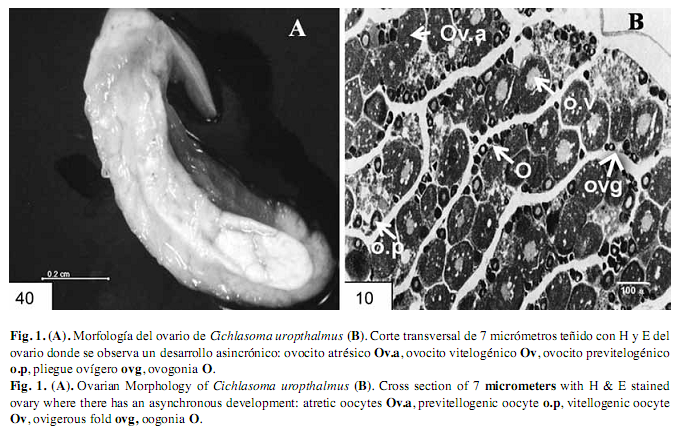
<body><![CDATA[<font size="2"><span style="font-family: verdana;"><span      style="font-weight: bold;">Ovarios:</span> Los ovarios     de <span style="font-style: italic;">C.     urophthalmus </span>son pareados en forma de sacos     huecos, ubicados en la cavidad pleuroperitoneal, dorsales en     relaci&oacute;n al intestino y ventrales al ri&ntilde;&oacute;n.     Fusionados caudalmente, forman un corto oviducto que desemboca en el     poro genital (Bedia &amp; Franco 2008) (<a      href="/img/revistas/rbt/v59n2/a16i1.jpg">Fig. 1A</a>). Los ovarios de <span      style="font-style: italic;">C.     ]]></body>
<body><![CDATA[urophthalmus </span>contienen ovocitos de diferentes estados de     desarrollo que     incluyen: Estado Perinuclear, Estado Alv&eacute;olo Cortical, Estado     Previtelog&eacute;nico y Estado Vitelog&eacute;nico (West 1990). El     ovario contiene dos tipos de c&eacute;lulas, som&aacute;ticas y     germinales. Las ovogonias est&aacute;n dispuestas en forma discontinua     y pueden realizar divisiones mit&oacute;ticas o iniciar la     divisi&oacute;n mei&oacute;tica para formar varios ovocitos, por lo     tanto el desarrollo de los fol&iacute;culos ocurre en dos etapas,     previtelog&eacute;nicos y vitelog&eacute;nicos (<a     ]]></body>
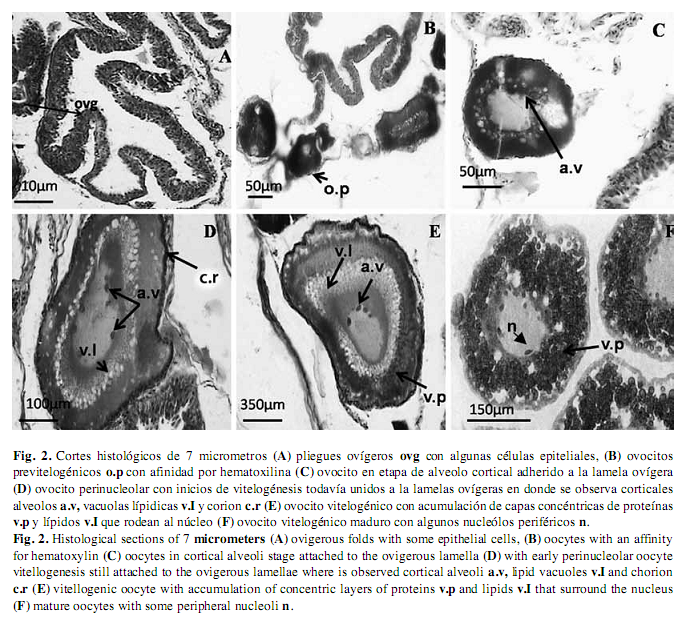
<body><![CDATA[ href="/img/revistas/rbt/v59n2/a16i1.jpg">Fig. 1B</a>). (Grier 2000).     En el ovario se extienden numerosos pliegues ov&iacute;geros revestidos     por epitelio germinal de c&eacute;lulas planas o c&uacute;bicas (<a      href="/img/revistas/rbt/v59n2/a16i2.jpg">Fig. 2     A y B</a>).</span></font><br style="font-family: verdana;">     <br style="font-family: verdana;">     <font size="2"><span style="font-family: verdana;"><span      style="font-weight: bold;">Ovogonias:</span> Son     c&eacute;lulas     ovoides que miden aproximadamente de 8 a     ]]></body>
<body><![CDATA[10<span style="font-style: italic;">&micro;</span>m, presentan un     n&uacute;cleo prominente de 5 a 6<span style="font-style: italic;">&micro;</span>m     de     di&aacute;metro y su posici&oacute;n es central, con 1 a 4     nucl&eacute;olos en su interior, escaso citoplasma, te&ntilde;ido     d&eacute;bilmente. Las ovogonias se observan rodeadas de&nbsp; epitelio     germinativo ov&aacute;rico.</span></font><br      style="font-family: verdana;">     <br style="font-family: verdana;">     <font size="2"><span style="font-family: verdana;"><span     ]]></body>
<body><![CDATA[ style="font-weight: bold;">Ovocitos     perinucleolares:</span> Miden     aproximadamente 40 a 80<span style="font-style: italic;">&micro;</span>m,     presentan un citoplasma fuertemente bas&oacute;filo, al final de este     estadio se pierde gradualmente su naturaleza bas&oacute;fila, son     m&aacute;s redondos y los nucl&eacute;olos empiezan a migrar hacia la     periferia (<a href="/img/revistas/rbt/v59n2/a16i2.jpg">Fig. 2 C</a>).</span></font><br      style="font-family: verdana;">     <br style="font-family: verdana;">     <font size="2"><span style="font-family: verdana;"><span     ]]></body>
<body><![CDATA[ style="font-weight: bold;">Ovocitos     alve&oacute;lo-corticales:</span>     Estos ovocitos miden     aproximadamente 100<span style="font-style: italic;">&micro;</span>m al     comienzo de esta etapa, se observa una     capa simple de c&eacute;lulas aplanadas que envuelve al ovocito,     durante el desarrollo se transforman a c&uacute;bicas y se inicia la     formaci&oacute;n de la zona pel&uacute;cida, entre el ovocito y las     c&eacute;lulas foliculares. En esta etapa, los alv&eacute;olos     corticales inicialmente son pocos y tienen distribuci&oacute;n     ]]></body>
<body><![CDATA[homog&eacute;nea en el citoplasma. Posteriormente, incrementan su     n&uacute;mero y se ubican alrededor del n&uacute;cleo (perinucleares),     y se empiezan a formar los gr&aacute;nulos de vitelo (<a      href="/img/revistas/rbt/v59n2/a16i2.jpg">Fig. 2 D</a>). </span></font><br      style="font-family: verdana;">     <font size="2"><span style="font-family: verdana;"><span      style="font-weight: bold;">    <br>     Ovocitos     previtelog&eacute;nicos:</span>     ]]></body>
<body><![CDATA[Durante esta etapa se observaron     ovocitos previtelog&eacute;nicos de tama&ntilde;o peque&ntilde;o de 110     a 180<span style="font-style: italic;">&micro;</span>m, asociados a los     pliegues ov&iacute;geros, que presentan     un n&uacute;cleo grande en relaci&oacute;n al volumen     citopl&aacute;smico, muestran una fuerte afinidad por la hematoxilina,     debido a la presencia de un aumento de organelos celulares como     ret&iacute;culo endopl&aacute;smico, ribosomas y mitocondrias, que le     dan la caracter&iacute;stica al ovoplasma de ser bas&oacute;filo     (Uribe <span style="font-style: italic;">et al.</span> 2006) (<a     ]]></body>
<body><![CDATA[ href="/img/revistas/rbt/v59n2/a16i2.jpg">Fig. 2     F</a>). Durante el desarrollo de los     ovocitos se observ&oacute; un aumento en su tama&ntilde;o, debido a la     acumulaci&oacute;n de grasas y prote&iacute;nas, por lo que se presenta     un cierto grado de zonaci&oacute;n con respecto a la disposici&oacute;n     del vitelo, y tambi&eacute;n se pudo observar la aparici&oacute;n de     nucl&eacute;olos en la periferia de n&uacute;cleo y con ello un     incremento en la cantidad de ribosomas en el ooplasma; en esta etapa no     se distingui&oacute; la zona radiada.</span></font><br      style="font-family: verdana;">     ]]></body>
<body><![CDATA[<br style="font-family: verdana;">     <font size="2"><span style="font-family: verdana;"><span      style="font-weight: bold;">Ovocitos     vitelog&eacute;nicos:</span>     Durante la vitelog&eacute;nesis el     ovocito de<span style="font-style: italic;"> C. urophthalmus </span>tiene     un tama&ntilde;o de 350-600<span style="font-style: italic;">&micro;</span>m,     y     en esta etapa se acumulan sustancias de reserva que constituyen al     vitelo, como es la acumulaci&oacute;n de capas de prote&iacute;nas y     ]]></body>
<body><![CDATA[l&iacute;pidos que se disponen centr&iacute;petamente al n&uacute;cleo,     d&aacute;ndole una apariencia esponjosa (<a      href="/img/revistas/rbt/v59n2/a16i2.jpg">Fig. 2 E</a>). Durante la     vitelog&eacute;nesis, las c&eacute;lulas foliculares tienen una     actividad muy importante, en la captaci&oacute;n y l selecci&oacute;n     de m&uacute;ltiples sustancias del exterior provenientes de los vasos     sangu&iacute;neos. En esta&nbsp; etapa se hace m&aacute;s evidente la     zona radiada de <span style="font-style: italic;">C. urophthalmus</span>,     la cual est&aacute; compuesta por dos     capas; la m&aacute;s delgada y densa es la que est&aacute; en contacto     ]]></body>
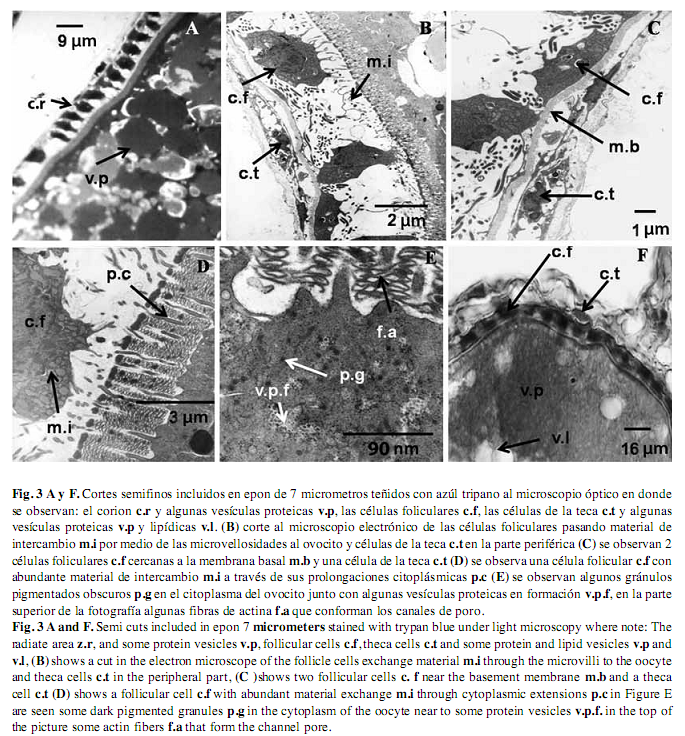
<body><![CDATA[con las c&eacute;lulas foliculares (<a      href="/img/revistas/rbt/v59n2/a16i3.jpg">Fig. 3 A y F</a>), y la otra     capa, que     est&aacute; en contacto con la membrana plasm&aacute;tica, es     m&aacute;s gruesa y con estriaciones m&aacute;s visibles, por lo que     corresponde a una estructura bipartita. </span></font><br      style="font-family: verdana;">     <br style="font-family: verdana;">     <font size="2"><span style="font-family: verdana;"><span      style="font-weight: bold;">Ovocitos     ]]></body>
<body><![CDATA[atr&eacute;sicos:</span> Los     ovocitos de este estadio disminuyen de     tama&ntilde;o significativamente y muestran una forma irregular. La     zona pel&uacute;cida present&oacute; un mayor grado de     fragmentaci&oacute;n y disoluci&oacute;n. La teca vascularizada se     observ&oacute; subyacente entre plegamientos de las&nbsp;     c&eacute;lulas foliculares (<a href="/img/revistas/rbt/v59n2/a16i1.jpg">Fig.     1 A</a>).</span></font><br style="font-family: verdana;">     <br style="font-family: verdana;">     <font size="2"><span style="font-family: verdana;"><span     ]]></body>
<body><![CDATA[ style="font-weight: bold;">Cubiertas     ovocitarias: </span>Las     c&eacute;lulas de la teca se ubican por     fuera del epitelio folicular y rodean completamente al ovocito. Estas     c&eacute;lulas est&aacute;n rodeadas por tejido conectivo, fibroblastos     y vasos sangu&iacute;neos, y en este estadio, las c&eacute;lulas     tecales presentan mitocondrias pleom&oacute;rficas (Nichols &amp;     Mapple 1972, Gresik <span style="font-style: italic;">et al.</span>     1973) (<a href="/img/revistas/rbt/v59n2/a16i3.jpg">Fig. 3 B y C</a>).     Est&aacute;n dispuestas     ]]></body>
<body><![CDATA[como una monocapa que se encuentra en contacto directo con las     c&eacute;lulas foliculares, las cuales se interdigitan con el ovocito     para incrementar el &aacute;rea superficial de absorci&oacute;n y     as&iacute; favorecer el intercambio de metabolitos por pinocitosis.     Tambi&eacute;n se observan algunas proyecciones dirigidas hacia la zona     del corion, y algunas fibras de actina, que conforman los canales de     poro, lugar por donde gran cantidad de material org&aacute;nico es     transferido al ovocito (<a href="/img/revistas/rbt/v59n2/a16i3.jpg">Fig.     3 D y E</a>). Algunos materiales de     intercambio en el citoplasma del ovocito son desde muy laxos hasta     ]]></body>
<body><![CDATA[algunos de car&aacute;cter electrodenso, probablemente se trata de     glicoprote&iacute;nas y una gran cantidad de peque&ntilde;os cuerpos     pigmentados&nbsp; que presumiblemente viajan desde la zona de la teca y     la granulosa, hasta el interior del ovocito (<a      href="/img/revistas/rbt/v59n2/a16i3.jpg">Fig. 3 E</a>).</span></font><br      style="font-family: verdana;">     <br style="font-family: verdana;">     <font style="font-weight: bold;" size="3"><span      style="font-family: verdana;">Discusi&oacute;n</span></font><br      style="font-family: verdana;">     ]]></body>
<body><![CDATA[<br style="font-family: verdana;">     <font size="2"><span style="font-family: verdana;">El desarrollo     folicular del ovario     es el resultado de procesos     complejos de desarrollo y diferenciaci&oacute;n controlados por     hormonas, los cuales involucran cambios celulares del ovocito (Guraya     1986). En este trabajo el crecimiento inicial de los ovocitos se     caracteriza por la presencia de un n&uacute;cleo que sufre constantes     transformaciones como el incremento del n&uacute;mero de     nucl&eacute;olos que tienen como funci&oacute;n la bios&iacute;ntesis     ]]></body>
<body><![CDATA[de ribosomas y con ello&nbsp; la formaci&oacute;n&nbsp; de ARN     ribosomal (Goetz &amp; Garcynski 1997), los cu&aacute;les son     necesarios para la&nbsp; bios&iacute;ntesis de prote&iacute;nas     celulares en los ovocitos. La presencia de los gr&aacute;nulos de     vitelo y material electrodenso se debe a la abundante cantidad de     prote&iacute;nas y s&iacute;ntesis de ARN (Wallace &amp; Selman 1990,     Mu&ntilde;oz<span style="font-style: italic;"> et al.</span> 2002). La     acumulaci&oacute;n de las gotas de     l&iacute;pidos es un indicador del inicio de la segunda fase de     crecimiento del ovocito. En este trabajo se pudo determinar los     ]]></body>
<body><![CDATA[componentes estructurales, durante estas fases de desarrollo, los     ovocitos se desprenden de los pliegues ov&iacute;geros a&uacute;n en     distintos grados de maduraci&oacute;n. Los ovocitos en estado     previtelog&eacute;nico con nucl&eacute;olos perif&eacute;ricos muestran     a&nbsp; diferencia de otras especies (Neidig <span      style="font-style: italic;">et al. </span>2000) las gotas     lip&iacute;dicas, que inicialmente se colocan en la zona cercana al     n&uacute;cleo&nbsp; mientras que las ves&iacute;culas proteicas     aparecen poco despu&eacute;s en la capa conc&eacute;ntrica superior y     migran hacia la periferia de la c&eacute;lula, en este estado no se     ]]></body>
<body><![CDATA[encontraron gotas de grasa fusionadas en la zona cercana al     n&uacute;cleo como en el caso de <span style="font-style: italic;">Centropomus     undecimalis</span> (Grier 2000).     En el estado vitelog&eacute;nico se observ&oacute; una     interacci&oacute;n e intercambio de materiales org&aacute;nicos entre     las c&eacute;lulas de la teca y de la granulosa con el ovocito, debido     a la presencia de numerosas microvellosidades, que comunican a las     c&eacute;lulas foliculares con la membrana plasm&aacute;tica del     ovocito, tambi&eacute;n se hizo evidente. Los ovarios de <span      style="font-style: italic;">C.     ]]></body>
<body><![CDATA[urophthalmus</span> corresponden al tipo cistov&aacute;rico y en su     interior se distribuyen las l&aacute;minas&nbsp; ov&aacute;ricas que     contienen los fol&iacute;culos ov&aacute;ricos en distintos estadios de     maduraci&oacute;n. El proceso de crecimiento y maduraci&oacute;n de los     fol&iacute;culos ov&aacute;ricos de esta especie comprende tres     procesos generales: (1) cambios nucleares con formaci&oacute;n&nbsp; de     numerosos nucleolos, (2) cambios citoplasm&aacute;ticos con     acumulaci&oacute;n de ves&iacute;culas vitelinas, gr&aacute;nulos     vitelinos y ves&iacute;culas lip&iacute;dicas, y (3) desarrollo de la     pared folicular (Selman &amp; Wallace 1983). Las c&eacute;lulas de la     ]]></body>
<body><![CDATA[teca est&aacute;n compuestas de Tejido Conectivo y vasos     sangu&iacute;neos con algunos desmosomas que interconectan las     c&eacute;lulas. Trabajos previos proponen que&nbsp; estas     c&eacute;lulas podr&iacute;an producir precursores de esteroides     (andr&oacute;genos) y las c&eacute;lulas granulosas podr&iacute;an     convertir andr&oacute;genos a 17 &#946; estradiol u otros mediadores     esteroideos (Nakamura &amp; Nagahama 1993, Nagahama 1997, Devlin &amp;     Nagahama 2002, C&aacute;rdenas <span style="font-style: italic;">et al.</span>     2008). Las c&eacute;lulas     granulosas poseen organelos t&iacute;picos de c&eacute;lulas secretoras     ]]></body>
<body><![CDATA[de prote&iacute;nas lo cual sugiere funciones adicionales en la     s&iacute;ntesis de la cubierta y la producci&oacute;n de enzimas     involucradas en la conversi&oacute;n de precursores de esteroides. En     este trabajo se encontraron numerosas c&eacute;lulas tecales, lo cual     puede indicar que esta especie presenta una gran capacidad de     producci&oacute;n de esteroides. La mayor&iacute;a de los     C&iacute;clidos durante su desarrollo gonadal, una maduraci&oacute;n     asincr&oacute;nica, a diferencia de <span style="font-style: italic;">Nematogenys     inermis</span> que pertenece a     la categor&iacute;a de sincronismo parcial que tiene otras estrategias     ]]></body>
<body><![CDATA[de desove (Huaquin et al. 2002). Es necesario seguir el proceso     reproductivo de <span style="font-style: italic;">C. uruphthalmus</span>     para determinar     adem&aacute;s las etapas de desarrollo de la ovog&eacute;nesis en las     temporadas de desove (Prisco <span style="font-style: italic;">et al.</span>     2002, Prisco <span style="font-style: italic;">et al.</span>     2004).</span></font><br style="font-family: verdana;">     <br style="font-family: verdana; font-weight: bold;">     <font style="font-weight: bold;" size="3"><span      style="font-family: verdana;">Agradecimientos</span></font><br     ]]></body>
<body><![CDATA[ style="font-family: verdana; font-weight: bold;">     <br style="font-family: verdana;">     <font size="2"><span style="font-family: verdana;">Para Adolfo     Garc&iacute;a     S&aacute;enz del Instituto de     Fisiolog&iacute;a Celular por el uso del microscopio electr&oacute;nico     de transmisi&oacute;n. Al programa PAPCA-2007-2008 de la FES-I, por     apoyar el proyecto &#8220;La Laguna de Alvarado; Biodiversidad y     din&aacute;mica tr&oacute;fica en dos h&aacute;bitats cr&iacute;ticos&#8221;.</span></font><br      style="font-family: verdana;">     ]]></body>
<body><![CDATA[<br style="font-family: verdana;">     <font style="font-weight: bold;" size="3"><span      style="font-family: verdana;"></span></font>     <hr style="width: 100%; height: 2px;">    <!-- ref --><br> <font style="font-weight: bold;" size="3"><span  style="font-family: verdana;">Referencias</span></font><br  style="font-family: verdana;"> <br style="font-family: verdana;"> <font size="2"><span style="font-family: verdana;">Arceo, D.J., J. Franco, G.L. Waggy &amp; R. Ch&aacute;vez. 2004. Trophic comparison of two species of needlefish (Belonidae) in the Alvarado Lagoonal System, Veracruz, Mexico. Gulf. Caribb. Res. 16: 81-88.    &nbsp;&nbsp;&nbsp;&nbsp;&nbsp;&nbsp;&nbsp;&nbsp;[&#160;<a href="javascript:void(0);" onclick="javascript: window.open('/scielo.php?script=sci_nlinks&ref=1765826&pid=S0034-7744201100020001600001&lng=','','width=640,height=500,resizable=yes,scrollbars=1,menubar=yes,');">Links</a>&#160;]<!-- end-ref --><!-- ref --> </span></font><br style="font-family: verdana;"> <br style="font-family: verdana;"> <font size="2"><span style="font-family: verdana;">Bedia, C. &amp; J. Franco. 2008. Peces de los sistemas costeros del Estado de Veracruz. FES-Iztacala U.N.A.M. M&eacute;xico, D.F.    &nbsp;&nbsp;&nbsp;&nbsp;&nbsp;&nbsp;&nbsp;&nbsp;[&#160;<a href="javascript:void(0);" onclick="javascript: window.open('/scielo.php?script=sci_nlinks&ref=1765827&pid=S0034-7744201100020001600002&lng=','','width=640,height=500,resizable=yes,scrollbars=1,menubar=yes,');">Links</a>&#160;]<!-- end-ref --><!-- ref --></span></font><br  style="font-family: verdana;"> <br style="font-family: verdana;"> <font size="2"><span style="font-family: verdana;">C&aacute;rdenas, R. &amp; H. Barrera. 1998. Histolog&iacute;a y ultraestructura del test&iacute;culo del charal <span  style="font-style: italic;">Chirostoma jordani</span> (Osteichtyes: Ahterinidae). Rev. Biol. Trop. 46: 943-949.    &nbsp;&nbsp;&nbsp;&nbsp;&nbsp;&nbsp;&nbsp;&nbsp;[&#160;<a href="javascript:void(0);" onclick="javascript: window.open('/scielo.php?script=sci_nlinks&ref=1765828&pid=S0034-7744201100020001600003&lng=','','width=640,height=500,resizable=yes,scrollbars=1,menubar=yes,');">Links</a>&#160;]<!-- end-ref --><!-- ref --></span></font><br  style="font-family: verdana;"> <br style="font-family: verdana;"> <font size="2"><span style="font-family: verdana;">C&aacute;rdenas, R., M. Ch&aacute;vez, J.L. Gonz&aacute;lez, P. Aley, J. Espinoza &amp; L.F. Jim&eacute;nez. 2008. Oocyte structure and ultrastructure in the Mexican silverside fish&nbsp; <span  style="font-style: italic;">Chirostoma humboldtianum</span> (Atheriniformes: Atherinopsidae). Rev. Biol. Trop. 56: 1371-1380.    &nbsp;&nbsp;&nbsp;&nbsp;&nbsp;&nbsp;&nbsp;&nbsp;[&#160;<a href="javascript:void(0);" onclick="javascript: window.open('/scielo.php?script=sci_nlinks&ref=1765829&pid=S0034-7744201100020001600004&lng=','','width=640,height=500,resizable=yes,scrollbars=1,menubar=yes,');">Links</a>&#160;]<!-- end-ref --><!-- ref --></span></font><br style="font-family: verdana;"> <br style="font-family: verdana;"> <font size="2"><span style="font-family: verdana;">Cruz-Landim, C. &amp; M.A. Cruz-H&ouml;fling. 2001. Ultrastructure of ovarian follicular epithelium of the Amazonian fish <span  style="font-style: italic;">Pseudotylosurus microps</span> (Teleostei: Belonidae): morphological and histochemical characterization of intercellular deposits. Rev. Bras. Biol. 61: 133-140.    &nbsp;&nbsp;&nbsp;&nbsp;&nbsp;&nbsp;&nbsp;&nbsp;[&#160;<a href="javascript:void(0);" onclick="javascript: window.open('/scielo.php?script=sci_nlinks&ref=1765830&pid=S0034-7744201100020001600005&lng=','','width=640,height=500,resizable=yes,scrollbars=1,menubar=yes,');">Links</a>&#160;]<!-- end-ref --><!-- ref --> </span></font><br style="font-family: verdana;"> <br style="font-family: verdana;"> <font size="2"><span style="font-family: verdana;">Devlin, R.H. &amp; Y. Nagahama.2002. Sex determination and sex differentiation in Fish: an overview of genetic, physiological, and environmental influences. Aquaculture 208: 191-364.    &nbsp;&nbsp;&nbsp;&nbsp;&nbsp;&nbsp;&nbsp;&nbsp;[&#160;<a href="javascript:void(0);" onclick="javascript: window.open('/scielo.php?script=sci_nlinks&ref=1765831&pid=S0034-7744201100020001600006&lng=','','width=640,height=500,resizable=yes,scrollbars=1,menubar=yes,');">Links</a>&#160;]<!-- end-ref --><!-- ref --></span></font><br  style="font-family: verdana;"> <br style="font-family: verdana;"> <font size="2"><span style="font-family: verdana;">Goetz, F.W. &amp; M. Garcynski. 1997. The ovarian regulation of ovulation in teleost. Fish. Physiol. Biochem. 17: 33-38.    &nbsp;&nbsp;&nbsp;&nbsp;&nbsp;&nbsp;&nbsp;&nbsp;[&#160;<a href="javascript:void(0);" onclick="javascript: window.open('/scielo.php?script=sci_nlinks&ref=1765832&pid=S0034-7744201100020001600007&lng=','','width=640,height=500,resizable=yes,scrollbars=1,menubar=yes,');">Links</a>&#160;]<!-- end-ref --><!-- ref --></span></font><br  style="font-family: verdana;"> <br style="font-family: verdana;"> <font size="2"><span style="font-family: verdana;">Gresik, E.W., G. Quirk &amp; J.B. Hamilton. 1973. Fine structure of the Sertoli cell of the testis of the teleost Oryzias latipes. Gen. Comp. Endocrinol. 21: 341-352.    &nbsp;&nbsp;&nbsp;&nbsp;&nbsp;&nbsp;&nbsp;&nbsp;[&#160;<a href="javascript:void(0);" onclick="javascript: window.open('/scielo.php?script=sci_nlinks&ref=1765833&pid=S0034-7744201100020001600008&lng=','','width=640,height=500,resizable=yes,scrollbars=1,menubar=yes,');">Links</a>&#160;]<!-- end-ref --><!-- ref --></span></font><br style="font-family: verdana;"> <br style="font-family: verdana;"> <font size="2"><span style="font-family: verdana;">Grier, H. 2000. Ovarian germinal epithelium and folliculogenesis in the common snook, <span style="font-style: italic;">Centropomus undecimalis </span>(Teleostei: Centropomidae). J. Morphol. 243: 265-281.    &nbsp;&nbsp;&nbsp;&nbsp;&nbsp;&nbsp;&nbsp;&nbsp;[&#160;<a href="javascript:void(0);" onclick="javascript: window.open('/scielo.php?script=sci_nlinks&ref=1765834&pid=S0034-7744201100020001600009&lng=','','width=640,height=500,resizable=yes,scrollbars=1,menubar=yes,');">Links</a>&#160;]<!-- end-ref --><!-- ref --></span></font><br style="font-family: verdana;"> <br style="font-family: verdana;"> <font size="2"><span style="font-family: verdana;">Guraya, S.S. 1986. The cell and molecular biology of fish oog&eacute;nesis. Monogr. Dev. Biol. 18: 117-125.    &nbsp;&nbsp;&nbsp;&nbsp;&nbsp;&nbsp;&nbsp;&nbsp;[&#160;<a href="javascript:void(0);" onclick="javascript: window.open('/scielo.php?script=sci_nlinks&ref=1765835&pid=S0034-7744201100020001600010&lng=','','width=640,height=500,resizable=yes,scrollbars=1,menubar=yes,');">Links</a>&#160;]<!-- end-ref --><!-- ref --></span></font><br  style="font-family: verdana;"> <br style="font-family: verdana;"> <font size="2"><span style="font-family: verdana;">G&uuml;nter, A.A. 1862. Catalogue of fishes in the British Museum. Catalogue of the Acanthopterygii, Paryngognathi and Anacanthini in the collection of the British Museum. American Museum of Natural History Library, Londres, Inglaterra.    &nbsp;&nbsp;&nbsp;&nbsp;&nbsp;&nbsp;&nbsp;&nbsp;[&#160;<a href="javascript:void(0);" onclick="javascript: window.open('/scielo.php?script=sci_nlinks&ref=1765836&pid=S0034-7744201100020001600011&lng=','','width=640,height=500,resizable=yes,scrollbars=1,menubar=yes,');">Links</a>&#160;]<!-- end-ref --><!-- ref --></span></font><br  style="font-family: verdana;"> <br style="font-family: verdana;"> <font size="2"><span style="font-family: verdana;">Huaqu&iacute;n, L.G., D. Veliz &amp; G. Arratia. 2002. Estudio comparativo de ovarios y cubiertas ovocitarias en peces siluriformes de aguas continentales de Chile. Gayana Zool. 66: 269-274.    &nbsp;&nbsp;&nbsp;&nbsp;&nbsp;&nbsp;&nbsp;&nbsp;[&#160;<a href="javascript:void(0);" onclick="javascript: window.open('/scielo.php?script=sci_nlinks&ref=1765837&pid=S0034-7744201100020001600012&lng=','','width=640,height=500,resizable=yes,scrollbars=1,menubar=yes,');">Links</a>&#160;]<!-- end-ref --><!-- ref --></span></font><br  style="font-family: verdana;"> <br style="font-family: verdana;"> <font size="2"><span style="font-family: verdana;">Luna, L.G. 1958. Manual of the Armed Forces institute of pathology. McGraw-Hill, Nueva York, EEUU.    &nbsp;&nbsp;&nbsp;&nbsp;&nbsp;&nbsp;&nbsp;&nbsp;[&#160;<a href="javascript:void(0);" onclick="javascript: window.open('/scielo.php?script=sci_nlinks&ref=1765838&pid=S0034-7744201100020001600013&lng=','','width=640,height=500,resizable=yes,scrollbars=1,menubar=yes,');">Links</a>&#160;]<!-- end-ref --><!-- ref --></span></font><br  style="font-family: verdana;"> <br style="font-family: verdana;"> <font size="2"><span style="font-family: verdana;">Mu&ntilde;oz, M., M. Sabat, S. Mallol &amp; M. Casadevall. 2002. Gonadal structure and gametogenesis of <span  style="font-style: italic;">Trigla lyra </span>(Pisces:<span  style="font-style: italic;">Triglidae</span>). Zool. Stud. 41: 412-420.    &nbsp;&nbsp;&nbsp;&nbsp;&nbsp;&nbsp;&nbsp;&nbsp;[&#160;<a href="javascript:void(0);" onclick="javascript: window.open('/scielo.php?script=sci_nlinks&ref=1765839&pid=S0034-7744201100020001600014&lng=','','width=640,height=500,resizable=yes,scrollbars=1,menubar=yes,');">Links</a>&#160;]<!-- end-ref --><!-- ref --></span></font><br style="font-family: verdana;"> <br style="font-family: verdana;"> <font size="2"><span style="font-family: verdana;">Nagahama, Y. 1997. 17&#945;, 20&#946;-dihydroxy-4-pregnen-3-one, a maturation-inducing hormone in fish oocytes: Mechanism of synthesis and action. Steroid. 62: 190-196.    &nbsp;&nbsp;&nbsp;&nbsp;&nbsp;&nbsp;&nbsp;&nbsp;[&#160;<a href="javascript:void(0);" onclick="javascript: window.open('/scielo.php?script=sci_nlinks&ref=1765840&pid=S0034-7744201100020001600015&lng=','','width=640,height=500,resizable=yes,scrollbars=1,menubar=yes,');">Links</a>&#160;]<!-- end-ref --><!-- ref --></span></font><br  style="font-family: verdana;"> <br style="font-family: verdana;"> <font size="2"><span style="font-family: verdana;">Nakamura, M. &amp; Y. Nagahama. 1993. Ultrastructural study on the differentiation and development of steroid producing cells during ovarian differentiation in amago salmon, <span  style="font-style: italic;">Oncorhynchus rhodurus</span>. Rev. Aquaculture 112: 237-251.    &nbsp;&nbsp;&nbsp;&nbsp;&nbsp;&nbsp;&nbsp;&nbsp;[&#160;<a href="javascript:void(0);" onclick="javascript: window.open('/scielo.php?script=sci_nlinks&ref=1765841&pid=S0034-7744201100020001600016&lng=','','width=640,height=500,resizable=yes,scrollbars=1,menubar=yes,');">Links</a>&#160;]<!-- end-ref --><!-- ref --></span></font><br  style="font-family: verdana;"> <br style="font-family: verdana;"> <font size="2"><span style="font-family: verdana;">Neidig, L.C., D.P. Skapura, H.J. Grier &amp; C.W. Dennis. 2000. Techniques for spawning common snook: broodstock. handling, oocyte stating and egg quality. N. Am. J. Aquacult. 62: 103-113.    &nbsp;&nbsp;&nbsp;&nbsp;&nbsp;&nbsp;&nbsp;&nbsp;[&#160;<a href="javascript:void(0);" onclick="javascript: window.open('/scielo.php?script=sci_nlinks&ref=1765842&pid=S0034-7744201100020001600017&lng=','','width=640,height=500,resizable=yes,scrollbars=1,menubar=yes,');">Links</a>&#160;]<!-- end-ref --><!-- ref --> </span></font><br  style="font-family: verdana;"> <br style="font-family: verdana;"> <font size="2"><span style="font-family: verdana;">Nichols, T.J &amp; G. Mapple. 1972. Ultrastructure observations on possible sites of steroids biosynthesis on the ovarian follicular epithelium of two species of cichlid fish, <span  style="font-style: italic;">Cichlasoma nigrofasciatum</span> and <span style="font-style: italic;">Haplochromis multicolor</span>. Zellforch Mikrosk. Anat. 128: 317-335.    &nbsp;&nbsp;&nbsp;&nbsp;&nbsp;&nbsp;&nbsp;&nbsp;[&#160;<a href="javascript:void(0);" onclick="javascript: window.open('/scielo.php?script=sci_nlinks&ref=1765843&pid=S0034-7744201100020001600018&lng=','','width=640,height=500,resizable=yes,scrollbars=1,menubar=yes,');">Links</a>&#160;]<!-- end-ref --><!-- ref --></span></font><br  style="font-family: verdana;"> <br style="font-family: verdana;"> <font size="2"><span style="font-family: verdana;">Prisco, M., L. Ricchiari &amp; P. Andreuccetti. 2002. Ultrastructural studies on developing follicles spotted ray <span  style="font-style: italic;">Torpedo marmorata</span>. Mol. Reprod. Dev. 61: 78-86.    &nbsp;&nbsp;&nbsp;&nbsp;&nbsp;&nbsp;&nbsp;&nbsp;[&#160;<a href="javascript:void(0);" onclick="javascript: window.open('/scielo.php?script=sci_nlinks&ref=1765844&pid=S0034-7744201100020001600019&lng=','','width=640,height=500,resizable=yes,scrollbars=1,menubar=yes,');">Links</a>&#160;]<!-- end-ref --><!-- ref --></span></font><br style="font-family: verdana;"> <br style="font-family: verdana;"> <font size="2"><span style="font-family: verdana;">Prisco, M., S. Valiant, M. Romano, L. Ricchiari, A. Liguoro, V. Laforgia, E. Limatola &amp; P. Andreucchetti. 2004. Ovarian follicle cells in <span style="font-style: italic;">Torpedo marmorata</span> synthesis vitellogenin. Mol. Reprod. Dev. 67: 424-429.    &nbsp;&nbsp;&nbsp;&nbsp;&nbsp;&nbsp;&nbsp;&nbsp;[&#160;<a href="javascript:void(0);" onclick="javascript: window.open('/scielo.php?script=sci_nlinks&ref=1765845&pid=S0034-7744201100020001600020&lng=','','width=640,height=500,resizable=yes,scrollbars=1,menubar=yes,');">Links</a>&#160;]<!-- end-ref --><!-- ref --></span></font><br style="font-family: verdana;"> <br style="font-family: verdana;"> <font size="2"><span style="font-family: verdana;">Selman, K. &amp; R.A. Wallace. 1983. Oogenesis in <span style="font-style: italic;">Fundulus heteroclitus</span>. III. Vitellogenesis. J. Exp. Zool. 226: 441-457.    &nbsp;&nbsp;&nbsp;&nbsp;&nbsp;&nbsp;&nbsp;&nbsp;[&#160;<a href="javascript:void(0);" onclick="javascript: window.open('/scielo.php?script=sci_nlinks&ref=1765846&pid=S0034-7744201100020001600021&lng=','','width=640,height=500,resizable=yes,scrollbars=1,menubar=yes,');">Links</a>&#160;]<!-- end-ref --><!-- ref --></span></font><br  style="font-family: verdana;"> <br style="font-family: verdana;"> <font size="2"><span style="font-family: verdana;">Sj&ouml;strand, F.S. 1971. Electron microscopy of cells and tissues. Academic, Nueva York, EEUU.    &nbsp;&nbsp;&nbsp;&nbsp;&nbsp;&nbsp;&nbsp;&nbsp;[&#160;<a href="javascript:void(0);" onclick="javascript: window.open('/scielo.php?script=sci_nlinks&ref=1765847&pid=S0034-7744201100020001600022&lng=','','width=640,height=500,resizable=yes,scrollbars=1,menubar=yes,');">Links</a>&#160;]<!-- end-ref --><!-- ref --></span></font><br  style="font-family: verdana;"> <br style="font-family: verdana;"> <font size="2"><span style="font-family: verdana;">Uribe, A.C., A. Garc&iacute;a, S. Milena &amp; M. Aguilar. 2006. Caracter&iacute;sticas histol&oacute;gicas de los estudios de atresia de fol&iacute;culos ovaricos en dos especies de Tele&oacute;steos Viv&iacute;paros: <span style="font-style: italic;">Llyodon Whitei </span>(Meek, 2002) y <span style="font-style: italic;">Godea atripinnis</span> (Jordan 1998) (Goodeidae). Rev. Hydrobiol. Trop. 16: 67-73.    &nbsp;&nbsp;&nbsp;&nbsp;&nbsp;&nbsp;&nbsp;&nbsp;[&#160;<a href="javascript:void(0);" onclick="javascript: window.open('/scielo.php?script=sci_nlinks&ref=1765848&pid=S0034-7744201100020001600023&lng=','','width=640,height=500,resizable=yes,scrollbars=1,menubar=yes,');">Links</a>&#160;]<!-- end-ref --><!-- ref --></span></font><br style="font-family: verdana;"> <br style="font-family: verdana;"> <font size="2"><span style="font-family: verdana;">Vitale, F., M. Cardinale &amp; H. Svedeng. 2005. Evaluation of the temporal development of the ovaries in cod (<span  style="font-style: italic;">Gadus morhua</span>) from the Sound and Kattegat. J. Fish Biol. 67: 669-683.    &nbsp;&nbsp;&nbsp;&nbsp;&nbsp;&nbsp;&nbsp;&nbsp;[&#160;<a href="javascript:void(0);" onclick="javascript: window.open('/scielo.php?script=sci_nlinks&ref=1765849&pid=S0034-7744201100020001600024&lng=','','width=640,height=500,resizable=yes,scrollbars=1,menubar=yes,');">Links</a>&#160;]<!-- end-ref --><!-- ref --> </span></font><br  style="font-family: verdana;"> <br style="font-family: verdana;"> <font size="2"><span style="font-family: verdana;">Wallace, R.A. &amp; K. Selman. 1990. Ultrastructural aspects of oogenesis and oocyte growth in fish and amphibians. J. Electron. Microsc. Tech. 16: 175-201.    &nbsp;&nbsp;&nbsp;&nbsp;&nbsp;&nbsp;&nbsp;&nbsp;[&#160;<a href="javascript:void(0);" onclick="javascript: window.open('/scielo.php?script=sci_nlinks&ref=1765850&pid=S0034-7744201100020001600025&lng=','','width=640,height=500,resizable=yes,scrollbars=1,menubar=yes,');">Links</a>&#160;]<!-- end-ref --><!-- ref --></span></font><br  style="font-family: verdana;"> <br style="font-family: verdana;"> <font size="2"><span style="font-family: verdana;">West, G. 1990. Methods of assessing ovarian development in Fishes: a review. Aust. J. Mar. Freshwat. Res. 41: 199-222.    &nbsp;&nbsp;&nbsp;&nbsp;&nbsp;&nbsp;&nbsp;&nbsp;[&#160;<a href="javascript:void(0);" onclick="javascript: window.open('/scielo.php?script=sci_nlinks&ref=1765851&pid=S0034-7744201100020001600026&lng=','','width=640,height=500,resizable=yes,scrollbars=1,menubar=yes,');">Links</a>&#160;]<!-- end-ref --><br>     <br>     <br> </span></font><font size="2"><span style="font-family: verdana;"><a  name="Correspondencia"></a>Correspondencia a: Rub&iacute; Viedma, Carlos Bedia, Guadalupe Guedea Fern&aacute;ndez &amp; H&eacute;ctor Barrera Escorcia: </span></font><font size="2"><span  style="font-family: verdana;">Laboratorio de Microscopia, Facultad de Estudios Superiores Iztacala, U.N.A.M. C.P. 54090, Estado de M&eacute;xico; <a href="mailto:araceliviedma@hotmail.com">araceliviedma@hotmail.com</a>, <a href="mailto:bediacharly@yahoo.com.mx">bediacharly@yahoo.com.mx</a>, <a href="mailto:dalethguedea@hotmail.com">dalethguedea@hotmail.com</a>, <a href="mailto:hectorbarrerae@hotmail.com">hectorbarrerae@hotmail.com</a>    <br> </span></font><font size="2"><span style="font-family: verdana;">Jonathan Franco: </span></font><font size="2"><span  style="font-family: verdana;">Laboratorio de Ecologia, Facultad de Estudios Superiores Iztacala, U.N.A.M. C.P. 54090, Estado de M&eacute;xico;&nbsp;&nbsp; <a href="mailto:jonfrancol@yahoo.com">jonfrancol@yahoo.com</a>    <br> </span></font><font size="2"><span style="font-family: verdana;">H&eacute;ctor Barrera Villa Zevallos: </span></font><font size="2"><span  style="font-family: verdana;">Consejo Nacional de Ciencia y Tecnolog&iacute;a, Av. Insurgentes Sur 1582, Col. Cr&eacute;dito Constructor Del. Benito Ju&aacute;rez C.P. 03940, M&eacute;xico, D.F.; <a  href="mailto:hectorbarrerav@hotmail.com">hectorbarrerav</a></span></font><a  href="mailto:hectorbarrerav@hotmail.com"><font size="2"><span  style="font-family: verdana;"></span></font></a><font  style="font-family: verdana;" size="2"><a>@hotmail.com</a> </font><br style="font-family: verdana;"> <font size="2"><span style="font-family: verdana;"></span> <span style="font-family: verdana;"></span></font><br  style="font-family: verdana;">     <div style="text-align: center;"><font size="2"><span  style="font-family: verdana;"></span></font> <hr style="width: 100%; height: 2px;"><font size="2"><span  style="font-family: verdana;">Recibido 04-VI-2010.&nbsp;&nbsp;&nbsp;&nbsp;&nbsp;&nbsp; Corregido 03-X-2010.&nbsp;&nbsp;&nbsp;&nbsp;&nbsp;&nbsp; Aceptado 04-XI-2010.</span></font></div> </div>      ]]></body><back>
<ref-list>
<ref id="B1">
<nlm-citation citation-type="journal">
<person-group person-group-type="author">
<name>
<surname><![CDATA[Arceo]]></surname>
<given-names><![CDATA[D.J.]]></given-names>
</name>
<name>
<surname><![CDATA[Franco]]></surname>
<given-names><![CDATA[J.]]></given-names>
</name>
<name>
<surname><![CDATA[Waggy]]></surname>
<given-names><![CDATA[G.L.]]></given-names>
</name>
<name>
<surname><![CDATA[Chávez]]></surname>
<given-names><![CDATA[R.]]></given-names>
</name>
</person-group>
<article-title xml:lang="en"><![CDATA[Trophic comparison of two species of needlefish (Belonidae) in the Alvarado Lagoonal System, Veracruz, Mexico]]></article-title>
<source><![CDATA[Gulf. Caribb. Res.]]></source>
<year>2004</year>
<volume>16</volume>
<page-range>81-88</page-range></nlm-citation>
</ref>
<ref id="B2">
<nlm-citation citation-type="book">
<person-group person-group-type="author">
<name>
<surname><![CDATA[Bedia]]></surname>
<given-names><![CDATA[C]]></given-names>
</name>
<name>
<surname><![CDATA[Franco]]></surname>
<given-names><![CDATA[J]]></given-names>
</name>
</person-group>
<source><![CDATA[Peces de los sistemas costeros del Estado de Veracruz]]></source>
<year>2008</year>
<publisher-loc><![CDATA[^eMéxico, D.F México, D.F]]></publisher-loc>
<publisher-name><![CDATA[FES-Iztacala U.N.A.M]]></publisher-name>
</nlm-citation>
</ref>
<ref id="B3">
<nlm-citation citation-type="journal">
<person-group person-group-type="author">
<name>
<surname><![CDATA[Cárdenas]]></surname>
<given-names><![CDATA[R.]]></given-names>
</name>
<name>
<surname><![CDATA[Barrera]]></surname>
<given-names><![CDATA[H.]]></given-names>
</name>
</person-group>
<article-title xml:lang="es"><![CDATA[Histología y ultraestructura del testículo del charal Chirostoma jordani (Osteichtyes: Ahterinidae)]]></article-title>
<source><![CDATA[Rev. Biol. Trop.]]></source>
<year>1998</year>
<volume>46</volume>
<page-range>943-949</page-range></nlm-citation>
</ref>
<ref id="B4">
<nlm-citation citation-type="journal">
<person-group person-group-type="author">
<name>
<surname><![CDATA[Cárdenas]]></surname>
<given-names><![CDATA[R.]]></given-names>
</name>
<name>
<surname><![CDATA[Chávez]]></surname>
<given-names><![CDATA[M.]]></given-names>
</name>
<name>
<surname><![CDATA[González]]></surname>
<given-names><![CDATA[J.L.]]></given-names>
</name>
<name>
<surname><![CDATA[Aley]]></surname>
<given-names><![CDATA[P.]]></given-names>
</name>
<name>
<surname><![CDATA[Espinoza]]></surname>
<given-names><![CDATA[J.]]></given-names>
</name>
<name>
<surname><![CDATA[Jiménez]]></surname>
<given-names><![CDATA[L.F.]]></given-names>
</name>
</person-group>
<article-title xml:lang="en"><![CDATA[Oocyte structure and ultrastructure in the Mexican silverside fish Chirostoma humboldtianum (Atheriniformes: Atherinopsidae)]]></article-title>
<source><![CDATA[Rev. Biol. Trop.]]></source>
<year>2008</year>
<volume>56:</volume>
<page-range>1371-1380</page-range></nlm-citation>
</ref>
<ref id="B5">
<nlm-citation citation-type="journal">
<person-group person-group-type="author">
<name>
<surname><![CDATA[Cruz-Landim]]></surname>
<given-names><![CDATA[C.]]></given-names>
</name>
<name>
<surname><![CDATA[Cruz-Höfling]]></surname>
<given-names><![CDATA[M.A.]]></given-names>
</name>
</person-group>
<article-title xml:lang="en"><![CDATA[Ultrastructure of ovarian follicular epithelium of the Amazonian fish Pseudotylosurus microps (Teleostei: Belonidae):: morphological and histochemical characterization of intercellular deposits.]]></article-title>
<source><![CDATA[Rev. Bras. Biol.]]></source>
<year>2001</year>
<volume>61</volume>
<page-range>133-140</page-range></nlm-citation>
</ref>
<ref id="B6">
<nlm-citation citation-type="journal">
<person-group person-group-type="author">
<name>
<surname><![CDATA[Devlin]]></surname>
<given-names><![CDATA[R.H.]]></given-names>
</name>
<name>
<surname><![CDATA[Nagahama]]></surname>
<given-names><![CDATA[Y.]]></given-names>
</name>
</person-group>
<article-title xml:lang="en"><![CDATA[Sex determination and sex differentiation in Fish:: an overview of genetic, physiological, and environmental influences]]></article-title>
<source><![CDATA[Aquaculture]]></source>
<year>2002</year>
<volume>208</volume>
<page-range>191-364</page-range></nlm-citation>
</ref>
<ref id="B7">
<nlm-citation citation-type="journal">
<person-group person-group-type="author">
<name>
<surname><![CDATA[Goetz]]></surname>
<given-names><![CDATA[F.W.]]></given-names>
</name>
<name>
<surname><![CDATA[Garcynski]]></surname>
<given-names><![CDATA[M.]]></given-names>
</name>
</person-group>
<article-title xml:lang="en"><![CDATA[The ovarian regulation of ovulation in teleost]]></article-title>
<source><![CDATA[Fish. Physiol. Biochem.]]></source>
<year>1997</year>
<volume>17</volume>
<page-range>33-38</page-range></nlm-citation>
</ref>
<ref id="B8">
<nlm-citation citation-type="journal">
<person-group person-group-type="author">
<name>
<surname><![CDATA[Gresik]]></surname>
<given-names><![CDATA[E.W.]]></given-names>
</name>
<name>
<surname><![CDATA[Quirk]]></surname>
<given-names><![CDATA[G.]]></given-names>
</name>
<name>
<surname><![CDATA[Hamilton]]></surname>
<given-names><![CDATA[J.B.]]></given-names>
</name>
</person-group>
<article-title xml:lang="en"><![CDATA[Fine structure of the Sertoli cell of the testis of the teleost Oryzias latipes]]></article-title>
<source><![CDATA[Gen. Comp. Endocrinol.]]></source>
<year>1973</year>
<volume>21</volume>
<page-range>341-352</page-range></nlm-citation>
</ref>
<ref id="B9">
<nlm-citation citation-type="journal">
<person-group person-group-type="author">
<name>
<surname><![CDATA[Grier]]></surname>
<given-names><![CDATA[H.]]></given-names>
</name>
</person-group>
<article-title xml:lang="en"><![CDATA[Ovarian germinal epithelium and folliculogenesis in the common snook, Centropomus undecimalis (Teleostei: Centropomidae)]]></article-title>
<source><![CDATA[J. Morphol.]]></source>
<year>2000</year>
<volume>243</volume>
<page-range>265-281</page-range></nlm-citation>
</ref>
<ref id="B10">
<nlm-citation citation-type="journal">
<person-group person-group-type="author">
<name>
<surname><![CDATA[Guraya]]></surname>
<given-names><![CDATA[S.S.]]></given-names>
</name>
</person-group>
<article-title xml:lang="en"><![CDATA[The cell and molecular biology of fish oogénesis]]></article-title>
<source><![CDATA[Monogr. Dev. Biol.]]></source>
<year>1986</year>
<volume>18</volume>
<page-range>117-125</page-range></nlm-citation>
</ref>
<ref id="B11">
<nlm-citation citation-type="book">
<person-group person-group-type="author">
<name>
<surname><![CDATA[Günter]]></surname>
<given-names><![CDATA[A.A.]]></given-names>
</name>
</person-group>
<source><![CDATA[Catalogue of fishes in the British Museum. Catalogue of the Acanthopterygii, Paryngognathi and Anacanthini in the collection of the British Museum]]></source>
<year>1862</year>
<publisher-loc><![CDATA[^eLondres Londres]]></publisher-loc>
<publisher-name><![CDATA[American Museum of Natural History Library]]></publisher-name>
</nlm-citation>
</ref>
<ref id="B12">
<nlm-citation citation-type="journal">
<person-group person-group-type="author">
<name>
<surname><![CDATA[Huaquín]]></surname>
<given-names><![CDATA[L.G.]]></given-names>
</name>
<name>
<surname><![CDATA[Veliz]]></surname>
<given-names><![CDATA[D.]]></given-names>
</name>
<name>
<surname><![CDATA[Arratia]]></surname>
<given-names><![CDATA[G.]]></given-names>
</name>
</person-group>
<article-title xml:lang="es"><![CDATA[Estudio comparativo de ovarios y cubiertas ovocitarias en peces siluriformes de aguas continentales de Chile]]></article-title>
<source><![CDATA[Gayana Zool.]]></source>
<year>2002</year>
<volume>66</volume>
<page-range>269-274</page-range></nlm-citation>
</ref>
<ref id="B13">
<nlm-citation citation-type="book">
<person-group person-group-type="author">
<name>
<surname><![CDATA[Luna]]></surname>
<given-names><![CDATA[L.G.]]></given-names>
</name>
</person-group>
<source><![CDATA[Manual of the Armed Forces institute of pathology.]]></source>
<year>1958</year>
<publisher-loc><![CDATA[^eNueva York Nueva York]]></publisher-loc>
<publisher-name><![CDATA[McGraw-Hill]]></publisher-name>
</nlm-citation>
</ref>
<ref id="B14">
<nlm-citation citation-type="journal">
<person-group person-group-type="author">
<name>
<surname><![CDATA[Muñoz]]></surname>
<given-names><![CDATA[M.]]></given-names>
</name>
<name>
<surname><![CDATA[Sabat]]></surname>
<given-names><![CDATA[M.]]></given-names>
</name>
<name>
<surname><![CDATA[Mallol]]></surname>
<given-names><![CDATA[S.]]></given-names>
</name>
<name>
<surname><![CDATA[Casadevall]]></surname>
<given-names><![CDATA[M.]]></given-names>
</name>
</person-group>
<article-title xml:lang="en"><![CDATA[Gonadal structure and gametogenesis of Trigla lyra (Pisces:Triglidae).]]></article-title>
<source><![CDATA[Zool. Stud]]></source>
<year>2002</year>
<volume>41</volume>
<page-range>412-420</page-range></nlm-citation>
</ref>
<ref id="B15">
<nlm-citation citation-type="journal">
<person-group person-group-type="author">
<name>
<surname><![CDATA[Nagahama]]></surname>
<given-names><![CDATA[Y.]]></given-names>
</name>
</person-group>
<article-title xml:lang="en"><![CDATA[17&#945;, 20&#946;-dihydroxy-4-pregnen-3-one, a maturation-inducing hormone in fish oocytes:: Mechanism of synthesis and action]]></article-title>
<source><![CDATA[Steroid.]]></source>
<year>1997</year>
<volume>62</volume>
<page-range>190-196</page-range></nlm-citation>
</ref>
<ref id="B16">
<nlm-citation citation-type="journal">
<person-group person-group-type="author">
<name>
<surname><![CDATA[Nakamura]]></surname>
<given-names><![CDATA[M.]]></given-names>
</name>
<name>
<surname><![CDATA[Nagahama]]></surname>
<given-names><![CDATA[Y.]]></given-names>
</name>
</person-group>
<article-title xml:lang="en"><![CDATA[Ultrastructural study on the differentiation and development of steroid producing cells during ovarian differentiation in amago salmon, Oncorhynchus rhodurus.]]></article-title>
<source><![CDATA[Rev. Aquaculture]]></source>
<year>1993</year>
<volume>112</volume>
<page-range>237-251</page-range></nlm-citation>
</ref>
<ref id="B17">
<nlm-citation citation-type="journal">
<person-group person-group-type="author">
<name>
<surname><![CDATA[Neidig]]></surname>
<given-names><![CDATA[L.C.]]></given-names>
</name>
<name>
<surname><![CDATA[Skapura]]></surname>
<given-names><![CDATA[D.P.]]></given-names>
</name>
<name>
<surname><![CDATA[Grier]]></surname>
<given-names><![CDATA[H.J.]]></given-names>
</name>
<name>
<surname><![CDATA[Dennis]]></surname>
<given-names><![CDATA[C.W.]]></given-names>
</name>
</person-group>
<article-title xml:lang="en"><![CDATA[Techniques for spawning common snook:: broodstock. handling, oocyte stating and egg quality.]]></article-title>
<source><![CDATA[N. Am. J. Aquacult.]]></source>
<year>2000</year>
<volume>62</volume>
<page-range>103-113</page-range></nlm-citation>
</ref>
<ref id="B18">
<nlm-citation citation-type="journal">
<person-group person-group-type="author">
<name>
<surname><![CDATA[Nichols]]></surname>
<given-names><![CDATA[T.J]]></given-names>
</name>
<name>
<surname><![CDATA[Mapple]]></surname>
<given-names><![CDATA[G.]]></given-names>
</name>
</person-group>
<article-title xml:lang="en"><![CDATA[Ultrastructure observations on possible sites of steroids biosynthesis on the ovarian follicular epithelium of two species of cichlid fish, Cichlasoma nigrofasciatum and Haplochromis multicolor.]]></article-title>
<source><![CDATA[Zellforch Mikrosk. Anat.]]></source>
<year>1972</year>
<volume>128</volume>
<page-range>317-335</page-range></nlm-citation>
</ref>
<ref id="B19">
<nlm-citation citation-type="journal">
<person-group person-group-type="author">
<name>
<surname><![CDATA[Prisco]]></surname>
<given-names><![CDATA[M.]]></given-names>
</name>
<name>
<surname><![CDATA[Ricchiari]]></surname>
<given-names><![CDATA[L.]]></given-names>
</name>
<name>
<surname><![CDATA[Andreuccetti]]></surname>
<given-names><![CDATA[P.]]></given-names>
</name>
</person-group>
<article-title xml:lang="en"><![CDATA[Ultrastructural studies on developing follicles spotted ray Torpedo marmorata]]></article-title>
<source><![CDATA[Mol. Reprod. Dev.]]></source>
<year>2002</year>
<volume>61</volume>
<page-range>78-86</page-range></nlm-citation>
</ref>
<ref id="B20">
<nlm-citation citation-type="journal">
<person-group person-group-type="author">
<name>
<surname><![CDATA[Prisco]]></surname>
<given-names><![CDATA[M.]]></given-names>
</name>
<name>
<surname><![CDATA[Valiant]]></surname>
<given-names><![CDATA[S.]]></given-names>
</name>
<name>
<surname><![CDATA[Romano]]></surname>
<given-names><![CDATA[M.]]></given-names>
</name>
<name>
<surname><![CDATA[Ricchiari]]></surname>
<given-names><![CDATA[L.]]></given-names>
</name>
<name>
<surname><![CDATA[Liguoro]]></surname>
<given-names><![CDATA[A.]]></given-names>
</name>
<name>
<surname><![CDATA[Laforgia]]></surname>
<given-names><![CDATA[V.]]></given-names>
</name>
<name>
<surname><![CDATA[Limatola]]></surname>
<given-names><![CDATA[E.]]></given-names>
</name>
<name>
<surname><![CDATA[Andreucchetti]]></surname>
<given-names><![CDATA[P.]]></given-names>
</name>
</person-group>
<article-title xml:lang="en"><![CDATA[Ovarian follicle cells in Torpedo marmorata synthesis vitellogenin]]></article-title>
<source><![CDATA[Mol. Reprod. Dev.]]></source>
<year>2004</year>
<volume>67</volume>
<page-range>424-429</page-range></nlm-citation>
</ref>
<ref id="B21">
<nlm-citation citation-type="journal">
<person-group person-group-type="author">
<name>
<surname><![CDATA[Selman]]></surname>
<given-names><![CDATA[K.]]></given-names>
</name>
<name>
<surname><![CDATA[Wallace]]></surname>
<given-names><![CDATA[R.A.]]></given-names>
</name>
</person-group>
<source><![CDATA[J. Exp. Zool.Oogenesis in Fundulus heteroclitus]]></source>
<year>1983</year>
<volume>III</volume><volume>226</volume>
<page-range>441-457</page-range></nlm-citation>
</ref>
<ref id="B22">
<nlm-citation citation-type="book">
<person-group person-group-type="author">
<name>
<surname><![CDATA[Sjöstrand]]></surname>
<given-names><![CDATA[F.S.]]></given-names>
</name>
</person-group>
<source><![CDATA[Electron microscopy of cells and tissues.]]></source>
<year>1971</year>
<publisher-loc><![CDATA[^eNueva York Nueva York]]></publisher-loc>
<publisher-name><![CDATA[Academic]]></publisher-name>
</nlm-citation>
</ref>
<ref id="B23">
<nlm-citation citation-type="journal">
<person-group person-group-type="author">
<name>
<surname><![CDATA[Uribe]]></surname>
<given-names><![CDATA[A.C.]]></given-names>
</name>
<name>
<surname><![CDATA[García]]></surname>
<given-names><![CDATA[A.]]></given-names>
</name>
<name>
<surname><![CDATA[Milena]]></surname>
<given-names><![CDATA[S.]]></given-names>
</name>
<name>
<surname><![CDATA[Aguilar]]></surname>
<given-names><![CDATA[M.]]></given-names>
</name>
</person-group>
<article-title xml:lang="es"><![CDATA[Características histológicas de los estudios de atresia de folículos ovaricos en dos especies de Teleósteos Vivíparos:: Llyodon Whitei (Meek, 2002) y Godea atripinnis (Jordan 1998) (Goodeidae).]]></article-title>
<source><![CDATA[Rev. Hydrobiol. Trop.]]></source>
<year>2006</year>
<volume>16</volume>
<page-range>67-73</page-range></nlm-citation>
</ref>
<ref id="B24">
<nlm-citation citation-type="journal">
<person-group person-group-type="author">
<name>
<surname><![CDATA[Vitale]]></surname>
<given-names><![CDATA[F.]]></given-names>
</name>
<name>
<surname><![CDATA[Cardinale]]></surname>
<given-names><![CDATA[M.]]></given-names>
</name>
<name>
<surname><![CDATA[Svedeng]]></surname>
<given-names><![CDATA[H.]]></given-names>
</name>
</person-group>
<article-title xml:lang="en"><![CDATA[Evaluation of the temporal development of the ovaries in cod (Gadus morhua) from the Sound and Kattegat]]></article-title>
<source><![CDATA[J. Fish Biol.]]></source>
<year>2005</year>
<volume>67</volume>
<page-range>669-683</page-range></nlm-citation>
</ref>
<ref id="B25">
<nlm-citation citation-type="journal">
<person-group person-group-type="author">
<name>
<surname><![CDATA[Wallace]]></surname>
<given-names><![CDATA[R.A.]]></given-names>
</name>
<name>
<surname><![CDATA[Selman]]></surname>
<given-names><![CDATA[K.]]></given-names>
</name>
</person-group>
<article-title xml:lang="en"><![CDATA[Ultrastructural aspects of oogenesis and oocyte growth in fish and amphibians]]></article-title>
<source><![CDATA[J. Electron. Microsc. Tech.]]></source>
<year>1990</year>
<volume>16</volume>
<page-range>175-201</page-range></nlm-citation>
</ref>
<ref id="B26">
<nlm-citation citation-type="journal">
<person-group person-group-type="author">
<name>
<surname><![CDATA[West]]></surname>
<given-names><![CDATA[G.]]></given-names>
</name>
</person-group>
<article-title xml:lang="en"><![CDATA[Methods of assessing ovarian development in Fishes:: a review]]></article-title>
<source><![CDATA[Aust. J. Mar. Freshwat. Res.]]></source>
<year>1990</year>
<volume>41</volume>
<page-range>199-222</page-range></nlm-citation>
</ref>
</ref-list>
</back>
</article>