<?xml version="1.0" encoding="ISO-8859-1"?><article xmlns:mml="http://www.w3.org/1998/Math/MathML" xmlns:xlink="http://www.w3.org/1999/xlink" xmlns:xsi="http://www.w3.org/2001/XMLSchema-instance">
<front>
<journal-meta>
<journal-id>0034-7744</journal-id>
<journal-title><![CDATA[Revista de Biología Tropical]]></journal-title>
<abbrev-journal-title><![CDATA[Rev. biol. trop]]></abbrev-journal-title>
<issn>0034-7744</issn>
<publisher>
<publisher-name><![CDATA[Universidad de Costa Rica]]></publisher-name>
</publisher>
</journal-meta>
<article-meta>
<article-id>S0034-77442010000400007</article-id>
<title-group>
<article-title xml:lang="en"><![CDATA[On Branchiostoma californiense (Cephalochordata) from the Gulf of Nicoya estuary, Costa Rica]]></article-title>
</title-group>
<contrib-group>
<contrib contrib-type="author">
<name>
<surname><![CDATA[Vargas]]></surname>
<given-names><![CDATA[José A]]></given-names>
</name>
<xref ref-type="aff" rid="A01"/>
</contrib>
<contrib contrib-type="author">
<name>
<surname><![CDATA[Dean]]></surname>
<given-names><![CDATA[Harlan K]]></given-names>
</name>
<xref ref-type="aff" rid="A03"/>
</contrib>
</contrib-group>
<aff id="A01">
<institution><![CDATA[,Universidad de Costa Rica Centro de Investigación en Ciencias del Mar y Limonología ]]></institution>
<addr-line><![CDATA[ ]]></addr-line>
<country>Costa Rica</country>
</aff>
<aff id="A03">
<institution><![CDATA[,Harvard University Museum of Comparative Zoology ]]></institution>
<addr-line><![CDATA[ ]]></addr-line>
<country>U.S.A</country>
</aff>
<pub-date pub-type="pub">
<day>00</day>
<month>12</month>
<year>2010</year>
</pub-date>
<pub-date pub-type="epub">
<day>00</day>
<month>12</month>
<year>2010</year>
</pub-date>
<volume>58</volume>
<numero>4</numero>
<fpage>1143</fpage>
<lpage>1148</lpage>
<copyright-statement/>
<copyright-year/>
<self-uri xlink:href="http://www.scielo.sa.cr/scielo.php?script=sci_arttext&amp;pid=S0034-77442010000400007&amp;lng=en&amp;nrm=iso"></self-uri><self-uri xlink:href="http://www.scielo.sa.cr/scielo.php?script=sci_abstract&amp;pid=S0034-77442010000400007&amp;lng=en&amp;nrm=iso"></self-uri><self-uri xlink:href="http://www.scielo.sa.cr/scielo.php?script=sci_pdf&amp;pid=S0034-77442010000400007&amp;lng=en&amp;nrm=iso"></self-uri><abstract abstract-type="short" xml:lang="en"><p><![CDATA[The cephalochordates are represented by the lancelets, of which species of the genus Branchiostoma are the best known. In recent years, these organisms have been the center of activity of studies focusing on the phylogenetic relationships of the chordates. In 1980, a survey of the benthos at 48 stations in the Gulf of Nicoya estuary, Pacific coast of Costa Rica, yielded 265 specimens of the lancelet Branchiostoma californiense. A total of 48 specimens was also collected at an intertidal flat in the mid upper estuary. Of the 48 subtidal stations, only eight had B. californiense, and these sites all had a sand fraction above 72%. The remaining stations ranged in their sand content from as low as 1% to as high as 92%, with an average of 25.9%, with 29 stations having a sand content lower than 72%. Lower salinities and muddy sediments may limit the distribution of the lancelet further upstream. This information is useful when changes over decades in the ecology of the estuary need to be evaluated against the background of local, regional, and global dynamics. Rev. Biol. Trop. 58 (4): 1143-1148. Epub 2010 December 01.]]></p></abstract>
<abstract abstract-type="short" xml:lang="es"><p><![CDATA[Los cefalocordados están representados por los anfioxos, de los que especies del género Branchiostoma son los más conocidos. En los últimos años, estos organismos han sido muy estudiados, principalmente sus relaciones filogenéticas. Durante 1980, realizamos un muestreo del bentos en 48 estaciones del Golfo de Nicoya, costa Pacífica de Costa Rica y reportamos 265 ejemplares del anfioxo, Branchiostoma californiense. También recolectamos un total de 48 individuos en una planicie fangosa de la zona entre mareas de la región superior media del estuario. De las 48 estaciones solamente en ocho encontramos especímenes de B. californiense y estos sitios tenían un porcentaje de arena superior al 72%. Las otras estaciones tenían un porcentaje de arena en un ámbito tan bajo como 1% y tan alto como 92%, con un promedio de 25.9%, 29 estaciones presentaron un porcentaje de arena menor de 72%. Salinidades bajas y sedimentos fangosos pueden limitar la distribución del anfioxo en la región superior del estuario. Esta información es de utilidad cuando se desea evaluar los cambios en la biodiversidad y la ecología del estuario a largo plazo en el contexto de la dinámica local, regional o global.]]></p></abstract>
<kwd-group>
<kwd lng="en"><![CDATA[amphioxus]]></kwd>
<kwd lng="en"><![CDATA[lancelets]]></kwd>
<kwd lng="en"><![CDATA[Branchiostoma]]></kwd>
<kwd lng="en"><![CDATA[B. californiense]]></kwd>
<kwd lng="en"><![CDATA[estuary]]></kwd>
<kwd lng="en"><![CDATA[Gulf of Nicoya]]></kwd>
<kwd lng="en"><![CDATA[Costa Rica]]></kwd>
<kwd lng="es"><![CDATA[anfioxo]]></kwd>
<kwd lng="es"><![CDATA[Branchiostoma]]></kwd>
<kwd lng="es"><![CDATA[B. californiense]]></kwd>
<kwd lng="es"><![CDATA[estuario]]></kwd>
<kwd lng="es"><![CDATA[Golfo de Nicoya]]></kwd>
<kwd lng="es"><![CDATA[Costa Rica]]></kwd>
</kwd-group>
</article-meta>
</front><body><![CDATA[ <p align="center"><b><font face="Verdana" size="4">On </font></b><font  face="Verdana" size="4"><i>Branchiostoma californiense </i><b>(Cephalochordata) from the Gulf of Nicoya estuary, Costa Rica</b></font></p> <b><font size="2"> </font></b><font face="Verdana" size="2">     <p style="font-weight: bold;">Jos&eacute; A. Vargas<sup><a  href="#autor1">1</a>,<a href="#autor2">2</a></sup> &amp; Harlan K. Dean<a href="#autor3"><sup>3</sup></a></p>     <p><a name="autor1"></a>1. Centro de Investigaci&oacute;n en Ciencias del Mar y Limnolog&iacute;a (CIMAR), Universidad de Costa Rica, 2060. Costa Rica; <a  href="mailto:javargas@biologia.ucr.ac.cr">javargas@biologia.ucr.ac.cr</a>    <br> <a name="autor2"></a>2. Escuela de Biolog&iacute;a, Universidad de Costa Rica, 2060. Costa Rica.    <br> <a name="autor3"></a>3. Museum of Comparative Zoology, Harvard University, 26 Oxford St. Cambridge, MA. 02138. U.S.A.    <br> </p>     <p><a href="#Correspondencia">Direcci&oacute;n para correspondencia</a>    <br> </p> </font> <hr style="width: 100%; height: 2px;"><b><font face="Verdana" size="3">     <p>Abstract</p> </font><font size="2"> </font></b>     <p style="text-align: justify;"><font face="Verdana" size="2">The cephalochordates are represented by the lancelets, of which species of the genus <i>Branchiostoma </i>are the best known<i>. </i>In recent years, these organisms have been the center of activity of studies focusing on the phylogenetic relationships of the chordates. In 1980, a survey of the benthos at 48 stations in the Gulf of Nicoya estuary, Pacific coast of Costa Rica, yielded 265 specimens of the lancelet <i>Branchiostoma californiense</i>. A total of 48 specimens was also collected at an intertidal flat in the mid upper estuary. Of the 48 subtidal stations, only eight had <i>B. californiense</i>, and these sites all had a sand fraction above 72%. The remaining stations ranged in their sand content from as low as 1% to as high as 92%, with an average of 25.9%, with 29 stations having a sand content lower than 72%. Lower salinities and muddy sediments may limit the distribution of the lancelet further upstream. This information is useful when changes over decades in the ecology of the estuary need to be evaluated against the background of local, regional, and global dynamics. Rev. Biol. Trop. 58 (4): 1143-1148. Epub 2010 December 01.</font></p>     ]]></body>
<body><![CDATA[<p><font face="Verdana" size="2"><b>Key words: </b>amphioxus, lancelets, <i>Branchiostoma</i>, <i>B. californiense</i>, estuary, Gulf of Nicoya, Costa Rica.    <br> </font></p>     <p><b><font face="Verdana" size="3">     <p>Resumen</p> </font></b><font size="2"> </font><font face="Verdana" size="2"></font></p>     <p style="text-align: justify;"><font face="Verdana" size="2">Los cefalocordados est&aacute;n representados por los anfioxos, de los que especies del g&eacute;nero <i>Branchiostoma </i>son los m&aacute;s conocidos. En los &uacute;ltimos a&ntilde;os, estos organismos han sido muy estudiados, principalmente sus relaciones filogen&eacute;ticas. Durante 1980, realizamos un muestreo del bentos en 48 estaciones del Golfo de Nicoya, costa Pac&iacute;fica de Costa Rica y reportamos 265 ejemplares del anfioxo, <i>Branchiostoma californiense</i>. Tambi&eacute;n recolectamos un total de 48 individuos en una planicie fangosa de la zona entre mareas de la regi&oacute;n superior media del estuario. De las 48 estaciones solamente en ocho encontramos espec&iacute;menes de <i>B. californiense </i>y estos sitios ten&iacute;an un porcentaje de arena superior al 72%. Las otras estaciones ten&iacute;an un porcentaje de arena en un &aacute;mbito tan bajo como 1% y tan alto como 92%, con un promedio de 25.9%, 29 estaciones presentaron un porcentaje de arena menor de 72%. Salinidades bajas y sedimentos fangosos pueden limitar la distribuci&oacute;n del anfioxo en la regi&oacute;n superior del estuario. Esta informaci&oacute;n es de utilidad cuando se desea evaluar los cambios en la biodiversidad y la ecolog&iacute;a del estuario a largo plazo en el contexto de la din&aacute;mica local, regional o global.</font></p> <b><font size="2"> </font></b>     <p></p>     <p><b><font face="Verdana" size="2">Palabras clave: </font></b><font  face="Verdana" size="2">anfioxo, <i>Branchiostoma</i>, <i>B. californiense</i>, estuario, Golfo de Nicoya, Costa Rica.</font></p> <hr style="width: 100%; height: 2px;">     <p style="text-align: justify;"><font face="Verdana" size="2">The Phylum Chordata comprises three Subphyla: Urochordata, Cephalochordata, and Vertebrata. The cephalochordates are represented by the lancelets (also known as amphioxus in old literature), with about 29 valid species in two genera: <i>Branchiostoma </i>and <i>Epigonychthys </i>(Poss &amp; Boschung 1996)<i>. </i>In recent years, these organisms have been the center of activity of studies focusing on the phylogenetic relationships of the chordates (Gee 2006). Lancelets are found in both temperate and tropical regions mainly from coarse sediments such as sands, gravel, or shell material. In these sediments the organisms usually show a patchy distribution, being abundant at one spot and absent from another a few centimeters away (Webb 1975). Although often viewed as occurring in clean coarse sediments, lancelets have also been reported from anthropologically impacted sediments (Da Silva <i>et al. </i>2008). According to Ruppert <i>et al. </i>(2000), these organisms feed on particles smaller than 100 microns (microbial and phytoplankton production), and transfer this production to higher trophic levels. Their larval phase may last for several months, allowing the organisms to be transported by currents to distant habitats (Webb 1975). Length at recruitment is known for several species, ranging from 3.3 to 7.0mm (Da Silva <i>et al</i>. 2008).</font></p>     <div style="text-align: justify;"></div>     <p style="text-align: justify;"><font face="Verdana" size="2">The Pacific species, <i>B. belcheri </i>reaches sexual maturity at a length greater than 20mm, and most individuals mature after their second year (Yamaguchi &amp; Henmi 2003)<i>. B. californiense </i>Andrews 1893, is the only species reported for the Pacific coast of Central America (Poss &amp; Boschung 1996).</font></p>     ]]></body>
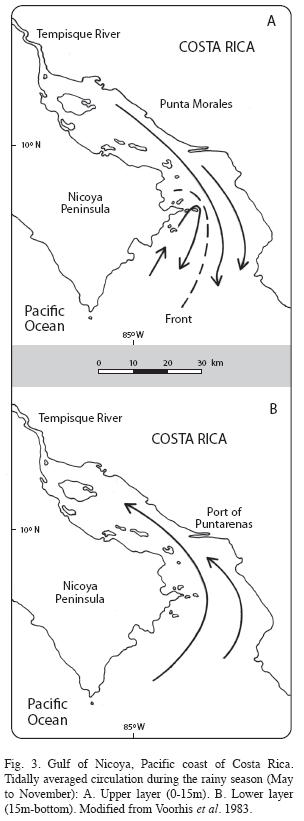
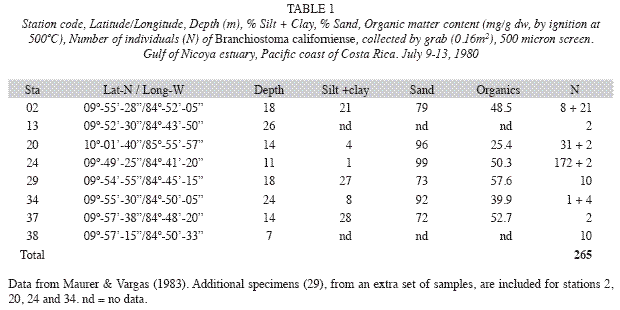
<body><![CDATA[<div style="text-align: justify;"></div>     <p style="text-align: justify;"><font face="Verdana" size="2">In 1980, physical, chemical, and biological surveys were conducted at the Gulf of Nicoya estuary, on the Pacific coast of Costa Rica (10&ordm; N-85&ordm; W). The surveys were aimed at providing baseline information on the estuary in support of management policies. More than 100 papers were published, making the Gulf of Nicoya one of the best known tropical estuaries worldwide (Vargas 1995). This baseline information is of increasing importance, especially when changes over decades in the biodiversity and ecology of the estuary need to be evaluated against the background of local, regional, and global dynamics (Vargas &amp; Mata 2004).</font></p>     <div style="text-align: justify;"></div>     <p style="text-align: justify;"><font face="Verdana" size="2">The biological subtidal surveys included sampling of the bottom epifaunal (Maurer <i>et al</i>. 1984), infaunal (Maurer &amp; Vargas 1983, 1984), and fish (Bartels <i>et al. </i>1984) diversities. The subtidal studies were followed by a three year survey of an intertidal site in the upper Gulf of Nicoya (Vargas 1987, 1996), where <i>B. californiense </i>was collected occasionally. The recent book on marine biodiversity of Costa Rica (Wehrtman &amp; Cort&eacute;s 2009), only mentions that <i>B. californiense </i>was collected from the Gulf of Nicoya estuary.</font></p>     <div style="text-align: justify;"></div>     <p style="text-align: justify;"><font face="Verdana" size="2">Thus, the objective of this contribution is to make accesible complementary data on the abundance of <i>B. californiense </i>collected in the Gulf of Nicoya in 1980, and from 1984 to 1986.</font></p>     <p><b><font face="Verdana" size="3">Materials and methods</font></b></p> <font size="2"> </font><font face="Verdana" size="2"></font>     <p style="text-align: justify;"><font face="Verdana" size="2">From 9-13 July, 1980, grab (Smith-McIntyre) samples were taken at 48 subtidal (depth range: 2 to 44m) stations in the Gulf of Nicoya estuary, Pacific coast of Costa Rica. Sediment samples were washed on board the RV Skimmer using a 500 micron sieve (Maurer &amp; Vargas 1984). From February 1984 to December 1986, samples were also collected at low tide at an intertidal (tidal range: 3m) flat in the upper Gulf of Nicoya, using a corer of 17.7cm2 of area, and washed with sea water at a field station on a 500 micron sieve. In 1984, sets of 28 cores were collected at intervals ranging from 12 to 18 days. Monthy sampling (14 cores) was conducted afterwards until the end of 1986. The 28 cores represented an area of 0.05m<sup>2</sup>, which is about 1/3<sup>rd</sup> of that sampled by the grab in the subtidal survey. In both surveys, biological specimens were preserved for 24 hours in 5% formaldehyde solution in sea water stained with Rose bengal, and transferred to vials filled with 70% ethanol for long-term storage. Lancelets were identified to species level based on Hubbs (1922), and voucher specimens of <i>B. californiense </i>were deposited by the junior author at the United States National Museum (USNM, see catalogue numbers in Poss &amp; Boschung 1996).</font></p>     <div style="text-align: justify;"><b><font face="Verdana" size="3">     <p>Results</p> </font></b><font size="2"> </font><font face="Verdana" size="2">     ]]></body>
<body><![CDATA[<p>In the subtidal infaunal survey, a total of 205 species and a total of 4684 individuals was collected, with polychaete worms dominating by numbers (68.1%) and by species (58.6%), of which <i>Mediomastus californiensis </i>Hartman 1944, (9.9%), <i>Synelmis emiliae </i>Salazar-Vallejo 2003, (=<i>S. albini</i>), (6.5%) and <i>Prionospio multibranchiata </i>Berkeley 1927, (6.4%), ranked as the top three. Among the infaunal species, a total of 237 specimens of <i>B. californiense </i>was collected, ranking 4<sup>th</sup> in abundance (Maurer &amp; Vargas 1984). Table 1 also includes 29 specimens added after the publication by Maurer &amp; Vargas (1984), to stations 2 (21), 20 (2), 24 (2), and 34 (4), from a duplicate set of samples deposited at the Museum of Zoology, University of Costa Rica (Cat. MZUCR-01-01).</p>     <p>Of the 48 stations, only eight (<a href="#fig1">Fig. 1</a>) were found to contain specimens of <i>B. californiense</i>, and these sites had a sand fraction above 72% (<a href="/img/revistas/rbt/v58n4/a07t1.gif">Table 1</a>). The remaining stations ranged in their sand content from as low as 1% to as high as 92%, with an average of 25.9% and 29 stations had a sand content lower than 72%. Bottom salinity ranged from 29 to 30&#8240; and botton temperature varied from 22 to 28&ordm;C (Maurer &amp; Vargas 1983, 1984).</p> </font>    <br> <font face="Verdana" size="2">     <p></p> </font></div> <font face="Verdana" size="2">     <p>    <br> </p> </font>     <div style="text-align: center;"><font face="Verdana" size="2">     <p><a name="fig1"></a><img src="/img/revistas/rbt/v58n4/a07i1.jpg"  title="" alt="" style="width: 304px; height: 348px;">    <br> </p> </font>    <br> </div> <font face="Verdana" size="2"> </font>     ]]></body>
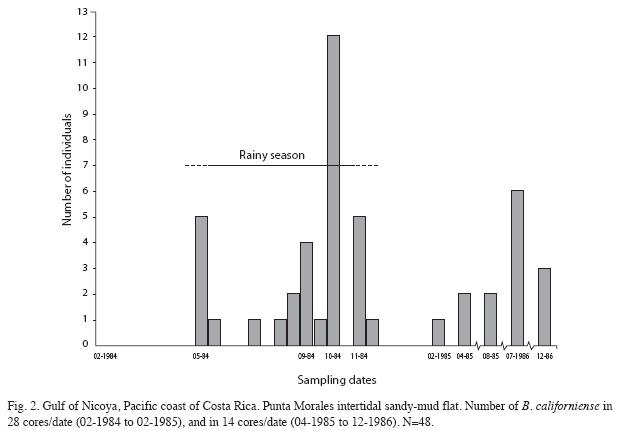
<body><![CDATA[<div style="text-align: justify;"><font face="Verdana" size="2">     <p>At the intertidal sandy-mud flat, a total of 92 species and 16837 individuals were collected. The ostracod, <i>Cyprideis pacifica </i>Hartmann 1957, and the cumacean, <i>Coricuma nicoyensis </i>Watling &amp; Breedy 1988, accounted for 22.6% and 21% of the abundance, respectively. The polychaete, <i>M. californiensis </i>accounted for 11.0% of the abundance. A total of 48 specimens of <i>B. californiense </i>was collected, with a maximum of 12 individuals found on October 1984, at the peak of the rainy season (<a  href="/img/revistas/rbt/v58n4/a07i2.jpg">Fig. 2</a>). The percentage of silt+clay at the flat ranged from 23 to 44%, with an average of 32%.</p>     <p>The sand fraction averaged 65%. The organic matter content of the sediments was between 1.3 and 2.9%. Salinity ranged from 27 (rainy season, May to November) to 34&#8240; (dry season, December to April). Minimum water temperature was 27&ordm;C and the maximum was 40&ordm;C, when the flat was exposed at the peak of the dry season (Vargas 1987, 1996).</p> </font><b><font face="Verdana" size="3">     <p>Discussion</p> </font></b><font size="2"> </font></div>     <p style="text-align: justify;"><font face="Verdana" size="2">The type locality of <i>B. californiense </i>is San Diego, California, and its known geographical range is from Monterrey Bay (California, U.S.A) to Chame Point, Panama. Prior to the RV Skimmer surveys, the presence of <i>B. californiense </i>in Costa Rica was reported, before 1940, from Puerto Jim&eacute;nez and Golfito Bay in the Golfo Dulce deep basin near the border with Panama. On the Nicoya peninsula it was collected at Piedra Blanca Bay, Culebra Bay (Puerto Culebra) and further North at Salinas Bay near the border with Nicaragua (Poss &amp; Boschung 1996). Thus, its presence in the Gulf of Nicoya was expected.</font></p>     <div style="text-align: justify;"></div>     <p style="text-align: justify;"><font face="Verdana" size="2">The presence of <i>B. californiense, </i>in sediments with a high (more than 60%) sand content in the Gulf of Nicoya, agrees with reports from other collections worldwide (see data in Poss &amp; Boschung 1996). Webb (1975), mentions for <i>B. nigeriense </i>that these lancelets are dependent on a free flow of water between the sand grains in which it lives, and adopts a different position in the sand according to its permeability (body buried in coarse sand, mouth exposed at the surface of medium sands, and mouth and atriopore exposed in fine sands). In muddy sediments the cephalochordate remains on the sediment surface.</font></p>     <div style="text-align: justify;"></div>     <p style="text-align: justify;"><font face="Verdana" size="2">The maximun size reported for <i>B. californiense </i>is 83.5mm (Hubbs 1922). Three size measuments are reported by Poss &amp; Boschung (1996) for specimens collected in Costa Rica: 19, 30, and 36mm. In both subtidal and intertidal surveys, the presence of small specimens of <i>B. californiense </i>was recorded. An additional set of samples collected July 1980, yielded 29 specimens (<a  href="/img/revistas/rbt/v58n4/a07t1.gif">Table 1</a>), with sizes ranging from 5 to 37mm, with an average of 14mm. The individuals of the smallest size probably represent recent recruits for this species. All the specimens collected at the intertidal flat were of less than 30mm in length, and most of them were found during the rainy season (<a  href="/img/revistas/rbt/v58n4/a07i2.jpg">Fig. 2</a>). Larger specimens probably avoided capture by the grab, and more so by the small corer.</font></p>     <div style="text-align: justify;"></div>     ]]></body>
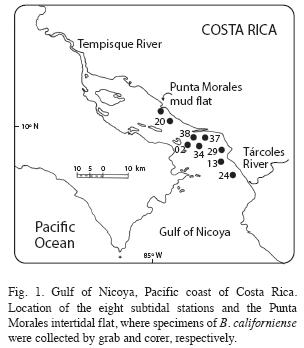
<body><![CDATA[<p style="text-align: justify;"><font face="Verdana" size="2">According to Webb (1975) the distribution of lancelets is determined by the currents dispersing the larvae, and by the physical nature of the substratum in which the adults live. The Gulf of Nicoya is characterized by an estuarine circulation (<a href="#fig3">Fig. 3</a>), where the freshened surface water from the upper Gulf flows southward along the eastern side of the estuary. This flow is compensated by a northward flow of more saline water on the western side at all depths and on the eastern side along the bottom (Voorhis <i>et al</i>. 1983). This bottom flow probably carries larvae and juvenile <i>B. californiense </i>to the upper reaches of the estuary, including the intertidal flats. Lower salinities, and the presence of sediments with a high content of silt+clay due to the influence of the Tempisque river (<a href="#fig3">Fig. 3</a>), may limit the distribution of amphioxus further upstream. For <i>B. nigeriense</i>, Webb &amp; Hill (1958) found experimentaly that a salinity of 13&#8240; was the lowest tolerated by larvae and also mention previous work on <i>B. belcheri </i>that lives on a salinity range of 19 to 29&#8240;.    <br> </font></p>     <p><font face="Verdana" size="2">    <br>     <br> </font></p>     <div style="text-align: center;"><a name="fig3"></a><img  src="/img/revistas/rbt/v58n4/a07i3.jpg" title="" alt=""  style="width: 304px; height: 821px;">    <br>     <br> </div> <font face="Verdana" size="2"> </font>     <div style="text-align: justify;"><font face="Verdana" size="2">     <p>The presence of high densities of <i>B. caribaeum </i>in an eutrophic bay, receiving discharges from industrial and domestic sources, has been reported by Da Silva <i>et al. </i>(2008). The Gulf of Nicoya estuary receives agricultural, industrial and domestic discharges (Vargas &amp; Mata 2004), mainly by the Tempisque and T&aacute;rcoles rivers (<a href="#fig1">Fig. 1</a>), and the port city of Puntarenas (<a href="#fig3">Fig. 3B</a>). The results of a survey (1981-82) of trace metals in sediments and invertebrates near the T&aacute;rcoles river mouth (Dean <i>et al</i>. 1986), supported the conclusion that the low concentrations found were probably attributable to natural geochemical cycles, rather than to anthropogenic sources. However, recent evidence indicates that anthropogenic input is on the rise in the Gulf for trace metals and other pollutants (Spongberg 2004, Gravel <i>et al. </i>2006).</p> </font></div> <font face="Verdana" size="2"></font><b><font face="Verdana" size="3">     ]]></body>
<body><![CDATA[<p>Acknowledgments</p> </font></b><font size="2"> </font><font face="Verdana" size="2">     <p>We thank Manuel M. Murillo at the University of Costa Rica and Kent S. Price at the University of Delaware for organizing the joint cruises aboard the RV Skimmer.</p> </font> <hr style="width: 100%; height: 2px;"><b><font face="Verdana" size="3">     <p>References</p> </font></b><font size="2"> </font><font face="Verdana" size="2">     <!-- ref --><p>Bartels, C., K.S. Price, M.L. Bussing &amp; W. Bussing. 1984. Ecological asessment of finfish as indicators of habitats in the Gulf of Nicoya, Costa Rica. Hydrobiologia 112: 197-207.    &nbsp;&nbsp;&nbsp;&nbsp;&nbsp;&nbsp;&nbsp;&nbsp;[&#160;<a href="javascript:void(0);" onclick="javascript: window.open('/scielo.php?script=sci_nlinks&ref=1389769&pid=S0034-7744201000040000700001&lng=','','width=640,height=500,resizable=yes,scrollbars=1,menubar=yes,');">Links</a>&#160;]<!-- end-ref --></p>     <!-- ref --><p>Da Silva, L.F.B., M. Tavares &amp; A. Soares-Gomes. 2008. Population structure of the lancelet <i>Branchiostoma caribaeum </i>(Cephalochordata: Branchiostomidae) in the Baia de Guanabara, Rio de Janeiro, southeastern Brazil. Rev. Bras. Zool. 25: 617-623.    &nbsp;&nbsp;&nbsp;&nbsp;&nbsp;&nbsp;&nbsp;&nbsp;[&#160;<a href="javascript:void(0);" onclick="javascript: window.open('/scielo.php?script=sci_nlinks&ref=1389771&pid=S0034-7744201000040000700002&lng=','','width=640,height=500,resizable=yes,scrollbars=1,menubar=yes,');">Links</a>&#160;]<!-- end-ref --></p>     <!-- ref --><p>Dean, H.K., D. Maurer, J.A. Vargas &amp; C.H. Tinsman. 1986. Trace metal concentrations in sediment and invertebrates from the Gulf of Nicoya, Costa Rica. Mar. Pollut. Bull. 17: 128-131.    &nbsp;&nbsp;&nbsp;&nbsp;&nbsp;&nbsp;&nbsp;&nbsp;[&#160;<a href="javascript:void(0);" onclick="javascript: window.open('/scielo.php?script=sci_nlinks&ref=1389773&pid=S0034-7744201000040000700003&lng=','','width=640,height=500,resizable=yes,scrollbars=1,menubar=yes,');">Links</a>&#160;]<!-- end-ref --></p>     <!-- ref --><p>Gee, H. 2006. Careful with that amphioxus. Nature 439: 923-924.    &nbsp;&nbsp;&nbsp;&nbsp;&nbsp;&nbsp;&nbsp;&nbsp;[&#160;<a href="javascript:void(0);" onclick="javascript: window.open('/scielo.php?script=sci_nlinks&ref=1389775&pid=S0034-7744201000040000700004&lng=','','width=640,height=500,resizable=yes,scrollbars=1,menubar=yes,');">Links</a>&#160;]<!-- end-ref --></p>     <!-- ref --><p>Gravel, P., K. Johanning, J. McLachlan, J.A. Vargas &amp; E. Oberdorster. 2006. Imposex in the intertidal snail <i>Thais brevidentata </i>(Gastropoda: Muricidae) from the Pacific coast of Costa Rica. Rev. Biol. Trop. 54 (Suppl. 1): 21-26.    &nbsp;&nbsp;&nbsp;&nbsp;&nbsp;&nbsp;&nbsp;&nbsp;[&#160;<a href="javascript:void(0);" onclick="javascript: window.open('/scielo.php?script=sci_nlinks&ref=1389777&pid=S0034-7744201000040000700005&lng=','','width=640,height=500,resizable=yes,scrollbars=1,menubar=yes,');">Links</a>&#160;]<!-- end-ref --></p>     <!-- ref --><p>Hubbs, C.L. 1922. A list of the lancelets of the world with diagnosis of five new species of <i>Branchiostoma</i>. Occ. Pap. Mus. Zool. U. Michigan 105: 2-15.    &nbsp;&nbsp;&nbsp;&nbsp;&nbsp;&nbsp;&nbsp;&nbsp;[&#160;<a href="javascript:void(0);" onclick="javascript: window.open('/scielo.php?script=sci_nlinks&ref=1389779&pid=S0034-7744201000040000700006&lng=','','width=640,height=500,resizable=yes,scrollbars=1,menubar=yes,');">Links</a>&#160;]<!-- end-ref --></p>     <!-- ref --><p>Maurer, D. &amp; J.A. Vargas. 1983. Benthic Studies in the Gulf of Nicoya, Costa Rica. Progress Report of the International Cooperative Assistance Program of Sea Grant. University of Delaware, Lewes, Delaware, U.S.A.    &nbsp;&nbsp;&nbsp;&nbsp;&nbsp;&nbsp;&nbsp;&nbsp;[&#160;<a href="javascript:void(0);" onclick="javascript: window.open('/scielo.php?script=sci_nlinks&ref=1389781&pid=S0034-7744201000040000700007&lng=','','width=640,height=500,resizable=yes,scrollbars=1,menubar=yes,');">Links</a>&#160;]<!-- end-ref --></p>     <!-- ref --><p>Maurer, D. &amp; J.A. Vargas. 1984. Diversity of soft-bottom benthos in a tropical estuary: Gulf of Nicoya, Costa Rica. Mar. Biol. 81: 97-106.    &nbsp;&nbsp;&nbsp;&nbsp;&nbsp;&nbsp;&nbsp;&nbsp;[&#160;<a href="javascript:void(0);" onclick="javascript: window.open('/scielo.php?script=sci_nlinks&ref=1389783&pid=S0034-7744201000040000700008&lng=','','width=640,height=500,resizable=yes,scrollbars=1,menubar=yes,');">Links</a>&#160;]<!-- end-ref --></p>     <!-- ref --><p>Maurer, D., C.E. Epifanio, H.K. Dean, S. Howe, J.A. Vargas, A.I. Dittel &amp; M. Murillo. 1984. Benthic invertebrates of a tropical estuary: Gulf of Nicoya, Costa Rica. J. Nat. Hist. 18: 47-61.    &nbsp;&nbsp;&nbsp;&nbsp;&nbsp;&nbsp;&nbsp;&nbsp;[&#160;<a href="javascript:void(0);" onclick="javascript: window.open('/scielo.php?script=sci_nlinks&ref=1389785&pid=S0034-7744201000040000700009&lng=','','width=640,height=500,resizable=yes,scrollbars=1,menubar=yes,');">Links</a>&#160;]<!-- end-ref --></p>     <!-- ref --><p>Poss, S.G. &amp; H.T. Boschung. 1996. Lancelets (Cephalochordata: Branchiostomatidae): how many species are valid? Israel J. Zool. 42: S-13/S-66.    &nbsp;&nbsp;&nbsp;&nbsp;&nbsp;&nbsp;&nbsp;&nbsp;[&#160;<a href="javascript:void(0);" onclick="javascript: window.open('/scielo.php?script=sci_nlinks&ref=1389787&pid=S0034-7744201000040000700010&lng=','','width=640,height=500,resizable=yes,scrollbars=1,menubar=yes,');">Links</a>&#160;]<!-- end-ref --></p>     <!-- ref --><p>Ruppert, E.E., T.R. Nash &amp; A.J. Smith. 2000. The size range of suspended particles trapped and ingested by the filter-feeding lancelet <i>Branchiostoma floridae </i>(Cephalochordata: Acrania). J. Mar. Biol. Ass. U.K. 80: 329-332.    &nbsp;&nbsp;&nbsp;&nbsp;&nbsp;&nbsp;&nbsp;&nbsp;[&#160;<a href="javascript:void(0);" onclick="javascript: window.open('/scielo.php?script=sci_nlinks&ref=1389789&pid=S0034-7744201000040000700011&lng=','','width=640,height=500,resizable=yes,scrollbars=1,menubar=yes,');">Links</a>&#160;]<!-- end-ref --></p>     <!-- ref --><p>Spongberg, A.L. 2004. PCB concentrations in sediments from the Gulf of Nicoya estuary, Pacific coast of Costa Rica. Rev. Biol. Trop. 52 (Suppl. 2): 11-22.    &nbsp;&nbsp;&nbsp;&nbsp;&nbsp;&nbsp;&nbsp;&nbsp;[&#160;<a href="javascript:void(0);" onclick="javascript: window.open('/scielo.php?script=sci_nlinks&ref=1389791&pid=S0034-7744201000040000700012&lng=','','width=640,height=500,resizable=yes,scrollbars=1,menubar=yes,');">Links</a>&#160;]<!-- end-ref --></p>     <!-- ref --><p>Vargas, J.A. 1987. The benthic community of an intertidal mud flat in the Gulf of Nicoya, Costa Rica. Description of the community. Rev. Biol. Trop. 35: 229-316.    &nbsp;&nbsp;&nbsp;&nbsp;&nbsp;&nbsp;&nbsp;&nbsp;[&#160;<a href="javascript:void(0);" onclick="javascript: window.open('/scielo.php?script=sci_nlinks&ref=1389793&pid=S0034-7744201000040000700013&lng=','','width=640,height=500,resizable=yes,scrollbars=1,menubar=yes,');">Links</a>&#160;]<!-- end-ref --></p>     <!-- ref --><p>Vargas, J.A. 1995. The Gulf of Nicoya estuary, Costa Rica. Past, present, and future cooperative research. Helgol&auml;nder Meeresunters 49: 821-828.    &nbsp;&nbsp;&nbsp;&nbsp;&nbsp;&nbsp;&nbsp;&nbsp;[&#160;<a href="javascript:void(0);" onclick="javascript: window.open('/scielo.php?script=sci_nlinks&ref=1389795&pid=S0034-7744201000040000700014&lng=','','width=640,height=500,resizable=yes,scrollbars=1,menubar=yes,');">Links</a>&#160;]<!-- end-ref --></p>     <!-- ref --><p>Vargas, J.A. 1996. Ecological dynamics of a tropical intertidal mudflat community, p. 355-371. <i>In </i>K.F. Nordstrom &amp; C.T. Roman (eds.). Estuarine Shores: Evolution, Environments and Human Alterations. Wiley, London, England.    &nbsp;&nbsp;&nbsp;&nbsp;&nbsp;&nbsp;&nbsp;&nbsp;[&#160;<a href="javascript:void(0);" onclick="javascript: window.open('/scielo.php?script=sci_nlinks&ref=1389797&pid=S0034-7744201000040000700015&lng=','','width=640,height=500,resizable=yes,scrollbars=1,menubar=yes,');">Links</a>&#160;]<!-- end-ref --></p>     <!-- ref --><p>Vargas, J.A. &amp; A. Mata. 2004. Where the dry forest feeds the sea: The Gulf of Nicoya estuary, p. 126-135. <i>In </i>G.W. Frankie, A. Mata &amp; S.B. Vinson (eds.). Biodiversity conservation in Costa Rica; Learning the lessons in a seasonal dry forest. University of California, Berkeley, California, USA.    &nbsp;&nbsp;&nbsp;&nbsp;&nbsp;&nbsp;&nbsp;&nbsp;[&#160;<a href="javascript:void(0);" onclick="javascript: window.open('/scielo.php?script=sci_nlinks&ref=1389799&pid=S0034-7744201000040000700016&lng=','','width=640,height=500,resizable=yes,scrollbars=1,menubar=yes,');">Links</a>&#160;]<!-- end-ref --></p>     <!-- ref --><p>Voorhis, A., C.E. Epifanio, D. Maurer, A.I. Dittel &amp; J.A. Vargas. 1983. The estuarine character of the Gulf of Nicoya, an embayment on the Pacific coast of Central America. Hydrobiologia 99: 225-237.    &nbsp;&nbsp;&nbsp;&nbsp;&nbsp;&nbsp;&nbsp;&nbsp;[&#160;<a href="javascript:void(0);" onclick="javascript: window.open('/scielo.php?script=sci_nlinks&ref=1389801&pid=S0034-7744201000040000700017&lng=','','width=640,height=500,resizable=yes,scrollbars=1,menubar=yes,');">Links</a>&#160;]<!-- end-ref --></p>     <!-- ref --><p>Webb, J.E. 1975. The distribution of amphioxus. Symp. Zool. Soc. Lond. 36: 179-212.    &nbsp;&nbsp;&nbsp;&nbsp;&nbsp;&nbsp;&nbsp;&nbsp;[&#160;<a href="javascript:void(0);" onclick="javascript: window.open('/scielo.php?script=sci_nlinks&ref=1389803&pid=S0034-7744201000040000700018&lng=','','width=640,height=500,resizable=yes,scrollbars=1,menubar=yes,');">Links</a>&#160;]<!-- end-ref --></p>     <!-- ref --><p>Webb, J.E. &amp; M.B. Hill. 1958. The ecology of Lagos lagoon. IV. On the reactions of <i>Branchiostoma nigeriense </i>Webb to its environment. Phil. Trans. Roy. Soc. B. 241: 355-391.    &nbsp;&nbsp;&nbsp;&nbsp;&nbsp;&nbsp;&nbsp;&nbsp;[&#160;<a href="javascript:void(0);" onclick="javascript: window.open('/scielo.php?script=sci_nlinks&ref=1389805&pid=S0034-7744201000040000700019&lng=','','width=640,height=500,resizable=yes,scrollbars=1,menubar=yes,');">Links</a>&#160;]<!-- end-ref --></p>     <!-- ref --><p>Wehrtmann, I. &amp; J. Cort&eacute;s. 2009. Marine biodiversity of Costa Rica, Central America. Monographiae Biologicae 86. Springer, Dordrecht, The Netherlands.    &nbsp;&nbsp;&nbsp;&nbsp;&nbsp;&nbsp;&nbsp;&nbsp;[&#160;<a href="javascript:void(0);" onclick="javascript: window.open('/scielo.php?script=sci_nlinks&ref=1389807&pid=S0034-7744201000040000700020&lng=','','width=640,height=500,resizable=yes,scrollbars=1,menubar=yes,');">Links</a>&#160;]<!-- end-ref --></p>     <!-- ref --><p>Yamaguchi, T. &amp; Y. Henmi. 2003. Biology of the amphioxus, <i>Branchiostoma belcheri </i>in the Ariake Sea, Japan. II. Reproduction. Zool. Sci. 20: 907-918.    &nbsp;&nbsp;&nbsp;&nbsp;&nbsp;&nbsp;&nbsp;&nbsp;[&#160;<a href="javascript:void(0);" onclick="javascript: window.open('/scielo.php?script=sci_nlinks&ref=1389809&pid=S0034-7744201000040000700021&lng=','','width=640,height=500,resizable=yes,scrollbars=1,menubar=yes,');">Links</a>&#160;]<!-- end-ref --><br> </p>     <p>    <br> <a name="Correspondencia"></a>Correspondencia a: <font><font  face="Verdana" size="2">Jos&eacute; A. Vargas. </font></font><font><font  face="Verdana" size="2">Centro de Investigaci&oacute;n en Ciencias del Mar y Limnolog&iacute;a (CIMAR), Universidad de Costa Rica, 2060. Costa Rica</font></font><font><font  face="Verdana" size="2">; <a href="mailto:javargas@biologia.ucr.ac.cr">javargas@biologia.ucr.ac.cr</a></font></font><font><font  face="Verdana" size="2"> / </font></font><font><font face="Verdana"  size="2">Escuela de Biolog&iacute;a, Universidad de Costa Rica, 2060. Costa Rica.    <br> </font></font><font><font face="Verdana" size="2">Harlan K. Dean. </font></font><font><font  face="Verdana" size="2">Museum of Comparative Zoology, Harvard University, 26 Oxford St. Cambridge, MA. 02138. U.S.A.</font></font> </p> </font> <hr style="width: 100%; height: 2px;"><font face="Verdana" size="2">     <p align="center">Received 09-VI-2010. Corrected 10-VII-2010. Accepted 11-VIII-2010.    <br> </p> </font>     ]]></body>
<body><![CDATA[ ]]></body><back>
<ref-list>
<ref id="B1">
<nlm-citation citation-type="journal">
<person-group person-group-type="author">
<name>
<surname><![CDATA[Bartels]]></surname>
<given-names><![CDATA[C]]></given-names>
</name>
<name>
<surname><![CDATA[Price]]></surname>
<given-names><![CDATA[K.S]]></given-names>
</name>
<name>
<surname><![CDATA[Bussing]]></surname>
<given-names><![CDATA[M.L]]></given-names>
</name>
<name>
<surname><![CDATA[Bussing]]></surname>
<given-names><![CDATA[W]]></given-names>
</name>
</person-group>
<article-title xml:lang="en"><![CDATA[Ecological asessment of finfish as indicators of habitats in the Gulf of Nicoya, Costa Rica]]></article-title>
<source><![CDATA[Hydrobiologia]]></source>
<year>1984</year>
<volume>112</volume>
<page-range>197-207</page-range></nlm-citation>
</ref>
<ref id="B2">
<nlm-citation citation-type="journal">
<person-group person-group-type="author">
<name>
<surname><![CDATA[Da Silva]]></surname>
<given-names><![CDATA[L.F.B]]></given-names>
</name>
<name>
<surname><![CDATA[Tavares]]></surname>
<given-names><![CDATA[M]]></given-names>
</name>
<name>
<surname><![CDATA[Soares-Gomes]]></surname>
<given-names><![CDATA[A]]></given-names>
</name>
</person-group>
<article-title xml:lang="en"><![CDATA[Population structure of the lancelet Branchiostoma caribaeum (Cephalochordata: Branchiostomidae) in the Baia de Guanabara, Rio de Janeiro, southeastern Brazil]]></article-title>
<source><![CDATA[Rev. Bras. Zool]]></source>
<year>2008</year>
<volume>25</volume>
<page-range>617-623</page-range></nlm-citation>
</ref>
<ref id="B3">
<nlm-citation citation-type="journal">
<person-group person-group-type="author">
<name>
<surname><![CDATA[Dean]]></surname>
<given-names><![CDATA[H.K]]></given-names>
</name>
<name>
<surname><![CDATA[Maurer]]></surname>
<given-names><![CDATA[D]]></given-names>
</name>
<name>
<surname><![CDATA[Vargas]]></surname>
<given-names><![CDATA[J.A]]></given-names>
</name>
<name>
<surname><![CDATA[Tinsman]]></surname>
<given-names><![CDATA[C.H]]></given-names>
</name>
</person-group>
<article-title xml:lang="en"><![CDATA[Trace metal concentrations in sediment and invertebrates from the Gulf of Nicoya, Costa Rica]]></article-title>
<source><![CDATA[Mar. Pollut. Bull]]></source>
<year>1986</year>
<volume>17</volume>
<page-range>128-131</page-range></nlm-citation>
</ref>
<ref id="B4">
<nlm-citation citation-type="journal">
<person-group person-group-type="author">
<name>
<surname><![CDATA[Gee]]></surname>
<given-names><![CDATA[H]]></given-names>
</name>
</person-group>
<article-title xml:lang="en"><![CDATA[Careful with that amphioxus]]></article-title>
<source><![CDATA[Nature]]></source>
<year>2006</year>
<volume>439</volume>
<page-range>923-924</page-range></nlm-citation>
</ref>
<ref id="B5">
<nlm-citation citation-type="journal">
<person-group person-group-type="author">
<name>
<surname><![CDATA[Gravel]]></surname>
<given-names><![CDATA[P]]></given-names>
</name>
<name>
<surname><![CDATA[Johanning]]></surname>
<given-names><![CDATA[K]]></given-names>
</name>
<name>
<surname><![CDATA[McLachlan]]></surname>
<given-names><![CDATA[J]]></given-names>
</name>
<name>
<surname><![CDATA[Vargas]]></surname>
<given-names><![CDATA[J.A]]></given-names>
</name>
<name>
<surname><![CDATA[Oberdorster]]></surname>
<given-names><![CDATA[E]]></given-names>
</name>
</person-group>
<article-title xml:lang="en"><![CDATA[Imposex in the intertidal snail Thais brevidentata (Gastropoda: Muricidae) from the Pacific coast of Costa Rica]]></article-title>
<source><![CDATA[Rev. Biol. Trop]]></source>
<year>2006</year>
<volume>54</volume>
<numero>^s1</numero>
<issue>^s1</issue>
<supplement>1</supplement>
<page-range>21-26</page-range></nlm-citation>
</ref>
<ref id="B6">
<nlm-citation citation-type="journal">
<person-group person-group-type="author">
<name>
<surname><![CDATA[Hubbs]]></surname>
<given-names><![CDATA[C.L]]></given-names>
</name>
</person-group>
<article-title xml:lang="en"><![CDATA[A list of the lancelets of the world with diagnosis of five new species of Branchiostoma]]></article-title>
<source><![CDATA[Occ. Pap. Mus. Zool. U. Michigan]]></source>
<year>1922</year>
<volume>105</volume>
<page-range>2-15</page-range></nlm-citation>
</ref>
<ref id="B7">
<nlm-citation citation-type="book">
<person-group person-group-type="author">
<name>
<surname><![CDATA[Maurer]]></surname>
<given-names><![CDATA[D]]></given-names>
</name>
<name>
<surname><![CDATA[Vargas]]></surname>
<given-names><![CDATA[J.A]]></given-names>
</name>
</person-group>
<source><![CDATA[Benthic Studies in the Gulf of Nicoya, Costa Rica: Progress Report of the International Cooperative Assistance Program of Sea Grant]]></source>
<year>1983</year>
<publisher-loc><![CDATA[Lewes^eDelaware Delaware]]></publisher-loc>
<publisher-name><![CDATA[University of Delaware]]></publisher-name>
</nlm-citation>
</ref>
<ref id="B8">
<nlm-citation citation-type="journal">
<person-group person-group-type="author">
<name>
<surname><![CDATA[Maurer]]></surname>
<given-names><![CDATA[D]]></given-names>
</name>
<name>
<surname><![CDATA[Vargas]]></surname>
<given-names><![CDATA[J.A]]></given-names>
</name>
</person-group>
<article-title xml:lang="en"><![CDATA[Diversity of soft-bottom benthos in a tropical estuary: Gulf of Nicoya, Costa Rica]]></article-title>
<source><![CDATA[Mar. Biol]]></source>
<year>1984</year>
<volume>81</volume>
<page-range>97-106</page-range></nlm-citation>
</ref>
<ref id="B9">
<nlm-citation citation-type="journal">
<person-group person-group-type="author">
<name>
<surname><![CDATA[Maurer]]></surname>
<given-names><![CDATA[D]]></given-names>
</name>
<name>
<surname><![CDATA[Epifanio]]></surname>
<given-names><![CDATA[C.E]]></given-names>
</name>
<name>
<surname><![CDATA[Dean]]></surname>
<given-names><![CDATA[H.K]]></given-names>
</name>
<name>
<surname><![CDATA[Howe]]></surname>
<given-names><![CDATA[S]]></given-names>
</name>
<name>
<surname><![CDATA[Vargas]]></surname>
<given-names><![CDATA[J.A]]></given-names>
</name>
<name>
<surname><![CDATA[Dittel]]></surname>
<given-names><![CDATA[A.I]]></given-names>
</name>
<name>
<surname><![CDATA[Murillo]]></surname>
<given-names><![CDATA[M]]></given-names>
</name>
</person-group>
<article-title xml:lang="en"><![CDATA[Benthic invertebrates of a tropical estuary: Gulf of Nicoya, Costa Rica]]></article-title>
<source><![CDATA[J. Nat. Hist]]></source>
<year>1984</year>
<volume>18</volume>
<page-range>47-61</page-range></nlm-citation>
</ref>
<ref id="B10">
<nlm-citation citation-type="journal">
<person-group person-group-type="author">
<name>
<surname><![CDATA[Poss]]></surname>
<given-names><![CDATA[S.G]]></given-names>
</name>
<name>
<surname><![CDATA[Boschung]]></surname>
<given-names><![CDATA[H.T]]></given-names>
</name>
</person-group>
<article-title xml:lang="en"><![CDATA[Lancelets (Cephalochordata: Branchiostomatidae): how many species are valid]]></article-title>
<source><![CDATA[Israel J. Zool]]></source>
<year>1996</year>
<volume>42</volume>
<page-range>S-13/S-66</page-range></nlm-citation>
</ref>
<ref id="B11">
<nlm-citation citation-type="journal">
<person-group person-group-type="author">
<name>
<surname><![CDATA[Ruppert]]></surname>
<given-names><![CDATA[E.E]]></given-names>
</name>
<name>
<surname><![CDATA[Nash]]></surname>
<given-names><![CDATA[T.R]]></given-names>
</name>
<name>
<surname><![CDATA[Smith]]></surname>
<given-names><![CDATA[A.J]]></given-names>
</name>
</person-group>
<article-title xml:lang="en"><![CDATA[The size range of suspended particles trapped and ingested by the filter-feeding lancelet Branchiostoma floridae (Cephalochordata: Acrania)]]></article-title>
<source><![CDATA[J. Mar. Biol. Ass. U.K]]></source>
<year>2000</year>
<volume>80</volume>
<page-range>329-332</page-range></nlm-citation>
</ref>
<ref id="B12">
<nlm-citation citation-type="journal">
<person-group person-group-type="author">
<name>
<surname><![CDATA[Spongberg]]></surname>
<given-names><![CDATA[A.L]]></given-names>
</name>
</person-group>
<article-title xml:lang="en"><![CDATA[PCB concentrations in sediments from the Gulf of Nicoya estuary, Pacific coast of Costa Rica]]></article-title>
<source><![CDATA[Rev. Biol. Trop]]></source>
<year>2004</year>
<volume>52</volume>
<numero>^s2</numero>
<issue>^s2</issue>
<supplement>2</supplement>
<page-range>11-22</page-range></nlm-citation>
</ref>
<ref id="B13">
<nlm-citation citation-type="journal">
<person-group person-group-type="author">
<name>
<surname><![CDATA[Vargas]]></surname>
<given-names><![CDATA[J.A]]></given-names>
</name>
</person-group>
<article-title xml:lang="en"><![CDATA[The benthic community of an intertidal mud flat in the Gulf of Nicoya, Costa Rica: Description of the community]]></article-title>
<source><![CDATA[Rev. Biol. Trop]]></source>
<year>1987</year>
<volume>35</volume>
<page-range>229-316</page-range></nlm-citation>
</ref>
<ref id="B14">
<nlm-citation citation-type="journal">
<person-group person-group-type="author">
<name>
<surname><![CDATA[Vargas]]></surname>
<given-names><![CDATA[J.A]]></given-names>
</name>
</person-group>
<article-title xml:lang="en"><![CDATA[The Gulf of Nicoya estuary, Costa Rica: Past, present, and future cooperative research]]></article-title>
<source><![CDATA[Helgoländer Meeresunters]]></source>
<year>1995</year>
<volume>49</volume>
<page-range>821-828</page-range></nlm-citation>
</ref>
<ref id="B15">
<nlm-citation citation-type="book">
<person-group person-group-type="author">
<name>
<surname><![CDATA[Vargas]]></surname>
<given-names><![CDATA[J.A]]></given-names>
</name>
</person-group>
<article-title xml:lang="en"><![CDATA[Ecological dynamics of a tropical intertidal mudflat community]]></article-title>
<person-group person-group-type="editor">
<name>
<surname><![CDATA[Nordstrom]]></surname>
<given-names><![CDATA[K.F]]></given-names>
</name>
<name>
<surname><![CDATA[Roman]]></surname>
<given-names><![CDATA[C.T]]></given-names>
</name>
</person-group>
<source><![CDATA[Estuarine Shores: Evolution, Environments and Human Alterations]]></source>
<year>1996</year>
<page-range>355-371</page-range><publisher-loc><![CDATA[London ]]></publisher-loc>
<publisher-name><![CDATA[Wiley]]></publisher-name>
</nlm-citation>
</ref>
<ref id="B16">
<nlm-citation citation-type="book">
<person-group person-group-type="author">
<name>
<surname><![CDATA[Vargas]]></surname>
<given-names><![CDATA[J.A]]></given-names>
</name>
<name>
<surname><![CDATA[Mata]]></surname>
<given-names><![CDATA[A]]></given-names>
</name>
</person-group>
<article-title xml:lang="en"><![CDATA[Where the dry forest feeds the sea: The Gulf of Nicoya estuary]]></article-title>
<person-group person-group-type="editor">
<name>
<surname><![CDATA[Frankie]]></surname>
<given-names><![CDATA[G.W]]></given-names>
</name>
<name>
<surname><![CDATA[Mata]]></surname>
<given-names><![CDATA[A]]></given-names>
</name>
<name>
<surname><![CDATA[Vinson]]></surname>
<given-names><![CDATA[S.B]]></given-names>
</name>
</person-group>
<source><![CDATA[Biodiversity conservation in Costa Rica; Learning the lessons in a seasonal dry forest]]></source>
<year>2004</year>
<page-range>126-135</page-range><publisher-loc><![CDATA[Berkeley ]]></publisher-loc>
<publisher-name><![CDATA[University of California]]></publisher-name>
</nlm-citation>
</ref>
<ref id="B17">
<nlm-citation citation-type="journal">
<person-group person-group-type="author">
<name>
<surname><![CDATA[Voorhis]]></surname>
<given-names><![CDATA[A]]></given-names>
</name>
<name>
<surname><![CDATA[Epifanio]]></surname>
<given-names><![CDATA[C.E]]></given-names>
</name>
<name>
<surname><![CDATA[Maurer]]></surname>
<given-names><![CDATA[D]]></given-names>
</name>
<name>
<surname><![CDATA[Dittel]]></surname>
<given-names><![CDATA[A.I]]></given-names>
</name>
<name>
<surname><![CDATA[Vargas]]></surname>
<given-names><![CDATA[J.A]]></given-names>
</name>
</person-group>
<article-title xml:lang="en"><![CDATA[The estuarine character of the Gulf of Nicoya, an embayment on the Pacific coast of Central America]]></article-title>
<source><![CDATA[Hydrobiologia]]></source>
<year>1983</year>
<volume>99</volume>
<page-range>225-237</page-range></nlm-citation>
</ref>
<ref id="B18">
<nlm-citation citation-type="journal">
<person-group person-group-type="author">
<name>
<surname><![CDATA[Webb]]></surname>
<given-names><![CDATA[J.E]]></given-names>
</name>
</person-group>
<article-title xml:lang="en"><![CDATA[The distribution of amphioxus]]></article-title>
<source><![CDATA[Symp. Zool. Soc. Lond]]></source>
<year>1975</year>
<volume>36</volume>
<page-range>179-212</page-range></nlm-citation>
</ref>
<ref id="B19">
<nlm-citation citation-type="journal">
<person-group person-group-type="author">
<name>
<surname><![CDATA[Webb]]></surname>
<given-names><![CDATA[J.E]]></given-names>
</name>
<name>
<surname><![CDATA[Hill]]></surname>
<given-names><![CDATA[M.B]]></given-names>
</name>
</person-group>
<article-title xml:lang="en"><![CDATA[The ecology of Lagos lagoon: IV. On the reactions of Branchiostoma nigeriense Webb to its environment]]></article-title>
<source><![CDATA[Phil. Trans. Roy. Soc. B]]></source>
<year>1958</year>
<volume>241</volume>
<page-range>355-391</page-range></nlm-citation>
</ref>
<ref id="B20">
<nlm-citation citation-type="book">
<person-group person-group-type="author">
<name>
<surname><![CDATA[Wehrtmann]]></surname>
<given-names><![CDATA[I]]></given-names>
</name>
<name>
<surname><![CDATA[Cortés]]></surname>
<given-names><![CDATA[J]]></given-names>
</name>
</person-group>
<source><![CDATA[Marine biodiversity of Costa Rica, Central America]]></source>
<year>2009</year>
<volume>86</volume>
<publisher-loc><![CDATA[Dordrecht ]]></publisher-loc>
<publisher-name><![CDATA[Springer]]></publisher-name>
</nlm-citation>
</ref>
<ref id="B21">
<nlm-citation citation-type="journal">
<person-group person-group-type="author">
<name>
<surname><![CDATA[Yamaguchi]]></surname>
<given-names><![CDATA[T]]></given-names>
</name>
<name>
<surname><![CDATA[Henmi]]></surname>
<given-names><![CDATA[Y]]></given-names>
</name>
</person-group>
<article-title xml:lang="en"><![CDATA[Biology of the amphioxus, Branchiostoma belcheri in the Ariake Sea, Japan: II. Reproduction]]></article-title>
<source><![CDATA[Zool. Sci]]></source>
<year>2003</year>
<volume>20</volume>
<page-range>907-918</page-range></nlm-citation>
</ref>
</ref-list>
</back>
</article>