<?xml version="1.0" encoding="ISO-8859-1"?><article xmlns:mml="http://www.w3.org/1998/Math/MathML" xmlns:xlink="http://www.w3.org/1999/xlink" xmlns:xsi="http://www.w3.org/2001/XMLSchema-instance">
<front>
<journal-meta>
<journal-id>0034-7744</journal-id>
<journal-title><![CDATA[Revista de Biología Tropical]]></journal-title>
<abbrev-journal-title><![CDATA[Rev. biol. trop]]></abbrev-journal-title>
<issn>0034-7744</issn>
<publisher>
<publisher-name><![CDATA[Universidad de Costa Rica]]></publisher-name>
</publisher>
</journal-meta>
<article-meta>
<article-id>S0034-77442010000400004</article-id>
<title-group>
<article-title xml:lang="en"><![CDATA[Determinants of scientific output: an in-depth view of the productivity of tropical botanist and conservationist, Luis Diego Gómez Pignataro]]></article-title>
</title-group>
<contrib-group>
<contrib contrib-type="author">
<name>
<surname><![CDATA[Monge-Nájera]]></surname>
<given-names><![CDATA[Julián]]></given-names>
</name>
<xref ref-type="aff" rid="A01"/>
</contrib>
<contrib contrib-type="author">
<name>
<surname><![CDATA[Nielsen-Muñoz]]></surname>
<given-names><![CDATA[Vanessa]]></given-names>
</name>
<xref ref-type="aff" rid="A02"/>
</contrib>
<contrib contrib-type="author">
<name>
<surname><![CDATA[Azofeifa]]></surname>
<given-names><![CDATA[Ana Beatriz]]></given-names>
</name>
<xref ref-type="aff" rid="A03"/>
</contrib>
</contrib-group>
<aff id="A01">
<institution><![CDATA[,Universidad Estatal a Distancia  ]]></institution>
<addr-line><![CDATA[San José ]]></addr-line>
<country>Costa Rica</country>
</aff>
<aff id="A02">
<institution><![CDATA[,Universidad de Costa Rica Revista de Biología Tropical ]]></institution>
<addr-line><![CDATA[ ]]></addr-line>
</aff>
<aff id="A03">
<institution><![CDATA[,Universidad de Costa Rica Escuela de Bibliotecología y Ciencias de la Información ]]></institution>
<addr-line><![CDATA[ ]]></addr-line>
</aff>
<pub-date pub-type="pub">
<day>00</day>
<month>12</month>
<year>2010</year>
</pub-date>
<pub-date pub-type="epub">
<day>00</day>
<month>12</month>
<year>2010</year>
</pub-date>
<volume>58</volume>
<numero>4</numero>
<fpage>1093</fpage>
<lpage>1114</lpage>
<copyright-statement/>
<copyright-year/>
<self-uri xlink:href="http://www.scielo.sa.cr/scielo.php?script=sci_arttext&amp;pid=S0034-77442010000400004&amp;lng=en&amp;nrm=iso"></self-uri><self-uri xlink:href="http://www.scielo.sa.cr/scielo.php?script=sci_abstract&amp;pid=S0034-77442010000400004&amp;lng=en&amp;nrm=iso"></self-uri><self-uri xlink:href="http://www.scielo.sa.cr/scielo.php?script=sci_pdf&amp;pid=S0034-77442010000400004&amp;lng=en&amp;nrm=iso"></self-uri><abstract abstract-type="short" xml:lang="en"><p><![CDATA[Bibliometric studies have found that male researchers have their greatest productivity around the age of 40, that female researchers produce less than their male colleagues, that incentives for collaboration are slow to affect productivity and that, just like humans, research institutes become larger, less productive, more expensive to maintain and less able to raise money as they grow old. Almost invariably, these conclusions come from statistical studies of large numbers of European and American scientists, and there are practically no studies about tropical researchers. We present an in-depth analysis of the productivity of an internationally recognized tropical botanist and conservationist, Luis Diego Gómez Pignataro, based on the totality of his published work and on our own knowledge, as co-workers and friends, of the life frame in which that scientific output was produced. His life output departs from the expected pattern in that he had the highest productivity before reaching the expected peak productivity age, and that when he reached it his productivity fell and never recovered. Furthermore, marriage did not produce the expected fall in productivity. A close analysis of his life indicates that in the middle of his career he switched to intense teaching and conservation activities, and this better explains why his output of scientific research articles was low afterwards. This switch may occur in other tropical scientists. Rev. Biol. Trop. 58 (4): 1093-1114. Epub 2010 December 01.]]></p></abstract>
<abstract abstract-type="short" xml:lang="es"><p><![CDATA[Los estudios bibliométricos han encontrado que los investigadores de sexo masculino tienen su mayor productividad aproximadamente a los 40 años; que las investigadoras producen menos que sus colegas masculinos, que los incentivos para la colaboración tardan en aumentar la productividad y que, al igual que los seres humanos, los institutos de investigación se hacen más grandes, menos productivos, más costosos y menos capaces de recaudar dinero a medida que envejecen. Casi siempre, estas conclusiones provienen de estudios de un gran número de científicos europeos y estadounidenses, y prácticamente no hay estudios sobre los investigadores tropicales. Aquí presentamos un análisis detallado de la productividad de un botánico y conservacionista tropical reconocido internacionalmente, Luis Diego Gómez Pignataro, basado en la totalidad de su obra publicada y en nuestro propio conocimiento de su vida como compañeros de trabajo y amigos. Su vida se aparta del patrón esperado en que tuvo su mayor productividad en los primeros 20 años de carrera y produjo comparativamente poco en los siguientes 20 años. Además, el matrimonio no produjo el descenso esperado en su productividad. Justo a la mitad de su carrera se dedicó intensamente a actividades de enseñanza y conservación, lo que explica esa baja en su producción. Este patrón podría darse en otros científicos tropicales.]]></p></abstract>
<kwd-group>
<kwd lng="en"><![CDATA[bibliometry]]></kwd>
<kwd lng="en"><![CDATA[productivity]]></kwd>
<kwd lng="en"><![CDATA[differences among tropical and temperate scientists]]></kwd>
<kwd lng="en"><![CDATA[science in "developing countries"]]></kwd>
<kwd lng="en"><![CDATA[conservation and science]]></kwd>
<kwd lng="es"><![CDATA[bibliometría]]></kwd>
<kwd lng="es"><![CDATA[productividad]]></kwd>
<kwd lng="es"><![CDATA[diferencias entre científicos tropicales y de zonas templadas]]></kwd>
<kwd lng="es"><![CDATA[ciencia en "países en desarrollo"]]></kwd>
<kwd lng="es"><![CDATA[conservación y ciencia]]></kwd>
</kwd-group>
</article-meta>
</front><body><![CDATA[  <b><font face="Verdana" size="4">     <p align="center">Determinants of scientific output: an in-depth view of the productivity of tropical botanist and conservationist, Luis Diego G&oacute;mez Pignataro</p> </font><font size="2"> </font></b>     <p style="font-weight: bold;"><font face="Verdana" size="2">Juli&aacute;n Monge-N&aacute;jera<sup><a href="#autor1">1</a>,<a href="#autor2">2</a></sup>, Vanessa Nielsen-Mu&ntilde;oz<a href="#autor2"><sup>2</sup></a> &amp; Ana Beatriz Azofeifa<a href="#autor3"><sup>3</sup></a></font></p>     <p><font face="Verdana" size="2"><a name="autor1"></a>1. Laboratorio de Ecolog&iacute;a Urbana, Universidad Estatal a Distancia, San Jos&eacute;, Costa Rica; <a href="mailto:julianmonge@gmail.com">julianmonge@gmail.com</a>    <br> <a name="autor2"></a>2. Revista de Biolog&iacute;a Tropical, Universidad de Costa Rica; <a href="mailto:vnielsen.rbt@gmail.com">vnielsen.rbt@gmail.com</a>    <br> <a name="autor3"></a>3. Escuela de Bibliotecolog&iacute;a y Ciencias de la Informaci&oacute;n, Universidad de Costa Rica; </font><a href="mailto:abazofeifa@gmail.com"><font  face="Verdana" size="2">abazofeifa@gmail.com</font></a>    <br> </p>     <p><font><font face="Verdana" size="2"><a href="#Correspondencia">Direcci&oacute;n para correspondencia</a>    <br> </font></font></p> <b><font face="Verdana" size="3"> </font></b> <hr style="width: 100%; height: 2px;"><b><font face="Verdana" size="3">     <p>Abstract</p> </font><font size="2"> </font></b><font face="Verdana" size="2"></font>     ]]></body>
<body><![CDATA[<div style="text-align: justify;"><font face="Verdana" size="2">     <p>Bibliometric studies have found that male researchers have their greatest productivity around the age of 40, that female researchers produce less than their male colleagues, that incentives for collaboration are slow to affect productivity and that, just like humans, research institutes become larger, less productive, more expensive to maintain and less able to raise money as they grow old. Almost invariably, these conclusions come from statistical studies of large numbers of European and American scientists, and there are practically no studies about tropical researchers. We present an in-depth analysis of the productivity of an internationally recognized tropical botanist and conservationist, Luis Diego G&oacute;mez Pignataro, based on the totality of his published work and on our own knowledge, as co-workers and friends, of the life frame in which that scientific output was produced. His life output departs from the expected pattern in that he had the highest productivity before reaching the expected peak productivity age, and that when he reached it his productivity fell and never recovered. Furthermore, marriage did not produce the expected fall in productivity. A close analysis of his life indicates that in the middle of his career he switched to intense teaching and conservation activities, and this better explains why his output of scientific research articles was low afterwards. This switch may occur in other tropical scientists. Rev. Biol. Trop. 58 (4): 1093-1114. Epub 2010 December 01.</p> </font><b><font face="Verdana" size="2">Key words: </font></b><font  face="Verdana" size="2">bibliometry, productivity, differences among tropical and temperate scientists, science in "developing countries", conservation and science.</font></div> <font face="Verdana" size="2"></font><b><font size="2"> </font></b> <font size="2"></font><b><font face="Verdana" size="3">     <p>Resumen</p> </font></b><font size="2"> </font>     <p style="text-align: justify;"><font face="Verdana" size="2">Los estudios bibliom&eacute;tricos han encontrado que los investigadores de sexo masculino tienen su mayor productividad aproximadamente a los 40 a&ntilde;os; que las investigadoras producen menos que sus colegas masculinos, que los incentivos para la colaboraci&oacute;n tardan en aumentar la productividad y que, al igual que los seres humanos, los institutos de investigaci&oacute;n se hacen m&aacute;s grandes, menos productivos, m&aacute;s costosos y menos capaces de recaudar dinero a medida que envejecen. Casi siempre, estas conclusiones provienen de estudios de un gran n&uacute;mero de cient&iacute;ficos europeos y estadounidenses, y pr&aacute;cticamente no hay estudios sobre los investigadores tropicales. Aqu&iacute; presentamos un an&aacute;lisis detallado de la productividad de un bot&aacute;nico y conservacionista tropical reconocido internacionalmente, Luis Diego G&oacute;mez Pignataro, basado en la totalidad de su obra publicada y en nuestro propio conocimiento de su vida como compa&ntilde;eros de trabajo y amigos. Su vida se aparta del patr&oacute;n esperado en que tuvo su mayor productividad en los primeros 20 a&ntilde;os de carrera y produjo comparativamente poco en los siguientes 20 a&ntilde;os. Adem&aacute;s, el matrimonio no produjo el descenso esperado en su productividad. Justo a la mitad de su carrera se dedic&oacute; intensamente a actividades de ense&ntilde;anza y conservaci&oacute;n, lo que explica esa baja en su producci&oacute;n. Este patr&oacute;n podr&iacute;a darse en otros cient&iacute;ficos tropicales.</font></p> <b><font size="2"> </font></b>     <p><b><font face="Verdana" size="2">Palabras clave: </font></b><font  face="Verdana" size="2">bibliometr&iacute;a, productividad, diferencias entre cient&iacute;ficos tropicales y de zonas templadas, ciencia en "pa&iacute;ses en desarrollo", conservaci&oacute;n y ciencia.</font></p> <hr style="width: 100%; height: 2px;">     <p style="text-align: justify;"><font face="Verdana" size="2">Scientific productivity generally follows a known curve along the life of researchers. There are famous exceptions such as the French entomologist Jean Henri Fabre, who made most of is vast contribution after the age of 50, but basically, output increases to reach a peak around the time when the researchers are 40 years old and declines with old age, usually after the 60<sup>th</sup> birthday (Kyvik 1990). Not only productivity, but also the "quality label" that society gives to productivity, is higher for the first years of productivity. This applies to all fields, including music, literature, cinematography, mathematics and biology. For example, Paul McCartney, J.D. Salinger, Orson Welles, John von Neumann and James D. Watson did not make any significant contributions after their young years (Kanazawa 2003). In the words of Albert Einstein (cited by Brodetsky 1942, p. 699): "A person who has not made his great contribution to science before the age of thirty will never do so".</font></p>     <div style="text-align: justify;"><font size="2"> </font></div>     <p style="text-align: justify;"><font face="Verdana" size="2">The patterns for productivity vary to some extent among scientific fields. In the social sciences, for example, the output remains approximately the same in all age groups, while authors in the humanities tend to have a final peak after the age of 60 years (Kyvik 1990).</font></p>     <div style="text-align: justify;"></div>     <p style="text-align: justify;"><font face="Verdana" size="2">More recent studies have asked new questions, such as: Is the pattern the same for women and men?, what is the effect of collaboration on productivity? Or, do institutions show the same "life pattern" as people?</font></p>     ]]></body>
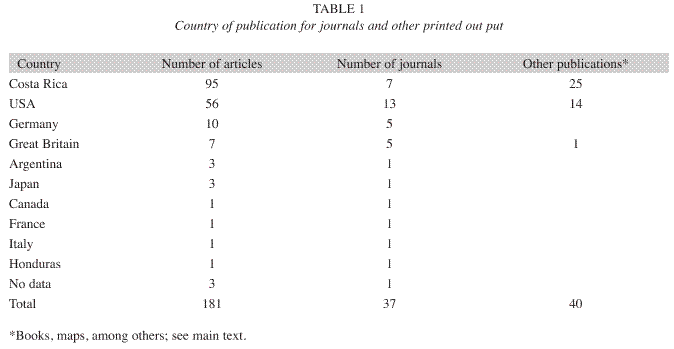
<body><![CDATA[<div style="text-align: justify;"></div>     <p style="text-align: justify;"><font face="Verdana" size="2">Female researchers produce less than their male colleagues (Kelchtermans &amp; Veugelers 2008) and follow throughout life a flattened version of the male productivity curve; the same is true for female musicians and fiction writers (Kanazawa 2003). The reasons for the lower productivity of women have traditionally been explained as the result of social limitations, but a biological cause must also be considered (Kanazawa 2003).</font></p>     <div style="text-align: justify;"></div>     <p style="text-align: justify;"><font face="Verdana" size="2">How incentives for collaboration affect productivity has been studied in research networks funded by the European Union. During the period of funding, collaboration does not produce an increase in productivity. But productivity after the funding period increases (Defazio <i>et al. </i>2009).</font></p>     <div style="text-align: justify;"></div>     <p style="text-align: justify;"><font face="Verdana" size="2">A study of the Italian National Research Council data found that, just like humans, research institutes become larger, less productive, more expensive to maintain and less able to raise money as they grow old (Bonaccorsi &amp; Daraio 2003).</font></p>     <div style="text-align: justify;"></div>     <p style="text-align: justify;"><font face="Verdana" size="2">To come to such conclusions, the great majority of studies have done correlation analyses on samples of hundreds of researchers (Kanazawa 2003, Defazio <i>et al. </i>2009), but few have done in-depth observations on individual lives. Besides, almost the totality of studies deal with European or American scientists (Kyvik 1990, Defazio <i>et al. </i>2009) ignoring the rest of the world&#8217;s scientific community. In these times of danger for the tropical ecosystems where the majority of biodiversity is found, it is particularly shocking that no such studies exist for tropical researchers.</font></p>     <div style="text-align: justify;"></div>     <p style="text-align: justify;"><font face="Verdana" size="2">Our contribution in this article is that we present an in-depth analysis of the productivity of an internationally recognized tropical botanist and conservationist, Luis Diego G&oacute;mez Pignataro, based on the totality of his published work and on our own knowledge, as co-workers and friends, of the life frame in which that scientific output was produced. </font></p> <b><font face="Verdana" size="3">     ]]></body>
<body><![CDATA[<p>Materials and methods</p> </font></b><font size="2"> </font>     <p style="text-align: justify;"><font face="Verdana" size="2">The scientific output was obtained from various sources: "Luis Diego G&oacute;mez: Personal Bibliography" Organization for Tropical Studies (www.ots.ac.cr), the online-catalogues (OPAC) of Universidad de Costa Rica and Universidad Nacional (www.ucr.ac.cr and www. una.ac.cr), the ISI Web of Science and Google Academic, as well as interviews and other information supplied by close associates and relatives familiar with his work. His book reviews, published for years in the Revista de Biolog&iacute;a Tropical (</font><font face="Verdana" size="2">www.biologiatropical</font><font  face="Verdana" size="2">.ac.cr) were not included. The information was processed with the bibliographies manager ProCite.</font></p>     <p><font face="Verdana" size="2">The Collaboration Index (CI) was calculated with the formula: CI=number of authors per publication/number of publications.</font></p> <b><font face="Verdana" size="3">     <p>Results</p> </font></b><font size="2"> </font><font face="Verdana" size="2"></font>     <p style="text-align: justify;"><font face="Verdana" size="2">Luis Diego was one of the most outstanding Latin American botanists of the 20th century (Bohlen 1993) and his mini-autobiography is now available (Bohlen 1993). His productive career covered 39 years (1968-2009), in which he produced 181 articles that were published in a total of 37 journals. The overall mean was 4.6 articles per year but in 1982 he published 15 articles (mostly of the <i>Plantae Mesoamericanae Novae </i>series) and 23 articles and other works were published in 1983, many as chapters in Costa Rican Natural History (Janzen 1983).</font></p>     <div style="text-align: justify;"></div>     <p style="text-align: justify;"><font face="Verdana" size="2">He also published 41 other works that included books, book chapters, meeting presentations, booklets and maps, and he edited several books by other authors (<a href="/img/revistas/rbt/v58n4/a04t1.gif">Table 1</a>).</font></p>     <div style="text-align: justify;"></div>     <p style="text-align: justify;"><font face="Verdana" size="2">Half of his articles appeared in international journals published in Costa Rica, one third in the USA and the rest in European, Latin American and Asian journals published in a total of 10 countries (<a  href="/img/revistas/rbt/v58n4/a04t1.gif">Table 1</a>).</font></p>     <div style="text-align: justify;"></div>     ]]></body>
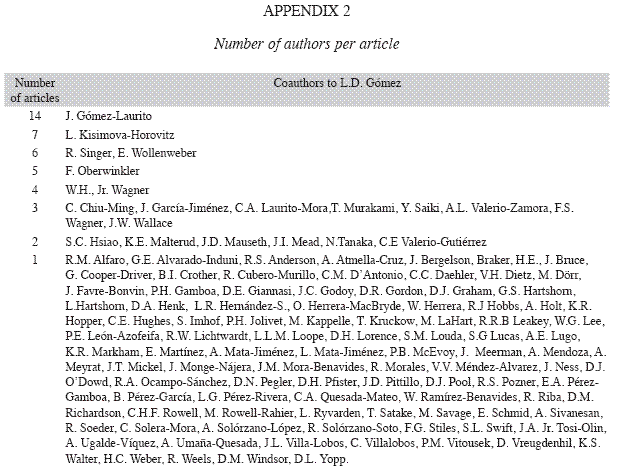
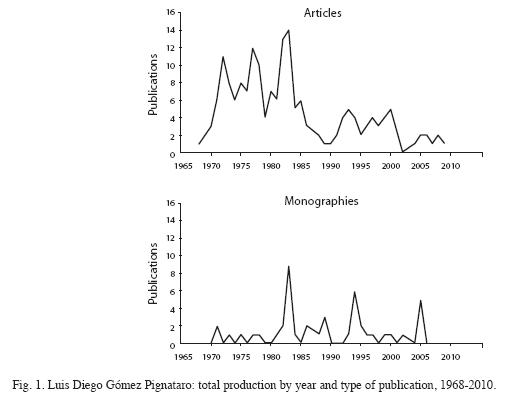
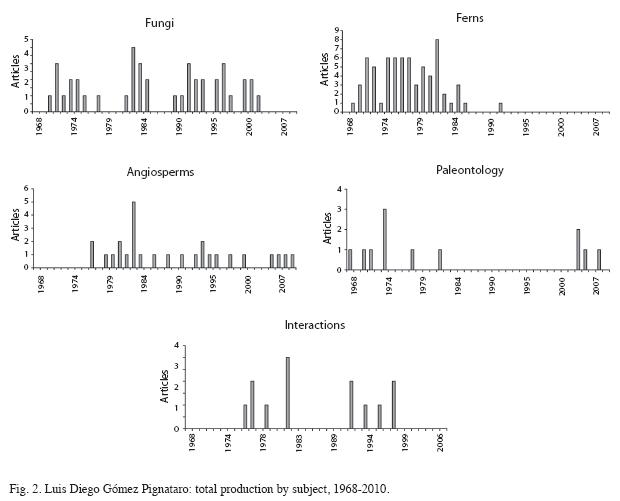
<body><![CDATA[<p style="text-align: justify;"><font face="Verdana" size="2">His favorite journals to publish were Brenesia, Biolog&iacute;a Tropical, American Fern Journal and Phytologia (<a  href="/img/revistas/rbt/v58n4/a04t1a.gif">Appendix 1</a>).</font></p>     <div style="text-align: justify;"></div>     <p style="text-align: justify;"><font face="Verdana" size="2">Nearly 60% of his articles were in English, the rest were mostly in Spanish but he also wrote two in German and one in Italian.</font></p>     <div style="text-align: justify;"></div>     <p style="text-align: justify;"><font face="Verdana" size="2">He was the single author in 63% of his articles, with a collaboration index of 1.79. His most frequent co-authors were Jorge G&oacute;mez- Laurito, Liuba Kisimova-Horovitz, Rolf Singer and Eckhard Wollenweber. He also published 44 articles with one coauthor, 22 with two, five with three, five with four and five articles with more than four coauthors (<a href="/img/revistas/rbt/v58n4/a04t2a.gif">Appendix 2</a>).</font></p>     <div style="text-align: justify;"></div>     <p style="text-align: justify;"><font face="Verdana" size="2">The productivity curve has many peaks but for articles his greatest output was during the first 20 years of his career. For other publications such as books and maps, he peaked 15 and again 25 years after the beginning. There are three basic time trends in productivity: his output on fungi remained fairly constant throughout his life; the output on ferns had three large peaks in the first 20 years and the output on angiosperms was zero in the first 10 years, it peaked and was kept low afterwards (<a href="#fig1">Fig. 1</a>).    <br> </font></p>     <p><font face="Verdana" size="2">    <br>     ]]></body>
<body><![CDATA[<br> </font></p>     <div style="text-align: center;"><a name="fig1"></a><img  src="/img/revistas/rbt/v58n4/a04i1.jpg" title="" alt=""  style="width: 506px; height: 396px;">    <br>     <br> </div> <font face="Verdana" size="2">     <p>The greatest output was on ferns, fungi and angiosperms (<a  href="/img/revistas/rbt/v58n4/a04i2.jpg">Fig. 2</a>). The complete list of publications appears in <a  href="/img/revistas/rbt/v58n4/a04t3a.gif">Appendix 3</a>. </p> </font><b><font face="Verdana" size="3">     <p>Discussion</p> </font><font size="2"> </font></b>     <p style="text-align: justify;"><b><font face="Verdana" size="2">Early life: </font></b><font face="Verdana" size="2">In the decade of 1990, scientists started to publish internationally at the age of 35, but when Luis Diego G&oacute;mez Pignataro began his career in 1968, he was within the standard documented for that period by Bonaccorsi &amp; Daraio (2003), which was around 25 years.</font></p>     <div style="text-align: justify;"></div>     <p style="text-align: justify;"><font face="Verdana" size="2">His interest in tropical nature was born in an era in which Costa Rica was experiencing a population boom and the agro-export model was the country&#8217;s accepted "path to development". The tropical forest was seen as a frontier to conquer, as described by the Costa Rican novelist Fabian Doubles in <i>El sitio de las abras </i>(Dobles 1950), a novel that describes the place and time in which Luis Diego grew up. He started publishing the results of his scientific research in the late 1960s but years before, when he was a child growing up amid the dense Caribbean rainforest, he had already begun studying the family garden, reading natural history books and creating his own plant classification system based on morphological characteristics (Bohlen 1993). Thus started a productive career that lasted the typical spam of around 40 years (Kyvik 1990).</font></p>     <div style="text-align: justify;"><b><font size="2"> </font></b></div>     ]]></body>
<body><![CDATA[<p style="text-align: justify;"><b><font face="Verdana" size="2">Productivity: </font></b><font face="Verdana" size="2">In the USA, a study based on 443 academic scientists found that productivity is related to being male, tenured, married and non-native, and that chemists have the highest per capita productivity while scientists in computer science have the lowest (Bozeman &amp; Lee 2003). The number of articles per author increased along the 20<sup>th</sup> century. In the 1930s, scientists peaked at three articles per year, while that working in the 1960&#8217;s averaged four articles per year (Hall <i>et al. </i>2003). More recently, the number of yearly international publications per researcher varies from none to 20 but three is typical for Europe (Bonaccorsi &amp; Daraio 2003). The productivity of Luis Diego (4.6 articles per year) can be considered average for good international researchers. Considering that he almost never asked for research funds, his output is extraordinary and shows a known but seldom mentioned finding: get far less financing than their mediocre colleagues (Bonaccorsi &amp; Daraio 2003, Kelchtermans &amp; Veugelers 2008).</font></p>     <div style="text-align: justify;"></div>     <p style="text-align: justify;"><font face="Verdana" size="2">The unusually high productivities of 1982 and 1983 probably reflect the fact that the <i>Plantae Mesoamericanae Novae </i>series was a field that he knew well and that the chapters in <i>Costa Rican Natural History </i>were short: we believe that both required less time than more complex scientific papers and thus his output was higher in these years.</font></p>     <div style="text-align: justify;"></div>     <p style="text-align: justify;"><font face="Verdana" size="2">Young researchers tend to produce work of higher quality (Kelchtermans &amp; Veugelers 2008) but we did not study if this applies to the work by Luis Diego.</font></p>     <div style="text-align: justify;"></div>     <p style="text-align: justify;"><font face="Verdana" size="2">The 1980s was a period of great transformation in Luis Diego&#8217;s life. After achieving in 1986 what has been called the National Museum&#8217;s Second Golden Age, he left to pursue another major rescue project, one that appeared to be a lost cause: what is now the Wilson Botanical Garden.</font></p>     <div style="text-align: justify;"></div>     <p style="text-align: justify;"><font face="Verdana" size="2">As a result of his effort and ability to motivate those around him, from construction workers to scientists and donors, the garden became an international research center and scored the highest rating as a destination for ecotourism. The garden is also an internationally recognized documentation and conservation center, an achievement seen by the local community as their own actions thanks to outreach efforts and environmental education. It is visited annually by biology students from the U.S., Europe and several other regions, and Luis Diego played several simultaneous roles in keeping the garden as a leader in the region.</font></p>     <p style="text-align: justify;"><font face="Verdana" size="2">All this administrative effort did not prevent him from publishing. He designed a fern key that is essential to any current Central American fern ecology and conservation research. He also studied the extraordinary resistance of ferns to herbivore attack and their biogeographic origin, a subject that he continued to work on until it was extended to all Costa Rica paleo-biogeography. Perhaps his most striking description was his paper on the first American fern preserved in amber, which he called <i>Grammitis succinea </i>(G&oacute;mez 1982). He found time to continue the series on fungi taxonomy that he had begun in the previous decade and to describe the gastronomic preferences of a squirrel when offered fungi, in the most classic style of natural history.</font></p>     ]]></body>
<body><![CDATA[<div style="text-align: justify;"></div>     <p style="text-align: justify;"><font face="Verdana" size="2">In the field of history and drawing from his Latin knowledge, he wrote an article on the Roman naturalist Pliny the Elder and how his view influenced the attitude of Spaniards and Latin Americans towards fungi (G&oacute;mez 1983).</font></p>     <div style="text-align: justify;"></div>     <p style="text-align: justify;"><font face="Verdana" size="2">Supporting talented young people may be the best investment in science (Wallner <i>et al. </i>2003) and Luis Diego was well known for practicing this idea. Gail Hewson, his second wife tells us about his time as head of the Costa Rica National Museum Natural History Department between 1970 and 1985:</font></p>     <div style="text-align: justify;"></div>     <p style="text-align: justify;"><font face="Verdana" size="2">"Luis Diego&#8217;s botany and taxonomy contribution impress beyond words. He had a formidable career within Costa Rica&#8217;s National Museum. It is almost impossible to browse a guide to identification of any Costa Rican flora and fauna group without finding recognition to Luis Diego, for his time, energy and collaboration".</font></p>     <div style="text-align: justify;"></div>     <p style="text-align: justify;"><font face="Verdana" size="2">Rafael &Aacute;ngel Chac&oacute;n adds:</font></p>     <div style="text-align: justify;"></div>     <p style="text-align: justify;"><font face="Verdana" size="2">"In 1972, when I was only 16 years old, I started to work at the National Museum of Costa Rica. There I met Mr. Luis Diego G&oacute;mez. At that time he was the General Director, Natural History Section Chair and the National Herbarium Director. Don Luis, as he was known, called me to be part of the National Herbarium staff, which by that time had 45 000 specimens mounted and cataloged, with much material stored in cardboard boxes. He taught me my first steps in the natural sciences. Under his management, the Natural History Section changed its name to Natural History Department. As the collections were scattered throughout various parts of the museum, with hard work and dedication he built the Natural History Building.</font></p>     ]]></body>
<body><![CDATA[<div style="text-align: justify;"></div>     <p style="text-align: justify;"><font face="Verdana" size="2">As a person and leader he was outstanding. We shared many things, both personal and workrelated. In March 1984, I had the wonderful experience of walking for 22 days by his side, climbing Fabrega Peak in Panama. On the third day we wanted to come back due to the weather. In the tent everything was completely wet and he said "Look, if tomorrow we wake-up with more rain, we&#8217;ll turn around and go back". Fortunately, the next morning the sun shined. The following days, the cold pierced my bones but Luis Diego, always looking ahead, told us: "We will make it!". To talk about Luis Diego there is only one word in the dictionary: <i>naturalist</i>; he was a true one, an expert on our natural history like there are very few".</font></p>     <div style="text-align: justify;"></div>     <p style="text-align: justify;"><font face="Verdana" size="2"><b>Journals where he published: </b>Like other scientists, he tried to spread his articles among a variety of journals in the hope of reaching a wider audience but concentrated on a few. <i>Brenesia </i>was the natural history journal that he had founded in the Museum. To our knowledge, he was not criticized for publishing in his own journal, perhaps this was not an issue because the quality of his work was so widely recognized. He sent many manuscripts to Biolog&iacute;a Tropical and a possible reason was that the <i>Revista </i>is one of the leading journals in tropical research and it has its offices in Costa Rica. The American Fern Journal and Phytologia were also good options for him because they are specialized in his field of work.</font></p>     <p style="text-align: justify;"><font face="Verdana" size="2">Perhaps his most seminal contribution in the editorial field was the creation of the journal <i>Brenesia</i>, which honors Costa Rica&#8217;s first graduate biologist, botanist Alberto Brenes. <i>Brenesia </i>quickly became a major scientific journal, with authors of great prestige, thanks to his skillful editorship. <i>Brenesia</i></font><font  size="2">&#8217;</font><font face="Verdana" size="2">s foundation was within a broader renewal context, because Luis Diego was Director of Costa Rica National Museum Department of Natural History between 1970 and 1985, bringing the museum not only out of the decline it had suffered after World War II but achieving in that time the recognition of an active international center for botanical and entomological research.</font></p>     <div style="text-align: justify;"><b><font size="2"> </font></b><font face="Verdana" size="2">     <p><span style="font-weight: bold;">Language: </span>English dominates the scientific productivity of the world (Monge-N&aacute;jera &amp; Nielsen 2005). In the case of Luis Diego, his command of the English language was impressive, so is not surprising that he wrote nearly 60% of his articles in the language of science but the fact that he also wrote almost 40% in Spanish is harder to explain. Maybe he wanted to make those articles more accessible to technicians and students. Perhaps he published in German and Italian just "for fun" (Italian was the language of his mother). He also had knowledge of Aramaic, Latin and Russian. Ana Victoria Lizano says:</p>     <p>"His relationship with Dr. Rafael Lucas Rodriguez was very close. Among their common passion was the love for Latin who he also shared with Jorge G&oacute;mez Laurito. It seems that exchanging letters and messages in Latin was among their hobbies".</p> </font><font size="2"> </font></div>     <p style="text-align: justify;"><span style="font-weight: bold;"><font  face="Verdana" size="2">Collaboration:</font></span><font  face="Verdana" size="2"> In recent decades, collaboration leading to coauthorship has been the norm: the mean number of collaborators for one year&#8217;s research work is nearly 14, of which 41% are graduate students and 27% are women (Bozeman &amp; Lee 2003). Researchers spend 84% of their time working in collaboration and researchers with more collaborators publish more articles (Bozeman &amp; Lee 2003). Collaborative projects are often done to capitalize on funding opportunities but in the long run they tend to increase researcher productivity (Defazio <i>et al. </i>2009). By modern standards, Luis Diego was a lonely author with only 37% of his articles done in collaboration, possibly because others found it hard to follow his rhythm of work. Even so, he published repeatedly with several colleagues, particularly Jorge G&oacute;mez-Laurito, who was both cousin and a tropical botanist; Liuba Kisimova-Horovitz, a German mycologist who visited Costa Rica several times (they shared their love for long walks in the forest); Rolf Singer, the famous German botanist, had been his mentor in earlier years and Eckhard Wollenweber, a leading German researcher in natural products (Luis Diego was always interested in the uses of tropical plants and published a <i>Botany of the Central Market </i>column in the Wilson Garden&#8217;s <i>Amigos Newsletter</i>).</font></p>     <div style="text-align: justify;"><font size="2"> </font></div>     ]]></body>
<body><![CDATA[<p style="text-align: justify;"><font face="Verdana" size="2"><span  style="font-weight: bold;">Fields of work:</span> </font><font face="Verdana" size="2">Brilliant researchers tend to work in many fields, in contrast with the rest of their colleagues; classical examples of the first group include Leonardo da Vinci and Benjamin Franklin. Even though the greatest output from Luis Diego came in the areas of ferns, fungi and angiosperms, his published work covered many other areas and besides excelling in botany and natural history he was also a gifted illustrator and a pianist. Ana Victoria Lizano says:</font></p>     <p style="text-align: justify;"><font face="Verdana" size="2">"Since the times of high school, Luis Diego was a passionate music lover. He played the violin and the piano very well and I think that even gave some public concerts".</font></p>     <div style="text-align: justify;"></div>     <p style="text-align: justify;"><font face="Verdana" size="2">During the 1970s he defined what would be his major working areas. He described palms, bromeliads, algae, fossil figs and horsetail plants, updating the approach by reconstructing not only the organism but also the environmental conditions in which it lived. This was a model for later research on Costa Rica&#8217;s paleoclimate and paleo-ecosystems. He started the series <i>Flora Costaricensis</i>, which has continued to appear for more than three decades in the prestigious <i>Fieldiana: Botany</i>. He also described new fungi and fern species in various journals, always with excellent illustrations from his own hand.</font></p>     <div style="text-align: justify;"></div>     <p style="text-align: justify;"><font face="Verdana" size="2">He rescued Costa Rican lichens from oblivion with his research on basidiolichens, which years later would help make possible a dozen other studies from different authors on lichens as bioindicators of air pollution in Costa Rican cities. He published papers on the taxonomy and geographical distribution of fungi and ferns, from places as diverse as Central America, Easter Island and the Venezuelan Guyana. It was also during this period that Luis Diego began publishing about one of his favorite places, Cocos Island, where he studied subjects ranging from plants to flies that were associated with crabs.</font></p>     <div style="text-align: justify;"></div>     <p style="text-align: justify;"><font face="Verdana" size="2">He also made some incursions into ecology when he worked with ants associated with <i>Polypodium </i>plants (G&oacute;mez 1973) and with <i>Trigona </i>bees that collect plant gums (Ram&iacute;rez &amp; G&oacute;mez 1978).</font></p>     <div style="text-align: justify;"></div>     <p style="text-align: justify;"><font face="Verdana" size="2">He also pioneered historical analyses of Costa Rican science, with biographies of the Swiss botanist Hermann Crist, who described many Central American ferns (G&oacute;mez 1977) and the deeply human story of Swiss botanist Charles Werckl&eacute;, who sadly ended his days as an alcoholic in 19<sup>th</sup> Century Costa Rica (G&oacute;mez 1978).</font></p>     ]]></body>
<body><![CDATA[<div style="text-align: justify;"></div>     <p style="text-align: justify;"><font face="Verdana" size="2">Giving recognition to Costa Rican biologist Clodomiro Picado Twight, who published the first large ecological study of bromeliad ecology in the early 20th Century, Luis Diego published <i>The Biology of Bromeliads</i>, which was to be the first issue of a new serial publication called <i>Historia Natural de Costa Rica</i>, which he was unable to continue.</font></p>     <div style="text-align: justify;"></div>     <p style="text-align: justify;"><font face="Verdana" size="2">He annoyed some by dedicating his book <i>Costa Rican Vegetation </i></font><font size="2">"</font><font  face="Verdana" size="2">to the bureaucrats, without whose help I would have done more and better" and made some deep comments on the role of egos in Costa Rica science, for example commenting that the Costa Rican National Academy of Science was useless and included some people who should not be there while excluding some who should be in (G&oacute;mez 1994). Fortunately for him, apparently few &#8211;if any&#8211; ever read that book.</font></p>     <div style="text-align: justify;"><font size="2"> </font><font face="Verdana" size="2">     <p><span style="font-weight: bold;">Effect of marriage on productivity: </span>The higher productivity that characterizes earlier life in fields as varied as art, science and crime, may be a manifestation of young men&#8217;s competitive desire to gain access to women&#8217;s reproductive resources (Kanazawa 2003). The idea of a biological origin, explained because higher productivity would have increased male reproductive success in the ancestral environment, is supported by another interesting observation: marriage has a strong "desistance effect" on the productivity of male scientists and artists: men&#8217;s evolved psychological mechanism to be highly competitive in early adulthood seems to &#8216;&#8216;turn off&#8217;&#8217; when they get married, have children and experiment a reduced level of testosterone (Kanazawa 2003).</p> </font></div> <font face="Verdana" size="2"></font>     <div style="text-align: justify;"><font face="Verdana" size="2">     <p>Luis Diego married in 1970 (Bohlen 1993) and had a son, yet his productivity did not decrease (the marriage, however, lasted only 6 years). One change in his life that should have reduced his productivity was the administrative burden that he had as director of the Natural History Department (National Museum) from 1970 through 1985. Yet this reduction did not occur. Besides the articles, he published 41 other works that included whole books, book chapters, meeting presentations, booklets and maps. In the decade of 1980, he made assessments for the National Park Service, which were handed over to the authorities to improve their administrative work. He also published specialized articles on tropical ferns, conservation of natural ecosystems and botanical gardens and about horticulture in Costa Rica.</p>     <p>In 1989 he married for the second time, but again there was no immediate change in his productivity. During this period, he published several studies on the phytochemistry of Neotropical plants and made three major contributions in book form. On one hand, he played a central role as co-author and sponsor of the essays in <i>Costa Rican Natural History</i>, published in English by the University of Chicago and in Spanish by University of Costa Rica. In this regard, Gail Hewson, states:</p>     <p>"Probably his most accessible and widely read work is the first chapter in <i>Costa Rican Natural History</i>, entitled "Searchers on That Rich Coast: Costa Rican Field Biology, 1400-1980" (written with Jay Savage). His other contributions to this collection include "Marsh Fern", "Tree Ferns", "Parasitic Plants" and "Ferns" (with Warren H. Wagner). Certainly this fascinating and information rich book tops the list of "Required Readings" for students and travelers even though it was first published more than 20 years ago! ".</p>     ]]></body>
<body><![CDATA[<p>On the other hand, he was the author of <i>Costa Rica&#8217;s Aquatic and Amphibious Plants </i>(G&oacute;mez 1984) and the principal author of <i>Costa Rica&#8217;s Flora and Climate </i>(Herrera &amp; G&oacute;mez 1993) both published by the Universidad Estatal a Distancia de Costa Rica. His work on aquatic plants would become a key reference for the study and conservation of wetlands in Costa Rica, and <i>Costa Rica&#8217;s Flora and Climate </i>still is the principal compendium on the country&#8217;s climate, plant ecology and paleoecosystems.</p> </font><font size="2"> </font></div>     <p style="text-align: justify;"><span style="font-weight: bold;"><font  face="Verdana" size="2">Possible effect of garden&#8217;s work on productivity:</font></span><font face="Verdana" size="2"> The marked reduction in his personal productivity came when he left the National Museum and started work in the Wilson Botanical Garden. The scientific productivity of the Museum also fell noticeably after he left, not only in quantity but also in quality (and has not recovered to this date). In fact, Luis Diego&#8217;s output was lower after he started working intensively in conservation and in saving the botanical garden. Gail Hewson remembers this period:</font></p>     <p style="text-align: justify;"><font face="Verdana" size="2">"The garden&#8217;s recovery after the terrible fire of 1994 was the work of many committed individuals and foundations, but none worked harder than Luis to ensure it. The <i>Amigos Newsletter </i>went from being a simple letter to OTS friends and staff members, to a very popular quarterly newsletter for visitors, who sought to keep their memories of the garden alive through the colorful, humorous and enlightening prose that characterized Luis. Who can forget his column <i>Botany in the Central Market </i>and his reflections on everything from tropical medicine, nature&#8217;s color, the protocol to transform a meadow in a forest or the wisdom of the local shamans. He had the wonderful gift of being able to awake interest and even occasional controversy among scientists and laypersons alike".</font></p>     <div style="text-align: justify;"></div>     <p style="text-align: justify;"><font face="Verdana" size="2">He also found time to work, with much clearer way, in conservation, combining his duties in the botanical garden with publications on Costa Rica&#8217;s tropical biodiversity, paramo&#8217;s ecology and conservation and Costa Rica&#8217;s southern region common trees and birds names. Simultaneously, he became active in the scientific articles publication on fungi systematic, plant physiology and phytochemistry.</font></p>     <div style="text-align: justify;"></div>     <p style="text-align: justify;"><font face="Verdana" size="2">During the third decade, even though his output was lower, he made occasional forays into other fields, such as participating in the redescription of the snake <i>Bothrops supraciliaris </i>(Sol&oacute;rzano <i>et al. </i>1998) and understanding the bird&#8217;s role in dispersal of the primitive plant <i>Zamia&#8217;</i>s (G&oacute;mez 1993), a species particularly striking because it survived the Cretaceous- Tertiary extinction (65.5 million years ago) with few changes.</font></p>     <div style="text-align: justify;"></div>     <p style="text-align: justify;"><font face="Verdana" size="2">After 2000 he continued his work on the <i>Flora Costaricensis</i>, published more on fungal taxonomy and showed that he was still interest in biogeography with the publication of the important <i>Central America&#8217;s Ecosystems Map </i>(Vreugdenhil <i>et al. </i>2002).</font></p>     <div style="text-align: justify;"><font size="2"> </font></div>     ]]></body>
<body><![CDATA[<p style="text-align: justify;"><span style="font-weight: bold;"><font  face="Verdana" size="2">The great fire and its effect on his motivation:</font></span><font face="Verdana" size="2"> Shortly after the fire in the garden, he told one of us (JMN): "My collection of San Vito insects burned during the fire. The next day, a nice beetle landed so close that I captured it with my hand. I told myself &#8216;this is the beginning of my new collection&#8217;, but then I thought of all that I had lost and let it fly away". Then he showed stacks of manuscripts he kept in a drawer and added: "I have all these, but I will never publish them. I no longer feel like it, I think it will make no difference if I publish them or not". This could explain the fall in his productivity, but it does not: the dramatic reduction in productivity had begun years before, just after he left the Museum. What did he lose when he left, that affected his output so much?</font></p>     <div style="text-align: justify;"></div>     <p style="text-align: justify;"><font face="Verdana" size="2">Two hypotheses are that he was too busy teaching and that he no longer felt a need to contribute articles to <i>Brenesia</i>. </font></p>     <div style="text-align: justify;"></div>     <p style="text-align: justify;"><font face="Verdana" size="2">Luis Diego was a passionate man and this included his teaching activities. He personally participated in the graduate and undergraduate courses taught at the Wilson Botanical Gardens, lecturing and acting as a guide in field trips. Unofficial data in the OTS files indicate that from 1986 to 2008 there were 177 graduate courses with 3 566 students. Additionally there were 56 undergraduate courses. Luis Diego was program coordinator in six of the eight <i>Ethnobiology </i>courses taught in Costa Rica, attended by a total of 103 students, participated in similar courses in Peru and even got scholarhips for some Peruvian students to travel to Costa Rica (Guiselle Castro, OTS, pers. com.). He also spent time hosting many visiting scientists and student group, so it is easy to see that he did not have much free time to write and we accept this hypothesis as a good candidate to explain the reduction in his productivity.</font></p> <font size="2"> </font><font face="Verdana" size="2"></font>     <div style="text-align: justify;"><font face="Verdana" size="2">     <p><span style="font-weight: bold;">The "Journal Hypothesis":</span> Future researchers may test the other hypothesis: that during the museum years he felt the need to write for <i>Brenesia </i>because the journal did not receive enough manuscripts and that he published far less after he left the journal because he no longer felt responsible for filling it up.</p> </font><font size="2"> </font><font face="Verdana" size="2">     <p><span style="font-weight: bold;">Conclusion:</span> The 222 publications that Luis Diego G&oacute;mez Pignataro contributed to world science are an extraordinary output for a lifetime but he might have produced even more if he had stayed in an European or American research center, with access to far superior resources. Nevertheless, like so many other scientists (as found by Bonaccorsi &amp; Daraio 2003), he chose to stay in his native land, to the great benefit of Latin American biology.</p> </font></div> <font face="Verdana" size="2"></font><font face="Verdana" size="3">     <p><span style="font-weight: bold;">Acknowledgments</span> </p> </font><font size="2"> </font><font face="Verdana" size="2"></font>     <div style="text-align: justify;"><font face="Verdana" size="2">     ]]></body>
<body><![CDATA[<p>From the University of Costa Rica we thank Jorge G&oacute;mez Laurito for information and advice, and from the OTS we thank Guiselle Castro for data and Mariana Mora for the interviews reproduced here (our translation).</p> </font></div> <font face="Verdana" size="2"></font><font face="Verdana" size="3"> </font> <hr style="width: 100%; height: 2px;"><font face="Verdana" size="3">     <p><span style="font-weight: bold;">References</span> </p> </font><font size="2"> </font><font face="Verdana" size="2"></font>     <!-- ref --><p><font face="Verdana" size="2">Bohlen, J.T. 1993. For the wild places: profiles in conservation. Island, Washington, D.C.    &nbsp;&nbsp;&nbsp;&nbsp;&nbsp;&nbsp;&nbsp;&nbsp;[&#160;<a href="javascript:void(0);" onclick="javascript: window.open('/scielo.php?script=sci_nlinks&ref=1389139&pid=S0034-7744201000040000400001&lng=','','width=640,height=500,resizable=yes,scrollbars=1,menubar=yes,');">Links</a>&#160;]<!-- end-ref --></font></p>     <!-- ref --><p><font face="Verdana" size="2">Bonaccorsi A. &amp; C. Daraio. 2003. Age effects in scientific productivity. Scientometrics 58: 49-90</font>&nbsp;&nbsp;&nbsp;&nbsp;&nbsp;&nbsp;&nbsp;&nbsp;[&#160;<a href="javascript:void(0);" onclick="javascript: window.open('/scielo.php?script=sci_nlinks&ref=1389141&pid=S0034-7744201000040000400002&lng=','','width=640,height=500,resizable=yes,scrollbars=1,menubar=yes,');">Links</a>&#160;]<!-- end-ref --><!-- ref --><p><font face="Verdana" size="2">Bozeman, B. &amp; S. Lee. 2003. The Impact of Research Collaboration on Scientific Productivity. Annual Meeting of the American Association for the Advancement of Science. February. Denver, Colorado, USA.    &nbsp;&nbsp;&nbsp;&nbsp;&nbsp;&nbsp;&nbsp;&nbsp;[&#160;<a href="javascript:void(0);" onclick="javascript: window.open('/scielo.php?script=sci_nlinks&ref=1389142&pid=S0034-7744201000040000400003&lng=','','width=640,height=500,resizable=yes,scrollbars=1,menubar=yes,');">Links</a>&#160;]<!-- end-ref --></font></p>     <!-- ref --><p><font face="Verdana" size="2">Brodetsky, S. 1942. Newton: Scientist and man. Nature 150: 698-699.    &nbsp;&nbsp;&nbsp;&nbsp;&nbsp;&nbsp;&nbsp;&nbsp;[&#160;<a href="javascript:void(0);" onclick="javascript: window.open('/scielo.php?script=sci_nlinks&ref=1389144&pid=S0034-7744201000040000400004&lng=','','width=640,height=500,resizable=yes,scrollbars=1,menubar=yes,');">Links</a>&#160;]<!-- end-ref --></font></p>     <!-- ref --><p><font face="Verdana" size="2">Defazio D., A. Lockett &amp; M. Wright. 2009. Funding incentives, collaborative dynamics and scientific productivity: Evidence from the EU framework program. Res. Policy 38: 293-305.    &nbsp;&nbsp;&nbsp;&nbsp;&nbsp;&nbsp;&nbsp;&nbsp;[&#160;<a href="javascript:void(0);" onclick="javascript: window.open('/scielo.php?script=sci_nlinks&ref=1389146&pid=S0034-7744201000040000400005&lng=','','width=640,height=500,resizable=yes,scrollbars=1,menubar=yes,');">Links</a>&#160;]<!-- end-ref --></font></p>     <!-- ref --><p><font face="Verdana" size="2">Dobles, F. 1950. El sitio de las abras. Editorial Costa Rica, San Jos&eacute;, Costa Rica.    &nbsp;&nbsp;&nbsp;&nbsp;&nbsp;&nbsp;&nbsp;&nbsp;[&#160;<a href="javascript:void(0);" onclick="javascript: window.open('/scielo.php?script=sci_nlinks&ref=1389148&pid=S0034-7744201000040000400006&lng=','','width=640,height=500,resizable=yes,scrollbars=1,menubar=yes,');">Links</a>&#160;]<!-- end-ref --></font></p>     <!-- ref --><p><font face="Verdana" size="2">G&oacute;mez, L.D. 1973. Ants and <i>Polypodium polypodioides</i>. Amer. Fern J. 63: 166.    &nbsp;&nbsp;&nbsp;&nbsp;&nbsp;&nbsp;&nbsp;&nbsp;[&#160;<a href="javascript:void(0);" onclick="javascript: window.open('/scielo.php?script=sci_nlinks&ref=1389150&pid=S0034-7744201000040000400007&lng=','','width=640,height=500,resizable=yes,scrollbars=1,menubar=yes,');">Links</a>&#160;]<!-- end-ref --></font></p>     <!-- ref --><p><font face="Verdana" size="2">G&oacute;mez, L.D. 1977. Contribuciones a la pteridolog&iacute;a costarricense. XI. Hermann Crist, su vida, obra e influencia en la bot&aacute;nica nacional. <i>Brenesia </i>12/13: 25-79.    &nbsp;&nbsp;&nbsp;&nbsp;&nbsp;&nbsp;&nbsp;&nbsp;[&#160;<a href="javascript:void(0);" onclick="javascript: window.open('/scielo.php?script=sci_nlinks&ref=1389152&pid=S0034-7744201000040000400008&lng=','','width=640,height=500,resizable=yes,scrollbars=1,menubar=yes,');">Links</a>&#160;]<!-- end-ref --></font></p>     <!-- ref --><p><font face="Verdana" size="2">G&oacute;mez, L.D. 1978. Contribuciones a la pteridolog&iacute;a costarricense XII. Carlos Werckl&eacute;. <i>Brenesia </i>14/15: 361- 93.    &nbsp;&nbsp;&nbsp;&nbsp;&nbsp;&nbsp;&nbsp;&nbsp;[&#160;<a href="javascript:void(0);" onclick="javascript: window.open('/scielo.php?script=sci_nlinks&ref=1389154&pid=S0034-7744201000040000400009&lng=','','width=640,height=500,resizable=yes,scrollbars=1,menubar=yes,');">Links</a>&#160;]<!-- end-ref --></font></p>     <!-- ref --><p><font face="Verdana" size="2">G&oacute;mez, L.D. 1982. <i>Grammitis succinea</i>, the first new world fern found in Amber. Am. Fern J. 72: 49-52.    &nbsp;&nbsp;&nbsp;&nbsp;&nbsp;&nbsp;&nbsp;&nbsp;[&#160;<a href="javascript:void(0);" onclick="javascript: window.open('/scielo.php?script=sci_nlinks&ref=1389156&pid=S0034-7744201000040000400010&lng=','','width=640,height=500,resizable=yes,scrollbars=1,menubar=yes,');">Links</a>&#160;]<!-- end-ref --></font></p>     <!-- ref --><p><font face="Verdana" size="2">G&oacute;mez, L.D. 1983. De Fungi: una selecci&oacute;n de Plinio el Viejo. Brenesia 21: 437-47</font>&nbsp;&nbsp;&nbsp;&nbsp;&nbsp;&nbsp;&nbsp;&nbsp;[&#160;<a href="javascript:void(0);" onclick="javascript: window.open('/scielo.php?script=sci_nlinks&ref=1389158&pid=S0034-7744201000040000400011&lng=','','width=640,height=500,resizable=yes,scrollbars=1,menubar=yes,');">Links</a>&#160;]<!-- end-ref --><!-- ref --><p><font face="Verdana" size="2">G&oacute;mez, L.D. 1993. Birds as short-range seed dispersers of <i>Zamia fairchildiana </i>in SW Costa Rica. Rev. Biol. Trop. 41: 905-906.    &nbsp;&nbsp;&nbsp;&nbsp;&nbsp;&nbsp;&nbsp;&nbsp;[&#160;<a href="javascript:void(0);" onclick="javascript: window.open('/scielo.php?script=sci_nlinks&ref=1389159&pid=S0034-7744201000040000400012&lng=','','width=640,height=500,resizable=yes,scrollbars=1,menubar=yes,');">Links</a>&#160;]<!-- end-ref --></font></p>     <!-- ref --><p><font face="Verdana" size="2">G&oacute;mez, L.D. 1994. Las ciencias naturales, p. 173-182. <i>In </i>O. Morales (ed.). Ideario Nacional de la Ciencia y la Tecnolog&iacute;a : Hacia el nuevo milenio. Ministerio de Ciencia y Tecnolog&iacute;a. San Jos&eacute;, Costa Rica.    &nbsp;&nbsp;&nbsp;&nbsp;&nbsp;&nbsp;&nbsp;&nbsp;[&#160;<a href="javascript:void(0);" onclick="javascript: window.open('/scielo.php?script=sci_nlinks&ref=1389161&pid=S0034-7744201000040000400013&lng=','','width=640,height=500,resizable=yes,scrollbars=1,menubar=yes,');">Links</a>&#160;]<!-- end-ref --> </font></p>     <!-- ref --><p><font face="Verdana" size="2">G&oacute;mez, L.D.1984. Las plantas acu&aacute;ticas y anfibias de Costa Rica y Centroam&eacute;rica I. Liliopsida. EUNED, San Jos&eacute;, Costa Rica.    &nbsp;&nbsp;&nbsp;&nbsp;&nbsp;&nbsp;&nbsp;&nbsp;[&#160;<a href="javascript:void(0);" onclick="javascript: window.open('/scielo.php?script=sci_nlinks&ref=1389163&pid=S0034-7744201000040000400014&lng=','','width=640,height=500,resizable=yes,scrollbars=1,menubar=yes,');">Links</a>&#160;]<!-- end-ref --></font></p>     <!-- ref --><p><font face="Verdana" size="2">Bohlen, J.T. 1993. Luis Diego G&oacute;mez: behind the scenes botanist, p. 118-146. <i>In </i>For the wild places: profile in conservation, Island, Washington, D.C., USA.    &nbsp;&nbsp;&nbsp;&nbsp;&nbsp;&nbsp;&nbsp;&nbsp;[&#160;<a href="javascript:void(0);" onclick="javascript: window.open('/scielo.php?script=sci_nlinks&ref=1389165&pid=S0034-7744201000040000400015&lng=','','width=640,height=500,resizable=yes,scrollbars=1,menubar=yes,');">Links</a>&#160;]<!-- end-ref --></font></p>     ]]></body>
<body><![CDATA[<!-- ref --><p><font face="Verdana" size="2">Herrera, W. &amp; L.D. G&oacute;mez. 1993. Mapa de unidades bi&oacute;ticas de Costa Rica San Jos&eacute;: (Escala 1:685 000). INCAFO, Madrid, Espa&ntilde;a.    &nbsp;&nbsp;&nbsp;&nbsp;&nbsp;&nbsp;&nbsp;&nbsp;[&#160;<a href="javascript:void(0);" onclick="javascript: window.open('/scielo.php?script=sci_nlinks&ref=1389167&pid=S0034-7744201000040000400016&lng=','','width=640,height=500,resizable=yes,scrollbars=1,menubar=yes,');">Links</a>&#160;]<!-- end-ref --></font></p>     <!-- ref --><p><font face="Verdana" size="2">Janzen, D.H. (ed.). 1983. Costa Rican Natural History, University of Chicago, Chicago, Illinois, USA.    &nbsp;&nbsp;&nbsp;&nbsp;&nbsp;&nbsp;&nbsp;&nbsp;[&#160;<a href="javascript:void(0);" onclick="javascript: window.open('/scielo.php?script=sci_nlinks&ref=1389169&pid=S0034-7744201000040000400017&lng=','','width=640,height=500,resizable=yes,scrollbars=1,menubar=yes,');">Links</a>&#160;]<!-- end-ref --></font></p>     <!-- ref --><p><font face="Verdana" size="2">Kanazawa, S. 2003. Why productivity fades with age: The crime&#8211;genius connection. J. Res. Personality 37: 257-272.    &nbsp;&nbsp;&nbsp;&nbsp;&nbsp;&nbsp;&nbsp;&nbsp;[&#160;<a href="javascript:void(0);" onclick="javascript: window.open('/scielo.php?script=sci_nlinks&ref=1389171&pid=S0034-7744201000040000400018&lng=','','width=640,height=500,resizable=yes,scrollbars=1,menubar=yes,');">Links</a>&#160;]<!-- end-ref --></font></p>     <!-- ref --><p><font face="Verdana" size="2">Kelchtermans, S. &amp; R. Veugelers. 2008. The great divide in scientific productivity: Why the average scientist does not exist. Department of Managerial Economics, Katholieke Universiteit, Leuve, Belgium.    &nbsp;&nbsp;&nbsp;&nbsp;&nbsp;&nbsp;&nbsp;&nbsp;[&#160;<a href="javascript:void(0);" onclick="javascript: window.open('/scielo.php?script=sci_nlinks&ref=1389173&pid=S0034-7744201000040000400019&lng=','','width=640,height=500,resizable=yes,scrollbars=1,menubar=yes,');">Links</a>&#160;]<!-- end-ref --></font></p> <font size="2"> </font><font face="Verdana" size="2">     <!-- ref --><p>Kyvik, S. 1990. Age and scientific productivity. Differences between fields of learning. Higher Educ. 19: 37-55.    &nbsp;&nbsp;&nbsp;&nbsp;&nbsp;&nbsp;&nbsp;&nbsp;[&#160;<a href="javascript:void(0);" onclick="javascript: window.open('/scielo.php?script=sci_nlinks&ref=1389175&pid=S0034-7744201000040000400020&lng=','','width=640,height=500,resizable=yes,scrollbars=1,menubar=yes,');">Links</a>&#160;]<!-- end-ref --></p>     ]]></body>
<body><![CDATA[<!-- ref --><p>Hall, B.H., J. Mairesse &amp; L. Turner. 2003. Identifying Age, Cohort and Period Effects in Scientific Research Productivity: Discussion and Illustration Using Simulated and Actual Data on French Physicists. SPRU Conference in Memory of Keith Pavitt, 13-15 November, University of Sussex, Sussex, England.    &nbsp;&nbsp;&nbsp;&nbsp;&nbsp;&nbsp;&nbsp;&nbsp;[&#160;<a href="javascript:void(0);" onclick="javascript: window.open('/scielo.php?script=sci_nlinks&ref=1389177&pid=S0034-7744201000040000400021&lng=','','width=640,height=500,resizable=yes,scrollbars=1,menubar=yes,');">Links</a>&#160;]<!-- end-ref --></p>     <!-- ref --><p>Wallner, B., M. Fieder &amp; K. Iber. 2003. Age profile, personnel costs and scientific productivity at the University of Vienna. Scientometrics 58: 143-153.    &nbsp;&nbsp;&nbsp;&nbsp;&nbsp;&nbsp;&nbsp;&nbsp;[&#160;<a href="javascript:void(0);" onclick="javascript: window.open('/scielo.php?script=sci_nlinks&ref=1389179&pid=S0034-7744201000040000400022&lng=','','width=640,height=500,resizable=yes,scrollbars=1,menubar=yes,');">Links</a>&#160;]<!-- end-ref --></p>     <!-- ref --><p>Ram&iacute;rez B.W. &amp; L.D. G&oacute;mez. 1978. Production of nectar and gums by flowers of <i>Monstera deliciosa </i>(Araceae) and of some species of <i>Clusia </i>(Guttiferae) collected by New World <i>Trigona </i>bees. Brenesia 14/15: 407-412.    &nbsp;&nbsp;&nbsp;&nbsp;&nbsp;&nbsp;&nbsp;&nbsp;[&#160;<a href="javascript:void(0);" onclick="javascript: window.open('/scielo.php?script=sci_nlinks&ref=1389181&pid=S0034-7744201000040000400023&lng=','','width=640,height=500,resizable=yes,scrollbars=1,menubar=yes,');">Links</a>&#160;]<!-- end-ref --></p>     <!-- ref --><p>Vreugdenhil, D., J. Meerman, A. Meyrat, L.D. G&oacute;mez &amp; D.J. Graham. 2002. Map of the Ecosystems of Central America: Final Report. World Bank, Washington, D.C., USA.    &nbsp;&nbsp;&nbsp;&nbsp;&nbsp;&nbsp;&nbsp;&nbsp;[&#160;<a href="javascript:void(0);" onclick="javascript: window.open('/scielo.php?script=sci_nlinks&ref=1389183&pid=S0034-7744201000040000400024&lng=','','width=640,height=500,resizable=yes,scrollbars=1,menubar=yes,');">Links</a>&#160;]<!-- end-ref --><br>     <br> </p>     <p><font face="Verdana" size="2"><a name="Correspondencia"></a>Corrrespondencia a: Juli&aacute;n Monge Najera. </font><font face="Verdana" size="2">Laboratorio de Ecolog&iacute;a Urbana, Universidad Estatal a Distancia, San Jos&eacute;, Costa Rica; </font><font  face="Verdana" size="2"><a href="mailto:julianmonge@gmail.com">julianmonge@gmail.com</a></font><font  face="Verdana" size="2">.     ]]></body>
<body><![CDATA[<br> </font><font face="Verdana" size="2">Vanessa Nielsen-Mu&ntilde;oz. </font><font face="Verdana" size="2">Revista de Biolog&iacute;a Tropical, Universidad de Costa Rica</font><font face="Verdana" size="2">; <a href="mailto:vnielsen.rbt@gmail.com">vnielsen.rbt@gmail.com</a></font><font  face="Verdana" size="2">.    <br> </font><font face="Verdana" size="2">Ana Beatriz Azofeifa. </font><font face="Verdana" size="2">Escuela de Bibliotecolog&iacute;a y Ciencias de la Informaci&oacute;n, Universidad de Costa Rica</font><font face="Verdana" size="2">; </font><a  href="mailto:abazofeifa@gmail.com"><font face="Verdana" size="2">abazofeifa@gmail.com</font></a><font  face="Verdana" size="2">.</font></p> </font> <hr style="width: 100%; height: 2px;"><font face="Verdana" size="2"></font><font  face="Verdana" size="2"><font face="Verdana" size="2">     <p align="center">Received 26-V-2010. Corrected 01-VII-2010. Accepted 06-VIII-2010.    <br> </p> </font> </font>      ]]></body><back>
<ref-list>
<ref id="B1">
<nlm-citation citation-type="">
<person-group person-group-type="author">
<name>
<surname><![CDATA[Bohlen]]></surname>
<given-names><![CDATA[J.T]]></given-names>
</name>
</person-group>
<source><![CDATA[For the wild places: profiles in conservation]]></source>
<year>1993</year>
<publisher-loc><![CDATA[Island^eWashington, D.C Washington, D.C]]></publisher-loc>
</nlm-citation>
</ref>
<ref id="B2">
<nlm-citation citation-type="journal">
<person-group person-group-type="author">
<name>
<surname><![CDATA[Bonaccorsi]]></surname>
<given-names><![CDATA[A]]></given-names>
</name>
<name>
<surname><![CDATA[Daraio]]></surname>
<given-names><![CDATA[C]]></given-names>
</name>
</person-group>
<article-title xml:lang="en"><![CDATA[Age effects in scientific productivity]]></article-title>
<source><![CDATA[Scientometrics]]></source>
<year>2003</year>
<volume>58</volume>
<page-range>49-90</page-range></nlm-citation>
</ref>
<ref id="B3">
<nlm-citation citation-type="">
<person-group person-group-type="author">
<name>
<surname><![CDATA[Bozeman]]></surname>
<given-names><![CDATA[B]]></given-names>
</name>
<name>
<surname><![CDATA[Lee]]></surname>
<given-names><![CDATA[S]]></given-names>
</name>
</person-group>
<source><![CDATA[The Impact of Research Collaboration on Scientific Productivity]]></source>
<year>2003</year>
<publisher-loc><![CDATA[Denver^eColorado Colorado]]></publisher-loc>
</nlm-citation>
</ref>
<ref id="B4">
<nlm-citation citation-type="journal">
<person-group person-group-type="author">
<name>
<surname><![CDATA[Brodetsky]]></surname>
<given-names><![CDATA[S]]></given-names>
</name>
</person-group>
<article-title xml:lang="en"><![CDATA[Newton: Scientist and man]]></article-title>
<source><![CDATA[Nature]]></source>
<year>1942</year>
<volume>150</volume>
<page-range>698-699</page-range></nlm-citation>
</ref>
<ref id="B5">
<nlm-citation citation-type="journal">
<person-group person-group-type="author">
<name>
<surname><![CDATA[Defazio]]></surname>
<given-names><![CDATA[D]]></given-names>
</name>
<name>
<surname><![CDATA[Lockett]]></surname>
<given-names><![CDATA[A]]></given-names>
</name>
<name>
<surname><![CDATA[Wright]]></surname>
<given-names><![CDATA[M]]></given-names>
</name>
</person-group>
<article-title xml:lang="en"><![CDATA[Funding incentives, collaborative dynamics and scientific productivity: Evidence from the EU framework program]]></article-title>
<source><![CDATA[Res. Policy]]></source>
<year>2009</year>
<volume>38</volume>
<page-range>293-305</page-range></nlm-citation>
</ref>
<ref id="B6">
<nlm-citation citation-type="book">
<person-group person-group-type="author">
<name>
<surname><![CDATA[Dobles]]></surname>
<given-names><![CDATA[F]]></given-names>
</name>
</person-group>
<source><![CDATA[El sitio de las abras]]></source>
<year>1950</year>
<publisher-loc><![CDATA[San José ]]></publisher-loc>
<publisher-name><![CDATA[Editorial Costa Rica]]></publisher-name>
</nlm-citation>
</ref>
<ref id="B7">
<nlm-citation citation-type="journal">
<person-group person-group-type="author">
<name>
<surname><![CDATA[Gómez]]></surname>
<given-names><![CDATA[L.D]]></given-names>
</name>
</person-group>
<article-title xml:lang="en"><![CDATA[Ants and Polypodium polypodioides]]></article-title>
<source><![CDATA[Amer. Fern J]]></source>
<year>1973</year>
<volume>63</volume>
<page-range>166</page-range></nlm-citation>
</ref>
<ref id="B8">
<nlm-citation citation-type="journal">
<person-group person-group-type="author">
<name>
<surname><![CDATA[Gómez]]></surname>
<given-names><![CDATA[L.D]]></given-names>
</name>
</person-group>
<article-title xml:lang="es"><![CDATA[Contribuciones a la pteridología costarricense: XI. Hermann Crist, su vida, obra e influencia en la botánica nacional]]></article-title>
<source><![CDATA[Brenesia]]></source>
<year>1977</year>
<volume>12/13</volume>
<page-range>25-79</page-range></nlm-citation>
</ref>
<ref id="B9">
<nlm-citation citation-type="journal">
<person-group person-group-type="author">
<name>
<surname><![CDATA[Gómez]]></surname>
<given-names><![CDATA[L.D]]></given-names>
</name>
</person-group>
<article-title xml:lang="es"><![CDATA[Contribuciones a la pteridología costarricense: XII. Carlos Wercklé]]></article-title>
<source><![CDATA[Brenesia]]></source>
<year>1978</year>
<volume>14/15</volume>
<page-range>361- 93</page-range></nlm-citation>
</ref>
<ref id="B10">
<nlm-citation citation-type="journal">
<person-group person-group-type="author">
<name>
<surname><![CDATA[Gómez]]></surname>
<given-names><![CDATA[L.D]]></given-names>
</name>
</person-group>
<article-title xml:lang="en"><![CDATA[Grammitis succinea, the first new world fern found in Amber]]></article-title>
<source><![CDATA[Am. Fern J]]></source>
<year>1982</year>
<volume>72</volume>
<page-range>49-52</page-range></nlm-citation>
</ref>
<ref id="B11">
<nlm-citation citation-type="journal">
<person-group person-group-type="author">
<name>
<surname><![CDATA[Gómez]]></surname>
<given-names><![CDATA[L.D]]></given-names>
</name>
</person-group>
<article-title xml:lang="es"><![CDATA[De Fungi: una selección de Plinio el Viejo]]></article-title>
<source><![CDATA[Brenesia]]></source>
<year>1983</year>
<volume>21</volume>
<page-range>437-47</page-range></nlm-citation>
</ref>
<ref id="B12">
<nlm-citation citation-type="journal">
<person-group person-group-type="author">
<name>
<surname><![CDATA[Gómez]]></surname>
<given-names><![CDATA[L.D]]></given-names>
</name>
</person-group>
<article-title xml:lang="en"><![CDATA[Birds as short-range seed dispersers of Zamia fairchildiana in SW Costa Rica]]></article-title>
<source><![CDATA[Rev. Biol. Trop]]></source>
<year>1993</year>
<volume>41</volume>
<page-range>905-906</page-range></nlm-citation>
</ref>
<ref id="B13">
<nlm-citation citation-type="book">
<person-group person-group-type="author">
<name>
<surname><![CDATA[Gómez]]></surname>
<given-names><![CDATA[L.D]]></given-names>
</name>
</person-group>
<article-title xml:lang="es"><![CDATA[Las ciencias naturales]]></article-title>
<person-group person-group-type="editor">
<name>
<surname><![CDATA[Morales]]></surname>
<given-names><![CDATA[O]]></given-names>
</name>
</person-group>
<source><![CDATA[Ideario Nacional de la Ciencia y la Tecnología: Hacia el nuevo milenio]]></source>
<year>1994</year>
<page-range>173-182</page-range><publisher-loc><![CDATA[San José ]]></publisher-loc>
<publisher-name><![CDATA[Ministerio de Ciencia y Tecnología]]></publisher-name>
</nlm-citation>
</ref>
<ref id="B14">
<nlm-citation citation-type="book">
<person-group person-group-type="author">
<name>
<surname><![CDATA[Gómez]]></surname>
<given-names><![CDATA[L.D]]></given-names>
</name>
</person-group>
<source><![CDATA[Las plantas acuáticas y anfibias de Costa Rica y Centroamérica I: Liliopsida]]></source>
<year>1984</year>
<publisher-loc><![CDATA[San José ]]></publisher-loc>
<publisher-name><![CDATA[EUNED]]></publisher-name>
</nlm-citation>
</ref>
<ref id="B15">
<nlm-citation citation-type="">
<person-group person-group-type="author">
<name>
<surname><![CDATA[Bohlen]]></surname>
<given-names><![CDATA[J.T]]></given-names>
</name>
</person-group>
<article-title xml:lang="en"><![CDATA[Luis Diego Gómez: behind the scenes botanist]]></article-title>
<source><![CDATA[For the wild places: profile in conservation]]></source>
<year>1993</year>
<page-range>118-146</page-range><publisher-loc><![CDATA[Island^eWashington, D.C Washington, D.C]]></publisher-loc>
</nlm-citation>
</ref>
<ref id="B16">
<nlm-citation citation-type="book">
<person-group person-group-type="author">
<name>
<surname><![CDATA[Herrera]]></surname>
<given-names><![CDATA[W]]></given-names>
</name>
<name>
<surname><![CDATA[Gómez]]></surname>
<given-names><![CDATA[L.D]]></given-names>
</name>
</person-group>
<source><![CDATA[Mapa de unidades bióticas de Costa Rica San José: (Escala 1:685 000)]]></source>
<year>1993</year>
<publisher-loc><![CDATA[Madrid ]]></publisher-loc>
<publisher-name><![CDATA[INCAFO]]></publisher-name>
</nlm-citation>
</ref>
<ref id="B17">
<nlm-citation citation-type="book">
<person-group person-group-type="author">
<name>
<surname><![CDATA[Janzen]]></surname>
<given-names><![CDATA[D.H]]></given-names>
</name>
</person-group>
<source><![CDATA[Costa Rican Natural History]]></source>
<year>1983</year>
<publisher-loc><![CDATA[Chicago^eIllinois Illinois]]></publisher-loc>
<publisher-name><![CDATA[University of Chicago]]></publisher-name>
</nlm-citation>
</ref>
<ref id="B18">
<nlm-citation citation-type="journal">
<person-group person-group-type="author">
<name>
<surname><![CDATA[Kanazawa]]></surname>
<given-names><![CDATA[S]]></given-names>
</name>
</person-group>
<article-title xml:lang="en"><![CDATA[Why productivity fades with age: The crime-genius connection]]></article-title>
<source><![CDATA[J. Res. Personality]]></source>
<year>2003</year>
<volume>37</volume>
<page-range>257-272</page-range></nlm-citation>
</ref>
<ref id="B19">
<nlm-citation citation-type="book">
<person-group person-group-type="author">
<name>
<surname><![CDATA[Kelchtermans]]></surname>
<given-names><![CDATA[S]]></given-names>
</name>
<name>
<surname><![CDATA[Veugelers]]></surname>
<given-names><![CDATA[R]]></given-names>
</name>
</person-group>
<source><![CDATA[The great divide in scientific productivity: Why the average scientist does not exist]]></source>
<year>2008</year>
<publisher-loc><![CDATA[Leuve ]]></publisher-loc>
<publisher-name><![CDATA[Department of Managerial Economics, Katholieke Universiteit]]></publisher-name>
</nlm-citation>
</ref>
<ref id="B20">
<nlm-citation citation-type="journal">
<person-group person-group-type="author">
<name>
<surname><![CDATA[Kyvik]]></surname>
<given-names><![CDATA[S]]></given-names>
</name>
</person-group>
<article-title xml:lang="en"><![CDATA[Age and scientific productivity: Differences between fields of learning]]></article-title>
<source><![CDATA[Higher Educ]]></source>
<year>1990</year>
<volume>19</volume>
<page-range>37-55</page-range></nlm-citation>
</ref>
<ref id="B21">
<nlm-citation citation-type="confpro">
<person-group person-group-type="author">
<name>
<surname><![CDATA[Hall]]></surname>
<given-names><![CDATA[B.H]]></given-names>
</name>
<name>
<surname><![CDATA[Mairesse]]></surname>
<given-names><![CDATA[J]]></given-names>
</name>
<name>
<surname><![CDATA[Turner]]></surname>
<given-names><![CDATA[L]]></given-names>
</name>
</person-group>
<source><![CDATA[Identifying Age, Cohort and Period Effects in Scientific Research Productivity: Discussion and Illustration Using Simulated and Actual Data on French Physicists]]></source>
<year>2003</year>
<conf-name><![CDATA[ SPRU Conference in Memory of Keith Pavitt, 13-15 November]]></conf-name>
<conf-loc> </conf-loc>
<publisher-loc><![CDATA[Sussex ]]></publisher-loc>
<publisher-name><![CDATA[University of Sussex]]></publisher-name>
</nlm-citation>
</ref>
<ref id="B22">
<nlm-citation citation-type="journal">
<person-group person-group-type="author">
<name>
<surname><![CDATA[Wallner]]></surname>
<given-names><![CDATA[B]]></given-names>
</name>
<name>
<surname><![CDATA[Fieder]]></surname>
<given-names><![CDATA[M]]></given-names>
</name>
<name>
<surname><![CDATA[Iber]]></surname>
<given-names><![CDATA[K]]></given-names>
</name>
</person-group>
<article-title xml:lang="en"><![CDATA[Age profile, personnel costs and scientific productivity at the University of Vienna]]></article-title>
<source><![CDATA[Scientometrics]]></source>
<year>2003</year>
<volume>58</volume>
<page-range>143-153</page-range></nlm-citation>
</ref>
<ref id="B23">
<nlm-citation citation-type="journal">
<person-group person-group-type="author">
<name>
<surname><![CDATA[Ramírez]]></surname>
<given-names><![CDATA[B.W]]></given-names>
</name>
<name>
<surname><![CDATA[Gómez]]></surname>
<given-names><![CDATA[L.D]]></given-names>
</name>
</person-group>
<article-title xml:lang="en"><![CDATA[Production of nectar and gums by flowers of Monstera deliciosa (Araceae) and of some species of Clusia (Guttiferae) collected by New World Trigona bees]]></article-title>
<source><![CDATA[Brenesia]]></source>
<year>1978</year>
<volume>14/15</volume>
<page-range>407-412</page-range></nlm-citation>
</ref>
<ref id="B24">
<nlm-citation citation-type="book">
<person-group person-group-type="author">
<name>
<surname><![CDATA[Vreugdenhil]]></surname>
<given-names><![CDATA[D]]></given-names>
</name>
<name>
<surname><![CDATA[Meerman]]></surname>
<given-names><![CDATA[J]]></given-names>
</name>
<name>
<surname><![CDATA[Meyrat]]></surname>
<given-names><![CDATA[A]]></given-names>
</name>
<name>
<surname><![CDATA[Gómez]]></surname>
<given-names><![CDATA[L.D]]></given-names>
</name>
<name>
<surname><![CDATA[Graham]]></surname>
<given-names><![CDATA[D.J]]></given-names>
</name>
</person-group>
<source><![CDATA[Map of the Ecosystems of Central America: Final Report]]></source>
<year>2002</year>
<publisher-loc><![CDATA[^eWashington, D.C Washington, D.C]]></publisher-loc>
<publisher-name><![CDATA[World Bank]]></publisher-name>
</nlm-citation>
</ref>
</ref-list>
</back>
</article>
