<?xml version="1.0" encoding="ISO-8859-1"?><article xmlns:mml="http://www.w3.org/1998/Math/MathML" xmlns:xlink="http://www.w3.org/1999/xlink" xmlns:xsi="http://www.w3.org/2001/XMLSchema-instance">
<front>
<journal-meta>
<journal-id>0034-7744</journal-id>
<journal-title><![CDATA[Revista de Biología Tropical]]></journal-title>
<abbrev-journal-title><![CDATA[Rev. biol. trop]]></abbrev-journal-title>
<issn>0034-7744</issn>
<publisher>
<publisher-name><![CDATA[Universidad de Costa Rica]]></publisher-name>
</publisher>
</journal-meta>
<article-meta>
<article-id>S0034-77442009000100034</article-id>
<title-group>
<article-title xml:lang="en"><![CDATA[Scarlet Macaw (Ara macao, Psittaciformes: Psittacidae) Nest Characteristics in the Osa Peninsula Conservation Area (ACOSA), Costa Rica]]></article-title>
</title-group>
<contrib-group>
<contrib contrib-type="author">
<name>
<surname><![CDATA[Guittar]]></surname>
<given-names><![CDATA[John L]]></given-names>
</name>
<xref ref-type="aff" rid="A01"/>
</contrib>
<contrib contrib-type="author">
<name>
<surname><![CDATA[Dear]]></surname>
<given-names><![CDATA[Fiona]]></given-names>
</name>
<xref ref-type="aff" rid="A03"/>
</contrib>
<contrib contrib-type="author">
<name>
<surname><![CDATA[Vaughan]]></surname>
<given-names><![CDATA[Christopher]]></given-names>
</name>
<xref ref-type="aff" rid="A02"/>
</contrib>
</contrib-group>
<aff id="A01">
<institution><![CDATA[,Grinnell College  ]]></institution>
<addr-line><![CDATA[ ]]></addr-line>
<country>USA</country>
</aff>
<aff id="A02">
<institution><![CDATA[,Associated Colleges of the Midwest  ]]></institution>
<addr-line><![CDATA[ ]]></addr-line>
<country>Costa Rica</country>
</aff>
<aff id="A03">
<institution><![CDATA[,University of East Anglia  ]]></institution>
<addr-line><![CDATA[ ]]></addr-line>
<country>UK</country>
</aff>
<pub-date pub-type="pub">
<day>00</day>
<month>06</month>
<year>2009</year>
</pub-date>
<pub-date pub-type="epub">
<day>00</day>
<month>06</month>
<year>2009</year>
</pub-date>
<volume>57</volume>
<numero>1-2</numero>
<fpage>387</fpage>
<lpage>393</lpage>
<copyright-statement/>
<copyright-year/>
<self-uri xlink:href="http://www.scielo.sa.cr/scielo.php?script=sci_arttext&amp;pid=S0034-77442009000100034&amp;lng=en&amp;nrm=iso"></self-uri><self-uri xlink:href="http://www.scielo.sa.cr/scielo.php?script=sci_abstract&amp;pid=S0034-77442009000100034&amp;lng=en&amp;nrm=iso"></self-uri><self-uri xlink:href="http://www.scielo.sa.cr/scielo.php?script=sci_pdf&amp;pid=S0034-77442009000100034&amp;lng=en&amp;nrm=iso"></self-uri><abstract abstract-type="short" xml:lang="en"><p><![CDATA[The Scarlet Macaw (Ara macao) is an endangered species. In Costa Rica, the Scarlet Macaw population of the Central Pacific Conservation Area (ACOPAC, n =432 individuals) has undergone considerable study and has been used effectively as a flagship species for regional conservation. Costa Rica’s only other viable Scarlet Macaw population, located in the Osa Peninsula Conservation Area (ACOSA, n=800-1200 individuals), remains virtually unstudied. We studied ACOSA Scarlet Macaw nest cavities from February 19th to March 22nd 2006. Through informal interviews with park guards and residents, we found a total of 57 potential nests in 52 trees. Eleven nests were reported as frequently poached. Scarlet Macaws used 14 identified tree species, ten of which are unrecorded in Costa Rica. The most common nesting trees were Caryocar costaricense (n=12, 24%), Schizolobium parahyba (n=9, 18.0%), Ceiba pentandra (n=7, 14.0%) and Ficus sp. (n=5, 10.0%). We compare nesting characteristics to those recorded in ACOPAC. A combination of bottom-up and top-down strategies are necessary to ensure the Scarlet Macaw’s long-term success, including environmental education in local schools, community stewardship of active nests, and the advertisement of stricter penalties for poaching. Rev. Biol. Trop. 57 (1-2): 387-393. Epub 2009 June 30.]]></p></abstract>
<kwd-group>
<kwd lng="en"><![CDATA[Ara macao]]></kwd>
<kwd lng="en"><![CDATA[Costa Rica]]></kwd>
<kwd lng="en"><![CDATA[nest cavities]]></kwd>
<kwd lng="en"><![CDATA[Osa Peninsula]]></kwd>
<kwd lng="en"><![CDATA[Scarlet Macaw]]></kwd>
</kwd-group>
</article-meta>
</front><body><![CDATA[ <p style="font-family: verdana; text-align: center;"><font size="4"><span  style="font-weight: bold;">Scarlet Macaw (<span  style="font-style: italic;">Ara macao</span>, Psittaciformes: Psittacidae) Nest Characteristics in the Osa Peninsula Conservation Area (ACOSA), Costa Rica</span> </font></p>     <p style="font-family: verdana;"><font size="2"><span  style="font-weight: bold;">John L. Guittar<a name="a1"></a><sup><a  href="#a2">1</a>,<a href="#a2">2</a></sup>, Fiona Dear<a href="#a2"><sup>3</sup></a> &amp; Christopher Vaughan<sup><a  href="#a2">2</a>,<a href="#a2">4</a>,<a href="#a2">5</a></sup></span> </font></p>     <p style="font-family: verdana;"><font size="2"><a name="a2"></a><a  href="#a1">1</a>. Grinnell College, Grinnell, IA 50112, USA; <a href="mailto:guittarj@gmail.com">guittarj@gmail.com</a> </font></p>     <p style="font-family: verdana;"><font size="2"><a href="#a1">2</a>. Associated Colleges of the Midwest, Apartado 10265, San Jose, Costa Rica </font></p>     <p style="font-family: verdana;"><font size="2"><a href="#a1">3</a>. University of East Anglia, Norwich, NR4 7TJ, UK; <a href="mailto:fiona_dear@hotmail.com">fiona_dear@hotmail.com</a> </font></p>     <p style="font-family: verdana;"><font size="2"><a href="#a1">4</a>. University of Wisconsin/Madison, WI 53706, USA; <a href="mailto:cvaughan@wisc.edu">cvaughan@wisc.edu</a> </font></p>     <p style="font-family: verdana;"><font size="2"><a href="#a1">5</a>. International Institute in Wildlife Conservation and Management, Universidad Nacional, Costa Rica </font></p>     <p style="font-family: verdana;"><font size="2"> </font></p> <hr style="width: 100%; height: 2px;">     <p style="font-family: verdana;"><font size="2"><span  style="font-weight: bold;">Abstract:</span> The Scarlet Macaw (<span style="font-style: italic;">Ara macao</span>) is an endangered species. In Costa Rica, the Scarlet Macaw population of the Central Pacific Conservation Area (ACOPAC, n =432 individuals) has undergone considerable study and has been used effectively as a flagship species for regional conservation. Costa Rica’s only other viable Scarlet Macaw population, located in the Osa Peninsula Conservation Area (ACOSA, n=800-1200 individuals), remains virtually unstudied. We studied ACOSA Scarlet Macaw nest cavities from February 19<sup>th</sup> to March 22<sup>nd</sup> 2006. Through informal interviews with park guards and residents, we found a total of 57 potential nests in 52 trees. Eleven nests were reported as frequently poached. Scarlet Macaws used 14 identified tree species, ten of which are unrecorded in Costa Rica. The most common nesting trees were <span  style="font-style: italic;">Caryocar costaricense</span> (n=12, 24%), <span style="font-style: italic;">Schizolobium parahyba</span> (n=9, 18.0%), <span style="font-style: italic;">Ceiba pentandra</span> (n=7, 14.0%) and <span style="font-style: italic;">Ficus</span> sp. (n=5, 10.0%). We compare nesting characteristics to those recorded in ACOPAC. A combination of bottom-up and top-down strategies are necessary to ensure the Scarlet Macaw’s long-term success, including environmental education in local schools, community stewardship of active nests, and the advertisement of stricter penalties for poaching. Rev. Biol. Trop. 57 (1-2): 387-393. Epub 2009 June 30. </font></p>     <p style="font-family: verdana;"><font size="2"><span  style="font-weight: bold;">Key words:</span> <span  style="font-style: italic;">Ara macao</span>, Costa Rica, nest cavities, Osa Peninsula, Scarlet Macaw.</font></p> <hr style="width: 100%; height: 2px;">     ]]></body>
<body><![CDATA[<p style="font-family: verdana;"><font size="2"> </font></p>     <p style="font-family: verdana;"><font size="2">The Scarlet Macaw, an iconic Psittacine of the Neotropics, once ranged from Mexico to Bolivia (Marineros and Vaughan 1995). As with most macaws, the Scarlet Macaw’s range is now fragmented and reduced due to habitat destruction and intense poaching for the pet trade (Snyder <span style="font-style: italic;">et al</span>. 1992, Vaughan <span style="font-style: italic;">et al</span>. 2003a). Because of these threats, the Convention on International Trade of Endangered Species (CITES) listed the Scarlet Macaw as an endangered species on Appendix 1 in 1985 (Marineros and Vaughan 1995). </font></p>     <p style="font-family: verdana;"><font size="2">In Costa Rica, two viable Scarlet Macaw populations remain. One population, located in the Central Pacific Conservation Area (ACOPAC, n = 432 individuals), has been studied for over 15 years (Marineros and Vaughan 1995, Vaughan <span style="font-style: italic;">et al</span>. 2003a, Myers and Vaughan 2004, Vaughan <span style="font-style: italic;">et al</span>. 2005). The other, suspected as genetically isolated (Nader <span style="font-style: italic;">et al</span>. 1999), is found in the Osa Peninsula Conservation Area (ACOSA, n = 800-1200 individuals) and is virtually unstudied (Dear <span style="font-style: italic;">et al</span>. 2005). </font></p>     <p style="font-family: verdana;"><font size="2">The effect of habitat destruction and poaching on Scarlet Macaw populations is worsened by naturally low rates of reproductive success. In one study of 52 acres of Peruvian floodplain forest, only 10-20% of Scarlet Macaw pairs bred and 33% of nests failed (Munn 1992). A high rate of Neotropical tree turnover further compromises successful breeding. In ACOPAC, Vaughan <span style="font-style: italic;">et al</span>. (2003a) found dead and living trees with Scarlet Macaw nests to fall at annual rates of 22% and 8%, respectively. The low rate of Scarlet Macaw recruitment may slow population recovery in reduced populations (Bennett and Owens 1997). </font></p>     <p style="font-family: verdana;"><font size="2">Nesting behavior studies and local community awareness enabled Vaughan <span style="font-style: italic;">et al</span>. (2003b) and Vaughan <span style="font-style: italic;">et al</span>. (2005) to implement conservation strategies on ACOPAC Scarlet Macaws with some success. Demonstrably effective practices, such as stakeholder participation, poacher identification, and artificial and natural nest protection, must be considered for ACOSA Scarlet Macaws. The objective to this study was to a) locate, describe, and assess current threats to ACOSA Scarlet Macaw nesting cavities, b) compare these data to ACOPAC Scarlet Macaw nesting cavities, and c) discuss resultant conservation implications. </font></p>     <p style="font-family: verdana;"><font size="3"><span  style="font-weight: bold;">Materials and methodos</span>    <br> </font></p>     <p style="font-family: verdana;"><font size="2"><span  style="font-weight: bold;">Study site:</span> ACOSA is located in south western Costa Rica (08°42’N, 83°29’W) and consists of 410,400 km<sup>2</sup> of mostly lowland humid forest (Quesada et al. 1997) (<a href="#f1">Fig. 1</a>). The area receives between 2.5 m and 3.3 m of annual precipitation and has a mean annual temperature of 24-28° C (Herrera 1986). Seventeen protected wildland areas cover 145,425 hectares in ACOSA (García 1997). Most of the remaining land is in production of African palm oil, teak, and cattle pastures, or in land use as fallow ground, private forests or small villages.    <br> </font></p>     <p style="font-family: verdana;"><font size="2">    ]]></body>
<body><![CDATA[<br> <a name="f1"></a></font></p>     <div style="text-align: center;"><font size="2"><img  src="/img/revistas/rbt/v57n1-2/art34i1.jpg" title="" alt=""  style="width: 585px; height: 391px;"></font>    <br> <font size="2"> </font></div>     <p style="font-family: verdana;"><font size="2">We studied ACOSA Scarlet Macaws during the nesting season, from February 19-April 22, 2006. To locate potential nesting cavities, we combined past interview data (Dear <span style="font-style: italic;">et al</span>. 2005) with visits to landowners, farmers, park guards, and tour guides. We confirmed Scarlet Macaw activity for each cavity with: a) evidence of feathers or eggshells on the ground underneath the cavity, b) observation of Scarlet Macaws entering or exiting the cavity, or c) testaments from reliable local sources. We climbed two trees to confirm nesting activity. Large-scale locating of nesting cavities necessitates local assistance; much of the southwest corner of ACOSA was unexplored because of a lack of human inhabitants within Corcovado National Park. </font></p>     <p style="font-family: verdana;"><font size="2">At each potential nesting cavity, we collected: a) tree species, identified by submitting samples to INBio (Instituto Nacional de Biodiversidad), or personal observation confirmed using Quesada (1997); b) latitude/longitude, determined by a Garmin 12 GPS; c) photographic voucher of tree and cavity; d) tree status, considered "dead" if all leaves were absent and wood appeared rotten, otherwise "alive;" e) cavity height, as distance from ground to cavity opening, estimated to the nearest meter by using a person of known height standing adjacent to the tree for reference; f) tree height, by same method as nest height; g) cavity orientation, recorded with a compass; h) cavity location on branch or trunk; and i) habitat, categorized by observation as pasture (few scattered trees), secondary forest (pioneering species recovering from disturbance), or primary forest (undisturbed private or protected reserves). </font></p>     <p style="font-family: verdana;"><font size="2">We determined potential and actual poaching by assessing cavity accessibility and interviewing park guards and/or local contacts near nesting areas. Climbing difficulty of each cavity was rated considering local techniques (ropes and spiked tree-climbing boots), cavity location, and apparent tree stability (1-easy, 2-medium, 3-difficult). Nests reported as poached were tagged as "high-risk" (<a href="#f1">Fig. 1</a>). </font></p>     <p style="font-family: verdana;"><font size="3"><span  style="font-weight: bold;">Results</span> </font></p>     <p style="font-family: verdana;"><font size="2">In nine weeks, we found 57 potential nesting cavities in 52 trees (5.9 ± SD 4.9 hrs/person/ nest) (<a href="#t1">Table 1</a>). Three trees held multiple nests: a <span style="font-style: italic;">Caryocar costaricense</span> tree had four nests, a <span style="font-style: italic;">Ficus</span> sp. had two nests, and a <span style="font-style: italic;">Quiina</span> sp. also had two nests. Of the two nests climbed, one had no evidence of eggs or chicks, and the other had one chick that later successfully fledged. Our biased methods for locating nests invalidate nest density analysis.    <br> </font></p>     <p style="font-family: verdana;"><font size="2">    ]]></body>
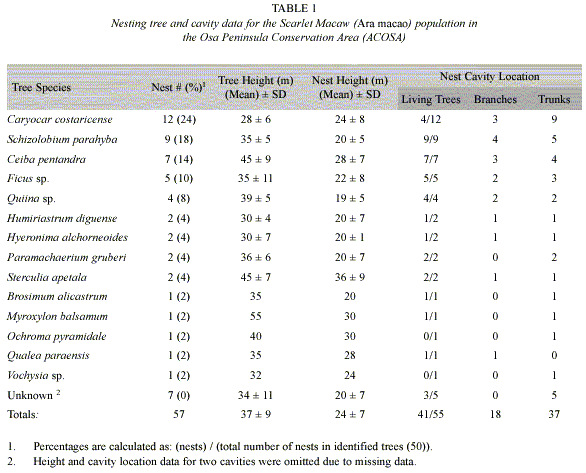
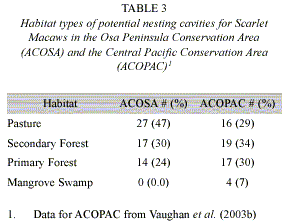
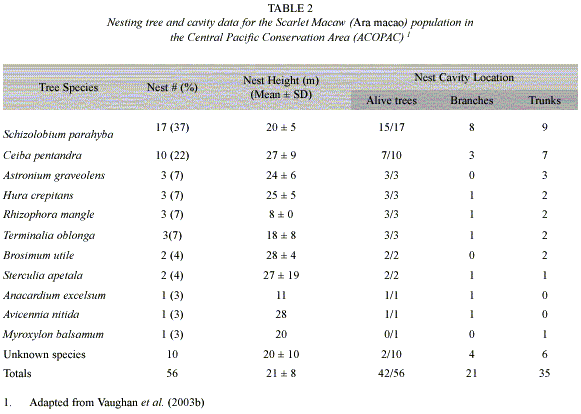
<body><![CDATA[<br> <a name="t1"></a></font></p>     <div style="text-align: center;"><font size="2"><img  src="/img/revistas/rbt/v57n1-2/art34t1.gif" title="" alt=""  style="width: 586px; height: 473px;"></font>    <br> <font size="2"> </font></div>     <p style="font-family: verdana;"><font size="2">Scarlet Macaws used a greater number of tree species for nesting in ACOSA than ACOPAC (14 vs. 11) (Vaughan <span style="font-style: italic;">et al</span>. 2003a) (<a  href="#t1">Table 1</a>, <a href="#c2">Table 2</a>), and only four species overlap. The local interviews (Dear <span style="font-style: italic;">et al</span>. unpubl. data) reference nine additional potential nesting tree species, six of which are new: <span style="font-style: italic;">Aspidosperma myristicifolium</span>, <span style="font-style: italic;">A. spruceanum</span>, <span style="font-style: italic;">Brosimum alicastrum</span>, <span style="font-style: italic;">Calophyllum brasiliense</span>, <span style="font-style: italic;">Carapa guianensis</span>, <span style="font-style: italic;">Couratari scottmorii</span>, <span style="font-style: italic;">Ormosia</span> spp, <span style="font-style: italic;">Terminalia oblonga</span>. Cavities in identified trees (n = 50) included 12 (24%) <span style="font-style: italic;">Caryocar costaricense</span>, 9 (18%) <span style="font-style: italic;">Schizolobium parahyba</span>, 7 (14%) <span style="font-style: italic;">Ceiba pentandra</span>, and 5 (10%) <span style="font-style: italic;">Ficus</span> sp. Seven (7) dead trees had no identifying characteristics (<a href="#t1">Table 1</a>). Average cavity height (24 ± 7 m SD), ratio of living trees (41/55), and branch to trunk ratio (18:37) were similar to ACOPAC data (Table 2). ACOSA cavity height ranged from 13 m to 30 m. We located more nesting cavities in ACOSA pastures (47%) than Vaughan <span style="font-style: italic;">et al</span>. (2003a) found in ACOPAC pastures (29%) (<a href="#c3">Table 3</a>), although this result is subject to bias.    <br> </font></p>     <p style="font-family: verdana;"><font size="2">    <br> <a name="c2"></a></font></p>     <div style="text-align: center;"><font size="2"><img  src="/img/revistas/rbt/v57n1-2/art34t2.gif" title="" alt=""  style="width: 581px; height: 414px;"></font>    <br> </div>     <p style="font-family: verdana;"><font size="2">    ]]></body>
<body><![CDATA[<br> <a name="c3"></a></font></p>     <div style="text-align: center;"><font size="2"><img  src="/img/revistas/rbt/v57n1-2/art34t3.gif" title="" alt=""  style="width: 286px; height: 224px;"></font>    <br> <font size="2"> </font></div>     <p style="font-family: verdana;"><font size="2">ACOSA Scarlet Macaws can coexist with moderate human development. We found a nesting cavity in a <span style="font-style: italic;">Hyeronima alchorneoides</span> located on the Puerto Jiménez (town pop: 4000) high school property, and a nest carved in the side of a secluded but inhabited wooden cabin. Further, we observed daily foraging on beach-almond trees (Terminalia catappa) in the Puerto Jimenez city park and other town sites. Locals reported eleven (19%) of the 57 potential nesting cavities as recently poached and all were on private lands (<a href="#f1">Fig. 1</a>). Of the 57 potential nesting cavities, 23 were 20 m high or less. Fourteen (14) were "easy" to climb, 28 were of "moderate" difficulty to climb, and 15 were "difficult" to climb. One poacher reportedly takes 25 chicks/yr from the ACOSA area (Dear <span style="font-style: italic;">et al</span> 2005), and another may annually raid at least five nests. During an informal interview, an ex-poacher referenced a buyer near the Panamanian border paying $200/chick. </font></p>     <p style="font-family: verdana;"><font size="3"><span  style="font-weight: bold;">Dscussion</span> </font></p>     <p style="font-family: verdana;"><font size="2">The high variability in cavity height, cavity location, tree height, and tree species suggests that ACOSA Scarlet Macaws do not select nest sites based on any one of these characteristics. This flexibility is large relative to many other Neotropical Parrots, such as the Lilac-Crowned parrot (Amazona finchi) (Renton and Salinas 1999), and Amazon parrots in northeastern Mexico (Christman and Dhondt 1997), which both show clear preference for specific nesting tree species and nest height. Indeed, our study contributes ten new potential nesting tree species recorded for Scarlet Macaws in Costa Rica. Six additional species referenced in interviews (Dear <span  style="font-style: italic;">et al</span>. 2005), and our survey’s omission of Corcovado National Park, suggest more exist. </font></p>     <p style="font-family: verdana;"><font size="2">Availability of secure and popular ACOSA nesting trees might improve reproductive success of ACOPAC Scarlet Macaws, and vise versa. Prime examples are <span style="font-style: italic;">Caryocar costaricense </span>and <span style="font-style: italic;">Ficus</span> sp., two major ACOSA nesting trees not recorded in ACOPAC. <span style="font-style: italic;">C. costaricense</span> is a long-living 35-50 m tree with a dry trunk which forms high, natural cavities (n = 12, mean cavity height 24.0 ± 8.0) (personal observation, Quesada <span style="font-style: italic;">et al</span>. 1997). <span style="font-style: italic;">Ficus</span>. sp. also has a high average nest height (n = 5, 22 ± 8 m). Geographic ranges for both trees include ACOPAC (Quesada <span  style="font-style: italic;">et al</span>. 1997), and both are appropriate shade trees in pastures. </font></p>     <p style="font-family: verdana;"><font size="2">Ideal Scarlet Macaw nesting cavities are found in stable living trees, located as far from the ground as possible, and in close proximity to potential guardians. Low cavities are most susceptible to poaching and/or arboreal threats such as the Black Iguana (Ctenosaura similes), the common opossum, (Didelphis marsupialis), and monkey vandalism (Vaughan <span style="font-style: italic;">et al</span>. 2003a). We recommend that cavities close to the ground and/or those suspected of being poached should be removed, closed, or closely guarded during the nesting season. Although artificial Scarlet Macaw nest boxes have had low success rates (Vaughan 2003a), they may provide future nesting alternatives, especially if concentrated near active nests so that several nests could be protected simultaneously. Plans detailed in Nycander (1995) or Vaughan <span style="font-style: italic;">et al</span>. (2005) provide suggestions for future design. </font></p>     <p style="font-family: verdana;"><font size="2">The influence of habitat loss and poaching on Scarlet Macaw populations is exacerbated by a naturally small clutch size and a low chick survival rate (Wright <span style="font-style: italic;">et al</span>. 2001). An understanding of Scarlet Macaw reproduction is crucial for its conservation, and can be used to inform environmental education projects, artificial nest construction, and grass-roots ecotourism. Our initial survey of potential ACOSA Scarlet Macaw nests should be followed by long-term cavity monitoring, especially fledgling counts and nest cavity reuse studies. </font></p>     <p style="font-family: verdana;"><font size="2"><span  style="font-weight: bold;">Conservation implications:</span> The Scarlet Macaw has been used effectively as a flagship species to promote conservation and environmental education in ACOPAC (Vaughan <span style="font-style: italic;">et al</span>. 2003b); ACOSA, where the Scarlet Macaw thrives, should do the same. One example could be an annual school course which encourages children to estimate Scarlet Macaw population size, or excursions to see artificial and natural Scarlet Macaw nests. The nest located on the Puerto Jiménez High School campus is an ideal location to begin such a program. </font></p>     ]]></body>
<body><![CDATA[<p style="font-family: verdana;"><font size="2">Present and future ACOSA cattle farms, especially those adjacent to forested areas, should be informed about Scarlet Macaw conservation efforts and encouraged to plant and/or guard popular nesting trees and food sources in their pastures. These trees would benefit the Scarlet Macaw population and other wildlife species, provide natural shade for the farmer’s cattle, and provide aesthetic value to their land. Later, farms with known Scarlet Macaw nests could potentially profit from the Scarlet Macaw as an ecotourism icon. </font></p>     <p style="font-family: verdana;"><font size="2">Lastly, poaching in ACOPAC should be further investigated and actively discouraged. While only 11 of 57 ACOSA cavities were reported as poached, the actual number is likely greater. Costa Rica’s Ministry for the     <br> Environment (MINAE) should continue to dissuade known poachers and work towards identifying unknown poachers. MINAE should advertise stricter penalties, while reminding the public of the legal and environmental consequences of poaching, and suggesting ecofriendly alternatives. </font></p>     <p style="font-family: verdana;"><font size="3"><span  style="font-weight: bold;">Acknowledgments</span> </font></p>     <p style="font-family: verdana;"><font size="2">We are thankful to many community members including Adrian Morales Polanco, Eduvijes de Bahia Drake, and Lana Luna for lodging and assistance with finding nests. Andy Pruter provided tree climbing materials. Hayder Santamaria, Eliecer Arce, and MINAE offered transportation, logistical advice, and nest information. Local botanist Reinaldo Aguilar from INBio assisted in identifying nesting tree species. Lastly, we are thankful to Associated Colleges of the Midwest (ACM), The Parrot Society-UK and Amigos de la Osa for funding.    <br> </font></p>     <p style="font-family: verdana; text-align: center;"><font size="2">Received 29-V-2008. Corrected 10-X-2008. Accepted 08-XI-2008.</font></p>     <p style="font-family: verdana;"><font size="3"><span  style="font-weight: bold;">References</span> </font></p>     <!-- ref --><p style="font-family: verdana;"><font size="2">Bennett, P. M., I. P. F. Owens. 1997. Variation in extinction risk among birds: chance or evolutionary predisposition? Proceedings of the Royal Society of London, Series B 264: 401-408. </font>&nbsp;&nbsp;&nbsp;&nbsp;&nbsp;&nbsp;&nbsp;&nbsp;[&#160;<a href="javascript:void(0);" onclick="javascript: window.open('/scielo.php?script=sci_nlinks&ref=1272295&pid=S0034-7744200900010003400001&lng=','','width=640,height=500,resizable=yes,scrollbars=1,menubar=yes,');">Links</a>&#160;]<!-- end-ref --><!-- ref --><p style="font-family: verdana;"><font size="2">Christman, B. J., A. A. Dhondt. 1997. Nest predation in Black-capped Chickadees: how safe are cavity nests? Auk. 114: 769-773. </font>&nbsp;&nbsp;&nbsp;&nbsp;&nbsp;&nbsp;&nbsp;&nbsp;[&#160;<a href="javascript:void(0);" onclick="javascript: window.open('/scielo.php?script=sci_nlinks&ref=1272296&pid=S0034-7744200900010003400002&lng=','','width=640,height=500,resizable=yes,scrollbars=1,menubar=yes,');">Links</a>&#160;]<!-- end-ref --><!-- ref --><p style="font-family: verdana;"><font size="2">Dear, F., C. Vaughan, A. Morales. 2005. Current status and conservation of the Scarlet Macaw (<span style="font-style: italic;">Ara macao</span>) in the Osa Conservation Area (ACOSA), Costa Rica. International Institute for Wildlife Conservation and Management, Universidad Nacional, Costa Rica. Mimeographed. </font>&nbsp;&nbsp;&nbsp;&nbsp;&nbsp;&nbsp;&nbsp;&nbsp;[&#160;<a href="javascript:void(0);" onclick="javascript: window.open('/scielo.php?script=sci_nlinks&ref=1272297&pid=S0034-7744200900010003400003&lng=','','width=640,height=500,resizable=yes,scrollbars=1,menubar=yes,');">Links</a>&#160;]<!-- end-ref --><!-- ref --><p style="font-family: verdana;"><font size="2">García, R. 1997. Biología de la Conservación y Áreas Silvestres Protegidas: Situación Actual y Perspectivas en Costa Rica. Instituto Nacional de Biodiversidad Press, Santo Domingo, Costa Rica. </font>&nbsp;&nbsp;&nbsp;&nbsp;&nbsp;&nbsp;&nbsp;&nbsp;[&#160;<a href="javascript:void(0);" onclick="javascript: window.open('/scielo.php?script=sci_nlinks&ref=1272298&pid=S0034-7744200900010003400004&lng=','','width=640,height=500,resizable=yes,scrollbars=1,menubar=yes,');">Links</a>&#160;]<!-- end-ref --><!-- ref --><p style="font-family: verdana;"><font size="2">Herrera, W. 1986. Clima de Costa Rica. Editorial Univ. Estatal de Distancia, San José, Costa Rica. </font>&nbsp;&nbsp;&nbsp;&nbsp;&nbsp;&nbsp;&nbsp;&nbsp;[&#160;<a href="javascript:void(0);" onclick="javascript: window.open('/scielo.php?script=sci_nlinks&ref=1272299&pid=S0034-7744200900010003400005&lng=','','width=640,height=500,resizable=yes,scrollbars=1,menubar=yes,');">Links</a>&#160;]<!-- end-ref --><!-- ref --><p style="font-family: verdana;"><font size="2">Marineros, L., &amp; C. Vaughan. 1995. Scarlet Macaws of Carara, p. 445–467. <span  style="font-style: italic;">In</span> Abramson, J., B. Speer, &amp; J. Thomsen (eds.). The large macaws: Their care, breeding and conservation. Raintree Publications, Fort Bragg, California, USA. </font>&nbsp;&nbsp;&nbsp;&nbsp;&nbsp;&nbsp;&nbsp;&nbsp;[&#160;<a href="javascript:void(0);" onclick="javascript: window.open('/scielo.php?script=sci_nlinks&ref=1272300&pid=S0034-7744200900010003400006&lng=','','width=640,height=500,resizable=yes,scrollbars=1,menubar=yes,');">Links</a>&#160;]<!-- end-ref --><!-- ref --><p style="font-family: verdana;"><font size="2">Munn, C. 1992. Macaw biology and ecotourism or, "When a bird in the hand is worth two in the bush." p. 47–72. <span style="font-style: italic;">In</span> Beissinger, S., &amp; N. Snyder (eds.). New World parrots in crisis: Solutions from conservation biology. Smithsonian Institution Press, Washington, D.C., USA. </font>&nbsp;&nbsp;&nbsp;&nbsp;&nbsp;&nbsp;&nbsp;&nbsp;[&#160;<a href="javascript:void(0);" onclick="javascript: window.open('/scielo.php?script=sci_nlinks&ref=1272301&pid=S0034-7744200900010003400007&lng=','','width=640,height=500,resizable=yes,scrollbars=1,menubar=yes,');">Links</a>&#160;]<!-- end-ref --><!-- ref --><p style="font-family: verdana;"><font size="2">Myers, M. &amp; C. Vaughan. 2004. Movement and behaviour of scarlet macaws (<span  style="font-style: italic;">Ara macao</span>) during the postfledgling dependence period: implications for in situ versus ex situ management. Biol. Conserv. 118: 411–420. </font>&nbsp;&nbsp;&nbsp;&nbsp;&nbsp;&nbsp;&nbsp;&nbsp;[&#160;<a href="javascript:void(0);" onclick="javascript: window.open('/scielo.php?script=sci_nlinks&ref=1272302&pid=S0034-7744200900010003400008&lng=','','width=640,height=500,resizable=yes,scrollbars=1,menubar=yes,');">Links</a>&#160;]<!-- end-ref --><!-- ref --><p style="font-family: verdana;"><font size="2">Nader, W., D. Werner, M. Wink. 1999. Genetic diversity of scarlet macaws Ara macao in reintroduction studies for threatened populations in Costa Rica. Biol. Cons. 87: 269-272. </font>&nbsp;&nbsp;&nbsp;&nbsp;&nbsp;&nbsp;&nbsp;&nbsp;[&#160;<a href="javascript:void(0);" onclick="javascript: window.open('/scielo.php?script=sci_nlinks&ref=1272303&pid=S0034-7744200900010003400009&lng=','','width=640,height=500,resizable=yes,scrollbars=1,menubar=yes,');">Links</a>&#160;]<!-- end-ref --><!-- ref --><p style="font-family: verdana;"><font size="2">Nycander, E., D. Blanco, K. Holle, A. del Campo, C. Munn, J. Moscoso, &amp; D. Ricalde. 1995. Nesting success and techniques for increasing reproduction in wild macaws in southwestern Peru, p. 423–444. <span style="font-style: italic;">In</span> Abramson, J., B. Speer, &amp; J. Thomsen (eds.). The large macaws: Their care, breedg and conservation. Raintree Publications, Fort Bragg, California, USA. </font>&nbsp;&nbsp;&nbsp;&nbsp;&nbsp;&nbsp;&nbsp;&nbsp;[&#160;<a href="javascript:void(0);" onclick="javascript: window.open('/scielo.php?script=sci_nlinks&ref=1272304&pid=S0034-7744200900010003400010&lng=','','width=640,height=500,resizable=yes,scrollbars=1,menubar=yes,');">Links</a>&#160;]<!-- end-ref --><!-- ref --><p style="font-family: verdana;"><font size="2">Quesada, F. J., Q. Jiménez, N. Zamora, R. Aguilar, &amp; J. Gonzáles. 1997. Árboles de la Península de Osa. Instituto Nacional de Biodiversidad Press, Heredia, Costa Rica. </font>&nbsp;&nbsp;&nbsp;&nbsp;&nbsp;&nbsp;&nbsp;&nbsp;[&#160;<a href="javascript:void(0);" onclick="javascript: window.open('/scielo.php?script=sci_nlinks&ref=1272305&pid=S0034-7744200900010003400011&lng=','','width=640,height=500,resizable=yes,scrollbars=1,menubar=yes,');">Links</a>&#160;]<!-- end-ref --><!-- ref --><p style="font-family: verdana;"><font size="2">Renton, K., A. Salinas. 1999. Nesting behavior of the lilaccrowned parrot. Wilson Bull. 111: 488-493. </font>&nbsp;&nbsp;&nbsp;&nbsp;&nbsp;&nbsp;&nbsp;&nbsp;[&#160;<a href="javascript:void(0);" onclick="javascript: window.open('/scielo.php?script=sci_nlinks&ref=1272306&pid=S0034-7744200900010003400012&lng=','','width=640,height=500,resizable=yes,scrollbars=1,menubar=yes,');">Links</a>&#160;]<!-- end-ref --><!-- ref --><p style="font-family: verdana;"><font size="2">Snyder, N. &amp; Beissinger, G. 1992, (eds) New World Parrots in Crisis: Solutions from Conservation Biology. Smithsonian Institution Press, Washington, D.C., USA. </font>&nbsp;&nbsp;&nbsp;&nbsp;&nbsp;&nbsp;&nbsp;&nbsp;[&#160;<a href="javascript:void(0);" onclick="javascript: window.open('/scielo.php?script=sci_nlinks&ref=1272307&pid=S0034-7744200900010003400013&lng=','','width=640,height=500,resizable=yes,scrollbars=1,menubar=yes,');">Links</a>&#160;]<!-- end-ref --><!-- ref --><p style="font-family: verdana;"><font size="2">Vaughan, C., N. Nemeth &amp; L. Marineros. 2003a. Ecology and management of natural and artificial Scarlet Macaw (<span style="font-style: italic;">Ara macao</span>) nest cavities in Costa Rica. Ornitol. Neotrop. 14: 381-396. </font>&nbsp;&nbsp;&nbsp;&nbsp;&nbsp;&nbsp;&nbsp;&nbsp;[&#160;<a href="javascript:void(0);" onclick="javascript: window.open('/scielo.php?script=sci_nlinks&ref=1272308&pid=S0034-7744200900010003400014&lng=','','width=640,height=500,resizable=yes,scrollbars=1,menubar=yes,');">Links</a>&#160;]<!-- end-ref --><!-- ref --><p style="font-family: verdana;"><font size="2">Vaughan, C., J. Gack, H. Soloranzo, R. Ray, 2003b. The effect of environmental education on school children, their parents, and community members: a study of intergenerational and intercommunity learning. J. Environ. Educ. 34: 12–21. </font>&nbsp;&nbsp;&nbsp;&nbsp;&nbsp;&nbsp;&nbsp;&nbsp;[&#160;<a href="javascript:void(0);" onclick="javascript: window.open('/scielo.php?script=sci_nlinks&ref=1272309&pid=S0034-7744200900010003400015&lng=','','width=640,height=500,resizable=yes,scrollbars=1,menubar=yes,');">Links</a>&#160;]<!-- end-ref --><!-- ref --><p style="font-family: verdana;"><font size="2">Vaughan, C. N. Nemeth, J. Cary &amp; S. Temple. 2005. Conservation strategies for a Scarlet Macaw (<span style="font-style: italic;">Ara macao</span>) population in Costa Rica. Birdlife Int. 15: 119-130. </font>&nbsp;&nbsp;&nbsp;&nbsp;&nbsp;&nbsp;&nbsp;&nbsp;[&#160;<a href="javascript:void(0);" onclick="javascript: window.open('/scielo.php?script=sci_nlinks&ref=1272310&pid=S0034-7744200900010003400016&lng=','','width=640,height=500,resizable=yes,scrollbars=1,menubar=yes,');">Links</a>&#160;]<!-- end-ref --><!-- ref --><p style="font-family: verdana;"><font size="2">Wright, T. F, C. A. Toft, E. Enkerlin-Hoeflich, J. Gonzalez-Elizondo, M. Albornoz, A. Rodriguez-Ferraro, F. Rojas-Suarez, V. Sanz, A. Trujillo, S. R. Beissinger, V. Berovides A., Xiomara Galvez A., A. T. Brice, K. Joyner, J. Eberhard, J. Gilardi, S. E. Koenig, S. Stoleson, P. Martuscelli, J. M. Meyers, K. Renton, A. M. Rodgriguez, A. C. Sosa-Asanza, F. J. Vilella, J. W. Wiley. 2001. Nest poaching in Neotropical parrots. Conserv. Bio. 15: 710-720. </font>&nbsp;&nbsp;&nbsp;&nbsp;&nbsp;&nbsp;&nbsp;&nbsp;[&#160;<a href="javascript:void(0);" onclick="javascript: window.open('/scielo.php?script=sci_nlinks&ref=1272311&pid=S0034-7744200900010003400017&lng=','','width=640,height=500,resizable=yes,scrollbars=1,menubar=yes,');">Links</a>&#160;]<!-- end-ref --> ]]></body><back>
<ref-list>
<ref id="B1">
<nlm-citation citation-type="journal">
<person-group person-group-type="author">
<name>
<surname><![CDATA[Bennett]]></surname>
<given-names><![CDATA[P. M]]></given-names>
</name>
<name>
<surname><![CDATA[Owens]]></surname>
<given-names><![CDATA[I. P. F]]></given-names>
</name>
</person-group>
<article-title xml:lang="en"><![CDATA[Variation in extinction risk among birds: chance or evolutionary predisposition?]]></article-title>
<source><![CDATA[Proceedings of the Royal Society of London, Series B]]></source>
<year>1997</year>
<volume>264</volume>
<page-range>401-408</page-range></nlm-citation>
</ref>
<ref id="B2">
<nlm-citation citation-type="journal">
<person-group person-group-type="author">
<name>
<surname><![CDATA[Christman]]></surname>
<given-names><![CDATA[B. J]]></given-names>
</name>
<name>
<surname><![CDATA[Dhondt]]></surname>
<given-names><![CDATA[A. A]]></given-names>
</name>
</person-group>
<article-title xml:lang="en"><![CDATA[Nest predation in Black-capped Chickadees: how safe are cavity nests?]]></article-title>
<source><![CDATA[Auk]]></source>
<year>1997</year>
<volume>114</volume>
<page-range>769-773</page-range></nlm-citation>
</ref>
<ref id="B3">
<nlm-citation citation-type="book">
<person-group person-group-type="author">
<name>
<surname><![CDATA[Dear]]></surname>
<given-names><![CDATA[F]]></given-names>
</name>
<name>
<surname><![CDATA[Vaughan]]></surname>
<given-names><![CDATA[C]]></given-names>
</name>
<name>
<surname><![CDATA[Morales]]></surname>
<given-names><![CDATA[A]]></given-names>
</name>
</person-group>
<source><![CDATA[Current status and conservation of the Scarlet Macaw (Ara macao) in the Osa Conservation Area (ACOSA), Costa Rica]]></source>
<year>2005</year>
<publisher-name><![CDATA[International Institute for Wildlife Conservation and Management, Universidad Nacional, Costa Rica]]></publisher-name>
</nlm-citation>
</ref>
<ref id="B4">
<nlm-citation citation-type="book">
<person-group person-group-type="author">
<name>
<surname><![CDATA[García]]></surname>
<given-names><![CDATA[R]]></given-names>
</name>
</person-group>
<source><![CDATA[Biología de la Conservación y Áreas Silvestres Protegidas: Situación Actual y Perspectivas en Costa Rica]]></source>
<year>1997</year>
<publisher-loc><![CDATA[Santo Domingo ]]></publisher-loc>
<publisher-name><![CDATA[Instituto Nacional de Biodiversidad Press]]></publisher-name>
</nlm-citation>
</ref>
<ref id="B5">
<nlm-citation citation-type="book">
<person-group person-group-type="author">
<name>
<surname><![CDATA[Herrera]]></surname>
<given-names><![CDATA[W]]></given-names>
</name>
</person-group>
<source><![CDATA[Clima de Costa Rica]]></source>
<year>1986</year>
<publisher-loc><![CDATA[San José ]]></publisher-loc>
<publisher-name><![CDATA[Editorial Univ. Estatal de Distancia]]></publisher-name>
</nlm-citation>
</ref>
<ref id="B6">
<nlm-citation citation-type="book">
<person-group person-group-type="author">
<name>
<surname><![CDATA[Marineros]]></surname>
<given-names><![CDATA[L]]></given-names>
</name>
<name>
<surname><![CDATA[Vaughan]]></surname>
<given-names><![CDATA[C]]></given-names>
</name>
</person-group>
<article-title xml:lang="en"><![CDATA[Scarlet Macaws of Carara]]></article-title>
<person-group person-group-type="editor">
<name>
<surname><![CDATA[Abramson]]></surname>
<given-names><![CDATA[J]]></given-names>
</name>
<name>
<surname><![CDATA[Speer]]></surname>
<given-names><![CDATA[B]]></given-names>
</name>
<name>
<surname><![CDATA[Thomsen]]></surname>
<given-names><![CDATA[J]]></given-names>
</name>
</person-group>
<source><![CDATA[The large macaws: Their care, breeding and conservation]]></source>
<year>1995</year>
<page-range>445-467</page-range><publisher-loc><![CDATA[Fort Bragg^eCalifornia California]]></publisher-loc>
<publisher-name><![CDATA[Raintree Publications]]></publisher-name>
</nlm-citation>
</ref>
<ref id="B7">
<nlm-citation citation-type="book">
<person-group person-group-type="author">
<name>
<surname><![CDATA[Munn]]></surname>
<given-names><![CDATA[C]]></given-names>
</name>
</person-group>
<article-title xml:lang="en"><![CDATA[Macaw biology and ecotourism or, "When a bird in the hand is worth two in the bush."]]></article-title>
<person-group person-group-type="editor">
<name>
<surname><![CDATA[Beissinger]]></surname>
<given-names><![CDATA[S]]></given-names>
</name>
<name>
<surname><![CDATA[Snyder]]></surname>
<given-names><![CDATA[N]]></given-names>
</name>
</person-group>
<source><![CDATA[New World parrots in crisis: Solutions from conservation biology]]></source>
<year>1992</year>
<page-range>47-72</page-range><publisher-loc><![CDATA[^eWashington, D.C Washington, D.C]]></publisher-loc>
<publisher-name><![CDATA[Smithsonian Institution Press]]></publisher-name>
</nlm-citation>
</ref>
<ref id="B8">
<nlm-citation citation-type="journal">
<person-group person-group-type="author">
<name>
<surname><![CDATA[Myers]]></surname>
<given-names><![CDATA[M]]></given-names>
</name>
<name>
<surname><![CDATA[Vaughan]]></surname>
<given-names><![CDATA[C]]></given-names>
</name>
</person-group>
<article-title xml:lang="en"><![CDATA[Movement and behaviour of scarlet macaws (Ara macao) during the postfledgling dependence period: implications for in situ versus ex situ management]]></article-title>
<source><![CDATA[Biol. Conserv]]></source>
<year>2004</year>
<volume>118</volume>
<page-range>411-420</page-range></nlm-citation>
</ref>
<ref id="B9">
<nlm-citation citation-type="journal">
<person-group person-group-type="author">
<name>
<surname><![CDATA[Nader]]></surname>
<given-names><![CDATA[W]]></given-names>
</name>
<name>
<surname><![CDATA[Werner]]></surname>
<given-names><![CDATA[D]]></given-names>
</name>
<name>
<surname><![CDATA[Wink]]></surname>
<given-names><![CDATA[M]]></given-names>
</name>
</person-group>
<article-title xml:lang="en"><![CDATA[Genetic diversity of scarlet macaws Ara macao in reintroduction studies for threatened populations in Costa Rica]]></article-title>
<source><![CDATA[Biol. Cons]]></source>
<year>1999</year>
<volume>87</volume>
<page-range>269-272</page-range></nlm-citation>
</ref>
<ref id="B10">
<nlm-citation citation-type="book">
<person-group person-group-type="author">
<name>
<surname><![CDATA[Nycander]]></surname>
<given-names><![CDATA[E]]></given-names>
</name>
<name>
<surname><![CDATA[Blanco]]></surname>
<given-names><![CDATA[D]]></given-names>
</name>
<name>
<surname><![CDATA[Holle]]></surname>
<given-names><![CDATA[K]]></given-names>
</name>
<name>
<surname><![CDATA[del Campo]]></surname>
<given-names><![CDATA[A]]></given-names>
</name>
<name>
<surname><![CDATA[Munn]]></surname>
<given-names><![CDATA[C]]></given-names>
</name>
<name>
<surname><![CDATA[Moscoso]]></surname>
<given-names><![CDATA[J]]></given-names>
</name>
<name>
<surname><![CDATA[Ricalde]]></surname>
<given-names><![CDATA[D]]></given-names>
</name>
</person-group>
<article-title xml:lang="en"><![CDATA[Nesting success and techniques for increasing reproduction in wild macaws in southwestern Peru]]></article-title>
<person-group person-group-type="editor">
<name>
<surname><![CDATA[Abramson]]></surname>
<given-names><![CDATA[J]]></given-names>
</name>
<name>
<surname><![CDATA[Speer]]></surname>
<given-names><![CDATA[B]]></given-names>
</name>
<name>
<surname><![CDATA[Thomsen]]></surname>
<given-names><![CDATA[J]]></given-names>
</name>
</person-group>
<source><![CDATA[The large macaws: Their care, breedg and conservation]]></source>
<year>1995</year>
<page-range>423-444</page-range><publisher-loc><![CDATA[Fort Bragg^eCalifornia California]]></publisher-loc>
<publisher-name><![CDATA[Raintree Publications]]></publisher-name>
</nlm-citation>
</ref>
<ref id="B11">
<nlm-citation citation-type="book">
<person-group person-group-type="author">
<name>
<surname><![CDATA[Quesada]]></surname>
<given-names><![CDATA[F. J]]></given-names>
</name>
<name>
<surname><![CDATA[Jiménez]]></surname>
<given-names><![CDATA[Q]]></given-names>
</name>
<name>
<surname><![CDATA[Zamora]]></surname>
<given-names><![CDATA[N]]></given-names>
</name>
<name>
<surname><![CDATA[Aguilar]]></surname>
<given-names><![CDATA[R]]></given-names>
</name>
<name>
<surname><![CDATA[Gonzáles]]></surname>
<given-names><![CDATA[J]]></given-names>
</name>
</person-group>
<source><![CDATA[Árboles de la Península de Osa]]></source>
<year>1997</year>
<publisher-loc><![CDATA[Heredia ]]></publisher-loc>
<publisher-name><![CDATA[Instituto Nacional de Biodiversidad Press]]></publisher-name>
</nlm-citation>
</ref>
<ref id="B12">
<nlm-citation citation-type="journal">
<person-group person-group-type="author">
<name>
<surname><![CDATA[Renton]]></surname>
<given-names><![CDATA[K]]></given-names>
</name>
<name>
<surname><![CDATA[Salinas]]></surname>
<given-names><![CDATA[A]]></given-names>
</name>
</person-group>
<article-title xml:lang="en"><![CDATA[Nesting behavior of the lilaccrowned parrot]]></article-title>
<source><![CDATA[Wilson Bull]]></source>
<year>1999</year>
<volume>111</volume>
<page-range>488-493</page-range></nlm-citation>
</ref>
<ref id="B13">
<nlm-citation citation-type="book">
<person-group person-group-type="author">
<name>
<surname><![CDATA[Snyder]]></surname>
<given-names><![CDATA[N]]></given-names>
</name>
<name>
<surname><![CDATA[Beissinger]]></surname>
<given-names><![CDATA[G]]></given-names>
</name>
</person-group>
<source><![CDATA[New World Parrots in Crisis: Solutions from Conservation Biology]]></source>
<year>1992</year>
<publisher-loc><![CDATA[^eWashington, D.C Washington, D.C]]></publisher-loc>
<publisher-name><![CDATA[Smithsonian Institution Press]]></publisher-name>
</nlm-citation>
</ref>
<ref id="B14">
<nlm-citation citation-type="journal">
<person-group person-group-type="author">
<name>
<surname><![CDATA[Vaughan]]></surname>
<given-names><![CDATA[C]]></given-names>
</name>
<name>
<surname><![CDATA[Nemeth]]></surname>
<given-names><![CDATA[N]]></given-names>
</name>
<name>
<surname><![CDATA[Marineros]]></surname>
<given-names><![CDATA[L]]></given-names>
</name>
</person-group>
<article-title xml:lang="en"><![CDATA[Ecology and management of natural and artificial Scarlet Macaw (Ara macao) nest cavities in Costa Rica]]></article-title>
<source><![CDATA[Ornitol. Neotrop]]></source>
<year>2003</year>
<volume>14</volume>
<page-range>381-396</page-range></nlm-citation>
</ref>
<ref id="B15">
<nlm-citation citation-type="journal">
<person-group person-group-type="author">
<name>
<surname><![CDATA[Vaughan]]></surname>
<given-names><![CDATA[C]]></given-names>
</name>
<name>
<surname><![CDATA[Gack]]></surname>
<given-names><![CDATA[J]]></given-names>
</name>
<name>
<surname><![CDATA[Soloranzo]]></surname>
<given-names><![CDATA[H]]></given-names>
</name>
<name>
<surname><![CDATA[Ray]]></surname>
<given-names><![CDATA[R]]></given-names>
</name>
</person-group>
<article-title xml:lang="en"><![CDATA[The effect of environmental education on school children, their parents, and community members: a study of intergenerational and intercommunity learning]]></article-title>
<source><![CDATA[J. Environ. Educ]]></source>
<year>2003</year>
<volume>34</volume>
<page-range>12-21</page-range></nlm-citation>
</ref>
<ref id="B16">
<nlm-citation citation-type="journal">
<person-group person-group-type="author">
<name>
<surname><![CDATA[Vaughan]]></surname>
<given-names><![CDATA[C. N]]></given-names>
</name>
<name>
<surname><![CDATA[Nemeth]]></surname>
<given-names><![CDATA[J]]></given-names>
</name>
<name>
<surname><![CDATA[Cary]]></surname>
</name>
<name>
<surname><![CDATA[Temple]]></surname>
<given-names><![CDATA[S]]></given-names>
</name>
</person-group>
<article-title xml:lang="en"><![CDATA[Conservation strategies for a Scarlet Macaw (Ara macao) population in Costa Rica]]></article-title>
<source><![CDATA[Birdlife Int]]></source>
<year>2005</year>
<volume>15</volume>
<page-range>119-130</page-range></nlm-citation>
</ref>
<ref id="B17">
<nlm-citation citation-type="journal">
<person-group person-group-type="author">
<name>
<surname><![CDATA[Wright]]></surname>
<given-names><![CDATA[T. F]]></given-names>
</name>
<name>
<surname><![CDATA[Toft]]></surname>
<given-names><![CDATA[C. A]]></given-names>
</name>
<name>
<surname><![CDATA[Enkerlin-Hoeflich]]></surname>
<given-names><![CDATA[E]]></given-names>
</name>
<name>
<surname><![CDATA[Gonzalez-Elizondo]]></surname>
<given-names><![CDATA[J]]></given-names>
</name>
<name>
<surname><![CDATA[Albornoz]]></surname>
<given-names><![CDATA[M]]></given-names>
</name>
<name>
<surname><![CDATA[Rodriguez-Ferraro]]></surname>
<given-names><![CDATA[A]]></given-names>
</name>
<name>
<surname><![CDATA[Rojas-Suarez]]></surname>
<given-names><![CDATA[F]]></given-names>
</name>
<name>
<surname><![CDATA[Sanz]]></surname>
<given-names><![CDATA[V]]></given-names>
</name>
<name>
<surname><![CDATA[Trujillo]]></surname>
<given-names><![CDATA[A]]></given-names>
</name>
<name>
<surname><![CDATA[Beissinger]]></surname>
<given-names><![CDATA[S. R]]></given-names>
</name>
<name>
<surname><![CDATA[Berovides A]]></surname>
<given-names><![CDATA[V]]></given-names>
</name>
<name>
<surname><![CDATA[Xiomara Galvez]]></surname>
<given-names><![CDATA[A]]></given-names>
</name>
<name>
<surname><![CDATA[Brice]]></surname>
<given-names><![CDATA[A. T]]></given-names>
</name>
<name>
<surname><![CDATA[Joyner]]></surname>
<given-names><![CDATA[K]]></given-names>
</name>
<name>
<surname><![CDATA[Eberhard]]></surname>
<given-names><![CDATA[J]]></given-names>
</name>
<name>
<surname><![CDATA[Gilardi]]></surname>
<given-names><![CDATA[J]]></given-names>
</name>
<name>
<surname><![CDATA[Koenig]]></surname>
<given-names><![CDATA[S. E]]></given-names>
</name>
<name>
<surname><![CDATA[Stoleson]]></surname>
<given-names><![CDATA[S]]></given-names>
</name>
<name>
<surname><![CDATA[Martuscelli]]></surname>
<given-names><![CDATA[P]]></given-names>
</name>
<name>
<surname><![CDATA[Meyers]]></surname>
<given-names><![CDATA[J. M]]></given-names>
</name>
<name>
<surname><![CDATA[Renton]]></surname>
<given-names><![CDATA[K]]></given-names>
</name>
<name>
<surname><![CDATA[Rodgriguez]]></surname>
<given-names><![CDATA[A. M]]></given-names>
</name>
<name>
<surname><![CDATA[Sosa-Asanza]]></surname>
<given-names><![CDATA[A. C]]></given-names>
</name>
<name>
<surname><![CDATA[Vilella]]></surname>
<given-names><![CDATA[F. J]]></given-names>
</name>
<name>
<surname><![CDATA[Wiley]]></surname>
<given-names><![CDATA[J. W]]></given-names>
</name>
</person-group>
<article-title xml:lang="en"><![CDATA[Nest poaching in Neotropical parrots]]></article-title>
<source><![CDATA[Conserv. Bio]]></source>
<year>2001</year>
<volume>15</volume>
<page-range>710-720</page-range></nlm-citation>
</ref>
</ref-list>
</back>
</article>