<?xml version="1.0" encoding="ISO-8859-1"?><article xmlns:mml="http://www.w3.org/1998/Math/MathML" xmlns:xlink="http://www.w3.org/1999/xlink" xmlns:xsi="http://www.w3.org/2001/XMLSchema-instance">
<front>
<journal-meta>
<journal-id>0034-7744</journal-id>
<journal-title><![CDATA[Revista de Biología Tropical]]></journal-title>
<abbrev-journal-title><![CDATA[Rev. biol. trop]]></abbrev-journal-title>
<issn>0034-7744</issn>
<publisher>
<publisher-name><![CDATA[Universidad de Costa Rica]]></publisher-name>
</publisher>
</journal-meta>
<article-meta>
<article-id>S0034-77442007000200009</article-id>
<title-group>
<article-title xml:lang="en"><![CDATA[Molecular phylogenetic relationships among four species of the mangrove tree genus Bruguiera (Rhizophoraceae), as revealed by chromosome and RAPD markers]]></article-title>
</title-group>
<contrib-group>
<contrib contrib-type="author">
<name>
<surname><![CDATA[Sahoo]]></surname>
<given-names><![CDATA[Pragnya]]></given-names>
</name>
<xref ref-type="aff" rid="A01"/>
</contrib>
<contrib contrib-type="author">
<name>
<surname><![CDATA[Jena]]></surname>
<given-names><![CDATA[Satyanarayan]]></given-names>
</name>
<xref ref-type="aff" rid="A01"/>
</contrib>
<contrib contrib-type="author">
<name>
<surname><![CDATA[Mohanty]]></surname>
<given-names><![CDATA[Suprava]]></given-names>
</name>
<xref ref-type="aff" rid="A01"/>
</contrib>
<contrib contrib-type="author">
<name>
<surname><![CDATA[Bandhu Das]]></surname>
<given-names><![CDATA[Anath]]></given-names>
</name>
<xref ref-type="aff" rid="A01"/>
</contrib>
</contrib-group>
<aff id="A01">
<institution><![CDATA[,Regional Plant Resource Centre Cytogenetics Laboratory ]]></institution>
<addr-line><![CDATA[Orissa ]]></addr-line>
<country>India</country>
</aff>
<pub-date pub-type="pub">
<day>00</day>
<month>06</month>
<year>2007</year>
</pub-date>
<pub-date pub-type="epub">
<day>00</day>
<month>06</month>
<year>2007</year>
</pub-date>
<volume>55</volume>
<numero>2</numero>
<fpage>437</fpage>
<lpage>448</lpage>
<copyright-statement/>
<copyright-year/>
<self-uri xlink:href="http://www.scielo.sa.cr/scielo.php?script=sci_arttext&amp;pid=S0034-77442007000200009&amp;lng=en&amp;nrm=iso"></self-uri><self-uri xlink:href="http://www.scielo.sa.cr/scielo.php?script=sci_abstract&amp;pid=S0034-77442007000200009&amp;lng=en&amp;nrm=iso"></self-uri><self-uri xlink:href="http://www.scielo.sa.cr/scielo.php?script=sci_pdf&amp;pid=S0034-77442007000200009&amp;lng=en&amp;nrm=iso"></self-uri><abstract abstract-type="short" xml:lang="en"><p><![CDATA[Analysis of karyotype, nuclear DNA content and RAPD markers were performed in four species of Bruguiera (Rhizophoraceae) of Bhitarkanika mangrove forests, Orissa, India. Detailed karyotype analysis revealing 2n=34 in B. cylindrica and 2n=36 in B. gymnorrhiza was reported for the first time and 2n=34 in B. parviflora and B. sexangula was confirmed. On the basis of the common types of chromosomes present among Bruguiera, two distinct groups were found; one consists of B. cylindrica and B. parviflora and the other of B. gymnorrhiza and B. sexangula. The symmetrical karyotype with same chromosome types grouped B. cylindrica and B. parviflora together and presence of Type E chromosomes placed B. gymnorrhiza and B. sexangula in a separate group, suggesting their closer affinity in their respective group. Analysis of chromosome length, volume, INV and 4C DNA content confirmed this division. Nuclear DNA content was two-fold higher (~17.0 pg) in the second group than in the first (~8.0 pg). The amplification products generated through RAPD revealed 1-9 amplicons with size variations from 600 bp to 2 500 bp with 49.31% genetic similarity between B. gymnorrhiza and B. sexangula and 47.10% in between B. cylindrica and B. parviflora. The high copy number marker band (~ 1 100 bp) yielded in OPN-15 primer in B. parviflora the characteristic DNA marker, which was cloned and used as probes for assessment of genetic diversity, and demonstrated its close genetic affinity to B. cylindrica. B. gymnorrhiza and B. sexangula also produced similar marker bands of ~600 bp and ~2 200 bp in the same primer. All of the cytological, 4C DNA content and RAPD data confirmed the existence of two taxonomically distinct groups of Bruguiera: one consisting of B. cylindrica and B. parviflora and the other of B. gymnorrhiza and B. sexangula as placed earlier (1862) in the tribe Rhizophoreae by Bentham and Hooker, on the basis of the flowering habits of Bruguiera. Genetically, the B. sexangula and B. gymnorrhiza group was found to be very closely, rather than distantly, related to B. parviflora and B. cylindrica. Our results demonstrate that molecular markers together with cytological evidence provide an effective tool to access the existing interspecific genetic polymorphism in mangrove species, to solve the taxonomic problems and to design their conservation strategy. Rev. Biol. Trop. 55 (2): 437-448. Epub 2007 June, 29.]]></p></abstract>
<abstract abstract-type="short" xml:lang="es"><p><![CDATA[Estudiamos cuatro especies del mangle Bruguiera (Rhizophoraceae) en Orissa, India. Los cromosomas indican queB. cylindrica y B. parviflora son un grupo taxonómico, y que B. gymnorrhiza y B. sexangula son otro. Genéticamente, el par B. sexangula y B. gymnorrhiza está cercanamente emparentado con B. parviflora and B. cylindrica. Nuestros datos indican que el uso combinado de marcadores genéticos y evidencia citológica permiten discernir el polimorfismo genético interespecífico en los mangles, tanto para resolver problemas taxonómicos como para diseña estrategias eficaces de conservación.]]></p></abstract>
<kwd-group>
<kwd lng="en"><![CDATA[4C DNA content]]></kwd>
<kwd lng="en"><![CDATA[Bruguiera]]></kwd>
<kwd lng="en"><![CDATA[molecular phylogeny]]></kwd>
<kwd lng="en"><![CDATA[tree mangrove]]></kwd>
<kwd lng="en"><![CDATA[karyotype]]></kwd>
<kwd lng="es"><![CDATA[contenido de ADN4C]]></kwd>
<kwd lng="es"><![CDATA[Bruguiera]]></kwd>
<kwd lng="es"><![CDATA[filogenia molecular]]></kwd>
<kwd lng="es"><![CDATA[mangle]]></kwd>
<kwd lng="es"><![CDATA[cariotipo]]></kwd>
</kwd-group>
</article-meta>
</front><body><![CDATA[  <b><font face="Arial">     <p align="center">Molecular phylogenetic relationships among four species of the mangrove tree genus <span  style="font-weight: normal; font-style: italic;">Bruguiera</span><i> </i>(Rhizophoraceae), as revealed by chromosome and RAPD markers</p>     <p align="center"></p> </font></b><font face="Arial" size="2"></font>     <p><font face="Arial" size="2">Pragnya Sahoo, Satyanarayan Jena, Suprava Mohanty &amp; Anath Bandhu Das<a href="#1">*</a> </font></p>     <p><font face="Arial" size="2"><a name="1"></a>Cytogenetics Laboratory, Regional Plant Resource Centre, Nayapalli, Bhubaneswar-751015, Orissa, India, Fax: ++-91-674-2550274; * <a href="mailto:a_b_das@hotmail.com">a_b_das@hotmail.com</a> </font></p>     <p align="center"><font face="Arial" size="2">Received 02-VII-2003. Corrected 09-I-2006. Accepted 13-X-2006.</font></p> <font face="Arial" size="2"><b></b></font>     <p><font face="Arial" size="2"><b>Abstract:</b> Analysis of karyotype, nuclear DNA content and RAPD markers were performed in four species of <i>Bruguiera </i>(Rhizophoraceae) of Bhitarkanika mangrove forests, Orissa, India. Detailed karyotype analysis revealing 2n=34 in <i>B</i>. <i>cylindrica </i>and 2n=36 in <i>B</i>. <i>gymnorrhiza </i>was reported for the first time and 2n=34 in <i>B. parviflora </i>and <i>B. sexangula </i>was confirmed. On the basis of the common types of chromosomes present among <i>Bruguiera, </i>two distinct groups were found; one consists of <i>B. cylindrica </i>and <i>B. parviflora </i>and the other of <i>B. gymnorrhiza </i>and <i>B. sexangula</i>. The symmetrical karyotype with same chromosome types grouped <i>B. cylindrica </i>and <i>B. parviflora </i>together and presence of Type E chromosomes placed <i>B. gymnorrhiza </i>and <i>B. sexangula </i>in a separate group, suggesting their closer affinity in their respective group. Analysis of chromosome length, volume, INV and 4C DNA content confirmed this division. Nuclear DNA content was two-fold higher (~17.0 pg) in the second group than in the first (~8.0 pg). The amplification products generated through RAPD revealed 1-9 amplicons with size variations from 600 bp to 2 500 bp with 49.31% genetic similarity between <i>B. gymnorrhiza </i>and <i>B. sexangula </i>and 47.10% in between <i>B. cylindrica </i>and <i>B. parviflora. </i>The high copy number marker band (~ 1 100 bp) yielded in OPN-15 primer in <i>B. parviflora </i>the characteristic DNA marker, which was cloned and used as probes for assessment of genetic diversity, and demonstrated its close genetic affinity to <i>B. cylindrica</i>. <i>B. gymnorrhiza </i>and <i>B. sexangula </i>also produced similar marker bands of ~600 bp and ~2 200 bp in the same primer. All of the cytological, 4C DNA content and RAPD data confirmed the existence of two taxonomically distinct groups of <i>Bruguiera</i>: one consisting of <i>B. cylindrica </i>and <i>B. parviflora </i>and the other of <i>B. gymnorrhiza </i>and <i>B. sexangula </i>as placed earlier (1862) in the tribe Rhizophoreae by Bentham and Hooker, on the basis of the flowering habits of <i>Bruguiera. </i>Genetically, the <i>B. sexangula </i>and <i>B. gymnorrhiza </i>group was found to be very closely, rather than distantly, related to <i>B. parviflora </i>and <i>B. cylindrica. </i>Our results demonstrate that molecular markers together with cytological evidence provide an effective tool to access the existing interspecific genetic polymorphism in mangrove species, to solve the taxonomic problems and to design their conservation strategy. Rev. Biol. Trop. 55 (2): 437-448. Epub 2007 June, 29.</font></p>     <p><font face="Arial" size="2"> </font></p> <font face="Arial" size="2"><b></b></font>     <p><font face="Arial" size="2"><b>Key words:</b> 4C DNA content, <i>Bruguiera</i>, molecular phylogeny, tree mangrove, karyotype. </font></p>     <p><font face="Arial" size="2">Mangroves are perennial plants found in the intertidal zones of coastal wetlands in tropical regions; many species that are found exclusively there are called true mangroves and are capable of forming dense pure stands of trees. The mangrove ecosystem plays an important role in maintaining coastal ecological balance and is also one of the most highly productive and dynamic ecosystems to mankind, providing food, livelihood and eco logical security. </font></p>     ]]></body>
<body><![CDATA[<p><font face="Arial" size="2">The genus <i>Bruguiera</i>, a true mangrove, of the family Rhizophoraceae consists of four spe cies distributed throughout the coastal regions of India: <i>B. cylindrica, B. gymnorrhiza, B. parviflora </i>and <i>B. sexangula</i>. The fruits of <i>B. parviflora </i>are used in making medicines for eye diseases, the bark of <i>B. gymnorrhiza </i>is used in the treatment of diarrhea and the leaves of <i>B. cylindrica </i>are used as fodder (Naskar and Mandal 1999). These mangroves are now endangered because they are being exploited indiscriminately for their timber (Das <i>et al</i>. 2002) which is resistant to post harvest pest infection due to the high deposits of tannin in the wood. Ignorance and negligence of its importance has led to a drastic reduction worldwide and the local extinction of many species and populations of <i>Bruguiera</i>. </font></p>     <p><font face="Arial" size="2">Cytological and molecular phylogenetic research has mainly focused on the analysis of genomes of different taxa, but the detailed studies on the cytological, cytochemical and molecular aspects of <i>Bruguiera </i>are lacking. However, chromosome and cytophotometric studies are extremely difficult in these species due to the accumulation of a high amount of secondary metabolites and their tiny chromosomes. Studies of genetic variability and interspecific relationships among the mangrove species using molecular markers have been used to accurately quantify the extent of genetic diversity among the species (Waugh and Powell 1992). Unlike morphological markers, molecular markers are not prone to environmental influences and accurately portray the genetic relationships between plant groups (Emmarold <i>et al</i>. 2001). These markers can also be used to select priority areas for conservation and provide vital information to improve strategies for genetic conservation (New-bury and Ford-Lloyd 1993). The somatic chromosome number 2n=34 in <i>B. parviflora </i>and <i>B. sexangula </i>was reported earlier by our group (Das <i>et al</i>. 1995) and is in contrast with an earlier report of 2n=36 in <i>B. parviflora </i>(Sidhu 1968). Scanty reports on RAPD markers on <i>Bruguiera </i>were noted (Parani <i>et al</i>. 1998) without any report on <i>B. parviflora</i>, <i>B. gymnorrhiza </i>and <i>B. sexangula. </i></font></p>     <p><font face="Arial" size="2">Bentham and Hooker (1862) placed <i>Bruguiera </i>in the tribe Rhizophoreae along with the genera <i>Rhizophora</i>, <i>Ceriops </i>and <i>Kandelia</i>. The genus <i>Bruguiera </i>was found to be distinct in its explosive mechanism of pollen release, which is largely triggered by visiting pollinators, a phenomenon not observed in other genera of this tribe. The genus was further segregated into two distinct taxonomic groups of species based on flowering differences: the large, solitary-flowering group consisting of <i>B. gymnorrhiza </i>and <i>B. sexangula </i>and the small multi-flowering group of <i>B. parviflora </i>and <i>B. cylindrica</i>. The difference in flower size also correlated with differences in leaf and fruit size. However, Ding Hou (1958) pointed out that the distinction between the two groups was obscured by the later discovery of the two species, <i>B. hainesi </i>and <i>B. exarillata</i>, which have some morphologically intermediate characteristics. The first species sometimes has solitary flowers, the second sometimes has flowers in pairs and the size difference between flowers is slight; however, there is a fairly sharp distinction between the species on the basis of flower orientation in relation to different types of pollinators (birds vs. insects). Despite this variation, there is not sufficient justification to revise the classification. </font></p>     <p><font face="Arial" size="2">The present study deals with detailed karyotype analysis, estimation of 4C DNA content and RAPD polymorphism analysis in the four species of <i>Bruguiera </i>belonging to two morphological groups of the tribe Rhizophoreae in order to ascertain their genetic diversity and to establish phylogenetic relationships as well as affinities, if any, of the four species of <i>Bruguiera </i>belonging to the two taxonomic groups and to resolve the taxonomic status of these genera using the existing taxonomic classification. </font></p> <font face="Arial" size="2"><b>     <p align="center">Materials and methods</p> </b> </font>     <p><font face="Arial" size="2">Propagules of <i>Bruguiera parviflora </i>Roxb., <i>B. cylindrica </i>(Linn.) Bl.<i>, B. gymnorrhiza </i>(Linn.) Lamark and <i>B. sexangula </i>(Lour.) Poir. were collected from Bhitrarkanika, Orissa and were grown in the experimental mangrove nursery at Regional Plant Resource Centre, Bhubaneswar and voucher specimens of all the species were kept in the herbaria of the centre. </font></p> <font face="Arial" size="2"><b></b></font>     <p><font face="Arial" size="2"><b>Karyotype analysis:</b> for the somatic chromosome study, healthy fresh root-tips were pretreated in ¼<sup>th </sup>saturated solution of paradichlorobenzene (pDB) and aesculine for 2½ h at 14<sup>o</sup>C followed by overnight fixation in lactopropionic alcohol (1:3). The root-tips were stained in 2% lactopropionic orcein after cold hydrolysis in 5N HCl for 10 min and were squashed in 45% lactopropionic acid. Five well scattered metaphase plates were selected for karyotype analysis of each species. The total chromosome length was ascertained by adding the length of all chromosomes in the karyotype and the total chromosome volume of a karyotype was calculated by applying the formula </font><font  face="Arial" size="2" color="#ff0000" style="color: rgb(0, 0, 0);">&#960;</font><font  face="Arial" size="2">r<sup>2</sup>h, where r and h represent the radius and length of the chromosome, respectively. The total form percentage (TF%) of a karyotype was the average of the sum total F% of a karyotype. The mean values of total genomic chromosome length and total chromosome volume with standard error were calculated. </font></p> <font face="Arial" size="2"><b></b></font>     <p><font face="Arial" size="2"><b>Nuclear DNA content:</b> for Feulgen cytophotometric estimation of 4C DNA content, ten fixed root-tips from each species were hydrolyzed in 1N HCl for 12 min at 60<sup>o</sup>C, washed in distilled water and rinsed in SO<sub>2 </sub>water (Fox 1969). Root tips were stained in Schiff’s reagent for 2h at 14<sup>o</sup>C and each root-tip squash was prepared in 45% lactopropionic acid. <i>In situ </i>nuclear DNA content was estimated from metaphase chromosomes using a Nikon Optiphot microscope fitted with a microspectrophotometer using monochromatic light at 550 nm following the method of Sharma and Sharma (1980), with ten scorings made from each slide. <i>In situ </i>DNA content was obtained on the basis of optical density, which was converted to picograms (pg) using the 4C nuclear DNA values (67.1 pg) for <i>Allium cepa </i>var. Deshi (Vant Hof 1965) as a standard, whose root tips were prepared and scored in the same way as the experimental material. The correlation coefficient analysis was done between different chromosomal parameters to compare genomic characteristics. Analysis of variance (ANOVA) was performed among the nuclear DNA values using Duncan’s multiple range test (Harter 1960). </font></p> <font face="Arial" size="2"><b></b></font>     <p><font face="Arial" size="2"><b>Interphase nuclear volume (INV): </b>for the scoring of interphase nuclear volume (INV), root-tips about 2-2.5 mm in length were fixed in 1:3 acetic acid: ethanol for 24 h at 25<sup>o</sup>C, hydrolyzed in 1N HCl at 4<sup>o</sup>C for 15 min. After a thorough washing, the root-tips were put into Schiff’s reagent for 1 h at 20<sup>o</sup>C and kept in the dark for staining. Squash preparation was done in 45% lactopropionic acid. Scoring was done following the method of Das <i>et al. </i>(1993). </font></p> <font face="Arial" size="2"><b></b></font>     <p><font face="Arial" size="2"><b>Isolation of nuclear DNA:</b> Genomic DNA was isolated from young expanding leaves (Saghai-Maroof <i>et al. </i>1984). Young leaves (10 g) were ground to fine powde</font><font face="Arial"  size="2">r in liquid nitrogen and suspended in three volumes of suspension buffer (pH 8) containing 50 mM EDTA, 100 mM Tris-HCl, 0.8 M NaCl, 0.5 M sucrose, 2% Triton-X 100, 0.1% &#946;-mercaptoethanol and incubated at 60 </font><sup><font face="Arial" size="2">o</font></sup><font  face="Arial" size="2">C for 30 min. The suspension was centrifuged at </font><font  face="Arial" size="2">10 000 g for 10 min at room temperature. Then the pellet was extracted in 20 ml of extraction buffer containing 2 mM EDTA, 100 mM Tris-HCl, 1.5M NaCl, 2% CTAB, 1% &#946;-mercaptoethanol and incubated at 60</font><sup><font face="Arial" size="2">o</font></sup><font  face="Arial" size="2">C for 30 min and centrifuged again at 10 000 g for 20 min at room temperature. The aqueous phase was transferred to a new 50 ml tube and the DNA was precipitated with a double volume of chilled isopropanol, and hooked out and dried with vacuum drier and dissolved in a minimum amount of TE (10 mM Tris-HCl, 1 mM EDTA; pH 8). The DNA was again purified by treating with RNase at 37<sup>o</sup>C for 1 h followed by chloroform: isoamyl alcohol extraction and ethanol precipitation in the presence of 0.3M sodium acetate (pH 5.2). The DNA was spooled out, washed in 70% ethanol, air-dried and dissolved in T<sub>10</sub>E<sub>1 </sub>buffer and DNA concentration was estimated using Versafluor TM Fluorometer (Bio-Rad, USA) using Hoechst 33258 as the fluorimetric dye. The DNA was diluted to a final concentration of 25 ng µl<sup>-1 </sup>using T<sub>10</sub>E<sub>1 </sub>buffer as template for RAPD analysis. </font></p> <font face="Arial" size="2"><b></b></font>     ]]></body>
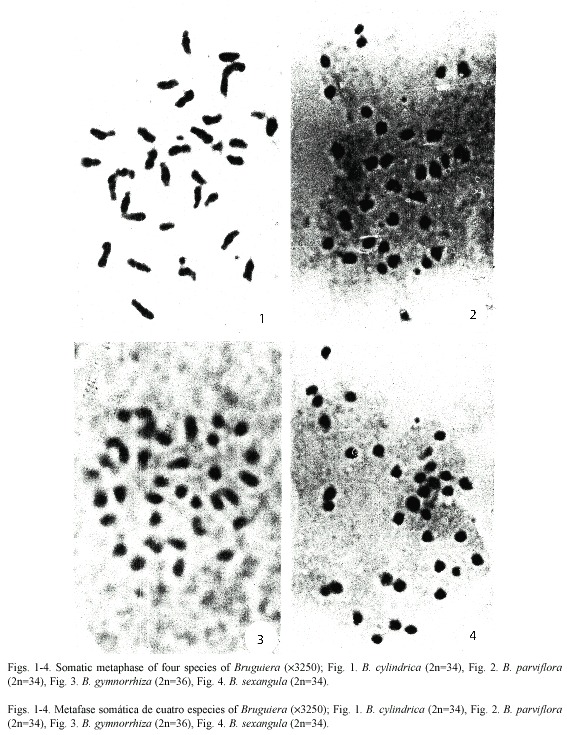
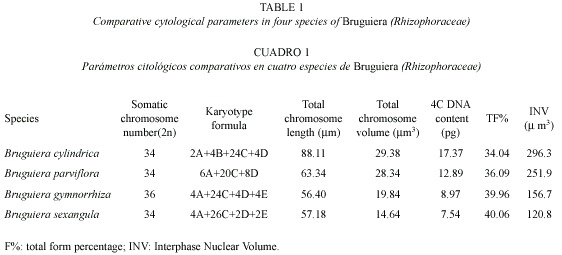
<body><![CDATA[<p><font face="Arial" size="2"><b>RAPD analysis:</b> RAPD profiles were generated using single decamer primers (Operon Technologies, Alameda, USA) in polymerase chain reaction (PCR) following the standard protocol of Williams <i>et al</i>. (1990). Each reaction mixture (25 µl) for PCR amplification, was prepared with 25 ng genomic template DNA, 200 µM each of dNTP, 25 ng primer, 0.5 unit Taq DNA Polymerase (Bangalore Genei Pvt. Ltd., Bangalore, India) and 10</font><span  style="font-family: arial;">x</span><font face="Arial" size="2"> PCR assay buffer (50 mM KCl, 10 mM Tris-HCl, 1.5 mM MgCl<sub>2, </sub>pH 9.0). The PCR reaction was carried out in a GeneAmp PCR 2400 thermal cycler (Perkin Elmer, USA) programmed for 45 cycles using 10 primers each for all the species. The first cycle consisted of denaturation at 94<sup>o</sup>C for 5 min, primer annealing at 37<sup>o</sup>C for 1min and DNA polymerization at 72<sup>o</sup>C for 2 min. In the next 44 cycles the period of denaturation was maintained at 1min while the primer annealing and DNA polymerization were kept the same as in the first cycle. The last cycle consisted of only primer extension (72<sup>o</sup>C) for 8 min. The amplified samples were stored at 4<sup>o</sup>C and separated by electrophoresis in 1.5% agarose gel in 1</font><span  style="font-family: arial;">x</span><font face="Arial" size="2"> TAE buffer for 3 h at 55 V. Gene Ruler 100 bp DNA ladder plus (MBI Fermantas, Lithuania) was used as a marker to determine the size of the amplicons. Amplified products were visualized by staining the gel with ethidium bromide, were photographed, and an image was captured using an image analyzer Gel Doc-G 700 (Bio-Rad, USA) for documentation and data analysis. Only those amplification products that appeared consistently in triplicate were scored for further analysis. </font></p> <font face="Arial" size="2"><b>     <p>Statistical analysis </p> </b> <b></b></font>     <p><font face="Arial" size="2"><b>Chromosome and nuclear DNA analysis:</b> mean values of total genomic chromosome length and volume with standard error were calculated. The ANOVAs were performed on the nuclear DNA content using Duncan’s multiple range test (Harter 1960). </font></p> <font face="Arial" size="2"><b></b></font>     <p><font face="Arial" size="2"><b>RAPD data analysis:</b> in RAPD analysis, the presence or absence of the bands were taken into consideration and the difference in the intensity of the bands was ignored. From RAPD data a binary matrix was obtained and calculate using the multivariate analysis program NTSYS-PC (Rohlf 1993). The binary matrix was transformed in a similarity matrix using the Jaccard’s coefficient. From this matrix a phylogenetic dendrogram was obtained by cluster analysis following the unweighted pair group with arithmetic mean (UPGMA) method (Sneath and Sokal 1973), using NTSYS version 1.7, Exeter Software, New York, USA. </font></p> <font face="Arial" size="2"><b>     <p align="center">Results</p> </b> <b></b></font>     <p><font face="Arial" size="2"><b>Karyotype analysis:</b> The somatic chromosome number varied from 2 n = 34 in <i>B. cylindrica, B. parviflora </i>and <i>B. sexangula </i>to 2 n = 36 in <i>B. gymnorrhiza. </i>Chromosome structure was highly similar among species types with minor structural variations in the karyotypes. On the basis of size and position of the primary and secondary constrictions, five types of chromosomes A, B, C, D and E were identified in the four species, although the species differed from one another in chromosome types and/or copy number. Type A chromosomes are medium-sized with primary and secondary constrictions at the nearly median and nearly sub-terminal positions. Type B chromosomes have two constrictions, one median and the other sub-terminal, producing a satellite body on the long arm. Types C and D chromosomes are medium to small in size with median and sub-median constrictions respectively. Type E chromosomes are very small in size with a primary constriction close to the submedian position. A detailed description of the somatic complements and different genomic characteristics of the four species studied of <i>Bruguiera </i>showed species specific variations in the genomic behavior (<a  href="#t1">Table 1</a>, <a href="#f1-4">Figs. 1-4</a>). Type A, C and D chromosome were present in all the species of <i>Bruguiera </i>in different doses and were the only chromosome types present in <i>B. parviflora</i>; only type B was obtained in <i>B. cylindrica </i>and Type E chromosomes were observed in <i>B. gymnorrhiza </i>and <i>B. sexangula. </i>The total chromosome length varied from 56.40 µm in <i>B. gymnorrhiza </i>to 88.11 µm in <i>B. cylindrica</i>. Minimum chromosome volume was 14.64 µm<sup>3 </sup>in <i>B. sexangula </i>and maximum 29.38 µm<sup>3 </sup>in <i>B. cylindrica</i>. The total percentage (TF%) varied from 34.04% in <i>B. cylindrica </i>to 40.06% in <i>B. sexangula </i>(<a href="#t1">Table 1</a>). </font></p> <a name="t1"></a>     <div style="text-align: center;"><img src="/img/fbpe/rbt/v55n2/3643i1.JPG" title=""  alt="" style="width: 562px; height: 255px;">    
<br> </div>     <br>     <br> <a name="f1-4"></a>     ]]></body>
<body><![CDATA[<div style="text-align: center;"><img src="/img/fbpe/rbt/v55n2/3643i2.JPG" title=""  alt="" style="width: 567px; height: 735px;"></div>     
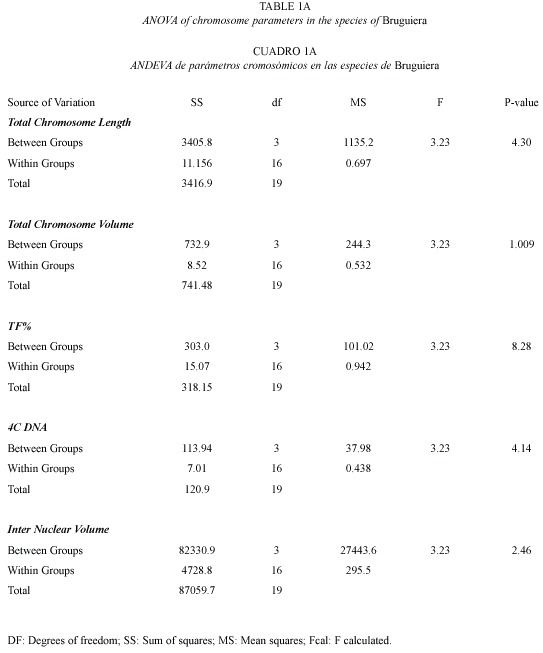
<p><font face="Arial" size="2"><b>4C Nuclear DNA and INV:</b> The 4C nuclear DNA amount varied significantly from 7.45 pg in <i>B. sexangula </i>to 17.37 pg in <i>B. cylindrica</i>. The average DNA amount per chromosome also varied from species to species, i.e. 0.21 pg in <i>B. sexangula</i>, 0.26 pg in <i>B. gymnorrhiza</i>, 0.37 pg in <i>B. parviflora</i>, 0.51 pg in <i>B. cylindrica</i>. The frequency polygraph of the INV showed a distinct peak around the mean value in all the species (data not shown). Correlation coefficient analysis showed a significant correlation of total chromosome length with volume (0.732), 4C DNA content (0.939) and INV (0.850). 4C DNA content showed positive correlation to chromosome volume (0.921) and INV (0.979). The ANOVA and Duncan’s multiple range tests showed that the variation in the nuclear DNA amounts among the different species of <i>Bruguiera </i>were significant at the 1 % level (<a href="#t1a">Table 1a</a>).    <br> </font></p>     <p style="text-align: center;"><font face="Arial" size="2"><a name="t1a"></a><img  src="/img/fbpe/rbt/v55n2/3643i3.JPG" title="" alt=""  style="width: 543px; height: 653px;">    
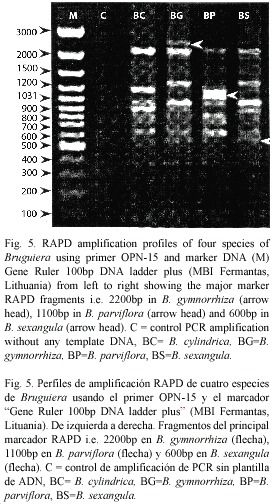
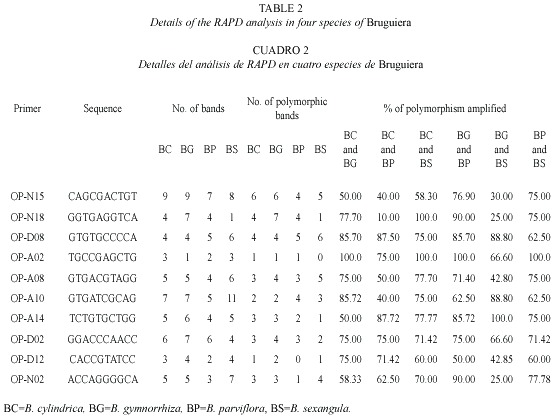
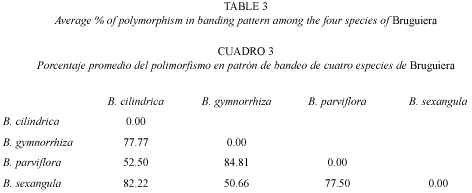
<br> </font></p> <font face="Arial" size="2"><b></b></font>     <p><font face="Arial" size="2"><b>RAPD analysis:</b> The RAPD profiles were reproducible and displayed no variation within the different plants studied in triplicate. On the basis of RAPD analysis results, interspecific variations were reflected in their genomic DNA amplified with ten primers. The amplification products in RAPD ranged from one to nine in the four species, with fragment size ranging from 0.60 KB to 2.5 KB (<a href="#f5">Fig. 5</a>). The total number of amplification products in all the species in each primer ranged from nine in OPA-2 to 33 in OPN-15 (<a href="#t2">Table 2</a>). The maximum at 11 amplified products were obtained in <i>B. sexangula </i>with OPA-10 primer. Different primers responded differently according to the genomic characteristics of the species and the numbers of amplicon varied from 7-11 bands in OPA-10, 7-9 bands in OPN-15 and 4-7 bands in OPD-2 primer. The maximum of 36 polymorphic bands was obtained in <i>B. gymnorrhiza</i>, followed by 30 in <i>B. cylindrica, </i>28 in <i>B. sexangula </i>and 27 in <i>B. parviflora. </i>A maximum of six polymorphic bands could be resolved in <i>B. cylindrica, B. gymnorrhiza </i>and <i>B. sexangula </i>using OPN-15 and OPD-8 primers whereas five polymorphic bands were obtained in <i>B. parviflora </i>in OPD-8 primer. The maximum average percentage of polymorphism (84.81%) was observed between <i>B. parviflora </i>and <i>B. gymnorrhiza</i>, whereas the minimum DNA polymorphism (50.66%) existed between <i>B. gymnorrhiza </i>and <i>B. sexangula </i>(<a href="#t3">Table 3</a>).The RAPD banding pattern obtained from the primers OPN-18 and OPA-2 revealed 100% polymorphism between <i>B. cylindrica</i> and <i>B. sexangula </i>as well as between <i>B. gymnorrhiza </i>and <i>B. parviflora.    <br> </i></font></p>     <p style="text-align: center;"><font face="Arial" size="2"><i><a  name="f5"></a><img src="/img/fbpe/rbt/v55n2/3643i4.JPG" title="" alt=""  style="width: 273px; height: 504px;">    
<br> </i></font></p>     <div style="text-align: center;"><font face="Arial" size="2"><i><a  name="t2"></a><img src="/img/fbpe/rbt/v55n2/3643i5.JPG" title="" alt=""  style="width: 556px; height: 417px;"></i></font>    
]]></body>
<body><![CDATA[<br> </div>     <p><font face="Arial" size="2"><i>    <br> </i></font></p>     <p style="text-align: center;"><font face="Arial" size="2"><i><a  name="t3"></a><img src="/img/fbpe/rbt/v55n2/3643i6.JPG" title="" alt=""  style="width: 472px; height: 193px;">    
<br> </i></font></p> <font face="Arial" size="2"><b></b></font>     <p><font face="Arial" size="2"><b>Cluster analysis:</b> The cluster analysis of the RAPD profiles of all the primers follow ing the method of unweighted pair group with arithmetic mean (UPGMA) revealed four species of <i>Bruguiera </i>distributed into two distinct branches of a single tree (Fig. 6); <i>B. cylindrica </i>and <i>B. parviflora </i>were clustered together with a similarity coefficient of 0.45 and <i>B. gymnorrhiza </i>and <i>B. sexangula </i>with similarity coefficient 0.83.</font></p> <font face="Arial" size="2"><i> </i><b>     <p align="center">Discussion</p> </b><i> </i><b></b></font>     <p><font face="Arial" size="2"><b>Karyotype, genome length and INV: </b>Detailed karyotype analysis of four species of<i> Bruguiera </i>revealed 2 n = 34 diploid chromosomes in all the species except <i>B. gymnorrhiza </i>(2 n = 36). Although the chromosome numbers were same in <i>B. cylindrica, B. parviflora </i>and <i>B. sexangula, </i>they differed in the type and number of secondary constricted chromosomes in their karyotype. The chromosome number reports 2n=34 in <i>B. cylindrica </i>and <i>B. parviflora </i>reconfirm our earlier report (Das <i>et al. </i>1995) and the diploid number in <i>B. gymnorrhiza </i>(2 n = 36) and in <i>B. sexangula </i>(2 n = 34) was reported for the first time. Among the species studied, the three chromosome types A, C, D were present in all four species. Type B chromosome was only characteristic of <i>B. cylindrica </i>with secondary constriction on the long arm of the chromosomes and Type E chromosomes were present in <i>B. gymnorrhiza </i>and <i>B. sexangula </i>in different doses. <i>B. cylindrica </i>and <i>B. parviflora </i>had six secondary constricted chromosomes, with chromosome types A and B present in <i>B</i>. <i>cylindrica</i>, and a high number of D type chromosomes in <i>B. parviflora</i>. Four Type A chromosomes were present in both <i>B. gymnorrhiza </i>and <i>B. sexangula. </i>The median constricted chromosomes were nearly equal in all the species studied. Evidently, structural changes as well as changes in the amount of heterochromatin might have played a vital role in differentiating at species level (Das <i>et al</i>. 1995). </font></p>     <p><font face="Arial" size="2">The TF % values varied from 34.96% to 40.06% among the four species might be due to structural alterations in the genome during speciation revealed by a duplication of the parts of some chromosomes, or by translocations, some with secondary constrictions and some without (Das <i>et al</i>. 2001). TF% values of about 35% in <i>B. cylindrica </i>and <i>B. parviflora </i>and ~40% in <i>B. gymnorrhiza </i>and <i>B. sexangula </i>suggest two distinct groups; the former had more sub-median chromosomes while the latter presented more median chromosomes. The gradual decrease of sub-metacentric chromosomes in the karyotypes of first group (<i>B. cylindrica </i>and <i>B. parviflora</i>) and an increase in the number of median chromosomes in the second group (<i>B. sexangula </i>and <i>B. gymnorrhiza</i>) suggests a gradual shifting of primary chromosome constriction through translocation or alteration and rearrangements of chromosomal arms in the evolution. Furthermore, the symmetrical karyotype with same number of secondary constricted chromosomes in <i>B. cylindrica</i>, <i>B. parviflora</i>, <i>B. gymnorrhiza </i>and <i>B. sexangula </i>suggests their close affinity. </font></p>     <p><font face="Arial" size="2">The total chromosome length and total chromosome volume varied significantly e.g., in <i>B. gymnorrhiza </i>with 56.40 µm and 19.84 µm<sup>3</sup>, respectively and in <i>B. cylindrica </i>with a length of 88.11 µm and a volume of 29.38 µm<sup>3</sup>. The first time reports of 4C DNA in these species of <i>Bruguiera </i>classified each in one of the two established groups; one group consisting of <i>B. gymnorrhiza </i>and <i>B. sexangula </i>had ~7 pg to 8 pg of DNA and the other consisting of <i>B. cylindrica </i>and <i>B. parviflora </i>had about twice the DNA content<i>. </i>The average DNA content was highly correlated to average chromosome volume and INV. However, in the eukaryotic system, chromosome volume is not only determined by its DNA, but also by its basic and non basic proteins as well. The highest DNA content found was 17.37 pg in <i>B. cylindrical</i>, which had all the types of chromosomes except Type E and the lowest was found in <i>B. sexangula </i>with 7.54 pg, which had two Type E chromosomes but lacked any Type B. The variability in DNA amount has often been attributed to loss or addition of highly repetitive DNA sequences rather than to the AT-or GC-rich sequences in the genome (Martel <i>et al</i>. 1997). These highly repetitive DNA sequences reach a certain level and become stabilized during microevolution and gradual selection (Price <i>et al</i>. 1980). Such interspecific variation in DNA amount is not unique to angiosperm species (Laurie and Bennet 1985, Rayburn <i>et al</i>. 1989). <i>B. cylindrical</i>, along with <i>B. parviflora</i>, has adapted to the comparatively low saline areas in the mangrove community, while <i>B. sexangula </i>and <i>B. gymnorrhiza </i>have adapted to the comparatively high saline zones of mangroves, suggesting species adaptability through chromosomal structural alterations and their resulting changes at the DNA level during the course of evolution. </font></p> <font face="Arial" size="2"><b></b></font>     ]]></body>
<body><![CDATA[<p><font face="Arial" size="2"><b>RAPD profile:</b> The previous studies on the genetic structure of the four <i>Bruguiera </i>species was restricted largely to chromosome number and karyotype (Das <i>et al</i>. 1995). Parani <i>et al</i>. (1998) reported the RAPD analysis on only the <i>B. cylindrica </i>species, but no such studies had been done on the other three species <i>B. parviflora</i>, <i>B. gymnorrhiza </i>and <i>B. sexangula</i>. In the present study, the RAPD analysis of the four species of <i>Bruguiera </i>that form mangrove forests in Orissa, recorded the highest average percentage of polymorphism (84.81%) between <i>B. gymnorrhiza </i>and <i>B. parviflora </i>and the lowest between <i>B. gymnorrhiza </i>and <i>B. sexangula </i>(50.66%). This suggests a greater similarity in genetic constitution between <i>B. gymnorrhiza </i>and <i>B. sexangula </i>as compared to <i>B. parviflora </i>and <i>B. cylindrica</i>. The maximum percentage of similarity (49.31%) in banding pattern was observed between <i>B. gymnorrhiza </i>and <i>B. sexangula</i>, followed by <i>B. cylindrica </i>and <i>B. parviflora </i>(47.1%). The UPGMA cluster analysis of the four species showed a high coefficient of interspecific similarity among the species, forming the two distinctly separate groups, <i>B. cylindrica </i>and <i>B. parviflora </i>(0.45) and <i>B. gymnorrhiza </i>and <i>B. sexangula </i>(0.57), also confirmed by the karyotype, 4C DNA content and Interphase Nuclear Volume analysis. </font></p>     <p><font face="Arial" size="2">Mangrove species are constantly subject to physiological stress caused by fluctuating growing conditions (Chapecker 1994). Despite such extremes, they have sucessessfully colonized suitable areas through morphological, physiological and reproductive adaptations (Clough 1994). Therefore, depending on their edaphic preferences and adaptation, different species are likely to display varying degrees of polymorphism. The observations on the RAPD analysis of <i>Bruguiera </i>are in accordance with the cytological studies with a genomic similarity of 49.31% between <i>B. gymnorrhiza </i>&amp; <i>B. sexangula </i>and of 47.10% between <i>B. cylindrica </i>and <i>B. parviflora. </i>The OPA-2 primer yielded maximum polymorphism in all the species at a level of 100% between <i>B. cylindrical </i>&amp; <i>B. sexangula </i>and <i>B. gymnorrhiza </i>and </font></p> <font face="Arial" size="2"><i></i></font>     <p><font face="Arial" size="2"><i>B. parviflora. </i>The primer OPN-15 showed a significant marker band at 1 100 bp with a high copy number in <i>B. parviflora</i>, which was the most prominent marker band. <i>B. gymnorrhiza </i>produced an unique marker band at 2 200 bp DNA which differentiates this species from the others. <i>B. gymnorrhiza </i>and <i>B. sexangula </i>also produced similar marker bands at 600 bp. The observed interspecific differences could be ascribed to the fluctuating climatic habitat conditions and may be species specific. The distinct RAPD bands could be cloned and used as markers for species identification. In conclusion, our results demonstrate that molecular markers provide an effective tool to access the existing interspecific genetic polymorphism in mangrove species and to design their conservation strategy. The two taxonomically and genetically distinct groups of <i>Bruguiera </i>consist of <i>B. cylindrica </i>and <i>B. parviflora </i>in one group and <i>B. gymnorrhiza </i>and <i>B. sexangula </i>in the other. All the karyotypic, DNA content and RAPD marker analysis suggests and confirms the taxonomic segregation of these groups in the Rhizophoreae tribe as suggested by Bentham and Hooker (1862) on the basis of the flowering habits of <i>Bruguiera. </i>Genetically, the group consisting of <i>B. sexangula </i>and <i>B. gymnorrhiza </i>was more closely, than distantly, related to <i>B. parviflora </i>and <i>B. cylindrica</i>. A better understanding of these groups could be of phylogenetic interest. </font></p> <font face="Arial" size="2"><b>     <p>Acknowledgment </p> </b> </font>     <p><font face="Arial" size="2">The authors are thankful to the Ministry of Forest and Environment, Government of India Grant No. 3/7/2000-C3 (M) for financial assistance. </font></p> <font face="Arial" size="2"><b>     <p>Resumen </p> </b> </font>     <p><font face="Arial" size="2">Estudiamos cuatro especies del mangle <i>Bruguiera </i>(Rhizophoraceae) en Orissa, India. Los cromosomas indican <i>queB. cylindrica </i>y <i>B. parviflora </i>son un grupo taxonómico, y que <i>B. gymnorrhiza </i>y <i>B. sexangula </i>son otro. Genéticamente, el par <i>B. sexangula </i>y <i>B. gymnorrhiza </i>está cercanamente emparentado con <i>B. parviflora </i>and <i>B. cylindrica. </i>Nuestros datos indican que el uso combinado de marcadores genéticos y evidencia citológica permiten discernir el polimorfismo genético interespecífico en los mangles, tanto para resolver problemas taxonómicos como para diseña estrategias eficaces de conservación. </font></p> <font face="Arial" size="2"><b></b></font>     <p><font face="Arial" size="2"><b>Palabras clave:</b> contenido de ADN4C, <i>Bruguiera</i>, filogenia molecular, mangle, cariotipo. </font></p> <font face="Arial" size="2"><b>     <p>References </p> </b> </font>     <!-- ref --><p><font face="Arial" size="2">Bentham, G. &amp; J.D. Hooker. 1962<i>. </i>Rhizophoreae: Genera Plantarum Vol. 1. Linnean Society, London. 677 p. </font>&nbsp;&nbsp;&nbsp;&nbsp;&nbsp;&nbsp;&nbsp;&nbsp;[&#160;<a href="javascript:void(0);" onclick="javascript: window.open('/scielo.php?script=sci_nlinks&ref=1245327&pid=S0034-7744200700020000900001&lng=','','width=640,height=500,resizable=yes,scrollbars=1,menubar=yes,');">Links</a>&#160;]<!-- end-ref --><!-- ref --><p><font face="Arial" size="2">Clough, B.S. 1994. Climatic impacts on mangrove ecosystems. p. 39-43. <i>In </i>V. Deshmukh &amp; V. Balaji (eds.). Conservation of mangrove genetic resources: Training manual. ITTO-CRSARD Project, MSSRF, Madras, India. </font>&nbsp;&nbsp;&nbsp;&nbsp;&nbsp;&nbsp;&nbsp;&nbsp;[&#160;<a href="javascript:void(0);" onclick="javascript: window.open('/scielo.php?script=sci_nlinks&ref=1245328&pid=S0034-7744200700020000900002&lng=','','width=640,height=500,resizable=yes,scrollbars=1,menubar=yes,');">Links</a>&#160;]<!-- end-ref --><!-- ref --><p><font face="Arial" size="2">Das, A.B. &amp; R. Mallick. 1993. Karyotype diversity and interspecific 4C DNA variation in <i>Bupleurum. </i>Biologia Plantarum 35: 355-363. </font>&nbsp;&nbsp;&nbsp;&nbsp;&nbsp;&nbsp;&nbsp;&nbsp;[&#160;<a href="javascript:void(0);" onclick="javascript: window.open('/scielo.php?script=sci_nlinks&ref=1245329&pid=S0034-7744200700020000900003&lng=','','width=640,height=500,resizable=yes,scrollbars=1,menubar=yes,');">Links</a>&#160;]<!-- end-ref --><!-- ref --><p><font face="Arial" size="2">Das, A.B., U.C. Basak &amp; P. Das. 1995. Chromosome number and karyotype diversity in the Rhizophoraceae found in the mangrove forest of Orissa. Cytobios 81: 27-35. </font>&nbsp;&nbsp;&nbsp;&nbsp;&nbsp;&nbsp;&nbsp;&nbsp;[&#160;<a href="javascript:void(0);" onclick="javascript: window.open('/scielo.php?script=sci_nlinks&ref=1245330&pid=S0034-7744200700020000900004&lng=','','width=640,height=500,resizable=yes,scrollbars=1,menubar=yes,');">Links</a>&#160;]<!-- end-ref --><!-- ref --><p><font face="Arial" size="2">Das, A.B., A.K. Mukhejee &amp; P. Das. 2001. Molecular phylogeny of <i>Heritiera </i>Aiton (Sterculiaceae), a tree mangrove, variations in RAPD markers and nuclear DNA content. Bot. J. Linn. Soc. 136: 221-229. </font>&nbsp;&nbsp;&nbsp;&nbsp;&nbsp;&nbsp;&nbsp;&nbsp;[&#160;<a href="javascript:void(0);" onclick="javascript: window.open('/scielo.php?script=sci_nlinks&ref=1245331&pid=S0034-7744200700020000900005&lng=','','width=640,height=500,resizable=yes,scrollbars=1,menubar=yes,');">Links</a>&#160;]<!-- end-ref --><!-- ref --><p><font face="Arial" size="2">Emmarold, E.M., H.M. Sinclair &amp; B. Mark. 2001. Use of random amplified polymorphic DNA (RAPD) markers to reveal genetic diversity within and between populations of cashew (<i>Anacardium occidentale </i>L.). J. Hortic. Sci. Biotech. 76: 375-383. </font>&nbsp;&nbsp;&nbsp;&nbsp;&nbsp;&nbsp;&nbsp;&nbsp;[&#160;<a href="javascript:void(0);" onclick="javascript: window.open('/scielo.php?script=sci_nlinks&ref=1245332&pid=S0034-7744200700020000900006&lng=','','width=640,height=500,resizable=yes,scrollbars=1,menubar=yes,');">Links</a>&#160;]<!-- end-ref --><!-- ref --><p><font face="Arial" size="2">Fox, D.P. 1969. Some characteristics of the cold hydrolysis technique for staining plant tissues by the Feulgen reaction. J. Histochem. Cytochem. 17: 266-272. </font>&nbsp;&nbsp;&nbsp;&nbsp;&nbsp;&nbsp;&nbsp;&nbsp;[&#160;<a href="javascript:void(0);" onclick="javascript: window.open('/scielo.php?script=sci_nlinks&ref=1245333&pid=S0034-7744200700020000900007&lng=','','width=640,height=500,resizable=yes,scrollbars=1,menubar=yes,');">Links</a>&#160;]<!-- end-ref --><!-- ref --><p><font face="Arial" size="2">Harter, H.L. 1960. Critical values for Duncan’s Multiple range test. Biometrics 16: 671-685. </font>&nbsp;&nbsp;&nbsp;&nbsp;&nbsp;&nbsp;&nbsp;&nbsp;[&#160;<a href="javascript:void(0);" onclick="javascript: window.open('/scielo.php?script=sci_nlinks&ref=1245334&pid=S0034-7744200700020000900008&lng=','','width=640,height=500,resizable=yes,scrollbars=1,menubar=yes,');">Links</a>&#160;]<!-- end-ref --><!-- ref --><p><font face="Arial" size="2">Laurie, D.A. &amp; M.D. Bennet. 1985. Nuclear DNA content in the genera <i>Zea </i>and <i>Sorghum</i>. Intergeneric, interspecific and intraspecific variation. Heredity 55: 307-313. </font>&nbsp;&nbsp;&nbsp;&nbsp;&nbsp;&nbsp;&nbsp;&nbsp;[&#160;<a href="javascript:void(0);" onclick="javascript: window.open('/scielo.php?script=sci_nlinks&ref=1245335&pid=S0034-7744200700020000900009&lng=','','width=640,height=500,resizable=yes,scrollbars=1,menubar=yes,');">Links</a>&#160;]<!-- end-ref --><!-- ref --><p><font face="Arial" size="2">Martel, E., D. Denay, S. Siljakyakovlev, S. Brown &amp; A. Sarr. 1997. Genome size variation and basic chromosome number in pearl millet and fourteen related <i>Pennisetum </i>Species. J. Heredity 88: 139-143. </font>&nbsp;&nbsp;&nbsp;&nbsp;&nbsp;&nbsp;&nbsp;&nbsp;[&#160;<a href="javascript:void(0);" onclick="javascript: window.open('/scielo.php?script=sci_nlinks&ref=1245336&pid=S0034-7744200700020000900010&lng=','','width=640,height=500,resizable=yes,scrollbars=1,menubar=yes,');">Links</a>&#160;]<!-- end-ref --><!-- ref --><p><font face="Arial" size="2">Naskar, K. &amp; R. Mandal. 1999. Ecology and Biodiversity of Indian Mangroves, (Vol-II), Daya, Delhi, India. 364 p. </font>&nbsp;&nbsp;&nbsp;&nbsp;&nbsp;&nbsp;&nbsp;&nbsp;[&#160;<a href="javascript:void(0);" onclick="javascript: window.open('/scielo.php?script=sci_nlinks&ref=1245337&pid=S0034-7744200700020000900011&lng=','','width=640,height=500,resizable=yes,scrollbars=1,menubar=yes,');">Links</a>&#160;]<!-- end-ref --><!-- ref --><p><font face="Arial" size="2">Parani, M., M. Lakshmi, P. Senthilkumar, R. Nivedita &amp; A. Parida. 1998. Molecular phylogeny of mangroves V. Analysis of genome relationships in mangrove species using RAPD and RFLP markers. Theor. App. Gen. 97: 617-625. </font>&nbsp;&nbsp;&nbsp;&nbsp;&nbsp;&nbsp;&nbsp;&nbsp;[&#160;<a href="javascript:void(0);" onclick="javascript: window.open('/scielo.php?script=sci_nlinks&ref=1245338&pid=S0034-7744200700020000900012&lng=','','width=640,height=500,resizable=yes,scrollbars=1,menubar=yes,');">Links</a>&#160;]<!-- end-ref --><!-- ref --><p><font face="Arial" size="2">Price, H. J., K. Bachaman, K.L. Chambers &amp; J. Riggs. 1980. Detection of interspecific variation in nuclear DNA content in <i>Microseris douglasii</i>. Bot. Gaz. 141: 195-198. </font>&nbsp;&nbsp;&nbsp;&nbsp;&nbsp;&nbsp;&nbsp;&nbsp;[&#160;<a href="javascript:void(0);" onclick="javascript: window.open('/scielo.php?script=sci_nlinks&ref=1245339&pid=S0034-7744200700020000900013&lng=','','width=640,height=500,resizable=yes,scrollbars=1,menubar=yes,');">Links</a>&#160;]<!-- end-ref --><!-- ref --><p><font face="Arial" size="2">Rayburn, A.L., J.A. Auger, E.A. Benzinger &amp; A.G. Hepburn. 1989. Detection of interspecific DNA content variation in <i>Zea mays </i>L. by flow cytometry. J. Exp. Bot. 40: 1179-1183. </font>&nbsp;&nbsp;&nbsp;&nbsp;&nbsp;&nbsp;&nbsp;&nbsp;[&#160;<a href="javascript:void(0);" onclick="javascript: window.open('/scielo.php?script=sci_nlinks&ref=1245340&pid=S0034-7744200700020000900014&lng=','','width=640,height=500,resizable=yes,scrollbars=1,menubar=yes,');">Links</a>&#160;]<!-- end-ref --><!-- ref --><p><font face="Arial" size="2">Rohlf, F.J. 1993. NTSYS-pc. Numerical and reproductive adaptations of Australian mangroves. p. 232-238. <i>In </i>Chapman V. J. (ed.) Ecosystems of the world. Vol. 1: Wet Coastal Ecosystems. Elsevier. Amsterdam, Netherlands. </font>&nbsp;&nbsp;&nbsp;&nbsp;&nbsp;&nbsp;&nbsp;&nbsp;[&#160;<a href="javascript:void(0);" onclick="javascript: window.open('/scielo.php?script=sci_nlinks&ref=1245341&pid=S0034-7744200700020000900015&lng=','','width=640,height=500,resizable=yes,scrollbars=1,menubar=yes,');">Links</a>&#160;]<!-- end-ref --><!-- ref --><p><font face="Arial" size="2">Saghai–Maroof, M.A., K.M. Soliman, H.A. Jorgensen &amp; H.A. Allard. 1984. Ribosomal DNA spacer length polymorphism in Barley. Mendelian inheritance, chromosomal locations and population dynamics. Proc. Nat. Acad. Sci. USA 81: 8014-8018. </font>&nbsp;&nbsp;&nbsp;&nbsp;&nbsp;&nbsp;&nbsp;&nbsp;[&#160;<a href="javascript:void(0);" onclick="javascript: window.open('/scielo.php?script=sci_nlinks&ref=1245342&pid=S0034-7744200700020000900016&lng=','','width=640,height=500,resizable=yes,scrollbars=1,menubar=yes,');">Links</a>&#160;]<!-- end-ref --><!-- ref --><p><font face="Arial" size="2">Sharma, A.K. &amp; A. Sharma. 1980. Chromosome techniques: theory and practice. Butterworths. London, United Kingdom. 575p. </font>&nbsp;&nbsp;&nbsp;&nbsp;&nbsp;&nbsp;&nbsp;&nbsp;[&#160;<a href="javascript:void(0);" onclick="javascript: window.open('/scielo.php?script=sci_nlinks&ref=1245343&pid=S0034-7744200700020000900017&lng=','','width=640,height=500,resizable=yes,scrollbars=1,menubar=yes,');">Links</a>&#160;]<!-- end-ref --><!-- ref --><p><font face="Arial" size="2">Sidhu, S.S. 1968. Further studies on the cytology of mangrove species in India. Caryologia 21: 353-357. </font>&nbsp;&nbsp;&nbsp;&nbsp;&nbsp;&nbsp;&nbsp;&nbsp;[&#160;<a href="javascript:void(0);" onclick="javascript: window.open('/scielo.php?script=sci_nlinks&ref=1245344&pid=S0034-7744200700020000900018&lng=','','width=640,height=500,resizable=yes,scrollbars=1,menubar=yes,');">Links</a>&#160;]<!-- end-ref --><!-- ref --><p><font face="Arial" size="2">Sneath, P.H.A. &amp; R. Sokal. 1973. Numerical taxonomy. Freeman. San Francisco, California, USA. 359p. </font>&nbsp;&nbsp;&nbsp;&nbsp;&nbsp;&nbsp;&nbsp;&nbsp;[&#160;<a href="javascript:void(0);" onclick="javascript: window.open('/scielo.php?script=sci_nlinks&ref=1245345&pid=S0034-7744200700020000900019&lng=','','width=640,height=500,resizable=yes,scrollbars=1,menubar=yes,');">Links</a>&#160;]<!-- end-ref --><!-- ref --><p><font face="Arial" size="2">Van’t Hof, J. 1965. Relationships between mitotic cycle duration and the average rate of DNA synthesis in the root meristem cells of sevaral plants. Exp. Cell Res. 39:48. </font>&nbsp;&nbsp;&nbsp;&nbsp;&nbsp;&nbsp;&nbsp;&nbsp;[&#160;<a href="javascript:void(0);" onclick="javascript: window.open('/scielo.php?script=sci_nlinks&ref=1245346&pid=S0034-7744200700020000900020&lng=','','width=640,height=500,resizable=yes,scrollbars=1,menubar=yes,');">Links</a>&#160;]<!-- end-ref --><!-- ref --><p><font face="Arial" size="2">Waugh, R. &amp; W. Powell. 1992. Using RAPD markers for crop improvement. Trends Biotech. 10:186-191. </font>&nbsp;&nbsp;&nbsp;&nbsp;&nbsp;&nbsp;&nbsp;&nbsp;[&#160;<a href="javascript:void(0);" onclick="javascript: window.open('/scielo.php?script=sci_nlinks&ref=1245347&pid=S0034-7744200700020000900021&lng=','','width=640,height=500,resizable=yes,scrollbars=1,menubar=yes,');">Links</a>&#160;]<!-- end-ref --><!-- ref --><p><font face="Arial" size="2">Williams, J.G.K., A.R. Kubelik, K.J. Livak, J.A. Rafalski &amp; S.V. Tingey. 1990. DNA polymorphisms amplified by arbitrary primers are useful as genetic markers. Nucleic Acid Res. 18:6531-6535. </font>&nbsp;&nbsp;&nbsp;&nbsp;&nbsp;&nbsp;&nbsp;&nbsp;[&#160;<a href="javascript:void(0);" onclick="javascript: window.open('/scielo.php?script=sci_nlinks&ref=1245348&pid=S0034-7744200700020000900022&lng=','','width=640,height=500,resizable=yes,scrollbars=1,menubar=yes,');">Links</a>&#160;]<!-- end-ref --> ]]></body><back>
<ref-list>
<ref id="B1">
<nlm-citation citation-type="book">
<person-group person-group-type="author">
<name>
<surname><![CDATA[Bentham]]></surname>
<given-names><![CDATA[G]]></given-names>
</name>
<name>
<surname><![CDATA[Hooker]]></surname>
<given-names><![CDATA[J.D]]></given-names>
</name>
</person-group>
<source><![CDATA[Rhizophoreae: Genera Plantarum]]></source>
<year>1962</year>
<volume>1</volume>
<page-range>677</page-range><publisher-loc><![CDATA[London ]]></publisher-loc>
<publisher-name><![CDATA[Linnean Society]]></publisher-name>
</nlm-citation>
</ref>
<ref id="B2">
<nlm-citation citation-type="book">
<person-group person-group-type="author">
<name>
<surname><![CDATA[Clough]]></surname>
<given-names><![CDATA[B.S]]></given-names>
</name>
</person-group>
<article-title xml:lang="en"><![CDATA[Climatic impacts on mangrove ecosystems]]></article-title>
<person-group person-group-type="editor">
<name>
<surname><![CDATA[Deshmukh]]></surname>
<given-names><![CDATA[V]]></given-names>
</name>
<name>
<surname><![CDATA[Balaji]]></surname>
<given-names><![CDATA[V]]></given-names>
</name>
</person-group>
<source><![CDATA[Conservation of mangrove genetic resources: Training manual]]></source>
<year>1994</year>
<page-range>39-43</page-range><publisher-loc><![CDATA[Madras ]]></publisher-loc>
<publisher-name><![CDATA[MSSRF]]></publisher-name>
</nlm-citation>
</ref>
<ref id="B3">
<nlm-citation citation-type="journal">
<person-group person-group-type="author">
<name>
<surname><![CDATA[Das]]></surname>
<given-names><![CDATA[A.B]]></given-names>
</name>
<name>
<surname><![CDATA[Mallick]]></surname>
<given-names><![CDATA[R]]></given-names>
</name>
</person-group>
<article-title xml:lang="en"><![CDATA[Karyotype diversity and interspecific 4C DNA variation in Bupleurum]]></article-title>
<source><![CDATA[Biologia Plantarum]]></source>
<year>1993</year>
<volume>35</volume>
<page-range>355-363</page-range></nlm-citation>
</ref>
<ref id="B4">
<nlm-citation citation-type="journal">
<person-group person-group-type="author">
<name>
<surname><![CDATA[Das]]></surname>
<given-names><![CDATA[A.B]]></given-names>
</name>
<name>
<surname><![CDATA[Basak]]></surname>
<given-names><![CDATA[U.C]]></given-names>
</name>
<name>
<surname><![CDATA[Das]]></surname>
<given-names><![CDATA[P]]></given-names>
</name>
</person-group>
<article-title xml:lang="en"><![CDATA[Chromosome number and karyotype diversity in the Rhizophoraceae found in the mangrove forest of Orissa]]></article-title>
<source><![CDATA[Cytobios]]></source>
<year>1995</year>
<volume>81</volume>
<page-range>27-35</page-range></nlm-citation>
</ref>
<ref id="B5">
<nlm-citation citation-type="journal">
<person-group person-group-type="author">
<name>
<surname><![CDATA[Das]]></surname>
<given-names><![CDATA[A.B]]></given-names>
</name>
<name>
<surname><![CDATA[Mukhejee]]></surname>
<given-names><![CDATA[A.K]]></given-names>
</name>
<name>
<surname><![CDATA[Das]]></surname>
<given-names><![CDATA[P]]></given-names>
</name>
</person-group>
<article-title xml:lang="en"><![CDATA[Molecular phylogeny of Heritiera Aiton (Sterculiaceae), a tree mangrove, variations in RAPD markers and nuclear DNA content]]></article-title>
<source><![CDATA[Bot. J. Linn. Soc]]></source>
<year>2001</year>
<volume>136</volume>
<page-range>221-229</page-range></nlm-citation>
</ref>
<ref id="B6">
<nlm-citation citation-type="journal">
<person-group person-group-type="author">
<name>
<surname><![CDATA[Emmarold]]></surname>
<given-names><![CDATA[E.M]]></given-names>
</name>
<name>
<surname><![CDATA[Sinclair]]></surname>
<given-names><![CDATA[H.M]]></given-names>
</name>
<name>
<surname><![CDATA[Mark]]></surname>
<given-names><![CDATA[B]]></given-names>
</name>
</person-group>
<article-title xml:lang="en"><![CDATA[Use of random amplified polymorphic DNA (RAPD) markers to reveal genetic diversity within and between populations of cashew (Anacardium occidentale L.)]]></article-title>
<source><![CDATA[J. Hortic. Sci. Biotech]]></source>
<year>2001</year>
<volume>76</volume>
<page-range>375-383</page-range></nlm-citation>
</ref>
<ref id="B7">
<nlm-citation citation-type="journal">
<person-group person-group-type="author">
<name>
<surname><![CDATA[Fox]]></surname>
<given-names><![CDATA[D.P]]></given-names>
</name>
</person-group>
<article-title xml:lang="en"><![CDATA[Some characteristics of the cold hydrolysis technique for staining plant tissues by the Feulgen reaction]]></article-title>
<source><![CDATA[J. Histochem. Cytochem]]></source>
<year>1969</year>
<volume>17</volume>
<page-range>266-272</page-range></nlm-citation>
</ref>
<ref id="B8">
<nlm-citation citation-type="journal">
<person-group person-group-type="author">
<name>
<surname><![CDATA[Harter]]></surname>
<given-names><![CDATA[H.L]]></given-names>
</name>
</person-group>
<article-title xml:lang="en"><![CDATA[Critical values for Duncan’s Multiple range test]]></article-title>
<source><![CDATA[Biometrics]]></source>
<year>1960</year>
<volume>16</volume>
<page-range>671-685</page-range></nlm-citation>
</ref>
<ref id="B9">
<nlm-citation citation-type="journal">
<person-group person-group-type="author">
<name>
<surname><![CDATA[Laurie]]></surname>
<given-names><![CDATA[D.A]]></given-names>
</name>
<name>
<surname><![CDATA[Bennet]]></surname>
<given-names><![CDATA[M.D]]></given-names>
</name>
</person-group>
<article-title xml:lang="en"><![CDATA[Nuclear DNA content in the genera Zea and Sorghum: Intergeneric, interspecific and intraspecific variation]]></article-title>
<source><![CDATA[Heredity]]></source>
<year>1985</year>
<volume>55</volume>
<page-range>307-313</page-range></nlm-citation>
</ref>
<ref id="B10">
<nlm-citation citation-type="journal">
<person-group person-group-type="author">
<name>
<surname><![CDATA[Martel]]></surname>
<given-names><![CDATA[E]]></given-names>
</name>
<name>
<surname><![CDATA[Denay]]></surname>
<given-names><![CDATA[D]]></given-names>
</name>
<name>
<surname><![CDATA[Siljakyakovlev]]></surname>
<given-names><![CDATA[S]]></given-names>
</name>
<name>
<surname><![CDATA[Brown]]></surname>
<given-names><![CDATA[S]]></given-names>
</name>
<name>
<surname><![CDATA[Sarr]]></surname>
<given-names><![CDATA[A]]></given-names>
</name>
</person-group>
<article-title xml:lang="en"><![CDATA[Genome size variation and basic chromosome number in pearl millet and fourteen related Pennisetum Species]]></article-title>
<source><![CDATA[J. Heredity]]></source>
<year>1997</year>
<volume>88</volume>
<page-range>139-143</page-range></nlm-citation>
</ref>
<ref id="B11">
<nlm-citation citation-type="">
<person-group person-group-type="author">
<name>
<surname><![CDATA[Naskar]]></surname>
<given-names><![CDATA[K]]></given-names>
</name>
<name>
<surname><![CDATA[Mandal]]></surname>
<given-names><![CDATA[R]]></given-names>
</name>
</person-group>
<source><![CDATA[Ecology and Biodiversity of Indian Mangroves]]></source>
<year>1999</year>
<volume>II</volume>
<page-range>364</page-range><publisher-loc><![CDATA[Delhi ]]></publisher-loc>
</nlm-citation>
</ref>
<ref id="B12">
<nlm-citation citation-type="journal">
<person-group person-group-type="author">
<name>
<surname><![CDATA[Parani]]></surname>
<given-names><![CDATA[M]]></given-names>
</name>
<name>
<surname><![CDATA[Lakshmi]]></surname>
<given-names><![CDATA[M]]></given-names>
</name>
<name>
<surname><![CDATA[Senthilkumar]]></surname>
<given-names><![CDATA[P]]></given-names>
</name>
<name>
<surname><![CDATA[Nivedita]]></surname>
<given-names><![CDATA[R]]></given-names>
</name>
<name>
<surname><![CDATA[Parida]]></surname>
<given-names><![CDATA[A]]></given-names>
</name>
</person-group>
<article-title xml:lang="en"><![CDATA[Molecular phylogeny of mangroves V. Analysis of genome relationships in mangrove species using RAPD and RFLP markers]]></article-title>
<source><![CDATA[Theor. App. Gen]]></source>
<year>1998</year>
<volume>97</volume>
<page-range>617-625</page-range></nlm-citation>
</ref>
<ref id="B13">
<nlm-citation citation-type="journal">
<person-group person-group-type="author">
<name>
<surname><![CDATA[Price]]></surname>
<given-names><![CDATA[H. J]]></given-names>
</name>
<name>
<surname><![CDATA[Bachaman]]></surname>
<given-names><![CDATA[K]]></given-names>
</name>
<name>
<surname><![CDATA[Chambers]]></surname>
<given-names><![CDATA[K.L]]></given-names>
</name>
<name>
<surname><![CDATA[Riggs]]></surname>
<given-names><![CDATA[J]]></given-names>
</name>
</person-group>
<article-title xml:lang="en"><![CDATA[Detection of interspecific variation in nuclear DNA content in Microseris douglasii]]></article-title>
<source><![CDATA[Bot. Gaz]]></source>
<year>1980</year>
<volume>141</volume>
<page-range>195-198</page-range></nlm-citation>
</ref>
<ref id="B14">
<nlm-citation citation-type="journal">
<person-group person-group-type="author">
<name>
<surname><![CDATA[Rayburn]]></surname>
<given-names><![CDATA[A.L]]></given-names>
</name>
<name>
<surname><![CDATA[Auger]]></surname>
<given-names><![CDATA[J.A]]></given-names>
</name>
<name>
<surname><![CDATA[Benzinger]]></surname>
<given-names><![CDATA[E.A]]></given-names>
</name>
<name>
<surname><![CDATA[Hepburn]]></surname>
<given-names><![CDATA[A.G]]></given-names>
</name>
</person-group>
<article-title xml:lang="en"><![CDATA[Detection of interspecific DNA content variation in Zea mays L. by flow cytometry]]></article-title>
<source><![CDATA[J. Exp. Bot]]></source>
<year>1989</year>
<volume>40</volume>
<page-range>1179-1183</page-range></nlm-citation>
</ref>
<ref id="B15">
<nlm-citation citation-type="">
<person-group person-group-type="author">
<name>
<surname><![CDATA[Rohlf]]></surname>
<given-names><![CDATA[F.J]]></given-names>
</name>
</person-group>
<article-title xml:lang="en"><![CDATA[NTSYS-pc. Numerical and reproductive adaptations of Australian mangroves]]></article-title>
<person-group person-group-type="editor">
<name>
<surname><![CDATA[Chapman]]></surname>
<given-names><![CDATA[V. J]]></given-names>
</name>
</person-group>
<source><![CDATA[Ecosystems of the world]]></source>
<year>1993</year>
<volume>1</volume>
<page-range>232-238</page-range><publisher-loc><![CDATA[Amsterdam ]]></publisher-loc>
</nlm-citation>
</ref>
<ref id="B16">
<nlm-citation citation-type="journal">
<person-group person-group-type="author">
<name>
<surname><![CDATA[Saghai-Maroof]]></surname>
<given-names><![CDATA[M.A]]></given-names>
</name>
<name>
<surname><![CDATA[Soliman]]></surname>
<given-names><![CDATA[K.M]]></given-names>
</name>
<name>
<surname><![CDATA[Jorgensen]]></surname>
<given-names><![CDATA[H.A]]></given-names>
</name>
<name>
<surname><![CDATA[Allard]]></surname>
<given-names><![CDATA[H.A]]></given-names>
</name>
</person-group>
<article-title xml:lang="en"><![CDATA[Ribosomal DNA spacer length polymorphism in Barley. Mendelian inheritance, chromosomal locations and population dynamics]]></article-title>
<source><![CDATA[Proc. Nat. Acad. Sci]]></source>
<year>1984</year>
<volume>81</volume>
<page-range>8014-8018</page-range></nlm-citation>
</ref>
<ref id="B17">
<nlm-citation citation-type="book">
<person-group person-group-type="author">
<name>
<surname><![CDATA[Sharma]]></surname>
<given-names><![CDATA[A.K]]></given-names>
</name>
<name>
<surname><![CDATA[Sharma]]></surname>
<given-names><![CDATA[A]]></given-names>
</name>
</person-group>
<source><![CDATA[Chromosome techniques: theory and practice]]></source>
<year>1980</year>
<page-range>575</page-range><publisher-loc><![CDATA[London ]]></publisher-loc>
<publisher-name><![CDATA[Butterworths]]></publisher-name>
</nlm-citation>
</ref>
<ref id="B18">
<nlm-citation citation-type="journal">
<person-group person-group-type="author">
<name>
<surname><![CDATA[Sidhu]]></surname>
<given-names><![CDATA[S.S]]></given-names>
</name>
</person-group>
<article-title xml:lang="en"><![CDATA[Further studies on the cytology of mangrove species in India]]></article-title>
<source><![CDATA[Caryologia]]></source>
<year>1968</year>
<volume>21</volume>
<page-range>353-357</page-range></nlm-citation>
</ref>
<ref id="B19">
<nlm-citation citation-type="">
<person-group person-group-type="author">
<name>
<surname><![CDATA[Sneath]]></surname>
<given-names><![CDATA[P.H.A]]></given-names>
</name>
<name>
<surname><![CDATA[Sokal]]></surname>
<given-names><![CDATA[R]]></given-names>
</name>
</person-group>
<source><![CDATA[Numerical taxonomy]]></source>
<year>1973</year>
<page-range>359</page-range><publisher-loc><![CDATA[San Francisco^eCalifornia California]]></publisher-loc>
</nlm-citation>
</ref>
<ref id="B20">
<nlm-citation citation-type="journal">
<person-group person-group-type="author">
<name>
<surname><![CDATA[Van’t Hof]]></surname>
<given-names><![CDATA[J]]></given-names>
</name>
</person-group>
<article-title xml:lang="en"><![CDATA[Relationships between mitotic cycle duration and the average rate of DNA synthesis in the root meristem cells of sevaral plants]]></article-title>
<source><![CDATA[Exp. Cell Res]]></source>
<year>1965</year>
<volume>39</volume>
<page-range>48</page-range></nlm-citation>
</ref>
<ref id="B21">
<nlm-citation citation-type="journal">
<person-group person-group-type="author">
<name>
<surname><![CDATA[Waugh]]></surname>
<given-names><![CDATA[R]]></given-names>
</name>
<name>
<surname><![CDATA[Powell]]></surname>
<given-names><![CDATA[W]]></given-names>
</name>
</person-group>
<article-title xml:lang="en"><![CDATA[Using RAPD markers for crop improvement]]></article-title>
<source><![CDATA[Trends Biotech]]></source>
<year>1992</year>
<volume>10</volume>
<page-range>186-191</page-range></nlm-citation>
</ref>
<ref id="B22">
<nlm-citation citation-type="journal">
<person-group person-group-type="author">
<name>
<surname><![CDATA[Williams]]></surname>
<given-names><![CDATA[J.G.K]]></given-names>
</name>
<name>
<surname><![CDATA[Kubelik]]></surname>
<given-names><![CDATA[A.R]]></given-names>
</name>
<name>
<surname><![CDATA[Livak]]></surname>
<given-names><![CDATA[K.J]]></given-names>
</name>
<name>
<surname><![CDATA[Rafalski]]></surname>
<given-names><![CDATA[J.A]]></given-names>
</name>
<name>
<surname><![CDATA[Tingey]]></surname>
<given-names><![CDATA[S.V]]></given-names>
</name>
</person-group>
<article-title xml:lang="en"><![CDATA[DNA polymorphisms amplified by arbitrary primers are useful as genetic markers]]></article-title>
<source><![CDATA[Nucleic Acid Res]]></source>
<year>1990</year>
<volume>18</volume>
<page-range>6531-6535</page-range></nlm-citation>
</ref>
</ref-list>
</back>
</article>