<?xml version="1.0" encoding="ISO-8859-1"?><article xmlns:mml="http://www.w3.org/1998/Math/MathML" xmlns:xlink="http://www.w3.org/1999/xlink" xmlns:xsi="http://www.w3.org/2001/XMLSchema-instance">
<front>
<journal-meta>
<journal-id>0034-7744</journal-id>
<journal-title><![CDATA[Revista de Biología Tropical]]></journal-title>
<abbrev-journal-title><![CDATA[Rev. biol. trop]]></abbrev-journal-title>
<issn>0034-7744</issn>
<publisher>
<publisher-name><![CDATA[Universidad de Costa Rica]]></publisher-name>
</publisher>
</journal-meta>
<article-meta>
<article-id>S0034-77442006000400003</article-id>
<title-group>
<article-title xml:lang="es"><![CDATA[Ultraestructura de los huevos de dos mariposas nocturnas de Chile: Ormiscodes socialis y Polythysana cinerascens (Lepidoptera: Saturniidae)]]></article-title>
</title-group>
<contrib-group>
<contrib contrib-type="author">
<name>
<surname><![CDATA[Benítez-Mora]]></surname>
<given-names><![CDATA[Alfonso]]></given-names>
</name>
<xref ref-type="aff" rid="A01"/>
</contrib>
<contrib contrib-type="author">
<name>
<surname><![CDATA[Olivares]]></surname>
<given-names><![CDATA[Tania S]]></given-names>
</name>
<xref ref-type="aff" rid="A02"/>
</contrib>
</contrib-group>
<aff id="A01">
<institution><![CDATA[,Universidad de Concepción  ]]></institution>
<addr-line><![CDATA[ ]]></addr-line>
</aff>
<aff id="A02">
<institution><![CDATA[,Casilla 4040 correo 3  ]]></institution>
<addr-line><![CDATA[ ]]></addr-line>
</aff>
<pub-date pub-type="pub">
<day>00</day>
<month>12</month>
<year>2006</year>
</pub-date>
<pub-date pub-type="epub">
<day>00</day>
<month>12</month>
<year>2006</year>
</pub-date>
<volume>54</volume>
<numero>4</numero>
<fpage>1085</fpage>
<lpage>1091</lpage>
<copyright-statement/>
<copyright-year/>
<self-uri xlink:href="http://www.scielo.sa.cr/scielo.php?script=sci_arttext&amp;pid=S0034-77442006000400003&amp;lng=en&amp;nrm=iso"></self-uri><self-uri xlink:href="http://www.scielo.sa.cr/scielo.php?script=sci_abstract&amp;pid=S0034-77442006000400003&amp;lng=en&amp;nrm=iso"></self-uri><self-uri xlink:href="http://www.scielo.sa.cr/scielo.php?script=sci_pdf&amp;pid=S0034-77442006000400003&amp;lng=en&amp;nrm=iso"></self-uri><abstract abstract-type="short" xml:lang="en"><p><![CDATA[Egg ultrastructure in two Chilean moths: Ormiscodes socialis y Polythysana cinerascens (Lepidoptera: Saturniidae). The structure and ultra-structure of the eggs from Ormiscodes socialis (Feisthamel) and Polythysana cinerascens (Philippi) are described, considering shape, size, coloring when recently laid, oviposition type nd aeropiles (quantity, distribution and proportion) in the micropilar area, among others. The ultra-structure is shown for primary cells, secondary cells, aeropiles and icropiles. A comparative table of the eggs of these species is presented and includes the previously described eggs of Adetomeris microphthalma (Philippi). Myoschilos oblonga Ruiz y Pavón (Santalaceae) is recorded as a new host for P. cinerascens. Rev. Biol. Trop. 54 (4): 1085-1091. Epub 2006 Dec. 15.]]></p></abstract>
<abstract abstract-type="short" xml:lang="es"><p><![CDATA[Se describe la estructura y ultraestructura de los huevos de las especies Ormiscodes socialis (Feisthamel) y Polythysana cinerascens (Philippi), considerando la forma, tamaño, color, tipo de ovipostura, y aeropilas (cantidad, distribución y proporción) en el área micropilar, entre otros. La ultraestructura es mostrada a través de las celdas primarias, celdas secundarias, aeropilas y micropilas; además se incluye a la especie ya descrita Adetomeris microphthalma (Philippi) y se confecciona un cuadro comparativo para los huevos de estas especies. Se registra como nuevo hospedero de P. Cinerascens a Myoschilos oblonga Ruiz y Pavón (Santalaceae).]]></p></abstract>
<kwd-group>
<kwd lng="en"><![CDATA[Lepidoptera]]></kwd>
<kwd lng="en"><![CDATA[Saturniidae]]></kwd>
<kwd lng="en"><![CDATA[egg]]></kwd>
<kwd lng="en"><![CDATA[ultra-structure]]></kwd>
<kwd lng="en"><![CDATA[key]]></kwd>
<kwd lng="en"><![CDATA[Adetomeris microphthalma]]></kwd>
<kwd lng="en"><![CDATA[Ormiscodes socialis]]></kwd>
<kwd lng="en"><![CDATA[Polythysana cinerascens]]></kwd>
<kwd lng="en"><![CDATA[new host]]></kwd>
<kwd lng="es"><![CDATA[Lepidoptera]]></kwd>
<kwd lng="es"><![CDATA[Saturniidae]]></kwd>
<kwd lng="es"><![CDATA[huevos]]></kwd>
<kwd lng="es"><![CDATA[ultraestructura]]></kwd>
<kwd lng="es"><![CDATA[clave]]></kwd>
<kwd lng="es"><![CDATA[Adetomeris microphthalma]]></kwd>
<kwd lng="es"><![CDATA[Ormiscodes socialis]]></kwd>
<kwd lng="es"><![CDATA[Polythysana cinerascens]]></kwd>
<kwd lng="es"><![CDATA[nuevo hospedero]]></kwd>
</kwd-group>
</article-meta>
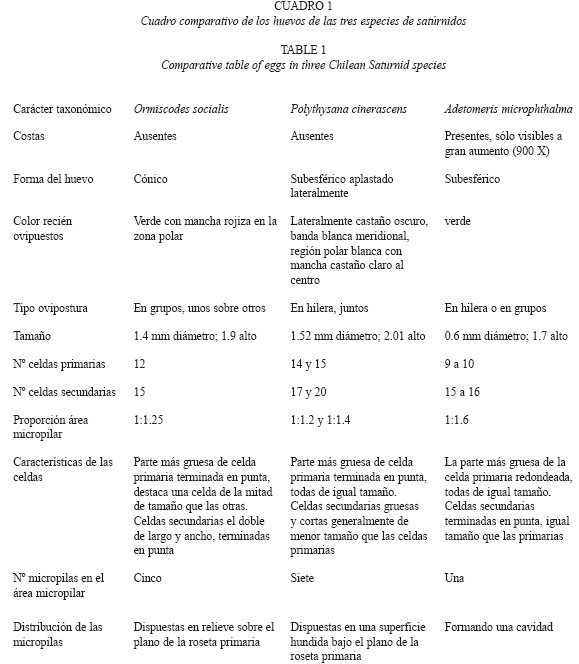
</front><body><![CDATA[ <div style="text-align: center; font-family: arial;"><span  style="font-weight: bold;">Ultraestructura de los huevos de dos mariposas nocturnas de Chile</span>: <span style="font-style: italic;">Ormiscodes socialis</span> y <span style="font-style: italic;">Polythysana cinerascens</span> (<span style="font-weight: bold;">Lepidoptera: Saturniidae</span>)    <br> </div> <br style="font-family: arial;">     <div style="text-align: left;"><small><span style="font-family: arial;">Alfonso Ben&iacute;tez-Mora<sup>1</sup> &amp; Tania S. Olivares<sup>2</sup></span></small>    <br> <br style="font-family: arial;"> <small><span style="font-family: arial;">1 Universidad de Concepci&oacute;n. Facultad de Ciencias Naturales y Oceanogr&aacute;ficas. Departamento de Zoolog&iacute;a. Casilla 160-C, Concepci&oacute;n-Chile; <a href="mailto:abenitez@udec.cl">abenitez@udec.cl</a></span></small>    <br> <br style="font-family: arial;"> <small><span style="font-family: arial;">2 Casilla 4040 correo 3. Concepci&oacute;n-Chile; <a href="mailto:tolivare@udec.cl">tolivare@udec.cl</a></span></small><br  style="font-family: arial;"> <br style="font-family: arial;"> </div>     <div style="text-align: center;">     <div style="text-align: left;">     <div style="text-align: center;"><small><span  style="font-family: arial;">Recibido 13-VI-2003. Corregido 09-XI-2003. Aceptado 09-VIII-2006.</span></small><br style="font-family: arial;"> </div> </div>     <div style="text-align: left;"><br style="font-family: arial;"> <small><span style="font-family: arial;"><span  style="font-weight: bold;">Abstract: Egg ultrastructure in two Chilean moths</span>: <span  style="font-style: italic;">Ormiscodes socialis</span> y <span  style="font-style: italic;">Polythysana cinerascens</span> <span  style="font-weight: bold;">(Lepidoptera: Saturniidae)</span>. The structure and ultra-structure of the eggs from <span style="font-style: italic;">Ormiscodes socialis</span> (Feisthamel)&nbsp; and <span style="font-style: italic;">Polythysana cinerascens</span> (Philippi) are described, considering shape, size, coloring when recently laid, oviposition type nd aeropiles (quantity, distribution and proportion) in the micropilar area, among others. The&nbsp; ultra-structure is shown for primary cells, secondary cells, aeropiles and icropiles. A comparative table of the&nbsp; eggs of these species is presented and includes the previously described eggs of <span style="font-style: italic;">Adetomeris microphthalma</span> (Philippi). <span style="font-style: italic;">Myoschilos oblonga</span> Ruiz y Pav&oacute;n (Santalaceae) is recorded as a new host for <span  style="font-style: italic;">P. cinerascens</span>. Rev. </span> <span  style="font-family: arial;">Biol. Trop. 54 (4): 1085-1091. Epub 2006 Dec. 15.</span></small><br style="font-family: arial;"> <br style="font-family: arial;"> <small><span style="font-family: arial;"><span  style="font-weight: bold;">Key words</span>: Lepidoptera, Saturniidae, egg, ultra-structure, key, <span  style="font-style: italic;">Adetomeris microphthalma, Ormiscodes socialis, </span></span><span style="font-family: arial;"> <span  style="font-style: italic;">Polythysana cinerascens</span>, new host.</span></small><br  style="font-family: arial;"> <br style="font-family: arial;"> <small><span style="font-family: arial;">La Familia Saturniidae re&uacute;ne en total 18 </span><span style="font-family: arial;">especies en Chile. Estas mariposas nocturnas </span><span  style="font-family: arial;">se destacan por su coloraci&oacute;n y su tama&ntilde;o que alcanza los 100 mm de envergadura (Artigas 1994). Esta familia es de importancia econ&oacute;mica debido a los h&aacute;bitos gregarios y fit&oacute;fagos de sus estados larvales. En muchos de los casos causan da&ntilde;os en el &aacute;rea forestal, aunque &eacute;sta es m&aacute;s de tipo secundario, por lo tanto no llegan a considerarse como plagas.</span></small><br style="font-family: arial;"> <br style="font-family: arial;"> <small><span style="font-family: arial;">En la obra de Lemaire (2002) se recopilan </span><span style="font-family: arial;">los datos conocidos de los estados preimaginales </span><span style="font-family: arial;">en las especias chilenas, mayoritariamente </span> <span  style="font-family: arial;">larva y en menor grado pupas y huevos, los cuales</span><span style="font-family: arial;"> comprenden los siguientes autores y a&ntilde;os: </span></small><br  style="font-family: arial;"> <br style="font-family: arial;"> <small><span style="font-family: arial;"><span  style="font-style: italic;">Adetomeris erythrops</span> (Blanchard): <span style="font-weight: bold;">Larva</span>: </span><span style="font-family: arial;">Ureta 1942.</span></small><br  style="font-family: arial;"> <br style="font-family: arial;"> <small><span style="font-family: arial;"><span  style="font-style: italic;">Adetomeris microphthalma</span> (Izquierdo): </span><span  style="font-family: arial;"><span style="font-weight: bold;">Huevo</span>: Hormaz&aacute;bal y Navarro 1995. <span style="font-weight: bold;">Larva</span>: </span><span style="font-family: arial;">Hormaz&aacute;bal y Navarro 1995.</span></small><br style="font-family: arial;"> <br style="font-family: arial;"> <small><span style="font-family: arial;"><span  style="font-style: italic;">Cercophana frauenfeldi</span> (Felder): <span style="font-weight: bold;">Larva</span>: Ureta </span><span style="font-family: arial;">1944.</span></small><br  style="font-family: arial;"> <br style="font-family: arial;"> <small><span style="font-family: arial;"><span  style="font-style: italic;">Cercophana venusta</span> (Walker):<span style="font-weight: bold;"> Larva</span>: Philippi </span><span style="font-family: arial;">1859, Ureta 1944, Wolfe y Balc&aacute;zar-Lara 1994. </span><span  style="font-family: arial;"><span style="font-weight: bold;">Capullo</span>: Philippi 1859.</span></small><br style="font-family: arial;"> <br style="font-family: arial;"> <small><span style="font-family: arial;"> <span  style="font-style: italic;">Cinommata bistrigata</span> Butler: <span style="font-weight: bold;">Larva</span>: Ureta 1943.</span></small>    <br> <br style="font-family: arial;"> <small> <span style="font-family: arial;"><span  style="font-style: italic;">Microdulia mirabilis</span> Rothschild: <span style="font-weight: bold;">Capullo</span>: </span> <span style="font-family: arial;">Ureta 1944.</span></small><br  style="font-family: arial;"> <br style="font-family: arial;"> <small><span style="font-family: arial;"><span  style="font-style: italic;">Neocercophana philippi</span> Izquierdo: <span style="font-weight: bold;">Huevo, </span> </span><span style="font-family: arial;"><span  style="font-weight: bold;">larva, pupa y capullo</span>: Ureta 1944.</span></small><br  style="font-family: arial;"> <br style="font-family: arial;"> <small><span style="font-family: arial;"> <span  style="font-style: italic;">Ormiscodes amphinome</span> (Fabricius): <span style="font-weight: bold;">Larva</span>: </span><span style="font-family: arial;">Silva-Figueroa 1917. <span  style="font-weight: bold;">Pupa</span>: Silva-Figueroa 1917. </span> <span  style="font-family: arial;"><span style="font-weight: bold;">Complejo hipofar&iacute;ngeo</span>: Parra <span style="font-style: italic;">et al</span>. 1985.</span></small><br style="font-family: arial;"> <br style="font-family: arial;"> <small><span style="font-family: arial;"> <span  style="font-style: italic;">Ormiscodes socialis</span> (Feisthamel, 1839). </span><span  style="font-family: arial;"><span style="font-weight: bold;">Larva</span>: Navarro y Rodr&iacute;guez 1998. <span style="font-weight: bold;">Pupa</span>: </span><span style="font-family: arial;">Navarro y Rodr&iacute;guez 1998.</span></small><br style="font-family: arial;"> <br style="font-family: arial;"> <small><span style="font-family: arial;"><span  style="font-style: italic;">Polythysana apollina</span> Felder y Rogenhofer: </span><span  style="font-family: arial;"><span style="font-weight: bold;">Larva</span>: Ureta 1943.</span></small><br style="font-family: arial;"> <br style="font-family: arial;"> <small><span style="font-family: arial;"> <span  style="font-style: italic;">Polythysana cinerascens</span> (Philippi): <span style="font-weight: bold;">Larva</span>: </span><span style="font-family: arial;">Philippi, Angulo y Weigert 1974. <span style="font-weight: bold;">Pupa</span>: Angulo </span> <span  style="font-family: arial;">y Weigert 1974.</span></small><br  style="font-family: arial;"> <br style="font-family: arial;"> <small><span style="font-family: arial;"><span  style="font-style: italic;">Polythysana rubrescens</span> (Blanchard): <span style="font-weight: bold;">Larva</span>: </span><span style="font-family: arial;">Ureta 1943.</span></small><br  style="font-family: arial;"> <br style="font-family: arial;"> <small><span style="font-family: arial;">Exceptuando<span  style="font-style: italic;"> A. microphthalma</span> y de <span  style="font-style: italic;">N. </span></span> <span  style="font-family: arial;"><span style="font-style: italic;">philippi</span>, se desconocen totalmente los huevos. </span><span  style="font-family: arial;">Por esto, este informe inicia un estudio detallado </span><span style="font-family: arial;">de todos los huevos de los sat&uacute;rnidos </span><span style="font-family: arial;">chilenos para su identificaci&oacute;n.</span></small><br  style="font-family: arial;"> <br style="font-family: arial;"> <b><small><span style="font-family: arial;">M</span><span  style="font-family: arial;">ateriales y m&eacute;todos</span></small></b><br  style="font-family: arial;"> <br style="font-family: arial;"> <small> <span style="font-family: arial;">El material utilizado para realizar las </span><span style="font-family: arial;">descripciones se obtuvo a partir de hembras </span><span style="font-family: arial;">recolectadas para ambas especies, las que se </span><span  style="font-family: arial;">mantuvieron en c&aacute;maras de crianza hasta que </span><span style="font-family: arial;">ovipusieron, adem&aacute;s de huevos colectados en </span> <span  style="font-family: arial;"><span style="font-style: italic;">Pinus pinaster</span> Aiton y <span style="font-style: italic;">Myoschilos oblonga</span> </span><span style="font-family: arial;">Ruiz y Pav&oacute;n. La descripci&oacute;n del huevo de&nbsp; </span> <span  style="font-family: arial;"><span style="font-style: italic;">A. microphthalma</span> se obtuvo de Hormaz&aacute;bal y</span><span  style="font-family: arial;"> Navarro 1995. Los huevos que se obuvieron se </span><span style="font-family: arial;">analizaron bajo lupa estereosc&oacute;pica Carl Zeiss </span><span  style="font-family: arial;">y fotografiados en Microscopio Electr&oacute;nico de </span><span style="font-family: arial;">Barrido, Autoscanning ETEC de la Universidad </span><span  style="font-family: arial;">de Concepci&oacute;n, seg&uacute;n la t&eacute;cnica Angulo y </span><span style="font-family: arial;">Olivares (1991).</span></small><br style="font-family: arial;"> <br style="font-family: arial;"> <small><span style="font-family: arial;">Todo el material se encuentra depositado </span><span style="font-family: arial;">en las colecciones cient&iacute;ficas de la Universidad </span><span  style="font-family: arial;">de Concepci&oacute;n, Concepci&oacute;n (UCCC).</span></small><br style="font-family: arial;"> <br style="font-family: arial;"> <b><small><span style="font-family: arial;">R</span><span  style="font-family: arial;">esultados</span></small></b><br  style="font-family: arial;"> <br style="font-family: arial;"> <small> <span style="font-family: arial;">A continuaci&oacute;n se describen las dos </span><span style="font-family: arial;">especies y se entrega un cuadro comparativo </span><span  style="font-family: arial;">(<a href="#cuadro1">Cuadro 1</a>), incluyendo adem&aacute;s a la especie <span style="font-style: italic;">A. </span></span> <span  style="font-family: arial; font-style: italic;">microphthalma.</span></small><br  style="font-family: arial;"> <br style="font-family: arial;"> <small><span style="font-family: arial; font-style: italic;">O. socialis</span></small><br  style="font-family: arial;"> <small><span style="font-family: arial;">(Feisthamel, 1839)</span></small><br  style="font-family: arial;"> <br style="font-family: arial;"> <small><span style="font-family: arial;">Sin&oacute;nimos y combinaciones: </span> </small>    ]]></body>
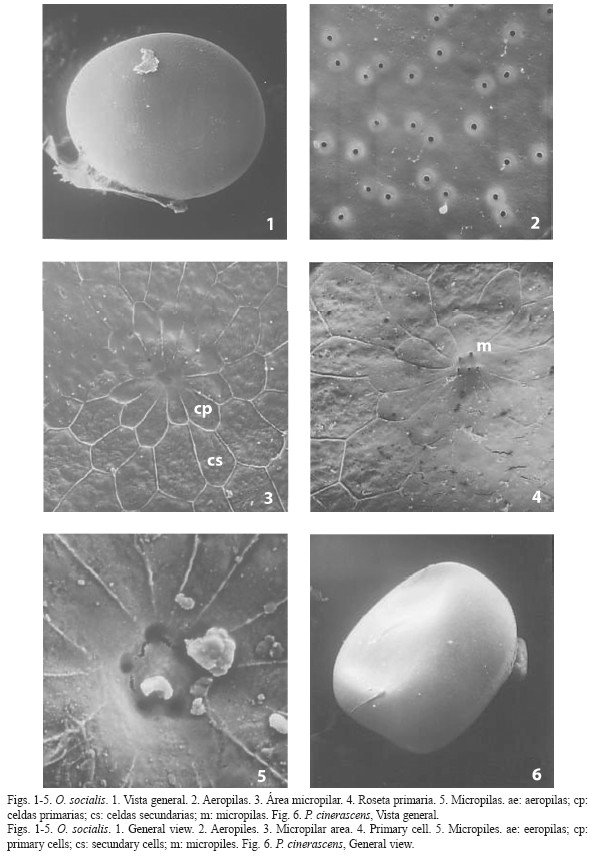
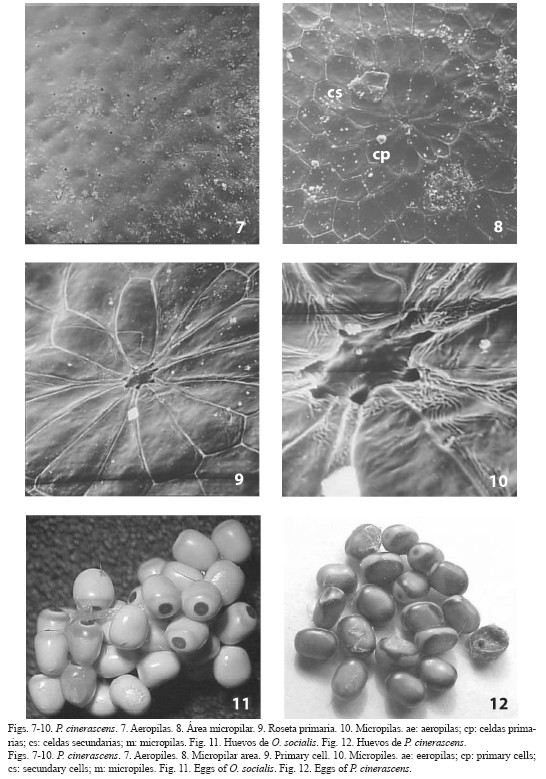
<body><![CDATA[<br> <small><span style="font-family: arial;"><span  style="font-style: italic;">Bombyx socialis</span> Feisthamel, 1839 </span></small>    <br> <small><span style="font-family: arial;"><span  style="font-style: italic;">Dirphia angulifera</span> Walker, 1855</span></small><br  style="font-family: arial;"> <small><span style="font-family: arial;"> <span  style="font-style: italic;">Thauma ribesii </span>(H. Edwards, 1874)</span></small><br  style="font-family: arial;"> <small><span style="font-family: arial;"><span  style="font-style: italic;">O. socialis grisea</span> Ureta, 1957</span></small><br  style="font-family: arial;"> <br style="font-family: arial;"> <small><span style="font-family: arial;"> <span  style="font-weight: bold;">Huevo</span>: Los huevos tienen forma c&oacute;nica </span> <span  style="font-family: arial;">(<a href="#img1-6">Fig. 1</a>), no presentan costras, son de color </span><span style="font-family: arial;">verde cuando reci&eacute;n ovipuestos, con mancha </span><span  style="font-family: arial;">rojiza en la zona polar (<a href="#img7-10">Fig. 11</a>). Ovipostura </span><span style="font-family: arial;">en grupos, unos sobre otros, adosados al sustrato </span><span  style="font-family: arial;">por una sustancia cementante. Di&aacute;metro </span><span style="font-family: arial;">1.4 mm, altura 1.9 mm. Aeropilas en regi&oacute;n </span> <span  style="font-family: arial;">lateral del cuerpo (<a href="#img1-6">Fig. 2</a>). &Aacute;rea micropilar </span><span style="font-family: arial;">ubicada en la regi&oacute;n polar. Celdas primarias de </span> <span  style="font-family: arial;">12, secundarias 15 (n= 5) (<a  href="#img1-6">Fig. 3</a>). Proporci&oacute;n&nbsp; </span><span  style="font-family: arial;">&aacute;rea micropilar 12/15 &oacute; 1:1.25. Roseta primaria </span> <span  style="font-family: arial;">dispuesta en el mismo plano que la secundaria </span><span style="font-family: arial;">(<a href="#img1-6">Fig. 4</a>). Parte m&aacute;s gruesa de celda primaria </span><span  style="font-family: arial;">terminada en punta, destaca una celda de la </span><span style="font-family: arial;">mitad de tama&ntilde;o que las otras (<a href="#img1-6">Fig. 3</a>). Celdas </span><span  style="font-family: arial;">secundarias el doble de largo y ancho, terminadas </span> <span  style="font-family: arial;">en punta. Cinco micropilas en el centro de </span> <span style="font-family: arial;">&aacute;rea micropilar, dispuestas en relieve sobre el </span><span style="font-family: arial;">plano de la roseta primaria (<a href="#img1-6">Fig. 5</a>).</span></small><br  style="font-family: arial;"> <br style="font-family: arial;"> <small><span style="font-family: arial;"> <span  style="font-weight: bold;">Material examinado</span>: 118 huevos, Chile, VIII Regi&oacute;n, Prov. de Concepci&oacute;n, Concepci&oacute;n, </span> <span  style="font-family: arial;">Barrio universitario, Universidad de Concepci&oacute;n, VII/2001, H. Moyano Coll. (UCCC)</span></small><br style="font-family: arial;"> <br style="font-family: arial;"> <small><span style="font-family: arial;"> <span  style="font-weight: bold;">Hospederos</span>:<span  style="font-style: italic;"> Pinus radiata</span> D. Don, </span> <span  style="font-family: arial;"><span style="font-style: italic;">Nothofagus obliqua</span> (Mirbel), <span style="font-style: italic;">Drimys winteri</span> </span><span style="font-family: arial;">J.R. et G. Forster, <span style="font-style: italic;">Luma apiculata</span> DC, </span> <span style="font-family: arial;"><span style="font-style: italic;">Cryptocaria alba</span> Molina, <span style="font-style: italic;">Proustia ilicifolia</span> </span><span style="font-family: arial;">Hook. et Arn. (Angulo <span style="font-style: italic;">et al</span>. 2004).</span></small><br  style="font-family: arial;"> </div>     <p style="text-align: justify;"><small>&nbsp;</small></p>     <p><a name="img1-6"> <img  style="border: 0px solid ; width: 590px; height: 861px;"  src="/img/fbpe/rbt/v54n4/3489i2.JPG" title="" alt=""></a></p>     
<p><a name="cuadro1"> <img  style="border: 0px solid ; width: 579px; height: 664px;"  src="/img/fbpe/rbt/v54n4/3489i1.JPG" title="" alt=""></a></p>     
<p style="text-align: justify;"><small><br style="font-family: arial;"> </small></p>     <div style="text-align: left;"><small><span      style="font-family: arial; font-style: italic;">P. cinerascens</span></small><br      style="font-family: arial;">     <small><span style="font-family: arial;">(Philippi)</span></small><br     ]]></body>
<body><![CDATA[ style="font-family: arial;">     <br style="font-family: arial;">     <small><span style="font-family: arial;">Sin&oacute;nimos y     combinaciones:</span></small><br style="font-family: arial;">     <small><span style="font-family: arial;"> <span      style="font-style: italic;">Attacus     cinerascens</span> (Philippi, 1859)</span></small><br      style="font-family: arial;">     <small><span style="font-family: arial;"> <span      style="font-style: italic;">Attacus     ]]></body>
<body><![CDATA[andromeda</span> (Philippi, 1859)</span></small><br      style="font-family: arial;">     <small><span style="font-family: arial;"><span      style="font-style: italic;">P.     edmondsii</span> Butler, 1882</span></small><br      style="font-family: arial;">     <small><span style="font-family: arial;"><span      style="font-style: italic;">P.     cinerascens</span> f. latchami Ureta 1943</span></small><br      style="font-family: arial;">     ]]></body>
<body><![CDATA[<br style="font-family: arial;">     <small><span style="font-family: arial;"><span      style="font-weight: bold;">Huevo</span>:     Forma subesf&eacute;rica, aplastado </span><span      style="font-family: arial;">lateralmente (<a href="#img1-6">Fig. 6</a>).     No presenta costas. </span> <span style="font-family: arial;">Lateralmente     casta&ntilde;o     oscuro, atravesado </span><span style="font-family: arial;">meridionalmente     por una banda color blanco, </span><span style="font-family: arial;">regi&oacute;n     polar blanca con mancha casta&ntilde;o claro </span> <span     ]]></body>
<body><![CDATA[ style="font-family: arial;">al centro (<a href="#img7-10">Fig. 12</a>).     Ovipostura en hilera,     juntos, </span><span style="font-family: arial;">adosados al sustrato     por la regi&oacute;n lateral </span><span style="font-family: arial;">mediante     una sustancia cementante. Di&aacute;metro1.52 mm, altura 2.01 mm.     Aeropilas en regi&oacute;n </span><span style="font-family: arial;">lateral     del cuerpo (<a href="#img7-10">Fig. 7</a>). &Aacute;rea micropilar     ubicada </span> <span style="font-family: arial;">en la regi&oacute;n     polar. Celdas     primarias de 14 </span><span style="font-family: arial;">a 15,     ]]></body>
<body><![CDATA[secundarias 17 y 20, cuando son 14 celdas </span> <span      style="font-family: arial;">primarias hay 17 secundarias y cuando son     15 </span><span style="font-family: arial;">primarias hay 20     secundarias, sin embargo es </span><span style="font-family: arial;">mucho     m&aacute;s abundante la relaci&oacute;n 14 primarias </span> <span      style="font-family: arial;">17 secundarias (n= 5) (<a href="#img7-10">Fig.     8</a>). Proporci&oacute;n </span><span style="font-family: arial;">&aacute;rea     micropilar m&aacute;s abundante 14/17 &oacute; 1:1.21. </span> <span      style="font-family: arial;">Roseta primaria dispuesta en el mismo     plano </span><span style="font-family: arial;">que la secundaria.     ]]></body>
<body><![CDATA[Parte m&aacute;s gruesa de celda </span><span      style="font-family: arial;">primaria terminada en punta (<a      href="#img7-10">Fig. 9</a>). Celdas </span><span      style="font-family: arial;">secundarias gruesas y     cortas, generalmente de </span><span style="font-family: arial;">menor     tama&ntilde;o que las celdas primarias. Siete </span> <span      style="font-family: arial;">micropilas en el centro de &aacute;rea     micropilar, dispuestas </span><span style="font-family: arial;">una     superficie hundida bajo el plano de </span><span      style="font-family: arial;">la roseta primaria (<a href="#img7-10">Fig.     ]]></body>
<body><![CDATA[10</a>).</span></small><br style="font-family: arial;">     <br style="font-family: arial;">     <small><span style="font-family: arial;"><span      style="font-weight: bold;">Material     examinado</span>: 257 huevos, Chile, </span><span      style="font-family: arial;">vIII Regi&oacute;n, Prov. de     Concepci&oacute;n, Concepci&oacute;n, </span> <span      style="font-family: arial;">s/d, 28/ix/1998, L. A. Cerda Coll. (UCCC).</span></small><br      style="font-family: arial;">     <br style="font-family: arial;">     ]]></body>
<body><![CDATA[<small><span style="font-family: arial;"><span      style="font-weight: bold;">Hospedero</span>:<span      style="font-style: italic;"> Myoschilos oblonga</span> </span> <span      style="font-family: arial;">Ruiz y Pav&oacute;n. Nuevo registro. Se     registra </span><span style="font-family: arial;">como nuevo hospedero     <span style="font-style: italic;">M. oblonga</span> Fam.: </span> <span      style="font-family: arial;">Santalaceae, conocido com&uacute;nmente     como </span><span style="font-family: arial;">&#8220;Codocoypu&#8221;, &#8220;Orocoipo&#8221;     o &#8220;Codocoipo&#8221;. </span><span style="font-family: arial;">Habita lugares     h&uacute;medos, desde el Aconcagua </span><span     ]]></body>
<body><![CDATA[ style="font-family: arial;">hasta Chilo&eacute;. Especie chilena.     Bastante frecuente </span><span style="font-family: arial;">(Hoffmann     1997).</span></small><br style="font-family: arial;">     <br style="font-family: arial;">     <small><span style="font-family: arial; font-weight: bold;">Clave para     separar     los huevos de las tres especies de Saturnidae con base en los     caracteres de cantidad de micropilas, forma y color y cuando     reci&eacute;n ovipuestos</span></small><br style="font-family: arial;">     <br style="font-family: arial;">     ]]></body>
<body><![CDATA[<small><span style="font-family: arial;">1. Una micropila . . . . . . .     . . .     . . . . . . . . . . . . . . . . . . . . . . . . . . . . . . . . . . . .     . . . . . . . . . . . . . . <i>Adetomeris microphthalma</i></span></small><br      style="font-family: arial;">     <small><span style="font-family: arial;">1&#8217; m&aacute;s de una micropila     . . .     . . . . . . . . . . . . . . . . . . . . . . . . . . . . . . . . . .     . . . . . . . . . . . . . . . . . . . . . . . . . . . . . . . . . . . .     2</span></small><br style="font-family: arial;">     ]]></body>
<body><![CDATA[<br style="font-family: arial;">     <small><span style="font-family: arial;">2(1) Huevo subesf&eacute;rico.     Micropilas dispuestas en una superficie hundida bajo el plano de la     roseta primaria. Cuando reci&eacute;n</span></small><br      style="font-family: arial;">     <small><span style="font-family: arial;">ovipuesto lateralmente     casta&ntilde;o-oscuro, atravesado meridionalmente por una banda color     blanco a casta&ntilde;o-claro que</span></small><br      style="font-family: arial;">     <small><span style="font-family: arial;">llega a la regi&oacute;n     ]]></body>
<body><![CDATA[polar,     regi&oacute;n polar blanca a casta&ntilde;o-claro con mancha     casta&ntilde;o-oscuro en el centro. Ovipostura en</span></small><br      style="font-family: arial;">     <small><span style="font-family: arial;">hilera, adosado por la     regi&oacute;n     lateral del huevo, juntos. 1.52 mm di&aacute;metro por 2.01 mm de alto.     14 a 15 celdas primarias</span></small><br style="font-family: arial;">     <small><span style="font-family: arial;">y 17 &oacute; 20 secundarias;     cuando     ]]></body>
<body><![CDATA[son 14 celdas primarias van acompa&ntilde;adas de 17 secundarias y     cuando son 15 van</span></small><br style="font-family: arial;">     <small><span style="font-family: arial;">acompa&ntilde;adas por 20,     siendo     m&aacute;s abundante la relaci&oacute;n 14/17. Celdas secundarias     gruesas y cortas, generalmente de</span></small><br      style="font-family: arial;">     <small><span style="font-family: arial;">menor tama&ntilde;o que las     celdas     primarias. Siete micropilas . . . . . . . . . . . . . . . . . . . . . .     ]]></body>
<body><![CDATA[. . . . . . . . . . . . . . .<span style="font-style: italic;">P.     cinerascens</span></span></small><br style="font-family: arial;">     <br style="font-family: arial;">     <small><span style="font-family: arial;">2&#8217; Huevo c&oacute;nico.     Micropilas     dispuestas en relieve sobre el plano de la roseta primaria. Cuando     reci&eacute;n ovipuesto verde</span></small><br      style="font-family: arial;">     <small><span style="font-family: arial;">con mancha rojiza en la zona     polar.     ]]></body>
<body><![CDATA[Ovipostura en grupos, adosados por la zona polar del huevo, unos sobre     otros. 1.4</span></small><br style="font-family: arial;">     <small><span style="font-family: arial;">mm de di&aacute;metro por 1.9     mm de     alto. 12 celdas primarias y 15 celdas secundarias, siempre en esta     relaci&oacute;n. Celdas</span></small><br style="font-family: arial;">     <small><span style="font-family: arial;">secundarias el doble de largo     y ancho     que las celdas primarias. Cinco micropilas. . . . . . . . . . . . . . .     . . . . . . O. socialis</span></small><br style="font-family: arial;">     ]]></body>
<body><![CDATA[<br style="font-family: arial;">     <small><span style="font-family: arial; font-weight: 700;">D</span><span      style="font-family: arial; font-weight: 700;">iscusi&oacute;n</span></small></div>     <p style="text-align: left;"><span style="font-family: arial;">Todos los huevos carecen de costas. Los huevos de las especies estudiadas presentaron diferencias en la coloraci&oacute;n y la ovipostura. La ovipostura se realiza en hileras o en grupos, adosados por una sustancia cementante. Existe variaci&oacute;n en el n&uacute;mero de las celdas primarias y secundarias entre cada una de las especies, que va desde una relaci&oacute;n de 1: 1.2 en <span style="font-style: italic;">P. cinerascens</span> a 1:1.16 en <span style="font-style: italic;">A. microphthalma</span>. Existen diferencias en el n&uacute;mero y distribuci&oacute;n de las micropilas, que van desde una en <span style="font-style: italic;">A. microphthalma</span> a siete en <span style="font-style: italic;">P. cinerascens</span>. El tama&ntilde;o de los huevos var&iacute;a desde 0.6 a 1.52 mm de di&aacute;metro y de 1.7 a 2.01 mm de alto en las tres especies estudiadas, presentando el menor tama&ntilde;o el huevo de <span style="font-style: italic;">A. microphthalma</span> </span><span style="font-family: arial;">y el de mayor tama&ntilde;o el de <span style="font-style: italic;">P. cinerascens</span>. </span><span style="font-family: arial;">Existe una variaci&oacute;n intraespec&iacute;fica a nivel </span> <span  style="font-family: arial;">de las celdas primarias y celdas secundarias. </span><span style="font-family: arial;">Para la clave de los huevos se incluyeron tres </span><span style="font-family: arial;">especies, por lo que a&uacute;n resta incluir, cuando </span> <span  style="font-family: arial;">se conozcan, los huevos de las quince especies </span><span style="font-family: arial;">restantes.<span  style="font-style: italic;"> M. oblonga</span> es un nuevo hospedero </span> <span style="font-family: arial;">de la especie <span  style="font-style: italic;">P. cinerascens</span>.</span></p>     <p><br style="font-family: arial;"> <br style="font-family: arial;"> <a name="img7-10"> <img  style="border: 0px solid ; width: 546px; height: 779px;"  src="/img/fbpe/rbt/v54n4/3489i3.JPG" title="" alt=""></a></p>     
<p style="text-align: left;"><b><span style="font-family: arial;">Agradecimientos</span><br  style="font-family: arial;"> </b><br style="font-family: arial;"> <span style="font-family: arial;">Los autores agradecen a Hugo H. Moyano </span><span style="font-family: arial;">y Luis Cerda por la donaci&oacute;n del material para </span><span  style="font-family: arial;">realizar el presente trabajo. Nuestro agradecimiento </span><span style="font-family: arial;">y reconocimiento, en forma especial, </span><span  style="font-family: arial;">a Andr&eacute;s O. Angulo, por sus sugerencias y </span><span style="font-family: arial;">cr&iacute;ticas al trabajo.</span> </p>     <p style="font-family: arial; text-align: left;"><br  style="font-family: arial;"> <b><span style="font-family: arial;">R</span><span  style="font-family: arial;">esumen</span><br  style="font-family: arial;"> </b><br style="font-family: arial;"> <span style="font-family: arial;">Se describe la estructura y ultraestructura de los </span><span style="font-family: arial;">huevos de las especies <span style="font-style: italic;">Ormiscodes socialis</span> (Feisthamel) </span><span style="font-family: arial;">y <span  style="font-style: italic;">Polythysana cinerascens</span> (Philippi), considerando la </span><span style="font-family: arial;">forma, tama&ntilde;o, color, tipo de ovipostura, y aeropilas </span><span  style="font-family: arial;">(cantidad, distribuci&oacute;n y proporci&oacute;n) en el &aacute;rea micropilar, </span><span  style="font-family: arial;">entre otros. La ultraestructura es mostrada a trav&eacute;s de las </span><span  style="font-family: arial;">celdas primarias, celdas secundarias, aeropilas y micropilas; </span><span style="font-family: arial;">adem&aacute;s se incluye a la especie ya descrita <span style="font-style: italic;">Adetomeris </span></span><span style="font-family: arial;"> <span  style="font-style: italic;">microphthalma</span> (Philippi) y se confecciona un cuadro comparativo </span><span  style="font-family: arial;">para los huevos de estas especies. Se registra como </span><span style="font-family: arial;">nuevo hospedero de <span style="font-style: italic;">P. Cinerascens</span> a <span  style="font-style: italic;">Myoschilos oblonga</span> </span><span  style="font-family: arial;">Ruiz y Pav&oacute;n (Santalaceae).</span><br  style="font-family: arial;"> <br style="font-family: arial;"> <span style="font-family: arial;"><b>Palabras clave:</b> Lepidoptera, Saturniidae, huevos, ultraestructura, </span><span  style="font-family: arial;">clave, <span style="font-style: italic;">Adetomeris microphthalma, Ormiscodes </span></span><span  style="font-family: arial;"><span style="font-style: italic;">socialis, Polythysana cinerascens</span>, nuevo hospedero.</span><br  style="font-family: arial;"> <br style="font-family: arial;"> <b> <span style="font-family: arial;">R</span><span  style="font-family: arial;">eferencias</span><br  style="font-family: arial;"> </b></p>     <!-- ref --><p style="font-family: arial; text-align: left;"><span  style="font-family: arial;">Angulo, A.O. &amp; G.T. Weigert. 1974. Estados preimaginales </span><span  style="font-family: arial;">de Polythysana cinerascens (Phil.) (Lepidoptera: </span><span style="font-family: arial;">Saturniidae). Bol. Soc. Biol. Concepci&oacute;n 47: 145-150.</span>&nbsp;&nbsp;&nbsp;&nbsp;&nbsp;&nbsp;&nbsp;&nbsp;[&#160;<a href="javascript:void(0);" onclick="javascript: window.open('/scielo.php?script=sci_nlinks&ref=1359524&pid=S0034-7744200600040000300001&lng=','','width=640,height=500,resizable=yes,scrollbars=1,menubar=yes,');">Links</a>&#160;]<!-- end-ref --><div style="text-align: left;"></div>     <!-- ref --><p style="font-family: arial; text-align: left;"><span  style="font-family: arial;">Angulo, A.O., C. Lemaire &amp; T.S. Olivares. 2004. Cat&aacute;logo </span><span  style="font-family: arial;">cr&iacute;tico e ilustrado de las especies de la familia saturniidae </span><span style="font-family: arial;">en Chile (Lepidoptera: Saturniidae). Gayana </span><span  style="font-family: arial;">68: 20-42.</span>&nbsp;&nbsp;&nbsp;&nbsp;&nbsp;&nbsp;&nbsp;&nbsp;[&#160;<a href="javascript:void(0);" onclick="javascript: window.open('/scielo.php?script=sci_nlinks&ref=1359526&pid=S0034-7744200600040000300002&lng=','','width=640,height=500,resizable=yes,scrollbars=1,menubar=yes,');">Links</a>&#160;]<!-- end-ref --><div style="text-align: left;"></div>     <!-- ref --><p style="font-family: arial; text-align: left;"><span  style="font-family: arial;">Angulo, A.O. &amp; T.S. Olivares. 1991. Microestructura del </span><span style="font-family: arial;">exocorion en huevos de algunas especies de n&oacute;ctuidos </span><span  style="font-family: arial;">(Lepidoptera: Glossata: Noctuidae). Ans. Ins. Pat. </span><span style="font-family: arial;">Ser. Cs. Nats. 20: 95-100.</span>&nbsp;&nbsp;&nbsp;&nbsp;&nbsp;&nbsp;&nbsp;&nbsp;[&#160;<a href="javascript:void(0);" onclick="javascript: window.open('/scielo.php?script=sci_nlinks&ref=1359528&pid=S0034-7744200600040000300003&lng=','','width=640,height=500,resizable=yes,scrollbars=1,menubar=yes,');">Links</a>&#160;]<!-- end-ref --><div style="text-align: left;"></div>     <!-- ref --><p style="font-family: arial; text-align: left;"><span  style="font-family: arial;">Artigas, J.N. 1994. Entomolog&iacute;a econ&oacute;mica. Insectos de inter&eacute;s </span><span  style="font-family: arial;">agr&iacute;cola, forestal, m&eacute;dico y veterinario (nativos, introducidos </span><span  style="font-family: arial;">y susceptibles de ser introducidos). Universidad de </span><span style="font-family: arial;">Concepci&oacute;n, Concepci&oacute;n, Chile 2: 943 p.</span>&nbsp;&nbsp;&nbsp;&nbsp;&nbsp;&nbsp;&nbsp;&nbsp;[&#160;<a href="javascript:void(0);" onclick="javascript: window.open('/scielo.php?script=sci_nlinks&ref=1359530&pid=S0034-7744200600040000300004&lng=','','width=640,height=500,resizable=yes,scrollbars=1,menubar=yes,');">Links</a>&#160;]<!-- end-ref --><div style="text-align: left;"></div>     <!-- ref --><p style="font-family: arial; text-align: left;"><span  style="font-family: arial;">Hoffmann, A.E. 1997. Flora silvestre de Chile, zona </span><span style="font-family: arial;">araucana, &aacute;rboles, arbustos y enredaderas le&ntilde;osas. </span><span  style="font-family: arial;">Fundaci&oacute;n Claudio Gay, Santiago, Chile. 258 pp.</span>&nbsp;&nbsp;&nbsp;&nbsp;&nbsp;&nbsp;&nbsp;&nbsp;[&#160;<a href="javascript:void(0);" onclick="javascript: window.open('/scielo.php?script=sci_nlinks&ref=1359532&pid=S0034-7744200600040000300005&lng=','','width=640,height=500,resizable=yes,scrollbars=1,menubar=yes,');">Links</a>&#160;]<!-- end-ref --><div style="text-align: left;"></div>     <!-- ref --><p style="font-family: arial; text-align: left;"><span  style="font-family: arial;">Hormaz&aacute;bal, M.E. &amp; M.E. Navarro. 1995. Descripci&oacute;n </span><span  style="font-family: arial;">del huevo, larva en primer estad&iacute;o y genitalia de </span><span style="font-family: arial;"> <span  style="font-style: italic;">Adetomeris microphthalma</span> (Ph.) (Lepidoptera: </span><span style="font-family: arial;">Saturniidae). Gayana Zool. 59: 41-46.</span>&nbsp;&nbsp;&nbsp;&nbsp;&nbsp;&nbsp;&nbsp;&nbsp;[&#160;<a href="javascript:void(0);" onclick="javascript: window.open('/scielo.php?script=sci_nlinks&ref=1359534&pid=S0034-7744200600040000300006&lng=','','width=640,height=500,resizable=yes,scrollbars=1,menubar=yes,');">Links</a>&#160;]<!-- end-ref --><div style="text-align: left;"></div>     <!-- ref --><p style="font-family: arial; text-align: left;"><span  style="font-family: arial;">Lemaire, C. 2002. The Saturniidae of America. Les </span><span style="font-family: arial;">Saturniidae Americains. Hemileucinae (= Attacinae). </span><span  style="font-family: arial;">Goecke &amp; Evers Antiquariat, Keltern, Deutschland. </span><span style="font-family: arial;">Part 1-3. 1388 p. + 214 plates.</span>&nbsp;&nbsp;&nbsp;&nbsp;&nbsp;&nbsp;&nbsp;&nbsp;[&#160;<a href="javascript:void(0);" onclick="javascript: window.open('/scielo.php?script=sci_nlinks&ref=1359536&pid=S0034-7744200600040000300007&lng=','','width=640,height=500,resizable=yes,scrollbars=1,menubar=yes,');">Links</a>&#160;]<!-- end-ref --><div style="text-align: left;"></div>     <!-- ref --><p style="font-family: arial; text-align: left;"><span  style="font-family: arial;">Navarro, M.E.&amp; M.A. Rodr&iacute;guez. 1998. Ormiscodes socialis </span><span  style="font-family: arial;">socialis (Feisthamel, 1839): descripci&oacute;n de los </span><span style="font-family: arial;">estados postembrionales (Lepidoptera: Saturniidae). </span><span  style="font-family: arial;">Guayana&nbsp; Zool. 62: 37-44.</span>&nbsp;&nbsp;&nbsp;&nbsp;&nbsp;&nbsp;&nbsp;&nbsp;[&#160;<a href="javascript:void(0);" onclick="javascript: window.open('/scielo.php?script=sci_nlinks&ref=1359538&pid=S0034-7744200600040000300008&lng=','','width=640,height=500,resizable=yes,scrollbars=1,menubar=yes,');">Links</a>&#160;]<!-- end-ref --><div style="text-align: left;"></div>     <!-- ref --><p style="font-family: arial; text-align: left;"><span  style="font-family: arial;">Parra, L.E., A.O. Angulo &amp; C. Jana-S&aacute;enz. 1985. Biolog&iacute;a </span><span  style="font-family: arial;">y estados inmaduros de dos mariposas saturnidas </span><span style="font-family: arial;">chilenas (Lepidoptera: Saturniidae). Caracteres diagn&oacute;sticos </span><span  style="font-family: arial;">diferenciales espec&iacute;ficos. Bol. Soc. Biol. </span><span style="font-family: arial;">Concep. Chile 56: 131-139.</span>&nbsp;&nbsp;&nbsp;&nbsp;&nbsp;&nbsp;&nbsp;&nbsp;[&#160;<a href="javascript:void(0);" onclick="javascript: window.open('/scielo.php?script=sci_nlinks&ref=1359540&pid=S0034-7744200600040000300009&lng=','','width=640,height=500,resizable=yes,scrollbars=1,menubar=yes,');">Links</a>&#160;]<!-- end-ref --><div style="text-align: left;"></div>     <!-- ref --><p style="font-family: arial; text-align: left;"><span  style="font-family: arial;">Philippi, R.A. 1859. Descripci&oacute;n de algunas nuevas especies </span><span  style="font-family: arial;">de mariposas chilenas, principalmente en la </span><span style="font-family: arial;">Provincia de valdivia. An. Univ. Chile 16: 1088- </span><span style="font-family: arial;">1114. </span>&nbsp;&nbsp;&nbsp;&nbsp;&nbsp;&nbsp;&nbsp;&nbsp;[&#160;<a href="javascript:void(0);" onclick="javascript: window.open('/scielo.php?script=sci_nlinks&ref=1359542&pid=S0034-7744200600040000300010&lng=','','width=640,height=500,resizable=yes,scrollbars=1,menubar=yes,');">Links</a>&#160;]<!-- end-ref --><div style="text-align: left;"></div>     <!-- ref --><p style="text-align: left;">Silva-Figueroa, C. 1917. La <span  style="font-style: italic;">Dirphia amphimone</span>, (F.) Berg <span style="font-family: arial;">i sus par&aacute;sitos. Bol. Mus. Nac. Chile. 10: 105-128.</span>&nbsp;&nbsp;&nbsp;&nbsp;&nbsp;&nbsp;&nbsp;&nbsp;[&#160;<a href="javascript:void(0);" onclick="javascript: window.open('/scielo.php?script=sci_nlinks&ref=1359544&pid=S0034-7744200600040000300011&lng=','','width=640,height=500,resizable=yes,scrollbars=1,menubar=yes,');">Links</a>&#160;]<!-- end-ref --><div style="text-align: left;"></div>     <!-- ref --><p style="font-family: arial; text-align: left;"><span  style="font-family: arial;">Ureta, E. 1942. Revisi&oacute;n de las especies del g&eacute;nero</span><span style="font-family: arial;"> <span style="font-style: italic;">Automeris</span> Hbn. (Saturniidae). Bol. Mus. Nac. Chil. </span><span style="font-family: arial;">20: 51-80 +4 l&aacute;m.</span>&nbsp;&nbsp;&nbsp;&nbsp;&nbsp;&nbsp;&nbsp;&nbsp;[&#160;<a href="javascript:void(0);" onclick="javascript: window.open('/scielo.php?script=sci_nlinks&ref=1359546&pid=S0034-7744200600040000300012&lng=','','width=640,height=500,resizable=yes,scrollbars=1,menubar=yes,');">Links</a>&#160;]<!-- end-ref --><div style="text-align: left;"></div>     <!-- ref --><p style="font-family: arial; text-align: left;"><span  style="font-family: arial;">Ureta, E. 1943. Revisi&oacute;n del g&eacute;nero <span style="font-style: italic;">Polythysana</span> Wkr. </span><span style="font-family: arial;">(Saturniidae). Bol. Mus. Nac. Chile 21: 55-70.</span>&nbsp;&nbsp;&nbsp;&nbsp;&nbsp;&nbsp;&nbsp;&nbsp;[&#160;<a href="javascript:void(0);" onclick="javascript: window.open('/scielo.php?script=sci_nlinks&ref=1359548&pid=S0034-7744200600040000300013&lng=','','width=640,height=500,resizable=yes,scrollbars=1,menubar=yes,');">Links</a>&#160;]<!-- end-ref --><div style="text-align: left;"></div>     <!-- ref --><p style="font-family: arial; text-align: left;"><span  style="font-family: arial;">Ureta, E. 1944. La familia Saturniidae (Heterocera) en </span><span style="font-family: arial;">Chile. III Parte. Bol. Mus. Nac. Chile 22: 49-64.</span>&nbsp;&nbsp;&nbsp;&nbsp;&nbsp;&nbsp;&nbsp;&nbsp;[&#160;<a href="javascript:void(0);" onclick="javascript: window.open('/scielo.php?script=sci_nlinks&ref=1359550&pid=S0034-7744200600040000300014&lng=','','width=640,height=500,resizable=yes,scrollbars=1,menubar=yes,');">Links</a>&#160;]<!-- end-ref --><div style="text-align: left;"></div>     <!-- ref --><div style="text-align: left;"><span style="font-family: arial;">Wolfe, K.L. &amp; M.A. Balc&aacute;zar-Lara. 1994. Chile&#8217;s <span style="font-style: italic;">Cercophana </span></span><span style="font-family: arial;"> <span  style="font-style: italic;">venusta</span> and its immature stages (Lepidoptera: </span><span style="font-family: arial;">Cercophanidae). Trop. Lepid. 5: 35-42.</span></div>    &nbsp;&nbsp;&nbsp;&nbsp;&nbsp;&nbsp;&nbsp;&nbsp;[&#160;<a href="javascript:void(0);" onclick="javascript: window.open('/scielo.php?script=sci_nlinks&ref=1359552&pid=S0034-7744200600040000300015&lng=','','width=640,height=500,resizable=yes,scrollbars=1,menubar=yes,');">Links</a>&#160;]<!-- end-ref --><p style="font-family: arial;"> </p> </div>      ]]></body><back>
<ref-list>
<ref id="B1">
<nlm-citation citation-type="journal">
<person-group person-group-type="author">
<name>
<surname><![CDATA[Angulo]]></surname>
<given-names><![CDATA[A.O]]></given-names>
</name>
<name>
<surname><![CDATA[Weigert]]></surname>
<given-names><![CDATA[G.T]]></given-names>
</name>
</person-group>
<article-title xml:lang="es"><![CDATA[Estados preimaginales de Polythysana cinerascens (Phil.) (Lepidoptera: Saturniidae)]]></article-title>
<source><![CDATA[Bol. Soc. Biol]]></source>
<year>1974</year>
<volume>47</volume>
<page-range>145-150</page-range><publisher-loc><![CDATA[Concepción ]]></publisher-loc>
</nlm-citation>
</ref>
<ref id="B2">
<nlm-citation citation-type="journal">
<person-group person-group-type="author">
<name>
<surname><![CDATA[Angulo]]></surname>
<given-names><![CDATA[A.O]]></given-names>
</name>
<name>
<surname><![CDATA[Lemaire]]></surname>
<given-names><![CDATA[C]]></given-names>
</name>
<name>
<surname><![CDATA[Olivares]]></surname>
<given-names><![CDATA[T.S]]></given-names>
</name>
</person-group>
<article-title xml:lang="es"><![CDATA[Catálogo crítico e ilustrado de las especies de la familia saturniidae en Chile (Lepidoptera: Saturniidae)]]></article-title>
<source><![CDATA[Gayana]]></source>
<year>2004</year>
<volume>68</volume>
<page-range>20-42</page-range></nlm-citation>
</ref>
<ref id="B3">
<nlm-citation citation-type="journal">
<person-group person-group-type="author">
<name>
<surname><![CDATA[Angulo]]></surname>
<given-names><![CDATA[A.O]]></given-names>
</name>
<name>
<surname><![CDATA[Olivares]]></surname>
<given-names><![CDATA[T.S]]></given-names>
</name>
</person-group>
<article-title xml:lang="es"><![CDATA[Microestructura del exocorion en huevos de algunas especies de nóctuidos (Lepidoptera: Glossata: Noctuidae)]]></article-title>
<source><![CDATA[Ans. Ins. Pat. Ser. Cs. Nats]]></source>
<year>1991</year>
<volume>20</volume>
<page-range>95-100</page-range></nlm-citation>
</ref>
<ref id="B4">
<nlm-citation citation-type="book">
<person-group person-group-type="author">
<name>
<surname><![CDATA[Artigas]]></surname>
<given-names><![CDATA[J.N]]></given-names>
</name>
</person-group>
<source><![CDATA[Entomología económica. Insectos de interés agrícola, forestal, médico y veterinario (nativos, introducidos y susceptibles de ser introducidos)]]></source>
<year>1994</year>
<volume>2</volume>
<page-range>943</page-range><publisher-loc><![CDATA[Concepción ]]></publisher-loc>
<publisher-name><![CDATA[Universidad de Concepción]]></publisher-name>
</nlm-citation>
</ref>
<ref id="B5">
<nlm-citation citation-type="book">
<person-group person-group-type="author">
<name>
<surname><![CDATA[Hoffmann]]></surname>
<given-names><![CDATA[A.E]]></given-names>
</name>
</person-group>
<source><![CDATA[Flora silvestre de Chile, zona araucana, árboles, arbustos y enredaderas leñosas]]></source>
<year>1997</year>
<page-range>258</page-range><publisher-loc><![CDATA[Santiago ]]></publisher-loc>
<publisher-name><![CDATA[Fundación Claudio Gay]]></publisher-name>
</nlm-citation>
</ref>
<ref id="B6">
<nlm-citation citation-type="journal">
<person-group person-group-type="author">
<name>
<surname><![CDATA[Hormazábal]]></surname>
<given-names><![CDATA[M.E]]></given-names>
</name>
<name>
<surname><![CDATA[Navarro]]></surname>
<given-names><![CDATA[M.E]]></given-names>
</name>
</person-group>
<article-title xml:lang="es"><![CDATA[Descripción del huevo, larva en primer estadío y genitalia de Adetomeris microphthalma (Ph.) (Lepidoptera: Saturniidae)]]></article-title>
<source><![CDATA[Gayana Zool]]></source>
<year>1995</year>
<volume>59</volume>
<page-range>41-46</page-range></nlm-citation>
</ref>
<ref id="B7">
<nlm-citation citation-type="book">
<person-group person-group-type="author">
<name>
<surname><![CDATA[Lemaire]]></surname>
<given-names><![CDATA[C]]></given-names>
</name>
</person-group>
<source><![CDATA[The Saturniidae of America. Les Saturniidae Americains. Hemileucinae (= Attacinae)]]></source>
<year>2002</year>
<page-range>1388 p. + 214 plates</page-range><publisher-loc><![CDATA[Keltern ]]></publisher-loc>
<publisher-name><![CDATA[Goecke & Evers Antiquariat]]></publisher-name>
</nlm-citation>
</ref>
<ref id="B8">
<nlm-citation citation-type="journal">
<person-group person-group-type="author">
<name>
<surname><![CDATA[Navarro]]></surname>
<given-names><![CDATA[M.E]]></given-names>
</name>
<name>
<surname><![CDATA[Rodríguez]]></surname>
<given-names><![CDATA[M.A]]></given-names>
</name>
</person-group>
<article-title xml:lang="es"><![CDATA[Ormiscodes socialis socialis (Feisthamel, 1839): descripción de los estados postembrionales (Lepidoptera: Saturniidae)]]></article-title>
<source><![CDATA[Guayana Zool]]></source>
<year>1998</year>
<volume>62</volume>
<page-range>37-44</page-range></nlm-citation>
</ref>
<ref id="B9">
<nlm-citation citation-type="journal">
<person-group person-group-type="author">
<name>
<surname><![CDATA[Parra]]></surname>
<given-names><![CDATA[L.E]]></given-names>
</name>
<name>
<surname><![CDATA[Angulo]]></surname>
<given-names><![CDATA[A.O]]></given-names>
</name>
<name>
<surname><![CDATA[Jana-Sáenz]]></surname>
<given-names><![CDATA[C]]></given-names>
</name>
</person-group>
<article-title xml:lang="es"><![CDATA[Biología y estados inmaduros de dos mariposas saturnidas chilenas (Lepidoptera: Saturniidae). Caracteres diagnósticos diferenciales específicos]]></article-title>
<source><![CDATA[Bol. Soc. Biol. Concep]]></source>
<year>1985</year>
<volume>56</volume>
<page-range>131-139</page-range></nlm-citation>
</ref>
<ref id="B10">
<nlm-citation citation-type="journal">
<person-group person-group-type="author">
<name>
<surname><![CDATA[Philippi]]></surname>
<given-names><![CDATA[R.A]]></given-names>
</name>
</person-group>
<article-title xml:lang="es"><![CDATA[Descripción de algunas nuevas especies de mariposas chilenas, principalmente en la Provincia de valdivia]]></article-title>
<source><![CDATA[An. Univ]]></source>
<year>1859</year>
<volume>16</volume>
<page-range>1088- 1114</page-range></nlm-citation>
</ref>
<ref id="B11">
<nlm-citation citation-type="journal">
<person-group person-group-type="author">
<name>
<surname><![CDATA[Silva-Figueroa]]></surname>
<given-names><![CDATA[C]]></given-names>
</name>
</person-group>
<article-title xml:lang="es"><![CDATA[La Dirphia amphimone, (F.) Berg i sus parásitos]]></article-title>
<source><![CDATA[Bol. Mus. Nac. Chile]]></source>
<year>1917</year>
<volume>10</volume>
<page-range>105-128</page-range></nlm-citation>
</ref>
<ref id="B12">
<nlm-citation citation-type="journal">
<person-group person-group-type="author">
<name>
<surname><![CDATA[Ureta]]></surname>
<given-names><![CDATA[E]]></given-names>
</name>
</person-group>
<article-title xml:lang="es"><![CDATA[Revisión de las especies del género Automeris Hbn. (Saturniidae)]]></article-title>
<source><![CDATA[Bol. Mus. Nac. Chil]]></source>
<year>1942</year>
<volume>20</volume>
<page-range>51-80 +4 lám</page-range></nlm-citation>
</ref>
<ref id="B13">
<nlm-citation citation-type="journal">
<person-group person-group-type="author">
<name>
<surname><![CDATA[Ureta]]></surname>
<given-names><![CDATA[E]]></given-names>
</name>
</person-group>
<article-title xml:lang="es"><![CDATA[Revisión del género Polythysana Wkr. (Saturniidae)]]></article-title>
<source><![CDATA[Bol. Mus. Nac]]></source>
<year>1943</year>
<volume>21</volume>
<page-range>55-70</page-range></nlm-citation>
</ref>
<ref id="B14">
<nlm-citation citation-type="journal">
<person-group person-group-type="author">
<name>
<surname><![CDATA[Ureta]]></surname>
<given-names><![CDATA[E]]></given-names>
</name>
</person-group>
<article-title xml:lang="es"><![CDATA[La familia Saturniidae (Heterocera) en Chile. III Parte]]></article-title>
<source><![CDATA[Bol. Mus. Nac]]></source>
<year>1944</year>
<volume>22</volume>
<page-range>49-64</page-range></nlm-citation>
</ref>
<ref id="B15">
<nlm-citation citation-type="journal">
<person-group person-group-type="author">
<name>
<surname><![CDATA[Wolfe]]></surname>
<given-names><![CDATA[K.L]]></given-names>
</name>
<name>
<surname><![CDATA[Balcázar-Lara]]></surname>
<given-names><![CDATA[M.A]]></given-names>
</name>
</person-group>
<article-title xml:lang="en"><![CDATA[Chile’s Cercophana venusta and its immature stages (Lepidoptera: Cercophanidae)]]></article-title>
<source><![CDATA[Trop. Lepid]]></source>
<year>1994</year>
<volume>5</volume>
<page-range>35-42</page-range></nlm-citation>
</ref>
</ref-list>
</back>
</article>