<?xml version="1.0" encoding="ISO-8859-1"?><article xmlns:mml="http://www.w3.org/1998/Math/MathML" xmlns:xlink="http://www.w3.org/1999/xlink" xmlns:xsi="http://www.w3.org/2001/XMLSchema-instance">
<front>
<journal-meta>
<journal-id>0034-7744</journal-id>
<journal-title><![CDATA[Revista de Biología Tropical]]></journal-title>
<abbrev-journal-title><![CDATA[Rev. biol. trop]]></abbrev-journal-title>
<issn>0034-7744</issn>
<publisher>
<publisher-name><![CDATA[Universidad de Costa Rica]]></publisher-name>
</publisher>
</journal-meta>
<article-meta>
<article-id>S0034-77442006000300033</article-id>
<title-group>
<article-title xml:lang="en"><![CDATA[Species diversity, structure and dynamics of two populations of an endangered species, Magnolia dealbata (Magnoliaceae)]]></article-title>
</title-group>
<contrib-group>
<contrib contrib-type="author">
<name>
<surname><![CDATA[Sánchez-Velásquez]]></surname>
<given-names><![CDATA[Lázaro R]]></given-names>
</name>
<xref ref-type="aff" rid="A01"/>
</contrib>
<contrib contrib-type="author">
<name>
<surname><![CDATA[Pineda-López]]></surname>
<given-names><![CDATA[María del Rosario]]></given-names>
</name>
<xref ref-type="aff" rid="A01"/>
</contrib>
</contrib-group>
<aff id="A01">
<institution><![CDATA[,Universidad Veracruzana  ]]></institution>
<addr-line><![CDATA[ ]]></addr-line>
<country>México</country>
</aff>
<pub-date pub-type="pub">
<day>00</day>
<month>09</month>
<year>2006</year>
</pub-date>
<pub-date pub-type="epub">
<day>00</day>
<month>09</month>
<year>2006</year>
</pub-date>
<volume>54</volume>
<numero>3</numero>
<fpage>997</fpage>
<lpage>1001</lpage>
<copyright-statement/>
<copyright-year/>
<self-uri xlink:href="http://www.scielo.sa.cr/scielo.php?script=sci_arttext&amp;pid=S0034-77442006000300033&amp;lng=en&amp;nrm=iso"></self-uri><self-uri xlink:href="http://www.scielo.sa.cr/scielo.php?script=sci_abstract&amp;pid=S0034-77442006000300033&amp;lng=en&amp;nrm=iso"></self-uri><self-uri xlink:href="http://www.scielo.sa.cr/scielo.php?script=sci_pdf&amp;pid=S0034-77442006000300033&amp;lng=en&amp;nrm=iso"></self-uri><abstract abstract-type="short" xml:lang="en"><p><![CDATA[Little is known about the ecology and demography of the genus Magnolia. Magnolia dealbata Zucc. is an endangered species endemic to Mexico. Two contrasting populations of M. dealbata (one from the grasslands and other from a secondary cloud forest) were studied. We asked the following questions: (a) Are size structure (diameter at breast height, DBH) and infrutescence production significantly different between the two populations? (b) What are the populations’ growth rates (&#955;) based on an initial 1987 study? (c) Are the associated species diversity indices of these M. dealbata populations significantly different? The results show no significant differences between the population size structure (p=.094); the growth rates of the populations were 0.992 in grassland and 1.053 in secondary cloud forest. The number of infrutescences produced in year 2001 and DBH relationship were significantly linear (p<.001) in both populations, and there was no significant difference (p>.01) between their slopes. The diversity indices were not significantly different (p>.05), and only 54% of the species were common to both sites. Our study suggests that both populations are relatively stable and that the management history could impact more on the species composition than on the diversity indices. Rev. Biol. Trop. 54 (3): 997-1002. Epub 2006 Sept. 29.]]></p></abstract>
<abstract abstract-type="short" xml:lang="es"><p><![CDATA[La ecología y demografía del género Magnolia han sido poco estudiadas. Magnolia dealbata Zucc. es una especie endémica de México y es considerada en peligro de extinción. Se estudiaron dos poblaciones contrastantes de M. dealbata (una dentro de un pastizal y la otra dentro de vegetación secundaria del bosque mesófilo de montaña -bosque de niebla-). Buscamos respuestas a las siguientes preguntas: (a) ¿La estructura de tamaños y la producción de frutos de ambas poblaciones son significativamente diferentes? (b) ¿Cuáles son las tasas de crecimiento poblacional (&#955;), tomando como población inicial un estudio de 1987? (c) ¿Son significativamente diferentes los valores de diversidad de especies de ambas poblaciones? No hallamos diferencias significativas entre la estructura de tamaños de ambas poblaciones (p=.094). Las tasas de crecimiento poblacional de las poblaciones en pastizal y en el bosque secundario de neblina fueron 0.992 y 1.053, respectivamente. El número de infrutescencias por individuo producidas en 2001 y su relación con el diámetro a la altura del pecho fueron significativamente lineales, y no hubo diferencias significativas entre sus pendientes (p>.1). Los índices de diversidad no fueron significativamente diferentes (p>.05) y sólo el 54 % de las especies fueron comunes entre sitios. Las poblaciones parecen relativamente estables y el historial de manejo en ambas comunidades podría afectar más a la composición de especies que a los índices de diversidad.]]></p></abstract>
<kwd-group>
<kwd lng="en"><![CDATA[cloud forest]]></kwd>
<kwd lng="en"><![CDATA[diversity]]></kwd>
<kwd lng="en"><![CDATA[endangered species]]></kwd>
<kwd lng="en"><![CDATA[infrutescences]]></kwd>
<kwd lng="en"><![CDATA[Magnolia dealbata]]></kwd>
<kwd lng="en"><![CDATA[Mexico]]></kwd>
<kwd lng="en"><![CDATA[population]]></kwd>
<kwd lng="es"><![CDATA[bosque nuboso]]></kwd>
<kwd lng="es"><![CDATA[diversidad]]></kwd>
<kwd lng="es"><![CDATA[especie en peligro de extinción]]></kwd>
<kwd lng="es"><![CDATA[infrutescencia]]></kwd>
<kwd lng="es"><![CDATA[Magnolia dealbata]]></kwd>
<kwd lng="es"><![CDATA[México]]></kwd>
<kwd lng="es"><![CDATA[población]]></kwd>
</kwd-group>
</article-meta>
</front><body><![CDATA[  <b><font face="Arial"></font></b>     <p align="center"><b><font face="Arial">Species diversity, structure and dynamics of two populations of an endangered species, <i>Magnolia dealbata</i></font><font face="Arial" color="#ff0000"> </font><font  face="Arial">(Magnoliaceae)</font></b></p> <font face="Arial" size="2"></font>     <p><font face="Arial" size="2">Lázaro R. Sánchez-Velásquez<sup><a  href="#a1">1</a>,<a href="#a2">2</a></sup> &amp; María del Rosario Pineda-López<a href="#a1"><sup>1</sup></a></font></p>     <p><font face="Arial" size="2"><a name="a1"></a>1 Laboratorio de Biotecnología y Ecología Aplicada, Dirección General de Investigaciones, Universidad Veracruzana, Campus para la Cultura, las Artes y el Deporte, Av. de las Culturas Veracruzanas No. 101, Col. Zapata, AP 250, Xalapa, Ver., CP 91090, México. Tel.: (+52) (228) 842-277</font></p>     <p><font face="Arial" size="2"><a name="a2"></a>2 <a  href="mailto:lasanchez@uv.mx">lasanchez@uv.mx</a></font></p>     <p align="center"><font face="Arial" size="2">Received 14-IX-2003. Corrected 15-VII-2005. Accepted 09-III-2006.</font></p> <font face="Arial" size="2"><b></b></font>     <p><font face="Arial" size="2"><b>Abstract:</b> Little is known about the ecology and demography of the genus <i>Magnolia</i>. <i>Magnolia dealbata</i> Zucc. is an endangered species endemic to Mexico. Two contrasting populations of <i>M. dealbata</i> (one from the grasslands and other from a secondary cloud forest) were studied. We asked the following questions: (a) Are size structure (diameter at breast height, DBH) and infrutescence production significantly different between the two populations? (b) What are th</font><font face="Arial" size="2">e populations’ growth rates (&#955;) based on an initial 1987 study? (c) Are the associated species diversity indices of these </font><i><font  face="Arial" size="2">M. dealbata</font></i><font face="Arial" size="2"> populations significantly different? The results show no significant differences between the population size structure (p=.094); the growth rates of the populations were 0.992 in grassland and 1.053 in secondary cloud forest. The number of infrutescences produced in year 2001 and DBH relationship were significantly linear (p<i>&lt;</i>.001) in both populations, and there was no significant difference (p<i>&gt;</i>.01) between their slopes. The diversity indices were not significantly different (p<i>&gt;</i>.05), and only 54% of the species were common to both sites. Our study suggests that both populations are relatively stable and that the management history could impact more on the species composition than on the diversity indices. Rev. Biol. Trop. 54 (3): 997-1002. Epub 2006 Sept. 29.</font></p> <font face="Arial" size="2"><b></b></font>     <p><font face="Arial" size="2"><b>Key words:</b> cloud forest, diversity, endangered species, infrutescences, <i>Magnolia dealbata</i>, Mexico, population.</font></p>     <p><font face="Arial" size="2">&nbsp;</font></p>     <p><font face="Arial" size="2">Few population studies have been done on the genus <i>Magnolia</i> (eg Weaver 1987, Doyle 1989, Gutiérrez 1993). Seven species and two subspecies of <i>Magnolia</i> are native to Mexico (Vázquez 1994): <i>M. iltisiana</i> and <i>M. schiedeana</i> are classified as threatened species, and <i>M. dealbata</i> and <i>M. sharpii</i> are classified as endangered according to IUCN and Federal Mexican laws. <i>Magnolia dealbata</i> is endemic to Mexico and it is actually restricted to small local populations in the states of Oaxaca, Hidalgo, San Luis Potosí and Veracruz. Coyopolan, Veracruz has the highest number of individuals (Pattison 1985, Gutierrez 1993). A recent study reported a new locality for <i>M. dealbata</i> in the state of Querétaro, but it did not describe the condition of the population (Cartujano <i>et al.</i> 2002). </font></p> <font face="Arial" size="2"><i></i></font>     ]]></body>
<body><![CDATA[<p><font face="Arial" size="2"><i>M. dealbata</i> wood is utilized as firewood and fence material. Its giant white flowers are used ornamentally and for traditional medicine (Gutierrez and Vovides 1997). Indigenous Mexicans know <i>M. dealbata</i> as <i>Eloxochitl</i> (from nahuatl <i>elotl</i> ear and <i>xochitl</i> flower) (Pattison 1985). <i>M. dealbata</i> usually grows in cloud forest or "bosque mesófilo de montaña" (Rzedowski 1978).</font></p>     <p><font face="Arial" size="2">Gutierrez and Vovides (1997) described the annual survivorship of two <i>M. dealbata </i>populations from Coyopolan, Veracruz, based on data from 1986 to 1987 (L. Gutiérrez, pers. com.). There are no other studies published on the present population status of this rare species. Similarly, there are no descriptions or listings of the species associated with <i>M. dealbata</i>.</font></p>     <p><font face="Arial" size="2">Information on population structure and size is useful, even from short-term studies, to allow us to make inferences about the past and future of a particular population (Martínez-Ramos and Álvarez-Buylla 1995, Sánchez-Velásquez <i>et al</i>. 2002). Our study is a preliminary investigation of a long-term study in which the general objective is to document the perturbation impact on the demography of <i>M. dealbata</i> in Coyopolan, Veracruz, México. Two ecologically contrasting populations of <i>M. dealbata</i> were studied (grassland and secondary cloud fore</font><font face="Arial"  size="2">st) with the following questions to test: (a) Are the size structure (DBH) and infrutescences production significantly different in both populations? (b) What are the populations’ growth rates (&#955;) based on the initial study of Guti&#953;rrez from 1986-1987? (c</font><font  face="Arial" size="2">) Are the associated species diversity indices of the <i>M. dealbata</i> populations significantly different?</font></p> <font face="Arial" size="2"><b>     <p>Materials and methods</p> </b><i></i></font>     <p><font face="Arial" size="2"><i>M. dealbata</i>, a member of Section Rytidospermum, is a deciduous tree that grows to 25 m in height, has white large flowers measuring 20 cm and leaves 80 cm long. Each adult tree is able to produce several new stump sprouts after they have been cut, but only one or two principal stems will survive. These attributes produce no clear relationship between age and size, as we found an old tree with a small stem as well as an old tree with a large stem. Altitudinal distribution of <i>M. dealbata</i> is from 1200 to 1500 m, Pattison (1985), Johnson (1989), Vázquez (1994), Qiu <i>et al</i>. (1995), Vovides and Iglesias (1996), Gutiérrez and Vovides (1997), Azuma <i>et al.</i> (2001) and Kim <i>et al</i>. 2001, for more details of its ecology, taxonomy and phylogeny. </font></p>     <p><font face="Arial" size="2">We studied two populations of <i>M. dealbata</i> in Coyopolan, Veracruz, México (19º21’ N, 97º04’ W), one located in secondary cloud forest and the other in grassland. Both were previously studied during 1986-1987 by Gutiérrez (1993), but we did not find the exact location of the originals plots. The climate in this area is subtropical, with rainfall of 1 500-2&#8200;000 mm annually distributed throughout the year. The average annual temperature is 19.5&#8200;ºC (Gutiérrez and Vovides 1997). Eight random plots (10 x 10 m) were used for each population (a total of 16), accounting for all individuals of <i>M. dealbata</i>. Other species included were only those <u>&gt;</u> 1.3 m in height; species, DBH and height were registered. Our plot size was larger than the size of the largest cluster (6 x 5 m) of <i>M. dealbata</i> found (Gutiérrez 1993). Number of infrutescences produced by individuals of <i>M. dealbata</i> was counted. Each individual <i>M. dealbata </i>seedling was mapped and labeled for a subsequent demography study. </font></p>     <p><font face="Arial" size="2">The size structure between both populations was analyzed by Spearman correlation coefficient (Zar 1999). Dependence between size classes of <i>M. dealbata</i> <i>vs</i>. sites was determined by Fisher test exact.</font></p>     <p><font face="Arial" size="2">The X<sup>2</sup> test was used to find independence (total number of individuals of <i>M. dealbata</i>)<i> </i>between sites and year (years 1987 and 2002). Previously, the registered data was recorded as the </font><font face="Arial" size="2">number of individuals per hectare. The annual population growth rate (&#955;) was calculated in both populations by using the equation:</font></p> <font face="Arial" size="2">     <p>&nbsp;</p> </font>     <p style="text-align: center;"><img src="/img/fbpe/rbt/v54n3/f%F3rmula1.JPG" title=""  alt="" style="width: 60px; height: 18px;"><font face="Arial" size="2">,</font></p>     
]]></body>
<body><![CDATA[<p><font face="Arial" size="2">were <i>N<sub>t</sub></i><sub> </sub>is population size in time <i>t</i> (until year 2001), <i>N<sub>o</sub></i><sub> </sub>is initial p</font><font face="Arial" size="2">opulation size (year 1987), &#955; is population growth rate and </font><i><font  face="Arial" size="2">t</font></i><font face="Arial" size="2"> is time (14 years). Hence &#955; value can be estimated by</font></p>     <p style="text-align: center;"><img src="/img/fbpe/rbt/v54n3/f%F3rmula2.JPG" title=""  alt="" style="width: 60px; height: 43px;">    
<br> </p> <font face="Arial" size="2">     <p>    <br> </p>     <p>The infrutescences number <i>vs.</i> DBH size was analyzed by linear simple regression in both <i>M. dealbata</i> populations (DBH as independent variable). </p>     <p>Shannon-Wiener diversity indices were calculated for both sites using the equation:</p>     <p>&nbsp;</p> </font>     <p style="text-align: center;"><img src="/img/fbpe/rbt/v54n3/f%F3rmula3.JPG" title=""  alt="" style="width: 100px; height: 29px;"><font face="Arial" size="2">, </font></p>     
<p><font face="Arial" size="2">where <i>s</i> is species number; <i>p<sub>i</sub></i> is proportion of species <i>i-th</i>. The diversity indices were compared with Student’s T test (Zar 1999, Sánchez-Velásquez and Pineda-López 2000). We used individuals &gt; 1.3 m height. The structure of plant species community associated with <i>M. dealbata</i> was analyzed through X<sup>2</sup> test.</font></p> <font face="Arial" size="2"><b>     ]]></body>
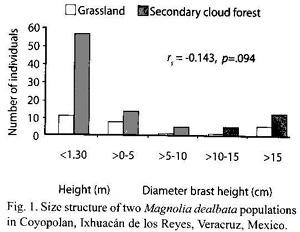
<body><![CDATA[<p>Results</p> </b></font>     <p><font face="Arial" size="2">The size structure between both populations was not significantly correlated (<a href="#f1">Fig. 1</a>) (Spearman, p=.094), nor was size structure <i>vs</i>. sites significantly dependent (Fisher, p=.276). </font></p> <a name="f1"></a>     <div style="text-align: center;"><img src="/img/fbpe/rbt/v54n3/3889i6.JPG" title=""  alt="" style="width: 300px; height: 232px;"></div>     
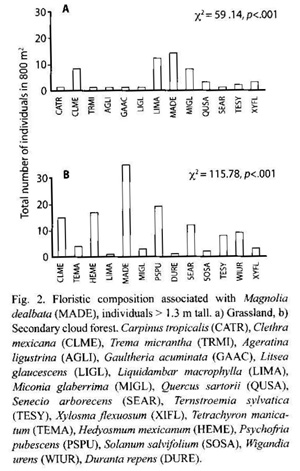
<p><font face="Arial" size="2">In the 1986-1987 study, the number of individuals of <i>M. dealbata</i> per hectare was 338 and 554 in grassland and secondary cloud forest, respectively (Gutiérrez 1993), while in this study (2001) was 300 in grassland and 1 137 in secondary cloud forest. The total number of individuals of <i>M. dealbata</i> between sites and </font><font face="Arial" size="2">years was not independent (&#967;2, p&lt;.001). The population growth rate in grassland was 0.992, while in secondary cloud forest was 1.053. </font></p>     <p><font face="Arial" size="2">Linear regression analysis between relationship of the number of infrutescences and DBH was significant in both populations; grassland (</font><i><font face="Arial" size="2">Nc = </font></i><font face="Arial" size="2">-7.28+1.556 DBH; <i>r</i><sup>2</sup>, p&lt;.001) and secondary cloud forest (<i>Nc = </i>-5.11+1.549 DBH; <i>r</i><sup>2</sup>, p&lt;.001). However, the slopes were not significantly different between populations (Student’s T, p&gt;.1).</font></p>     <p><font face="Arial" size="2">The diversity index was not significantly different between sites (Student’s T, p&gt;.05; secondary cloud forest <i>H´</i> = 2.62 and grassland <i>H´</i> = 2.84). Nevertheless, only 54 % of the species were common to both sites (year 2001). Five species from grassland were not found in secondary cloud forest, while two species from secondary cloud forest were not established in grassland (<a href="#f2">Fig. 2</a>). </font></p> <a name="f2"></a>     <div style="text-align: center;"><img src="/img/fbpe/rbt/v54n3/3889i7.JPG" title=""  alt="" style="width: 300px; height: 471px;"></div> <font face="Arial" size="2"><b>     
<p>Discussion</p> </b>     <p>The size structure in both <i>M. dealbata </i>populations was an inverse <i>J</i> type. This is typical for many natural populations of tree species (Vanclay 1994) and shade tolerant species. This type of curve, in which age and size are not correlated, suggests that there are more environmentally poor conditions than rich for the growth of individuals (Martínez-Ramos and Álvarez-Buylla 1995). However, we infer in our study that this is not the case: from almost all the individuals that had been cut recently at the base emerged more small individuals than large. As mentioned earlier, <i>M. dealbata </i>can sprout several stems after it has been cut, but only one or two principal sprouts survive (pers. obs.). We could identify sprouts because some individuals had evidence of cuttings. Similarly, the size structure of the population (<i>J</i> inverse and non relationship between age-size) of <i>Magnolia splendens </i>was observed in the Luquillo mountains of Puerto Rico (Weaver 1987) and also in <i>M. macrophylla</i> in the Mill Creek Forest,USA (Doyle 1989). </p> </font><font face="Arial" size="2"></font>     <p><font face="Arial" size="2">In the secondary cloud forest the population growth rate (&#955;) of </font><i><font face="Arial" size="2">M. dealbata</font></i><font face="Arial" size="2"> was estimated at a 5.4% annual populat</font><font face="Arial" size="2">ion increase, ie &#955;= 1.054. This suggests a good history of </font><i><font face="Arial"  size="2">in situ</font></i><font face="Arial" size="2"> conservation management and also &#955;&gt; 1 is typical of a shade tolerant species (Vanclay 1995). Nevertheless, the grassland population of </font><i><font  face="Arial" size="2">M. dealbata</font></i><font face="Arial" size="2"> (an open area and frequently used for cow grazing) showed a slight annual population decrease, a 1% annual loss. However, more details and time are necessary to understand the perturbation impact on population dynamics of <i>M. dealbata</i>. Weaver (1987) found inversed results: he registered an 18% population increase of <i>M. splendens</i> in clear cut sites, while in sites without clear cutting, he found a <i>M. splendens</i> population decrease of 35% in 35 years. There have been other studies in Mexico of two evergreen species; briefly, <i>M. sharpii</i> is a local endangered species in Los Altos de Chiapas (González <i>et al</i>. 1997) and <i>M. iltisiana</i> is a threatened species with low regeneration and few individuals in the Western Sierra de Manantlán of Mexico (Vázquez <i>et al</i>. 1995, Saldaña-Acosta <i>et al</i>. 2001).</font></p>     ]]></body>
<body><![CDATA[<p><font face="Arial" size="2">The significant linear regression of DBH <i>vs</i> the infrutescences number within each of the populations and the lack of significant difference between the slopes implies that <i>M. dealbata</i> individuals produce more infrutescences as size increases. This characteristic is common in nature because the tallest individual captures more resources than the shorter individuals, and in turn produces more infrutescence. Future demography studies or conservation agencies can use these models (relationship DBH-Infrutescences number) to forecast future production of seeds. </font></p>     <p><font face="Arial" size="2">We found more species simultaneously with <i>M. dealbata</i> (19) than the six cited in Gutiérrez and Vovides (1997), but we did not find <i>Tilia sp.</i> as they reported. Perhaps, we found more species because we used smaller size DBH than they did.</font></p>     <p><font face="Arial" size="2">Diversity index comparisons of the different studies have some limitations (Sánchez-Velásquez <i>et al</i>. 2002b) because: 1) different sample size, plot size and diversity index are used, and 2) the minimum size of the individuals used are different. However, with these limitations we can observe that our index values are in the intervals of those found in other studies of Mexican cloud forests, but our values are higher than their average values: Sierra de Manantlán Biosphere Reserve (H’ from 3.2 to 0.59, with 5 cm of DBH minimum) (Santiago and Jardel 1993, Hernández <i>et al</i>. 2000), El Cielo Biosphere Reserve (H’ from 3.6 to 0.39, with 5 cm of DBH minimum)(Puig 1987), Sierra de Cucharas (H’ from 3.89 to 2.81,with 15 cm of DBH minimum)(Puig <i>et al</i>. 1983) and El Triunfo (H´=3.8024, with 5 cm of DBH minimum)(Williams 1991).</font></p>     <p><font face="Arial" size="2">Our study suggests that a change in management history can impact species composition more than diversity indices. Only 54% of the species were common to both plant communities associated with <i>M. dealbata.</i></font></p> <font face="Arial" size="2"><b>     <p>Acknowledgments</p>     <p>&nbsp;</p> </b></font>     <p><font face="Arial" size="2">Andres Vovides, Elizabeth Hulstrand, Antonio Andrade-Torres, Luis Manuel Martínez Rivera, Irene Masquina and two anonymous individuals reviewed the manuscript. Vicente Vázquez and Rene A. Palestina-Guerrero determined the scientific name of plants collected. Thanks to Aron, Abdon and Candido from the Coyopolan community, José Luis Herrador and Liliana Gutiérrez for their assistance on our first field visits. Mario Fernández and José Luis Sánchez for the logistic support in the Casa Universitaria in Coyopolan. The study was funded by Consejo Nacional de Ciencia y Tecnología –Mexico and by grants I39240-V and Universidad Veracruzana. </font></p> <font face="Arial" size="2"><b>     <p>Resumen</p> </b></font>     <p><font face="Arial" size="2">La ecología y demografía del género <i>Magnolia</i> han sido poco estudiadas. <i>Magnolia dealbata</i> Zucc. es una especie endémica de México y es considerada en peligro de extinción. Se estudiaron dos poblaciones contrastantes de <i>M. dealbat</i>a (una dentro de un pastizal y la otra dentro de vegetación secundaria del bosque mesófilo de montaña –bosque de niebla-). Buscamos respuestas a las siguientes preguntas: (a) ¿La estructura de tamaños y la producción de frutos de ambas poblaciones son significativamente diferentes? (b) ¿Cuáles son las tasas de crecimiento poblacional (&#955;), tomando como población inicial un estudio de 1987? (c) ¿Son significativamente diferentes los valores de diversidad de especies de ambas poblaciones? No hallamos diferencias significativas entre la estructura de tamaños de ambas poblaciones (p=.094). Las tasas de crecimiento poblacional de las poblaciones en pastizal y en el bosque secundario de neblina fueron 0.992 y 1.053, respectivamente. El número de infrutescencias por individuo producidas en 2001 y su relación con el diámetro a la altura del pecho fueron significativamente lineales, y no hubo diferencias significativas entre sus pendientes (p&gt;.1). Los índices de diversidad no fueron significativamente diferentes (p&gt;.05) y sólo el 54 % de las especies fueron comunes entre sitios. Las poblaciones parecen relativamente estables y el historial de manejo en ambas comunidades podría afectar más a la composición de especies que a los índices de diversidad. </font></p> <font face="Arial" size="2"><b></b></font>     <p><font face="Arial" size="2"><b>Palabras clave:</b> bosque nuboso, diversidad, especie en peligro de extinción, infrutescencia, <i>Magnolia dealbata</i>, México, población.</font></p> <font face="Arial" size="2"><b>     ]]></body>
<body><![CDATA[<p>References</p> </b></font>     <!-- ref --><p><font face="Arial" size="2">Azuma, H., J. García-Franco, V. Rico-Gray &amp; L.B. Thien. 2001. Molecular phylogeny of the Magnoliaceae: the biography of tropical and temperate disjunctions. Am. J. Bot. 88: 2275-2285.</font>&nbsp;&nbsp;&nbsp;&nbsp;&nbsp;&nbsp;&nbsp;&nbsp;[&#160;<a href="javascript:void(0);" onclick="javascript: window.open('/scielo.php?script=sci_nlinks&ref=1325845&pid=S0034-7744200600030003300001&lng=','','width=640,height=500,resizable=yes,scrollbars=1,menubar=yes,');">Links</a>&#160;]<!-- end-ref --><!-- ref --><p><font face="Arial" size="2">Cartujano, S., S. Zamudio, O. Alcántara &amp; I. Luna. 2002. El bosque mesófilo de montaña en el municipio de Landa Matamoros, Querétaro, México. Bol. Soc. Bot. Méx. 70: 13-43. </font>&nbsp;&nbsp;&nbsp;&nbsp;&nbsp;&nbsp;&nbsp;&nbsp;[&#160;<a href="javascript:void(0);" onclick="javascript: window.open('/scielo.php?script=sci_nlinks&ref=1325846&pid=S0034-7744200600030003300002&lng=','','width=640,height=500,resizable=yes,scrollbars=1,menubar=yes,');">Links</a>&#160;]<!-- end-ref --><!-- ref --><p><font face="Arial" size="2">Doyle, A.M. 1989. <i>Magnolia macrophylla</i>: Population structure, reproductive strategies and the disturbance regime of Mill Creek Forest. Tesis de licenciatura, Tulane University, Louisiana, USA. 69 p.</font>&nbsp;&nbsp;&nbsp;&nbsp;&nbsp;&nbsp;&nbsp;&nbsp;[&#160;<a href="javascript:void(0);" onclick="javascript: window.open('/scielo.php?script=sci_nlinks&ref=1325847&pid=S0034-7744200600030003300003&lng=','','width=640,height=500,resizable=yes,scrollbars=1,menubar=yes,');">Links</a>&#160;]<!-- end-ref --><!-- ref --><p><font face="Arial" size="2">González, E.M., G.S. Ochoa, M.N. Ramírez &amp; P.F. Quintana. 1997. Contexto Vegetacional y Florístico de la Agricultura, p. 85-117. <i>In </i>M.R. Parra V. &amp; B.M. Díaz H. (eds.). Los Altos de Chiapas: Agricultura y Crisis Rural. Tomo 1. Los Recursos Naturales. El Colegio de la Frontera Sur, Quintana Roo, Mexico.</font>&nbsp;&nbsp;&nbsp;&nbsp;&nbsp;&nbsp;&nbsp;&nbsp;[&#160;<a href="javascript:void(0);" onclick="javascript: window.open('/scielo.php?script=sci_nlinks&ref=1325848&pid=S0034-7744200600030003300004&lng=','','width=640,height=500,resizable=yes,scrollbars=1,menubar=yes,');">Links</a>&#160;]<!-- end-ref --><!-- ref --><p><font face="Arial" size="2">Guitiérrez, L. 1993. Estudio biológico de una especie forestal endémica (<i>Magnolia dealbata</i> Zucc.). Tesis de maestría en ciencias, Facultad de Ciencias Biológicas, Universidad Autónoma de Nuevo León, Monterrey, Nuevo León, México. 92 p.</font>&nbsp;&nbsp;&nbsp;&nbsp;&nbsp;&nbsp;&nbsp;&nbsp;[&#160;<a href="javascript:void(0);" onclick="javascript: window.open('/scielo.php?script=sci_nlinks&ref=1325849&pid=S0034-7744200600030003300005&lng=','','width=640,height=500,resizable=yes,scrollbars=1,menubar=yes,');">Links</a>&#160;]<!-- end-ref --><!-- ref --><p><font face="Arial" size="2">Gutiérrez, L. &amp; A. Vovides. 1997. An <i>in situ</i> study of <i>Magnolia dealbata</i> Zucc. In Veracruz State: an endangered endemic tree of Mexico, Biod. Cons. 6: 89-97.</font>&nbsp;&nbsp;&nbsp;&nbsp;&nbsp;&nbsp;&nbsp;&nbsp;[&#160;<a href="javascript:void(0);" onclick="javascript: window.open('/scielo.php?script=sci_nlinks&ref=1325850&pid=S0034-7744200600030003300006&lng=','','width=640,height=500,resizable=yes,scrollbars=1,menubar=yes,');">Links</a>&#160;]<!-- end-ref --><!-- ref --><p><font face="Arial" size="2">Johnson, D.L. 1989. Nomenclatural changes in <i>Magnolia</i>. Baileya 23: 55-56.</font>&nbsp;&nbsp;&nbsp;&nbsp;&nbsp;&nbsp;&nbsp;&nbsp;[&#160;<a href="javascript:void(0);" onclick="javascript: window.open('/scielo.php?script=sci_nlinks&ref=1325851&pid=S0034-7744200600030003300007&lng=','','width=640,height=500,resizable=yes,scrollbars=1,menubar=yes,');">Links</a>&#160;]<!-- end-ref --><!-- ref --><p><font face="Arial" size="2">Kim, S., C.W. Park, Y.D. Kim &amp; Y. Suh. 2001. Phylogenetic relationships in family Magnoliaceae inferred from NDHF sequences. Am. J. Bot. 88: 717-728.</font>&nbsp;&nbsp;&nbsp;&nbsp;&nbsp;&nbsp;&nbsp;&nbsp;[&#160;<a href="javascript:void(0);" onclick="javascript: window.open('/scielo.php?script=sci_nlinks&ref=1325852&pid=S0034-7744200600030003300008&lng=','','width=640,height=500,resizable=yes,scrollbars=1,menubar=yes,');">Links</a>&#160;]<!-- end-ref --><!-- ref --><p><font face="Arial" size="2">Martínez-Ramos, M. &amp; E. Álvarez-Buylla. 1995. Ecología de poblaciones de plantas en una selva húmeda de México. Bol. Soc. Bot. Méx. 56: 121-153.</font>&nbsp;&nbsp;&nbsp;&nbsp;&nbsp;&nbsp;&nbsp;&nbsp;[&#160;<a href="javascript:void(0);" onclick="javascript: window.open('/scielo.php?script=sci_nlinks&ref=1325853&pid=S0034-7744200600030003300009&lng=','','width=640,height=500,resizable=yes,scrollbars=1,menubar=yes,');">Links</a>&#160;]<!-- end-ref --><!-- ref --><p><font face="Arial" size="2">Patisson, G. 1985. <i>Magnolia dealbata</i>. Magnolia J. Magnolia Society 22: 17-18.</font>&nbsp;&nbsp;&nbsp;&nbsp;&nbsp;&nbsp;&nbsp;&nbsp;[&#160;<a href="javascript:void(0);" onclick="javascript: window.open('/scielo.php?script=sci_nlinks&ref=1325854&pid=S0034-7744200600030003300010&lng=','','width=640,height=500,resizable=yes,scrollbars=1,menubar=yes,');">Links</a>&#160;]<!-- end-ref --><!-- ref --><p><font face="Arial" size="2">Puig, H., R. Bracho &amp; V. Sosa. 1983. Composición florística del bosque mesófilo en Gómez Farías, Tamaulipas, México. Biótica 8: 339-358.</font>&nbsp;&nbsp;&nbsp;&nbsp;&nbsp;&nbsp;&nbsp;&nbsp;[&#160;<a href="javascript:void(0);" onclick="javascript: window.open('/scielo.php?script=sci_nlinks&ref=1325855&pid=S0034-7744200600030003300011&lng=','','width=640,height=500,resizable=yes,scrollbars=1,menubar=yes,');">Links</a>&#160;]<!-- end-ref --><!-- ref --><p><font face="Arial" size="2">Qiu, Y.L., M.W. Chase &amp; C.R. Parks. 1995. A chloroplast DNA phylogenetic study of the eastern Asia-eastern North America disjunct section <i>Rytiodospermum </i>of <i>Magnolia </i>(Magnoliaceae). Am. J. Bot. 82: 1582-1588.</font>&nbsp;&nbsp;&nbsp;&nbsp;&nbsp;&nbsp;&nbsp;&nbsp;[&#160;<a href="javascript:void(0);" onclick="javascript: window.open('/scielo.php?script=sci_nlinks&ref=1325856&pid=S0034-7744200600030003300012&lng=','','width=640,height=500,resizable=yes,scrollbars=1,menubar=yes,');">Links</a>&#160;]<!-- end-ref --><!-- ref --><p><font face="Arial" size="2">Rzedowski, J. 1978. Vegetación de México. LIMUSA, México, DF. 432 p.</font>&nbsp;&nbsp;&nbsp;&nbsp;&nbsp;&nbsp;&nbsp;&nbsp;[&#160;<a href="javascript:void(0);" onclick="javascript: window.open('/scielo.php?script=sci_nlinks&ref=1325857&pid=S0034-7744200600030003300013&lng=','','width=640,height=500,resizable=yes,scrollbars=1,menubar=yes,');">Links</a>&#160;]<!-- end-ref --><!-- ref --><p><font face="Arial" size="2">Saldaña-Acosta, A., S. Zuluaga &amp; E. Jardel. 2001. Germinación de <i>Acer skutchii </i>Rehder y <i>Magnolia iltisiana</i> Vázquez en la Reserva de la Biosfera Sierra de Manantlán, Jalisco, México. Foresta Veracruzana 3: 1-8.</font>&nbsp;&nbsp;&nbsp;&nbsp;&nbsp;&nbsp;&nbsp;&nbsp;[&#160;<a href="javascript:void(0);" onclick="javascript: window.open('/scielo.php?script=sci_nlinks&ref=1325858&pid=S0034-7744200600030003300014&lng=','','width=640,height=500,resizable=yes,scrollbars=1,menubar=yes,');">Links</a>&#160;]<!-- end-ref --><!-- ref --><p><font face="Arial" size="2">Sánchez-Velásquez, L.R. &amp; M.R. Pineda-López. 2000. Ecología Cuantitativa en Plantas: Métodos. Universidad de Guadalajara, Guadalajara, Jalisco, México. 142 p.</font>&nbsp;&nbsp;&nbsp;&nbsp;&nbsp;&nbsp;&nbsp;&nbsp;[&#160;<a href="javascript:void(0);" onclick="javascript: window.open('/scielo.php?script=sci_nlinks&ref=1325859&pid=S0034-7744200600030003300015&lng=','','width=640,height=500,resizable=yes,scrollbars=1,menubar=yes,');">Links</a>&#160;]<!-- end-ref --><!-- ref --><p><font face="Arial" size="2">Sánchez-Velásquez, L.R., E. Ezcurra, M. Martínez-Ramos, E. Álvarez-Buylla &amp; R. Lorente. 2002a. Population dynamics of <i>Zea diploperennis</i>, a perennial herbs: effect of slash and burn practice. J. Ecol. 90: 684-692.</font>&nbsp;&nbsp;&nbsp;&nbsp;&nbsp;&nbsp;&nbsp;&nbsp;[&#160;<a href="javascript:void(0);" onclick="javascript: window.open('/scielo.php?script=sci_nlinks&ref=1325860&pid=S0034-7744200600030003300016&lng=','','width=640,height=500,resizable=yes,scrollbars=1,menubar=yes,');">Links</a>&#160;]<!-- end-ref --><!-- ref --><p><font face="Arial" size="2">Sánchez-Velásquez, L.R., G. Hernández, M. Carranza, M.R. Pineda-López, R. Cuevas &amp; F. Aragón. 2002b. Estructura arbórea del bosque tropical caducifolio usado para la ganadería extensiva en el norte de la Sierra de Manantlán, México: Antagonismo de usos. Polibotánica 13: 25-46.</font>&nbsp;&nbsp;&nbsp;&nbsp;&nbsp;&nbsp;&nbsp;&nbsp;[&#160;<a href="javascript:void(0);" onclick="javascript: window.open('/scielo.php?script=sci_nlinks&ref=1325861&pid=S0034-7744200600030003300017&lng=','','width=640,height=500,resizable=yes,scrollbars=1,menubar=yes,');">Links</a>&#160;]<!-- end-ref --><!-- ref --><p><font face="Arial" size="2">Santiago, A.L. &amp; E. Jardel. 1993. Composición y estructura del bosque mesófilo de montaña en la Sierra de Manantlán, Jalisco-Colima. Biotam 5: 13-26.</font>&nbsp;&nbsp;&nbsp;&nbsp;&nbsp;&nbsp;&nbsp;&nbsp;[&#160;<a href="javascript:void(0);" onclick="javascript: window.open('/scielo.php?script=sci_nlinks&ref=1325862&pid=S0034-7744200600030003300018&lng=','','width=640,height=500,resizable=yes,scrollbars=1,menubar=yes,');">Links</a>&#160;]<!-- end-ref --><!-- ref --><p><font face="Arial" size="2">SAS Institute. 1996. SAS/STAT user´s guide. Version 6. SAS Institute, Cary, North Carolina, USA.</font>&nbsp;&nbsp;&nbsp;&nbsp;&nbsp;&nbsp;&nbsp;&nbsp;[&#160;<a href="javascript:void(0);" onclick="javascript: window.open('/scielo.php?script=sci_nlinks&ref=1325863&pid=S0034-7744200600030003300019&lng=','','width=640,height=500,resizable=yes,scrollbars=1,menubar=yes,');">Links</a>&#160;]<!-- end-ref --><!-- ref --><p><font face="Arial" size="2">Vanclay, J.K. 1994. Modeling Forest Growth and Yield: Applications to Mixed Tropical Forest. CAB International, London, England. 312 p.</font>&nbsp;&nbsp;&nbsp;&nbsp;&nbsp;&nbsp;&nbsp;&nbsp;[&#160;<a href="javascript:void(0);" onclick="javascript: window.open('/scielo.php?script=sci_nlinks&ref=1325864&pid=S0034-7744200600030003300020&lng=','','width=640,height=500,resizable=yes,scrollbars=1,menubar=yes,');">Links</a>&#160;]<!-- end-ref --><!-- ref --><p><font face="Arial" size="2">Vázquez, G.A. 1994. <i>Magnolia</i> (Magnoliaceae) in Mexico and Central America: a synopsis. Brittonia 46: 1-23.</font>&nbsp;&nbsp;&nbsp;&nbsp;&nbsp;&nbsp;&nbsp;&nbsp;[&#160;<a href="javascript:void(0);" onclick="javascript: window.open('/scielo.php?script=sci_nlinks&ref=1325865&pid=S0034-7744200600030003300021&lng=','','width=640,height=500,resizable=yes,scrollbars=1,menubar=yes,');">Links</a>&#160;]<!-- end-ref --><!-- ref --><p><font face="Arial" size="2">Vázquez, G.A., R. Cuevas, T.S. Cochrane, H.H. Iltis, F. Santana &amp; L. Guzmán. 1995. Flora de Manantlán. SIDA, Bot. Misc., Bot. Res. Inst. Texas, Inc. 13. Universidad de Guadalajara, Guadalajara, Jalisco, México. 312 p.</font>&nbsp;&nbsp;&nbsp;&nbsp;&nbsp;&nbsp;&nbsp;&nbsp;[&#160;<a href="javascript:void(0);" onclick="javascript: window.open('/scielo.php?script=sci_nlinks&ref=1325866&pid=S0034-7744200600030003300022&lng=','','width=640,height=500,resizable=yes,scrollbars=1,menubar=yes,');">Links</a>&#160;]<!-- end-ref --><!-- ref --><p><font face="Arial" size="2">Weaver, P.L. 1987. Ecological observations on <i>Magnolia</i> <i>splendens</i> urban in the Luquillo mountains of Puerto Rico. Carib. J. Sci. 23: 340-351.</font>&nbsp;&nbsp;&nbsp;&nbsp;&nbsp;&nbsp;&nbsp;&nbsp;[&#160;<a href="javascript:void(0);" onclick="javascript: window.open('/scielo.php?script=sci_nlinks&ref=1325867&pid=S0034-7744200600030003300023&lng=','','width=640,height=500,resizable=yes,scrollbars=1,menubar=yes,');">Links</a>&#160;]<!-- end-ref --><!-- ref --><p><font face="Arial" size="2">Williams, L.G. 1991. Nota sobre la estructura del estrato arbóreo del bosque mesófilo de montaña en los alrededores del campamento "El Triunfo", Chiapas. Acta Bot. Mexic. 13: 1-7.</font>&nbsp;&nbsp;&nbsp;&nbsp;&nbsp;&nbsp;&nbsp;&nbsp;[&#160;<a href="javascript:void(0);" onclick="javascript: window.open('/scielo.php?script=sci_nlinks&ref=1325868&pid=S0034-7744200600030003300024&lng=','','width=640,height=500,resizable=yes,scrollbars=1,menubar=yes,');">Links</a>&#160;]<!-- end-ref --><!-- ref --><p><font face="Arial" size="2">Zar, J.H. 1999. Biostatistical Analysis. Prentice-Hall, London. 663 p. </font>&nbsp;&nbsp;&nbsp;&nbsp;&nbsp;&nbsp;&nbsp;&nbsp;[&#160;<a href="javascript:void(0);" onclick="javascript: window.open('/scielo.php?script=sci_nlinks&ref=1325869&pid=S0034-7744200600030003300025&lng=','','width=640,height=500,resizable=yes,scrollbars=1,menubar=yes,');">Links</a>&#160;]<!-- end-ref --> ]]></body><back>
<ref-list>
<ref id="B1">
<nlm-citation citation-type="journal">
<person-group person-group-type="author">
<name>
<surname><![CDATA[Azuma]]></surname>
<given-names><![CDATA[H]]></given-names>
</name>
<name>
<surname><![CDATA[García-Franco]]></surname>
<given-names><![CDATA[J]]></given-names>
</name>
<name>
<surname><![CDATA[Rico-Gray]]></surname>
<given-names><![CDATA[V]]></given-names>
</name>
<name>
<surname><![CDATA[Thien]]></surname>
<given-names><![CDATA[L.B]]></given-names>
</name>
</person-group>
<article-title xml:lang="en"><![CDATA[Molecular phylogeny of the Magnoliaceae: the biography of tropical and temperate disjunctions]]></article-title>
<source><![CDATA[Am. J. Bot]]></source>
<year>2001</year>
<volume>88</volume>
<page-range>2275-2285</page-range></nlm-citation>
</ref>
<ref id="B2">
<nlm-citation citation-type="journal">
<person-group person-group-type="author">
<name>
<surname><![CDATA[Cartujano]]></surname>
<given-names><![CDATA[S]]></given-names>
</name>
<name>
<surname><![CDATA[Zamudio]]></surname>
<given-names><![CDATA[S]]></given-names>
</name>
<name>
<surname><![CDATA[Alcántara]]></surname>
<given-names><![CDATA[O]]></given-names>
</name>
<name>
<surname><![CDATA[Luna]]></surname>
<given-names><![CDATA[I]]></given-names>
</name>
</person-group>
<article-title xml:lang="es"><![CDATA[El bosque mesófilo de montaña en el municipio de Landa Matamoros, Querétaro, México]]></article-title>
<source><![CDATA[Bol. Soc. Bot. Méx]]></source>
<year>2002</year>
<volume>70</volume>
<page-range>13-43</page-range></nlm-citation>
</ref>
<ref id="B3">
<nlm-citation citation-type="">
<person-group person-group-type="author">
<name>
<surname><![CDATA[Doyle]]></surname>
<given-names><![CDATA[A.M]]></given-names>
</name>
</person-group>
<source><![CDATA[Magnolia macrophylla: Population structure, reproductive strategies and the disturbance regime of Mill Creek Forest.]]></source>
<year>1989</year>
<page-range>69</page-range></nlm-citation>
</ref>
<ref id="B4">
<nlm-citation citation-type="book">
<person-group person-group-type="author">
<name>
<surname><![CDATA[González]]></surname>
<given-names><![CDATA[E.M]]></given-names>
</name>
<name>
<surname><![CDATA[Ochoa]]></surname>
<given-names><![CDATA[G.S]]></given-names>
</name>
<name>
<surname><![CDATA[Ramírez]]></surname>
<given-names><![CDATA[M.N]]></given-names>
</name>
<name>
<surname><![CDATA[Quintana]]></surname>
<given-names><![CDATA[P.F]]></given-names>
</name>
</person-group>
<article-title xml:lang="es"><![CDATA[Contexto Vegetacional y Florístico de la Agricultura]]></article-title>
<person-group person-group-type="editor">
<name>
<surname><![CDATA[Parra V]]></surname>
<given-names><![CDATA[M.R]]></given-names>
</name>
<name>
<surname><![CDATA[Díaz H]]></surname>
<given-names><![CDATA[B.M]]></given-names>
</name>
</person-group>
<source><![CDATA[Los Altos de Chiapas: Agricultura y Crisis Rural. Tomo 1. Los Recursos Naturales]]></source>
<year>1997</year>
<page-range>85-117</page-range><publisher-loc><![CDATA[Quintana Roo ]]></publisher-loc>
<publisher-name><![CDATA[El Colegio de la Frontera Sur]]></publisher-name>
</nlm-citation>
</ref>
<ref id="B5">
<nlm-citation citation-type="">
<person-group person-group-type="author">
<name>
<surname><![CDATA[Guitiérrez]]></surname>
<given-names><![CDATA[L]]></given-names>
</name>
</person-group>
<source><![CDATA[Estudio biológico de una especie forestal endémica (Magnolia dealbata Zucc.)]]></source>
<year>1993</year>
<page-range>92</page-range></nlm-citation>
</ref>
<ref id="B6">
<nlm-citation citation-type="journal">
<person-group person-group-type="author">
<name>
<surname><![CDATA[Gutiérrez]]></surname>
<given-names><![CDATA[L]]></given-names>
</name>
<name>
<surname><![CDATA[Vovides]]></surname>
<given-names><![CDATA[A]]></given-names>
</name>
</person-group>
<article-title xml:lang="en"><![CDATA[An in situ study of Magnolia dealbata Zucc. In Veracruz State: an endangered endemic tree of Mexico, Biod]]></article-title>
<source><![CDATA[Cons]]></source>
<year>1997</year>
<volume>6</volume>
<page-range>89-97</page-range></nlm-citation>
</ref>
<ref id="B7">
<nlm-citation citation-type="journal">
<person-group person-group-type="author">
<name>
<surname><![CDATA[Johnson]]></surname>
<given-names><![CDATA[D.L]]></given-names>
</name>
</person-group>
<article-title xml:lang="en"><![CDATA[Nomenclatural changes in Magnolia]]></article-title>
<source><![CDATA[Baileya]]></source>
<year>1989</year>
<volume>23</volume>
<page-range>55-56</page-range></nlm-citation>
</ref>
<ref id="B8">
<nlm-citation citation-type="journal">
<person-group person-group-type="author">
<name>
<surname><![CDATA[Kim]]></surname>
<given-names><![CDATA[S]]></given-names>
</name>
<name>
<surname><![CDATA[Park]]></surname>
<given-names><![CDATA[C.W]]></given-names>
</name>
<name>
<surname><![CDATA[Kim]]></surname>
<given-names><![CDATA[Y.D]]></given-names>
</name>
<name>
<surname><![CDATA[Suh]]></surname>
<given-names><![CDATA[Y]]></given-names>
</name>
</person-group>
<article-title xml:lang="en"><![CDATA[Phylogenetic relationships in family Magnoliaceae inferred from NDHF sequences]]></article-title>
<source><![CDATA[Am. J. Bot]]></source>
<year>2001</year>
<volume>88</volume>
<page-range>717-728</page-range></nlm-citation>
</ref>
<ref id="B9">
<nlm-citation citation-type="journal">
<person-group person-group-type="author">
<name>
<surname><![CDATA[Martínez-Ramos]]></surname>
<given-names><![CDATA[M]]></given-names>
</name>
<name>
<surname><![CDATA[Álvarez-Buylla]]></surname>
<given-names><![CDATA[E]]></given-names>
</name>
</person-group>
<article-title xml:lang="es"><![CDATA[Ecología de poblaciones de plantas en una selva húmeda de México]]></article-title>
<source><![CDATA[Bol. Soc. Bot. Méx]]></source>
<year>1995</year>
<volume>56</volume>
<page-range>121-153</page-range></nlm-citation>
</ref>
<ref id="B10">
<nlm-citation citation-type="journal">
<person-group person-group-type="author">
<name>
<surname><![CDATA[Patisson]]></surname>
<given-names><![CDATA[G]]></given-names>
</name>
</person-group>
<article-title xml:lang="en"><![CDATA[Magnolia dealbata. Magnolia J]]></article-title>
<source><![CDATA[Magnolia Society]]></source>
<year>1985</year>
<volume>22</volume>
<page-range>17-18</page-range></nlm-citation>
</ref>
<ref id="B11">
<nlm-citation citation-type="journal">
<person-group person-group-type="author">
<name>
<surname><![CDATA[Puig]]></surname>
<given-names><![CDATA[H]]></given-names>
</name>
<name>
<surname><![CDATA[Bracho]]></surname>
<given-names><![CDATA[R]]></given-names>
</name>
<name>
<surname><![CDATA[Sosa]]></surname>
<given-names><![CDATA[V]]></given-names>
</name>
</person-group>
<article-title xml:lang="es"><![CDATA[Composición florística del bosque mesófilo en Gómez Farías, Tamaulipas, México]]></article-title>
<source><![CDATA[Biótica]]></source>
<year>1983</year>
<volume>8</volume>
<page-range>339-358</page-range></nlm-citation>
</ref>
<ref id="B12">
<nlm-citation citation-type="journal">
<person-group person-group-type="author">
<name>
<surname><![CDATA[Qiu]]></surname>
<given-names><![CDATA[Y.L]]></given-names>
</name>
<name>
<surname><![CDATA[Chase]]></surname>
<given-names><![CDATA[M.W]]></given-names>
</name>
<name>
<surname><![CDATA[Parks]]></surname>
<given-names><![CDATA[C.R]]></given-names>
</name>
</person-group>
<article-title xml:lang="en"><![CDATA[A chloroplast DNA phylogenetic study of the eastern Asia-eastern North America disjunct section Rytiodospermum of Magnolia (Magnoliaceae)]]></article-title>
<source><![CDATA[Am. J. Bot]]></source>
<year>1995</year>
<volume>82</volume>
<page-range>1582-1588</page-range></nlm-citation>
</ref>
<ref id="B13">
<nlm-citation citation-type="book">
<person-group person-group-type="author">
<name>
<surname><![CDATA[Rzedowski]]></surname>
<given-names><![CDATA[J]]></given-names>
</name>
</person-group>
<source><![CDATA[Vegetación de México]]></source>
<year>1978</year>
<page-range>432</page-range><publisher-loc><![CDATA[^eMéxico, DF México, DF]]></publisher-loc>
<publisher-name><![CDATA[LIMUSA]]></publisher-name>
</nlm-citation>
</ref>
<ref id="B14">
<nlm-citation citation-type="journal">
<person-group person-group-type="author">
<name>
<surname><![CDATA[Saldaña-Acosta]]></surname>
<given-names><![CDATA[A]]></given-names>
</name>
<name>
<surname><![CDATA[Zuluaga]]></surname>
<given-names><![CDATA[S]]></given-names>
</name>
<name>
<surname><![CDATA[Jardel]]></surname>
<given-names><![CDATA[E]]></given-names>
</name>
</person-group>
<article-title xml:lang="es"><![CDATA[Germinación de Acer skutchii Rehder y Magnolia iltisiana Vázquez en la Reserva de la Biosfera Sierra de Manantlán, Jalisco, México]]></article-title>
<source><![CDATA[Foresta Veracruzana]]></source>
<year>2001</year>
<volume>3</volume>
<page-range>1-8</page-range></nlm-citation>
</ref>
<ref id="B15">
<nlm-citation citation-type="book">
<person-group person-group-type="author">
<name>
<surname><![CDATA[Sánchez-Velásquez]]></surname>
<given-names><![CDATA[L.R]]></given-names>
</name>
<name>
<surname><![CDATA[Pineda-López]]></surname>
<given-names><![CDATA[M.R]]></given-names>
</name>
</person-group>
<source><![CDATA[Ecología Cuantitativa en Plantas: Métodos]]></source>
<year>2000</year>
<page-range>142</page-range><publisher-loc><![CDATA[Guadalajara^eJalisco Jalisco]]></publisher-loc>
<publisher-name><![CDATA[Universidad de Guadalajara]]></publisher-name>
</nlm-citation>
</ref>
<ref id="B16">
<nlm-citation citation-type="journal">
<person-group person-group-type="author">
<name>
<surname><![CDATA[Sánchez-Velásquez]]></surname>
<given-names><![CDATA[L.R]]></given-names>
</name>
<name>
<surname><![CDATA[Ezcurra]]></surname>
<given-names><![CDATA[E]]></given-names>
</name>
<name>
<surname><![CDATA[Martínez-Ramos]]></surname>
<given-names><![CDATA[M]]></given-names>
</name>
<name>
<surname><![CDATA[Álvarez-Buylla]]></surname>
<given-names><![CDATA[E]]></given-names>
</name>
<name>
<surname><![CDATA[Lorente]]></surname>
<given-names><![CDATA[R]]></given-names>
</name>
</person-group>
<article-title xml:lang="en"><![CDATA[Population dynamics of Zea diploperennis, a perennial herbs: effect of slash and burn practice]]></article-title>
<source><![CDATA[J. Ecol]]></source>
<year>2002</year>
<volume>90</volume>
<page-range>684-692</page-range></nlm-citation>
</ref>
<ref id="B17">
<nlm-citation citation-type="journal">
<person-group person-group-type="author">
<name>
<surname><![CDATA[Sánchez-Velásquez]]></surname>
<given-names><![CDATA[L.R]]></given-names>
</name>
<name>
<surname><![CDATA[Hernández]]></surname>
<given-names><![CDATA[G]]></given-names>
</name>
<name>
<surname><![CDATA[Carranza]]></surname>
<given-names><![CDATA[M]]></given-names>
</name>
<name>
<surname><![CDATA[Pineda-López]]></surname>
<given-names><![CDATA[M.R]]></given-names>
</name>
<name>
<surname><![CDATA[Cuevas]]></surname>
<given-names><![CDATA[R]]></given-names>
</name>
<name>
<surname><![CDATA[Aragón]]></surname>
<given-names><![CDATA[F]]></given-names>
</name>
</person-group>
<article-title xml:lang="es"><![CDATA[Estructura arbórea del bosque tropical caducifolio usado para la ganadería extensiva en el norte de la Sierra de Manantlán, México: Antagonismo de usos]]></article-title>
<source><![CDATA[Polibotánica]]></source>
<year>2002</year>
<volume>13</volume>
<page-range>25-46</page-range></nlm-citation>
</ref>
<ref id="B18">
<nlm-citation citation-type="journal">
<person-group person-group-type="author">
<name>
<surname><![CDATA[Santiago]]></surname>
<given-names><![CDATA[A.L]]></given-names>
</name>
<name>
<surname><![CDATA[Jardel]]></surname>
<given-names><![CDATA[E]]></given-names>
</name>
</person-group>
<article-title xml:lang="es"><![CDATA[Composición y estructura del bosque mesófilo de montaña en la Sierra de Manantlán, Jalisco-Colima]]></article-title>
<source><![CDATA[Biotam]]></source>
<year>1993</year>
<volume>5</volume>
<page-range>13-26</page-range></nlm-citation>
</ref>
<ref id="B19">
<nlm-citation citation-type="book">
<collab>SAS Institute</collab>
<source><![CDATA[SAS/STAT user´s guide. Version 6]]></source>
<year>1996</year>
<publisher-loc><![CDATA[Cary^eNorth Carolina North Carolina]]></publisher-loc>
<publisher-name><![CDATA[SAS Institute]]></publisher-name>
</nlm-citation>
</ref>
<ref id="B20">
<nlm-citation citation-type="book">
<person-group person-group-type="author">
<name>
<surname><![CDATA[Vanclay]]></surname>
<given-names><![CDATA[J.K]]></given-names>
</name>
</person-group>
<source><![CDATA[Modeling Forest Growth and Yield: Applications to Mixed Tropical Forest]]></source>
<year>1994</year>
<page-range>312</page-range><publisher-loc><![CDATA[London ]]></publisher-loc>
<publisher-name><![CDATA[CAB International]]></publisher-name>
</nlm-citation>
</ref>
<ref id="B21">
<nlm-citation citation-type="journal">
<person-group person-group-type="author">
<name>
<surname><![CDATA[Vázquez]]></surname>
<given-names><![CDATA[G.A]]></given-names>
</name>
</person-group>
<article-title xml:lang="en"><![CDATA[Magnolia (Magnoliaceae) in Mexico and Central America: a synopsis]]></article-title>
<source><![CDATA[Brittonia]]></source>
<year>1994</year>
<volume>46</volume>
<page-range>1-23</page-range></nlm-citation>
</ref>
<ref id="B22">
<nlm-citation citation-type="book">
<person-group person-group-type="author">
<name>
<surname><![CDATA[Vázquez]]></surname>
<given-names><![CDATA[G.A]]></given-names>
</name>
<name>
<surname><![CDATA[Cuevas]]></surname>
<given-names><![CDATA[R]]></given-names>
</name>
<name>
<surname><![CDATA[Cochrane]]></surname>
<given-names><![CDATA[T.S]]></given-names>
</name>
<name>
<surname><![CDATA[Iltis]]></surname>
<given-names><![CDATA[H.H]]></given-names>
</name>
<name>
<surname><![CDATA[Santana]]></surname>
<given-names><![CDATA[F]]></given-names>
</name>
<name>
<surname><![CDATA[Guzmán]]></surname>
<given-names><![CDATA[L]]></given-names>
</name>
</person-group>
<source><![CDATA[Flora de Manantlán. SIDA, Bot. Misc., Bot. Res. Inst. Texas, Inc. 13]]></source>
<year>1995</year>
<page-range>312</page-range><publisher-loc><![CDATA[Guadalajara^eJalisco Jalisco]]></publisher-loc>
<publisher-name><![CDATA[Universidad de Guadalajara]]></publisher-name>
</nlm-citation>
</ref>
<ref id="B23">
<nlm-citation citation-type="journal">
<person-group person-group-type="author">
<name>
<surname><![CDATA[Weaver]]></surname>
<given-names><![CDATA[P.L]]></given-names>
</name>
</person-group>
<article-title xml:lang="en"><![CDATA[Ecological observations on Magnolia splendens urban in the Luquillo mountains of Puerto Rico]]></article-title>
<source><![CDATA[Carib. J. Sci]]></source>
<year>1987</year>
<volume>23</volume>
<page-range>340-351</page-range></nlm-citation>
</ref>
<ref id="B24">
<nlm-citation citation-type="journal">
<person-group person-group-type="author">
<name>
<surname><![CDATA[Williams]]></surname>
<given-names><![CDATA[L.G]]></given-names>
</name>
</person-group>
<article-title xml:lang="es"><![CDATA[Nota sobre la estructura del estrato arbóreo del bosque mesófilo de montaña en los alrededores del campamento "El Triunfo", Chiapas]]></article-title>
<source><![CDATA[Acta Bot. Mexic]]></source>
<year>1991</year>
<volume>13</volume>
<page-range>1-7</page-range></nlm-citation>
</ref>
<ref id="B25">
<nlm-citation citation-type="book">
<person-group person-group-type="author">
<name>
<surname><![CDATA[Zar]]></surname>
<given-names><![CDATA[J.H]]></given-names>
</name>
</person-group>
<source><![CDATA[Biostatistical Analysis]]></source>
<year>1999</year>
<page-range>663</page-range><publisher-name><![CDATA[Prentice-Hall]]></publisher-name>
</nlm-citation>
</ref>
</ref-list>
</back>
</article>