<?xml version="1.0" encoding="ISO-8859-1"?><article xmlns:mml="http://www.w3.org/1998/Math/MathML" xmlns:xlink="http://www.w3.org/1999/xlink" xmlns:xsi="http://www.w3.org/2001/XMLSchema-instance">
<front>
<journal-meta>
<journal-id>0034-7744</journal-id>
<journal-title><![CDATA[Revista de Biología Tropical]]></journal-title>
<abbrev-journal-title><![CDATA[Rev. biol. trop]]></abbrev-journal-title>
<issn>0034-7744</issn>
<publisher>
<publisher-name><![CDATA[Universidad de Costa Rica]]></publisher-name>
</publisher>
</journal-meta>
<article-meta>
<article-id>S0034-77442006000200027</article-id>
<title-group>
<article-title xml:lang="en"><![CDATA[Taxonomy and phylogeny of a new Central American beetle genus: (Coleoptera: Scarabaeidae)]]></article-title>
</title-group>
<contrib-group>
<contrib contrib-type="author">
<name>
<surname><![CDATA[Coca-Abia]]></surname>
<given-names><![CDATA[María Milagro]]></given-names>
</name>
<xref ref-type="aff" rid="A01"/>
</contrib>
<contrib contrib-type="author">
<name>
<surname><![CDATA[Robbins]]></surname>
<given-names><![CDATA[Paul S]]></given-names>
</name>
<xref ref-type="aff" rid="A02"/>
</contrib>
</contrib-group>
<aff id="A01">
<institution><![CDATA[,Centro de Investigaciones y Tecnologías Agroalimentarias Unidad de Protección Vegetal ]]></institution>
<addr-line><![CDATA[Zaragoza ]]></addr-line>
<country>Spain</country>
</aff>
<aff id="A02">
<institution><![CDATA[,New York State Agricultural Experiment StationTecnologías Agroalimentarias Department of Entomology ]]></institution>
<addr-line><![CDATA[ ]]></addr-line>
<country>USA</country>
</aff>
<pub-date pub-type="pub">
<day>00</day>
<month>06</month>
<year>2006</year>
</pub-date>
<pub-date pub-type="epub">
<day>00</day>
<month>06</month>
<year>2006</year>
</pub-date>
<volume>54</volume>
<numero>2</numero>
<fpage>519</fpage>
<lpage>529</lpage>
<copyright-statement/>
<copyright-year/>
<self-uri xlink:href="http://www.scielo.sa.cr/scielo.php?script=sci_arttext&amp;pid=S0034-77442006000200027&amp;lng=en&amp;nrm=iso"></self-uri><self-uri xlink:href="http://www.scielo.sa.cr/scielo.php?script=sci_abstract&amp;pid=S0034-77442006000200027&amp;lng=en&amp;nrm=iso"></self-uri><self-uri xlink:href="http://www.scielo.sa.cr/scielo.php?script=sci_pdf&amp;pid=S0034-77442006000200027&amp;lng=en&amp;nrm=iso"></self-uri><abstract abstract-type="short" xml:lang="en"><p><![CDATA[A new genus and two species of Melolonthinae from Honduras and Nicaragua are described. A phylogenetic analysis, carried out using morphological characters, suggests that Catrachia is a strongly supported monophyletic group. Catrachia is therefore established as a new genus, constituted by two new species, Catrachia mariana and Catrachia nica. Rev. Biol. Trop. 54(1): 000-000. Epub 2006 Mar 31.]]></p></abstract>
<abstract abstract-type="short" xml:lang="es"><p><![CDATA[En este trabajo se describe el género Catrachia y dos especies nuevas, Catrachia mariana y Catrachia nica de Honduras y Nicaragua respectivamente. En análisis filogenético basado en caracteres morfológicos demostró que Catrachia es un grupo monofilético fuertemente soportado lo cual permite su consideración como género nuevo.]]></p></abstract>
<kwd-group>
<kwd lng="en"><![CDATA[Catrachia]]></kwd>
<kwd lng="en"><![CDATA[C. mariana]]></kwd>
<kwd lng="en"><![CDATA[C. nica]]></kwd>
<kwd lng="en"><![CDATA[taxonomy]]></kwd>
<kwd lng="en"><![CDATA[phylogeny]]></kwd>
<kwd lng="es"><![CDATA[Catrachia]]></kwd>
<kwd lng="es"><![CDATA[C. mariana]]></kwd>
<kwd lng="es"><![CDATA[C. nica]]></kwd>
<kwd lng="es"><![CDATA[taxonomia]]></kwd>
<kwd lng="es"><![CDATA[filogenia]]></kwd>
</kwd-group>
</article-meta>
</front><body><![CDATA[  <b><font face="Arial"></font></b>     <p align="center"><b><font face="Arial">Taxonomy and phylogeny of a new Central American beetle genus: </font></b><font face="Arial"><i>Catrachia </i><b>(Coleoptera: Scarabaeidae)</b></font></p> <font face="Arial" size="2"></font>     <p align="center"></p>     <p><font face="Arial" size="2">María Milagro Coca-Abia<a href="#autor1"><sup>1</sup></a> &amp; Paul S. Robbins<a href="#autor2"><sup>2</sup></a></font></p>     <p align="justify"></p>     <p align="justify"><font face="Arial" size="2"><a name="autor1"></a>1 Centro de Investigaciones y Tecnologías Agroalimentarias (CITA). Unidad de Protección Vegetal. Crtra. de Montañana a Peñaflor, 930. 50059 Zaragoza (Spain); <a href="msilto:mcoca@aragon.es">mcoca@aragon.es</a> </font></p>     <p><font face="Arial" size="2"><a name="autor2"></a>2 Department of Entomology. New York State Agricultural Experiment Station. Cornell University. Geneva, NY 14456 USA; <a href="mailto:psr1@cornell.edu">psr1@cornell.edu</a></font></p>     <p align="center"><font face="Arial" size="2">Received 02-III-2005. Corrected 29-VI-2005. Accepted 07-XII-2005.</font></p> <font face="Arial" size="2"><b></b></font>     <p align="justify"></p>     <p align="justify"><font face="Arial" size="2"><b>Abstract: </b>A new genus and two species of Melolonthinae from Honduras and Nicaragua are described. A phylogenetic analysis, carried out using morphological characters, suggests that <i>Catrachia </i>is a strongly supported monophyletic group. <i>Catrachia </i>is therefore established as a new genus, constituted by two new species, <i>Catrachia mariana </i>and <i>Catrachia nica</i>. Rev. Biol. Trop. 54(1): 000-000. Epub 2006 Mar 31.</font></p> <font face="Arial" size="2"><b> </b></font>     ]]></body>
<body><![CDATA[<p><font face="Arial" size="2"><b>Key words: </b><i>Catrachia</i>, <i>C. mariana</i>, <i>C. nica</i>, taxonomy, phylogeny.</font></p>     <p align="justify"></p>     <p align="justify"><font face="Arial" size="2">The Melolonthinae is a diverse scarab subfamily with a worldwide distribution. The taxonomy of this group is not well understood, despite the efforts of numerous workers in both the 19th (Say 1825, Harris 1827, Bates 1888) and 20th century (Luginbill and Painter 1953, Vaurie 1958, Báguena-Corella 1967, Frey 1975, Baraud 1977, Britton 1978, Moron 1986, Woodruff and Beck 1989, Baraud 1992, Coca-Abia <i>et al</i>. 1993, Coca-Abia and Martín-Piera 1998, Coca-Abia 2000, Evans 2003 etc.). </font></p> <font face="Arial" size="2"><i> </i></font>     <p><font face="Arial" size="2"><i>Phyllophaga </i>Harris 1827 is a New World melolonthine genus with &gt;800 species presently assigned to ten sub-genera (Evans 2003, Smith and Evans 2005). Among the genera found in the New World Rhizotrogini, <i>Phyllophaga </i>is the genus that has the largest number of species and the greatest morphological diversity. It has long been evident that the systematics of the <i>Phyllophaga </i>present many problems, not the least being the number of species assigned in this genus without the employment of systematic criteria. Therefore, the large number of species, the degree of morphological diversity and the lack of use of systematic criteria to assign taxonomic status calls the monophyly of <i>Phyllophaga </i>into question. Coca-Abia (2002) demonstrated the polyphyly of <i>Phyllophaga </i>when the genus <i>Trichesthes </i>Erichson 1847 (synonymized with <i>Phyllophaga </i>by LeConte (1856)) was re-established. </font></p>     <p align="justify"></p>     <div style="text-align: left;"><font face="Arial" size="2">The aim of this work is to contribute to a better understanding of the biodiversity of the Melolonthinae in the Neotropical Region. A new genus and two species from Honduras and Nicaragua are described and established with phylogenetic support.</font>    <br> </div> <font face="Arial" size="2"><b> </b></font><font face="Arial" size="2"><b></b></font>     <p><small style="font-family: arial; font-weight: bold;">Materials and methods</small>    <br> <font face="Arial" size="2">    <br> Both new species were captured in vane traps baited with rubber septa containing 4 mg each of various blends of the methyl esters of L-valine and L-isoleucine, sex pheromone compounds identified from a common North American species of <i>Phyllophaga</i>, <i>P. anxia </i>(LeConte 1850) (Zhang <i>et al. </i>1997). Stated blends are in the ratio of the methyl esters of L-valine/L-isoleucine. In 1996, when <i>Catrachia mariana </i>was captured, traps were baited with blends in the ratios of 100/0, 65/35, 50/50, 35/65, and 0/100. In 2000, when <i>C. nica </i>was captured, traps were baited with blends in the ratios of 100/0, 90/10, 80/20, 60/40, 40/60, 20/80, 10/90, and 0/100.</font></p>     ]]></body>
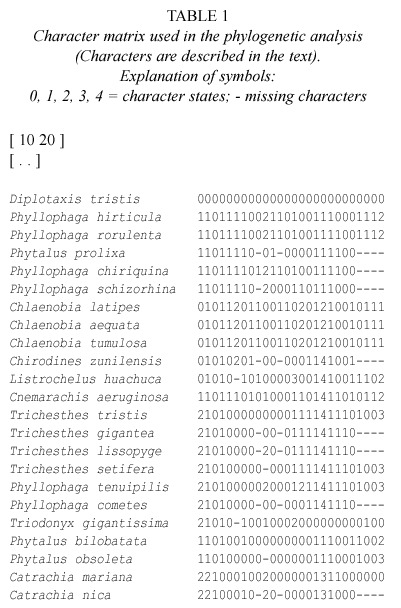
<body><![CDATA[<p align="justify"></p>     <p align="justify"><font face="Arial" size="2">The phylogenetic analysis was based on external morphology, mouthparts and genitalic characters.</font></p>     <p align="justify"></p>     <p align="justify"><font face="Arial" size="2">The mouthparts and genitalia (male and female) were removed and cleared in a hot solution of 5% KOH. After clearing, they were studied under immersion in distilled water. Additionally, the female genitalia were dehydrated in a progressive ethanol series (70%, 90%, 95% and 100%) and mounted in Euparal.</font></p>     <p align="justify"></p>     <p align="justify"><font face="Arial" size="2">Phylogenetic analysis was carried out using PAUP 4 (Swofford 2003). A heuristic search was used to find the most parsimonious trees. Support for the clades in the tree was assessed with bootstrapping (Felsenstein 1985).</font></p> <font face="Arial" size="2"><i></i></font>     <p align="justify"></p>     <p align="justify"><font face="Arial" size="2"><i>Diplotaxis tristis </i>Kirby 1837 was selected as the outgroup because the genus <i>Diplotaxis </i>is a sister group of the <i>Phyllophaga</i>.</font></p>     <p align="justify"></p>     <p align="justify"><font face="Arial" size="2">The genera <i>Trichesthes </i>and <i>Phyllophaga </i>are represented by the type species <i>T. tristis </i>(F. 1781) and <i>P. hirticula </i>(Knoch 1801). In addition, representative species belonging to other subgenera in the <i>Phyllophaga </i>were selected to reflect the variation within the genus (<a  href="#tabla1">Table 1</a>).    ]]></body>
<body><![CDATA[<br> </font></p>     <p style="text-align: center;"><font face="Arial" size="2"><a  name="tabla1"></a><img src="/img/fbpe/rbt/v54n2/3841i1.JPG"  title="" alt="" style="width: 401px; height: 608px;">    
<br> </font></p>     <p align="justify"></p>     <p align="justify"><font face="Arial" size="2">The data set comprises 26 characters scored across 23 taxa. The characters include 16 from the external morphology (including mouthparts) and 10 from the genitalia (6 male, 4 female). Characters were polarised using the outgroup method as described by Nixon and Carpenter (1993). The multistate characters were treated as non-additive (Fitch 1971). In unordered multistate characters, the distance between all pairs of states was treated as a single step. The character state matrix used in the phylogenetic analysis may be seen in <a href="#tabla1">Table 1</a>.</font></p>     <p align="justify"></p>     <p><font face="Arial" size="2">1. Clypeus shape.    <br> (0) Semi-circular; (1) bi-lobed;    <br> (2) rectangular.</font></p>     <p align="justify"><font face="Arial" size="2">The semi-circular state is characterized in having the clypeus shaped like a semi-circle, i.e., oblique sides and a non-sinuated fore edge. The bi-lobed state is similar to the preceding state, with the exception of the fore edge, which is strongly sinuated medially. The rectangular state has parallel sides and a straight fore edge.</font></p>     ]]></body>
<body><![CDATA[<p align="justify"></p>     <p align="justify"><font face="Arial" size="2">2. Clypeal lateral sides.    <br> (0) Fused to the eye edge; (1) above the eye edge and slightly elevated; (2) above the eye edge and strongly elevated.</font></p>     <p align="justify"></p>     <p align="justify"><font face="Arial" size="2">3. Frontal carina.    <br> (0) Absent; (1) present.</font></p>     <p align="justify"></p>     <p align="justify"><font face="Arial" size="2">4. Labrum.    <br> (0) Narrow and wavy; (1) wide and depressed in the middle.</font></p>     <p align="justify"></p>     ]]></body>
<body><![CDATA[<p><font face="Arial" size="2">5. Incisor mandibular lobe.    <br> (0) Smooth; (1) with a small notch.</font></p>     <p align="justify"><font face="Arial" size="2">6. Molar mandibular lobe.    <br> (0) Widely striate; (1) narrowly striate with holes; (2) narrowly striate without holes.</font></p>     <p align="justify"></p>     <p align="justify"><font face="Arial" size="2">7. Maxillary galea.    <br> (0) With strong tooth on the dorsal face; (1) smooth or with weak tooth on the dorsal face.</font></p>     <p align="justify"></p>     <p align="justify"><font face="Arial" size="2">8. Sensory area of the maxillary palpi.    <br> (0) Round; (1) oval.</font></p>     ]]></body>
<body><![CDATA[<p align="justify"></p>     <p align="justify"><font face="Arial" size="2">9. Female pygidium.    <br> (0) Flat; (1) protruding.</font></p>     <p align="justify"></p>     <p align="justify"><font face="Arial" size="2">10. Dorsal surfice of the metatibiae.    <br> (0) Smooth; (1) with spurs; (2) with an edge.</font></p>     <p align="justify"></p>     <p align="justify"><font face="Arial" size="2">11. Lower spur of metatibial plate.    <br> (0) Articulated to tibiae; (1) fused to tibiae.</font></p>     <p align="justify"></p>     ]]></body>
<body><![CDATA[<p align="justify"><font face="Arial" size="2">12. Female metatibial plate.    <br> (0) Glabrous; (1) pubescent.</font></p>     <p align="justify"></p>     <p align="justify"><font face="Arial" size="2">13. Brush of small setae on the inner surface of tarsal joints.    <br> (0) Absent; (1) present.</font></p>     <p align="justify"></p>     <p align="justify"><font face="Arial" size="2">14. Claw shape.    <br> (0) Cleft; (1) simple with a basal tooth; (2) simple with two basal teeth; (3) serrated.</font></p>     <p align="justify"></p>     <p align="justify"><font face="Arial" size="2">15. Abdominal sternites.    ]]></body>
<body><![CDATA[<br> (0) Smooth; (1) with ornaments; (2) with setae.</font></p>     <p align="justify"></p>     <p align="justify"><font face="Arial" size="2">16. Anal plate.    <br> (0) Flat; (1) depressed.</font></p>     <p align="justify"></p>     <p align="justify"><font face="Arial" size="2">17. Parameres/phallobase ratio.    <br> (0) Greater than or equal to 1 (parameres longer than or equal to the phallobase); (1) less than 1 (parameres shorter than the phallobase).</font></p>     <p align="justify"></p>     <p align="justify"><font face="Arial" size="2">18. Arrangement of temones.    <br> (0) Simple, with dorsal isolated plate; (1) simple, symmetric, dorsally fused and without dorsal plate; (2) simple, asymmetric, dorsally fused and without dorsal plate; (3) simple with isolated dorsal structures; (4) median lobe.</font></p>     ]]></body>
<body><![CDATA[<p align="justify"></p>     <p align="justify"><font face="Arial" size="2">19. Dorsal structures attached to temones.    <br> (0) Present; (1) absent. </font></p>     <p align="justify"></p>     <p align="justify"><font face="Arial" size="2">20. Setae of the endophallus.    <br> (0) Inconspicuous; (1) conspicuous.</font></p>     <p align="justify"></p>     <p align="justify"><font face="Arial" size="2">21. Shape of the endophallum.    <br> (0) Sack-shaped; (1) flagello-shaped.</font></p>     <p align="justify"></p>     ]]></body>
<body><![CDATA[<p><font face="Arial" size="2">22. Ventral surface of the phallobase.    <br> (0) Membranous; (1) sclerotized.</font></p>     <p align="justify"></p>     <p align="justify"><font face="Arial" size="2">23. Median oviduct.    <br> (0) Small and without sclerotized structures; (1) Well developed and with sclerotized structures or thick integument.</font></p>     <p align="justify"></p>     <p align="justify"><font face="Arial" size="2">24. Genital chamber folding.    <br> (0) Slight; (1) marked.</font></p>     <p align="justify"></p>     <p align="justify"><font face="Arial" size="2">25. Genital chamber dorsal wall.    ]]></body>
<body><![CDATA[<br> (0) Non-sclerotized; (1) with sclerotized structures.</font></p>     <p align="justify"></p>     <p align="justify"><font face="Arial" size="2">26. Sensorial structures in the genital chamber.    <br> (0) Sternites with setae at caudal position; (1) isolated palpi; (2) dorsal plates; (3) hook plates (Coca-Abia 2002).</font></p> <font face="Arial" size="2"><b> </b></font>     <p align="center"><font face="Arial" size="2"><b>Genus </b><i>Catrachia </i>Coca-Abia and Robbins </font></p> <font face="Arial" size="2"><b></b></font>     <p align="center"><font face="Arial" size="2"><b>(<i>NEW GENUS</i>)</b></font></p>     <p align="justify"></p>     <p align="justify"><font face="Arial" size="2"><b>Type species: </b><i>Catrachia mariana </i>Coca-Abia and Robbins (<b><i>new species</i></b>)</font></p> <font face="Arial" size="2"><b></b></font>     <p align="justify"></p>     <p align="justify"><font face="Arial" size="2"><b>Diagnosis of the genus: </b>Members of <i>Catrachia </i>can be characterized by the following features. </font></p> <font face="Arial" size="2"><b></b></font>     ]]></body>
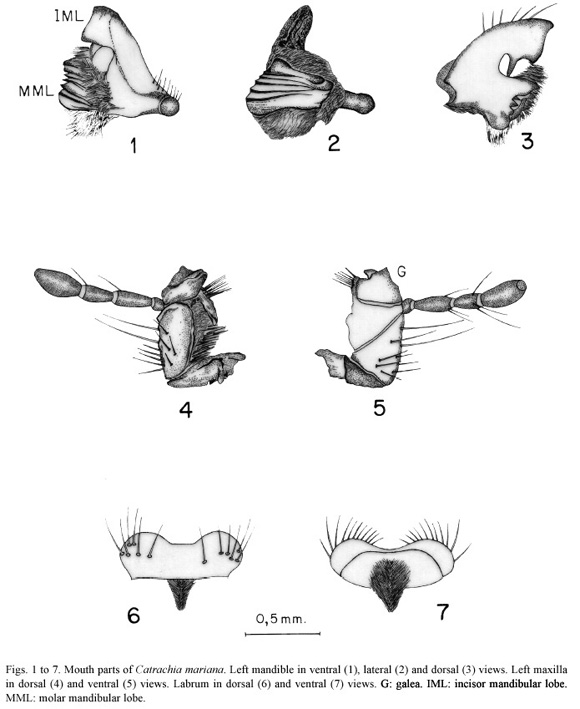
<body><![CDATA[<p align="justify"></p>     <p align="justify"><font face="Arial" size="2"><b>Head: </b>Antenna with 9 segments; antennal club with three segments and shorter than the stem; mandible with edge of the incisor lobe straight (<a href="#fig1-7">Figs. 1</a> and <a href="#fig1-7">3</a>); moderately wrinkled molar lobe (<a href="#fig1-7">Fig. 2</a>); galea of the maxilla with very poorly developed teeth (<a href="#fig1-7">Figs. 4</a> and <a  href="#fig1-7">5</a>); labrum gently depressed in the middle (Fig. 6 and 7) with very little pubescence; clypeus shorter than frons, clypeus abruptly widens from base and then quickly narrows; lateral sides arcuate and elevated in relation to the eye edge, anterior margin not sinuate at the middle; head coarsely and closely punctated and with conspicuous, with not very abundant pubescence; frontal carina highly developed; depressed vertex with punctures more densely distributed than on the frons; small and flat ocular carina; small eyes hidden by the anterior angle of the pronotum.    <br> </font></p>     <p style="text-align: center;"><font face="Arial" size="2"><a  name="fig1-7"></a><img src="/img/fbpe/rbt/v54n2/3841i2.JPG"  title="" alt="" style="width: 695px; height: 849px;">    
<br> </font></p>     <p style="text-align: center;"><font face="Arial" size="2">    <br> </font></p> <font face="Arial" size="2"><b> </b></font>     <p><font face="Arial" size="2"><b>Prothorax: </b>In dorsal view, glabrous pronotal surface with scattered punctures; anterior angles of the pronotum very sharp and prolonged towards the eyes; anterior margin of the pronotum thick, elevated and with a row of pubescence; posterior angles obtuse with rounded apex; softly serrated lateral margins, with scarce and short pubescence.</font></p> <font face="Arial" size="2"><b></b></font>     <p align="justify"></p>     <p align="justify"><font face="Arial" size="2"><b>Elytra: </b>Glabrous elytral surface with shallow punctures; smooth, not striated. </font></p> <font face="Arial" size="2"><b></b></font>     ]]></body>
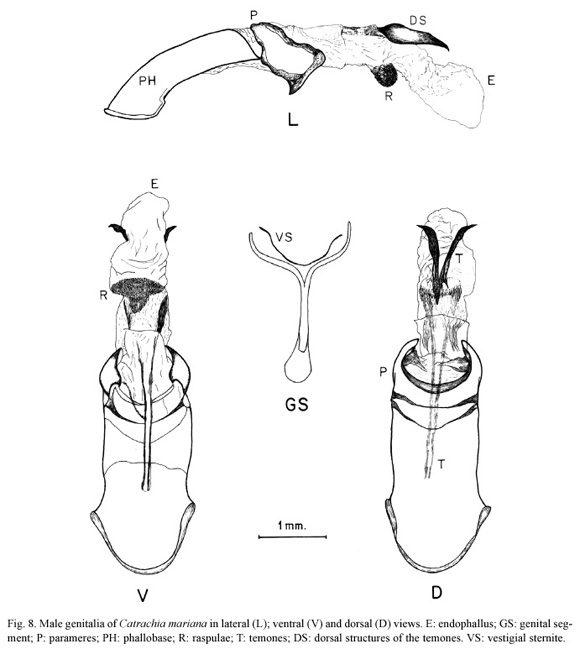
<body><![CDATA[<p align="justify"></p>     <p align="justify"><font face="Arial" size="2"><b>Legs: </b>Fore tibia with three teeth; meso and meta tibia with developed lateral carina. Cleft tarsal claws.</font></p> <font face="Arial" size="2"><b></b></font>     <p align="justify"></p>     <p align="justify"><font face="Arial" size="2"><b>Pygidium: </b>Strongly punctated with pubescent apex. </font></p> <font face="Arial" size="2"><b> </b></font>     <p><font face="Arial" size="2"><b>Abdominal sternites: </b>Anal plate narrow. Abdominal sternites without ornament and moderately pubescent.</font></p> <font face="Arial" size="2"><b></b></font>     <p align="justify"></p>     <p align="justify"><font face="Arial" size="2"><b>Male genitalia </b>(<a  href="#figura8">Fig. 8</a>): With parameres short (1/3 phallobase, approximately), ventrally separated. Endophallus long and thin (but not flagello-shaped); joined to the parameres by simple temones having two dorsal structures of differing shape and size. Epithelium of the endophallus covered with scattered sensillae. Genital segment with reduced vestigial sternite.    <br> </font></p>     <p style="text-align: center;"><font face="Arial" size="2"><a  name="figura8"></a><img src="/img/fbpe/rbt/v54n2/3841i3.JPG"  title="" alt="" style="width: 691px; height: 773px;">    
<br> </font></p> <font face="Arial" size="2"><b> </b></font>     ]]></body>
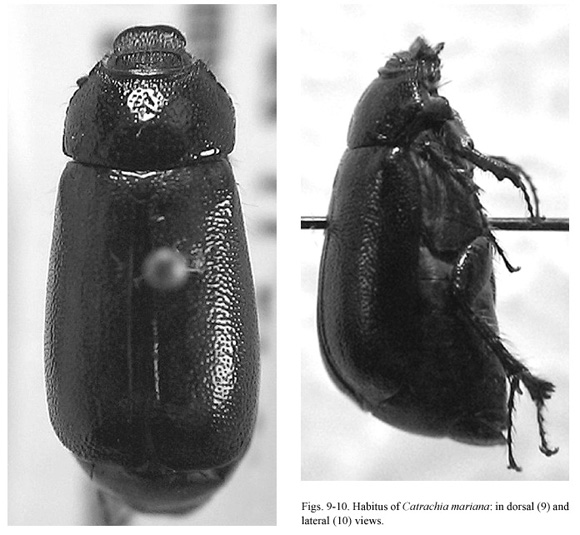
<body><![CDATA[<p align="justify"><font face="Arial" size="2"><b>Etymology: </b>General Florencio Xatruch led the defense of Honduras in 1857 against an attempted invasion by North American William Walker. The complimentary nicknames "catracho" or "catracha" (derived from Xatruch) refer to people of Honduran descent. This genus is named to honour the people of Honduras who endeavour to preserve the biodiversity of Central America for the benefit of all.</font></p> <font face="Arial" size="2"><i></i></font>     <p align="center"></p>     <p align="center"><font face="Arial" size="2"><i>Catrachia mariana </i>Coca-Abia and Robbins </font></p> <font face="Arial" size="2"><b>     <p align="center">(<i>NEW SPECIES</i>)</p> </b></font>     <p align="justify"><b><font face="Arial" size="2">Types: </font></b><font  face="Arial" size="2">Holotype: A male specimen in the collection of the Museo Nacional de Ciencias Naturales, Madrid (Spain) (MNCN), is the designated Holotype, labelled as: 1) white and printed label: Honduras, VI 1996, pheromone trap 100/0 valine/isoleucine; 2) red and printed label: Holotype, <i>Catrachia mariana </i>Coca-Abia and Robbins, 2005.</font></p> <font face="Arial" size="2"><b></b></font>     <p align="justify"></p>     <p align="justify"><font face="Arial" size="2"><b>Paratypes: </b>A male and four female specimens in the collection MNCN are designated Paratypes, labelled as: 1) white and printed labels: Honduras VI 1996, pheromone trap 100/0 valine/isoleucine; 2) red and printed label: Paratype, <i>Catrachia mariana </i>Coca-Abia and Robbins, 2005.</font></p>     <p align="justify"><font face="Arial" size="2">Other specimens of <i>C. mariana </i>were deposited in the following collections: Cornell University, Ithaca, NY, USA; Florida State Collection of Arthropods, Gainesville, Florida, USA; Escuela Agrícola Panamericana de Zamorano, Apartado Postal No. 93, Tegucigalpa, Honduras; University of Nebraska State Museum, Systematics Research Collections, Lincoln, Nebraska, USA, and the personal collection of the junior author (PSR).</font></p> <font face="Arial" size="2"><b></b></font>     <p align="justify"></p>     <p align="justify"><font face="Arial" size="2"><b>Description: </b>Habitus as in <a href="#fig9-10">Figures 9 a</a>nd <a href="#fig9-10">10</a>. In addition to the generic features, this species can be characterized by: antennal clubs about the same size in both sexes. Pronotal surface with wide and deep punctures; punctures more densely distributed on the anterior edge than on the remaining part of the pronotum. Pygidium with wide and deep punctures of indistinct outline and inconspicuous pubescence on the surface. Dorsal surface of the metatibia with an edge.    ]]></body>
<body><![CDATA[<br> </font></p>     <p style="text-align: center;"><font face="Arial" size="2"><a  name="fig9-10"></a><img src="/img/fbpe/rbt/v54n2/3841i4.JPG"  title="" alt="" style="width: 696px; height: 642px;">    
<br> </font></p>     <p align="justify"><font face="Arial" size="2">Male genitalia (<a  href="#figura8">Fig. 8</a>) with highly developed and spear–like, dorsal structures of the temones which are recumbent when the endophallum is at rest, and raised when the endophallum is projected. Endophallum with a raspullae in the ventral position. </font></p>     <p align="justify"><font face="Arial" size="2">Female genitalia very little sclerotized. Large, deep genital chamber with the distal edge sclerotized, thick integument, well developed sternites, dorsal genital palpi and two thin and long tergites. Median oviduct without sclerotized structures and with membranous integument. Pedunculated bursa copulatrix with a proximal duct (<i>ductus bursae</i>) and a slightly dilated distal blister (<i>corpus bursae</i>). Spermatheca inserted directly on the median oviduct and twice as short as its gland. Two accessory glands.</font></p> <font face="Arial" size="2"><b></b></font>     <p align="justify"></p>     <p align="justify"><font face="Arial" size="2"><b>Material examined: </b>All specimens of the type series were trapped in Zamorano, Honduras between May 27 and June 6, 1996 in a sex attractant trap. </font></p> <font face="Arial" size="2"><b></b></font>     <p align="justify"></p>     <p align="justify"><font face="Arial" size="2"><b>Etymology: </b>This species is named to honor Maryann Robbins, wife of the junior author, whose enthusiasm for, and willingness to participate in numerous beetle adventures has made the life work of the junior author pleasant indeed.</font></p> <font face="Arial" size="2"><i></i></font>     <p align="center"></p>     ]]></body>
<body><![CDATA[<p align="center"><font face="Arial" size="2"><i>Catrachia nica </i>Coca-Abia and Robbins </font></p> <font face="Arial" size="2"><b></b></font>     <p align="center"><font face="Arial" size="2"><b>(<i>NEW SPECIES</i>) </b></font></p>     <p><font face="Arial" size="2"><b>Type: </b>A male specimen in the MNCN collection is designated Holotype, labelled as: 1) white and handwritten label: J. Collins, Estelí Nicaragua, 5/28/00; 2) white and printed label: pheromone trap 90/10 valine/isoleucine; 3) red and printed label: Holotype, <i>Catrachia nica </i>Coca-Abia and Robbins, 2005. Females unknown.</font></p> <font face="Arial" size="2"><b></b></font>     <p align="justify"></p>     <p align="justify"><font face="Arial" size="2"><b>Description: </b>Habitus as in Figure 11. In addition to the generic features, this species can be characterized by: pronotal surface with homogeneously distributed thin and shallow punctures. Pygidium with thin, deep and outlined punctures; conspicuous surface pubescence. Dorsal surface of the metatibia scarcely dentate and with an edge.</font></p> <font face="Arial" size="2"><b></b></font>     <p align="justify"></p>     <p align="justify"><font face="Arial" size="2"><b>Male genitalia </b>with the dorsal structures of the temones relatively undeveloped and drumstick shaped. Endophallum without raspullae in ventral position </font></p> <font face="Arial" size="2"><b></b></font>     <p align="justify"></p>     <p align="justify"><font face="Arial" size="2"><b>Material examined: </b>type specimen trapped in Estelí, Nicaragua, 5/28/00 in a sex attractant trap.</font></p> <font face="Arial" size="2"><b> </b></font>     <p><font face="Arial" size="2"><b>Etymology: </b>This species is named in honor the people of Nicaragua who endeavor to preserve the biodiversity of Central America for benefit of all.</font></p> <font face="Arial" size="2"><b>     ]]></body>
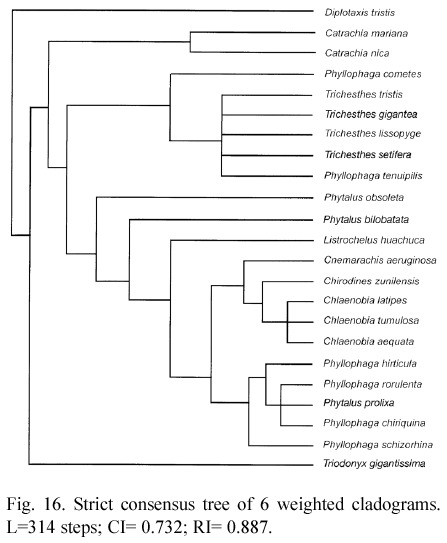
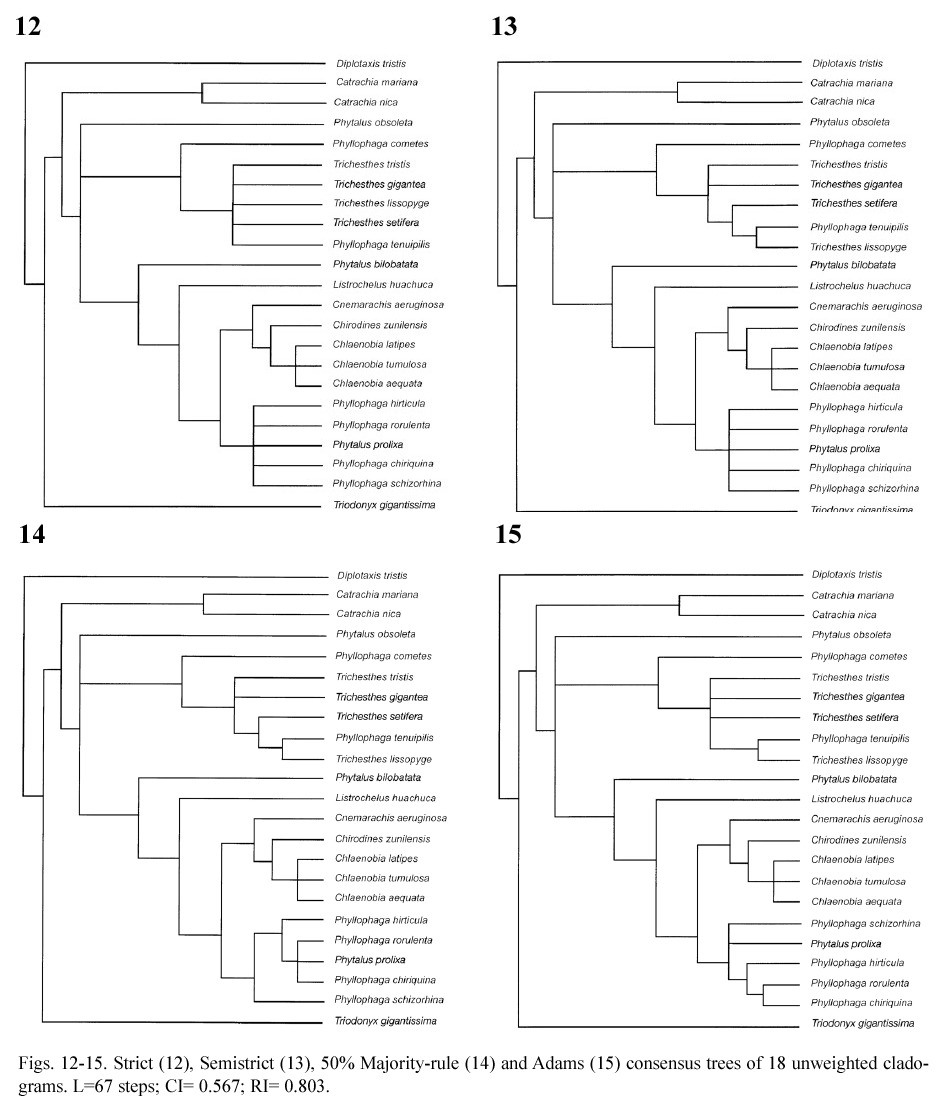
<body><![CDATA[<p align="center">Phylogenetic analysis</p> </b></font> <font face="Arial" size="2"></font>     <p><font face="Arial" size="2">A maximum parsimony analysis (heuristic search) using equal weights yielded 18 equally parsimonious cladograms, each with 67 steps. The consistency (CI) and retention (RI) indices were 0.567 and 0.803, respectively. All consensus trees displayed the same topology except in the terminal taxa <i>Phyllophaga </i>and <i>Trichesthes </i>(<a href="/img/revistas/rbt/v54n2/3841i6.JPG">Figs. 12-15</a>).    <br> </font></p>     <p><font face="Arial" size="2">The results of character weighting were stable in three successive iterations, yielding 6 trees of length 314 steps, a CI of 0.732 and an RI of 0.887 All weighted consensus trees displayed the same topology (<a href="#figura16">Fig. 16</a>).    <br> </font></p>     <p style="text-align: center;"><font face="Arial" size="2"><a  name="figura16"></a><img src="/img/fbpe/rbt/v54n2/3841i7.JPG"  title="" alt="" style="width: 447px; height: 543px;">    
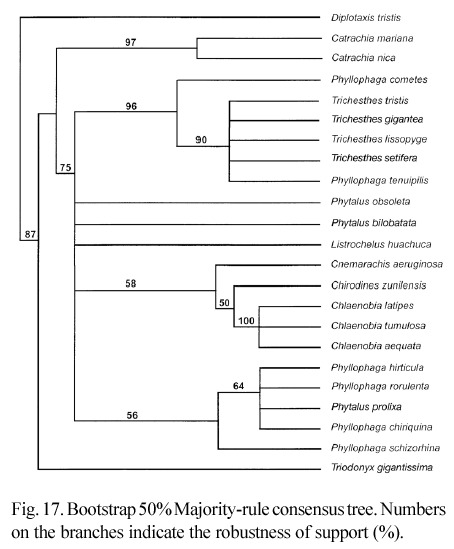
<br> </font></p>     <p><font face="Arial" size="2">The bootstrapping analysis (<a  href="#figura17">Fig. 17</a>) provided considerable support for the basal clade (87% bootstrap). <i>Triodonyx gigantissima </i>occupies a basal position outside the main clade. Two clades emerge above the <i>T. gigantísima </i>node, one comprised of <i>Catrachia mariana </i>and <i>Catrachia nica</i>, and the other composed of species from <i>Phyllophaga</i>, <i>Chlaenobia</i>, <i>Chirodines</i>, <i>Cnemarachis</i>, <i>Listrochelus</i>, <i>Phytalus </i>and <i>Trichesthes </i>.    <br> </font></p>     <p style="text-align: center;"><font face="Arial" size="2"><a  name="figura17"></a><img src="/img/fbpe/rbt/v54n2/3841i8.JPG"  title="" alt="" style="width: 454px; height: 549px;">    
]]></body>
<body><![CDATA[<br> </font> </p> <font face="Arial" size="2">     <p align="justify"></p>     <p align="justify">The bootstrap analysis provides considerable support for the clade established by the two species included in the new genus <i>Catrachia </i>(97% bootstrap) (<a href="#figura17">Fig. 17</a>). This clade is supported by unambiguous synapomorphic characters (CI=1 and RI=1) such as the lateral edges of the clypeus strongly elevated over the eyes (character 2) and a well developed frontal carina (character 3). The second major clade also has considerable support (75% bootstrap) but there is, however, a basal conflict that leaves unresolved the relationships of the taxa in question.</p>     <p align="center"></p> <b>     <p align="center">Discussion </p> </b></font> <i><font face="Arial" size="2"></font></i>     <p align="justify"><i><font face="Arial" size="2">Catrachia </font></i><font  face="Arial" size="2">constitutes a monophyletic group that is well supported (<a href="#figura17">Fig. 17</a>) by autapomorphic characters which clearly distinguish it from <i>Phyllophaga</i>, <i>Chlaenobia </i>Blanchard 1850, <i>Chirodines </i>Bates 1888, <i>Cnemarachis </i>Saylor 1942, <i>Listrochelus </i>Blanchard 1850, <i>Phytalus </i>Erichson 1847 and <i>Trichesthes </i>Erichson 1847. These allied genera and subgenera form a monophyletic group, but this analysis does not resolve their phylogenetic relationships. The cladogram does, however, provide clear evidence that <i>Catrachia </i>and its allied genera and subgenera are sister clades (<a href="#figura17">Fig. 17</a>).</font></p>     <p><font face="Arial" size="2">Morphological and genitalic features which distinguish <i>Catrachia </i>from allied genera and subgenera (lateral sides of clypeus strongly elevated over the eyes, strong frontal carina and temones with two dorsal structures), together with its phylogenetic position as sister group of the genus <i>Phyllophaga</i>, allow us to establish <i>Catrachia </i>as a group with the same taxonomic rank as the genus <i>Phyllophaga</i>. Therefore, the genus <i>Catrachia </i>is hereby established with two species: <i>Catrachia mariana </i>and <i>Catrachia nica</i>.</font></p> <font face="Arial" size="2"><b>     <p align="center">Acknowledgments</p> </b></font>     <p align="justify"></p>     <p align="justify"><font face="Arial" size="2">We thank Emilio Soteras Polo for the illustrations and Museo Nacional de Ciencias Naturales of Madrid for use of the facilities to produce them. We also thank Dr. Michael Zeiss and Harold Argüello of Escuela Agrícola Panamericana de Zamorano, Tegucigalpa, Honduras and Ms. Jodi Collins of Cornell University, Ithaca, NY, USA, for maintaining the trap lines in which the insects were captured. </font></p> <font face="Arial" size="2"><b>     ]]></body>
<body><![CDATA[<p align="center">Resumen</p> </b></font>     <p align="justify"></p>     <p align="justify"><font face="Arial" size="2">En este trabajo se describe el género <i>Catrachia </i>y dos especies nuevas, <i>Catrachia mariana </i>y <i>Catrachia nica </i>de Honduras y Nicaragua respectivamente. En análisis filogenético basado en caracteres morfológicos demostró que <i>Catrachia </i>es un grupo monofilético fuertemente soportado lo cual permite su consideración como género nuevo.</font></p> <font face="Arial" size="2"><b></b></font>     <p align="justify"></p>     <p align="justify"><font face="Arial" size="2"><b>Palabras clave: </b><i>Catrachia</i>, <i>C. mariana</i>, <i>C. nica</i>, taxonomia, filogenia.</font></p>     <p align="center"></p> <font face="Arial" size="2"><b>     <p align="center">References</p> </b></font>     <p align="justify"></p>     <!-- ref --><p align="justify"><font face="Arial" size="2">Báguena-Corella, L. 1967. Scarabaeoidea de la Fauna Ibero-Balear y Pirenaica. Instituto Español de Entomología (Consejo Superior de Investigaciones Científicas). 561 p.</font>&nbsp;&nbsp;&nbsp;&nbsp;&nbsp;&nbsp;&nbsp;&nbsp;[&#160;<a href="javascript:void(0);" onclick="javascript: window.open('/scielo.php?script=sci_nlinks&ref=1280903&pid=S0034-7744200600020002700001&lng=','','width=640,height=500,resizable=yes,scrollbars=1,menubar=yes,');">Links</a>&#160;]<!-- end-ref --><p align="justify"></p>     ]]></body>
<body><![CDATA[<!-- ref --><p align="justify"><font face="Arial" size="2">Baraud, J. 1977. Coléoptères Scarabaeoidea. Fauna de l’Europe occidentale. Belgique, France, Grande Bretagne, Italia, Peninsule Ibérique. Nouv. Rev. Entom. 7: 1-532.</font>&nbsp;&nbsp;&nbsp;&nbsp;&nbsp;&nbsp;&nbsp;&nbsp;[&#160;<a href="javascript:void(0);" onclick="javascript: window.open('/scielo.php?script=sci_nlinks&ref=1280905&pid=S0034-7744200600020002700002&lng=','','width=640,height=500,resizable=yes,scrollbars=1,menubar=yes,');">Links</a>&#160;]<!-- end-ref --><p align="justify"></p>     <!-- ref --><p align="justify"><font face="Arial" size="2">Baraud, J. 1992. Faune de France, 78. Coléoptères Scarabaeoidea d’Europe. Federation française des Sociétés de Sciences Naturelles et société Linnénne de Lyon. 856 p.</font>&nbsp;&nbsp;&nbsp;&nbsp;&nbsp;&nbsp;&nbsp;&nbsp;[&#160;<a href="javascript:void(0);" onclick="javascript: window.open('/scielo.php?script=sci_nlinks&ref=1280907&pid=S0034-7744200600020002700003&lng=','','width=640,height=500,resizable=yes,scrollbars=1,menubar=yes,');">Links</a>&#160;]<!-- end-ref --><!-- ref --><p align="justify"><font face="Arial" size="2">Bates, H.W. 1888. Biologia Centrali-Americana. Insecta Coleoptera 2: 161-416.</font>&nbsp;&nbsp;&nbsp;&nbsp;&nbsp;&nbsp;&nbsp;&nbsp;[&#160;<a href="javascript:void(0);" onclick="javascript: window.open('/scielo.php?script=sci_nlinks&ref=1280908&pid=S0034-7744200600020002700004&lng=','','width=640,height=500,resizable=yes,scrollbars=1,menubar=yes,');">Links</a>&#160;]<!-- end-ref --><p align="justify"></p>     <!-- ref --><p align="justify"><font face="Arial" size="2">Blanchard, C.E. 1850. Catalogue de la collection entomologique. Classe des Insectes. Ordre des Coléoptères. <i>In </i>H. Milne-Edwards, E. Blanchard &amp; H. Lucas (eds.) Museum d’Histoire Naturelle, Paris, France.</font>&nbsp;&nbsp;&nbsp;&nbsp;&nbsp;&nbsp;&nbsp;&nbsp;[&#160;<a href="javascript:void(0);" onclick="javascript: window.open('/scielo.php?script=sci_nlinks&ref=1280910&pid=S0034-7744200600020002700005&lng=','','width=640,height=500,resizable=yes,scrollbars=1,menubar=yes,');">Links</a>&#160;]<!-- end-ref --><!-- ref --><p><font face="Arial" size="2">Britton, E.B. 1978. A revision of the Australian chafers (Coleoptera: Scarabaeidae: Melolonthinae). Tribe Melolonthini. Aust. J. Zool., Suppl. Ser. 60: 1-150.</font>&nbsp;&nbsp;&nbsp;&nbsp;&nbsp;&nbsp;&nbsp;&nbsp;[&#160;<a href="javascript:void(0);" onclick="javascript: window.open('/scielo.php?script=sci_nlinks&ref=1280911&pid=S0034-7744200600020002700006&lng=','','width=640,height=500,resizable=yes,scrollbars=1,menubar=yes,');">Links</a>&#160;]<!-- end-ref --><p align="justify"></p>     <!-- ref --><p align="justify"><font face="Arial" size="2">Coca-Abia, M. 2000. <i>Polylamina </i>Hardy, a junior synonym of <i>Polyphylla </i>Harris (Coleoptera, Scarabaeidae, Melolonthinae, Melolonthini). Coleop. Bull. 54: 11-22.</font>&nbsp;&nbsp;&nbsp;&nbsp;&nbsp;&nbsp;&nbsp;&nbsp;[&#160;<a href="javascript:void(0);" onclick="javascript: window.open('/scielo.php?script=sci_nlinks&ref=1280913&pid=S0034-7744200600020002700007&lng=','','width=640,height=500,resizable=yes,scrollbars=1,menubar=yes,');">Links</a>&#160;]<!-- end-ref --><p align="justify"></p>     ]]></body>
<body><![CDATA[<!-- ref --><p align="justify"><font face="Arial" size="2">Coca-Abia, M. 2002. Reestablishment of the genus <i>Trichesthes </i>Erichson, 1847 (Coleoptera: Scarabaeidae: Melolonthinae) based on phylogeny. J. Entomol. Soc. New York 110: 95-114.</font>&nbsp;&nbsp;&nbsp;&nbsp;&nbsp;&nbsp;&nbsp;&nbsp;[&#160;<a href="javascript:void(0);" onclick="javascript: window.open('/scielo.php?script=sci_nlinks&ref=1280915&pid=S0034-7744200600020002700008&lng=','','width=640,height=500,resizable=yes,scrollbars=1,menubar=yes,');">Links</a>&#160;]<!-- end-ref --><p align="justify"></p>     <!-- ref --><p align="justify"><font face="Arial" size="2">Coca-Abia, M &amp; F. Martín-Piera. 1998. Revisión taxonómica del género <i>Rhizotrogus </i>Berthold, 1827 (Coleoptera: Scarabaeidae, Melolonthinae). Coleopterological Monographs 2: 140 p.</font>&nbsp;&nbsp;&nbsp;&nbsp;&nbsp;&nbsp;&nbsp;&nbsp;[&#160;<a href="javascript:void(0);" onclick="javascript: window.open('/scielo.php?script=sci_nlinks&ref=1280917&pid=S0034-7744200600020002700009&lng=','','width=640,height=500,resizable=yes,scrollbars=1,menubar=yes,');">Links</a>&#160;]<!-- end-ref --><p align="justify"></p>     <!-- ref --><p align="justify"><font face="Arial" size="2">Coca-Abia, M., F. Martín-Piera, &amp; M.A. Morón. 1993. Anatomía y morfología de la genitalia feminina de las especies mexicanas del género <i>Phyllophaga </i>(<i>sensu lato</i>) (Coleoptera, Melolonthidae). Relaciones filogenéticas con otros géneros del área mediterránea. G. It. Ent. 6: 263-274.</font>&nbsp;&nbsp;&nbsp;&nbsp;&nbsp;&nbsp;&nbsp;&nbsp;[&#160;<a href="javascript:void(0);" onclick="javascript: window.open('/scielo.php?script=sci_nlinks&ref=1280919&pid=S0034-7744200600020002700010&lng=','','width=640,height=500,resizable=yes,scrollbars=1,menubar=yes,');">Links</a>&#160;]<!-- end-ref --><p align="justify"></p>     <!-- ref --><p align="justify"><font face="Arial" size="2">Erichson,W.F. 1847. Naturgeschinchte der insecten Deutschlands. Coleoptera. Nicolaische Buchhandlung, Berlin, Germany, p. 656-662.</font>&nbsp;&nbsp;&nbsp;&nbsp;&nbsp;&nbsp;&nbsp;&nbsp;[&#160;<a href="javascript:void(0);" onclick="javascript: window.open('/scielo.php?script=sci_nlinks&ref=1280921&pid=S0034-7744200600020002700011&lng=','','width=640,height=500,resizable=yes,scrollbars=1,menubar=yes,');">Links</a>&#160;]<!-- end-ref --><p align="justify"></p>     <!-- ref --><p align="justify"><font face="Arial" size="2">Evans, A. 2003. A checklist of the New World chafers (Coleoptera: Scarabaeidae: Melolonthinae). Zootaxa. 211:1-419.</font>&nbsp;&nbsp;&nbsp;&nbsp;&nbsp;&nbsp;&nbsp;&nbsp;[&#160;<a href="javascript:void(0);" onclick="javascript: window.open('/scielo.php?script=sci_nlinks&ref=1280923&pid=S0034-7744200600020002700012&lng=','','width=640,height=500,resizable=yes,scrollbars=1,menubar=yes,');">Links</a>&#160;]<!-- end-ref --><p align="justify"></p>     ]]></body>
<body><![CDATA[<!-- ref --><p align="justify"><font face="Arial" size="2">Fabricius, J.C. 1781. Species Insectorum exhibentes eorum differntias specificas, synonyma, auctorum, loca natalia, metamorphosin adiectis observationibus, descriptionibus. Vol. 1 Proft. Hafniae. 348 p.</font>&nbsp;&nbsp;&nbsp;&nbsp;&nbsp;&nbsp;&nbsp;&nbsp;[&#160;<a href="javascript:void(0);" onclick="javascript: window.open('/scielo.php?script=sci_nlinks&ref=1280925&pid=S0034-7744200600020002700013&lng=','','width=640,height=500,resizable=yes,scrollbars=1,menubar=yes,');">Links</a>&#160;]<!-- end-ref --><p align="justify"></p>     <!-- ref --><p align="justify"><font face="Arial" size="2">Felsenstein, J. 1985. Confidence limits on phylogenies: an approach using the bootstrap. Evolution. 38: 16-24.</font>&nbsp;&nbsp;&nbsp;&nbsp;&nbsp;&nbsp;&nbsp;&nbsp;[&#160;<a href="javascript:void(0);" onclick="javascript: window.open('/scielo.php?script=sci_nlinks&ref=1280927&pid=S0034-7744200600020002700014&lng=','','width=640,height=500,resizable=yes,scrollbars=1,menubar=yes,');">Links</a>&#160;]<!-- end-ref --><p align="justify"></p>     <!-- ref --><p align="justify"><font face="Arial" size="2">Fitch, W.H. 1971. Towards defining the course of evolution: Minimal change for a specific tree topology. Syst. Zool. 20: 406-416.</font>&nbsp;&nbsp;&nbsp;&nbsp;&nbsp;&nbsp;&nbsp;&nbsp;[&#160;<a href="javascript:void(0);" onclick="javascript: window.open('/scielo.php?script=sci_nlinks&ref=1280929&pid=S0034-7744200600020002700015&lng=','','width=640,height=500,resizable=yes,scrollbars=1,menubar=yes,');">Links</a>&#160;]<!-- end-ref --><p align="justify"></p>     <!-- ref --><p align="justify"><font face="Arial" size="2">Frey, Von G. 1975. Bestimmungstabelle der Südamerikanischen Arten der Gattung <i>Phyllophaga </i>Harris und ihrer Untergattung <i>Phytalus </i>Er. (Col. Melolonthidae). Ent. Arb. Mus. Frey. 26: 201-226.</font>&nbsp;&nbsp;&nbsp;&nbsp;&nbsp;&nbsp;&nbsp;&nbsp;[&#160;<a href="javascript:void(0);" onclick="javascript: window.open('/scielo.php?script=sci_nlinks&ref=1280931&pid=S0034-7744200600020002700016&lng=','','width=640,height=500,resizable=yes,scrollbars=1,menubar=yes,');">Links</a>&#160;]<!-- end-ref --><p align="justify"></p>     <!-- ref --><p align="justify"><font face="Arial" size="2">Harris, T. W. 1827. Minutes toward a history of some American species of Melolonthinae particularly injurious to vegetation. Mass. Agr. J. 10: 1-12.</font>&nbsp;&nbsp;&nbsp;&nbsp;&nbsp;&nbsp;&nbsp;&nbsp;[&#160;<a href="javascript:void(0);" onclick="javascript: window.open('/scielo.php?script=sci_nlinks&ref=1280933&pid=S0034-7744200600020002700017&lng=','','width=640,height=500,resizable=yes,scrollbars=1,menubar=yes,');">Links</a>&#160;]<!-- end-ref --><p align="justify"></p>     ]]></body>
<body><![CDATA[<!-- ref --><p align="justify"><font face="Arial" size="2">Kirby, W. 1837. <i>In </i>J. Richardson (ed.). Fauna Boreali-Americana. Insects. Coleoptera. Part 4. Norwich, London. 249 p.</font>&nbsp;&nbsp;&nbsp;&nbsp;&nbsp;&nbsp;&nbsp;&nbsp;[&#160;<a href="javascript:void(0);" onclick="javascript: window.open('/scielo.php?script=sci_nlinks&ref=1280935&pid=S0034-7744200600020002700018&lng=','','width=640,height=500,resizable=yes,scrollbars=1,menubar=yes,');">Links</a>&#160;]<!-- end-ref --><p align="justify"></p>     <!-- ref --><p align="justify"><font face="Arial" size="2">Knoch, A.W. 1801. Neue Beiträge zur Insectenkunde. Theil 1.Schwickertschen Verlage, Leipzig. 208 p.</font>&nbsp;&nbsp;&nbsp;&nbsp;&nbsp;&nbsp;&nbsp;&nbsp;[&#160;<a href="javascript:void(0);" onclick="javascript: window.open('/scielo.php?script=sci_nlinks&ref=1280937&pid=S0034-7744200600020002700019&lng=','','width=640,height=500,resizable=yes,scrollbars=1,menubar=yes,');">Links</a>&#160;]<!-- end-ref --><!-- ref --><p><font face="Arial" size="2">LeConte, J.L. 1856. Synopsis of the Melolonthidae of the United States. J. Acad. Nat. Sci. Phila. 3: 225-288.</font>&nbsp;&nbsp;&nbsp;&nbsp;&nbsp;&nbsp;&nbsp;&nbsp;[&#160;<a href="javascript:void(0);" onclick="javascript: window.open('/scielo.php?script=sci_nlinks&ref=1280938&pid=S0034-7744200600020002700020&lng=','','width=640,height=500,resizable=yes,scrollbars=1,menubar=yes,');">Links</a>&#160;]<!-- end-ref --><!-- ref --><p align="justify"><font face="Arial" size="2">Luginbill, P. &amp; Painter, H.R. 1953. May beetles of the United States and Canada. U.S. Dep. Agric. Tech. Bull. 1060. 102 p.</font>&nbsp;&nbsp;&nbsp;&nbsp;&nbsp;&nbsp;&nbsp;&nbsp;[&#160;<a href="javascript:void(0);" onclick="javascript: window.open('/scielo.php?script=sci_nlinks&ref=1280939&pid=S0034-7744200600020002700021&lng=','','width=640,height=500,resizable=yes,scrollbars=1,menubar=yes,');">Links</a>&#160;]<!-- end-ref --><p align="justify"></p>     <!-- ref --><p align="justify"><font face="Arial" size="2">Morón, M.A. 1986. El género <i>Phyllophaga </i>en México. Morfología, distribución y sistemática supraespecifica (Insecta: Coleóptera). Publicaciones Instituto de Ecología, No.19. 341 p.</font>&nbsp;&nbsp;&nbsp;&nbsp;&nbsp;&nbsp;&nbsp;&nbsp;[&#160;<a href="javascript:void(0);" onclick="javascript: window.open('/scielo.php?script=sci_nlinks&ref=1280941&pid=S0034-7744200600020002700022&lng=','','width=640,height=500,resizable=yes,scrollbars=1,menubar=yes,');">Links</a>&#160;]<!-- end-ref --><p align="justify"></p>     <!-- ref --><p align="justify"><font face="Arial" size="2">Nixon, K.C. &amp; Carpenter, J.M. 1993. On outgroups. Cladistics. 14: 221-228.</font>&nbsp;&nbsp;&nbsp;&nbsp;&nbsp;&nbsp;&nbsp;&nbsp;[&#160;<a href="javascript:void(0);" onclick="javascript: window.open('/scielo.php?script=sci_nlinks&ref=1280943&pid=S0034-7744200600020002700023&lng=','','width=640,height=500,resizable=yes,scrollbars=1,menubar=yes,');">Links</a>&#160;]<!-- end-ref --><p align="justify"></p>     ]]></body>
<body><![CDATA[<!-- ref --><p align="justify"><font face="Arial" size="2">Ratcliffe, B.C. 1991. The scarab beetles of Nebraska. Bull. Univ. Nebr. State Mus. 12: 158-226.</font>&nbsp;&nbsp;&nbsp;&nbsp;&nbsp;&nbsp;&nbsp;&nbsp;[&#160;<a href="javascript:void(0);" onclick="javascript: window.open('/scielo.php?script=sci_nlinks&ref=1280945&pid=S0034-7744200600020002700024&lng=','','width=640,height=500,resizable=yes,scrollbars=1,menubar=yes,');">Links</a>&#160;]<!-- end-ref --><p align="justify"></p>     <!-- ref --><p align="justify"><font face="Arial" size="2">Say, T. 1825. Descriptions of new species of Coleopterous insects inhabiting the United States. J. Acad. Nat. Sci. Phila. 5: 160-204.</font>&nbsp;&nbsp;&nbsp;&nbsp;&nbsp;&nbsp;&nbsp;&nbsp;[&#160;<a href="javascript:void(0);" onclick="javascript: window.open('/scielo.php?script=sci_nlinks&ref=1280947&pid=S0034-7744200600020002700025&lng=','','width=640,height=500,resizable=yes,scrollbars=1,menubar=yes,');">Links</a>&#160;]<!-- end-ref --><p align="justify"></p>     <!-- ref --><p align="justify"><font face="Arial" size="2">Saylor, L.W. 1942. Ten new <i>Phyllophaga </i>beetles from Panama and South America. Rev. Entomol (Rio de Janeiro). 13: 154-166.</font>&nbsp;&nbsp;&nbsp;&nbsp;&nbsp;&nbsp;&nbsp;&nbsp;[&#160;<a href="javascript:void(0);" onclick="javascript: window.open('/scielo.php?script=sci_nlinks&ref=1280949&pid=S0034-7744200600020002700026&lng=','','width=640,height=500,resizable=yes,scrollbars=1,menubar=yes,');">Links</a>&#160;]<!-- end-ref --><p><font face="Arial" size="2">Smith, A. B. T. &amp; Evans, A. V. 2005. A supplement to the checklist of the New World chafers (Coleoptera:</font></p>     <p align="justify"><font face="Arial" size="2">Scarabaeidae: Melolonthinae) with notes on their tribal classification. Zootaxa. 1032: 29-60.</font></p>     <p align="justify"></p>     <!-- ref --><p align="justify"><font face="Arial" size="2">Swofford, D.L. 2003. PAUP*: Phylogenetic Analysis Using Parsimony (*and Other Methods), version 4. Sinauer Associates, Sunderland, Massachusetts, USA.</font>&nbsp;&nbsp;&nbsp;&nbsp;&nbsp;&nbsp;&nbsp;&nbsp;[&#160;<a href="javascript:void(0);" onclick="javascript: window.open('/scielo.php?script=sci_nlinks&ref=1280953&pid=S0034-7744200600020002700028&lng=','','width=640,height=500,resizable=yes,scrollbars=1,menubar=yes,');">Links</a>&#160;]<!-- end-ref --><p align="justify"></p>     ]]></body>
<body><![CDATA[<!-- ref --><p align="justify"><font face="Arial" size="2">Vaurie, P. 1958. A revision of the genus <i>Diplotaxis </i>(Coleoptera, Scarabaeidae, Melolonthinae). Part 1. Bull. Am. Mus. Nat. Hist. 115: 269-396.</font>&nbsp;&nbsp;&nbsp;&nbsp;&nbsp;&nbsp;&nbsp;&nbsp;[&#160;<a href="javascript:void(0);" onclick="javascript: window.open('/scielo.php?script=sci_nlinks&ref=1280955&pid=S0034-7744200600020002700029&lng=','','width=640,height=500,resizable=yes,scrollbars=1,menubar=yes,');">Links</a>&#160;]<!-- end-ref --><p align="justify"></p>     <!-- ref --><p align="justify"><font face="Arial" size="2">Woodruff, R.E. &amp; Beck, B.M. 1989. The scarab beetles of Florida (Coleoptera: Scarabaeidae) Part II. The May or June Beetles (genus <i>Phyllophaga</i>). Arthropods of Florida and Neighboring Land Areas. Florida Department of Agriculture and Consumer Services. Division of Plant Industry. Gainesville, Florida, USA. 223 p.</font>&nbsp;&nbsp;&nbsp;&nbsp;&nbsp;&nbsp;&nbsp;&nbsp;[&#160;<a href="javascript:void(0);" onclick="javascript: window.open('/scielo.php?script=sci_nlinks&ref=1280957&pid=S0034-7744200600020002700030&lng=','','width=640,height=500,resizable=yes,scrollbars=1,menubar=yes,');">Links</a>&#160;]<!-- end-ref --><!-- ref --><p><font face="Arial" size="2">Zhang, A., P.S. Robbins, W.S. Leal, C.E. Linn Jr., M.G. Villani &amp; W.L. Roelofs. 1997. Essential amino acid methyl esters: major sex pheromone components of the cranberry white grub, <i>Phyllophaga anxia </i>(Coleoptera: Scarabaeidae). J. Chem. Ecol. 23: 231-245.</font>&nbsp;&nbsp;&nbsp;&nbsp;&nbsp;&nbsp;&nbsp;&nbsp;[&#160;<a href="javascript:void(0);" onclick="javascript: window.open('/scielo.php?script=sci_nlinks&ref=1280958&pid=S0034-7744200600020002700031&lng=','','width=640,height=500,resizable=yes,scrollbars=1,menubar=yes,');">Links</a>&#160;]<!-- end-ref --> ]]></body><back>
<ref-list>
<ref id="B1">
<nlm-citation citation-type="">
<person-group person-group-type="author">
<name>
<surname><![CDATA[Báguena-Corella]]></surname>
<given-names><![CDATA[L]]></given-names>
</name>
</person-group>
<source><![CDATA[Scarabaeoidea de la Fauna Ibero-Balear y Pirenaica. Instituto Español de Entomología (Consejo Superior de Investigaciones Científicas)]]></source>
<year>1967</year>
<page-range>561</page-range></nlm-citation>
</ref>
<ref id="B2">
<nlm-citation citation-type="journal">
<person-group person-group-type="author">
<name>
<surname><![CDATA[Baraud]]></surname>
<given-names><![CDATA[J]]></given-names>
</name>
</person-group>
<article-title xml:lang="fr"><![CDATA[Coléoptères Scarabaeoidea. Fauna de l’Europe occidentale. Belgique, France, Grande Bretagne, Italia, Peninsule Ibérique]]></article-title>
<source><![CDATA[Nouv. Rev. Entom]]></source>
<year>1977</year>
<volume>7</volume>
<page-range>1-532</page-range></nlm-citation>
</ref>
<ref id="B3">
<nlm-citation citation-type="book">
<person-group person-group-type="author">
<name>
<surname><![CDATA[Baraud]]></surname>
<given-names><![CDATA[J]]></given-names>
</name>
</person-group>
<source><![CDATA[Faune de France]]></source>
<year>1992</year>
<volume>78</volume>
<page-range>856</page-range><publisher-name><![CDATA[Federation française des Sociétés de Sciences Naturelles et société Linnénne de Lyon]]></publisher-name>
</nlm-citation>
</ref>
<ref id="B4">
<nlm-citation citation-type="journal">
<person-group person-group-type="author">
<name>
<surname><![CDATA[Bates]]></surname>
<given-names><![CDATA[H.W]]></given-names>
</name>
</person-group>
<article-title xml:lang="es"><![CDATA[Biologia Centrali-Americana]]></article-title>
<source><![CDATA[Insecta Coleoptera]]></source>
<year>1888</year>
<volume>2</volume>
<page-range>161-416</page-range></nlm-citation>
</ref>
<ref id="B5">
<nlm-citation citation-type="">
<person-group person-group-type="author">
<name>
<surname><![CDATA[Blanchard]]></surname>
<given-names><![CDATA[C.E]]></given-names>
</name>
</person-group>
<article-title xml:lang="fr"><![CDATA[Catalogue de la collection entomologique. Classe des Insectes. Ordre des Coléoptères]]></article-title>
<person-group person-group-type="editor">
<name>
<surname><![CDATA[Milne-Edwards]]></surname>
<given-names><![CDATA[H]]></given-names>
</name>
<name>
<surname><![CDATA[Blanchard]]></surname>
<given-names><![CDATA[E]]></given-names>
</name>
<name>
<surname><![CDATA[Lucas]]></surname>
<given-names><![CDATA[H]]></given-names>
</name>
</person-group>
<source><![CDATA[Museum d’Histoire Naturelle]]></source>
<year>1850</year>
<publisher-loc><![CDATA[Paris ]]></publisher-loc>
</nlm-citation>
</ref>
<ref id="B6">
<nlm-citation citation-type="journal">
<person-group person-group-type="author">
<name>
<surname><![CDATA[Britton]]></surname>
<given-names><![CDATA[E.B]]></given-names>
</name>
</person-group>
<article-title xml:lang="en"><![CDATA[A revision of the Australian chafers (Coleoptera: Scarabaeidae: Melolonthinae). Tribe Melolonthini]]></article-title>
<source><![CDATA[Aust. J. Zool., Suppl. Ser]]></source>
<year>1978</year>
<volume>60</volume>
<page-range>1-150</page-range></nlm-citation>
</ref>
<ref id="B7">
<nlm-citation citation-type="journal">
<person-group person-group-type="author">
<name>
<surname><![CDATA[Coca-Abia]]></surname>
<given-names><![CDATA[M]]></given-names>
</name>
</person-group>
<article-title xml:lang="en"><![CDATA[Polylamina Hardy, a junior synonym of Polyphylla Harris (Coleoptera, Scarabaeidae, Melolonthinae, Melolonthini)]]></article-title>
<source><![CDATA[Coleop. Bull]]></source>
<year>2000</year>
<volume>54</volume>
<page-range>11-22</page-range></nlm-citation>
</ref>
<ref id="B8">
<nlm-citation citation-type="journal">
<person-group person-group-type="author">
<name>
<surname><![CDATA[Coca-Abia]]></surname>
<given-names><![CDATA[M]]></given-names>
</name>
</person-group>
<article-title xml:lang="en"><![CDATA[Reestablishment of the genus Trichesthes Erichson, 1847 (Coleoptera: Scarabaeidae: Melolonthinae) based on phylogeny]]></article-title>
<source><![CDATA[J. Entomol. Soc]]></source>
<year>2002</year>
<volume>110</volume>
<page-range>95-114</page-range><publisher-loc><![CDATA[New York ]]></publisher-loc>
</nlm-citation>
</ref>
<ref id="B9">
<nlm-citation citation-type="journal">
<person-group person-group-type="author">
<name>
<surname><![CDATA[Coca-Abia]]></surname>
<given-names><![CDATA[M]]></given-names>
</name>
<name>
<surname><![CDATA[Martín-Piera]]></surname>
<given-names><![CDATA[F]]></given-names>
</name>
</person-group>
<article-title xml:lang="es"><![CDATA[Revisión taxonómica del género Rhizotrogus Berthold, 1827 (Coleoptera: Scarabaeidae, Melolonthinae)]]></article-title>
<source><![CDATA[Coleopterological Monographs]]></source>
<year>1998</year>
<volume>2</volume>
<page-range>140</page-range></nlm-citation>
</ref>
<ref id="B10">
<nlm-citation citation-type="journal">
<person-group person-group-type="author">
<name>
<surname><![CDATA[Coca-Abia]]></surname>
<given-names><![CDATA[M]]></given-names>
</name>
<name>
<surname><![CDATA[Martín-Piera]]></surname>
<given-names><![CDATA[F]]></given-names>
</name>
<name>
<surname><![CDATA[Morón]]></surname>
<given-names><![CDATA[M.A]]></given-names>
</name>
</person-group>
<article-title xml:lang="es"><![CDATA[Anatomía y morfología de la genitalia feminina de las especies mexicanas del género Phyllophaga (sensu lato) (Coleoptera, Melolonthidae). Relaciones filogenéticas con otros géneros del área mediterránea]]></article-title>
<source><![CDATA[G. It. Ent]]></source>
<year>1993</year>
<volume>6</volume>
<page-range>263-274</page-range></nlm-citation>
</ref>
<ref id="B11">
<nlm-citation citation-type="book">
<person-group person-group-type="author">
<name>
<surname><![CDATA[Erichson]]></surname>
<given-names><![CDATA[W.F]]></given-names>
</name>
</person-group>
<source><![CDATA[Naturgeschinchte der insecten Deutschlands. Coleoptera]]></source>
<year>1847</year>
<page-range>656-662</page-range><publisher-loc><![CDATA[Berlin ]]></publisher-loc>
<publisher-name><![CDATA[Nicolaische Buchhandlung]]></publisher-name>
</nlm-citation>
</ref>
<ref id="B12">
<nlm-citation citation-type="journal">
<person-group person-group-type="author">
<name>
<surname><![CDATA[Evans]]></surname>
<given-names><![CDATA[A]]></given-names>
</name>
</person-group>
<article-title xml:lang="en"><![CDATA[A checklist of the New World chafers (Coleoptera: Scarabaeidae: Melolonthinae)]]></article-title>
<source><![CDATA[Zootaxa]]></source>
<year>2003</year>
<volume>211</volume>
<page-range>1-419</page-range></nlm-citation>
</ref>
<ref id="B13">
<nlm-citation citation-type="">
<person-group person-group-type="author">
<name>
<surname><![CDATA[Fabricius]]></surname>
<given-names><![CDATA[J.C]]></given-names>
</name>
</person-group>
<source><![CDATA[Species Insectorum exhibentes eorum differntias specificas, synonyma, auctorum, loca natalia, metamorphosin adiectis observationibus, descriptionibus]]></source>
<year>1781</year>
<volume>1</volume>
<page-range>348</page-range></nlm-citation>
</ref>
<ref id="B14">
<nlm-citation citation-type="journal">
<person-group person-group-type="author">
<name>
<surname><![CDATA[Felsenstein]]></surname>
<given-names><![CDATA[J]]></given-names>
</name>
</person-group>
<article-title xml:lang="en"><![CDATA[Confidence limits on phylogenies: an approach using the bootstrap]]></article-title>
<source><![CDATA[Evolution]]></source>
<year>1985</year>
<volume>38</volume>
<page-range>16-24</page-range></nlm-citation>
</ref>
<ref id="B15">
<nlm-citation citation-type="journal">
<person-group person-group-type="author">
<name>
<surname><![CDATA[Fitch]]></surname>
<given-names><![CDATA[W.H]]></given-names>
</name>
</person-group>
<article-title xml:lang="en"><![CDATA[Towards defining the course of evolution: Minimal change for a specific tree topology]]></article-title>
<source><![CDATA[Syst. Zool]]></source>
<year>1971</year>
<volume>20</volume>
<page-range>406-416</page-range></nlm-citation>
</ref>
<ref id="B16">
<nlm-citation citation-type="journal">
<person-group person-group-type="author">
<name>
<surname><![CDATA[Von G]]></surname>
<given-names><![CDATA[Frey]]></given-names>
</name>
</person-group>
<article-title xml:lang="de"><![CDATA[Bestimmungstabelle der Südamerikanischen Arten der Gattung Phyllophaga Harris und ihrer Untergattung Phytalus Er. (Col. Melolonthidae)]]></article-title>
<source><![CDATA[Ent. Arb. Mus. Frey]]></source>
<year>1975</year>
<volume>26</volume>
<page-range>201-226</page-range></nlm-citation>
</ref>
<ref id="B17">
<nlm-citation citation-type="journal">
<person-group person-group-type="author">
<name>
<surname><![CDATA[Harris]]></surname>
<given-names><![CDATA[T. W]]></given-names>
</name>
</person-group>
<article-title xml:lang="en"><![CDATA[Minutes toward a history of some American species of Melolonthinae particularly injurious to vegetation]]></article-title>
<source><![CDATA[Mass. Agr. J]]></source>
<year>1827</year>
<volume>10</volume>
<page-range>1-12</page-range></nlm-citation>
</ref>
<ref id="B18">
<nlm-citation citation-type="">
<person-group person-group-type="author">
<name>
<surname><![CDATA[Kirby]]></surname>
<given-names><![CDATA[W]]></given-names>
</name>
</person-group>
<person-group person-group-type="editor">
<name>
<surname><![CDATA[Richardson]]></surname>
<given-names><![CDATA[J]]></given-names>
</name>
</person-group>
<source><![CDATA[Fauna Boreali-Americana]]></source>
<year>1837</year>
<page-range>249</page-range><publisher-loc><![CDATA[London ]]></publisher-loc>
</nlm-citation>
</ref>
<ref id="B19">
<nlm-citation citation-type="">
<person-group person-group-type="author">
<name>
<surname><![CDATA[Knoch]]></surname>
<given-names><![CDATA[A.W]]></given-names>
</name>
</person-group>
<source><![CDATA[Neue Beiträge zur Insectenkunde. Theil 1]]></source>
<year>1801</year>
<page-range>208</page-range><publisher-loc><![CDATA[Leipzig ]]></publisher-loc>
</nlm-citation>
</ref>
<ref id="B20">
<nlm-citation citation-type="journal">
<person-group person-group-type="author">
<name>
<surname><![CDATA[LeConte]]></surname>
<given-names><![CDATA[J.L]]></given-names>
</name>
</person-group>
<article-title xml:lang="en"><![CDATA[Synopsis of the Melolonthidae of the United States]]></article-title>
<source><![CDATA[J. Acad. Nat. Sci. Phila]]></source>
<year>1856</year>
<volume>3</volume>
<page-range>225-288</page-range></nlm-citation>
</ref>
<ref id="B21">
<nlm-citation citation-type="journal">
<person-group person-group-type="author">
<name>
<surname><![CDATA[Luginbill]]></surname>
<given-names><![CDATA[P]]></given-names>
</name>
<name>
<surname><![CDATA[Painter]]></surname>
<given-names><![CDATA[H.R]]></given-names>
</name>
</person-group>
<article-title xml:lang="en"><![CDATA[May beetles of the United States and Canada]]></article-title>
<source><![CDATA[U.S. Dep. Agric. Tech. Bull]]></source>
<year>1953</year>
<volume>1060</volume>
<page-range>102</page-range></nlm-citation>
</ref>
<ref id="B22">
<nlm-citation citation-type="">
<person-group person-group-type="author">
<name>
<surname><![CDATA[Morón]]></surname>
<given-names><![CDATA[M.A]]></given-names>
</name>
</person-group>
<source><![CDATA[El género Phyllophaga en México. Morfología, distribución y sistemática supraespecifica (Insecta: Coleóptera)]]></source>
<year>1986</year>
<volume>19</volume>
<page-range>341</page-range></nlm-citation>
</ref>
<ref id="B23">
<nlm-citation citation-type="journal">
<person-group person-group-type="author">
<name>
<surname><![CDATA[Nixon]]></surname>
<given-names><![CDATA[K.C]]></given-names>
</name>
<name>
<surname><![CDATA[Carpenter]]></surname>
<given-names><![CDATA[J.M]]></given-names>
</name>
</person-group>
<article-title xml:lang="en"><![CDATA[On outgroups]]></article-title>
<source><![CDATA[Cladistics]]></source>
<year>1993</year>
<volume>14</volume>
<page-range>221-228</page-range></nlm-citation>
</ref>
<ref id="B24">
<nlm-citation citation-type="journal">
<person-group person-group-type="author">
<name>
<surname><![CDATA[Ratcliffe]]></surname>
<given-names><![CDATA[B.C]]></given-names>
</name>
</person-group>
<article-title xml:lang="en"><![CDATA[The scarab beetles of Nebraska]]></article-title>
<source><![CDATA[Bull. Univ. Nebr. State Mus]]></source>
<year>1991</year>
<volume>12</volume>
<page-range>158-226</page-range></nlm-citation>
</ref>
<ref id="B25">
<nlm-citation citation-type="journal">
<person-group person-group-type="author">
<name>
<surname><![CDATA[Say]]></surname>
<given-names><![CDATA[T]]></given-names>
</name>
</person-group>
<article-title xml:lang="en"><![CDATA[Descriptions of new species of Coleopterous insects inhabiting the United States]]></article-title>
<source><![CDATA[J. Acad. Nat. Sci. Phila]]></source>
<year>1825</year>
<volume>5</volume>
<page-range>160-204</page-range></nlm-citation>
</ref>
<ref id="B26">
<nlm-citation citation-type="journal">
<person-group person-group-type="author">
<name>
<surname><![CDATA[Saylor]]></surname>
<given-names><![CDATA[L.W]]></given-names>
</name>
</person-group>
<article-title xml:lang="en"><![CDATA[Ten new Phyllophaga beetles from Panama and South America]]></article-title>
<source><![CDATA[Rev. Entomol]]></source>
<year>1942</year>
<volume>13</volume>
<page-range>154-166</page-range><publisher-loc><![CDATA[Rio de Janeiro ]]></publisher-loc>
</nlm-citation>
</ref>
<ref id="B27">
<nlm-citation citation-type="journal">
<person-group person-group-type="author">
<name>
<surname><![CDATA[Smith]]></surname>
<given-names><![CDATA[A. B. T]]></given-names>
</name>
<name>
<surname><![CDATA[Evans]]></surname>
<given-names><![CDATA[A. V]]></given-names>
</name>
</person-group>
<article-title xml:lang="en"><![CDATA[A supplement to the checklist of the New World chafers (Coleoptera: Scarabaeidae: Melolonthinae) with notes on their tribal classification]]></article-title>
<source><![CDATA[Zootaxa]]></source>
<year>2005</year>
<volume>1032</volume>
<page-range>29-60</page-range></nlm-citation>
</ref>
<ref id="B28">
<nlm-citation citation-type="book">
<person-group person-group-type="author">
<name>
<surname><![CDATA[Swofford]]></surname>
<given-names><![CDATA[D.L]]></given-names>
</name>
</person-group>
<source><![CDATA[PAUP*: Phylogenetic Analysis Using Parsimony (*and Other Methods), version 4]]></source>
<year>2003</year>
<publisher-loc><![CDATA[Sunderland^eMassachusetts Massachusetts]]></publisher-loc>
<publisher-name><![CDATA[Sinauer Associates]]></publisher-name>
</nlm-citation>
</ref>
<ref id="B29">
<nlm-citation citation-type="journal">
<person-group person-group-type="author">
<name>
<surname><![CDATA[Vaurie]]></surname>
<given-names><![CDATA[P]]></given-names>
</name>
</person-group>
<article-title xml:lang="en"><![CDATA[A revision of the genus Diplotaxis (Coleoptera, Scarabaeidae, Melolonthinae). Part 1]]></article-title>
<source><![CDATA[Bull. Am. Mus. Nat. Hist]]></source>
<year>1958</year>
<volume>115</volume>
<page-range>269-396</page-range></nlm-citation>
</ref>
<ref id="B30">
<nlm-citation citation-type="book">
<person-group person-group-type="author">
<name>
<surname><![CDATA[Woodruff]]></surname>
<given-names><![CDATA[R.E]]></given-names>
</name>
<name>
<surname><![CDATA[Beck]]></surname>
<given-names><![CDATA[B.M]]></given-names>
</name>
</person-group>
<source><![CDATA[The scarab beetles of Florida (Coleoptera: Scarabaeidae) Part II. The May or June Beetles (genus Phyllophaga). Arthropods of Florida and Neighboring Land Areas]]></source>
<year>1989</year>
<page-range>223</page-range><publisher-loc><![CDATA[Gainesville^eFlorida Florida]]></publisher-loc>
<publisher-name><![CDATA[Florida Department of Agriculture and Consumer Services. Division of Plant Industry]]></publisher-name>
</nlm-citation>
</ref>
<ref id="B31">
<nlm-citation citation-type="journal">
<person-group person-group-type="author">
<name>
<surname><![CDATA[Zhang]]></surname>
<given-names><![CDATA[A]]></given-names>
</name>
<name>
<surname><![CDATA[Robbins]]></surname>
<given-names><![CDATA[P.S]]></given-names>
</name>
<name>
<surname><![CDATA[Leal]]></surname>
<given-names><![CDATA[W.S]]></given-names>
</name>
<name>
<surname><![CDATA[Linn Jr]]></surname>
<given-names><![CDATA[C.E]]></given-names>
</name>
<name>
<surname><![CDATA[Villani]]></surname>
<given-names><![CDATA[M.G]]></given-names>
</name>
<name>
<surname><![CDATA[Roelofs]]></surname>
<given-names><![CDATA[W.L]]></given-names>
</name>
</person-group>
<article-title xml:lang="en"><![CDATA[Essential amino acid methyl esters: major sex pheromone components of the cranberry white grub, Phyllophaga anxia (Coleoptera: Scarabaeidae)]]></article-title>
<source><![CDATA[J. Chem. Ecol]]></source>
<year>1997</year>
<volume>23</volume>
<page-range>231-245</page-range></nlm-citation>
</ref>
</ref-list>
</back>
</article>