<?xml version="1.0" encoding="ISO-8859-1"?><article xmlns:mml="http://www.w3.org/1998/Math/MathML" xmlns:xlink="http://www.w3.org/1999/xlink" xmlns:xsi="http://www.w3.org/2001/XMLSchema-instance">
<front>
<journal-meta>
<journal-id>0034-7744</journal-id>
<journal-title><![CDATA[Revista de Biología Tropical]]></journal-title>
<abbrev-journal-title><![CDATA[Rev. biol. trop]]></abbrev-journal-title>
<issn>0034-7744</issn>
<publisher>
<publisher-name><![CDATA[Universidad de Costa Rica]]></publisher-name>
</publisher>
</journal-meta>
<article-meta>
<article-id>S0034-77442005000100031</article-id>
<title-group>
<article-title xml:lang="en"><![CDATA[The countries and languages that dominate biological research at the beginning of the 21st century]]></article-title>
</title-group>
<contrib-group>
<contrib contrib-type="author">
<name>
<surname><![CDATA[Monge-Nájera]]></surname>
<given-names><![CDATA[Julián]]></given-names>
</name>
<xref ref-type="aff" rid="A01"/>
</contrib>
<contrib contrib-type="author">
<name>
<surname><![CDATA[Nielsen]]></surname>
<given-names><![CDATA[Vanessa]]></given-names>
</name>
<xref ref-type="aff" rid="A02"/>
</contrib>
</contrib-group>
<aff id="A01">
<institution><![CDATA[,Universidad de Costa Rica  ]]></institution>
<addr-line><![CDATA[San José ]]></addr-line>
<country>Costa Rica</country>
</aff>
<aff id="A02">
<institution><![CDATA[,Universidad de Costa Rica  ]]></institution>
<addr-line><![CDATA[San José ]]></addr-line>
<country>Costa Rica</country>
</aff>
<pub-date pub-type="pub">
<day>00</day>
<month>06</month>
<year>2005</year>
</pub-date>
<pub-date pub-type="epub">
<day>00</day>
<month>06</month>
<year>2005</year>
</pub-date>
<volume>53</volume>
<numero>1-2</numero>
<fpage>283</fpage>
<lpage>294</lpage>
<copyright-statement/>
<copyright-year/>
<self-uri xlink:href="http://www.scielo.sa.cr/scielo.php?script=sci_arttext&amp;pid=S0034-77442005000100031&amp;lng=en&amp;nrm=iso"></self-uri><self-uri xlink:href="http://www.scielo.sa.cr/scielo.php?script=sci_abstract&amp;pid=S0034-77442005000100031&amp;lng=en&amp;nrm=iso"></self-uri><self-uri xlink:href="http://www.scielo.sa.cr/scielo.php?script=sci_pdf&amp;pid=S0034-77442005000100031&amp;lng=en&amp;nrm=iso"></self-uri><abstract abstract-type="short" xml:lang="en"><p><![CDATA[Traditionally,studies of scientific productivity are biased in two ways: they are based on Current Contents, an index centered in British and American journals, and they seldom correct for population size, ignoring the relative effort that each society places in research. We studied national productivity for biology using a more representative index, the Biological Abstracts, and analyzed both total and relative productivity. English dominates biological publications with 87% (no other individual language reaches 2%). If the USA is considered a region by itself, it occupies the first place in per capita production of biology papers, with at least twice the productivity of either Asia or Europe. Canada, Oceania and Latin America occupy an intermediate position. The global output of scientific papers is dominated by Europe, USA, Japan, Canada, China and India. When corrected for population size, the countries with the greatest productivity of biology papers are the Nordic nations, Israel, Switzerland, Netherlands, Australia, Saint Lucia and Montserrat. The predominance of English as the language of biological research found in this study shows a continuation of the trend initiated around the year 1900. The large relative productivity of the USA reflects the importance that American society gives to science as the basis for technological and economic development, but the USA’s share of total scientific output has decreased from 44% in 1983 to 34% in 2002, while there is a greater growth of science in India, Japan and Latin America, among others. The increasing share obtained by China and India may reflect a recent change in attitude towards funding science. The leadership of Nordic nations, Israel, Switzerland, Netherlands and Australia can be explained by cultural attitude. Apparently, a positive trend is emerging in Latin America, where Chile improved its ranking in per capita productivity but Argentina, Costa Rica, Uruguay, Brazil and Cuba fell. Nevertheless, the most productive countries in total number of papers are Brazil, Mexico and Argentina: large countries with a long tradition of funding scientific research. Rev. Biol. Trop. 53(1-2):283-294. Epub 2005 Jun 24]]></p></abstract>
<abstract abstract-type="short" xml:lang="es"><p><![CDATA[Tradicionalmente, los estudios sobre productividad científica tienen dos sesgos: se basan en el Current Contents, un índice basado en revistas de países industrializados, y rara vez toman en cuenta el tamaño de la población, con lo cual dejan por fuera a la mayoría de la producción de países no industrializados (e.g. América Latina) e ignoran el esfuerzo relativo que cada sociedad dedica a la ciencia. Estudiamos la productividad por país usando Biological Abstracts, que incluye más revistas y tomamos en cuenta el tamaño de la población. El idioma inglés domina la literatura científica con un 87% de los artículos (ningún otro idioma llega al 2%). Si se considera a los EEUU como una región, ocupa el primer lugar en productividad por habitante de artículos científicos en el área de la biología, con al menos el doble de la productividad que Asia o Europa. En tanto Canadá, Oceanía y América Latina ocupan lugares intermedios. Mundialmente, la producción total es dominada por Europa, EEUU, Japón, Canadá, China e India. Si se toma en cuenta el tamaño de la población, los países con mayor productividad son las naciones nórdicas, Israel, Suiza, Holanda, Australia, Santa Lucía y Montserrat. El dominio del inglés comenzó a desarrollarse desde cerca del año 1900. La gran producción relativa de los EEUU refleja la importancia que la sociedad estadounidense da a la ciencia como base para el desarrollo tecnológico y económico, pero la porción estadounidense de la producción científica mundial ha bajado de 44% en 1983 a 34% en 2002, al tiempo que se acelera el crecimiento de la producción científica en India, Japón y América Latina, entre otros. La proporción creciente de la literatura de China e India podría reflejar un cambio reciente en actitud hacia la inversión en ciencia. El liderazgo de las naciones nórdicas, Israel, Suiza, Holanda y Australia puede explicarse debido a la actitud cultural. Parece estar emergiendo una tendencia positiva en América Latina, donde Chile mejoró su ubicación en producción por habitante, pero Argentina, Costa Rica, Uruguay, Brasil y Cuba desmejoraron. Sin embargo, en producción bruta total, los países más productivos son Brasil, México y Argentina: países grandes con larga tradición de financiar la investigación científica]]></p></abstract>
<kwd-group>
<kwd lng="en"><![CDATA[article productivity]]></kwd>
<kwd lng="en"><![CDATA[country]]></kwd>
<kwd lng="en"><![CDATA[region]]></kwd>
<kwd lng="en"><![CDATA[ranking]]></kwd>
<kwd lng="en"><![CDATA[language of science]]></kwd>
<kwd lng="en"><![CDATA[cultural attitude]]></kwd>
<kwd lng="es"><![CDATA[productividad]]></kwd>
<kwd lng="es"><![CDATA[número de artículos]]></kwd>
<kwd lng="es"><![CDATA[país]]></kwd>
<kwd lng="es"><![CDATA[región]]></kwd>
<kwd lng="es"><![CDATA[rango]]></kwd>
<kwd lng="es"><![CDATA[idioma de la ciencia]]></kwd>
<kwd lng="es"><![CDATA[actitud cultural]]></kwd>
</kwd-group>
</article-meta>
</front><body><![CDATA[  <b><font face="Arial">     <p align="center">The countries and languages that dominate biological research    <br> at the beginning of the 21<sup>st</sup> century</p> </font><font face="Arial" size="2"> </font></b>     <p><font face="Arial" size="2">Julián Monge-Nájera<sup> <a name="1"></a><a  href="#2">1</a></sup> &amp; Vanessa Nielsen<sup> <a href="#2">2</a></sup></font></p>     <p><font face="Arial" size="2"><a name="2"></a><a href="#1">1</a> Revista Biología Tropical,Universidad de Costa Rica,2060 San José, Costa Rica; <a href="mailto:rbt@cariari.ucr.ac.cr">rbt@cariari.ucr.ac.cr</a></font></p>     <p><font face="Arial" size="2"><a href="#1">2</a> Escuela de Biología, Universidad de Costa Rica,2060 San José, Costa Rica; <a  href="mailto:vnielsen@cariari.ucr.ac.cr">vnielsen@cariari.ucr.ac.cr</a></font></p>     <p style="text-align: center;"><font face="Arial" size="2">Received 14-XII-2004.&nbsp;&nbsp;&nbsp;&nbsp;&nbsp; Corrected 27-II-2005.&nbsp;&nbsp;&nbsp;&nbsp;&nbsp; Accepted 30-IV-2005.</font></p> <font face="Arial" size="2"><b>     <p>Abstract</p> </b></font>     <p><font face="Arial" size="2">Traditionally,studies of scientific productivity are biased in two ways: they are based on <i>Current Contents</i>, an index centered in British and American journals, and they seldom correct for population size, ignoring the relative effort that each society places in research. We studied national productivity for biology using a more representative index, the <i>Biological Abstracts</i>, and analyzed both total and relative productivity. English dominates biological publications with 87% (no other individual language reaches 2%). If the USA is considered a region by itself, it occupies the first place in per capita production of biology papers, with at least twice the productivity of either Asia or Europe. Canada, Oceania and Latin America occupy an intermediate position. The global output of scientific papers is dominated by Europe, USA, Japan, Canada, China and India. When corrected for population size, the countries with the greatest productivity of biology papers are the Nordic nations, Israel, Switzerland, Netherlands, Australia, Saint Lucia and Montserrat. The predominance of English as the language of biological research found in this study shows a continuation of the trend initiated around the year 1900. The large relative productivity of the USA reflects the importance that American society gives to science as the basis for technological and economic development, but the USA’s share of total scientific output has decreased from 44% in 1983 to 34% in 2002, while there is a greater growth of science in India, Japan and Latin America, among others. The increasing share obtained by China and India may reflect a recent change in attitude towards funding science. The leadership of Nordic nations, Israel, Switzerland, Netherlands and Australia can be explained by cultural attitude. Apparently, a positive trend is emerging in Latin America, where Chile improved its ranking in per capita productivity but Argentina, Costa Rica, Uruguay, Brazil and Cuba fell. Nevertheless, the most productive countries in total number of papers are Brazil, Mexico and Argentina: large countries with a long tradition of funding scientific research. Rev. Biol. Trop. 53(1-2):283-294. Epub 2005 Jun 24.</font></p> <font face="Arial" size="2"><b></b></font>     <p><font face="Arial" size="2"><b>Key words: </b>article productivity, country, region, ranking, language of science, cultural attitude.</font></p>     ]]></body>
<body><![CDATA[<p><font face="Arial" size="2">The countries and languages that dominate biological research in particular, and scientific research in general, change dramatically over time. Early scientific work was dominated by Iraq, Egypt, India and China. These countries produced most of the significant advances in mathematics, astronomy and medicine from 6000 BC to 600 AD (<a href="#ru03">Ruiz 2003</a>).</font></p>     <p><font face="Arial" size="2">In the next period (600 BC to 400 AD) Greece liberated research from the earlier mythical view of nature and introduced rationalization, dominating advances in biology as well as in physics and cosmology (<a href="#si59">Singer 1959</a>).</font></p>     <p><font face="Arial" size="2">In the period from 400 AD to 1450 AD the Arabic kingdoms conserved and expanded Greek knowledge and after the European Renaissance, Italy, France, Holland, Germany, England and Russia led the development of modern science in all fields of knowledge (<a href="#pa95">Papavero <i>et al. </i>1995</a>). Around the year 1900, Japan and the USA joined Europe as scientific leaders, while Australia, China and India increased in importance as the century advanced. Other Asian countries as well as Latin America have less developed scientific systems but generally are in better condition than African and Oceanic nations (<a href="#ga84a">Garfield 1984a</a>, <a  href="#ga84b">b</a>).</font></p>     <p><font face="Arial" size="2">It has been suggested that in these countries science is less developed because of the external debt, privatization of public enterprise, the use of imported technology and in general, insufficient funds (Vessuri and Cetto 1999). However, <a  href="#in03">Inönü (2003)</a> has found that cultural attitude toward scientific research is a more general predictor of scientific development and productivity.</font></p>     <p><font face="Arial" size="2">Like the dominating countries, the dominating languages of science have varied greatly over the years, from Babylonian, Egyptian, Sanskrit and Chinese before 600 AD, to Greek and Arabic from 600 BC to 1450 AD. In the early Renaissance, Latin dominated science to an extent that probably has not been reached by any other language before or after. From 1700 to 1900 French, German, Italian, English, Dutch and Russian were the languages of western science. After 1900, English has increased enormously its share of the scientific literature and also dominates the Internet in the early 21<sup>st</sup> century. </font></p>     <p><font face="Arial" size="2">Despite the generalizations presented in this introduction,most studies on the scientific output of science by country and language have two shortcomings related with sample size and country size. Normally authors use data from the Institute for Scientific Information of the USA, which is greatly biased against non USA science and underestimates the productivity and impact of poorer nations (Monge-Nájera 2003, <a href="#va03">van Leeuwen <i>et al. </i>2003</a>, <a href="#zi03a">Zit <i>et al. </i>2003 a</a>, <a href="#zi03b">b</a>). Additionally, studies seldom correct for population size,providing overall patterns while ignoring the relative effort that each society places in research (<a href="#in03">Inönü 2003</a>).</font></p>     <p><font face="Arial" size="2">This study overcomes the above shortcomings by using data from the more representative <i>Biological Abstracts </i>and by considering both absolute scientific output and population-corrected output. </font></p> <font face="Arial" size="2"><b>     <p align="center">Materials and methods</p> </b> </font>     <p><font face="Arial" size="2">Data on the number of biology papers published by language and by every country,state and territory, were extracted from the digital edition of the <i>Biological Abstracts</i>, July-December 2002 edition. Population size for every country, state and territory were extracted from the U.S. Bureau of the Census International Data Base (<a  href="http://www.census.gov/cgi-bin/ipc/idbsprd">http://www.census.gov/cgi-bin/ipc/idbsprd</a>; 2002 edition). By combining number of papers and number of inhabitants it was possible to make a correction for population size to facilitate comparisons, but total output data are also presented because they are complementary to per-capita production analyses. </font></p>     <p><font face="Arial" size="2">Some regions were defined by the traditional classification: Asia, Africa, Europe. However, we considered that the English and French speaking Caribbean states should not be pooled with Spanish and Portuguese speaking Latin American countries because of their differences. Similarly, Canada was separated from the larger USA instead of being pooled as "Anglo-Saxon North America" and the small Pacific islands were separated from the rest of Oceania.</font></p> <font face="Arial" size="2"><b></b></font>     ]]></body>
<body><![CDATA[<p align="center"><font face="Arial" size="2"><b>Results</b></font></p>     <p><font face="Arial" size="2"><b>The results are organized in three basic analyses: </b>language, regional productivity and national productivity.</font></p> <font face="Arial" size="2"><b> </b></font>     <p><font face="Arial" size="2"><b>Language: </b>English clearly dominates the scientific literature. Other languages do not reach 2% of the biological papers included in <i>Biological Abstracts </i>(<a  href="#t1">Table 1</a>).</font></p>     <p style="text-align: center;"><font face="Arial" size="2">&nbsp;<a  name="t1"></a><img src="/img/fbpe/rbt/v53n1-2/3041i2.JPG" title=""  alt="" style="width: 304px; height: 377px;"></font></p> <font face="Arial" size="2"></font>     
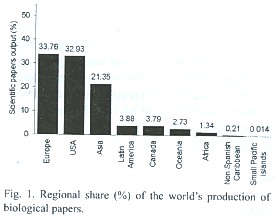
<p><font face="Arial" size="2"><b>Regional productivity: </b>the number of papers produced by each region of the world can be considered by per-capita production, to correct for differences in population size, and also by total output to measure the weight that each region has in the biology literature. </font></p> <font face="Arial" size="2"><b>     <p>Per capita production</p> </b></font>     <p><font face="Arial" size="2">The USA is large enough to be considered a region by itself. It occupies the first place in production of biology papers for every 100 000 inhabitants, with at least twice the productivity of either Asia or Europe. Canada, Oceania and Latin America occupy an intermediate position. Africa, the English and French speaking states of the Caribbean and the small Pacific islands have as a group low productivities for every 100 000 inhabitants.</font></p> <font face="Arial" size="2"><b>     <p>Total output (%)</p> </b> </font>     <p><font face="Arial" size="2">When no correction is made for population size, the global output of scientific papers is dominated by Europe, closely followed by the USA and (less closely) by Asia. Latin America, Canada and Oceania together produce 10% of the biology papers, and Africa, the Non-Spanish Caribbean and small Pacific islands produce a very small percentage (<a href="#f1">Fig.1</a>).</font></p> <a name="f1"></a>     <div style="text-align: center;"><img  src="/img/fbpe/rbt/v53n1-2/3041i1.JPG" title="" alt=""  style="width: 276px; height: 216px;"></div> <font face="Arial" size="2"><b>     
]]></body>
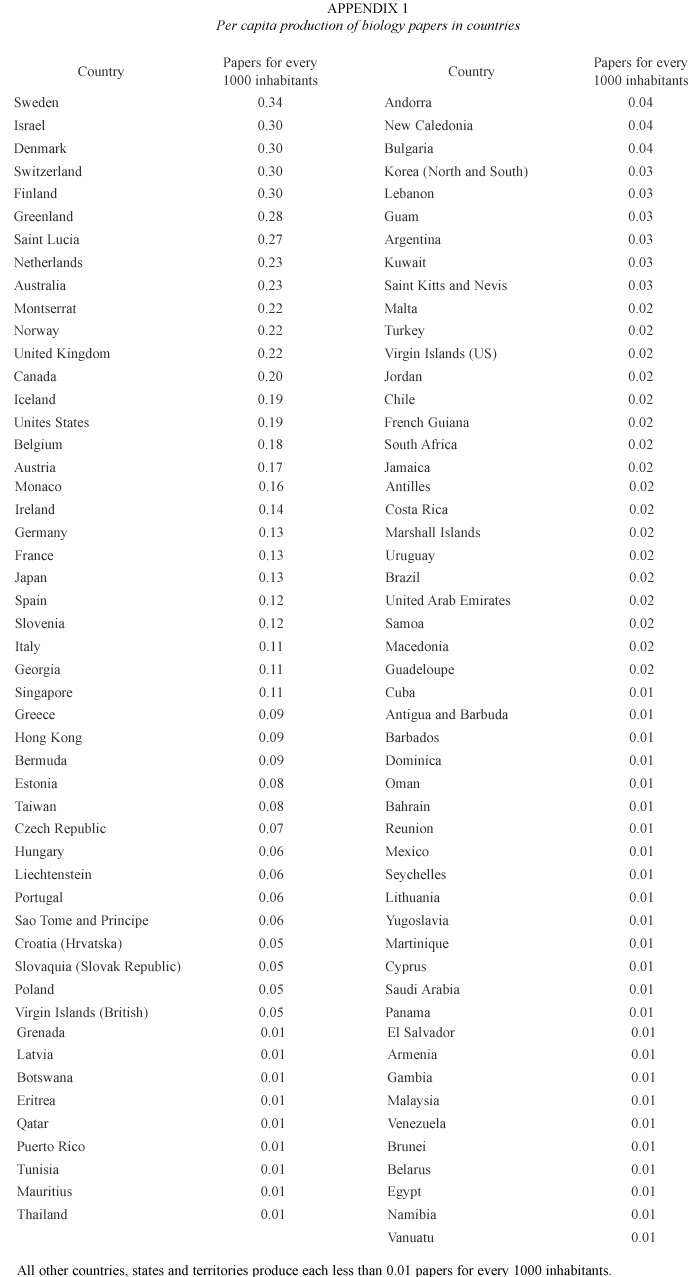
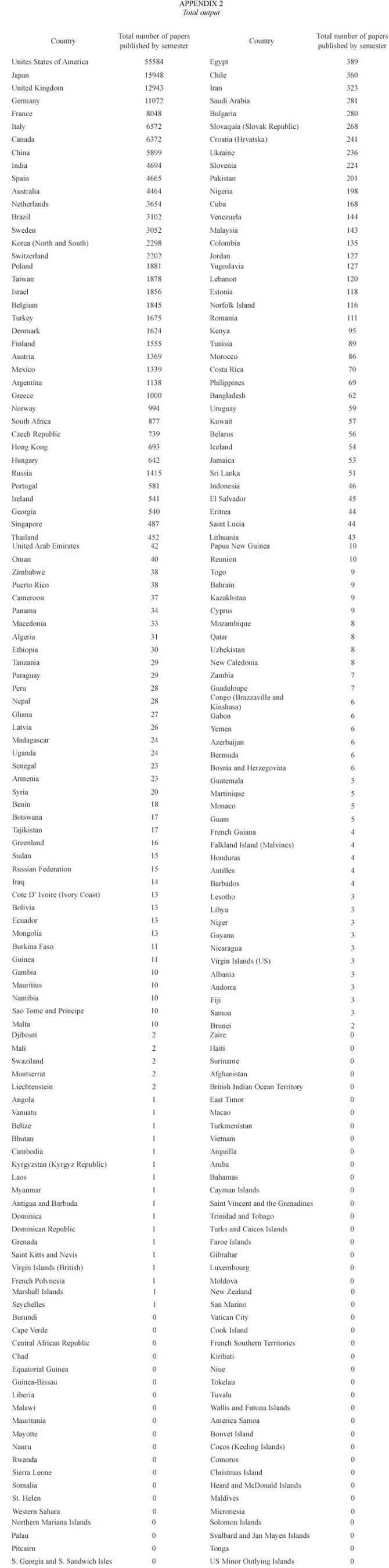
<body><![CDATA[<p>National productivity</p> </b> </font>     <p><font face="Arial" size="2">When countries, states and territories are not pooled into larger regions, important additional information can be added to the larger patterns. The results are again presented in the two options of per capita production and total output of biology papers.</font></p> <font face="Arial" size="2"><b>     <p>Per capita production</p> </b> </font>     <p><font face="Arial" size="2">When corrected for population size, the countries with the greatest productivity of biology papers are the Nordic nations, Israel, Switzerland, Netherlands, Australia, Saint Lucia and Montserrat (<a href="#a1">Appendix 1</a>).</font></p>     <p><font face="Arial" size="2">The lowest productivity corresponds mainly to the small islands of the Pacific, African countries and the poorer Latin American countries (<a href="#a1">Appendix 1</a>). In Latin America, which leads the production of tropical biology papers, the most productive countries are Argentina, Chile and Costa Rica. A second block includes Uruguay, Brazil, Cuba, Mexico, Panama and Puerto Rico (<a href="#a1">Appendix 1</a>).</font></p> <font face="Arial" size="2"><b>     <p>Total output</p> </b> </font>     <p><font face="Arial" size="2">When only the total number of published biology papers is measured, without correction for population size, the most productive countries are the USA, Japan, United Kingdom, Germany, France, Italy, Canada, China, India and Spain (<a href="#a2">Appendix 2</a>).</font></p>     <p><font face="Arial" size="2">The countries, states and territories that publish less biology papers are the islands and several African nations (<a href="#a2">Appendix 2</a>).</font></p>     <p><font face="Arial" size="2">Within Latin America, the most productive countries are Brazil, Mexico and Argentina. Chile, Cuba and Venezuela occupy an intermediate place and Central American, as well as other Caribbean and South American countries have low total outputs of biological papers (<a href="#a2">Appendix 2</a>).</font></p> <font face="Arial" size="2"><b></b></font>     <p align="center"><font face="Arial" size="2"><b>Discussion</b></font></p>     ]]></body>
<body><![CDATA[<p><font face="Arial" size="2"><b>Language: </b>The predominance of English as the language of biological research found in this study is not a surprise. It simply shows an continuation of the trend initiated around the year 1900 and applies both to printed publications and to the Internet. For example, Chinese journals in English language have increased in number and impact in the last 20 years (<a href="#li03">Li and Zhang 2003</a>). Arguments for an standardization of English as scientific language even in poorer countries can be found, among others, in <a href="#mo02">Monge-Nájera 2002</a> and at least 50% of academic web pages in Western European countries are in English, independently of the official local language of each country (<a  href="#th03">Thelwall <i>et al. </i>2003</a>). However, it cannot be predicted if English will dominate science for more than one or two centuries. It could also follow the fate of Latin and be substituted by local languages, specially when automatic translations become widespread and reliable in the future.</font></p> <font face="Arial" size="2"><b>     <p>Regional productivity: Per capita production</p> </b></font>     <p><font face="Arial" size="2">The large relative productivity of the USA reflect the importance that its society gives to science as the basis for technological and economic development (<a href="#in03">Inönü 2003</a>), an attitude that is justified (<a href="#va03">van Looy et al. 2003</a>, <a href="#zi03a">Zitt <i>et al. </i>2003 a</a>, <a  href="#zi03b">b</a>). The leading role of the USA as a regional block has not changed since the last century, as shown by correcting <a  href="#ga84a">Garfield’s (1984a</a>, <a href="#ga84b">b)</a> data for country population size (Monge-Nájera: unpublished reanalysis of <a  href="#ga84a">Garfield 1984a</a>, <a href="#ga84b">b</a>).</font></p> <font face="Arial" size="2"><b>     <p>Total output</p> </b> </font>     <p><font face="Arial" size="2">The USA’s share of total scientific output has decreased from 44% in 1983 (<a href="#ga84a">Garfield 1984a</a>, <a href="#ga84b">b</a>) to 34% in 2002 (this study). The same trend has been noticed in scientometric research (<a href="#bh03">Bharvi <i>et al. </i>2003</a>) and apparently does not reflect a reduction in total output from the USA but rather a greater growth of science in India, Japan (<a href="#bh03">Bharvi <i>et al. </i>2003</a>) and Latin America, among others (this study). </font></p> <font face="Arial" size="2"><b>     <p>National productivity: Per capita production</p> </b></font>     <p><font face="Arial" size="2">The USA led the list of productive regions because low-output countries within other regions reduce regional average, but when individual countries are compared, the USA is not among the ten more productive countries. Again, the leadership of Nordic nations, Israel, Switzerland, Netherlands and Australia can be explained by cultural attitude (<a href="#in03">Inönü 2003</a>), but the excellent record of small, less known states (Saint Lucia and Montserrat) warrants in depth research because they can serve as models for other small countries with similar conditions and characteristics.</font></p>     <p><font face="Arial" size="2">In comparison with 1983 (Monge-Nájera: unpublished reanalysis of <a href="#ga84a">Garfield 1984a</a>, <a  href="#ga84b">b</a>), Chile improved its ranking in per capita productivity one step while Argentina, Costa Rica, Uruguay and Brazil fell one step each. Cuba fell three steps in the ranking and Venezuela and Guatemala disappeared from the list of most productive Latin American countries. Mexico had no change: it was and is seventh in the ranking.</font></p> <font face="Arial" size="2"><b>     <p>Total output</p> </b> </font>     <p><font face="Arial" size="2">Considering total number of published biology papers is measured, the leadership of USA, Canada, Japan and Western European countries can be explained by population size and cultural attitude reflected in industry and government financial support (Vessuri and Cetto 1999, <a href="#in03">Inönü 2003</a>, <a  href="#zi03a">Zitt <i>et al. </i>2003 a</a>, <a href="#zi03b">b</a>). China and India also have large populations, but a positive attitude toward science has not been traditional in those societies, so their improving share of science may reflect a recent change in attitude (<a  href="#bh03">Bharvi <i>et al. </i>2003</a>, <a href="#in03">Inönü 2003</a>). Spain, with a small population and a tradition of disregard for science does not fit Inönü’s hypothesis (<a href="#in03">Inönü 2003</a>) and needs further and in-depth research to understand why it has increased its scientific output to this extent.</font></p>     ]]></body>
<body><![CDATA[<p><font face="Arial" size="2">Within Latin America, the most productive countries are Brazil, Mexico and Argentina, again in concordance with Inönü’s hypothesis (<a href="#in03">Inönü 2003</a>), because these are large countries with a long tradition of funding scientific research (<a href="#an98">Anonymous 1998</a>).</font></p> <font face="Arial" size="2"><b>     <p>Acknowledgments</p> </b> </font>     <p><font face="Arial" size="2">We thank Mónica Chávez R. for assistance with data corroboration and Bernal Morera B. for supporting our research in this field and for suggestions to improve an earlier draft.</font></p> <font face="Arial" size="2"><b>     <p>Resumen</p> </b> </font>     <p><font face="Arial" size="2">Tradicionalmente, los estudios sobre productividad científica tienen dos sesgos: se basan en el <i>Current Contents</i>, un índice basado en revistas de países industrializados, y rara vez toman en cuenta el tamaño de la población, con lo cual dejan por fuera a la mayoría de la producción de países no industrializados (<i>e.g. </i>América Latina) e ignoran el esfuerzo relativo que cada sociedad dedica a la ciencia. Estudiamos la productividad por país usando <i>Biological Abstracts</i>, que incluye más revistas y tomamos en cuenta el tamaño de la población. El idioma inglés domina la literatura científica con un 87% de los artículos (ningún otro idioma llega al 2%). Si se considera a los EEUU como una región, ocupa el primer lugar en productividad por habitante de artículos científicos en el área de la biología, con al menos el doble de la productividad que Asia o Europa. En tanto Canadá, Oceanía y América Latina ocupan lugares intermedios. Mundialmente, la producción total es dominada por Europa, EEUU, Japón, Canadá, China e India. Si se toma en cuenta el tamaño de la población, los países con mayor productividad son las naciones nórdicas, Israel, Suiza, Holanda, Australia, Santa Lucía y Montserrat. El dominio del inglés comenzó a desarrollarse desde cerca del año 1900. La gran producción relativa de los EEUU refleja la importancia que la sociedad estadounidense da a la ciencia como base para el desarrollo tecnológico y económico, pero la porción estadounidense de la producción científica mundial ha bajado de 44% en 1983 a 34% en 2002, al tiempo que se acelera el crecimiento de la producción científica en India, Japón y América Latina, entre otros. La proporción creciente de la literatura de China e India podría reflejar un cambio reciente en actitud hacia la inversión en ciencia. El liderazgo de las naciones nórdicas, Israel, Suiza, Holanda y Australia puede explicarse debido a la actitud cultural. Parece estar emergiendo una tendencia positiva en América Latina, donde Chile mejoró su ubicación en producción por habitante, pero Argentina, Costa Rica, Uruguay, Brasil y Cuba desmejoraron. Sin embargo, en producción bruta total, los países más productivos son Brasil, México y Argentina: países grandes con larga tradición de financiar la investigación científica.</font></p> <font face="Arial" size="2"><b></b></font>     <p><font face="Arial" size="2"><b>Palabras clave: </b>productividad, número de artículos, país, región, rango, idioma de la ciencia, actitud cultural.</font></p> <font face="Arial" size="2"><b>     <p>References</p> </b> </font>     <!-- ref --><p><font face="Arial" size="2"><a name="bh03"></a>Bharvi, D., K. C. Garg &amp; A. Bali. 2003. Scientometrics of the international journal Scientometrics. Scientometrics 56:81-93.    &nbsp;&nbsp;&nbsp;&nbsp;&nbsp;&nbsp;&nbsp;&nbsp;[&#160;<a href="javascript:void(0);" onclick="javascript: window.open('/scielo.php?script=sci_nlinks&ref=1681952&pid=S0034-7744200500010003100001&lng=','','width=640,height=500,resizable=yes,scrollbars=1,menubar=yes,');">Links</a>&#160;]<!-- end-ref --></font></p>     <!-- ref --><p><font face="Arial" size="2"><a name="ga84a"></a>Garfield, E. 1984a. Latin American Research. Current Contents 19:3-8.    &nbsp;&nbsp;&nbsp;&nbsp;&nbsp;&nbsp;&nbsp;&nbsp;[&#160;<a href="javascript:void(0);" onclick="javascript: window.open('/scielo.php?script=sci_nlinks&ref=1681954&pid=S0034-7744200500010003100002&lng=','','width=640,height=500,resizable=yes,scrollbars=1,menubar=yes,');">Links</a>&#160;]<!-- end-ref --></font></p>     <!-- ref --><p><font face="Arial" size="2"><a name="ga84b"></a>Garfield, E. 1984b. Latin American Research. Current Contents 20:3-10.    &nbsp;&nbsp;&nbsp;&nbsp;&nbsp;&nbsp;&nbsp;&nbsp;[&#160;<a href="javascript:void(0);" onclick="javascript: window.open('/scielo.php?script=sci_nlinks&ref=1681956&pid=S0034-7744200500010003100003&lng=','','width=640,height=500,resizable=yes,scrollbars=1,menubar=yes,');">Links</a>&#160;]<!-- end-ref --></font></p>     <!-- ref --><p><font face="Arial" size="2"><a name="in03"></a>Inönü, E. 2003. The influence of cultural factors on scientific production. Scientometrics 56:137-146.    &nbsp;&nbsp;&nbsp;&nbsp;&nbsp;&nbsp;&nbsp;&nbsp;[&#160;<a href="javascript:void(0);" onclick="javascript: window.open('/scielo.php?script=sci_nlinks&ref=1681958&pid=S0034-7744200500010003100004&lng=','','width=640,height=500,resizable=yes,scrollbars=1,menubar=yes,');">Links</a>&#160;]<!-- end-ref --></font></p>     <!-- ref --><p><font face="Arial" size="2"><a name="li03"></a>Li, L. &amp; F. Zhang. 2003. Developing English-language academic journals of China. Scientometrics 57:119- 125.    &nbsp;&nbsp;&nbsp;&nbsp;&nbsp;&nbsp;&nbsp;&nbsp;[&#160;<a href="javascript:void(0);" onclick="javascript: window.open('/scielo.php?script=sci_nlinks&ref=1681960&pid=S0034-7744200500010003100005&lng=','','width=640,height=500,resizable=yes,scrollbars=1,menubar=yes,');">Links</a>&#160;]<!-- end-ref --></font></p>     <!-- ref --><p><font face="Arial" size="2"><a name="mo02"></a>Monge-Nájera, J. 2002. How to be a tropical scientist. Rev. Biol. Trop. 50:XIX-XXIII.    &nbsp;&nbsp;&nbsp;&nbsp;&nbsp;&nbsp;&nbsp;&nbsp;[&#160;<a href="javascript:void(0);" onclick="javascript: window.open('/scielo.php?script=sci_nlinks&ref=1681962&pid=S0034-7744200500010003100006&lng=','','width=640,height=500,resizable=yes,scrollbars=1,menubar=yes,');">Links</a>&#160;]<!-- end-ref --></font></p>     <!-- ref --><p><font face="Arial" size="2"><a name="pa95"></a>Papavero, N., J. Llorente-Bousquets &amp; D. Espinosa- Organista. 1995. Historia de la biología comparada. Universidad Nacional Autónoma de México, Mexico D.F., Mexico (eight volumes).    &nbsp;&nbsp;&nbsp;&nbsp;&nbsp;&nbsp;&nbsp;&nbsp;[&#160;<a href="javascript:void(0);" onclick="javascript: window.open('/scielo.php?script=sci_nlinks&ref=1681964&pid=S0034-7744200500010003100007&lng=','','width=640,height=500,resizable=yes,scrollbars=1,menubar=yes,');">Links</a>&#160;]<!-- end-ref --></font></p>     <!-- ref --><p><font face="Arial" size="2"><a name="ru03"></a>Ruiz Z., A. 2003. Historia y fiolosofía de las matemáticas. Universidad Estatal a Distancia, San José, Costa Rica. 620 p.    &nbsp;&nbsp;&nbsp;&nbsp;&nbsp;&nbsp;&nbsp;&nbsp;[&#160;<a href="javascript:void(0);" onclick="javascript: window.open('/scielo.php?script=sci_nlinks&ref=1681966&pid=S0034-7744200500010003100008&lng=','','width=640,height=500,resizable=yes,scrollbars=1,menubar=yes,');">Links</a>&#160;]<!-- end-ref --></font></p>     <!-- ref --><p><font face="Arial" size="2"><a name="si59"></a>Singer, C. 1959. A history of biology to about the year 1900. Abelard-Schuman, London. 580 p.    &nbsp;&nbsp;&nbsp;&nbsp;&nbsp;&nbsp;&nbsp;&nbsp;[&#160;<a href="javascript:void(0);" onclick="javascript: window.open('/scielo.php?script=sci_nlinks&ref=1681968&pid=S0034-7744200500010003100009&lng=','','width=640,height=500,resizable=yes,scrollbars=1,menubar=yes,');">Links</a>&#160;]<!-- end-ref --> </font></p>     <!-- ref --><p><font face="Arial" size="2"><a name="th03"></a>Thelwall, M., R. Tang &amp; L. Price. 2003. Linguistic patterns of academic Web use in Western Europe. Scientometrics 56:417-432.    &nbsp;&nbsp;&nbsp;&nbsp;&nbsp;&nbsp;&nbsp;&nbsp;[&#160;<a href="javascript:void(0);" onclick="javascript: window.open('/scielo.php?script=sci_nlinks&ref=1681970&pid=S0034-7744200500010003100010&lng=','','width=640,height=500,resizable=yes,scrollbars=1,menubar=yes,');">Links</a>&#160;]<!-- end-ref --></font></p>     <!-- ref --><p><font face="Arial" size="2"><a name="va03"></a>van Leeuwen, T. N., M. S. Visser, H. F. Moed, T. J. Nederhof &amp; A. F. J. van Raan. 2003. The Holy Grail of science policy: Exploring and combining bibliometric tools in search of scientific excellence. Scientometrics 57:257-280.    &nbsp;&nbsp;&nbsp;&nbsp;&nbsp;&nbsp;&nbsp;&nbsp;[&#160;<a href="javascript:void(0);" onclick="javascript: window.open('/scielo.php?script=sci_nlinks&ref=1681972&pid=S0034-7744200500010003100011&lng=','','width=640,height=500,resizable=yes,scrollbars=1,menubar=yes,');">Links</a>&#160;]<!-- end-ref --></font></p>     <!-- ref --><p><font face="Arial" size="2">van Looy, B., E. Zimmermann, R. Veugelers, A. Verbeek, J. Mello &amp; K. Debackere. 2003. Do science-technology interactions pay off when developing technology? Scientometrics 57:355-367.    &nbsp;&nbsp;&nbsp;&nbsp;&nbsp;&nbsp;&nbsp;&nbsp;[&#160;<a href="javascript:void(0);" onclick="javascript: window.open('/scielo.php?script=sci_nlinks&ref=1681974&pid=S0034-7744200500010003100012&lng=','','width=640,height=500,resizable=yes,scrollbars=1,menubar=yes,');">Links</a>&#160;]<!-- end-ref --></font></p>     <!-- ref --><p><font face="Arial" size="2"><a name="zi03a"></a>Zitt, M., S. Ramanana-Rahary &amp; E. Bassecoulard. 2003a. Correcting glasses help fair comparisons in international science landscape:Country indicators as a function of ISI database delineation. Scientometrics 56:259-282.    &nbsp;&nbsp;&nbsp;&nbsp;&nbsp;&nbsp;&nbsp;&nbsp;[&#160;<a href="javascript:void(0);" onclick="javascript: window.open('/scielo.php?script=sci_nlinks&ref=1681976&pid=S0034-7744200500010003100013&lng=','','width=640,height=500,resizable=yes,scrollbars=1,menubar=yes,');">Links</a>&#160;]<!-- end-ref --></font></p>     <!-- ref --><p><font face="Arial" size="2"><a name="zi03b"></a>Zitt, M., S. Ramanana-Rahary, E. Bassecoulard &amp; F. Laville. 2003b. Potential science-technology spillovers in regions: An insight on geographic co-location of knowledge activities in the EU. Scientometrics 57:295-320.    &nbsp;&nbsp;&nbsp;&nbsp;&nbsp;&nbsp;&nbsp;&nbsp;[&#160;<a href="javascript:void(0);" onclick="javascript: window.open('/scielo.php?script=sci_nlinks&ref=1681978&pid=S0034-7744200500010003100014&lng=','','width=640,height=500,resizable=yes,scrollbars=1,menubar=yes,');">Links</a>&#160;]<!-- end-ref --></font></p> <font face="Arial" size="2"><b>     <p>Internet references</p> </b> </font>     <!-- ref --><p><font face="Arial" size="2"><a name="an98"></a>Anonymous. 1998. Indicadores de la ciencia latinoamericana. (Downloaded Sept., 12, 2003. <a href="http://healthig.com/salud/salud9.html">healthig.com/salud/salud9.html</a>).    &nbsp;&nbsp;&nbsp;&nbsp;&nbsp;&nbsp;&nbsp;&nbsp;[&#160;<a href="javascript:void(0);" onclick="javascript: window.open('/scielo.php?script=sci_nlinks&ref=1681981&pid=S0034-7744200500010003100015&lng=','','width=640,height=500,resizable=yes,scrollbars=1,menubar=yes,');">Links</a>&#160;]<!-- end-ref --><br> </font></p>     <p><font face="Arial" size="2">    <br> <a name="a1"></a></font></p>     ]]></body>
<body><![CDATA[<div style="text-align: center;">     <div style="text-align: left;"><font face="Arial" size="2"><img  src="/img/fbpe/rbt/v53n1-2/3041i4.JPG" title="" alt=""  style="width: 693px; height: 1277px;"></font>    
<br> </div> <font face="Arial" size="2">    <br>     <br> </font></div> <a name="a2"></a>     <div style="text-align: center;"><img src="/img/fbpe/rbt/v53n1-2/3041i5.JPG" title=""  alt="" style="width: 670px; height: 2701px;">    
<br> </div> <font face="Arial" size="2"><b>     <p>    <br> </p> </b></font>      ]]></body><back>
<ref-list>
<ref id="B1">
<nlm-citation citation-type="journal">
<person-group person-group-type="author">
<name>
<surname><![CDATA[Bharvi]]></surname>
<given-names><![CDATA[D]]></given-names>
</name>
<name>
<surname><![CDATA[Garg]]></surname>
<given-names><![CDATA[K. C]]></given-names>
</name>
<name>
<surname><![CDATA[Bali]]></surname>
<given-names><![CDATA[A]]></given-names>
</name>
</person-group>
<article-title xml:lang="en"><![CDATA[Scientometrics of the international journal Scientometrics]]></article-title>
<source><![CDATA[Scientometrics]]></source>
<year>2003</year>
<volume>56</volume>
<page-range>81-93</page-range></nlm-citation>
</ref>
<ref id="B2">
<nlm-citation citation-type="journal">
<person-group person-group-type="author">
<name>
<surname><![CDATA[Garfield]]></surname>
<given-names><![CDATA[E]]></given-names>
</name>
</person-group>
<article-title xml:lang="en"><![CDATA[Latin American Research]]></article-title>
<source><![CDATA[Current Contents]]></source>
<year>1984</year>
<month>a</month>
<volume>19</volume>
<page-range>3-8</page-range></nlm-citation>
</ref>
<ref id="B3">
<nlm-citation citation-type="journal">
<person-group person-group-type="author">
<name>
<surname><![CDATA[Garfield]]></surname>
<given-names><![CDATA[E]]></given-names>
</name>
</person-group>
<article-title xml:lang="en"><![CDATA[Latin American Research]]></article-title>
<source><![CDATA[Current Contents]]></source>
<year>1984</year>
<month>b</month>
<volume>20</volume>
<page-range>3-10</page-range></nlm-citation>
</ref>
<ref id="B4">
<nlm-citation citation-type="journal">
<person-group person-group-type="author">
<name>
<surname><![CDATA[Inönü]]></surname>
<given-names><![CDATA[E]]></given-names>
</name>
</person-group>
<article-title xml:lang="en"><![CDATA[The influence of cultural factors on scientific production]]></article-title>
<source><![CDATA[Scientometrics]]></source>
<year>2003</year>
<volume>56</volume>
<page-range>137-146</page-range></nlm-citation>
</ref>
<ref id="B5">
<nlm-citation citation-type="journal">
<person-group person-group-type="author">
<name>
<surname><![CDATA[Li]]></surname>
<given-names><![CDATA[L]]></given-names>
</name>
<name>
<surname><![CDATA[Zhang]]></surname>
<given-names><![CDATA[F]]></given-names>
</name>
</person-group>
<article-title xml:lang="en"><![CDATA[Developing English-language academic journals of China]]></article-title>
<source><![CDATA[Scientometrics]]></source>
<year>2003</year>
<volume>57</volume>
<page-range>119- 125</page-range></nlm-citation>
</ref>
<ref id="B6">
<nlm-citation citation-type="journal">
<person-group person-group-type="author">
<name>
<surname><![CDATA[Monge-Nájera]]></surname>
<given-names><![CDATA[J]]></given-names>
</name>
</person-group>
<article-title xml:lang="en"><![CDATA[How to be a tropical scientist]]></article-title>
<source><![CDATA[Rev. Biol. Trop]]></source>
<year>2002</year>
<volume>50</volume>
<page-range>XIX-XXIII</page-range></nlm-citation>
</ref>
<ref id="B7">
<nlm-citation citation-type="book">
<person-group person-group-type="author">
<name>
<surname><![CDATA[Papavero]]></surname>
<given-names><![CDATA[N]]></given-names>
</name>
<name>
<surname><![CDATA[Llorente-Bousquets]]></surname>
<given-names><![CDATA[J]]></given-names>
</name>
<name>
<surname><![CDATA[Espinosa- Organista]]></surname>
<given-names><![CDATA[D]]></given-names>
</name>
</person-group>
<source><![CDATA[Historia de la biología comparada]]></source>
<year>1995</year>
<publisher-loc><![CDATA[^eMexico D.F Mexico D.F]]></publisher-loc>
<publisher-name><![CDATA[Universidad Nacional Autónoma de México]]></publisher-name>
</nlm-citation>
</ref>
<ref id="B8">
<nlm-citation citation-type="book">
<person-group person-group-type="author">
<name>
<surname><![CDATA[Ruiz Z]]></surname>
<given-names><![CDATA[A]]></given-names>
</name>
</person-group>
<source><![CDATA[Historia y fiolosofía de las matemáticas]]></source>
<year>2003</year>
<page-range>620</page-range><publisher-loc><![CDATA[San José ]]></publisher-loc>
<publisher-name><![CDATA[Universidad Estatal a Distancia]]></publisher-name>
</nlm-citation>
</ref>
<ref id="B9">
<nlm-citation citation-type="book">
<person-group person-group-type="author">
<name>
<surname><![CDATA[Singer]]></surname>
<given-names><![CDATA[C]]></given-names>
</name>
</person-group>
<source><![CDATA[A history of biology to about the year 1900]]></source>
<year>1959</year>
<page-range>580</page-range><publisher-loc><![CDATA[London ]]></publisher-loc>
<publisher-name><![CDATA[Abelard-Schuman]]></publisher-name>
</nlm-citation>
</ref>
<ref id="B10">
<nlm-citation citation-type="journal">
<person-group person-group-type="author">
<name>
<surname><![CDATA[Thelwall]]></surname>
<given-names><![CDATA[M]]></given-names>
</name>
<name>
<surname><![CDATA[Tang]]></surname>
<given-names><![CDATA[R]]></given-names>
</name>
<name>
<surname><![CDATA[Price]]></surname>
<given-names><![CDATA[L]]></given-names>
</name>
</person-group>
<article-title xml:lang="en"><![CDATA[Linguistic patterns of academic Web use in Western Europe]]></article-title>
<source><![CDATA[Scientometrics]]></source>
<year>2003</year>
<volume>56</volume>
<page-range>417-432</page-range></nlm-citation>
</ref>
<ref id="B11">
<nlm-citation citation-type="journal">
<person-group person-group-type="author">
<name>
<surname><![CDATA[van Leeuwen]]></surname>
<given-names><![CDATA[T. N]]></given-names>
</name>
<name>
<surname><![CDATA[Visser]]></surname>
<given-names><![CDATA[M. S]]></given-names>
</name>
<name>
<surname><![CDATA[Moed]]></surname>
<given-names><![CDATA[H. F]]></given-names>
</name>
<name>
<surname><![CDATA[Nederhof]]></surname>
<given-names><![CDATA[T. J]]></given-names>
</name>
<name>
<surname><![CDATA[van Raan]]></surname>
<given-names><![CDATA[A. F. J]]></given-names>
</name>
</person-group>
<article-title xml:lang="en"><![CDATA[The Holy Grail of science policy: Exploring and combining bibliometric tools in search of scientific excellence]]></article-title>
<source><![CDATA[Scientometrics]]></source>
<year>2003</year>
<volume>57</volume>
<page-range>257-280</page-range></nlm-citation>
</ref>
<ref id="B12">
<nlm-citation citation-type="journal">
<person-group person-group-type="author">
<name>
<surname><![CDATA[van Looy]]></surname>
<given-names><![CDATA[B]]></given-names>
</name>
<name>
<surname><![CDATA[Zimmermann]]></surname>
<given-names><![CDATA[E]]></given-names>
</name>
<name>
<surname><![CDATA[Veugelers]]></surname>
<given-names><![CDATA[R]]></given-names>
</name>
<name>
<surname><![CDATA[Verbeek]]></surname>
<given-names><![CDATA[A]]></given-names>
</name>
<name>
<surname><![CDATA[Mello]]></surname>
<given-names><![CDATA[J]]></given-names>
</name>
<name>
<surname><![CDATA[Debackere]]></surname>
<given-names><![CDATA[K]]></given-names>
</name>
</person-group>
<article-title xml:lang="en"><![CDATA[Do science-technology interactions pay off when developing technology?]]></article-title>
<source><![CDATA[Scientometrics]]></source>
<year>2003</year>
<volume>57</volume>
<page-range>355-367</page-range></nlm-citation>
</ref>
<ref id="B13">
<nlm-citation citation-type="journal">
<person-group person-group-type="author">
<name>
<surname><![CDATA[Zitt]]></surname>
<given-names><![CDATA[M]]></given-names>
</name>
<name>
<surname><![CDATA[Ramanana-Rahary]]></surname>
<given-names><![CDATA[S]]></given-names>
</name>
<name>
<surname><![CDATA[Bassecoulard]]></surname>
<given-names><![CDATA[E]]></given-names>
</name>
</person-group>
<article-title xml:lang="en"><![CDATA[Correcting glasses help fair comparisons in international science landscape: Country indicators as a function of ISI database delineation]]></article-title>
<source><![CDATA[Scientometrics]]></source>
<year>2003</year>
<month>a</month>
<volume>56</volume>
<page-range>259-282</page-range></nlm-citation>
</ref>
<ref id="B14">
<nlm-citation citation-type="journal">
<person-group person-group-type="author">
<name>
<surname><![CDATA[Zitt]]></surname>
<given-names><![CDATA[M]]></given-names>
</name>
<name>
<surname><![CDATA[Ramanana-Rahary]]></surname>
<given-names><![CDATA[S]]></given-names>
</name>
<name>
<surname><![CDATA[Bassecoulard]]></surname>
<given-names><![CDATA[E]]></given-names>
</name>
<name>
<surname><![CDATA[Laville]]></surname>
<given-names><![CDATA[F]]></given-names>
</name>
</person-group>
<article-title xml:lang="en"><![CDATA[Potential science-technology spillovers in regions: An insight on geographic co-location of knowledge activities in the EU]]></article-title>
<source><![CDATA[Scientometrics]]></source>
<year>2003</year>
<month>b</month>
<volume>57</volume>
<page-range>295-320</page-range></nlm-citation>
</ref>
<ref id="B15">
<nlm-citation citation-type="">
<person-group person-group-type="author">
<name>
</name>
<name>
</name>
</person-group>
<source><![CDATA[Indicadores de la ciencia latinoamericana]]></source>
<year>1998</year>
</nlm-citation>
</ref>
</ref-list>
</back>
</article>