<?xml version="1.0" encoding="ISO-8859-1"?><article xmlns:mml="http://www.w3.org/1998/Math/MathML" xmlns:xlink="http://www.w3.org/1999/xlink" xmlns:xsi="http://www.w3.org/2001/XMLSchema-instance">
<front>
<journal-meta>
<journal-id>0034-7744</journal-id>
<journal-title><![CDATA[Revista de Biología Tropical]]></journal-title>
<abbrev-journal-title><![CDATA[Rev. biol. trop]]></abbrev-journal-title>
<issn>0034-7744</issn>
<publisher>
<publisher-name><![CDATA[Universidad de Costa Rica]]></publisher-name>
</publisher>
</journal-meta>
<article-meta>
<article-id>S0034-77442005000100026</article-id>
<title-group>
<article-title xml:lang="en"><![CDATA[A twelve-month field study of the West African Thrush Turdus pelios (Passeriformes: Muscicapidae): Part 2: annual cycles]]></article-title>
</title-group>
<contrib-group>
<contrib contrib-type="author">
<name>
<surname><![CDATA[Akinpelu]]></surname>
<given-names><![CDATA[Akinsola I]]></given-names>
</name>
<xref ref-type="aff" rid="A01"/>
</contrib>
</contrib-group>
<aff id="A01">
<institution><![CDATA[,Obafemi Awolowo University  ]]></institution>
<addr-line><![CDATA[Ile-Ife ]]></addr-line>
<country>Nigeria</country>
</aff>
<pub-date pub-type="pub">
<day>00</day>
<month>06</month>
<year>2005</year>
</pub-date>
<pub-date pub-type="epub">
<day>00</day>
<month>06</month>
<year>2005</year>
</pub-date>
<volume>53</volume>
<numero>1-2</numero>
<fpage>239</fpage>
<lpage>247</lpage>
<copyright-statement/>
<copyright-year/>
<self-uri xlink:href="http://www.scielo.sa.cr/scielo.php?script=sci_arttext&amp;pid=S0034-77442005000100026&amp;lng=en&amp;nrm=iso"></self-uri><self-uri xlink:href="http://www.scielo.sa.cr/scielo.php?script=sci_abstract&amp;pid=S0034-77442005000100026&amp;lng=en&amp;nrm=iso"></self-uri><self-uri xlink:href="http://www.scielo.sa.cr/scielo.php?script=sci_pdf&amp;pid=S0034-77442005000100026&amp;lng=en&amp;nrm=iso"></self-uri><abstract abstract-type="short" xml:lang="en"><p><![CDATA[In Africa, birds inhabiting forested regions are less seasonal in their activities than those from open areas. In order to study annual cycles in forest regions of South western Nigeria, West African Thrushes (Turdus pelios ) were mist-netted and banded during the last two weeks of each month. The nest is a cup-shaped structure built out of grasses, herbs, weeds, roots and earth laid out in a clockwise manner. Only the nesting tree and feeding sites were defended during the breeding period. The clutch size was 2.69 ±0.20 eggs with a mean incubation period of 14.11 ±0.26 days. The mean nestling period was 15 ±1.00 days. The nestlings were fed on a variety of plant and animal matter, of which grass seeds and insects were predominant. Moult was found to be protracted with a population moult period of 194 days and a much shorter individual moult period. Moult and breeding periods were spread out: moult period dovetailed into the breeding period. The birds were found to gain weight during the period but they attained their maximum weight in August after the moult period. The lowest weight was recorded in February, during the peak of the dry season, when food availability was lower. Rev. Biol. Trop. 53(1-2):239-247. Epub 2005 Jun 24]]></p></abstract>
<abstract abstract-type="short" xml:lang="es"><p><![CDATA[El nido del tordo africano occidental es una estructura en forma de copa construida con pastos, hierbas, malezas, raíces y tierra, proyectado en el sentido de las manecillas del reloj. Solamente el árbol con el nido y los sitios de alimentación son defendidos durante la crianza. El tamaño de la nidada fue 2.69 ± 0.20 huevos con un periodo de incubación de 14.11 ± 0.26 días. El periodo promedio de cría fue de 15 ± 1.00 días. Los polluelos fueron alimentados con una variedad de material animal y vegetal, predominando las semillas de pasto y los insectos. La muda del plumaje alar es prolongada, con un período poblacional de muda de 194 días y un periodo individual mucho menor. La muda y crianza son tan prolongados que se empalman con el periodo de crianza. Las aves ganaron peso durante el periodo pero alcanzaron su peso máximo en agosto, después del periodo de muda. El peso más bajo fue el de febrero, lo que coincide con el pico de la estación seca, cuando los recursos alimenticios son escasos]]></p></abstract>
<kwd-group>
<kwd lng="en"><![CDATA[Turdus pelios]]></kwd>
<kwd lng="en"><![CDATA[ecology]]></kwd>
<kwd lng="en"><![CDATA[nest]]></kwd>
<kwd lng="en"><![CDATA[nestlings]]></kwd>
<kwd lng="en"><![CDATA[gonad size]]></kwd>
<kwd lng="en"><![CDATA[clutch size]]></kwd>
<kwd lng="en"><![CDATA[wing moult]]></kwd>
<kwd lng="en"><![CDATA[body weight]]></kwd>
<kwd lng="en"><![CDATA[Nigeria]]></kwd>
<kwd lng="es"><![CDATA[Turdus pelios]]></kwd>
<kwd lng="es"><![CDATA[ecología]]></kwd>
<kwd lng="es"><![CDATA[nido]]></kwd>
<kwd lng="es"><![CDATA[polluelos]]></kwd>
<kwd lng="es"><![CDATA[tamaño gonadal]]></kwd>
<kwd lng="es"><![CDATA[tamaño de nidada]]></kwd>
<kwd lng="es"><![CDATA[muda de plumaje alar]]></kwd>
<kwd lng="es"><![CDATA[tamaño corporal]]></kwd>
<kwd lng="es"><![CDATA[Nigeria]]></kwd>
</kwd-group>
</article-meta>
</front><body><![CDATA[ <p align="center"><b><font face="Arial">A twelve-month field study of the West African Thrush </font></b><font face="Arial"><i>Turdus pelios</i></font>    <br> <span style="font-family: arial; font-weight: bold;">(Passeriformes: Muscicapidae). Part 2: annual cycles</span></p> <font face="Arial"><b> </b></font><font face="Arial" size="2"></font>     <p><font face="Arial" size="2">Akinsola I. Akinpelu</font></p>     <p><font face="Arial" size="2">Department of Zoology, Obafemi Awolowo University, Ile-Ife, Nigeria; <a href="mailto:sholaakinpelu@yahoo.com">sholaakinpelu@yahoo.com</a></font></p>     <p style="text-align: center;"><font face="Arial" size="2">Received 19-VII-2002.&nbsp;&nbsp;&nbsp;&nbsp; Corrected 10-IX-2003.&nbsp;&nbsp;&nbsp;&nbsp; Accepted 07-XII-2004.</font></p> <font face="Arial" size="2"><b>     <p>Abstract</p> </b></font>     <p><font face="Arial" size="2">In Africa, birds inhabiting forested regions are less seasonal in their activities than those from open areas. In order to study annual cycles in forest regions of South western Nigeria, West African Thrushes (<i>Turdus pelios </i>) were mist-netted and banded during the last two weeks of each month. The nest is a cup-shaped structure built out of grasses, herbs, weeds, roots and earth laid out in a clockwise manner. Only the nesting tree and feeding sites were defended during the breeding period. The clutch size was 2.69 ±0.20 eggs with a mean incubation period of 14.11 ±0.26 days. The mean nestling period was 15 ±1.00 days. The nestlings were fed on a variety of plant and animal matter, of which grass seeds and insects were predominant. Moult was found to be protracted with a population moult period of 194 days and a much shorter individual moult period. Moult and breeding periods were spread out: moult period dovetailed into the breeding period. The birds were found to gain weight during the period but they attained their maximum weight in August after the moult period. The lowest weight was recorded in February, during the peak of the dry season, when food availability was lower. Rev. Biol. Trop. 53(1-2):239-247. Epub 2005 Jun 24.</font></p> <font face="Arial" size="2"><b></b></font>     <p><font face="Arial" size="2"><b>Key words: </b><i>Turdus pelios</i>, ecology, nest, nestlings, gonad size, clutch size, wing moult, body weight, Nigeria.</font></p>     <p><font face="Arial" size="2">Birds in the forested regions of tropical Africa are not as seasonally distinct in their breeding and moult characteristics as their counterparts in the non-forested savanna regions (<a href="#si78">Sinclair 1978</a>, <a href="#ak92">Akinpelu 1992</a>). Several species are known to make seasonal movements in relation to rainfall (<a href="#el73">Elgood <i>et al. </i>1973</a>). However, there are evidences that birds inhabiting the forested regions do exhibit seasonality in most of their activities albeit less clearly (<a  href="#th88">Thompson 1988</a>, <a href="#th89">1989</a>, <a  href="#ak92">Akinpelu 1992</a>, <a href="#ak04">Akinpelu and Oyedipe 2004</a>). </font></p>     <p><font face="Arial" size="2">The raising of a family is a yearly occupation for most adult birds and the biological aim is ultimately to replace each old adult with a young one (<a href="#ra67">Rand 1967</a>). However, much of the breeding cycles differ from species to species but are all in concert with the local seasons, so that the young are raised during periods of favourable climate when food supply is not limited and the young birds have the best opportunity to survive. </font></p>     ]]></body>
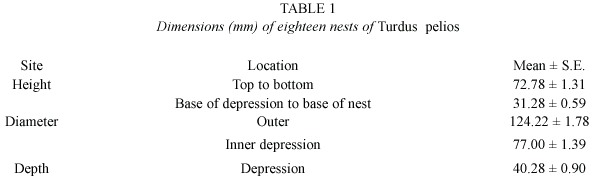
<body><![CDATA[<p><font face="Arial" size="2">Replacement of old feathers through moult is an adaptive affair and it occurs once in a year. In most bird species moult proceeds gradually with a few at a time so that at no time will a bird be found devoid of feathers. While moulting, birds will still be able to carry out their normal activities (<a href="#pa80">Payne 1980</a>,<a href="#ai87">Aidley and Wilkinson 1987</a>,<a href="#ak94b">Akinpelu 1994b</a>).</font></p>     <p><font face="Arial" size="2">A more critical period for birds is the breeding and nesting season because a lot of energy is expended and therefore, the timing of moult has to be such that the normal activities of the bird are not adversely affected. Where there is an overlap of moult and breeding cycles, the period of moult is rather prolonged with few feathers being shed at a time as opposed to a much more rapid period of moult in non-breeding forms (<a href="#ra67">Rand 1967</a>, <a href="#ak94b">Akinpelu, 1994b</a>). This paper examines the annual cycles of the West African Thrush <i>Turdus pelios </i>and at the same time extends the range of species investigated in the forest regions of South western Nigeria.</font></p> <font face="Arial" size="2"><b>     <p>Material and methods</p> </b> </font>     <p><font face="Arial" size="2">In order to obtain quantitative data on the annual cycles, the birds were mist-netted during the last two weeks of each month. Birds caught were banded, weighed (to the nearest 0.1g using a 50g or 100g spring balance), classified as an adult or juvenile (on plumage, bill and iris colour). Moult of primary feathers of adults was scored from 0 (all old feathers) to 50 (all new feathers) using conventional notation (<a href="#as62">Ashmole 1962</a>). Estimates of moult were made from the comparison of moult scores from recaptures of marked individuals during the process of active moult (<a href="#cr83">Craig 1983</a>). The rate of moult was calculated as the change in moult score divided by the number of days elapsed between recaptures and the duration of moult as the reciprocal of this rate multiplied by 50 (maximum score for a bird with ten primaries). The birds were released at the point of capture and a total of 51 birds, including recaptures, were examined.</font></p>     <p><font face="Arial" size="2">Unfortunately,the recapture rate of West African Thrush in this study was very low, hence the moult parameters estimated for individual birds was small. Moult calculated from population data involved the primary moult scores of all adult individuals caught and plotted against the number of days since the beginning of the year, i. e., January 1 and the regression calculated so as to provide a supplementary approach. Regression analysis of population moult scores offered a useful tool to support estimates derived from recaptures of actively moulting individuals and had been widely used in analysis of moult data. (<a href="#ti94">Tidemann and Woinarski 1994</a>).</font></p>     <p><font face="Arial" size="2">Details of nest structure and dimensions were recorded within the study area. All nests containing eggs and those already abandoned were inspected daily in order to record the fate of clutches, determine hatching periods, weight of nestlings and nestling mortality. Weights were taken with spring balance.</font></p>     <p><font face="Arial" size="2">Seasonal changes in the weight of the birds and gonadal lengths were monitored in a small sample of the birds collected during the last week of each month. Specimens were deposited in the avian collection of the Natural History Museum and Zoology Department Museum Unit, Obafemi Awolowo University, Ile-Ife.</font></p> <font face="Arial" size="2"><b>     <p>Results</p> </b> </font>     <p><font face="Arial" size="2">The birds were frequently seen on grass lawns during the rainy season (April-October) which was invariably the breeding season. Courtship display was characterised by the production of loud, pleasant, piping calls which lasted for 4 -5s after which responses from others on nearby shrubs and trees became evident. This was then followed by pair formation after which each pair constantly flew from one branch to another on a tree. The pair then flew vertically upwards, descended together and then flew off horizontally disappearing into the undergrowth. The call was also used to advertise the birds territory and in chasing male intruders.</font></p>     <p><font face="Arial" size="2">Nest building period commenced in April and lasted until July. Since it was difficult to differentiate between the sexes of the birds, only one of the birds was responsible for initiating nest building. However, subsequent nest building activities were a cooperative behaviour of the pair. The nest was a deep cup of grasses, herbs or weeds and roots laid down in a clockwise manner. The roots of the herbs and grasses formed the base and lower part of the cup, while the grass and herb heads formed the upper part. The soil and mud still attached to the roots of these plants were used in plastering them together so that the base of the nest now had a relatively solid structure. The inner part of the cup was lined with fine plant materials. For 18 nests examined a mean height of 72.78 ± 1.31 mm and a mean outer diameter of 124.22 ± 1.78 mm were obtained. The cup-shaped depression had a mean diameter of 77.00 ±1.39 mm and a mean depth of 40.28 ± 0.90 mm. The mean height of the solid base was 31.28 ± 0.59 mm (<a  href="#t1">Table 1</a>). The nests were usually located on thick tree branches with relatively flat surfaces and on suitable almost inaccessible flat areas on nearby buildings at a height of between 6.10 to 7.62 m above the ground.</font></p>     ]]></body>
<body><![CDATA[<p style="text-align: center;"><font face="Arial" size="2">&nbsp;<a  name="t1"></a><img src="/img/fbpe/rbt/v53n1-2/3036i6.JPG" title="" alt=""  style="width: 593px; height: 181px;">    
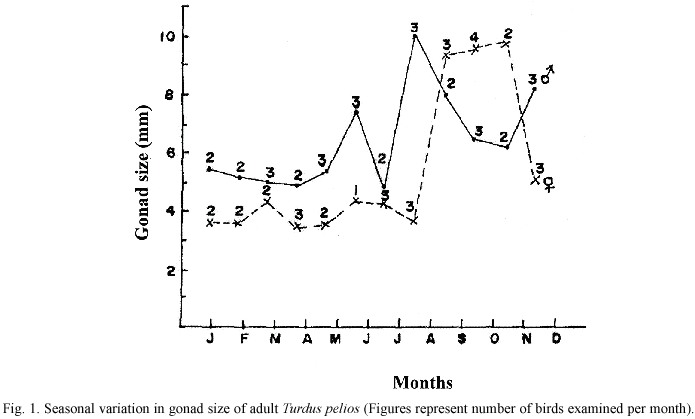
<br> </font></p>     <p><font face="Arial" size="2">&nbsp;</font></p>     <p><font face="Arial" size="2"><a href="#f1">Figure 1</a> shows the seasonal variation in the gonad size of both male and female <i>Turdus pelios </i>. The data suggested that females were in breeding condition during a three to four month period towards the end of the rains, i.e., from late August to late November. Males showed peaks of breeding activity in August and December for the species. Intra-and inter-clutch variation in the shape of the eggs were not observed. The eggs were usually pale greenish blue, spotted and blotched with brown lavender markings especially at the larger blunt end of the oval- shaped eggs. The clutch size usually ranged between 2-3 eggs with a mean of 2.69 ± 0.20 eggs for 43 eggs examined. A clutch size of 3 eggs accounted for 76.7% of the total. Egg length varied between 25.90 -28.30 mm with a mean at 27.13 ± 0.01 mm, the egg width ranged from 17.80 -20.00 mm with a mean at 18.64 ± 0.01 mm and the egg weight varied from 3.02 -4.27g with a mean at 3.24 ± 0.05 g. The eggs were always laid early in the morning before 08.00 hr, three to five days after the nest was completed at an interval of 24 hr. Incubation started in most cases when the last but one egg in a clutch had been laid. Only one of the parents, supposedly the female, incubated and the male was seldom seen near the nest during incubation. The mean incubation period for nine nests was found to be 14.11 ± 0.26 days.</font></p> <a name="f1"></a>     <div style="text-align: center;"><img src="/img/fbpe/rbt/v53n1-2/3036i1.JPG" title=""  alt="" style="width: 695px; height: 419px;"></div>     
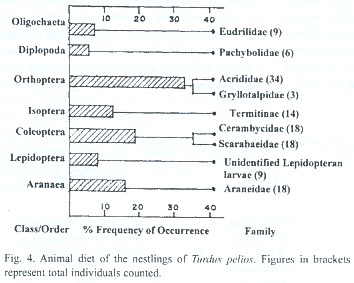
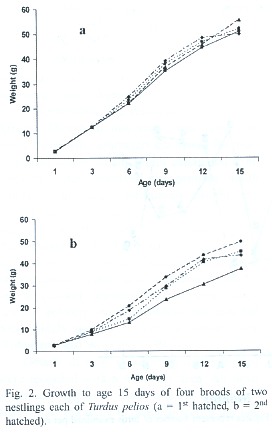
<p><font face="Arial" size="2">The eggs hatched synchronously with the chicks emerging within the space of two hours and the newly hatched were dark,pink-skinned and naked. At three days the eye slits had formed and the pterylae were visible as dark patches. By the 5<sup>th</sup> day the eyes were open and the shafts of the primaries were about 3-4 mm long.</font></p>     <p></p> <font face="Arial" size="2">The growth pattern of four broods of 2 nestlings and four broods of 3 nestlings in which the weights of the young were recorded from hatching date to date of departure from the nest are shown in <a href="#f2">Figs.2</a> and <a href="#f3">3</a>. The nestling weights showed the typical sigmoid curve. In the four broods of two nestling (<a href="#f2">Fig.2</a>), on hatching the chicks weighed approximately 2.8 g. From days 1 to 3 daily increments of growth averaged 4.85 g but by day 9 weight gained accelerated to as much as nearly 49.8g. Maximum weight was attained by about day 15 and the heaviest nestling weight was 56 g, which was 18% more than adult weight (X = 45.9 g;n =54). Within broods of two or three nestlings, the first-hatched sibling was heavier than second-hatched. There was no significant difference in the mean rate of growth observed in both broods (t =2.3;P &gt; 0.05, d.f. =7). The nestling period was 15 ± 1 days. During this time the nestlings were generally confined to the nest where they were fed by the parent.</font>     <p></p> <a name="f2"></a>     <div style="text-align: center;"><img src="/img/fbpe/rbt/v53n1-2/3036i2.JPG" title=""  alt="" style="width: 272px; height: 433px;">    
<br>     ]]></body>
<body><![CDATA[<br>     <br>     <br> <a name="f3"></a><img src="/img/fbpe/rbt/v53n1-2/3036i3.JPG" title="" alt=""  style="width: 276px; height: 620px;">    
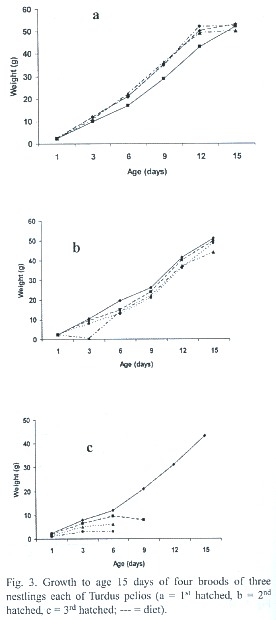
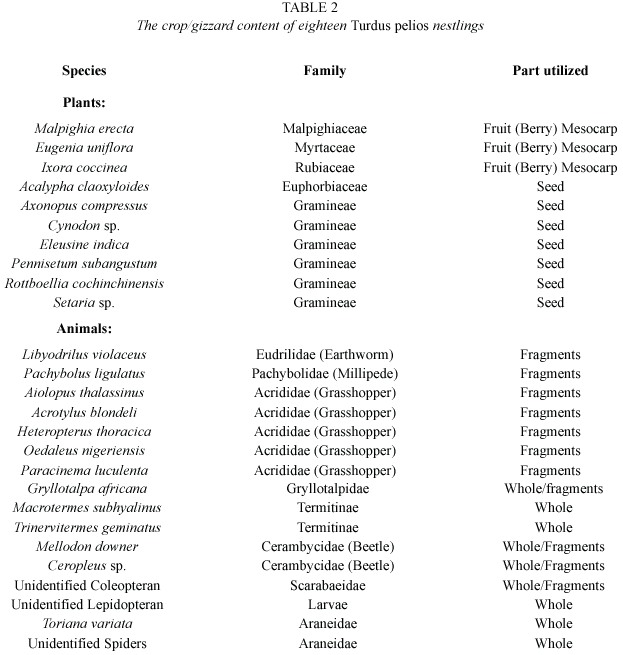
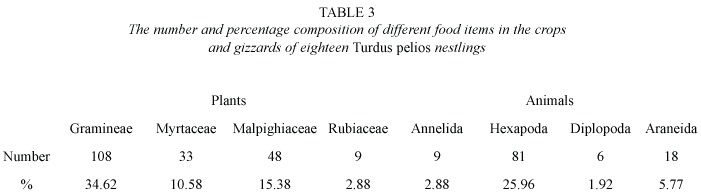
<br> </div>     <p><font face="Arial" size="2">Twenty-six food items consisting of fruits, grass, seeds, insects and spiders were identified in the crops and on seven occasions in the gizzards of dead West African thrush nestlings (<a href="#t2">Table 2</a>). Plant matter accounted for 63.5% of the total food items out of which grass seeds formed 54.5% of the plant items. The insects (Hexapoda) formed the major bulk of the animal matter (71%). Numerically, the most important of these were Orthoptera, Coleoptera and Isoptera which accounted for 72 (i.e.,63%) out of a total of 114 insects (<a href="#t3">Table 3</a> and <a href="#f4">Fig.4</a>).</font></p> <a name="t2"></a>     <div style="text-align: center;"><img src="/img/fbpe/rbt/v53n1-2/3036i7.JPG" title=""  alt="" style="width: 623px; height: 655px;">    
<br>     <br>     <br>     <br> <a name="t3"></a><img src="/img/fbpe/rbt/v53n1-2/3036i8.JPG" title="" alt=""  style="width: 701px; height: 193px;">    
]]></body>
<body><![CDATA[<br> </div>     <p><font face="Arial" size="2">    <br> <a name="f4"></a></font></p>     <div style="text-align: center;"><font face="Arial" size="2"><img  src="/img/fbpe/rbt/v53n1-2/3036i4.JPG" title="" alt=""  style="width: 354px; height: 283px;"></font>    
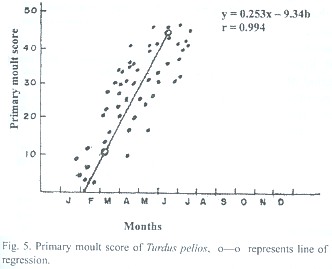
<br> </div>     <p><font face="Arial" size="2">Parents collected faecal sacs after a feed and dropped them in flight after which bill wiping followed. The number of faecal sacs increased as the young grew older and then decreased again just before they left the nest.</font></p>     <p><font face="Arial" size="2">On eight occasions the distance faecal sacs were carried varied between 24.6 and 33.5 m with a mean at 28.8 ± 1.20 m. Only one nest containing three chicks was lost when the tree branch broke during a heavy storm.It was observed that nestling mortality, one per brood, occurred where there were more than two chicks in the brood and nestling mortality was 16.3% in the 18 nests monitored. On two different occasions two parents were seen feeding a chick five and eights days after leaving the nest. One of these same chicks was seen feeding on its own seven days later at about 760 m from the nest it was raised.</font></p>     <p><font face="Arial" size="2">The shedding of the innermost primary (P1) initiates the sequence of adult wing moult which was descendent and symmetrical. Secondary moult commenced at the outermost secondary (S1) after the third primary (P3) had completed growth. The primary moult was completed before all the secondaries were replaced.</font></p>     <p><font face="Arial" size="2"><a href="#f5">Figure 5</a> shows the result of individual moult score plotted against date and the regression equation for estimating the duration of moult in an individual within the population is y =0.253x -9.34b, calculated by the method of least squares from the data presented in <a href="#f5">Fig. 5</a>, and where y is the primary moult score and x the days elapsed since 1 January. The beginning of moult was taken as 1 January for calculation purposes, but the estimated start of moult shown by the regression line is 6 February. The period of moult for adult population began on 6 February and was completed on 18 August indicating a population moult period of 194 days. The scattergram of primary moult score of retrapped individuals suggested a moult period of about five months for individuals.</font></p>     <p style="text-align: center;"><font face="Arial" size="2">&nbsp;<a  name="f5"></a><img src="/img/fbpe/rbt/v53n1-2/3036i5.JPG" title="" alt=""  style="width: 332px; height: 269px;"></font></p>     
]]></body>
<body><![CDATA[<p><font face="Arial" size="2">Since sexes are morphologically alike the weight of both males and females were taken together. Mean monthly weights varied from 42.80 ± 0.75 to 49.6 ± 1.00g. Lower weights were recorded in January, February and December with the lowest in February. The weights gradually increased from March to August when it reached its peak. Although there was a steady decline in weights from August to November, the weights still remained as high as 47.4g.</font></p> <font face="Arial" size="2"><b>     <p>Discussion</p> </b> </font>     <p><font face="Arial" size="2">Seasonal breeding activities in birds reported by several researchers (<a href="#pa80">Payne 1980</a>, <a  href="#wi83">Wilkinson 1983</a>, <a href="#th89">Thompson 1989</a>, <a  href="#ak94b">Akinpelu 1994b</a>) have found to be timed so that the young are raised during the period of food abundance. The West African Thrush is no exception to this observation in Ile-Ife. Although nesting building activities took place between April and July, i.e. a period of heavy rainfall, actual breeding portrayed by increased gonadal activities occurred between August and November when more chicks hatched. This period coincided with the latter part of the wet season and the early part of the dry season thereby ensuring availability of mature seeds, fruits and an array of insect life (<a href="#ak94a">Akinpelu 1994a</a>). The availability of these food sources ensures that enough protein reserve was built up (<a href="#jo76">Jones and Ward 1976</a>) for the production of eggs and rearing of the young.</font></p>     <p><font face="Arial" size="2"><a href="#sn74">Snow and Lill (1974)</a> suggested that small nests with easily fed broods were built by birds as a result of predation but it seemed likely that a low clutch size permitted only a small nest and not the other way round. This seemed justifiable since no significant difference was found in the clutch size of those that nested in nearby buildings and trees close to human habitation and those that nested in forest trees. A similar situation was observed by <a href="#ak94a">Akinpelu (1994a)</a>, in <i>Lonchura cucullata </i>who suggested that it was a devise against predation to nest close to human habitation. West African Thrush laid between two to three eggs per clutch with three eggs per clutch having a higher frequency. However, higher hatching and fledging successes were found in two-egg clutches. The incubation and nestling periods were of short duration which ensured that the young reached fledging stage within the shortest possible period. The short duration may also be an adaptive device against predation since the nest were open cup-shaped structures.</font></p>     <p><font face="Arial" size="2">Nestlings were fed on diets consisting of fruits, grass seeds, insects, spiders, earthworms and millipedes. Plant matter accounted for the bulk of the total food items and grass seeds formed more than half of the plant items. The insects formed the major bulk of animal matter and numerically important ones were the Orthoptera, Coleoptera and Isoptera which accounted for almost two-thirds of the insects. The presence of these groups of animals suggested that foraging was more frequent on the ground than in the air. This observation buttressed the fact that the birds were poor fliers that would find it rather difficult to capture prey in flight. <a  href="#de78">Dean (1978)</a> considered moult as a severe energy draining process that could be undergone before breeding. This was observed to be the case in West African Thrush where the protracted moult dovetailed into the breeding season. Moult began just before the wet season and was completed by the time when food resources were still abundant. The terminal portion of moult gradually merged into the breeding period. This period also coincided with the time the birds were heaviest during the year. <a href="#wi83">Wilkinson (1983)</a> and <a href="#ak97">Akinpelu (1997)</a> suggested that regression analysis of population moult could bring about a longer moult duration as opposed to the retrap data of individual birds. This was found to be case in that individual moult period deduced from few retrapped individuals was shorter than the estimated population moult period of seven months for the West African Thrush.</font></p>     <p><font face="Arial" size="2">Body weight showed a unimodal pattern with a peak in August after which a gradual decline in weight was recorded. Moult started at a time when there was a gradual gain in weight and ended before maximum weight was attained. The lowest weight was recorded in February, a period coinciding with peak of the dry season, when food resources were less available. Shortly after moulting period the weights remained high until August thereby merging into the breeding season. This observation was consistent with the findings from other studies (<a href="#fo72">Fogden 1972</a>, <a href="#ak94a">Akinpelu 1994a</a>). From February to August, which was the period of moult, substantial weight gains were recorded thereby confirming the observation of <a href="#cr79">Craig and Manson (1979)</a> that in some cases birds undergoing moulting could gain weight.</font></p> <font face="Arial" size="2"><b>     <p>Acknowledgments</p> </b> </font>     <p><font face="Arial" size="2">My profound gratitude to the Department of Zoology, Obafemi Awolowo University, Ile-Ife for putting some of the materials at my disposal.</font></p> <font face="Arial" size="2"><b>     <p>Resumen</p> </b> </font>     <p><font face="Arial" size="2">El nido del tordo africano occidental es una estructura en forma de copa construida con pastos, hierbas, malezas, raíces y tierra, proyectado en el sentido de las manecillas del reloj. Solamente el árbol con el nido y los sitios de alimentación son defendidos durante la crianza. El tamaño de la nidada fue 2.69 ± 0.20 huevos con un periodo de incubación de 14.11 ± 0.26 días. El periodo promedio de cría fue de 15 ± 1.00 días. Los polluelos fueron alimentados con una variedad de material animal y vegetal, predominando las semillas de pasto y los insectos. La muda del plumaje alar es prolongada, con un período poblacional de muda de 194 días y un periodo individual mucho menor. La muda y crianza son tan prolongados que se empalman con el periodo de crianza. Las aves ganaron peso durante el periodo pero alcanzaron su peso máximo en agosto, después del periodo de muda. El peso más bajo fue el de febrero, lo que coincide con el pico de la estación seca, cuando los recursos alimenticios son escasos.</font></p> <font face="Arial" size="2"><b></b></font>     ]]></body>
<body><![CDATA[<p><font face="Arial" size="2"><b>Palabras clave: </b><i>Turdus pelios</i>, ecología, nido, polluelos, tamaño gonadal, tamaño de nidada, muda de plumaje alar, tamaño corporal, Nigeria.</font></p> <font face="Arial" size="2"><b>     <p>References</p> </b> </font>     <!-- ref --><p><font face="Arial" size="2"><a name="ai87"></a>Aidley, D. J. &amp; R. Wilkinson, 1987. Moult of some palaearctic warblers in northern Nigeria. Bird Study 34:219-225.    &nbsp;&nbsp;&nbsp;&nbsp;&nbsp;&nbsp;&nbsp;&nbsp;[&#160;<a href="javascript:void(0);" onclick="javascript: window.open('/scielo.php?script=sci_nlinks&ref=1681335&pid=S0034-7744200500010002600001&lng=','','width=640,height=500,resizable=yes,scrollbars=1,menubar=yes,');">Links</a>&#160;]<!-- end-ref --></font></p>     <!-- ref --><p><font face="Arial" size="2"><a name="ak92"></a>Akinpelu, A. I. 1992. Studies on the reproductive activities of three estrildid birds (Family: Estrildidae) in Ile-Ife, Nigeria. Ph. D. Thesis, Obafemi Awolowo University, Nigeria.    &nbsp;&nbsp;&nbsp;&nbsp;&nbsp;&nbsp;&nbsp;&nbsp;[&#160;<a href="javascript:void(0);" onclick="javascript: window.open('/scielo.php?script=sci_nlinks&ref=1681337&pid=S0034-7744200500010002600002&lng=','','width=640,height=500,resizable=yes,scrollbars=1,menubar=yes,');">Links</a>&#160;]<!-- end-ref --></font></p>     <!-- ref --><p><font face="Arial" size="2"><a name="ak94a"></a>Akinpelu, A. I. 1994a.B reeding seasons of three estrildid species in Ile-Ife, Nigeria. Malimbus 16:94-99.    &nbsp;&nbsp;&nbsp;&nbsp;&nbsp;&nbsp;&nbsp;&nbsp;[&#160;<a href="javascript:void(0);" onclick="javascript: window.open('/scielo.php?script=sci_nlinks&ref=1681339&pid=S0034-7744200500010002600003&lng=','','width=640,height=500,resizable=yes,scrollbars=1,menubar=yes,');">Links</a>&#160;]<!-- end-ref --></font></p>     <!-- ref --><p><font face="Arial" size="2"><a name="ak94b"></a>Akinpelu, A. I. 1994b. Moult and weight cycles in two species of <i>Lonchura </i>in Ile-Ife, Nigeria. Malimbus 16:88-93.    &nbsp;&nbsp;&nbsp;&nbsp;&nbsp;&nbsp;&nbsp;&nbsp;[&#160;<a href="javascript:void(0);" onclick="javascript: window.open('/scielo.php?script=sci_nlinks&ref=1681341&pid=S0034-7744200500010002600004&lng=','','width=640,height=500,resizable=yes,scrollbars=1,menubar=yes,');">Links</a>&#160;]<!-- end-ref --></font></p>     ]]></body>
<body><![CDATA[<!-- ref --><p><font face="Arial" size="2"><a name="ak97"></a>Akinpelu, A. I. 1997. Body mass and moult cycles in adult Orange-checked Waxbill <i>Estrilda melpoda </i>in Ile-Ife, Nigeria. Ostrich 68 (2-4):119-120.    &nbsp;&nbsp;&nbsp;&nbsp;&nbsp;&nbsp;&nbsp;&nbsp;[&#160;<a href="javascript:void(0);" onclick="javascript: window.open('/scielo.php?script=sci_nlinks&ref=1681343&pid=S0034-7744200500010002600005&lng=','','width=640,height=500,resizable=yes,scrollbars=1,menubar=yes,');">Links</a>&#160;]<!-- end-ref --></font></p>     <!-- ref --><p><font face="Arial" size="2"><a name="ak04"></a>Akinpelu, A. I. &amp; O. A. Oyedipe. 2004. A Twelve-month field study of the West African Thrush <i>Turdus pelios </i>(Passeriformes:Muscicapidae). Part 1: food and feeding ecology. Rev. Biol. Trop. 52:1001-1007.    &nbsp;&nbsp;&nbsp;&nbsp;&nbsp;&nbsp;&nbsp;&nbsp;[&#160;<a href="javascript:void(0);" onclick="javascript: window.open('/scielo.php?script=sci_nlinks&ref=1681345&pid=S0034-7744200500010002600006&lng=','','width=640,height=500,resizable=yes,scrollbars=1,menubar=yes,');">Links</a>&#160;]<!-- end-ref --></font></p>     <!-- ref --><p><font face="Arial" size="2"><a name="as62"></a>Ashmole, N. P. 1962. The Black Noddy <i>Anous tenuirostris </i>on Ascension Island.Ibis 103:235 -273.    &nbsp;&nbsp;&nbsp;&nbsp;&nbsp;&nbsp;&nbsp;&nbsp;[&#160;<a href="javascript:void(0);" onclick="javascript: window.open('/scielo.php?script=sci_nlinks&ref=1681347&pid=S0034-7744200500010002600007&lng=','','width=640,height=500,resizable=yes,scrollbars=1,menubar=yes,');">Links</a>&#160;]<!-- end-ref --></font></p>     <!-- ref --><p><font face="Arial" size="2"><a name="cr83"></a>Craig, A. J. F. K. 1983. Moult in Southern African passerine birds: a review. Ostrich 54:220 -237.    &nbsp;&nbsp;&nbsp;&nbsp;&nbsp;&nbsp;&nbsp;&nbsp;[&#160;<a href="javascript:void(0);" onclick="javascript: window.open('/scielo.php?script=sci_nlinks&ref=1681349&pid=S0034-7744200500010002600008&lng=','','width=640,height=500,resizable=yes,scrollbars=1,menubar=yes,');">Links</a>&#160;]<!-- end-ref --></font></p>     <!-- ref --><p><font face="Arial" size="2"><a name="cr79"></a>Craig, A. J. F. K. &amp; A. J. Manson. 1979. Moult of the Red Bishop and related species of <i>Euplectes. </i>Ostrich 50: 65-69.    &nbsp;&nbsp;&nbsp;&nbsp;&nbsp;&nbsp;&nbsp;&nbsp;[&#160;<a href="javascript:void(0);" onclick="javascript: window.open('/scielo.php?script=sci_nlinks&ref=1681351&pid=S0034-7744200500010002600009&lng=','','width=640,height=500,resizable=yes,scrollbars=1,menubar=yes,');">Links</a>&#160;]<!-- end-ref --></font></p>     ]]></body>
<body><![CDATA[<!-- ref --><p><font face="Arial" size="2"><a name="de78"></a>Dean, W. R. J. 1978. Plumage, reproductive condition and moult in non-breeding Wattled Starlings. Ostrich 49: 97-101.    &nbsp;&nbsp;&nbsp;&nbsp;&nbsp;&nbsp;&nbsp;&nbsp;[&#160;<a href="javascript:void(0);" onclick="javascript: window.open('/scielo.php?script=sci_nlinks&ref=1681353&pid=S0034-7744200500010002600010&lng=','','width=640,height=500,resizable=yes,scrollbars=1,menubar=yes,');">Links</a>&#160;]<!-- end-ref --></font></p>     <!-- ref --><p><font face="Arial" size="2"><a name="el73"></a>Elgood, J. H., C. H. Fry &amp; R. J. Dowsett. 1973. African migrants in Nigeria. Ibis 108:84-116.    &nbsp;&nbsp;&nbsp;&nbsp;&nbsp;&nbsp;&nbsp;&nbsp;[&#160;<a href="javascript:void(0);" onclick="javascript: window.open('/scielo.php?script=sci_nlinks&ref=1681355&pid=S0034-7744200500010002600011&lng=','','width=640,height=500,resizable=yes,scrollbars=1,menubar=yes,');">Links</a>&#160;]<!-- end-ref --></font></p>     <!-- ref --><p><font face="Arial" size="2"><a name="fo72"></a>Fogden, M. P. L. 1972. The seasonality and population dynamics of equatorial forest birds in Sarawak. Ibis 114:307-343.    &nbsp;&nbsp;&nbsp;&nbsp;&nbsp;&nbsp;&nbsp;&nbsp;[&#160;<a href="javascript:void(0);" onclick="javascript: window.open('/scielo.php?script=sci_nlinks&ref=1681357&pid=S0034-7744200500010002600012&lng=','','width=640,height=500,resizable=yes,scrollbars=1,menubar=yes,');">Links</a>&#160;]<!-- end-ref --></font></p>     <!-- ref --><p><font face="Arial" size="2"><a name="jo76"></a>Jones, P. J. &amp; P. Ward. 1976. The level of reserve protein as the proximate factor controlling the timing of breeding and clutch size in the Redbilled <i>Quelea quelea</i>. Ibis 118:547-574.    &nbsp;&nbsp;&nbsp;&nbsp;&nbsp;&nbsp;&nbsp;&nbsp;[&#160;<a href="javascript:void(0);" onclick="javascript: window.open('/scielo.php?script=sci_nlinks&ref=1681359&pid=S0034-7744200500010002600013&lng=','','width=640,height=500,resizable=yes,scrollbars=1,menubar=yes,');">Links</a>&#160;]<!-- end-ref --></font></p>     <!-- ref --><p><font face="Arial" size="2"><a name="pa80"></a>Payne, R. B. 1980. Seasonal incidence of breeding, moult and local dispersal of Redbilled Firefinches <i>Lagonosticta senegala </i>in Zambia. Ibis 122:43-56.    &nbsp;&nbsp;&nbsp;&nbsp;&nbsp;&nbsp;&nbsp;&nbsp;[&#160;<a href="javascript:void(0);" onclick="javascript: window.open('/scielo.php?script=sci_nlinks&ref=1681361&pid=S0034-7744200500010002600014&lng=','','width=640,height=500,resizable=yes,scrollbars=1,menubar=yes,');">Links</a>&#160;]<!-- end-ref --></font></p>     ]]></body>
<body><![CDATA[<!-- ref --><p><font face="Arial" size="2"><a name="ra67"></a>Rand, A. L. 1967. Ornithology: An introduction. Pengium Books, Harmondsworth, Middlesex, England. 368 pp.    &nbsp;&nbsp;&nbsp;&nbsp;&nbsp;&nbsp;&nbsp;&nbsp;[&#160;<a href="javascript:void(0);" onclick="javascript: window.open('/scielo.php?script=sci_nlinks&ref=1681363&pid=S0034-7744200500010002600015&lng=','','width=640,height=500,resizable=yes,scrollbars=1,menubar=yes,');">Links</a>&#160;]<!-- end-ref --></font></p>     <!-- ref --><p><font face="Arial" size="2"><a name="si78"></a>Sinclair, A. RE. 1978. Factors affecting food supply and breeding seasons of resident birds and movements of palaearctic migrants in a tropical African savanna. Ibis 120:480-497.    &nbsp;&nbsp;&nbsp;&nbsp;&nbsp;&nbsp;&nbsp;&nbsp;[&#160;<a href="javascript:void(0);" onclick="javascript: window.open('/scielo.php?script=sci_nlinks&ref=1681365&pid=S0034-7744200500010002600016&lng=','','width=640,height=500,resizable=yes,scrollbars=1,menubar=yes,');">Links</a>&#160;]<!-- end-ref --></font></p>     <!-- ref --><p><font face="Arial" size="2"><a name="sn74"></a>Snow, D. W. &amp; A. Lill. 1974. Longevity records for some neotropical land birds. Condor 76:262-267.    &nbsp;&nbsp;&nbsp;&nbsp;&nbsp;&nbsp;&nbsp;&nbsp;[&#160;<a href="javascript:void(0);" onclick="javascript: window.open('/scielo.php?script=sci_nlinks&ref=1681367&pid=S0034-7744200500010002600017&lng=','','width=640,height=500,resizable=yes,scrollbars=1,menubar=yes,');">Links</a>&#160;]<!-- end-ref --><br> </font></p>     <p><font face="Arial" size="2"><a name="th88"></a>Thompson,J.J.1988.The post-nuptial moult of Quelea quelea in relation to breeding in Kenya.J.Trop.Ecol. 4:373-380.</font></p>     <p><font face="Arial" size="2"><a name="th89"></a>Thompson,J.J.1989.Diet and breeding seasonality of the Bronze Mannikin Lonchura cucullata (Swainson) and the Blue-billed Mannikin Lonchura bicolor (Frazer)in Western Sierra-Leone.Malimbus 11: 73-87.</font></p>     <p><font face="Arial" size="2"><a name="ti94"></a>Tidemann,S.C.&amp;J.C.Z.Woinarski.1994.Moult characteristics and breeding seasons of Gouldian Erythrura gouldiae ,Masked Poephila personata and Long-tailed Finches P.acuticauda in savanna wood in the northern territory.Emu 94:46-52.</font></p>     <p><font face="Arial" size="2"><a name="wi83"></a>Wilkinson,R.1983.Biannual breeding and moult-breeding overlap of the Chestnut-bellied starling Spreo pulcher .Ibis 125:353-361.    ]]></body>
<body><![CDATA[<br> </font></p>      ]]></body><back>
<ref-list>
<ref id="B1">
<nlm-citation citation-type="journal">
<person-group person-group-type="author">
<name>
<surname><![CDATA[Aidley]]></surname>
<given-names><![CDATA[D. J]]></given-names>
</name>
<name>
<surname><![CDATA[Wilkinson]]></surname>
<given-names><![CDATA[R]]></given-names>
</name>
</person-group>
<article-title xml:lang="en"><![CDATA[Moult of some palaearctic warblers in northern Nigeria]]></article-title>
<source><![CDATA[Bird Study]]></source>
<year>1987</year>
<volume>34</volume>
<page-range>219-225</page-range></nlm-citation>
</ref>
<ref id="B2">
<nlm-citation citation-type="">
<person-group person-group-type="author">
<name>
<surname><![CDATA[Akinpelu]]></surname>
<given-names><![CDATA[A. I]]></given-names>
</name>
</person-group>
<source><![CDATA[Studies on the reproductive activities of three estrildid birds (Family: Estrildidae) in Ile-Ife, Nigeria]]></source>
<year>1992</year>
</nlm-citation>
</ref>
<ref id="B3">
<nlm-citation citation-type="journal">
<person-group person-group-type="author">
<name>
<surname><![CDATA[Akinpelu]]></surname>
<given-names><![CDATA[A. I]]></given-names>
</name>
</person-group>
<article-title xml:lang="en"><![CDATA[Breeding seasons of three estrildid species in Ile-Ife, Nigeria]]></article-title>
<source><![CDATA[Malimbus]]></source>
<year>1994</year>
<month>a</month>
<volume>16</volume>
<page-range>94-99</page-range></nlm-citation>
</ref>
<ref id="B4">
<nlm-citation citation-type="journal">
<person-group person-group-type="author">
<name>
<surname><![CDATA[Akinpelu]]></surname>
<given-names><![CDATA[A. I]]></given-names>
</name>
</person-group>
<article-title xml:lang="en"><![CDATA[Moult and weight cycles in two species of Lonchura in Ile-Ife, Nigeria]]></article-title>
<source><![CDATA[Malimbus]]></source>
<year>1994</year>
<month>b</month>
<volume>16</volume>
<page-range>88-93</page-range></nlm-citation>
</ref>
<ref id="B5">
<nlm-citation citation-type="journal">
<person-group person-group-type="author">
<name>
<surname><![CDATA[Akinpelu]]></surname>
<given-names><![CDATA[A. I]]></given-names>
</name>
</person-group>
<article-title xml:lang="en"><![CDATA[Body mass and moult cycles in adult Orange-checked Waxbill Estrilda melpoda in Ile-Ife, Nigeria]]></article-title>
<source><![CDATA[Ostrich]]></source>
<year>1997</year>
<volume>68</volume>
<numero>2-4</numero>
<issue>2-4</issue>
<page-range>119-120</page-range></nlm-citation>
</ref>
<ref id="B6">
<nlm-citation citation-type="journal">
<person-group person-group-type="author">
<name>
<surname><![CDATA[Akinpelu]]></surname>
<given-names><![CDATA[A. I]]></given-names>
</name>
<name>
<surname><![CDATA[Oyedipe]]></surname>
<given-names><![CDATA[O. A]]></given-names>
</name>
</person-group>
<article-title xml:lang="en"><![CDATA[A Twelve-month field study of the West African Thrush Turdus pelios (Passeriformes:Muscicapidae): Part 1: food and feeding ecology]]></article-title>
<source><![CDATA[Rev. Biol. Trop]]></source>
<year>2004</year>
<volume>52</volume>
<page-range>1001-1007</page-range></nlm-citation>
</ref>
<ref id="B7">
<nlm-citation citation-type="journal">
<person-group person-group-type="author">
<name>
<surname><![CDATA[Ashmole]]></surname>
<given-names><![CDATA[N. P]]></given-names>
</name>
</person-group>
<article-title xml:lang="en"><![CDATA[The Black Noddy Anous tenuirostris on Ascension Island]]></article-title>
<source><![CDATA[Ibis]]></source>
<year>1962</year>
<volume>103</volume>
<page-range>235 -273</page-range></nlm-citation>
</ref>
<ref id="B8">
<nlm-citation citation-type="journal">
<person-group person-group-type="author">
<name>
<surname><![CDATA[Craig]]></surname>
<given-names><![CDATA[A. J. F. K]]></given-names>
</name>
</person-group>
<article-title xml:lang="en"><![CDATA[Moult in Southern African passerine birds: a review]]></article-title>
<source><![CDATA[Ostrich]]></source>
<year>1983</year>
<volume>54</volume>
<page-range>220 -237</page-range></nlm-citation>
</ref>
<ref id="B9">
<nlm-citation citation-type="journal">
<person-group person-group-type="author">
<name>
<surname><![CDATA[Craig]]></surname>
<given-names><![CDATA[A. J. F. K]]></given-names>
</name>
<name>
<surname><![CDATA[Manson]]></surname>
<given-names><![CDATA[A. J]]></given-names>
</name>
</person-group>
<article-title xml:lang="en"><![CDATA[Moult of the Red Bishop and related species of Euplectes]]></article-title>
<source><![CDATA[Ostrich]]></source>
<year>1979</year>
<volume>50</volume>
<page-range>65-69</page-range></nlm-citation>
</ref>
<ref id="B10">
<nlm-citation citation-type="journal">
<person-group person-group-type="author">
<name>
<surname><![CDATA[Dean]]></surname>
<given-names><![CDATA[W. R. J]]></given-names>
</name>
</person-group>
<article-title xml:lang="en"><![CDATA[Plumage, reproductive condition and moult in non-breeding Wattled Starlings]]></article-title>
<source><![CDATA[Ostrich]]></source>
<year>1978</year>
<volume>49</volume>
<page-range>97-101</page-range></nlm-citation>
</ref>
<ref id="B11">
<nlm-citation citation-type="journal">
<person-group person-group-type="author">
<name>
<surname><![CDATA[Elgood]]></surname>
<given-names><![CDATA[J. H]]></given-names>
</name>
<name>
<surname><![CDATA[Fry]]></surname>
<given-names><![CDATA[C. H]]></given-names>
</name>
<name>
<surname><![CDATA[Dowsett]]></surname>
<given-names><![CDATA[R. J]]></given-names>
</name>
</person-group>
<article-title xml:lang="en"><![CDATA[African migrants in Nigeria]]></article-title>
<source><![CDATA[Ibis]]></source>
<year>1973</year>
<volume>108</volume>
<page-range>84-116</page-range></nlm-citation>
</ref>
<ref id="B12">
<nlm-citation citation-type="journal">
<person-group person-group-type="author">
<name>
<surname><![CDATA[Fogden]]></surname>
<given-names><![CDATA[M. P. L]]></given-names>
</name>
</person-group>
<article-title xml:lang="en"><![CDATA[The seasonality and population dynamics of equatorial forest birds in Sarawak]]></article-title>
<source><![CDATA[Ibis]]></source>
<year>1972</year>
<volume>114</volume>
<page-range>307-343</page-range></nlm-citation>
</ref>
<ref id="B13">
<nlm-citation citation-type="journal">
<person-group person-group-type="author">
<name>
<surname><![CDATA[Jones]]></surname>
<given-names><![CDATA[P. J]]></given-names>
</name>
<name>
<surname><![CDATA[Ward]]></surname>
<given-names><![CDATA[P]]></given-names>
</name>
</person-group>
<article-title xml:lang="en"><![CDATA[The level of reserve protein as the proximate factor controlling the timing of breeding and clutch size in the Redbilled Quelea quelea]]></article-title>
<source><![CDATA[Ibis]]></source>
<year>1976</year>
<volume>118</volume>
<page-range>547-574</page-range></nlm-citation>
</ref>
<ref id="B14">
<nlm-citation citation-type="journal">
<person-group person-group-type="author">
<name>
<surname><![CDATA[Payne]]></surname>
<given-names><![CDATA[R. B]]></given-names>
</name>
</person-group>
<article-title xml:lang="en"><![CDATA[Seasonal incidence of breeding, moult and local dispersal of Redbilled Firefinches Lagonosticta senegala in Zambia]]></article-title>
<source><![CDATA[Ibis]]></source>
<year>1980</year>
<volume>122</volume>
<page-range>43-56</page-range></nlm-citation>
</ref>
<ref id="B15">
<nlm-citation citation-type="book">
<person-group person-group-type="author">
<name>
<surname><![CDATA[Rand]]></surname>
<given-names><![CDATA[A. L]]></given-names>
</name>
</person-group>
<source><![CDATA[Ornithology: An introduction]]></source>
<year>1967</year>
<page-range>368</page-range><publisher-loc><![CDATA[Harmondsworth^eMiddlesex Middlesex]]></publisher-loc>
<publisher-name><![CDATA[Pengium Books]]></publisher-name>
</nlm-citation>
</ref>
<ref id="B16">
<nlm-citation citation-type="journal">
<person-group person-group-type="author">
<name>
<surname><![CDATA[Sinclair]]></surname>
<given-names><![CDATA[A. RE]]></given-names>
</name>
</person-group>
<article-title xml:lang="en"><![CDATA[Factors affecting food supply and breeding seasons of resident birds and movements of palaearctic migrants in a tropical African savanna]]></article-title>
<source><![CDATA[Ibis]]></source>
<year>1978</year>
<volume>120</volume>
<page-range>480-497</page-range></nlm-citation>
</ref>
<ref id="B17">
<nlm-citation citation-type="journal">
<person-group person-group-type="author">
<name>
<surname><![CDATA[Snow]]></surname>
<given-names><![CDATA[D. W]]></given-names>
</name>
<name>
<surname><![CDATA[Lill]]></surname>
<given-names><![CDATA[A]]></given-names>
</name>
</person-group>
<article-title xml:lang="en"><![CDATA[Longevity records for some neotropical land birds]]></article-title>
<source><![CDATA[Condor]]></source>
<year>1974</year>
<volume>76</volume>
<page-range>262-267</page-range></nlm-citation>
</ref>
</ref-list>
</back>
</article>