<?xml version="1.0" encoding="ISO-8859-1"?><article xmlns:mml="http://www.w3.org/1998/Math/MathML" xmlns:xlink="http://www.w3.org/1999/xlink" xmlns:xsi="http://www.w3.org/2001/XMLSchema-instance">
<front>
<journal-meta>
<journal-id>0034-7744</journal-id>
<journal-title><![CDATA[Revista de Biología Tropical]]></journal-title>
<abbrev-journal-title><![CDATA[Rev. biol. trop]]></abbrev-journal-title>
<issn>0034-7744</issn>
<publisher>
<publisher-name><![CDATA[Universidad de Costa Rica]]></publisher-name>
</publisher>
</journal-meta>
<article-meta>
<article-id>S0034-77442003000300018</article-id>
<title-group>
<article-title xml:lang="en"><![CDATA[Sexual behavior of mutant strains of the medfly Ceratitis capitata (Diptera: Tephritidae)]]></article-title>
</title-group>
<contrib-group>
<contrib contrib-type="author">
<name>
<surname><![CDATA[Briceño]]></surname>
<given-names><![CDATA[R.D]]></given-names>
</name>
<xref ref-type="aff" rid="A01"/>
</contrib>
</contrib-group>
<aff id="A01">
<institution><![CDATA[,Universidad de Costa Rica Escuela de Biologia ]]></institution>
<addr-line><![CDATA[ ]]></addr-line>
<country>Costa Rica</country>
</aff>
<pub-date pub-type="pub">
<day>00</day>
<month>09</month>
<year>2003</year>
</pub-date>
<pub-date pub-type="epub">
<day>00</day>
<month>09</month>
<year>2003</year>
</pub-date>
<volume>51</volume>
<numero>3-4</numero>
<fpage>763</fpage>
<lpage>767</lpage>
<copyright-statement/>
<copyright-year/>
<self-uri xlink:href="http://www.scielo.sa.cr/scielo.php?script=sci_arttext&amp;pid=S0034-77442003000300018&amp;lng=en&amp;nrm=iso"></self-uri><self-uri xlink:href="http://www.scielo.sa.cr/scielo.php?script=sci_abstract&amp;pid=S0034-77442003000300018&amp;lng=en&amp;nrm=iso"></self-uri><self-uri xlink:href="http://www.scielo.sa.cr/scielo.php?script=sci_pdf&amp;pid=S0034-77442003000300018&amp;lng=en&amp;nrm=iso"></self-uri><abstract abstract-type="short" xml:lang="en"><p><![CDATA[Males of the mutant strains (blind, vestigal-winged) of the Mediterranean fruit fly (medfly), Ceratits capitata (Wiedmann) showed differences in behavior compared with control (mass-reared) males. Mutant males made fewer mating attempts and achieved fewer matings than control males. Vestigal-winged females copulated less frequently with both mutants. Blind males climbed rather than jumped onto females and copulated in very low numbers compared with control and vestigal males. Blind females copulated normally with control, males and in very low numbers with both types of mutant males]]></p></abstract>
<abstract abstract-type="short" xml:lang="es"><p><![CDATA[Machos mutantes (ciegos, alas vestigiales) de la mosca del mediterráneo Ceratitis capitata (Wiedmann) mostraron diferencias en conducta comparados con los machos testigo (cría masiva). Los machos mutantes, realizaron menos intentos por aparearse y lograron menos apareamientos que los machos testigo. Las hembras con alas vestigiales, copularon menos con ambas clases de mutantes. Los machos ciegos, subieron en lugar de saltar sobre las hembras y copularon en números muy bajos comparados con los machos testigo y con los de alas vestigiales. Las hembras ciegas, copularon de forma normal con los machos testigo y en números muy bajos con ambos tipos de machos mutantes]]></p></abstract>
<kwd-group>
<kwd lng="en"><![CDATA[Courtship behavior]]></kwd>
<kwd lng="en"><![CDATA[medfly]]></kwd>
<kwd lng="en"><![CDATA[Ceratitis capitata]]></kwd>
<kwd lng="en"><![CDATA[mutants]]></kwd>
</kwd-group>
</article-meta>
</front><body><![CDATA[ <div style="text-align: center;"><b><font face="Arial">Sexual behavior of mutant strains of the medfly<span style="font-style: italic;">    <br> </span></font></b><font face="Arial"><i>Ceratitis capitata </i><b>(Diptera: Tephritidae)</b></font>    <br> </div> <font face="Arial" size="2"></font>     <p><font face="Arial" size="2">R.D. Briceño</font></p>     <p><font face="Arial" size="2">Escuela de Biologia, Universidad de Costa Rica, Ciudad Universitaria, Costa Rica; <a  href="mailto:rbriceno@biologia.ucr.ac.cr">rbriceno@biologia.ucr.ac.cr</a>; Tel: (506)2074367; Fax: (506)2074216.</font></p>     <p style="text-align: center;"><font face="Arial" size="2">Received 07-IV-2003.&nbsp;&nbsp;&nbsp;&nbsp;&nbsp;&nbsp;&nbsp; Corrected 15-VIII-2003. &nbsp; &nbsp; &nbsp;&nbsp; Accepted 01-IX-2003.</font></p> <font face="Arial" size="2"><i> </i></font>     <p><font face="Arial" size="2">&nbsp;</font></p> <font face="Arial" size="2"><b></b></font>     <p><font face="Arial" size="2"><b>Abstrac</b>t</font></p>     <p><font face="Arial" size="2">Males of the mutant strains (blind, vestigal-winged) of the Mediterranean fruit fly (medfly), <i>Ceratits capitata </i>(Wiedmann) showed differences in behavior compared with control (mass-reared) males. Mutant males made fewer mating attempts and achieved fewer matings than control males. Vestigal-winged females copulated less frequently with both mutants. Blind males climbed rather than jumped onto females and copulated in very low numbers compared with control and vestigal males. Blind females copulated normally with control, males and in very low numbers with both types of mutant males.</font></p> <font face="Arial" size="2"><b></b></font>     <p><font face="Arial" size="2"><b>Key words: </b>Courtship behavior, medfly, <i>Ceratitis capitat</i>a, mutants.</font></p>     ]]></body>
<body><![CDATA[<p><font face="Arial" size="2">    <br> Males of the Mediterranean fruit fly, <i>Ceratitis capitat</i>a, produce an array of stimuli that the female can detect before accepting or rejecting the male. Courtship begins with the release of pheromones and continuous wing vibration, followed by intermittent wing buzzing (possibly combined with the release of pheromones) and head rocking that causes the male’s aristae to tap those of the female (Briceño and Eberhard 2000); these can be display several dimorphic characters of the male, which include eye and face colors, and the capitate bristles (<a  href="#Feron62">Feron 1962</a>, Webb <i>et a</i>l. 1983, Briceño <i>et a</i>l. 1996, <a href="#Mendez98">Mendez <i>et a</i>l. 1998</a>).</font></p>     <p><font face="Arial" size="2">The stimuli involved in the courtship behavior of <i>Ceratitis capitata </i>that induce acceptance by the female are only poorly understood (<a href="#Eberhard99">Eberhard 1999</a>). There is only fragmentary experimental evidence addressing intraspecific visual, acoustic and chemical communication. When male wings were removed, the percentage of females inseminated after three days dropped by about half (<a href="#Keiser73">Keiser <i>et al. </i>1973</a>). Mating was inhibited almost totally when both antennae were removed from female medflies (Nakagawa <i>et al. </i>1973) but this could alter visual, auditory and chemical stimulation of the female. Removal of female aristae resulted in less frequent mounting and copulation (<a  href="#Miranda00">Miranda 2000</a>). The aristae are associated with movement and sound reception (<a href="#Wigglesworth65">Wigglesworth 1965</a>, <a href="#Bennett-Clark71">Bennet-Clark 1971</a>, <a  href="#Ewing89">Ewing 1989</a>) and probably also tactile stimuli (<a  href="#Briceno02">Briceño and Eberhard 2002</a>). Visual communication was modified by genetic alteration of male eye color (with the apricot gene) which resulted in reduced male mating success (<a  href="#Rossler80">Rössler 1980</a>). Elimination of all visual stimuli by keeping flies in darkness reduced insemination rates by a factor of more than 10 (</font><font face="Arial" size="2"><a href="#Keiser73">Keiser <i>et al. </i>1973</a></font><font face="Arial" size="2">) but the possible roles of males and females in this</font></p>     <p><font face="Arial" size="2">reduction were not checked. When the capitate anterior orbital bristles of males flies were removed, presumably modifying the visual stimuli received by the female, the female was more likely to attack males and avoid mounting (</font><font  face="Arial" size="2"><a href="#Mendez98">Mendez <i>et a</i>l. 1998</a></font><font  face="Arial" size="2">)</font></p>     <p><font face="Arial" size="2">The study of mutations that affect phenotypic traits can be useful in understanding animal behavior (<a  href="#Hall94">Hall 1994</a>), and studies using mutant flies in Tephritidae are lacking to date. The study of flies with point mutations that affect either emission or reception of signals promises to improve our understanding of cues which trigger different behavior patterns during courtship. This paper reports on the effects on sexual behavior of vestigal wings and blind mutations in <i>C. capitat</i>a. </font></p> <font face="Arial" size="2"><b>     <p>Materials and methods</p> </b> </font>     <p><font face="Arial" size="2">The flies were from strains kept in the rearing facilities of the International Atomic Energy Agency in Seibersdorf, Austria. The collection and rearing of mutants from natural populations was begun more than 10 years ago (<a  href="#Rossler92">Röessler 1992</a>).</font></p>     <p><font face="Arial" size="2">The mutant strains used were derived from two recessive mutants in field material in Israel, and initially reared in the Cohen Institute for Biological Control (CMBI): white eye (we) located on chromosome 5 found in 1989, and vestigial wings (vg-wp) located on chromosome 4 found in 1990. The control flies were from the Egypt II strain (egII).</font></p>     <p><font face="Arial" size="2">The adults were separated by sex 24 hours after emergence, and kept for 4-6 days prior to initiating the experiments in small plastic boxes (16 cm long x 19.5 high x 10.5 wide containing about 100 flies fed with hydrolyzed protein. In the first series of experiments, a pair of virgin flies was placed in a petri dish (13.7 cm diam., 1.8 cm deep). The petri dishes were placed on a glass plate that could be rotated, and the flies were observed from below under artificial illumination, at 24 ºC (10 pairs were observed simultaneously). The male of each pair was placed in the dish 5 min before the female. Observations were initiated at 9 AM and ended at 3 PM. A small microphone (Senheiser system MZK 802V) was inserted through a hole in the ceiling of the chamber to detect sound production. </font></p>     <p><font face="Arial" size="2">Courtship, mounting and copulation behavior of all flies was noted. In the second series of experiments each petri dish contained one female and two males of different strains. Chi squared tests were used for statistical analyses.</font></p> <font face="Arial" size="2"><b>     ]]></body>
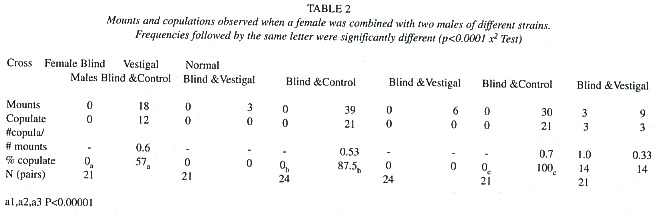
<body><![CDATA[<p>Results</p> </b> </font>     <p><font face="Arial" size="2">Males of all strains raised the tip of the abdomen with the everted rectal epithelium in the pheromonal calling position (</font><font face="Arial" size="2"><a href="#Feron62">Feron 1962</a></font><font face="Arial" size="2">) and all except blind males turned toward females when they passed nearby. Vestigial-winged males did not, however, produce the sustained wing vibration produced by the other strains, although they did lower their abdomen and direct the tip anteriorly like the others. Vestigial-winged males also moved their relatively small wings forward and backward, as did control flies during the succeeding stage of normal courtship; there was intermittent wing buzzing but no sound accompanying these movements was detected by the microphone. Blind individuals of both sexes did not show any response to other flies moving nearby and males did not "track" the female, as was common in the other strains. Blind males did perform continual wing vibration and intermittent wing buzzing, suggesting that these behaviors do not always need visual stimuli to be released. Head rocking behavior, which normally accompanies buzzing, was absent. Blind males never attempted to jump onto females</font></p>     <p><font face="Arial" size="2"><a href="#t1">(Table 1)</a>, but they did occasionally climb onto females. Blind females copulated in normal numbers with control males. </font></p>     <div style="text-align: center;"><a name="t1"></a><img  src="/img/fbpe/rbt/v51n3-4/2921i1.JPG" title="" alt=""  style="width: 588px; height: 320px;">    
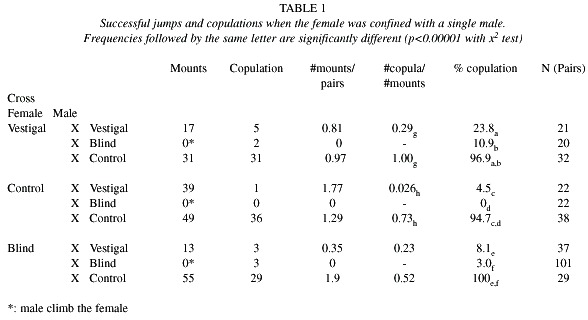
<br> </div>     <p><font face="Arial" size="2">The two series of experiments (Table <a  href="#t1">1</a>, <a href="#t2">2)</a> produced similar results, though significance levels were lower in the 2 nd series, presumably due to small sample sizes. Both control and vestigal males mounted all three types of females more often than blind males, and vestigal males mounted fewer females than normal males <a href="#t1">(Table 1)</a>. Control males were more likely to mate after mounting than vestigial males.</font></p>     <div style="text-align: center;"><a name="t2"></a><img  src="/img/fbpe/rbt/v51n3-4/2921i2.JPG" title="" alt=""  style="width: 658px; height: 215px;">    
<br> </div> <font face="Arial" size="2"><b>     <p>Discussion</p> </b> </font>     <p><font face="Arial" size="2">The visual signals emitted by females (direction of movement, distance and angle with respect to a male) appear to activate and direct male courtship behavior (Briceño <i>et al. </i>1996, Briceño and Eberhard 2000). The sharply reduced mounting and copulation rate of blind males may thus be due to lack of visual stimuli from the female. Although blind males sometimes courted, lack of proper orientation and timing, may reduce rates of female approach and acceptance. In <i>Drosophila </i>the white eye mutant and optomotor blind males (omb) court in a mediocre manner, largely the result of their poor visual acuity (Stuverant 1915, Geer and Green 1961, cited by </font><font face="Arial" size="2"><a href="#Hall94">Hall 1994</a></font><font face="Arial" size="2">). As in <i>Drosophil</i>a, male responses are probably important in medfly courtship because they promote female orientation and attraction to the nearly immobile male. The effect of lack of visual stimuli in the female is quite different. Blind females copulated at the same rates with control males as did other females. Presumably other stimuli from those males (possibly chemical, auditory, tactile and air flow) compensated for the lack of visual stimuli perceived by these female.</font></p>     ]]></body>
<body><![CDATA[<p><font face="Arial" size="2">Female preference for control males over vestigial males could have been due to any one of several differences in stimuli including visual, auditory and chemical (mutant males would be less able to waft odor toward the female).</font></p>     <p><font face="Arial" size="2">The vestigial-wing mutation is thought to also reduce or abolish development of the thoracic muscles responsible for raising the wing (<a href="#Rossler88">Rössler and Rosenthal 1988</a>), and this may be the reason why the males of this strain did not perform sustained wing vibration, and why they did not produce sound.</font></p> <font face="Arial" size="2"><b>     <p>Acknowledgements</p> </b> </font>     <p><font face="Arial" size="2">Thanks to J. Hendrichs for inviting me to work with medflies mutants, A. Robinson for allowing me access to IAEA laboratory facilities in Seibersdorf, Austria, to J. Lobo for help with statistical analysis, and William Eberhard and J. Monge for suggestions on previous drafts. The International Atomic Energy Agency and "Vicerrectoria de Investigación" of the University of Costa Rica provided financial support.</font></p> <font face="Arial" size="2"><b>     <p>Resumen </p> </b> </font>     <p><font face="Arial" size="2">Machos mutantes (ciegos, alas vestigiales) de la mosca del mediterráneo <i>Ceratitis capitata </i>(Wiedmann) mostraron diferencias en conducta comparados con los machos testigo (cría masiva). Los machos mutantes, realizaron menos intentos por aparearse y lograron menos apareamientos que los machos testigo. Las hembras con alas vestigiales, copularon menos con ambas clases de mutantes. Los machos ciegos, subieron en lugar de saltar sobre las hembras y copularon en números muy bajos comparados con los machos testigo y con los de alas vestigiales. Las hembras ciegas, copularon de forma normal con los machos testigo y en números muy bajos con ambos tipos de machos mutantes. </font></p> <font face="Arial" size="2"><b>     <p>References</p> </b> </font>     <!-- ref --><p><font face="Arial" size="2"><a name="Bennett-Clark71"></a>Bennett-Clark, H.C. 1971. Acoustics of insect song. Nature 234: 255-259.    &nbsp;&nbsp;&nbsp;&nbsp;&nbsp;&nbsp;&nbsp;&nbsp;[&#160;<a href="javascript:void(0);" onclick="javascript: window.open('/scielo.php?script=sci_nlinks&ref=1690449&pid=S0034-7744200300030001800001&lng=','','width=640,height=500,resizable=yes,scrollbars=1,menubar=yes,');">Links</a>&#160;]<!-- end-ref --></font></p>     <!-- ref --><p><font face="Arial" size="2"><a name="Briceno02"></a>Briceño, R.D. &amp; W. Eberhard. 2002 Decision during courtship by male and female medflies, <i>Ceratitis capitata </i>(Diptera: Tephritidae); correlated changes in male behavior and female acceptance criteria in mass-reared flies. Florida Entomol. 85: 14-31.    &nbsp;&nbsp;&nbsp;&nbsp;&nbsp;&nbsp;&nbsp;&nbsp;[&#160;<a href="javascript:void(0);" onclick="javascript: window.open('/scielo.php?script=sci_nlinks&ref=1690451&pid=S0034-7744200300030001800002&lng=','','width=640,height=500,resizable=yes,scrollbars=1,menubar=yes,');">Links</a>&#160;]<!-- end-ref --></font></p>     <!-- ref --><p><font face="Arial" size="2"><a name="Briceno98"></a>Briceño, R.D. &amp; W. Eberhard. 1998. Medfly courtship duration: a sexually selected reaction norm changed by crowding. Ethol. Ecol. &amp; Evolut. 10: 369-382.    &nbsp;&nbsp;&nbsp;&nbsp;&nbsp;&nbsp;&nbsp;&nbsp;[&#160;<a href="javascript:void(0);" onclick="javascript: window.open('/scielo.php?script=sci_nlinks&ref=1690453&pid=S0034-7744200300030001800003&lng=','','width=640,height=500,resizable=yes,scrollbars=1,menubar=yes,');">Links</a>&#160;]<!-- end-ref --></font></p>     <!-- ref --><p><font face="Arial" size="2"><a name="Eberhard99"></a>Eberhard, W. 1999. Sexual behavior and sexual selection in the mediterranean fruit fly <i>Ceratitis capitata </i>(Dacinae: Ceratidini). <i>In </i>M. Aluja &amp; A.L. Norrbom (eds.). Fruit Flies (Tephritidae) Phylogeny and Evolution of Behavior. CRC. pp. 457-487.    &nbsp;&nbsp;&nbsp;&nbsp;&nbsp;&nbsp;&nbsp;&nbsp;[&#160;<a href="javascript:void(0);" onclick="javascript: window.open('/scielo.php?script=sci_nlinks&ref=1690455&pid=S0034-7744200300030001800004&lng=','','width=640,height=500,resizable=yes,scrollbars=1,menubar=yes,');">Links</a>&#160;]<!-- end-ref --></font></p>     <!-- ref --><p><font face="Arial" size="2">Briceño, R.D. &amp; W. Eberhard. 2002. Courtship in the med-fly, <i>Ceratitis capitat</i>a, includes tactile stimulation with the male´s aristae. Entomol. Exp. Appl. 102: 221-228.    &nbsp;&nbsp;&nbsp;&nbsp;&nbsp;&nbsp;&nbsp;&nbsp;[&#160;<a href="javascript:void(0);" onclick="javascript: window.open('/scielo.php?script=sci_nlinks&ref=1690457&pid=S0034-7744200300030001800005&lng=','','width=640,height=500,resizable=yes,scrollbars=1,menubar=yes,');">Links</a>&#160;]<!-- end-ref --></font></p>     <!-- ref --><p><font face="Arial" size="2"><a name="Ewing89"></a>Ewing, A.W. 1989. Arthropod bioacustics: neurobiology and behavior. Cornell University. Ithaca, New York. 260 p.    &nbsp;&nbsp;&nbsp;&nbsp;&nbsp;&nbsp;&nbsp;&nbsp;[&#160;<a href="javascript:void(0);" onclick="javascript: window.open('/scielo.php?script=sci_nlinks&ref=1690459&pid=S0034-7744200300030001800006&lng=','','width=640,height=500,resizable=yes,scrollbars=1,menubar=yes,');">Links</a>&#160;]<!-- end-ref --></font></p>     <!-- ref --><p><font face="Arial" size="2"><a name="Feron62"></a>Feron, M. 1962. L´instinct de reproduction chez la mouche mediterraneenne des fruits <i>Ceratitis capitata </i>Wied (Dipt. Tephritidae). Comportemente sexuel. Comportement de ponte. Rev. Pat. Veg. Entomol. 41: 1-129.    &nbsp;&nbsp;&nbsp;&nbsp;&nbsp;&nbsp;&nbsp;&nbsp;[&#160;<a href="javascript:void(0);" onclick="javascript: window.open('/scielo.php?script=sci_nlinks&ref=1690461&pid=S0034-7744200300030001800007&lng=','','width=640,height=500,resizable=yes,scrollbars=1,menubar=yes,');">Links</a>&#160;]<!-- end-ref --></font></p>     <!-- ref --><p><font face="Arial" size="2"><a name="Hall94"></a>Hall, J.C. 1994. The mating of a fly. Science 64: 1702- 1714.    &nbsp;&nbsp;&nbsp;&nbsp;&nbsp;&nbsp;&nbsp;&nbsp;[&#160;<a href="javascript:void(0);" onclick="javascript: window.open('/scielo.php?script=sci_nlinks&ref=1690463&pid=S0034-7744200300030001800008&lng=','','width=640,height=500,resizable=yes,scrollbars=1,menubar=yes,');">Links</a>&#160;]<!-- end-ref --></font></p>     <!-- ref --><p><font face="Arial" size="2"><a name="Keiser73"></a>Keiser, I., R. Kobayashi, D. Chambers &amp; E. Schneider. 1973. Relation of sexual dimorphism in the wings, potential stridulation and illumination to mating of oriental fruit fly, melon flies, and Mediterranean fruit fly in Hawaii. Ann. Entomol. Soc. Am. 66: 937-941.    &nbsp;&nbsp;&nbsp;&nbsp;&nbsp;&nbsp;&nbsp;&nbsp;[&#160;<a href="javascript:void(0);" onclick="javascript: window.open('/scielo.php?script=sci_nlinks&ref=1690465&pid=S0034-7744200300030001800009&lng=','','width=640,height=500,resizable=yes,scrollbars=1,menubar=yes,');">Links</a>&#160;]<!-- end-ref --></font></p>     <!-- ref --><p><font face="Arial" size="2"><a name="Mendez98"></a>Mendez, V., R.D. Briceño &amp; W. Eberhard. 1998. Functional significance of the capitate supra-fronto-orbital bristles of male medflies <i>(Ceratitis capitat</i>a)( Diptera, Tephritidae). J. Kansas Entomol. Soc. 71(2): 164-174.    &nbsp;&nbsp;&nbsp;&nbsp;&nbsp;&nbsp;&nbsp;&nbsp;[&#160;<a href="javascript:void(0);" onclick="javascript: window.open('/scielo.php?script=sci_nlinks&ref=1690467&pid=S0034-7744200300030001800010&lng=','','width=640,height=500,resizable=yes,scrollbars=1,menubar=yes,');">Links</a>&#160;]<!-- end-ref --></font></p>     <!-- ref --><p><font face="Arial" size="2"><a name="Miranda00"></a>Miranda, X. 2000. Sexual dimorphism in the arista of <i>Ceratitis capitata </i>(Diptera, Tephritidae) and its possible importance in courtship. NY Entomol. Soc. 108: 339-348.    &nbsp;&nbsp;&nbsp;&nbsp;&nbsp;&nbsp;&nbsp;&nbsp;[&#160;<a href="javascript:void(0);" onclick="javascript: window.open('/scielo.php?script=sci_nlinks&ref=1690469&pid=S0034-7744200300030001800011&lng=','','width=640,height=500,resizable=yes,scrollbars=1,menubar=yes,');">Links</a>&#160;]<!-- end-ref --></font></p>     <!-- ref --><p><font face="Arial" size="2"><a name="Nakagawa73"></a>Nakagawa, S., G.J. Farias, D. Suda &amp; D.L. Chambers. 1973. Mating Behavior of the mediterranean fruit fly following excision of the antennae. J. Economic Entomol. 66: 583-584.    &nbsp;&nbsp;&nbsp;&nbsp;&nbsp;&nbsp;&nbsp;&nbsp;[&#160;<a href="javascript:void(0);" onclick="javascript: window.open('/scielo.php?script=sci_nlinks&ref=1690471&pid=S0034-7744200300030001800012&lng=','','width=640,height=500,resizable=yes,scrollbars=1,menubar=yes,');">Links</a>&#160;]<!-- end-ref --></font></p>     <!-- ref --><p><font face="Arial" size="2"><a name="Rossler88"></a>Rössler, Y. &amp; H. Rosenthal. 1988. Genetics of the Mediterranean fruit fly (Diptera: Tephritidae): Eye color, eye shape and wing mutations. Ann. Entomol. Soc. Amer 81: 350-355.    &nbsp;&nbsp;&nbsp;&nbsp;&nbsp;&nbsp;&nbsp;&nbsp;[&#160;<a href="javascript:void(0);" onclick="javascript: window.open('/scielo.php?script=sci_nlinks&ref=1690473&pid=S0034-7744200300030001800013&lng=','','width=640,height=500,resizable=yes,scrollbars=1,menubar=yes,');">Links</a>&#160;]<!-- end-ref --></font></p>     <!-- ref --><p><font face="Arial" size="2"><a name="Rossler92"></a>Rössler, Y. &amp; H. Rosenthal. 1992. Genetics of the Mediterranean fruit fly, (Diptera: Tephritidae): morphological mutants on chromosome five. Ann. Entomol. Soc. Amer. 85: 525-531.    &nbsp;&nbsp;&nbsp;&nbsp;&nbsp;&nbsp;&nbsp;&nbsp;[&#160;<a href="javascript:void(0);" onclick="javascript: window.open('/scielo.php?script=sci_nlinks&ref=1690475&pid=S0034-7744200300030001800014&lng=','','width=640,height=500,resizable=yes,scrollbars=1,menubar=yes,');">Links</a>&#160;]<!-- end-ref --></font></p>     <!-- ref --><p><font face="Arial" size="2"><a name="Rossler80"></a>Rössler, Y. 1980. Sexual competitiveness of males of the Mediterranean fruit fly, <i>Ceratits capitata </i>(W.)(Diptera: Tephritidae), carrying a Y-chromosome translocacion. Bull. Entomol. Res. 70: 649-656.    &nbsp;&nbsp;&nbsp;&nbsp;&nbsp;&nbsp;&nbsp;&nbsp;[&#160;<a href="javascript:void(0);" onclick="javascript: window.open('/scielo.php?script=sci_nlinks&ref=1690477&pid=S0034-7744200300030001800015&lng=','','width=640,height=500,resizable=yes,scrollbars=1,menubar=yes,');">Links</a>&#160;]<!-- end-ref --></font></p>     <!-- ref --><p><font face="Arial" size="2"><a name="Wigglesworth65"></a>Wigglesworth, V.B. 1965. Principles of Insect Physiology. Methven, London. 741 p.    &nbsp;&nbsp;&nbsp;&nbsp;&nbsp;&nbsp;&nbsp;&nbsp;[&#160;<a href="javascript:void(0);" onclick="javascript: window.open('/scielo.php?script=sci_nlinks&ref=1690479&pid=S0034-7744200300030001800016&lng=','','width=640,height=500,resizable=yes,scrollbars=1,menubar=yes,');">Links</a>&#160;]<!-- end-ref --></font></p>      ]]></body><back>
<ref-list>
<ref id="B1">
<nlm-citation citation-type="journal">
<person-group person-group-type="author">
<name>
<surname><![CDATA[Bennett-Clark]]></surname>
<given-names><![CDATA[H.C]]></given-names>
</name>
</person-group>
<article-title xml:lang="en"><![CDATA[Acoustics of insect song]]></article-title>
<source><![CDATA[Nature]]></source>
<year>1971</year>
<volume>234</volume>
<page-range>255-259</page-range></nlm-citation>
</ref>
<ref id="B2">
<nlm-citation citation-type="journal">
<person-group person-group-type="author">
<name>
<surname><![CDATA[Briceño]]></surname>
<given-names><![CDATA[R.D]]></given-names>
</name>
<name>
<surname><![CDATA[Eberhard]]></surname>
<given-names><![CDATA[W]]></given-names>
</name>
</person-group>
<article-title xml:lang="en"><![CDATA[Decision during courtship by male and female medflies, Ceratitis capitata (Diptera: Tephritidae); correlated changes in male behavior and female acceptance criteria in mass-reared flies]]></article-title>
<source><![CDATA[Florida Entomol]]></source>
<year>2002</year>
<volume>85</volume>
<page-range>14-31</page-range></nlm-citation>
</ref>
<ref id="B3">
<nlm-citation citation-type="journal">
<person-group person-group-type="author">
<name>
<surname><![CDATA[Briceño]]></surname>
<given-names><![CDATA[R.D]]></given-names>
</name>
<name>
<surname><![CDATA[Eberhard]]></surname>
<given-names><![CDATA[W]]></given-names>
</name>
</person-group>
<article-title xml:lang="en"><![CDATA[Medfly courtship duration: a sexually selected reaction norm changed by crowding]]></article-title>
<source><![CDATA[Ethol. Ecol. & Evolut]]></source>
<year>1998</year>
<volume>10</volume>
<page-range>369-382</page-range></nlm-citation>
</ref>
<ref id="B4">
<nlm-citation citation-type="book">
<person-group person-group-type="author">
<name>
<surname><![CDATA[Eberhard]]></surname>
<given-names><![CDATA[W]]></given-names>
</name>
<name>
<surname><![CDATA[Aluja]]></surname>
<given-names><![CDATA[M]]></given-names>
</name>
<name>
<surname><![CDATA[Norrbom]]></surname>
<given-names><![CDATA[A.L]]></given-names>
</name>
</person-group>
<source><![CDATA[Sexual behavior and sexual selection in the mediterranean fruit fly Ceratitis capitata (Dacinae: Ceratidini)]]></source>
<year>1999</year>
<page-range>457-487</page-range><publisher-name><![CDATA[CRC]]></publisher-name>
</nlm-citation>
</ref>
<ref id="B5">
<nlm-citation citation-type="journal">
<person-group person-group-type="author">
<name>
<surname><![CDATA[Briceño]]></surname>
<given-names><![CDATA[R.D]]></given-names>
</name>
<name>
<surname><![CDATA[Eberhard]]></surname>
<given-names><![CDATA[W]]></given-names>
</name>
</person-group>
<article-title xml:lang="en"><![CDATA[Courtship in the med-fly, Ceratitis capitata, includes tactile stimulation with the male´s aristae]]></article-title>
<source><![CDATA[Entomol. Exp. Appl]]></source>
<year>2002</year>
<volume>102</volume>
<page-range>221-228</page-range></nlm-citation>
</ref>
<ref id="B6">
<nlm-citation citation-type="book">
<person-group person-group-type="author">
<name>
<surname><![CDATA[Ewing]]></surname>
<given-names><![CDATA[A.W]]></given-names>
</name>
</person-group>
<source><![CDATA[Arthropod bioacustics: neurobiology and behavior]]></source>
<year>1989</year>
<page-range>260</page-range><publisher-loc><![CDATA[Ithaca^eNew York New York]]></publisher-loc>
<publisher-name><![CDATA[Cornell University]]></publisher-name>
</nlm-citation>
</ref>
<ref id="B7">
<nlm-citation citation-type="journal">
<person-group person-group-type="author">
<name>
<surname><![CDATA[Feron]]></surname>
<given-names><![CDATA[M]]></given-names>
</name>
</person-group>
<article-title xml:lang="fr"><![CDATA[L´instinct de reproduction chez la mouche mediterraneenne des fruits Ceratitis capitata Wied (Dipt. Tephritidae): Comportemente sexuel. Comportement de ponte]]></article-title>
<source><![CDATA[Rev. Pat. Veg. Entomol]]></source>
<year>1962</year>
<volume>41</volume>
<page-range>1-129</page-range></nlm-citation>
</ref>
<ref id="B8">
<nlm-citation citation-type="journal">
<person-group person-group-type="author">
<name>
<surname><![CDATA[Hall]]></surname>
<given-names><![CDATA[J.C]]></given-names>
</name>
</person-group>
<article-title xml:lang="en"><![CDATA[The mating of a fly]]></article-title>
<source><![CDATA[Science]]></source>
<year>1994</year>
<volume>64</volume>
<page-range>1702- 1714</page-range></nlm-citation>
</ref>
<ref id="B9">
<nlm-citation citation-type="journal">
<person-group person-group-type="author">
<name>
<surname><![CDATA[Keiser]]></surname>
<given-names><![CDATA[I]]></given-names>
</name>
<name>
<surname><![CDATA[Kobayashi]]></surname>
<given-names><![CDATA[R]]></given-names>
</name>
<name>
<surname><![CDATA[Chambers]]></surname>
<given-names><![CDATA[D]]></given-names>
</name>
<name>
<surname><![CDATA[Schneider]]></surname>
<given-names><![CDATA[E]]></given-names>
</name>
</person-group>
<article-title xml:lang="en"><![CDATA[Relation of sexual dimorphism in the wings, potential stridulation and illumination to mating of oriental fruit fly, melon flies, and Mediterranean fruit fly in Hawaii]]></article-title>
<source><![CDATA[Ann. Entomol. Soc. Am]]></source>
<year>1973</year>
<volume>66</volume>
<page-range>937-941</page-range></nlm-citation>
</ref>
<ref id="B10">
<nlm-citation citation-type="journal">
<person-group person-group-type="author">
<name>
<surname><![CDATA[Mendez]]></surname>
<given-names><![CDATA[V]]></given-names>
</name>
<name>
<surname><![CDATA[Briceño]]></surname>
<given-names><![CDATA[R.D]]></given-names>
</name>
<name>
<surname><![CDATA[Eberhard]]></surname>
<given-names><![CDATA[W]]></given-names>
</name>
</person-group>
<article-title xml:lang="en"><![CDATA[Functional significance of the capitate supra-fronto-orbital bristles of male medflies (Ceratitis capitata)( Diptera, Tephritidae)]]></article-title>
<source><![CDATA[J. Kansas Entomol. Soc]]></source>
<year>1998</year>
<volume>71</volume>
<numero>2</numero>
<issue>2</issue>
<page-range>164-174</page-range></nlm-citation>
</ref>
<ref id="B11">
<nlm-citation citation-type="journal">
<person-group person-group-type="author">
<name>
<surname><![CDATA[Miranda]]></surname>
<given-names><![CDATA[X]]></given-names>
</name>
</person-group>
<article-title xml:lang="en"><![CDATA[Sexual dimorphism in the arista of Ceratitis capitata (Diptera, Tephritidae) and its possible importance in courtship]]></article-title>
<source><![CDATA[NY Entomol. Soc]]></source>
<year>2000</year>
<volume>108</volume>
<page-range>339-348</page-range></nlm-citation>
</ref>
<ref id="B12">
<nlm-citation citation-type="journal">
<person-group person-group-type="author">
<name>
<surname><![CDATA[Nakagawa]]></surname>
<given-names><![CDATA[S]]></given-names>
</name>
<name>
<surname><![CDATA[Farias]]></surname>
<given-names><![CDATA[G.J]]></given-names>
</name>
<name>
<surname><![CDATA[Suda]]></surname>
<given-names><![CDATA[D]]></given-names>
</name>
<name>
<surname><![CDATA[Chambers]]></surname>
<given-names><![CDATA[D.L]]></given-names>
</name>
</person-group>
<article-title xml:lang="en"><![CDATA[Mating Behavior of the mediterranean fruit fly following excision of the antennae]]></article-title>
<source><![CDATA[J. Economic Entomol]]></source>
<year>1973</year>
<volume>66</volume>
<page-range>583-584</page-range></nlm-citation>
</ref>
<ref id="B13">
<nlm-citation citation-type="journal">
<person-group person-group-type="author">
<name>
<surname><![CDATA[Rössler]]></surname>
<given-names><![CDATA[Y]]></given-names>
</name>
<name>
<surname><![CDATA[Rosenthal]]></surname>
<given-names><![CDATA[H]]></given-names>
</name>
</person-group>
<article-title xml:lang="en"><![CDATA[Genetics of the Mediterranean fruit fly (Diptera: Tephritidae): Eye color, eye shape and wing mutations]]></article-title>
<source><![CDATA[Ann. Entomol. Soc. Amer]]></source>
<year>1988</year>
<volume>81</volume>
<page-range>350-355</page-range></nlm-citation>
</ref>
<ref id="B14">
<nlm-citation citation-type="journal">
<person-group person-group-type="author">
<name>
<surname><![CDATA[Rössler]]></surname>
<given-names><![CDATA[Y]]></given-names>
</name>
<name>
<surname><![CDATA[Rosenthal]]></surname>
<given-names><![CDATA[H]]></given-names>
</name>
</person-group>
<article-title xml:lang="en"><![CDATA[Genetics of the Mediterranean fruit fly, (Diptera: Tephritidae): morphological mutants on chromosome five]]></article-title>
<source><![CDATA[Ann. Entomol. Soc. Amer]]></source>
<year>1992</year>
<volume>85</volume>
<page-range>525-531</page-range></nlm-citation>
</ref>
<ref id="B15">
<nlm-citation citation-type="journal">
<person-group person-group-type="author">
<name>
<surname><![CDATA[Rössler]]></surname>
<given-names><![CDATA[Y]]></given-names>
</name>
</person-group>
<article-title xml:lang="en"><![CDATA[Sexual competitiveness of males of the Mediterranean fruit fly, Ceratits capitata (W.)(Diptera: Tephritidae), carrying a Y-chromosome translocacion]]></article-title>
<source><![CDATA[Bull. Entomol. Res]]></source>
<year>1980</year>
<volume>70</volume>
<page-range>649-656</page-range></nlm-citation>
</ref>
<ref id="B16">
<nlm-citation citation-type="book">
<person-group person-group-type="author">
<name>
<surname><![CDATA[Wigglesworth]]></surname>
<given-names><![CDATA[V.B]]></given-names>
</name>
</person-group>
<source><![CDATA[Principles of Insect Physiology]]></source>
<year>1965</year>
<page-range>741</page-range><publisher-loc><![CDATA[London ]]></publisher-loc>
<publisher-name><![CDATA[Methven]]></publisher-name>
</nlm-citation>
</ref>
</ref-list>
</back>
</article>