<?xml version="1.0" encoding="ISO-8859-1"?><article xmlns:mml="http://www.w3.org/1998/Math/MathML" xmlns:xlink="http://www.w3.org/1999/xlink" xmlns:xsi="http://www.w3.org/2001/XMLSchema-instance">
<front>
<journal-meta>
<journal-id>0034-7744</journal-id>
<journal-title><![CDATA[Revista de Biología Tropical]]></journal-title>
<abbrev-journal-title><![CDATA[Rev. biol. trop]]></abbrev-journal-title>
<issn>0034-7744</issn>
<publisher>
<publisher-name><![CDATA[Universidad de Costa Rica]]></publisher-name>
</publisher>
</journal-meta>
<article-meta>
<article-id>S0034-77442003000300003</article-id>
<title-group>
<article-title xml:lang="en"><![CDATA[Polythene and Plastics-degrading microbes from the mangrove soil]]></article-title>
</title-group>
<contrib-group>
<contrib contrib-type="author">
<name>
<surname><![CDATA[Kathiresan]]></surname>
<given-names><![CDATA[K]]></given-names>
</name>
<xref ref-type="aff" rid="A01"/>
</contrib>
</contrib-group>
<aff id="A01">
<institution><![CDATA[,Annamalai University Centre of Advanced Study in Marine Biology ]]></institution>
<addr-line><![CDATA[ ]]></addr-line>
<country>India</country>
</aff>
<pub-date pub-type="pub">
<day>00</day>
<month>09</month>
<year>2003</year>
</pub-date>
<pub-date pub-type="epub">
<day>00</day>
<month>09</month>
<year>2003</year>
</pub-date>
<volume>51</volume>
<numero>3-4</numero>
<fpage>629</fpage>
<lpage>633</lpage>
<copyright-statement/>
<copyright-year/>
<self-uri xlink:href="http://www.scielo.sa.cr/scielo.php?script=sci_arttext&amp;pid=S0034-77442003000300003&amp;lng=en&amp;nrm=iso"></self-uri><self-uri xlink:href="http://www.scielo.sa.cr/scielo.php?script=sci_abstract&amp;pid=S0034-77442003000300003&amp;lng=en&amp;nrm=iso"></self-uri><self-uri xlink:href="http://www.scielo.sa.cr/scielo.php?script=sci_pdf&amp;pid=S0034-77442003000300003&amp;lng=en&amp;nrm=iso"></self-uri><abstract abstract-type="short" xml:lang="en"><p><![CDATA[Biodegradation of polythene bags and plastic cups was analyzed after 2, 4, 6, and 9 months of incubation in the mangrove soil. The biodegradation of polythene bags was significantly higher (up to 4.21% in 9 months) than that of plastic cups (up to 0.25% in 9 months). Microbial counts in the degrading materials were recorded up to 79.67 x 10 4 per gram for total heterotrophic bacteria, and up to 55.33 x 10 2 per gram for fungi. The microbial species found associated with the degrading materials were identified as five Gram positive and two Gram negative bacteria, and eight fungal species of Aspergillus. The species that were predominant were Streptococcus, Staphylococcus, Micrococcus (Gram +ve), Moraxella, and Pseudomonas (Gram -ve) and two species of fungi (Aspergillus glaucus and A. niger). Efficacy of the microbial species in degradation of plastics and polythene was analyzed in shaker cultures. Among the bacteria, Pseudomonas species degraded 20.54% of polythene and 8.16% of plastics in one-month period. Among the fungal species, Aspergillus glaucus degraded 28.80% of polythene and 7.26% of plastics in one-month period. This work reveals that the mangrove soil is a good source of microbes capable of degrading polythene and plastics]]></p></abstract>
<abstract abstract-type="short" xml:lang="es"><p><![CDATA[La biodegradación de las bolsas de polietileno y vasos de plástico fue analizada después de 2, 4, 6 y 9 meses de incubación en suelo de manglar. La biodegradación de las bolsas fue significativamente más alta (hasta 4.21% en 9 meses) que los vasos plásticos (hasta 0.25% en 9 meses). Los conteos microbianos en los materiales degradados mostraron hasta 79.67 x 10(4) por gramo para las bacterias heterotroficas totales, y hasta 55.33 x 10² por gramo para los hongos. Se identificó 5 especies microbianas Gram positivas, 2 Gram negativas, y 8 especies de hongos del género Aspergillus en asociación con materiales degradados. Las especies predominantes fueron Streptococcus, Staphylococcus, Micrococcus (Gram +), Moraxella, and Pseudomonas (Gram -) y dos especies de hongos (Aspergillus glacus and A. niger). La eficiencia de las especies microbianas en la degradación fue analizada en cultivos bajo agitación. Entre las bacterias, las Pseudomonas degradaron 20.54% de polietileno y 8.16% de plásticos en un período de un mes. Entre los hongos, Aspergillus glaucus degradó 28.80% de polietileno y 7.26% de plásticos por mes. Este trabajo revela que el suelo manglar es una buena fuete de microbios capaces de degradar polietileno y plásticos]]></p></abstract>
<kwd-group>
<kwd lng="en"><![CDATA[Rhizophora]]></kwd>
<kwd lng="en"><![CDATA[Avicennia]]></kwd>
<kwd lng="en"><![CDATA[plastics]]></kwd>
<kwd lng="en"><![CDATA[polythene]]></kwd>
<kwd lng="en"><![CDATA[degradation]]></kwd>
</kwd-group>
</article-meta>
</front><body><![CDATA[ <div style="text-align: center;"><span  style="font-weight: bold; font-family: arial;">Polythene and Plastics-degrading microbes from the mangrove soil</span>    <br> </div> <font face="Arial" size="2"></font>     <p><font face="Arial" size="2">K. Kathiresan</font></p>     <p><font face="Arial" size="2">Centre of Advanced Study in Marine Biology, Annamalai University, Parangipettai 608 502, India. Phone: +91 4144 243533 Ext. 210 (Office) +914144 238419 (Home). Fax: +91 4144 238419 / 243555; <a href="mailto:cdl_aucasmb@sancharnet.in">cdl_aucasmb@sancharnet.in</a>; <a href="mailto:cdl_mangrove@sancharnet.in">cdl_mangrove@sancharnet.in</a></font></p>     <p style="text-align: center;"><font face="Arial" size="2">Received 13-V-2002.&nbsp;&nbsp;&nbsp;&nbsp;&nbsp;&nbsp;&nbsp; Corrected 27-VI-2003. &nbsp; &nbsp; &nbsp;&nbsp; Accepted 30-VI-2003.</font></p> <font face="Arial" size="2"><b>     <p>Abstract</p> </b></font>     <p><font face="Arial" size="2">Biodegradation of polythene bags and plastic cups was analyzed after 2, 4, 6, and 9 months of incubation in the mangrove soil. The biodegradation of polythene bags was significantly higher (up to 4.21% in 9 months) than that of plastic cups (up to 0.25% in 9 months). Microbial counts in the degrading materials were recorded up to 79.67 x 10 4 per gram for total heterotrophic bacteria, and up to 55.33 x 10 2 per gram for fungi. The microbial species found associated with the degrading materials were identified as five Gram positive and two Gram negative bacteria, and eight fungal species of <i>Aspergillu</i>s. The species that were predominant were</font></p> <font face="Arial" size="2"><i></i></font>     <p><font face="Arial" size="2"><i>Streptococcu</i>s, <i>Staphylococcu</i>s, <i>Micrococcus </i>(Gram +ve), <i>Moraxella, </i>and <i>Pseudomonas </i>(Gram –ve) and two species of fungi <i>(Aspergillus glaucus </i>and <i>A. nige</i>r). Efficacy of the microbial species in degradation of plastics and polythene was analyzed in shaker cultures. Among the bacteria, <i>Pseudomonas </i>species degraded 20.54% of polythene and 8.16% of plastics in one-month period. Among the fungal species, <i>Aspergillus glaucus </i>degraded 28.80% of polythene and 7.26% of plastics in one-month period. This work reveals that the mangrove soil is a good source of microbes capable of degrading polythene and plastics.</font></p> <font face="Arial" size="2"><b></b></font>     <p><font face="Arial" size="2"><b>Key words: </b><i>Rhizophora, Avicenni</i>a, plastics, polythene, degradation.</font></p>     <p><font face="Arial" size="2">During the past 3-decades, plastic materials have been increasingly used in food clothing, shelter, transportation, construction, medical, and recreation industries. Plastics are advantageous as they are strong, light-weighted, and durable. However, they are disadvantageous as they are resistant to biodegradation, leading to pollution, harmful to the natural environment. The successful production and marketing of biodegradable plastics will help alleviate the problem of environmental pollution. In the past 10 years, several biodegradable plastics have been introduced into the market. However, none of them is efficiently biodegradable in landfills. For this reason, none of the products has gained widespread use (<a href="#Anonymous99">Anonymous 1999</a>). Hence, there is an urgent need to develop efficient microorganisms and their products to solve this global issue. </font></p>     ]]></body>
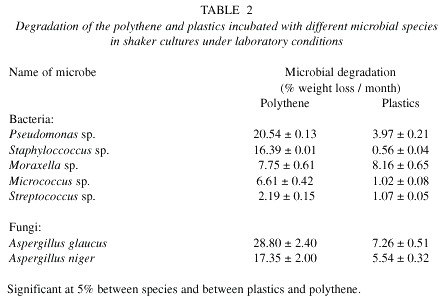
<body><![CDATA[<p><font face="Arial" size="2">The polythene is the most commonly found non-degradable solid waste that has been recently recognized as a major threat to marine life. The polythene could sometimes cause blockage in intestine of fish, birds and marine mammals (<a href="#Spear95">Spear <i>et a</i>l. 1995</a>, <a href="#Secchi99">Secchi and Zarzur 1999</a>). Degradation of polythene is a great challenge as the materials are increasingly used. A very general estimate of world wide plastic waste generation is annually about 57 million tons (<a href="#Bollag00">Bollag <i>et a</i>l. 2000</a>). This solid waste related problems pose threat to megacities especially coastal ones. The coastal mangroves have historically been favoured dumping sites for the solid waste disposal (<a  href="#Kathiresan01">Kathiresan and Bingham 2001</a>). An attempt in this paper has been made to isolate potent microorganisms that degrade the plastic materials from the mangrove sediment.</font></p> <font face="Arial" size="2"><b></b></font>     <p><font face="Arial" size="2"><b>Biodegradation under field conditions: </b>Plastic cups and polythene bags were buried at a depth of 5 cm in the mangrove soil under two zones, colonized by <i>Rhizophora </i>sp. and or <i>Avicennia </i>sp., along the Vellar estuary (11°29’ N; 79°46’ E; southeast coast of India). The materials were allowed to degrade naturally in the mangrove soil, and they were sampled at the intervals of 2, 4, 6 and 9 months using sterile forceps and transferred to laboratory aseptically. One set of samples was thoroughly washed using distilled water, shade-dried and then weighed for final weight. The degradation was determined in terms of per cent of weight loss of the materials over a period. Another set of sampled materials was washed gently using sterile water to remove soil debris. About one gram of the materials infested with bacteria and fungi was transferred into the conical flask having 99 ml of sterile water. This content, which was shaken vigorously for its equal distribution, was serially diluted. The pour plate method was adopted using the Zobell’s agar medium for bacteria and the Martin Rose Bengal medium for fungi. For each dilution, three replicates were made. The plates were then incubated at 30°C for 2-7 days. The bacterial and fungal counts were then made. </font></p> <font face="Arial" size="2"><b></b></font>     <p><font face="Arial" size="2"><b>Identification of microorganisms: </b>Among the bacterial and fungal colonies, the dominant ones were isolated and sub-cultured repeatedly for getting pure colonies and then preserved in slant tubes for further identification. The bacterial strains were identified based on the keys detailed by <a href="#Oliver82">Oliver (1982)</a>. The tests conducted were motility test, glucose oxidation, penicillin sensitivity, and glucose fermentation for gram-negative bacteria; and, shape, dextrose fermentation, catalase and glucose utilization for gram-positive bacteria. The fungal strains were identified after staining them with cotton blue, by following the keys of <a href="#Raper87">Raper and Fennell (1987)</a>. </font></p> <font face="Arial" size="2"><b></b></font>     <p><font face="Arial" size="2"><b>Microbial degradation of plastics under laboratory conditions: </b>To assess this, the pre-weighed discs of 1-cm diameter prepared from polythene bags and disposable plastic cups were aseptically transferred to the conical flask containing 50 ml of culture broth medium, inoculated with different bacterial and fungal species separately. Nutrient broth medium was used for bacteria and Rose Bengal broth medium for fungi. Control was maintained with plastic discs in the microbe-free medium. Four flasks were maintained for each treatment and left in a shaker. After one month of shaking, the plastic discs were collected, washed thoroughly using distilled water, shade-dried and then weighed for final weight. From the data collected, weight loss of the plastics and polythene bags, was calculated.</font></p> <font face="Arial" size="2"><b><i></i></b></font>     <p><font face="Arial" size="2"><b><i>In situ </i>degradation of plastics in the mangrove soil: </b>An experiment was designed for degrading the polythene bags and plastic cups, under the soil conditions of two mangrove species. The results are shown in <a  href="#t1">Table 1</a>. Irrespective of mangrove zone, the polythene bags were found degraded after 6 and 9 months, but not after 2 and 4 months of incubation in the soil. The plastic cups were found degraded only after 9 months, but not after 2,4 and 6 months of analysis. The biodegradation of polythene was maximum of 3.77% and 4.21% respectively under <i>Rhizophora </i>and <i>Avicennia </i>zones, after 9 months of analysis, and the corresponding values for the biodegradation of plastics were only 0.25% and 0.17% (<a href="#t1">Table 1</a>).</font></p>     <div style="text-align: center;"><a name="t1"></a><img  src="/img/fbpe/rbt/v51n3-4/2906i1.JPG" title="" alt=""  style="width: 552px; height: 222px;">    
<br> </div>     <p><font face="Arial" size="2"><b>Microbial counts in degrading plastics: </b>The microbial counts on the polythene bags and plastic cups that degraded for different months under two mangrove zones were recorded.<b> </b>However, there was no statistically significant variation of bacterial counts between the two mangrove zones <i>(Rhizophora </i>and <i>Avicenni</i>a) and or between the months of degradation (Data not shown in table). </font></p>     <p><font face="Arial" size="2">The counts of total heterotrophic bacteria (THB) ranged from 24.50 x 10<sup>4</sup> (2-month) to 64.83 x 10<sup>4</sup> (6-month) in the polythene degraded under <i>Avicennia </i>soil, and from 41.33 x 10<sup>4</sup> to 64.83 x 10<sup>4</sup> under <i>Rhizophora </i>soil. The THB counts ranged from 67.33 x 10<sup>4</sup> (2-month) to 79.67 x 10<sup>4</sup> (6-month) in the plastic degraded under <i>Rhizophora </i>soil, and from 43.17 x 10<sup>4</sup> to 52.83 x 10<sup>4</sup> under <i>Avicennia </i>soil. The fungal counts ranged from 13.50 x 10<sup>2</sup> (2-month) to 55.33 x 10<sup>2</sup> (6-month) in the polythene degraded under <i>Rhizophora </i>soil, and from 44.73 x 10<sup>2</sup> to 62.67 x 10<sup>2</sup> under <i>Avicennia </i>soil. The fungal counts varied from 35.17 x 10<sup>2</sup> (2 month) to 50 x 10<sup>2</sup> (6-month) for the plastics degraded under <i>Avicennia </i>soil, and from 24.17 x 10<sup>2</sup> to 47.33 x 10<sup>2</sup> under <i>Rhizophora </i>soil.</font></p> <font face="Arial" size="2"><b></b></font>     <p><font face="Arial" size="2"><b>Microbes identified: </b>The microbial species identified from degrading polythene bags were <i>Bacillus </i>sp., <i>Staphylococcus </i>sp., <i>Streptococcus </i>sp., <i>Diplococcus </i>sp., and <i>Micrococcus </i>sp. (belong to Gram- positive bacteria); <i>Moraxella </i>sp. and <i>Pseudomonas </i>sp. (belong to Gram-negative bacteria); and, <i>Aspergillus niger, A. ornatus, A. cremeus, A. flavus, A. candidus, A. ochraceus, A. nidulans, </i>and <i>A. glaucus </i>(belonging to fungi). Thus seven bacterial species and eight fungal species were obtained. These microbial species were also recorded from degrading plastic bags, except <i>Bacillus </i>sp<i>., Diplococcus </i>sp., <i>Aspergillus ornatu</i>s, <i>A. cremeus, A. flavus, A. candidus, A. ochraceus, A. nidulans. </i>There were five bacterial and two fungal species, commonly and predominantly found detected in both polythene and plastics, and these were selected for further study.</font></p> <font face="Arial" size="2"><b></b></font>     ]]></body>
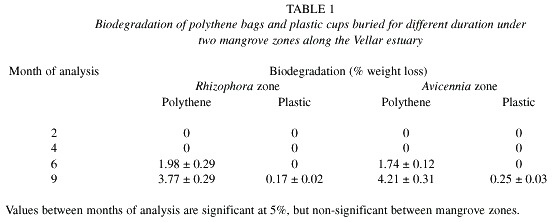
<body><![CDATA[<p><font face="Arial" size="2"><b>Microbial degradation of plastics and polythene bags in laboratory: </b>Seven microbial species were tested in the laboratory for their ability of degrading the polythene and plastics. The species tested were <i>Moraxella </i>species, <i>Pseudomonas, Staphyloccoccus, Micrococcus </i>and <i>Streptococcus </i>species and two fungal species - <i>Aspergillus niger </i>and <i>A. glaucu</i>s. These microbes were separately allowed to degrade the polythene and plastics under shaker cultures for a month. The results are shown in <a  href="#t2">Table 2</a>. </font></p>     <div style="text-align: center;"><a name="t2"></a><img  src="/img/fbpe/rbt/v51n3-4/2906i2.JPG" title="" alt=""  style="width: 445px; height: 301px;">    
<br> </div>     <p><font face="Arial" size="2">The bacteria caused the biodegradation ranging from 2.19 to 20.54% for polythene and from 0.56 to 8.16% for plastics. Among the bacteria, <i>Pseudomonas </i>and <i>Moraxella </i>sp. were found most active in degrading 20.54% of polythene, and 8.16 % of plastics in one-month period (<a href="#t2">Table 2</a>).</font></p>     <p><font face="Arial" size="2">Among the species, <i>Aspergillus glaucus </i>was more active than <i>A. niger </i>in degrading 28.8% of polythene and 7.26% of plastics within a month (<a href="#t2">Table 2</a>). </font></p>     <p><font face="Arial" size="2">To our knowledge, there is no report on polythene and plastic degradation in the mangrove environment, which serves as a dumping site of those materials. The biodegradation of the polythene is relatively faster and earlier than that of the plastics. The biodegradation is up to 1.98% after 6 months of analysis for polythene and is up to 0.25% only after 9 months for plastics (<a  href="#t1">Table 1</a>). This may be attributed to the thickness of the polythene that is 5-times thinner than the plastics.</font></p>     <p><font face="Arial" size="2">The plastic materials have been degraded in the mangrove soil irrespective of the mangrove zones. This reveals that the mangrove soil can be a source of factors responsible for the degradation of plastic materials. The factors may include microbes besides moisture, heat <i>etc. </i>(</font><font face="Arial" size="2"><a  href="#Anonymous99">Anonymous 1999</a></font><font face="Arial"  size="2">). The mangrove soil maintains moisture by tidal water flood during high tide and the soil gets heated during low tide when exposed to sunlight as well due to exothermic reactions of biological compounds in the soil (</font><font face="Arial" size="2"><a href="#Kathiresan01">Kathiresan and Bingham 2001</a></font><font face="Arial" size="2">). Besides these abiotic conditions, microbial counts are also high, perhaps favouring the degradation of plastics. For example, the plastic materials in mangrove soil have shown rich total heterotrophic bacterial counts of up to 79.67 x 10<sup>4</sup> and fungal counts of up to 55.33 x 10<sup>2</sup> , and the plastic materials have been colonized commonly by five species of bacteria and two species of fungi.</font></p>     <p><font face="Arial" size="2">It has experimentally been proved that these microbes cause degradation of plastic materials up to 28.8% within a month. Among these microbes, the strains of <i>Aspergillus glaucu</i>s, <i>A. nige</i>r, <i>Pseudomonas </i>sp. and <i>Moraxella </i>sp. are efficient in biodegradation (<a href="#t2">Table 2</a>). The mechanism of degradation is not known. The surface of plastic materials has turned from smooth to rough with cracking. This may be due to the compounds secreted extracellularly by the microbes that may break the complex molecular structure of plastics. Hence, further study on microbial enzymes or organic acids in degradation of the polythene and plastics will pave way for finding technology for degrading the plastic materials, which are otherwise hazardous to environment. </font></p> <font face="Arial" size="2"><b>     <p>Acknowledgements</p> </b> </font>     <p><font face="Arial" size="2">The author is thankful to the Director and authorities of Annamalai University for providing facilities and Dr. N. Rajendran for his help.</font></p> <font face="Arial" size="2"><b>     ]]></body>
<body><![CDATA[<p>Resumen</p> </b> </font>     <p><font face="Arial" size="2">La biodegradación de las bolsas de polietileno y vasos de plástico fue analizada después de 2, 4, 6 y 9 meses de incubación en suelo de manglar. La biodegradación de las bolsas fue significativamente más alta (hasta 4.21% en 9 meses) que los vasos plásticos (hasta 0.25% en 9 meses). Los conteos microbianos en los materiales degradados mostraron hasta 79.67 x 10<sup>4</sup> por gramo para las bacterias heterotroficas totales, y hasta 55.33 x 10<sup>2</sup> por gramo para los hongos. Se identificó 5 especies microbianas Gram positivas, 2 Gram negativas, y 8 especies de hongos del género <i>Aspergillus </i>en asociación con materiales degradados. Las especies predominantes fueron <i>Streptococcu</i>s, <i>Staphylococcu</i>s, <i>Micrococcus </i>(Gram +), <i>Moraxella, </i>and <i>Pseudomonas </i>(Gram –) y dos especies de hongos <i>(Aspergillus glacus </i>and <i>A. nige</i>r). La eficiencia de las especies microbianas en la degradación fue analizada en cultivos bajo agitación. Entre las bacterias, las <i>Pseudomonas </i>degradaron 20.54% de polietileno y 8.16% de plásticos en un período de un mes. Entre los hongos, <i>Aspergillus glaucus </i>degradó 28.80% de polietileno y 7.26% de plásticos por mes. Este trabajo revela que el suelo manglar es una buena fuete de microbios capaces de degradar polietileno y plásticos.</font></p> <font face="Arial" size="2"><b>     <p>References</p> </b> </font>     <p><font face="Arial" size="2"><a name="Anonymous99"></a>Anonymous, 1999. Ecological assessment of ECM plastics. Microtech Research Inc., Ohio, Report by Chem Risk- A service of Mc Laren Hart Inc. Ohio, p. 14.</font></p>     <!-- ref --><p><font face="Arial" size="2"><a name="Bollag00"></a>Bollag, W.B., Jerzy Dec &amp; J.M. Bollag. 2000. Biodegradation &amp; encylopedia of microbiology. <i>In </i>J. Lederberg (ed.). Academic, New York. p. 461-471.    &nbsp;&nbsp;&nbsp;&nbsp;&nbsp;&nbsp;&nbsp;&nbsp;[&#160;<a href="javascript:void(0);" onclick="javascript: window.open('/scielo.php?script=sci_nlinks&ref=1675510&pid=S0034-7744200300030000300002&lng=','','width=640,height=500,resizable=yes,scrollbars=1,menubar=yes,');">Links</a>&#160;]<!-- end-ref --></font></p>     <!-- ref --><p><font face="Arial" size="2"><a name="Kathiresan01"></a>Kathiresan, K. &amp; B.L. Bingham. 2001. Biology of mangroves and mangrove ecosystems. Advances Mar. Biol. 40: 81-251.    &nbsp;&nbsp;&nbsp;&nbsp;&nbsp;&nbsp;&nbsp;&nbsp;[&#160;<a href="javascript:void(0);" onclick="javascript: window.open('/scielo.php?script=sci_nlinks&ref=1675512&pid=S0034-7744200300030000300003&lng=','','width=640,height=500,resizable=yes,scrollbars=1,menubar=yes,');">Links</a>&#160;]<!-- end-ref --></font></p>     <p><font face="Arial" size="2"><a name="Oliver82"></a>Oliver J.D. 1982. Identification of marine bacteria. Deep Sea Res. 29: 795-798.</font></p>     <!-- ref --><p><font face="Arial" size="2"><a name="Raper87"></a>Raper, K.B. &amp; D.I. Fennell. 1987. The genus <i>Aspergillu</i>s. R.E. Krieger (ed.). Huntington, New York. p. 686.    &nbsp;&nbsp;&nbsp;&nbsp;&nbsp;&nbsp;&nbsp;&nbsp;[&#160;<a href="javascript:void(0);" onclick="javascript: window.open('/scielo.php?script=sci_nlinks&ref=1675515&pid=S0034-7744200300030000300005&lng=','','width=640,height=500,resizable=yes,scrollbars=1,menubar=yes,');">Links</a>&#160;]<!-- end-ref --> </font></p>     <p><font face="Arial" size="2"><a name="Spear95"></a>Spear, L.B., D.G. Ainley &amp; C.A. Ribic. 1995. Incidence of plastic in seabirds from the tropical Pacific 1984-91: Relation with distribution of species, sex, age, season, year and body weight. Mar. Environmen. Res. 40: 123-141.</font></p>     <!-- ref --><p><font face="Arial" size="2"><a name="Secchi99"></a>Secchi, E.R. &amp; S. Zarzur. 1999. Plastic debris ingested by a Blainville’s beaked whale, <i>Mesoplodon densirostri</i>s, Washed ashore in Brazil. Aquat. Mammal. 25(1): 21-24.    &nbsp;&nbsp;&nbsp;&nbsp;&nbsp;&nbsp;&nbsp;&nbsp;[&#160;<a href="javascript:void(0);" onclick="javascript: window.open('/scielo.php?script=sci_nlinks&ref=1675518&pid=S0034-7744200300030000300007&lng=','','width=640,height=500,resizable=yes,scrollbars=1,menubar=yes,');">Links</a>&#160;]<!-- end-ref --></font></p>      ]]></body><back>
<ref-list>
<ref id="B1">
<nlm-citation citation-type="">
<person-group person-group-type="author">
<name>
</name>
<name>
</name>
</person-group>
<source><![CDATA[Ecological assessment of ECM plastics: Microtech Research Inc]]></source>
<year>l999</year>
<page-range>14</page-range><publisher-loc><![CDATA[Ohio ]]></publisher-loc>
</nlm-citation>
</ref>
<ref id="B2">
<nlm-citation citation-type="book">
<person-group person-group-type="author">
<name>
<surname><![CDATA[Bollag]]></surname>
<given-names><![CDATA[W.B]]></given-names>
</name>
<name>
<surname><![CDATA[Jerzy]]></surname>
<given-names><![CDATA[Dec]]></given-names>
</name>
<name>
<surname><![CDATA[Bollag]]></surname>
<given-names><![CDATA[J.M]]></given-names>
</name>
<name>
<surname><![CDATA[Lederberg]]></surname>
<given-names><![CDATA[J]]></given-names>
</name>
</person-group>
<source><![CDATA[Biodegradation & encylopedia of microbiology]]></source>
<year>2000</year>
<page-range>461-471</page-range><publisher-loc><![CDATA[New York ]]></publisher-loc>
<publisher-name><![CDATA[Academic]]></publisher-name>
</nlm-citation>
</ref>
<ref id="B3">
<nlm-citation citation-type="journal">
<person-group person-group-type="author">
<name>
<surname><![CDATA[Kathiresan]]></surname>
<given-names><![CDATA[K]]></given-names>
</name>
<name>
<surname><![CDATA[Bingham]]></surname>
<given-names><![CDATA[B.L]]></given-names>
</name>
</person-group>
<article-title xml:lang="en"><![CDATA[Biology of mangroves and mangrove ecosystems]]></article-title>
<source><![CDATA[Advances Mar. Biol]]></source>
<year>2001</year>
<volume>40</volume>
<page-range>81-251</page-range></nlm-citation>
</ref>
<ref id="B4">
<nlm-citation citation-type="journal">
<person-group person-group-type="author">
<name>
<surname><![CDATA[Oliver]]></surname>
<given-names><![CDATA[J.D]]></given-names>
</name>
</person-group>
<article-title xml:lang="en"><![CDATA[Identification of marine bacteria]]></article-title>
<source><![CDATA[Deep Sea Res]]></source>
<year>l982</year>
<volume>29</volume>
<page-range>795-798</page-range></nlm-citation>
</ref>
<ref id="B5">
<nlm-citation citation-type="book">
<person-group person-group-type="author">
<name>
<surname><![CDATA[Raper]]></surname>
<given-names><![CDATA[K.B]]></given-names>
</name>
<name>
<surname><![CDATA[Fennell]]></surname>
<given-names><![CDATA[D.I]]></given-names>
</name>
<name>
<surname><![CDATA[Krieger]]></surname>
<given-names><![CDATA[R.E]]></given-names>
</name>
</person-group>
<source><![CDATA[The genus Aspergillus]]></source>
<year>1987</year>
<page-range>686</page-range><publisher-loc><![CDATA[New York ]]></publisher-loc>
<publisher-name><![CDATA[Huntington]]></publisher-name>
</nlm-citation>
</ref>
<ref id="B6">
<nlm-citation citation-type="journal">
<person-group person-group-type="author">
<name>
<surname><![CDATA[Spear]]></surname>
<given-names><![CDATA[L.B]]></given-names>
</name>
<name>
<surname><![CDATA[Ainley]]></surname>
<given-names><![CDATA[D.G]]></given-names>
</name>
<name>
<surname><![CDATA[Ribic]]></surname>
<given-names><![CDATA[C.A]]></given-names>
</name>
</person-group>
<article-title xml:lang="en"><![CDATA[Incidence of plastic in seabirds from the tropical Pacific l984-91: Relation with distribution of species, sex, age, season, year and body weight]]></article-title>
<source><![CDATA[Mar. Environmen. Res]]></source>
<year>1995</year>
<volume>40</volume>
<page-range>123-141</page-range></nlm-citation>
</ref>
<ref id="B7">
<nlm-citation citation-type="journal">
<person-group person-group-type="author">
<name>
<surname><![CDATA[Secchi]]></surname>
<given-names><![CDATA[E.R]]></given-names>
</name>
<name>
<surname><![CDATA[Zarzur]]></surname>
<given-names><![CDATA[S]]></given-names>
</name>
</person-group>
<article-title xml:lang="en"><![CDATA[Plastic debris ingested by a Blainville’s beaked whale, Mesoplodon densirostris, Washed ashore in Brazil]]></article-title>
<source><![CDATA[Aquat. Mammal]]></source>
<year>1999</year>
<volume>25</volume>
<numero>1</numero>
<issue>1</issue>
<page-range>21-24</page-range></nlm-citation>
</ref>
</ref-list>
</back>
</article>