<?xml version="1.0" encoding="ISO-8859-1"?><article xmlns:mml="http://www.w3.org/1998/Math/MathML" xmlns:xlink="http://www.w3.org/1999/xlink" xmlns:xsi="http://www.w3.org/2001/XMLSchema-instance">
<front>
<journal-meta>
<journal-id>0034-7744</journal-id>
<journal-title><![CDATA[Revista de Biología Tropical]]></journal-title>
<abbrev-journal-title><![CDATA[Rev. biol. trop]]></abbrev-journal-title>
<issn>0034-7744</issn>
<publisher>
<publisher-name><![CDATA[Universidad de Costa Rica]]></publisher-name>
</publisher>
</journal-meta>
<article-meta>
<article-id>S0034-77442002000300029</article-id>
<title-group>
<article-title xml:lang="en"><![CDATA[Benthic macroinvertebrate communities as indicators of river environment quality: an experience in Nicaragua]]></article-title>
</title-group>
<contrib-group>
<contrib contrib-type="author">
<name>
<surname><![CDATA[Fenoglio]]></surname>
<given-names><![CDATA[Stefano]]></given-names>
</name>
<xref ref-type="aff" rid="A01"/>
</contrib>
<contrib contrib-type="author">
<name>
<surname><![CDATA[Badino]]></surname>
<given-names><![CDATA[Guido]]></given-names>
</name>
<xref ref-type="aff" rid="A02"/>
</contrib>
<contrib contrib-type="author">
<name>
<surname><![CDATA[Bona]]></surname>
<given-names><![CDATA[Francesca]]></given-names>
</name>
<xref ref-type="aff" rid="A02"/>
</contrib>
</contrib-group>
<aff id="A01">
<institution><![CDATA[,Univ. del Piemonte Orientale Di.S.T.A ]]></institution>
<addr-line><![CDATA[ Alessandria]]></addr-line>
<country>Italia</country>
</aff>
<aff id="A02">
<institution><![CDATA[,Univ. di Torino Dip. di Biologia Animale e dell'Uomo ]]></institution>
<addr-line><![CDATA[ Torino]]></addr-line>
<country>Italia</country>
</aff>
<pub-date pub-type="pub">
<day>00</day>
<month>12</month>
<year>2002</year>
</pub-date>
<pub-date pub-type="epub">
<day>00</day>
<month>12</month>
<year>2002</year>
</pub-date>
<volume>50</volume>
<numero>3-4</numero>
<fpage>1125</fpage>
<lpage>1131</lpage>
<copyright-statement/>
<copyright-year/>
<self-uri xlink:href="http://www.scielo.sa.cr/scielo.php?script=sci_arttext&amp;pid=S0034-77442002000300029&amp;lng=en&amp;nrm=iso"></self-uri><self-uri xlink:href="http://www.scielo.sa.cr/scielo.php?script=sci_abstract&amp;pid=S0034-77442002000300029&amp;lng=en&amp;nrm=iso"></self-uri><self-uri xlink:href="http://www.scielo.sa.cr/scielo.php?script=sci_pdf&amp;pid=S0034-77442002000300029&amp;lng=en&amp;nrm=iso"></self-uri><abstract abstract-type="short" xml:lang="en"><p><![CDATA[Biotic indexes are one of severas types of measures that are routinely used in biological monitoring in temperate streams and offer interesting possibilities to assess the environmental quality of rivers in the neotropics. Macroinvertebrate communities of seven southeastern Nicaraguan streams were monitored and seven ecological indexes were applied. The results suggest that information from the Indice Biótico Esteso (I.B.E.) is closely correlated to the results of other methods, but the I.B.E. index is easier to apply as well as avoiding high costs and time-consuming procedures. A calibration of the method is necessary for rapid assessment approaches in the neotropics.]]></p></abstract>
<abstract abstract-type="short" xml:lang="es"><p><![CDATA[Los índices bióticos representan una topología de medidas que se emplea rutinariamente en el control biológico de los ambientes lóticos templados: ellos ofrecen también interesantes posibilidades en el área neotropical. Para evaluar la calidad ambiental de algunos ríos de Nicaragua, investigamos las comunidades macrobentónicas y aplicamos siete índices ecológicos. Los resultados sugieren que el índice I.B.E. se relaciona fuertemente a los otros índices, pero permite ahorrar costos y tiempo. Una calibración del método sería necesaria para obtener un método de valoración rápida de la calidad ambiental de los ríos de Centro América.]]></p></abstract>
<kwd-group>
<kwd lng="en"><![CDATA[Benthic macroinvertebrates]]></kwd>
<kwd lng="en"><![CDATA[biological monitoring]]></kwd>
<kwd lng="en"><![CDATA[Nicaragua]]></kwd>
<kwd lng="en"><![CDATA[biotic indexes]]></kwd>
</kwd-group>
</article-meta>
</front><body><![CDATA[    &nbsp;<b><font face="Arial"></font></b>       <center><b><font face="Arial">Benthic macroinvertebrate communities as indicators  of river environment quality: an experience in Nicaragua</font></b></center>           <p><font face="Arial"><font size="-1">&nbsp;</font></font> </p>       <center><b><font size="-1"><font face="Arial">Stefano Fenoglio&nbsp;<a name="1a"></a>  </font><sup><font face="Arial,Helvetica"><a href="#1">1</a>  </font></sup><font face="Arial">, Guido Badino </font><sup><font face="Arial,Helvetica"><a href="#1">  2</a>  </font></sup><font face="Arial"> and Francesca Bona </font><sup><font face="Arial,Helvetica"><a href="#1">  2</a>  </font></sup></font></b></center>   <b><font face="Arial"><font size="-1"></font></font></b>        <p>&nbsp;     <br>  <font face="Arial"><font size="-1">&nbsp;</font></font> </p>       <center></center>       <center><font face="Arial"><font size="-1">Received 11-VI-2001. Corrected  28-XI-2001. Accepted 5-VI-2002.</font></font></center>           <p><b><font face="Arial"><font size="-1">&nbsp;</font></font></b>     <br>  <b><font face="Arial"><font size="-1">Abstract</font></font></b>  </p>       ]]></body>
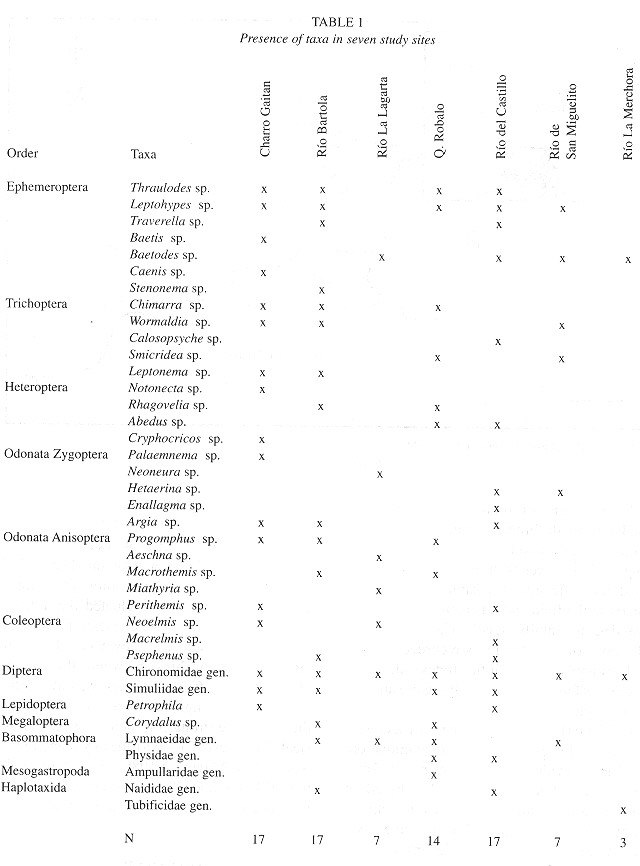
<body><![CDATA[<div align="Justify">      <p><font face="Arial"><font size="-1">Biotic indexes are one of severas types  of measures that are routinely used in biological monitoring in temperate  streams and offer interesting possibilities to assess the environmental quality of rivers in the neotropics. Macroinvertebrate communities of seven southeastern Nicaraguan streams were monitored and seven ecological indexes were applied. The results suggest that information from the Indice Bi&oacute;tico Esteso (I.B.E.) is closely correlated to the results of other methods, but the I.B.E. index is easier to apply as well as avoiding high costs and time-consuming  procedures. A calibration of the method is necessary for rapid assessment  approaches in the neotropics.</font></font>  </p>       <p><b><font face="Arial"><font size="-1">Key words</font></font></b>  </p>       <p><font face="Arial"><font size="-1">Benthic macroinvertebrates, biological  monitoring, Nicaragua, biotic indexes.</font></font>  </p>       <p><font face="Arial"><font size="-1">&nbsp;</font></font>  </p>       <p><font face="Arial"><font size="-1">Large and small lowland neotropical  streams are being increasingly studied in depth because of their enormous  ecological and economic importance (<a href="#Covich">Covich 1988</a>  ). Biological monitoring is an effective tool to assess the ecological quality  of a watercourse. Chemical monitoring can also be very important to understand  water quality, but it is expensive in terms of equipment and time and often  offers only limited information. Furthermore, biological monitoring can give an indication of past as well as present conditions. Biological methods offer interesting possibilities of application in neotropical lotic environments:  here they allow overcome the logistic difficulties of traditional chemical-physical  surveys and appear advantageous from an economic point of view, thus providing  synthetic information in a short time. In some countries, such as Honduras  and Costa Rica, there is an increasing interest in the use of bioindicators.  Some studies have used diatoms as bioindicators (<a href="#Michels">Michels  1998</a>  ). However, there are some difficulties in diatom identification and complex  technical equipment and highly specialised knowledge are needed. The use of the so-called benthic macroinvertebrates appears more advantageous, and consolidated (<a href="#Hellawell">Hellawell 1986</a>  ), partly because the taxonomic and autoecological knowledge of these organisms  today is better than other aquatic groups, such as algae or mesofauna (<a href="#Jackson">  Jackson and Sweeney 1995</a>  ). Moreover, their sensitivity varies according to numerous environmental  factors, both biotic and abiotic. Consequently, their community structure  has often been used as an indicator of the general conditions of a river's  aquatic environment. Knowledge about the benthic macroinvertebrates of Central  America is making rapid progress (<a href="#Hurlbert">Hurlbert and Figueroa  1982</a>  , <a href="#Rold%E1n">Rold&aacute;n 1988</a>  , <a href="#Fernandez">Fern&aacute;ndez and Dom&iacute;nguez 2001</a>  ). Nevertheless, the analysis used so far in Central America has not always  been appropriate in representing the environmental situation; in some cases  the evaluation of river quality was drawn from the application of 'classical'  ecological diversity indexes, i.e. Shannon-Wiener (<a href="#Krebs">Krebs  1985</a>  ) and Simpson (<a href="#Simpson">Simpson 1949</a>  ). In other cases, biotic indexes formulated for North American rivers (Biotic  Index-<a href="#Hilsenhoff87">Hilsenhoff 1987</a>  , Family Biotic Index-<a href="#Hilsenhoff88">Hilsenhoff 1988</a>  ) were used. All these methods require quantitative sampling; moreover, the Hilsenhoff's indexes give great importance to some systematic groups (i.e. insects) and are focused on alterations caused by organic pollution.</font></font>    </p>       <p><font face="Arial"><font size="-1">In Costa Rican streams, aquatic entomofauna  (<a href="#Springer">Springer 1998</a>  ) and macroinvertebrate community structures (<a href="#Ramirez">Ram&iacute;rez  and Pringle 1998</a>  ) were recently investigated. Furthermore, comparisons between disturbed  and undisturbed sites and between sampling methods were made, using a species  diversity index (<a href="#Paaby">Paaby <i>et al. </i>1998</a>  ). In Nicaragua, except for some studies on aquatic insects (<a href="#Maes88">  Maes 1988</a>  , <a href="#Maes89a">1989a</a>  , <a href="#Maes89b">1989b</a>  , <a href="#Maes95">1995</a>  , <a href="#Maes98">1998</a>  , <a href="#Maesetal88">Maes <i>et al. </i>1988</a>  , <a href="#Maes-Flint88">Maes and Flint 1988</a>  , <a href="#Fenoglio">Fenoglio 1999</a>  ), benthic macroinvertebrate fauna is poorly known. Recently, application  of diversity indexes to the macroinvertebrate communities has begun (Garc&iacute;a  pers. comm.) The aim of our study was to test some biotic and ecological indexes in Nicaraguan rivers and to compare their relative effectiveness and ease of their use.</font></font>  </p>       <p><font face="Arial"><font size="-1"><b>Study area: </b>The study area is  the R&iacute;o San Juan hydrographic network (<a href="#fig1">Fig. 1</a>  ), characterized by a humid tropical climate and intense precipitations from  May to January. The air temperature varies around the year from a minimum  of 23&ordm;C to a maximum of 36.6&ordm;C. Human activities and urban settings  decrease conspicuously going from Lake Cocibolca towards the sea. San Carlos  and San Miguelito have the greatest urban extension of the whole area, where,  besides the activity of tradicional fishing, extensive agriculture is practised.  In the few last years cattle breeding has increased in large deforested areas.  Further along the valley, uncultivated areas and secondary forests increase,  until Refugio Bartola and Gran Reserva Indio-Maiz, which are protected primary  forests. In the seven sites studied in the R&iacute;o San Juan district very  different environmental situations were noticed. In some of them (Charro Gaitan, R&iacute;o Bartola and R&iacute;o del Castillo) the river goes through primary or secondary forest and no traces of alteration of anthropic origin were noticed. In other study sites, there are small urban agglomerations and cultivations. R&iacute;o La Merchora receives sewage directly from a village and organic material from a small fish processing firm: the presence of evident colonies of filamentous bacteria and a diffused anaerobic patina below the submerged material immediately testifies the high degree of environmental alteration of this site.</font></font> </p>       <center><a name="fig1"></a>  <img src="/img/fbpe/rbt/v50n2-3/2143i01.JPG" height="460" width="688">  </center>           
<p><font face="Arial"><font size="-1">&nbsp;</font></font>     ]]></body>
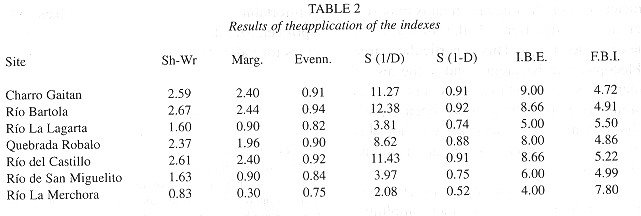
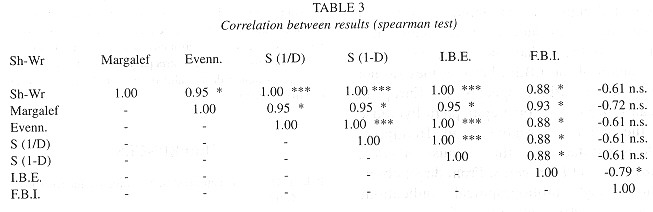
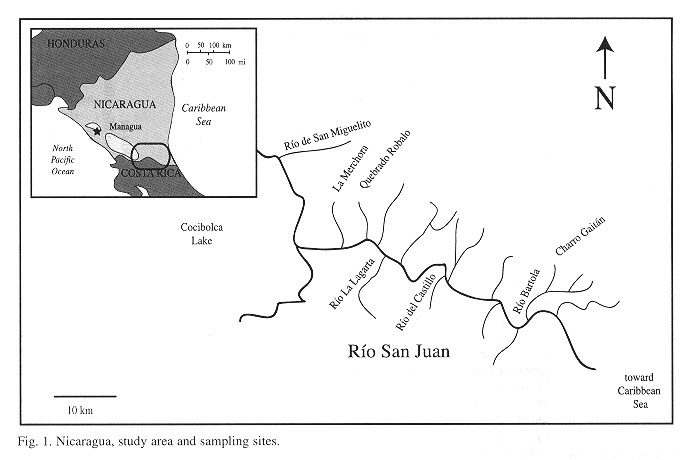
<body><![CDATA[<br>  <b><font face="Arial"><font size="-1">Materials and methods</font></font></b>    </p>       <p><font face="Arial"><font size="-1">Our data was collected in southeastern  Nicaragua during two periods (October November 1998 and October 1999), in  cooperation with the Universidad Popular de Nicaragua - San Carlos. Seven  sites exposed to various anthropic impacts were examined along the tributarios  of R&iacute;o San Juan (<a href="#fig1">Fig. 1</a>  ). Benthic macroinvertebrates were sampled using a dip-in net (250 pm mesh)  according to the quantitative method describes by <a href="#Hilsenhoff87">  Hilsenhoff (1987)</a>  . Samples were fixed in ethanol 70' and subsequently examined in the laboratory  with a compound scope (20/60 X). Taxonomic identification of organisms was  perfonned using the following texts: <a href="#Rold%E1n">Roldan Per&eacute;z  (1988)</a>  , <a href="#Merritt">Merritt and Cummins (1996)</a>  , <a href="#Wills">Wills Flowers (1992)</a>  , Springer <i>et al. (in prep.).</i></font></font>  </p>       <p><font face="Arial"><font size="-1"><b>Ecological indexes: </b>Benthic communities were analyzed by the application of seven ecological indexes: Shannon - Weaver (<a href="#Krebs">Krebs 1985</a>  ), Simpson (I-D and I/D) (<a href="#Simpson">Simpson 1949</a>  ), Evenness (<a href="#Pielou">Pielou 1969</a>  ), Margalef (<a href="#Clifford">Clifford and Stephenson 1975</a>  ), Family Biotic Index (<a href="#Hilsenhoff88">Hilsenhoff 1988</a>  ), Indice Biotico Esteso (<a href="#Ghetti">Ghetti 1997</a>  ).</font></font>  </p>       <p><font face="Arial"><font size="-1">Shannon-Wiener, Margalef, Simpson and  Evenness are "classical ecological indexes", created to measure diversity  in ecological communities. The Family level Biotic Index (<a href="#Hilsenhoff88">  Hilsenhoff 1988</a>  ) is a synthetic index used in field assessment of organic pollution. It  is based on the different tolerance of different families of arthropods. The metbod needs a sample of no fewer than 100 arthropods collected in a riffle area. The sample is examined directly in the field and it is then separated and classified to family level. The number of arthropods of each family is recorded and the EB.I. (Family-level Biotic Index) index is therefore calculated by multiplying the number of specimens of every family by its tolerance value. The EB.I. can vary from 0 to 10, detecting seven classes of organic contamination. The I.B.E. method derives from the Trent Biotic Index (<a href="#Woodiwiss"> Woodiwiss 1964</a>  ). It is based on two evaluation parameters: taxonomic richness and the presence of pollution-sensitive taxa. This method offers synthetic information about the general conditions of river ecosystems, underlining potential alterations.  This method is widely used in Italy to assess the state of health of rivers,  and its application is envisaged by Italian legislation (Decree Law 152/99).</font></font>    </p>       <p><font face="Arial"><font size="-1">&nbsp;</font></font>     <br>  <b><font face="Arial"><font size="-1">Results</font></font></b>  </p>       <p><font face="Arial"><font size="-1">Altogether, 38 different systematic  unities were determined, for a total number of 702 individuals (<a href="#table1">  Table 1</a>  ). The community composition at each site was evaluated through the application  of the above mentioned seven indexes. The results are shown in <a href="#table2">  Table 2</a>  . To test the relationships between the results obtained with different indexes, we ran a statistical analysis using Spearman's correlation test (<a href="#table3"> Table 3</a>  ). The strong correlation between 'classical' index results is confirmed  by many previous studies (Magurran 1988), and interestingly the I.B.E. method  also shows a significant correspondence with other monitoring tools.</font></font>   </p>       <center><font face="Arial"><font size="-1">&nbsp;</font></font><a name="table1"></a>  <img src="/img/fbpe/rbt/v50n2-3/2143i02.JPG" height="866" width="640">  </center>   &nbsp;       
<center><a name="table2"></a>  <img src="/img/fbpe/rbt/v50n2-3/2143i03.JPG" height="216" width="641">  </center>   &nbsp;       
<center><a name="table3"></a>  <img src="/img/fbpe/rbt/v50n2-3/2143i04.JPG" height="212" width="653">  </center>   <b><font face="Arial"><font size="-1">&nbsp;</font></font></b>     
]]></body>
<body><![CDATA[<br>  <b><font face="Arial"><font size="-1">&nbsp;</font></font></b>     <br>  <b><font face="Arial"><font size="-1">Discussion</font></font></b>        <p><font face="Arial"><font size="-1">We found an evident correspondence between I.B.E. values and the environmental situation at each site. According to its fauna, the most contaminated site was R&iacute;o La Merchora, in which  we found only three taxa, while R&iacute;o Bartola, R&iacute;o El Castillo  and Charro Gaitan were the sites with the greater diversity of benthic macroinvertebrates.</font></font>    </p>       <p><font face="Arial"><font size="-1"><b>Comparison between indexes: </b>  The application of seven different ecological indexes underlined that the  I.B.E. index offers results which are well correlated with those obtained  with other indexes. The I.B.E. is equally effective if it is compared with  the other indexes from the diagnostic point of view, and it seems quicker  and more versatile in this context. In fact, I.B.E. does not require quantitative  sampling (as the indexes of difference do) or a deep knowledge of the ecological  characteristics of all the taxa (required in the case of the EB.I.). Furthermore,  I.B.E. offers a general picture of the environmental situation by combining  indications about the taxonomic richness with information on the sensitivity  of the different taxa. I.B.E. considers the benthic macroinvertebrate's community and not only arthropods and a few other groups as the Hilsenhoff index does, in its original layout (<a href="#Hilsenhoff87">Hilsenhoff 1987</a>  , <a href="#Hilsenhoff88">1988</a>  ) and in its following modifications (<a href="#Resh">Resh <i>et al. </i>  1996</a>  ).</font></font>  </p>       <p><font face="Arial"><font size="-1"><b>Problems and preliminary hypothesis</b>   <b>of I.B.E. setting for its use in the neotropics:</b> Direct application  of the method can be problematic, especially because of the limited knowledge  of biocenosis at taxonomic and ecological-functional levels.</font></font>    </p>       <p><font face="Arial"><font size="-1">For this purpose, we can hypothesize  two phases. First, knowledge related to other fauna can be deductively employed.  In fact, the high taxonomic groups are very similar to their European and  North American relatives, which are already well known. In 1874, Thomas Belt  wrote in 'The naturalist in Nicaragua': "All the land fauna was strikingly  different from that of other regions; but the water fauna was as strikingly  similar", and moreover "The close affinities of fresh-water animals and plants  have been noticed by many naturalists", an element also verified in our samplings.  In the near future, information related to the local fauna will be available  and could he employed: for example, the University of Costa Rica is preparing  a key for benthic macroinvertebrates (Springer <i>et al.</i> in prep.). When  this tool is available, it<b> </b>could be applied to numerous Central American  situations, including Nicaragua.</font></font>  </p>       <p><font face="Arial"><font size="-1">A calibration of the I.B.E. index must  be made for its correct application in the neotropics:</font></font>  </p>       <p><font face="Arial"><font size="-1">Exclusion or diminution of the relative  importance of some groups. The environmental characteristics of Nicaraguan  streams impose a different consideration of the bioindicator value of some  groups. This is particularly true for Plecoptera: in Nicaragua and in the  rest of southem Central America only one genus <i>(Anacroneuria </i>sp., Perlidae) has been reported. Its distribution is less known but this species seems extremely located in Nicaragua (<a href="#Stark">Stark 1998</a>  ).</font></font>  </p>       <p><font face="Arial"><font size="-1">Inclusion of other macroinvertebrate  groups. During this study and other samplings, (<a href="#Fenoglio">Fenoglio  1999</a>  ) we have often recovered specimens belonging to taxonomic groups of remarkable  local numerical and ecological importance that we have not considered in the calculation of the I.B.E., because they do not have not vicariant species  in European streams. We can report Lepidoptera Pyralidae of the genus <i>  Petrophyla </i>and Hemiptera Belostomatidae of the genus <i>Abedus,</i> <i> Belostoma and Lethocerus. </i>From direct observations and bibliographical  indications (<a href="#Springer">Springer 1998</a>  ) nymphs of the genus <i>Epilampra </i>(Blattodea, Blaberidae) should also  be included. Moreover, considering the fauna composition of the Nicaragua  river, it is also advisable to use all the species of Anisoptera and Zygoptera  (Odonata) for the calculation of the I.B.E.</font></font>  </p>       <p><font face="Arial"><font size="-1">Further validation of the proposed methodology will include the comparison between abiotic conditions of streams. Calibrating the method to the specific environmental situation would allow the diffusion of this biomonitoring tool in the Central American area.</font></font>   </p>       ]]></body>
<body><![CDATA[<p><font face="Arial"><font size="-1">An adaptation of I.B.E. could represent  a rapid and cost-effective assessment instrument: I.B.E. could be employed  routinely in large monitoring plans, while a quantitative ap proach lo community-level  analysis could be used only in cases of particular interest.</font></font>       <br>  &nbsp;  </p>       <p><b><font face="Arial"><font size="-1">Acknowledgements</font></font></b>    </p>       <p><font face="Arial"><font size="-1">We thank U.PO.NIC. - San Carlos who  provided the local facilities and made our work comfortable. We also thank  J.M. Maes, M. Springer, Merida, S.A. and two anonymous referees for valuable  suggestions and comments.</font></font>  </p>       <p><font face="Arial"><font size="-1">&nbsp;</font></font>     <br>  <b><font face="Arial"><font size="-1">Resumen</font></font></b>  </p>       <p><font face="Arial"><font size="-1">Los &iacute;ndices bi&oacute;ticos representan una topolog&iacute;a de medidas que se emplea rutinariamente en el control biol&oacute;gico de los ambientes l&oacute;ticos templados: ellos ofrecen tambi&eacute;n interesantes posibilidades en el &aacute;rea neotropical. Para evaluar la calidad ambiental de algunos r&iacute;os de Nicaragua, investigamos las comunidades macrobent&oacute;nicas y aplicamos siete &iacute;ndices ecol&oacute;gicos. Los resultados sugieren que el &iacute;ndice I.B.E. se relaciona fuertemente a los otros &iacute;ndices, pero permite ahorrar costos y tiempo. Una calibraci&oacute;n del m&eacute;todo ser&iacute;a necesaria para obtener un m&eacute;todo de valoraci&oacute;n r&aacute;pida de la calidad ambiental de los r&iacute;os de Centro Am&eacute;rica.</font></font>   </p>       <p><font face="Arial"><font size="-1">&nbsp;</font></font>     <br>  <b><font face="Arial"><font size="-1">References</font></font></b>  </p>       <!-- ref --><p><a name="Belt"></a>  <font face="Arial"><font size="-1">Belt, T. 1874. The naturalist in Nicaragua.  Chicago Univ., Chicago.    &nbsp;&nbsp;&nbsp;&nbsp;&nbsp;&nbsp;&nbsp;&nbsp;[&#160;<a href="javascript:void(0);" onclick="javascript: window.open('/scielo.php?script=sci_nlinks&ref=1697543&pid=S0034-7744200200030002900001&lng=','','width=640,height=500,resizable=yes,scrollbars=1,menubar=yes,');">Links</a>&#160;]<!-- end-ref --></font></font>  </p>       <!-- ref --><p><a name="Clifford"></a>  <font face="Arial"><font size="-1">Clifford, H.T. &amp; W. Stephenson. 1975.  An introduction to numerical classification. Academic, London.    &nbsp;&nbsp;&nbsp;&nbsp;&nbsp;&nbsp;&nbsp;&nbsp;[&#160;<a href="javascript:void(0);" onclick="javascript: window.open('/scielo.php?script=sci_nlinks&ref=1697545&pid=S0034-7744200200030002900002&lng=','','width=640,height=500,resizable=yes,scrollbars=1,menubar=yes,');">Links</a>&#160;]<!-- end-ref --></font></font>    </p>       <!-- ref --><p><a name="Covich"></a>  <font face="Arial"><font size="-1">Covich, A.R 1988. Geographical and historical  comparisons of neotropical streams: biotic. diversity and detrital processing  in highly variable habitats. J. N. Am. Benthol. Soc. 7: 361-386.    &nbsp;&nbsp;&nbsp;&nbsp;&nbsp;&nbsp;&nbsp;&nbsp;[&#160;<a href="javascript:void(0);" onclick="javascript: window.open('/scielo.php?script=sci_nlinks&ref=1697547&pid=S0034-7744200200030002900003&lng=','','width=640,height=500,resizable=yes,scrollbars=1,menubar=yes,');">Links</a>&#160;]<!-- end-ref --></font></font>    </p>       <!-- ref --><p><a name="Fenoglio"></a>  <font face="Arial"><font size="-1">Fenoglio, S. 1999. Entomofauna acu&aacute;tica  de ambientes l&oacute;ticos: observaciones ecol&oacute;gicas en el Refugio  Bartola y nuevos taxa para Nicaragua. Rev. Nica. Ent. 4: 29-43.    &nbsp;&nbsp;&nbsp;&nbsp;&nbsp;&nbsp;&nbsp;&nbsp;[&#160;<a href="javascript:void(0);" onclick="javascript: window.open('/scielo.php?script=sci_nlinks&ref=1697549&pid=S0034-7744200200030002900004&lng=','','width=640,height=500,resizable=yes,scrollbars=1,menubar=yes,');">Links</a>&#160;]<!-- end-ref --></font></font>    </p>       <!-- ref --><p><a name="Fernandez"></a>  <font face="Arial"><font size="-1">Fern&aacute;ndez, H.R. &amp; E. Dom&iacute;nguez  (eds.). 2001. Gu&iacute;a para la determinaci&oacute;n de los artr&oacute;podos  bent&oacute;nicos sudamericanos. UNT, Tucuman.    &nbsp;&nbsp;&nbsp;&nbsp;&nbsp;&nbsp;&nbsp;&nbsp;[&#160;<a href="javascript:void(0);" onclick="javascript: window.open('/scielo.php?script=sci_nlinks&ref=1697551&pid=S0034-7744200200030002900005&lng=','','width=640,height=500,resizable=yes,scrollbars=1,menubar=yes,');">Links</a>&#160;]<!-- end-ref --></font></font>  </p>       <!-- ref --><p><a name="Ghetti"></a>  <font face="Arial"><font size="-1">Ghetti, RE 1997. Manuale di applicazione  Indice Biotico Esteso (I.B.E.) Prov. Aut. Trento, Trento. 222 p.    &nbsp;&nbsp;&nbsp;&nbsp;&nbsp;&nbsp;&nbsp;&nbsp;[&#160;<a href="javascript:void(0);" onclick="javascript: window.open('/scielo.php?script=sci_nlinks&ref=1697553&pid=S0034-7744200200030002900006&lng=','','width=640,height=500,resizable=yes,scrollbars=1,menubar=yes,');">Links</a>&#160;]<!-- end-ref --></font></font>    </p>       <!-- ref --><p><a name="Hellawell"></a>  <font face="Arial"><font size="-1">Hellawell, J.M. 1986. Biological indicators  of freshwater pollution and environmental management. Elsevier, New York.  546 p.    &nbsp;&nbsp;&nbsp;&nbsp;&nbsp;&nbsp;&nbsp;&nbsp;[&#160;<a href="javascript:void(0);" onclick="javascript: window.open('/scielo.php?script=sci_nlinks&ref=1697555&pid=S0034-7744200200030002900007&lng=','','width=640,height=500,resizable=yes,scrollbars=1,menubar=yes,');">Links</a>&#160;]<!-- end-ref --></font></font>  </p>       <!-- ref --><p><a name="Hilsenhoff87"></a>  <font face="Arial"><font size="-1">Hilsenhoff, W.L. 1987. An improved biotic  index of organic stream pollution. Great Lakes Entomologist 20: 31-39.    &nbsp;&nbsp;&nbsp;&nbsp;&nbsp;&nbsp;&nbsp;&nbsp;[&#160;<a href="javascript:void(0);" onclick="javascript: window.open('/scielo.php?script=sci_nlinks&ref=1697557&pid=S0034-7744200200030002900008&lng=','','width=640,height=500,resizable=yes,scrollbars=1,menubar=yes,');">Links</a>&#160;]<!-- end-ref --></font></font>    </p>       <!-- ref --><p><a name="Hilsenhoff88"></a>  <font face="Arial"><font size="-1">Hilsenhoff, W.L. 1988. Rapid field assessment  of organic pollution with a family-level biotic index. J. N.<b> </b>Am. Benthol.  Soc. 7: 65-68.    &nbsp;&nbsp;&nbsp;&nbsp;&nbsp;&nbsp;&nbsp;&nbsp;[&#160;<a href="javascript:void(0);" onclick="javascript: window.open('/scielo.php?script=sci_nlinks&ref=1697559&pid=S0034-7744200200030002900009&lng=','','width=640,height=500,resizable=yes,scrollbars=1,menubar=yes,');">Links</a>&#160;]<!-- end-ref --></font></font>  </p>       <!-- ref --><p><a name="Hurlbert"></a>  <font face="Arial"><font size="-1">Hurlbert, S.H. &amp; A.Y Figueroa (eds.).  1982. Aquatic Biota of Mexico, Central America and the West Indies. San Diego  State Univ., San Diego.    &nbsp;&nbsp;&nbsp;&nbsp;&nbsp;&nbsp;&nbsp;&nbsp;[&#160;<a href="javascript:void(0);" onclick="javascript: window.open('/scielo.php?script=sci_nlinks&ref=1697561&pid=S0034-7744200200030002900010&lng=','','width=640,height=500,resizable=yes,scrollbars=1,menubar=yes,');">Links</a>&#160;]<!-- end-ref --></font></font>  </p>       <!-- ref --><p><a name="Jackson"></a>  <font face="Arial"><font size="-1">Jackson, J.K. &amp; B.W. Sweeney. 1995.  Research in tropical streams and rivers: introduction to a series of papers.  J. N. Am. Benthol. Soc. 14: 2-4.    &nbsp;&nbsp;&nbsp;&nbsp;&nbsp;&nbsp;&nbsp;&nbsp;[&#160;<a href="javascript:void(0);" onclick="javascript: window.open('/scielo.php?script=sci_nlinks&ref=1697563&pid=S0034-7744200200030002900011&lng=','','width=640,height=500,resizable=yes,scrollbars=1,menubar=yes,');">Links</a>&#160;]<!-- end-ref --></font></font>  </p>       <!-- ref --><p><a name="Krebs"></a>  <font face="Arial"><font size="-1">Krebs, C.J. 1985. Ecology: the experimental  analysis of distribution and abundance. Harper &amp; Row, New York.    &nbsp;&nbsp;&nbsp;&nbsp;&nbsp;&nbsp;&nbsp;&nbsp;[&#160;<a href="javascript:void(0);" onclick="javascript: window.open('/scielo.php?script=sci_nlinks&ref=1697565&pid=S0034-7744200200030002900012&lng=','','width=640,height=500,resizable=yes,scrollbars=1,menubar=yes,');">Links</a>&#160;]<!-- end-ref --></font></font>    </p>       <!-- ref --><p><a name="Maes88"></a>  <font face="Arial"><font size="-1">Maes, J.M. 1988. Cat&aacute;logo de los  Ephemeroptera y Plecoptera de Nicaragua. Rev. Nica. Ent. 2: 49-50.    &nbsp;&nbsp;&nbsp;&nbsp;&nbsp;&nbsp;&nbsp;&nbsp;[&#160;<a href="javascript:void(0);" onclick="javascript: window.open('/scielo.php?script=sci_nlinks&ref=1697567&pid=S0034-7744200200030002900013&lng=','','width=640,height=500,resizable=yes,scrollbars=1,menubar=yes,');">Links</a>&#160;]<!-- end-ref --></font></font>    </p>       <!-- ref --><p><a name="Maes89a"></a>  <font face="Arial"><font size="-1">Maes, J.M. 1989a. Cat&aacute;logo de los insectos consoladores bi&oacute;logicos en Nicaragua. Vol. I. Insectos depredadores (primera parte). Rev. Nica. Ent. 4: 2943.    &nbsp;&nbsp;&nbsp;&nbsp;&nbsp;&nbsp;&nbsp;&nbsp;[&#160;<a href="javascript:void(0);" onclick="javascript: window.open('/scielo.php?script=sci_nlinks&ref=1697569&pid=S0034-7744200200030002900014&lng=','','width=640,height=500,resizable=yes,scrollbars=1,menubar=yes,');">Links</a>&#160;]<!-- end-ref --></font></font>  </p>       <!-- ref --><p><a name="Maes89b"></a>  <font face="Arial"><font size="-1">Maes, J.M. 1989b. Cat&aacute;logo de los insectos consoladores bi&oacute;logicos en Nicaragua. Volumen II. Insectos  depredadores (segunda parte). Rev. Nica. Ent. 9 : 1120-</font></font>  &nbsp;&nbsp;&nbsp;&nbsp;&nbsp;&nbsp;&nbsp;&nbsp;[&#160;<a href="javascript:void(0);" onclick="javascript: window.open('/scielo.php?script=sci_nlinks&ref=1697571&pid=S0034-7744200200030002900015&lng=','','width=640,height=500,resizable=yes,scrollbars=1,menubar=yes,');">Links</a>&#160;]<!-- end-ref --><!-- ref --><p><a name="Maes95"></a>  <font face="Arial"><font size="-1">Maes, J.M. 1995. Haliplidae, Ciidae y  Sphindidae (Coleoptera). Tres familias nuevas para la fauna de Nicaragua.  Rev. Nica. Ent. 32:1-3.    &nbsp;&nbsp;&nbsp;&nbsp;&nbsp;&nbsp;&nbsp;&nbsp;[&#160;<a href="javascript:void(0);" onclick="javascript: window.open('/scielo.php?script=sci_nlinks&ref=1697572&pid=S0034-7744200200030002900016&lng=','','width=640,height=500,resizable=yes,scrollbars=1,menubar=yes,');">Links</a>&#160;]<!-- end-ref --></font></font>  </p>       ]]></body>
<body><![CDATA[<!-- ref --><p><a name="Maesetal88"></a>  <font face="Arial"><font size="-1">Maes, J.M., J.P. Desmedt &amp; Y Hellebuyck.  1988. Cat&aacute;logo de los Odonata de Nicaragua. Rev. Nica. Ent. 4: 2943.    &nbsp;&nbsp;&nbsp;&nbsp;&nbsp;&nbsp;&nbsp;&nbsp;[&#160;<a href="javascript:void(0);" onclick="javascript: window.open('/scielo.php?script=sci_nlinks&ref=1697574&pid=S0034-7744200200030002900017&lng=','','width=640,height=500,resizable=yes,scrollbars=1,menubar=yes,');">Links</a>&#160;]<!-- end-ref --></font></font>    </p>       <!-- ref --><p><a name="Maes-Flint88"></a>  <font face="Arial"><font size="-1">Maes, J.M. &amp; O.S. Flint. 1988. Catalogo  de los Trichoptera de Nicaragua. Rev. Nica. Ent. 2: 1 -11.    &nbsp;&nbsp;&nbsp;&nbsp;&nbsp;&nbsp;&nbsp;&nbsp;[&#160;<a href="javascript:void(0);" onclick="javascript: window.open('/scielo.php?script=sci_nlinks&ref=1697576&pid=S0034-7744200200030002900018&lng=','','width=640,height=500,resizable=yes,scrollbars=1,menubar=yes,');">Links</a>&#160;]<!-- end-ref --></font></font>   </p>       <!-- ref --><p><a name="Maes98"></a>  <font face="Arial"><font size="-1">Maes, J.M. 1998, Insectos de Nicaragua.  Vol. 1, Print-Le&oacute;n, Nicaragua.    &nbsp;&nbsp;&nbsp;&nbsp;&nbsp;&nbsp;&nbsp;&nbsp;[&#160;<a href="javascript:void(0);" onclick="javascript: window.open('/scielo.php?script=sci_nlinks&ref=1697578&pid=S0034-7744200200030002900019&lng=','','width=640,height=500,resizable=yes,scrollbars=1,menubar=yes,');">Links</a>&#160;]<!-- end-ref --></font></font>  </p>       <!-- ref --><p><a name="Magurran"></a>  <font face="Arial"><font size="-1">Magurran, A.E. 1988. Ecological diversity  and its measurement. Cambridge University, Cambridge.    &nbsp;&nbsp;&nbsp;&nbsp;&nbsp;&nbsp;&nbsp;&nbsp;[&#160;<a href="javascript:void(0);" onclick="javascript: window.open('/scielo.php?script=sci_nlinks&ref=1697580&pid=S0034-7744200200030002900020&lng=','','width=640,height=500,resizable=yes,scrollbars=1,menubar=yes,');">Links</a>&#160;]<!-- end-ref --></font></font>  </p>       <!-- ref --><p><a name="Merritt"></a>  <font face="Arial"><font size="-1">Merritt, R.W. &amp; K.W. Cummins (eds.).  1996. An introduction to the aquatic insects of North America. Kendall/Hunt.  Dubuque, 10.    &nbsp;&nbsp;&nbsp;&nbsp;&nbsp;&nbsp;&nbsp;&nbsp;[&#160;<a href="javascript:void(0);" onclick="javascript: window.open('/scielo.php?script=sci_nlinks&ref=1697582&pid=S0034-7744200200030002900021&lng=','','width=640,height=500,resizable=yes,scrollbars=1,menubar=yes,');">Links</a>&#160;]<!-- end-ref --></font></font>  </p>       ]]></body>
<body><![CDATA[<!-- ref --><p><a name="Michels"></a>  <font face="Arial"><font size="-1">Michels, A. 1998. Use of diatoms for water quality assessment in two tropical streams in Costa Rica. Rev. Biol. Trop. 46: 143-153.    &nbsp;&nbsp;&nbsp;&nbsp;&nbsp;&nbsp;&nbsp;&nbsp;[&#160;<a href="javascript:void(0);" onclick="javascript: window.open('/scielo.php?script=sci_nlinks&ref=1697584&pid=S0034-7744200200030002900022&lng=','','width=640,height=500,resizable=yes,scrollbars=1,menubar=yes,');">Links</a>&#160;]<!-- end-ref --></font></font>  </p>       <!-- ref --><p><a name="Paaby"></a>  <font face="Arial"><font size="-1">Paaby P., A. Ram&iacute;rez &amp; C.M.  Pringle. 1998. The benthic macroinvertebrate community in Caribbean Costa  Rican streams and the effect of two sampling methods. Rev. Biol. Tro . 46:  185-199.    &nbsp;&nbsp;&nbsp;&nbsp;&nbsp;&nbsp;&nbsp;&nbsp;[&#160;<a href="javascript:void(0);" onclick="javascript: window.open('/scielo.php?script=sci_nlinks&ref=1697586&pid=S0034-7744200200030002900023&lng=','','width=640,height=500,resizable=yes,scrollbars=1,menubar=yes,');">Links</a>&#160;]<!-- end-ref --></font></font>  </p>       <!-- ref --><p><a name="Pielou"></a>  <font face="Arial"><font size="-1">Pielou, E.C. 1969. An introduction to  mathematic ecology. Wiley, New York. 286 p.    &nbsp;&nbsp;&nbsp;&nbsp;&nbsp;&nbsp;&nbsp;&nbsp;[&#160;<a href="javascript:void(0);" onclick="javascript: window.open('/scielo.php?script=sci_nlinks&ref=1697588&pid=S0034-7744200200030002900024&lng=','','width=640,height=500,resizable=yes,scrollbars=1,menubar=yes,');">Links</a>&#160;]<!-- end-ref --></font></font>  </p>       <!-- ref --><p><a name="Ramirez"></a>  <font face="Arial"><font size="-1">Ram&iacute;rez, A. &amp; C.M. Pringle.  1998. Structure and production of a benthic insect assemblage in a neotropical  stream. J.<b> </b>N. Am. Benthol. Soc. 17: 443-463.    &nbsp;&nbsp;&nbsp;&nbsp;&nbsp;&nbsp;&nbsp;&nbsp;[&#160;<a href="javascript:void(0);" onclick="javascript: window.open('/scielo.php?script=sci_nlinks&ref=1697590&pid=S0034-7744200200030002900025&lng=','','width=640,height=500,resizable=yes,scrollbars=1,menubar=yes,');">Links</a>&#160;]<!-- end-ref --></font></font>  </p>       <!-- ref --><p><a name="Resh"></a>  <font face="Arial"><font size="-1">Resh, VH., Myers M.J. &amp; M.J. Hannaford.  1996. Macroinvertebates as biotic indicators of environmental quality. pp.  647-668. In ER. Hauer. &amp; G.A. Lamberti (eds.). 1996. Methods in Stream  Ecology. Academic, San Diego, CA.    &nbsp;&nbsp;&nbsp;&nbsp;&nbsp;&nbsp;&nbsp;&nbsp;[&#160;<a href="javascript:void(0);" onclick="javascript: window.open('/scielo.php?script=sci_nlinks&ref=1697592&pid=S0034-7744200200030002900026&lng=','','width=640,height=500,resizable=yes,scrollbars=1,menubar=yes,');">Links</a>&#160;]<!-- end-ref --></font></font>  </p>       ]]></body>
<body><![CDATA[<!-- ref --><p>&nbsp;&nbsp; <font face="Arial"><font size="-1">Rold&aacute;n, G. 1988. Gu&iacute;a para el estudio de los maeroinvertebrados acu&aacute;ticos del Departamento de Antioquia. Universidad de Antioquia-CIEN, Antioquia, Colombia.    &nbsp;&nbsp;&nbsp;&nbsp;&nbsp;&nbsp;&nbsp;&nbsp;[&#160;<a href="javascript:void(0);" onclick="javascript: window.open('/scielo.php?script=sci_nlinks&ref=1697594&pid=S0034-7744200200030002900027&lng=','','width=640,height=500,resizable=yes,scrollbars=1,menubar=yes,');">Links</a>&#160;]<!-- end-ref --></font></font>    </p>       <!-- ref --><p><a name="Simpson"></a>  <font face="Arial"><font size="-1">Simpson, E.H. 1949. Measurement of diversity.  Nature 163: 688.    &nbsp;&nbsp;&nbsp;&nbsp;&nbsp;&nbsp;&nbsp;&nbsp;[&#160;<a href="javascript:void(0);" onclick="javascript: window.open('/scielo.php?script=sci_nlinks&ref=1697596&pid=S0034-7744200200030002900028&lng=','','width=640,height=500,resizable=yes,scrollbars=1,menubar=yes,');">Links</a>&#160;]<!-- end-ref --></font></font>  </p>       <!-- ref --><p><a name="Springer"></a>  <font face="Arial"><font size="-1">Springer, M. 1998. Genera of aquatie insects from Costa Rica, depositad at the Museo de Zoologia, Universidad de Costa Rica. Rev. Biol. Trop. 46: 137-142.    &nbsp;&nbsp;&nbsp;&nbsp;&nbsp;&nbsp;&nbsp;&nbsp;[&#160;<a href="javascript:void(0);" onclick="javascript: window.open('/scielo.php?script=sci_nlinks&ref=1697598&pid=S0034-7744200200030002900029&lng=','','width=640,height=500,resizable=yes,scrollbars=1,menubar=yes,');">Links</a>&#160;]<!-- end-ref --></font></font>  </p>       <!-- ref --><p><a name="Stark"></a>  <font face="Arial"><font size="-1">Stark, B.P. 1998. The Anacroneuria of  Costa Rica and Panam&aacute; (Insecta: Plecoptera: Perlidae). Proc. Biol.  Soc. Washington 111: 551-603.    &nbsp;&nbsp;&nbsp;&nbsp;&nbsp;&nbsp;&nbsp;&nbsp;[&#160;<a href="javascript:void(0);" onclick="javascript: window.open('/scielo.php?script=sci_nlinks&ref=1697600&pid=S0034-7744200200030002900030&lng=','','width=640,height=500,resizable=yes,scrollbars=1,menubar=yes,');">Links</a>&#160;]<!-- end-ref --></font></font>  </p>       <!-- ref --><p><a name="Wills"></a>  <font face="Arial"><font size="-1">Wills Flowers, R. 1992. Review of the  genera of Mayflies of Panama, with a Checklist of Panamanian and Costa Rican  Species (Ephemeroptera) pp. 37-51. <i>In</i> D. Quintero &amp; A. Aiello (eds.). Insects of Panama and Mesoamerica, Oxford University, Oxford.    &nbsp;&nbsp;&nbsp;&nbsp;&nbsp;&nbsp;&nbsp;&nbsp;[&#160;<a href="javascript:void(0);" onclick="javascript: window.open('/scielo.php?script=sci_nlinks&ref=1697602&pid=S0034-7744200200030002900031&lng=','','width=640,height=500,resizable=yes,scrollbars=1,menubar=yes,');">Links</a>&#160;]<!-- end-ref --></font></font>    </p>       ]]></body>
<body><![CDATA[<!-- ref --><p><a name="Woodiwiss"></a>  <font face="Arial"><font size="-1">Woodiwiss, F.S. 1964. The biological system of stream classification used by the Trent River Board. Chem. Ind. 14: 443-447.    &nbsp;&nbsp;&nbsp;&nbsp;&nbsp;&nbsp;&nbsp;&nbsp;[&#160;<a href="javascript:void(0);" onclick="javascript: window.open('/scielo.php?script=sci_nlinks&ref=1697604&pid=S0034-7744200200030002900032&lng=','','width=640,height=500,resizable=yes,scrollbars=1,menubar=yes,');">Links</a>&#160;]<!-- end-ref --></font></font>      <br>  <font face="Arial"><font size="-1">&nbsp;</font></font>     <br>  <font face="Arial"><font size="-1">&nbsp;</font></font>  </p>       <p><a name="1"></a>  <font face="Arial,Helvetica"><font size="-1"><a href="#1a">1</a>  &nbsp;&nbsp; Di.S.T.A., Univ. del Piemonte Orientale - Via Cavour 84 I-15100.  Alessandria, Italia.</font></font>  </p>       <p><font face="Arial,Helvetica"><font size="-1"><a href="#1a">2</a>  &nbsp;&nbsp; Univ. di Torino - Dip. di Biologia Animale e dell'Uomo, Via  Ace. Albertina 17. Torino, Italia <a href="mailto:fenoglio@mfn.unipmn.it">  fenoglio@mfn.unipmn.it</a>  </font></font> </p>  </div>        ]]></body><back>
<ref-list>
<ref id="B1">
<nlm-citation citation-type="book">
<person-group person-group-type="author">
<name>
<surname><![CDATA[Belt]]></surname>
<given-names><![CDATA[T]]></given-names>
</name>
</person-group>
<source><![CDATA[The naturalist in Nicaragua]]></source>
<year>1874</year>
<publisher-loc><![CDATA[Chicago ]]></publisher-loc>
<publisher-name><![CDATA[Chicago Univ]]></publisher-name>
</nlm-citation>
</ref>
<ref id="B2">
<nlm-citation citation-type="book">
<person-group person-group-type="author">
<name>
<surname><![CDATA[Clifford]]></surname>
<given-names><![CDATA[H.T]]></given-names>
</name>
<name>
<surname><![CDATA[Stephenson]]></surname>
<given-names><![CDATA[W]]></given-names>
</name>
</person-group>
<source><![CDATA[An introduction to numerical classification]]></source>
<year>1975</year>
<publisher-loc><![CDATA[London ]]></publisher-loc>
<publisher-name><![CDATA[Academic]]></publisher-name>
</nlm-citation>
</ref>
<ref id="B3">
<nlm-citation citation-type="journal">
<person-group person-group-type="author">
<name>
<surname><![CDATA[Covich]]></surname>
<given-names><![CDATA[A.R]]></given-names>
</name>
</person-group>
<article-title xml:lang="en"><![CDATA[Geographical and historical comparisons of neotropical streams: biotic. diversity and detrital processing in highly variable habitats]]></article-title>
<source><![CDATA[J. N. Am. Benthol. Soc]]></source>
<year>1988</year>
<volume>7</volume>
<page-range>361-386</page-range></nlm-citation>
</ref>
<ref id="B4">
<nlm-citation citation-type="journal">
<person-group person-group-type="author">
<name>
<surname><![CDATA[Fenoglio]]></surname>
<given-names><![CDATA[S]]></given-names>
</name>
</person-group>
<article-title xml:lang="es"><![CDATA[Entomofauna acuática de ambientes lóticos: observaciones ecológicas en el Refugio Bartola y nuevos taxa para Nicaragua]]></article-title>
<source><![CDATA[Rev. Nica. Ent]]></source>
<year>1999</year>
<volume>4</volume>
<page-range>29-43</page-range></nlm-citation>
</ref>
<ref id="B5">
<nlm-citation citation-type="book">
<person-group person-group-type="author">
<name>
<surname><![CDATA[Fernández]]></surname>
<given-names><![CDATA[H.R]]></given-names>
</name>
<name>
<surname><![CDATA[Domínguez]]></surname>
<given-names><![CDATA[E]]></given-names>
</name>
</person-group>
<source><![CDATA[Guía para la determinación de los artrópodos bentónicos sudamericanos]]></source>
<year>2001</year>
<publisher-loc><![CDATA[Tucuman ]]></publisher-loc>
<publisher-name><![CDATA[UNT]]></publisher-name>
</nlm-citation>
</ref>
<ref id="B6">
<nlm-citation citation-type="book">
<person-group person-group-type="author">
<name>
<surname><![CDATA[Ghetti]]></surname>
<given-names><![CDATA[RE]]></given-names>
</name>
</person-group>
<source><![CDATA[Manuale di applicazione Indice Biotico Esteso (I.B.E.)]]></source>
<year>1997</year>
<page-range>222</page-range><publisher-loc><![CDATA[Trento ]]></publisher-loc>
<publisher-name><![CDATA[Prov. Aut. Trento]]></publisher-name>
</nlm-citation>
</ref>
<ref id="B7">
<nlm-citation citation-type="book">
<person-group person-group-type="author">
<name>
<surname><![CDATA[Hellawell]]></surname>
<given-names><![CDATA[J.M]]></given-names>
</name>
</person-group>
<source><![CDATA[Biological indicators of freshwater pollution and environmental management]]></source>
<year>1986</year>
<page-range>546</page-range><publisher-loc><![CDATA[New York ]]></publisher-loc>
<publisher-name><![CDATA[Elsevier]]></publisher-name>
</nlm-citation>
</ref>
<ref id="B8">
<nlm-citation citation-type="journal">
<person-group person-group-type="author">
<name>
<surname><![CDATA[Hilsenhoff]]></surname>
<given-names><![CDATA[W.L]]></given-names>
</name>
</person-group>
<article-title xml:lang="en"><![CDATA[An improved biotic index of organic stream pollution]]></article-title>
<source><![CDATA[Great Lakes Entomologist]]></source>
<year>1987</year>
<volume>20</volume>
<page-range>31-39</page-range></nlm-citation>
</ref>
<ref id="B9">
<nlm-citation citation-type="journal">
<person-group person-group-type="author">
<name>
<surname><![CDATA[Hilsenhoff]]></surname>
<given-names><![CDATA[W.L]]></given-names>
</name>
</person-group>
<article-title xml:lang="en"><![CDATA[Rapid field assessment of organic pollution with a family-level biotic index]]></article-title>
<source><![CDATA[J. N. Am. Benthol. Soc]]></source>
<year>1988</year>
<volume>7</volume>
<page-range>65-68</page-range></nlm-citation>
</ref>
<ref id="B10">
<nlm-citation citation-type="book">
<person-group person-group-type="author">
<name>
<surname><![CDATA[Hurlbert]]></surname>
<given-names><![CDATA[S.H]]></given-names>
</name>
<name>
<surname><![CDATA[Figueroa]]></surname>
<given-names><![CDATA[A.Y]]></given-names>
</name>
</person-group>
<source><![CDATA[Aquatic Biota of Mexico, Central America and the West Indies]]></source>
<year>1982</year>
<publisher-loc><![CDATA[San Diego ]]></publisher-loc>
<publisher-name><![CDATA[San Diego State Univ]]></publisher-name>
</nlm-citation>
</ref>
<ref id="B11">
<nlm-citation citation-type="journal">
<person-group person-group-type="author">
<name>
<surname><![CDATA[Jackson]]></surname>
<given-names><![CDATA[J.K]]></given-names>
</name>
<name>
<surname><![CDATA[Sweeney]]></surname>
<given-names><![CDATA[B.W]]></given-names>
</name>
</person-group>
<article-title xml:lang="en"><![CDATA[Research in tropical streams and rivers: introduction to a series of papers]]></article-title>
<source><![CDATA[J. N. Am. Benthol. Soc]]></source>
<year>1995</year>
<volume>14</volume>
<page-range>2-4</page-range></nlm-citation>
</ref>
<ref id="B12">
<nlm-citation citation-type="book">
<person-group person-group-type="author">
<name>
<surname><![CDATA[Krebs]]></surname>
<given-names><![CDATA[C.J]]></given-names>
</name>
</person-group>
<source><![CDATA[Ecology: the experimental analysis of distribution and abundance]]></source>
<year>1985</year>
<publisher-loc><![CDATA[New York ]]></publisher-loc>
<publisher-name><![CDATA[Harper & Row]]></publisher-name>
</nlm-citation>
</ref>
<ref id="B13">
<nlm-citation citation-type="journal">
<person-group person-group-type="author">
<name>
<surname><![CDATA[Maes]]></surname>
<given-names><![CDATA[J.M]]></given-names>
</name>
</person-group>
<article-title xml:lang="es"><![CDATA[Catálogo de los Ephemeroptera y Plecoptera de Nicaragua]]></article-title>
<source><![CDATA[Rev. Nica. Ent]]></source>
<year>1988</year>
<volume>2</volume>
<page-range>49-50</page-range></nlm-citation>
</ref>
<ref id="B14">
<nlm-citation citation-type="journal">
<person-group person-group-type="author">
<name>
<surname><![CDATA[Maes]]></surname>
<given-names><![CDATA[J.M]]></given-names>
</name>
</person-group>
<article-title xml:lang="es"><![CDATA[Catálogo de los insectos consoladores biólogicos en Nicaragua. Vol. I. Insectos depredadores (primera parte)]]></article-title>
<source><![CDATA[Rev. Nica. Ent]]></source>
<year>1989</year>
<volume>4</volume>
<page-range>2943</page-range></nlm-citation>
</ref>
<ref id="B15">
<nlm-citation citation-type="journal">
<person-group person-group-type="author">
<name>
<surname><![CDATA[Maes]]></surname>
<given-names><![CDATA[J.M]]></given-names>
</name>
</person-group>
<article-title xml:lang="es"><![CDATA[Catálogo de los insectos consoladores biólogicos en Nicaragua. Volumen II. Insectos depredadores (segunda parte)]]></article-title>
<source><![CDATA[Rev. Nica. Ent]]></source>
<year>1989</year>
<volume>9</volume>
<page-range>1120</page-range></nlm-citation>
</ref>
<ref id="B16">
<nlm-citation citation-type="journal">
<person-group person-group-type="author">
<name>
<surname><![CDATA[Maes]]></surname>
<given-names><![CDATA[J.M]]></given-names>
</name>
</person-group>
<article-title xml:lang="es"><![CDATA[Haliplidae, Ciidae y Sphindidae (Coleoptera). Tres familias nuevas para la fauna de Nicaragua]]></article-title>
<source><![CDATA[Rev. Nica. Ent]]></source>
<year>1995</year>
<volume>32</volume>
<page-range>1-3</page-range></nlm-citation>
</ref>
<ref id="B17">
<nlm-citation citation-type="journal">
<person-group person-group-type="author">
<name>
<surname><![CDATA[Maes]]></surname>
<given-names><![CDATA[J.M]]></given-names>
</name>
<name>
<surname><![CDATA[Desmedt]]></surname>
<given-names><![CDATA[J.P]]></given-names>
</name>
<name>
<surname><![CDATA[Hellebuyck]]></surname>
<given-names><![CDATA[Y]]></given-names>
</name>
</person-group>
<article-title xml:lang="es"><![CDATA[Catálogo de los Odonata de Nicaragua]]></article-title>
<source><![CDATA[Rev. Nica. Ent]]></source>
<year>1988</year>
<volume>4</volume>
<page-range>29-43</page-range></nlm-citation>
</ref>
<ref id="B18">
<nlm-citation citation-type="journal">
<person-group person-group-type="author">
<name>
<surname><![CDATA[Maes]]></surname>
<given-names><![CDATA[J.M]]></given-names>
</name>
<name>
<surname><![CDATA[Flint]]></surname>
<given-names><![CDATA[O.S]]></given-names>
</name>
</person-group>
<article-title xml:lang="es"><![CDATA[Catalogo de los Trichoptera de Nicaragua]]></article-title>
<source><![CDATA[Rev. Nica. Ent]]></source>
<year>1988</year>
<volume>2</volume>
<page-range>1 -11</page-range></nlm-citation>
</ref>
<ref id="B19">
<nlm-citation citation-type="book">
<person-group person-group-type="author">
<name>
<surname><![CDATA[Maes]]></surname>
<given-names><![CDATA[J.M]]></given-names>
</name>
</person-group>
<source><![CDATA[Insectos de Nicaragua]]></source>
<year>1998</year>
<volume>1</volume>
<publisher-loc><![CDATA[Nicaragua ]]></publisher-loc>
<publisher-name><![CDATA[Print-León]]></publisher-name>
</nlm-citation>
</ref>
<ref id="B20">
<nlm-citation citation-type="book">
<person-group person-group-type="author">
<name>
<surname><![CDATA[Magurran]]></surname>
<given-names><![CDATA[A.E]]></given-names>
</name>
</person-group>
<source><![CDATA[Ecological diversity and its measurement]]></source>
<year>1988</year>
<publisher-loc><![CDATA[Cambridge ]]></publisher-loc>
<publisher-name><![CDATA[Cambridge University]]></publisher-name>
</nlm-citation>
</ref>
<ref id="B21">
<nlm-citation citation-type="book">
<person-group person-group-type="author">
<name>
<surname><![CDATA[Merritt]]></surname>
<given-names><![CDATA[R.W]]></given-names>
</name>
<name>
<surname><![CDATA[Cummins]]></surname>
<given-names><![CDATA[K.W]]></given-names>
</name>
</person-group>
<source><![CDATA[An introduction to the aquatic insects of North America]]></source>
<year>1996</year>
<page-range>10</page-range><publisher-loc><![CDATA[Dubuque ]]></publisher-loc>
<publisher-name><![CDATA[Kendall/Hunt]]></publisher-name>
</nlm-citation>
</ref>
<ref id="B22">
<nlm-citation citation-type="journal">
<person-group person-group-type="author">
<name>
<surname><![CDATA[Michels]]></surname>
<given-names><![CDATA[A]]></given-names>
</name>
</person-group>
<article-title xml:lang="en"><![CDATA[Use of diatoms for water quality assessment in two tropical streams in Costa Rica]]></article-title>
<source><![CDATA[Rev. Biol. Trop]]></source>
<year>1998</year>
<volume>46</volume>
<page-range>143-153</page-range></nlm-citation>
</ref>
<ref id="B23">
<nlm-citation citation-type="journal">
<person-group person-group-type="author">
<name>
<surname><![CDATA[Paaby]]></surname>
<given-names><![CDATA[P]]></given-names>
</name>
<name>
<surname><![CDATA[Ramírez]]></surname>
<given-names><![CDATA[A]]></given-names>
</name>
<name>
<surname><![CDATA[Pringle]]></surname>
<given-names><![CDATA[C.M]]></given-names>
</name>
</person-group>
<article-title xml:lang="en"><![CDATA[The benthic macroinvertebrate community in Caribbean Costa Rican streams and the effect of two sampling methods]]></article-title>
<source><![CDATA[Rev. Biol. Tro]]></source>
<year>1998</year>
<volume>46</volume>
<page-range>185-199</page-range></nlm-citation>
</ref>
<ref id="B24">
<nlm-citation citation-type="book">
<person-group person-group-type="author">
<name>
<surname><![CDATA[Pielou]]></surname>
<given-names><![CDATA[E.C]]></given-names>
</name>
</person-group>
<source><![CDATA[An introduction to mathematic ecology]]></source>
<year>1969</year>
<page-range>286</page-range><publisher-loc><![CDATA[New York ]]></publisher-loc>
<publisher-name><![CDATA[Wiley]]></publisher-name>
</nlm-citation>
</ref>
<ref id="B25">
<nlm-citation citation-type="journal">
<person-group person-group-type="author">
<name>
<surname><![CDATA[Ramírez]]></surname>
<given-names><![CDATA[A]]></given-names>
</name>
<name>
<surname><![CDATA[Pringle]]></surname>
<given-names><![CDATA[C.M]]></given-names>
</name>
</person-group>
<article-title xml:lang="en"><![CDATA[Structure and production of a benthic insect assemblage in a neotropical stream]]></article-title>
<source><![CDATA[J. N. Am. Benthol. Soc]]></source>
<year>1998</year>
<volume>17</volume>
<page-range>443-463</page-range></nlm-citation>
</ref>
<ref id="B26">
<nlm-citation citation-type="book">
<person-group person-group-type="author">
<name>
<surname><![CDATA[Resh]]></surname>
<given-names><![CDATA[VH]]></given-names>
</name>
<name>
<surname><![CDATA[Myers]]></surname>
<given-names><![CDATA[M.J]]></given-names>
</name>
<name>
<surname><![CDATA[Hannaford]]></surname>
<given-names><![CDATA[M.J]]></given-names>
</name>
</person-group>
<article-title xml:lang="en"><![CDATA[Macroinvertebates as biotic indicators of environmental quality]]></article-title>
<person-group person-group-type="editor">
<name>
<surname><![CDATA[Hauer]]></surname>
<given-names><![CDATA[ER]]></given-names>
</name>
<name>
<surname><![CDATA[Lamberti]]></surname>
<given-names><![CDATA[G.A]]></given-names>
</name>
</person-group>
<source><![CDATA[Methods in Stream Ecology]]></source>
<year>1996</year>
<month>19</month>
<day>96</day>
<publisher-loc><![CDATA[San Diego^eCA CA]]></publisher-loc>
<publisher-name><![CDATA[Academic]]></publisher-name>
</nlm-citation>
</ref>
<ref id="B27">
<nlm-citation citation-type="book">
<person-group person-group-type="author">
<name>
<surname><![CDATA[Roldán]]></surname>
<given-names><![CDATA[G]]></given-names>
</name>
</person-group>
<source><![CDATA[Guía para el estudio de los maeroinvertebrados acuáticos del Departamento de Antioquia]]></source>
<year>1988</year>
<publisher-loc><![CDATA[Antioquia ]]></publisher-loc>
<publisher-name><![CDATA[Universidad de Antioquia-CIEN]]></publisher-name>
</nlm-citation>
</ref>
<ref id="B28">
<nlm-citation citation-type="journal">
<person-group person-group-type="author">
<name>
<surname><![CDATA[Simpson]]></surname>
<given-names><![CDATA[E.H]]></given-names>
</name>
</person-group>
<article-title xml:lang="en"><![CDATA[Measurement of diversity]]></article-title>
<source><![CDATA[Nature]]></source>
<year>1949</year>
<volume>163</volume>
<page-range>688</page-range></nlm-citation>
</ref>
<ref id="B29">
<nlm-citation citation-type="journal">
<person-group person-group-type="author">
<name>
<surname><![CDATA[Springer]]></surname>
<given-names><![CDATA[M]]></given-names>
</name>
</person-group>
<article-title xml:lang="en"><![CDATA[Genera of aquatie insects from Costa Rica, depositad at the Museo de Zoologia, Universidad de Costa Rica]]></article-title>
<source><![CDATA[Rev. Biol. Trop]]></source>
<year>1998</year>
<volume>46</volume>
<page-range>137-142</page-range></nlm-citation>
</ref>
<ref id="B30">
<nlm-citation citation-type="journal">
<person-group person-group-type="author">
<name>
<surname><![CDATA[Stark]]></surname>
<given-names><![CDATA[B.P]]></given-names>
</name>
</person-group>
<article-title xml:lang="en"><![CDATA[The Anacroneuria of Costa Rica and Panamá (Insecta: Plecoptera: Perlidae)]]></article-title>
<source><![CDATA[Proc. Biol. Soc. Washington]]></source>
<year>1998</year>
<volume>111</volume>
<page-range>551-603</page-range></nlm-citation>
</ref>
<ref id="B31">
<nlm-citation citation-type="book">
<person-group person-group-type="author">
<name>
<surname><![CDATA[Wills Flowers]]></surname>
<given-names><![CDATA[R]]></given-names>
</name>
</person-group>
<article-title xml:lang="en"><![CDATA[Review of the genera of Mayflies of Panama, with a Checklist of Panamanian and Costa Rican Species (Ephemeroptera) pp]]></article-title>
<person-group person-group-type="editor">
<name>
<surname><![CDATA[Quintero]]></surname>
<given-names><![CDATA[D]]></given-names>
</name>
<name>
<surname><![CDATA[Aiello]]></surname>
<given-names><![CDATA[A]]></given-names>
</name>
</person-group>
<source><![CDATA[Insects of Panama and Mesoamerica]]></source>
<year>1992</year>
<publisher-loc><![CDATA[Oxford ]]></publisher-loc>
<publisher-name><![CDATA[Oxford University]]></publisher-name>
</nlm-citation>
</ref>
<ref id="B32">
<nlm-citation citation-type="journal">
<person-group person-group-type="author">
<name>
<surname><![CDATA[Woodiwiss]]></surname>
<given-names><![CDATA[F.S]]></given-names>
</name>
</person-group>
<article-title xml:lang="en"><![CDATA[The biological system of stream classification used by the Trent River Board]]></article-title>
<source><![CDATA[Chem. Ind]]></source>
<year>1964</year>
<volume>14</volume>
<page-range>443-447</page-range></nlm-citation>
</ref>
</ref-list>
</back>
</article>